Lecture # 2
Time Value of Money –
Interest theory
1-1
Dr. A. Alim
Time Value of Money
 The “time value” of money is the most
important concept in engineering economy
 All firms make use of investment of funds
 Investments are expected to earn a return
 Money possesses a “time value”
1-2Slide Sets to accompany Blank & Tarquin, Engineering
Economy, 7th Edition, 2012
© 2012 by McGraw-Hill, New York, N.Y All Rights Reserved
Equivalence
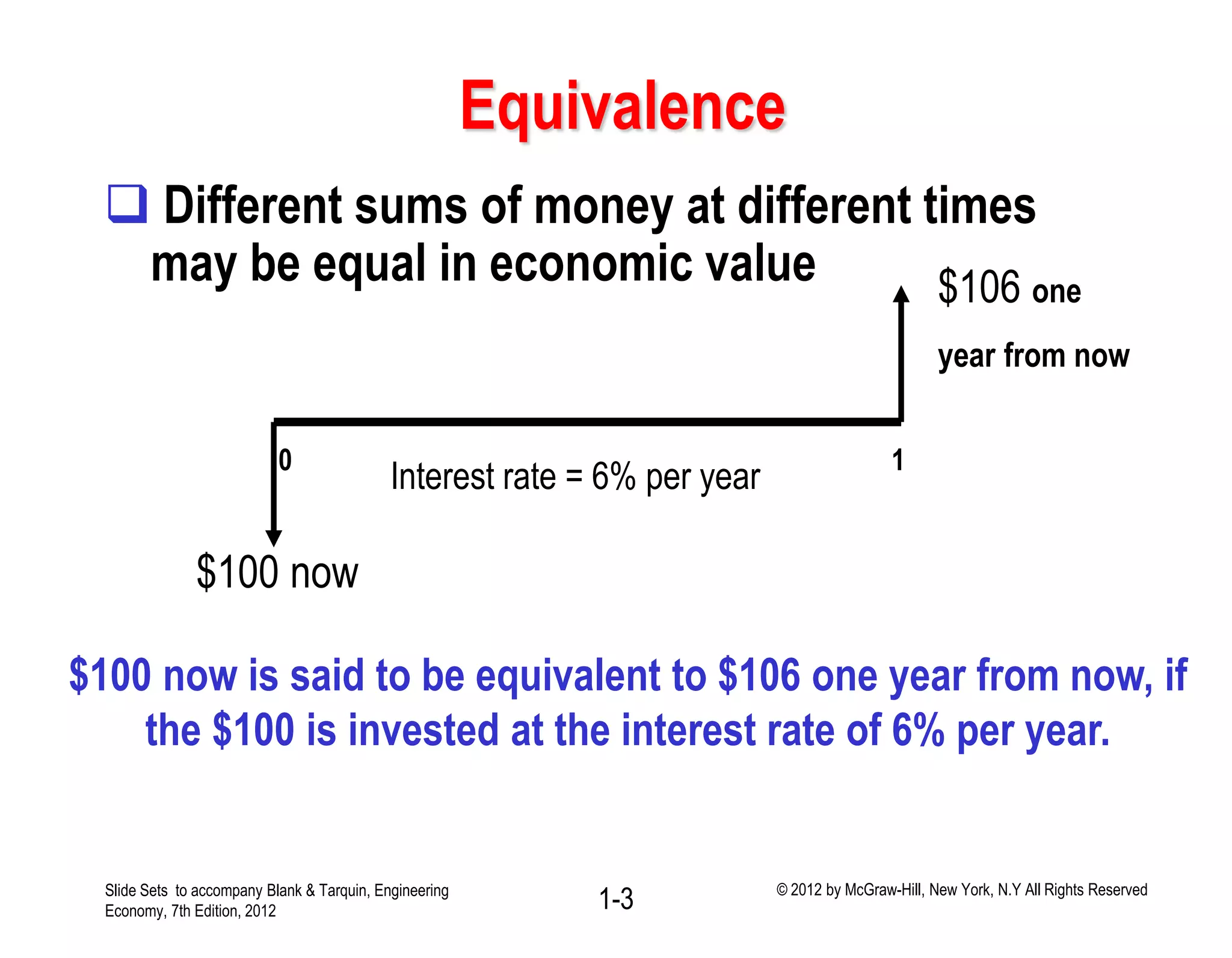
 Different sums of money at different times
may be equal in economic value
0 1
$100 now
$106 one
year from now
Interest rate = 6% per year
$100 now is said to be equivalent to $106 one year from now, if
the $100 is invested at the interest rate of 6% per year.
1-3Slide Sets to accompany Blank & Tarquin, Engineering
Economy, 7th Edition, 2012
© 2012 by McGraw-Hill, New York, N.Y All Rights Reserved
Interest Rate and Rate of Return
 Interest – the manifestation of the time value of money
 Rental fee that one pays to use someone else’s
money
 Difference between an ending amount of money and a
beginning amount of money
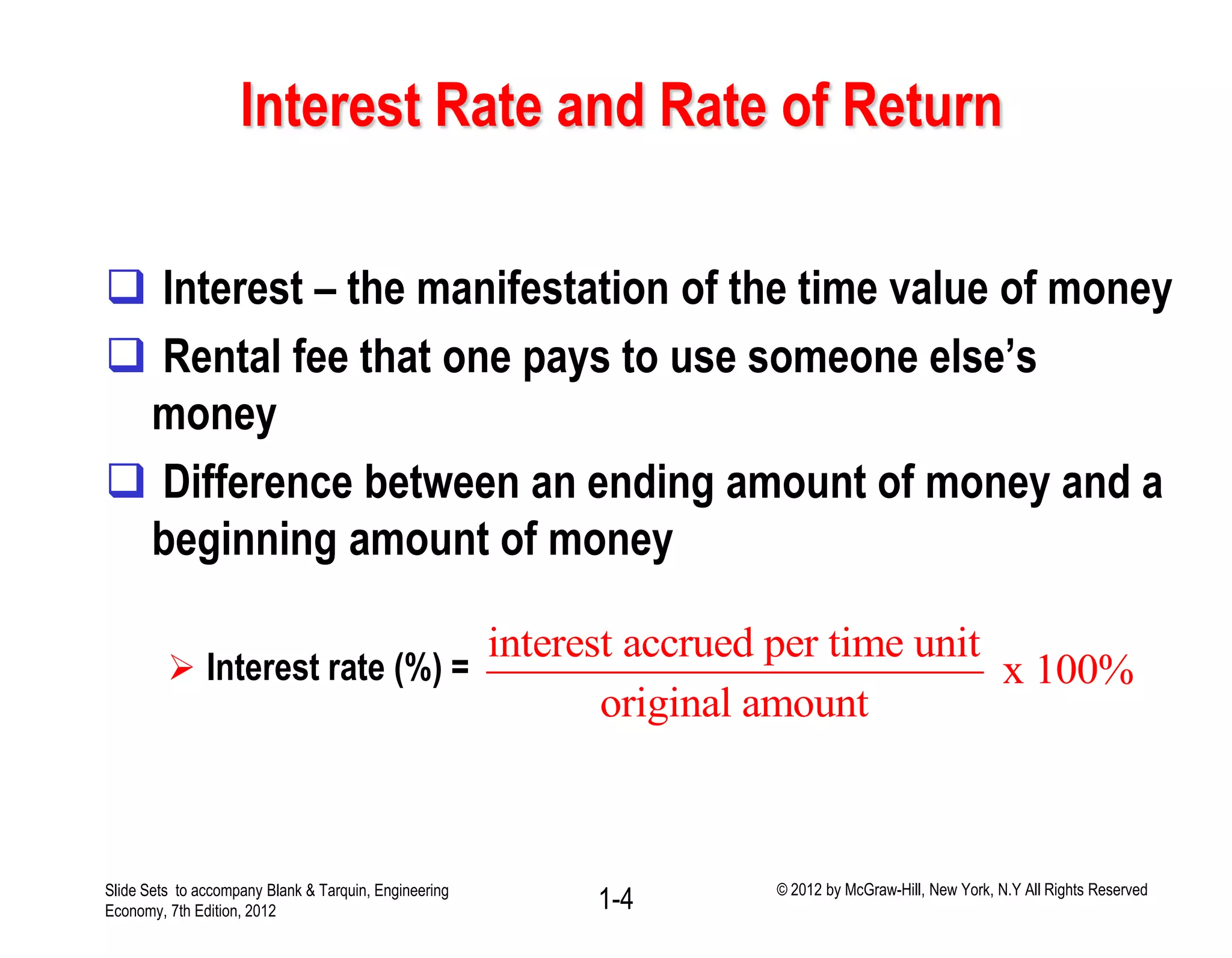
 Interest rate (%) =
interest accrued per time unit
x 100%
original amount
1-4Slide Sets to accompany Blank & Tarquin, Engineering
Economy, 7th Edition, 2012
© 2012 by McGraw-Hill, New York, N.Y All Rights Reserved
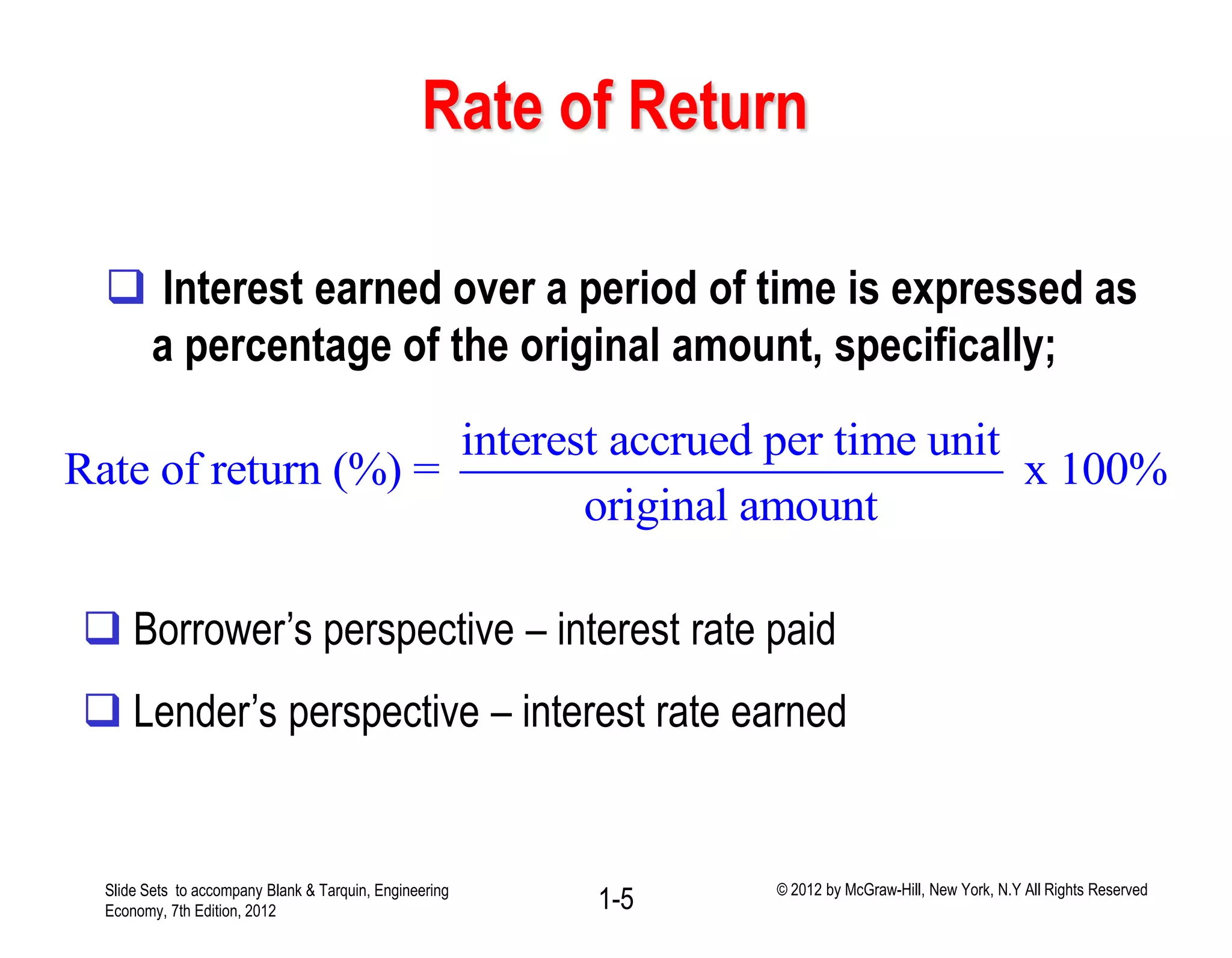
Rate of Return
 Interest earned over a period of time is expressed as
a percentage of the original amount, specifically;
interest accrued per time unit
Rate of return (%) = x 100%
original amount
 Borrower’s perspective – interest rate paid
 Lender’s perspective – interest rate earned
1-5Slide Sets to accompany Blank & Tarquin, Engineering
Economy, 7th Edition, 2012
© 2012 by McGraw-Hill, New York, N.Y All Rights Reserved
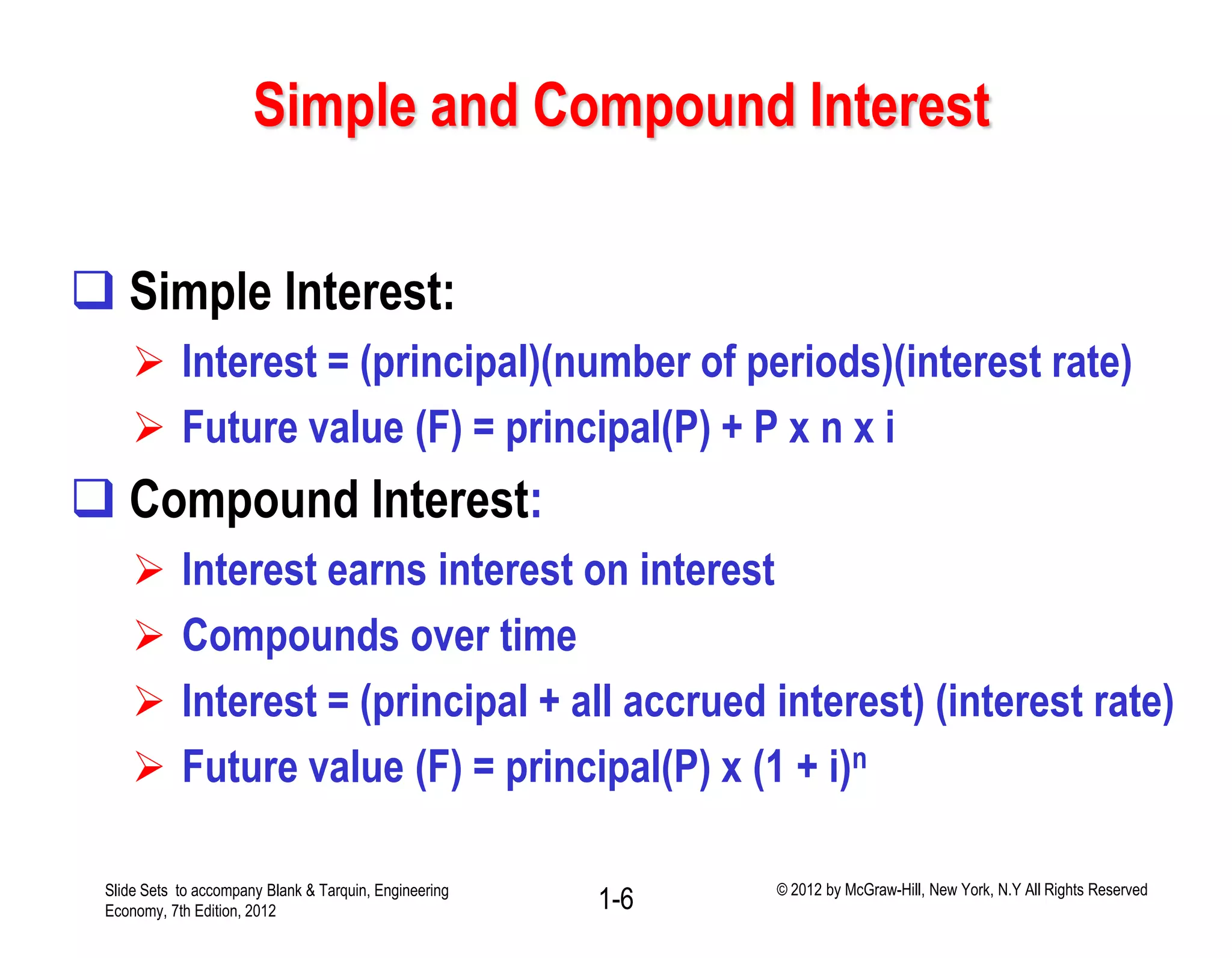
Simple and Compound Interest
 Simple Interest:
 Interest = (principal)(number of periods)(interest rate)
 Future value (F) = principal(P) + P x n x i
 Compound Interest:
 Interest earns interest on interest
 Compounds over time
 Interest = (principal + all accrued interest) (interest rate)
 Future value (F) = principal(P) x (1 + i)n
1-6Slide Sets to accompany Blank & Tarquin, Engineering
Economy, 7th Edition, 2012
© 2012 by McGraw-Hill, New York, N.Y All Rights Reserved
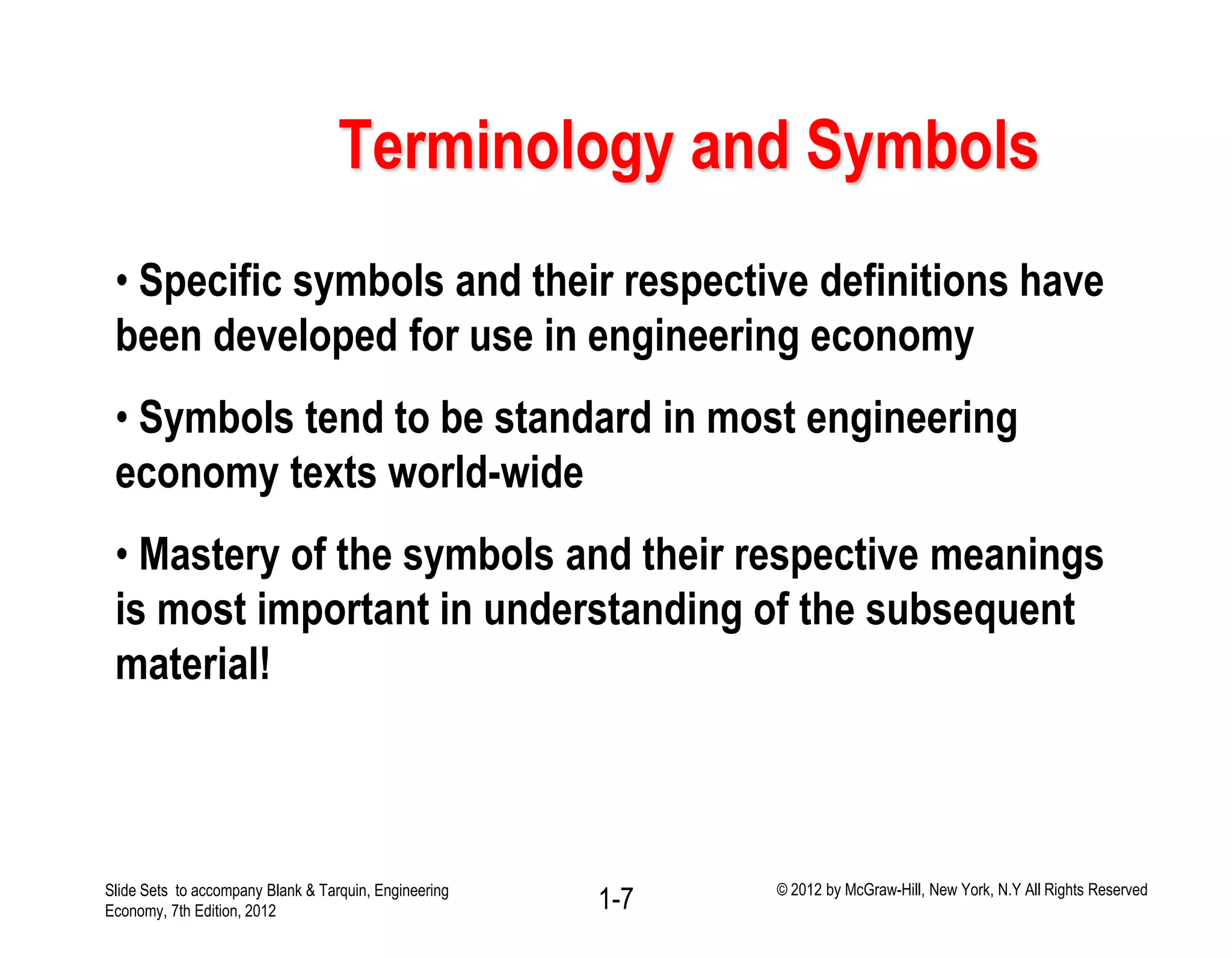
Terminology and Symbols
• Specific symbols and their respective definitions have
been developed for use in engineering economy
• Symbols tend to be standard in most engineering
economy texts world-wide
• Mastery of the symbols and their respective meanings
is most important in understanding of the subsequent
material!
1-7Slide Sets to accompany Blank & Tarquin, Engineering
Economy, 7th Edition, 2012
© 2012 by McGraw-Hill, New York, N.Y All Rights Reserved
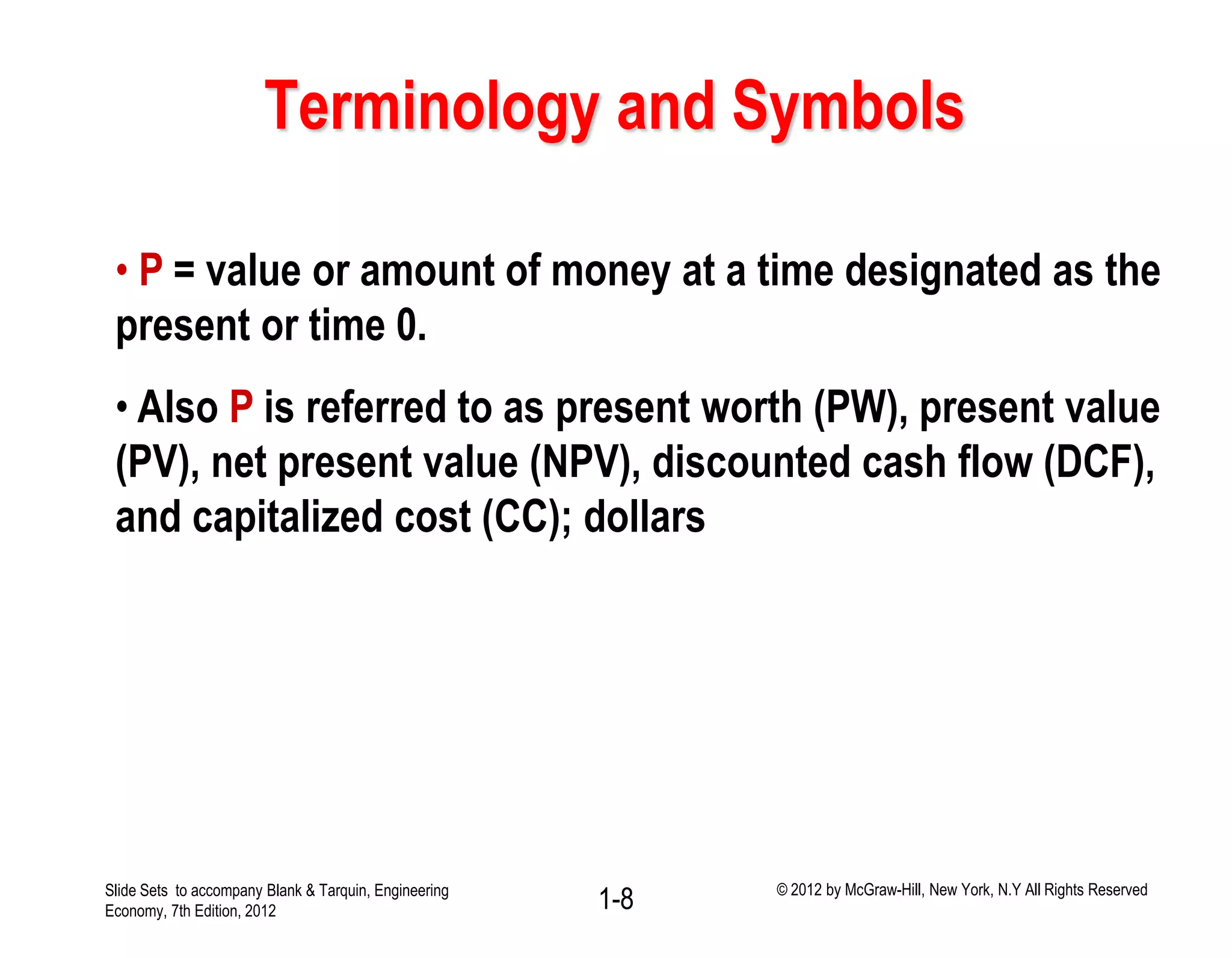
Terminology and Symbols
• P = value or amount of money at a time designated as the
present or time 0.
• Also P is referred to as present worth (PW), present value
(PV), net present value (NPV), discounted cash flow (DCF),
and capitalized cost (CC); dollars
1-8Slide Sets to accompany Blank & Tarquin, Engineering
Economy, 7th Edition, 2012
© 2012 by McGraw-Hill, New York, N.Y All Rights Reserved
Terminology and Symbols
• F = value or amount of money at some future time.
• Also F is called future worth (FW) and future value (FV);
dollars
1-9Slide Sets to accompany Blank & Tarquin, Engineering
Economy, 7th Edition, 2012
© 2012 by McGraw-Hill, New York, N.Y All Rights Reserved
Terminology and Symbols
• A = series of consecutive, equal, end-of-period
amounts of money.
• Also A is called the annual worth (AW) , equivalent
uniform annual worth (EUAW); dollars per year,
dollars per month
• n = number of interest periods; years, months, days
1-10Slide Sets to accompany Blank & Tarquin, Engineering
Economy, 7th Edition, 2012
© 2012 by McGraw-Hill, New York, N.Y All Rights Reserved
Terminology and Symbols
• i = interest rate or rate of return per time period;
percent per year, percent per month
• t = time, stated in periods; years, months, days, etc
1-11Slide Sets to accompany Blank & Tarquin, Engineering
Economy, 7th Edition, 2012
© 2012 by McGraw-Hill, New York, N.Y All Rights Reserved
Cash Flows: Their Estimation and
Diagramming
 Definition of terms
Cash Inflows - amount of funds flowing into the
firm
Cash Outflows – amount of funds flowing out of the
firm
 Net Cash Flow equals
 cash inflows – cash outflows
 Assumption for analysis – end of period
Funds flow at the end of a given (interest) period
1-12Slide Sets to accompany Blank & Tarquin, Engineering
Economy, 7th Edition, 2012
© 2012 by McGraw-Hill, New York, N.Y All Rights Reserved
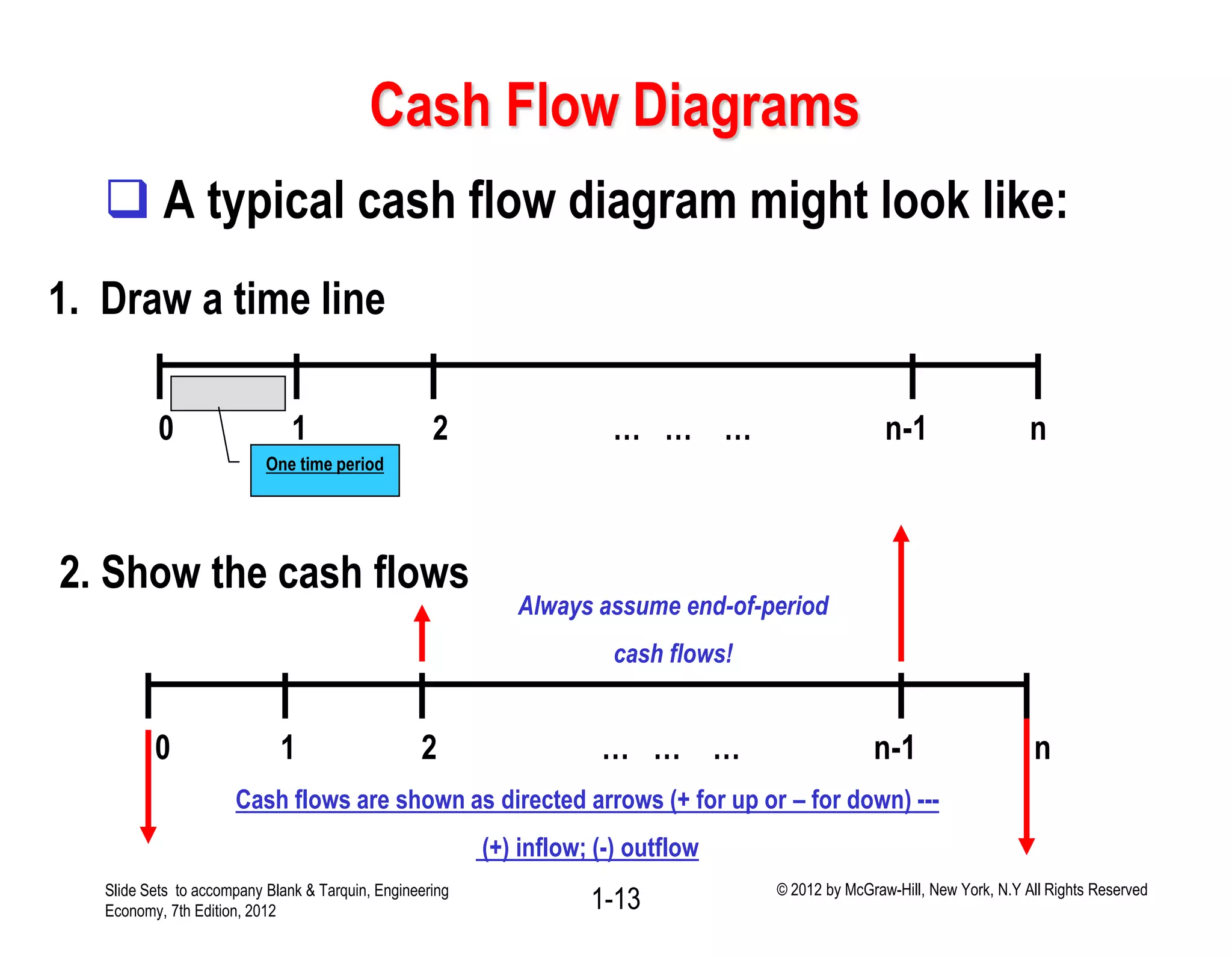
Cash Flow Diagrams
 A typical cash flow diagram might look like:
0 1 2 … … … n-1 n
1. Draw a time line
One time period
0 1 2 … … … n-1 n
2. Show the cash flows
Cash flows are shown as directed arrows (+ for up or – for down) ---
(+) inflow; (-) outflow
Always assume end-of-period
cash flows!
1-13Slide Sets to accompany Blank & Tarquin, Engineering
Economy, 7th Edition, 2012
© 2012 by McGraw-Hill, New York, N.Y All Rights Reserved
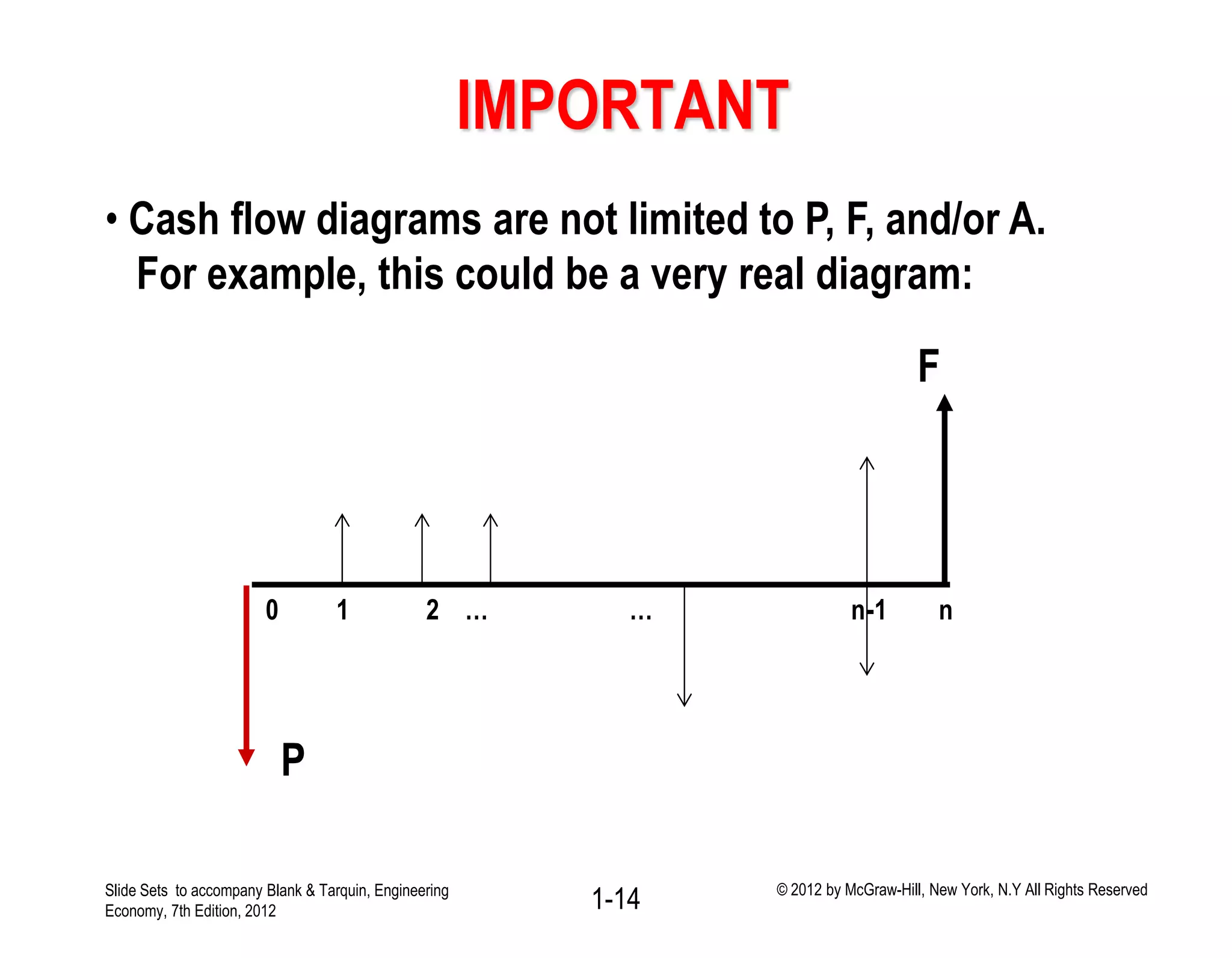
IMPORTANT
• Cash flow diagrams are not limited to P, F, and/or A.
For example, this could be a very real diagram:
P
F
0 1 2 … … n-1 n
1-14Slide Sets to accompany Blank & Tarquin, Engineering
Economy, 7th Edition, 2012
© 2012 by McGraw-Hill, New York, N.Y All Rights Reserved
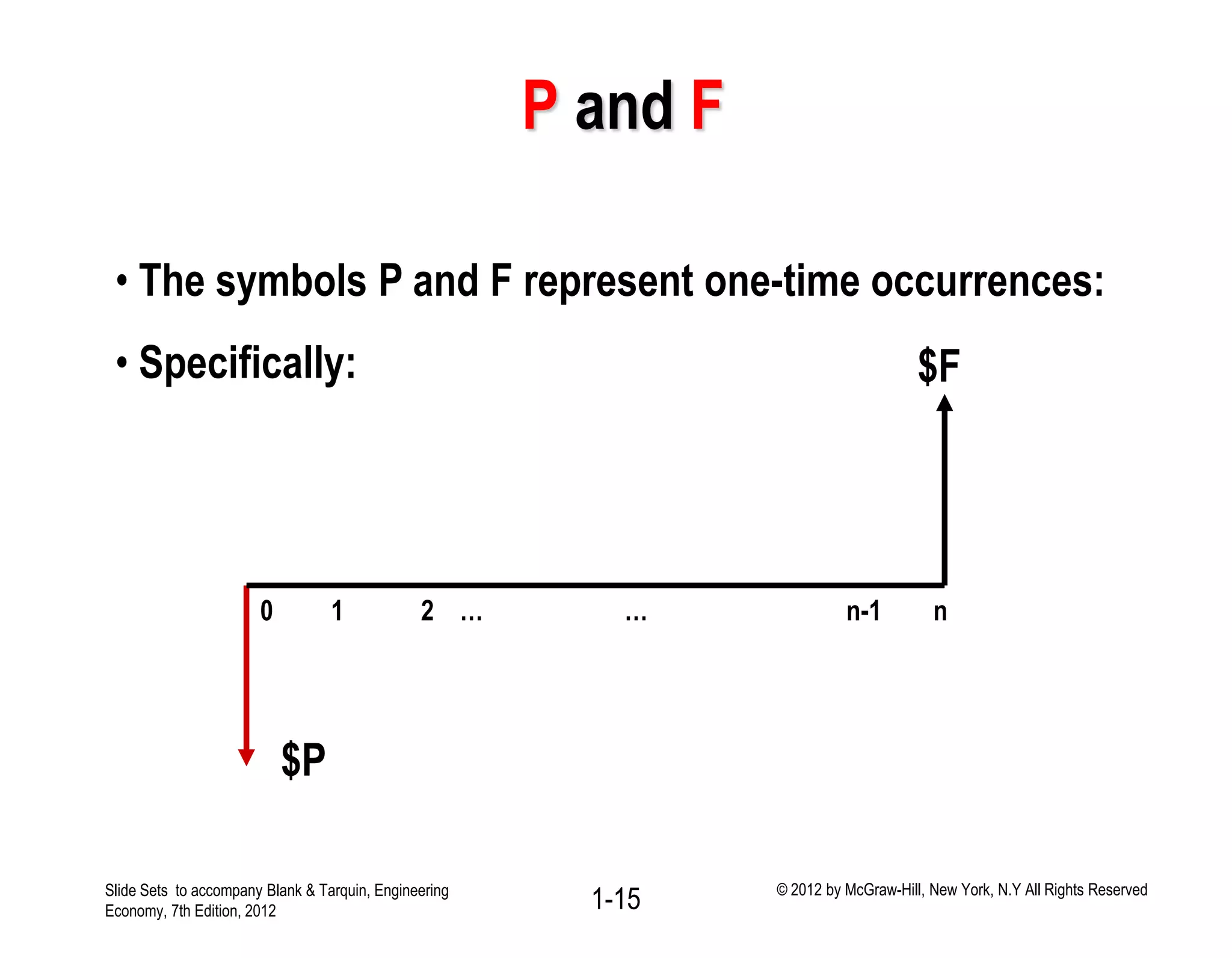
P and F
• The symbols P and F represent one-time occurrences:
• Specifically:
$P
$F
0 1 2 … … n-1 n
1-15Slide Sets to accompany Blank & Tarquin, Engineering
Economy, 7th Edition, 2012
© 2012 by McGraw-Hill, New York, N.Y All Rights Reserved
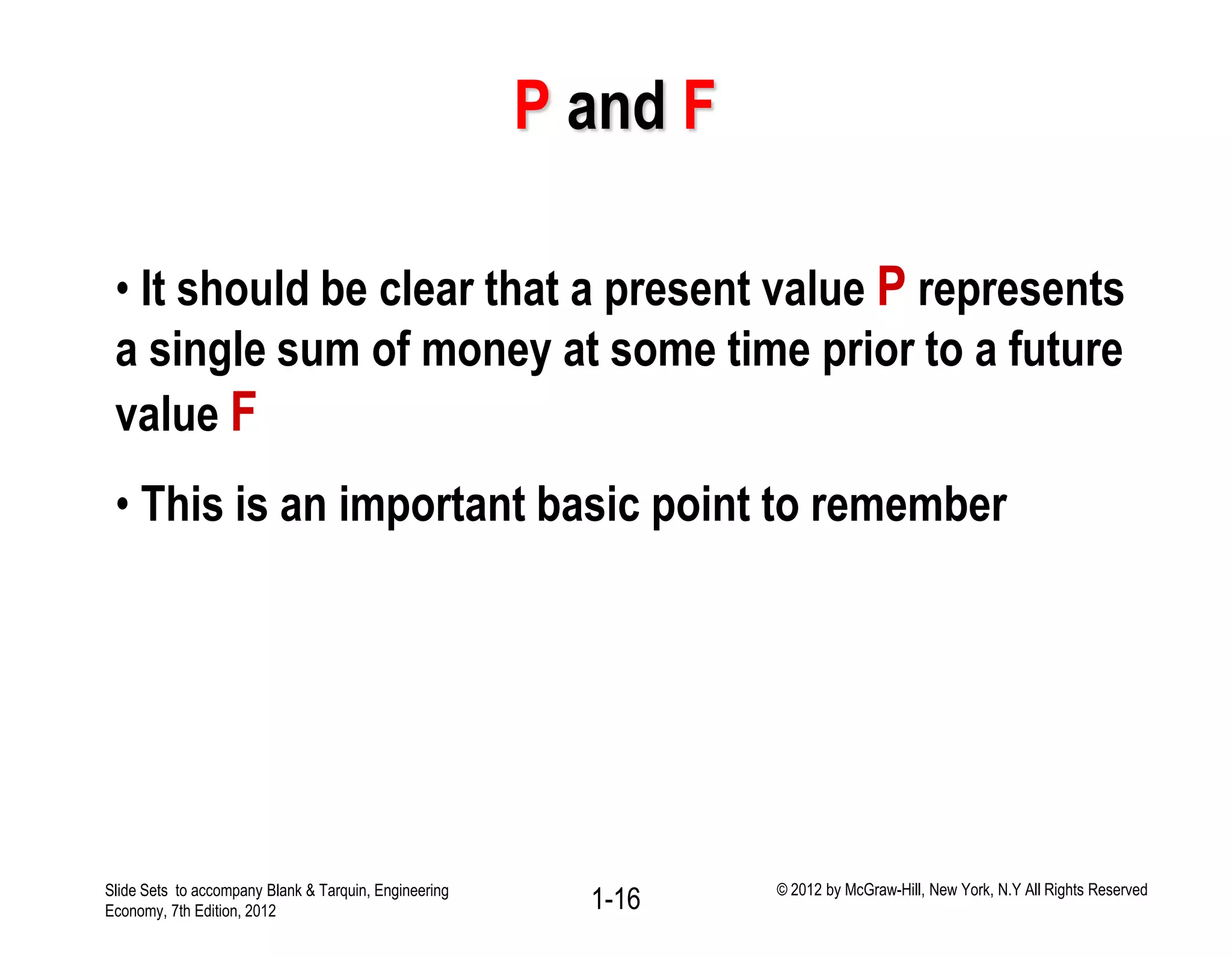
P and F
• It should be clear that a present value P represents
a single sum of money at some time prior to a future
value F
• This is an important basic point to remember
1-16Slide Sets to accompany Blank & Tarquin, Engineering
Economy, 7th Edition, 2012
© 2012 by McGraw-Hill, New York, N.Y All Rights Reserved
Annual Amounts
• It is important to note that the symbol A always
represents a uniform mount (i.e., the same amount
each period) that extends through consecutive
interest periods.
1-17Slide Sets to accompany Blank & Tarquin, Engineering
Economy, 7th Edition, 2012
© 2012 by McGraw-Hill, New York, N.Y All Rights Reserved
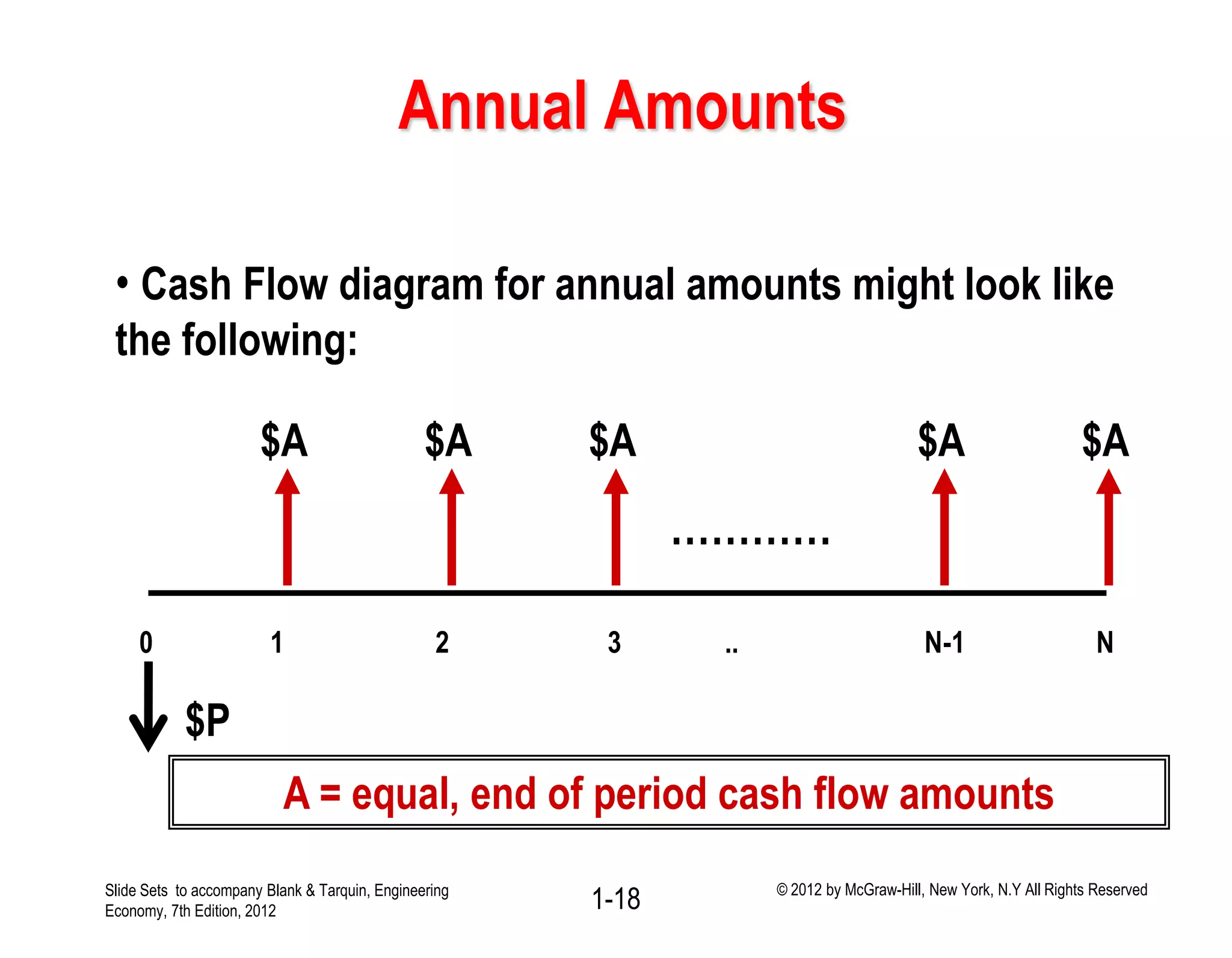
Annual Amounts
• Cash Flow diagram for annual amounts might look like
the following:
…………
$A $A $A $A $A
A = equal, end of period cash flow amounts
$P
0 1 2 3 .. N-1 N
1-18Slide Sets to accompany Blank & Tarquin, Engineering
Economy, 7th Edition, 2012
© 2012 by McGraw-Hill, New York, N.Y All Rights Reserved
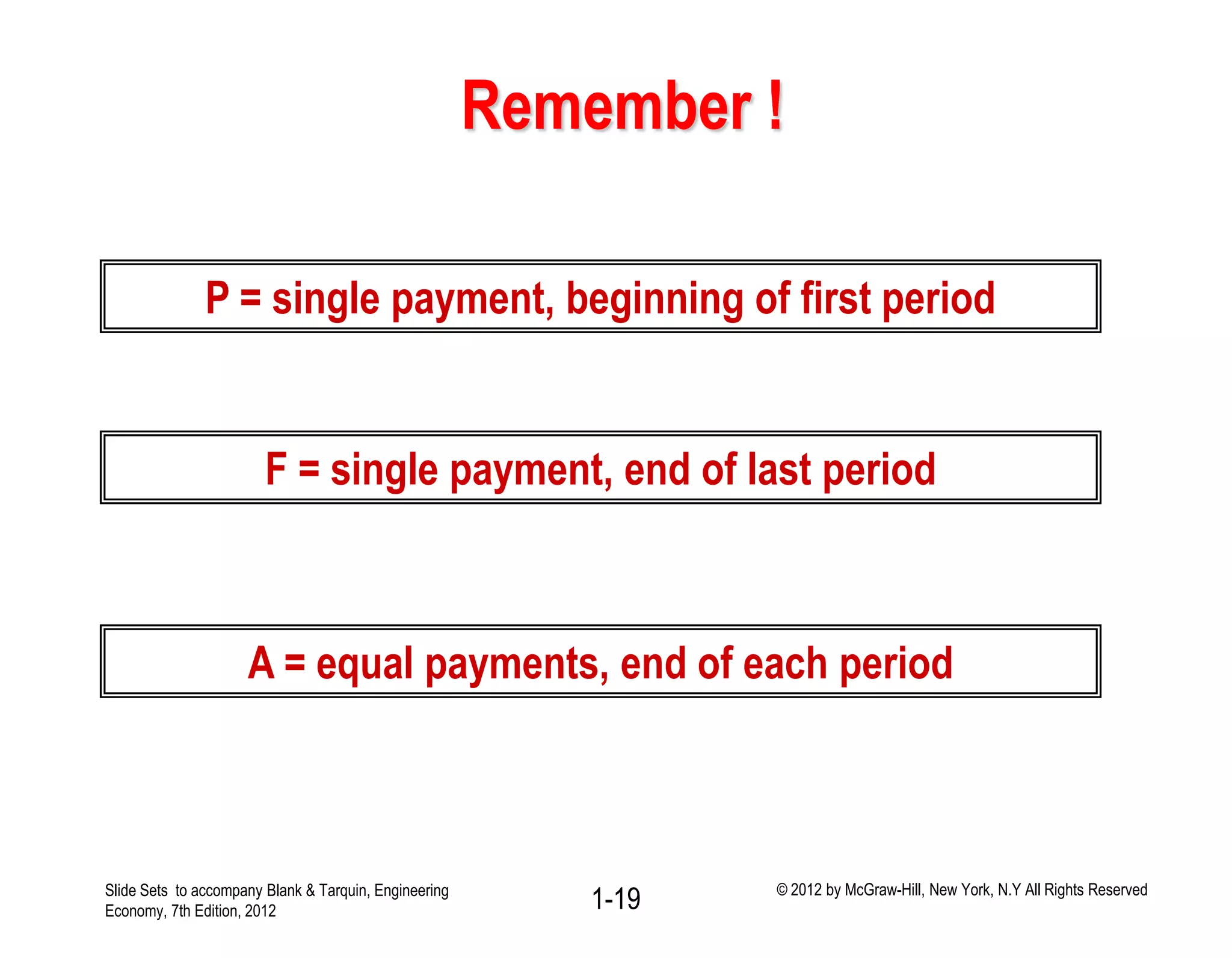
Remember !
A = equal payments, end of each period
F = single payment, end of last period
P = single payment, beginning of first period
1-19Slide Sets to accompany Blank & Tarquin, Engineering
Economy, 7th Edition, 2012
© 2012 by McGraw-Hill, New York, N.Y All Rights Reserved
Interest Rate – i% per period
• The interest rate i is assumed to be a compound rate,
unless specifically stated
as “simple interest”
• The rate i is expressed in percent per interest period,
for example, 12% per year.
1-20Slide Sets to accompany Blank & Tarquin, Engineering
Economy, 7th Edition, 2012
© 2012 by McGraw-Hill, New York, N.Y All Rights Reserved
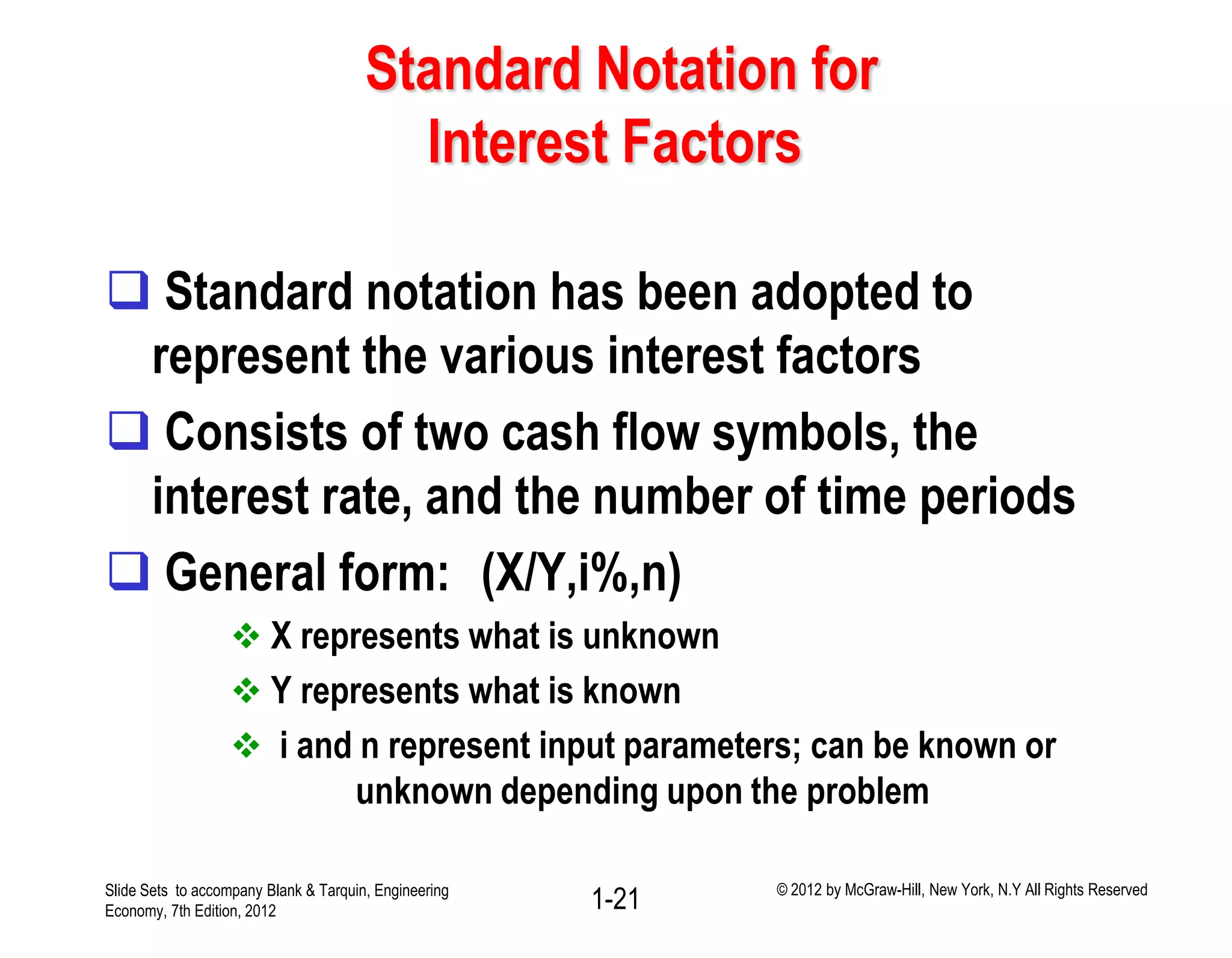
Standard Notation for
Interest Factors
 Standard notation has been adopted to
represent the various interest factors
 Consists of two cash flow symbols, the
interest rate, and the number of time periods
 General form: (X/Y,i%,n)
 X represents what is unknown
 Y represents what is known
 i and n represent input parameters; can be known or
unknown depending upon the problem
1-21Slide Sets to accompany Blank & Tarquin, Engineering
Economy, 7th Edition, 2012
© 2012 by McGraw-Hill, New York, N.Y All Rights Reserved
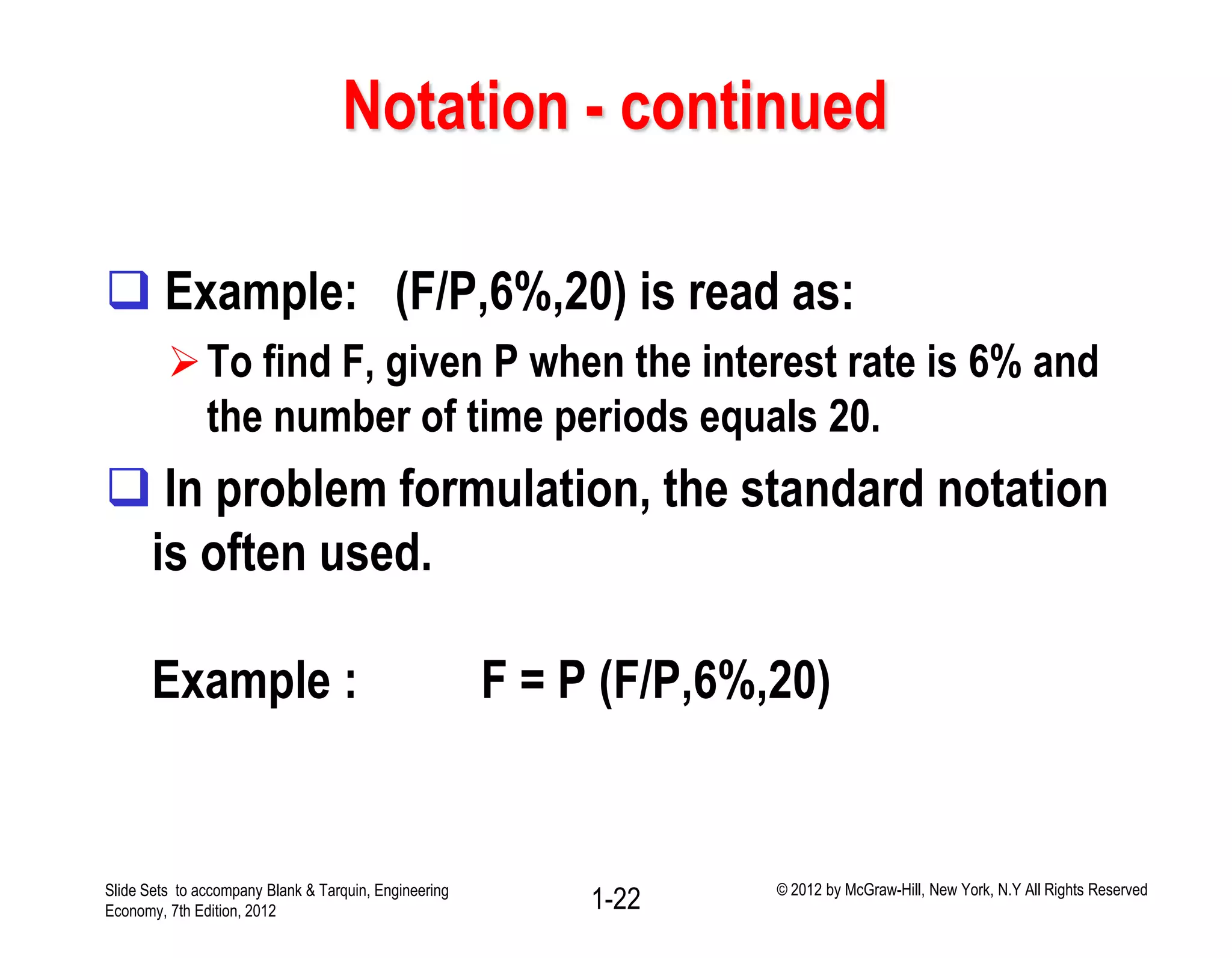
Notation - continued
 Example: (F/P,6%,20) is read as:
To find F, given P when the interest rate is 6% and
the number of time periods equals 20.
 In problem formulation, the standard notation
is often used.
Example : F = P (F/P,6%,20)
1-22Slide Sets to accompany Blank & Tarquin, Engineering
Economy, 7th Edition, 2012
© 2012 by McGraw-Hill, New York, N.Y All Rights Reserved
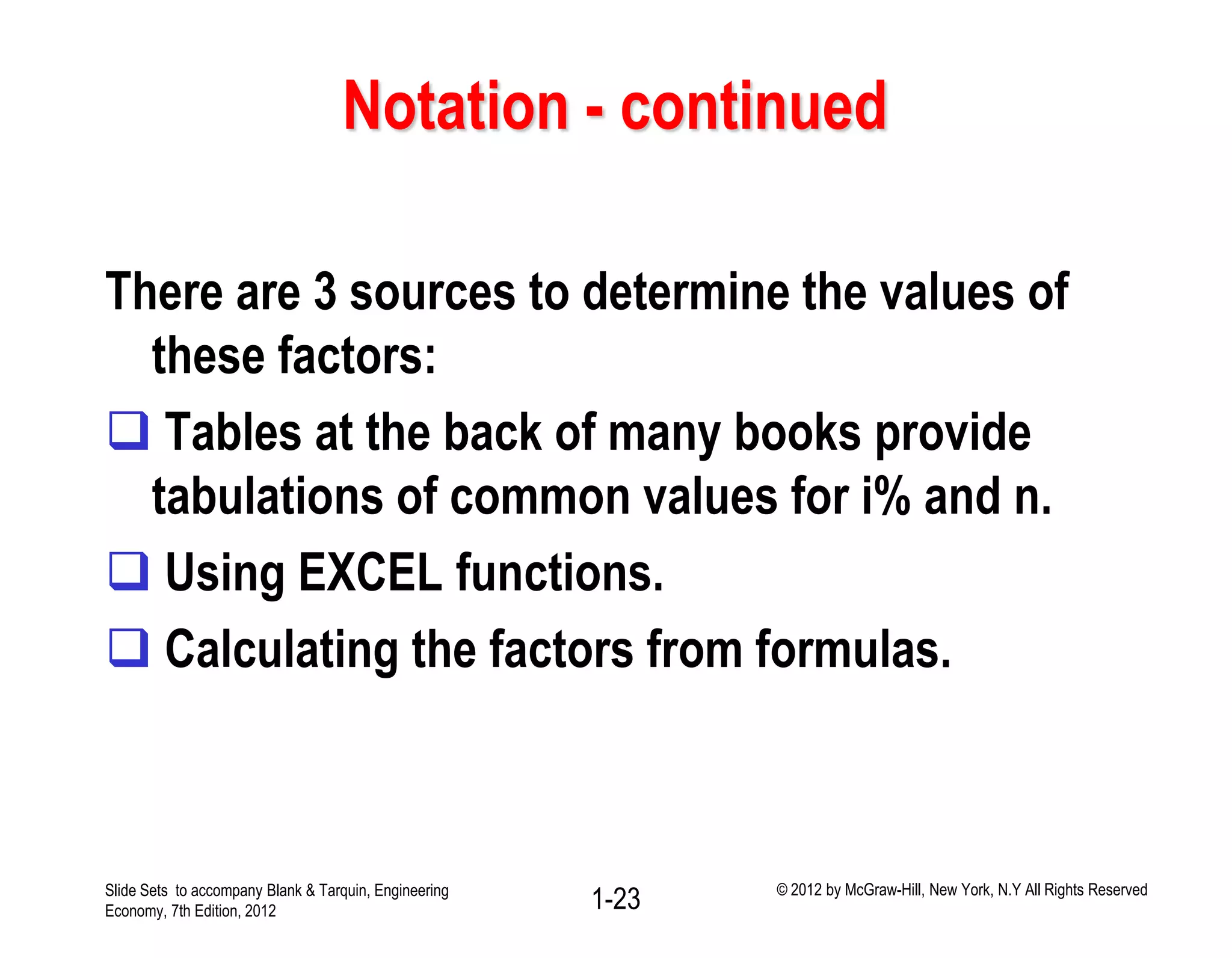
Notation - continued
There are 3 sources to determine the values of
these factors:
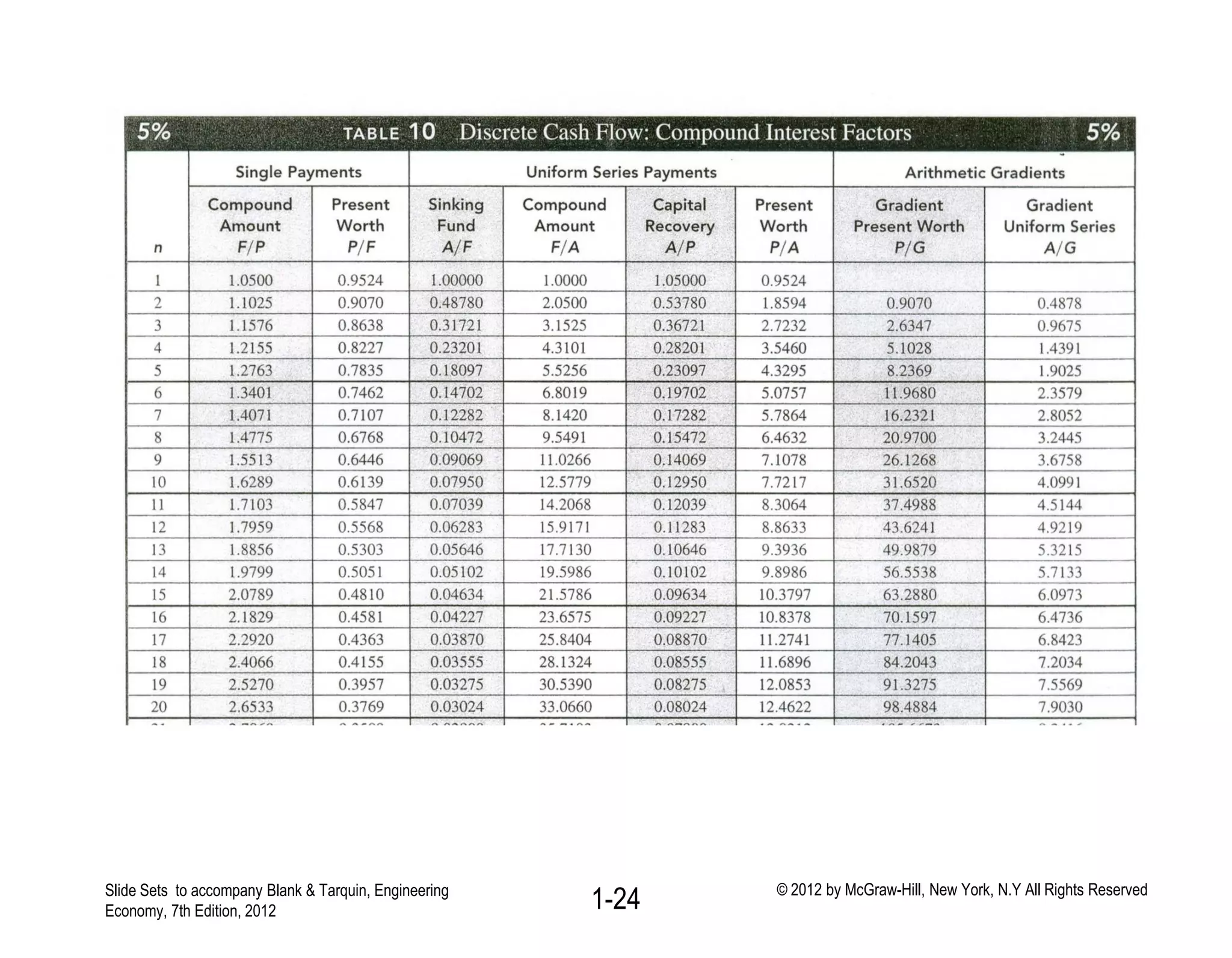
 Tables at the back of many books provide
tabulations of common values for i% and n.
 Using EXCEL functions.
 Calculating the factors from formulas.
1-23Slide Sets to accompany Blank & Tarquin, Engineering
Economy, 7th Edition, 2012
© 2012 by McGraw-Hill, New York, N.Y All Rights Reserved
1-24Slide Sets to accompany Blank & Tarquin, Engineering
Economy, 7th Edition, 2012
© 2012 by McGraw-Hill, New York, N.Y All Rights Reserved
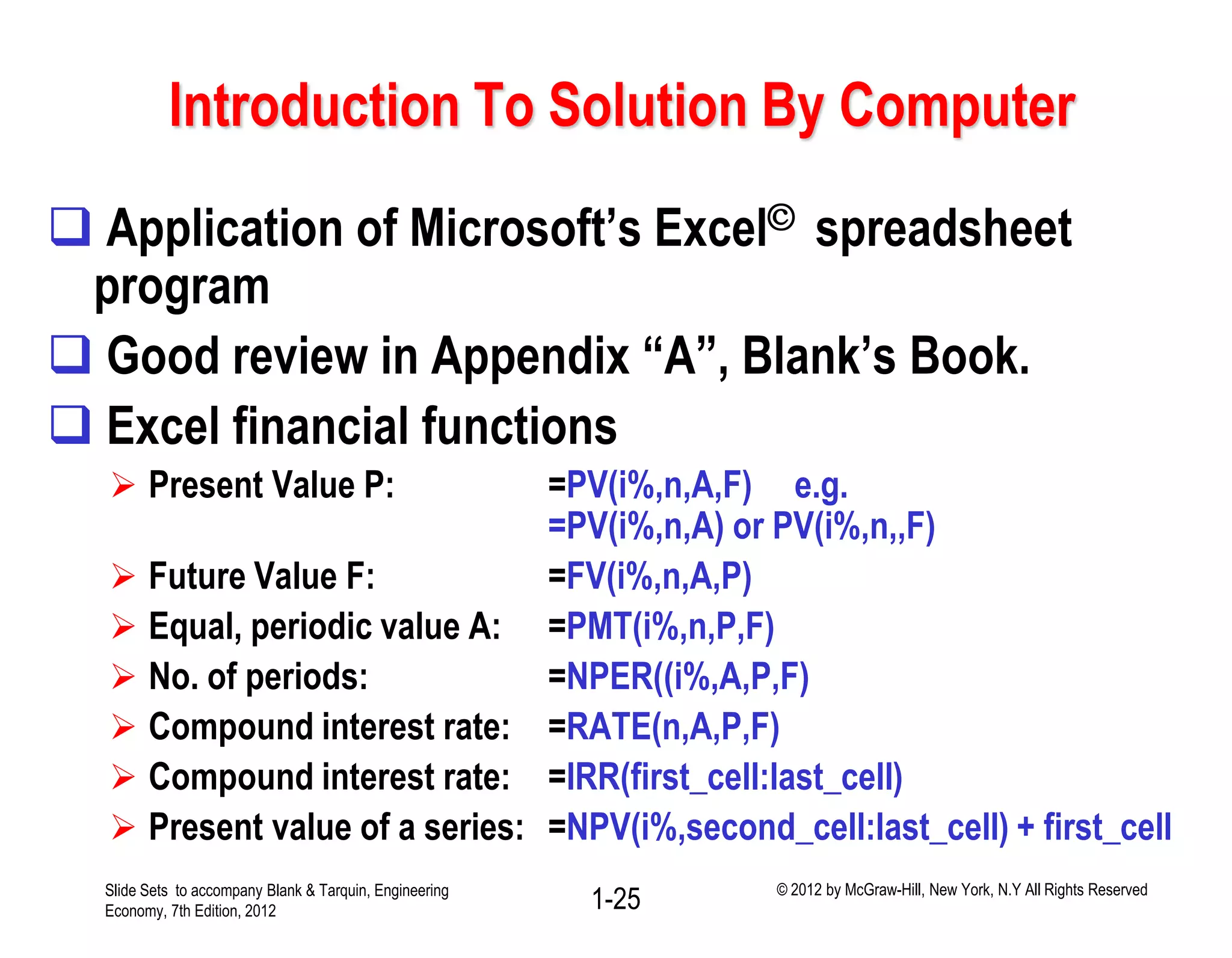
Introduction To Solution By Computer
 Application of Microsoft’s Excel© spreadsheet
program
 Good review in Appendix “A”, Blank’s Book.
 Excel financial functions
 Present Value P: =PV(i%,n,A,F) e.g.
=PV(i%,n,A) or PV(i%,n,,F)
 Future Value F: =FV(i%,n,A,P)
 Equal, periodic value A: =PMT(i%,n,P,F)
 No. of periods: =NPER((i%,A,P,F)
 Compound interest rate: =RATE(n,A,P,F)
 Compound interest rate: =IRR(first_cell:last_cell)
 Present value of a series: =NPV(i%,second_cell:last_cell) + first_cell
1-25Slide Sets to accompany Blank & Tarquin, Engineering
Economy, 7th Edition, 2012
© 2012 by McGraw-Hill, New York, N.Y All Rights Reserved
1-26Slide Sets to accompany Blank & Tarquin, Engineering
Economy, 7th Edition, 2012
© 2012 by McGraw-Hill, New York, N.Y All Rights Reserved
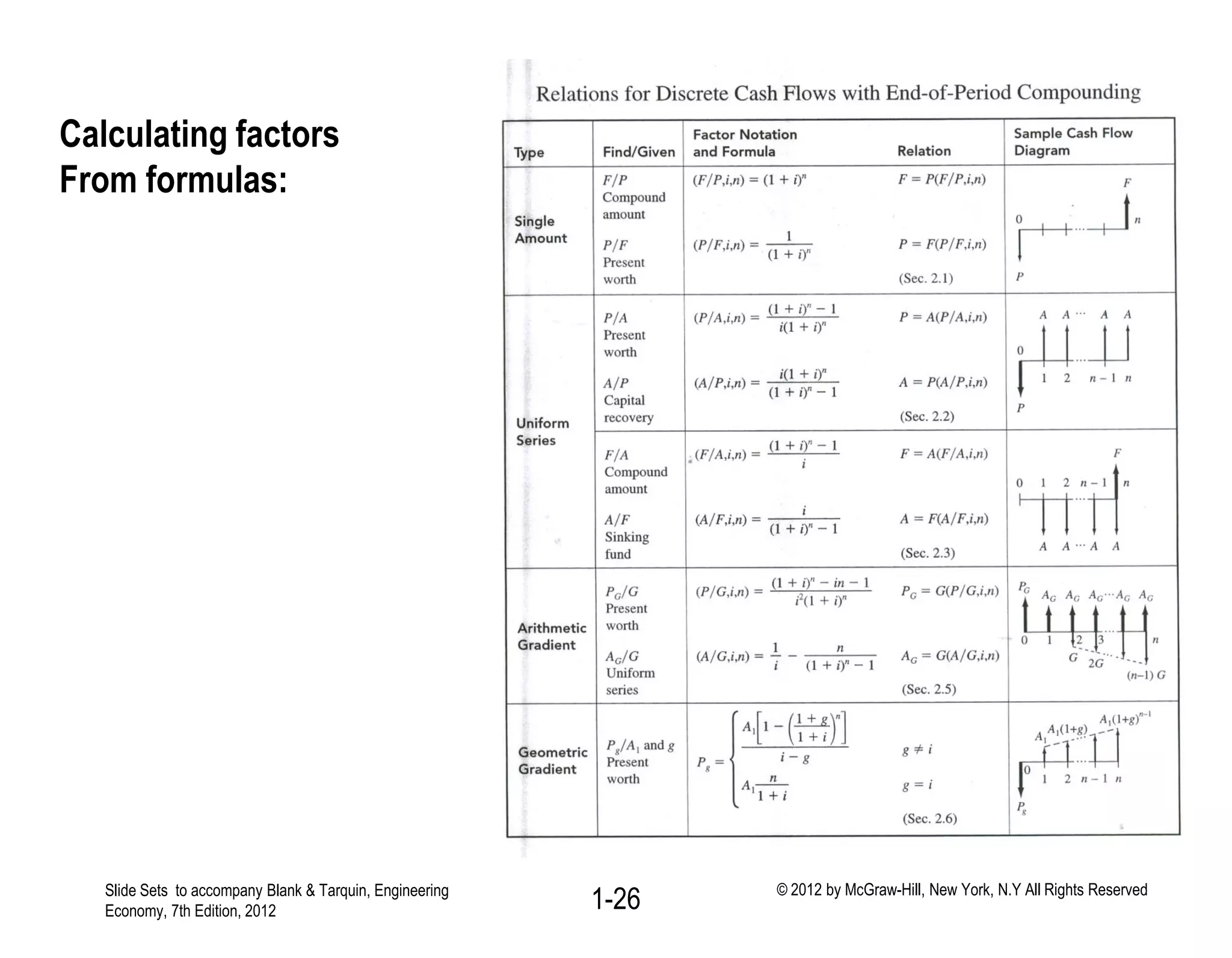
Calculating factors
From formulas:
Example:
1-27Slide Sets to accompany Blank & Tarquin, Engineering
Economy, 7th Edition, 2012
© 2012 by McGraw-Hill, New York, N.Y All Rights Reserved
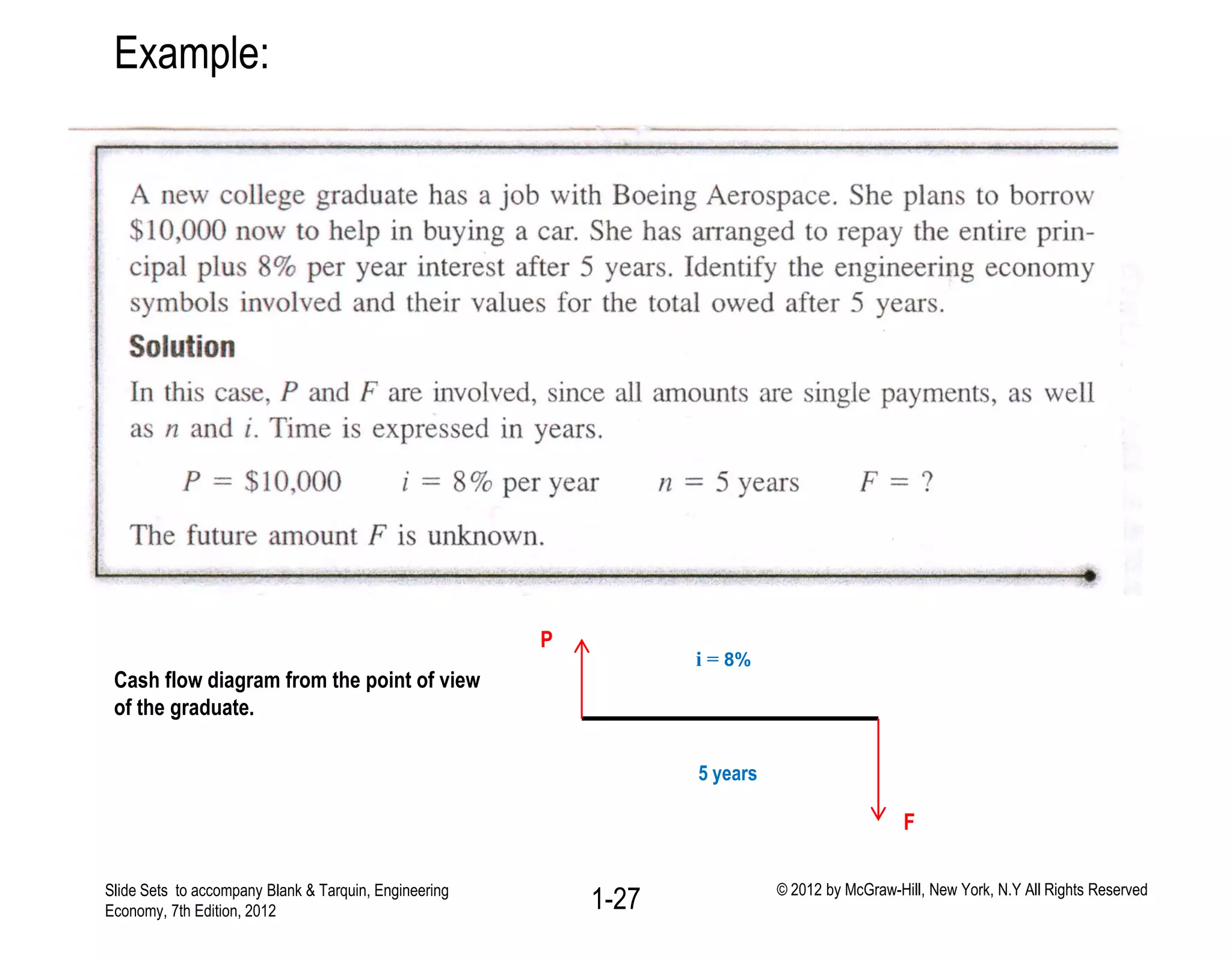
P
F
5 years
i = 8%
Cash flow diagram from the point of view
of the graduate.
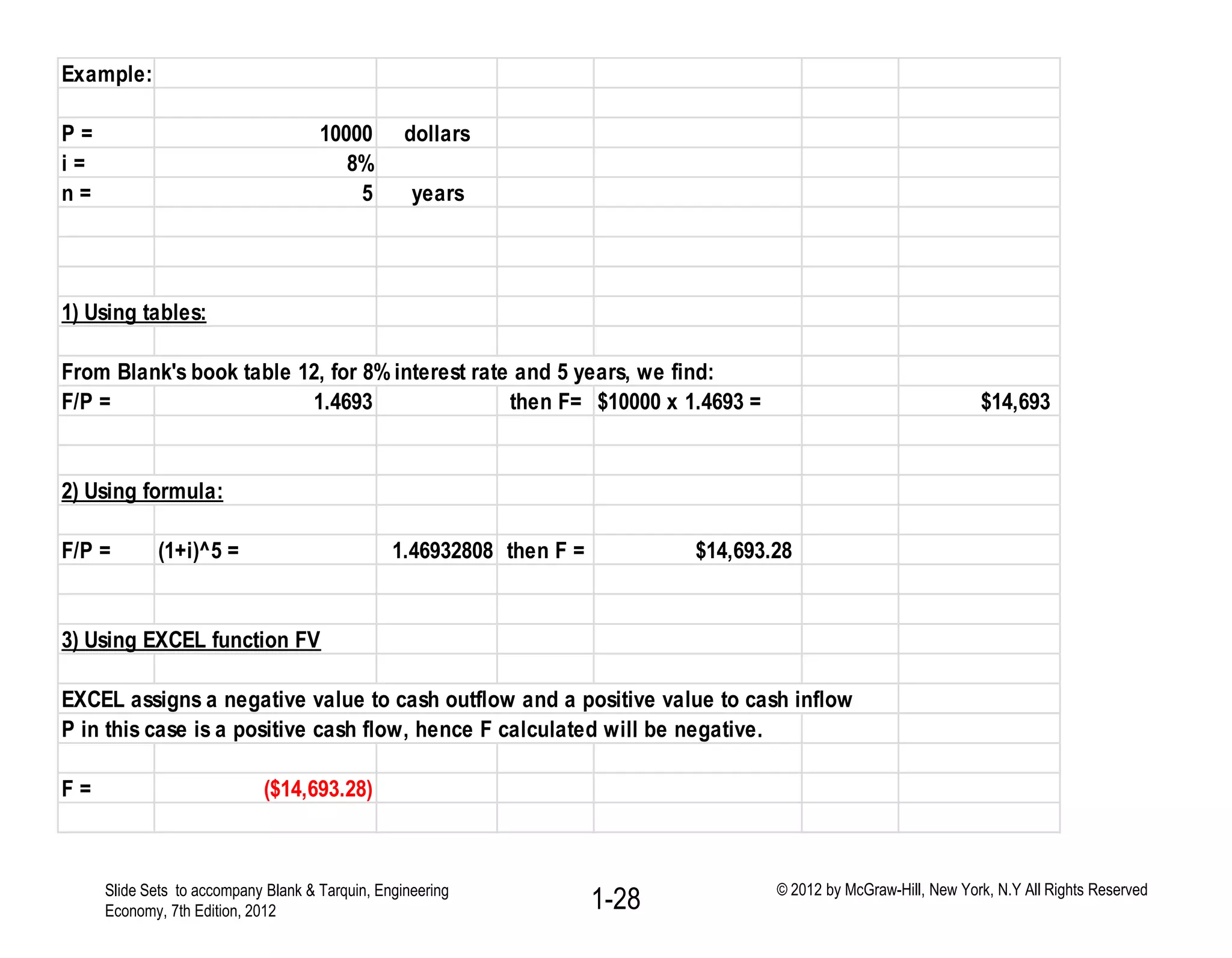
Example:
P = 10000 dollars
i = 8%
n = 5 years
1) Using tables:
From Blank's book table 12, for 8% interest rate and 5 years, we find:
F/P = 1.4693 then F= $10000 x 1.4693 = $14,693
2) Using formula:
F/P = (1+i)^5 = 1.46932808 then F = $14,693.28
3) Using EXCEL function FV
EXCEL assigns a negative value to cash outflow and a positive value to cash inflow
P in this case is a positive cash flow, hence F calculated will be negative.
F = ($14,693.28)
1-28Slide Sets to accompany Blank & Tarquin, Engineering
Economy, 7th Edition, 2012
© 2012 by McGraw-Hill, New York, N.Y All Rights Reserved
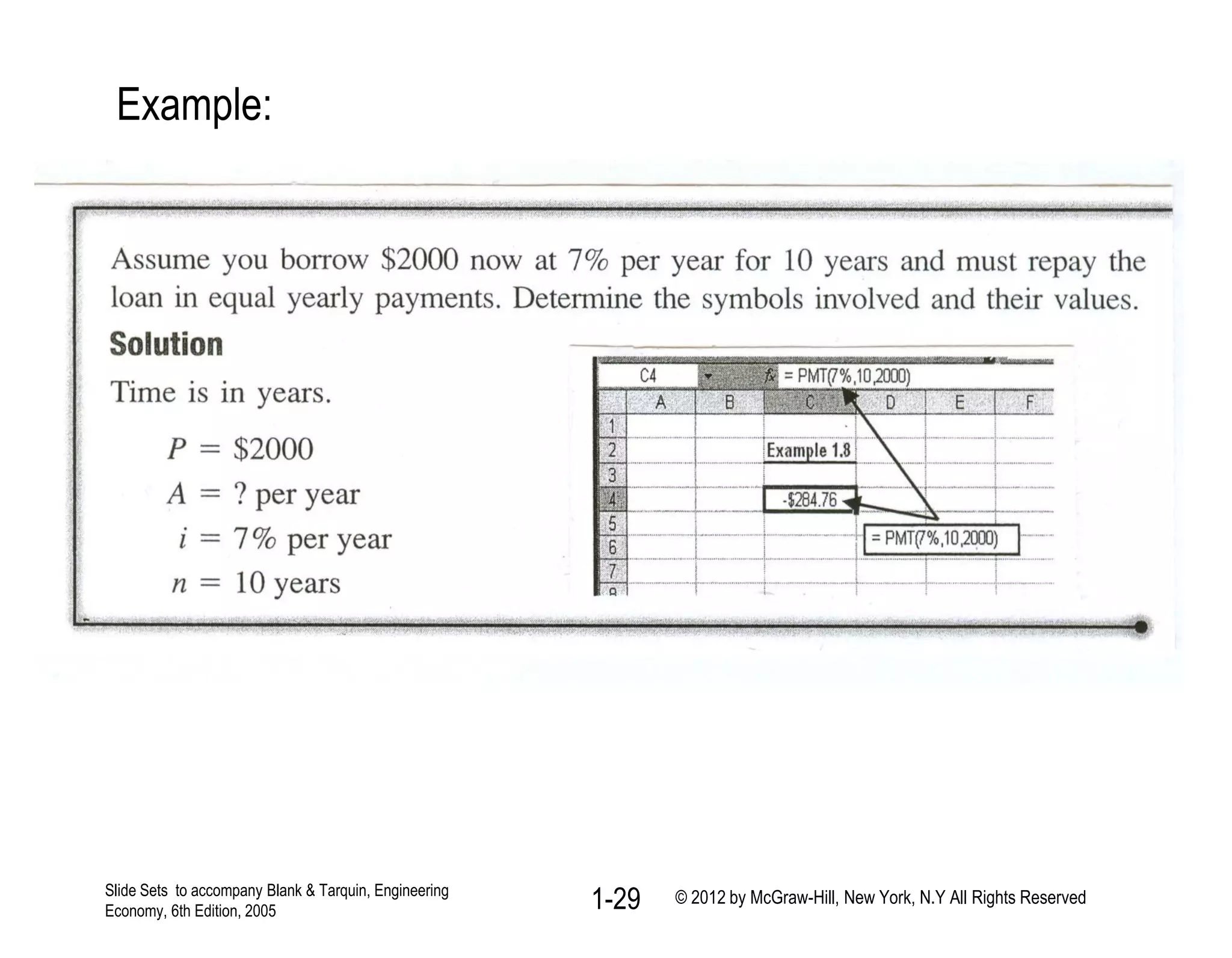
Example:
1-29Slide Sets to accompany Blank & Tarquin, Engineering
Economy, 6th Edition, 2005
© 2012 by McGraw-Hill, New York, N.Y All Rights Reserved
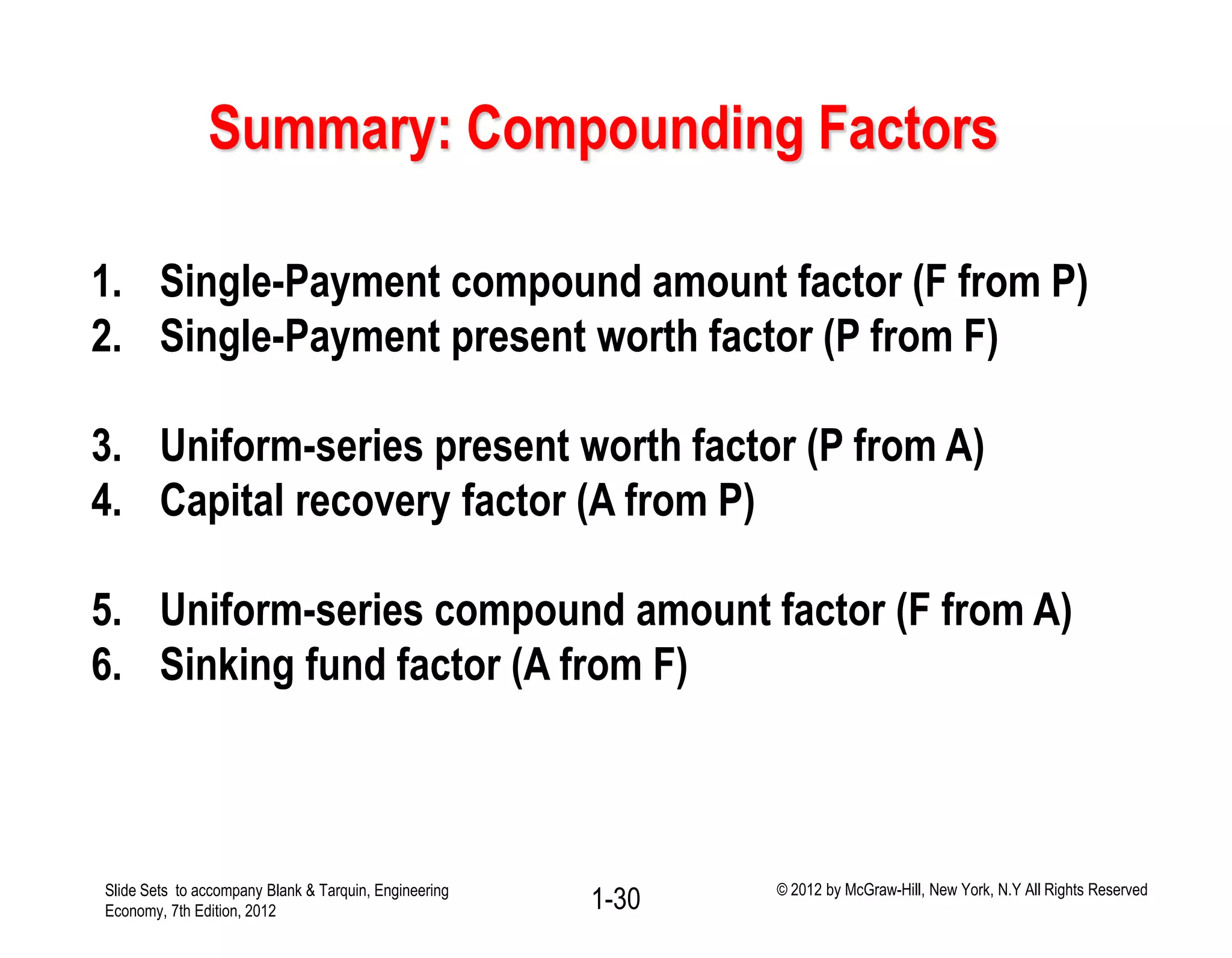
Summary: Compounding Factors
1. Single-Payment compound amount factor (F from P)
2. Single-Payment present worth factor (P from F)
3. Uniform-series present worth factor (P from A)
4. Capital recovery factor (A from P)
5. Uniform-series compound amount factor (F from A)
6. Sinking fund factor (A from F)
Slide Sets to accompany Blank & Tarquin, Engineering
Economy, 7th Edition, 2012 1-30 © 2012 by McGraw-Hill, New York, N.Y All Rights Reserved
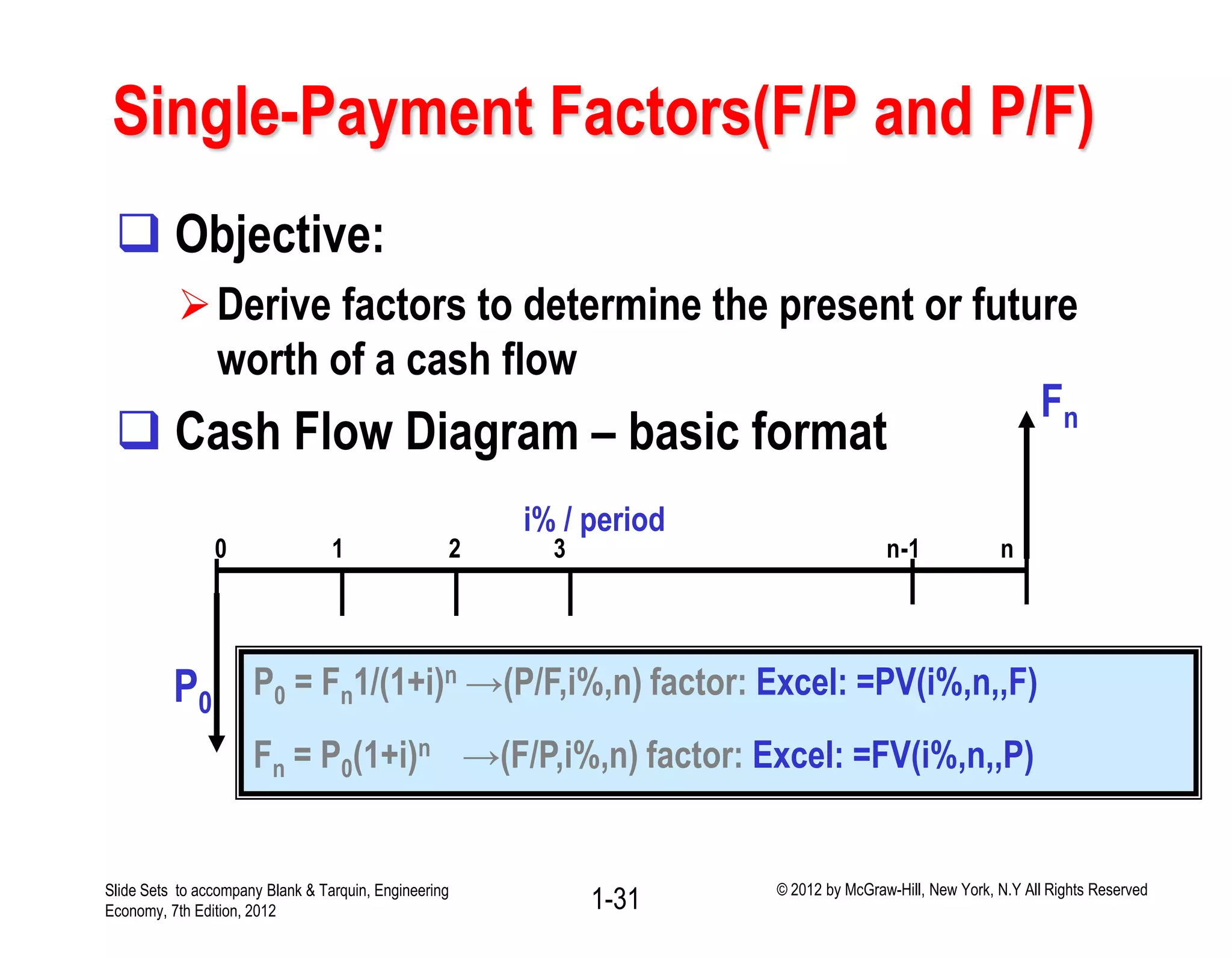
Single-Payment Factors(F/P and P/F)
 Objective:
Derive factors to determine the present or future
worth of a cash flow
 Cash Flow Diagram – basic format
0 1 2 3 n-1 n
P0
Fn
i% / period
P0 = Fn1/(1+i)n →(P/F,i%,n) factor: Excel: =PV(i%,n,,F)
Fn = P0(1+i)n →(F/P,i%,n) factor: Excel: =FV(i%,n,,P)
Slide Sets to accompany Blank & Tarquin, Engineering
Economy, 7th Edition, 2012 1-31 © 2012 by McGraw-Hill, New York, N.Y All Rights Reserved
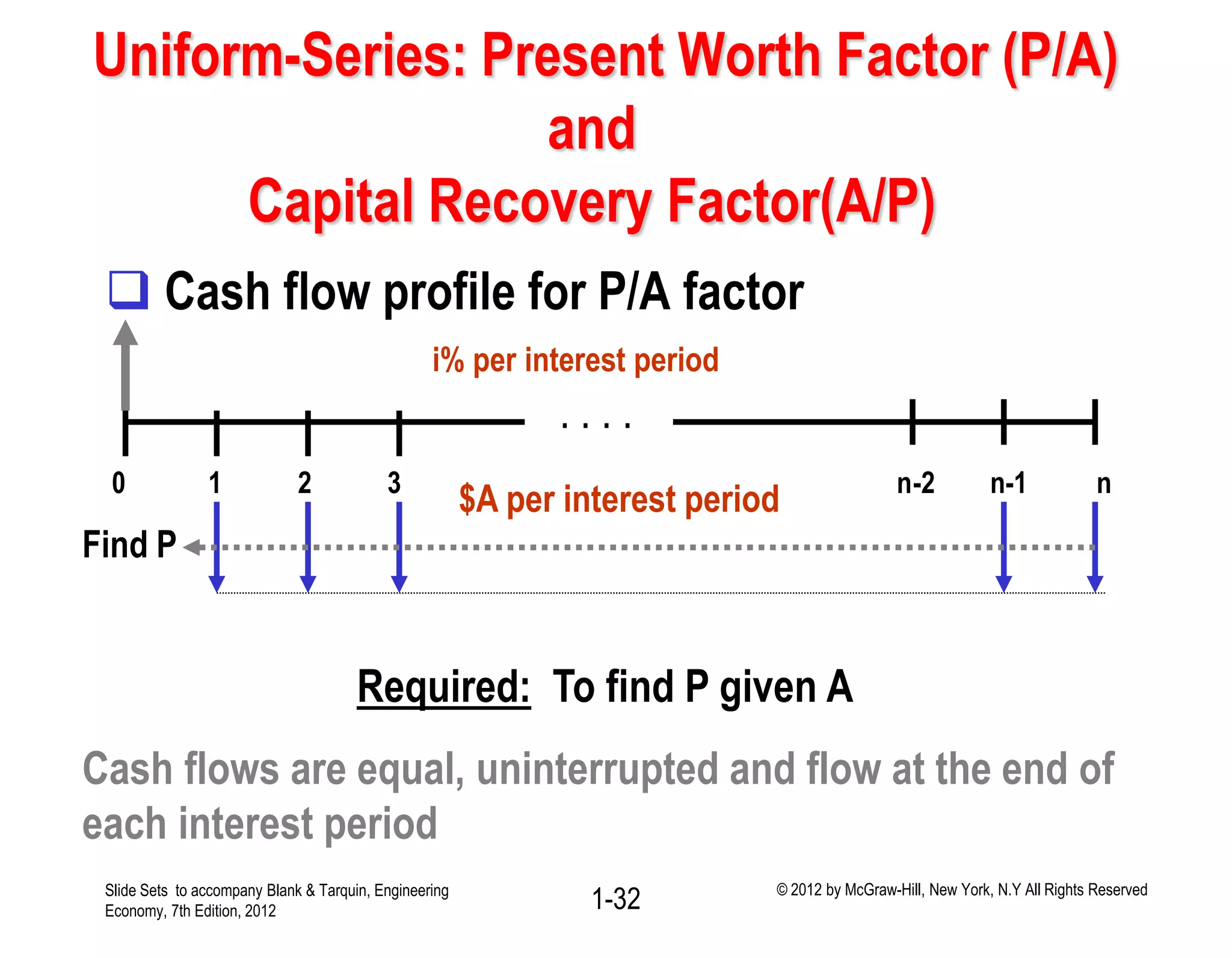
Uniform-Series: Present Worth Factor (P/A)
and
Capital Recovery Factor(A/P)
 Cash flow profile for P/A factor
. . . .
0 1 2 3 n-2 n-1 n
$A per interest period
i% per interest period
Required: To find P given A
Cash flows are equal, uninterrupted and flow at the end of
each interest period
Find P
Slide Sets to accompany Blank & Tarquin, Engineering
Economy, 7th Edition, 2012 1-32 © 2012 by McGraw-Hill, New York, N.Y All Rights Reserved
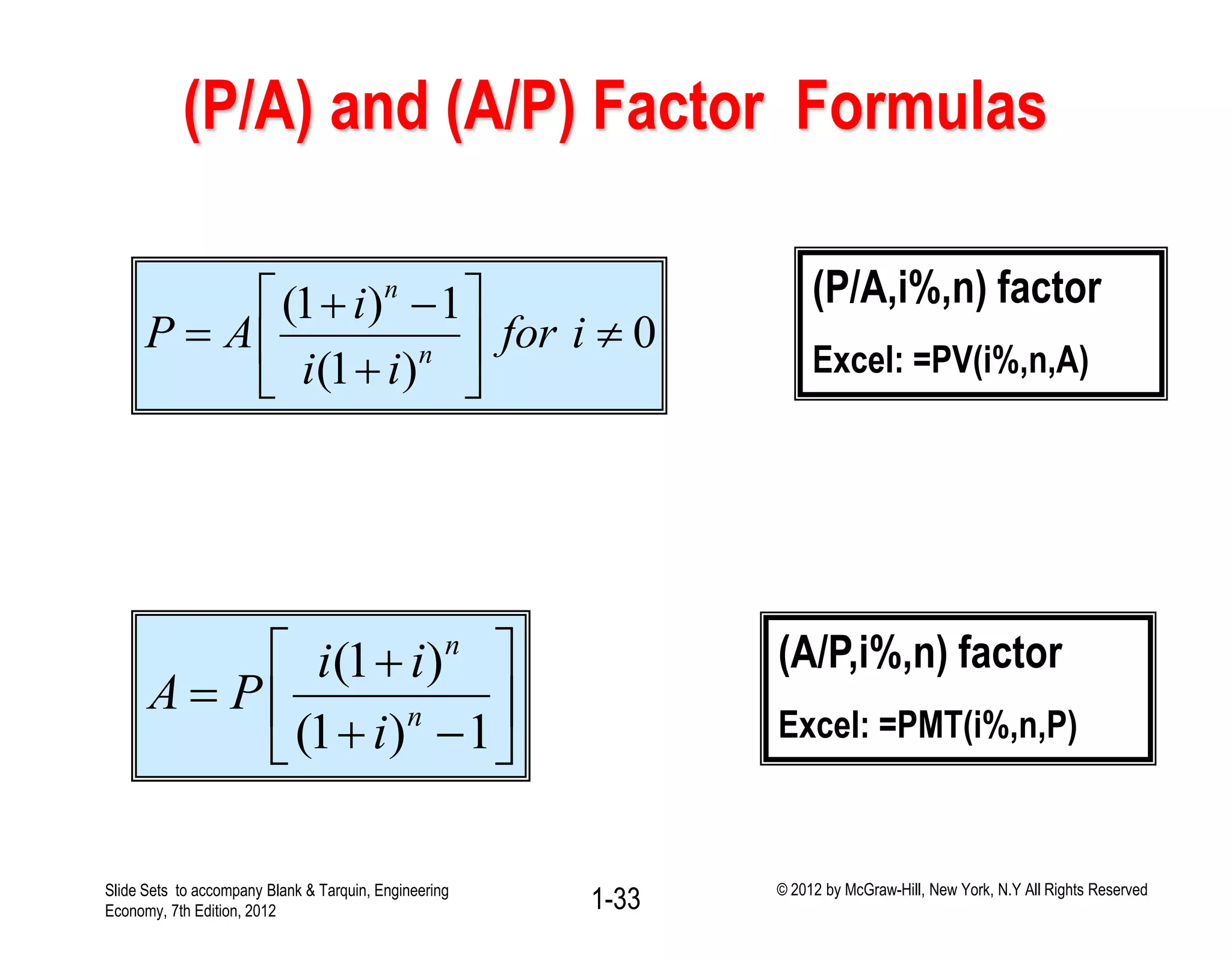
(P/A) and (A/P) Factor Formulas
(1 ) 1
0
(1 )
n
n
i
P A for i
i i
  
  
 
(1 )
(1 ) 1
n
n
i i
A P
i
 
  
  
(P/A,i%,n) factor
Excel: =PV(i%,n,A)
(A/P,i%,n) factor
Excel: =PMT(i%,n,P)
Slide Sets to accompany Blank & Tarquin, Engineering
Economy, 7th Edition, 2012 1-33 © 2012 by McGraw-Hill, New York, N.Y All Rights Reserved
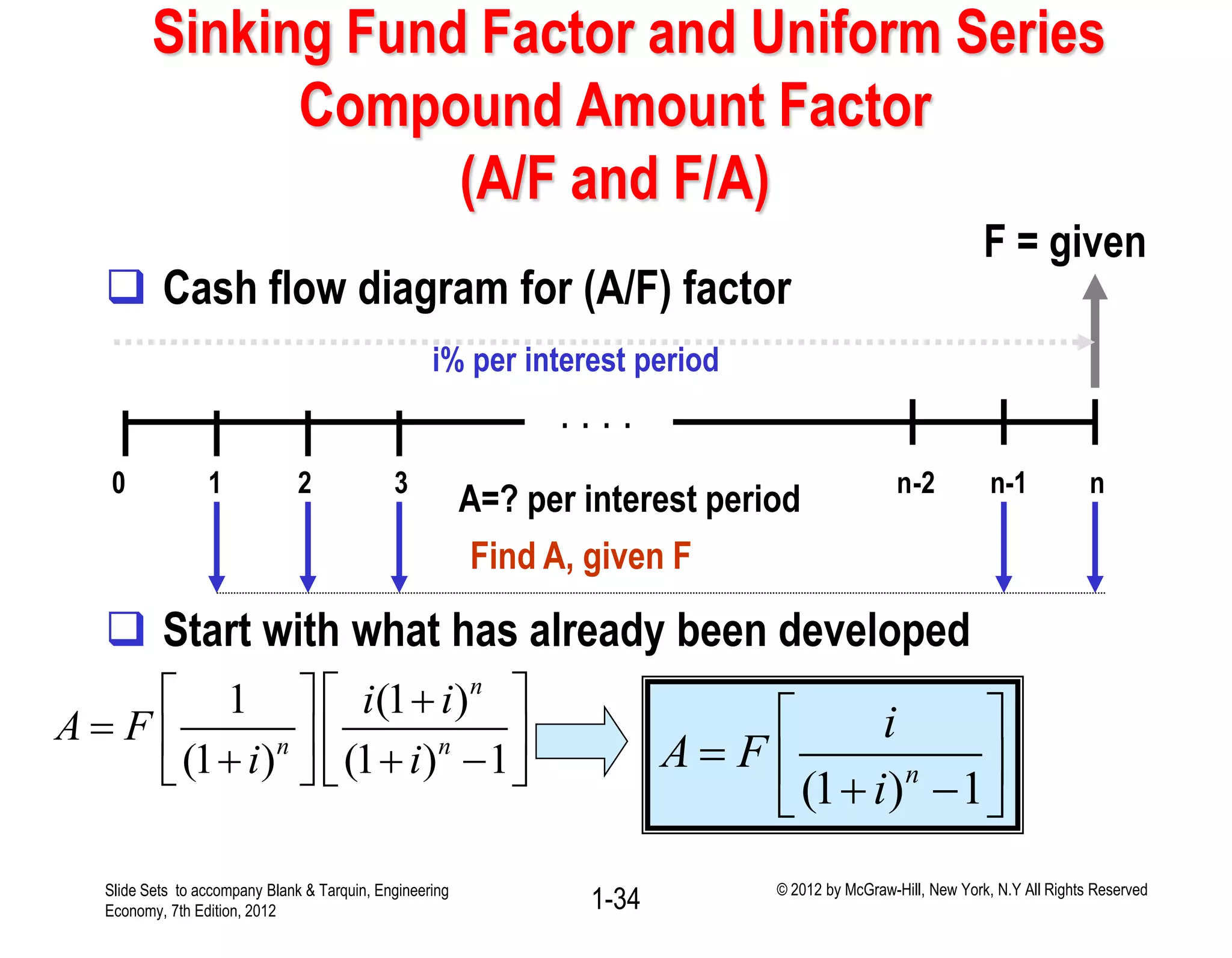
Sinking Fund Factor and Uniform Series
Compound Amount Factor
(A/F and F/A)
 Cash flow diagram for (A/F) factor
 Start with what has already been developed
1 (1 )
(1 ) (1 ) 1
n
n n
i i
A F
i i
   
        
. . . .
0 1 2 3 n-2 n-1 n
A=? per interest period
i% per interest period
F = given
Find A, given F
(1 ) 1n
i
A F
i
 
    
Slide Sets to accompany Blank & Tarquin, Engineering
Economy, 7th Edition, 2012 1-34 © 2012 by McGraw-Hill, New York, N.Y All Rights Reserved
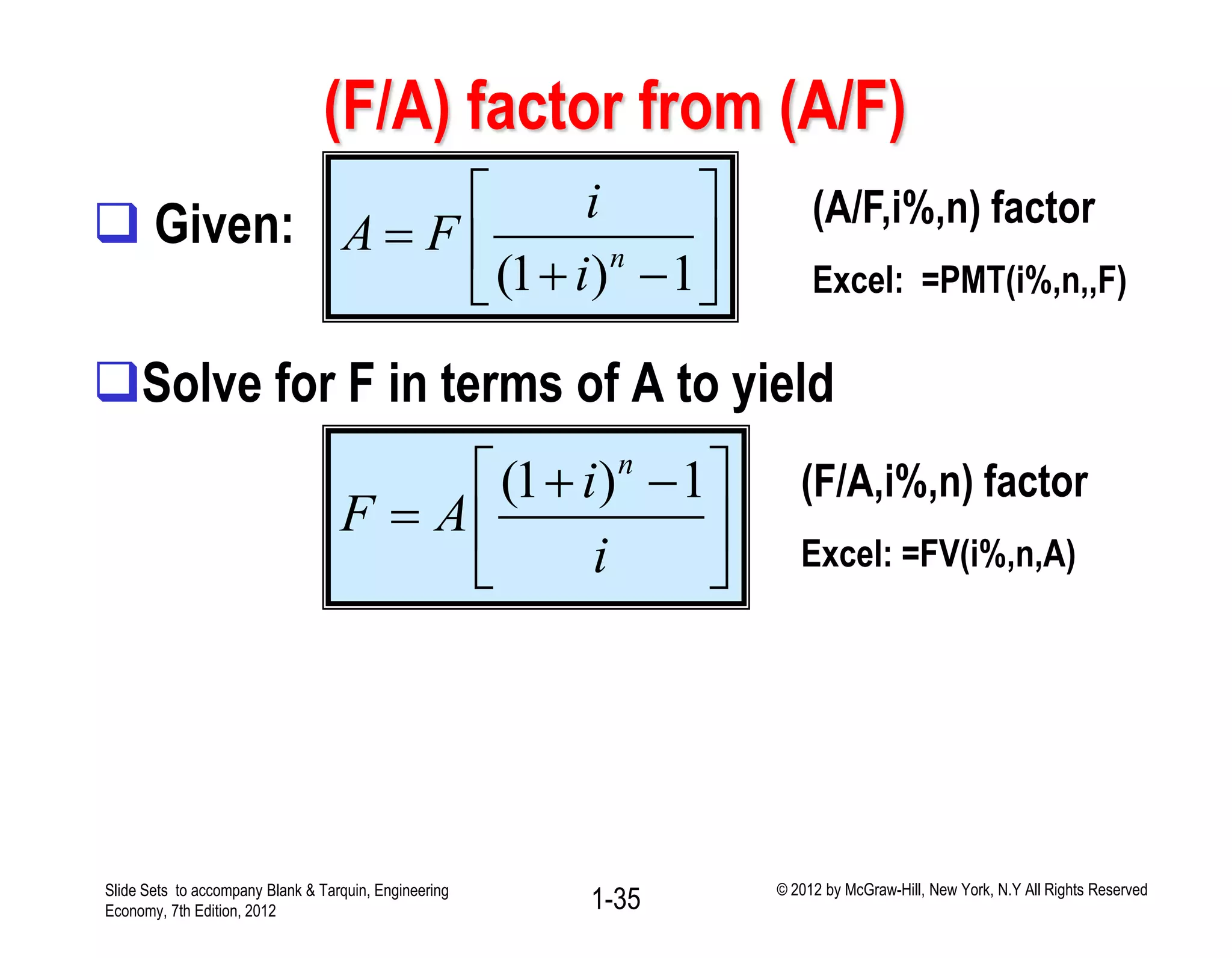
(F/A) factor from (A/F)
 Given:
Solve for F in terms of A to yield
(1 ) 1n
i
A F
i
 
    
(1 ) 1n
i
F A
i
  
  
 
(A/F,i%,n) factor
Excel: =PMT(i%,n,,F)
(F/A,i%,n) factor
Excel: =FV(i%,n,A)
Slide Sets to accompany Blank & Tarquin, Engineering
Economy, 7th Edition, 2012 1-35 © 2012 by McGraw-Hill, New York, N.Y All Rights Reserved
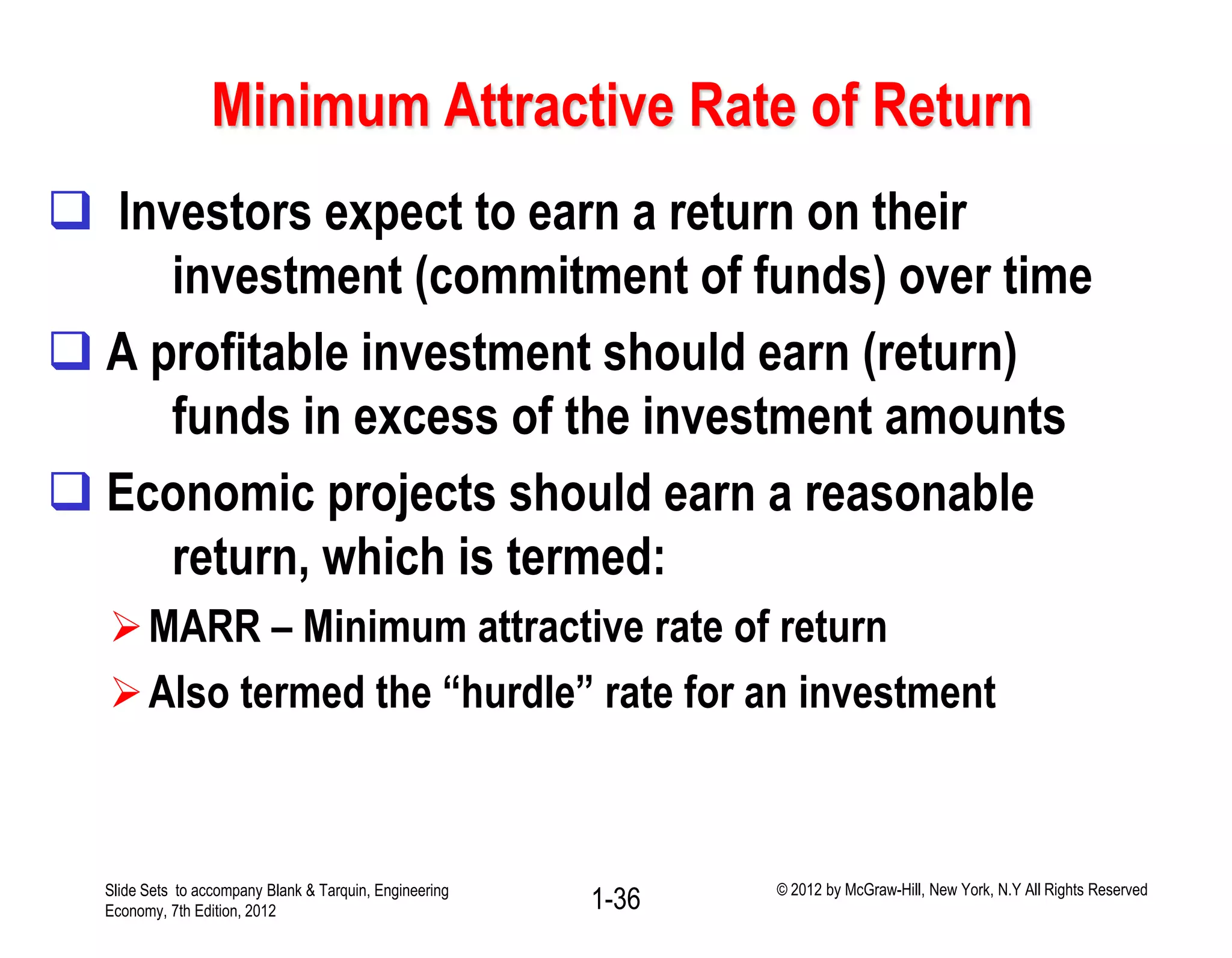
Minimum Attractive Rate of Return
 Investors expect to earn a return on their
investment (commitment of funds) over time
 A profitable investment should earn (return)
funds in excess of the investment amounts
 Economic projects should earn a reasonable
return, which is termed:
MARR – Minimum attractive rate of return
Also termed the “hurdle” rate for an investment
1-36Slide Sets to accompany Blank & Tarquin, Engineering
Economy, 7th Edition, 2012
© 2012 by McGraw-Hill, New York, N.Y All Rights Reserved
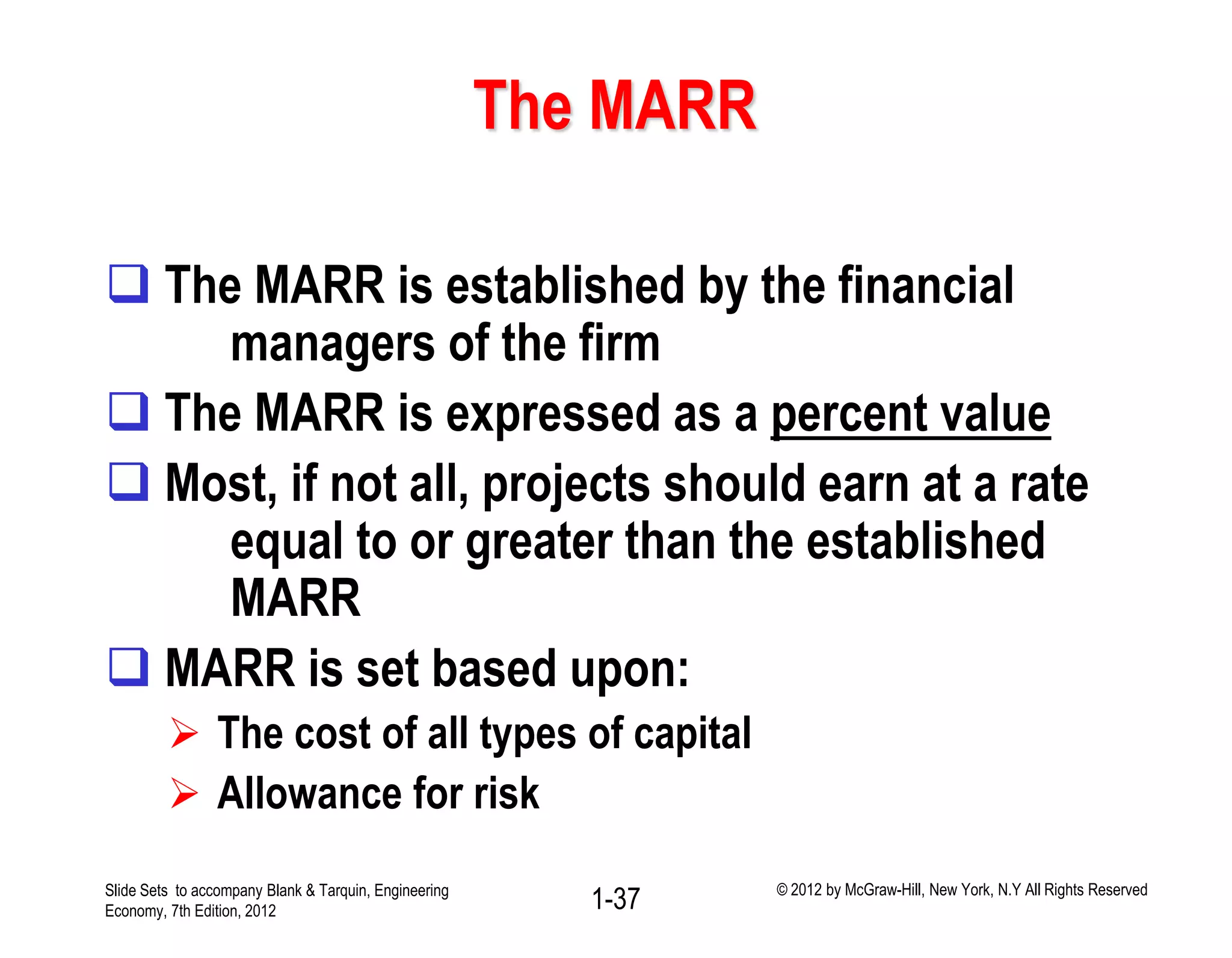
The MARR
 The MARR is established by the financial
managers of the firm
 The MARR is expressed as a percent value
 Most, if not all, projects should earn at a rate
equal to or greater than the established
MARR
 MARR is set based upon:
 The cost of all types of capital
 Allowance for risk
1-37Slide Sets to accompany Blank & Tarquin, Engineering
Economy, 7th Edition, 2012
© 2012 by McGraw-Hill, New York, N.Y All Rights Reserved
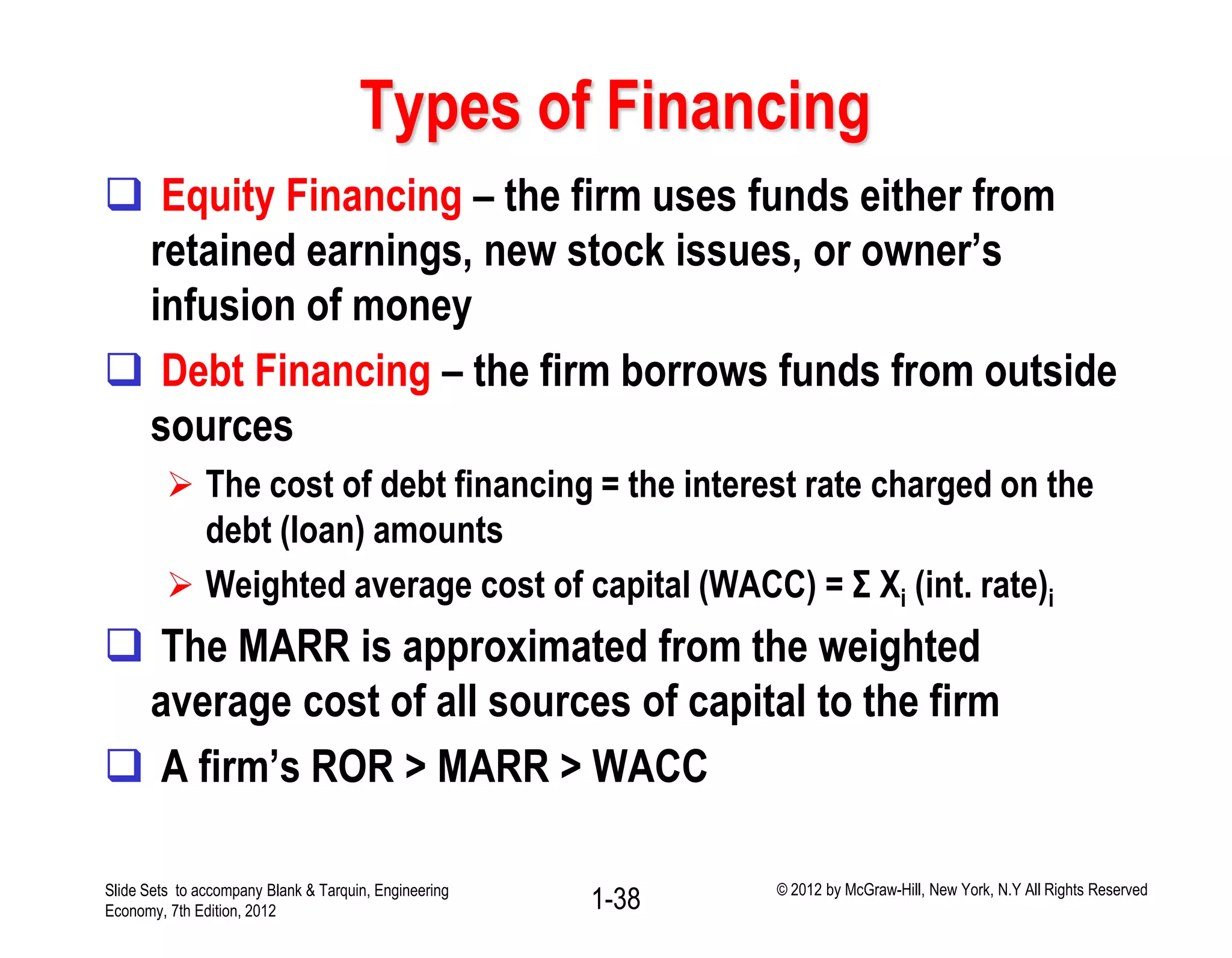
Types of Financing
 Equity Financing – the firm uses funds either from
retained earnings, new stock issues, or owner’s
infusion of money
 Debt Financing – the firm borrows funds from outside
sources
 The cost of debt financing = the interest rate charged on the
debt (loan) amounts
 Weighted average cost of capital (WACC) = Σ Xi (int. rate)i
 The MARR is approximated from the weighted
average cost of all sources of capital to the firm
 A firm’s ROR > MARR > WACC
1-38Slide Sets to accompany Blank & Tarquin, Engineering
Economy, 7th Edition, 2012
© 2012 by McGraw-Hill, New York, N.Y All Rights Reserved
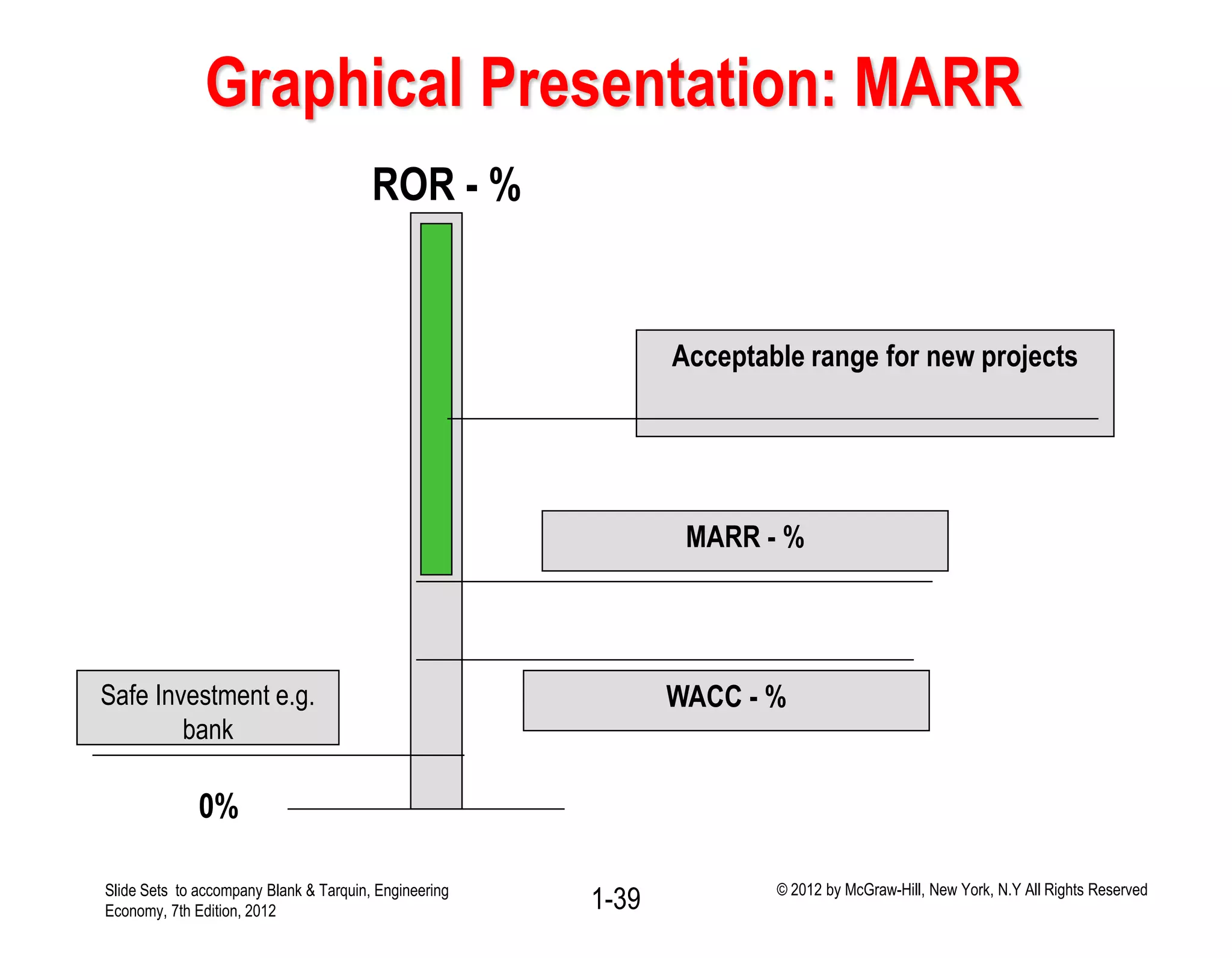
Graphical Presentation: MARR
0%
ROR - %
MARR - %
Safe Investment e.g.
bank
WACC - %
Acceptable range for new projects
1-39Slide Sets to accompany Blank & Tarquin, Engineering
Economy, 7th Edition, 2012
© 2012 by McGraw-Hill, New York, N.Y All Rights Reserved
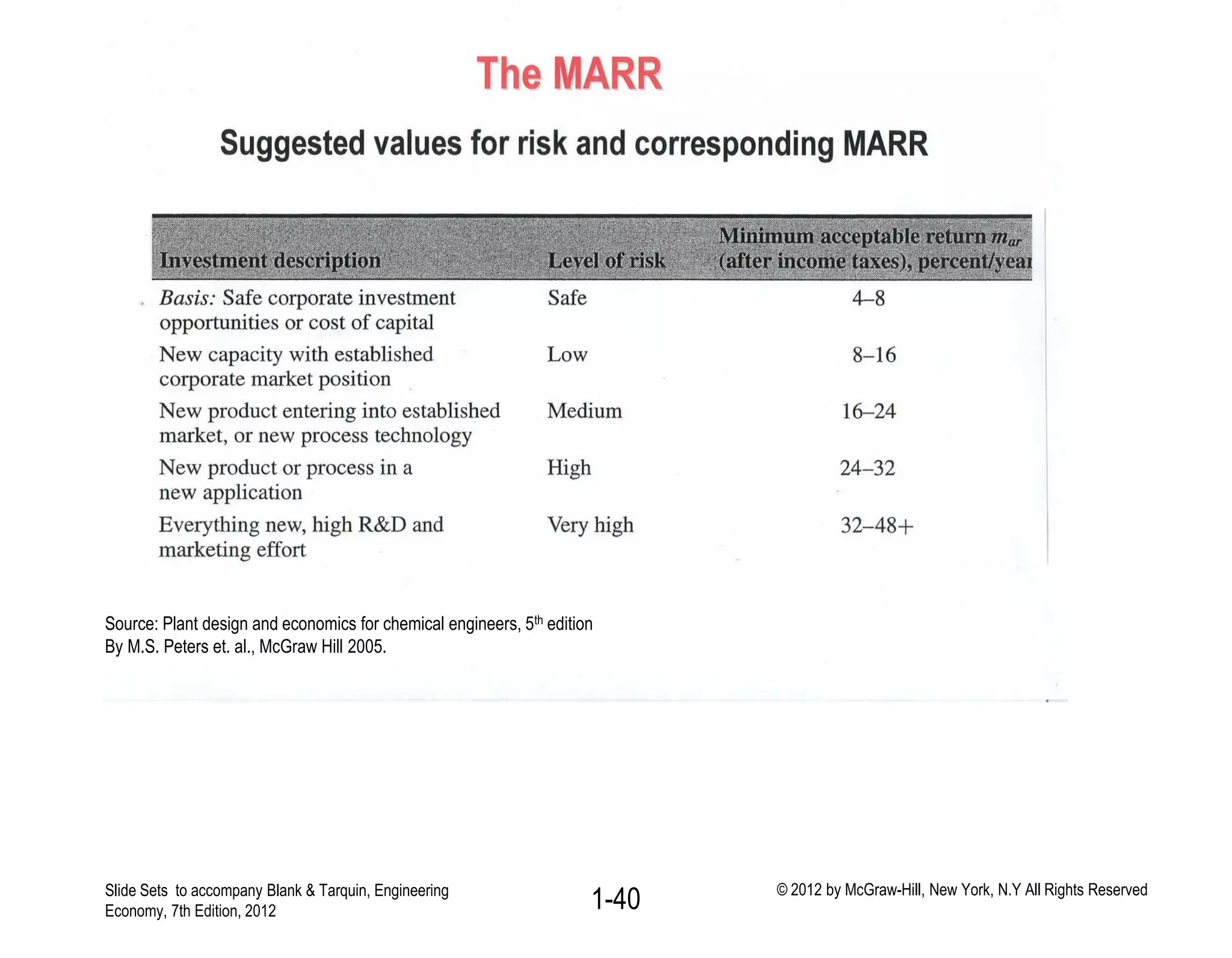
1-40
Source: Plant design and economics for chemical engineers, 5th edition
By M.S. Peters et. al., McGraw Hill 2005.
Slide Sets to accompany Blank & Tarquin, Engineering
Economy, 7th Edition, 2012
© 2012 by McGraw-Hill, New York, N.Y All Rights Reserved

Lecture # 2 time value of money

  • 1.
    Lecture # 2 TimeValue of Money – Interest theory 1-1 Dr. A. Alim
  • 2.
    Time Value ofMoney  The “time value” of money is the most important concept in engineering economy  All firms make use of investment of funds  Investments are expected to earn a return  Money possesses a “time value” 1-2Slide Sets to accompany Blank & Tarquin, Engineering Economy, 7th Edition, 2012 © 2012 by McGraw-Hill, New York, N.Y All Rights Reserved
  • 3.
    Equivalence  Different sumsof money at different times may be equal in economic value 0 1 $100 now $106 one year from now Interest rate = 6% per year $100 now is said to be equivalent to $106 one year from now, if the $100 is invested at the interest rate of 6% per year. 1-3Slide Sets to accompany Blank & Tarquin, Engineering Economy, 7th Edition, 2012 © 2012 by McGraw-Hill, New York, N.Y All Rights Reserved
  • 4.
    Interest Rate andRate of Return  Interest – the manifestation of the time value of money  Rental fee that one pays to use someone else’s money  Difference between an ending amount of money and a beginning amount of money  Interest rate (%) = interest accrued per time unit x 100% original amount 1-4Slide Sets to accompany Blank & Tarquin, Engineering Economy, 7th Edition, 2012 © 2012 by McGraw-Hill, New York, N.Y All Rights Reserved
  • 5.
    Rate of Return Interest earned over a period of time is expressed as a percentage of the original amount, specifically; interest accrued per time unit Rate of return (%) = x 100% original amount  Borrower’s perspective – interest rate paid  Lender’s perspective – interest rate earned 1-5Slide Sets to accompany Blank & Tarquin, Engineering Economy, 7th Edition, 2012 © 2012 by McGraw-Hill, New York, N.Y All Rights Reserved
  • 6.
    Simple and CompoundInterest  Simple Interest:  Interest = (principal)(number of periods)(interest rate)  Future value (F) = principal(P) + P x n x i  Compound Interest:  Interest earns interest on interest  Compounds over time  Interest = (principal + all accrued interest) (interest rate)  Future value (F) = principal(P) x (1 + i)n 1-6Slide Sets to accompany Blank & Tarquin, Engineering Economy, 7th Edition, 2012 © 2012 by McGraw-Hill, New York, N.Y All Rights Reserved
  • 7.
    Terminology and Symbols •Specific symbols and their respective definitions have been developed for use in engineering economy • Symbols tend to be standard in most engineering economy texts world-wide • Mastery of the symbols and their respective meanings is most important in understanding of the subsequent material! 1-7Slide Sets to accompany Blank & Tarquin, Engineering Economy, 7th Edition, 2012 © 2012 by McGraw-Hill, New York, N.Y All Rights Reserved
  • 8.
    Terminology and Symbols •P = value or amount of money at a time designated as the present or time 0. • Also P is referred to as present worth (PW), present value (PV), net present value (NPV), discounted cash flow (DCF), and capitalized cost (CC); dollars 1-8Slide Sets to accompany Blank & Tarquin, Engineering Economy, 7th Edition, 2012 © 2012 by McGraw-Hill, New York, N.Y All Rights Reserved
  • 9.
    Terminology and Symbols •F = value or amount of money at some future time. • Also F is called future worth (FW) and future value (FV); dollars 1-9Slide Sets to accompany Blank & Tarquin, Engineering Economy, 7th Edition, 2012 © 2012 by McGraw-Hill, New York, N.Y All Rights Reserved
  • 10.
    Terminology and Symbols •A = series of consecutive, equal, end-of-period amounts of money. • Also A is called the annual worth (AW) , equivalent uniform annual worth (EUAW); dollars per year, dollars per month • n = number of interest periods; years, months, days 1-10Slide Sets to accompany Blank & Tarquin, Engineering Economy, 7th Edition, 2012 © 2012 by McGraw-Hill, New York, N.Y All Rights Reserved
  • 11.
    Terminology and Symbols •i = interest rate or rate of return per time period; percent per year, percent per month • t = time, stated in periods; years, months, days, etc 1-11Slide Sets to accompany Blank & Tarquin, Engineering Economy, 7th Edition, 2012 © 2012 by McGraw-Hill, New York, N.Y All Rights Reserved
  • 12.
    Cash Flows: TheirEstimation and Diagramming  Definition of terms Cash Inflows - amount of funds flowing into the firm Cash Outflows – amount of funds flowing out of the firm  Net Cash Flow equals  cash inflows – cash outflows  Assumption for analysis – end of period Funds flow at the end of a given (interest) period 1-12Slide Sets to accompany Blank & Tarquin, Engineering Economy, 7th Edition, 2012 © 2012 by McGraw-Hill, New York, N.Y All Rights Reserved
  • 13.
    Cash Flow Diagrams A typical cash flow diagram might look like: 0 1 2 … … … n-1 n 1. Draw a time line One time period 0 1 2 … … … n-1 n 2. Show the cash flows Cash flows are shown as directed arrows (+ for up or – for down) --- (+) inflow; (-) outflow Always assume end-of-period cash flows! 1-13Slide Sets to accompany Blank & Tarquin, Engineering Economy, 7th Edition, 2012 © 2012 by McGraw-Hill, New York, N.Y All Rights Reserved
  • 14.
    IMPORTANT • Cash flowdiagrams are not limited to P, F, and/or A. For example, this could be a very real diagram: P F 0 1 2 … … n-1 n 1-14Slide Sets to accompany Blank & Tarquin, Engineering Economy, 7th Edition, 2012 © 2012 by McGraw-Hill, New York, N.Y All Rights Reserved
  • 15.
    P and F •The symbols P and F represent one-time occurrences: • Specifically: $P $F 0 1 2 … … n-1 n 1-15Slide Sets to accompany Blank & Tarquin, Engineering Economy, 7th Edition, 2012 © 2012 by McGraw-Hill, New York, N.Y All Rights Reserved
  • 16.
    P and F •It should be clear that a present value P represents a single sum of money at some time prior to a future value F • This is an important basic point to remember 1-16Slide Sets to accompany Blank & Tarquin, Engineering Economy, 7th Edition, 2012 © 2012 by McGraw-Hill, New York, N.Y All Rights Reserved
  • 17.
    Annual Amounts • Itis important to note that the symbol A always represents a uniform mount (i.e., the same amount each period) that extends through consecutive interest periods. 1-17Slide Sets to accompany Blank & Tarquin, Engineering Economy, 7th Edition, 2012 © 2012 by McGraw-Hill, New York, N.Y All Rights Reserved
  • 18.
    Annual Amounts • CashFlow diagram for annual amounts might look like the following: ………… $A $A $A $A $A A = equal, end of period cash flow amounts $P 0 1 2 3 .. N-1 N 1-18Slide Sets to accompany Blank & Tarquin, Engineering Economy, 7th Edition, 2012 © 2012 by McGraw-Hill, New York, N.Y All Rights Reserved
  • 19.
    Remember ! A =equal payments, end of each period F = single payment, end of last period P = single payment, beginning of first period 1-19Slide Sets to accompany Blank & Tarquin, Engineering Economy, 7th Edition, 2012 © 2012 by McGraw-Hill, New York, N.Y All Rights Reserved
  • 20.
    Interest Rate –i% per period • The interest rate i is assumed to be a compound rate, unless specifically stated as “simple interest” • The rate i is expressed in percent per interest period, for example, 12% per year. 1-20Slide Sets to accompany Blank & Tarquin, Engineering Economy, 7th Edition, 2012 © 2012 by McGraw-Hill, New York, N.Y All Rights Reserved
  • 21.
    Standard Notation for InterestFactors  Standard notation has been adopted to represent the various interest factors  Consists of two cash flow symbols, the interest rate, and the number of time periods  General form: (X/Y,i%,n)  X represents what is unknown  Y represents what is known  i and n represent input parameters; can be known or unknown depending upon the problem 1-21Slide Sets to accompany Blank & Tarquin, Engineering Economy, 7th Edition, 2012 © 2012 by McGraw-Hill, New York, N.Y All Rights Reserved
  • 22.
    Notation - continued Example: (F/P,6%,20) is read as: To find F, given P when the interest rate is 6% and the number of time periods equals 20.  In problem formulation, the standard notation is often used. Example : F = P (F/P,6%,20) 1-22Slide Sets to accompany Blank & Tarquin, Engineering Economy, 7th Edition, 2012 © 2012 by McGraw-Hill, New York, N.Y All Rights Reserved
  • 23.
    Notation - continued Thereare 3 sources to determine the values of these factors:  Tables at the back of many books provide tabulations of common values for i% and n.  Using EXCEL functions.  Calculating the factors from formulas. 1-23Slide Sets to accompany Blank & Tarquin, Engineering Economy, 7th Edition, 2012 © 2012 by McGraw-Hill, New York, N.Y All Rights Reserved
  • 24.
    1-24Slide Sets toaccompany Blank & Tarquin, Engineering Economy, 7th Edition, 2012 © 2012 by McGraw-Hill, New York, N.Y All Rights Reserved
  • 25.
    Introduction To SolutionBy Computer  Application of Microsoft’s Excel© spreadsheet program  Good review in Appendix “A”, Blank’s Book.  Excel financial functions  Present Value P: =PV(i%,n,A,F) e.g. =PV(i%,n,A) or PV(i%,n,,F)  Future Value F: =FV(i%,n,A,P)  Equal, periodic value A: =PMT(i%,n,P,F)  No. of periods: =NPER((i%,A,P,F)  Compound interest rate: =RATE(n,A,P,F)  Compound interest rate: =IRR(first_cell:last_cell)  Present value of a series: =NPV(i%,second_cell:last_cell) + first_cell 1-25Slide Sets to accompany Blank & Tarquin, Engineering Economy, 7th Edition, 2012 © 2012 by McGraw-Hill, New York, N.Y All Rights Reserved
  • 26.
    1-26Slide Sets toaccompany Blank & Tarquin, Engineering Economy, 7th Edition, 2012 © 2012 by McGraw-Hill, New York, N.Y All Rights Reserved Calculating factors From formulas:
  • 27.
    Example: 1-27Slide Sets toaccompany Blank & Tarquin, Engineering Economy, 7th Edition, 2012 © 2012 by McGraw-Hill, New York, N.Y All Rights Reserved P F 5 years i = 8% Cash flow diagram from the point of view of the graduate.
  • 28.
    Example: P = 10000dollars i = 8% n = 5 years 1) Using tables: From Blank's book table 12, for 8% interest rate and 5 years, we find: F/P = 1.4693 then F= $10000 x 1.4693 = $14,693 2) Using formula: F/P = (1+i)^5 = 1.46932808 then F = $14,693.28 3) Using EXCEL function FV EXCEL assigns a negative value to cash outflow and a positive value to cash inflow P in this case is a positive cash flow, hence F calculated will be negative. F = ($14,693.28) 1-28Slide Sets to accompany Blank & Tarquin, Engineering Economy, 7th Edition, 2012 © 2012 by McGraw-Hill, New York, N.Y All Rights Reserved
  • 29.
    Example: 1-29Slide Sets toaccompany Blank & Tarquin, Engineering Economy, 6th Edition, 2005 © 2012 by McGraw-Hill, New York, N.Y All Rights Reserved
  • 30.
    Summary: Compounding Factors 1.Single-Payment compound amount factor (F from P) 2. Single-Payment present worth factor (P from F) 3. Uniform-series present worth factor (P from A) 4. Capital recovery factor (A from P) 5. Uniform-series compound amount factor (F from A) 6. Sinking fund factor (A from F) Slide Sets to accompany Blank & Tarquin, Engineering Economy, 7th Edition, 2012 1-30 © 2012 by McGraw-Hill, New York, N.Y All Rights Reserved
  • 31.
    Single-Payment Factors(F/P andP/F)  Objective: Derive factors to determine the present or future worth of a cash flow  Cash Flow Diagram – basic format 0 1 2 3 n-1 n P0 Fn i% / period P0 = Fn1/(1+i)n →(P/F,i%,n) factor: Excel: =PV(i%,n,,F) Fn = P0(1+i)n →(F/P,i%,n) factor: Excel: =FV(i%,n,,P) Slide Sets to accompany Blank & Tarquin, Engineering Economy, 7th Edition, 2012 1-31 © 2012 by McGraw-Hill, New York, N.Y All Rights Reserved
  • 32.
    Uniform-Series: Present WorthFactor (P/A) and Capital Recovery Factor(A/P)  Cash flow profile for P/A factor . . . . 0 1 2 3 n-2 n-1 n $A per interest period i% per interest period Required: To find P given A Cash flows are equal, uninterrupted and flow at the end of each interest period Find P Slide Sets to accompany Blank & Tarquin, Engineering Economy, 7th Edition, 2012 1-32 © 2012 by McGraw-Hill, New York, N.Y All Rights Reserved
  • 33.
    (P/A) and (A/P)Factor Formulas (1 ) 1 0 (1 ) n n i P A for i i i         (1 ) (1 ) 1 n n i i A P i         (P/A,i%,n) factor Excel: =PV(i%,n,A) (A/P,i%,n) factor Excel: =PMT(i%,n,P) Slide Sets to accompany Blank & Tarquin, Engineering Economy, 7th Edition, 2012 1-33 © 2012 by McGraw-Hill, New York, N.Y All Rights Reserved
  • 34.
    Sinking Fund Factorand Uniform Series Compound Amount Factor (A/F and F/A)  Cash flow diagram for (A/F) factor  Start with what has already been developed 1 (1 ) (1 ) (1 ) 1 n n n i i A F i i              . . . . 0 1 2 3 n-2 n-1 n A=? per interest period i% per interest period F = given Find A, given F (1 ) 1n i A F i        Slide Sets to accompany Blank & Tarquin, Engineering Economy, 7th Edition, 2012 1-34 © 2012 by McGraw-Hill, New York, N.Y All Rights Reserved
  • 35.
    (F/A) factor from(A/F)  Given: Solve for F in terms of A to yield (1 ) 1n i A F i        (1 ) 1n i F A i         (A/F,i%,n) factor Excel: =PMT(i%,n,,F) (F/A,i%,n) factor Excel: =FV(i%,n,A) Slide Sets to accompany Blank & Tarquin, Engineering Economy, 7th Edition, 2012 1-35 © 2012 by McGraw-Hill, New York, N.Y All Rights Reserved
  • 36.
    Minimum Attractive Rateof Return  Investors expect to earn a return on their investment (commitment of funds) over time  A profitable investment should earn (return) funds in excess of the investment amounts  Economic projects should earn a reasonable return, which is termed: MARR – Minimum attractive rate of return Also termed the “hurdle” rate for an investment 1-36Slide Sets to accompany Blank & Tarquin, Engineering Economy, 7th Edition, 2012 © 2012 by McGraw-Hill, New York, N.Y All Rights Reserved
  • 37.
    The MARR  TheMARR is established by the financial managers of the firm  The MARR is expressed as a percent value  Most, if not all, projects should earn at a rate equal to or greater than the established MARR  MARR is set based upon:  The cost of all types of capital  Allowance for risk 1-37Slide Sets to accompany Blank & Tarquin, Engineering Economy, 7th Edition, 2012 © 2012 by McGraw-Hill, New York, N.Y All Rights Reserved
  • 38.
    Types of Financing Equity Financing – the firm uses funds either from retained earnings, new stock issues, or owner’s infusion of money  Debt Financing – the firm borrows funds from outside sources  The cost of debt financing = the interest rate charged on the debt (loan) amounts  Weighted average cost of capital (WACC) = Σ Xi (int. rate)i  The MARR is approximated from the weighted average cost of all sources of capital to the firm  A firm’s ROR > MARR > WACC 1-38Slide Sets to accompany Blank & Tarquin, Engineering Economy, 7th Edition, 2012 © 2012 by McGraw-Hill, New York, N.Y All Rights Reserved
  • 39.
    Graphical Presentation: MARR 0% ROR- % MARR - % Safe Investment e.g. bank WACC - % Acceptable range for new projects 1-39Slide Sets to accompany Blank & Tarquin, Engineering Economy, 7th Edition, 2012 © 2012 by McGraw-Hill, New York, N.Y All Rights Reserved
  • 40.
    1-40 Source: Plant designand economics for chemical engineers, 5th edition By M.S. Peters et. al., McGraw Hill 2005. Slide Sets to accompany Blank & Tarquin, Engineering Economy, 7th Edition, 2012 © 2012 by McGraw-Hill, New York, N.Y All Rights Reserved