JCPC Department Initiatives InterventionBuilding eLearning Communities at the University of Jos
Donna Oti, PhDConsultant
OverviewDII backgroundGoals and objectiveThe ICT environment which necessitated themThe eLearning FellowshipThe conceptRoles and responsibilitiesThe Departmental Initiativeslearning modelsignificance
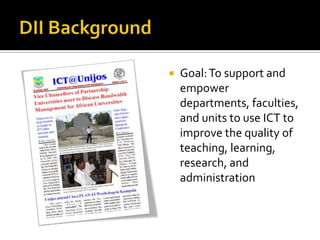
DII BackgroundGoal: To support and empower departments, faculties, and units to use ICT to improve the quality of teaching, learning, research, and administration
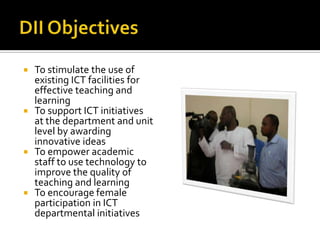
DII ObjectivesTo stimulate the use of existing ICT facilities for effective teaching and learningTo support ICT initiatives at the department and unit level by awarding innovative ideasTo empower academic staff to use technology to improve the quality of teaching and learningTo encourage female participation in ICT departmental initiatives
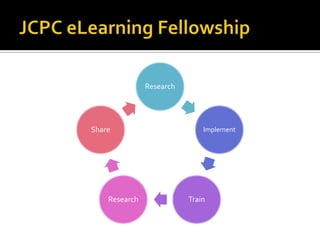
JCPC eLearning FellowshipWhat is a Fellowship?A professional or academic community or like-minded individuals collaborating to achieve a common goal or advance the disciplineWhat is your primary role as a Fellow?To boldly go where no woman has gone beforeTo master the online pedagogy literatureTo solve pedagogical challenges facing UnijosTo share your knowledge with wider academic communities
eLearning Fellowship CurriculumModule 1:  Building the Foundation for Successful eLearning InitiativesModule 2:  Enriching Teaching and Learning Through the Use of TechnologyModule 3:  Pedagogical Challenges for the Jos Context Module 4:  Discipline Specific Pedagogical Issues
JCPC eLearning Fellowship
eLearning Fellowship ExampleWeb Initiative in Teaching Fellow, 2001-2002Created course web site for journalismAdvised student newspapers for three universitiesCreated online newspapers for two universitiesTrained individual to teach online at the University of Maryland University CollegeConsultant for educational software for test administration and course management
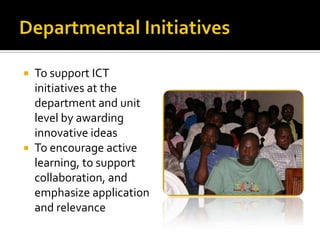
Departmental InitiativesTo support ICT initiatives at the department and unit level by awarding innovative ideasTo encourage active learning, to support collaboration, and emphasize application and relevance
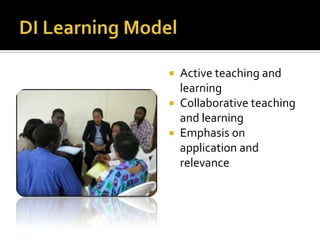
DI Learning ModelActive teaching and learningCollaborative teaching and learningEmphasis on application and relevance
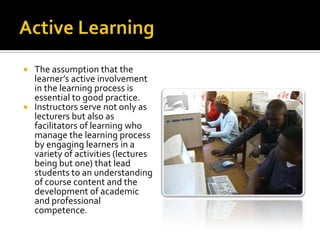
Active LearningThe assumption that the learner’s active involvement in the learning process is essential to good practice. Instructors serve not only as lecturers but also as facilitators of learning who manage the learning process by engaging learners in a variety of activities (lectures being but one) that lead students to an understanding of course content and the development of academic and professional competence.
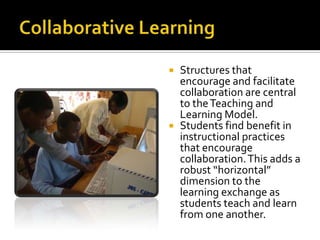
Collaborative LearningStructures that encourage and facilitate collaboration are central to the Teaching and Learning Model. Students find benefit in instructional practices that encourage collaboration. This adds a robust “horizontal” dimension to the learning exchange as students teach and learn from one another.
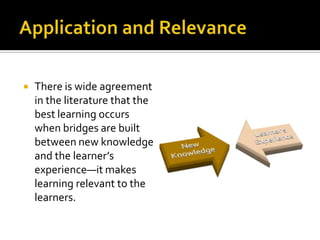
Application and RelevanceThere is wide agreement in the literature that the best learning occurs when bridges are built between new knowledge and the learner’s experience—it makes learning relevant to the learners.
Significance and SimilaritieseLearning fellowshipEngage students by teaching with technologyTeam course development encourages intra and inter-group collaborationEmphasis on a number of technology solutions for enabling students to apply knowledge and learn in context: games, simulation, case studies…Departmental initiativeUsing technologies to address discipline-specific challengesDepartmental initiatives support varied perspectives on teaching and learning challengesOpportunities for lecturers to collaborating on experimental learning projects
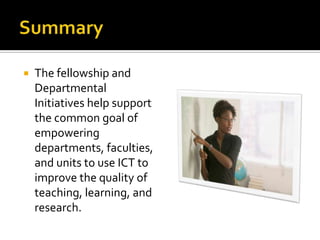
SummaryThe fellowship and Departmental Initiatives help support the common goal of empowering departments, faculties, and units to use ICT to improve the quality of teaching, learning, and research.
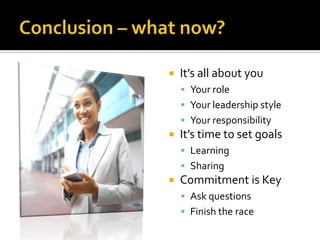
Conclusion – what now?It’s all about youYour roleYour leadership styleYour responsibilityIt’s time to set goalsLearningSharingCommitment is KeyAsk questionsFinish the race
ReferencesEngaging the Online Learner: Activities and Resources for Creative Instruction (Online Teaching and Learning Series (OTL)) by Rita-Marie Conrad and J. Ana Donaldson (2004)Exploring the Digital Library: A Guide for Online Teaching and Learning (Online Teaching and Learning Series (OTL)) by Kay Johnson and Elaine Magusin(2005)Faculty Development Companion Workbook Module 9:: Teaching Online by Amy Solomon and Quantum Integrations (2006)Teaching Online: A Practical Guide, 2d Edition by Susan Ko and Steven Rossen, (2004) The Tools for Successful Online Teaching by Lisa Dawley(2007)

Building eLearning Communities

  • 1.
    JCPC Department InitiativesInterventionBuilding eLearning Communities at the University of Jos
  • 2.
  • 3.
    OverviewDII backgroundGoals andobjectiveThe ICT environment which necessitated themThe eLearning FellowshipThe conceptRoles and responsibilitiesThe Departmental Initiativeslearning modelsignificance
  • 4.
    DII BackgroundGoal: Tosupport and empower departments, faculties, and units to use ICT to improve the quality of teaching, learning, research, and administration
  • 5.
    DII ObjectivesTo stimulatethe use of existing ICT facilities for effective teaching and learningTo support ICT initiatives at the department and unit level by awarding innovative ideasTo empower academic staff to use technology to improve the quality of teaching and learningTo encourage female participation in ICT departmental initiatives
  • 6.
    JCPC eLearning FellowshipWhatis a Fellowship?A professional or academic community or like-minded individuals collaborating to achieve a common goal or advance the disciplineWhat is your primary role as a Fellow?To boldly go where no woman has gone beforeTo master the online pedagogy literatureTo solve pedagogical challenges facing UnijosTo share your knowledge with wider academic communities
  • 7.
    eLearning Fellowship CurriculumModule1: Building the Foundation for Successful eLearning InitiativesModule 2: Enriching Teaching and Learning Through the Use of TechnologyModule 3: Pedagogical Challenges for the Jos Context Module 4: Discipline Specific Pedagogical Issues
  • 8.
  • 9.
    eLearning Fellowship ExampleWebInitiative in Teaching Fellow, 2001-2002Created course web site for journalismAdvised student newspapers for three universitiesCreated online newspapers for two universitiesTrained individual to teach online at the University of Maryland University CollegeConsultant for educational software for test administration and course management
  • 10.
    Departmental InitiativesTo supportICT initiatives at the department and unit level by awarding innovative ideasTo encourage active learning, to support collaboration, and emphasize application and relevance
  • 11.
    DI Learning ModelActiveteaching and learningCollaborative teaching and learningEmphasis on application and relevance
  • 12.
    Active LearningThe assumptionthat the learner’s active involvement in the learning process is essential to good practice. Instructors serve not only as lecturers but also as facilitators of learning who manage the learning process by engaging learners in a variety of activities (lectures being but one) that lead students to an understanding of course content and the development of academic and professional competence.
  • 13.
    Collaborative LearningStructures thatencourage and facilitate collaboration are central to the Teaching and Learning Model. Students find benefit in instructional practices that encourage collaboration. This adds a robust “horizontal” dimension to the learning exchange as students teach and learn from one another.
  • 14.
    Application and RelevanceThereis wide agreement in the literature that the best learning occurs when bridges are built between new knowledge and the learner’s experience—it makes learning relevant to the learners.
  • 15.
    Significance and SimilaritieseLearningfellowshipEngage students by teaching with technologyTeam course development encourages intra and inter-group collaborationEmphasis on a number of technology solutions for enabling students to apply knowledge and learn in context: games, simulation, case studies…Departmental initiativeUsing technologies to address discipline-specific challengesDepartmental initiatives support varied perspectives on teaching and learning challengesOpportunities for lecturers to collaborating on experimental learning projects
  • 16.
    SummaryThe fellowship andDepartmental Initiatives help support the common goal of empowering departments, faculties, and units to use ICT to improve the quality of teaching, learning, and research.
  • 17.
    Conclusion – whatnow?It’s all about youYour roleYour leadership styleYour responsibilityIt’s time to set goalsLearningSharingCommitment is KeyAsk questionsFinish the race
  • 18.
    ReferencesEngaging the OnlineLearner: Activities and Resources for Creative Instruction (Online Teaching and Learning Series (OTL)) by Rita-Marie Conrad and J. Ana Donaldson (2004)Exploring the Digital Library: A Guide for Online Teaching and Learning (Online Teaching and Learning Series (OTL)) by Kay Johnson and Elaine Magusin(2005)Faculty Development Companion Workbook Module 9:: Teaching Online by Amy Solomon and Quantum Integrations (2006)Teaching Online: A Practical Guide, 2d Edition by Susan Ko and Steven Rossen, (2004) The Tools for Successful Online Teaching by Lisa Dawley(2007)

Editor's Notes

  • #2 It is indeed an honor for me to welcome you as colleague, leaders, and future builders of the eLearning community at the University of Jos. I hope you recognize the historic nature of this occasion. JCPC on one hand, but equally important, the University is saying to you “We believe it you… We are investing in your future. We are investing in you because we believe that you offer the greatest promise for helping us to transition from teaching with chalk to teaching with technology. We are investing in you because we believe that you can lead others as we embark on this journey from having the best ICT infrastructure at a Nigerian university to having the most dynamic eLearning communities in Africa.Some of you may be thinking: Can I lead this eLearning revolution that lies on the horizon? Am I ready? Do I have the technological skills necessary? I say to you: “Yes you can, Yes you are and yes you do. While computer literacy is important. Interest, determination, and perseverance are equally so.