Chem 150
Chem 150
Unit 2 - Hydrocarbons &
Functional Groups
Functional Groups
Organic chemistry is the chemistry of carbon. The
name “organic” reflect the fact that organic
molecules are derived from living organisms. In this
unit will start by looking at four families of organic
molecules that are grouped together as the
hydrocarbons. We will also look at some functional
groups that define some of the other families of
organic molecules.
organic molecules.
2
Organic Chemistry
Organic Chemistry
Organic chemistry is the chemistry of carbon.
• There are three forms of pure carbon
There are three forms of pure carbon
• Diamond
Diamond
• Graphite
Graphite
3
Organic Chemistry
Organic Chemistry
Organic chemistry is the chemistry of carbon.
• There are three forms of pure carbon
There are three forms of pure carbon
• Buckminsterfullerene
Buckminsterfullerene
“Bucky Balls”
“Bucky Balls”
4
Hydrocarbons
Hydrocarbons
• Organic molecules contain carbon combined with other
Organic molecules contain carbon combined with other
elements.
elements.
• Organic molecules are grouped into families
Organic molecules are grouped into families
• Members of a family share common structural, physical, and chemical
Members of a family share common structural, physical, and chemical
characteristics.
characteristics.
• There are four families that contain molecules made of only
There are four families that contain molecules made of only
carbon and hydrogen.
• Hydrocarbons
Hydrocarbons
• Alkanes
Alkanes
• Alkenes
Alkenes
• Alkynes
Alkynes
• Aromatics
Aromatics
5
Hydrocarbons
Hydrocarbons
6
Alkanes
Alkanes
Alkanes are hydrocarbons that contain only carbon-carbon
single bonds.
single bonds.
• Every carbon atom participates in 4 single bonds, either to
Every carbon atom participates in 4 single bonds, either to
another carbon or to a hydrogen.
• Every hydrogen atom is bonded to a carbon by a single
Every hydrogen atom is bonded to a carbon by a single
bond.
bond.
7
Alkanes
Alkanes
Alkanes are hydrocarbons that contain only carbon-carbon
single bonds.
single bonds.
8
Alkanes
Alkanes
• Alkanes in which the carbons are connected in a straight
Alkanes in which the carbons are connected in a straight
chain are called
chain are called normal alkanes
normal alkanes.
.
• Alkanes that are branched are called
Alkanes that are branched are called branched chain
branched chain
alkanes
alkanes.
.
C C C C C C
H
H
H
H H H H H
H
H
H
H
H
H
C C C C C H
H
H
H
C
H H H
H
H
H
H
H
H
H
n-hexane
n-hexane
2-methyl-pentane
2-methyl-pentane
Alkanes
Alkanes
For a discusion on the structure of alkanes,
see the Unit 2
see the Unit 2
Elaboration - Alkane Structure
1
0
Alkanes
Alkanes
• Alkanes, along with the other hydrocarbons, are non-polar.
Alkanes, along with the other hydrocarbons, are non-polar.
• They interact with each other only through London
They interact with each other only through London
dispersion forces.
dispersion forces.
• This is why they have relatively low boiling and melting
This is why they have relatively low boiling and melting
points.
points.
1
1
They interact with each other only through London dispersion
forces.
forces.
• Note how the boiling points increase with molecular weight.
Note how the boiling points increase with molecular weight.
Alkanes
Alkanes
1
2
Molecule in the News
1
3
Molecule in the News:Melamine
1
4
http://www.
http://www.cbc
cbc.ca/health/story/2007/09/06/additives-lancet.html?ref=rss
.ca/health/story/2007/09/06/additives-lancet.html?ref=rss
http://www.
http://www.medpagetoday
medpagetoday.com/Psychiatry/ADHD-ADD/tb/6610
.com/Psychiatry/ADHD-ADD/tb/6610
Organic Molecules in the News!!
Carmoisine
Carmoisine
Quinoline yellow
Quinoline yellow
Sodium benzoate
Sodium benzoate
1
5
Alkanes, cannot be named based on their molecular formulas
• For example, all of the molecules shown below share the
For example, all of the molecules shown below share the
same molecular formula, C
same molecular formula, C6
6H
H14
14
(
(hexacarbon tetradecahydride
hexacarbon tetradecahydride?)
?)
Alkanes
C C C C C C
H
H
H
H H H H H
H
H
H
H
H
H
C C C C C H
H
H
H
C
H H H
H
H
H
H
H
H
H
n-hexane
n-hexane
2-methyl-pentane
2-methyl-pentane
C C C C C H
H
H
H
C
H H
H
H
H
H
H
H
H
H
C C C C
H
H
H
C
H H
H
H
C
H
H
H
H
H
H
H
C C C C
H
H
H
C
H
H
H
C
H
H
H
H
H
H
H
H
3-methyl-pentane
3-methyl-pentane 2,2-dimethylbutane
2,2-dimethylbutane 2,3-dimethylbutane
2,3-dimethylbutane
1
6
Organic chemists use a systematic set of rules, called the
IUPAC rules, to name organic molecules based on their
structural formulas instead of their chemical formulas.
Alkanes
C C C C C C
H
H
H
H H H H H
H
H
H
H
H
H
C C C C C H
H
H
H
C
H H H
H
H
H
H
H
H
H
n-hexane
n-hexane
2-methyl-pentane
2-methyl-pentane
C C C C C H
H
H
H
C
H H
H
H
H
H
H
H
H
H
C C C C
H
H
H
C
H H
H
H
C
H
H
H
H
H
H
H
C C C C
H
H
H
C
H
H
H
C
H
H
H
H
H
H
H
H
3-methyl-pentane
3-methyl-pentane 2,2-dimethylbutane
2,2-dimethylbutane 2,3-dimethylbutane
2,3-dimethylbutane
Alkanes
Alkanes
For a discussion on naming alkanes,
see the Unit 2
see the Unit 2
Elaboration - Naming Alkanes
1
8
When two or more molecules share the same molecular
formula, but have different atomic connections, they are
called
called constitutional isomers
constitutional isomers.
.
Constitutional Isomers
C C C C C C
H
H
H
H H H H H
H
H
H
H
H
H
C C C C C H
H
H
H
C
H H H
H
H
H
H
H
H
H
n-hexane
n-hexane
2-methyl-pentane
2-methyl-pentane
C C C C C H
H
H
H
C
H H
H
H
H
H
H
H
H
H
C C C C
H
H
H
C
H H
H
H
C
H
H
H
H
H
H
H
C C C C
H
H
H
C
H
H
H
C
H
H
H
H
H
H
H
H
3-methyl-pentane
3-methyl-pentane 2,2-dimethylbutane
2,2-dimethylbutane 2,3-dimethylbutane
2,3-dimethylbutane
1
9
Conformations
Conformations
Carbon-carbon single bonds are free to rotate
• This leads to different shapes for some molecules
This leads to different shapes for some molecules
• These should not be confused with isomers.
These should not be confused with isomers.
2
0
Conformations
Conformations
All of the 3-dimensional models shown below are for the
All of the 3-dimensional models shown below are for the n-
n-
butane
butane.
.
• They were generated by rotating the central carbon-carbon
They were generated by rotating the central carbon-carbon
bond.
bond.
• They all share the same structural formula.
They all share the same structural formula.
C C C C
H
H
H
H
H
H
H H H
H
2
1
Conformations
Conformations
All of the 3-dimensional models shown below are for the
All of the 3-dimensional models shown below are for the n-
n-
butane
butane.
.
• They were generated by rotating the central carbon-carbon
They were generated by rotating the central carbon-carbon
bond.
bond.
QuickTime™ and a
Photo - JPEG decompressor
are needed to see this picture.
2
2
Conformations
Conformations
Switching from one conformation to another
Switching from one conformation to another does not
does not require
require
the breaking and making of covalent bonds.
• Switching from one isomer to another
Switching from one isomer to another does
does require the
require the
breaking and making of covalent bonds.
C C C
C
H
H H
H
H
H H
H
H
H
C C C C
H
H
H
H
H
H
H H H
H
n-butane
n-butane 2-methylpropane
2-methylpropane
Conformations
Conformations
For a discussion on conformations,
see the Unit 2
see the Unit 2
Elaboration - Conformations
2
4
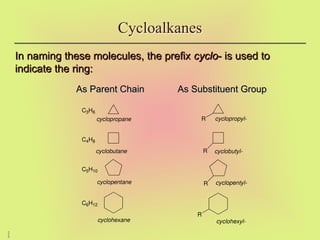
Cycloalkanes
Cycloalkanes
When there are three or more carbons in a straight chain, the
ends can be joined to make rings.
• In naming these molecules, the prefix
In naming these molecules, the prefix cyclo
cyclo- is used to
- is used to
indicate the ring:
indicate the ring:
• Skeletal structural formulas are used to represent the rings
Skeletal structural formulas are used to represent the rings
in structural formulas:
2
5
In naming these molecules, the prefix
In naming these molecules, the prefix cyclo
cyclo- is used to
- is used to
indicate the ring:
indicate the ring:
Cycloalkanes
cyclopropane
cyclobutane
cyclopentane
cyclohexane
C3H6
C4H8
C5H10
C6H12
R
R
R
R
cyclopropyl-
cyclobutyl-
cyclopentyl-
cyclohexyl-
As Parent Chain
As Parent Chain As Substituent Group
As Substituent Group
2
6
The carbon-carbon single bonds for the carbons in a ring are
no longer free to rotate.
• This leads to a new type of isomer
This leads to a new type of isomer
• Since the two structures share the same name, they are not
Since the two structures share the same name, they are not
constitutional isomers.
Cycloalkanes
CH3 CH3 CH3 CH3
H
H H
H
CH3
CH3
H
H
H
H H
H
H
H
H
H
CH3
H
CH3
H
H
H H
1,2-dimethylcyclohexane 1,2-dimethylcyclohexane
2
7
Isomers which share the same atomic connections, and
therefore, the same IUPAC name are called
therefore, the same IUPAC name are called stereoisomers.
stereoisomers.
• When this occurs due to restricted rotation about a covalent
When this occurs due to restricted rotation about a covalent
bond, they are called
bond, they are called geometric isomers
geometric isomers
• The prefix
The prefix cis-
cis- and
and trans-
trans- are used to distinguish geometric
are used to distinguish geometric
isomers.
isomers.
Cycloalkanes
CH3 CH3 CH3 CH3
H
H H
H
CH3
CH3
H
H
H
H H
H
H
H
H
H
CH3
H
CH3
H
H
H H
cis-1,2-dimethylcyclohexane trans-1,2-dimethylcyclohexane
2
8
Questions
Draw the condensed structural formulas for the following
molecules:
molecules:
A)
A) 1-ethyl-2-methylcyclopentane
1-ethyl-2-methylcyclopentane
B)
B) 1,1-dimethylcyclobutane
1,1-dimethylcyclobutane
C)
C) 1,1-dimethyl-2-propylcyclopropane
1,1-dimethyl-2-propylcyclopropane
Do any of these molecules have
Do any of these molecules have cis-
cis- and
and trans-
trans- geometric
geometric
isomers?
isomers?
2
9
Alkenes, Alkynes & Aromatic Compounds
The remaining three families of hydrocarbons are
unsaturated
unsaturated.
.
• Alkanes are
Alkanes are saturated
saturated, which means they contain the
, which means they contain the
maximum number of hydrogens per carbon.
• For alkanes C
For alkanes Cn
nH
H(2n+2)
(2n+2)
• Alkenes, Alkynes
Alkenes, Alkynes and
and Aromatics
Aromatics are
are unsaturated
unsaturated, which
, which
means they contain less than the maximum number of
hydrogens per carbon.
• Structurally, this means that they have carbon-carbon double or triple bonds
Structurally, this means that they have carbon-carbon double or triple bonds
3
0
Alkenes, Alkynes & Aromatic Compounds
Alkenes
Alkenes are hydrocarbons that contain at least 1 carbon-
are hydrocarbons that contain at least 1 carbon-
carbon double bond.
carbon double bond.
• Examples:
Examples:
C C
H
H
H
CH2 CH2 CH2 CH3
1-hexene
C C
H
H
H
H
ethene
(ethylene)
3
1
Alkenes, Alkynes & Aromatic Compounds
Alkynes
Alkynes are hydrocarbons that contain at least 1 carbon-
are hydrocarbons that contain at least 1 carbon-
carbon triple bond.
carbon triple bond.
• Examples:
Examples:
C C
H CH2 CH2 CH2 CH3
1-hexyne
C C
H H
ethyne
(acetylene)
3
2
Alkenes, Alkynes & Aromatic Compounds
Aromatics
Aromatics are unsaturated ring molecules
are unsaturated ring molecules
• They are often drawn to look like alkenes, but they behave
They are often drawn to look like alkenes, but they behave
much differently than alkenes.
• They have an alternating pattern of double and single
They have an alternating pattern of double and single
bonds within a ring.
• Benzene is an example
Benzene is an example
3
3
Alkenes, Alkynes & Aromatic Compounds
The physical properties of all hydrocarbons are the same
• The have essentially one noncovalent interaction, which
The have essentially one noncovalent interaction, which
isthe London dispersion force.
• They have no electronegative atoms and therefore have
They have no electronegative atoms and therefore have
• No ion/ion interactions
No ion/ion interactions
• No dipole/dipole interactions
No dipole/dipole interactions
• No hydrogenbonding interactions
No hydrogenbonding interactions
3
4
Alkenes, Alkynes & Aromatic Compounds
Naming of Alkenes and Alkynes work the same as for
alkanes, with these added rules:
• The parent chain must include both carbons in all double
The parent chain must include both carbons in all double
and triple bonds.
and triple bonds.
• Pick the longest chain that also contains all double and triple bonds
Pick the longest chain that also contains all double and triple bonds
• The
The -ene
-ene ending is used of alkenes
ending is used of alkenes
• The -
The -yne
yne ending is used for alkynes.
ending is used for alkynes.
• The number of the first carbon in the double or triple bond is
The number of the first carbon in the double or triple bond is
included in the name to locate the double or triple bond.
• Number the parent chain from the end that is closes to the first double or triple
Number the parent chain from the end that is closes to the first double or triple
bond.
bond.
3
5
Alkenes, Alkynes & Aromatic Compounds
Naming of Aromatics is based on benzene:
• When the molecule is build on benzene, the parent name
When the molecule is build on benzene, the parent name
is “benzene”.
is “benzene”.
• There are also many common names used to describe
There are also many common names used to describe
aromatic compounds.
aromatic compounds.
3
6
Alkenes, Alkynes & Aromatic Compounds
Naming of Aromatics is based on benzene:
• Aromatic compounds can contain multiple aromatic rings
Aromatic compounds can contain multiple aromatic rings
3
7
Alkenes, Alkynes & Aromatic Compounds
Benzo(a)pyrene found in tobacco smoke is converted to
carcinogenic products in the liver (see below) which link to
DNA and cause mutations.
3
8
Practice Quiz 1 KEY
Practice Quiz 1 KEY
http://www.
http://www.chem
chem.
.uwec
uwec
.edu/Chem150_S07/course/answers/C150-Quiz-1-key.
.edu/Chem150_S07/course/answers/C150-Quiz-1-key.swf
swf
3
9
Alkenes, Alkynes & Aromatic Compounds
There are many aromatic molecules found in biology
• Some aromatic compounds contain nitrogen and oxygen
Some aromatic compounds contain nitrogen and oxygen
atoms
atoms
• For example, the nucleotide base Adenine, which is used
For example, the nucleotide base Adenine, which is used
to make DNA and RNA
to make DNA and RNA
N
N
N
NH2
4
0
Alkenes, Alkynes & Aromatic Compounds
Like cycloalkanes, some alkenes can have
Like cycloalkanes, some alkenes can have cis
cis and
and trans
trans
isomers
isomers
• This is due to restricted rotation about the double-bond.
This is due to restricted rotation about the double-bond.
• Not all double bonds produce
Not all double bonds produce cis
cis and
and trans
trans isomers
isomers
• Each carbon participating in the double bond must have two different
Each carbon participating in the double bond must have two different
substituents attached to them
A ≠ B AND X ≠ Y
C C
A
B
X
Y
4
1
Alkenes, Alkynes & Aromatic Compounds
Like cycloalkanes, some alkenes can have
Like cycloalkanes, some alkenes can have cis
cis and
and trans
trans
isomers
isomers
4
2
Alcohols, Carboxylic Acids & Esters
In addition to the four families of hydrocarbons, there are also
many other families of organic molecules.
These other families include elements other than carbon and
hydrogen.
hydrogen.
• They exhibit a wide range of chemical and physical
They exhibit a wide range of chemical and physical
properties.
properties.
• The families are distinguished by a group of atoms called a
The families are distinguished by a group of atoms called a
functional group
functional group
4
3
Alcohols, Carboxylic Acids & Esters
Functional Group
Functional Group
“
“A functional group is an atom, group of atoms or bond that
A functional group is an atom, group of atoms or bond that
gives a molecule a particular set of chemical and physical
properties”
properties”
4
4
Alcohols, Carboxylic Acids & Esters
The carbon-carbon double bonds found in alkenes is an
example of a functional group.
• A chemical property of a double is that it will absorb
A chemical property of a double is that it will absorb
hydrogen in the hydrogenation reaction.
4
5
We look now at three families that are distinguished by a
functional group that contains the element oxygen.
Alcohols
Alcohols
• Members of the alcohol family contain a
Members of the alcohol family contain a hydroxyl group
hydroxyl group.
.
• The hydroxyl group comprises an oxygen with one single
The hydroxyl group comprises an oxygen with one single
bond to a hydrogen and another single bond to an alkane-
type carbon
type carbon
Alcohols, Carboxylic Acids & Esters
C C
H
H
H
H
H
O H hydroxyl group
hydroxyl group
An alkane-type carbon atom
ethanol
ethanol
4
6
We look now at three families that are distinguished by a
functional group that contains the element oxygen.
Carboxylic acids
Carboxylic acids
• Members of the carboxylic acid family contain a
Members of the carboxylic acid family contain a carboxylic
carboxylic
acid group
acid group
• The carboxylic acid group comprises a hydroxyl group
The carboxylic acid group comprises a hydroxyl group
connected to a carbonyl group:
Alcohols, Carboxylic Acids & Esters
+
+
C
O
O H C
O
O H
carbonyl group
carbonyl group hydroxyl group
hydroxyl group carboxylic acid group
carboxylic acid group
4
7
Alcohols, Carboxylic Acids & Esters
Carboxylic acids
Carboxylic acids
• The present of the hydroxyl group next to the cabonyl
The present of the hydroxyl group next to the cabonyl
group completely changes it properties.
• The alcohol hydroxyl group and the carboxylic acid hydroxyl group are
The alcohol hydroxyl group and the carboxylic acid hydroxyl group are
chemically quite different, which is why molecules that have the carboxylic acid
group are placed in a separate family from the alcohols.
• Later in the semester we will learn about some of these chemical differences.
Later in the semester we will learn about some of these chemical differences.
+
+
C
O
O H C
O
O H
carbonyl group
carbonyl group hydroxyl group
hydroxyl group carboxylic acid group
carboxylic acid group
4
8
Carboxylic acids
Carboxylic acids
• The carboxylic acid group can be attached to a hydrogen,
The carboxylic acid group can be attached to a hydrogen,
an alkane-type carbon, or an aromatic-type carbon:
Alcohols, Carboxylic Acids & Esters
methanoic acid
methanoic acid
(formic acid)
(formic acid)
propanoic acid
propanoic acid benzoic acid
benzoic acid
C OH
O
H C OH
O
C
C
H
H
H
H
H C OH
O
4
9
We look now at three families that are distinguished by a
functional group that contains the element oxygen.
Esters
Esters
• Chemically, esters can be synthesized by reacting a
Chemically, esters can be synthesized by reacting a
carboxylic acid with and alcohol:
Alcohols, Carboxylic Acids & Esters
carboxylic
carboxylic
acid
acid
alcohol
alcohol ester
ester water
water
C
O
O H H O C
+ C
O
O C H O
+ H
5
0
We look now at three families that are distinguished by a
functional group that contains the element oxygen.
Esters
Esters
• Chemically, esters can be synthesize by reacting a
Chemically, esters can be synthesize by reacting a
carboxylic acid with and alcohol:
Alcohols, Carboxylic Acids & Esters
C
O
O CH2
CH2
CH3 CH3
Carboxylic
acid part
Alcohol
part
Ethyl propanoate
Ethyl propanoate
5
1
Carboxylic acids
Carboxylic acids
• The carboxylic acid group can be attached to a hydrogen,
The carboxylic acid group can be attached to a hydrogen,
an alkane-type carbon, or an aromatic-type carbon:
Alcohols, Carboxylic Acids & Esters
methanoic acid
methanoic acid
(formic acid)
(formic acid)
propanoic acid
propanoic acid benzoic acid
benzoic acid
C OH
O
H C OH
O
C
C
H
H
H
H
H C OH
O
5
2
As we saw with the hydrocarbons, the physical properties of
organic molecules depend on the noncovalent intermolecular
interactions which attract one one molecule to another.
• With hydrocarbons, there is only one type of noncovalent
With hydrocarbons, there is only one type of noncovalent
interaction:
interaction:
• Induced dipole/Induced dipole (London dispersion force)
Induced dipole/Induced dipole (London dispersion force)
• The presence of the electronegative oxygen makes
The presence of the electronegative oxygen makes
alcohols, carboxylic acids and esters polar molecules,
these families, therefore, have at least two types of
noncovalent interactions:
• Induced dipole/Induced dipole (London dispersion force)
Induced dipole/Induced dipole (London dispersion force)
• Dipole/Dipole
Dipole/Dipole
Alcohols, Carboxylic Acids & Esters
5
3
As we saw with the hydrocarbons, the physical properties of
organic molecules depend on the noncovalent intermolecular
interactions which attract one one molecule to another.
• Alcohols and Carboxylic acids also have a hydroxyl group
Alcohols and Carboxylic acids also have a hydroxyl group
with a hydrogen bonded to an oxygen. This allows them to
form hydrogen bonds with each other. Therefore,
carboxylic acids have at least three different noncovalent
interactions:
interactions:
• Induced dipole/Induced dipole (London dispersion force)
Induced dipole/Induced dipole (London dispersion force)
• Dipole/Dipole
Dipole/Dipole
• Hydrogen bond
Hydrogen bond
Alcohols, Carboxylic Acids & Esters
5
4
To summarize, the types of noncovalent interact ions that
each family can participate in include:
• Hydrocarbons (Alkanes, Alkenes, Alkynes &
Hydrocarbons (Alkanes, Alkenes, Alkynes &
Aromatics)
Aromatics)
• Induced dipole/Induced dipole (London dispersion force)
Induced dipole/Induced dipole (London dispersion force)
• Esters
Esters
• Induced dipole/Induced dipole (London dispersion force)
Induced dipole/Induced dipole (London dispersion force)
• Dipole/Dipole
Dipole/Dipole
• Alcohols & Carboxylic acids
Alcohols & Carboxylic acids
• Induced dipole/Induced dipole (London dispersion force)
Induced dipole/Induced dipole (London dispersion force)
• Dipole/Dipole
Dipole/Dipole
• Hydrogen bond
Hydrogen bond
Alcohols, Carboxylic Acids & Esters
5
5
These interactions are illustrated in Figure 4.23 of your
textbook.
textbook.
Alcohols, Carboxylic Acids & Esters
alcohols
alcohols
carboxylic acids
carboxylic acids
esters
esters
5
6
Boiling points are a good measure of the strength of the
noncovalent interactions between molecules.
• The stronger the interactions, the higher the boiling point will
The stronger the interactions, the higher the boiling point will
be.
be.
• Since all molecules have the London dispersion interaction,
Since all molecules have the London dispersion interaction,
the boiling points of molecules is expected to increase with
temperature.
temperature.
• The next slide shows a chart using the data found in Table
The next slide shows a chart using the data found in Table
4.7 of Raymond, in which the boiling points for alcohols,
carboxylic acids and esters are plotted against molecular
weight.
weight.
Alcohols, Carboxylic Acids & Esters
5
7
Alcohols, Carboxylic Acids & Esters
• As expected, the boiling points
As expected, the boiling points
for members of all three
families increases with
molecular weight due to the
London dispersion interactions.
• For a given molecular weight,
For a given molecular weight,
the alcohols and carboxylic
acids have a higher boiling
point than esters, this is
because they can form
hydrogen bonds and esters
cannot.
cannot.
• The carboxylic acids have a
The carboxylic acids have a
slightly higher boiling point
than alcohols, because they
can form two hydrogen bonds
with a neighboring molecule (
See Figure 4.23 in Raymond
See Figure 4.23 in Raymond)
)
Molecular Weight {g/mol}
Boiling
Point
{°C}
Boiling
Point
{°C}
5
8
Alcohols, Carboxylic Acids & Esters
Another distinguishing characteristic of many of the families is
odor.
odor.
• You nose is actually a highly sensitive chemical detector.
You nose is actually a highly sensitive chemical detector.
• The members of different families can interact differently
The members of different families can interact differently
with the receptors in your nose to produce smells that are
characteristic of the families they belong to.
• For example:
For example:
• Carboxylic acids produce the pungent, sometime unpleasant odors associated
Carboxylic acids produce the pungent, sometime unpleasant odors associated
with ripe cheeses, rancid butter and vomit.
• Esters, on the other hand, produce the sweet, often pleasant order associated
Esters, on the other hand, produce the sweet, often pleasant order associated
with flowers, perfumes and various natural and artificial flavorings. The next slide
shows Figure 4.24 from Raymond, which gives some specific examples.
5
9
Examples of some
Examples of some
flavorable esters:
flavorable esters:
Alcohols, Carboxylic Acids & Esters
The End
The End

Unit-2-Hydrocarbons......................ppt

  • 1.
    Chem 150 Chem 150 Unit2 - Hydrocarbons & Unit 2 - Hydrocarbons & Functional Groups Functional Groups Organic chemistry is the chemistry of carbon. The Organic chemistry is the chemistry of carbon. The name “organic” reflect the fact that organic name “organic” reflect the fact that organic molecules are derived from living organisms. In this molecules are derived from living organisms. In this unit will start by looking at four families of organic unit will start by looking at four families of organic molecules that are grouped together as the molecules that are grouped together as the hydrocarbons. We will also look at some functional hydrocarbons. We will also look at some functional groups that define some of the other families of groups that define some of the other families of organic molecules. organic molecules.
  • 2.
    2 Organic Chemistry Organic Chemistry Organicchemistry is the chemistry of carbon. Organic chemistry is the chemistry of carbon. • There are three forms of pure carbon There are three forms of pure carbon • Diamond Diamond • Graphite Graphite
  • 3.
    3 Organic Chemistry Organic Chemistry Organicchemistry is the chemistry of carbon. Organic chemistry is the chemistry of carbon. • There are three forms of pure carbon There are three forms of pure carbon • Buckminsterfullerene Buckminsterfullerene “Bucky Balls” “Bucky Balls”
  • 4.
    4 Hydrocarbons Hydrocarbons • Organic moleculescontain carbon combined with other Organic molecules contain carbon combined with other elements. elements. • Organic molecules are grouped into families Organic molecules are grouped into families • Members of a family share common structural, physical, and chemical Members of a family share common structural, physical, and chemical characteristics. characteristics. • There are four families that contain molecules made of only There are four families that contain molecules made of only carbon and hydrogen. carbon and hydrogen. • Hydrocarbons Hydrocarbons • Alkanes Alkanes • Alkenes Alkenes • Alkynes Alkynes • Aromatics Aromatics
  • 5.
  • 6.
    6 Alkanes Alkanes Alkanes are hydrocarbonsthat contain only carbon-carbon Alkanes are hydrocarbons that contain only carbon-carbon single bonds. single bonds. • Every carbon atom participates in 4 single bonds, either to Every carbon atom participates in 4 single bonds, either to another carbon or to a hydrogen. another carbon or to a hydrogen. • Every hydrogen atom is bonded to a carbon by a single Every hydrogen atom is bonded to a carbon by a single bond. bond.
  • 7.
    7 Alkanes Alkanes Alkanes are hydrocarbonsthat contain only carbon-carbon Alkanes are hydrocarbons that contain only carbon-carbon single bonds. single bonds.
  • 8.
    8 Alkanes Alkanes • Alkanes inwhich the carbons are connected in a straight Alkanes in which the carbons are connected in a straight chain are called chain are called normal alkanes normal alkanes. . • Alkanes that are branched are called Alkanes that are branched are called branched chain branched chain alkanes alkanes. . C C C C C C H H H H H H H H H H H H H H C C C C C H H H H C H H H H H H H H H H n-hexane n-hexane 2-methyl-pentane 2-methyl-pentane
  • 9.
    Alkanes Alkanes For a discusionon the structure of alkanes, For a discusion on the structure of alkanes, see the Unit 2 see the Unit 2 Elaboration - Alkane Structure Elaboration - Alkane Structure
  • 10.
    1 0 Alkanes Alkanes • Alkanes, alongwith the other hydrocarbons, are non-polar. Alkanes, along with the other hydrocarbons, are non-polar. • They interact with each other only through London They interact with each other only through London dispersion forces. dispersion forces. • This is why they have relatively low boiling and melting This is why they have relatively low boiling and melting points. points.
  • 11.
    1 1 They interact witheach other only through London dispersion They interact with each other only through London dispersion forces. forces. • Note how the boiling points increase with molecular weight. Note how the boiling points increase with molecular weight. Alkanes Alkanes
  • 12.
    1 2 Molecule in theNews Molecule in the News
  • 13.
    1 3 Molecule in theNews:Melamine Molecule in the News:Melamine
  • 14.
  • 15.
    1 5 Alkanes, cannot benamed based on their molecular formulas Alkanes, cannot be named based on their molecular formulas • For example, all of the molecules shown below share the For example, all of the molecules shown below share the same molecular formula, C same molecular formula, C6 6H H14 14 ( (hexacarbon tetradecahydride hexacarbon tetradecahydride?) ?) Alkanes C C C C C C H H H H H H H H H H H H H H C C C C C H H H H C H H H H H H H H H H n-hexane n-hexane 2-methyl-pentane 2-methyl-pentane C C C C C H H H H C H H H H H H H H H H C C C C H H H C H H H H C H H H H H H H C C C C H H H C H H H C H H H H H H H H 3-methyl-pentane 3-methyl-pentane 2,2-dimethylbutane 2,2-dimethylbutane 2,3-dimethylbutane 2,3-dimethylbutane
  • 16.
    1 6 Organic chemists usea systematic set of rules, called the Organic chemists use a systematic set of rules, called the IUPAC rules, to name organic molecules based on their IUPAC rules, to name organic molecules based on their structural formulas instead of their chemical formulas. structural formulas instead of their chemical formulas. Alkanes C C C C C C H H H H H H H H H H H H H H C C C C C H H H H C H H H H H H H H H H n-hexane n-hexane 2-methyl-pentane 2-methyl-pentane C C C C C H H H H C H H H H H H H H H H C C C C H H H C H H H H C H H H H H H H C C C C H H H C H H H C H H H H H H H H 3-methyl-pentane 3-methyl-pentane 2,2-dimethylbutane 2,2-dimethylbutane 2,3-dimethylbutane 2,3-dimethylbutane
  • 17.
    Alkanes Alkanes For a discussionon naming alkanes, For a discussion on naming alkanes, see the Unit 2 see the Unit 2 Elaboration - Naming Alkanes Elaboration - Naming Alkanes
  • 18.
    1 8 When two ormore molecules share the same molecular When two or more molecules share the same molecular formula, but have different atomic connections, they are formula, but have different atomic connections, they are called called constitutional isomers constitutional isomers. . Constitutional Isomers C C C C C C H H H H H H H H H H H H H H C C C C C H H H H C H H H H H H H H H H n-hexane n-hexane 2-methyl-pentane 2-methyl-pentane C C C C C H H H H C H H H H H H H H H H C C C C H H H C H H H H C H H H H H H H C C C C H H H C H H H C H H H H H H H H 3-methyl-pentane 3-methyl-pentane 2,2-dimethylbutane 2,2-dimethylbutane 2,3-dimethylbutane 2,3-dimethylbutane
  • 19.
    1 9 Conformations Conformations Carbon-carbon single bondsare free to rotate Carbon-carbon single bonds are free to rotate • This leads to different shapes for some molecules This leads to different shapes for some molecules • These should not be confused with isomers. These should not be confused with isomers.
  • 20.
    2 0 Conformations Conformations All of the3-dimensional models shown below are for the All of the 3-dimensional models shown below are for the n- n- butane butane. . • They were generated by rotating the central carbon-carbon They were generated by rotating the central carbon-carbon bond. bond. • They all share the same structural formula. They all share the same structural formula. C C C C H H H H H H H H H H
  • 21.
    2 1 Conformations Conformations All of the3-dimensional models shown below are for the All of the 3-dimensional models shown below are for the n- n- butane butane. . • They were generated by rotating the central carbon-carbon They were generated by rotating the central carbon-carbon bond. bond. QuickTime™ and a Photo - JPEG decompressor are needed to see this picture.
  • 22.
    2 2 Conformations Conformations Switching from oneconformation to another Switching from one conformation to another does not does not require require the breaking and making of covalent bonds. the breaking and making of covalent bonds. • Switching from one isomer to another Switching from one isomer to another does does require the require the breaking and making of covalent bonds. breaking and making of covalent bonds. C C C C H H H H H H H H H H C C C C H H H H H H H H H H n-butane n-butane 2-methylpropane 2-methylpropane
  • 23.
    Conformations Conformations For a discussionon conformations, For a discussion on conformations, see the Unit 2 see the Unit 2 Elaboration - Conformations Elaboration - Conformations
  • 24.
    2 4 Cycloalkanes Cycloalkanes When there arethree or more carbons in a straight chain, the When there are three or more carbons in a straight chain, the ends can be joined to make rings. ends can be joined to make rings. • In naming these molecules, the prefix In naming these molecules, the prefix cyclo cyclo- is used to - is used to indicate the ring: indicate the ring: • Skeletal structural formulas are used to represent the rings Skeletal structural formulas are used to represent the rings in structural formulas: in structural formulas:
  • 25.
    2 5 In naming thesemolecules, the prefix In naming these molecules, the prefix cyclo cyclo- is used to - is used to indicate the ring: indicate the ring: Cycloalkanes cyclopropane cyclobutane cyclopentane cyclohexane C3H6 C4H8 C5H10 C6H12 R R R R cyclopropyl- cyclobutyl- cyclopentyl- cyclohexyl- As Parent Chain As Parent Chain As Substituent Group As Substituent Group
  • 26.
    2 6 The carbon-carbon singlebonds for the carbons in a ring are The carbon-carbon single bonds for the carbons in a ring are no longer free to rotate. no longer free to rotate. • This leads to a new type of isomer This leads to a new type of isomer • Since the two structures share the same name, they are not Since the two structures share the same name, they are not constitutional isomers. constitutional isomers. Cycloalkanes CH3 CH3 CH3 CH3 H H H H CH3 CH3 H H H H H H H H H H CH3 H CH3 H H H H 1,2-dimethylcyclohexane 1,2-dimethylcyclohexane
  • 27.
    2 7 Isomers which sharethe same atomic connections, and Isomers which share the same atomic connections, and therefore, the same IUPAC name are called therefore, the same IUPAC name are called stereoisomers. stereoisomers. • When this occurs due to restricted rotation about a covalent When this occurs due to restricted rotation about a covalent bond, they are called bond, they are called geometric isomers geometric isomers • The prefix The prefix cis- cis- and and trans- trans- are used to distinguish geometric are used to distinguish geometric isomers. isomers. Cycloalkanes CH3 CH3 CH3 CH3 H H H H CH3 CH3 H H H H H H H H H H CH3 H CH3 H H H H cis-1,2-dimethylcyclohexane trans-1,2-dimethylcyclohexane
  • 28.
    2 8 Questions Draw the condensedstructural formulas for the following Draw the condensed structural formulas for the following molecules: molecules: A) A) 1-ethyl-2-methylcyclopentane 1-ethyl-2-methylcyclopentane B) B) 1,1-dimethylcyclobutane 1,1-dimethylcyclobutane C) C) 1,1-dimethyl-2-propylcyclopropane 1,1-dimethyl-2-propylcyclopropane Do any of these molecules have Do any of these molecules have cis- cis- and and trans- trans- geometric geometric isomers? isomers?
  • 29.
    2 9 Alkenes, Alkynes &Aromatic Compounds Alkenes, Alkynes & Aromatic Compounds The remaining three families of hydrocarbons are The remaining three families of hydrocarbons are unsaturated unsaturated. . • Alkanes are Alkanes are saturated saturated, which means they contain the , which means they contain the maximum number of hydrogens per carbon. maximum number of hydrogens per carbon. • For alkanes C For alkanes Cn nH H(2n+2) (2n+2) • Alkenes, Alkynes Alkenes, Alkynes and and Aromatics Aromatics are are unsaturated unsaturated, which , which means they contain less than the maximum number of means they contain less than the maximum number of hydrogens per carbon. hydrogens per carbon. • Structurally, this means that they have carbon-carbon double or triple bonds Structurally, this means that they have carbon-carbon double or triple bonds
  • 30.
    3 0 Alkenes, Alkynes &Aromatic Compounds Alkenes, Alkynes & Aromatic Compounds Alkenes Alkenes are hydrocarbons that contain at least 1 carbon- are hydrocarbons that contain at least 1 carbon- carbon double bond. carbon double bond. • Examples: Examples: C C H H H CH2 CH2 CH2 CH3 1-hexene C C H H H H ethene (ethylene)
  • 31.
    3 1 Alkenes, Alkynes &Aromatic Compounds Alkenes, Alkynes & Aromatic Compounds Alkynes Alkynes are hydrocarbons that contain at least 1 carbon- are hydrocarbons that contain at least 1 carbon- carbon triple bond. carbon triple bond. • Examples: Examples: C C H CH2 CH2 CH2 CH3 1-hexyne C C H H ethyne (acetylene)
  • 32.
    3 2 Alkenes, Alkynes &Aromatic Compounds Alkenes, Alkynes & Aromatic Compounds Aromatics Aromatics are unsaturated ring molecules are unsaturated ring molecules • They are often drawn to look like alkenes, but they behave They are often drawn to look like alkenes, but they behave much differently than alkenes. much differently than alkenes. • They have an alternating pattern of double and single They have an alternating pattern of double and single bonds within a ring. bonds within a ring. • Benzene is an example Benzene is an example
  • 33.
    3 3 Alkenes, Alkynes &Aromatic Compounds Alkenes, Alkynes & Aromatic Compounds The physical properties of all hydrocarbons are the same The physical properties of all hydrocarbons are the same • The have essentially one noncovalent interaction, which The have essentially one noncovalent interaction, which isthe London dispersion force. isthe London dispersion force. • They have no electronegative atoms and therefore have They have no electronegative atoms and therefore have • No ion/ion interactions No ion/ion interactions • No dipole/dipole interactions No dipole/dipole interactions • No hydrogenbonding interactions No hydrogenbonding interactions
  • 34.
    3 4 Alkenes, Alkynes &Aromatic Compounds Alkenes, Alkynes & Aromatic Compounds Naming of Alkenes and Alkynes work the same as for Naming of Alkenes and Alkynes work the same as for alkanes, with these added rules: alkanes, with these added rules: • The parent chain must include both carbons in all double The parent chain must include both carbons in all double and triple bonds. and triple bonds. • Pick the longest chain that also contains all double and triple bonds Pick the longest chain that also contains all double and triple bonds • The The -ene -ene ending is used of alkenes ending is used of alkenes • The - The -yne yne ending is used for alkynes. ending is used for alkynes. • The number of the first carbon in the double or triple bond is The number of the first carbon in the double or triple bond is included in the name to locate the double or triple bond. included in the name to locate the double or triple bond. • Number the parent chain from the end that is closes to the first double or triple Number the parent chain from the end that is closes to the first double or triple bond. bond.
  • 35.
    3 5 Alkenes, Alkynes &Aromatic Compounds Alkenes, Alkynes & Aromatic Compounds Naming of Aromatics is based on benzene: Naming of Aromatics is based on benzene: • When the molecule is build on benzene, the parent name When the molecule is build on benzene, the parent name is “benzene”. is “benzene”. • There are also many common names used to describe There are also many common names used to describe aromatic compounds. aromatic compounds.
  • 36.
    3 6 Alkenes, Alkynes &Aromatic Compounds Alkenes, Alkynes & Aromatic Compounds Naming of Aromatics is based on benzene: Naming of Aromatics is based on benzene: • Aromatic compounds can contain multiple aromatic rings Aromatic compounds can contain multiple aromatic rings
  • 37.
    3 7 Alkenes, Alkynes &Aromatic Compounds Alkenes, Alkynes & Aromatic Compounds Benzo(a)pyrene found in tobacco smoke is converted to Benzo(a)pyrene found in tobacco smoke is converted to carcinogenic products in the liver (see below) which link to carcinogenic products in the liver (see below) which link to DNA and cause mutations. DNA and cause mutations.
  • 38.
    3 8 Practice Quiz 1KEY Practice Quiz 1 KEY http://www. http://www.chem chem. .uwec uwec .edu/Chem150_S07/course/answers/C150-Quiz-1-key. .edu/Chem150_S07/course/answers/C150-Quiz-1-key.swf swf
  • 39.
    3 9 Alkenes, Alkynes &Aromatic Compounds Alkenes, Alkynes & Aromatic Compounds There are many aromatic molecules found in biology There are many aromatic molecules found in biology • Some aromatic compounds contain nitrogen and oxygen Some aromatic compounds contain nitrogen and oxygen atoms atoms • For example, the nucleotide base Adenine, which is used For example, the nucleotide base Adenine, which is used to make DNA and RNA to make DNA and RNA N N N NH2
  • 40.
    4 0 Alkenes, Alkynes &Aromatic Compounds Alkenes, Alkynes & Aromatic Compounds Like cycloalkanes, some alkenes can have Like cycloalkanes, some alkenes can have cis cis and and trans trans isomers isomers • This is due to restricted rotation about the double-bond. This is due to restricted rotation about the double-bond. • Not all double bonds produce Not all double bonds produce cis cis and and trans trans isomers isomers • Each carbon participating in the double bond must have two different Each carbon participating in the double bond must have two different substituents attached to them substituents attached to them A ≠ B AND X ≠ Y C C A B X Y
  • 41.
    4 1 Alkenes, Alkynes &Aromatic Compounds Alkenes, Alkynes & Aromatic Compounds Like cycloalkanes, some alkenes can have Like cycloalkanes, some alkenes can have cis cis and and trans trans isomers isomers
  • 42.
    4 2 Alcohols, Carboxylic Acids& Esters Alcohols, Carboxylic Acids & Esters In addition to the four families of hydrocarbons, there are also In addition to the four families of hydrocarbons, there are also many other families of organic molecules. many other families of organic molecules. These other families include elements other than carbon and These other families include elements other than carbon and hydrogen. hydrogen. • They exhibit a wide range of chemical and physical They exhibit a wide range of chemical and physical properties. properties. • The families are distinguished by a group of atoms called a The families are distinguished by a group of atoms called a functional group functional group
  • 43.
    4 3 Alcohols, Carboxylic Acids& Esters Alcohols, Carboxylic Acids & Esters Functional Group Functional Group “ “A functional group is an atom, group of atoms or bond that A functional group is an atom, group of atoms or bond that gives a molecule a particular set of chemical and physical gives a molecule a particular set of chemical and physical properties” properties”
  • 44.
    4 4 Alcohols, Carboxylic Acids& Esters Alcohols, Carboxylic Acids & Esters The carbon-carbon double bonds found in alkenes is an The carbon-carbon double bonds found in alkenes is an example of a functional group. example of a functional group. • A chemical property of a double is that it will absorb A chemical property of a double is that it will absorb hydrogen in the hydrogenation reaction. hydrogen in the hydrogenation reaction.
  • 45.
    4 5 We look nowat three families that are distinguished by a We look now at three families that are distinguished by a functional group that contains the element oxygen. functional group that contains the element oxygen. Alcohols Alcohols • Members of the alcohol family contain a Members of the alcohol family contain a hydroxyl group hydroxyl group. . • The hydroxyl group comprises an oxygen with one single The hydroxyl group comprises an oxygen with one single bond to a hydrogen and another single bond to an alkane- bond to a hydrogen and another single bond to an alkane- type carbon type carbon Alcohols, Carboxylic Acids & Esters Alcohols, Carboxylic Acids & Esters C C H H H H H O H hydroxyl group hydroxyl group An alkane-type carbon atom An alkane-type carbon atom ethanol ethanol
  • 46.
    4 6 We look nowat three families that are distinguished by a We look now at three families that are distinguished by a functional group that contains the element oxygen. functional group that contains the element oxygen. Carboxylic acids Carboxylic acids • Members of the carboxylic acid family contain a Members of the carboxylic acid family contain a carboxylic carboxylic acid group acid group • The carboxylic acid group comprises a hydroxyl group The carboxylic acid group comprises a hydroxyl group connected to a carbonyl group: connected to a carbonyl group: Alcohols, Carboxylic Acids & Esters Alcohols, Carboxylic Acids & Esters + + C O O H C O O H carbonyl group carbonyl group hydroxyl group hydroxyl group carboxylic acid group carboxylic acid group
  • 47.
    4 7 Alcohols, Carboxylic Acids& Esters Alcohols, Carboxylic Acids & Esters Carboxylic acids Carboxylic acids • The present of the hydroxyl group next to the cabonyl The present of the hydroxyl group next to the cabonyl group completely changes it properties. group completely changes it properties. • The alcohol hydroxyl group and the carboxylic acid hydroxyl group are The alcohol hydroxyl group and the carboxylic acid hydroxyl group are chemically quite different, which is why molecules that have the carboxylic acid chemically quite different, which is why molecules that have the carboxylic acid group are placed in a separate family from the alcohols. group are placed in a separate family from the alcohols. • Later in the semester we will learn about some of these chemical differences. Later in the semester we will learn about some of these chemical differences. + + C O O H C O O H carbonyl group carbonyl group hydroxyl group hydroxyl group carboxylic acid group carboxylic acid group
  • 48.
    4 8 Carboxylic acids Carboxylic acids •The carboxylic acid group can be attached to a hydrogen, The carboxylic acid group can be attached to a hydrogen, an alkane-type carbon, or an aromatic-type carbon: an alkane-type carbon, or an aromatic-type carbon: Alcohols, Carboxylic Acids & Esters Alcohols, Carboxylic Acids & Esters methanoic acid methanoic acid (formic acid) (formic acid) propanoic acid propanoic acid benzoic acid benzoic acid C OH O H C OH O C C H H H H H C OH O
  • 49.
    4 9 We look nowat three families that are distinguished by a We look now at three families that are distinguished by a functional group that contains the element oxygen. functional group that contains the element oxygen. Esters Esters • Chemically, esters can be synthesized by reacting a Chemically, esters can be synthesized by reacting a carboxylic acid with and alcohol: carboxylic acid with and alcohol: Alcohols, Carboxylic Acids & Esters Alcohols, Carboxylic Acids & Esters carboxylic carboxylic acid acid alcohol alcohol ester ester water water C O O H H O C + C O O C H O + H
  • 50.
    5 0 We look nowat three families that are distinguished by a We look now at three families that are distinguished by a functional group that contains the element oxygen. functional group that contains the element oxygen. Esters Esters • Chemically, esters can be synthesize by reacting a Chemically, esters can be synthesize by reacting a carboxylic acid with and alcohol: carboxylic acid with and alcohol: Alcohols, Carboxylic Acids & Esters Alcohols, Carboxylic Acids & Esters C O O CH2 CH2 CH3 CH3 Carboxylic acid part Alcohol part Ethyl propanoate Ethyl propanoate
  • 51.
    5 1 Carboxylic acids Carboxylic acids •The carboxylic acid group can be attached to a hydrogen, The carboxylic acid group can be attached to a hydrogen, an alkane-type carbon, or an aromatic-type carbon: an alkane-type carbon, or an aromatic-type carbon: Alcohols, Carboxylic Acids & Esters methanoic acid methanoic acid (formic acid) (formic acid) propanoic acid propanoic acid benzoic acid benzoic acid C OH O H C OH O C C H H H H H C OH O
  • 52.
    5 2 As we sawwith the hydrocarbons, the physical properties of As we saw with the hydrocarbons, the physical properties of organic molecules depend on the noncovalent intermolecular organic molecules depend on the noncovalent intermolecular interactions which attract one one molecule to another. interactions which attract one one molecule to another. • With hydrocarbons, there is only one type of noncovalent With hydrocarbons, there is only one type of noncovalent interaction: interaction: • Induced dipole/Induced dipole (London dispersion force) Induced dipole/Induced dipole (London dispersion force) • The presence of the electronegative oxygen makes The presence of the electronegative oxygen makes alcohols, carboxylic acids and esters polar molecules, alcohols, carboxylic acids and esters polar molecules, these families, therefore, have at least two types of these families, therefore, have at least two types of noncovalent interactions: noncovalent interactions: • Induced dipole/Induced dipole (London dispersion force) Induced dipole/Induced dipole (London dispersion force) • Dipole/Dipole Dipole/Dipole Alcohols, Carboxylic Acids & Esters
  • 53.
    5 3 As we sawwith the hydrocarbons, the physical properties of As we saw with the hydrocarbons, the physical properties of organic molecules depend on the noncovalent intermolecular organic molecules depend on the noncovalent intermolecular interactions which attract one one molecule to another. interactions which attract one one molecule to another. • Alcohols and Carboxylic acids also have a hydroxyl group Alcohols and Carboxylic acids also have a hydroxyl group with a hydrogen bonded to an oxygen. This allows them to with a hydrogen bonded to an oxygen. This allows them to form hydrogen bonds with each other. Therefore, form hydrogen bonds with each other. Therefore, carboxylic acids have at least three different noncovalent carboxylic acids have at least three different noncovalent interactions: interactions: • Induced dipole/Induced dipole (London dispersion force) Induced dipole/Induced dipole (London dispersion force) • Dipole/Dipole Dipole/Dipole • Hydrogen bond Hydrogen bond Alcohols, Carboxylic Acids & Esters
  • 54.
    5 4 To summarize, thetypes of noncovalent interact ions that To summarize, the types of noncovalent interact ions that each family can participate in include: each family can participate in include: • Hydrocarbons (Alkanes, Alkenes, Alkynes & Hydrocarbons (Alkanes, Alkenes, Alkynes & Aromatics) Aromatics) • Induced dipole/Induced dipole (London dispersion force) Induced dipole/Induced dipole (London dispersion force) • Esters Esters • Induced dipole/Induced dipole (London dispersion force) Induced dipole/Induced dipole (London dispersion force) • Dipole/Dipole Dipole/Dipole • Alcohols & Carboxylic acids Alcohols & Carboxylic acids • Induced dipole/Induced dipole (London dispersion force) Induced dipole/Induced dipole (London dispersion force) • Dipole/Dipole Dipole/Dipole • Hydrogen bond Hydrogen bond Alcohols, Carboxylic Acids & Esters
  • 55.
    5 5 These interactions areillustrated in Figure 4.23 of your These interactions are illustrated in Figure 4.23 of your textbook. textbook. Alcohols, Carboxylic Acids & Esters alcohols alcohols carboxylic acids carboxylic acids esters esters
  • 56.
    5 6 Boiling points area good measure of the strength of the Boiling points are a good measure of the strength of the noncovalent interactions between molecules. noncovalent interactions between molecules. • The stronger the interactions, the higher the boiling point will The stronger the interactions, the higher the boiling point will be. be. • Since all molecules have the London dispersion interaction, Since all molecules have the London dispersion interaction, the boiling points of molecules is expected to increase with the boiling points of molecules is expected to increase with temperature. temperature. • The next slide shows a chart using the data found in Table The next slide shows a chart using the data found in Table 4.7 of Raymond, in which the boiling points for alcohols, 4.7 of Raymond, in which the boiling points for alcohols, carboxylic acids and esters are plotted against molecular carboxylic acids and esters are plotted against molecular weight. weight. Alcohols, Carboxylic Acids & Esters
  • 57.
    5 7 Alcohols, Carboxylic Acids& Esters • As expected, the boiling points As expected, the boiling points for members of all three for members of all three families increases with families increases with molecular weight due to the molecular weight due to the London dispersion interactions. London dispersion interactions. • For a given molecular weight, For a given molecular weight, the alcohols and carboxylic the alcohols and carboxylic acids have a higher boiling acids have a higher boiling point than esters, this is point than esters, this is because they can form because they can form hydrogen bonds and esters hydrogen bonds and esters cannot. cannot. • The carboxylic acids have a The carboxylic acids have a slightly higher boiling point slightly higher boiling point than alcohols, because they than alcohols, because they can form two hydrogen bonds can form two hydrogen bonds with a neighboring molecule ( with a neighboring molecule ( See Figure 4.23 in Raymond See Figure 4.23 in Raymond) ) Molecular Weight {g/mol} Molecular Weight {g/mol} Boiling Point {°C} Boiling Point {°C}
  • 58.
    5 8 Alcohols, Carboxylic Acids& Esters Another distinguishing characteristic of many of the families is Another distinguishing characteristic of many of the families is odor. odor. • You nose is actually a highly sensitive chemical detector. You nose is actually a highly sensitive chemical detector. • The members of different families can interact differently The members of different families can interact differently with the receptors in your nose to produce smells that are with the receptors in your nose to produce smells that are characteristic of the families they belong to. characteristic of the families they belong to. • For example: For example: • Carboxylic acids produce the pungent, sometime unpleasant odors associated Carboxylic acids produce the pungent, sometime unpleasant odors associated with ripe cheeses, rancid butter and vomit. with ripe cheeses, rancid butter and vomit. • Esters, on the other hand, produce the sweet, often pleasant order associated Esters, on the other hand, produce the sweet, often pleasant order associated with flowers, perfumes and various natural and artificial flavorings. The next slide with flowers, perfumes and various natural and artificial flavorings. The next slide shows Figure 4.24 from Raymond, which gives some specific examples. shows Figure 4.24 from Raymond, which gives some specific examples.
  • 59.
    5 9 Examples of some Examplesof some flavorable esters: flavorable esters: Alcohols, Carboxylic Acids & Esters
  • 60.