Medical and Surgical Nursing
Genito-Urinary Tract
Prepared by: Mark Fredderick R. Abejo RN,MAN
                                                                          B.   Structure
                                                                               1. Renal pelvis
                                                                               2. Renal colic
                                                                               3. Renal medulla
                                                                          C.   Nephron  glomerulus
                                                                          D.   Functions
                                                                               1. Urine formation
                                                                               2. Regulates BP
                                                                          E.   Urine Formation (Normal GFR: 125 ml of blood is
           MEDICAL AND SURGICAL NURSING                                        filtered in the glomerulus per minute)
                                                                               1. Filtration
                 Genito-Urinary Tract Disorder                                 2. Tubular Reabsorption – 124 ml of ultrafiltrates are
                                                                                     reabsorbed back into the blood
      Lecturer: Mark Fredderick R. Abejo RN,MAN                                3. Tubular Secretion – 1 ml excreted in the urine; ¼ of
________________________________________________                                     total cardiac output is received by kidneys

                                                                     II. Ureters – 20-30 mm long – serves as a passageway of urine

                                                                     III. Bladder
     OVERVIEW OF THE STRUCTURE AND FUNCTION OF                            A. Located behind the symphysis pubis
             THE GENITO-URINARY TRACT                                     B. Made up of muscular and elastic tissues  distensible 
                                                                              reservoir of urine
       -   Promotes excretion of nitrogenous waste products               C. Max: 1, 200 -1,800 ml of urine
       -   Maintain fluid electrolytes and acid-base balance              D. Initiates urination: 250-500 cc ml
                                                                          E. Normal urine:
                                                                              1. amber, aromatic, turbid/clear, pH 4-8
                                                                              2. spec gravity: 1.015-1.030
                                                                              3. WBC, CHON none
                                                                              4. (-) E. coli
                                                                              5. mucus threads few
                                                                              6. (-) amorphous urates
                                                                     IV. Urethra
                                                                          A. Serves as a passageway for urine, vaginal/seminal fluids
                                                                          B. Length
                                                                              1. F: 3-5 cm or 1-1/2 inches
                                                                              2. M: 20 cm or 8 inches
                                                                          C. Catheter
                                                                              1. Pedia: 8-10 fr
                                                                              2. F: 12-14 fr
                                                                              3. M: 16-18 fr

                                                                                    URINARY TRACT INFECTIONS

                                                                     I.   CYSTITIS – inflammation of bladder caused by bacterial
                                                                          infection


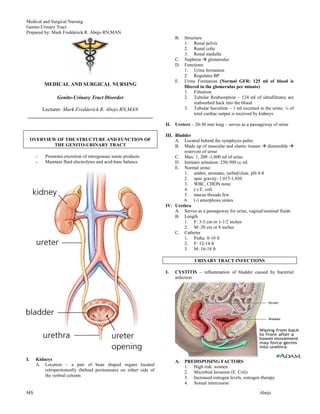
I.     Kidneys                                                            A.   PREDISPOSING FACTORS
       A. Location – a pair of bean shaped organs located                      1. High risk: women
           retroperitoneally (behind peritoneum) on either side of             2. Microbial Invasion (E. Coli)
           the verbral column                                                  3. Increased estrogen levels, estrogen therapy
                                                                               4. Sexual intercourse

MS                                                                                                                   Abejo
Medical and Surgical Nursing
Genito-Urinary Tract
Prepared by: Mark Fredderick R. Abejo RN,MAN
                                                                                           Void after sexual intercourse
          5.   Urinary retention                                                           Instruct female client to:
          6.   Incontinence                                                                  Proper perineal hygiene
          7.   Urinary obstruction                                                           Front to back cleaning
          8.   Poor perineal hygiene                                                         Avoid tissue use
                                                                                             Bubble bath
     B.   S/SX                                                                               (-) talcum powder, perfume
          1. Urinary frequency and urgency
          2. Flank pain                                                           7.   Prevent complications
          3. Fever, chills, anorexia, generalized body malaise                            Pyelonephritis
          4. Dysuria – burning upon urination
          5. Hematuria                                                  II. PYELONEPHRITIS – acute or chronic inflammation of
                                                                            renal pelvis leading to tubular destruction, intestinal abscesses
     C.   DX                                                                and renal failure
          1. Urine culture and sensitivity
                (+) E. Coli 90%
          2. Urinalysis
                Increased WBC
                Increased CHON
                Increased pus cells

     D.   NSG MGMT
          1. Forced fluids (2-3 L/d)
          2. Provide warm sitz bath to promote comfort
          3. Provide acid-ash diet: cranberries, grape juice,
             plums


                                                                             A.   PREDISPOSING FACTORS
                                                                                  1. Microbial invasion
                                                                                        E. coli
                                                                                        Streptococcus
                                                                                  2. Urinary retention/ stagnation
                                                                                  3. pregnancy
                                                                                  4. DM
                                                                                  5. Exposure to renal toxins/ use of nephrotoxic agents
                                                                                  6. Obesity
          4.   Monitor for gross hematuria, color, odor of urine
                                                                             B.   S/SX
          5.   Administer meds as ordered
                                                                                  1. Acute Pyelonephritis
                  Systemic antibiotics
                                                                                        Urinary frequency and urgency
                    Penicillins
                                                                                        Costovertebral angle pain and tenderness
                    Cephalosporins          (SE:    nephrotoxicity,
                                                                                        Fevers and chills, anorexia, general body
                        hepatotoxicity)
                                                                                         malaise
                    Tetracycline         (staining    of      teeth,
                                                                                        Burning upon urination
                        photosensitivity)
                                                                                        Dysuria, nocturia, hematuria
                  Sulfonamides
                                                                                  2. Chronic Pyelonephritis
                    Co-trimoxazole (Bactrim)
                                                                                        Fatigue and/or weakness
                    Gantricin
                                                                                        Weight loss
                    Sulfisoxazole
                                                                                        Polyuria
                  Urinary antiseptics
                                                                                        Polydypsia
                    Nitrofurantoin (Macrodantin)
                                                                                        HPN
                    Furadantoin
                  Urinary analgesics
                                                                             C.   DIAGNOSTICS
                    Pyridium – decreases pain, promotes
                                                                                  1. Urine CS: (+) cultured microorganisms (E.coli and
                        relaxation of sphincter
                                                                                     strep)
          6.   Discharge teaching
                                                                                  2. Urinalysis: elevated WBC, CHON, pus cells
                  Importance of hydration
                                                                                  3. Cystoscopic exam: (+) urinary obstruction
MS                                                                                                                        Abejo
Medical and Surgical Nursing
Genito-Urinary Tract
Prepared by: Mark Fredderick R. Abejo RN,MAN
                                                                              4.   Strain all urine using gauze pad
     D.   NURSING MANAGEMENT                                                  5.   Warm sitz bath for comfort
          1. Provide CBR especially during acute attack                       6.   Meds as ordered
          2. Forced fluids                                                             Narcotic analgesics – morphine
          3. Provide an acid ash in the diet                                           Allopurinol (zyloprim)
          4. Provide warm sitz bath for comfort                               7.   Provide dietary intake:
          5. Administer medications as ordered                                         If (+) to ca stones: acid ash
                 Nitrofurantoin                                                       If (+) to oxalate stones: alkaline ash (milk,
                   SE: GIT irritation, give with food,                                 tea, vegetables)
                       peripheral neuropathy, hemolytic anemia                         If (+) to uric acid: avoid purine rich food
                       (initial sx: fever), discoloration of teeth                      like anchovies, legumes, organ meat, nuts
                 Urinary analgesics                                          8.   Assist
                   Pyridium                                                           Litholapoxy – surgical removal of 2/3 stone
          6. prevent complications                                                     Nephrectomy – removal of kidney 
                 renal failure                                                         stagnation
                                                                                       Lithotripsy – extracorporeal shockwave
III. NEPHROLITHIASIS/UROLITHIASIS – formation of                                         No incision, early discharge
     stones elsewhere in the urinary tract                                               Too costly
                                                                                         Stones can recur
                                                                                         Post-op: strain urine
                                                                              9.   Prevent complications  renal failure

                                                                     IV. ACUTE RENAL FAILURE (ARF) – sudden inability of the
                                                                         kidneys to excrete nitrogenous waste products, leads to
                                                                         azotemia

                                                                         A.   PREDISPOSING FACTORS
                                                                              1. Pre-renal : involves decrease in GFR
                                                                                 (n=125ml/hr)
                                                                                     Hemorrhage
                                                                                     Shock
                                                                                     Chronic diarrhea (dehydration)
                                                                                     CHF
     A.   TYPES OF STONES
                                                                                     Hypotension
          1. calcium
                                                                                     Septicemia
          2. oxalate
                                                                              2. Intrarenal – involves renal pathology
          3. uric acid
                                                                                     Pyelonephritis
                                                                                     DM
     B.   PREDISPOSING FACTORS
                                                                                     AGN
          1. diet high in calcium and oxalate
                                                                                     Acute tubular necrosis: common SE post-
          2. hereditary (like gout)
                                                                                      hemolytic BT
          3. hyperparathyroidism (Hypercalcemia)
                                                                              3. Post-renal – (+) mechanical obstruction
          4. obesity
                                                                                     BPH
          5. sedentary lifestyle
                                                                                     Nephro/urolithiasis
                                                                                     Tumor
     C.   S/SX
                                                                                     Urinary strictures
          1. Renal colic
          2. Cool, moist skin
          3. Burning upon urination
          4. Dysuria, Nocturia
          5. Hematuria

     D.   DIAGNOSTICS
          1. Urinalysis – (+) RBC, WBC, Pus cells
          2. KUB: reveal site or location of stones
          3. Stone analysis: reveals composition of stone
          4. Cystoscopic exam: urinary obstruction
          5. IVP: reveals obstruction


     E.   NURSING MANAGEMENT
          1. Forced fluids to prevent further crystallization
          2. Alternate warm and cold compress
          3. Administer isotonic fluids as ordered

MS                                                                                                                 Abejo
Medical and Surgical Nursing
Genito-Urinary Tract
Prepared by: Mark Fredderick R. Abejo RN,MAN
                                                                                Anorexia
     B.   STAGES                                                                N&V
                                                                                Diarrhea and/or constipation
          1.   Oliguric phase – passage of urine (1-2 weeks)                    Stomatitis
                  UO: <400 ml/cc                                               Uremic breath
                  Hyperkalemia                                        7.   Integumentary
                  Hypernatremia                                                Pruritus
                  Hyperphosphatemia                                            Uremic frost
                  HYPOCALCEMIA                                        8.   Metabolic/Electrolyte imbalance
                  Hypermagnesemia                                              Hyperkalemia
                  Metabolic acidosis                                           Hyperphosphatemia
                  Elevated BUN, Crea                                           Metabolic acidosis
          2.   Diuretic Phase (2-3 weeks)                              9.   Endo
                  Increased passage of urine                                   Gynecomastia
                  Hyperkalemia                                                 Hyperthyroidism
                  Hyponatremia
                  Metabolic acidosis                             D.   NURSING MANAGEMENT
          3.   Convalescent phase (3-12 months)                        1. Enforce CBR
                  Improvement in passage of urine                     2. Admin oxygen inhalation as ordered
                  Characterized by complete diuresis                  3. High CHO diet low CHON, fats, High vit and
                                                                          minerals
V.   CHRONIC RENAL FAILURE (CRF) – irreversible loss of                4. Provide meticulous skin care
     kidney function                                                         Wash with warm water
                                                                             Soap irritates and dries skin
     A.   PREDISPOSING FACTORS                                         5. Meds as ordered
          1. DM and HPN (common causes)                                      anti-HPN agents
          2. Recurrent pyelonephritis                                          Hydralazine (appresoline)
          3. Exposure to renal toxins                                               SE: orthostatic hypotension
          4. Tumor                                                           NaHCO3
                                                                             Kayexelate enema
     B.   STAGES                                                             Hematinics
          1. Diminished renal reserve volume – asymptomatic,                 Antibiotics
             normal BUN and CREA                                             Supplementary vitamins and minerals
          2. Renal insufficiency                                             Phosphate binders
          3. End-stage renal disease (ESRD) – presence of                    Calcium gluconate
             oliguria, azotemia
                                                                       6.   Assist in hemodialysis
     C.   S/SX
          1. Uro
                Azotemia (elevated BUN and crea)
                Oliguria
                Nocturia
                Hematuria
                Dysuria
          2. Neuro
                Lethargy
                Headache
                Disorientation (initial sign of disequilibrium
                 syndrome) and confusion, restlessness
                Memory impairment
                Decreased LOC
          3. Respi
                Depressed or diminished cough reflex
                Kussmaul’s respirations
          4. Hema
                Anemia
                Leukopenia
                Bleeding tendencies (thrombocytopenia)                        Secure consent and explain procedure to client
                All blood cells decreased                                     Maintain strict aseptic technique
                Increased susceptibility to infection                         Obtain baseline data – before and q30 during
          5. CV changes                                                         procedure
                Pulmo HPN                                                       VS
                CHF                                                             Wt
                Pericarditis                                                    Blood exams – secure all pre-procedure
          6. GIT distress                                                        I/O
MS                                                                                                              Abejo
Medical and Surgical Nursing
Genito-Urinary Tract
Prepared by: Mark Fredderick R. Abejo RN,MAN
                                                                                Most      common       complication    is
                Have client void pre-procedure                                  PERITONITIS and shock
                Inform pt about bleeding (blood is heparinized)                  First sign: cloudy dialysate return
                Monitor for signs of complications                               Most           common        dialysate:
                 (BEDSSH)                                                             INFERSOL
                  Bleeding                                                     Infusion time: 10-20 minutes
                  Embolism                                                     Dwelling time: 30-45 minutes
                  DISEQUILIBRIUM SYNDROME –
                      results from rapid loss of nitrogenous                What determines effectiveness of dialysis?
                      waste products particularly UREA from                   Weight of patient
                      the brain
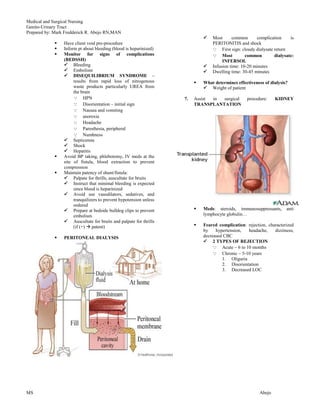
                       HPN                                         7.   Assist in surgical       procedure:     KIDNEY
                       Disorientation – initial sign                    TRANSPLANTATION
                       Nausea and vomiting
                       anorexia
                       Headache
                       Paresthesia, peripheral
                       Numbness
                  Septicemia
                  Shock
                  Hepatitis
                Avoid BP taking, phlebotomy, IV meds at the
                 site of fistula, blood extraction to prevent
                 compression
                Maintain patency of shunt/fistula:
                  Palpate for thrills, auscultate for bruits
                  Instruct that minimal bleeding is expected
                      since blood is heparinized
                  Avoid use vasodilators, sedatives, and
                      tranquilizers to prevent hypotension unless
                      ordered
                  Prepare at bedside bulldog clips to prevent              Meds: steroids, immunosuppressants,      anti
                      embolism                                               lymphocyte globulin…
                  Auscultate for bruits and palpate for thrills
                      (if (+)  patent)                                     Feared complication: rejection, characterized
                                                                             by    hypertension,  headache,     dizziness,
                PERITONEAL DIALYSIS                                         decreased CBC
                                                                              2 TYPES OF REJECTION
                                                                                   Acute – 6 to 10 months
                                                                                   Chronic – 5-10 years
                                                                                      1. Oliguria
                                                                                      2. Disorientation
                                                                                      3. Decreased LOC


MS                                                                                                       Abejo
Medical and Surgical Nursing
Genito-Urinary Tract
Prepared by: Mark Fredderick R. Abejo RN,MAN


MS                                             Abejo
Medical and Surgical Nursing
Genito-Urinary Tract
Prepared by: Mark Fredderick R. Abejo RN,MAN


MS                                             Abejo

Genito Urinary Nursing

  • 1.
    Medical and SurgicalNursing Genito-Urinary Tract Prepared by: Mark Fredderick R. Abejo RN,MAN B. Structure 1. Renal pelvis 2. Renal colic 3. Renal medulla C. Nephron  glomerulus D. Functions 1. Urine formation 2. Regulates BP E. Urine Formation (Normal GFR: 125 ml of blood is MEDICAL AND SURGICAL NURSING filtered in the glomerulus per minute) 1. Filtration Genito-Urinary Tract Disorder 2. Tubular Reabsorption – 124 ml of ultrafiltrates are reabsorbed back into the blood Lecturer: Mark Fredderick R. Abejo RN,MAN 3. Tubular Secretion – 1 ml excreted in the urine; ¼ of ________________________________________________ total cardiac output is received by kidneys II. Ureters – 20-30 mm long – serves as a passageway of urine III. Bladder OVERVIEW OF THE STRUCTURE AND FUNCTION OF A. Located behind the symphysis pubis THE GENITO-URINARY TRACT B. Made up of muscular and elastic tissues  distensible  reservoir of urine - Promotes excretion of nitrogenous waste products C. Max: 1, 200 -1,800 ml of urine - Maintain fluid electrolytes and acid-base balance D. Initiates urination: 250-500 cc ml E. Normal urine: 1. amber, aromatic, turbid/clear, pH 4-8 2. spec gravity: 1.015-1.030 3. WBC, CHON none 4. (-) E. coli 5. mucus threads few 6. (-) amorphous urates IV. Urethra A. Serves as a passageway for urine, vaginal/seminal fluids B. Length 1. F: 3-5 cm or 1-1/2 inches 2. M: 20 cm or 8 inches C. Catheter 1. Pedia: 8-10 fr 2. F: 12-14 fr 3. M: 16-18 fr URINARY TRACT INFECTIONS I. CYSTITIS – inflammation of bladder caused by bacterial infection I. Kidneys A. PREDISPOSING FACTORS A. Location – a pair of bean shaped organs located 1. High risk: women retroperitoneally (behind peritoneum) on either side of 2. Microbial Invasion (E. Coli) the verbral column 3. Increased estrogen levels, estrogen therapy 4. Sexual intercourse MS Abejo
  • 2.
    Medical and SurgicalNursing Genito-Urinary Tract Prepared by: Mark Fredderick R. Abejo RN,MAN  Void after sexual intercourse 5. Urinary retention  Instruct female client to: 6. Incontinence  Proper perineal hygiene 7. Urinary obstruction  Front to back cleaning 8. Poor perineal hygiene  Avoid tissue use  Bubble bath B. S/SX  (-) talcum powder, perfume 1. Urinary frequency and urgency 2. Flank pain 7. Prevent complications 3. Fever, chills, anorexia, generalized body malaise  Pyelonephritis 4. Dysuria – burning upon urination 5. Hematuria II. PYELONEPHRITIS – acute or chronic inflammation of renal pelvis leading to tubular destruction, intestinal abscesses C. DX and renal failure 1. Urine culture and sensitivity  (+) E. Coli 90% 2. Urinalysis  Increased WBC  Increased CHON  Increased pus cells D. NSG MGMT 1. Forced fluids (2-3 L/d) 2. Provide warm sitz bath to promote comfort 3. Provide acid-ash diet: cranberries, grape juice, plums A. PREDISPOSING FACTORS 1. Microbial invasion  E. coli  Streptococcus 2. Urinary retention/ stagnation 3. pregnancy 4. DM 5. Exposure to renal toxins/ use of nephrotoxic agents 6. Obesity 4. Monitor for gross hematuria, color, odor of urine B. S/SX 5. Administer meds as ordered 1. Acute Pyelonephritis  Systemic antibiotics  Urinary frequency and urgency  Penicillins  Costovertebral angle pain and tenderness  Cephalosporins (SE: nephrotoxicity,  Fevers and chills, anorexia, general body hepatotoxicity) malaise  Tetracycline (staining of teeth,  Burning upon urination photosensitivity)  Dysuria, nocturia, hematuria  Sulfonamides 2. Chronic Pyelonephritis  Co-trimoxazole (Bactrim)  Fatigue and/or weakness  Gantricin  Weight loss  Sulfisoxazole  Polyuria  Urinary antiseptics  Polydypsia  Nitrofurantoin (Macrodantin)  HPN  Furadantoin  Urinary analgesics C. DIAGNOSTICS  Pyridium – decreases pain, promotes 1. Urine CS: (+) cultured microorganisms (E.coli and relaxation of sphincter strep) 6. Discharge teaching 2. Urinalysis: elevated WBC, CHON, pus cells  Importance of hydration 3. Cystoscopic exam: (+) urinary obstruction MS Abejo
  • 3.
    Medical and SurgicalNursing Genito-Urinary Tract Prepared by: Mark Fredderick R. Abejo RN,MAN 4. Strain all urine using gauze pad D. NURSING MANAGEMENT 5. Warm sitz bath for comfort 1. Provide CBR especially during acute attack 6. Meds as ordered 2. Forced fluids  Narcotic analgesics – morphine 3. Provide an acid ash in the diet  Allopurinol (zyloprim) 4. Provide warm sitz bath for comfort 7. Provide dietary intake: 5. Administer medications as ordered  If (+) to ca stones: acid ash  Nitrofurantoin  If (+) to oxalate stones: alkaline ash (milk,  SE: GIT irritation, give with food, tea, vegetables) peripheral neuropathy, hemolytic anemia  If (+) to uric acid: avoid purine rich food (initial sx: fever), discoloration of teeth like anchovies, legumes, organ meat, nuts  Urinary analgesics 8. Assist  Pyridium  Litholapoxy – surgical removal of 2/3 stone 6. prevent complications  Nephrectomy – removal of kidney   renal failure stagnation  Lithotripsy – extracorporeal shockwave III. NEPHROLITHIASIS/UROLITHIASIS – formation of  No incision, early discharge stones elsewhere in the urinary tract  Too costly  Stones can recur  Post-op: strain urine 9. Prevent complications  renal failure IV. ACUTE RENAL FAILURE (ARF) – sudden inability of the kidneys to excrete nitrogenous waste products, leads to azotemia A. PREDISPOSING FACTORS 1. Pre-renal : involves decrease in GFR (n=125ml/hr)  Hemorrhage  Shock  Chronic diarrhea (dehydration)  CHF A. TYPES OF STONES  Hypotension 1. calcium  Septicemia 2. oxalate 2. Intrarenal – involves renal pathology 3. uric acid  Pyelonephritis  DM B. PREDISPOSING FACTORS  AGN 1. diet high in calcium and oxalate  Acute tubular necrosis: common SE post- 2. hereditary (like gout) hemolytic BT 3. hyperparathyroidism (Hypercalcemia) 3. Post-renal – (+) mechanical obstruction 4. obesity  BPH 5. sedentary lifestyle  Nephro/urolithiasis  Tumor C. S/SX  Urinary strictures 1. Renal colic 2. Cool, moist skin 3. Burning upon urination 4. Dysuria, Nocturia 5. Hematuria D. DIAGNOSTICS 1. Urinalysis – (+) RBC, WBC, Pus cells 2. KUB: reveal site or location of stones 3. Stone analysis: reveals composition of stone 4. Cystoscopic exam: urinary obstruction 5. IVP: reveals obstruction E. NURSING MANAGEMENT 1. Forced fluids to prevent further crystallization 2. Alternate warm and cold compress 3. Administer isotonic fluids as ordered MS Abejo
  • 4.
    Medical and SurgicalNursing Genito-Urinary Tract Prepared by: Mark Fredderick R. Abejo RN,MAN  Anorexia B. STAGES  N&V  Diarrhea and/or constipation 1. Oliguric phase – passage of urine (1-2 weeks)  Stomatitis  UO: <400 ml/cc  Uremic breath  Hyperkalemia 7. Integumentary  Hypernatremia  Pruritus  Hyperphosphatemia  Uremic frost  HYPOCALCEMIA 8. Metabolic/Electrolyte imbalance  Hypermagnesemia  Hyperkalemia  Metabolic acidosis  Hyperphosphatemia  Elevated BUN, Crea  Metabolic acidosis 2. Diuretic Phase (2-3 weeks) 9. Endo  Increased passage of urine  Gynecomastia  Hyperkalemia  Hyperthyroidism  Hyponatremia  Metabolic acidosis D. NURSING MANAGEMENT 3. Convalescent phase (3-12 months) 1. Enforce CBR  Improvement in passage of urine 2. Admin oxygen inhalation as ordered  Characterized by complete diuresis 3. High CHO diet low CHON, fats, High vit and minerals V. CHRONIC RENAL FAILURE (CRF) – irreversible loss of 4. Provide meticulous skin care kidney function  Wash with warm water  Soap irritates and dries skin A. PREDISPOSING FACTORS 5. Meds as ordered 1. DM and HPN (common causes)  anti-HPN agents 2. Recurrent pyelonephritis  Hydralazine (appresoline) 3. Exposure to renal toxins  SE: orthostatic hypotension 4. Tumor  NaHCO3  Kayexelate enema B. STAGES  Hematinics 1. Diminished renal reserve volume – asymptomatic,  Antibiotics normal BUN and CREA  Supplementary vitamins and minerals 2. Renal insufficiency  Phosphate binders 3. End-stage renal disease (ESRD) – presence of  Calcium gluconate oliguria, azotemia 6. Assist in hemodialysis C. S/SX 1. Uro  Azotemia (elevated BUN and crea)  Oliguria  Nocturia  Hematuria  Dysuria 2. Neuro  Lethargy  Headache  Disorientation (initial sign of disequilibrium syndrome) and confusion, restlessness  Memory impairment  Decreased LOC 3. Respi  Depressed or diminished cough reflex  Kussmaul’s respirations 4. Hema  Anemia  Leukopenia  Bleeding tendencies (thrombocytopenia)  Secure consent and explain procedure to client  All blood cells decreased  Maintain strict aseptic technique  Increased susceptibility to infection  Obtain baseline data – before and q30 during 5. CV changes procedure  Pulmo HPN  VS  CHF  Wt  Pericarditis  Blood exams – secure all pre-procedure 6. GIT distress  I/O MS Abejo
  • 5.
    Medical and SurgicalNursing Genito-Urinary Tract Prepared by: Mark Fredderick R. Abejo RN,MAN  Most common complication is  Have client void pre-procedure PERITONITIS and shock  Inform pt about bleeding (blood is heparinized)  First sign: cloudy dialysate return  Monitor for signs of complications  Most common dialysate: (BEDSSH) INFERSOL  Bleeding  Infusion time: 10-20 minutes  Embolism  Dwelling time: 30-45 minutes  DISEQUILIBRIUM SYNDROME – results from rapid loss of nitrogenous  What determines effectiveness of dialysis? waste products particularly UREA from  Weight of patient the brain  HPN 7. Assist in surgical procedure: KIDNEY  Disorientation – initial sign TRANSPLANTATION  Nausea and vomiting  anorexia  Headache  Paresthesia, peripheral  Numbness  Septicemia  Shock  Hepatitis  Avoid BP taking, phlebotomy, IV meds at the site of fistula, blood extraction to prevent compression  Maintain patency of shunt/fistula:  Palpate for thrills, auscultate for bruits  Instruct that minimal bleeding is expected since blood is heparinized  Avoid use vasodilators, sedatives, and tranquilizers to prevent hypotension unless ordered  Prepare at bedside bulldog clips to prevent  Meds: steroids, immunosuppressants, anti embolism lymphocyte globulin…  Auscultate for bruits and palpate for thrills (if (+)  patent)  Feared complication: rejection, characterized by hypertension, headache, dizziness,  PERITONEAL DIALYSIS decreased CBC  2 TYPES OF REJECTION  Acute – 6 to 10 months  Chronic – 5-10 years 1. Oliguria 2. Disorientation 3. Decreased LOC MS Abejo
  • 6.
    Medical and SurgicalNursing Genito-Urinary Tract Prepared by: Mark Fredderick R. Abejo RN,MAN MS Abejo
  • 7.
    Medical and SurgicalNursing Genito-Urinary Tract Prepared by: Mark Fredderick R. Abejo RN,MAN MS Abejo