Electrolyte  Disturbances Na+ Ca++ Cl- Mg+ K+ PO 4 NH 3 Cu HCO 3 - NaCl
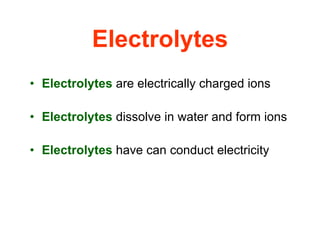
Electrolytes Electrolytes  are electrically charged ions  Electrolytes  dissolve in water and form ions Electrolytes  have can conduct electricity
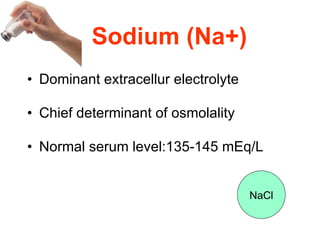
Sodium (Na+) Dominant extracellur electrolyte Chief determinant of osmolality Normal serum level:135-145 mEq/L  NaCl
Hyponatremia Signs & Symptoms Deficiency of sodium in the blood Hypotension Tachycardia Muscle weakness
Hypernatremia Signs & Symptoms Excess sodium in the blood Hypertension Muscle twitching Mental confusion Coma
Potassium (K+) Dominant intracellular electrolyte Primary buffer in the cell Normal serum level: 3.5-5.5 mEq/L K+
Potassium (K+) Has a role in:  Muscle contraction  Nerve impulses  Cell membrane function  Attracting water into the ICF Imbalances interfere with neuromuscular function and may cause cardiac rhythm disturbances
Hypokalemia Serum level below 3.5 mEq/L  Causes  Reduced dietary intake  Poor absorption by the body  Vomiting and/or diarrhea  Renal disease  Medications (typically diuretics)
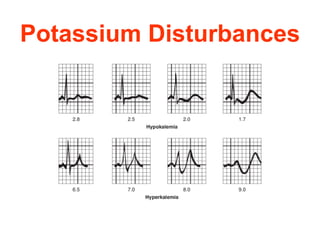
Hypokalemia Signs and Symptoms   Malaise  Skeletal muscle weakness  Decreased reflexes  Hypotension  Vomiting  Excessive thirst Cardiac arrhythmias and cardiac arrest Flattened T wave U wave
Hyperkalemia Serum level above 5 mEq/L  Causes:  Chronic or acute renal failure  Burns  Crush injuries  Excessive use of Potassium salts
Hyperkalemia Signs & Symptoms Excess potassium in the blood Cardiac arrhythmias and cardiac arrest Elevated T wave Muscle weakness ECG Changes
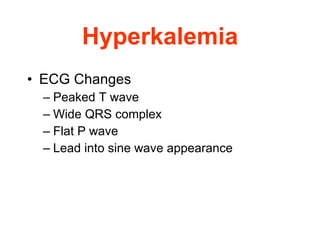
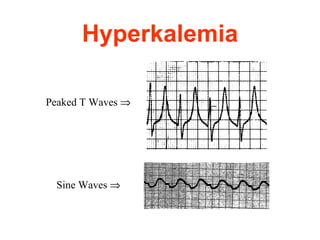
Hyperkalemia ECG Changes Peaked T wave Wide QRS complex Flat P wave Lead into sine wave appearance
Potassium Disturbances
Hyperkalemia Peaked T Waves   Sine Waves  
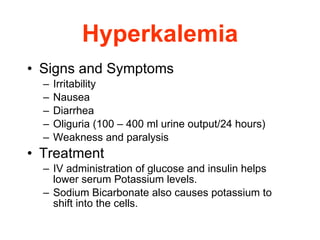
Hyperkalemia Signs and Symptoms Irritability  Nausea  Diarrhea  Oliguria (100 – 400 ml urine output/24 hours) Weakness and paralysis  Treatment IV administration of glucose and insulin helps lower serum Potassium levels. Sodium Bicarbonate also causes potassium to shift into the cells.
Magnesium (Mg+) Activates many enzymes  50% is insoluble in bone  45% is intracellular  5% is extracellular Mg+
Hypomagnesemia Signs & Symptoms Flat T wave ST interval depression Prolonged QT interval – may lead to Torsade de Pointes
Hypomagnesemia Low magnesium levels  Caused by:  Alcoholism  Malabsorption  Starvation  Diarrhea  Diuresis
Hypomagnesemia Signs and Symptoms  Tremors  Diarrhea  Hyperactive deep reflexes Confusion/Hallucinations  Seizures  Dysrhythmias
Hypermagnesemia Excess of Magnesium Not common Occurs with chronic renal insufficiency Treatment is hemodialysis
Hypermagnesemia Signs & Symptoms Peaked T wave Bradycardia CNS Depression  Areflexia  Sedation  Respiratory paralysis
Calcium (Ca++) Essential for  Neuromuscular transmission  Growth and ossification of bones  Muscle contraction  Excreted through urine, feces, and perspiration Ca++
Calcium (Ca++) Most is in bones and teeth Involved in Blood clotting Nerve impulse Muscle contraction Ca++
Hypocalcemia Deficiency of calcium in the blood Causes  Renal insufficiency  Decreased intake or malabsorption of Calcium Deficiency in or inability to activate Vitamin D
Hypocalcemia Signs & Symptoms Tetany  (cramps/convulsions in wrists and ankles)  Weak heart muscle Increased clotting time Prolonged QT interval – may lead to Torsade de Pointes Abnormal behavior Chvostek's sign (facial twitching) Paresthesia
Hypercalcemia Excess calcium in the blood Causes  Neoplasms (tumors)  Excessive administration of Vitamin D
Hypercalcemia Signs & symptoms Kidney stones Bone pain Cardiac arrhythmias Shortened QT interval
Hypercalcemia Signs and Symptoms   Hypotonicity of muscles (decreased muscle tone)  Renal stones  Altered mental status Treatment Usually aimed at underlying disease and hydration  Severe hypercalcemia may be treated with forced diuresis
Phosphorus (P,PO 4 ) A major player in: energy metabolism genetic coding cell function bone formation Normal serum level: 2.5-4.5 mg/dL PO 4
Hypophosphatemia Causes Alcoholism Hyperalimentation without phosphate Chronic ingestion of antacids Post stomach surgery  If you are lacking in Vitamin-D (which is needed to absorb phosphate)
Hypophosphatemia Signs & Symptoms Respiratory difficulty Confusion Irritability Coma.
Hyperphosphatemia Causes Severe infections Kidney failure Thyroid failure Parathyroid Failure Often associated with hypocalcemia or hypomagnesemia or too much Vitamin D Cell destruction - from chemotherapy, when the tumor cells die at a fast rate. This can cause tumor lysis syndrome.
Hyperphosphatemia Signs & Symptoms Elevated blood phosphate level There are no symptoms of hyperphosphatemia.
Hyperphosphatemia Treatment Calcium Carbonate tablets Aluminum hydroxide (can cause aluminum toxicity.
Na+ Ca++ Cl- Mg+ K+ PO 4 NH 3 Cu HCO 3 - NaCl THE END
References Schmidt, Tracy, RN, “Assessing a Sodium and Fluid Imbalance”, Nursing 2000, Volume 30 Number 1, p18 (C) 2004 Lippincott Williams & Wilkins, Inc.

Electrolyte Disturbances

  • 1.
    Electrolyte DisturbancesNa+ Ca++ Cl- Mg+ K+ PO 4 NH 3 Cu HCO 3 - NaCl
  • 2.
    Electrolytes Electrolytes are electrically charged ions Electrolytes dissolve in water and form ions Electrolytes have can conduct electricity
  • 3.
    Sodium (Na+) Dominantextracellur electrolyte Chief determinant of osmolality Normal serum level:135-145 mEq/L NaCl
  • 4.
    Hyponatremia Signs &Symptoms Deficiency of sodium in the blood Hypotension Tachycardia Muscle weakness
  • 5.
    Hypernatremia Signs &Symptoms Excess sodium in the blood Hypertension Muscle twitching Mental confusion Coma
  • 6.
    Potassium (K+) Dominantintracellular electrolyte Primary buffer in the cell Normal serum level: 3.5-5.5 mEq/L K+
  • 7.
    Potassium (K+) Hasa role in: Muscle contraction Nerve impulses Cell membrane function Attracting water into the ICF Imbalances interfere with neuromuscular function and may cause cardiac rhythm disturbances
  • 8.
    Hypokalemia Serum levelbelow 3.5 mEq/L Causes Reduced dietary intake Poor absorption by the body Vomiting and/or diarrhea Renal disease Medications (typically diuretics)
  • 9.
    Hypokalemia Signs andSymptoms Malaise Skeletal muscle weakness Decreased reflexes Hypotension Vomiting Excessive thirst Cardiac arrhythmias and cardiac arrest Flattened T wave U wave
  • 10.
    Hyperkalemia Serum levelabove 5 mEq/L Causes: Chronic or acute renal failure Burns Crush injuries Excessive use of Potassium salts
  • 11.
    Hyperkalemia Signs &Symptoms Excess potassium in the blood Cardiac arrhythmias and cardiac arrest Elevated T wave Muscle weakness ECG Changes
  • 12.
    Hyperkalemia ECG ChangesPeaked T wave Wide QRS complex Flat P wave Lead into sine wave appearance
  • 13.
  • 14.
    Hyperkalemia Peaked TWaves  Sine Waves 
  • 15.
    Hyperkalemia Signs andSymptoms Irritability Nausea Diarrhea Oliguria (100 – 400 ml urine output/24 hours) Weakness and paralysis Treatment IV administration of glucose and insulin helps lower serum Potassium levels. Sodium Bicarbonate also causes potassium to shift into the cells.
  • 16.
    Magnesium (Mg+) Activatesmany enzymes 50% is insoluble in bone 45% is intracellular 5% is extracellular Mg+
  • 17.
    Hypomagnesemia Signs &Symptoms Flat T wave ST interval depression Prolonged QT interval – may lead to Torsade de Pointes
  • 18.
    Hypomagnesemia Low magnesiumlevels Caused by: Alcoholism Malabsorption Starvation Diarrhea Diuresis
  • 19.
    Hypomagnesemia Signs andSymptoms Tremors Diarrhea Hyperactive deep reflexes Confusion/Hallucinations Seizures Dysrhythmias
  • 20.
    Hypermagnesemia Excess ofMagnesium Not common Occurs with chronic renal insufficiency Treatment is hemodialysis
  • 21.
    Hypermagnesemia Signs &Symptoms Peaked T wave Bradycardia CNS Depression Areflexia Sedation Respiratory paralysis
  • 22.
    Calcium (Ca++) Essentialfor Neuromuscular transmission Growth and ossification of bones Muscle contraction Excreted through urine, feces, and perspiration Ca++
  • 23.
    Calcium (Ca++) Mostis in bones and teeth Involved in Blood clotting Nerve impulse Muscle contraction Ca++
  • 24.
    Hypocalcemia Deficiency ofcalcium in the blood Causes Renal insufficiency Decreased intake or malabsorption of Calcium Deficiency in or inability to activate Vitamin D
  • 25.
    Hypocalcemia Signs &Symptoms Tetany (cramps/convulsions in wrists and ankles) Weak heart muscle Increased clotting time Prolonged QT interval – may lead to Torsade de Pointes Abnormal behavior Chvostek's sign (facial twitching) Paresthesia
  • 26.
    Hypercalcemia Excess calciumin the blood Causes Neoplasms (tumors) Excessive administration of Vitamin D
  • 27.
    Hypercalcemia Signs &symptoms Kidney stones Bone pain Cardiac arrhythmias Shortened QT interval
  • 28.
    Hypercalcemia Signs andSymptoms Hypotonicity of muscles (decreased muscle tone) Renal stones Altered mental status Treatment Usually aimed at underlying disease and hydration Severe hypercalcemia may be treated with forced diuresis
  • 29.
    Phosphorus (P,PO 4) A major player in: energy metabolism genetic coding cell function bone formation Normal serum level: 2.5-4.5 mg/dL PO 4
  • 30.
    Hypophosphatemia Causes AlcoholismHyperalimentation without phosphate Chronic ingestion of antacids Post stomach surgery If you are lacking in Vitamin-D (which is needed to absorb phosphate)
  • 31.
    Hypophosphatemia Signs &Symptoms Respiratory difficulty Confusion Irritability Coma.
  • 32.
    Hyperphosphatemia Causes Severeinfections Kidney failure Thyroid failure Parathyroid Failure Often associated with hypocalcemia or hypomagnesemia or too much Vitamin D Cell destruction - from chemotherapy, when the tumor cells die at a fast rate. This can cause tumor lysis syndrome.
  • 33.
    Hyperphosphatemia Signs &Symptoms Elevated blood phosphate level There are no symptoms of hyperphosphatemia.
  • 34.
    Hyperphosphatemia Treatment CalciumCarbonate tablets Aluminum hydroxide (can cause aluminum toxicity.
  • 35.
    Na+ Ca++ Cl-Mg+ K+ PO 4 NH 3 Cu HCO 3 - NaCl THE END
  • 36.
    References Schmidt, Tracy,RN, “Assessing a Sodium and Fluid Imbalance”, Nursing 2000, Volume 30 Number 1, p18 (C) 2004 Lippincott Williams & Wilkins, Inc.