Reason
What is reason?
Deductive Reasoning
Syllogisms 
Quantifiers: 
-all 
-some 
-no 
Syllogisms must contain 
-two premises 
-a conclusion 
-three terms which occur twice
All dogs have legs, 
Charlie is a dog, 
Therefore Charlie has legs
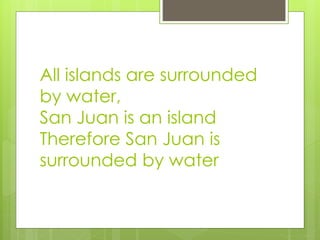
All islands are surrounded 
by water, 
San Juan is an island 
Therefore San Juan is 
surrounded by water
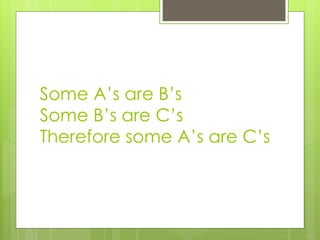
Some A’s are B’s 
Some B’s are C’s 
Therefore some A’s are C’s
Belief Bias 
Premises that are believed because the 
conclusion is correct even though the 
premises may be incorrect.
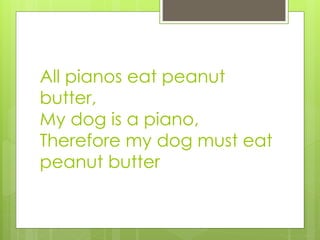
All pianos eat peanut 
butter, 
My dog is a piano, 
Therefore my dog must eat 
peanut butter
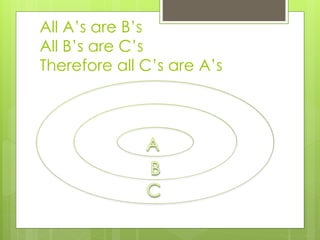
Venn Diagrams
All A’s are B’s 
Some A’s are C’s 
Therefore some B’s are C’s
All A’s are B’s 
All B’s are C’s 
Therefore all C’s are A’s
Deductive reasoning 
preserves the truth 
Are the premises true? 
Is the argument valid?
Enthymeme 
An argument that has not been set out in a 
formal way. 
If a premise strikes the person using this 
argument as obvious they will simply 
assume that the premise is correct and not 
bother stating it.
Inductive Reasoning
Specific observations > general rules 
-“Every human I’ve observed is mortal; I’ve 
never observed a human who is immortal; 
therefore, all humans are mortal” 
Opposite of deductive reasoning 
-“All humans are mortal; I’m a human; 
therefore, I’m mortal.”
What makes a good 
generalization? 
Number – number of instances/observations 
Variety – how well your sample group represents 
the whole group 
Exception – you should actively look for 
counterexamples 
Coherence – you should demand more 
evidence for things that are surprising / don’t fit 
with your current mental map 
Subject area – generalizations are more reliable 
in natural sciences than social ones.
Informal Reasoning
What is informal reasoning? 
Informal Reasoning is reasoning that contains a fallacy. 
Fallacies 
1. Ad ignorantiam 
2. Post hoc ergo propter hoc 
3. Ad hominem 
4. Circular reasoning 
5. Special pleading 
6. Equivocation 
7. False analogy 
8. False dilemma 
9. Loaded question
Argument ad ignorantiam 
If you claim that something is true on the 
grounds that there is no evidence to 
disprove it, or visa versa. 
Eg. The weather tomorrow will be rainy 
because you cannot prove it’s not true.
Post hoc ergo propter hoc 
Assuming that because one thing follows 
another thing, the first thing is the cause of 
the second thing 
If B follows A, then A is the cause of B. 
Eg. I ate a piece of pizza earlier tonight. I 
have stomach now. Therefore, my stomach 
ache is caused by eating the pizza.
Ad hominem 
Attacking or supporting a person rather 
than their argument 
Eg. It must be true because Einstein said 
so.
Circular reasoning 
Begging a question 
Assuming truth in something you are 
supposed to be proving 
Eg. I know that Jesus is the son of God 
because he said he is. And the son of God 
would not lie.
Special Pleading 
Double standards 
Making moral exceptions for yourself 
Eg. “I know there is a drought and I need 
to save water, but I am putting my prize 
flowers in a competition next week and I 
need to give them plenty of water.”
Equivocation 
When a word is given two different 
meanings in an argument 
Eg. A hamburger is better than nothing, 
Nothing is better than good health, 
Therefore a hamburger is better than good 
health.
False analogy 
To assume that because two things are 
similar in some respects, they must also be 
similar in further respects 
Eg. Our eyes, ears, nose and mouth 
create 7 windows on our heads, therefore 
there must be 7 planets- Francesco Sizzi, 17th 
century astronomer
False Dilemma 
This is the fallacy of assuming that only two 
alternatives exist when there is in fact a 
wider-range of options. 
Seeing things in black and white. 
Eg. You didn’t come to school today, so 
you must be sick at home.
Loaded question 
A question that is biased because it 
contains a built-in assumption. 
Eg. Jeff! How many of my shirts did you 
steal?
Causes of bad reasoning 
1. Ignorance 
2. Laziness 
3. Pride 
4. Prejudice
Ignorance
Laziness
Pride
Prejudice

Reason

  • 1.
  • 2.
  • 3.
  • 4.
    Syllogisms Quantifiers: -all -some -no Syllogisms must contain -two premises -a conclusion -three terms which occur twice
  • 5.
    All dogs havelegs, Charlie is a dog, Therefore Charlie has legs
  • 6.
    All islands aresurrounded by water, San Juan is an island Therefore San Juan is surrounded by water
  • 7.
    Some A’s areB’s Some B’s are C’s Therefore some A’s are C’s
  • 8.
    Belief Bias Premisesthat are believed because the conclusion is correct even though the premises may be incorrect.
  • 9.
    All pianos eatpeanut butter, My dog is a piano, Therefore my dog must eat peanut butter
  • 10.
  • 11.
    All A’s areB’s Some A’s are C’s Therefore some B’s are C’s
  • 12.
    All A’s areB’s All B’s are C’s Therefore all C’s are A’s
  • 13.
    Deductive reasoning preservesthe truth Are the premises true? Is the argument valid?
  • 14.
    Enthymeme An argumentthat has not been set out in a formal way. If a premise strikes the person using this argument as obvious they will simply assume that the premise is correct and not bother stating it.
  • 15.
  • 16.
    Specific observations >general rules -“Every human I’ve observed is mortal; I’ve never observed a human who is immortal; therefore, all humans are mortal” Opposite of deductive reasoning -“All humans are mortal; I’m a human; therefore, I’m mortal.”
  • 17.
    What makes agood generalization? Number – number of instances/observations Variety – how well your sample group represents the whole group Exception – you should actively look for counterexamples Coherence – you should demand more evidence for things that are surprising / don’t fit with your current mental map Subject area – generalizations are more reliable in natural sciences than social ones.
  • 18.
  • 19.
    What is informalreasoning? Informal Reasoning is reasoning that contains a fallacy. Fallacies 1. Ad ignorantiam 2. Post hoc ergo propter hoc 3. Ad hominem 4. Circular reasoning 5. Special pleading 6. Equivocation 7. False analogy 8. False dilemma 9. Loaded question
  • 20.
    Argument ad ignorantiam If you claim that something is true on the grounds that there is no evidence to disprove it, or visa versa. Eg. The weather tomorrow will be rainy because you cannot prove it’s not true.
  • 21.
    Post hoc ergopropter hoc Assuming that because one thing follows another thing, the first thing is the cause of the second thing If B follows A, then A is the cause of B. Eg. I ate a piece of pizza earlier tonight. I have stomach now. Therefore, my stomach ache is caused by eating the pizza.
  • 22.
    Ad hominem Attackingor supporting a person rather than their argument Eg. It must be true because Einstein said so.
  • 23.
    Circular reasoning Begginga question Assuming truth in something you are supposed to be proving Eg. I know that Jesus is the son of God because he said he is. And the son of God would not lie.
  • 24.
    Special Pleading Doublestandards Making moral exceptions for yourself Eg. “I know there is a drought and I need to save water, but I am putting my prize flowers in a competition next week and I need to give them plenty of water.”
  • 25.
    Equivocation When aword is given two different meanings in an argument Eg. A hamburger is better than nothing, Nothing is better than good health, Therefore a hamburger is better than good health.
  • 26.
    False analogy Toassume that because two things are similar in some respects, they must also be similar in further respects Eg. Our eyes, ears, nose and mouth create 7 windows on our heads, therefore there must be 7 planets- Francesco Sizzi, 17th century astronomer
  • 27.
    False Dilemma Thisis the fallacy of assuming that only two alternatives exist when there is in fact a wider-range of options. Seeing things in black and white. Eg. You didn’t come to school today, so you must be sick at home.
  • 28.
    Loaded question Aquestion that is biased because it contains a built-in assumption. Eg. Jeff! How many of my shirts did you steal?
  • 29.
    Causes of badreasoning 1. Ignorance 2. Laziness 3. Pride 4. Prejudice
  • 30.
  • 31.
  • 32.
  • 33.

Editor's Notes

  • #11 Venn diagrams can be used to verify a syllogism. Drawing out the syllogism with a venn diagram will help picture it
  • #13 Careful with interpreting them, this one is not true
  • #14 If you begin with the truth you will end with the truth. Only true if the premise is true
  • #15 Used during everyday life, incomplete argument