{
Reasoning:
COM 104
Teresa Cisneros
Reasoning is the process of creating
or generating conclusions from
evidence or premises.
Reasoning:
• Relates to the reasonableness of an argument
(consistency between evidence and the contention)
• Constructs a logical or rational connection between
the evidence and the contention
• Consists of a series of conclusions that say how the
evidence and the contention are connected
Inductive Reasoning: the process of reasoning from specifics to a general
conclusion related to those specifics
-It allows humans to create generalizations about people, events and
things in their environment. 5 ways to do this:
-By example, cause, sign comparison and by authority
Example reasoning: involves using specific instances as a basis for
making a valid conclusion
Tests for reasoning by example:
1. There must be a sufficient number of examples to justify the
generalized conclusion
2. The examples must be typical of the whole
3. Important counter examples must be accounted for
4. The examples must be relevant to the time period of your
argument
Causal reasoning: is based on the idea that for every action there is a
reaction
Tests of causal reasoning:
1. The cause must be capable of producing the effect
described, and vice versa
2. Cumulative causal reasoning increases the soundness of the
conclusion
3. Counter causal factors must also be accounted for
Sign reasoning: involves interfering a connection between two related
things, so that in presence or absence of one indicates the presence or
absence of the other
Tests of sign reasoning:
1. Other substance/ attribute relationships must be considered
2. Cumulative sign reasoning produces a more probable
connection
Comparison reasoning: is also known as reasoning by analogy
Two types of comparisons:
1. Figurative comparisons: attempt to link similarities between two
cases from different classifications
2. Literal comparisons: attempt to establish a link between similar
classifications: people to people, cars to cars, states to states
Tests for comparison reasoning:
1. To be considered as proof, the analogy must be a literal one
2. The cases need to contain significant points of similarity
3. Cumulative comparison reasoning will produce a more
probable conclusion
Reasoning from authority: is used when a person argues that a
particular claim is justified because it is held or advocated by a credible
source
Two ways this type of argument can be used:
1. You can ask that an argument be accepted simply because
someone you consider an authority advocates it
2. You can support your arguments with the credibility of another
person
Tests for reasoning from authority:
1. The authority must be credible
2. Views of counter authorities must be taken into account
3. Cumulative views of authorities increase the validity of the
reasoning
Deductive reasoning: is the process of reasoning from general statements
to a certain and logical conclusion related to that conclusion
-A deductive argument has 3 parts: a major premise, a minor
premise and a conclusion
1. The minor premise is a general statement
2. The minor premise is a statement of a specific instance related to
the major premise
3. The conclusion is the statement derived from the minor premises
relationship to the major premise
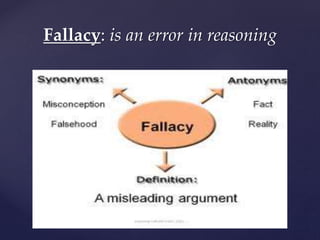
Fallacy: is an error in reasoning
Fallacy of the false dilemma: occurs when an argument offers a false
range of choices and requires that you pick one of them
Fallacy of appeal to emotion: is committed when someone manipulates
peoples’ emotions in order to get them to accept a claim as being true
Fallacy of non-sequitur: describes any unwarranted conclusion, but is
most often used when a statement openly contradicts itself and makes no
sense
Fallacy of the slippery slope: reduces and argument to absurdity by
extending it beyond its reasonable limits
Fallacy of ad hominem: consists of saying that someone’s argument is
wrong purely because of something about the person rather than about the
argument itself
Fallacy of hasty generalization: occurs when an arguer bases a
conclusion on too few examples that are not necessarily typical of the
conclusion being made
Fallacy of circular reasoning: is the assertion or repeated assertion of a
conclusion without giving reasons in its support
Fallacy of Appeal to Ignorance: errs by trying to make this argument in a
context in which the burden of truth falls on the arguer to show that his or
her position is actually true, not just that it has not yet been shown false
Bandwagon Fallacy: refers to joining a cause because of its popularity
Post hoc ergo propter hoc fallacy: (after this therefore because of this) is
based upon the the mistaken notion simply because one thing happens after
another, the first event was a cause of the second event
Fallacy of Appeal to Pity: the arguer tries to get people to agree with their
conclusion by evoking pity and sympathy either with their situation or the
situation of some third party
Straw-Man Fallacy: the arguer attacks an argument which is different
from, and usually weaker than, the opposition’s best argument
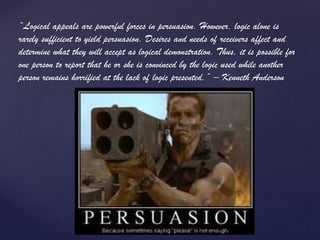
“Logical appeals are powerful forces in persuasion. However, logic alone is
rarely sufficient to yield persuasion. Desires and needs of receivers affect and
determine what they will accept as logical demonstration. Thus, it is possible for
one person to report that he or she is convinced by the logic used while another
person remains horrified at the lack of logic presented.” – Kenneth Anderson

Reasoning com 104

  • 1.
  • 2.
    Reasoning is theprocess of creating or generating conclusions from evidence or premises.
  • 3.
    Reasoning: • Relates tothe reasonableness of an argument (consistency between evidence and the contention) • Constructs a logical or rational connection between the evidence and the contention • Consists of a series of conclusions that say how the evidence and the contention are connected
  • 4.
    Inductive Reasoning: theprocess of reasoning from specifics to a general conclusion related to those specifics -It allows humans to create generalizations about people, events and things in their environment. 5 ways to do this: -By example, cause, sign comparison and by authority
  • 5.
    Example reasoning: involvesusing specific instances as a basis for making a valid conclusion Tests for reasoning by example: 1. There must be a sufficient number of examples to justify the generalized conclusion 2. The examples must be typical of the whole 3. Important counter examples must be accounted for 4. The examples must be relevant to the time period of your argument
  • 6.
    Causal reasoning: isbased on the idea that for every action there is a reaction Tests of causal reasoning: 1. The cause must be capable of producing the effect described, and vice versa 2. Cumulative causal reasoning increases the soundness of the conclusion 3. Counter causal factors must also be accounted for
  • 7.
    Sign reasoning: involvesinterfering a connection between two related things, so that in presence or absence of one indicates the presence or absence of the other Tests of sign reasoning: 1. Other substance/ attribute relationships must be considered 2. Cumulative sign reasoning produces a more probable connection
  • 8.
    Comparison reasoning: isalso known as reasoning by analogy Two types of comparisons: 1. Figurative comparisons: attempt to link similarities between two cases from different classifications 2. Literal comparisons: attempt to establish a link between similar classifications: people to people, cars to cars, states to states Tests for comparison reasoning: 1. To be considered as proof, the analogy must be a literal one 2. The cases need to contain significant points of similarity 3. Cumulative comparison reasoning will produce a more probable conclusion
  • 9.
    Reasoning from authority:is used when a person argues that a particular claim is justified because it is held or advocated by a credible source Two ways this type of argument can be used: 1. You can ask that an argument be accepted simply because someone you consider an authority advocates it 2. You can support your arguments with the credibility of another person Tests for reasoning from authority: 1. The authority must be credible 2. Views of counter authorities must be taken into account 3. Cumulative views of authorities increase the validity of the reasoning
  • 10.
    Deductive reasoning: isthe process of reasoning from general statements to a certain and logical conclusion related to that conclusion -A deductive argument has 3 parts: a major premise, a minor premise and a conclusion 1. The minor premise is a general statement 2. The minor premise is a statement of a specific instance related to the major premise 3. The conclusion is the statement derived from the minor premises relationship to the major premise
  • 11.
    Fallacy: is anerror in reasoning
  • 12.
    Fallacy of thefalse dilemma: occurs when an argument offers a false range of choices and requires that you pick one of them Fallacy of appeal to emotion: is committed when someone manipulates peoples’ emotions in order to get them to accept a claim as being true Fallacy of non-sequitur: describes any unwarranted conclusion, but is most often used when a statement openly contradicts itself and makes no sense Fallacy of the slippery slope: reduces and argument to absurdity by extending it beyond its reasonable limits
  • 13.
    Fallacy of adhominem: consists of saying that someone’s argument is wrong purely because of something about the person rather than about the argument itself Fallacy of hasty generalization: occurs when an arguer bases a conclusion on too few examples that are not necessarily typical of the conclusion being made Fallacy of circular reasoning: is the assertion or repeated assertion of a conclusion without giving reasons in its support Fallacy of Appeal to Ignorance: errs by trying to make this argument in a context in which the burden of truth falls on the arguer to show that his or her position is actually true, not just that it has not yet been shown false
  • 14.
    Bandwagon Fallacy: refersto joining a cause because of its popularity Post hoc ergo propter hoc fallacy: (after this therefore because of this) is based upon the the mistaken notion simply because one thing happens after another, the first event was a cause of the second event Fallacy of Appeal to Pity: the arguer tries to get people to agree with their conclusion by evoking pity and sympathy either with their situation or the situation of some third party Straw-Man Fallacy: the arguer attacks an argument which is different from, and usually weaker than, the opposition’s best argument
  • 15.
    “Logical appeals arepowerful forces in persuasion. However, logic alone is rarely sufficient to yield persuasion. Desires and needs of receivers affect and determine what they will accept as logical demonstration. Thus, it is possible for one person to report that he or she is convinced by the logic used while another person remains horrified at the lack of logic presented.” – Kenneth Anderson