Literature Search
Dr Bhaskar Borgohain
MBBS (AMC), MS Ortho (Delhi Univ.), DNB Ortho (NAMS),
AO Trauma Fellow, (Germany), Arthroplasty Fellow (Computer Navigation)
Professor & HoD, Orthopaedics
NEIGRIHMS Shillong
www.neigrihms.gov.in
ublishing your dissertatio
Dr Murali Poduval
(Orth) DNB(Orth) PGDM
nt Engineering and Industrial Services
aConsultancy Services
Mumbai
or : Indian Journal of Orthopaedics
IJO-NILD-WBOA sponsored National workshop on Research Methodology and scientific
publication: Kolkata 29TH September, 2019
PubMed
• Pubmed is a free search database that
contains Medline, plus additional information
in dentistry, nursing, history of medicine and
complimentary & alternative medicine.
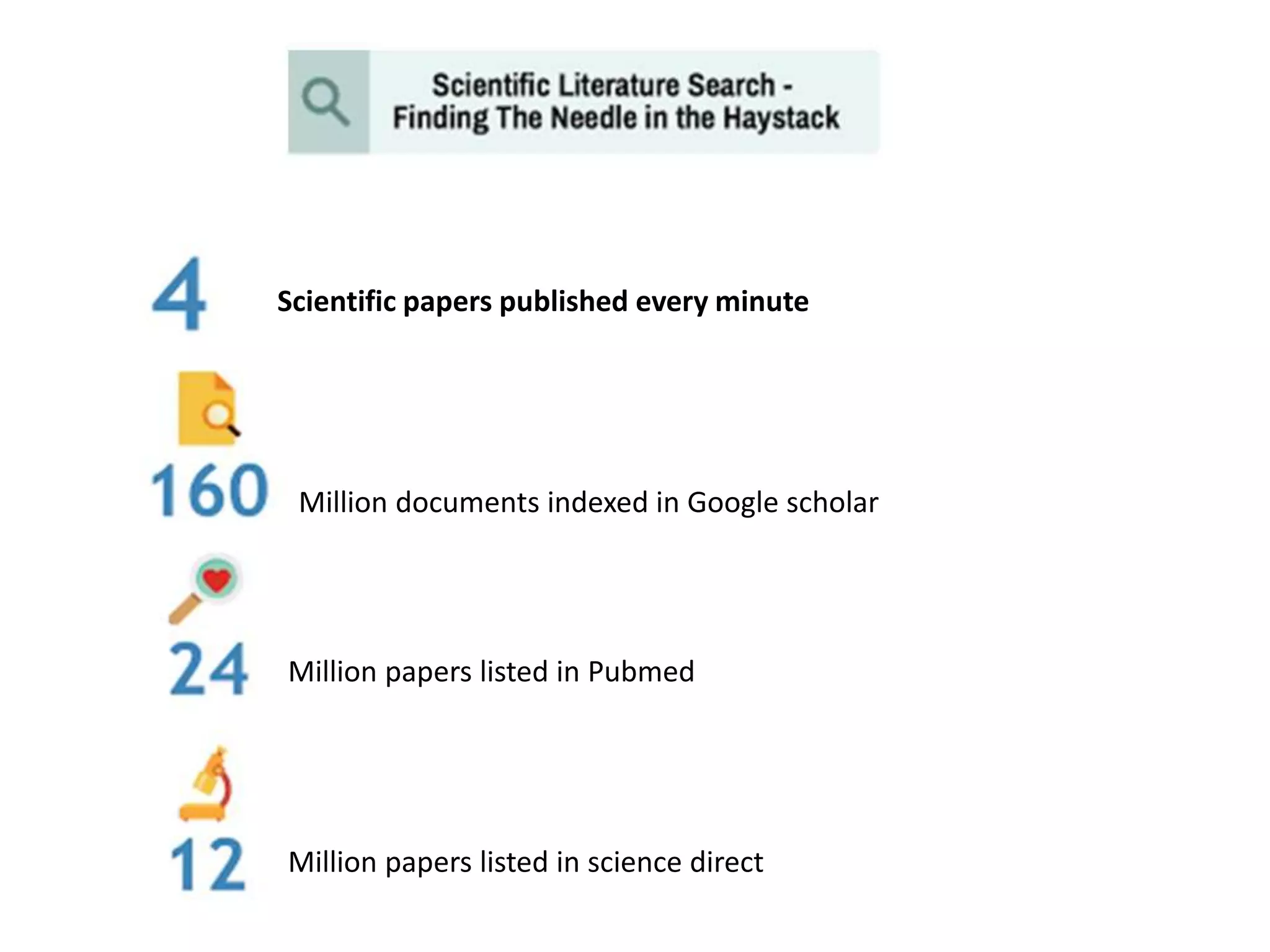
Million documents indexed in Google scholar
Million papers listed in Pubmed
Million papers listed in science direct
Scientific papers published every minute
We now live in
Information age
Information boom
Information overload
Problem of plenty
List of common medical databases
• Pubmed (Journals)
• Medline- Medical literature analysis and retrieval system online
• CINAHL- Cumulative index of Nursing and allied health literature
(Journals, books, conference proceedings)
• Cochrane library- EBM
• Science direct
• Ovid
• Psychinfo- psychological information (Journals, books, book
chapters, dissertations)
• Web of science (Journals, book chapters, conference proceedings)
A database is a system intended to organize , store and retrieve
large amount of data easily
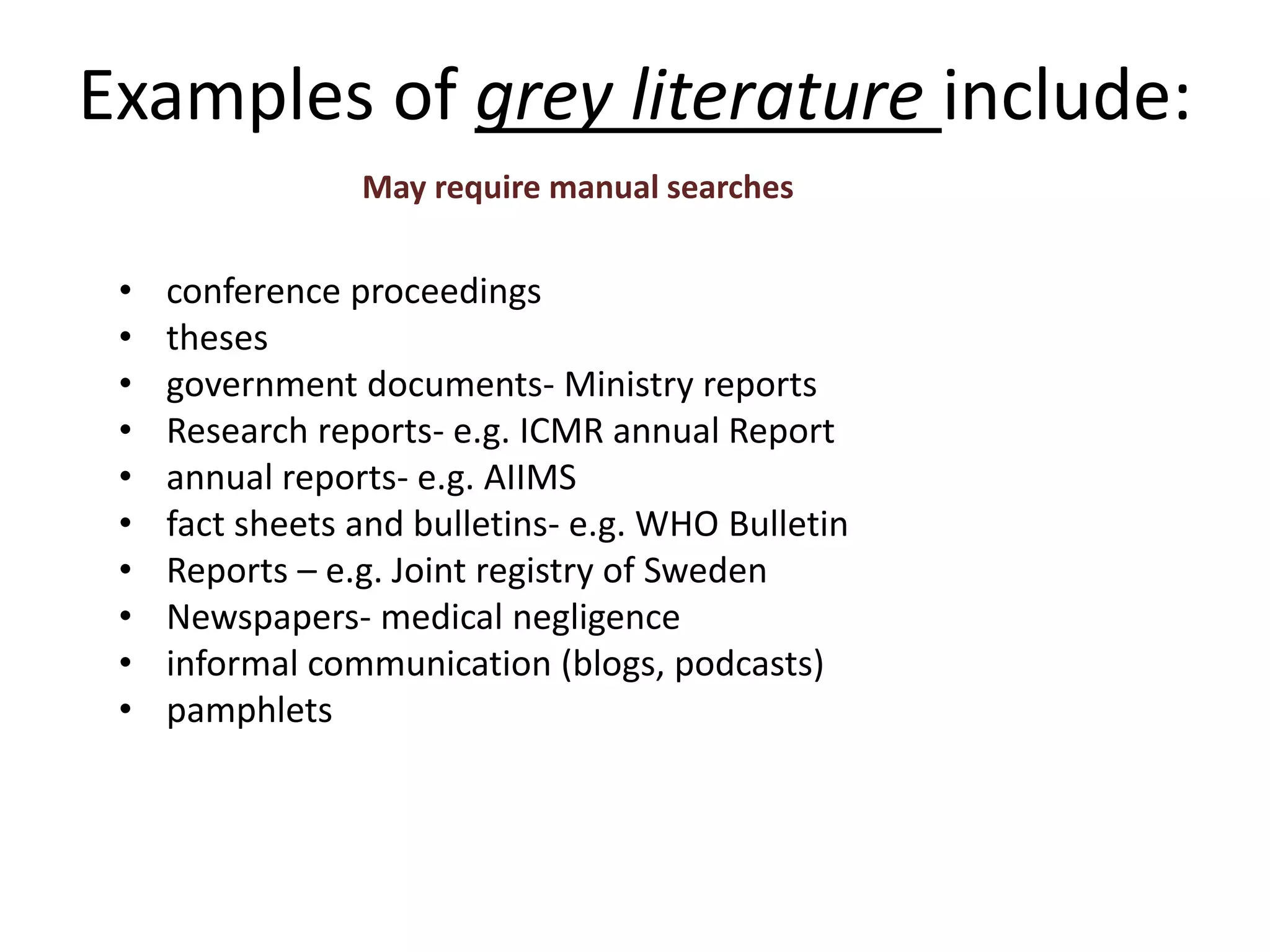
Examples of grey literature include:
• conference proceedings
• theses
• government documents- Ministry reports
• Research reports- e.g. ICMR annual Report
• annual reports- e.g. AIIMS
• fact sheets and bulletins- e.g. WHO Bulletin
• Reports – e.g. Joint registry of Sweden
• Newspapers- medical negligence
• informal communication (blogs, podcasts)
• pamphlets
May require manual searches
So you need a Smart Search strategy
Better to Begin with the end in mind
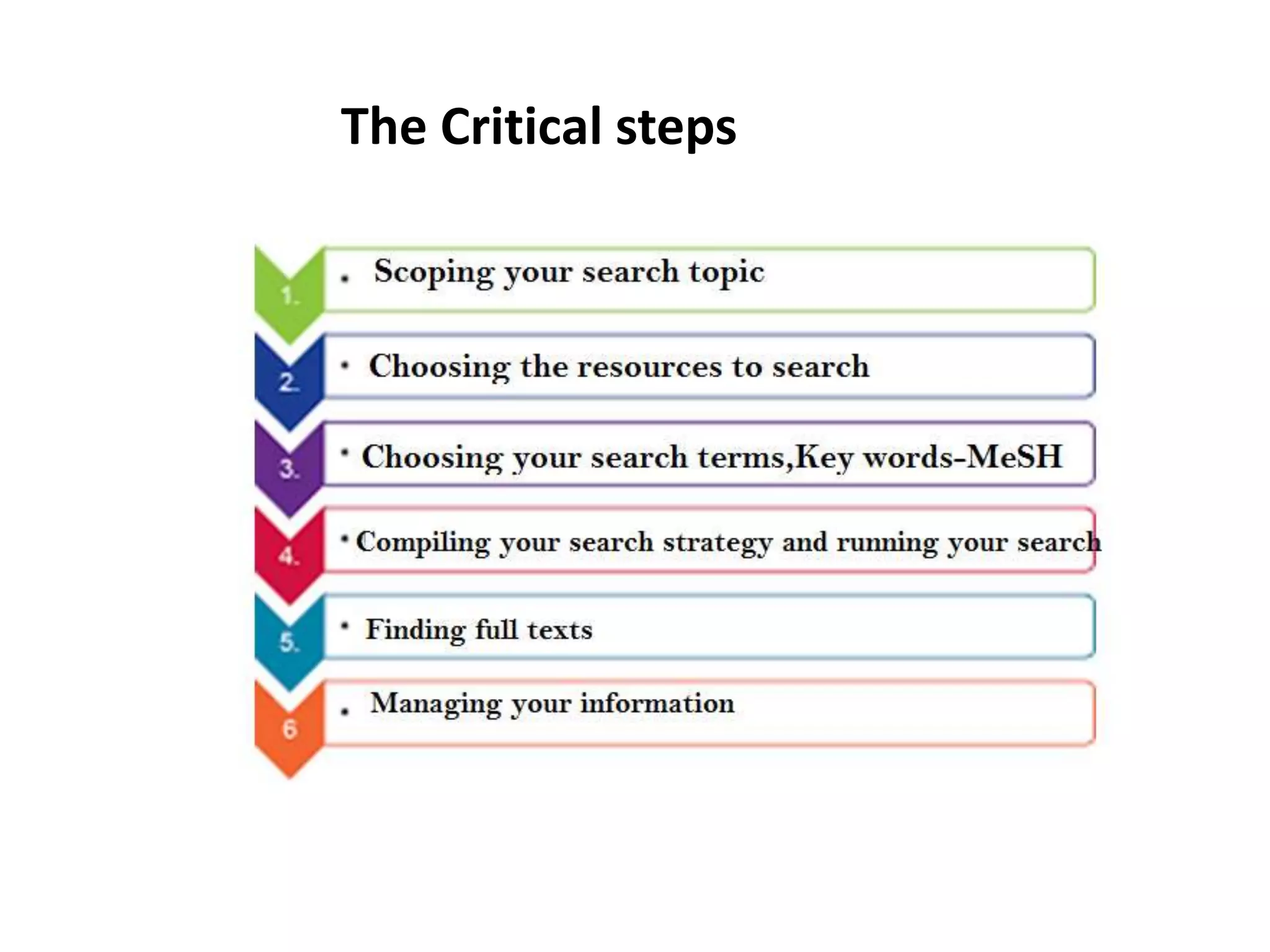
The Critical steps
The Literature search cycle
First thing
What is your Research question
PICOS in Systematic review
Population/ Problem
Intervention
Comparison
outcome
Key words, operators & filters:
Tools- terms- techniques
Next thing: What are the Key words
How to brainstorm
How to brainstorm
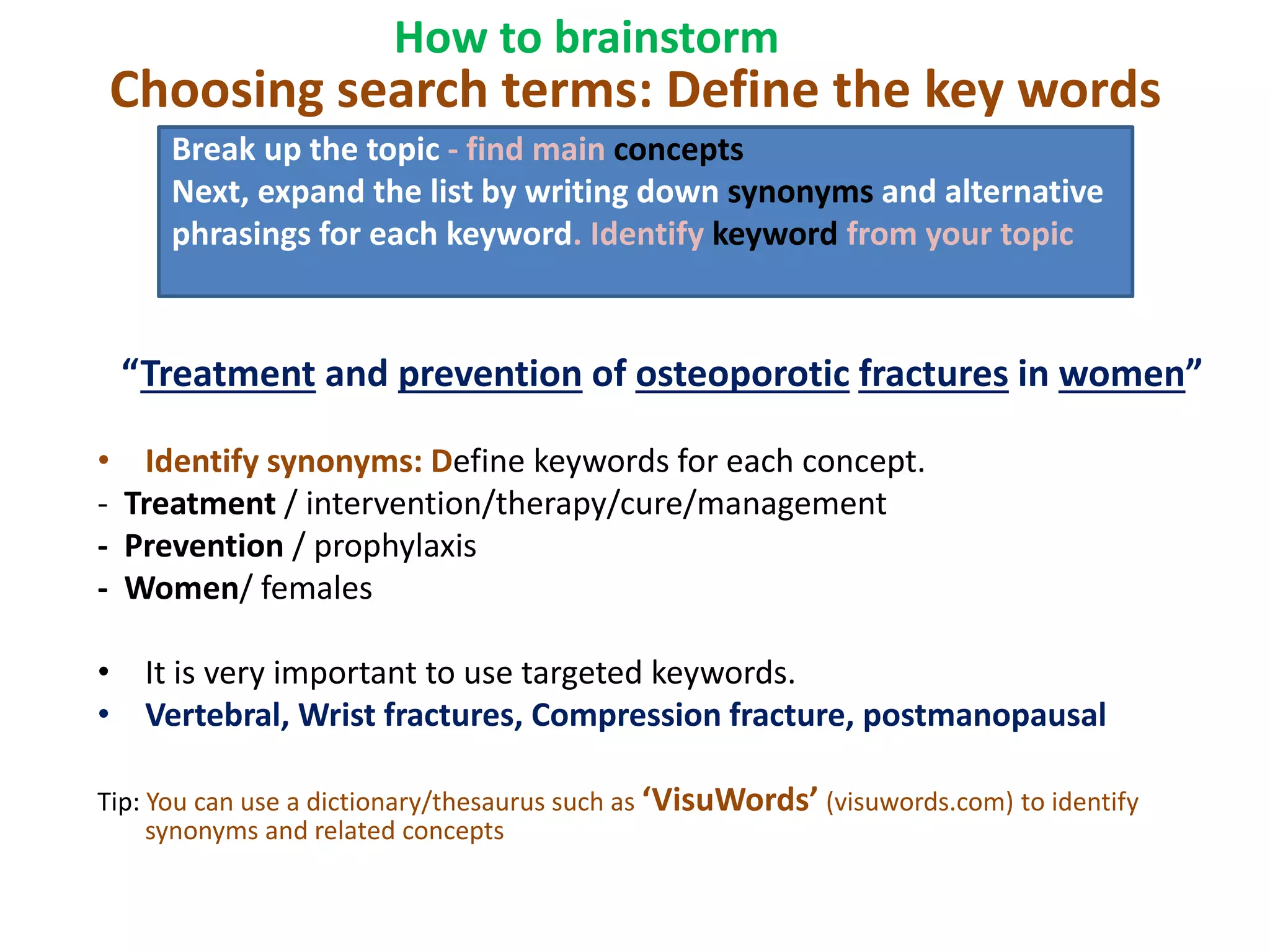
Choosing search terms: Define the key words
“Treatment and prevention of osteoporotic fractures in women”
• Identify synonyms: Define keywords for each concept.
- Treatment / intervention/therapy/cure/management
- Prevention / prophylaxis
- Women/ females
• It is very important to use targeted keywords.
• Vertebral, Wrist fractures, Compression fracture, postmanopausal
Tip: You can use a dictionary/thesaurus such as ‘VisuWords’ (visuwords.com) to identify
synonyms and related concepts
Break up the topic - find main concepts
Next, expand the list by writing down synonyms and alternative
phrasings for each keyword. Identify keyword from your topic
How to brainstorm
Search techniques:-
Refine your searches
Use of Filter to define Limit
• Age - children
• Time - last 5 years
• Language - English
• Article type - RCT, Metanalysis
• Subject - tumors
• [mh] to search a MeSH heading
• [majr] to search a MeSH heading that is a major topic of an
article
Brainstorming:
Checklist for defining keywords
• What alternative vocabulary is used by others in discussion of
my topic?
• Are there American and British variants of spelling or
vocabulary? Esophagus- Oesophagus
• Identify a truncation
e.g., child* to find child, children, or childish.
• Are common abbreviations, acronyms used?
Fat embolism, FES, Cerebral fat embolism
• What more general terms describe my topic?
• What categories I'd like to exclude?
How to brainstorm
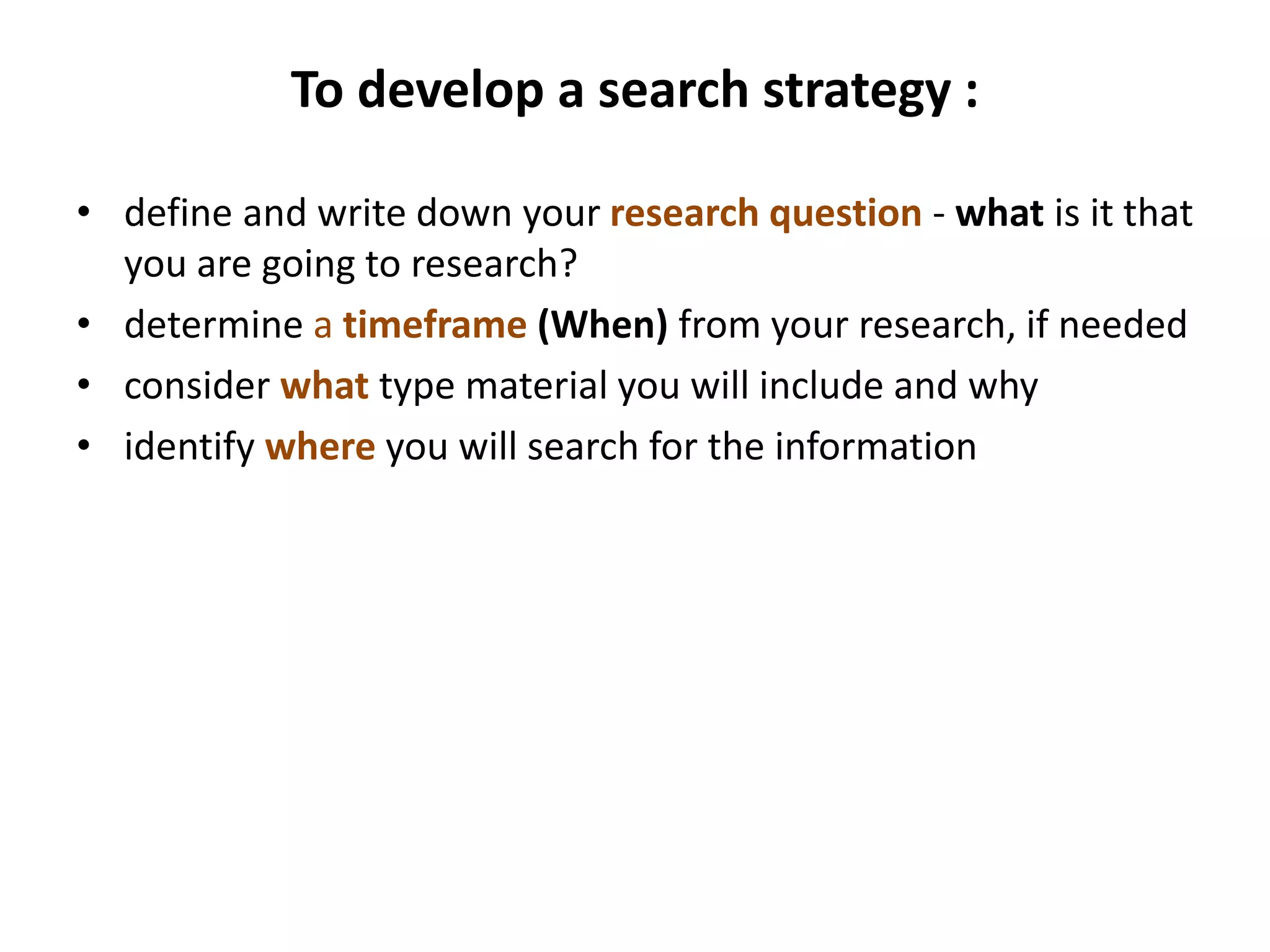
To develop a search strategy :
• define and write down your research question - what is it that
you are going to research?
• determine a timeframe (When) from your research, if needed
• consider what type material you will include and why
• identify where you will search for the information
Wild card & Truncation
Internal truncation or Wild card
If you type Colo?r
It will find both color and colour-
And Both English , American Journals will be covered
External truncation
If you Type “ Prevent*”
It will search all of the following
• Prevention
• Preventable
• preventative
Search techniques
Search strategy
Search strategy: Combine Key words and Boolean logic
In adolescent
smokers is brief
counseling
session help to
quit smoking
Research question
P-Population
I-Intervention
O-Outcome
A hierarchy of terms is arranged in
‘trees’ starting with a broad topic and
branching into more specific ones
Search techniques: MeSH Tree
Example:
• If you type eye [mh] it will retrieve citations
indexed to:
Eye
Eyebrows
Eyelids
Eyelashes
Eyelids etc
Search techniques
Field tag
Type [au] for Author
e.g. John (au)
Type [ti] to search for Title of the paper
Type [ta] for search for the journal- but will not pick up ebooks
hypertension [ta]- to search for the Journal only
Note: this will find the journal named HYPERTENSION but not pick up the keyword
“hypertension”
Type [dp] for date of publication- period
blood[au] AND hypertension[ta] AND 2005[dp]
Search techniques
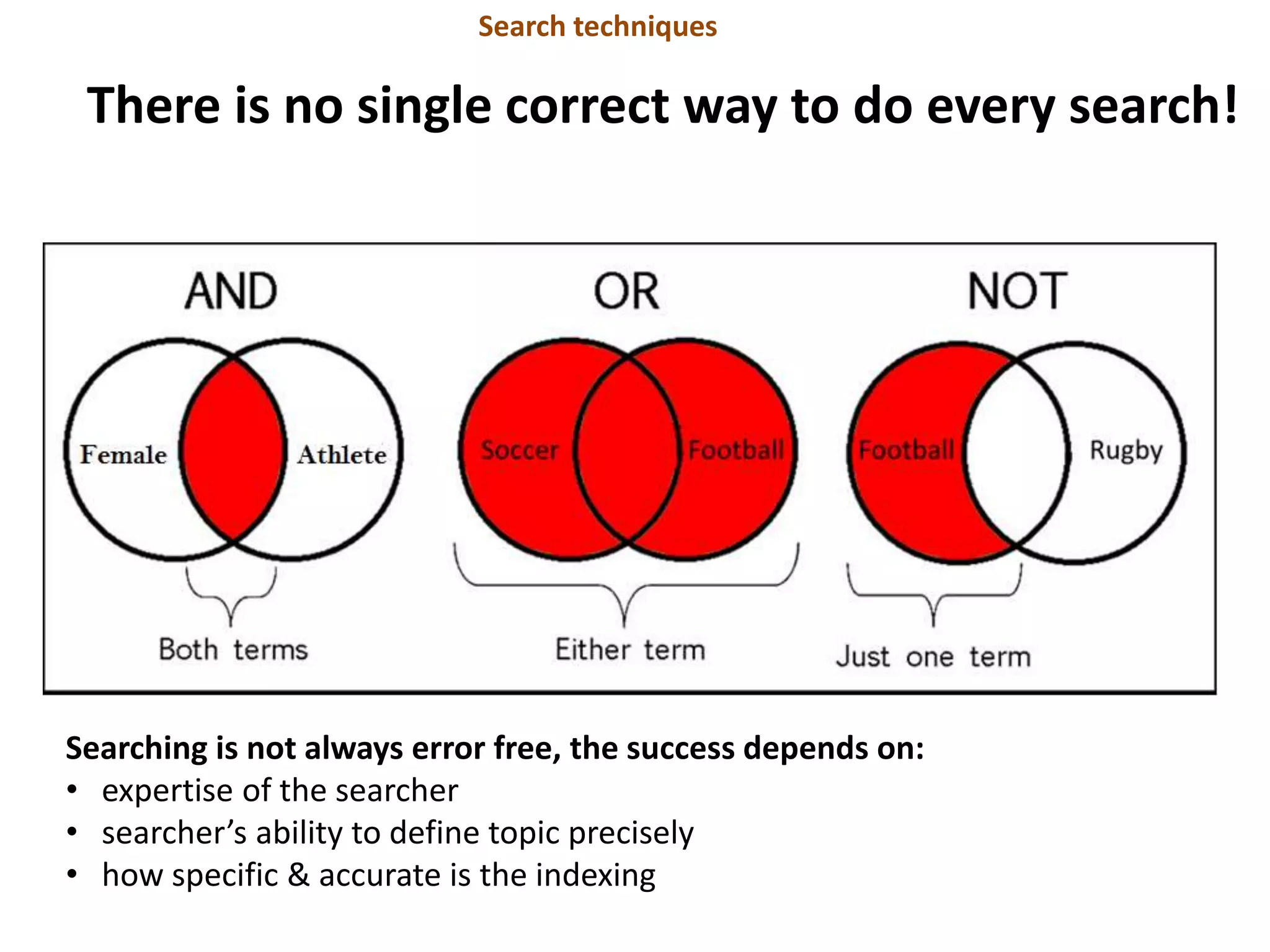
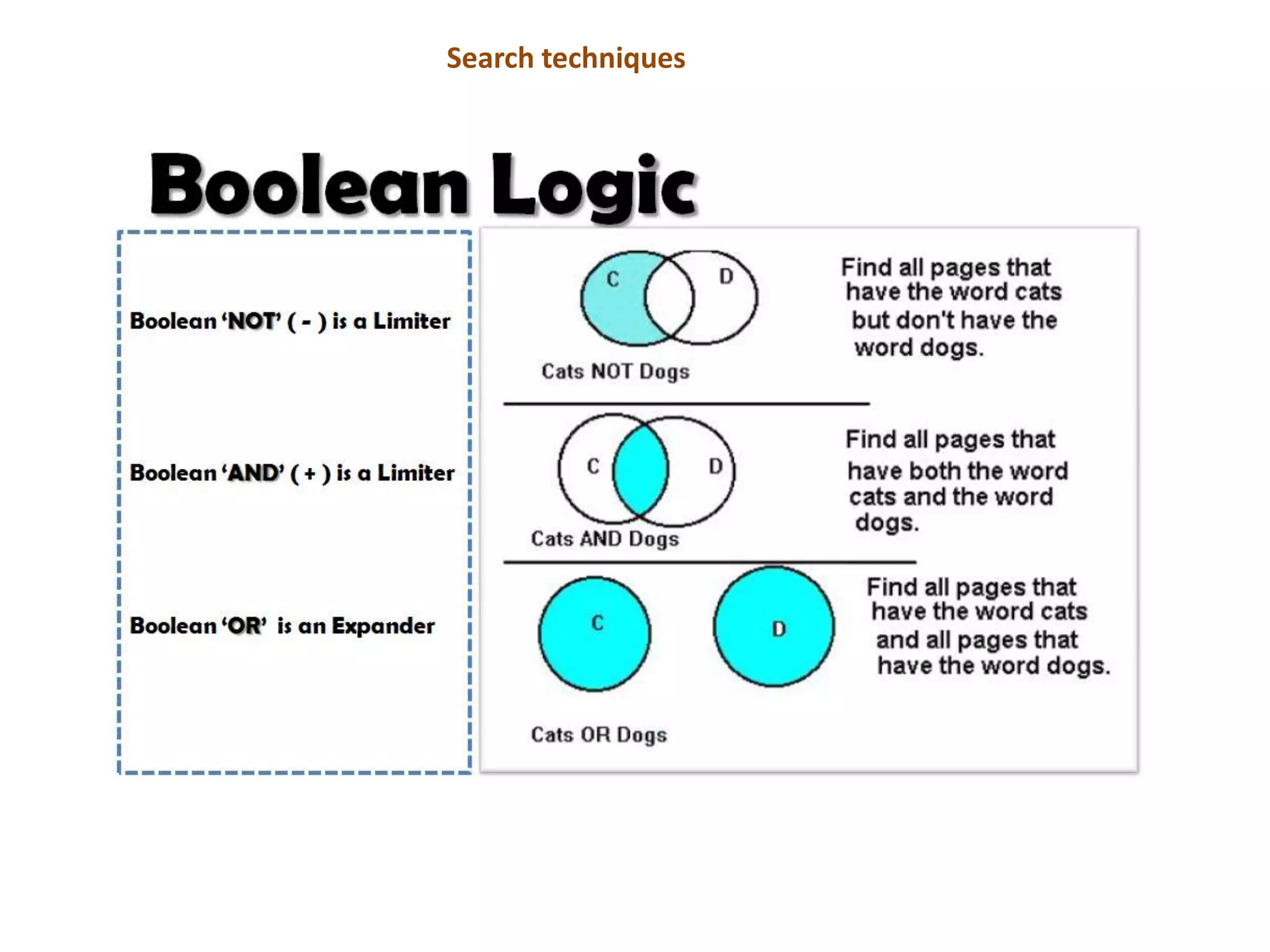
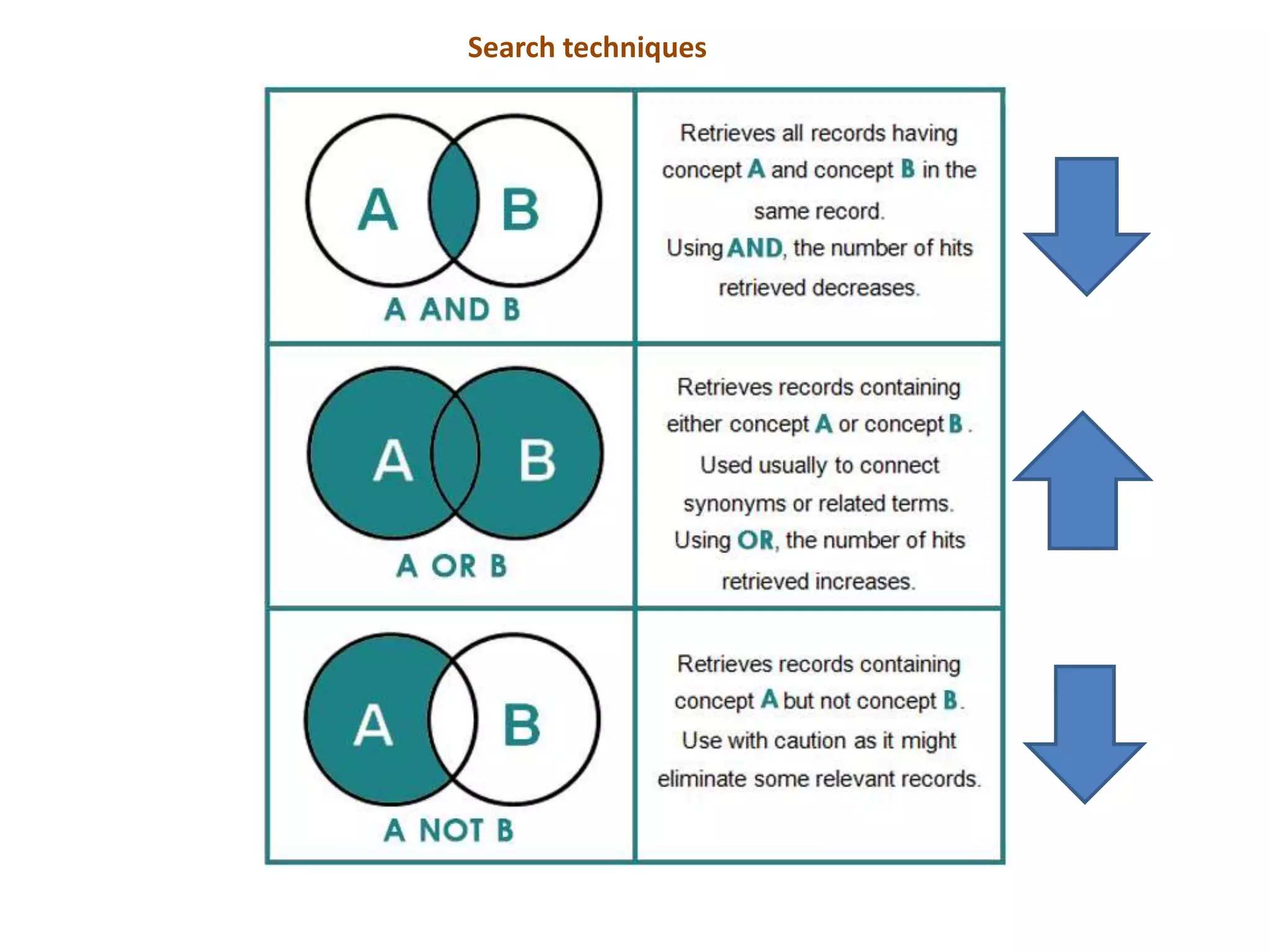
Use Boolean operator to search
• English Mathematician George Boole
• Must type in capital letter- AND, OR, NOT
• But not in small letters : and, or not
• PUBMED automatically uses AND if you don't
use any Boolean operators
Search techniques
There is no single correct way to do every search!
Searching is not always error free, the success depends on:
• expertise of the searcher
• searcher’s ability to define topic precisely
• how specific & accurate is the indexing
Search techniques
Search techniques
Search techniques
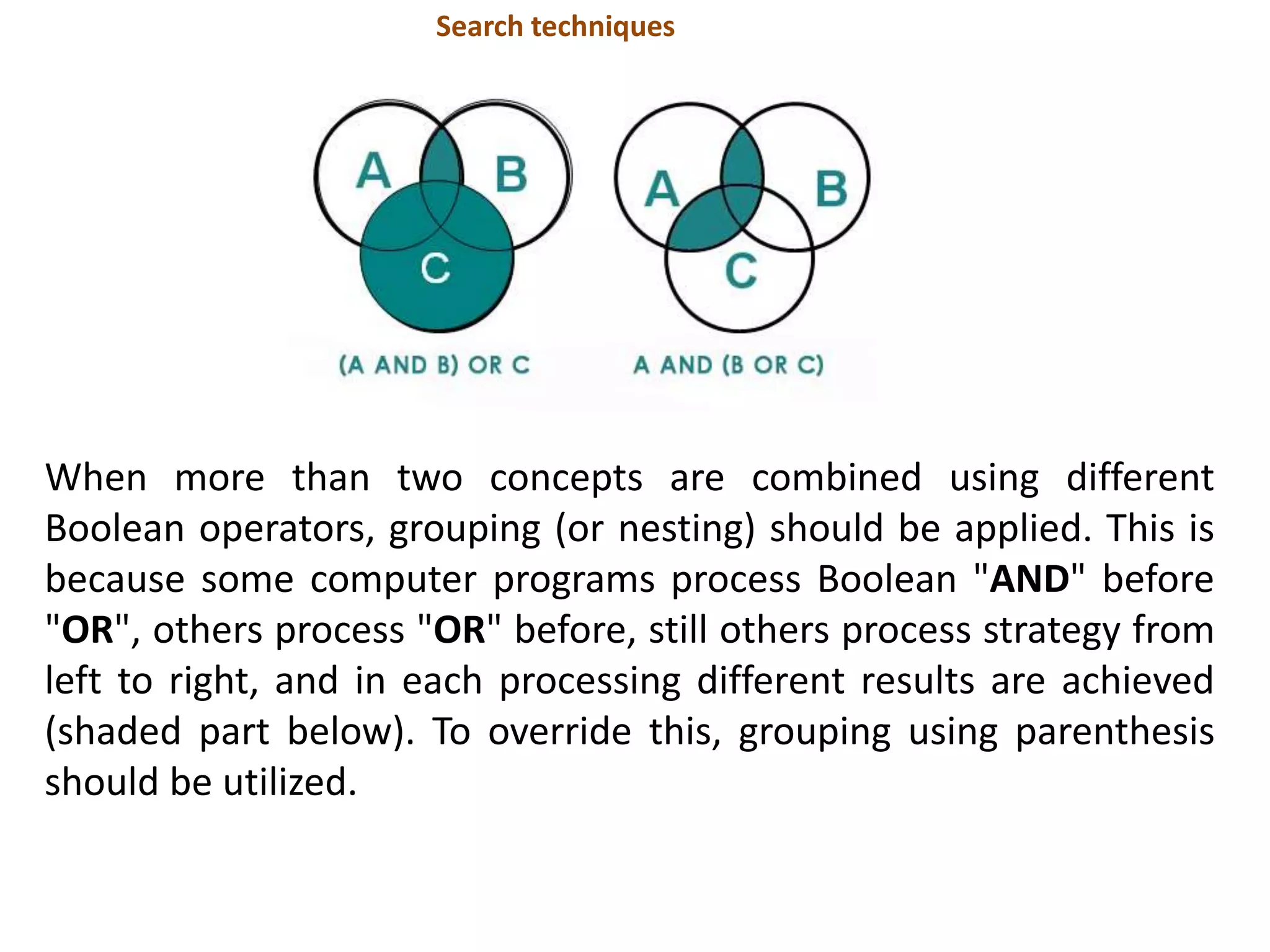
When more than two concepts are combined using different
Boolean operators, grouping (or nesting) should be applied. This is
because some computer programs process Boolean "AND" before
"OR", others process "OR" before, still others process strategy from
left to right, and in each processing different results are achieved
(shaded part below). To override this, grouping using parenthesis
should be utilized.
Search techniques
Phrase search
• Used to force retrieval of two or more words
next to each other, i.e. appearing as a phrase.
• “Fat embolism syndrome”
• “Damage control orthopaedics”
• “Mad cow disease”
• This will limit your search to the exact phrase
Search techniques
KEEPING A RECORD OF YOUR SEARCH ACTIVITY
• A search methodology could ideally include a search diary or document
detailing your search so that someone else can reproduce your steps and
get the same results.
• Keep a record of your search strategies, the sources searched and search
results from each.
• Include:
• The names of the sources you search- Pubmed, Cochrane, Ovid
• Author
• Journal
• Citation manager – endnote, Rayyan QRCI
• YEAR
A typical flow chart for Systematic review of literature
Keeping meticulous
records from the
beginning is critical
Keep a written record of your searches
• Note down the names of journals that you come
across often during your searches.
• Over time, you will get a good idea of which
journals are most prominent in your field and
which journals you should consider publishing in.
• Keep a list of the keywords and keyword
combinations that return the best results- Reduce
time taken for future searches plus also yield a
list of terminologies that are common
Use a references manager
• With the huge number of studies you will probably have to sift
through and track, manual compilation of references is no longer an
option.
• Use a reference manager like Endnote (purchase required) or
Zotero (free).
• Reference managers allow you to download and save papers in your
computer’s library directly from journal websites with just one
button click.
• make it very easy to organize your library and compile reference
lists.
• Although these programs may be difficult to use initially, skimming
through their help manual or video tutorial along with a few days of
learning through trial and error are all that’s required to become
comfortable with them
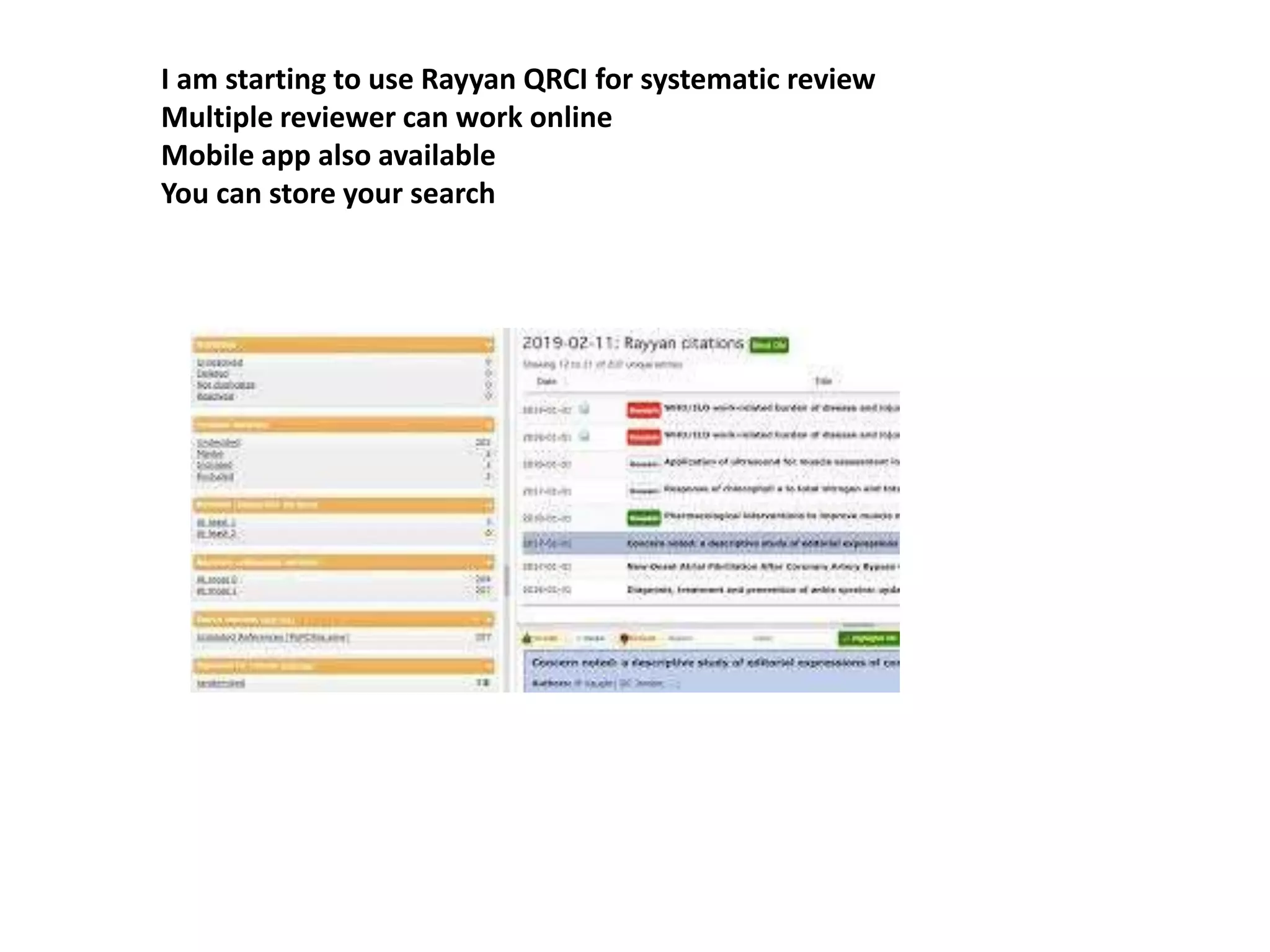
I am starting to use Rayyan QRCI for systematic review
Multiple reviewer can work online
Mobile app also available
You can store your search
Thank you
You can set up subject alert
• You can set up alerts for new articles on your
topic of interest. Such facility is available in
• Scopus
• Taylor and Francis online
• Science direct
• find more studies is by looking through the
reference lists of these articles (backward
searching)
• Also, look at the papers that have cited the
articles published (forward searching) & find
the newer studies

How to do a Literature search for your research and scientific publication

  • 1.
    Literature Search Dr BhaskarBorgohain MBBS (AMC), MS Ortho (Delhi Univ.), DNB Ortho (NAMS), AO Trauma Fellow, (Germany), Arthroplasty Fellow (Computer Navigation) Professor & HoD, Orthopaedics NEIGRIHMS Shillong www.neigrihms.gov.in ublishing your dissertatio Dr Murali Poduval (Orth) DNB(Orth) PGDM nt Engineering and Industrial Services aConsultancy Services Mumbai or : Indian Journal of Orthopaedics IJO-NILD-WBOA sponsored National workshop on Research Methodology and scientific publication: Kolkata 29TH September, 2019
  • 2.
    PubMed • Pubmed isa free search database that contains Medline, plus additional information in dentistry, nursing, history of medicine and complimentary & alternative medicine.
  • 3.
    Million documents indexedin Google scholar Million papers listed in Pubmed Million papers listed in science direct Scientific papers published every minute
  • 4.
    We now livein Information age Information boom Information overload Problem of plenty
  • 5.
    List of commonmedical databases • Pubmed (Journals) • Medline- Medical literature analysis and retrieval system online • CINAHL- Cumulative index of Nursing and allied health literature (Journals, books, conference proceedings) • Cochrane library- EBM • Science direct • Ovid • Psychinfo- psychological information (Journals, books, book chapters, dissertations) • Web of science (Journals, book chapters, conference proceedings) A database is a system intended to organize , store and retrieve large amount of data easily
  • 7.
    Examples of greyliterature include: • conference proceedings • theses • government documents- Ministry reports • Research reports- e.g. ICMR annual Report • annual reports- e.g. AIIMS • fact sheets and bulletins- e.g. WHO Bulletin • Reports – e.g. Joint registry of Sweden • Newspapers- medical negligence • informal communication (blogs, podcasts) • pamphlets May require manual searches
  • 8.
    So you needa Smart Search strategy Better to Begin with the end in mind
  • 9.
  • 10.
  • 11.
    First thing What isyour Research question PICOS in Systematic review Population/ Problem Intervention Comparison outcome
  • 12.
    Key words, operators& filters: Tools- terms- techniques
  • 13.
    Next thing: Whatare the Key words How to brainstorm
  • 14.
  • 15.
    Choosing search terms:Define the key words “Treatment and prevention of osteoporotic fractures in women” • Identify synonyms: Define keywords for each concept. - Treatment / intervention/therapy/cure/management - Prevention / prophylaxis - Women/ females • It is very important to use targeted keywords. • Vertebral, Wrist fractures, Compression fracture, postmanopausal Tip: You can use a dictionary/thesaurus such as ‘VisuWords’ (visuwords.com) to identify synonyms and related concepts Break up the topic - find main concepts Next, expand the list by writing down synonyms and alternative phrasings for each keyword. Identify keyword from your topic How to brainstorm
  • 16.
    Search techniques:- Refine yoursearches Use of Filter to define Limit • Age - children • Time - last 5 years • Language - English • Article type - RCT, Metanalysis • Subject - tumors • [mh] to search a MeSH heading • [majr] to search a MeSH heading that is a major topic of an article
  • 17.
    Brainstorming: Checklist for definingkeywords • What alternative vocabulary is used by others in discussion of my topic? • Are there American and British variants of spelling or vocabulary? Esophagus- Oesophagus • Identify a truncation e.g., child* to find child, children, or childish. • Are common abbreviations, acronyms used? Fat embolism, FES, Cerebral fat embolism • What more general terms describe my topic? • What categories I'd like to exclude? How to brainstorm
  • 18.
    To develop asearch strategy : • define and write down your research question - what is it that you are going to research? • determine a timeframe (When) from your research, if needed • consider what type material you will include and why • identify where you will search for the information
  • 19.
    Wild card &Truncation Internal truncation or Wild card If you type Colo?r It will find both color and colour- And Both English , American Journals will be covered External truncation If you Type “ Prevent*” It will search all of the following • Prevention • Preventable • preventative Search techniques
  • 20.
  • 21.
    Search strategy: CombineKey words and Boolean logic In adolescent smokers is brief counseling session help to quit smoking Research question P-Population I-Intervention O-Outcome
  • 22.
    A hierarchy ofterms is arranged in ‘trees’ starting with a broad topic and branching into more specific ones Search techniques: MeSH Tree
  • 23.
    Example: • If youtype eye [mh] it will retrieve citations indexed to: Eye Eyebrows Eyelids Eyelashes Eyelids etc Search techniques
  • 24.
    Field tag Type [au]for Author e.g. John (au) Type [ti] to search for Title of the paper Type [ta] for search for the journal- but will not pick up ebooks hypertension [ta]- to search for the Journal only Note: this will find the journal named HYPERTENSION but not pick up the keyword “hypertension” Type [dp] for date of publication- period blood[au] AND hypertension[ta] AND 2005[dp] Search techniques
  • 25.
    Use Boolean operatorto search • English Mathematician George Boole • Must type in capital letter- AND, OR, NOT • But not in small letters : and, or not • PUBMED automatically uses AND if you don't use any Boolean operators Search techniques
  • 26.
    There is nosingle correct way to do every search! Searching is not always error free, the success depends on: • expertise of the searcher • searcher’s ability to define topic precisely • how specific & accurate is the indexing Search techniques
  • 27.
  • 28.
  • 29.
    When more thantwo concepts are combined using different Boolean operators, grouping (or nesting) should be applied. This is because some computer programs process Boolean "AND" before "OR", others process "OR" before, still others process strategy from left to right, and in each processing different results are achieved (shaded part below). To override this, grouping using parenthesis should be utilized. Search techniques
  • 30.
    Phrase search • Usedto force retrieval of two or more words next to each other, i.e. appearing as a phrase. • “Fat embolism syndrome” • “Damage control orthopaedics” • “Mad cow disease” • This will limit your search to the exact phrase Search techniques
  • 31.
    KEEPING A RECORDOF YOUR SEARCH ACTIVITY • A search methodology could ideally include a search diary or document detailing your search so that someone else can reproduce your steps and get the same results. • Keep a record of your search strategies, the sources searched and search results from each. • Include: • The names of the sources you search- Pubmed, Cochrane, Ovid • Author • Journal • Citation manager – endnote, Rayyan QRCI • YEAR
  • 32.
    A typical flowchart for Systematic review of literature Keeping meticulous records from the beginning is critical
  • 34.
    Keep a writtenrecord of your searches • Note down the names of journals that you come across often during your searches. • Over time, you will get a good idea of which journals are most prominent in your field and which journals you should consider publishing in. • Keep a list of the keywords and keyword combinations that return the best results- Reduce time taken for future searches plus also yield a list of terminologies that are common
  • 35.
    Use a referencesmanager • With the huge number of studies you will probably have to sift through and track, manual compilation of references is no longer an option. • Use a reference manager like Endnote (purchase required) or Zotero (free). • Reference managers allow you to download and save papers in your computer’s library directly from journal websites with just one button click. • make it very easy to organize your library and compile reference lists. • Although these programs may be difficult to use initially, skimming through their help manual or video tutorial along with a few days of learning through trial and error are all that’s required to become comfortable with them
  • 36.
    I am startingto use Rayyan QRCI for systematic review Multiple reviewer can work online Mobile app also available You can store your search
  • 37.
  • 38.
    You can setup subject alert • You can set up alerts for new articles on your topic of interest. Such facility is available in • Scopus • Taylor and Francis online • Science direct • find more studies is by looking through the reference lists of these articles (backward searching) • Also, look at the papers that have cited the articles published (forward searching) & find the newer studies