Zohreh
Rajabi
Civil Engineer |PhD Scholar |
Academic Sessional | President of
WISE
Despite the impacts of the devastating global pandemic of
Covid-19 in 2020, I graduated with first-class honors and
received the Research Training Program (RTP) Scholarship in
2021 to start my PhD directly.
Since then, I have published a total of 10 Research Articles in
Q1/Q2 Journals, and 4 other articles are in the review process.
My Research Interest Score is higher than 94% of
ResearchGate members who first published in 2020. I have
attended two international conferences as the key speaker
and the session chair.
My Research is mainly focused on water resource
management. More specifically, water footprint, which is one
of the most important fields in the engineering industry and
research topic.
My contribution to water footprint and water resource
management is well recognized by the VU community and
reported by news articles occasionally.
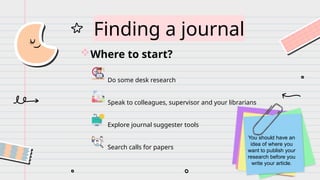
Finding a journal
Whereto start?
You should have an
idea of where you
want to publish your
research before you
write your article.
Do some desk research
Speak to colleagues, supervisor and your librarians
Explore journal suggester tools
Search calls for papers
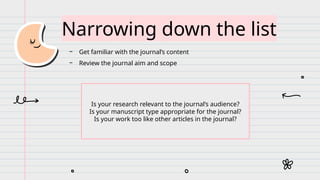
Narrowing down thelist
− Get familiar with the journal’s content
− Review the journal aim and scope
Is your research relevant to the journal’s audience?
Is your manuscript type appropriate for the journal?
Is your work too like other articles in the journal?
9.
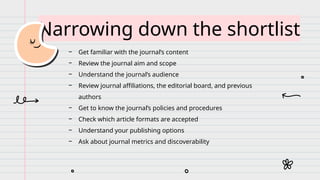
Narrowing down theshortlist
− Get familiar with the journal’s content
− Review the journal aim and scope
− Understand the journal’s audience
− Review journal affiliations, the editorial board, and previous
authors
− Get to know the journal’s policies and procedures
− Check which article formats are accepted
− Understand your publishing options
− Ask about journal metrics and discoverability
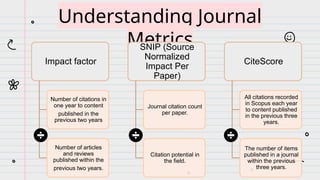
Understanding Journal
Metrics
Impact factor
Numberof citations in
one year to content
published in the
previous two years
Number of articles
and reviews
published within the
previous two years.
SNIP (Source
Normalized
Impact Per
Paper)
Journal citation count
per paper.
Citation potential in
the field.
CiteScore
All citations recorded
in Scopus each year
to content published
in the previous three
years.
The number of items
published in a journal
within the previous
three years.
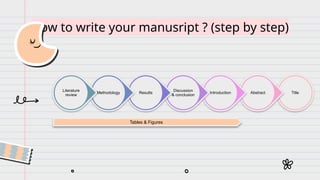
How to writeyour manusript ? (step by step)
Title
Abstract
Introduction
Discussion
& conclusion
Results
Methodology
Literature
review
Tables & Figures
15.
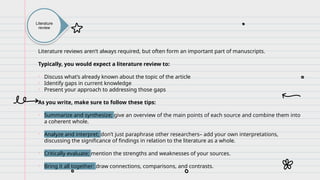
Literature
review
Literature reviews aren’talways required, but often form an important part of manuscripts.
Typically, you would expect a literature review to:
• Discuss what’s already known about the topic of the article
• Identify gaps in current knowledge
• Present your approach to addressing those gaps
As you write, make sure to follow these tips:
• Summarize and synthesize; give an overview of the main points of each source and combine them into
a coherent whole.
• Analyze and interpret; don’t just paraphrase other researchers– add your own interpretations,
discussing the significance of findings in relation to the literature as a whole.
• Critically evaluate; mention the strengths and weaknesses of your sources.
• Bring it all together: draw connections, comparisons, and contrasts.
16.
Literature
review
Citations should be:
•Well balanced: If experiments have found
conflicting results on a question, make
sure you cite studies with both kinds of
results.
• Current: Every field is different, but you
should aim to cite references that are not
more than 10 years old if possible.
Although be sure to cite the first discovery
or mention in the literature even if it was
more than 10 years ago.
• Relevant: This is the most important
requirement. The studies you cite should
be strongly related to your research
question.
17.
Methodology
Literature
review
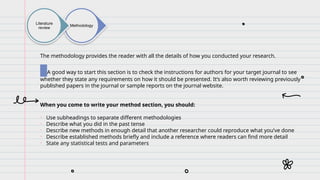
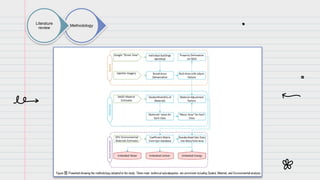
The methodology providesthe reader with all the details of how you conducted your research.
A good way to start this section is to check the instructions for authors for your target journal to see
whether they state any requirements on how it should be presented. It’s also worth reviewing previously
published papers in the journal or sample reports on the journal website.
When you come to write your method section, you should:
• Use subheadings to separate different methodologies
• Describe what you did in the past tense
• Describe new methods in enough detail that another researcher could reproduce what you’ve done
• Describe established methods briefly and include a reference where readers can find more detail
• State any statistical tests and parameters
Results
Methodology
Literature
review
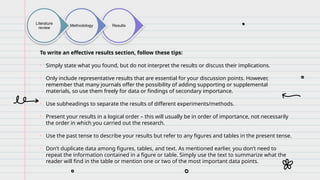
To write aneffective results section, follow these tips:
• Simply state what you found, but do not interpret the results or discuss their implications.
• Only include representative results that are essential for your discussion points. However,
remember that many journals offer the possibility of adding supporting or supplemental
materials, so use them freely for data or findings of secondary importance.
• Use subheadings to separate the results of different experiments/methods.
• Present your results in a logical order – this will usually be in order of importance, not necessarily
the order in which you carried out the research.
• Use the past tense to describe your results but refer to any figures and tables in the present tense.
• Don’t duplicate data among figures, tables, and text. As mentioned earlier, you don’t need to
repeat the information contained in a figure or table. Simply use the text to summarize what the
reader will find in the table or mention one or two of the most important data points.
20.
Discussion
& conclusion
Results
Methodology
Literature
review
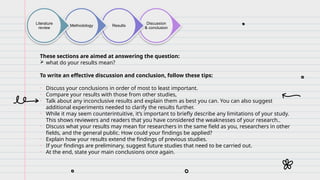
These sectionsare aimed at answering the question:
what do your results mean?
To write an effective discussion and conclusion, follow these tips:
• Discuss your conclusions in order of most to least important.
• Compare your results with those from other studies,
• Talk about any inconclusive results and explain them as best you can. You can also suggest
additional experiments needed to clarify the results further.
• While it may seem counterintuitive, it’s important to briefly describe any limitations of your study.
This shows reviewers and readers that you have considered the weaknesses of your research..
• Discuss what your results may mean for researchers in the same field as you, researchers in other
fields, and the general public. How could your findings be applied?
• Explain how your results extend the findings of previous studies.
• If your findings are preliminary, suggest future studies that need to be carried out.
• At the end, state your main conclusions once again.
21.
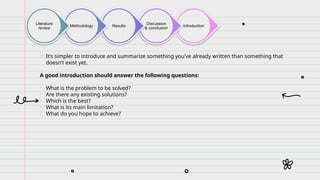
Introduction
Discussion
& conclusion
Results
Methodology
Literature
review
It’ssimpler to introduce and summarize something you’ve already written than something that
doesn’t exist yet.
A good introduction should answer the following questions:
• What is the problem to be solved?
• Are there any existing solutions?
• Which is the best?
• What is its main limitation?
• What do you hope to achieve?
22.
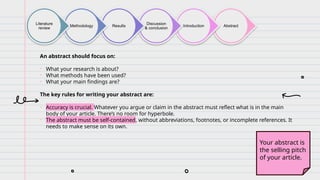
Abstract
Introduction
Discussion
& conclusion
Results
Methodology
Literature
review
An abstractshould focus on:
• What your research is about?
• What methods have been used?
• What your main findings are?
The key rules for writing your abstract are:
• Accuracy is crucial. Whatever you argue or claim in the abstract must reflect what is in the main
body of your article. There’s no room for hyperbole.
• The abstract must be self-contained, without abbreviations, footnotes, or incomplete references. It
needs to make sense on its own.
Your abstract is
the selling pitch
of your article.
23.
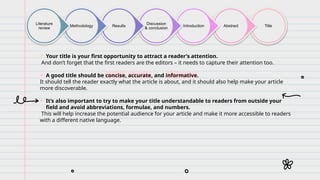
Title
Abstract
Introduction
Discussion
& conclusion
Results
Methodology
Literature
review
Yourtitle is your first opportunity to attract a reader’s attention.
And don’t forget that the first readers are the editors – it needs to capture their attention too.
A good title should be concise, accurate, and informative.
It should tell the reader exactly what the article is about, and it should also help make your article
more discoverable.
It’s also important to try to make your title understandable to readers from outside your
field and avoid abbreviations, formulae, and numbers.
This will help increase the potential audience for your article and make it more accessible to readers
with a different native language.
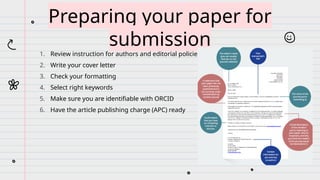
1. Review instructionfor authors and editorial policies
2. Write your cover letter
3. Check your formatting
4. Select right keywords
5. Make sure you are identifiable with ORCID
6. Have the article publishing charge (APC) ready
Preparing your paper for
submission
27.
1. Review instructionfor authors and editorial policies
2. Write your cover letter
3. Check your formatting
4. Select right keywords
5. Make sure you are identifiable with ORCID
6. Have the article publishing charge (APC) ready
Preparing your paper for
submission
28.
Academic journals usea variety of online submission systems that allow editors to
quickly access your submitted work.
What do you need to hand when submitting your manuscript?
When you submit your manuscript, you’ll generally need to have the following to
hand:
• Your manuscript (The main document file with abstract, keywords, main text,
and references.)
• Figure files
• Table files
• Any extra files such as supplemental material or biographical notes
Submit your work using
submission systems
The emotions andexpectations associated with receiving peer review
comments.
1. Anticipation: Authors often feel a sense of anticipation while waiting for the peer review
results.
2. Excitement: Receiving peer review comments can be exciting, as it signifies progress in the
publication process and an opportunity to improve the article.
3. Disappointment: If the peer review comments are predominantly negative or critical, authors
may feel a sense of disappointment. They might have expected more positive feedback or
hoped for a smoother review process.
4. Frustration: Authors may experience frustration if they perceive that the reviewers have
misunderstood their work or if they receive conflicting or unclear comments.
5. Validation: Positive feedback and constructive criticism from the reviewers can provide a
sense of validation and affirmation that the research is valuable and worthy of publication.
6. Overwhelm: The volume and depth of peer review comments can sometimes be
overwhelming, particularly if there are numerous suggestions for revision or major changes
Receiving Peer review comments
32.
The value ofconstructive criticism in improving the quality of the article.
1. Identifying weaknesses and gaps.
2. Offering fresh perspectives.
3. Enhancing clarity and coherence.
4. Strengthening arguments and evidence.
5. Refining research methodologies.
6. Improving writing style and readability.
7. Addressing limitations effectively.
8. Guiding the revision process.
9. Promoting academic rigor.
10. Increasing publication potential.
Receiving Peer review comments
33.
Carefully readand analyze the peer review comments.
Categorize the comments based on their nature (major or minor issues).
Prioritize the comments and determine the most critical ones to address.
Preparing review comments
34.
1. Introduce yourresponse letter professionally, acknowledging the reviewers and
expressing gratitude for their feedback.
2. Address each comment individually, providing a clear and concise response.
3. Use a respectful and professional tone throughout the response letter.
4. Provide detailed explanations and supporting evidence for the changes made or
reasons for disagreement (if applicable).
5. Consider using a table or bullet points to organize your responses for clarity.
Structuring your Response
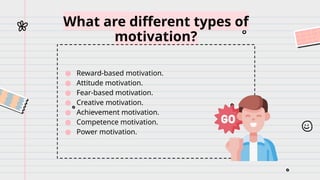
What are differenttypes of
motivation?
● Reward-based motivation.
● Attitude motivation.
● Fear-based motivation.
● Creative motivation.
● Achievement motivation.
● Competence motivation.
● Power motivation.
39.
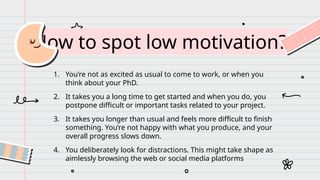
How to spotlow motivation?
1. You’re not as excited as usual to come to work, or when you
think about your PhD.
2. It takes you a long time to get started and when you do, you
postpone difficult or important tasks related to your project.
3. It takes you longer than usual and feels more difficult to finish
something. You’re not happy with what you produce, and your
overall progress slows down.
4. You deliberately look for distractions. This might take shape as
aimlessly browsing the web or social media platforms
40.
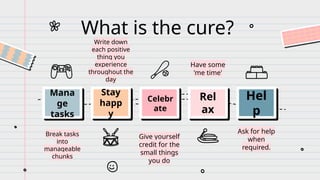
What is thecure?
Hel
p
Rel
ax
Celebr
ate
Stay
happ
y
Mana
ge
tasks
Have some
'me time'
Write down
each positive
thing you
experience
throughout the
day
Ask for help
when
required.
Give yourself
credit for the
small things
you do
Break tasks
into
manageable
chunks
41.
Possible topics
•Topic: Investigatingthe effects of climate change on urban water systems and developing adaptive
strategies.
Title: "Assessing the Impact of Climate Change on Urban Hydrology: A Case Study
of [City/Region]"
•Topic: Analyzing different governance approaches to ensure equitable and sustainable water management.
Title: "Evaluating Sustainable Water Governance Models for [Country/Region]"
•Topic: Conducting a water footprint assessment to determine the environmental impact of a specific industry
or process.
Title: "Quantifying the Water Footprint of [Industry/Production Process] in
[Location]"
•Topic: Evaluating the environmental impacts of urban water infrastructure from construction to operation.
Title: "Life Cycle Assessment of Water Infrastructure: Towards Sustainable Urban
Water Systems"
•Topic: Using multicriteria analysis to prioritize flood management strategies in urban areas vulnerable to
climate change-induced flooding.
Title: "Urban Flood Risk Management in the Face of Climate Change: A Multicriteria
Analysis"
42.
•Topic: Investigating therole of flood management in ensuring the sustainability of remote housing in Victoria
in the context of climate change.
Title: "Enhancing Remote Housing Resilience: Flood Management Strategies for
Victoria's Outback Communities"
•Topic: Analyzing the environmental impacts and sustainability of hydropower generation in Australia,
considering factors such as water resources and ecosystem health.
Title: "Hydropower Generation and Environmental Sustainability in Australia: A
Comprehensive Review"
•Topic: Examining the relationship between water scarcity, agriculture, and food security in a specific region.
Title: "Water Scarcity and Food Security: A Study of [Crop/Farming Practice] in
[Region]"
•Topic: Investigating the interdependencies between water supply and energy generation in urban
environments and proposing integrated solutions for sustainability.
Title: "Water-Energy Nexus in Urban Areas: Integrating Water Supply and Energy
Sustainability"
•Topic: Exploring the importance of community involvement and awareness in achieving sustainable urban
water management goals.
Title: "The Role of Community Engagement in Sustainable Urban Water
Management"
43.
CREDITS: This presentationtemplate was created
by Slidesgo, and includes icons by Flaticon and
infographics & images by Freepik
Thank
s!
Do you have any questions?
Zohreh.rajabi@live.vu.edu.au
![Possible topics
•Topic: Investigating the effects of climate change on urban water systems and developing adaptive
strategies.
Title: "Assessing the Impact of Climate Change on Urban Hydrology: A Case Study
of [City/Region]"
•Topic: Analyzing different governance approaches to ensure equitable and sustainable water management.
Title: "Evaluating Sustainable Water Governance Models for [Country/Region]"
•Topic: Conducting a water footprint assessment to determine the environmental impact of a specific industry
or process.
Title: "Quantifying the Water Footprint of [Industry/Production Process] in
[Location]"
•Topic: Evaluating the environmental impacts of urban water infrastructure from construction to operation.
Title: "Life Cycle Assessment of Water Infrastructure: Towards Sustainable Urban
Water Systems"
•Topic: Using multicriteria analysis to prioritize flood management strategies in urban areas vulnerable to
climate change-induced flooding.
Title: "Urban Flood Risk Management in the Face of Climate Change: A Multicriteria
Analysis"](https://image.slidesharecdn.com/researchmethodology-250723072809-49398cf7/85/Research-Methodology-Writing-Journals-Papers-41-320.jpg)
![•Topic: Investigating the role of flood management in ensuring the sustainability of remote housing in Victoria
in the context of climate change.
Title: "Enhancing Remote Housing Resilience: Flood Management Strategies for
Victoria's Outback Communities"
•Topic: Analyzing the environmental impacts and sustainability of hydropower generation in Australia,
considering factors such as water resources and ecosystem health.
Title: "Hydropower Generation and Environmental Sustainability in Australia: A
Comprehensive Review"
•Topic: Examining the relationship between water scarcity, agriculture, and food security in a specific region.
Title: "Water Scarcity and Food Security: A Study of [Crop/Farming Practice] in
[Region]"
•Topic: Investigating the interdependencies between water supply and energy generation in urban
environments and proposing integrated solutions for sustainability.
Title: "Water-Energy Nexus in Urban Areas: Integrating Water Supply and Energy
Sustainability"
•Topic: Exploring the importance of community involvement and awareness in achieving sustainable urban
water management goals.
Title: "The Role of Community Engagement in Sustainable Urban Water
Management"](https://image.slidesharecdn.com/researchmethodology-250723072809-49398cf7/85/Research-Methodology-Writing-Journals-Papers-42-320.jpg)