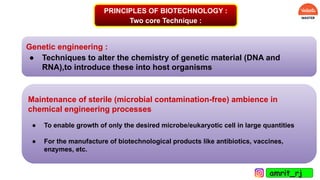
PRINCIPLES OF BIOTECHNOLOGY :
Two core Technique :
Genetic engineering :
● Techniques to alter the chemistry of genetic material (DNA and
RNA),to introduce these into host organisms
Maintenance of sterile (microbial contamination-free) ambience in
chemical engineering processes
● To enable growth of only the desired microbe/eukaryotic cell in large quantities
● For the manufacture of biotechnological products like antibiotics, vaccines,
enzymes, etc.
amrit_rj
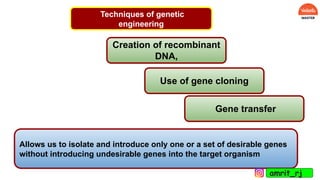
Techniques of genetic
engineering
Allows us to isolate and introduce only one or a set of desirable genes
without introducing undesirable genes into the target organism
Creation of recombinant
DNA,
Use of gene cloning
Gene transfer
amrit_rj
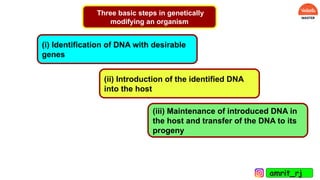
Three basic steps in genetically
modifying an organism
(i) Identification of DNA with desirable
genes
(ii) Introduction of the identified DNA
into the host
(iii) Maintenance of introduced DNA in
the host and transfer of the DNA to its
progeny
amrit_rj
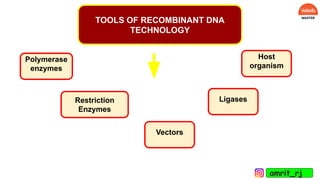
TOOLS OF RECOMBINANT DNA
TECHNOLOGY
Restriction
Enzymes
Host
organism
Vectors
Ligases
Polymerase
enzymes
amrit_rj
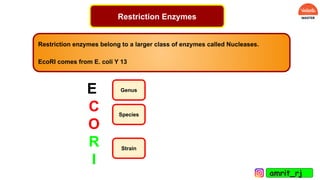
Restriction Enzymes
Restriction enzymes belong to a larger class of enzymes called Nucleases.
EcoRI comes from E. coli Y 13
E
C
O
R
I
Genus
Species
Strain
amrit_rj
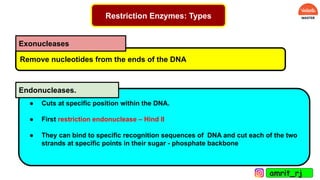
Restriction Enzymes: Types
Remove nucleotides from the ends of the DNA
● Cuts at specific position within the DNA.
● First restriction endonuclease – Hind II
● They can bind to specific recognition sequences of DNA and cut each of the two
strands at specific points in their sugar - phosphate backbone
Exonucleases
Endonucleases.
amrit_rj
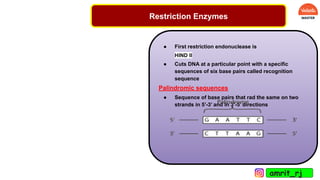
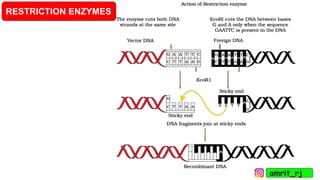
Restriction Enzymes
● First restriction endonuclease is
HIND II
● Cuts DNA at a particular point with a specific
sequences of six base pairs called recognition
sequence
Palindromic sequences
● Sequence of base pairs that rad the same on two
strands in 5’-3’ and in 3’-5’ directions
amrit_rj
RESTRICTION ENZYMES
amrit_rj
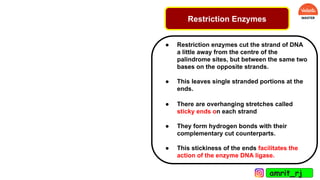
Restriction Enzymes
● Restriction enzymes cut the strand of DNA
a little away from the centre of the
palindrome sites, but between the same two
bases on the opposite strands.
● This leaves single stranded portions at the
ends.
● There are overhanging stretches called
sticky ends on each strand
● They form hydrogen bonds with their
complementary cut counterparts.
● This stickiness of the ends facilitates the
action of the enzyme DNA ligase.
amrit_rj
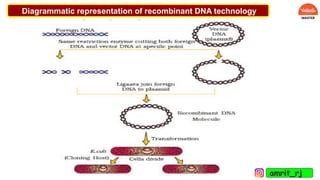
Diagrammatic representation of recombinant DNA technology
amrit_rj
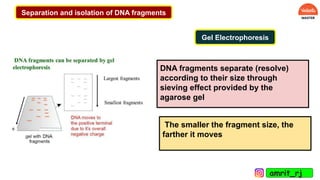
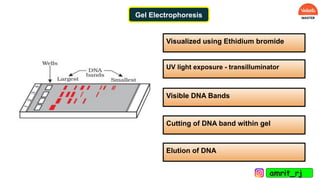
Separation and isolation of DNA fragments
Gel Electrophoresis
DNA fragments separate (resolve)
according to their size through
sieving effect provided by the
agarose gel
The smaller the fragment size, the
farther it moves
amrit_rj
Visualized using Ethidium bromide
UV light exposure - transilluminator
Visible DNA Bands
Cutting of DNA band within gel
Elution of DNA
amrit_rj
Gel Electrophoresis
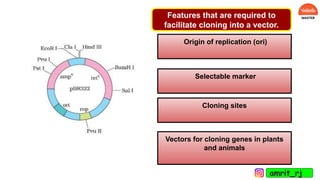
Features that are required to
facilitate cloning into a vector.
Origin of replication (ori)
Selectable marker
Cloning sites
Vectors for cloning genes in plants
and animals
amrit_rj
Origin of replication (ori)
● Sequence from where replication starts and any piece of DNA
when linked to this sequence can be made to replicate within the
host cells.
● Also responsible for controlling the copy number of the linked
DNA.
● So, if one wants to recover many copies of the target DNA it
should be cloned in a vector whose origin support high copy
number.
amrit_rj
Helps in identifying and eliminating non
transformants and selectively permitting the
growth of the transformants.
Transformation is a procedure through which a
piece of DNA is introduced in a host bacterium
Selectable marker
● Ampicillin
● Chloramphenicol
● Tetracycline
● Kanamycin, etc.
● For E. coli.
● The normal E. coli cells do not carry
resistance against any of these
antibiotics.
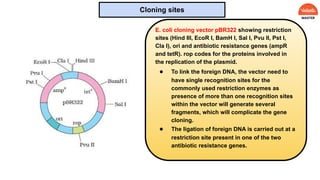
E. coli cloning vector pBR322 showing restriction
sites (Hind III, EcoR I, BamH I, Sal I, Pvu II, Pst I,
Cla I), ori and antibiotic resistance genes (ampR
and tetR). rop codes for the proteins involved in
the replication of the plasmid.
● To link the foreign DNA, the vector need to
have single recognition sites for the
commonly used restriction enzymes as
presence of more than one recognition sites
within the vector will generate several
fragments, which will complicate the gene
cloning.
● The ligation of foreign DNA is carried out at a
restriction site present in one of the two
antibiotic resistance genes.
Cloning sites
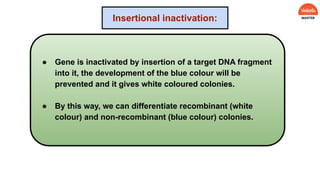
● Gene is inactivated by insertion of a target DNA fragment
into it, the development of the blue colour will be
prevented and it gives white coloured colonies.
● By this way, we can differentiate recombinant (white
colour) and non-recombinant (blue colour) colonies.
Insertional inactivation:
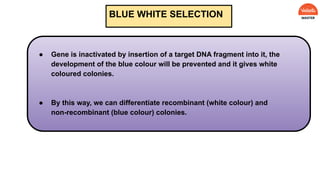
● Gene is inactivated by insertion of a target DNA fragment into it, the
development of the blue colour will be prevented and it gives white
coloured colonies.
● By this way, we can differentiate recombinant (white colour) and
non-recombinant (blue colour) colonies.
BLUE WHITE SELECTION
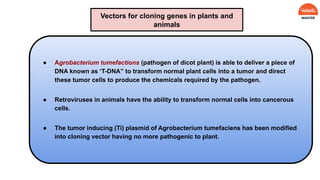
● Agrobacterium tumefactions (pathogen of dicot plant) is able to deliver a piece of
DNA known as ‘T-DNA” to transform normal plant cells into a tumor and direct
these tumor cells to produce the chemicals required by the pathogen.
● Retroviruses in animals have the ability to transform normal cells into cancerous
cells.
● The tumor inducing (Ti) plasmid of Agrobacterium tumefaciens has been modified
into cloning vector having no more pathogenic to plant.
Vectors for cloning genes in plants and
animals
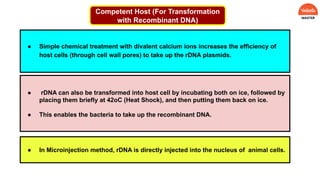
Competent Host (For Transformation
with Recombinant DNA)
● Simple chemical treatment with divalent calcium ions increases the efficiency of
host cells (through cell wall pores) to take up the rDNA plasmids.
● In Microinjection method, rDNA is directly injected into the nucleus of animal cells.
● rDNA can also be transformed into host cell by incubating both on ice, followed by
placing them briefly at 42oC (Heat Shock), and then putting them back on ice.
● This enables the bacteria to take up the recombinant DNA.
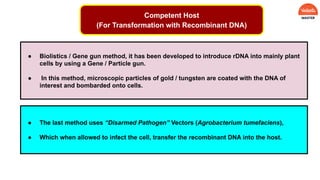
● Biolistics / Gene gun method, it has been developed to introduce rDNA into mainly plant
cells by using a Gene / Particle gun.
● In this method, microscopic particles of gold / tungsten are coated with the DNA of
interest and bombarded onto cells.
● The last method uses “Disarmed Pathogen” Vectors (Agrobacterium tumefaciens),
● Which when allowed to infect the cell, transfer the recombinant DNA into the host.
Competent Host
(For Transformation with Recombinant DNA)
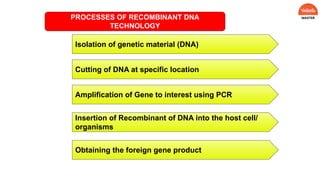
PROCESSES OF RECOMBINANT DNA
TECHNOLOGY
Isolation of genetic material (DNA)
Cutting of DNA at specific location
Amplification of Gene to interest using PCR
Insertion of Recombinant of DNA into the host cell/
organisms
Obtaining the foreign gene product
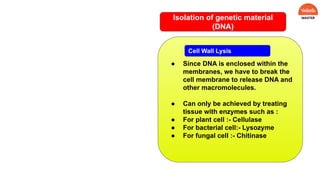
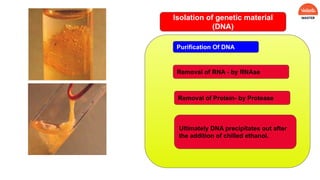
Isolation of genetic material
(DNA)
● Since DNA is enclosed within the
membranes, we have to break the
cell membrane to release DNA and
other macromolecules.
● Can only be achieved by treating
tissue with enzymes such as :
● For plant cell :- Cellulase
● For bacterial cell:- Lysozyme
● For fungal cell :- Chitinase
Cell Wall Lysis
Isolation of genetic material
(DNA)
Cell Wall Lysis
Removal of RNA - by RNAse
Removal of Protein- by Protease
Ultimately DNA precipitates out after
the addition of chilled ethanol.
Purification Of DNA
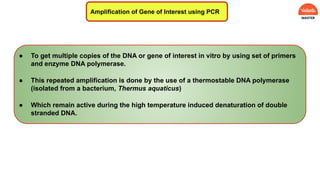
Amplification of Gene of Interest using PCR
● To get multiple copies of the DNA or gene of interest in vitro by using set of primers
and enzyme DNA polymerase.
● This repeated amplification is done by the use of a thermostable DNA polymerase
(isolated from a bacterium, Thermus aquaticus)
● Which remain active during the high temperature induced denaturation of double
stranded DNA.
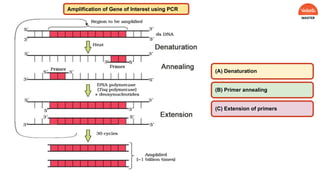
Amplification of Gene of Interest using PCR
(A) Denaturation
(B) Primer annealing
(C) Extension of primers
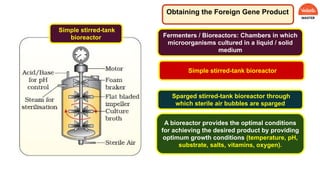
Obtaining the Foreign Gene Product
Fermenters / Bioreactors: Chambers in which
microorganisms cultured in a liquid / solid
medium
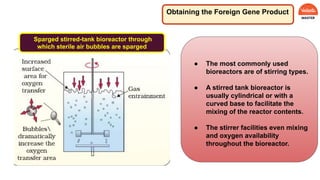
Sparged stirred-tank bioreactor through
which sterile air bubbles are sparged
Simple stirred-tank bioreactor
A bioreactor provides the optimal conditions
for achieving the desired product by providing
optimum growth conditions (temperature, pH,
substrate, salts, vitamins, oxygen).
Simple stirred-tank
bioreactor
Obtaining the Foreign Gene Product
Sparged stirred-tank bioreactor through
which sterile air bubbles are sparged
● The most commonly used
bioreactors are of stirring types.
● A stirred tank bioreactor is
usually cylindrical or with a
curved base to facilitate the
mixing of the reactor contents.
● The stirrer facilities even mixing
and oxygen availability
throughout the bioreactor.
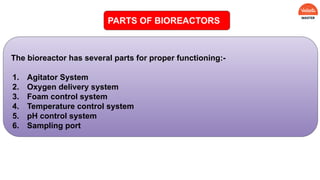
PARTS OF BIOREACTORS
The bioreactor has several parts for proper functioning:-
1. Agitator System
2. Oxygen delivery system
3. Foam control system
4. Temperature control system
5. pH control system
6. Sampling port
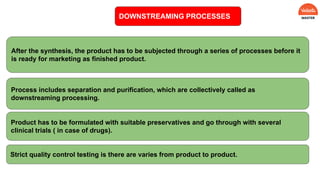
DOWNSTREAMING PROCESSES
After the synthesis, the product has to be subjected through a series of processes before it
is ready for marketing as finished product.
Process includes separation and purification, which are collectively called as
downstreaming processing.
Product has to be formulated with suitable preservatives and go through with several
clinical trials ( in case of drugs).
Strict quality control testing is there are varies from product to product.
amrit_rj
Course sale price Rs.
1,800/-(after discount)
NEET Crash Course-Lite
Recordings will be
available till your NEET
examination
9th May,2022
ARAPRO
amrit_rj
Like Share Subscribe
amrit_rj
ONE+SHOT+BIOTECHNOLOGY_TAMIL.pdf

ONE+SHOT+BIOTECHNOLOGY_TAMIL.pdf

  • 2.
    PRINCIPLES OF BIOTECHNOLOGY: Two core Technique : Genetic engineering : ● Techniques to alter the chemistry of genetic material (DNA and RNA),to introduce these into host organisms Maintenance of sterile (microbial contamination-free) ambience in chemical engineering processes ● To enable growth of only the desired microbe/eukaryotic cell in large quantities ● For the manufacture of biotechnological products like antibiotics, vaccines, enzymes, etc. amrit_rj
  • 3.
    Techniques of genetic engineering Allowsus to isolate and introduce only one or a set of desirable genes without introducing undesirable genes into the target organism Creation of recombinant DNA, Use of gene cloning Gene transfer amrit_rj
  • 4.
    Three basic stepsin genetically modifying an organism (i) Identification of DNA with desirable genes (ii) Introduction of the identified DNA into the host (iii) Maintenance of introduced DNA in the host and transfer of the DNA to its progeny amrit_rj
  • 5.
    TOOLS OF RECOMBINANTDNA TECHNOLOGY Restriction Enzymes Host organism Vectors Ligases Polymerase enzymes amrit_rj
  • 6.
    Restriction Enzymes Restriction enzymesbelong to a larger class of enzymes called Nucleases. EcoRI comes from E. coli Y 13 E C O R I Genus Species Strain amrit_rj
  • 7.
    Restriction Enzymes: Types Removenucleotides from the ends of the DNA ● Cuts at specific position within the DNA. ● First restriction endonuclease – Hind II ● They can bind to specific recognition sequences of DNA and cut each of the two strands at specific points in their sugar - phosphate backbone Exonucleases Endonucleases. amrit_rj
  • 8.
    Restriction Enzymes ● Firstrestriction endonuclease is HIND II ● Cuts DNA at a particular point with a specific sequences of six base pairs called recognition sequence Palindromic sequences ● Sequence of base pairs that rad the same on two strands in 5’-3’ and in 3’-5’ directions amrit_rj
  • 9.
  • 10.
    Restriction Enzymes ● Restrictionenzymes cut the strand of DNA a little away from the centre of the palindrome sites, but between the same two bases on the opposite strands. ● This leaves single stranded portions at the ends. ● There are overhanging stretches called sticky ends on each strand ● They form hydrogen bonds with their complementary cut counterparts. ● This stickiness of the ends facilitates the action of the enzyme DNA ligase. amrit_rj
  • 11.
    Diagrammatic representation ofrecombinant DNA technology amrit_rj
  • 12.
    Separation and isolationof DNA fragments Gel Electrophoresis DNA fragments separate (resolve) according to their size through sieving effect provided by the agarose gel The smaller the fragment size, the farther it moves amrit_rj
  • 13.
    Visualized using Ethidiumbromide UV light exposure - transilluminator Visible DNA Bands Cutting of DNA band within gel Elution of DNA amrit_rj Gel Electrophoresis
  • 14.
    Features that arerequired to facilitate cloning into a vector. Origin of replication (ori) Selectable marker Cloning sites Vectors for cloning genes in plants and animals amrit_rj
  • 15.
    Origin of replication(ori) ● Sequence from where replication starts and any piece of DNA when linked to this sequence can be made to replicate within the host cells. ● Also responsible for controlling the copy number of the linked DNA. ● So, if one wants to recover many copies of the target DNA it should be cloned in a vector whose origin support high copy number. amrit_rj
  • 16.
    Helps in identifyingand eliminating non transformants and selectively permitting the growth of the transformants. Transformation is a procedure through which a piece of DNA is introduced in a host bacterium Selectable marker ● Ampicillin ● Chloramphenicol ● Tetracycline ● Kanamycin, etc. ● For E. coli. ● The normal E. coli cells do not carry resistance against any of these antibiotics.
  • 17.
    E. coli cloningvector pBR322 showing restriction sites (Hind III, EcoR I, BamH I, Sal I, Pvu II, Pst I, Cla I), ori and antibiotic resistance genes (ampR and tetR). rop codes for the proteins involved in the replication of the plasmid. ● To link the foreign DNA, the vector need to have single recognition sites for the commonly used restriction enzymes as presence of more than one recognition sites within the vector will generate several fragments, which will complicate the gene cloning. ● The ligation of foreign DNA is carried out at a restriction site present in one of the two antibiotic resistance genes. Cloning sites
  • 18.
    ● Gene isinactivated by insertion of a target DNA fragment into it, the development of the blue colour will be prevented and it gives white coloured colonies. ● By this way, we can differentiate recombinant (white colour) and non-recombinant (blue colour) colonies. Insertional inactivation:
  • 19.
    ● Gene isinactivated by insertion of a target DNA fragment into it, the development of the blue colour will be prevented and it gives white coloured colonies. ● By this way, we can differentiate recombinant (white colour) and non-recombinant (blue colour) colonies. BLUE WHITE SELECTION
  • 20.
    ● Agrobacterium tumefactions(pathogen of dicot plant) is able to deliver a piece of DNA known as ‘T-DNA” to transform normal plant cells into a tumor and direct these tumor cells to produce the chemicals required by the pathogen. ● Retroviruses in animals have the ability to transform normal cells into cancerous cells. ● The tumor inducing (Ti) plasmid of Agrobacterium tumefaciens has been modified into cloning vector having no more pathogenic to plant. Vectors for cloning genes in plants and animals
  • 21.
    Competent Host (ForTransformation with Recombinant DNA) ● Simple chemical treatment with divalent calcium ions increases the efficiency of host cells (through cell wall pores) to take up the rDNA plasmids. ● In Microinjection method, rDNA is directly injected into the nucleus of animal cells. ● rDNA can also be transformed into host cell by incubating both on ice, followed by placing them briefly at 42oC (Heat Shock), and then putting them back on ice. ● This enables the bacteria to take up the recombinant DNA.
  • 22.
    ● Biolistics /Gene gun method, it has been developed to introduce rDNA into mainly plant cells by using a Gene / Particle gun. ● In this method, microscopic particles of gold / tungsten are coated with the DNA of interest and bombarded onto cells. ● The last method uses “Disarmed Pathogen” Vectors (Agrobacterium tumefaciens), ● Which when allowed to infect the cell, transfer the recombinant DNA into the host. Competent Host (For Transformation with Recombinant DNA)
  • 23.
    PROCESSES OF RECOMBINANTDNA TECHNOLOGY Isolation of genetic material (DNA) Cutting of DNA at specific location Amplification of Gene to interest using PCR Insertion of Recombinant of DNA into the host cell/ organisms Obtaining the foreign gene product
  • 24.
    Isolation of geneticmaterial (DNA) ● Since DNA is enclosed within the membranes, we have to break the cell membrane to release DNA and other macromolecules. ● Can only be achieved by treating tissue with enzymes such as : ● For plant cell :- Cellulase ● For bacterial cell:- Lysozyme ● For fungal cell :- Chitinase Cell Wall Lysis
  • 25.
    Isolation of geneticmaterial (DNA) Cell Wall Lysis Removal of RNA - by RNAse Removal of Protein- by Protease Ultimately DNA precipitates out after the addition of chilled ethanol. Purification Of DNA
  • 26.
    Amplification of Geneof Interest using PCR ● To get multiple copies of the DNA or gene of interest in vitro by using set of primers and enzyme DNA polymerase. ● This repeated amplification is done by the use of a thermostable DNA polymerase (isolated from a bacterium, Thermus aquaticus) ● Which remain active during the high temperature induced denaturation of double stranded DNA.
  • 27.
    Amplification of Geneof Interest using PCR (A) Denaturation (B) Primer annealing (C) Extension of primers
  • 28.
    Obtaining the ForeignGene Product Fermenters / Bioreactors: Chambers in which microorganisms cultured in a liquid / solid medium Sparged stirred-tank bioreactor through which sterile air bubbles are sparged Simple stirred-tank bioreactor A bioreactor provides the optimal conditions for achieving the desired product by providing optimum growth conditions (temperature, pH, substrate, salts, vitamins, oxygen). Simple stirred-tank bioreactor
  • 29.
    Obtaining the ForeignGene Product Sparged stirred-tank bioreactor through which sterile air bubbles are sparged ● The most commonly used bioreactors are of stirring types. ● A stirred tank bioreactor is usually cylindrical or with a curved base to facilitate the mixing of the reactor contents. ● The stirrer facilities even mixing and oxygen availability throughout the bioreactor.
  • 30.
    PARTS OF BIOREACTORS Thebioreactor has several parts for proper functioning:- 1. Agitator System 2. Oxygen delivery system 3. Foam control system 4. Temperature control system 5. pH control system 6. Sampling port
  • 31.
    DOWNSTREAMING PROCESSES After thesynthesis, the product has to be subjected through a series of processes before it is ready for marketing as finished product. Process includes separation and purification, which are collectively called as downstreaming processing. Product has to be formulated with suitable preservatives and go through with several clinical trials ( in case of drugs). Strict quality control testing is there are varies from product to product.
  • 32.
  • 34.
    Course sale priceRs. 1,800/-(after discount) NEET Crash Course-Lite Recordings will be available till your NEET examination
  • 35.
  • 36.
  • 37.
  • 38.