Copyright © 2017, Elsevier Inc. All Rights Reserved.
Immunization
Chapter 10
1
Copyright © 2017, Elsevier Inc. All Rights Reserved.
Learning Objectives
Lesson 10.1: Immunization
1. State the importance of immunization in the
health care field and identify vaccine-
preventable diseases.
2. Describe the diagnosis, microbiology, onset
and symptoms, and immunization and
boosters of tetanus.
3. List the types of influenza, symptoms,
process of influenza vaccinations, and the
CDC recommendations for influenza
vaccinations.
2
Copyright © 2017, Elsevier Inc. All Rights Reserved.
4. Discuss how hepatitis is transmitted, the
occupational hazards of hepatitis B, and the
importance and process of hepatitis B
vaccinations.
5. Discuss the risks associated with missing
important vaccines.
3
Learning Objectives
Lesson 10.1: Immunization (Cont.)
Copyright © 2017, Elsevier Inc. All Rights Reserved.
Immunization and Health Care
 Health care workers in hospitals and offsite
locations are at risk for the occupational
acquisition of infectious diseases
 Ensuring that personnel are immune to
vaccine-preventable diseases is an essential
part of a successful infection control plan
 Optimal use of vaccines can prevent transmission
of disease
4
Copyright © 2017, Elsevier Inc. All Rights Reserved.
Immunization and Health Care
 The compliance with a vaccination scheme is
known to be greater when the program is
mandatory rather than voluntary.
 When the employer pays for the vaccinations,
compliance is known to be significantly higher
than if the employees must pay all or part of
their immunization costs.
 .
5
Copyright © 2017, Elsevier Inc. All Rights Reserved.
Immunization and Health Care
 Types of health care provided, characteristics
of the patient pool, and the age and
experience of the health care workers
influence the decision as to which vaccines
should be included in an immunization
program.
 In some cases, screening can help determine
susceptibility to certain vaccine-preventable
diseases. Hepatitis B is an example
6
Copyright © 2017, Elsevier Inc. All Rights Reserved.
Missing Vaccines
 Vaccines do not exist for all diseases
 Important “missing vaccine” for dentistry in
the U.S.
 Hepatitis C
 HIV type 1
 Tuberculosis
 Some forms of human herpesviruses
7
Copyright © 2017, Elsevier Inc. All Rights Reserved.
Missing Vaccines
 Refer to Table 10.1 for recommended
immunization schedule.
 To have the most effective and efficient office/clinic
infection control program, personnel health
elements must be an essential component.
 In addition, immunization, education and training,
postexposure management, identification of
medical conditions, work-related illnesses and
work restriction, maintenance of records, data
management, and confidentiality are important
components.
8
Copyright © 2017, Elsevier Inc. All Rights Reserved.
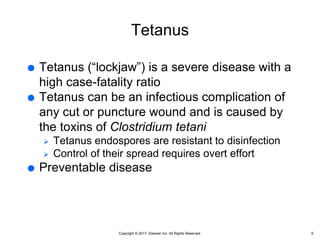
Tetanus
 Tetanus (“lockjaw”) is a severe disease with a
high case-fatality ratio
 Tetanus can be an infectious complication of
any cut or puncture wound and is caused by
the toxins of Clostridium tetani
 Tetanus endospores are resistant to disinfection
 Control of their spread requires overt effort
 Preventable disease
9
Copyright © 2017, Elsevier Inc. All Rights Reserved.
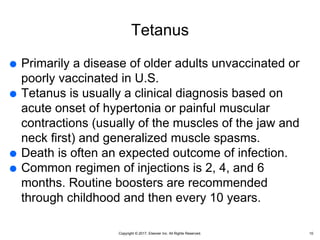
Tetanus
 Primarily a disease of older adults unvaccinated or
poorly vaccinated in U.S.
 Tetanus is usually a clinical diagnosis based on
acute onset of hypertonia or painful muscular
contractions (usually of the muscles of the jaw and
neck first) and generalized muscle spasms.
 Death is often an expected outcome of infection.
 Common regimen of injections is 2, 4, and 6
months. Routine boosters are recommended
through childhood and then every 10 years.
10
Copyright © 2017, Elsevier Inc. All Rights Reserved.
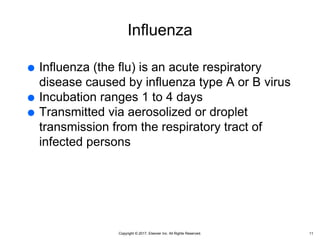
Influenza
 Influenza (the flu) is an acute respiratory
disease caused by influenza type A or B virus
 Incubation ranges 1 to 4 days
 Transmitted via aerosolized or droplet
transmission from the respiratory tract of
infected persons
11
Copyright © 2017, Elsevier Inc. All Rights Reserved.
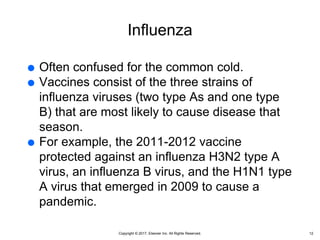
Influenza
 Often confused for the common cold.
 Vaccines consist of the three strains of
influenza viruses (two type As and one type
B) that are most likely to cause disease that
season.
 For example, the 2011-2012 vaccine
protected against an influenza H3N2 type A
virus, an influenza B virus, and the H1N1 type
A virus that emerged in 2009 to cause a
pandemic.
12
Copyright © 2017, Elsevier Inc. All Rights Reserved.
Influenza
 There are now three types of trivalent
influenza vaccines available. One is an
inactivated (killed) influenza vaccine
administered as a single dose
intramuscularly, one is a recombinant
influenza virus (RIV), and the other is a live,
attenuated (weakened) influenza vaccine
(LAIV) administered intranasally.
 See Table 10.2 to see differences between a
cold and the flu.
13
Copyright © 2017, Elsevier Inc. All Rights Reserved.
Influenza Vaccination
 The CDC recommends that all health care
workers be vaccinated annually against
influenza
 A preventive approach will help eliminate the
spread of the influenza virus from health care
workers to their patients
 Vaccination must be repeated annually
14
Copyright © 2017, Elsevier Inc. All Rights Reserved.
Influenza
 Health care workers who work with severely
immunocompromised patients who require a
protected environment should not receive
LAIV.
 If the employee initially declines vaccination
but at a later date, while still covered under
the standard, decides to accept the offer, the
employer must make the vaccine available at
no charge at that time.
15
Copyright © 2017, Elsevier Inc. All Rights Reserved.
Influenza
 Annual vaccination of persons at high risk (and their
close contacts) for influenza-associated
complications is the most effective means of
reducing the impact of influenza.
 New influenza vaccines are developed annually two
times a year.
 Persons with an egg allergy should not have the
vaccine.
 Inactivated influenza vaccine is approved for all
persons older than age 6 months who lack vaccine
contraindications including those with high-risk
conditions. 16
Copyright © 2017, Elsevier Inc. All Rights Reserved.
Transmission of HBV
 The hepatitis B virus (HBV) is an infectious
agent associated with acute and chronic
inflammation of the liver
 Has potential for indirect transmission such
as contact with contaminated instruments
17
Copyright © 2017, Elsevier Inc. All Rights Reserved.
Transmission of HBV
 Hepatitis B virus can be found primarily in blood and
blood products but also can be present in other body
fluids, such as semen, tears, feces, urine, vaginal
secretions, and saliva.
 Hepatitis B virus is a bloodborne pathogen
transmitted by percutaneous or mucosal exposure,
by sexual contact, and from mother to fetus or infant.
Hepatitis B virus is environmentally stable,
especially when surrounded by blood.
 Most frequently reported vaccine-preventable
diseases in U.S.
18
Copyright © 2017, Elsevier Inc. All Rights Reserved.
HBV Occupational Hazards
 Hepatitis B is a major occupational hazard for
dental personnel
 Attack rates among unvaccinated individuals are 3
to 10 times the 4% rate present in the general
population
 PPE cannot eliminate all body fluid
exposures, especially sharps injuries
 The best protection against HBV infection is
immunization
19
Copyright © 2017, Elsevier Inc. All Rights Reserved.
HBV Occupational Hazards
 Hepatitis B is an especially difficult problem
because many dental workers have repeated
intimate contact with patient body fluids and
with items soiled with such fluids.
 Hepatitis B virus infection appears to be
related more to the extent of exposure to
blood than to the number or type of patients
treated.
20
Copyright © 2017, Elsevier Inc. All Rights Reserved.
HBV Vaccinations
 All at-risk dental personnel need to be
vaccinated, including clinicians, laboratory
workers, and associated cleanup crews
 Employers must assume all costs associated
with HBV vaccination
 Not all health care workers have complied;
dentistry among highest rate of compliance
21
Copyright © 2017, Elsevier Inc. All Rights Reserved.
HBV Vaccinations
 A person such as an office receptionist may
be considered as not being at risk. However,
many dental offices practice multitasking
because when an emergency or special
patient need arises, “office workers”
temporarily participate in chairside dentistry.
 Complete protection against HBV includes
postscreening for antibody (anti-HBsAg)
levels. This procedure should be conducted 1
to 2 months after completion of the 3-dose
vaccination series.
22
Copyright © 2017, Elsevier Inc. All Rights Reserved.
HBV Vaccinations
 Employees have the right to refuse
vaccination. However, the employee must
read and sign a declination statement.
 What are some reasons for noncompliance?
(Concerns expressed include vaccine safety,
cost, efficacy, pregnancy-related issues, and
considering oneself to be at low risk.)
 Refer to Box 10.1 and Table 10.3.
23
Copyright © 2017, Elsevier Inc. All Rights Reserved.
Missing Important Vaccines
 Immunization programs successful in
preventing diseases among children
 Continuing need for vaccinations during
adulthood
 Many diseases are considered more severe when
contracted as adults
24
Copyright © 2017, Elsevier Inc. All Rights Reserved.
Missing Important Vaccines
 Dental personnel should discuss their
immunity schedule with primary care
physicians and keep all vaccinations current.
 Screenings for infectious diseases exist.
 CDC estimates that vaccinations will prevent
more than 21 million hospitalizations and
732,000 deaths among children born in the
last 20 years.
25

Chapter 10 immunizations

  • 1.
    Copyright © 2017,Elsevier Inc. All Rights Reserved. Immunization Chapter 10 1
  • 2.
    Copyright © 2017,Elsevier Inc. All Rights Reserved. Learning Objectives Lesson 10.1: Immunization 1. State the importance of immunization in the health care field and identify vaccine- preventable diseases. 2. Describe the diagnosis, microbiology, onset and symptoms, and immunization and boosters of tetanus. 3. List the types of influenza, symptoms, process of influenza vaccinations, and the CDC recommendations for influenza vaccinations. 2
  • 3.
    Copyright © 2017,Elsevier Inc. All Rights Reserved. 4. Discuss how hepatitis is transmitted, the occupational hazards of hepatitis B, and the importance and process of hepatitis B vaccinations. 5. Discuss the risks associated with missing important vaccines. 3 Learning Objectives Lesson 10.1: Immunization (Cont.)
  • 4.
    Copyright © 2017,Elsevier Inc. All Rights Reserved. Immunization and Health Care  Health care workers in hospitals and offsite locations are at risk for the occupational acquisition of infectious diseases  Ensuring that personnel are immune to vaccine-preventable diseases is an essential part of a successful infection control plan  Optimal use of vaccines can prevent transmission of disease 4
  • 5.
    Copyright © 2017,Elsevier Inc. All Rights Reserved. Immunization and Health Care  The compliance with a vaccination scheme is known to be greater when the program is mandatory rather than voluntary.  When the employer pays for the vaccinations, compliance is known to be significantly higher than if the employees must pay all or part of their immunization costs.  . 5
  • 6.
    Copyright © 2017,Elsevier Inc. All Rights Reserved. Immunization and Health Care  Types of health care provided, characteristics of the patient pool, and the age and experience of the health care workers influence the decision as to which vaccines should be included in an immunization program.  In some cases, screening can help determine susceptibility to certain vaccine-preventable diseases. Hepatitis B is an example 6
  • 7.
    Copyright © 2017,Elsevier Inc. All Rights Reserved. Missing Vaccines  Vaccines do not exist for all diseases  Important “missing vaccine” for dentistry in the U.S.  Hepatitis C  HIV type 1  Tuberculosis  Some forms of human herpesviruses 7
  • 8.
    Copyright © 2017,Elsevier Inc. All Rights Reserved. Missing Vaccines  Refer to Table 10.1 for recommended immunization schedule.  To have the most effective and efficient office/clinic infection control program, personnel health elements must be an essential component.  In addition, immunization, education and training, postexposure management, identification of medical conditions, work-related illnesses and work restriction, maintenance of records, data management, and confidentiality are important components. 8
  • 9.
    Copyright © 2017,Elsevier Inc. All Rights Reserved. Tetanus  Tetanus (“lockjaw”) is a severe disease with a high case-fatality ratio  Tetanus can be an infectious complication of any cut or puncture wound and is caused by the toxins of Clostridium tetani  Tetanus endospores are resistant to disinfection  Control of their spread requires overt effort  Preventable disease 9
  • 10.
    Copyright © 2017,Elsevier Inc. All Rights Reserved. Tetanus  Primarily a disease of older adults unvaccinated or poorly vaccinated in U.S.  Tetanus is usually a clinical diagnosis based on acute onset of hypertonia or painful muscular contractions (usually of the muscles of the jaw and neck first) and generalized muscle spasms.  Death is often an expected outcome of infection.  Common regimen of injections is 2, 4, and 6 months. Routine boosters are recommended through childhood and then every 10 years. 10
  • 11.
    Copyright © 2017,Elsevier Inc. All Rights Reserved. Influenza  Influenza (the flu) is an acute respiratory disease caused by influenza type A or B virus  Incubation ranges 1 to 4 days  Transmitted via aerosolized or droplet transmission from the respiratory tract of infected persons 11
  • 12.
    Copyright © 2017,Elsevier Inc. All Rights Reserved. Influenza  Often confused for the common cold.  Vaccines consist of the three strains of influenza viruses (two type As and one type B) that are most likely to cause disease that season.  For example, the 2011-2012 vaccine protected against an influenza H3N2 type A virus, an influenza B virus, and the H1N1 type A virus that emerged in 2009 to cause a pandemic. 12
  • 13.
    Copyright © 2017,Elsevier Inc. All Rights Reserved. Influenza  There are now three types of trivalent influenza vaccines available. One is an inactivated (killed) influenza vaccine administered as a single dose intramuscularly, one is a recombinant influenza virus (RIV), and the other is a live, attenuated (weakened) influenza vaccine (LAIV) administered intranasally.  See Table 10.2 to see differences between a cold and the flu. 13
  • 14.
    Copyright © 2017,Elsevier Inc. All Rights Reserved. Influenza Vaccination  The CDC recommends that all health care workers be vaccinated annually against influenza  A preventive approach will help eliminate the spread of the influenza virus from health care workers to their patients  Vaccination must be repeated annually 14
  • 15.
    Copyright © 2017,Elsevier Inc. All Rights Reserved. Influenza  Health care workers who work with severely immunocompromised patients who require a protected environment should not receive LAIV.  If the employee initially declines vaccination but at a later date, while still covered under the standard, decides to accept the offer, the employer must make the vaccine available at no charge at that time. 15
  • 16.
    Copyright © 2017,Elsevier Inc. All Rights Reserved. Influenza  Annual vaccination of persons at high risk (and their close contacts) for influenza-associated complications is the most effective means of reducing the impact of influenza.  New influenza vaccines are developed annually two times a year.  Persons with an egg allergy should not have the vaccine.  Inactivated influenza vaccine is approved for all persons older than age 6 months who lack vaccine contraindications including those with high-risk conditions. 16
  • 17.
    Copyright © 2017,Elsevier Inc. All Rights Reserved. Transmission of HBV  The hepatitis B virus (HBV) is an infectious agent associated with acute and chronic inflammation of the liver  Has potential for indirect transmission such as contact with contaminated instruments 17
  • 18.
    Copyright © 2017,Elsevier Inc. All Rights Reserved. Transmission of HBV  Hepatitis B virus can be found primarily in blood and blood products but also can be present in other body fluids, such as semen, tears, feces, urine, vaginal secretions, and saliva.  Hepatitis B virus is a bloodborne pathogen transmitted by percutaneous or mucosal exposure, by sexual contact, and from mother to fetus or infant. Hepatitis B virus is environmentally stable, especially when surrounded by blood.  Most frequently reported vaccine-preventable diseases in U.S. 18
  • 19.
    Copyright © 2017,Elsevier Inc. All Rights Reserved. HBV Occupational Hazards  Hepatitis B is a major occupational hazard for dental personnel  Attack rates among unvaccinated individuals are 3 to 10 times the 4% rate present in the general population  PPE cannot eliminate all body fluid exposures, especially sharps injuries  The best protection against HBV infection is immunization 19
  • 20.
    Copyright © 2017,Elsevier Inc. All Rights Reserved. HBV Occupational Hazards  Hepatitis B is an especially difficult problem because many dental workers have repeated intimate contact with patient body fluids and with items soiled with such fluids.  Hepatitis B virus infection appears to be related more to the extent of exposure to blood than to the number or type of patients treated. 20
  • 21.
    Copyright © 2017,Elsevier Inc. All Rights Reserved. HBV Vaccinations  All at-risk dental personnel need to be vaccinated, including clinicians, laboratory workers, and associated cleanup crews  Employers must assume all costs associated with HBV vaccination  Not all health care workers have complied; dentistry among highest rate of compliance 21
  • 22.
    Copyright © 2017,Elsevier Inc. All Rights Reserved. HBV Vaccinations  A person such as an office receptionist may be considered as not being at risk. However, many dental offices practice multitasking because when an emergency or special patient need arises, “office workers” temporarily participate in chairside dentistry.  Complete protection against HBV includes postscreening for antibody (anti-HBsAg) levels. This procedure should be conducted 1 to 2 months after completion of the 3-dose vaccination series. 22
  • 23.
    Copyright © 2017,Elsevier Inc. All Rights Reserved. HBV Vaccinations  Employees have the right to refuse vaccination. However, the employee must read and sign a declination statement.  What are some reasons for noncompliance? (Concerns expressed include vaccine safety, cost, efficacy, pregnancy-related issues, and considering oneself to be at low risk.)  Refer to Box 10.1 and Table 10.3. 23
  • 24.
    Copyright © 2017,Elsevier Inc. All Rights Reserved. Missing Important Vaccines  Immunization programs successful in preventing diseases among children  Continuing need for vaccinations during adulthood  Many diseases are considered more severe when contracted as adults 24
  • 25.
    Copyright © 2017,Elsevier Inc. All Rights Reserved. Missing Important Vaccines  Dental personnel should discuss their immunity schedule with primary care physicians and keep all vaccinations current.  Screenings for infectious diseases exist.  CDC estimates that vaccinations will prevent more than 21 million hospitalizations and 732,000 deaths among children born in the last 20 years. 25