NALS- ALGORITHM
Presentor- Dr. Kiran Dyavanagoudar
Moderator- Dr. Srinivas (Pediatrician)
Dr. Pooja Shah.
OBJECTIVE
• To describe the steps of Positive Pressure Ventilation.
• To describe the indications for Endotracheal Intubation and Chest
Compressions.
• To discuss about the Medications used in NRP.
4 key questions before birth:
( 1) What is the expected gestational age?
(2) Is the amniotic fluid clear?
(3) Are there any additional risk factors?
(4) What is our umbilical cord management plan?
INTRODUCTION
• Approximately 85% of term newborns will begin breathing-
spontaneously
• 10% will begin breathing - drying and stimulation.
INTRODUCTION
• 5% of term newborns - receive positive-pressure ventilation (PPV).
• 2% of term newborns -intubated.
• 1 to 3 babies per 1,000 births will receive chest compressions or
emergency medications.
INTRODUCTION
Ventilation of the newborn's lungs is the single most important and
effective step in neonatal resuscitation.
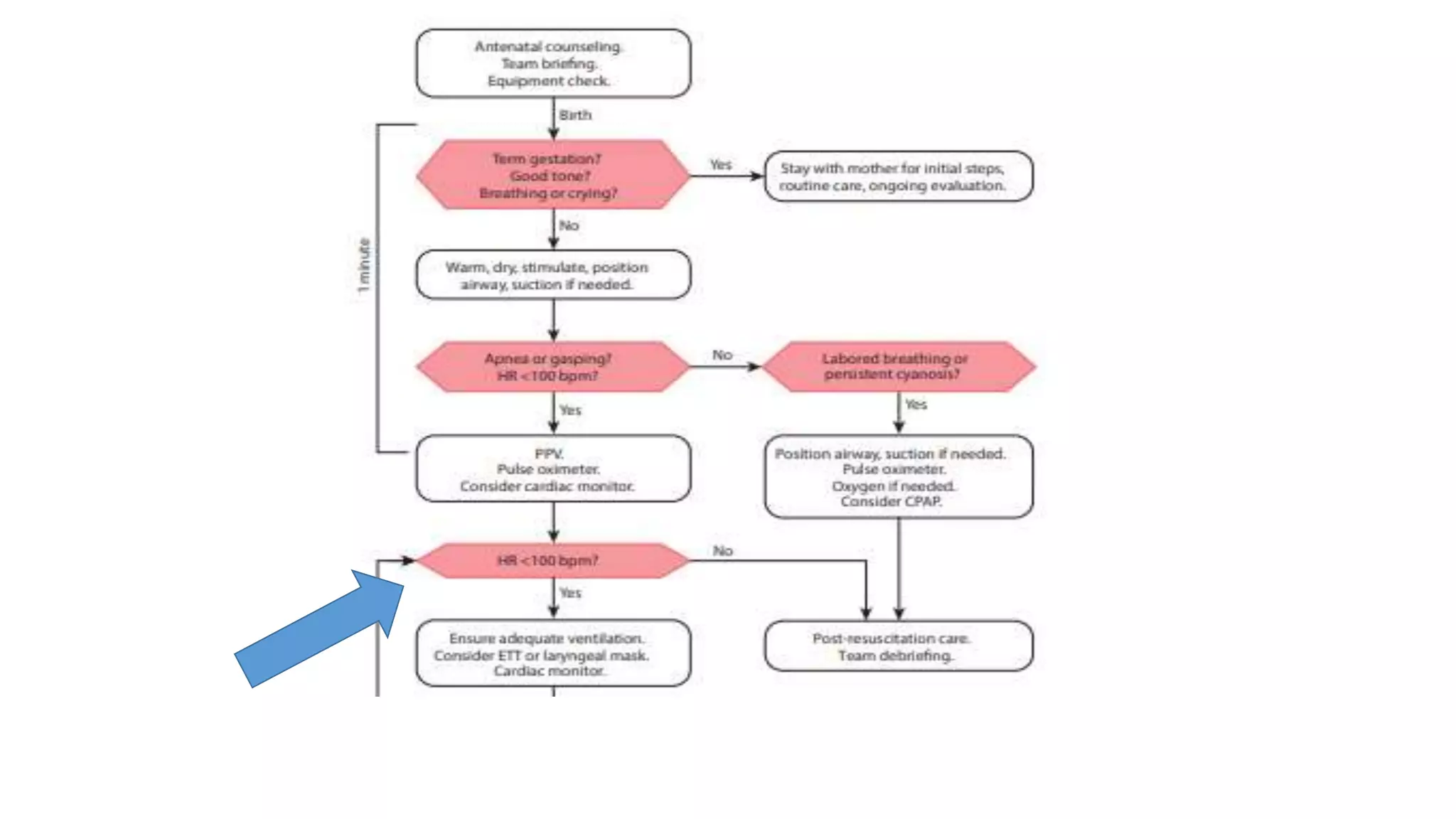
NRP ALGORITHM
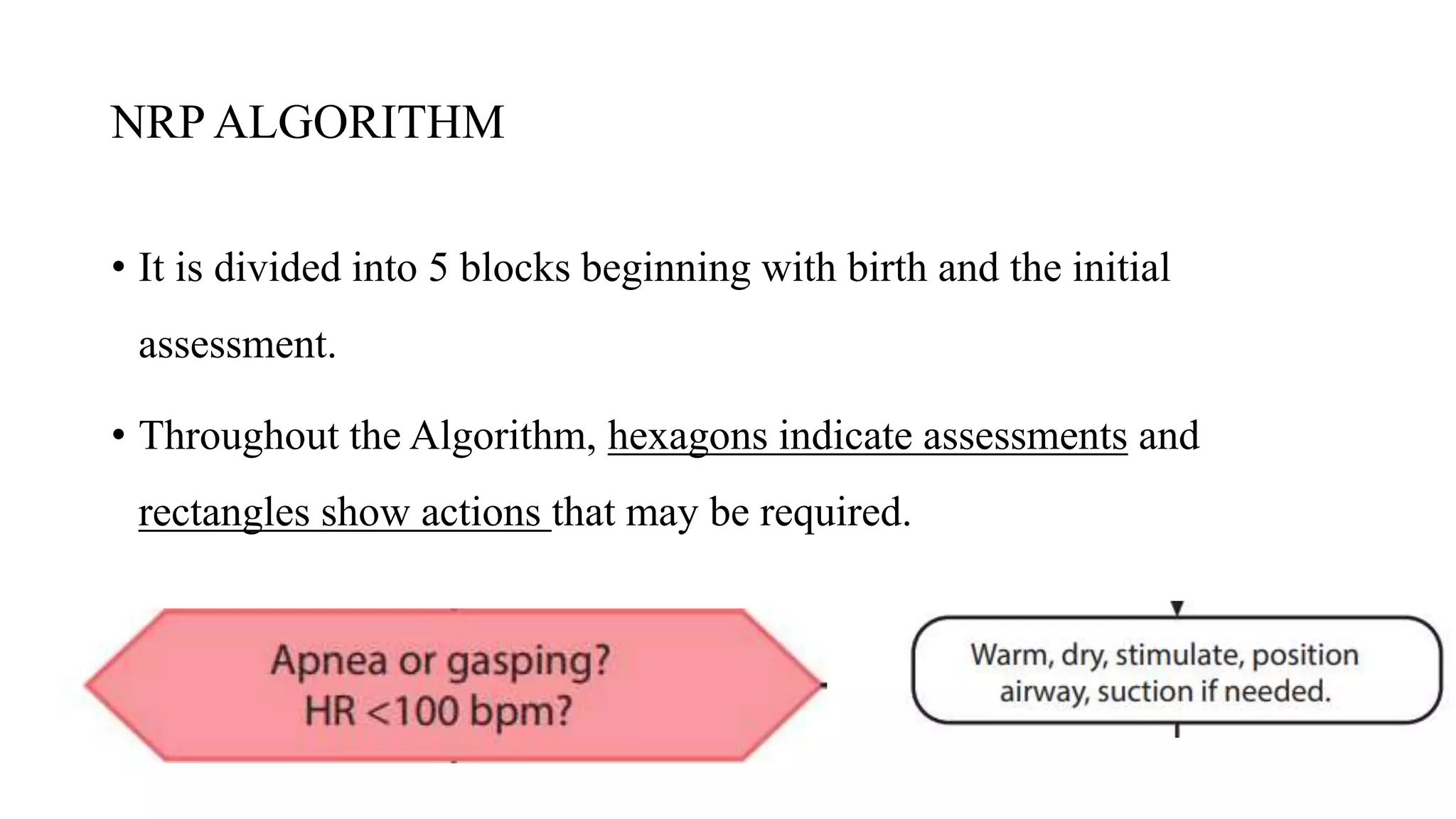
• It is divided into 5 blocks beginning with birth and the initial
assessment.
• Throughout the Algorithm, hexagons indicate assessments and
rectangles show actions that may be required.
NRP ALGORITHM
RESUSCITATION TEAM
• Every birth should be attended by at least 1 qualified individual
• If risk factors are present, at least 2 qualified individuals should be
present.
EQUIPMENT CHECKLIST
⦁ Anticipation
⦁ A radiant heat source ready for use
⦁ All resuscitation equipments immediately
available & in working order
⦁ At least 1 person skilled in neonatal
resuscitation
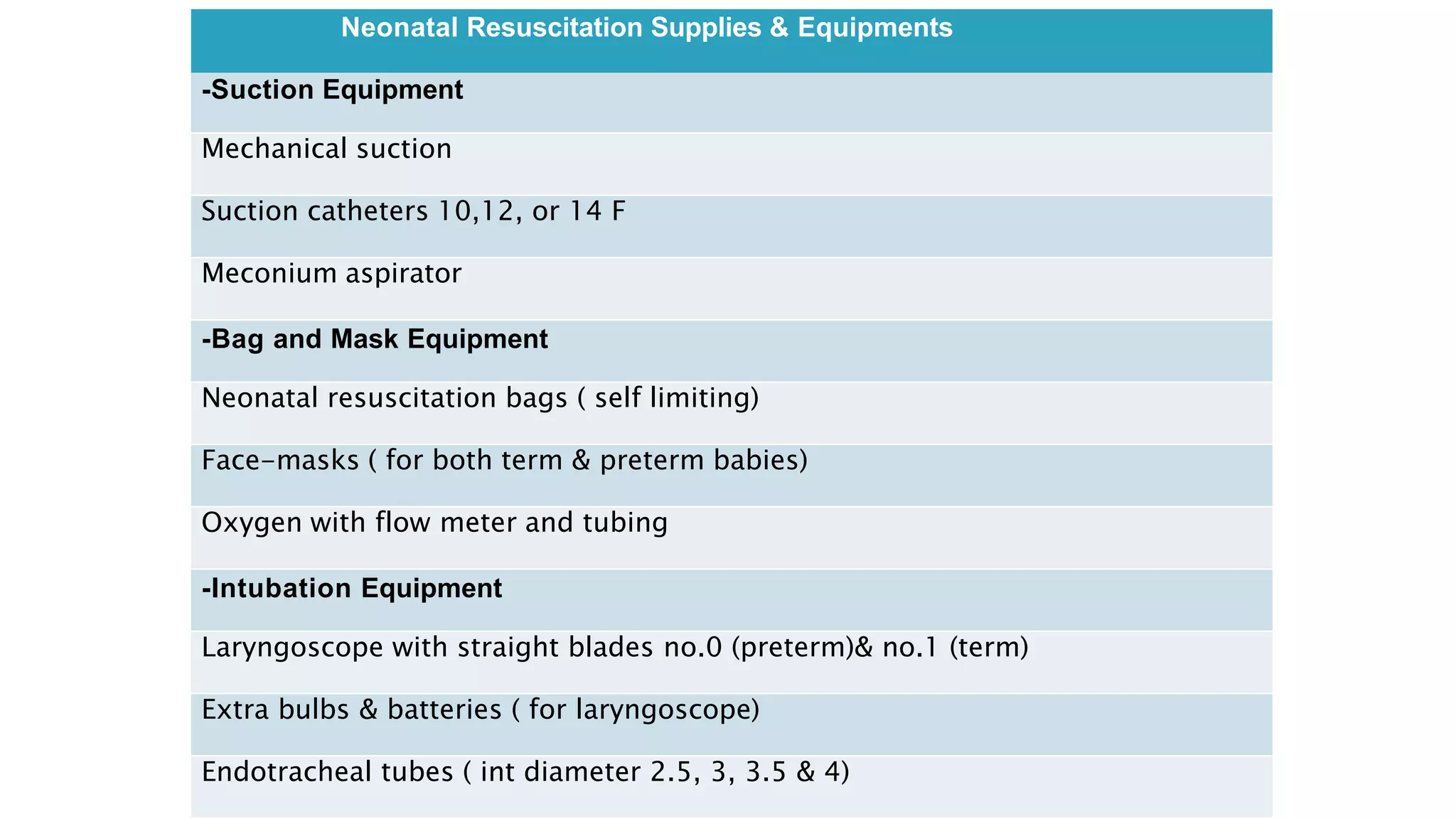
Neonatal Resuscitation Supplies & Equipments
-Suction Equipment
Mechanical suction
Suction catheters 10,12, or 14 F
Meconium aspirator
-Bag and Mask Equipment
Neonatal resuscitation bags ( self limiting)
Face-masks ( for both term & preterm babies)
Oxygen with flow meter and tubing
-Intubation Equipment
Laryngoscope with straight blades no.0 (preterm)& no.1 (term)
Extra bulbs & batteries ( for laryngoscope)
Endotracheal tubes ( int diameter 2.5, 3, 3.5 & 4)
Medications
Epinephrine
Normal saline or Ringer Lactate
Naloxone hydrochloride
Miscellaneous
Linen, shoulder roll, gauze
Radiant warmer
Stethoscope
Syringes 1,2,5,10,20,50 ml
Feeding tube 6 F
Umbilical catheters 3.5, 5 F
Three way stopcocks
Gloves
RAPID EVALUATION
High risk newborn: preterm,
poor tone, not crying
Low risk newborn:
Term,
good tone,
crying
INITIAL STEPS
• Provide warmth
• Dry
• Stimulate
• Positioning the head and neck
( to maintain patency of airway)
• Clearing the airway of secretions if needed
Vigorous term newborn – Skin to skin with
mother while initial steps are performed
INITIAL STEPS
• Gentle suctioning
• Mouth before Nose (M before N)
• Suction catheter – Negative pressure
80 – 100mmHg
Evaluation of initial steps
• Initial steps should be completed within 30 seconds
INITIAL STEPS -EVALUATION
• Auscultation
Measure for 6 seconds and
multiply by 10.
If heart rate not determined by
physical examination -
Pulse oximeter or cardiac monitor
APNEA/GASPING ? - NO
HR < 100bpm? - NO
PERSISTENT CYANOSIS
Acral cyanosis
• Supplemental oxygen needed only if oxygen saturation below
target.
Free flow oxygen
TARGET OXYGEN SATURATION
• Supplemental oxygen
1.Start with Fio2 – 30%
2.Flow – 10L/min
LABORED BREATHING? - YES
• Laboured breathing or oxygen saturation cannot be maintained within
target range despite oxygen.
• Trial of CPAP via Flow- inflating bag or T- piece.
T- piece
• PEEP – 5cm H2O
• Peak pressure
20 – 25mmHg
• Flow – 10L/min
POST RESUSCITATION
• POST RESUSCITATION CARE
• TEAM DEBRIEFING
POSITIVE PRESSURE VENTILATION
• Baby APNEA/GASPING or HR <100bpm
• Rate 40-60 breaths/ minute
• Rhythm – “Breathe, two, three”
POSITIVE PRESSURE VENTILATION
• Assess for increasing HR within 30 seconds of PPV, observe for chest movement.
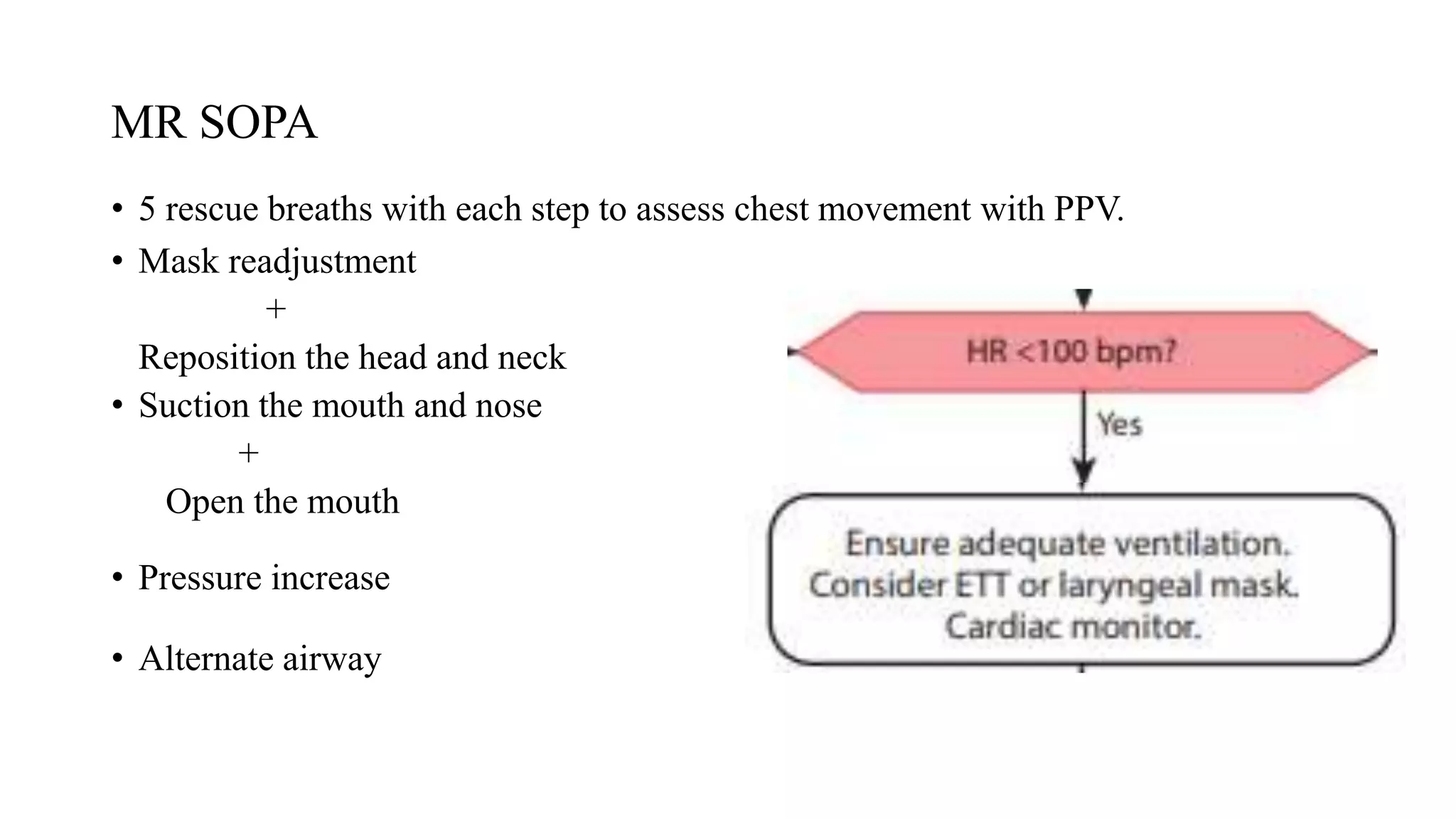
MR SOPA
• 5 rescue breaths with each step to assess chest movement with PPV.
• Mask readjustment
+
Reposition the head and neck
• Suction the mouth and nose
+
Open the mouth
• Pressure increase
• Alternate airway
ENDOTRACHEAL INTUBATION
Assess after 30 seconds of PPV
• HR < 60cpm
• Intubate if not already done.
• Start chest compressions
CHEST COMPRESSION
• Ratio of PPV to CC = 1:3 in 2 sec ( 1 and 2 and 3 and breathe)
• 100% Oxygen
MEDICATIONS
• If HR < 60bpm
1. Continue co- ordinated PPV and CC
2. Access Umbilical venous line
3. Injection Adrenaline 1:10000 dilutions of 0.2ml/kg (0.1 – 0.3) followed by
saline flush of 3ml. Every 3-5 minutes.
4. ET adrenaline may be administered at a dose of 1.0ml/kg till umbilical
venous access is established
MEDICATIONS
• Consider hypovolemia
• Consider Pneumothorax
• No response to adrenaline
1. Consider discontinuing resuscitation, if HR = 0 after 20 minutes of
life.
2. Post – resuscitation debriefing and family counselling.
TAKE HOME MESSAGES
• Newborn resuscitation requires anticipation and preparation by
providers who train individually and as teams.
• Ventilation of the newborn's lungs is the single most important
and effective step in neonatal resuscitation.
• A rise in heart rate is most important indicator of effective ventilation
and response to resuscitative interventions.
REFERENCES
• Zaichkin J, Kamath-Rayne BD, Weiner G. Neonatal Resuscitation, 8th
edition (2021), Jaypee Publication
THANK YOU

NALS- ALGORITHM-1 kiran final.pptx

  • 1.
    NALS- ALGORITHM Presentor- Dr.Kiran Dyavanagoudar Moderator- Dr. Srinivas (Pediatrician) Dr. Pooja Shah.
  • 3.
    OBJECTIVE • To describethe steps of Positive Pressure Ventilation. • To describe the indications for Endotracheal Intubation and Chest Compressions. • To discuss about the Medications used in NRP.
  • 4.
    4 key questionsbefore birth: ( 1) What is the expected gestational age? (2) Is the amniotic fluid clear? (3) Are there any additional risk factors? (4) What is our umbilical cord management plan?
  • 5.
    INTRODUCTION • Approximately 85%of term newborns will begin breathing- spontaneously • 10% will begin breathing - drying and stimulation.
  • 6.
    INTRODUCTION • 5% ofterm newborns - receive positive-pressure ventilation (PPV). • 2% of term newborns -intubated. • 1 to 3 babies per 1,000 births will receive chest compressions or emergency medications.
  • 7.
    INTRODUCTION Ventilation of thenewborn's lungs is the single most important and effective step in neonatal resuscitation.
  • 8.
    NRP ALGORITHM • Itis divided into 5 blocks beginning with birth and the initial assessment. • Throughout the Algorithm, hexagons indicate assessments and rectangles show actions that may be required.
  • 9.
  • 10.
    RESUSCITATION TEAM • Everybirth should be attended by at least 1 qualified individual • If risk factors are present, at least 2 qualified individuals should be present.
  • 11.
  • 12.
    ⦁ Anticipation ⦁ Aradiant heat source ready for use ⦁ All resuscitation equipments immediately available & in working order ⦁ At least 1 person skilled in neonatal resuscitation
  • 13.
    Neonatal Resuscitation Supplies& Equipments -Suction Equipment Mechanical suction Suction catheters 10,12, or 14 F Meconium aspirator -Bag and Mask Equipment Neonatal resuscitation bags ( self limiting) Face-masks ( for both term & preterm babies) Oxygen with flow meter and tubing -Intubation Equipment Laryngoscope with straight blades no.0 (preterm)& no.1 (term) Extra bulbs & batteries ( for laryngoscope) Endotracheal tubes ( int diameter 2.5, 3, 3.5 & 4)
  • 14.
    Medications Epinephrine Normal saline orRinger Lactate Naloxone hydrochloride Miscellaneous Linen, shoulder roll, gauze Radiant warmer Stethoscope Syringes 1,2,5,10,20,50 ml Feeding tube 6 F Umbilical catheters 3.5, 5 F Three way stopcocks Gloves
  • 15.
    RAPID EVALUATION High risknewborn: preterm, poor tone, not crying Low risk newborn: Term, good tone, crying
  • 16.
    INITIAL STEPS • Providewarmth • Dry • Stimulate • Positioning the head and neck ( to maintain patency of airway) • Clearing the airway of secretions if needed Vigorous term newborn – Skin to skin with mother while initial steps are performed
  • 17.
    INITIAL STEPS • Gentlesuctioning • Mouth before Nose (M before N) • Suction catheter – Negative pressure 80 – 100mmHg
  • 18.
    Evaluation of initialsteps • Initial steps should be completed within 30 seconds
  • 19.
    INITIAL STEPS -EVALUATION •Auscultation Measure for 6 seconds and multiply by 10. If heart rate not determined by physical examination - Pulse oximeter or cardiac monitor
  • 20.
    APNEA/GASPING ? -NO HR < 100bpm? - NO
  • 21.
    PERSISTENT CYANOSIS Acral cyanosis •Supplemental oxygen needed only if oxygen saturation below target. Free flow oxygen
  • 22.
    TARGET OXYGEN SATURATION •Supplemental oxygen 1.Start with Fio2 – 30% 2.Flow – 10L/min
  • 23.
    LABORED BREATHING? -YES • Laboured breathing or oxygen saturation cannot be maintained within target range despite oxygen. • Trial of CPAP via Flow- inflating bag or T- piece.
  • 24.
    T- piece • PEEP– 5cm H2O • Peak pressure 20 – 25mmHg • Flow – 10L/min
  • 25.
    POST RESUSCITATION • POSTRESUSCITATION CARE • TEAM DEBRIEFING
  • 27.
    POSITIVE PRESSURE VENTILATION •Baby APNEA/GASPING or HR <100bpm • Rate 40-60 breaths/ minute • Rhythm – “Breathe, two, three”
  • 28.
    POSITIVE PRESSURE VENTILATION •Assess for increasing HR within 30 seconds of PPV, observe for chest movement.
  • 30.
    MR SOPA • 5rescue breaths with each step to assess chest movement with PPV. • Mask readjustment + Reposition the head and neck • Suction the mouth and nose + Open the mouth • Pressure increase • Alternate airway
  • 32.
    ENDOTRACHEAL INTUBATION Assess after30 seconds of PPV • HR < 60cpm • Intubate if not already done. • Start chest compressions
  • 34.
    CHEST COMPRESSION • Ratioof PPV to CC = 1:3 in 2 sec ( 1 and 2 and 3 and breathe) • 100% Oxygen
  • 35.
    MEDICATIONS • If HR< 60bpm 1. Continue co- ordinated PPV and CC 2. Access Umbilical venous line 3. Injection Adrenaline 1:10000 dilutions of 0.2ml/kg (0.1 – 0.3) followed by saline flush of 3ml. Every 3-5 minutes. 4. ET adrenaline may be administered at a dose of 1.0ml/kg till umbilical venous access is established
  • 36.
  • 37.
    • No responseto adrenaline 1. Consider discontinuing resuscitation, if HR = 0 after 20 minutes of life. 2. Post – resuscitation debriefing and family counselling.
  • 38.
    TAKE HOME MESSAGES •Newborn resuscitation requires anticipation and preparation by providers who train individually and as teams. • Ventilation of the newborn's lungs is the single most important and effective step in neonatal resuscitation. • A rise in heart rate is most important indicator of effective ventilation and response to resuscitative interventions.
  • 39.
    REFERENCES • Zaichkin J,Kamath-Rayne BD, Weiner G. Neonatal Resuscitation, 8th edition (2021), Jaypee Publication
  • 40.