UNIT VI REPRODUCTION IN PLANTS
Chapter 1 Asexual and Sexual Reproduction in Plants
STATE COUNCIL OF EDUCATIONAL RESEARCH AND
TRAINING
CHENNAI-600006.
STATE LEVEL TRAINING FOR DISTRICT RESOURCE GROUP
(XII STD NEW BIOLOGY –BOTANY/ BOTANY NEW TEXT BOOK)
UNIT VI REPRODUCTION IN PLANTS
Chapter 1 Asexual and Sexual Reproduction in Plants
Objectives
History of the subject.
Recent information in the relevant field.
Information on plant reproduction with interdisciplinary approach.
Significance of plant reproduction with reference to existence and functioning
of other life forms.
Opportunity for Discovery learning.
The skill of observation through the dissection and drawing .
 Impart Scientific temper.
Build confidence to face the challenges in the society.
To develop resource materials to facilitate learning.
Opportunity for competitive exams.
Entrepreneurship.
UNIT VI REPRODUCTION IN PLANTS
Chapter 1 Asexual and Sexual Reproduction in Plants
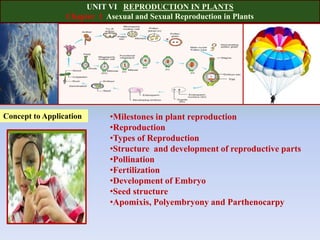
•Milestones in plant reproduction
•Reproduction
•Types of Reproduction
•Structure and development of reproductive parts
•Pollination
•Fertilization
•Development of Embryo
•Seed structure
•Apomixis, Polyembryony and Parthenocarpy
Concept to Application
Milestones in Plant Embryology
 1682 - Nehemiah Grew - Stamens as the male organ of a
flower
 1694 - R.J.Camerarius - Structure of a flower, anther, pollen
and ovule
 1848 – Hofmeister - Structure of pollen tetrad
 1898 - S.G.Nawaschin &
 1899 - L. Guignard - Double fertilization
 1964 - S.Guha and S.C.Maheswari - Haploids from Datura
pollen grains
 2015 - K.V. Krishnamurthy - Summarized the molecular
aspects of pre and post fertilization reproductive
development in flowering plants
UNIT VI REPRODUCTION IN PLANTS
Chapter 1 Asexual and Sexual Reproduction in Plants
UNIT VI REPRODUCTION IN PLANTS
Chapter 1 Asexual and Sexual Reproduction in Plants
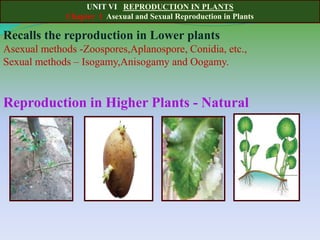
Recalls the reproduction in Lower plants
Asexual methods -Zoospores,Aplanospore, Conidia, etc.,
Sexual methods – Isogamy,Anisogamy and Oogamy.
Reproduction in Higher Plants - Natural
UNIT VI REPRODUCTION IN PLANTS
Chapter 1 Asexual and Sexual Reproduction in Plants
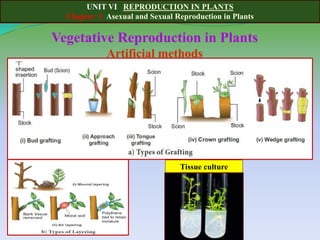
Vegetative Reproduction in Plants
Artificial methods
Tissue culture
UNIT VI REPRODUCTION IN PLANTS
Chapter 1 Asexual and Sexual Reproduction in Plants
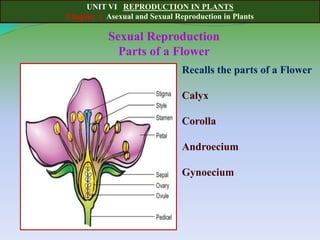
Sexual Reproduction
Parts of a Flower
Recalls the parts of a Flower
Calyx
Corolla
Androecium
Gynoecium
UNIT VI REPRODUCTION IN PLANTS
Chapter 1 Asexual and Sexual Reproduction in Plants
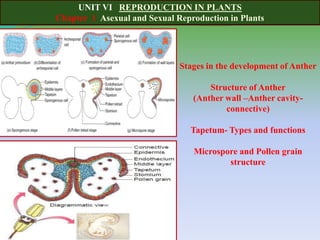
Stages in the development of Anther
Structure of Anther
(Anther wall –Anther cavity-
connective)
Tapetum- Types and functions
Microspore and Pollen grain
structure
UNIT VI REPRODUCTION IN PLANTS
Chapter 1 Asexual and Sexual Reproduction in Plants
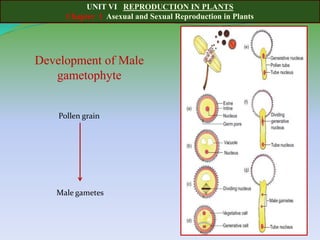
Development of Male
gametophyte
Pollen grain
Male gametes
UNIT VI REPRODUCTION IN PLANTS
Chapter 1 Asexual and Sexual Reproduction in Plants
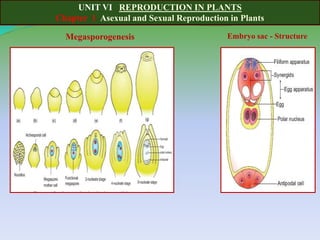
Megasporogenesis Embryo sac - Structure
UNIT VI REPRODUCTION IN PLANTS
Chapter 1 Asexual and Sexual Reproduction in Plants
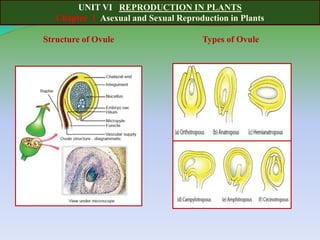
Structure of Ovule Types of Ovule
UNIT VI REPRODUCTION IN PLANTS
Chapter 1 Asexual and Sexual Reproduction in Plants
UNIT VI REPRODUCTION IN PLANTS
Chapter 1 Asexual and Sexual Reproduction in Plants
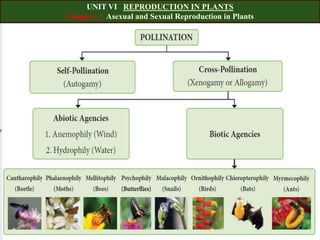
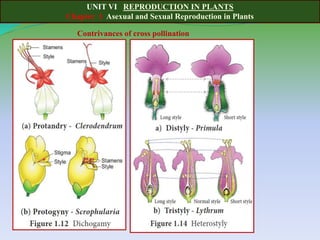
Contrivances of cross pollination
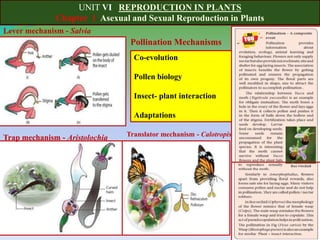
Pollination Mechanisms
Co-evolution
Pollen biology
Insect- plant interaction
Adaptations
UNIT VI REPRODUCTION IN PLANTS
Chapter 1 Asexual and Sexual Reproduction in Plants
Lever mechanism - Salvia
Trap mechanism - Aristolochia Translator mechanism - Calotropis
UNIT VI REPRODUCTION IN PLANTS
Chapter 1 Asexual and Sexual Reproduction in Plants
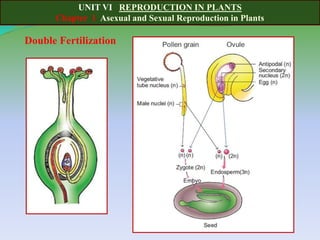
Double Fertilization
UNIT VI REPRODUCTION IN PLANTS
Chapter 1 Asexual and Sexual Reproduction in Plants
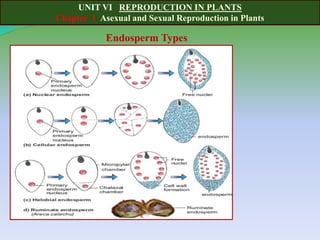
Endosperm Types
UNIT VI REPRODUCTION IN PLANTS
Chapter 1 Asexual and Sexual Reproduction in Plants
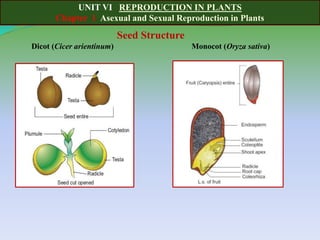
Seed Structure
Dicot (Cicer arientinum) Monocot (Oryza sativa)
UNIT VI REPRODUCTION IN PLANTS
Chapter 1 Asexual and Sexual Reproduction in Plants
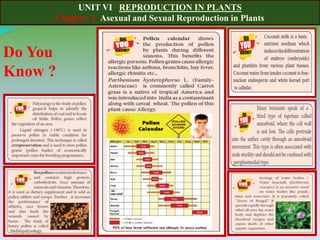
Do You
Know ?
UNIT VI REPRODUCTION IN PLANTS
Chapter 1 Asexual and Sexual Reproduction in Plants
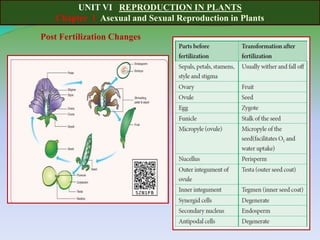
Post Fertilization Changes
UNIT VI REPRODUCTION IN PLANTS
Chapter 1 Asexual and Sexual Reproduction in Plants
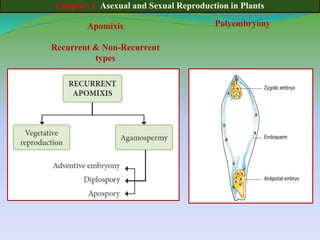
Apomixis
Recurrent & Non-Recurrent
types
Polyembryony
UNIT VI REPRODUCTION IN PLANTS
Chapter 1 Asexual and Sexual Reproduction in Plants
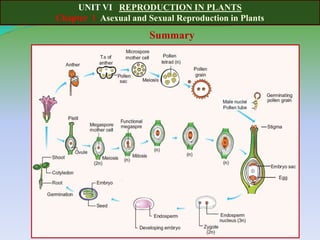
Summary
Outcomes:
•Recognise the contribution of eminent Botanists towards reproduction
•Differentiate the parts of a flower.
•Trace the steps involved in Microsporogenesis and Megasporogenensis.
•Compare the types of pollination and appreciate the importance of this mechanism.
•Promote the need for holistic approach to conserve plants and animals.
•Appreciate the modification found in plants to ensure pollination.
•Promote discovery learning ( Co-evolution, mimicry etc.,)
•Prepare for the competitive examinations.
•Acquire the skill of different plant propagation technique thus developing
entrepreneurship (Nursery, Bee Pollen etc.,)
•Address the environmental problem ( Eichhornia and Pollen allergy )
UNIT VI REPRODUCTION IN PLANTS
Chapter 1 Asexual and Sexual Reproduction in Plants
Don’t take rest after your first victory
Because if you fail in second,
More lips are waiting to say
That your first victory was just luck
Dr.APJ Abdul Kalam

Chapter 1 reproduction in plants

  • 1.
    UNIT VI REPRODUCTIONIN PLANTS Chapter 1 Asexual and Sexual Reproduction in Plants STATE COUNCIL OF EDUCATIONAL RESEARCH AND TRAINING CHENNAI-600006. STATE LEVEL TRAINING FOR DISTRICT RESOURCE GROUP (XII STD NEW BIOLOGY –BOTANY/ BOTANY NEW TEXT BOOK)
  • 2.
    UNIT VI REPRODUCTIONIN PLANTS Chapter 1 Asexual and Sexual Reproduction in Plants Objectives History of the subject. Recent information in the relevant field. Information on plant reproduction with interdisciplinary approach. Significance of plant reproduction with reference to existence and functioning of other life forms. Opportunity for Discovery learning. The skill of observation through the dissection and drawing .  Impart Scientific temper. Build confidence to face the challenges in the society. To develop resource materials to facilitate learning. Opportunity for competitive exams. Entrepreneurship.
  • 3.
    UNIT VI REPRODUCTIONIN PLANTS Chapter 1 Asexual and Sexual Reproduction in Plants •Milestones in plant reproduction •Reproduction •Types of Reproduction •Structure and development of reproductive parts •Pollination •Fertilization •Development of Embryo •Seed structure •Apomixis, Polyembryony and Parthenocarpy Concept to Application
  • 4.
    Milestones in PlantEmbryology  1682 - Nehemiah Grew - Stamens as the male organ of a flower  1694 - R.J.Camerarius - Structure of a flower, anther, pollen and ovule  1848 – Hofmeister - Structure of pollen tetrad  1898 - S.G.Nawaschin &  1899 - L. Guignard - Double fertilization  1964 - S.Guha and S.C.Maheswari - Haploids from Datura pollen grains  2015 - K.V. Krishnamurthy - Summarized the molecular aspects of pre and post fertilization reproductive development in flowering plants UNIT VI REPRODUCTION IN PLANTS Chapter 1 Asexual and Sexual Reproduction in Plants
  • 5.
    UNIT VI REPRODUCTIONIN PLANTS Chapter 1 Asexual and Sexual Reproduction in Plants Recalls the reproduction in Lower plants Asexual methods -Zoospores,Aplanospore, Conidia, etc., Sexual methods – Isogamy,Anisogamy and Oogamy. Reproduction in Higher Plants - Natural
  • 6.
    UNIT VI REPRODUCTIONIN PLANTS Chapter 1 Asexual and Sexual Reproduction in Plants Vegetative Reproduction in Plants Artificial methods Tissue culture
  • 7.
    UNIT VI REPRODUCTIONIN PLANTS Chapter 1 Asexual and Sexual Reproduction in Plants Sexual Reproduction Parts of a Flower Recalls the parts of a Flower Calyx Corolla Androecium Gynoecium
  • 8.
    UNIT VI REPRODUCTIONIN PLANTS Chapter 1 Asexual and Sexual Reproduction in Plants Stages in the development of Anther Structure of Anther (Anther wall –Anther cavity- connective) Tapetum- Types and functions Microspore and Pollen grain structure
  • 9.
    UNIT VI REPRODUCTIONIN PLANTS Chapter 1 Asexual and Sexual Reproduction in Plants Development of Male gametophyte Pollen grain Male gametes
  • 10.
    UNIT VI REPRODUCTIONIN PLANTS Chapter 1 Asexual and Sexual Reproduction in Plants Megasporogenesis Embryo sac - Structure
  • 11.
    UNIT VI REPRODUCTIONIN PLANTS Chapter 1 Asexual and Sexual Reproduction in Plants Structure of Ovule Types of Ovule
  • 12.
    UNIT VI REPRODUCTIONIN PLANTS Chapter 1 Asexual and Sexual Reproduction in Plants
  • 13.
    UNIT VI REPRODUCTIONIN PLANTS Chapter 1 Asexual and Sexual Reproduction in Plants Contrivances of cross pollination
  • 14.
    Pollination Mechanisms Co-evolution Pollen biology Insect-plant interaction Adaptations UNIT VI REPRODUCTION IN PLANTS Chapter 1 Asexual and Sexual Reproduction in Plants Lever mechanism - Salvia Trap mechanism - Aristolochia Translator mechanism - Calotropis
  • 15.
    UNIT VI REPRODUCTIONIN PLANTS Chapter 1 Asexual and Sexual Reproduction in Plants Double Fertilization
  • 16.
    UNIT VI REPRODUCTIONIN PLANTS Chapter 1 Asexual and Sexual Reproduction in Plants Endosperm Types
  • 17.
    UNIT VI REPRODUCTIONIN PLANTS Chapter 1 Asexual and Sexual Reproduction in Plants Seed Structure Dicot (Cicer arientinum) Monocot (Oryza sativa)
  • 18.
    UNIT VI REPRODUCTIONIN PLANTS Chapter 1 Asexual and Sexual Reproduction in Plants Do You Know ?
  • 19.
    UNIT VI REPRODUCTIONIN PLANTS Chapter 1 Asexual and Sexual Reproduction in Plants Post Fertilization Changes
  • 20.
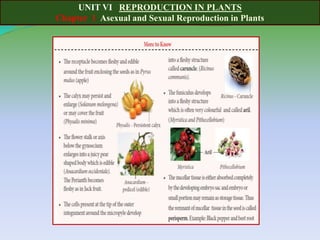
    UNIT VI REPRODUCTIONIN PLANTS Chapter 1 Asexual and Sexual Reproduction in Plants
  • 21.
    Chapter 1 Asexualand Sexual Reproduction in Plants Apomixis Recurrent & Non-Recurrent types Polyembryony
  • 22.
    UNIT VI REPRODUCTIONIN PLANTS Chapter 1 Asexual and Sexual Reproduction in Plants Summary
  • 23.
    Outcomes: •Recognise the contributionof eminent Botanists towards reproduction •Differentiate the parts of a flower. •Trace the steps involved in Microsporogenesis and Megasporogenensis. •Compare the types of pollination and appreciate the importance of this mechanism. •Promote the need for holistic approach to conserve plants and animals. •Appreciate the modification found in plants to ensure pollination. •Promote discovery learning ( Co-evolution, mimicry etc.,) •Prepare for the competitive examinations. •Acquire the skill of different plant propagation technique thus developing entrepreneurship (Nursery, Bee Pollen etc.,) •Address the environmental problem ( Eichhornia and Pollen allergy ) UNIT VI REPRODUCTION IN PLANTS Chapter 1 Asexual and Sexual Reproduction in Plants
  • 24.
    Don’t take restafter your first victory Because if you fail in second, More lips are waiting to say That your first victory was just luck Dr.APJ Abdul Kalam