ECOLOGY
ENVIRONMENTAL ISSUES
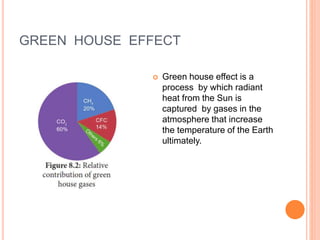
GREEN HOUSE EFFECT
 Green house effect is a
process by which radiant
heat from the Sun is
captured by gases in the
atmosphere that increase
the temperature of the Earth
ultimately.
GLOBAL WARMING
The increase in mean global temperature ( highest in 4000
years) due to increased concentration of green house gases is
called global warming
Green house gases include CO2, CH4,N2O &
variety of manufactured chemicals like chlofluorocarbon
(CFC)
Effects Of Global warming
Low agricultural productivity, frequent heat waves,
watercrisis,change in flowering season,& species extinction
OZONE DEPLETION
 Ozone layer ia a region of
Earth’s stratosphere that
absorbs most of the Sun’s
ultra violet radiation. It acts
as a protective shield for
living rganisms.
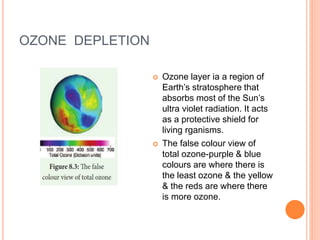
 The false colour view of
total ozone-purple & blue
colours are where there is
the least ozone & the yellow
& the reds are where there
is more ozone.
AGRO & SOCIAL FORESTRY
 Agroforestry is an integration of trees, crops,& livestock on the
same plot
 Agroforestry improves soil & water conservation,
Nutrientcycling, provides balanced atmospheric temperature &
relative humidity.
 Social forestry refers to the management of forests &
afforestati on on barren lands for helping social & rural
development & benefits.
 Activities of Social forestry
 Training on tree growing methods
 Raising & supply of seedlings on subsidy
 Formation of demonstration plots
 Publicity & awareness creation regarding tree growing
DEFORESTATION & AFFORESTATION
 Deforestation is one of the major contributers to enhance
green house effect & global warming
 The causes for deforestation are conversion of agricultural
plantation & livestock ranching,logging for
timber,industrialisation,urbanisation & increased global needs.
 To overcome deforestation Afforestation has to be carried out
 Afforestation is planting of trees where there was no previous
tree coverage & the conversion of non-forested lands into
forests by planting suitable trees to retrieve vegetation.
 It increases forest cover, rehabilitation of degraded
forests,mixed plantation, awareness creation, monitoring &
evaluation.
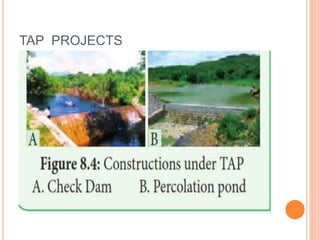
TAP PROJECTS
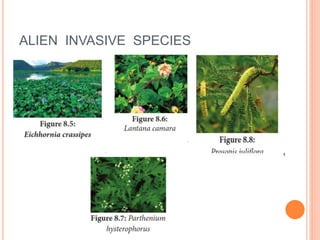
ALIEN INVASIVE SPECIES
 A non –native species to the ecosystem or country under
consideration that spreads naturally interferes with the bilgy &
existance of native species, pses a serious threat to the
ecosystem .
 Eichhornia & Prosopis are native to South America.
 Eichhornia leads to eutropication,a breeding habitat for
mosquitoes , blocks sunlight & waterways hampering agriculture
 Prosopis invades reducing the cver f native medicinal
herbaceous
 Species
 Lantana & Parthenium are also native of South America &has
allelopathic effect
 Lantana reduces plant growth by inhibiting germination & root
elongation
 Parthenium causes pollen allergy which leads to allergic rhinitis,
asthma,& dermatitis.

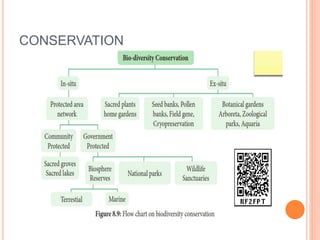
CONSERVATION
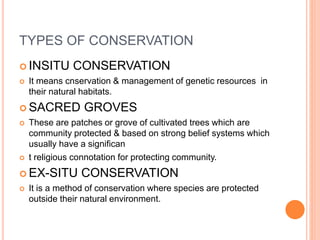
TYPES OF CONSERVATION
 INSITU CONSERVATION
 It means cnservation & management of genetic resources in
their natural habitats.
 SACRED GROVES
 These are patches or grove of cultivated trees which are
community protected & based on strong belief systems which
usually have a significan
 t religious connotation for protecting community.
 EX-SITU CONSERVATION
 It is a method of conservation where species are protected
outside their natural environment.
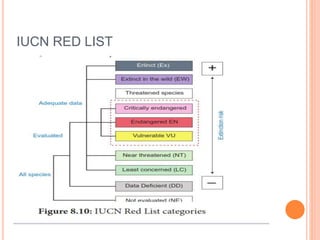
IUCN RED LIST
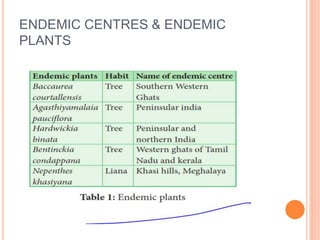
ENDEMIC CENTRES & ENDEMIC
PLANTS
CARBON CAPTURE & STORAGE
 Carbon capture & storage is a technology of capturing CO2 &
inject it deep into the underground rocks into a depth of 1 km
or more.
 CARBON SEQUESTRATION
 Carbon sequestration occurs naturally by plants & in ocean.
Terrestrial sequestration is typically accomplished through
forest & soil conservation practices that enhance the storage
carbon.
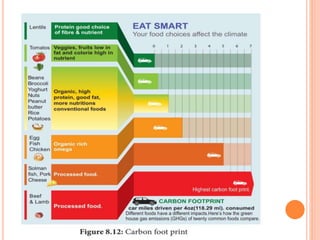
 CARBON FOOT PRINT
 Carbon foot print is the total amount of green house gases
produced by human activities such as agriculture, industries,
deforestation, waste disposal, burning fossil fuels directly or
indirectly.
BIOCHAR
 BIOCHAR is another long term method to store
carbon. To increase plants ability to store more
carbon, plants are partly burnt such as crop waste,
waste woods to become carbon rich slow
decomposing substances of material called
Biochal.
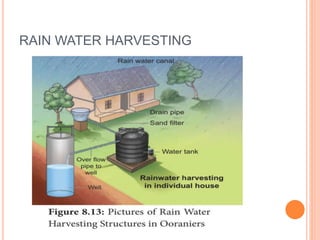
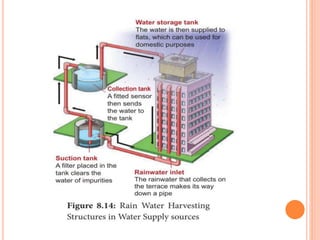
RAIN WATER HARVESTING
BENEFITS OF RAIN WATER
HARVESTING
 Promotes adequacy of underground water conservation
 Mitigates the effect of drought
 Reduces soil erosion as surface run off is reduced
 Reduces flood hazards
 Improves ground water quality & water table/ decreases
salinity
 No land is wasted for storage purpose & no population
displacement is involved.
 Storing water underground is an eco friendly measure &
sustainable water storage strategy.
EIA & BIA
 EIA is an environmental
management tool.
 It creates healthy
atmosphere
 Maintains Biodiversity
 Decreases resource
usage
 Reduces gas emissions
& environment damage
 BIA can be defined as a
decision supporting tool
to help development ,
planning &
implementation
 They are legally
complaint & include
mechanisms for the
conservation of bio-
diversity resources &
provide the benefits.
ENVIRONMENTAL IMPACT
ASSESSMENT
BIODIVERSITY IMPACT
ASSESSMENT
GIS & GPS
 GIS is a computer system
for capturing , storing ,
checking, & displaying data
related to positions on
Earth’s surface
 Also to manipulate,
analyse,manage & present
spacial or geographical data
 GPS is a satellite
navigation system to
determine the ground
position of an object
 It is currently used for
mining, Aviation,
Surveying,Agricultural
& Marine ecosystem.
Geographic Information
System Geo positioning System

Chapter 8 environmental issues

  • 1.
  • 2.
    GREEN HOUSE EFFECT Green house effect is a process by which radiant heat from the Sun is captured by gases in the atmosphere that increase the temperature of the Earth ultimately.
  • 3.
    GLOBAL WARMING The increasein mean global temperature ( highest in 4000 years) due to increased concentration of green house gases is called global warming Green house gases include CO2, CH4,N2O & variety of manufactured chemicals like chlofluorocarbon (CFC) Effects Of Global warming Low agricultural productivity, frequent heat waves, watercrisis,change in flowering season,& species extinction
  • 4.
    OZONE DEPLETION  Ozonelayer ia a region of Earth’s stratosphere that absorbs most of the Sun’s ultra violet radiation. It acts as a protective shield for living rganisms.  The false colour view of total ozone-purple & blue colours are where there is the least ozone & the yellow & the reds are where there is more ozone.
  • 5.
    AGRO & SOCIALFORESTRY  Agroforestry is an integration of trees, crops,& livestock on the same plot  Agroforestry improves soil & water conservation, Nutrientcycling, provides balanced atmospheric temperature & relative humidity.  Social forestry refers to the management of forests & afforestati on on barren lands for helping social & rural development & benefits.  Activities of Social forestry  Training on tree growing methods  Raising & supply of seedlings on subsidy  Formation of demonstration plots  Publicity & awareness creation regarding tree growing
  • 6.
    DEFORESTATION & AFFORESTATION Deforestation is one of the major contributers to enhance green house effect & global warming  The causes for deforestation are conversion of agricultural plantation & livestock ranching,logging for timber,industrialisation,urbanisation & increased global needs.  To overcome deforestation Afforestation has to be carried out  Afforestation is planting of trees where there was no previous tree coverage & the conversion of non-forested lands into forests by planting suitable trees to retrieve vegetation.  It increases forest cover, rehabilitation of degraded forests,mixed plantation, awareness creation, monitoring & evaluation.
  • 7.
  • 8.
  • 9.
     A non–native species to the ecosystem or country under consideration that spreads naturally interferes with the bilgy & existance of native species, pses a serious threat to the ecosystem .  Eichhornia & Prosopis are native to South America.  Eichhornia leads to eutropication,a breeding habitat for mosquitoes , blocks sunlight & waterways hampering agriculture  Prosopis invades reducing the cver f native medicinal herbaceous  Species  Lantana & Parthenium are also native of South America &has allelopathic effect  Lantana reduces plant growth by inhibiting germination & root elongation  Parthenium causes pollen allergy which leads to allergic rhinitis, asthma,& dermatitis. 
  • 10.
  • 11.
    TYPES OF CONSERVATION INSITU CONSERVATION  It means cnservation & management of genetic resources in their natural habitats.  SACRED GROVES  These are patches or grove of cultivated trees which are community protected & based on strong belief systems which usually have a significan  t religious connotation for protecting community.  EX-SITU CONSERVATION  It is a method of conservation where species are protected outside their natural environment.
  • 12.
  • 13.
    ENDEMIC CENTRES &ENDEMIC PLANTS
  • 14.
    CARBON CAPTURE &STORAGE  Carbon capture & storage is a technology of capturing CO2 & inject it deep into the underground rocks into a depth of 1 km or more.  CARBON SEQUESTRATION  Carbon sequestration occurs naturally by plants & in ocean. Terrestrial sequestration is typically accomplished through forest & soil conservation practices that enhance the storage carbon.  CARBON FOOT PRINT  Carbon foot print is the total amount of green house gases produced by human activities such as agriculture, industries, deforestation, waste disposal, burning fossil fuels directly or indirectly.
  • 16.
    BIOCHAR  BIOCHAR isanother long term method to store carbon. To increase plants ability to store more carbon, plants are partly burnt such as crop waste, waste woods to become carbon rich slow decomposing substances of material called Biochal.
  • 17.
  • 19.
    BENEFITS OF RAINWATER HARVESTING  Promotes adequacy of underground water conservation  Mitigates the effect of drought  Reduces soil erosion as surface run off is reduced  Reduces flood hazards  Improves ground water quality & water table/ decreases salinity  No land is wasted for storage purpose & no population displacement is involved.  Storing water underground is an eco friendly measure & sustainable water storage strategy.
  • 20.
    EIA & BIA EIA is an environmental management tool.  It creates healthy atmosphere  Maintains Biodiversity  Decreases resource usage  Reduces gas emissions & environment damage  BIA can be defined as a decision supporting tool to help development , planning & implementation  They are legally complaint & include mechanisms for the conservation of bio- diversity resources & provide the benefits. ENVIRONMENTAL IMPACT ASSESSMENT BIODIVERSITY IMPACT ASSESSMENT
  • 21.
    GIS & GPS GIS is a computer system for capturing , storing , checking, & displaying data related to positions on Earth’s surface  Also to manipulate, analyse,manage & present spacial or geographical data  GPS is a satellite navigation system to determine the ground position of an object  It is currently used for mining, Aviation, Surveying,Agricultural & Marine ecosystem. Geographic Information System Geo positioning System