Chapter - 2
Email for more PPTs at a very reasonable price.
Email: parmarshivam105@gmail.com By Shivam Parmar (PPT Designer)
INTRODUCTION
• Our country has
practically all major
physical features of the
earth i.e. mountains,
plains, deserts, plateaus
and islands.
• You must be wondering
how these physical
features have been
formed. We will learn
more about major
physical features of India
and how they have been
formed.
THEORY OF
PLATE
TECTONICS
• Earth scientists have attempted
to explain the formation of
physical features with the help
of some theories based on
certain evidences. One such
plausible theory is the “Theory
of Plate Tectonics”.
• According to this theory, the
crust (upper part) of the earth
has been formed out of seven
major and some minor plates.
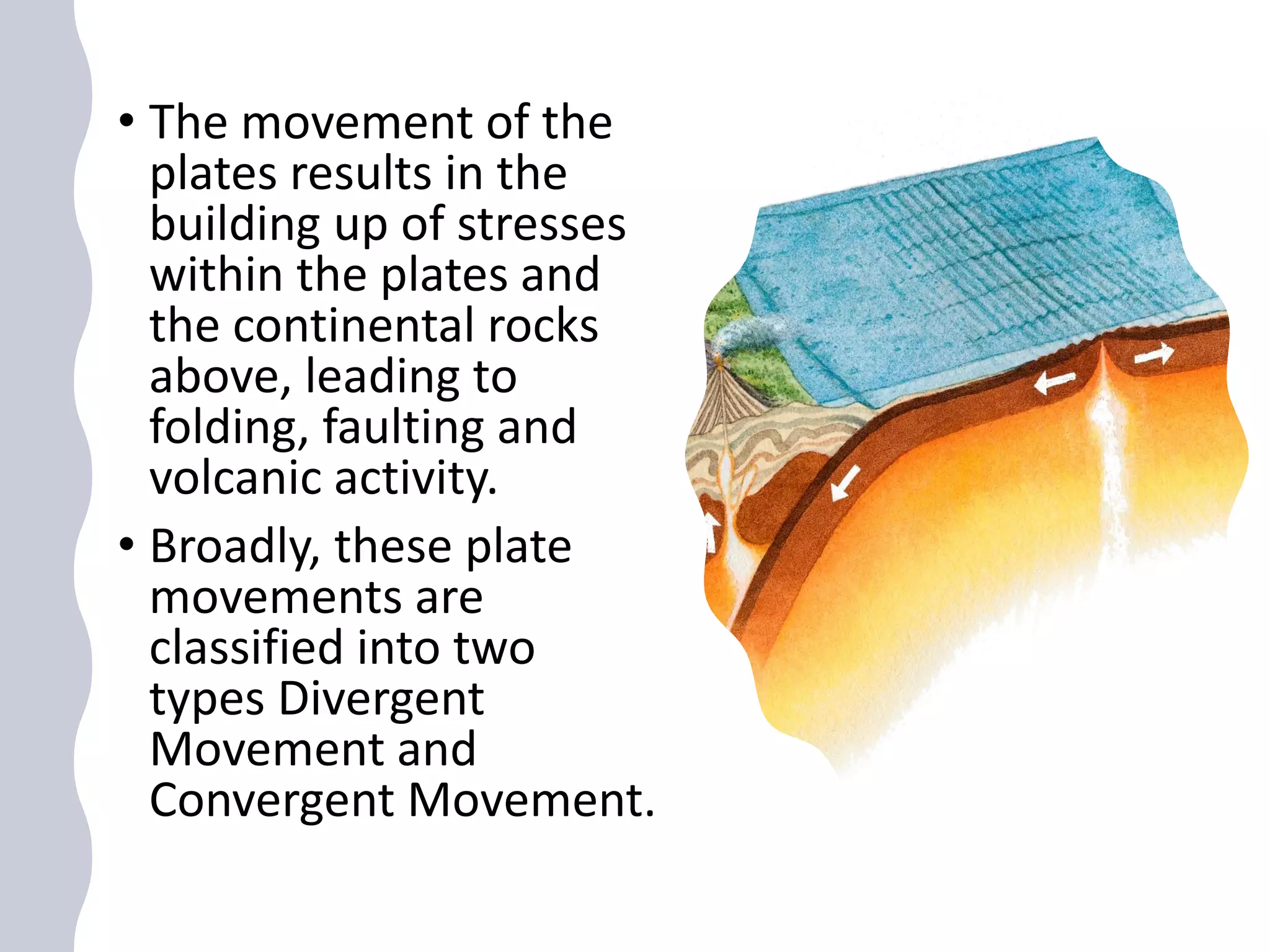
• The movement of the
plates results in the
building up of stresses
within the plates and
the continental rocks
above, leading to
folding, faulting and
volcanic activity.
• Broadly, these plate
movements are
classified into two
types Divergent
Movement and
Convergent Movement.
ON THE BASIS OF
MOVEMENT
THERE ARE THREE
TYPES OF PLATES
BOUNDARIES.
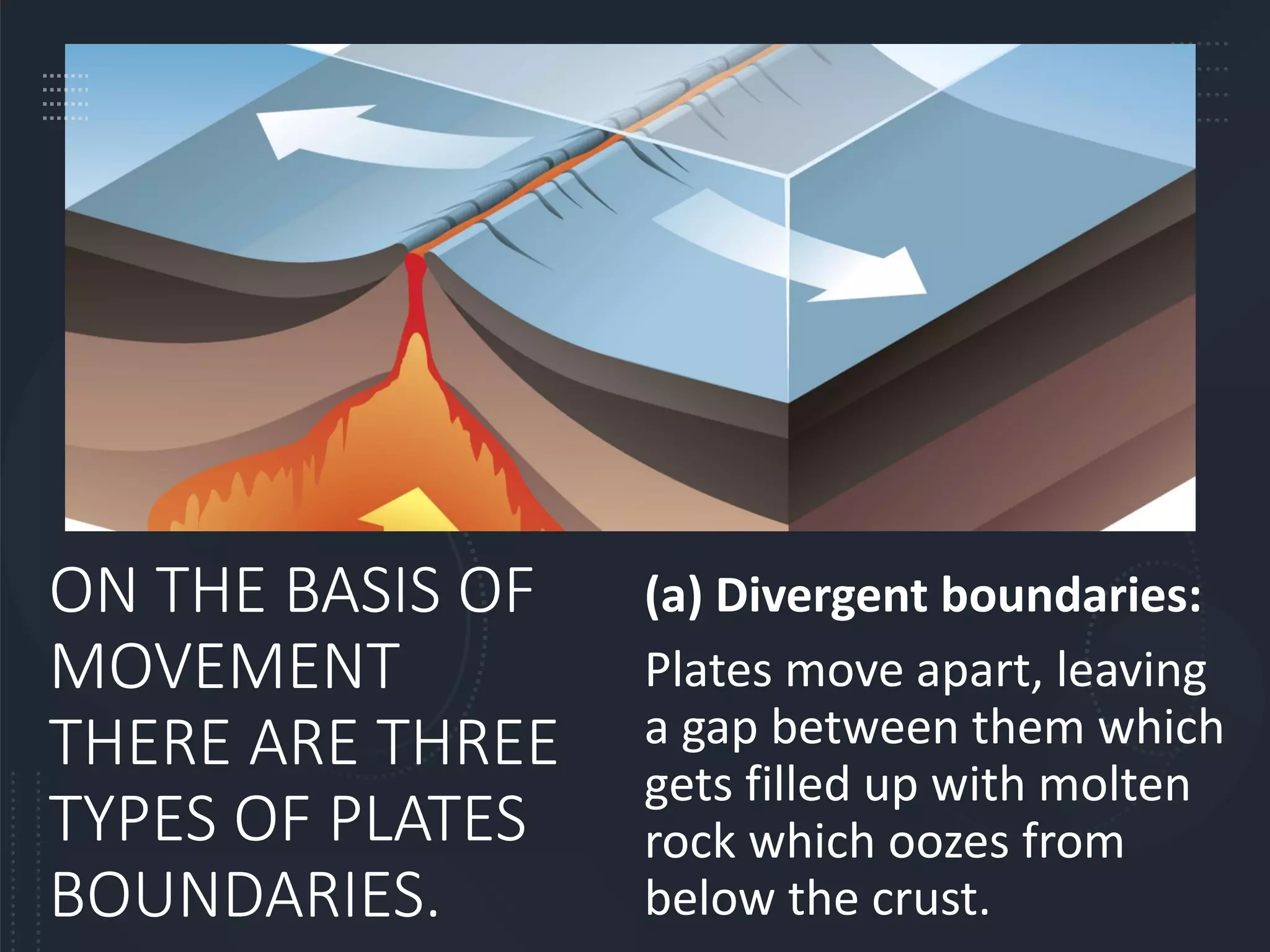
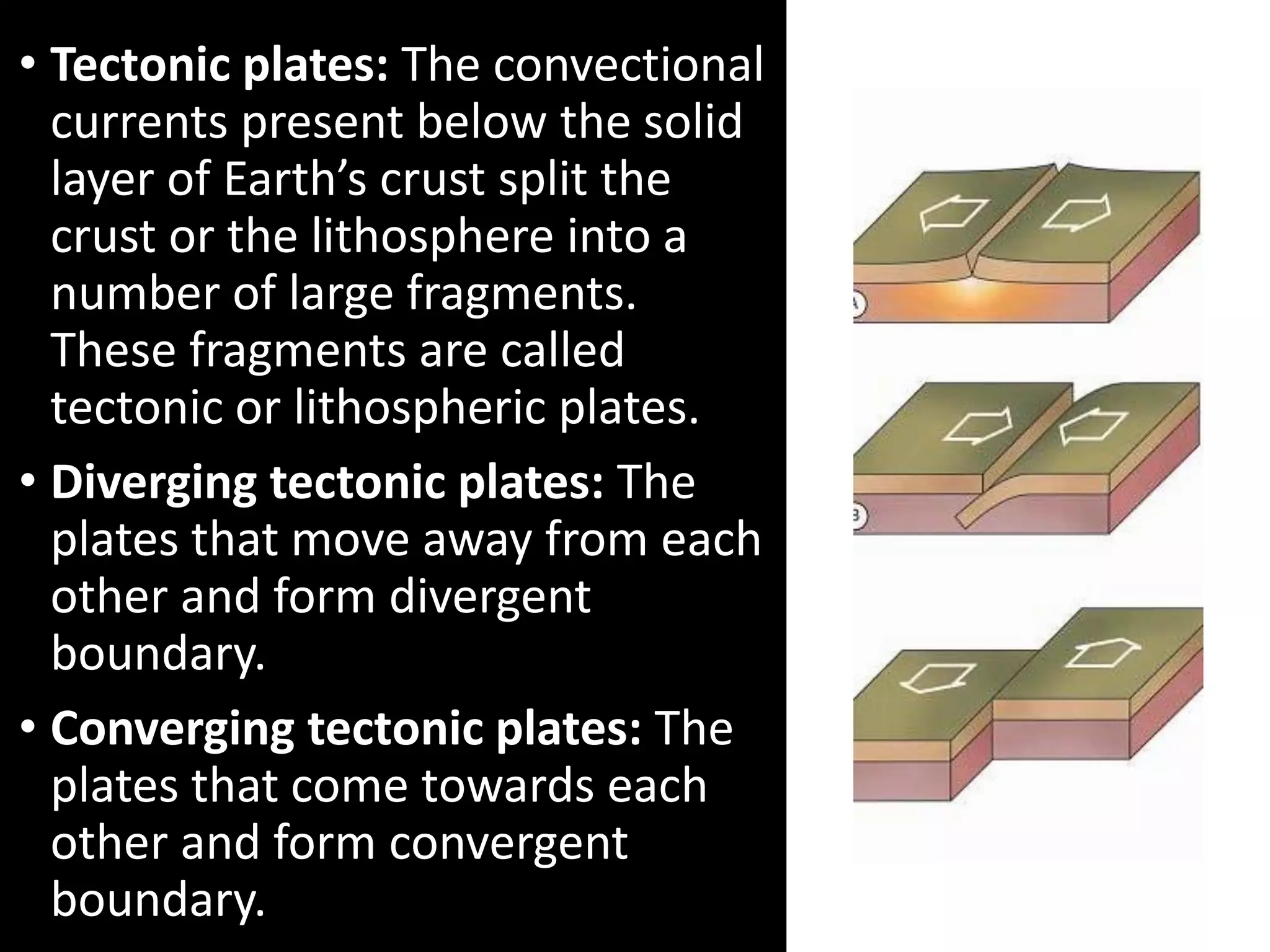
(a) Divergent boundaries:
Plates move apart, leaving
a gap between them which
gets filled up with molten
rock which oozes from
below the crust.
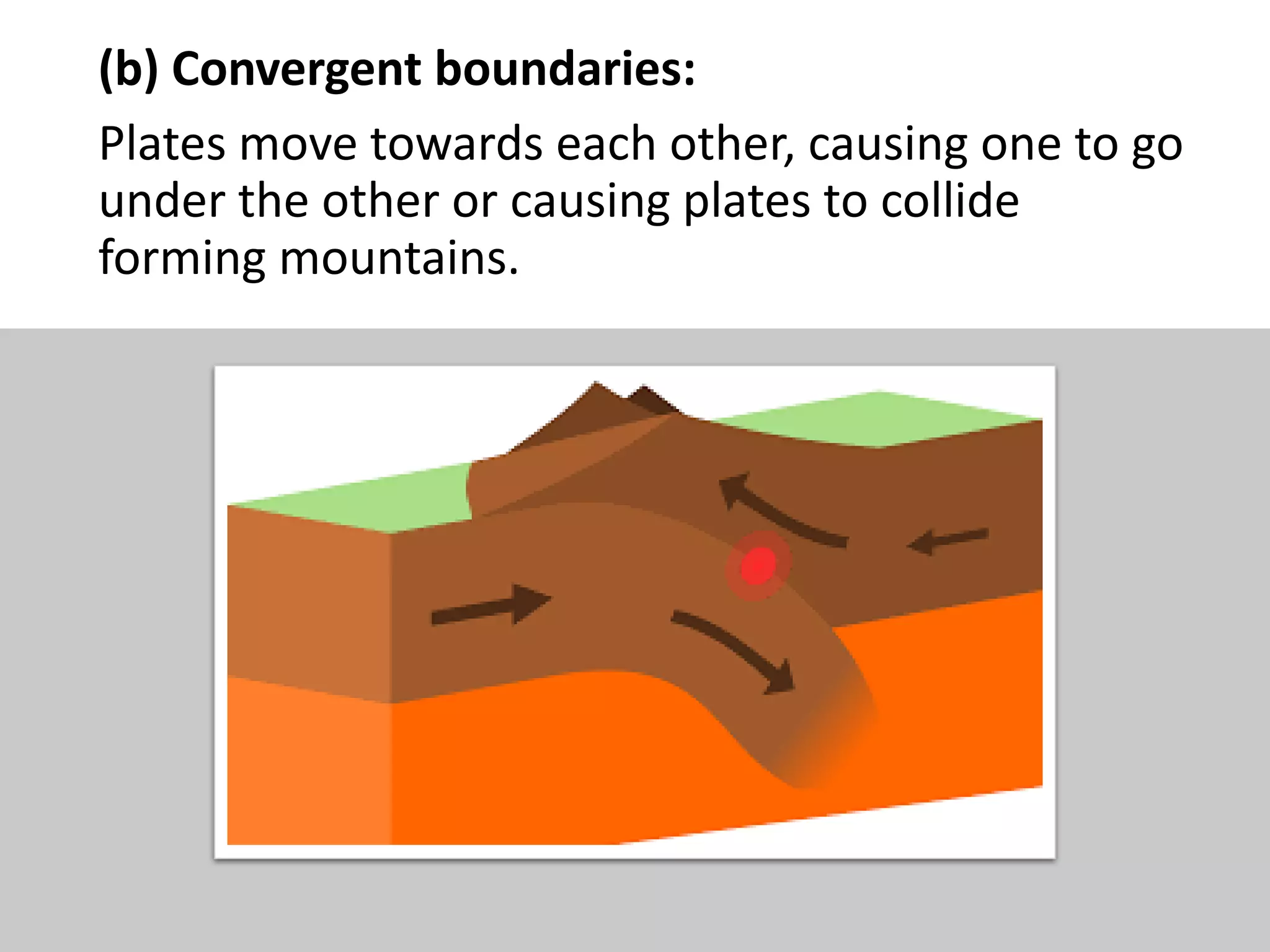
(b) Convergent boundaries:
Plates move towards each other, causing one to go
under the other or causing plates to collide
forming mountains.
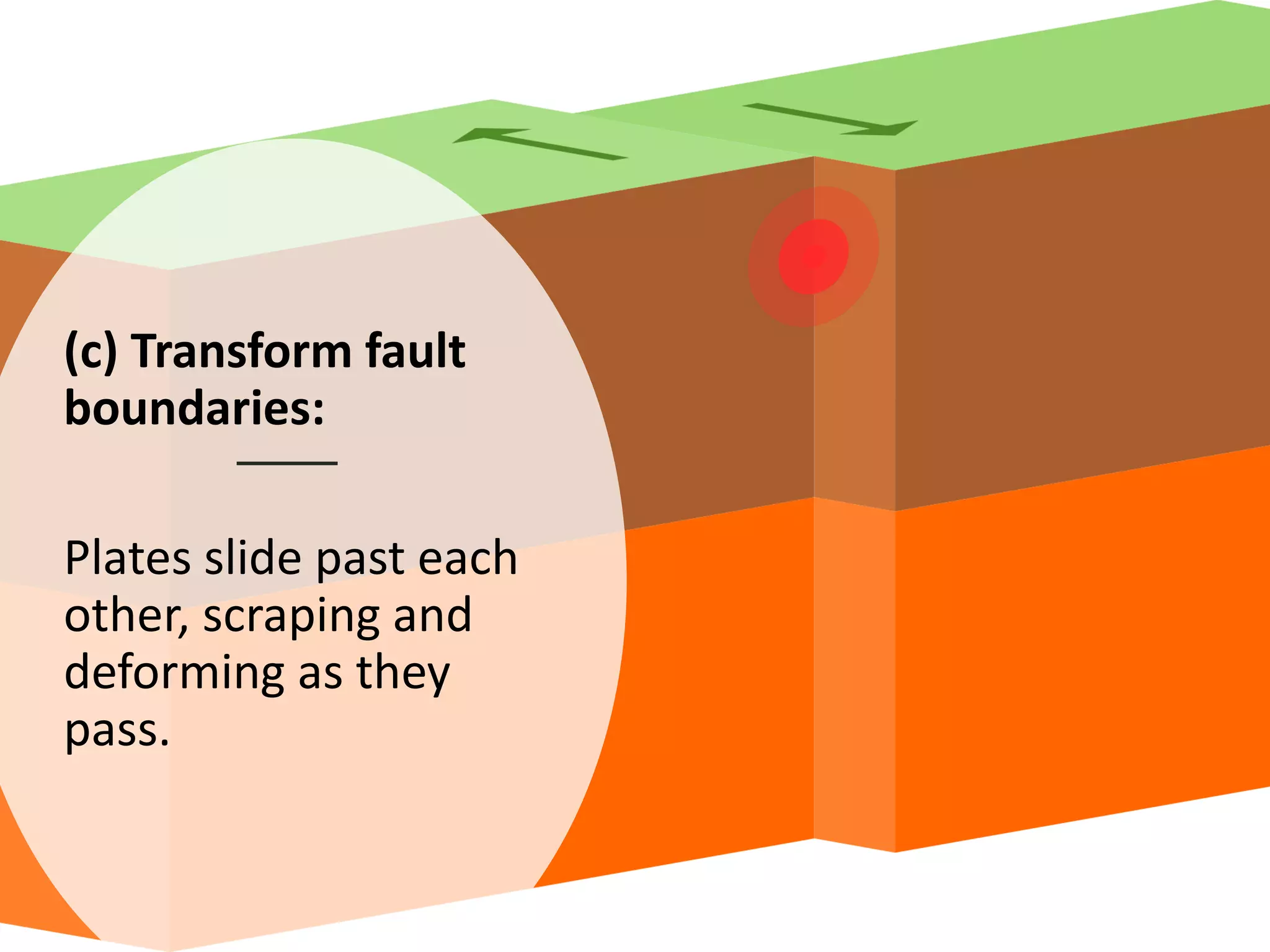
(c) Transform fault
boundaries:
Plates slide past each
other, scraping and
deforming as they
pass.
FORMATION OF HIMALAYAS
• Tectonic plates: The convectional
currents present below the solid
layer of Earth’s crust split the
crust or the lithosphere into a
number of large fragments.
These fragments are called
tectonic or lithospheric plates.
• Diverging tectonic plates: The
plates that move away from each
other and form divergent
boundary.
• Converging tectonic plates: The
plates that come towards each
other and form convergent
boundary.
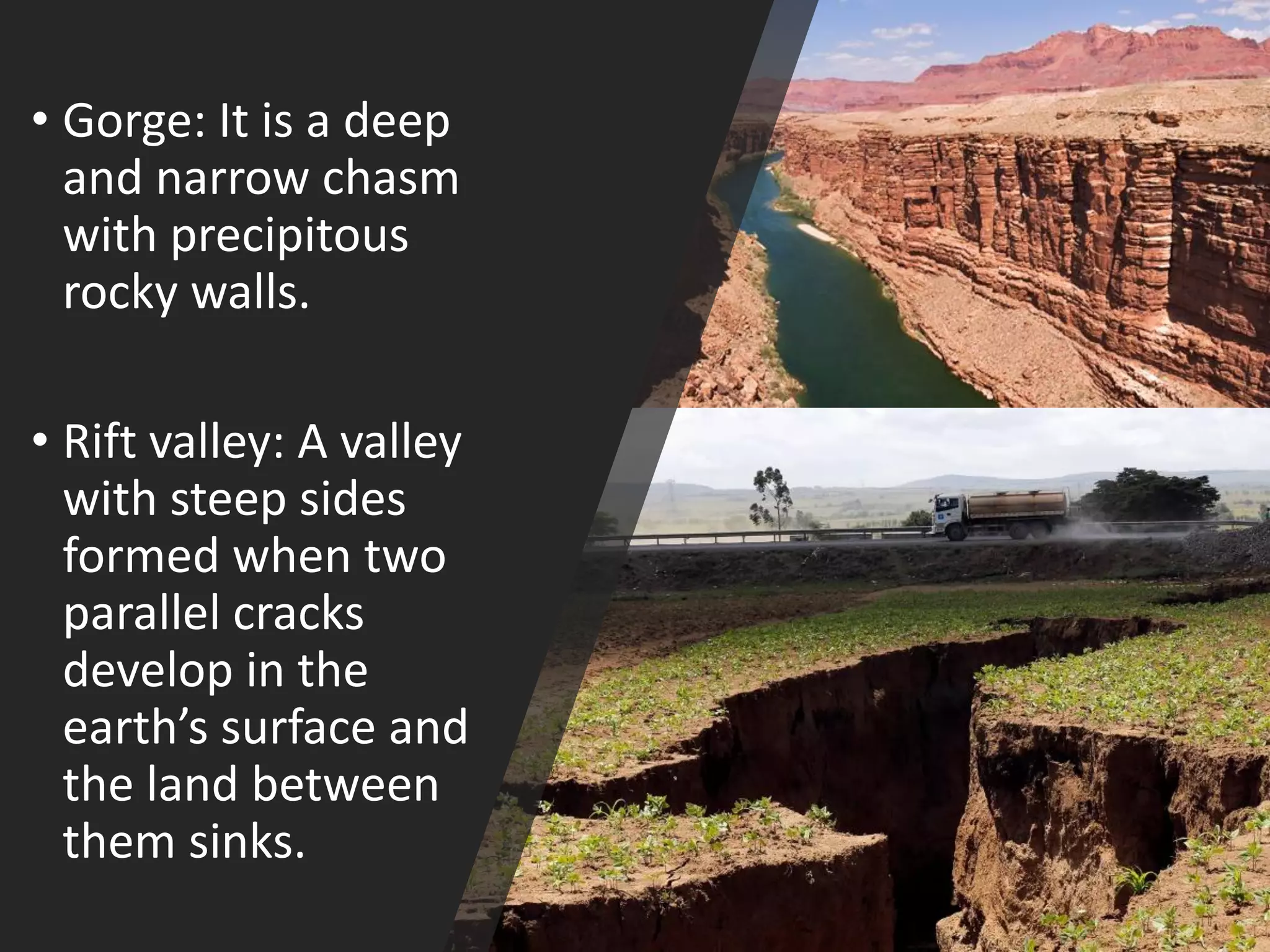
• Gorge: It is a deep
and narrow chasm
with precipitous
rocky walls.
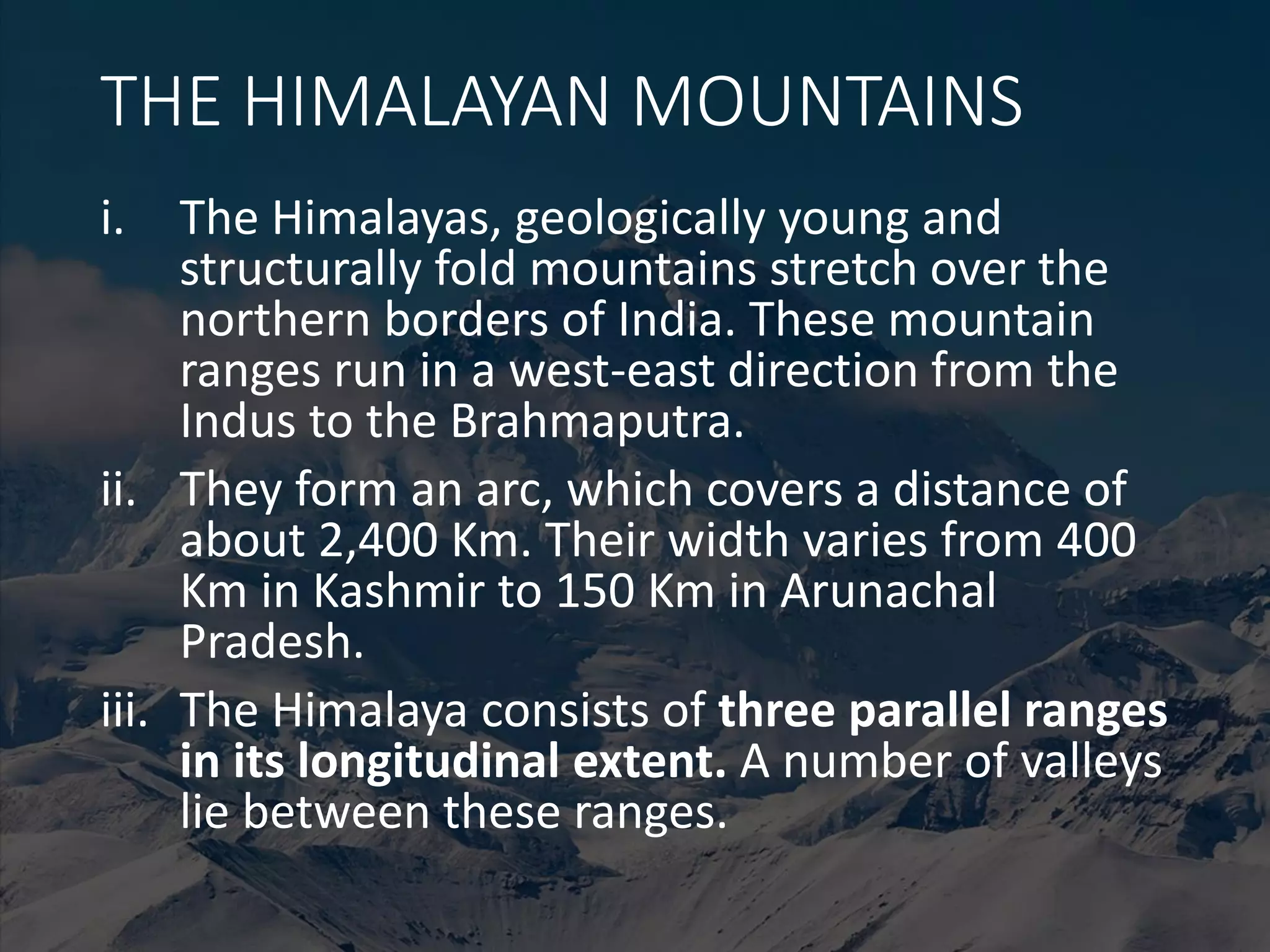
• Rift valley: A valley
with steep sides
formed when two
parallel cracks
develop in the
earth’s surface and
the land between
them sinks.
THE HIMALAYAN MOUNTAINS
i. The Himalayas, geologically young and
structurally fold mountains stretch over the
northern borders of India. These mountain
ranges run in a west-east direction from the
Indus to the Brahmaputra.
ii. They form an arc, which covers a distance of
about 2,400 Km. Their width varies from 400
Km in Kashmir to 150 Km in Arunachal
Pradesh.
iii. The Himalaya consists of three parallel ranges
in its longitudinal extent. A number of valleys
lie between these ranges.
1. HIMADRI
(i) The northern most range is known as the
Great of Inner Himalayas or the Himadri.
(ii) It is the most continuous range consisting of
the loftiest peaks like Mount Everest (8848
m), Nanga Parbat (8126 m).
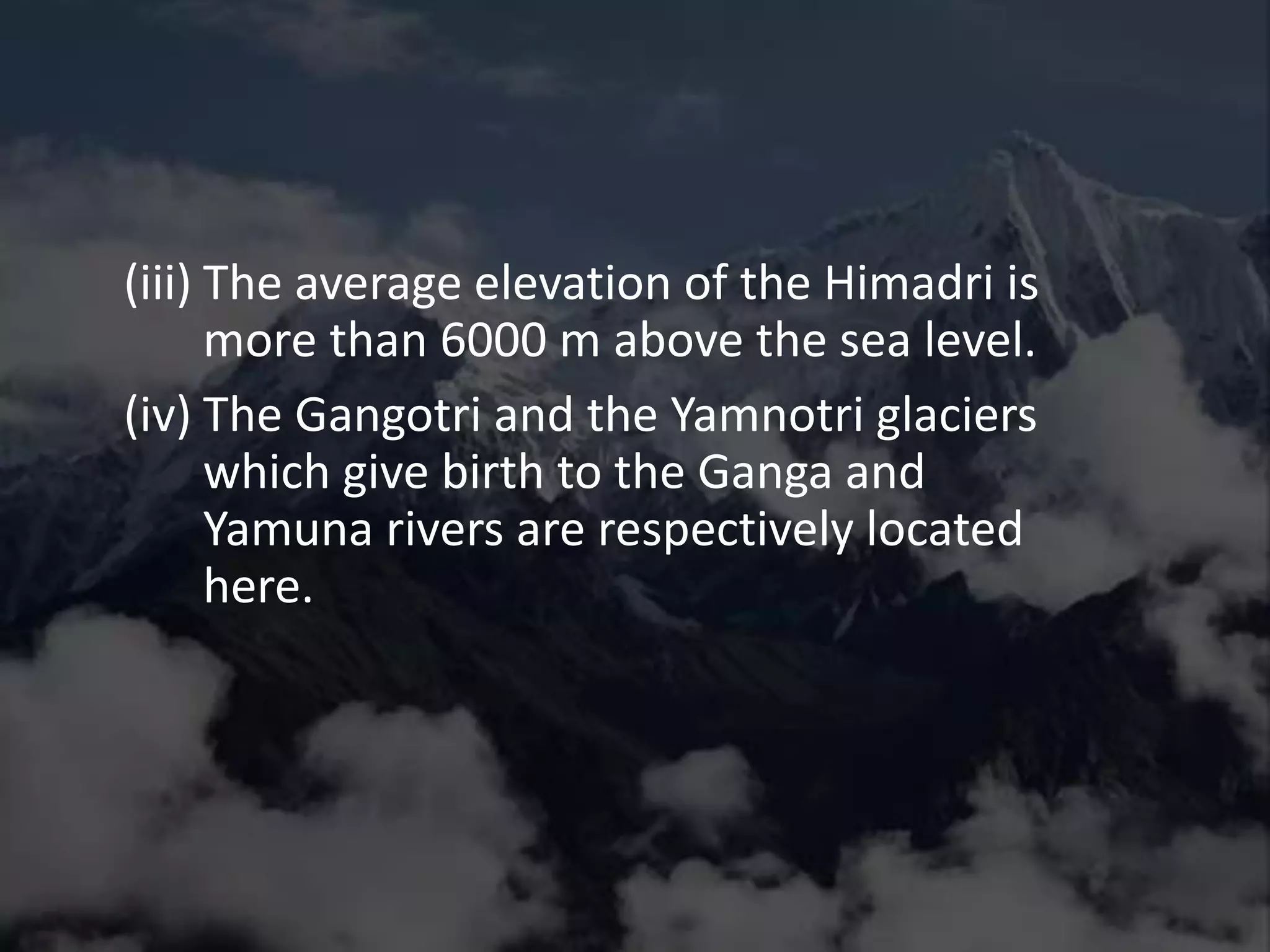
(iii) The average elevation of the Himadri is
more than 6000 m above the sea level.
(iv) The Gangotri and the Yamnotri glaciers
which give birth to the Ganga and
Yamuna rivers are respectively located
here.
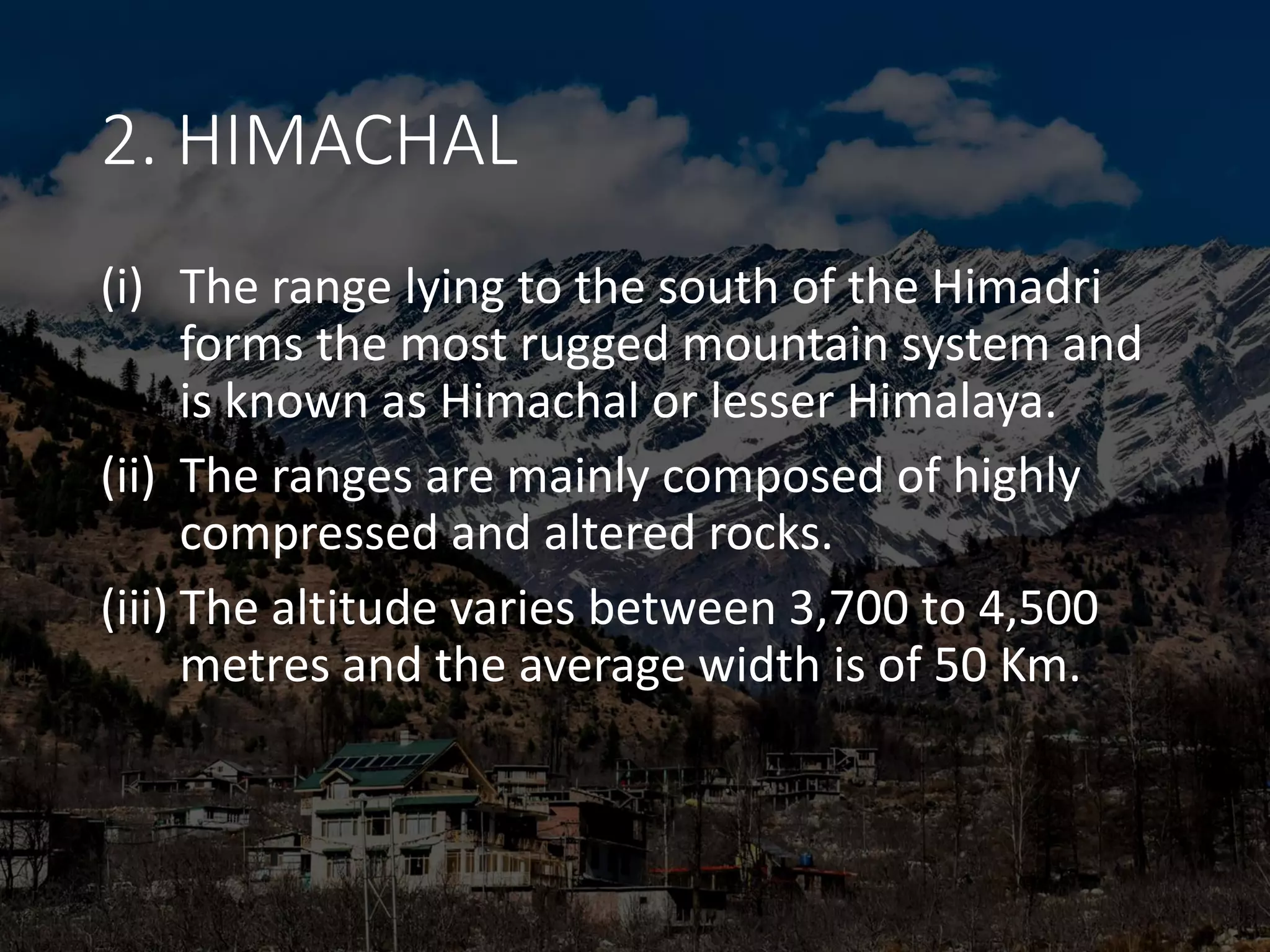
2. HIMACHAL
(i) The range lying to the south of the Himadri
forms the most rugged mountain system and
is known as Himachal or lesser Himalaya.
(ii) The ranges are mainly composed of highly
compressed and altered rocks.
(iii) The altitude varies between 3,700 to 4,500
metres and the average width is of 50 Km.
3. SHIVALIK
(i) The outer most range of the Himalayas is called
the Shivaliks. The extend over a width of 10-50
Km and have an altitude varying between 900
and 1100 metres.
(ii) These ranges are composed of unconsolidated
sediments brought down by rivers from the
main Himalayan ranges located farther north.
These valleys are covered with thick gravel and
alluvium
(iii) The longitudinal valley lying between lesser
Himalaya and the Shiwaliks are known as Duns.
Dehra Dun. Kotli Dun and Patli Dun are some of
the well-known Duns.
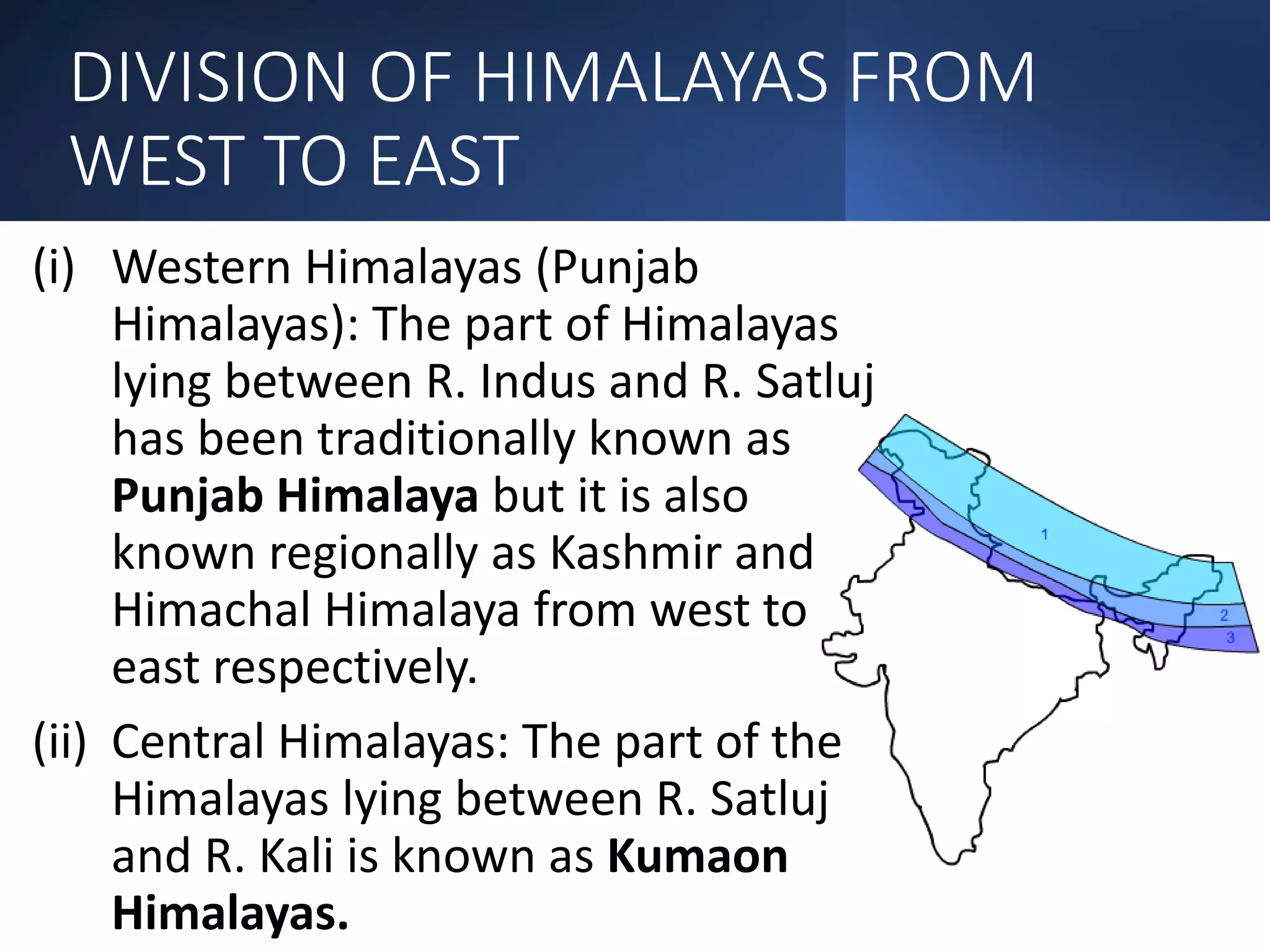
DIVISION OF HIMALAYAS FROM
WEST TO EAST
(i) Western Himalayas (Punjab
Himalayas): The part of Himalayas
lying between R. Indus and R. Satluj
has been traditionally known as
Punjab Himalaya but it is also
known regionally as Kashmir and
Himachal Himalaya from west to
east respectively.
(ii) Central Himalayas: The part of the
Himalayas lying between R. Satluj
and R. Kali is known as Kumaon
Himalayas.
THE NORTHERN PLAIN
(i) The northern plain has been formed
by the interplay of the three major river
systems, namely-the Indus, the Ganga
and the Brahmaputra along with their
tributaries. This plain is formed of alluvial
soil.
(ii) It spreads over an area of 7 lakh
sq.km. The plain being about 2400 Km
long and 240 to 320 Km broad, is a
densely populated physiographic
division.
(iii) With a rich soil cover combined with
adequate water supply and favourable
climate it is agriculturally a very
productive part of India.
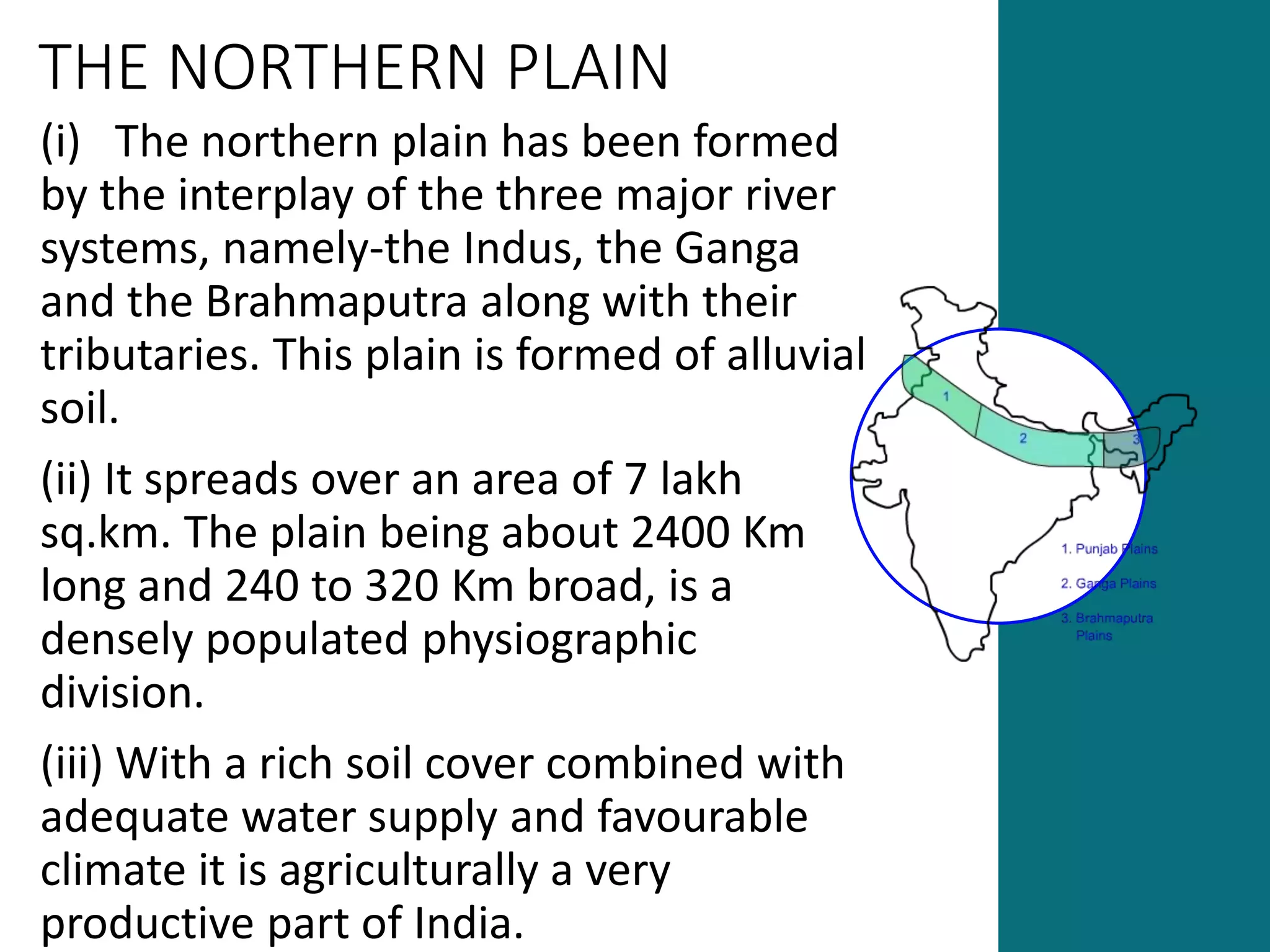
DIVISION OF NORTHERN PLAINS
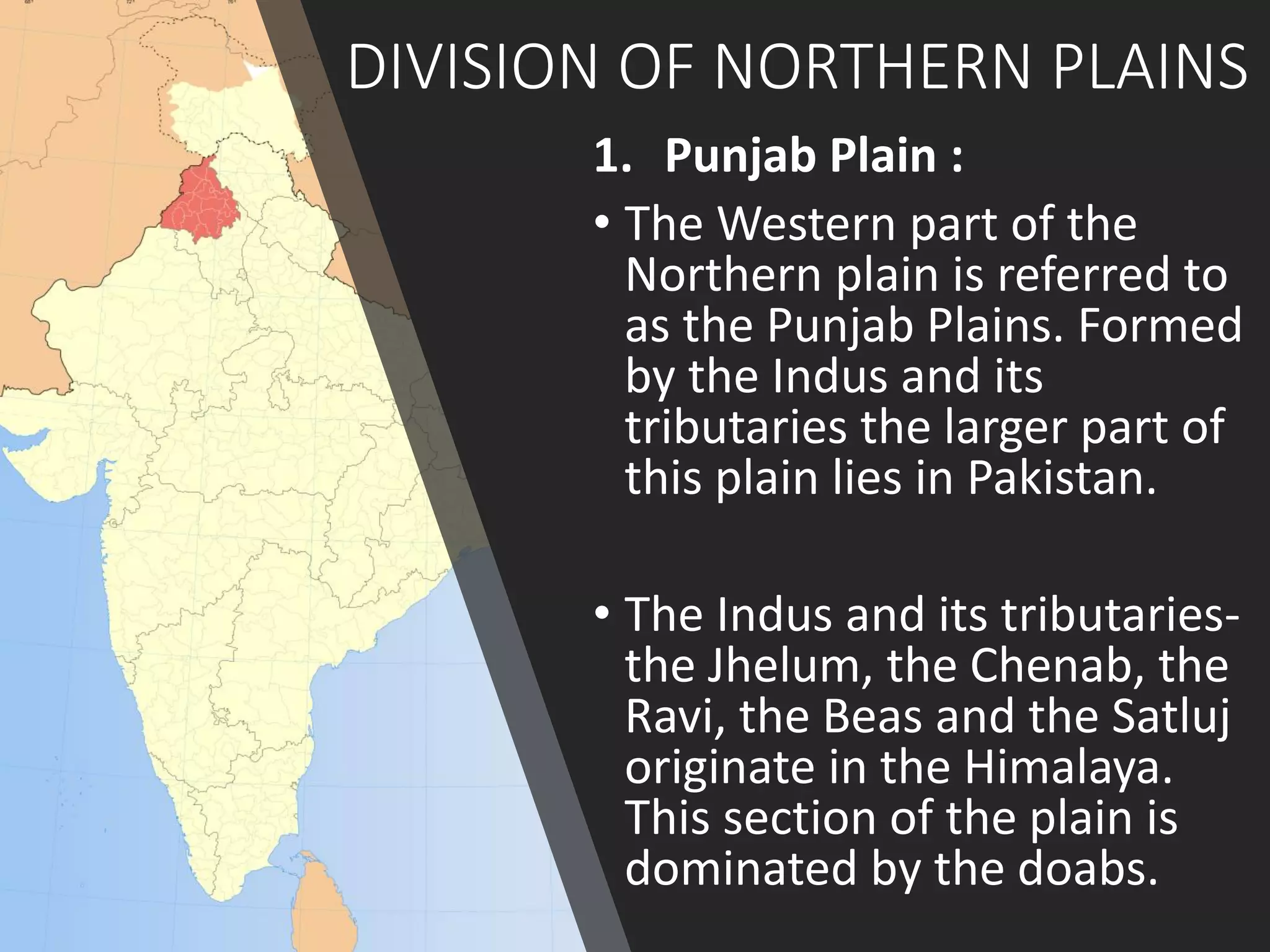
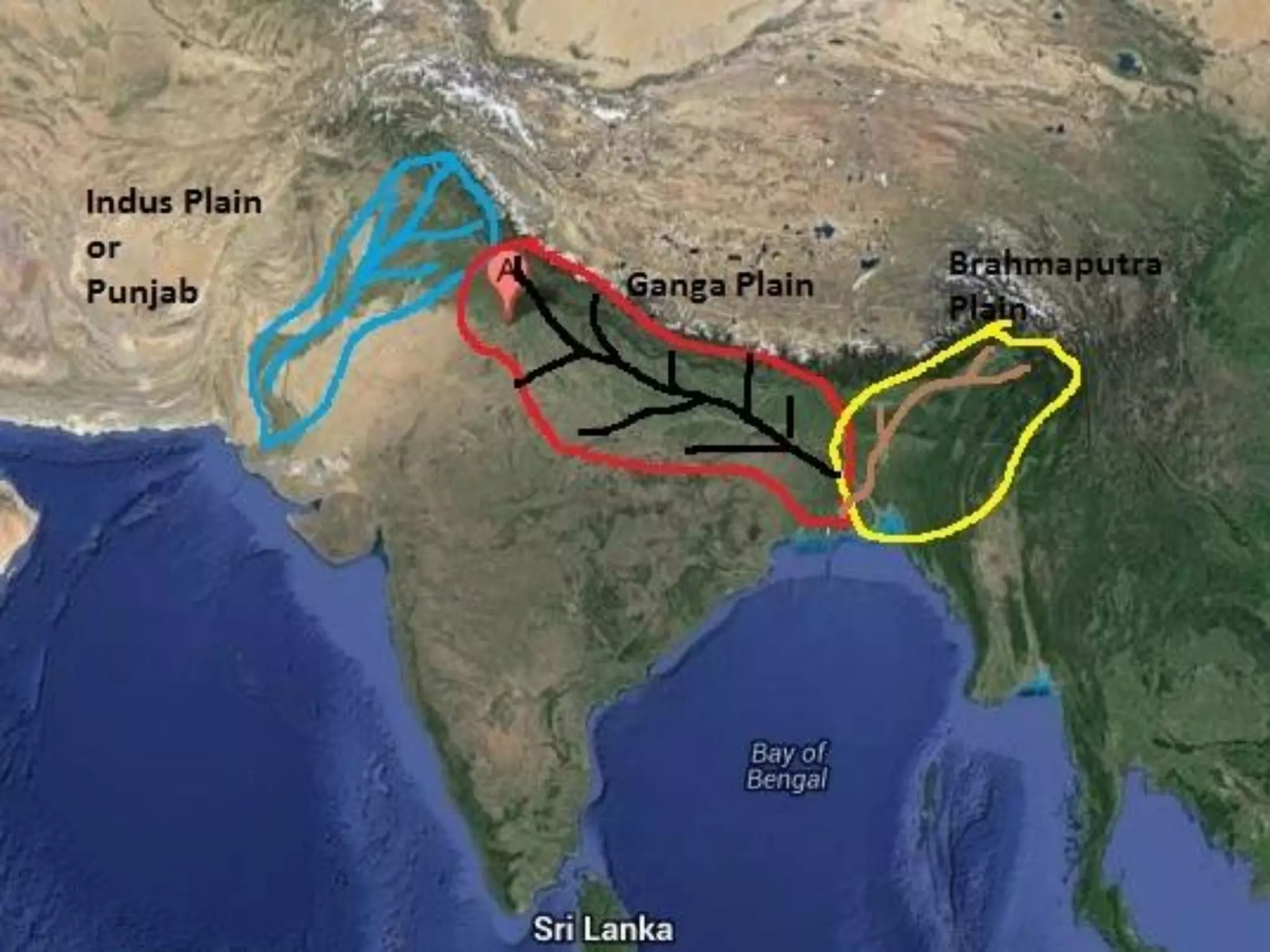
1. Punjab Plain :
• The Western part of the
Northern plain is referred to
as the Punjab Plains. Formed
by the Indus and its
tributaries the larger part of
this plain lies in Pakistan.
• The Indus and its tributaries-
the Jhelum, the Chenab, the
Ravi, the Beas and the Satluj
originate in the Himalaya.
This section of the plain is
dominated by the doabs.
2. Ganga & Brahmaputra Plain:
The Ganga plain extends between
Ghaggar and Tista rivers. It is spread
over the states of North India,
Haryana, Delhi, UP, Bihar, Partly
Jharkhand and West Bengal to its
east particularly in Assam lies the
Brahmaputra plain.
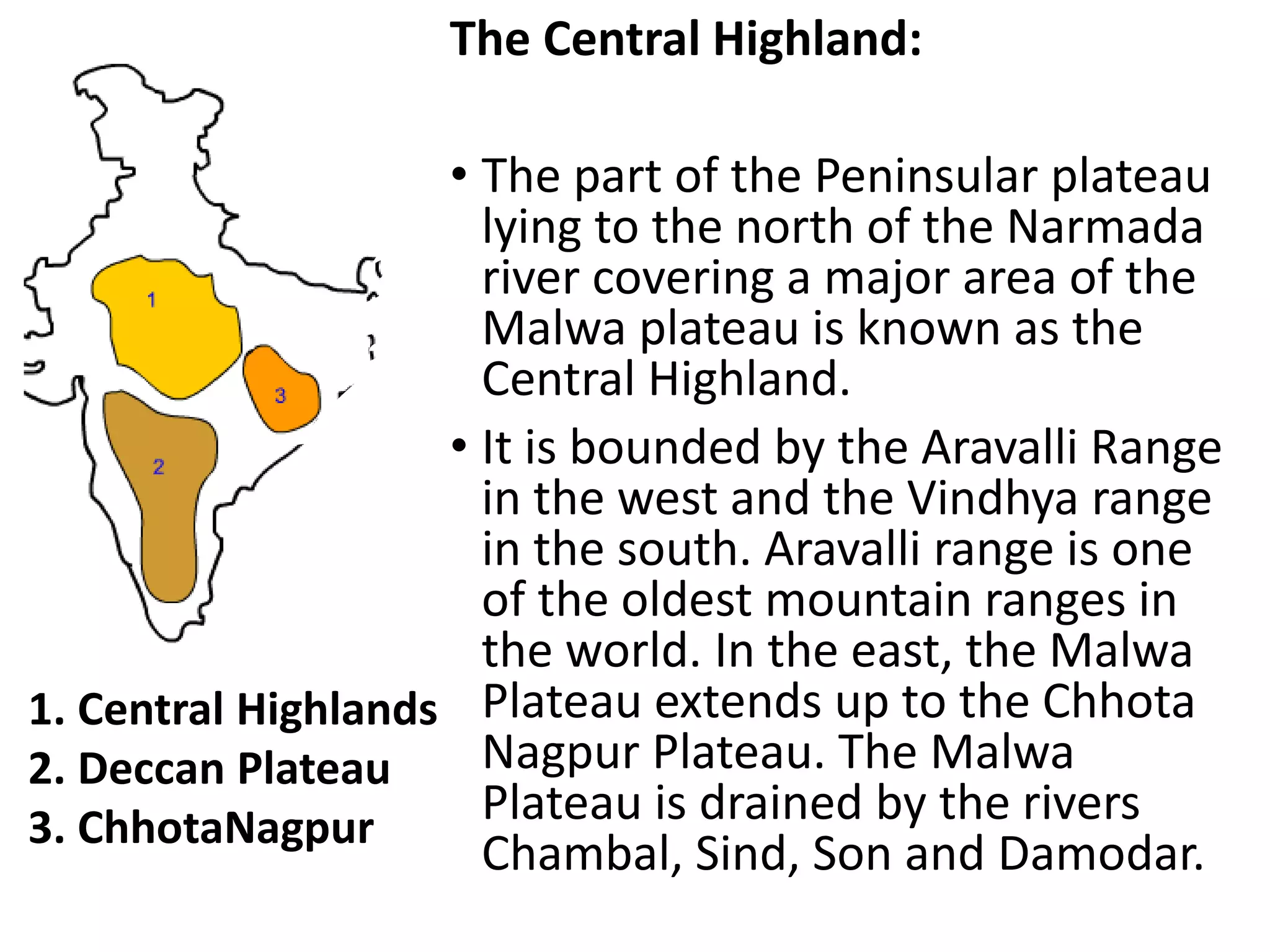
The Central Highland:
• The part of the Peninsular plateau
lying to the north of the Narmada
river covering a major area of the
Malwa plateau is known as the
Central Highland.
• It is bounded by the Aravalli Range
in the west and the Vindhya range
in the south. Aravalli range is one
of the oldest mountain ranges in
the world. In the east, the Malwa
Plateau extends up to the Chhota
Nagpur Plateau. The Malwa
Plateau is drained by the rivers
Chambal, Sind, Son and Damodar.
1. Central Highlands
2. Deccan Plateau
3. ChhotaNagpur
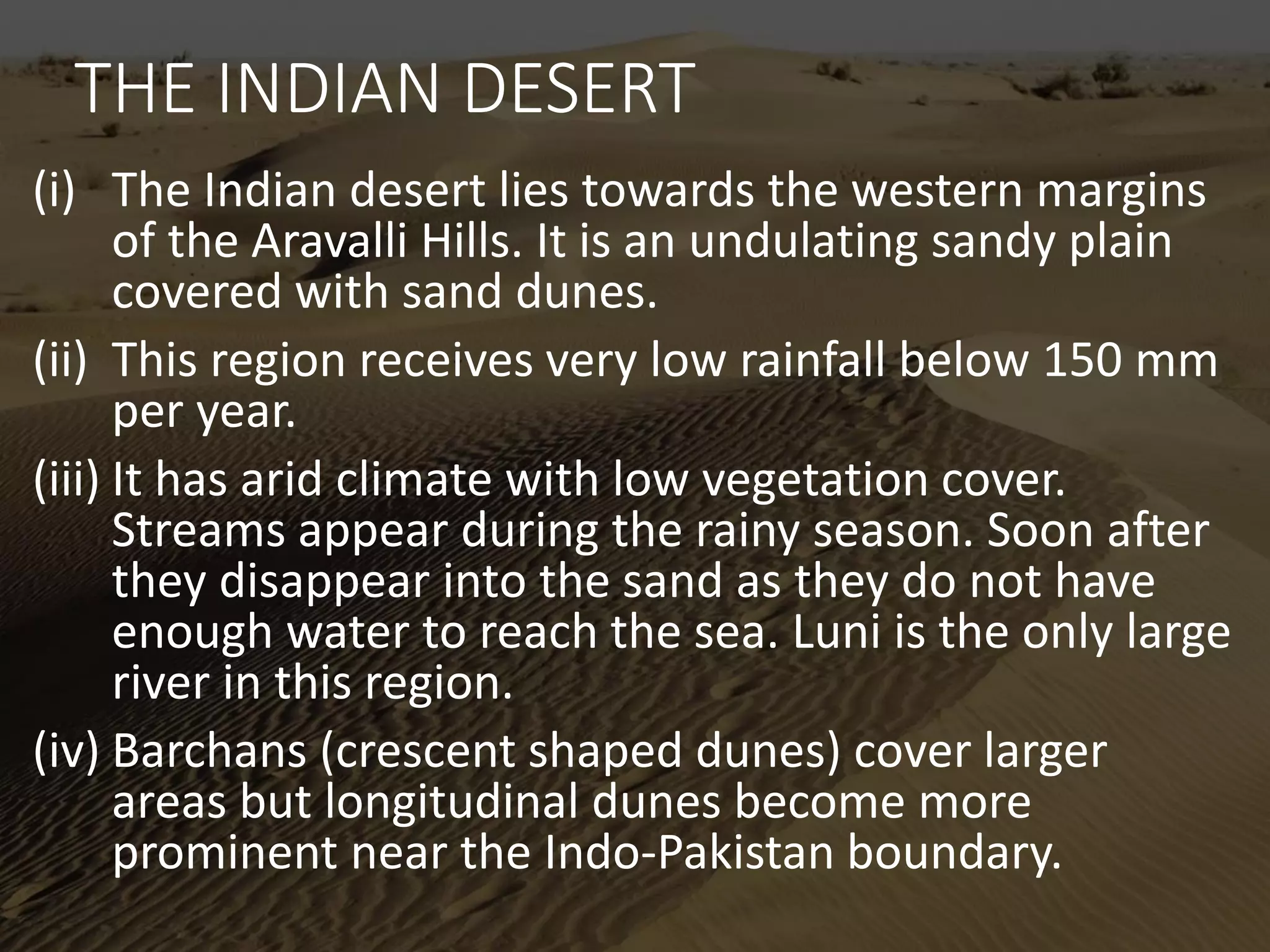
THE INDIAN DESERT
(i) The Indian desert lies towards the western margins
of the Aravalli Hills. It is an undulating sandy plain
covered with sand dunes.
(ii) This region receives very low rainfall below 150 mm
per year.
(iii) It has arid climate with low vegetation cover.
Streams appear during the rainy season. Soon after
they disappear into the sand as they do not have
enough water to reach the sea. Luni is the only large
river in this region.
(iv) Barchans (crescent shaped dunes) cover larger
areas but longitudinal dunes become more
prominent near the Indo-Pakistan boundary.
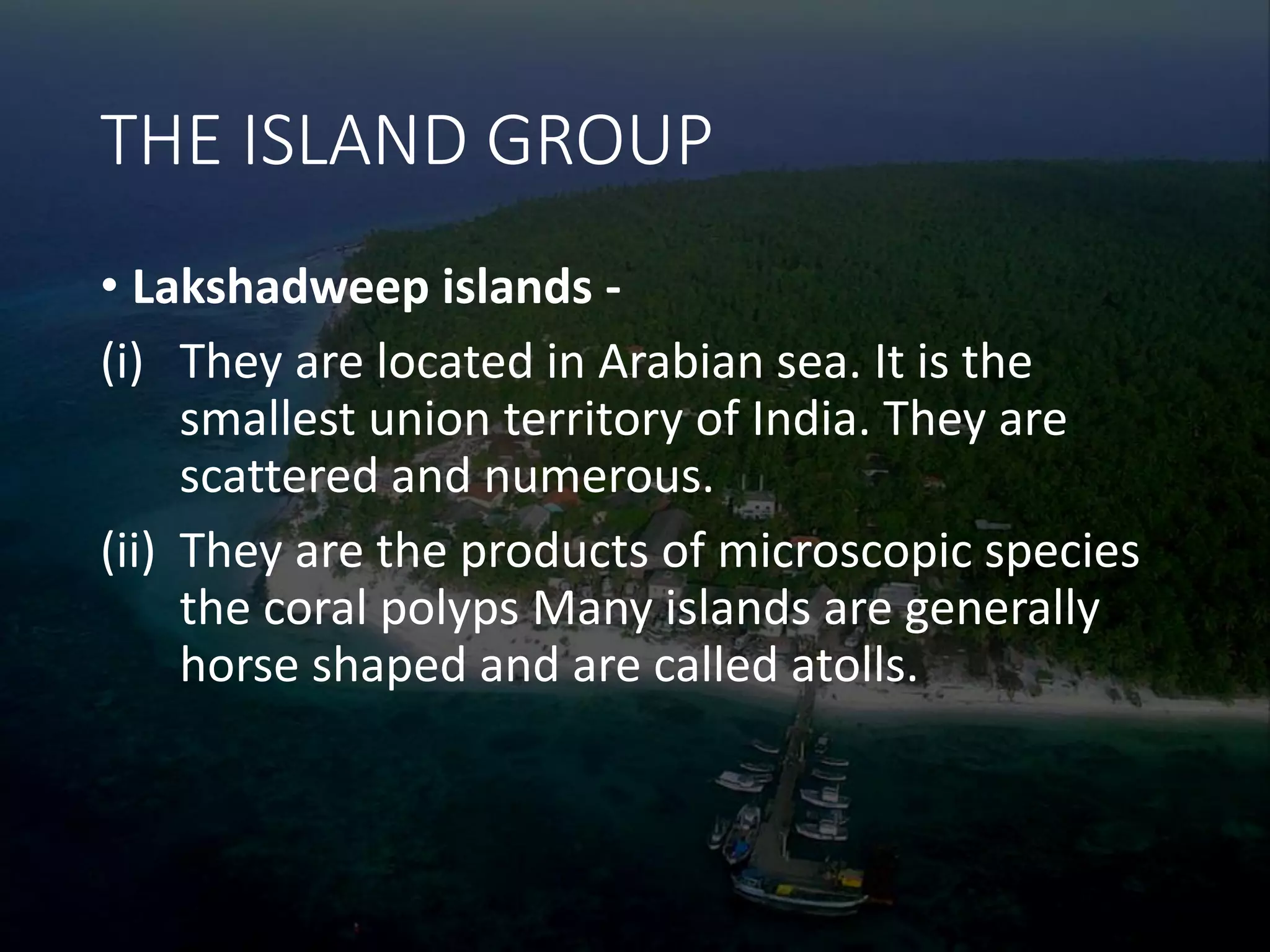
THE ISLAND GROUP
• Lakshadweep islands -
(i) They are located in Arabian sea. It is the
smallest union territory of India. They are
scattered and numerous.
(ii) They are the products of microscopic species
the coral polyps Many islands are generally
horse shaped and are called atolls.
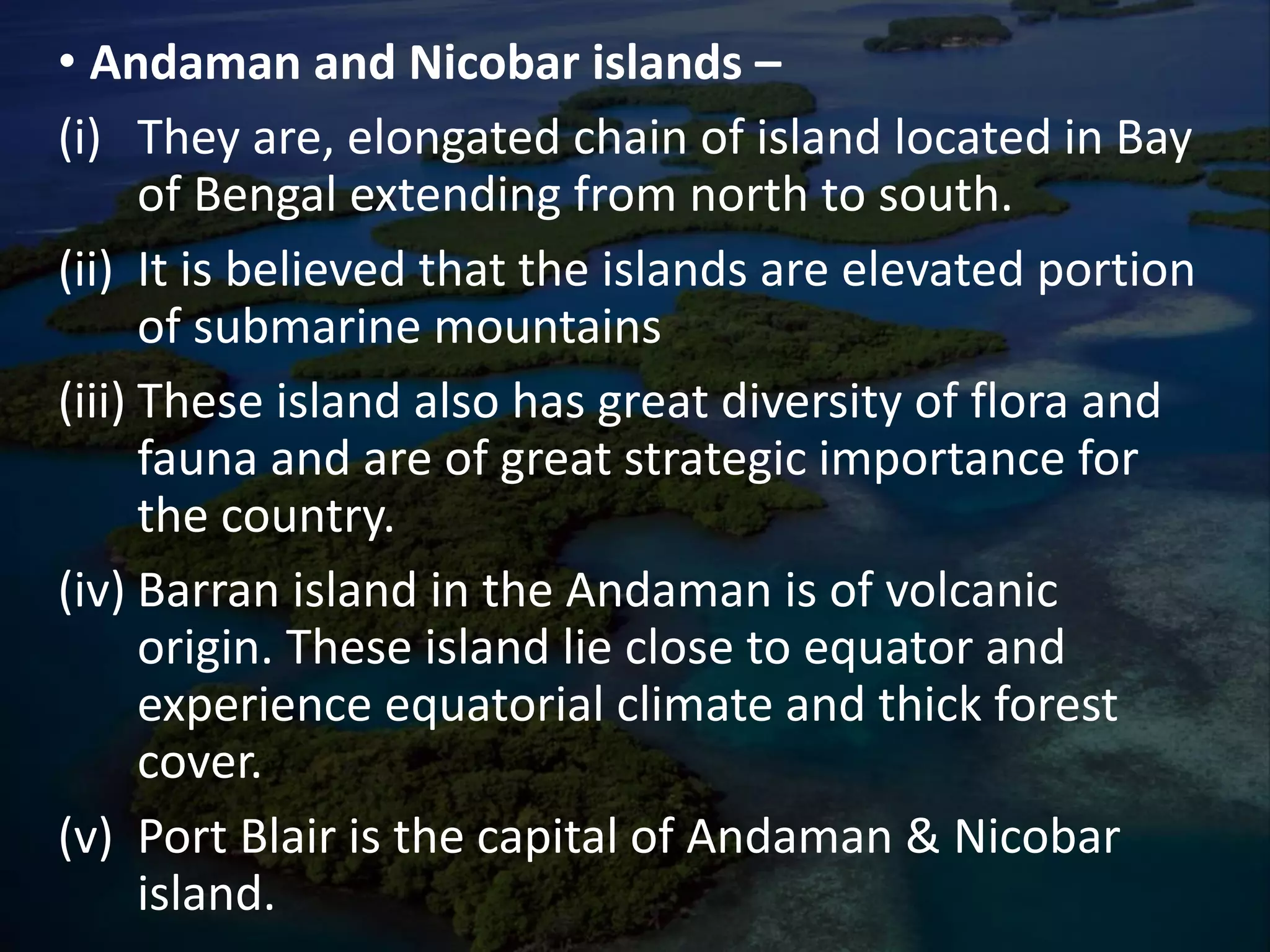
• Andaman and Nicobar islands –
(i) They are, elongated chain of island located in Bay
of Bengal extending from north to south.
(ii) It is believed that the islands are elevated portion
of submarine mountains
(iii) These island also has great diversity of flora and
fauna and are of great strategic importance for
the country.
(iv) Barran island in the Andaman is of volcanic
origin. These island lie close to equator and
experience equatorial climate and thick forest
cover.
(v) Port Blair is the capital of Andaman & Nicobar
island.
I have expertise in making educational
and other PPTs. Email me for more
PPTs at a very reasonable price that
perfectly fits in your budget.
Email: parmarshivam105@gmail.com
THANK YOU
• This PPT is for educational
purposes only. If you find
any infringement of your
copyrighted content, email
me directly and I will
remove it.
• If anyone is found using
this PPT for commercial
purposes, he/she will be
solely responsible for the
consequences.

Chapter - 2, Physical Features of India, Geography, Social Science, Class 9

  • 1.
    Chapter - 2 Emailfor more PPTs at a very reasonable price. Email: parmarshivam105@gmail.com By Shivam Parmar (PPT Designer)
  • 2.
    INTRODUCTION • Our countryhas practically all major physical features of the earth i.e. mountains, plains, deserts, plateaus and islands. • You must be wondering how these physical features have been formed. We will learn more about major physical features of India and how they have been formed.
  • 3.
    THEORY OF PLATE TECTONICS • Earthscientists have attempted to explain the formation of physical features with the help of some theories based on certain evidences. One such plausible theory is the “Theory of Plate Tectonics”. • According to this theory, the crust (upper part) of the earth has been formed out of seven major and some minor plates.
  • 4.
    • The movementof the plates results in the building up of stresses within the plates and the continental rocks above, leading to folding, faulting and volcanic activity. • Broadly, these plate movements are classified into two types Divergent Movement and Convergent Movement.
  • 5.
    ON THE BASISOF MOVEMENT THERE ARE THREE TYPES OF PLATES BOUNDARIES. (a) Divergent boundaries: Plates move apart, leaving a gap between them which gets filled up with molten rock which oozes from below the crust.
  • 6.
    (b) Convergent boundaries: Platesmove towards each other, causing one to go under the other or causing plates to collide forming mountains.
  • 7.
    (c) Transform fault boundaries: Platesslide past each other, scraping and deforming as they pass.
  • 8.
  • 9.
    • Tectonic plates:The convectional currents present below the solid layer of Earth’s crust split the crust or the lithosphere into a number of large fragments. These fragments are called tectonic or lithospheric plates. • Diverging tectonic plates: The plates that move away from each other and form divergent boundary. • Converging tectonic plates: The plates that come towards each other and form convergent boundary.
  • 10.
    • Gorge: Itis a deep and narrow chasm with precipitous rocky walls. • Rift valley: A valley with steep sides formed when two parallel cracks develop in the earth’s surface and the land between them sinks.
  • 11.
    THE HIMALAYAN MOUNTAINS i.The Himalayas, geologically young and structurally fold mountains stretch over the northern borders of India. These mountain ranges run in a west-east direction from the Indus to the Brahmaputra. ii. They form an arc, which covers a distance of about 2,400 Km. Their width varies from 400 Km in Kashmir to 150 Km in Arunachal Pradesh. iii. The Himalaya consists of three parallel ranges in its longitudinal extent. A number of valleys lie between these ranges.
  • 12.
    1. HIMADRI (i) Thenorthern most range is known as the Great of Inner Himalayas or the Himadri. (ii) It is the most continuous range consisting of the loftiest peaks like Mount Everest (8848 m), Nanga Parbat (8126 m).
  • 13.
    (iii) The averageelevation of the Himadri is more than 6000 m above the sea level. (iv) The Gangotri and the Yamnotri glaciers which give birth to the Ganga and Yamuna rivers are respectively located here.
  • 14.
    2. HIMACHAL (i) Therange lying to the south of the Himadri forms the most rugged mountain system and is known as Himachal or lesser Himalaya. (ii) The ranges are mainly composed of highly compressed and altered rocks. (iii) The altitude varies between 3,700 to 4,500 metres and the average width is of 50 Km.
  • 15.
    3. SHIVALIK (i) Theouter most range of the Himalayas is called the Shivaliks. The extend over a width of 10-50 Km and have an altitude varying between 900 and 1100 metres. (ii) These ranges are composed of unconsolidated sediments brought down by rivers from the main Himalayan ranges located farther north. These valleys are covered with thick gravel and alluvium (iii) The longitudinal valley lying between lesser Himalaya and the Shiwaliks are known as Duns. Dehra Dun. Kotli Dun and Patli Dun are some of the well-known Duns.
  • 16.
    DIVISION OF HIMALAYASFROM WEST TO EAST (i) Western Himalayas (Punjab Himalayas): The part of Himalayas lying between R. Indus and R. Satluj has been traditionally known as Punjab Himalaya but it is also known regionally as Kashmir and Himachal Himalaya from west to east respectively. (ii) Central Himalayas: The part of the Himalayas lying between R. Satluj and R. Kali is known as Kumaon Himalayas.
  • 17.
    THE NORTHERN PLAIN (i)The northern plain has been formed by the interplay of the three major river systems, namely-the Indus, the Ganga and the Brahmaputra along with their tributaries. This plain is formed of alluvial soil. (ii) It spreads over an area of 7 lakh sq.km. The plain being about 2400 Km long and 240 to 320 Km broad, is a densely populated physiographic division. (iii) With a rich soil cover combined with adequate water supply and favourable climate it is agriculturally a very productive part of India.
  • 18.
    DIVISION OF NORTHERNPLAINS 1. Punjab Plain : • The Western part of the Northern plain is referred to as the Punjab Plains. Formed by the Indus and its tributaries the larger part of this plain lies in Pakistan. • The Indus and its tributaries- the Jhelum, the Chenab, the Ravi, the Beas and the Satluj originate in the Himalaya. This section of the plain is dominated by the doabs.
  • 19.
    2. Ganga &Brahmaputra Plain: The Ganga plain extends between Ghaggar and Tista rivers. It is spread over the states of North India, Haryana, Delhi, UP, Bihar, Partly Jharkhand and West Bengal to its east particularly in Assam lies the Brahmaputra plain.
  • 21.
    The Central Highland: •The part of the Peninsular plateau lying to the north of the Narmada river covering a major area of the Malwa plateau is known as the Central Highland. • It is bounded by the Aravalli Range in the west and the Vindhya range in the south. Aravalli range is one of the oldest mountain ranges in the world. In the east, the Malwa Plateau extends up to the Chhota Nagpur Plateau. The Malwa Plateau is drained by the rivers Chambal, Sind, Son and Damodar. 1. Central Highlands 2. Deccan Plateau 3. ChhotaNagpur
  • 22.
    THE INDIAN DESERT (i)The Indian desert lies towards the western margins of the Aravalli Hills. It is an undulating sandy plain covered with sand dunes. (ii) This region receives very low rainfall below 150 mm per year. (iii) It has arid climate with low vegetation cover. Streams appear during the rainy season. Soon after they disappear into the sand as they do not have enough water to reach the sea. Luni is the only large river in this region. (iv) Barchans (crescent shaped dunes) cover larger areas but longitudinal dunes become more prominent near the Indo-Pakistan boundary.
  • 23.
    THE ISLAND GROUP •Lakshadweep islands - (i) They are located in Arabian sea. It is the smallest union territory of India. They are scattered and numerous. (ii) They are the products of microscopic species the coral polyps Many islands are generally horse shaped and are called atolls.
  • 24.
    • Andaman andNicobar islands – (i) They are, elongated chain of island located in Bay of Bengal extending from north to south. (ii) It is believed that the islands are elevated portion of submarine mountains (iii) These island also has great diversity of flora and fauna and are of great strategic importance for the country. (iv) Barran island in the Andaman is of volcanic origin. These island lie close to equator and experience equatorial climate and thick forest cover. (v) Port Blair is the capital of Andaman & Nicobar island.
  • 25.
    I have expertisein making educational and other PPTs. Email me for more PPTs at a very reasonable price that perfectly fits in your budget. Email: parmarshivam105@gmail.com THANK YOU
  • 26.
    • This PPTis for educational purposes only. If you find any infringement of your copyrighted content, email me directly and I will remove it. • If anyone is found using this PPT for commercial purposes, he/she will be solely responsible for the consequences.