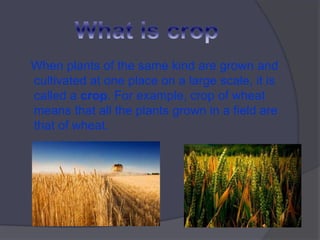
When plants of the same kind are grown and
cultivated at one place on a large scale, it is
called a crop. For example, crop of wheat
means that all the plants grown in a field are
that of wheat.
Cropping Pattern
 India is a vast country. The climatic conditions like
temperature, humidity and rainfall vary from one
region to another. Accordingly, there is a rich variety
of crops grown in different parts of the country.
Despite this diversity, two broad cropping patterns
can be identified. These are:
 1)Kharif Crops
 2)Rabi Crops
 The crops which are sown in the rainy season
are called kharif crops. The rainy season in
India is generally from June to September.
Paddy, maize, soyabean, groundnut, cotton,
etc., are kharif crops.
 These are grown in winter season,
generally in October/November and
harvested by March/April. Therefore, they
are called Winter season crop.
 For example- wheat, gram pea and mustard.
ALL LIVING ORGANISMS NEED FOOD TO
SURVIVE.THE BRANCH OF SCIENCE THAT
DEALS WITH GROWING PLANTS AND
RAISING LIVESTOCK FOR HUMAN USE IS
CALLED AGRICULTURE.
BASIC PRACTICES OF CROP
PRODUCTION
•Cultivation of crops involves several activities
undertaken by farmers over a period of time.
•These activities or tasks are referred to as
agricultural practices. These activities are listed
below.
(i) Preparation of soil
(ii) Sowing
(iii) Adding manure and fertilisers
(iv) Irrigation
(v) weeds
(vi) Harvesting
(vii) Storage
(i) TURNING AND LOOSENING OF SOIL
•This allows the roots to penetrate deep into the soil. The
loose soil allows the roots to breathe easily even when they
go deep into the soil.
•The loosened soil helps in the growth of earthworms and microbes
present in the soil. These organisms are friends of the farmer since they
further turn and loosen the soil and add humus to it.
•Turning and loosening of soil brings the nutrient-rich soil to
the top so that plants can use these nutrients.
The process of loosening and turning of the soil is called
tilling or ploughing. This is done by using a plough. Ploughs
are made of wood or iron.
•The ploughed field may have big pieces of soil called
crumbs. It is necessary to break these crumbs with a
plank.
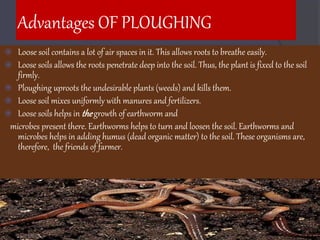
Advantages OF PLOUGHING
 Lo0se soil contains a lot of air spaces in it. This allows roots to breathe easily.
 Loose soils allows the roots penetrate deep into the soil. Thus, the plant is fixed to the soil
firmly.
 Ploughing uproots the undesirable plants (weeds) and kills them.
 Loose soil mixes uniformly with manures and fertilizers.
 Loose soils helps in thegrowth of earthworm and
microbes present there. Earthworms helps to turn and loosen the soil. Earthworms and
microbes helps in adding humus (dead organic matter) to the soil. These organisms are,
therefore, the friends of farmer.
Agricultural Implements
PLOUGHCULTIVATOR
Sowing of seeds
 Once the soil is prepared, seeds are sown in it. The
process of putting the seeds in the soil is called
sowing.
Most of the crops like wheat, bajra, jowar, oats
and mustard are grown by sowing seeds .selection of
good quality and healthy seed is very important
before sowing them.
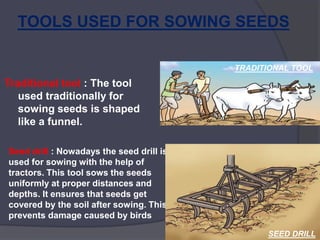
TOOLS USED FOR SOWING SEEDS
Traditional tool : The tool
used traditionally for
sowing seeds is shaped
like a funnel.
Seed drill : Nowadays the seed drill is
used for sowing with the help of
tractors. This tool sows the seeds
uniformly at proper distances and
depths. It ensures that seeds get
covered by the soil after sowing. This
prevents damage caused by birds
TRADITIONAL TOOL
SEED DRILL
Methods of sowing of seeds
By scattering the seeds in the
field by hand (manual sowing
): This method is called
Broadcasting. This is used in
case of wheat. Seeds sown by
this method are unevenly
distributed in the field.
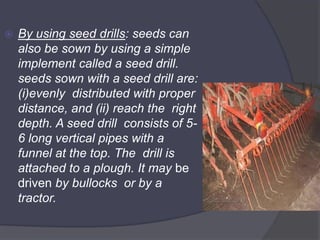
 By using seed drills: seeds can
also be sown by using a simple
implement called a seed drill.
seeds sown with a seed drill are:
(i)evenly distributed with proper
distance, and (ii) reach the right
depth. A seed drill consists of 5-
6 long vertical pipes with a
funnel at the top. The drill is
attached to a plough. It may be
driven by bullocks or by a
tractor.
Points to be kept in mind while sowing
seed
 Seed should be of good quality and
healthy.
 They should be sown at correct depth in
the soil. The correct depth varies from
crops to crops. If sown deep in the soil,
roots will not be able to respire. If sown on
the surface, birds may damage the seeds.
 Seed should sown at proper distance from
each other to prevent overcrowding of
plants. This allows plants to get enough
water, nutrients and sunlight.
 Seeds not sown directly in the soil.
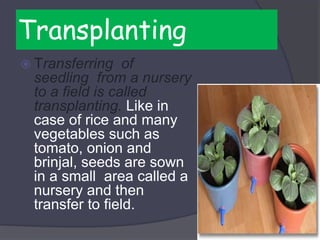
Transplanting
 Transferring of
seedling from a nursery
to a field is called
transplanting. Like in
case of rice and many
vegetables such as
tomato, onion and
brinjal, seeds are sown
in a small area called a
nursery and then
transfer to field.
Application of Manure and
Fertilizers
Manure
 A Natural substance
obtained by the
decomposition of plants
and animals(leaves,
straws, cattle dung,
urineZ0).
 Prepared in the fields.
 Provide a lot of humus to
the soil.
 No pollution is caused.
ADVANTAGES OF MANURE
Advantages of Manure : The organic manure
is considered better than
fertilisers. This is because:-
• It enhances the water holding capacity of the
soil.
• It makes the soil porous due to which
exchange of gases becomes easy.
• It increases the number of friendly
microbes.
• It improves the texture of the soil.
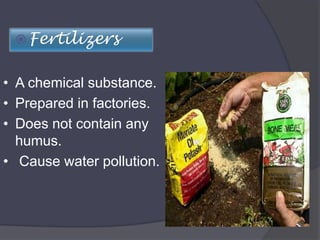
 Fertilizers
• A chemical substance.
• Prepared in factories.
• Does not contain any
humus.
• Cause water pollution.
IRRIGATION
•The supply of water to crops at different intervals is
called irrigation.
•The time and frequency of irrigation varies from crop to
crop, soil to soil and season to season.
•Water is absorbed by the plant roots. Along with water,
minerals and fertilisers are also absorbed. Plants contain
nearly 90% water.
The sources of irrigation are— wells,
tube wells, ponds, lakes, rivers, dams
and canals.
• TRADITIONAL METHOD OF
IRRIGATION:-
DHEKLI CHAIN PUMP
RAHATMOAT
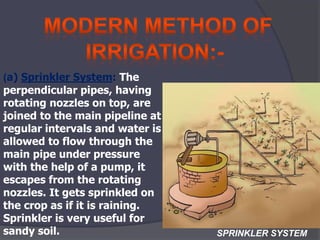
(a) Sprinkler System: The
perpendicular pipes, having
rotating nozzles on top, are
joined to the main pipeline at
regular intervals and water is
allowed to flow through the
main pipe under pressure
with the help of a pump, it
escapes from the rotating
nozzles. It gets sprinkled on
the crop as if it is raining.
Sprinkler is very useful for
sandy soil. SPRINKLER SYSTEM
 (b) Drip system :In this system, the water falls drop by
drop just at the position of the roots. So it is called drip
system. It is the best technique for watering fruit plants,
gardens and trees. The system provides water to plants
drop by drop. Water is not wasted at all.
Weeds
Weeds are unwanted and uncultivated
plants that grow along with the crop plants.
Some examples of common weeds are :
amaranthus(chaulai),chenopodium(bathua)
and wild oat (javi).
Weeds reduce crop yield, as they compete
with the crops for water , minerals and
sunlight. So ,it is necessary to remove them
from the fields from time to time. The
removal of weeds from a field called
weeding.
REMOVAL OF WEEDS
• Tilling before sowing of
crops helps in uprooting and
killing of weeds, which may
then dry up and get mixed
with the soil.
• Weeds are also controlled
by using certain chemicals,
called weedicides, like 2,4-
D. These are sprayed in the
fields to kill the weeds. They
do not damage the crops.
SPRAYING OF WEEDICIDES
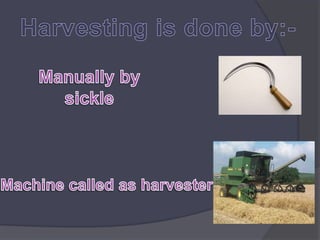
Harvesting
The process of cutting and gathering of
crops is called harvesting. For example,
for Rabi crops (like wheat)harvesting is
done March/April. In case of paddy (a
Kharif crop), harvesting is done in
September/October.
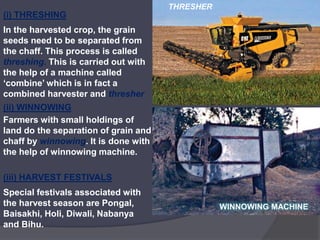
(i) THRESHING
In the harvested crop, the grain
seeds need to be separated from
the chaff. This process is called
threshing. This is carried out with
the help of a machine called
‘combine’ which is in fact a
combined harvester and thresher
THRESHER
(ii) WINNOWING
Farmers with small holdings of
land do the separation of grain and
chaff by winnowing. It is done with
the help of winnowing machine.
WINNOWING MACHINE
(iii) HARVEST FESTIVALS
Special festivals associated with
the harvest season are Pongal,
Baisakhi, Holi, Diwali, Nabanya
and Bihu.
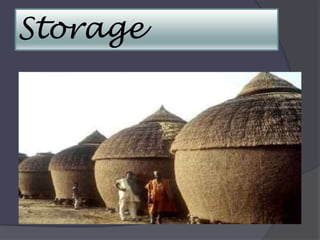
Storage
STORAGE OF GRAINS IN
GRANARIES
SILOS FOR STORAGE OF GRAINS
• Storage of produce is an important task. If the crop
grains are to be kept for longer time, they should be
safe from moisture, insects, rats and microorganisms.
• Before storing them, the grains are properly dried in
the sun to reduce the moisture in them. This prevents
the attack by insect pests, bacteria and fungi.
• Dried neem leaves are used for storing food grains at
home.
• For storing large quantities of grains in big godowns,
specific chemical treatments are required to protect
them from pests and microorganisms.
• However, large scale storage of grains is done in
silos and granaries to protect them from pests like rats
and insects.
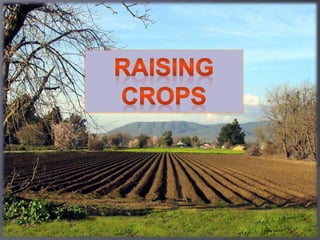
Raising crops

Raising crops

  • 2.
    When plants ofthe same kind are grown and cultivated at one place on a large scale, it is called a crop. For example, crop of wheat means that all the plants grown in a field are that of wheat.
  • 3.
    Cropping Pattern  Indiais a vast country. The climatic conditions like temperature, humidity and rainfall vary from one region to another. Accordingly, there is a rich variety of crops grown in different parts of the country. Despite this diversity, two broad cropping patterns can be identified. These are:  1)Kharif Crops  2)Rabi Crops
  • 4.
     The cropswhich are sown in the rainy season are called kharif crops. The rainy season in India is generally from June to September. Paddy, maize, soyabean, groundnut, cotton, etc., are kharif crops.
  • 5.
     These aregrown in winter season, generally in October/November and harvested by March/April. Therefore, they are called Winter season crop.  For example- wheat, gram pea and mustard.
  • 6.
    ALL LIVING ORGANISMSNEED FOOD TO SURVIVE.THE BRANCH OF SCIENCE THAT DEALS WITH GROWING PLANTS AND RAISING LIVESTOCK FOR HUMAN USE IS CALLED AGRICULTURE.
  • 7.
    BASIC PRACTICES OFCROP PRODUCTION •Cultivation of crops involves several activities undertaken by farmers over a period of time. •These activities or tasks are referred to as agricultural practices. These activities are listed below. (i) Preparation of soil (ii) Sowing (iii) Adding manure and fertilisers (iv) Irrigation (v) weeds (vi) Harvesting (vii) Storage
  • 9.
    (i) TURNING ANDLOOSENING OF SOIL •This allows the roots to penetrate deep into the soil. The loose soil allows the roots to breathe easily even when they go deep into the soil. •The loosened soil helps in the growth of earthworms and microbes present in the soil. These organisms are friends of the farmer since they further turn and loosen the soil and add humus to it. •Turning and loosening of soil brings the nutrient-rich soil to the top so that plants can use these nutrients. The process of loosening and turning of the soil is called tilling or ploughing. This is done by using a plough. Ploughs are made of wood or iron. •The ploughed field may have big pieces of soil called crumbs. It is necessary to break these crumbs with a plank.
  • 10.
    Advantages OF PLOUGHING Lo0se soil contains a lot of air spaces in it. This allows roots to breathe easily.  Loose soils allows the roots penetrate deep into the soil. Thus, the plant is fixed to the soil firmly.  Ploughing uproots the undesirable plants (weeds) and kills them.  Loose soil mixes uniformly with manures and fertilizers.  Loose soils helps in thegrowth of earthworm and microbes present there. Earthworms helps to turn and loosen the soil. Earthworms and microbes helps in adding humus (dead organic matter) to the soil. These organisms are, therefore, the friends of farmer.
  • 11.
  • 12.
  • 13.
    Sowing of seeds Once the soil is prepared, seeds are sown in it. The process of putting the seeds in the soil is called sowing. Most of the crops like wheat, bajra, jowar, oats and mustard are grown by sowing seeds .selection of good quality and healthy seed is very important before sowing them.
  • 14.
    TOOLS USED FORSOWING SEEDS Traditional tool : The tool used traditionally for sowing seeds is shaped like a funnel. Seed drill : Nowadays the seed drill is used for sowing with the help of tractors. This tool sows the seeds uniformly at proper distances and depths. It ensures that seeds get covered by the soil after sowing. This prevents damage caused by birds TRADITIONAL TOOL SEED DRILL
  • 15.
    Methods of sowingof seeds By scattering the seeds in the field by hand (manual sowing ): This method is called Broadcasting. This is used in case of wheat. Seeds sown by this method are unevenly distributed in the field.
  • 16.
     By usingseed drills: seeds can also be sown by using a simple implement called a seed drill. seeds sown with a seed drill are: (i)evenly distributed with proper distance, and (ii) reach the right depth. A seed drill consists of 5- 6 long vertical pipes with a funnel at the top. The drill is attached to a plough. It may be driven by bullocks or by a tractor.
  • 17.
    Points to bekept in mind while sowing seed  Seed should be of good quality and healthy.  They should be sown at correct depth in the soil. The correct depth varies from crops to crops. If sown deep in the soil, roots will not be able to respire. If sown on the surface, birds may damage the seeds.  Seed should sown at proper distance from each other to prevent overcrowding of plants. This allows plants to get enough water, nutrients and sunlight.  Seeds not sown directly in the soil.
  • 18.
    Transplanting  Transferring of seedlingfrom a nursery to a field is called transplanting. Like in case of rice and many vegetables such as tomato, onion and brinjal, seeds are sown in a small area called a nursery and then transfer to field.
  • 19.
    Application of Manureand Fertilizers Manure  A Natural substance obtained by the decomposition of plants and animals(leaves, straws, cattle dung, urineZ0).  Prepared in the fields.  Provide a lot of humus to the soil.  No pollution is caused.
  • 20.
    ADVANTAGES OF MANURE Advantagesof Manure : The organic manure is considered better than fertilisers. This is because:- • It enhances the water holding capacity of the soil. • It makes the soil porous due to which exchange of gases becomes easy. • It increases the number of friendly microbes. • It improves the texture of the soil.
  • 21.
     Fertilizers • Achemical substance. • Prepared in factories. • Does not contain any humus. • Cause water pollution.
  • 22.
    IRRIGATION •The supply ofwater to crops at different intervals is called irrigation. •The time and frequency of irrigation varies from crop to crop, soil to soil and season to season. •Water is absorbed by the plant roots. Along with water, minerals and fertilisers are also absorbed. Plants contain nearly 90% water. The sources of irrigation are— wells, tube wells, ponds, lakes, rivers, dams and canals.
  • 23.
    • TRADITIONAL METHODOF IRRIGATION:- DHEKLI CHAIN PUMP
  • 24.
  • 25.
    (a) Sprinkler System:The perpendicular pipes, having rotating nozzles on top, are joined to the main pipeline at regular intervals and water is allowed to flow through the main pipe under pressure with the help of a pump, it escapes from the rotating nozzles. It gets sprinkled on the crop as if it is raining. Sprinkler is very useful for sandy soil. SPRINKLER SYSTEM
  • 26.
     (b) Dripsystem :In this system, the water falls drop by drop just at the position of the roots. So it is called drip system. It is the best technique for watering fruit plants, gardens and trees. The system provides water to plants drop by drop. Water is not wasted at all.
  • 27.
    Weeds Weeds are unwantedand uncultivated plants that grow along with the crop plants. Some examples of common weeds are : amaranthus(chaulai),chenopodium(bathua) and wild oat (javi). Weeds reduce crop yield, as they compete with the crops for water , minerals and sunlight. So ,it is necessary to remove them from the fields from time to time. The removal of weeds from a field called weeding.
  • 28.
    REMOVAL OF WEEDS •Tilling before sowing of crops helps in uprooting and killing of weeds, which may then dry up and get mixed with the soil. • Weeds are also controlled by using certain chemicals, called weedicides, like 2,4- D. These are sprayed in the fields to kill the weeds. They do not damage the crops. SPRAYING OF WEEDICIDES
  • 29.
    Harvesting The process ofcutting and gathering of crops is called harvesting. For example, for Rabi crops (like wheat)harvesting is done March/April. In case of paddy (a Kharif crop), harvesting is done in September/October.
  • 31.
    (i) THRESHING In theharvested crop, the grain seeds need to be separated from the chaff. This process is called threshing. This is carried out with the help of a machine called ‘combine’ which is in fact a combined harvester and thresher THRESHER (ii) WINNOWING Farmers with small holdings of land do the separation of grain and chaff by winnowing. It is done with the help of winnowing machine. WINNOWING MACHINE (iii) HARVEST FESTIVALS Special festivals associated with the harvest season are Pongal, Baisakhi, Holi, Diwali, Nabanya and Bihu.
  • 32.
  • 33.
    STORAGE OF GRAINSIN GRANARIES SILOS FOR STORAGE OF GRAINS
  • 34.
    • Storage ofproduce is an important task. If the crop grains are to be kept for longer time, they should be safe from moisture, insects, rats and microorganisms. • Before storing them, the grains are properly dried in the sun to reduce the moisture in them. This prevents the attack by insect pests, bacteria and fungi. • Dried neem leaves are used for storing food grains at home. • For storing large quantities of grains in big godowns, specific chemical treatments are required to protect them from pests and microorganisms. • However, large scale storage of grains is done in silos and granaries to protect them from pests like rats and insects.