CROP PROCUCTION
AND
MANAGEMENT.
Introduction
• India’s most important crops include cotton, tea, rice, wheat,
and sugarcane. Other important cash crops include jute,
groundnuts, coffee, oil seeds, and spices. Another central
feature of India’s agricultural economy is the raising of
livestock, particularly horned cattle, buffalo, and goats. In
2005 the country had 185 million cattle, substantially more
than almost any other country. The cattle are used mainly as
draft animals and for leather. As farmers increasingly use
machinery, the number of livestock they raise will probably
decrease. Buffalo is the main animal used for producing milk
and dairy products. Milk production and distribution increased
dramatically in the 1990s because of a nationwide,
government-supported cooperative dairy program. Sheep are
raised for wool, and goats are the main meat animal. Many
Indians, particularly Hindus, refuse to eat beef for religious
reasons, although they eat other meat, eggs, and fish.
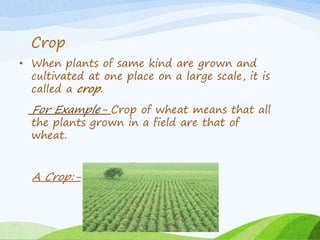
Crop
• When plants of same kind are grown and
cultivated at one place on a large scale, it is
called a crop.
For Example- Crop of wheat means that all
the plants grown in a field are that of
wheat.
A Crop:-
Types Of Crop
• Kharif Crops: The crops which are sown in the
rainy season are called kharif crop. The rainy
season in India is from June to September.
For Example- Paddy, maize, soyabean,
groundnut, cotton, etc.
o Rabi Crops: The crops grown in the winter
season are rabi crops. Their time Period is
generally from October to March.
For Example- Wheat, gram, pea ,mustard, and
linseed.
Basic Practices of Production
• Cultivation: of crop involves several activities . This activities are
referred as agricultural practices.
This activities are-
1) Preparation of soil
2) Sowing
3) Adding Manure and Fertilisers
4) Irrigation
5) Protecting from weeds
6) Harvesting
7) Storage
1)Preparation of Soil
• The preparation of soil is the first step before
growing a crop. One of the most important tasks
in agricultural is to turn the soil and loosen it.
This allow the roots to penetrate deep into the
soil. The loose soil allows the roots to breath
easily even when they go deep into the soil.
The loosened soil helps in the growth of
earthworm and microbes present in the soil.
These organisms are friends of the farmer since
they further turn and loose the soil and add
humus to it.
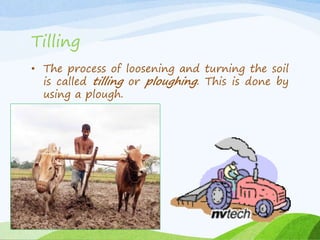
Tilling
• The process of loosening and turning the soil
is called tilling or ploughing. This is done by
using a plough.
Agricultural Implements for
Tilling
o Plough: In old days people use wooden
plough, but in now a days people use iron
plough.
Wooden Plough : Iron Plough:
Agricultural Implements for
Tilling
• Hoe: It’s a simple tool which is used for
removing weeds and for loosening the soil.
• Cultivator: Now a days ploughing is done by
tractor-driven cultivator. The use of
cultivator saves labour and time.
A Cultivator:
2)Sowing
• Selection of seeds: Sowing is the most
important part of crop production. Before
sowing, good quality seeds are selected. Good
quality seeds are clear and healthy seeds of a
good variety. Farmers prefer to use seeds
which give a high yield.
Tools used for Sowing Seeds
• Traditional Tool: The tool used traditionally
for sowing seeds is shaped liked funnel. The
seeds are filled in the funnel, passed down
through two or three pipes having sharp
ends. These ends pierce into the soil and
place seeds there.
Traditional method of sowing:
Tools used for Sowing Seeds
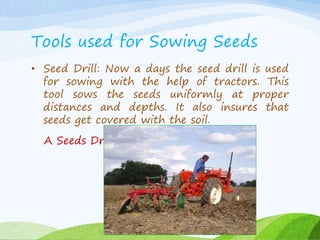
• Seed Drill: Now a days the seed drill is used
for sowing with the help of tractors. This
tool sows the seeds uniformly at proper
distances and depths. It also insures that
seeds get covered with the soil.
A Seeds Drill:
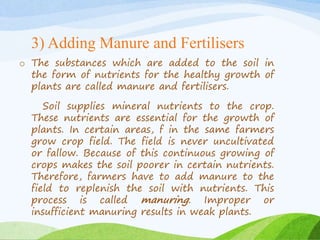
3) Adding Manure and Fertilisers
o The substances which are added to the soil in
the form of nutrients for the healthy growth of
plants are called manure and fertilisers.
Soil supplies mineral nutrients to the crop.
These nutrients are essential for the growth of
plants. In certain areas, f in the same farmers
grow crop field. The field is never uncultivated
or fallow. Because of this continuous growing of
crops makes the soil poorer in certain nutrients.
Therefore, farmers have to add manure to the
field to replenish the soil with nutrients. This
process is called manuring. Improper or
insufficient manuring results in weak plants.
Manure and Fetilisers
• Manure is an organic substance obtained from
the decomposition of plant or animal wastes. It
can be prepared in the Fields. It provides a lot of
humus to the soil. It is relatively less rich in plant
nutrients.
• Fertiliser is an inorganic salt. They are prepared
in factories. It does not provide any humus to
the soil. Fertilisers are very rich in plant
nutrients like nitrogen, phosphorus and
potassium.
• For Example: Urea, ammonium sulphate, super
phosphate, potash,NPK(Nitrogen, phosphorus
and potassium.
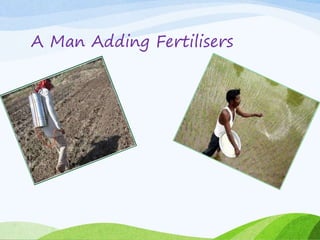
A Man Adding Fertilisers
4)Irrigation
• The supply of water to the crops at different
intervals is called irrigation.
 Sources of irrigation: The sources of
irrigation are-wells, tubewells, ponds, lakes,
rivers, dam and canals.
Types of Irrigation:
1)Traditional Method
2) Morden Method
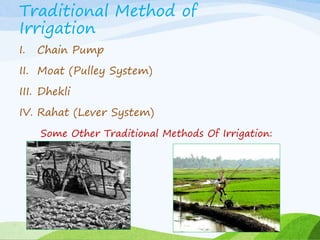
Traditional Method of
Irrigation
I. Chain Pump
II. Moat (Pulley System)
III. Dhekli
IV. Rahat (Lever System)
Some Other Traditional Methods Of Irrigation:
Morden Methods of Irrigation
Sprinkler System Drip System
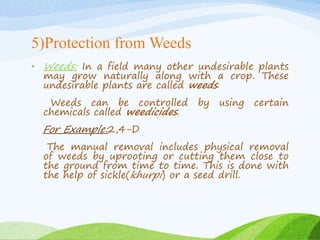
5)Protection from Weeds
• Weeds: In a field many other undesirable plants
may grow naturally along with a crop. These
undesirable plants are called weeds.
Weeds can be controlled by using certain
chemicals called weedicides.
For Example:2,4-D
The manual removal includes physical removal
of weeds by uprooting or cutting them close to
the ground from time to time. This is done with
the help of sickle(khurpi) or a seed drill.
A Man Spraying Weedicides
6)Harvesting
• Harvesting of a crop is an important task.
Cutting of a crop after its maturation is
called harvesting. It can be done manually
with the help of sickle or by a machine
called harvester or combine. In the
harvested crop, the grain are separated
from the chaff by the process of winnowing
and threshing.
Sickle: Combine:
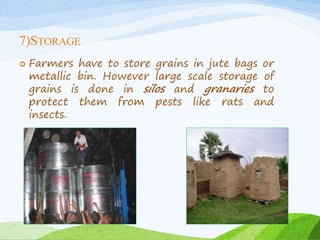
7)STORAGE
 Farmers have to store grains in jute bags or
metallic bin. However large scale storage of
grains is done in silos and granaries to
protect them from pests like rats and
insects.
indian crop system

indian crop system

  • 1.
  • 2.
    Introduction • India’s mostimportant crops include cotton, tea, rice, wheat, and sugarcane. Other important cash crops include jute, groundnuts, coffee, oil seeds, and spices. Another central feature of India’s agricultural economy is the raising of livestock, particularly horned cattle, buffalo, and goats. In 2005 the country had 185 million cattle, substantially more than almost any other country. The cattle are used mainly as draft animals and for leather. As farmers increasingly use machinery, the number of livestock they raise will probably decrease. Buffalo is the main animal used for producing milk and dairy products. Milk production and distribution increased dramatically in the 1990s because of a nationwide, government-supported cooperative dairy program. Sheep are raised for wool, and goats are the main meat animal. Many Indians, particularly Hindus, refuse to eat beef for religious reasons, although they eat other meat, eggs, and fish.
  • 3.
    Crop • When plantsof same kind are grown and cultivated at one place on a large scale, it is called a crop. For Example- Crop of wheat means that all the plants grown in a field are that of wheat. A Crop:-
  • 4.
    Types Of Crop •Kharif Crops: The crops which are sown in the rainy season are called kharif crop. The rainy season in India is from June to September. For Example- Paddy, maize, soyabean, groundnut, cotton, etc. o Rabi Crops: The crops grown in the winter season are rabi crops. Their time Period is generally from October to March. For Example- Wheat, gram, pea ,mustard, and linseed.
  • 5.
    Basic Practices ofProduction • Cultivation: of crop involves several activities . This activities are referred as agricultural practices. This activities are- 1) Preparation of soil 2) Sowing 3) Adding Manure and Fertilisers 4) Irrigation 5) Protecting from weeds 6) Harvesting 7) Storage
  • 6.
    1)Preparation of Soil •The preparation of soil is the first step before growing a crop. One of the most important tasks in agricultural is to turn the soil and loosen it. This allow the roots to penetrate deep into the soil. The loose soil allows the roots to breath easily even when they go deep into the soil. The loosened soil helps in the growth of earthworm and microbes present in the soil. These organisms are friends of the farmer since they further turn and loose the soil and add humus to it.
  • 7.
    Tilling • The processof loosening and turning the soil is called tilling or ploughing. This is done by using a plough.
  • 8.
    Agricultural Implements for Tilling oPlough: In old days people use wooden plough, but in now a days people use iron plough. Wooden Plough : Iron Plough:
  • 9.
    Agricultural Implements for Tilling •Hoe: It’s a simple tool which is used for removing weeds and for loosening the soil. • Cultivator: Now a days ploughing is done by tractor-driven cultivator. The use of cultivator saves labour and time. A Cultivator:
  • 10.
    2)Sowing • Selection ofseeds: Sowing is the most important part of crop production. Before sowing, good quality seeds are selected. Good quality seeds are clear and healthy seeds of a good variety. Farmers prefer to use seeds which give a high yield.
  • 11.
    Tools used forSowing Seeds • Traditional Tool: The tool used traditionally for sowing seeds is shaped liked funnel. The seeds are filled in the funnel, passed down through two or three pipes having sharp ends. These ends pierce into the soil and place seeds there. Traditional method of sowing:
  • 12.
    Tools used forSowing Seeds • Seed Drill: Now a days the seed drill is used for sowing with the help of tractors. This tool sows the seeds uniformly at proper distances and depths. It also insures that seeds get covered with the soil. A Seeds Drill:
  • 13.
    3) Adding Manureand Fertilisers o The substances which are added to the soil in the form of nutrients for the healthy growth of plants are called manure and fertilisers. Soil supplies mineral nutrients to the crop. These nutrients are essential for the growth of plants. In certain areas, f in the same farmers grow crop field. The field is never uncultivated or fallow. Because of this continuous growing of crops makes the soil poorer in certain nutrients. Therefore, farmers have to add manure to the field to replenish the soil with nutrients. This process is called manuring. Improper or insufficient manuring results in weak plants.
  • 14.
    Manure and Fetilisers •Manure is an organic substance obtained from the decomposition of plant or animal wastes. It can be prepared in the Fields. It provides a lot of humus to the soil. It is relatively less rich in plant nutrients. • Fertiliser is an inorganic salt. They are prepared in factories. It does not provide any humus to the soil. Fertilisers are very rich in plant nutrients like nitrogen, phosphorus and potassium. • For Example: Urea, ammonium sulphate, super phosphate, potash,NPK(Nitrogen, phosphorus and potassium.
  • 15.
    A Man AddingFertilisers
  • 16.
    4)Irrigation • The supplyof water to the crops at different intervals is called irrigation.  Sources of irrigation: The sources of irrigation are-wells, tubewells, ponds, lakes, rivers, dam and canals. Types of Irrigation: 1)Traditional Method 2) Morden Method
  • 17.
    Traditional Method of Irrigation I.Chain Pump II. Moat (Pulley System) III. Dhekli IV. Rahat (Lever System) Some Other Traditional Methods Of Irrigation:
  • 18.
    Morden Methods ofIrrigation Sprinkler System Drip System
  • 19.
    5)Protection from Weeds •Weeds: In a field many other undesirable plants may grow naturally along with a crop. These undesirable plants are called weeds. Weeds can be controlled by using certain chemicals called weedicides. For Example:2,4-D The manual removal includes physical removal of weeds by uprooting or cutting them close to the ground from time to time. This is done with the help of sickle(khurpi) or a seed drill.
  • 20.
    A Man SprayingWeedicides
  • 21.
    6)Harvesting • Harvesting ofa crop is an important task. Cutting of a crop after its maturation is called harvesting. It can be done manually with the help of sickle or by a machine called harvester or combine. In the harvested crop, the grain are separated from the chaff by the process of winnowing and threshing. Sickle: Combine:
  • 22.
    7)STORAGE  Farmers haveto store grains in jute bags or metallic bin. However large scale storage of grains is done in silos and granaries to protect them from pests like rats and insects.