Depreciation means decline in the
value of a fixed asset due to use,
passage of time or obsolescence
“The depreciation is the
diminution in intrinsic value of
the asset due to use and /or
lapse of time”
Institute of Cost and
Management
Accounting,London(ICMA)
FEATURES OF
DEPRECIATION
 Decline in the book value of fixed
assets
 It includes loss of value due to
effluxion of time, usage or
obsolescence
 It is a continuing process
 It is an expired cost and hence
must be deducted before
calculating profits
 It is a noncash expense
DEPLETION
MEANING
 The term depletion is used in the context of
extraction of natural resources like mines,
quarries etc.
 The decline in the value of assets due to the
reduction in the availability of quantity is termed
as depletion.
 Depreciation is concerned with the exhaustion
of economic resources. But depletion is related
with the erosion in the volume of natural
resources and expiry of the service potential.
AMORTISATION
Amortisation refers to writing-off the
cost of intangible assets like
patents,copyright,trade marks, etc
which have utility for a specified
period of time
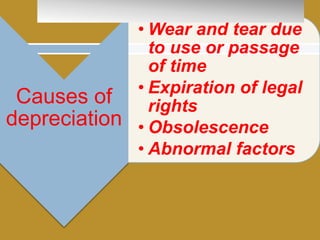
Causes of
depreciation
• Wear and tear due
to use or passage
of time
• Expiration of legal
rights
• Obsolescence
• Abnormal factors
Wear and tear means
deterioration which results in
diminution in an assets value. It
reduces the assets technical
capacities to serve the purpose
for which it is meant
Certain categories of assets lose their
value after the agreement governing
their use in business comes to an
end.
Eg. copy right, leases etc.
Obsolescence
Obsolescence means the fact of being
“out- of- date”.Obsolecence implies to an
existing asset becoming out of date on
account of availability of better type of
asset. It arises from the following factors
 Technological changes
 Improvement in production methods
 Change in market demand for the
product
 Legal or other description
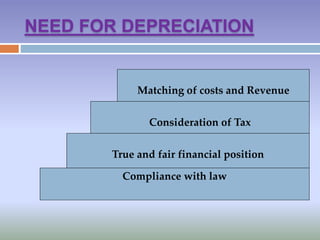
NEED FOR DEPRECIATION
Compliance with law
True and fair financial position
Consideration of Tax
Matching of costs and Revenue
Matching of Costs and Revenue
 Every asset is bound to undergo
some wear and tear and hence lose
value. Therefore, depreciation is as
much the cost as any other expense
incurred in the normal course of
business.
CONSIDERATION OF TAX
 Depreciation is a deductible cost
for tax purposes. But the
calculation of depreciation may
be different by tax authorities
True and Fair Financial
Position
If depreciation on assets is not
provided for, the assets will be
over valued and the balance
sheet will not depict the correct
financial position of the business
Compliance with
Law
There are certain specific legislations
that indirectly compel corporate
enterprises to provide depreciation on
fixed assets
Cost of Asset
Cost of asset includes invoice price,
transportation cost, transit insurance,
installation cost , registration cost ,
commission paid on purchase of asset
etc.
Estimated net residual value
Net residual value (salvage value or
scrap value )is the estimated net
realizable value of the asset at the end
of its useful life.
Depreciable Cost
Depreciable cost of an asset is
equal to its cost less net
residual value
Estimated Useful Life
Useful life of an asset is the
estimated economic or
commercial life of the asset.
METHODS OF CALCULATING
DEPRECIATION AMOUNT
 STRAIGHT LINE METHOD
 WRITTEN DOWN VALUE METHOD
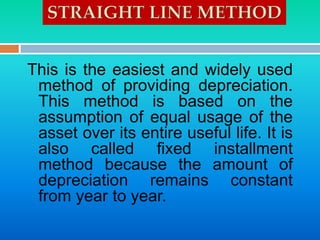
This is the easiest and widely used
method of providing depreciation.
This method is based on the
assumption of equal usage of the
asset over its entire useful life. It is
also called fixed installment
method because the amount of
depreciation remains constant
from year to year.
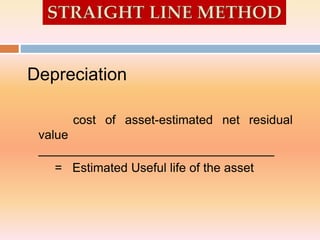
Depreciation
cost of asset-estimated net residual
value
__________________________________
= Estimated Useful life of the asset
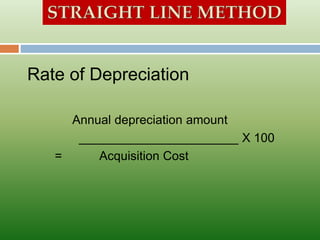
Rate of Depreciation
Annual depreciation amount
_______________________ X 100
= Acquisition Cost
Depreciation

Depreciation

  • 1.
    Depreciation means declinein the value of a fixed asset due to use, passage of time or obsolescence
  • 2.
    “The depreciation isthe diminution in intrinsic value of the asset due to use and /or lapse of time” Institute of Cost and Management Accounting,London(ICMA)
  • 3.
    FEATURES OF DEPRECIATION  Declinein the book value of fixed assets  It includes loss of value due to effluxion of time, usage or obsolescence  It is a continuing process  It is an expired cost and hence must be deducted before calculating profits  It is a noncash expense
  • 4.
    DEPLETION MEANING  The termdepletion is used in the context of extraction of natural resources like mines, quarries etc.  The decline in the value of assets due to the reduction in the availability of quantity is termed as depletion.  Depreciation is concerned with the exhaustion of economic resources. But depletion is related with the erosion in the volume of natural resources and expiry of the service potential.
  • 5.
    AMORTISATION Amortisation refers towriting-off the cost of intangible assets like patents,copyright,trade marks, etc which have utility for a specified period of time
  • 6.
    Causes of depreciation • Wearand tear due to use or passage of time • Expiration of legal rights • Obsolescence • Abnormal factors
  • 7.
    Wear and tearmeans deterioration which results in diminution in an assets value. It reduces the assets technical capacities to serve the purpose for which it is meant
  • 8.
    Certain categories ofassets lose their value after the agreement governing their use in business comes to an end. Eg. copy right, leases etc.
  • 9.
    Obsolescence Obsolescence means thefact of being “out- of- date”.Obsolecence implies to an existing asset becoming out of date on account of availability of better type of asset. It arises from the following factors  Technological changes  Improvement in production methods  Change in market demand for the product  Legal or other description
  • 10.
    NEED FOR DEPRECIATION Compliancewith law True and fair financial position Consideration of Tax Matching of costs and Revenue
  • 11.
    Matching of Costsand Revenue  Every asset is bound to undergo some wear and tear and hence lose value. Therefore, depreciation is as much the cost as any other expense incurred in the normal course of business.
  • 12.
    CONSIDERATION OF TAX Depreciation is a deductible cost for tax purposes. But the calculation of depreciation may be different by tax authorities
  • 13.
    True and FairFinancial Position If depreciation on assets is not provided for, the assets will be over valued and the balance sheet will not depict the correct financial position of the business
  • 14.
    Compliance with Law There arecertain specific legislations that indirectly compel corporate enterprises to provide depreciation on fixed assets
  • 15.
    Cost of Asset Costof asset includes invoice price, transportation cost, transit insurance, installation cost , registration cost , commission paid on purchase of asset etc.
  • 16.
    Estimated net residualvalue Net residual value (salvage value or scrap value )is the estimated net realizable value of the asset at the end of its useful life.
  • 17.
    Depreciable Cost Depreciable costof an asset is equal to its cost less net residual value
  • 18.
    Estimated Useful Life Usefullife of an asset is the estimated economic or commercial life of the asset.
  • 19.
    METHODS OF CALCULATING DEPRECIATIONAMOUNT  STRAIGHT LINE METHOD  WRITTEN DOWN VALUE METHOD
  • 20.
    This is theeasiest and widely used method of providing depreciation. This method is based on the assumption of equal usage of the asset over its entire useful life. It is also called fixed installment method because the amount of depreciation remains constant from year to year.
  • 21.
    Depreciation cost of asset-estimatednet residual value __________________________________ = Estimated Useful life of the asset
  • 22.
    Rate of Depreciation Annualdepreciation amount _______________________ X 100 = Acquisition Cost