Chapter Outline
Chemistry:A Science for the Twenty-First Century
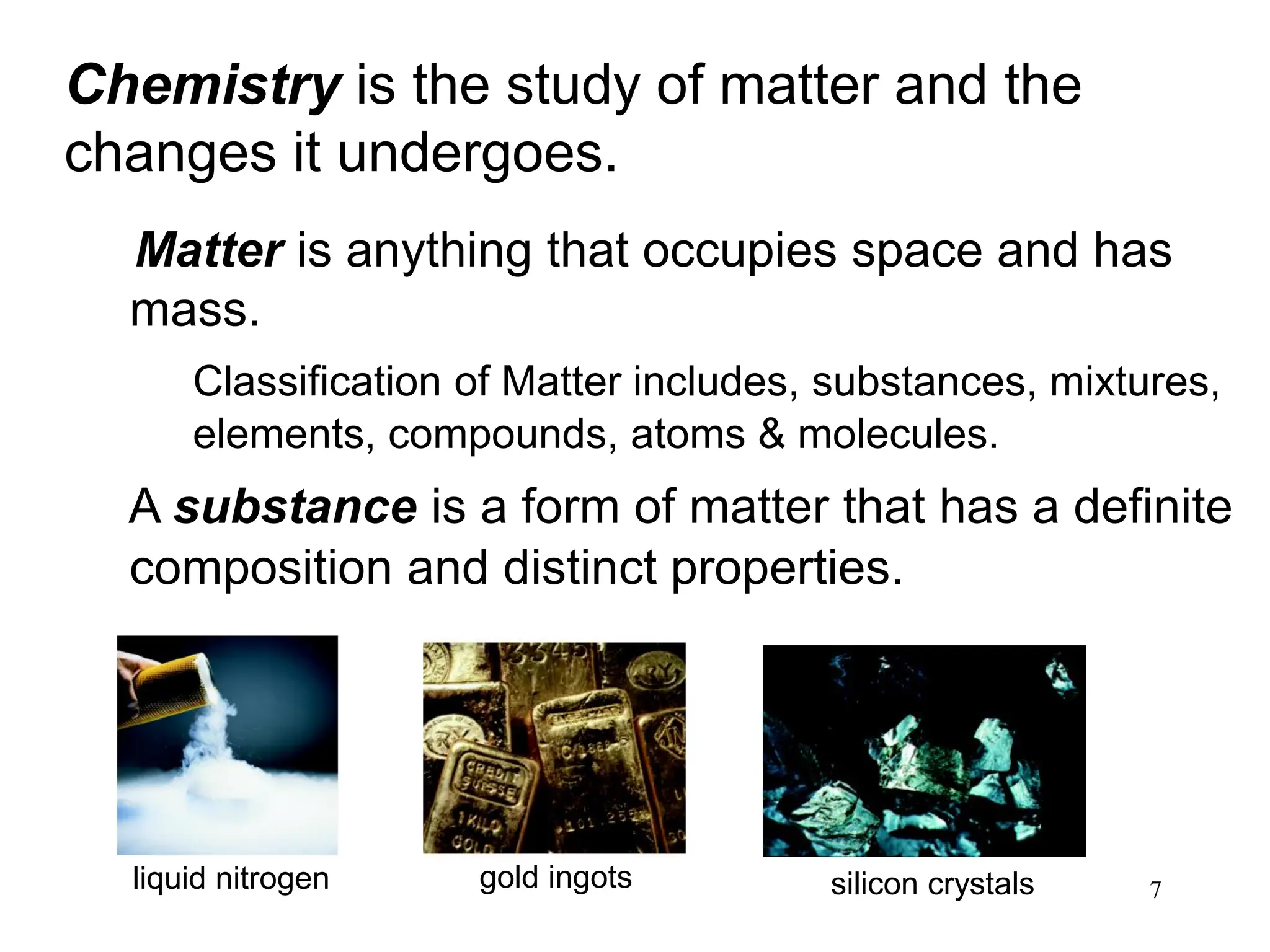
The Study of Chemistry
The Scientific Method
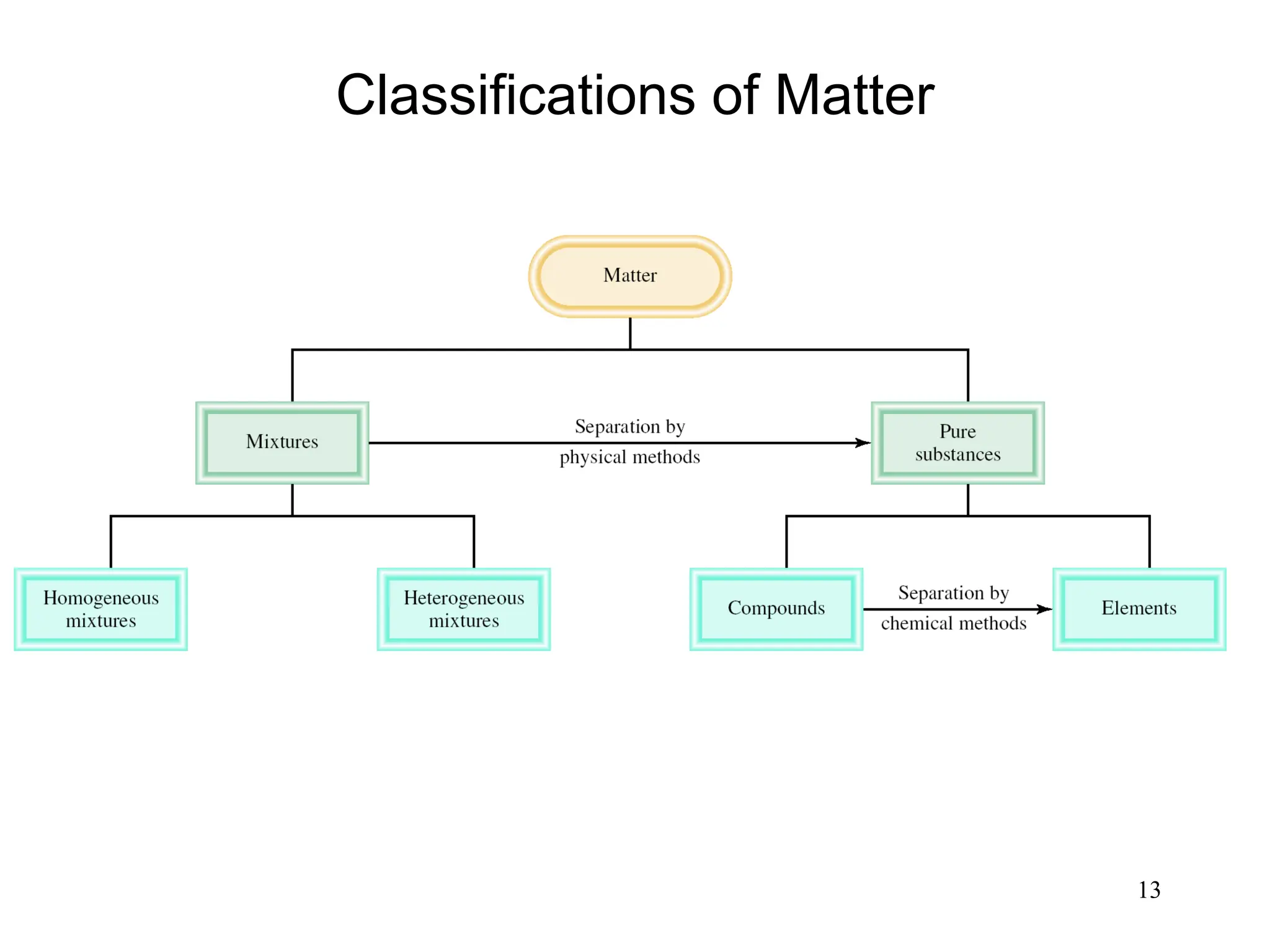
Classifications of Matter
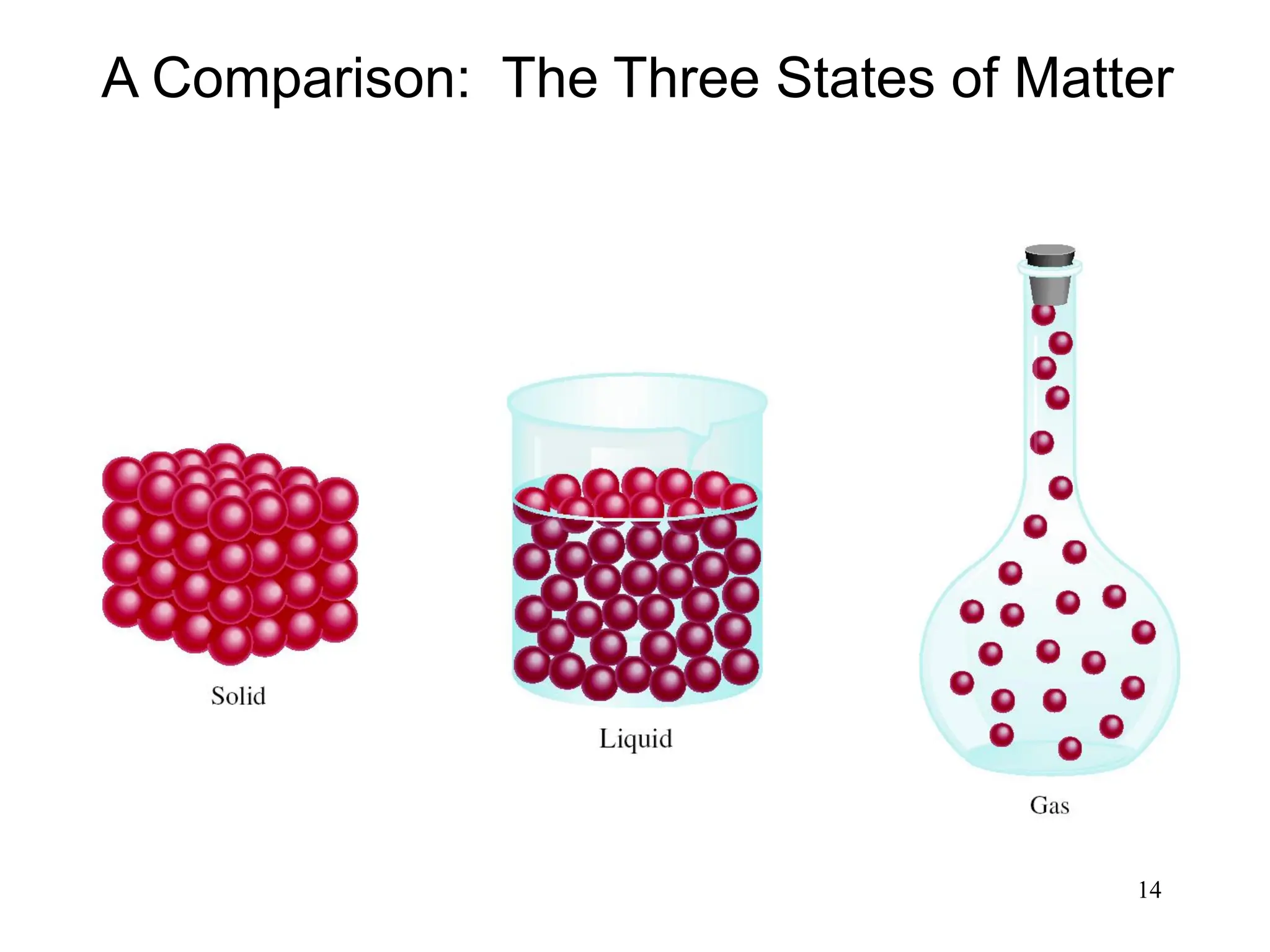
The Three States of Matter
Physical and Chemical Properties of Matter
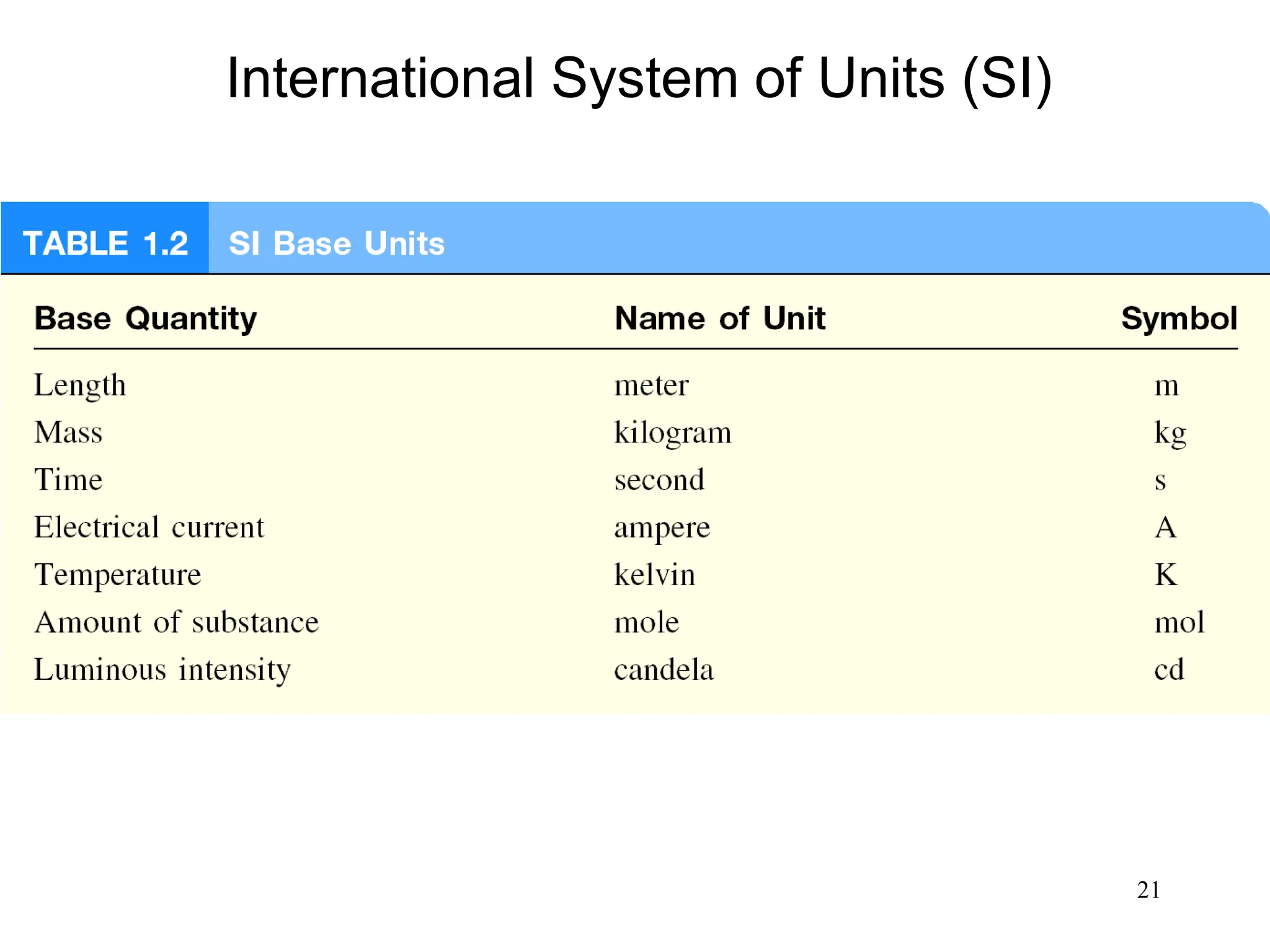
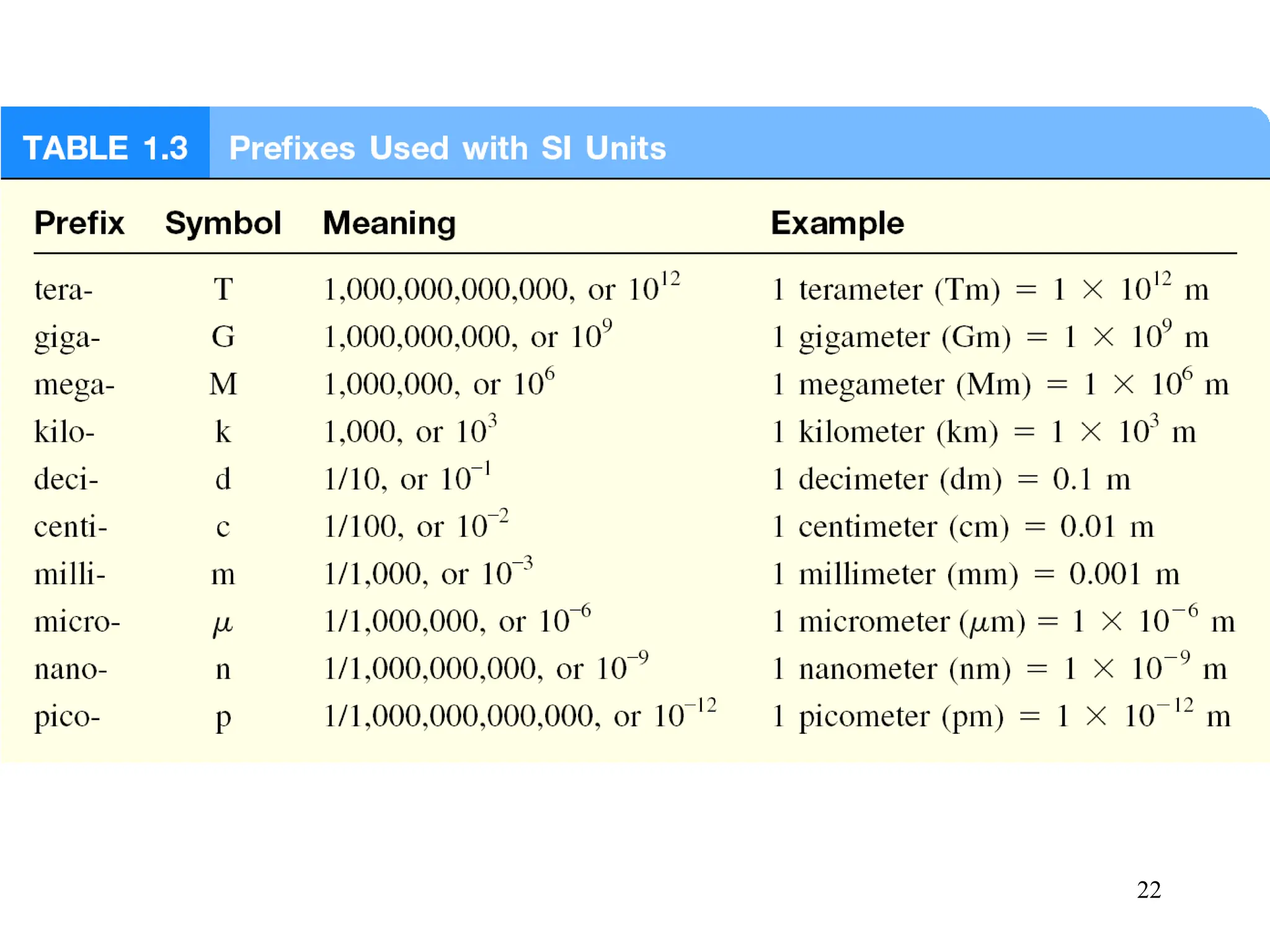
Measurement
Handling Numbers
Dimensional Analysis in Solving Problems
4
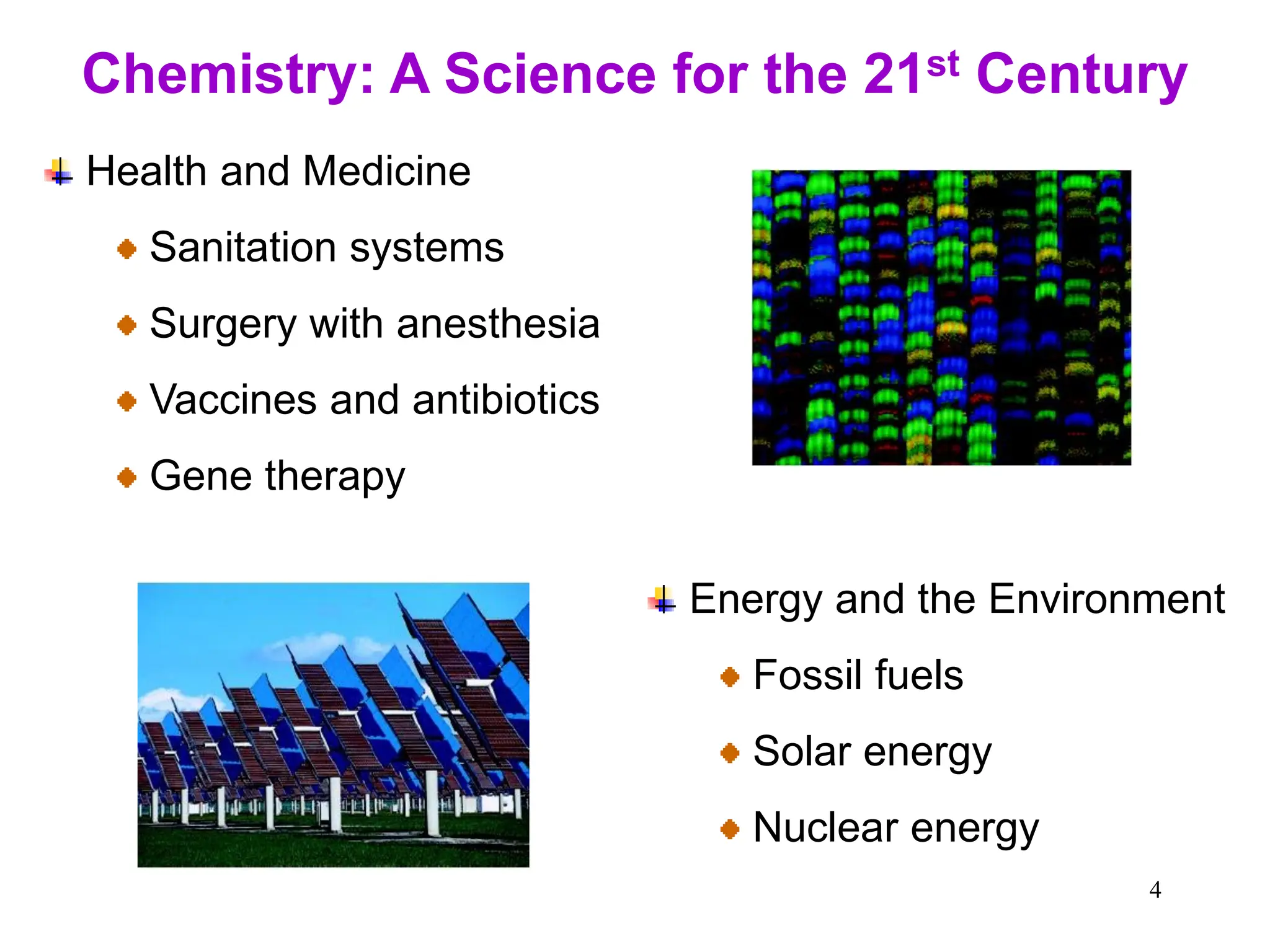
Chemistry: A Sciencefor the 21st Century
Health and Medicine
Sanitation systems
Surgery with anesthesia
Vaccines and antibiotics
Gene therapy
Energy and the Environment
Fossil fuels
Solar energy
Nuclear energy
5.
5
Chemistry: A Sciencefor the 21st Century
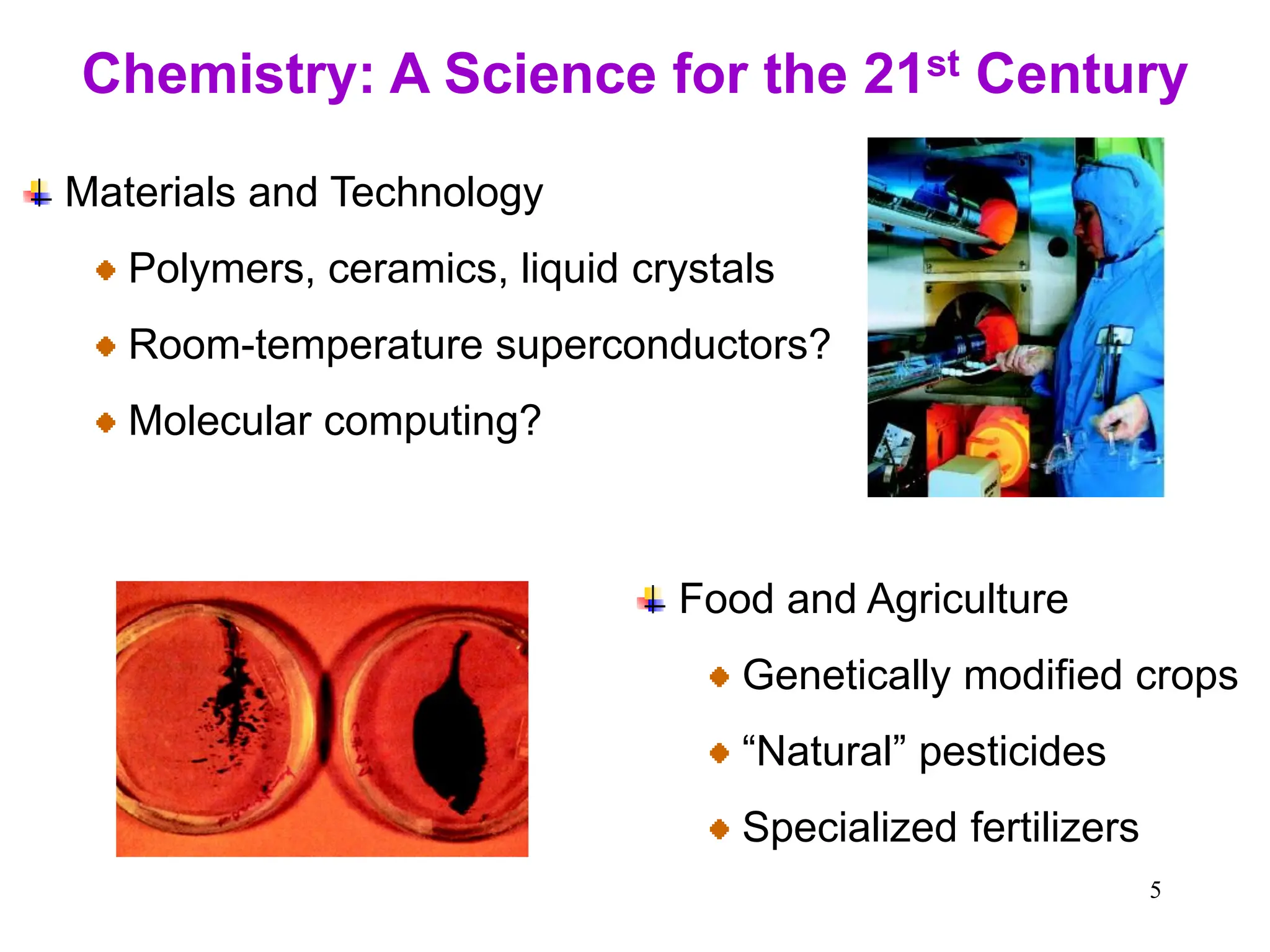
Materials and Technology
Polymers, ceramics, liquid crystals
Room-temperature superconductors?
Molecular computing?
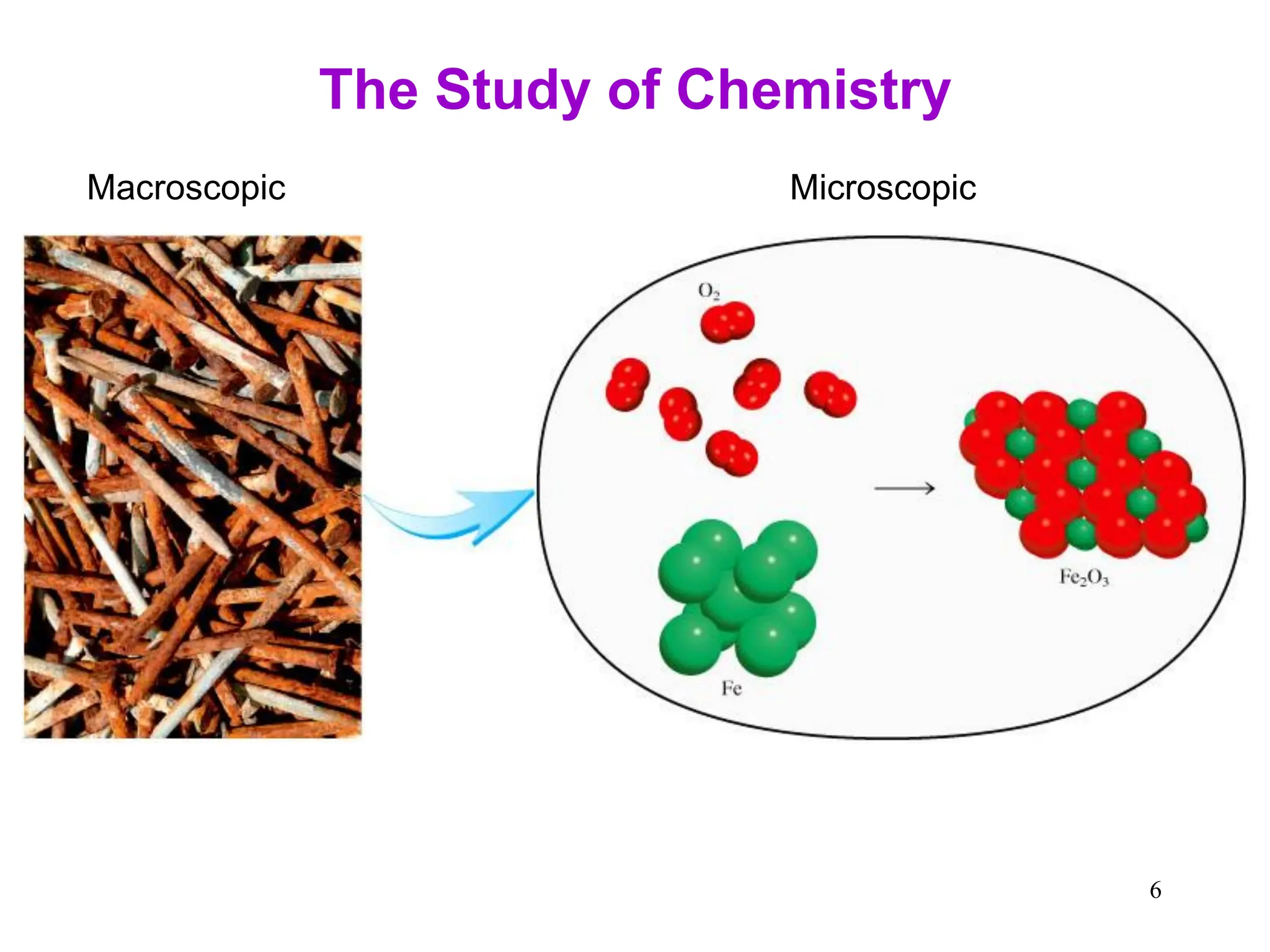
Food and Agriculture
Genetically modified crops
“Natural” pesticides
Specialized fertilizers
7
Matter is anythingthat occupies space and has
mass.
Classification of Matter includes, substances, mixtures,
elements, compounds, atoms & molecules.
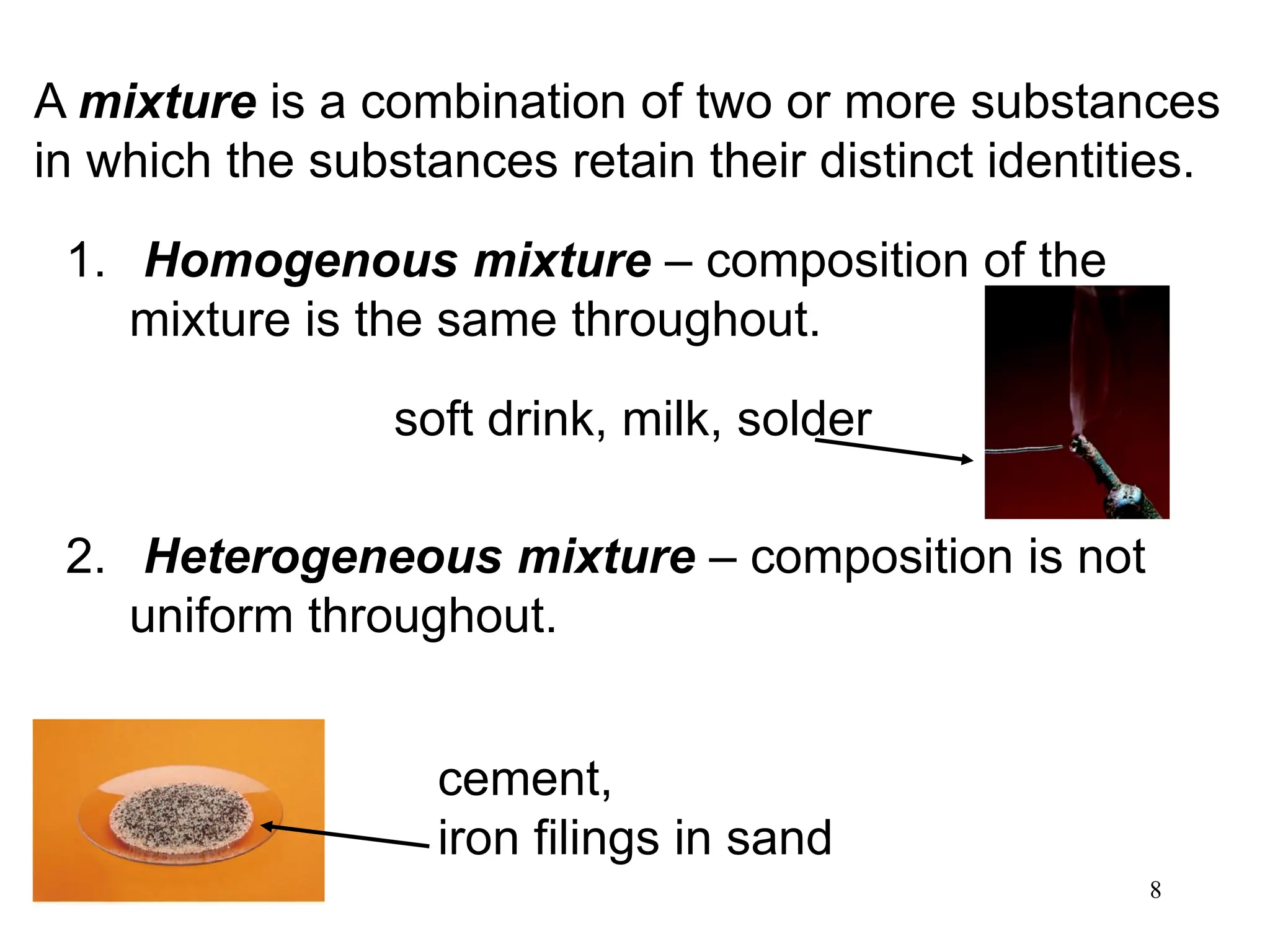
A substance is a form of matter that has a definite
composition and distinct properties.
Chemistry is the study of matter and the
changes it undergoes.
liquid nitrogen gold ingots silicon crystals
8.
8
A mixture isa combination of two or more substances
in which the substances retain their distinct identities.
1. Homogenous mixture – composition of the
mixture is the same throughout.
2. Heterogeneous mixture – composition is not
uniform throughout.
soft drink, milk, solder
cement,
iron filings in sand
9.
9
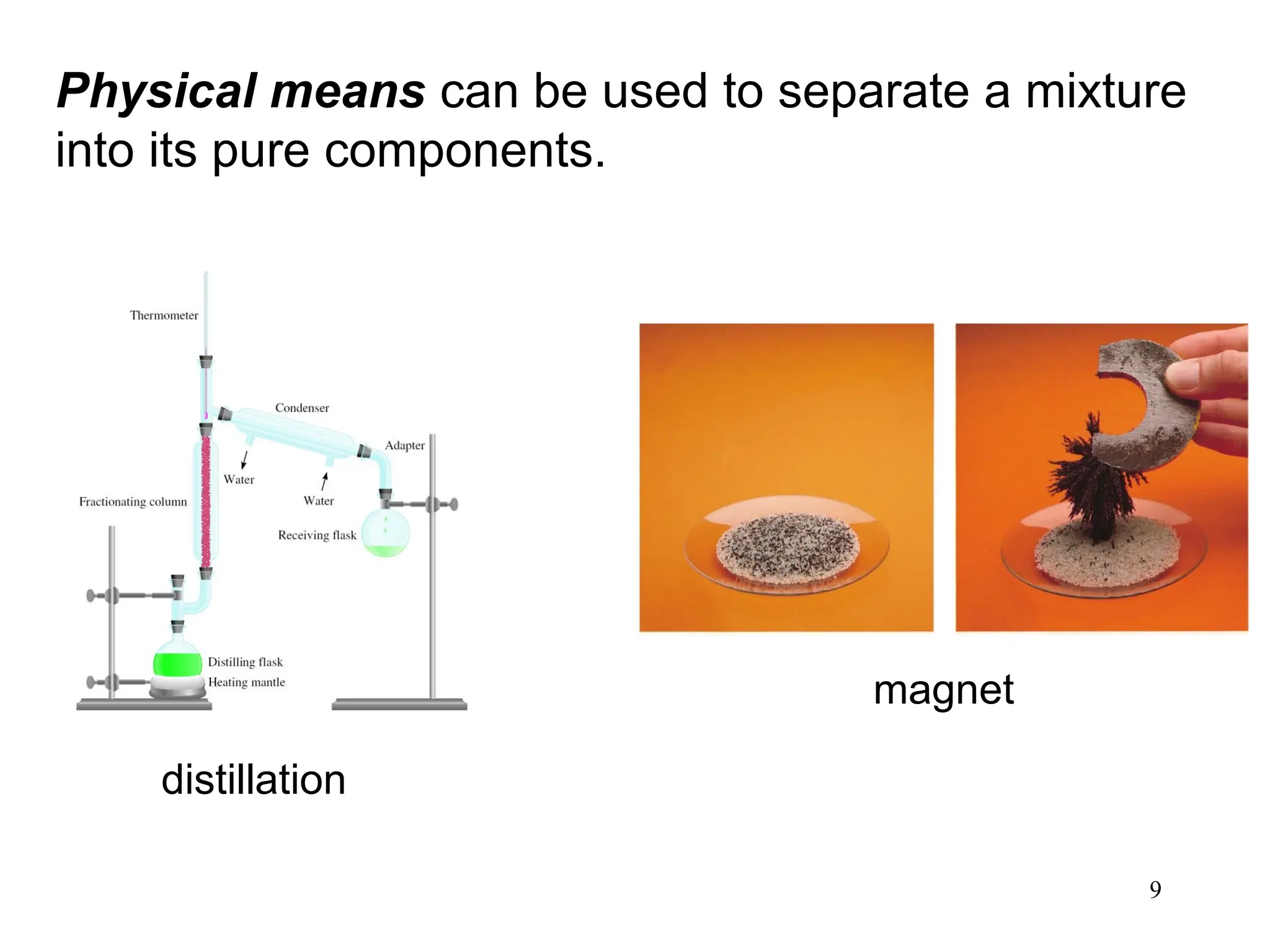
Physical means canbe used to separate a mixture
into its pure components.
magnet
distillation
10.
10
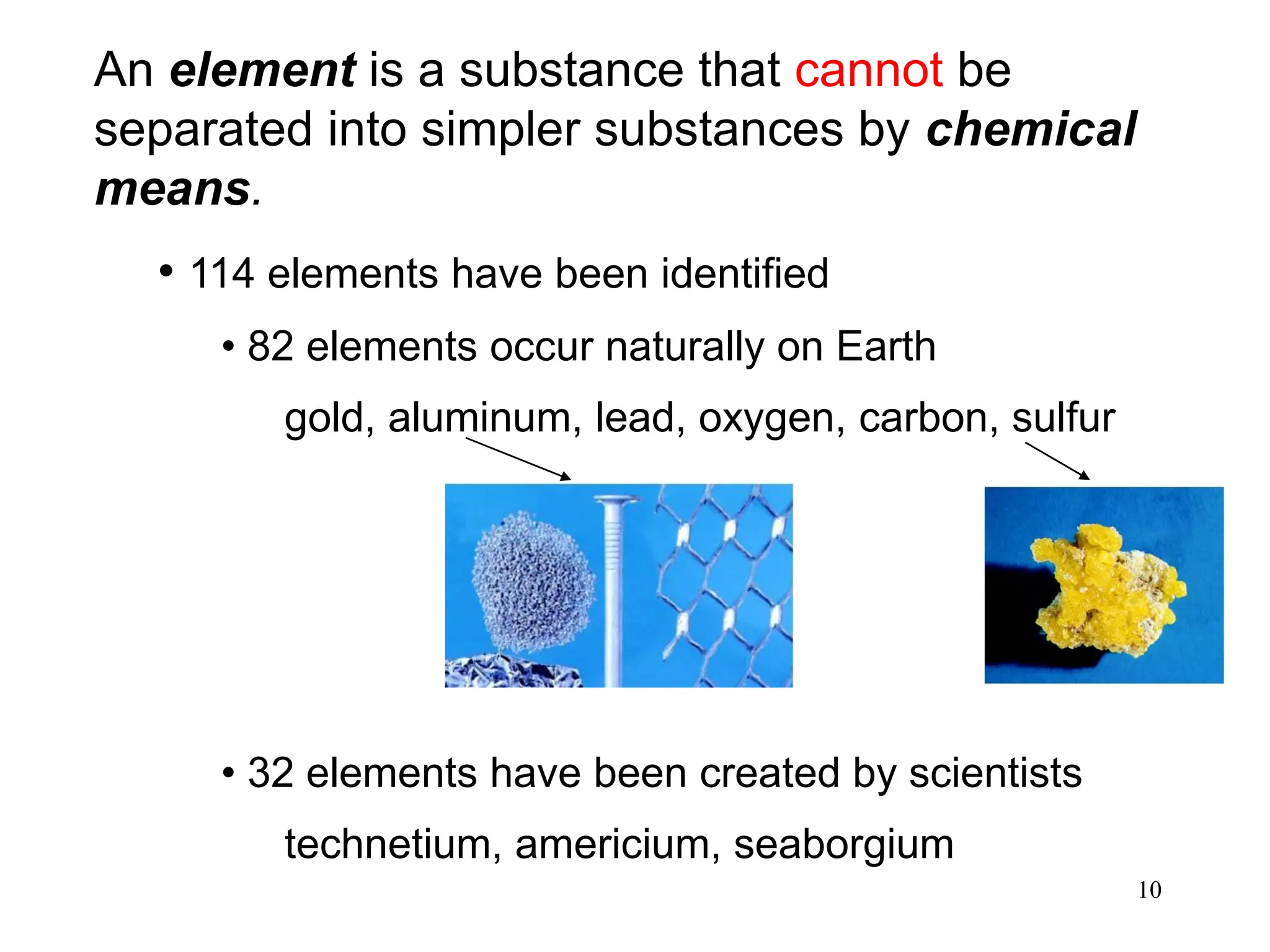
An element isa substance that cannot be
separated into simpler substances by chemical
means.
• 114 elements have been identified
• 82 elements occur naturally on Earth
gold, aluminum, lead, oxygen, carbon, sulfur
• 32 elements have been created by scientists
technetium, americium, seaborgium
12
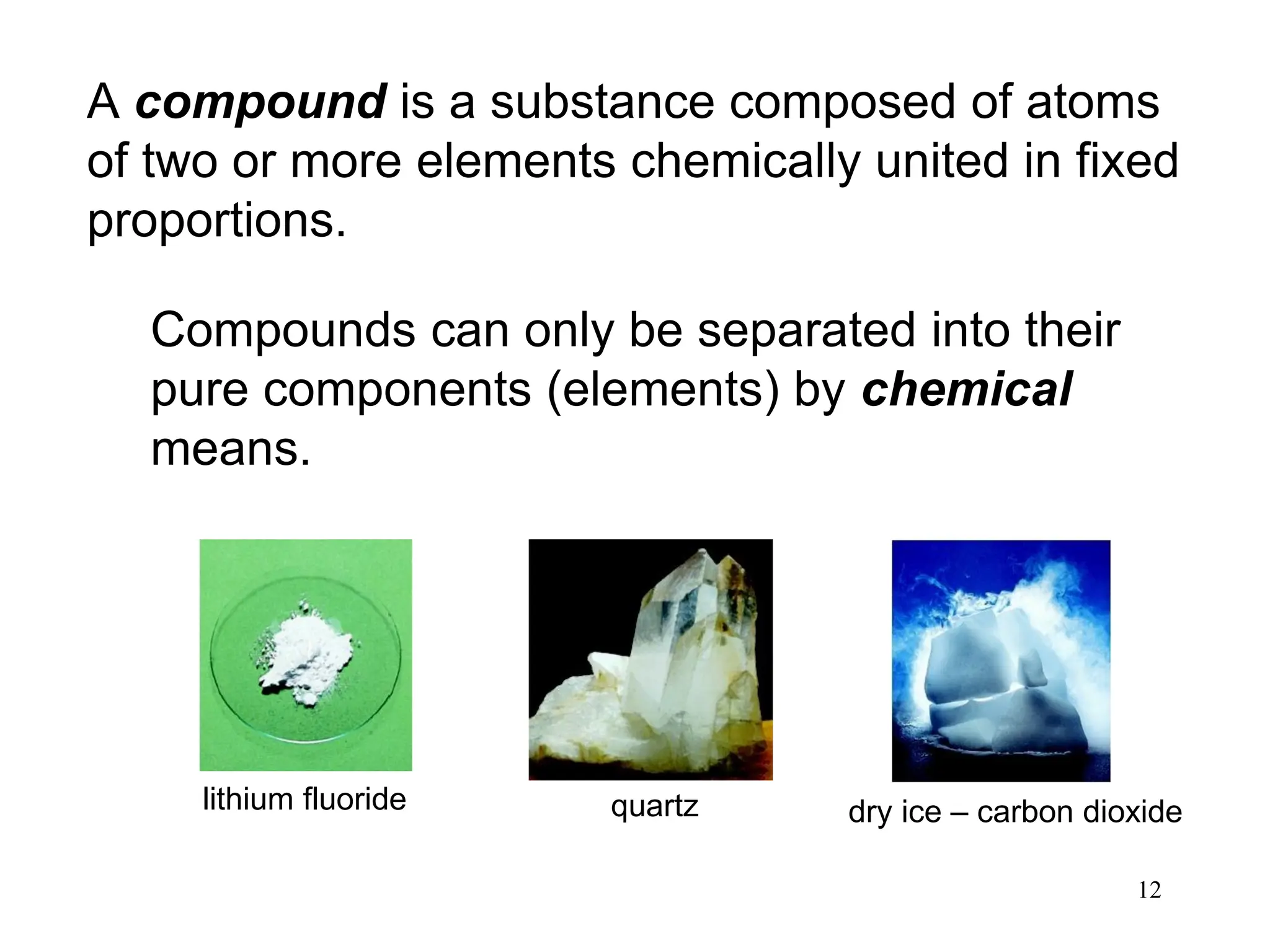
A compound isa substance composed of atoms
of two or more elements chemically united in fixed
proportions.
Compounds can only be separated into their
pure components (elements) by chemical
means.
lithium fluoride quartz dry ice – carbon dioxide
15
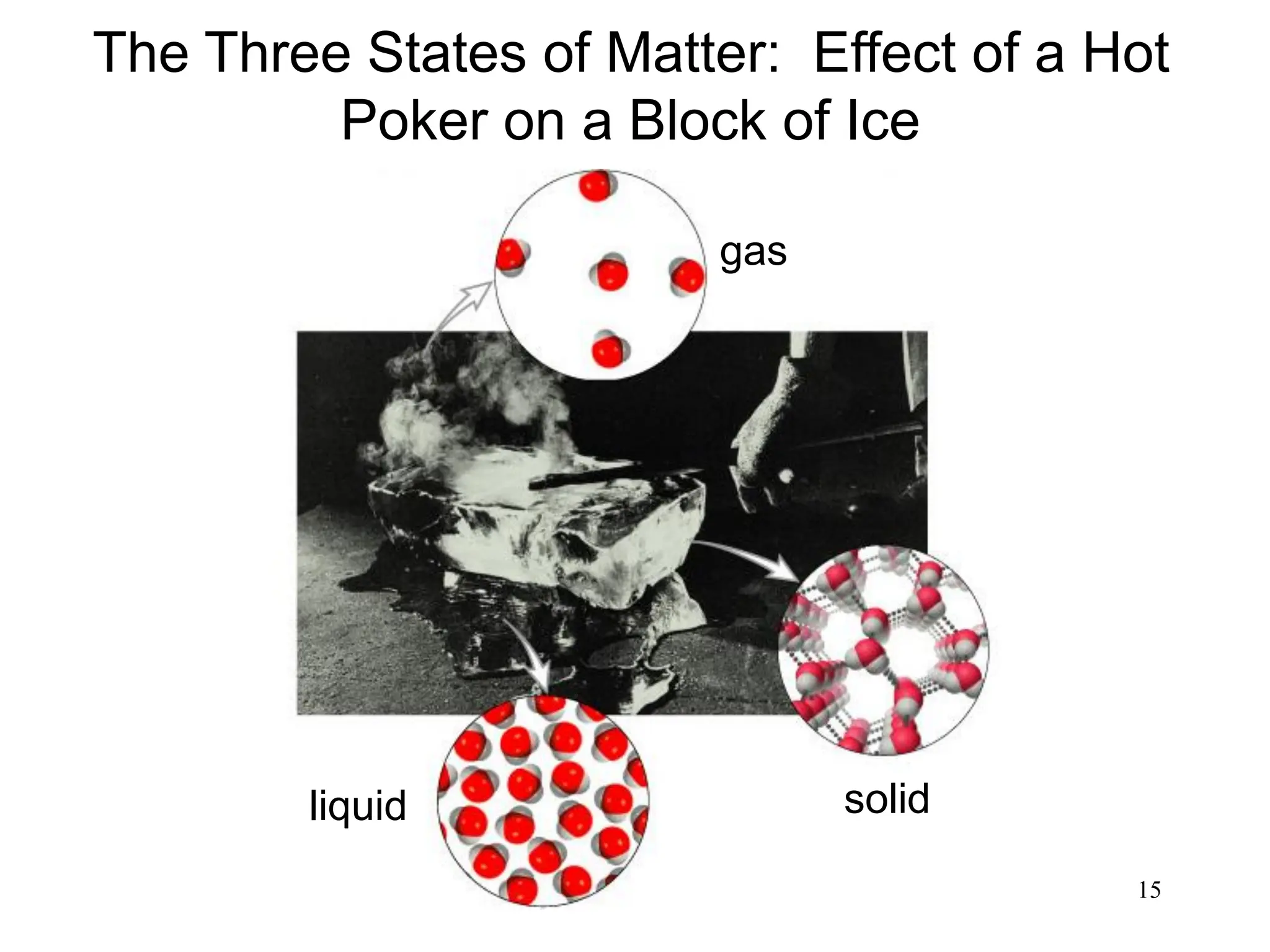
The Three Statesof Matter: Effect of a Hot
Poker on a Block of Ice
solid
liquid
gas
16.
16
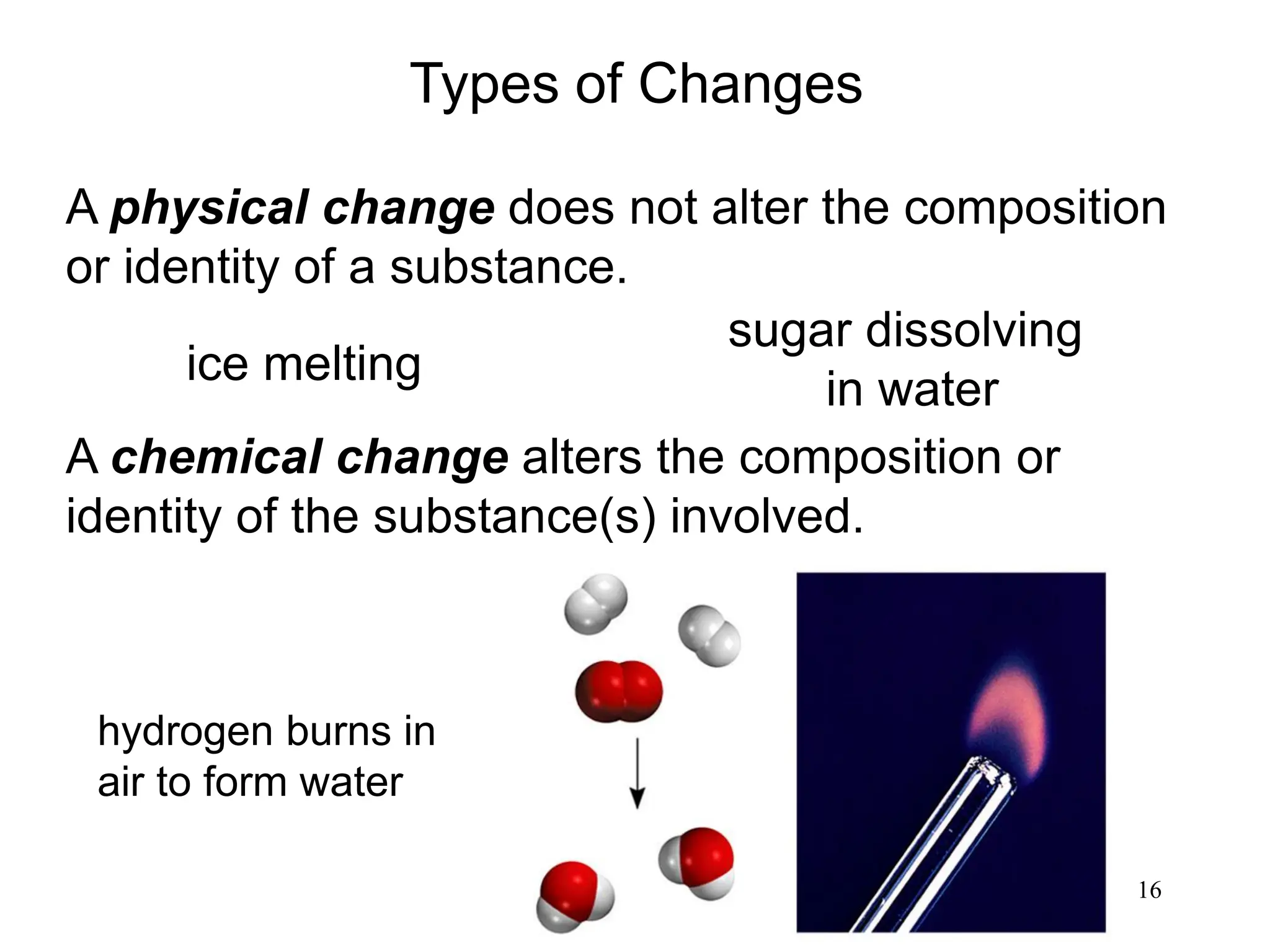
A physical changedoes not alter the composition
or identity of a substance.
A chemical change alters the composition or
identity of the substance(s) involved.
ice melting
sugar dissolving
in water
hydrogen burns in
air to form water
Types of Changes
17.
17
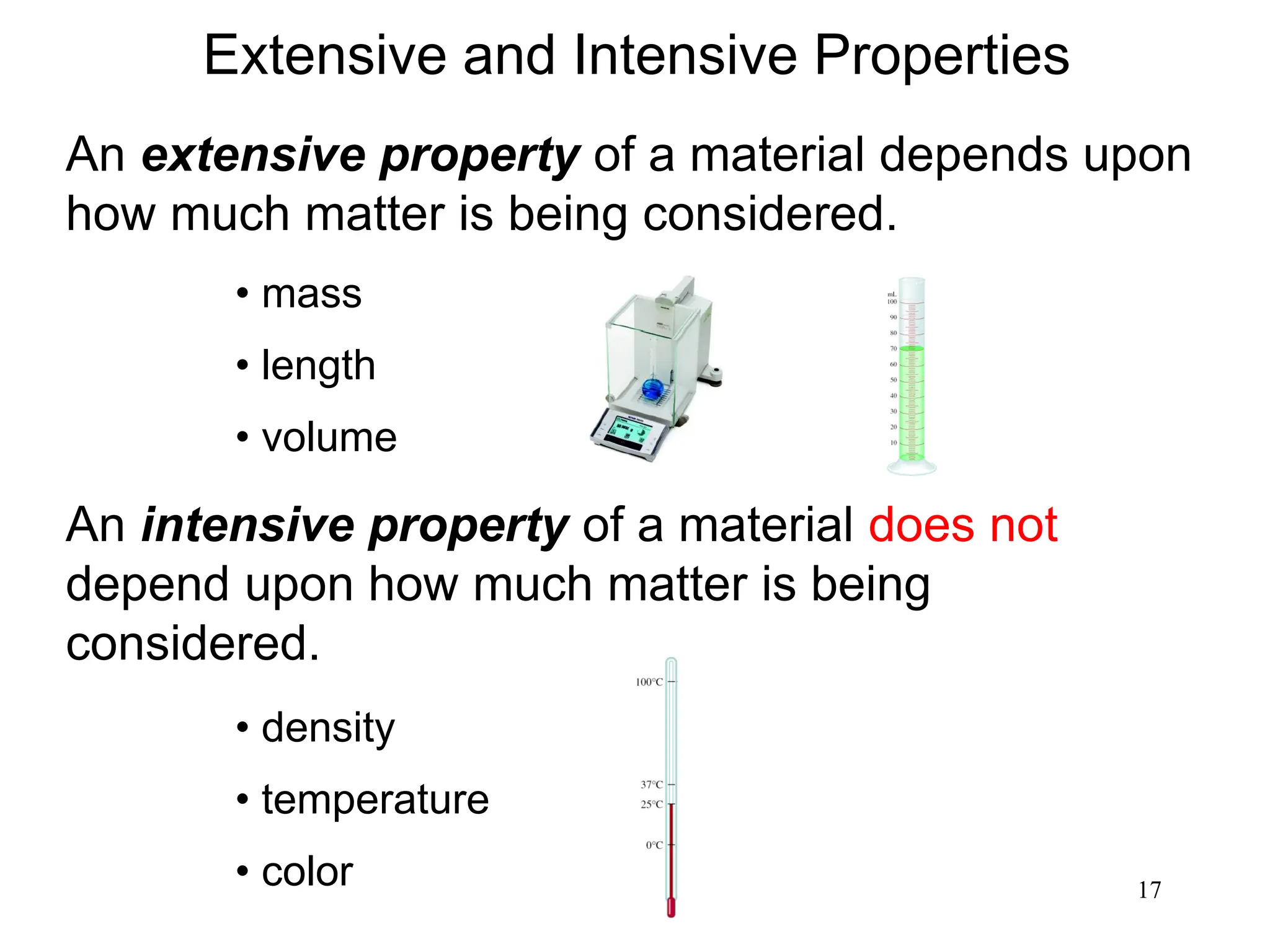
An extensive propertyof a material depends upon
how much matter is being considered.
An intensive property of a material does not
depend upon how much matter is being
considered.
• mass
• length
• volume
• density
• temperature
• color
Extensive and Intensive Properties
18.
18
Measurements
Measurement –quantitative observation
consisting of two parts:
Number
Scale (unit)
Examples:
20 grams
6.63 × 10⁻³⁴ joule·seconds
23
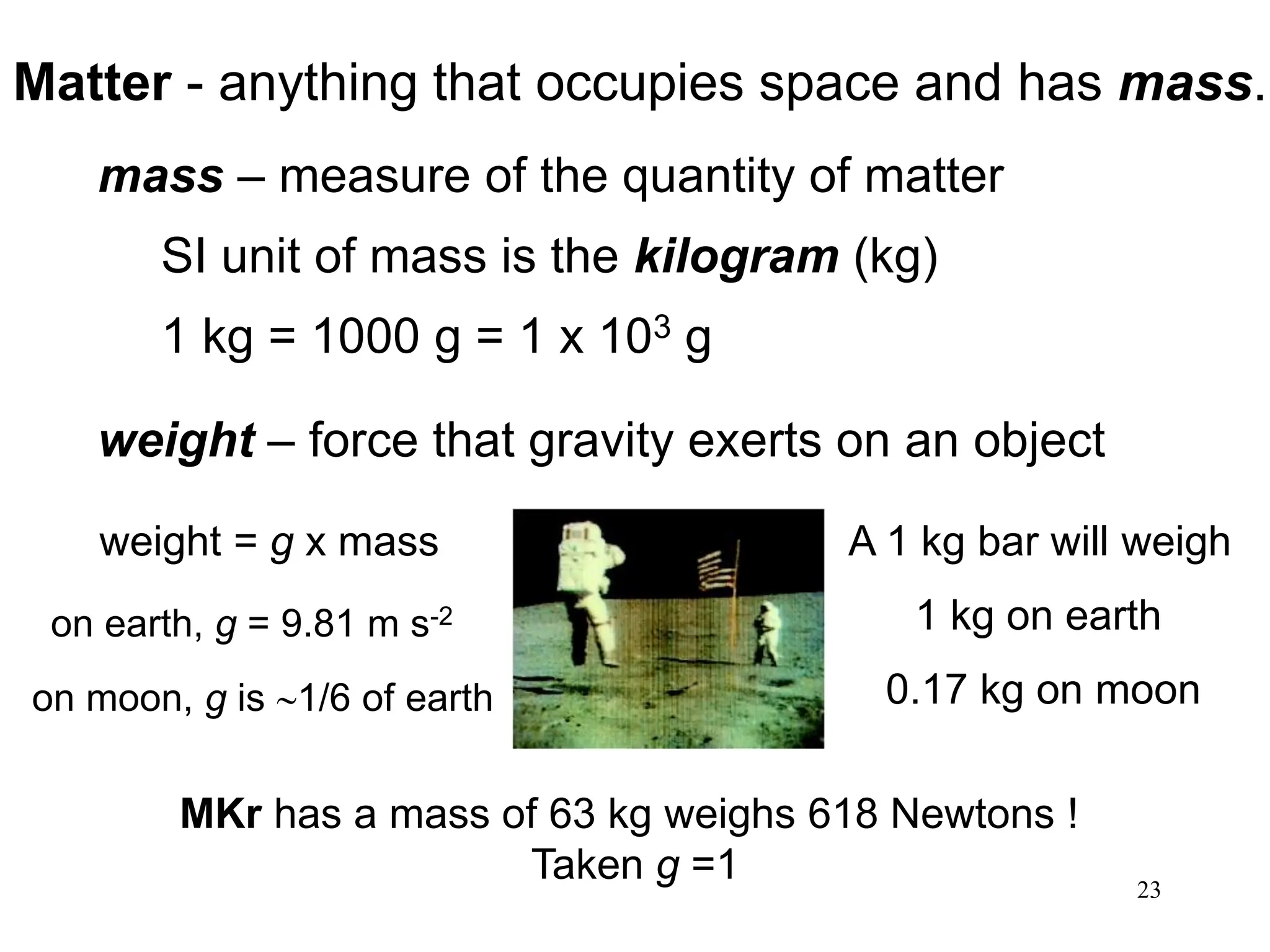
Matter - anythingthat occupies space and has mass.
mass – measure of the quantity of matter
SI unit of mass is the kilogram (kg)
1 kg = 1000 g = 1 x 10³ g
weight – force that gravity exerts on an object
A 1 kg bar will weigh
1 kg on earth
0.17 kg on moon
weight = g x mass
on earth, g = 9.81 m s-2
on moon, g is 1/6 of earth
MKr has a mass of 63 kg weighs 618 Newtons !
Taken g =1
24.
24
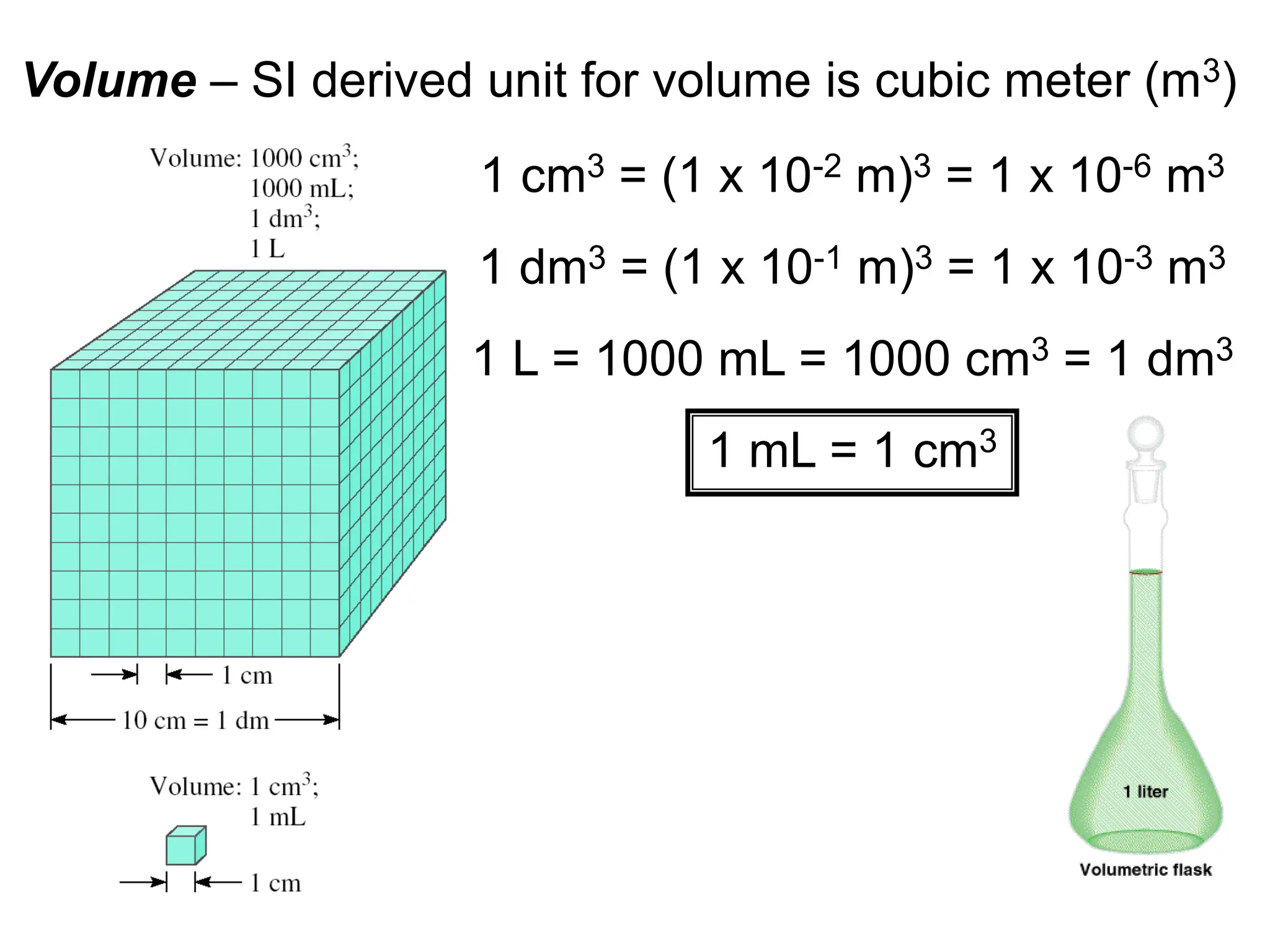
Volume – SIderived unit for volume is cubic meter (m3)
1 cm3 = (1 x 10⁻² m)3 = 1 x 10⁻⁶ m3
1 dm3 = (1 x 10⁻¹ m)3 = 1 x 10⁻³ m3
1 L = 1000 mL = 1000 cm3 = 1 dm3
1 mL = 1 cm3
25.
25
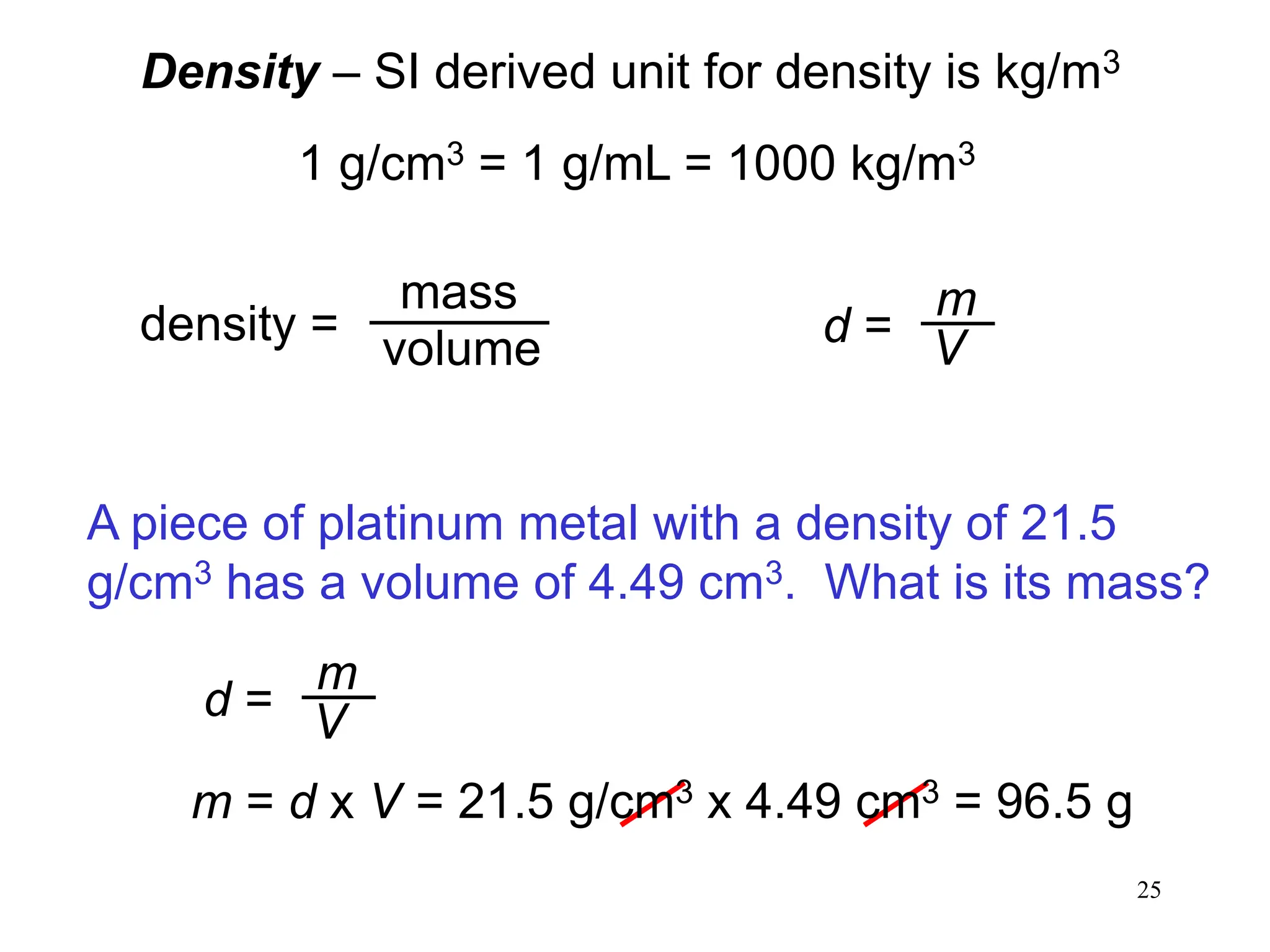
Density – SIderived unit for density is kg/m3
1 g/cm3 = 1 g/mL = 1000 kg/m3
density =
mass
volume d =
m
V
A piece of platinum metal with a density of 21.5
g/cm3 has a volume of 4.49 cm3. What is its mass?
d =
m
V
m = d x V = 21.5 g/cm3 x 4.49 cm3 = 96.5 g
27
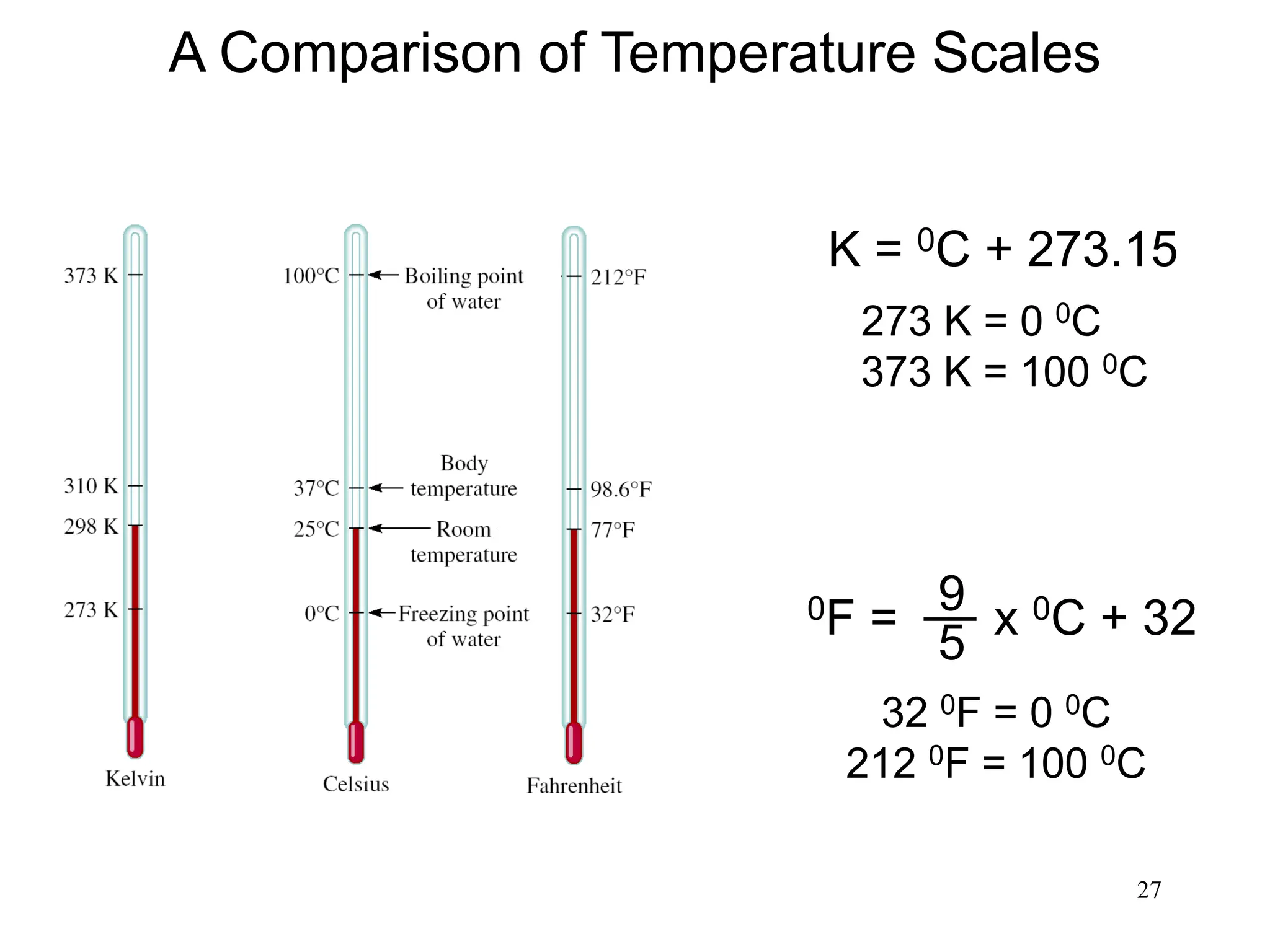
K = 0C+ 273.15
0F = x 0C + 32
9
5
273 K = 0 0C
373 K = 100 0C
32 0F = 0 0C
212 0F = 100 0C
A Comparison of Temperature Scales
28.
28
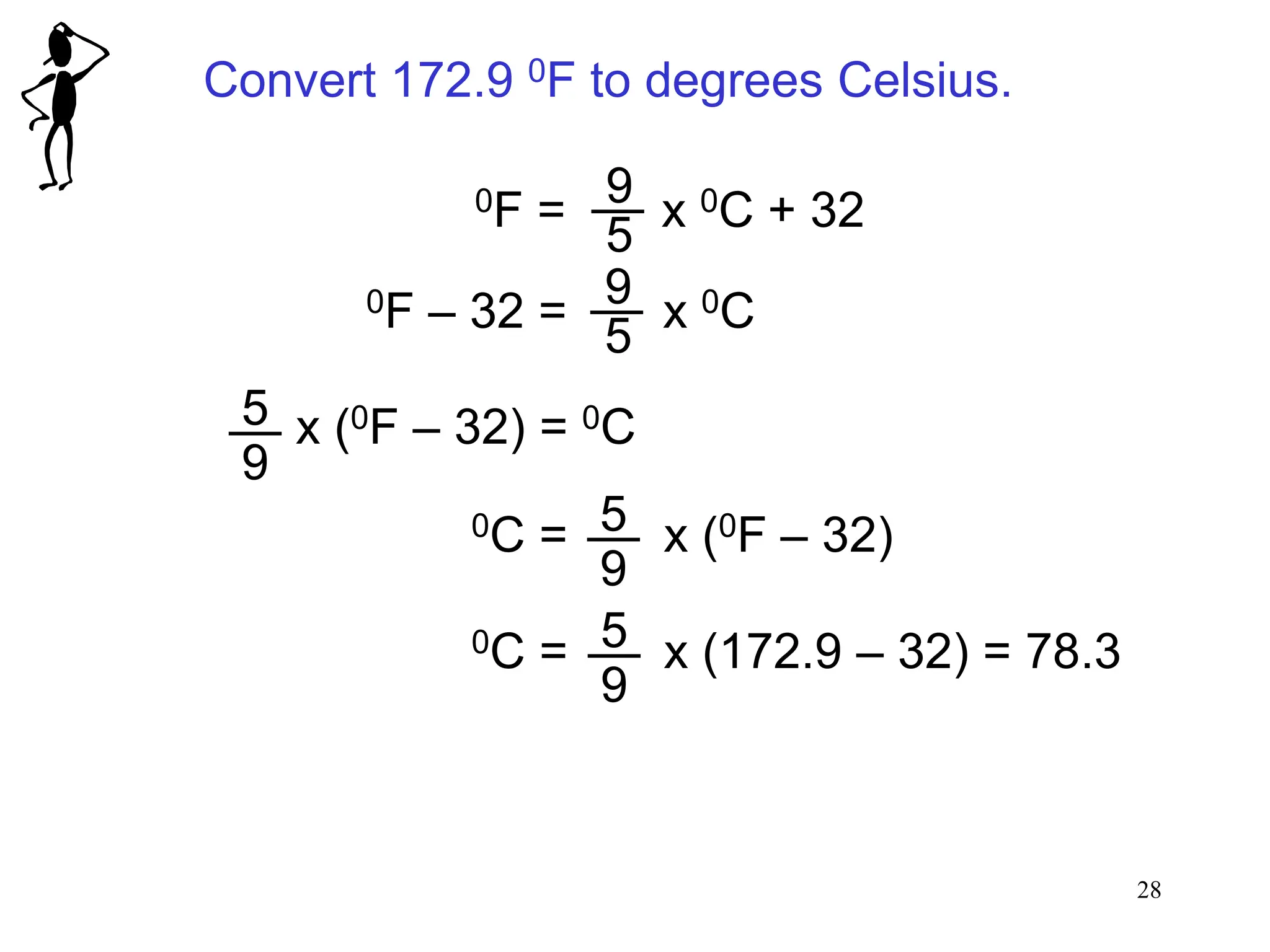
Convert 172.9 0Fto degrees Celsius.
0F = x 0C + 32
9
5
0F – 32 = x 0C
9
5
x (0F – 32) = 0C
9
5
0C = x (0F – 32)
9
5
0C = x (172.9 – 32) = 78.3
9
5
29.
29
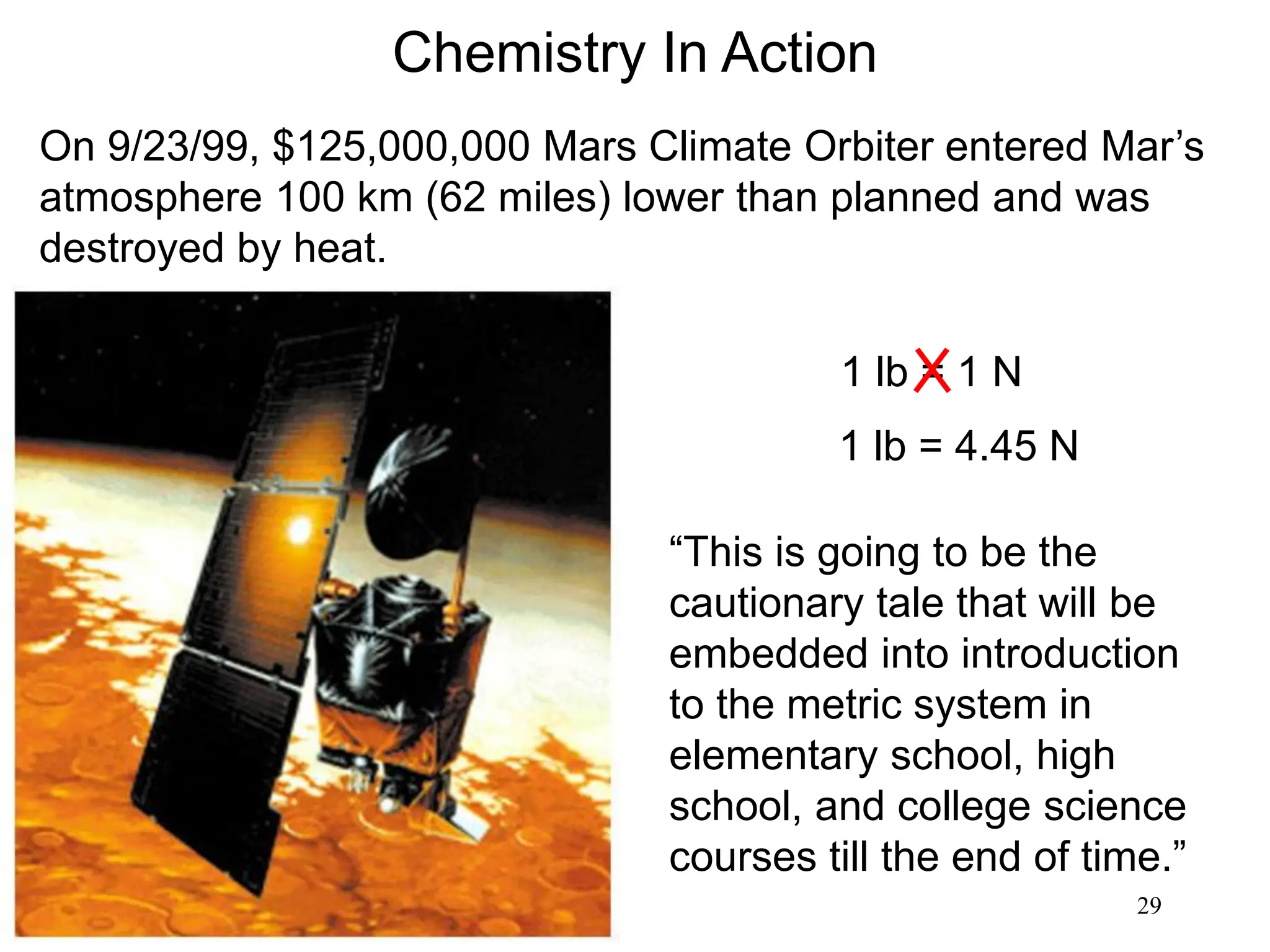
Chemistry In Action
On9/23/99, $125,000,000 Mars Climate Orbiter entered Mar’s
atmosphere 100 km (62 miles) lower than planned and was
destroyed by heat.
1 lb = 1 N
1 lb = 4.45 N
“This is going to be the
cautionary tale that will be
embedded into introduction
to the metric system in
elementary school, high
school, and college science
courses till the end of time.”
31
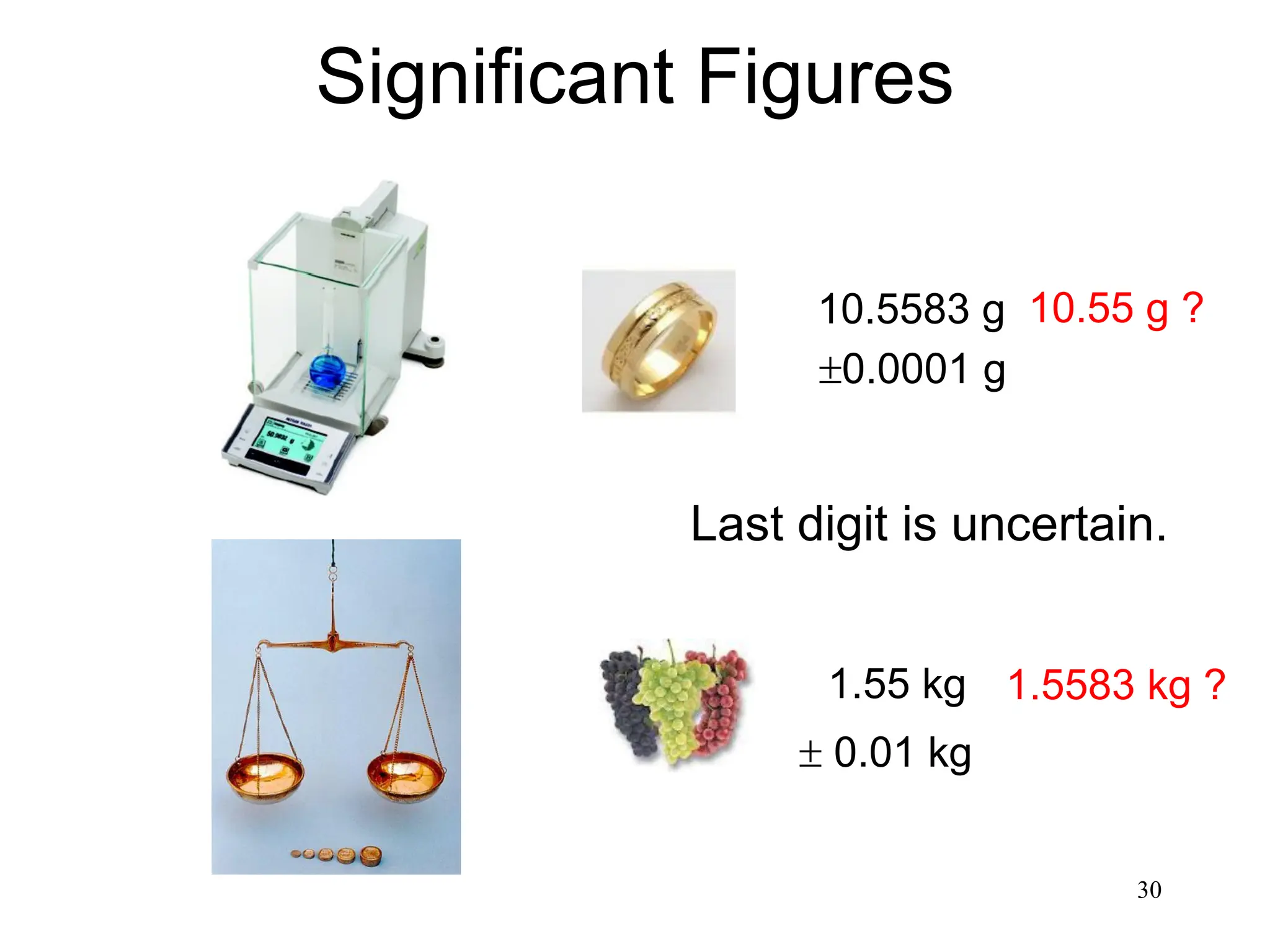
Significant Figures
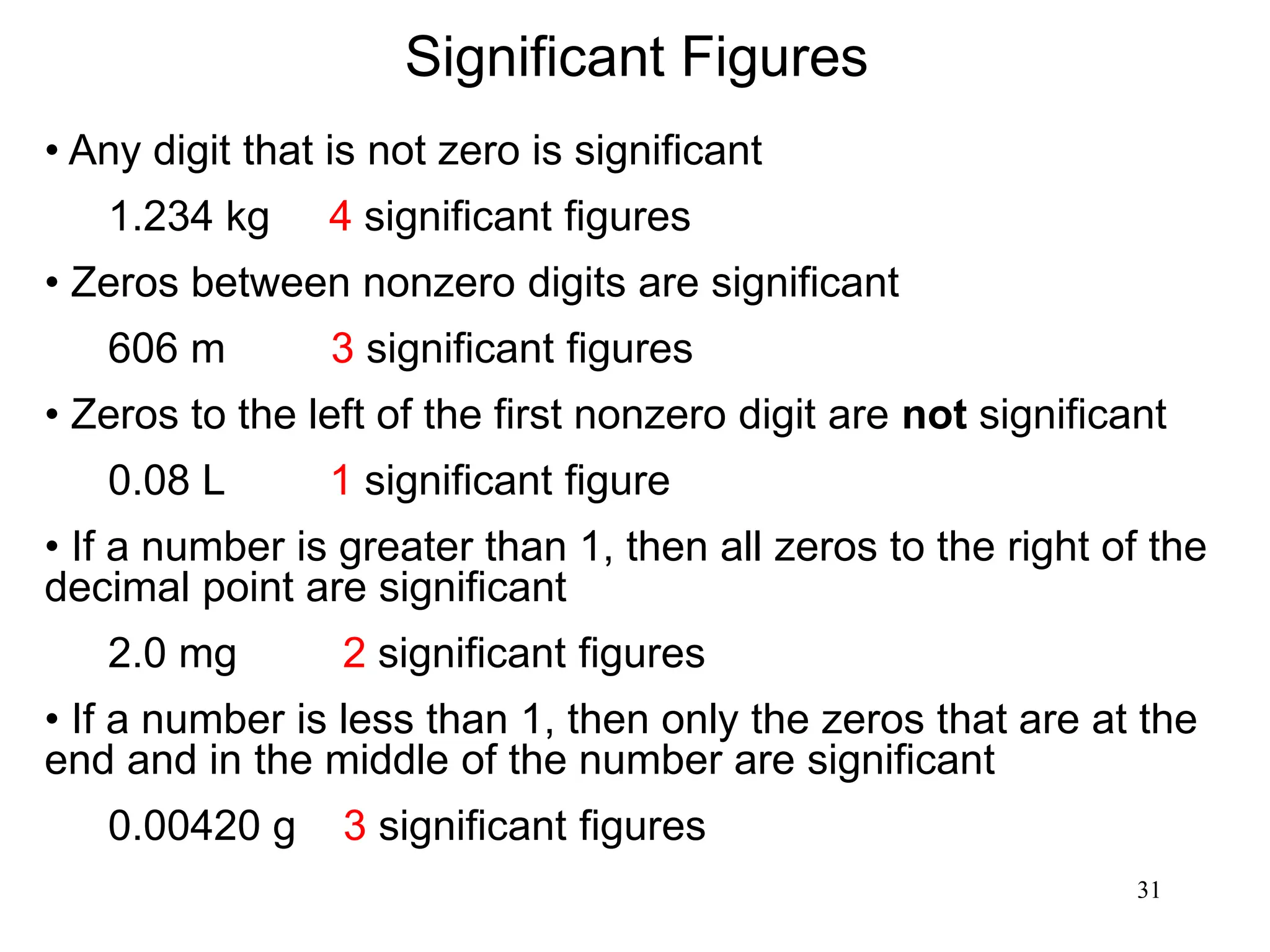
• Anydigit that is not zero is significant
1.234 kg 4 significant figures
• Zeros between nonzero digits are significant
606 m 3 significant figures
• Zeros to the left of the first nonzero digit are not significant
0.08 L 1 significant figure
• If a number is greater than 1, then all zeros to the right of the
decimal point are significant
2.0 mg 2 significant figures
• If a number is less than 1, then only the zeros that are at the
end and in the middle of the number are significant
0.00420 g 3 significant figures
32.
32
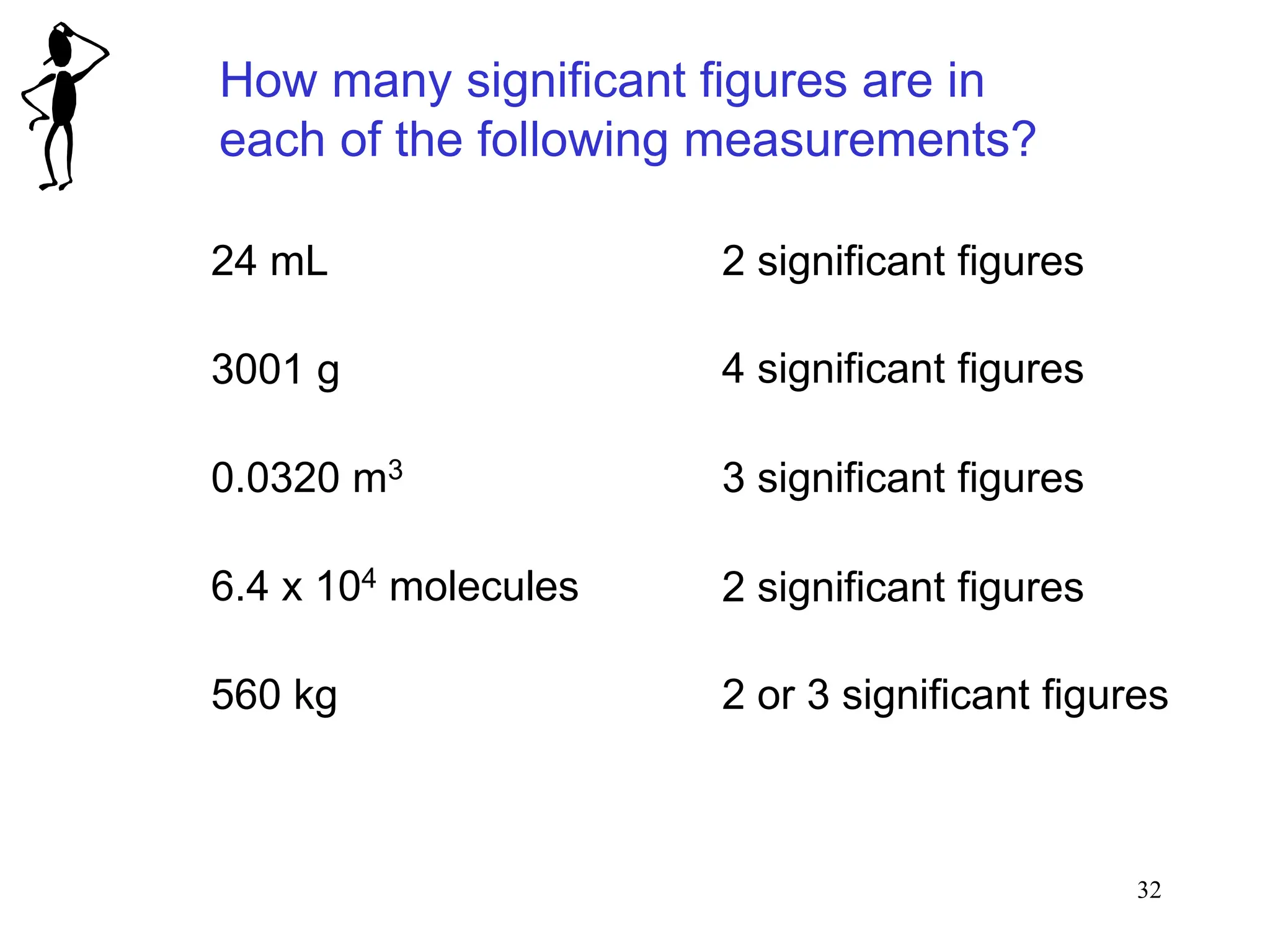
How many significantfigures are in
each of the following measurements?
24 mL 2 significant figures
3001 g 4 significant figures
0.0320 m3 3 significant figures
6.4 x 10⁴ molecules 2 significant figures
560 kg 2 or 3 significant figures
33.
33
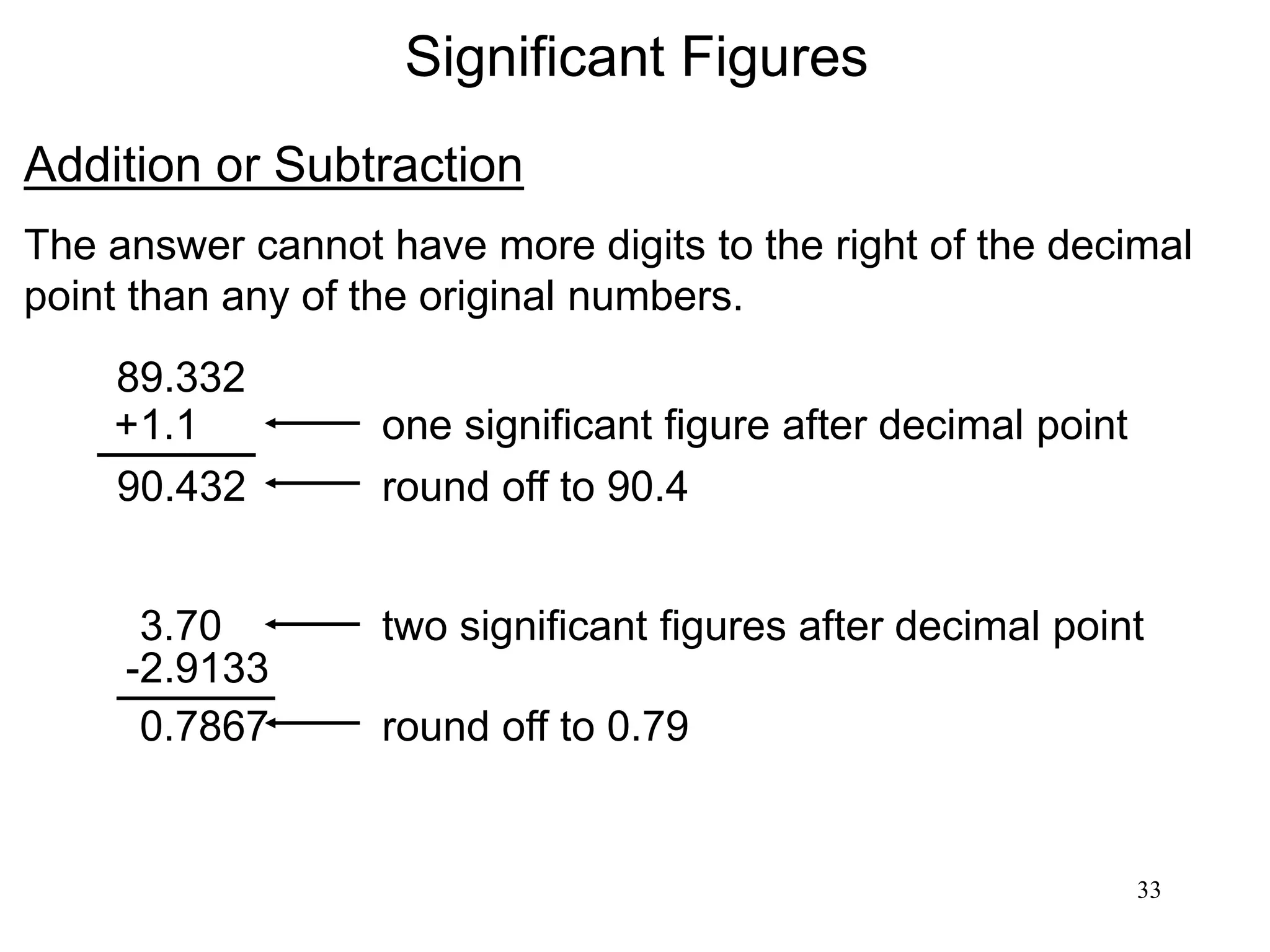
Significant Figures
Addition orSubtraction
The answer cannot have more digits to the right of the decimal
point than any of the original numbers.
89.332
1.1
+
90.432 round off to 90.4
one significant figure after decimal point
3.70
-2.9133
0.7867
two significant figures after decimal point
round off to 0.79
34.
34
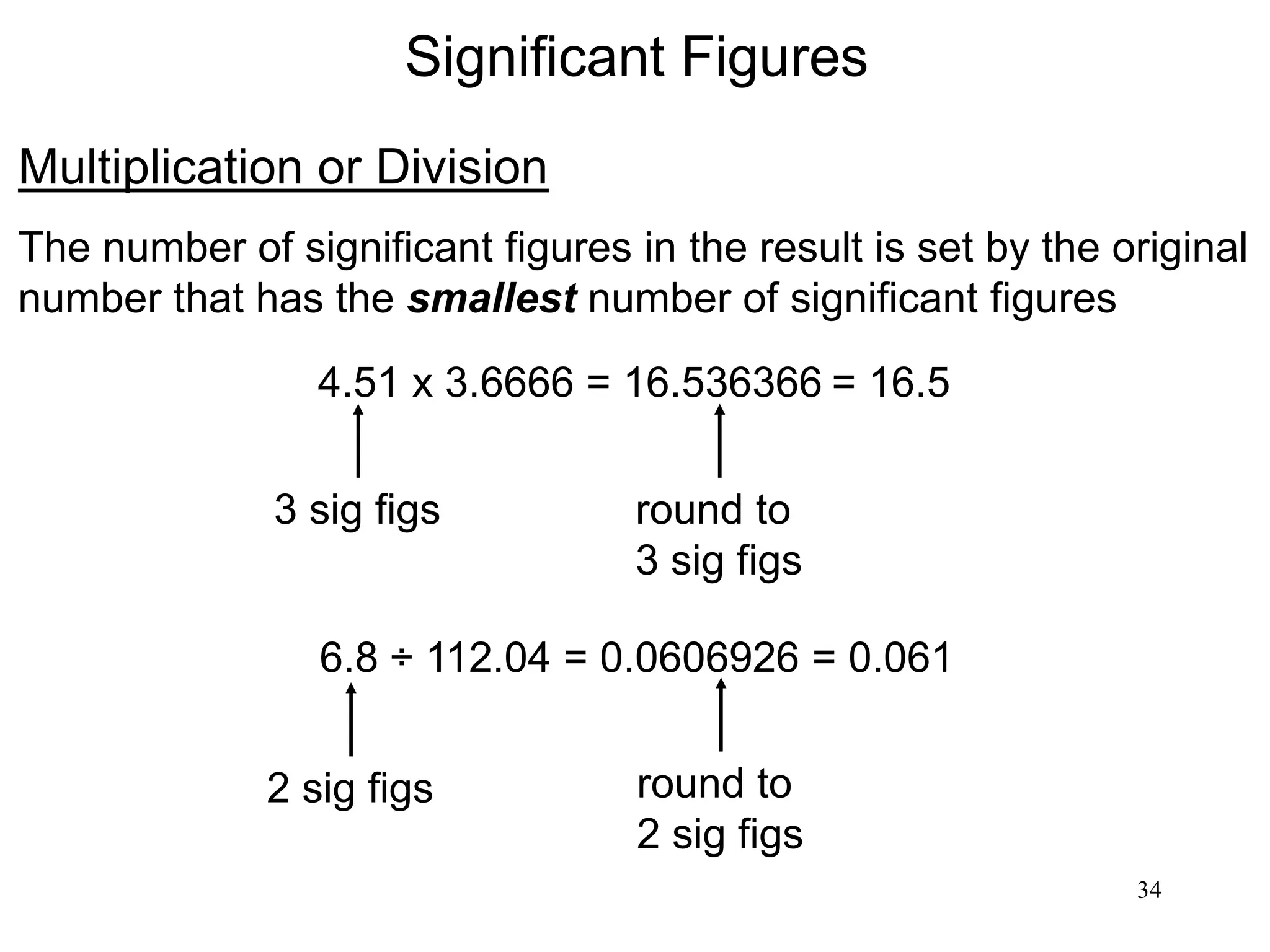
Significant Figures
Multiplication orDivision
The number of significant figures in the result is set by the original
number that has the smallest number of significant figures
4.51 x 3.6666 = 16.536366 = 16.5
3 sig figs round to
3 sig figs
6.8 ÷ 112.04 = 0.0606926
2 sig figs round to
2 sig figs
= 0.061
35.
35
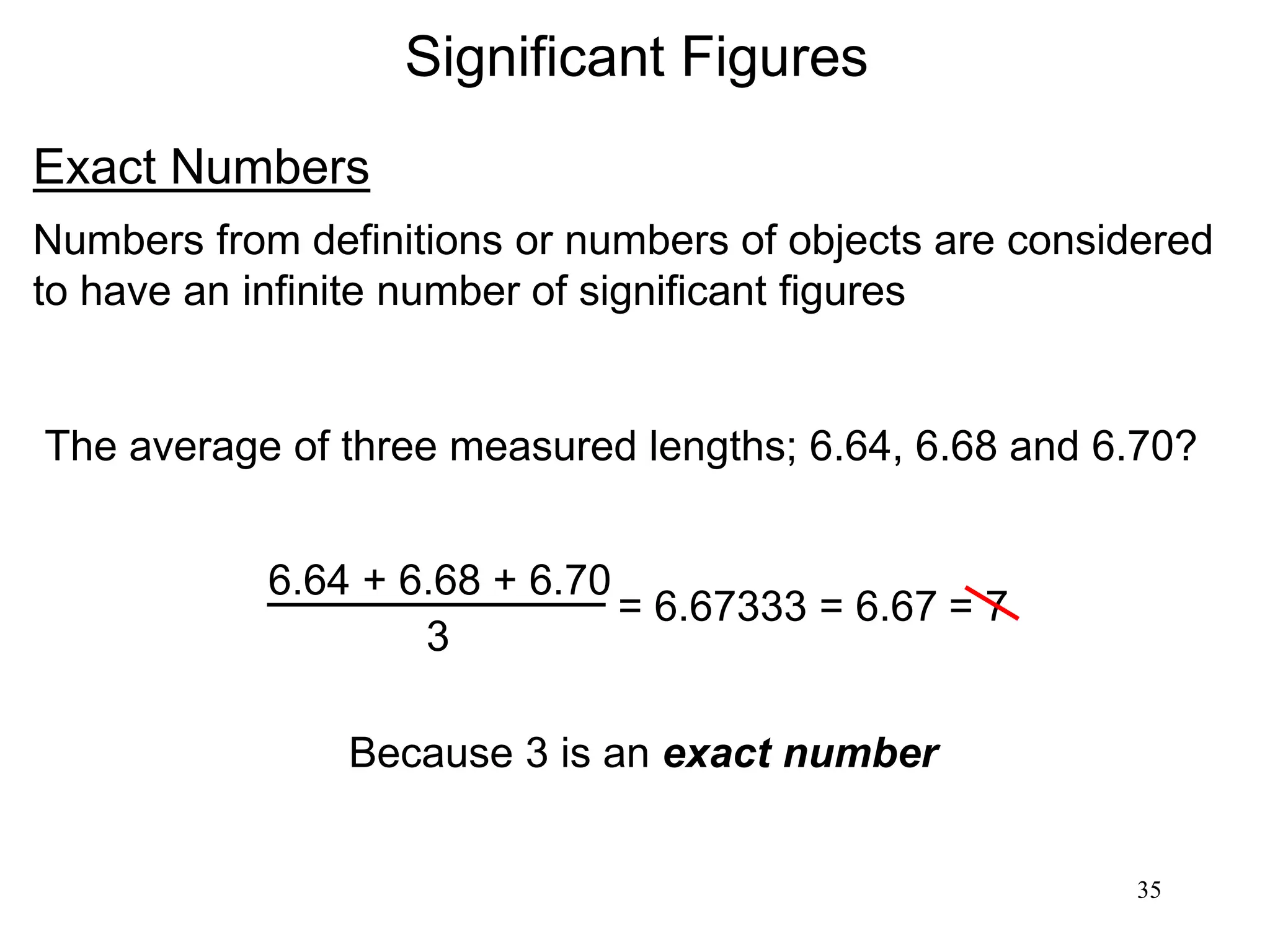
Significant Figures
Exact Numbers
Numbersfrom definitions or numbers of objects are considered
to have an infinite number of significant figures
The average of three measured lengths; 6.64, 6.68 and 6.70?
6.64 + 6.68 + 6.70
3
= 6.67333 = 6.67
Because 3 is an exact number
= 7
36.
36
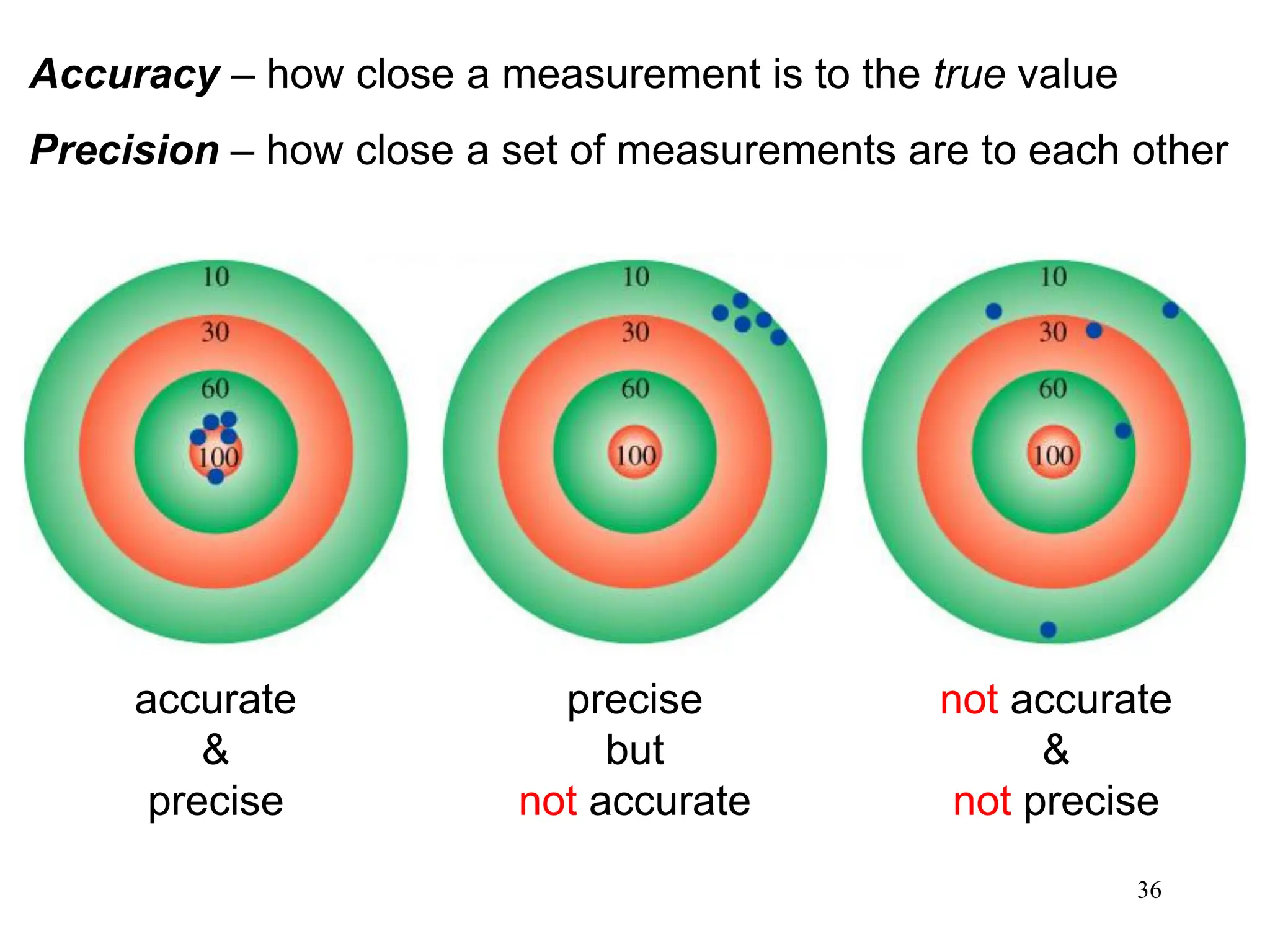
Accuracy – howclose a measurement is to the true value
Precision – how close a set of measurements are to each other
accurate
&
precise
precise
but
not accurate
not accurate
&
not precise
37.
37
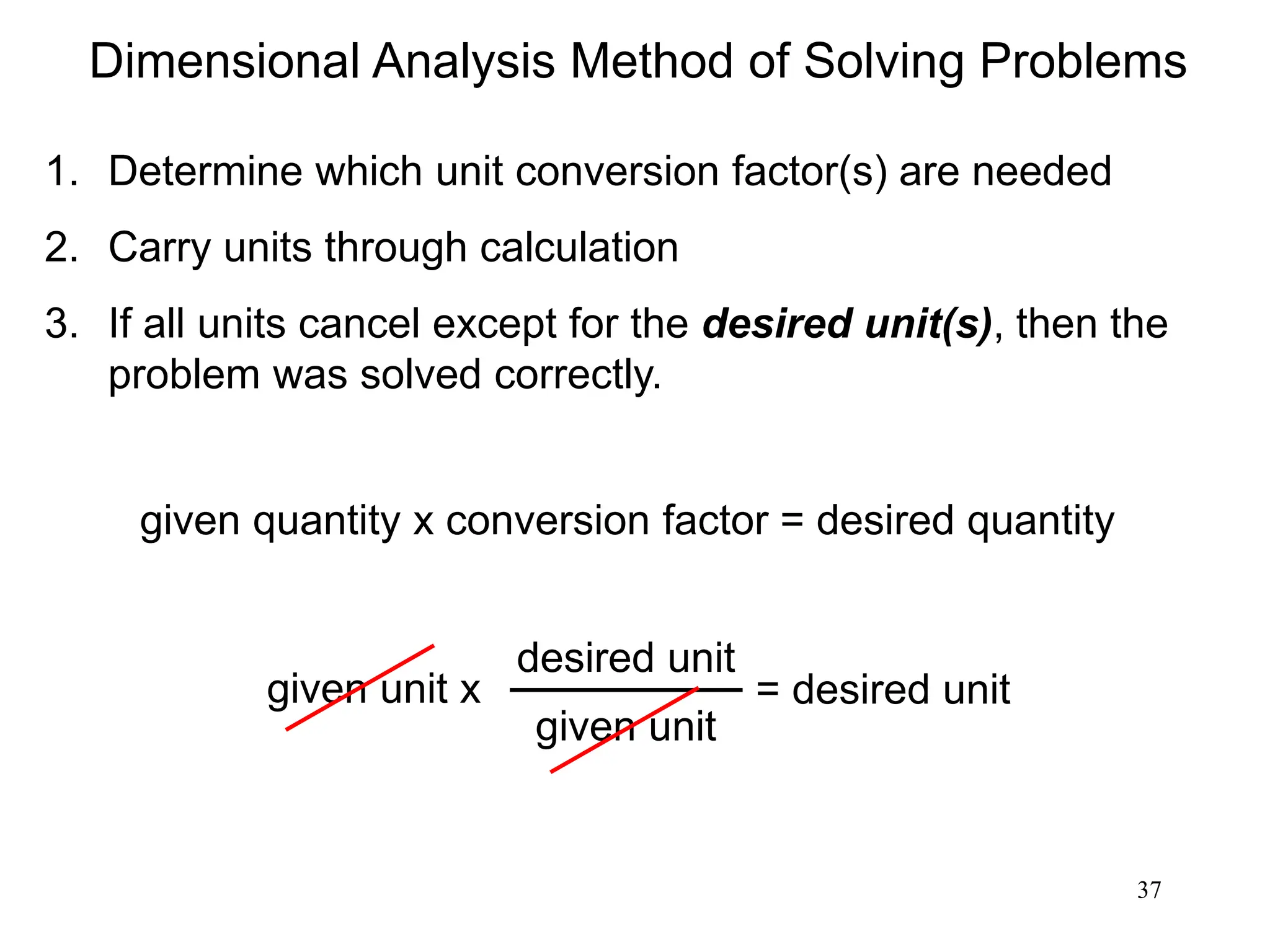
Dimensional Analysis Methodof Solving Problems
1. Determine which unit conversion factor(s) are needed
2. Carry units through calculation
3. If all units cancel except for the desired unit(s), then the
problem was solved correctly.
given quantity x conversion factor = desired quantity
given unit x = desired unit
desired unit
given unit
38.
38
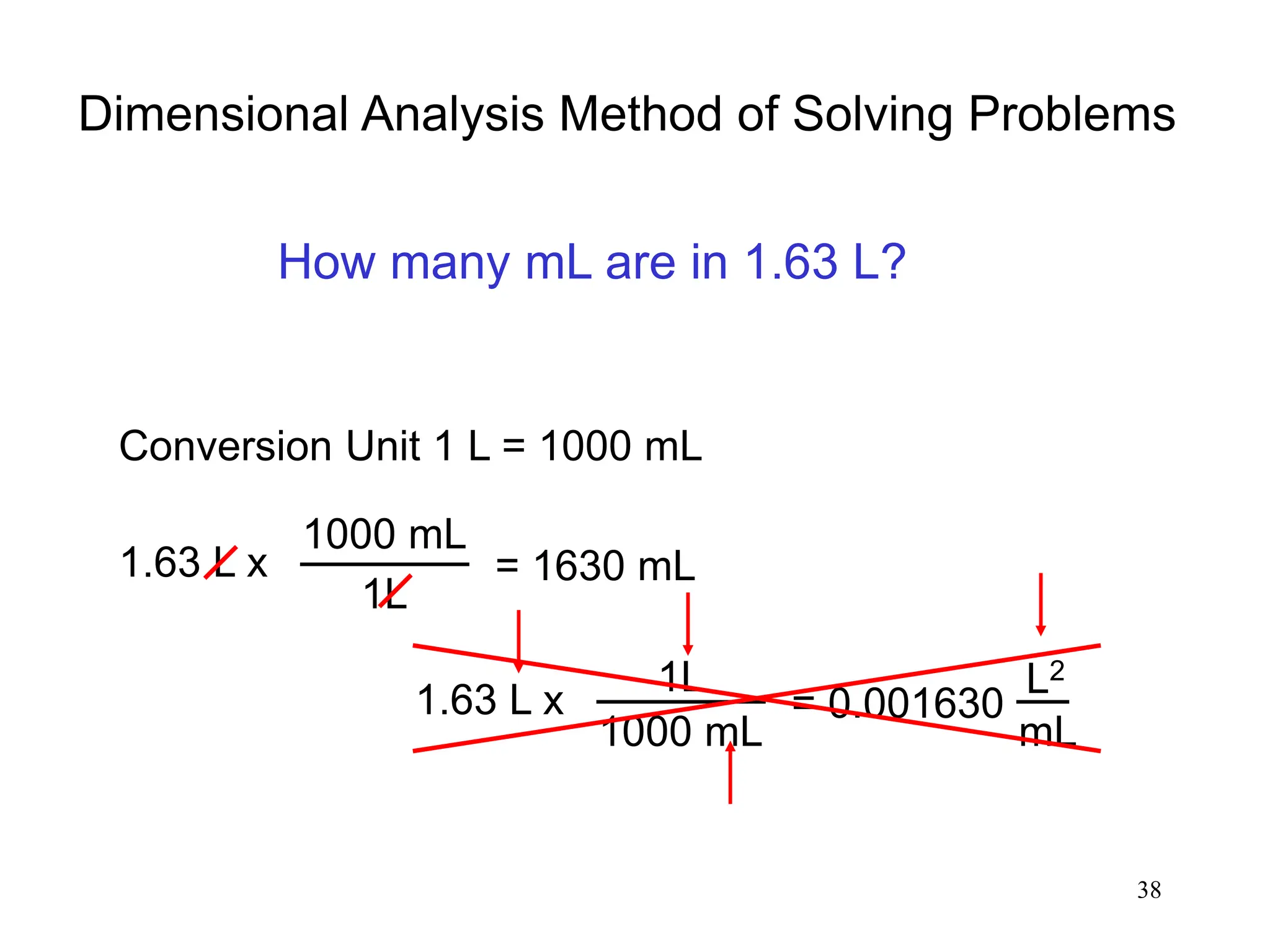
Dimensional Analysis Methodof Solving Problems
Conversion Unit 1 L = 1000 mL
1L
1000 mL
1.63 L x = 1630 mL
1L
1000 mL
1.63 L x = 0.001630
L2
mL
How many mL are in 1.63 L?
39.
39
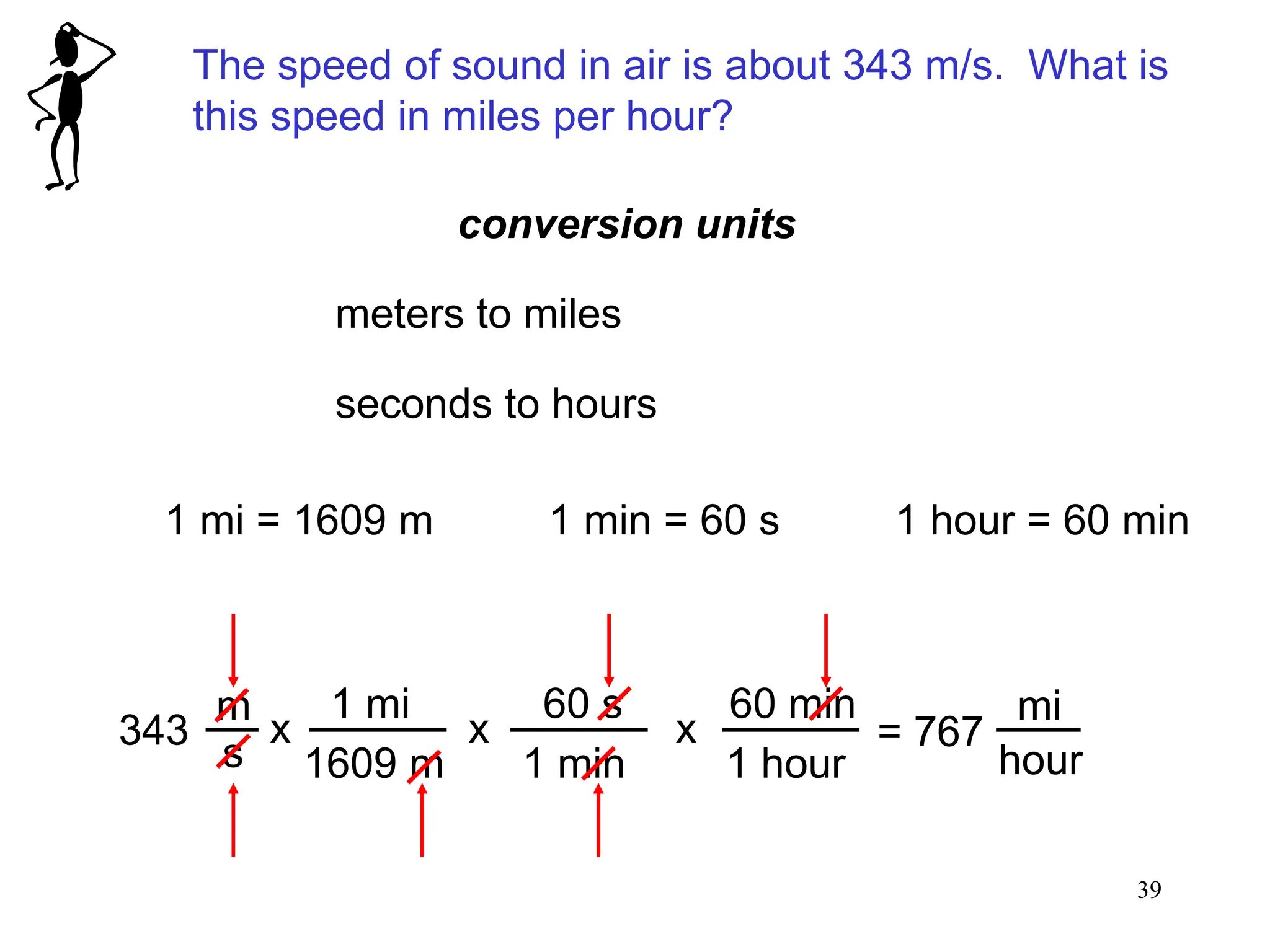
The speed ofsound in air is about 343 m/s. What is
this speed in miles per hour?
1 mi = 1609 m 1 min = 60 s 1 hour = 60 min
343
m
s
x
1 mi
1609 m
60 s
1 min
x
60 min
1 hour
x = 767
mi
hour
meters to miles
seconds to hours
conversion units