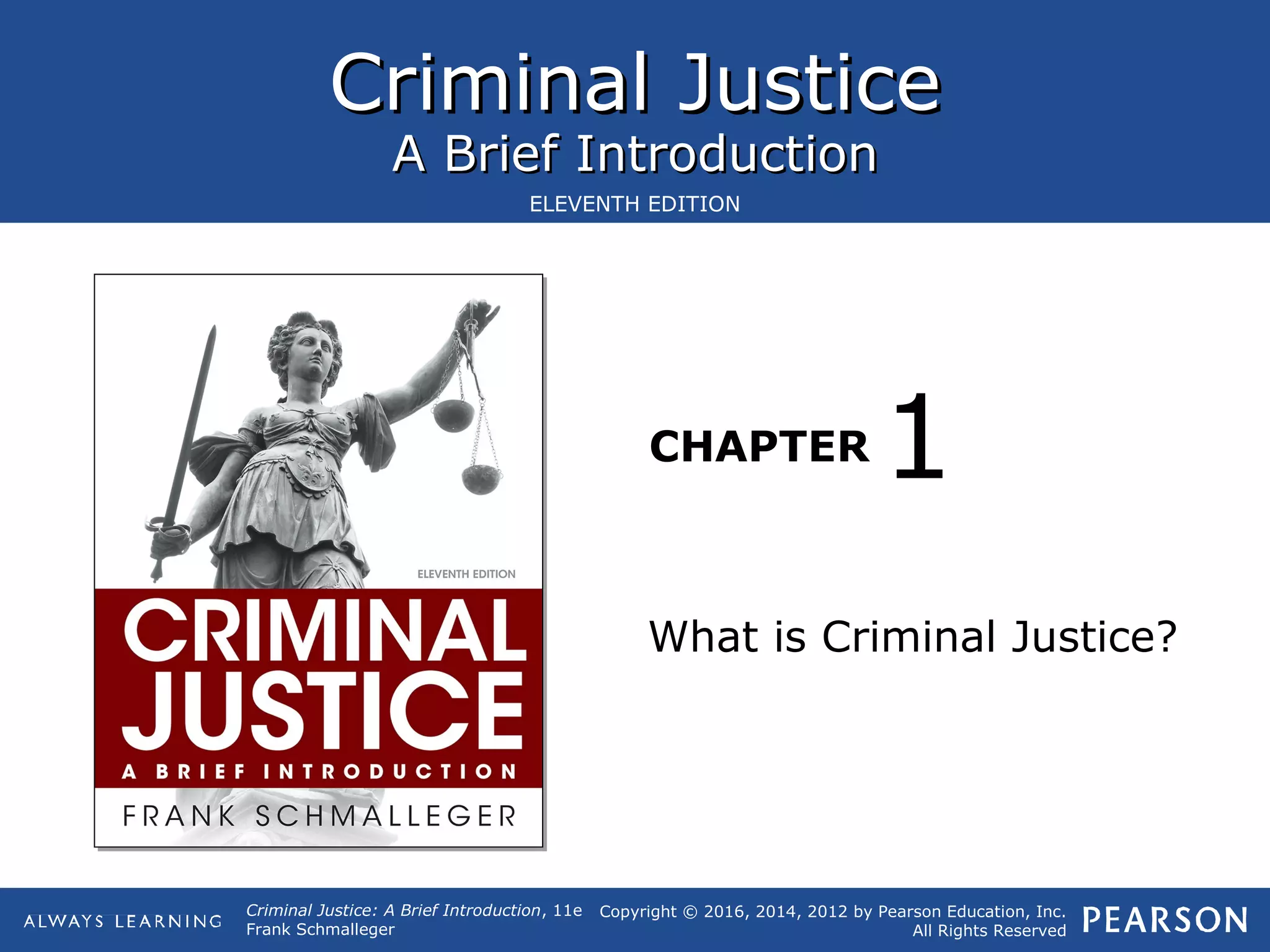
Criminal JusticeCriminal Justice
A Brief IntroductionA Brief Introduction
CHAPTER
Copyright © 2016, 2014, 2012 by Pearson Education, Inc.
All Rights Reserved
Criminal Justice: A Brief Introduction, 11e
Frank Schmalleger
ELEVENTH EDITION
What is Criminal Justice?
1
Copyright © 2016, 2014, 2012 by Pearson Education, Inc.
All Rights Reserved
Criminal Justice: A Brief Introduction, 11e
Frank Schmalleger
A Brief History of Crime in AmericaA Brief History of Crime in America
• 1850-1880
 Civil War, widespread immigration,
crime epidemic
• 1920-1933
 Prohibition, organized crime
• 1960-1970
 The civil rights movement
continued on next slide
Copyright © 2016, 2014, 2012 by Pearson Education, Inc.
All Rights Reserved
Criminal Justice: A Brief Introduction, 11e
Frank Schmalleger
A Brief History of Crime in AmericaA Brief History of Crime in America
• 1980s
 Sale and use of illicit drugs, President
Reagan declared a "war on drugs
• 1990s
 "Get tough on crime" era
• 2001
 USA PATRIOT Act increases
investigatory authority of federal, state,
and local police agencies
continued on next slide
Copyright © 2016, 2014, 2012 by Pearson Education, Inc.
All Rights Reserved
Criminal Justice: A Brief Introduction, 11e
Frank Schmalleger
A Brief History of Crime in AmericaA Brief History of Crime in America
• 2011
 FBI most-wanted terrorist Osama Bin
Laden killed by U.S. special operations
forces in Pakistan
• 2012-2014
 Epidemic of mass shootings and random
violence sweeps public venues across
the U.S.
Copyright © 2016, 2014, 2012 by Pearson Education, Inc.
All Rights Reserved
Criminal Justice: A Brief Introduction, 11e
Frank Schmalleger
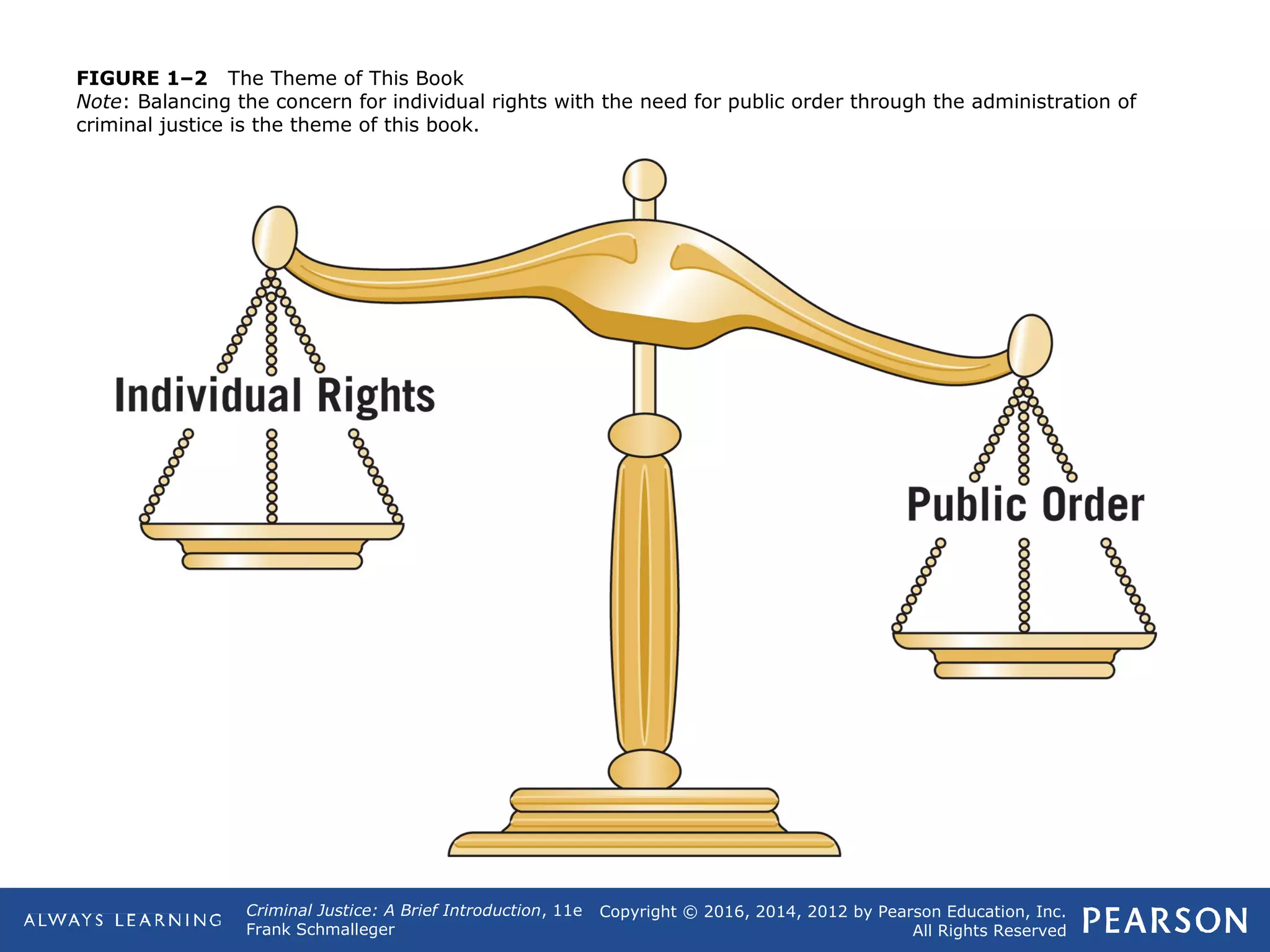
FIGURE 1–2 The Theme of This Book
Note: Balancing the concern for individual rights with the need for public order through the administration of
criminal justice is the theme of this book.
Copyright © 2016, 2014, 2012 by Pearson Education, Inc.
All Rights Reserved
Criminal Justice: A Brief Introduction, 11e
Frank Schmalleger
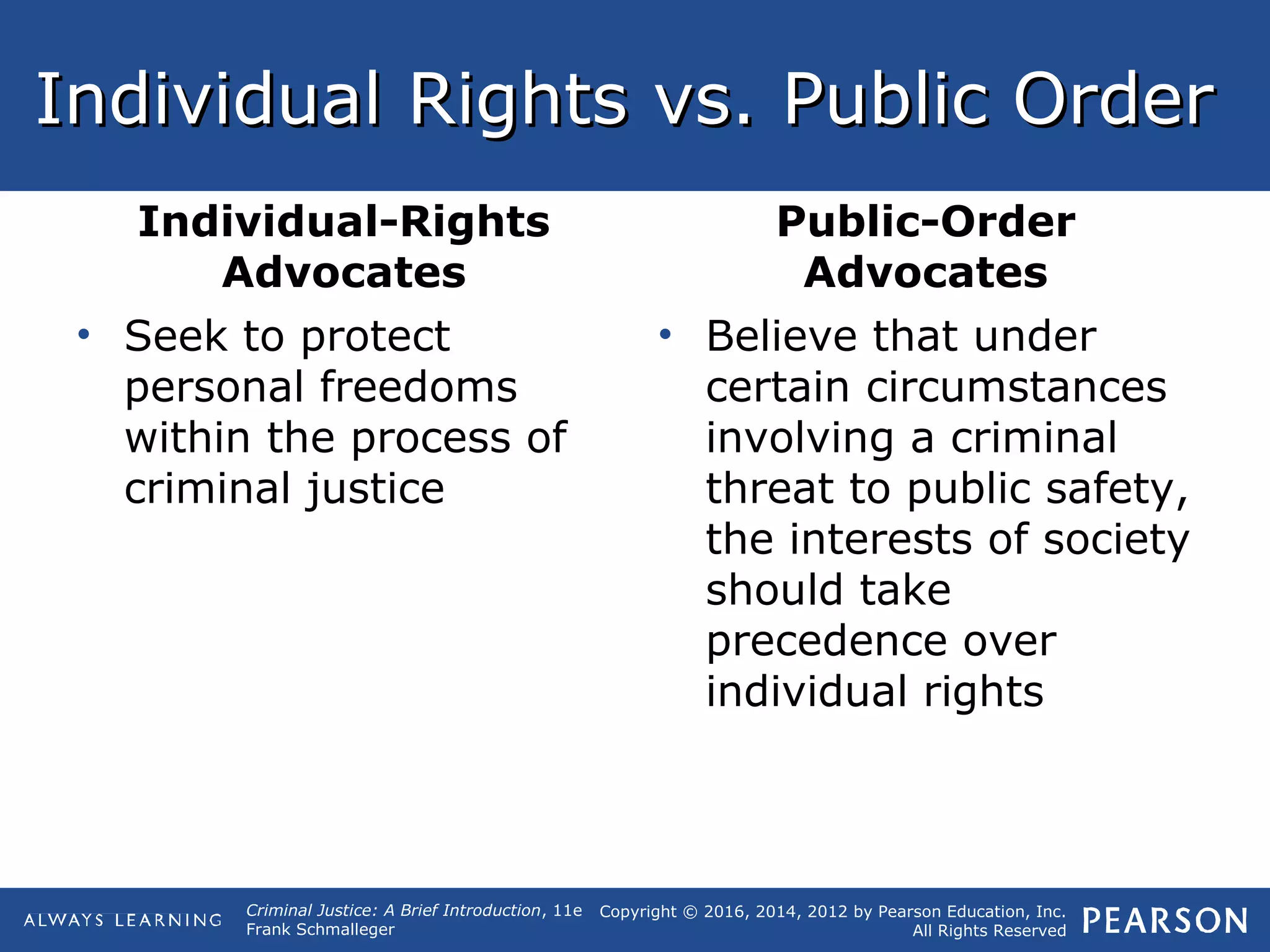
Individual Rights vs. Public OrderIndividual Rights vs. Public Order
Individual-Rights
Advocates
• Seek to protect
personal freedoms
within the process of
criminal justice
Public-Order
Advocates
• Believe that under
certain circumstances
involving a criminal
threat to public safety,
the interests of society
should take
precedence over
individual rights
Copyright © 2016, 2014, 2012 by Pearson Education, Inc.
All Rights Reserved
Criminal Justice: A Brief Introduction, 11e
Frank Schmalleger
Individual Rights vs. Public OrderIndividual Rights vs. Public Order
• 1960s and 1970s
 Known as the civil rights era
 Strong emphasis on individual rights
 Guarantee the rights of defendants and
attempt to understand the causes of
crime and violence
Copyright © 2016, 2014, 2012 by Pearson Education, Inc.
All Rights Reserved
Criminal Justice: A Brief Introduction, 11e
Frank Schmalleger
Individual Rights vs. Public OrderIndividual Rights vs. Public Order
• Today, we have a shift away from the
offender as victim and now see the
offender as a dangerous social
predator.
Copyright © 2016, 2014, 2012 by Pearson Education, Inc.
All Rights Reserved
Criminal Justice: A Brief Introduction, 11e
Frank Schmalleger
Criminal Justice and Basic FairnessCriminal Justice and Basic Fairness
• Justice
 The principle of fairness; the ideal of
moral equity
• Social justice
 Linked to fundamental notions of
fairness and to cultural beliefs about
right and wrong
continued on next slide
Copyright © 2016, 2014, 2012 by Pearson Education, Inc.
All Rights Reserved
Criminal Justice: A Brief Introduction, 11e
Frank Schmalleger
Criminal Justice and Basic FairnessCriminal Justice and Basic Fairness
• Civil justice
 A component of social justice concerned
with fairness in relationships between
citizens, government agencies, and
businesses in private matters
• Criminal justice
 The aspects of social justice that
concern violations of the criminal law
Copyright © 2016, 2014, 2012 by Pearson Education, Inc.
All Rights Reserved
Criminal Justice: A Brief Introduction, 11e
Frank Schmalleger
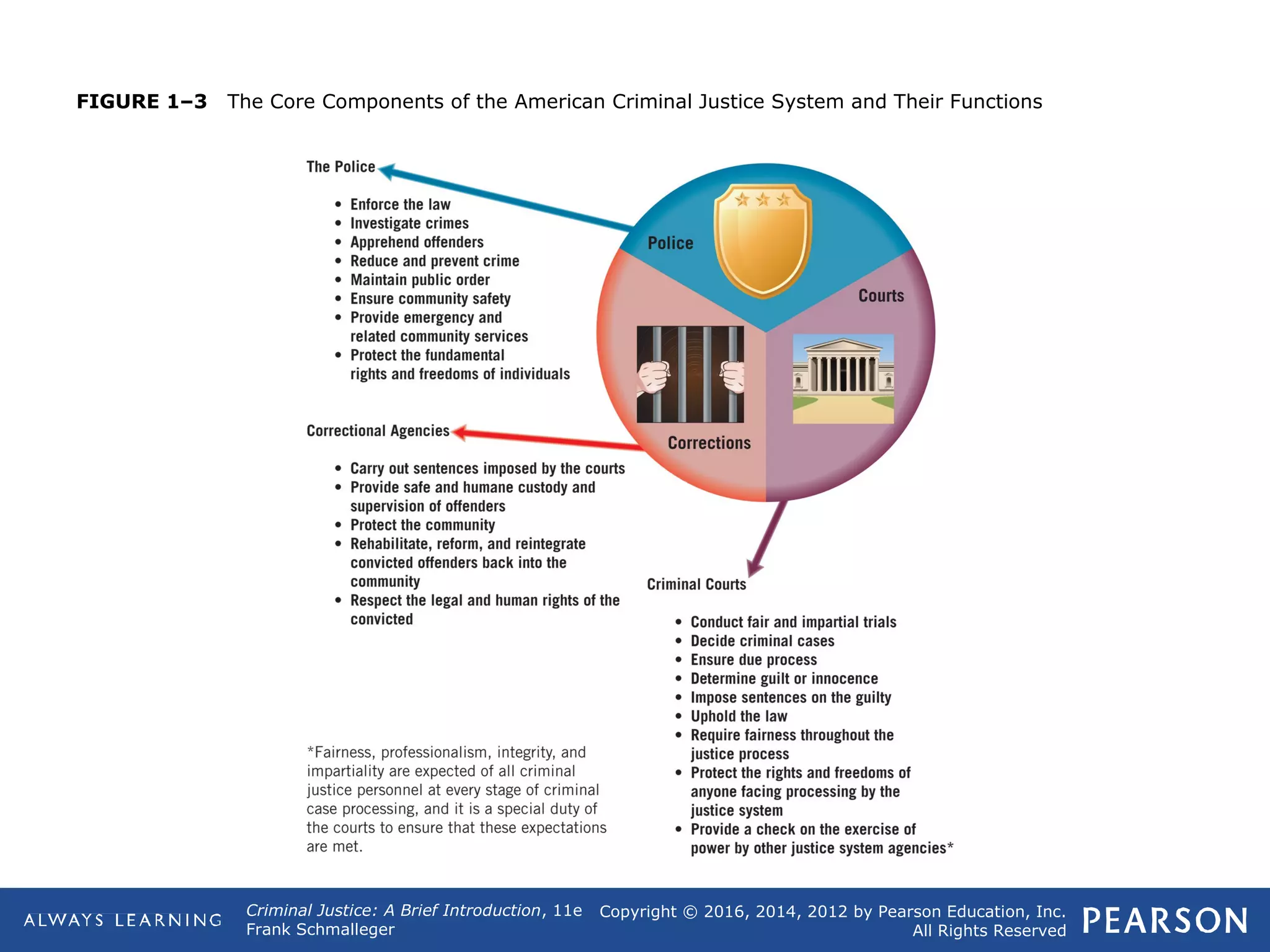
FIGURE 1–3 The Core Components of the American Criminal Justice System and Their Functions
Copyright © 2016, 2014, 2012 by Pearson Education, Inc.
All Rights Reserved
Criminal Justice: A Brief Introduction, 11e
Frank Schmalleger
Criminal Justice System StructureCriminal Justice System Structure
Consensus Model
• Various parts of the
justice system work
together to achieve
the social product of
justice
Conflict Model
• Components of the
justice system
function to serve their
own interests; justice
results from conflict
rather than
cooperation
Copyright © 2016, 2014, 2012 by Pearson Education, Inc.
All Rights Reserved
Criminal Justice: A Brief Introduction, 11e
Frank Schmalleger
Stages of Case ProcessingStages of Case Processing
• Investigation
 Evidence collected, reconstruction of
criminal event
• Warrant
 Writ issued by judge directing officer to
perform an act and protects officer from
damages
continued on next slide
Copyright © 2016, 2014, 2012 by Pearson Education, Inc.
All Rights Reserved
Criminal Justice: A Brief Introduction, 11e
Frank Schmalleger
Stages of Case ProcessingStages of Case Processing
• Arrest
 Act of taking an adult or juvenile into
custody
• Booking
 Taking pictures, fingerprints, personal
information from suspect
continued on next slide
Copyright © 2016, 2014, 2012 by Pearson Education, Inc.
All Rights Reserved
Criminal Justice: A Brief Introduction, 11e
Frank Schmalleger
Stages of Case ProcessingStages of Case Processing
• First Appearance
 Formally notified of the charges, advised
of their rights, given the opportunity to
retain a lawyer or have one appointed to
represent them
• Preliminary Hearing
 Occurs before a judicial officer; allows
the defense to assess the strength of
the prosecution's case
continued on next slide
Copyright © 2016, 2014, 2012 by Pearson Education, Inc.
All Rights Reserved
Criminal Justice: A Brief Introduction, 11e
Frank Schmalleger
Stages of Case ProcessingStages of Case Processing
• Information/ Indictment
 A formal written accusation submitted to
a court by a prosecutor, alleging that
the specified person(s) has committed
(a) specified offense(s)
continued on next slide
Copyright © 2016, 2014, 2012 by Pearson Education, Inc.
All Rights Reserved
Criminal Justice: A Brief Introduction, 11e
Frank Schmalleger
Stages of Case ProcessingStages of Case Processing
• Arraignment
 Hearing before the court having
jurisdiction in a criminal case in which:
• The identity of the defendant is
established
• Said defendant is informed of the
charges against him/her
• The defendant is informed of his/her
rights and requested to enter a plea
continued on next slide
Copyright © 2016, 2014, 2012 by Pearson Education, Inc.
All Rights Reserved
Criminal Justice: A Brief Introduction, 11e
Frank Schmalleger
Stages of Case ProcessingStages of Case Processing
• Adjudication
 Examination of the issues of fact and
law for the purpose of reaching a
judgment of conviction or acquittal
• Sentencing
 A number of difference sentencing
options exist, from fines to the death
penalty
continued on next slide
Copyright © 2016, 2014, 2012 by Pearson Education, Inc.
All Rights Reserved
Criminal Justice: A Brief Introduction, 11e
Frank Schmalleger
Stages of Case ProcessingStages of Case Processing
• Corrections
 The sentence is carried out
• Reentry
 Following corrections, an offender may
be returned to the community.
Copyright © 2016, 2014, 2012 by Pearson Education, Inc.
All Rights Reserved
Criminal Justice: A Brief Introduction, 11e
Frank Schmalleger
The Ultimate Goal: Crime ControlThe Ultimate Goal: Crime Control
through Due Processthrough Due Process
• Crime-control model
 Emphasizes the efficient arrest and
convictions of offenders
• Due process model
 Emphasizes individual rights at all
stages of the justice system processing
• These are often assumed to be
opposing goals.
Copyright © 2016, 2014, 2012 by Pearson Education, Inc.
All Rights Reserved
Criminal Justice: A Brief Introduction, 11e
Frank Schmalleger
Due Process and Individual RightsDue Process and Individual Rights
• Due process
 Right guaranteed by the Fifth, Sixth,
and Fourteenth Amendments of the U.S.
Constitution
 Bill of Rights
 Standard was set in the 1960s by the
Warren Court.
Copyright © 2016, 2014, 2012 by Pearson Education, Inc.
All Rights Reserved
Criminal Justice: A Brief Introduction, 11e
Frank Schmalleger
The Role of the Courts in DefiningThe Role of the Courts in Defining
RightsRights
• Rights are open to interpretation.
• U.S. Supreme Court
 Gideon v. Wainwright (1963)
• Sixth Amendment guarantee of a right to
counsel
• Including court-appointed counsel for
those unable to afford a lawyer
Copyright © 2016, 2014, 2012 by Pearson Education, Inc.
All Rights Reserved
Criminal Justice: A Brief Introduction, 11e
Frank Schmalleger
The Ultimate Goal: Crime ControlThe Ultimate Goal: Crime Control
through Due Processthrough Due Process
• Crime control through due process
 A system of social control that is fair to
those it processes
 Law enforcement infused with the
recognition of individual rights
Copyright © 2016, 2014, 2012 by Pearson Education, Inc.
All Rights Reserved
Criminal Justice: A Brief Introduction, 11e
Frank Schmalleger
The Ultimate Goal: Crime ControlThe Ultimate Goal: Crime Control
through Due Processthrough Due Process
• Social control
 The use of sanctions and rewards within
a group to influence and shape the
behavior of individual members of that
group
Copyright © 2016, 2014, 2012 by Pearson Education, Inc.
All Rights Reserved
Criminal Justice: A Brief Introduction, 11e
Frank Schmalleger
Evidence-Based Practice inEvidence-Based Practice in
Criminal JusticeCriminal Justice
• Refers to crime-fighting strategies that
have been scientifically tested
 Based on social science research
 A major element in the increasing
professionalization of criminal justice
 Strong demand for the application of
evidence-based practices throughout
criminal justice
Copyright © 2016, 2014, 2012 by Pearson Education, Inc.
All Rights Reserved
Criminal Justice: A Brief Introduction, 11e
Frank Schmalleger
The Start of Academic CriminalThe Start of Academic Criminal
JusticeJustice
• Began in the late 1920s
• Early criminal justice education was
practice oriented.
• Primarily focused on the application of
general management principles to the
administration of police agencies
• Organizational effectiveness
Copyright © 2016, 2014, 2012 by Pearson Education, Inc.
All Rights Reserved
Criminal Justice: A Brief Introduction, 11e
Frank Schmalleger
The Start of Academic CriminalThe Start of Academic Criminal
JusticeJustice
• By the 1960s, students began to apply
the techniques of social science
research.
 Criminology
 Sociology
 Psychology
 Political science
Copyright © 2016, 2014, 2012 by Pearson Education, Inc.
All Rights Reserved
Criminal Justice: A Brief Introduction, 11e
Frank Schmalleger
Multiculturalism and DiversityMulticulturalism and Diversity
in Criminal Justicein Criminal Justice
• Multiculturalism
 The existence within one society of
diverse groups that maintain unique
cultural identities while frequently
accepting and participating in the larger
society's legal and political systems

Schmalleger ch01 lecture

  • 1.
    Criminal JusticeCriminal Justice ABrief IntroductionA Brief Introduction CHAPTER Copyright © 2016, 2014, 2012 by Pearson Education, Inc. All Rights Reserved Criminal Justice: A Brief Introduction, 11e Frank Schmalleger ELEVENTH EDITION What is Criminal Justice? 1
  • 2.
    Copyright © 2016,2014, 2012 by Pearson Education, Inc. All Rights Reserved Criminal Justice: A Brief Introduction, 11e Frank Schmalleger A Brief History of Crime in AmericaA Brief History of Crime in America • 1850-1880  Civil War, widespread immigration, crime epidemic • 1920-1933  Prohibition, organized crime • 1960-1970  The civil rights movement continued on next slide
  • 3.
    Copyright © 2016,2014, 2012 by Pearson Education, Inc. All Rights Reserved Criminal Justice: A Brief Introduction, 11e Frank Schmalleger A Brief History of Crime in AmericaA Brief History of Crime in America • 1980s  Sale and use of illicit drugs, President Reagan declared a "war on drugs • 1990s  "Get tough on crime" era • 2001  USA PATRIOT Act increases investigatory authority of federal, state, and local police agencies continued on next slide
  • 4.
    Copyright © 2016,2014, 2012 by Pearson Education, Inc. All Rights Reserved Criminal Justice: A Brief Introduction, 11e Frank Schmalleger A Brief History of Crime in AmericaA Brief History of Crime in America • 2011  FBI most-wanted terrorist Osama Bin Laden killed by U.S. special operations forces in Pakistan • 2012-2014  Epidemic of mass shootings and random violence sweeps public venues across the U.S.
  • 5.
    Copyright © 2016,2014, 2012 by Pearson Education, Inc. All Rights Reserved Criminal Justice: A Brief Introduction, 11e Frank Schmalleger FIGURE 1–2 The Theme of This Book Note: Balancing the concern for individual rights with the need for public order through the administration of criminal justice is the theme of this book.
  • 6.
    Copyright © 2016,2014, 2012 by Pearson Education, Inc. All Rights Reserved Criminal Justice: A Brief Introduction, 11e Frank Schmalleger Individual Rights vs. Public OrderIndividual Rights vs. Public Order Individual-Rights Advocates • Seek to protect personal freedoms within the process of criminal justice Public-Order Advocates • Believe that under certain circumstances involving a criminal threat to public safety, the interests of society should take precedence over individual rights
  • 7.
    Copyright © 2016,2014, 2012 by Pearson Education, Inc. All Rights Reserved Criminal Justice: A Brief Introduction, 11e Frank Schmalleger Individual Rights vs. Public OrderIndividual Rights vs. Public Order • 1960s and 1970s  Known as the civil rights era  Strong emphasis on individual rights  Guarantee the rights of defendants and attempt to understand the causes of crime and violence
  • 8.
    Copyright © 2016,2014, 2012 by Pearson Education, Inc. All Rights Reserved Criminal Justice: A Brief Introduction, 11e Frank Schmalleger Individual Rights vs. Public OrderIndividual Rights vs. Public Order • Today, we have a shift away from the offender as victim and now see the offender as a dangerous social predator.
  • 9.
    Copyright © 2016,2014, 2012 by Pearson Education, Inc. All Rights Reserved Criminal Justice: A Brief Introduction, 11e Frank Schmalleger Criminal Justice and Basic FairnessCriminal Justice and Basic Fairness • Justice  The principle of fairness; the ideal of moral equity • Social justice  Linked to fundamental notions of fairness and to cultural beliefs about right and wrong continued on next slide
  • 10.
    Copyright © 2016,2014, 2012 by Pearson Education, Inc. All Rights Reserved Criminal Justice: A Brief Introduction, 11e Frank Schmalleger Criminal Justice and Basic FairnessCriminal Justice and Basic Fairness • Civil justice  A component of social justice concerned with fairness in relationships between citizens, government agencies, and businesses in private matters • Criminal justice  The aspects of social justice that concern violations of the criminal law
  • 11.
    Copyright © 2016,2014, 2012 by Pearson Education, Inc. All Rights Reserved Criminal Justice: A Brief Introduction, 11e Frank Schmalleger FIGURE 1–3 The Core Components of the American Criminal Justice System and Their Functions
  • 12.
    Copyright © 2016,2014, 2012 by Pearson Education, Inc. All Rights Reserved Criminal Justice: A Brief Introduction, 11e Frank Schmalleger Criminal Justice System StructureCriminal Justice System Structure Consensus Model • Various parts of the justice system work together to achieve the social product of justice Conflict Model • Components of the justice system function to serve their own interests; justice results from conflict rather than cooperation
  • 13.
    Copyright © 2016,2014, 2012 by Pearson Education, Inc. All Rights Reserved Criminal Justice: A Brief Introduction, 11e Frank Schmalleger Stages of Case ProcessingStages of Case Processing • Investigation  Evidence collected, reconstruction of criminal event • Warrant  Writ issued by judge directing officer to perform an act and protects officer from damages continued on next slide
  • 14.
    Copyright © 2016,2014, 2012 by Pearson Education, Inc. All Rights Reserved Criminal Justice: A Brief Introduction, 11e Frank Schmalleger Stages of Case ProcessingStages of Case Processing • Arrest  Act of taking an adult or juvenile into custody • Booking  Taking pictures, fingerprints, personal information from suspect continued on next slide
  • 15.
    Copyright © 2016,2014, 2012 by Pearson Education, Inc. All Rights Reserved Criminal Justice: A Brief Introduction, 11e Frank Schmalleger Stages of Case ProcessingStages of Case Processing • First Appearance  Formally notified of the charges, advised of their rights, given the opportunity to retain a lawyer or have one appointed to represent them • Preliminary Hearing  Occurs before a judicial officer; allows the defense to assess the strength of the prosecution's case continued on next slide
  • 16.
    Copyright © 2016,2014, 2012 by Pearson Education, Inc. All Rights Reserved Criminal Justice: A Brief Introduction, 11e Frank Schmalleger Stages of Case ProcessingStages of Case Processing • Information/ Indictment  A formal written accusation submitted to a court by a prosecutor, alleging that the specified person(s) has committed (a) specified offense(s) continued on next slide
  • 17.
    Copyright © 2016,2014, 2012 by Pearson Education, Inc. All Rights Reserved Criminal Justice: A Brief Introduction, 11e Frank Schmalleger Stages of Case ProcessingStages of Case Processing • Arraignment  Hearing before the court having jurisdiction in a criminal case in which: • The identity of the defendant is established • Said defendant is informed of the charges against him/her • The defendant is informed of his/her rights and requested to enter a plea continued on next slide
  • 18.
    Copyright © 2016,2014, 2012 by Pearson Education, Inc. All Rights Reserved Criminal Justice: A Brief Introduction, 11e Frank Schmalleger Stages of Case ProcessingStages of Case Processing • Adjudication  Examination of the issues of fact and law for the purpose of reaching a judgment of conviction or acquittal • Sentencing  A number of difference sentencing options exist, from fines to the death penalty continued on next slide
  • 19.
    Copyright © 2016,2014, 2012 by Pearson Education, Inc. All Rights Reserved Criminal Justice: A Brief Introduction, 11e Frank Schmalleger Stages of Case ProcessingStages of Case Processing • Corrections  The sentence is carried out • Reentry  Following corrections, an offender may be returned to the community.
  • 20.
    Copyright © 2016,2014, 2012 by Pearson Education, Inc. All Rights Reserved Criminal Justice: A Brief Introduction, 11e Frank Schmalleger The Ultimate Goal: Crime ControlThe Ultimate Goal: Crime Control through Due Processthrough Due Process • Crime-control model  Emphasizes the efficient arrest and convictions of offenders • Due process model  Emphasizes individual rights at all stages of the justice system processing • These are often assumed to be opposing goals.
  • 21.
    Copyright © 2016,2014, 2012 by Pearson Education, Inc. All Rights Reserved Criminal Justice: A Brief Introduction, 11e Frank Schmalleger Due Process and Individual RightsDue Process and Individual Rights • Due process  Right guaranteed by the Fifth, Sixth, and Fourteenth Amendments of the U.S. Constitution  Bill of Rights  Standard was set in the 1960s by the Warren Court.
  • 22.
    Copyright © 2016,2014, 2012 by Pearson Education, Inc. All Rights Reserved Criminal Justice: A Brief Introduction, 11e Frank Schmalleger The Role of the Courts in DefiningThe Role of the Courts in Defining RightsRights • Rights are open to interpretation. • U.S. Supreme Court  Gideon v. Wainwright (1963) • Sixth Amendment guarantee of a right to counsel • Including court-appointed counsel for those unable to afford a lawyer
  • 23.
    Copyright © 2016,2014, 2012 by Pearson Education, Inc. All Rights Reserved Criminal Justice: A Brief Introduction, 11e Frank Schmalleger The Ultimate Goal: Crime ControlThe Ultimate Goal: Crime Control through Due Processthrough Due Process • Crime control through due process  A system of social control that is fair to those it processes  Law enforcement infused with the recognition of individual rights
  • 24.
    Copyright © 2016,2014, 2012 by Pearson Education, Inc. All Rights Reserved Criminal Justice: A Brief Introduction, 11e Frank Schmalleger The Ultimate Goal: Crime ControlThe Ultimate Goal: Crime Control through Due Processthrough Due Process • Social control  The use of sanctions and rewards within a group to influence and shape the behavior of individual members of that group
  • 25.
    Copyright © 2016,2014, 2012 by Pearson Education, Inc. All Rights Reserved Criminal Justice: A Brief Introduction, 11e Frank Schmalleger Evidence-Based Practice inEvidence-Based Practice in Criminal JusticeCriminal Justice • Refers to crime-fighting strategies that have been scientifically tested  Based on social science research  A major element in the increasing professionalization of criminal justice  Strong demand for the application of evidence-based practices throughout criminal justice
  • 26.
    Copyright © 2016,2014, 2012 by Pearson Education, Inc. All Rights Reserved Criminal Justice: A Brief Introduction, 11e Frank Schmalleger The Start of Academic CriminalThe Start of Academic Criminal JusticeJustice • Began in the late 1920s • Early criminal justice education was practice oriented. • Primarily focused on the application of general management principles to the administration of police agencies • Organizational effectiveness
  • 27.
    Copyright © 2016,2014, 2012 by Pearson Education, Inc. All Rights Reserved Criminal Justice: A Brief Introduction, 11e Frank Schmalleger The Start of Academic CriminalThe Start of Academic Criminal JusticeJustice • By the 1960s, students began to apply the techniques of social science research.  Criminology  Sociology  Psychology  Political science
  • 28.
    Copyright © 2016,2014, 2012 by Pearson Education, Inc. All Rights Reserved Criminal Justice: A Brief Introduction, 11e Frank Schmalleger Multiculturalism and DiversityMulticulturalism and Diversity in Criminal Justicein Criminal Justice • Multiculturalism  The existence within one society of diverse groups that maintain unique cultural identities while frequently accepting and participating in the larger society's legal and political systems