CRIME
DETECTION
PRESENTED BY
M.MOBEEN (2017-21)
DEPARTMENT OF SOCIOLOGY
GC UNIVERSITY FAISALABAD
CRIME DETECTION
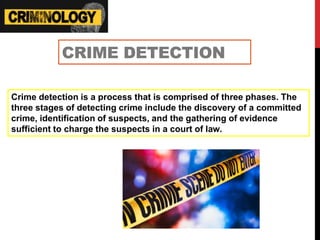
Crime detection is a process that is comprised of three phases. The
three stages of detecting crime include the discovery of a committed
crime, identification of suspects, and the gathering of evidence
sufficient to charge the suspects in a court of law.
 Committed Crime
• During this process, incidences of crime might either be reported
by members of the community, by a close relative of the victims,
by a friend or by the victim may report the occurrence of crime to
law enforcement agencies. Detectives and other law
enforcement officers are supposed to show up at the crime scene
to interview witnesses, collect evidence, and additional relevant
information that may lead to arresting and charging the criminal
court.
 Identification of Suspect
• The police and other law enforcement detectives have first to
identify the criminal suspect. Certain instances require law
enforcement agencies to do in-depth investigations to identify the
suspect. In other cases, the suspects are either caught in the act of
crime or are reported by potential witnesses.
• Advanced forensic techniques such as DNA and fingerprint
scanning are used to identify suspects thoroughly. Upon the
identification of a suspect, it is the role of the law enforcement
agencies to issue warranty of arrest and track down the suspect
with the help of the community.
 Gathering of Evidence
• Evidence in a crime scene is any physical or argument proof that
establishes legal interpretation facts that justify that a crime was
committed. Evidence can include; material objects, DNA,
fingerprints, oral statements, written documents, and other
relevant information. Gathering of proof in a crime scene is vital
as it allows law enforcement agencies to charge suspects in a
court of law.
 conclusion
• the prevention and detection of
crime depend on the
communication between the
community and law enforcement
agencies.
• Community awareness of crime is necessary for reducing
criminal activity because they are supposed to help law
enforcement agencies by reporting incidences

Crime detection

  • 1.
  • 2.
    CRIME DETECTION Crime detectionis a process that is comprised of three phases. The three stages of detecting crime include the discovery of a committed crime, identification of suspects, and the gathering of evidence sufficient to charge the suspects in a court of law.
  • 3.
     Committed Crime •During this process, incidences of crime might either be reported by members of the community, by a close relative of the victims, by a friend or by the victim may report the occurrence of crime to law enforcement agencies. Detectives and other law enforcement officers are supposed to show up at the crime scene to interview witnesses, collect evidence, and additional relevant information that may lead to arresting and charging the criminal court.
  • 4.
     Identification ofSuspect • The police and other law enforcement detectives have first to identify the criminal suspect. Certain instances require law enforcement agencies to do in-depth investigations to identify the suspect. In other cases, the suspects are either caught in the act of crime or are reported by potential witnesses. • Advanced forensic techniques such as DNA and fingerprint scanning are used to identify suspects thoroughly. Upon the identification of a suspect, it is the role of the law enforcement agencies to issue warranty of arrest and track down the suspect with the help of the community.
  • 5.
     Gathering ofEvidence • Evidence in a crime scene is any physical or argument proof that establishes legal interpretation facts that justify that a crime was committed. Evidence can include; material objects, DNA, fingerprints, oral statements, written documents, and other relevant information. Gathering of proof in a crime scene is vital as it allows law enforcement agencies to charge suspects in a court of law.
  • 6.
     conclusion • theprevention and detection of crime depend on the communication between the community and law enforcement agencies. • Community awareness of crime is necessary for reducing criminal activity because they are supposed to help law enforcement agencies by reporting incidences