Vehicle Fires

  Chapter 14


                © 2009 Delmar, Cengage Learning
Objectives
• Describe the safety precautions that must be
  taken before starting the investigation
• Describe the fuel and electrical systems of most
  common vehicles
• Describe the potential heat sources and fuels
  available in most vehicles today
• Describe the potential for arson and which
  indicators may point to an incendiary nature of
  the fire


                                         © 2009 Delmar, Cengage Learning
Case Study
• Student had no feeling below arms
• Family obtained used car that could be operated
  by hand controls
• Mother noticed burning smell when son returned
  from school and found that he suffered burns to
  his back
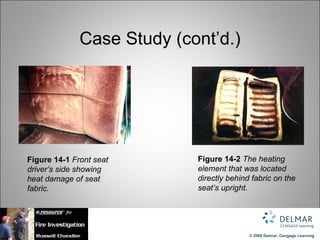
• Investigation of vehicle found seat heater had
  malfunctioned, causing burns


                                        © 2009 Delmar, Cengage Learning
Case Study (cont’d.)


Figure 14-1 Front seat      Figure 14-2 The heating
driver’s side showing       element that was located
heat damage of seat         directly behind fabric on the
fabric.                     seat’s upright.


                                           © 2009 Delmar, Cengage Learning
Introduction
• Vehicle fires are some of the most confusing
  fires to work
• Investigators need to do fire scene
  reconstruction
  – Work the scene from the least damage to the most
    damage
• Passenger vehicle today is an extremely
  complex device
• 278,000 vehicle fires occurred in 2006


                                            © 2009 Delmar, Cengage Learning
Safety and Initial Examination
• All precautions should be taken to protect
  yourself and others from injury
• Materials in modern vehicles contain numerous
  toxic fumes that are released from burning
  components
  – Range from hydrogen cyanide to carbon monoxide
  – Off-gassing: refers to vapors or gases that were
    absorbed by fabric, carpet, and so forth during a fire
    and then released after the fire was extinguished


                                                © 2009 Delmar, Cengage Learning
Safety and Initial Examination
              (cont’d.)
• First responder investigator should not take for
  granted that the initial fire crews have secured
  the vehicle
• Airbag deployment is a huge area of concern
  – Bags can inflate in 1/20th of a second
• Not recommended to crawl under the vehicle
• Always be aware of sharp edges and broken
  glass
  – Wear protective equipment at all times


                                             © 2009 Delmar, Cengage Learning
Type of Vehicle and Ignitable Fuels
• Basic makeup of various vehicles is the same
  – Framework, wheels, interior, and so forth


                                                © 2009 Delmar, Cengage Learning
Diesel Engines
• Diesel engines operate on a compressed
  combustion chamber
• Diesel fuel is a combustible liquid with a flash
  point above 100° F
• Fuel is stored in a sealed tank and is pumped
  from a fuel pump through lines and filters
• Failure of the system at any given point may be
  a possible point of fuel release in some vehicle
  fires


                                         © 2009 Delmar, Cengage Learning
Gasoline Engines
• Gasoline is more volatile and has a lower
  ignition temperature
  – Causes concern about it being the first fuel ignited
• Gasoline engines operate on flammable liquids
  that have a flash point of less than 100°F
  – Lack of maintenance or worn and loose parts can
    cause the fuel to be sprayed
     • Possible cause for the spread of the fire in the event it
       came into contact with an ignition source


                                                     © 2009 Delmar, Cengage Learning
Other Liquids
• Transmission fluid, windshield washer solvents,
  ethylene glycol, motor oil, brake fluids, and
  other hydraulic fluids
  – May ignite under extreme conditions, either
    contributing to or causing a fire


                                                  © 2009 Delmar, Cengage Learning
Hot Surfaces
• Manifold, catalytic converter, and exhaust pipe
  operate at sufficient temperatures to ignite a
  wide range of fuels
• Leaking brake fluid is most often the first fuel
  ignited when it leaks onto a hot surface
• Gasoline will not usually ignite when sprayed
  onto a hot surface
  – Many variables such as ventilation or humidity can
    influence this


                                              © 2009 Delmar, Cengage Learning
Electrical Systems
• Most vehicles operate on a 12-volt direct current
  (DC) system
  – Secondary wiring can come into play in fires from
    wear and tear and misuse
  – Resistance heating can cause the insulation around
    the wire to break down or melt
• Hybrids bring a whole new realm to the
  investigation of vehicle fires
  – Voltage in hybrid vehicles can reach more than 300
    volts of alternating current (AC)


                                              © 2009 Delmar, Cengage Learning
Hybrid Vehicles
• Combine an internal combustion gasoline
  engine with an electric, battery-powered motor
• Contain a high-voltage NI-MH battery pack
• In a series hybrid, the gasoline engine will
  automatically stop and start
• In a parallel system, the electric motor runs in
  conjunction with the gasoline engine
• If the vehicle is partially or more submerged, do
  not touch any high-voltage components

                                          © 2009 Delmar, Cengage Learning
Other Forms of Heat
• Vehicle’s heater, fans, and wires attached need
  to be looked at
• Properly operating catalytic converter, located
  on the underside of the vehicle, can reach
  temperatures of more than 700° F
• Turbo chargers create tremendous amounts of
  heat and may be a source of ignition
• Smoking-related incidents can be difficult to find


                                          © 2009 Delmar, Cengage Learning
How Did the Vehicle Burn and
               Why?
• If the vehicle was kept in clean and running
  condition and there is a fire, it may have been
  arson
  – For the purpose of insurance fraud
• Scene first needs to be photographed from all
  sides
• Photos of the area from the vehicle looking
  outward need to be taken
  – Particularly important when a stolen vehicle is found


                                                © 2009 Delmar, Cengage Learning
What Does the Exterior of the
         Vehicle Tell You?
• Extent of damage may show direction of fire
  travel
• Burn marks or demarcation lines may show path
  of travel
• Patterns left behind will show the direction from
  where the fire began
• Fire burns typically up and out
  – V pattern as in structure fire


                                         © 2009 Delmar, Cengage Learning
What Does the Exterior of the
     Vehicle Tell You? (cont’d.)
• VIN contains information about the vehicle, such
  as year, make, model, engine, and paint color
• One interesting facet to look at is the vehicle’s
  glass
  – Fire will cause long cracks on the front windshield
• Look at the tires remaining on the vehicle
  – May show direction of flame


                                                © 2009 Delmar, Cengage Learning
Inside the Vehicle
• Look at the glove box
• Did the owner leave the keys in the vehicle?
• Most of the interior of the vehicle is combustible
   – Composed of plastics or fabric
• Hood will show burn patterns from the heat and
  flame impingement if the fire was in the engine
  compartment


                                           © 2009 Delmar, Cengage Learning
Motor Homes
• Motor home contains components of a vehicle
  combined with the combustibles and heat
  source of a structure
• Motor homes are unusual and must be
  investigated with care
  – May contain liquid propane gas for heat and fuel for
    the cooking equipment
  – May have a built-in generator that may use a
    flammable or combustible liquid


                                               © 2009 Delmar, Cengage Learning
Boats
• Not much different from a vehicle or a motor
  home
• Gasoline can collect in lowest part of hull
• Unique situations in boat fires
  – Possibility that the boat sank
• With inboard motors, you should look into the
  engine compartment
• Area where the boat was moored should be
  closely examined

                                         © 2009 Delmar, Cengage Learning
Summary
• Work the fires from the exterior to the interior
  and from the least damaged to most damaged
• Scene needs to be documented and
  photographed on all sides
• Investigator needs to sift debris to find evidence
  that will aid in using a scientific methodology
• Both motor homes and boats have the same
  characteristics as other motorized vehicles


                                           © 2009 Delmar, Cengage Learning

Chapter 14

  • 1.
    Vehicle Fires Chapter 14 © 2009 Delmar, Cengage Learning
  • 2.
    Objectives • Describe thesafety precautions that must be taken before starting the investigation • Describe the fuel and electrical systems of most common vehicles • Describe the potential heat sources and fuels available in most vehicles today • Describe the potential for arson and which indicators may point to an incendiary nature of the fire © 2009 Delmar, Cengage Learning
  • 3.
    Case Study • Studenthad no feeling below arms • Family obtained used car that could be operated by hand controls • Mother noticed burning smell when son returned from school and found that he suffered burns to his back • Investigation of vehicle found seat heater had malfunctioned, causing burns © 2009 Delmar, Cengage Learning
  • 4.
    Case Study (cont’d.) Figure14-1 Front seat Figure 14-2 The heating driver’s side showing element that was located heat damage of seat directly behind fabric on the fabric. seat’s upright. © 2009 Delmar, Cengage Learning
  • 5.
    Introduction • Vehicle firesare some of the most confusing fires to work • Investigators need to do fire scene reconstruction – Work the scene from the least damage to the most damage • Passenger vehicle today is an extremely complex device • 278,000 vehicle fires occurred in 2006 © 2009 Delmar, Cengage Learning
  • 6.
    Safety and InitialExamination • All precautions should be taken to protect yourself and others from injury • Materials in modern vehicles contain numerous toxic fumes that are released from burning components – Range from hydrogen cyanide to carbon monoxide – Off-gassing: refers to vapors or gases that were absorbed by fabric, carpet, and so forth during a fire and then released after the fire was extinguished © 2009 Delmar, Cengage Learning
  • 7.
    Safety and InitialExamination (cont’d.) • First responder investigator should not take for granted that the initial fire crews have secured the vehicle • Airbag deployment is a huge area of concern – Bags can inflate in 1/20th of a second • Not recommended to crawl under the vehicle • Always be aware of sharp edges and broken glass – Wear protective equipment at all times © 2009 Delmar, Cengage Learning
  • 8.
    Type of Vehicleand Ignitable Fuels • Basic makeup of various vehicles is the same – Framework, wheels, interior, and so forth © 2009 Delmar, Cengage Learning
  • 9.
    Diesel Engines • Dieselengines operate on a compressed combustion chamber • Diesel fuel is a combustible liquid with a flash point above 100° F • Fuel is stored in a sealed tank and is pumped from a fuel pump through lines and filters • Failure of the system at any given point may be a possible point of fuel release in some vehicle fires © 2009 Delmar, Cengage Learning
  • 10.
    Gasoline Engines • Gasolineis more volatile and has a lower ignition temperature – Causes concern about it being the first fuel ignited • Gasoline engines operate on flammable liquids that have a flash point of less than 100°F – Lack of maintenance or worn and loose parts can cause the fuel to be sprayed • Possible cause for the spread of the fire in the event it came into contact with an ignition source © 2009 Delmar, Cengage Learning
  • 11.
    Other Liquids • Transmissionfluid, windshield washer solvents, ethylene glycol, motor oil, brake fluids, and other hydraulic fluids – May ignite under extreme conditions, either contributing to or causing a fire © 2009 Delmar, Cengage Learning
  • 12.
    Hot Surfaces • Manifold,catalytic converter, and exhaust pipe operate at sufficient temperatures to ignite a wide range of fuels • Leaking brake fluid is most often the first fuel ignited when it leaks onto a hot surface • Gasoline will not usually ignite when sprayed onto a hot surface – Many variables such as ventilation or humidity can influence this © 2009 Delmar, Cengage Learning
  • 13.
    Electrical Systems • Mostvehicles operate on a 12-volt direct current (DC) system – Secondary wiring can come into play in fires from wear and tear and misuse – Resistance heating can cause the insulation around the wire to break down or melt • Hybrids bring a whole new realm to the investigation of vehicle fires – Voltage in hybrid vehicles can reach more than 300 volts of alternating current (AC) © 2009 Delmar, Cengage Learning
  • 14.
    Hybrid Vehicles • Combinean internal combustion gasoline engine with an electric, battery-powered motor • Contain a high-voltage NI-MH battery pack • In a series hybrid, the gasoline engine will automatically stop and start • In a parallel system, the electric motor runs in conjunction with the gasoline engine • If the vehicle is partially or more submerged, do not touch any high-voltage components © 2009 Delmar, Cengage Learning
  • 15.
    Other Forms ofHeat • Vehicle’s heater, fans, and wires attached need to be looked at • Properly operating catalytic converter, located on the underside of the vehicle, can reach temperatures of more than 700° F • Turbo chargers create tremendous amounts of heat and may be a source of ignition • Smoking-related incidents can be difficult to find © 2009 Delmar, Cengage Learning
  • 16.
    How Did theVehicle Burn and Why? • If the vehicle was kept in clean and running condition and there is a fire, it may have been arson – For the purpose of insurance fraud • Scene first needs to be photographed from all sides • Photos of the area from the vehicle looking outward need to be taken – Particularly important when a stolen vehicle is found © 2009 Delmar, Cengage Learning
  • 17.
    What Does theExterior of the Vehicle Tell You? • Extent of damage may show direction of fire travel • Burn marks or demarcation lines may show path of travel • Patterns left behind will show the direction from where the fire began • Fire burns typically up and out – V pattern as in structure fire © 2009 Delmar, Cengage Learning
  • 18.
    What Does theExterior of the Vehicle Tell You? (cont’d.) • VIN contains information about the vehicle, such as year, make, model, engine, and paint color • One interesting facet to look at is the vehicle’s glass – Fire will cause long cracks on the front windshield • Look at the tires remaining on the vehicle – May show direction of flame © 2009 Delmar, Cengage Learning
  • 19.
    Inside the Vehicle •Look at the glove box • Did the owner leave the keys in the vehicle? • Most of the interior of the vehicle is combustible – Composed of plastics or fabric • Hood will show burn patterns from the heat and flame impingement if the fire was in the engine compartment © 2009 Delmar, Cengage Learning
  • 20.
    Motor Homes • Motorhome contains components of a vehicle combined with the combustibles and heat source of a structure • Motor homes are unusual and must be investigated with care – May contain liquid propane gas for heat and fuel for the cooking equipment – May have a built-in generator that may use a flammable or combustible liquid © 2009 Delmar, Cengage Learning
  • 21.
    Boats • Not muchdifferent from a vehicle or a motor home • Gasoline can collect in lowest part of hull • Unique situations in boat fires – Possibility that the boat sank • With inboard motors, you should look into the engine compartment • Area where the boat was moored should be closely examined © 2009 Delmar, Cengage Learning
  • 22.
    Summary • Work thefires from the exterior to the interior and from the least damaged to most damaged • Scene needs to be documented and photographed on all sides • Investigator needs to sift debris to find evidence that will aid in using a scientific methodology • Both motor homes and boats have the same characteristics as other motorized vehicles © 2009 Delmar, Cengage Learning