VISION
“To excel in civil engineering education to
prepare professionally competent engineers
with lifelong learning attitude for the
accomplishment of ever growing needs of
society.”
MISSION
1. To prepare technically and professionally competent
engineers by imparting quality education through
effective teaching learning methodologies and
providing stimulating environment for research and
innovation.
2. To develop professional skills and right attitude in
students that will help them to succeed and progress
in their personal and professional career.
3. To imbibe moral and ethical values in students with
concern to society and environment.
Unit1-constrction industry & management
CO1: Organize the human resources for the civil
engineering projects.
1.1Organization
 Organization is defined as the arrangement of the persons in any
business so that they act as one body and work together towards a
common goal.
 The grouping of activities necessary for attaining objective/goal.
 According to Louis Allen Organizing is the process of identifying and
grouping the work to be performed, defining and delegating
responsibility and authority, and establishing relationships for the
purpose of enabling people to work most effectively together in
accomplishing objectives.
 The achievement of the organization would depend upon the
efficient setup of organization.
 Inefficient economic organization of an enterprise would lead to
losses and ultimately to winding up of the enterprise.
OBJECTIVES OF ORGANISATION
 Divide work to be done into specific jobs and Departments.
 Assign tasks and responsibilities associated with individual.
 Coordinates diverse organizational tasks.
 Clusters job in to Units.
 Establish relationship among individuals , group , and departments.
 Allocates and deploys organizational resources.
PRINCIPAL OF ORGANISATION
1) Consideration of objectives
2) Relationship of basic components of the organization
3) Responsibility and authority
4) Span of control
5) Dividing and grouping work(including coordination)
6) Effective delegation
7) Communication
8) Line and staff relationships
9) Balance, stability and flexibility
1. Consideration of objectives
What's mean by this?
 Only those objectives should be taken up and accomplished for
which there is real need in the organization.
 It is to be ensured that the objectives of different departments in the
organization are unified and aligned to the corporate goals.
 e.g. Measures may be taken to increase productivity, improve
product quality.
2. Relationship of basic components of the organization
Determine
Decides
Objectives
Type of
work/functions
Personnel Physical facilities
3.1 Responsibility
 A superior is always responsible for the success or failure of his
subordinates.
 It means the responsibility can never be delegated, though authority
can percolate from upwards to downwards.
 In any organization, the superior is held responsible for the actions of
his subordinates and the subordinates are accountable for the work to
their superiors.
3.2 Authority
 The line of authority, must be well defined so that every subordinate
knows who is his superior.
What’s mean by that?
 Who shall take a decision, issue instructions, recruit staff, control
work, must be fixed in advance.
Why it’s needed?
 The work to be carried out by the subordinates as planned.
 There should never be confusion as to whom to report or refer to for
decisions.
4. Span of control
 This is also called as the span of management.
 The span of management is the number of subordinates that a
manager can supervise.
 He should not have more number of subordinates than he can
reasonably manage.
What’s is the reason for this?
1. He has limited time available for his activities and
2. He has limited available energy.
 Generally, depending upon the conditions of the business enterprise,
the span of control may be any number varying from 2 to 20.
Span of control depends upon the following considerations.
1. Trained and experience coordinates.
2. Same work at one table or very close to each other large span of
control is possible.
3. Working in isolated area small span of control is ideal.
4. Complex nature of work demands a small span of work.
5. For same nature of work executive to executive to span of control may
vary.
5. Dividing and grouping work
 Divisional provides a greater sense of responsibility on the part of
the personnel and more clear cut control over profits.
 Head of each division has a considerable freedom to act and adopt
to local needs.
 Grouping is needed for specialization and coordination.
 E.g. At the Hero Honda Motors Ltd factories bike comes off the
assembly line in every 18 seconds. Naturally, it would not be
feasible for any single person to assemble a bike in just 18
seconds. This signifies the power of the division of labor (also
called division of work).
6. Effective delegation
 When an executive instead of doing all thinking for the unit himself,
passes down to his subordinates any task on which they can take
decisions themselves and perform it efficiently and effectively.
7. Communication
 Communication serves as a linking process by which parts of an
organization are tied together.
 There are three types of communications.
1. Downward communication
2. Upward communication
3. Horizontal communication
4. Unofficial communication
8. Line and staff functions
 All activities of an organization can be classified into two categories.
1. Primary activities
2. Supporting activities
 Primary activities or line functions: Which contributes directly and
vitally to objectives of an organization.
E.g. Sales, production etc.
 Supporting activities: Supporting activities are those that aid/help the
line or auxiliary to line functions.
E.g. accounting, maintenance, administration etc.
9. Balance, Stability and Flexibility
9.1 Balance:
 All units of an organization should be balanced.
 In the absence of such balance the goals of the organization cannot
be cannot be achieved economically and effectively.
 E.g. If the purchase department is underdevelopment as compared
to other department it will seriously handicap the firm that may
otherwise be very strong and modern production and sales.
9.2 Stability
 It reference to the capacity to withstand the losses of key
personnel without serious loss to the effectiveness of the
organization in performing work.
9.3 Flexibility
 Flexibility is ability to bend and blend without experiencing any
serious setback.
Organizational structure
 An organizational structure is a visual diagram of a company that
describes what employees do, whom they report to, and how
decisions are made across the business.
 Organizational structures can use functions, markets, products,
geographies, or processes as their guide, and supply to businesses
of specific sizes and industries.
Choosing the best organizational structure for your company,
division, or team is a lot like picking out a new car.
At the most basic level, you're always looking for something
 Road-worthy?
 Automatic or manual?
 Four-wheel drive or two?
 Built-in GPS?
 Leather interior?
 Flux capacitor?
Types of Organizational Structure
1. Functional Organizational Structure
2. Product-Based Divisional Structure
3. Market-Based Divisional Structure
4. Geographical Divisional Structure
5. Process-Based Structure
6. Matrix Structure
7. Circular Structure
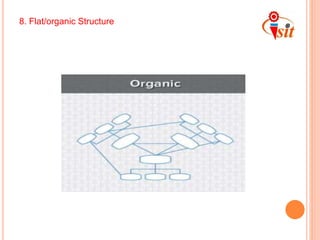
8. Flat Structure
9. Network Structure
1. Functional Organizational Structure:
2. Product-Based Divisional Structure
3. Market-Based Divisional Structure
4. Geographical Divisional Structure
5. Process-Based Structure
6. Matrix Structure
7. Circular Structure
8. Flat/organic Structure
9. Network Structure
 A network structure is often created when one company works with
another to share resources -- or if your company has multiple
locations with different functions and leadership.
 You might also use this structure to explain your company workflows
if much of your staffing or services is outsourced to freelancers or
multiple other businesses.
The Importance of a Good Organizational Structure
1) Structure Allows For Better Communication
 Since the flow of information is essential to an organization’s
success, the organizational structure should be designed to with
clear lines of communication in mind.
 For example, the financial planning and analysis department might
report to the Chief Financial Officer and the Senior Vice President
of Marketing, because both of these members of the top
management team depend on information and reports provided by
financial planning.
2. Clear Reporting Relationships
 Reporting relationships must be clear so all members of the
organization understand what their responsibilities are and know to
whom they are accountable; otherwise, responsibility for a task may
fall through the cracks.
 These clear relationships make it easier for managers to supervise
those in lower organization levels.
 Each employee benefits by knowing whom they can turn to for
direction or help.
 In addition, managers are aware of who is outside the scope of their
authority, so they do not overstep their bounds and interfere with
another manager’s responsibilities.
3. Growth And Expansion
 A sound organization structure ensures that the company has the
right people in the right positions.
 The structure may suggest weak spots or deficiencies in the
company’s current management team.
 As the company grows, the organization structure must evolve with
it.
 Many times more layers of management are created, when one
department head has too many individuals reporting to him at one
time to give each employee the attention and direction needed for
the employee to succeed.
4. Efficient Task Completion
 A well-designed organization structure facilitates the completion of
projects.
 Project managers can better identify the human resources available
to them if the scope of each department’s responsibility and each
team member’s capabilities are clear.
 A project to develop a new product would require market research,
for instance.
 The project manager needs to know who in the organization can
provide this research, and whose permission must be obtained for
the research to be done.
5. Fits Company’s Needs
 Companies in different industries require different mixes of talent
and a relatively greater stress on certain management functions.
 A software company often has a large development staff.
 Companies often have to go through a reorganization phase in
which individual positions or even whole departments are
repositioned on the organization chart in an effort to better utilize the
company’s human resources and make the operation run more
smoothly.
Organizational design
Types of organization
 The organization and distribution of functions within a firm depend
upon size of a firm and type of work undertaken by it.
Types of organization are as follow.
1. Military or line type organization
2. Line and staff organization
3. Functional organization
1. Military or line type organization
 Line organization is the simplest and the oldest type of organization.
 An important characteristic of such type of organization is superior-
subordinate relationship.
 Superior delegates authority to another subordinate and so on,
forming a line from the very top to the bottom of the organization
structure.
 The line of authority so established is referred as “line authority.”
 Under this type of organization authority flows downwards,
responsibility moves upwards in a straight line.
 This type of organization resembles with the army administration or
military type of organization.
There are two type of line organization. These are
(a) pure line organization and
(b) departmental line organization
(a) pure line organization
 In pure line organization, the activities at any one level are the same
and all the individuals perform the same type of work and the divisions
or departments are made for the sake of control and direction.
(b) Departmental line organization
 In this type of organization, the whole unit is divided into different
departments that are convenient for control purposes.
 Each department is under the control of a departmental manager who
is responsible to the superior over him.
Advantages of Line Organization
1. Simplicity: It is easy to establish and operate. It is also easy to
explain to the workers.
2. Fixed Responsibility: Every member of the organization knows his
exact function, to whom he is responsible and who are responsible to
him. Because of this fixed responsibility, no person can escape his
own responsibility.
3. Unity of control: There is unity of command and control according to
which an employee can receive orders only from one superior. It
means a subordinate is responsible to only one superior.
4. Prompt Decision: The unification of authority and responsibility
facilitates quick and prompt decisions.
5. Discipline: Singleness of responsibility and control ensures strong
discipline among the employees.
6. Flexibility: This type of organization is elastic. The adjustments in the
organization can be easily made to suit the changing conditions.
7. Co-ordination: As all activities relating to one department are managed
by one individual, there is a possibility for effective co-ordination.
8. Definition of Authority: As the powers and authorities of various person
are defined, the conflict in their powers and authorities is avoided.
9. Less Expensive: It is less expensive as no expenditure on staff
personnel is involved.
Disadvantages of Line Organization
1. Lack of Specialization: As one person looks after all the work relating
to his department, there is no scope for specialization.
2. Overloading: In this type, an executive is overloaded with work and
hence he may not be in a position to direct and control the efforts of
his subordinates properly.
3. Scope for Favoritism: Since only one executive controls all the
activities relating to his department, there is much scope for favoritism
and nepotism.
4. Unitary Administration: All decisions relating to a department are
taken only by one executive and hence, the successful functioning of
that department depends on his abilities.
5. Lack of Co-operation:
 One executive controls the various activities of a department and gets
undue importance while the importance of other people in the
department is not recognized.
 This may sometimes result in lack of co-operation and team spirit.
Suitability of Line Organization
(i) which are run on a small scale
(ii) which do not have many subordinates and operatives
(iii) which have straight and simple methods of operations and
(iv) which are engaged in the work which is largely of a routine nature.
2. Line and staff organization
 It refers to a pattern in which staff specialists advise line managers to
perform their duties.
 Line people will give advices.
 The staff people have the right to recommend, but have no authority
to enforce their preference on other departments features.
 This structure clearly distinguishes between two aspects of
administration viz., planning and execution.
 Staff officers provide advice only to the line officers, they do not have
any power of command over them.
Advantages of Line and Staff Organization
1. Specialization: This type of organization is based on planned
specialization and brings about the expert knowledge for the benefit of
the management.
2. Better decisions: Staff specialists help the line manager in taking better
decisions by providing them adequate information of right type at right
time.
3. Lesser Burden on line officers:
 The work of the line officers is considerably reduced with the help of
staff officers.
 Technical problems and specialized matters are handled by the Staff
and the routine and administrative matters are the concern of Line
Officers.
4. Advancement of research:
 As the work under this type of organization is carried out by experts,
they constantly undertake the research and experimentation for the
improvement of the product.
 New and economical means of production are developed with the help
of research and experimentation.
5. Training for line officer: Staff services have proved to be an excellent
training medium for Line Officers.
Disadvantages of Line and Staff Organization
1. Conflict between line and staff authorities:
 There may be chances of conflict between line and staff authorities.
 Line Officers resent the activities of staff members on the plea that
they do not always give correct advice.
 On other hand staff officials complain that their advice is not properly
carried out.
2. Problems of line and staff authority:
 There may be confusion on the relationship of line and staff
authorities.
 Line Officers consider themselves superior to Staff Officers.
 The Staff Officers object to it.
3. Lack of responsibility: As the staff specialists are not accountable for
the results, they may not perform their duties well.
4. The system is quite expensive:
 The appointment of experts involves a heavy expenditure.
 Small and medium size organizations cannot afford such a system.
5. More reliance on staff:
 Some of the line officers excessively rely on the staff. This may
considerably reduce the line control.
3. Functional organization
 F.W. Taylor, who is better known as the father of scientific
management developed the concept of ‘Functional Organization’.
 As the very name suggests, functional organization implies that the
organization should be based on various functions.
 Taylor’s functional approach is mainly based on principle of
specialization and tries to bring about organizational balance.
 The principle of specialization embodies the concept that both the
workers and the supervisors can develop a higher degree of
proficiency by separating the manual from the mental requirements..
 Taylor recommended that there should be fictionalization even at the
shop level where workers have to produce goods.
 He felt that the usual practice of putting one foreman in charge of
some 40 to 50 workers should be avoided
Advantages of functional organization
1. Specialization: As every functional in charge is an expert in his area,
he will guide using his specialization and with the help of the
subordinates, try to attain the specified objectives.
2. Increased efficiency: This type of organization ensures enhanced
efficiency as the workers operate under the expert and competent
personnel and perform limited operations.
3. Limited duties:
 The functional foremen have to carry out the limited number of duties
concerning their area of work.
 This considerably reduces the burden of work and makes possible
for the foreman to carry out the work in the best possible manner.
4. Scope for expansion:
 Functional organization offers a great scope for expansion of
business enterprise without any dislocation and loss of efficiency as
each man grows on account of his own specialty.
5. Flexibility:
 A change in organization can be made without disturbing the whole
organization.
 In the words of Louis A. Allen, “Function as a whole can he cut by
eliminating positions at the lower levels without seriously affecting its
total performance.”
Disadvantages of Functional Organization
1. Conflict in authority:
 The authority relationship violates the principle of ‘unity of command’.
 It creates several bosses instead of one line authority.
 It leads to conflict and confusion in the minds of the workers to whom
they should obey and whom they should ignore.
2. Difficulty in pinpointing responsibility:
 On account of the non-application of the principle of ‘unity of control’, it
is very difficult for the top management to fix the responsibility of a
particular foreman.
 There arises a tendency for shirking of responsibility.
3. Expensive:
 This pattern of organization is quite impracticable and expensive.
 Multiplicity of experts increases the overhead expenditure.
 The small organizations cannot afford to install such a system.
4. Discipline is slackened:
 Discipline among the workers as well as lower supervisory staff is
difficult to maintain as they are required to work under different
bosses and this may hamper the progress of the organization.
5. Lack of co-ordination:
 Appointment of several experts in the organization creates the
problem of co-ordination and delay in decision-making especially
when a decision requires the involvement of more than one specialist.
1.1.4 Organization of Public work department(P.W.D)
The various engineering govt. departments which are responsible for
construction and maintenance of public works such as building
roads, canals, public health and electrical installations known as
public work department.
The main braches of P.W.D are:
1. Public works and housing department
2. P.W.D irrigation
3. Environmental engineering department
 Public work department may be central PWD under the govt. of
India or state PWD under state govt.
 Example??
The other govt. dept. are:
1. The railway department
2. Military engineering Services- Defense works.
 Though the above two departments do not strictly fall in the
category of PWD the working of these is very much similar to the
working of other PWD’s.
 The other agencies which deals with construction of roads, buildings
etc fall in the third category. i.e. semi-government department such
as
1. Municipal corporations e.g. Mumbai, Pune
2. Maharashtra state electricity
3. M.I.D.C
The work of the three department is similar to that of PWD.
1.1.5 Administrative set-up of public works department
Functions of Chief Engineer
 The Chief Engineer is the professional head of the department and is
responsible to Government for efficient working.
The Chief Engineer shall:
(1) Provide technical guidance and supervision for ensuring both quality
and progress of work.
(2) Ensure co-ordination of activities of different wings of the
Department.
(3) Carry out inspections of the circle and divisional officers under his
control as per the following frequency:
(a) Circle offices under his control once every year.
(b) Divisional offices:- Ten Divisional Offices each year or every
divisional office in every three to four years.
 The chief engineer exercises control over the performance of the
Officers who maintain the accounts.
 He monitors the budget allocations in general and advises the
superintending engineers to avoid excess or lapses of grants.
 If in exercising his control, any financial irregularity is discovered and if he
considers it to be serious as to require disciplinary action, he takes further
necessary action.
 For the technical (civil) matters in the regional office, two assistant chief
engineers assist the chief engineer.
 For monitoring the maintenance of machineries, asstt. Chief engineer
(mech) is appointed in regional office.
 For the administrative matters in regional office the special superintendent
assists the chief engineer and under him superintendent, first clerk, senior
clerks, junior clerks are appointed
Superintending engineer (bridge & building) :
 He provides direction in the preparation of project designs.
 He also approve the design parameters before design work is taken
up in hand.
 He will approve the bridge/building designs as per guidelines and
norms fixed by the codes and govt. This function of inspection and
verification of designs is called as ’final design review’.
 He will also draw up and issue technical circulars and notes.
 Lay down technical norms and guidelines.
 Prepare/review type designs.
 He will co-ordinate design and construction.
 Participate in the advisory roll for various Govt. Committees and study
groups such as C.E.’s committee, Scrutinizing Committee, New
Materials Committee, etc.
 Provide directions and guidance in field queries and field problems.
 Work on I.S. and I.R.C. committee as preferred by Govt.
 Provide guidance to the field officers in case of difficulties
encountered during construction and post construction period.
Executive engineer:
 Executive Engineer is responsible to the Superintending Engineer
for the execution and management of all works within his division.
 The Executive Engineer is responsible to see that proper measures
are taken to maintain all the buildings and roads in his division.
 Every Executive Engineer is required to report immediately to the
Superintending Engineer about any serious accident or unusual
occurrence connected with his division and to state how he has
acted in consequence.
 The Executive Engineer has to carry out inspection of the sub
divisional officers under his control once every year.
 Executive Engineer takes necessary steps to obtain funds for the works
under his control and keeps its accounts and submits them punctually to
A.G. as per rules in force.
 For the technical matters in Division Office, Dy. Engineer (Dy.Executive
Engineer) assist the Executive Engineer.
 Moreover three to four Jr.Engrs., Draftsman, Tracer etc. assist in
handling the technical matters.
 For administrative matter in Division Office, First Clerk assist the
Executive Engineer.
 Accounts matter are dealt with by the Divisional accountant in Division
and for purchase of material etc. storekeeper is appointed in Division
office.
 These three Branch heads viz Dy. Executive Engineer, First Clerk &
Divisional Accountant assist the Executive Engineer.
Deputy Engineer/Assistant engineer:
 A division is divided into sub divisions.
 These officers are responsible to the Executive Engineer in-charge of
the division for the management and execution of works within their
sub divisions.
 The Deputy Engineer/Assistant Engineer ensure proper and timely
execution of work, ensure quality and quantity of work through testing
of material & work done at specified intervals/frequencies.
 The Deputy Engineer prepares estimate/revise estimate/completion
reports timely & exercises control on account related to his Sub
Division & submits the same timely to the executive engineer.
 He executes works related to M.L.A., M.P Fund Works, deposit works
etc.
 To handle the technical matters in Sub Divisional office, 5 to 6
Jr.Engineers are appointed to assist Dy. Engineer.
 Preparation of works estimate, supervision of work, recording
measurement of the works are the important duties of the Junior
Engineer.
 For dealing administrative matter, account and store matter Sr.Clerk is
appointed to assist Dy. Engineer of the sub division.
Junior engineer:
 Supervision of all works in his charge executed through contractor or
departmentally.
 Maintains attendance of departmental works.
 Maintains attendance of departmentally employed daily labor on
muster roll, and of casual labor either directly or through the field staff
whom he appointed to look after.
 Takes measurements of all the works in the measurement books.
 Exercises direct control in respect of specifications and progress of
works under his charge.
 Prepare running bills and final bills for all works in his charge.
 Carries out field survey of proposed work.
 Prepares estimates for all types of works in the section.
 Carries out half yearly checks of all stores in his charge and submits
reports to S.D.O.
 Carries out annual inspection of all structures in charge and submits
reports of such inspection to S.D.O.

Construction management

  • 2.
    VISION “To excel incivil engineering education to prepare professionally competent engineers with lifelong learning attitude for the accomplishment of ever growing needs of society.”
  • 3.
    MISSION 1. To preparetechnically and professionally competent engineers by imparting quality education through effective teaching learning methodologies and providing stimulating environment for research and innovation. 2. To develop professional skills and right attitude in students that will help them to succeed and progress in their personal and professional career. 3. To imbibe moral and ethical values in students with concern to society and environment.
  • 4.
    Unit1-constrction industry &management CO1: Organize the human resources for the civil engineering projects.
  • 5.
    1.1Organization  Organization isdefined as the arrangement of the persons in any business so that they act as one body and work together towards a common goal.  The grouping of activities necessary for attaining objective/goal.  According to Louis Allen Organizing is the process of identifying and grouping the work to be performed, defining and delegating responsibility and authority, and establishing relationships for the purpose of enabling people to work most effectively together in accomplishing objectives.
  • 6.
     The achievementof the organization would depend upon the efficient setup of organization.  Inefficient economic organization of an enterprise would lead to losses and ultimately to winding up of the enterprise.
  • 7.
    OBJECTIVES OF ORGANISATION Divide work to be done into specific jobs and Departments.  Assign tasks and responsibilities associated with individual.  Coordinates diverse organizational tasks.  Clusters job in to Units.  Establish relationship among individuals , group , and departments.  Allocates and deploys organizational resources.
  • 8.
    PRINCIPAL OF ORGANISATION 1)Consideration of objectives 2) Relationship of basic components of the organization 3) Responsibility and authority 4) Span of control 5) Dividing and grouping work(including coordination) 6) Effective delegation 7) Communication 8) Line and staff relationships 9) Balance, stability and flexibility
  • 9.
    1. Consideration ofobjectives What's mean by this?  Only those objectives should be taken up and accomplished for which there is real need in the organization.  It is to be ensured that the objectives of different departments in the organization are unified and aligned to the corporate goals.  e.g. Measures may be taken to increase productivity, improve product quality.
  • 10.
    2. Relationship ofbasic components of the organization Determine Decides Objectives Type of work/functions Personnel Physical facilities
  • 11.
    3.1 Responsibility  Asuperior is always responsible for the success or failure of his subordinates.  It means the responsibility can never be delegated, though authority can percolate from upwards to downwards.  In any organization, the superior is held responsible for the actions of his subordinates and the subordinates are accountable for the work to their superiors.
  • 12.
    3.2 Authority  Theline of authority, must be well defined so that every subordinate knows who is his superior. What’s mean by that?  Who shall take a decision, issue instructions, recruit staff, control work, must be fixed in advance. Why it’s needed?  The work to be carried out by the subordinates as planned.  There should never be confusion as to whom to report or refer to for decisions.
  • 13.
    4. Span ofcontrol  This is also called as the span of management.  The span of management is the number of subordinates that a manager can supervise.  He should not have more number of subordinates than he can reasonably manage. What’s is the reason for this? 1. He has limited time available for his activities and 2. He has limited available energy.
  • 14.
     Generally, dependingupon the conditions of the business enterprise, the span of control may be any number varying from 2 to 20. Span of control depends upon the following considerations. 1. Trained and experience coordinates. 2. Same work at one table or very close to each other large span of control is possible. 3. Working in isolated area small span of control is ideal. 4. Complex nature of work demands a small span of work. 5. For same nature of work executive to executive to span of control may vary.
  • 15.
    5. Dividing andgrouping work  Divisional provides a greater sense of responsibility on the part of the personnel and more clear cut control over profits.  Head of each division has a considerable freedom to act and adopt to local needs.  Grouping is needed for specialization and coordination.  E.g. At the Hero Honda Motors Ltd factories bike comes off the assembly line in every 18 seconds. Naturally, it would not be feasible for any single person to assemble a bike in just 18 seconds. This signifies the power of the division of labor (also called division of work).
  • 16.
    6. Effective delegation When an executive instead of doing all thinking for the unit himself, passes down to his subordinates any task on which they can take decisions themselves and perform it efficiently and effectively.
  • 17.
    7. Communication  Communicationserves as a linking process by which parts of an organization are tied together.  There are three types of communications. 1. Downward communication 2. Upward communication 3. Horizontal communication 4. Unofficial communication
  • 18.
    8. Line andstaff functions  All activities of an organization can be classified into two categories. 1. Primary activities 2. Supporting activities  Primary activities or line functions: Which contributes directly and vitally to objectives of an organization. E.g. Sales, production etc.
  • 19.
     Supporting activities:Supporting activities are those that aid/help the line or auxiliary to line functions. E.g. accounting, maintenance, administration etc.
  • 20.
    9. Balance, Stabilityand Flexibility 9.1 Balance:  All units of an organization should be balanced.  In the absence of such balance the goals of the organization cannot be cannot be achieved economically and effectively.  E.g. If the purchase department is underdevelopment as compared to other department it will seriously handicap the firm that may otherwise be very strong and modern production and sales.
  • 21.
    9.2 Stability  Itreference to the capacity to withstand the losses of key personnel without serious loss to the effectiveness of the organization in performing work. 9.3 Flexibility  Flexibility is ability to bend and blend without experiencing any serious setback.
  • 22.
  • 23.
     An organizationalstructure is a visual diagram of a company that describes what employees do, whom they report to, and how decisions are made across the business.  Organizational structures can use functions, markets, products, geographies, or processes as their guide, and supply to businesses of specific sizes and industries.
  • 24.
    Choosing the bestorganizational structure for your company, division, or team is a lot like picking out a new car. At the most basic level, you're always looking for something  Road-worthy?  Automatic or manual?  Four-wheel drive or two?  Built-in GPS?  Leather interior?  Flux capacitor?
  • 25.
    Types of OrganizationalStructure 1. Functional Organizational Structure 2. Product-Based Divisional Structure 3. Market-Based Divisional Structure 4. Geographical Divisional Structure 5. Process-Based Structure 6. Matrix Structure 7. Circular Structure 8. Flat Structure 9. Network Structure
  • 26.
  • 27.
  • 28.
  • 29.
  • 30.
  • 31.
  • 32.
  • 33.
  • 34.
    9. Network Structure A network structure is often created when one company works with another to share resources -- or if your company has multiple locations with different functions and leadership.  You might also use this structure to explain your company workflows if much of your staffing or services is outsourced to freelancers or multiple other businesses.
  • 35.
    The Importance ofa Good Organizational Structure 1) Structure Allows For Better Communication  Since the flow of information is essential to an organization’s success, the organizational structure should be designed to with clear lines of communication in mind.  For example, the financial planning and analysis department might report to the Chief Financial Officer and the Senior Vice President of Marketing, because both of these members of the top management team depend on information and reports provided by financial planning.
  • 36.
    2. Clear ReportingRelationships  Reporting relationships must be clear so all members of the organization understand what their responsibilities are and know to whom they are accountable; otherwise, responsibility for a task may fall through the cracks.  These clear relationships make it easier for managers to supervise those in lower organization levels.  Each employee benefits by knowing whom they can turn to for direction or help.  In addition, managers are aware of who is outside the scope of their authority, so they do not overstep their bounds and interfere with another manager’s responsibilities.
  • 37.
    3. Growth AndExpansion  A sound organization structure ensures that the company has the right people in the right positions.  The structure may suggest weak spots or deficiencies in the company’s current management team.  As the company grows, the organization structure must evolve with it.  Many times more layers of management are created, when one department head has too many individuals reporting to him at one time to give each employee the attention and direction needed for the employee to succeed.
  • 38.
    4. Efficient TaskCompletion  A well-designed organization structure facilitates the completion of projects.  Project managers can better identify the human resources available to them if the scope of each department’s responsibility and each team member’s capabilities are clear.  A project to develop a new product would require market research, for instance.  The project manager needs to know who in the organization can provide this research, and whose permission must be obtained for the research to be done.
  • 39.
    5. Fits Company’sNeeds  Companies in different industries require different mixes of talent and a relatively greater stress on certain management functions.  A software company often has a large development staff.  Companies often have to go through a reorganization phase in which individual positions or even whole departments are repositioned on the organization chart in an effort to better utilize the company’s human resources and make the operation run more smoothly.
  • 40.
  • 41.
    Types of organization The organization and distribution of functions within a firm depend upon size of a firm and type of work undertaken by it. Types of organization are as follow. 1. Military or line type organization 2. Line and staff organization 3. Functional organization
  • 42.
    1. Military orline type organization  Line organization is the simplest and the oldest type of organization.  An important characteristic of such type of organization is superior- subordinate relationship.  Superior delegates authority to another subordinate and so on, forming a line from the very top to the bottom of the organization structure.  The line of authority so established is referred as “line authority.”  Under this type of organization authority flows downwards, responsibility moves upwards in a straight line.  This type of organization resembles with the army administration or military type of organization.
  • 44.
    There are twotype of line organization. These are (a) pure line organization and (b) departmental line organization (a) pure line organization  In pure line organization, the activities at any one level are the same and all the individuals perform the same type of work and the divisions or departments are made for the sake of control and direction.
  • 45.
    (b) Departmental lineorganization  In this type of organization, the whole unit is divided into different departments that are convenient for control purposes.  Each department is under the control of a departmental manager who is responsible to the superior over him.
  • 46.
    Advantages of LineOrganization 1. Simplicity: It is easy to establish and operate. It is also easy to explain to the workers. 2. Fixed Responsibility: Every member of the organization knows his exact function, to whom he is responsible and who are responsible to him. Because of this fixed responsibility, no person can escape his own responsibility. 3. Unity of control: There is unity of command and control according to which an employee can receive orders only from one superior. It means a subordinate is responsible to only one superior. 4. Prompt Decision: The unification of authority and responsibility facilitates quick and prompt decisions.
  • 47.
    5. Discipline: Singlenessof responsibility and control ensures strong discipline among the employees. 6. Flexibility: This type of organization is elastic. The adjustments in the organization can be easily made to suit the changing conditions. 7. Co-ordination: As all activities relating to one department are managed by one individual, there is a possibility for effective co-ordination. 8. Definition of Authority: As the powers and authorities of various person are defined, the conflict in their powers and authorities is avoided. 9. Less Expensive: It is less expensive as no expenditure on staff personnel is involved.
  • 48.
    Disadvantages of LineOrganization 1. Lack of Specialization: As one person looks after all the work relating to his department, there is no scope for specialization. 2. Overloading: In this type, an executive is overloaded with work and hence he may not be in a position to direct and control the efforts of his subordinates properly. 3. Scope for Favoritism: Since only one executive controls all the activities relating to his department, there is much scope for favoritism and nepotism. 4. Unitary Administration: All decisions relating to a department are taken only by one executive and hence, the successful functioning of that department depends on his abilities.
  • 49.
    5. Lack ofCo-operation:  One executive controls the various activities of a department and gets undue importance while the importance of other people in the department is not recognized.  This may sometimes result in lack of co-operation and team spirit.
  • 50.
    Suitability of LineOrganization (i) which are run on a small scale (ii) which do not have many subordinates and operatives (iii) which have straight and simple methods of operations and (iv) which are engaged in the work which is largely of a routine nature.
  • 51.
    2. Line andstaff organization  It refers to a pattern in which staff specialists advise line managers to perform their duties.  Line people will give advices.  The staff people have the right to recommend, but have no authority to enforce their preference on other departments features.  This structure clearly distinguishes between two aspects of administration viz., planning and execution.  Staff officers provide advice only to the line officers, they do not have any power of command over them.
  • 52.
    Advantages of Lineand Staff Organization 1. Specialization: This type of organization is based on planned specialization and brings about the expert knowledge for the benefit of the management. 2. Better decisions: Staff specialists help the line manager in taking better decisions by providing them adequate information of right type at right time. 3. Lesser Burden on line officers:  The work of the line officers is considerably reduced with the help of staff officers.  Technical problems and specialized matters are handled by the Staff and the routine and administrative matters are the concern of Line Officers.
  • 53.
    4. Advancement ofresearch:  As the work under this type of organization is carried out by experts, they constantly undertake the research and experimentation for the improvement of the product.  New and economical means of production are developed with the help of research and experimentation. 5. Training for line officer: Staff services have proved to be an excellent training medium for Line Officers.
  • 54.
    Disadvantages of Lineand Staff Organization 1. Conflict between line and staff authorities:  There may be chances of conflict between line and staff authorities.  Line Officers resent the activities of staff members on the plea that they do not always give correct advice.  On other hand staff officials complain that their advice is not properly carried out. 2. Problems of line and staff authority:  There may be confusion on the relationship of line and staff authorities.  Line Officers consider themselves superior to Staff Officers.  The Staff Officers object to it.
  • 55.
    3. Lack ofresponsibility: As the staff specialists are not accountable for the results, they may not perform their duties well. 4. The system is quite expensive:  The appointment of experts involves a heavy expenditure.  Small and medium size organizations cannot afford such a system. 5. More reliance on staff:  Some of the line officers excessively rely on the staff. This may considerably reduce the line control.
  • 56.
    3. Functional organization F.W. Taylor, who is better known as the father of scientific management developed the concept of ‘Functional Organization’.  As the very name suggests, functional organization implies that the organization should be based on various functions.  Taylor’s functional approach is mainly based on principle of specialization and tries to bring about organizational balance.  The principle of specialization embodies the concept that both the workers and the supervisors can develop a higher degree of proficiency by separating the manual from the mental requirements..
  • 57.
     Taylor recommendedthat there should be fictionalization even at the shop level where workers have to produce goods.  He felt that the usual practice of putting one foreman in charge of some 40 to 50 workers should be avoided
  • 58.
    Advantages of functionalorganization 1. Specialization: As every functional in charge is an expert in his area, he will guide using his specialization and with the help of the subordinates, try to attain the specified objectives. 2. Increased efficiency: This type of organization ensures enhanced efficiency as the workers operate under the expert and competent personnel and perform limited operations. 3. Limited duties:  The functional foremen have to carry out the limited number of duties concerning their area of work.  This considerably reduces the burden of work and makes possible for the foreman to carry out the work in the best possible manner.
  • 59.
    4. Scope forexpansion:  Functional organization offers a great scope for expansion of business enterprise without any dislocation and loss of efficiency as each man grows on account of his own specialty. 5. Flexibility:  A change in organization can be made without disturbing the whole organization.  In the words of Louis A. Allen, “Function as a whole can he cut by eliminating positions at the lower levels without seriously affecting its total performance.”
  • 60.
    Disadvantages of FunctionalOrganization 1. Conflict in authority:  The authority relationship violates the principle of ‘unity of command’.  It creates several bosses instead of one line authority.  It leads to conflict and confusion in the minds of the workers to whom they should obey and whom they should ignore. 2. Difficulty in pinpointing responsibility:  On account of the non-application of the principle of ‘unity of control’, it is very difficult for the top management to fix the responsibility of a particular foreman.  There arises a tendency for shirking of responsibility.
  • 61.
    3. Expensive:  Thispattern of organization is quite impracticable and expensive.  Multiplicity of experts increases the overhead expenditure.  The small organizations cannot afford to install such a system. 4. Discipline is slackened:  Discipline among the workers as well as lower supervisory staff is difficult to maintain as they are required to work under different bosses and this may hamper the progress of the organization. 5. Lack of co-ordination:  Appointment of several experts in the organization creates the problem of co-ordination and delay in decision-making especially when a decision requires the involvement of more than one specialist.
  • 62.
    1.1.4 Organization ofPublic work department(P.W.D) The various engineering govt. departments which are responsible for construction and maintenance of public works such as building roads, canals, public health and electrical installations known as public work department. The main braches of P.W.D are: 1. Public works and housing department 2. P.W.D irrigation 3. Environmental engineering department
  • 63.
     Public workdepartment may be central PWD under the govt. of India or state PWD under state govt.  Example?? The other govt. dept. are: 1. The railway department 2. Military engineering Services- Defense works.  Though the above two departments do not strictly fall in the category of PWD the working of these is very much similar to the working of other PWD’s.
  • 64.
     The otheragencies which deals with construction of roads, buildings etc fall in the third category. i.e. semi-government department such as 1. Municipal corporations e.g. Mumbai, Pune 2. Maharashtra state electricity 3. M.I.D.C The work of the three department is similar to that of PWD.
  • 65.
    1.1.5 Administrative set-upof public works department
  • 66.
    Functions of ChiefEngineer  The Chief Engineer is the professional head of the department and is responsible to Government for efficient working. The Chief Engineer shall: (1) Provide technical guidance and supervision for ensuring both quality and progress of work. (2) Ensure co-ordination of activities of different wings of the Department. (3) Carry out inspections of the circle and divisional officers under his control as per the following frequency: (a) Circle offices under his control once every year. (b) Divisional offices:- Ten Divisional Offices each year or every divisional office in every three to four years.
  • 67.
     The chiefengineer exercises control over the performance of the Officers who maintain the accounts.  He monitors the budget allocations in general and advises the superintending engineers to avoid excess or lapses of grants.  If in exercising his control, any financial irregularity is discovered and if he considers it to be serious as to require disciplinary action, he takes further necessary action.  For the technical (civil) matters in the regional office, two assistant chief engineers assist the chief engineer.  For monitoring the maintenance of machineries, asstt. Chief engineer (mech) is appointed in regional office.  For the administrative matters in regional office the special superintendent assists the chief engineer and under him superintendent, first clerk, senior clerks, junior clerks are appointed
  • 68.
    Superintending engineer (bridge& building) :  He provides direction in the preparation of project designs.  He also approve the design parameters before design work is taken up in hand.  He will approve the bridge/building designs as per guidelines and norms fixed by the codes and govt. This function of inspection and verification of designs is called as ’final design review’.  He will also draw up and issue technical circulars and notes.  Lay down technical norms and guidelines.  Prepare/review type designs.  He will co-ordinate design and construction.
  • 69.
     Participate inthe advisory roll for various Govt. Committees and study groups such as C.E.’s committee, Scrutinizing Committee, New Materials Committee, etc.  Provide directions and guidance in field queries and field problems.  Work on I.S. and I.R.C. committee as preferred by Govt.  Provide guidance to the field officers in case of difficulties encountered during construction and post construction period.
  • 70.
    Executive engineer:  ExecutiveEngineer is responsible to the Superintending Engineer for the execution and management of all works within his division.  The Executive Engineer is responsible to see that proper measures are taken to maintain all the buildings and roads in his division.  Every Executive Engineer is required to report immediately to the Superintending Engineer about any serious accident or unusual occurrence connected with his division and to state how he has acted in consequence.  The Executive Engineer has to carry out inspection of the sub divisional officers under his control once every year.
  • 71.
     Executive Engineertakes necessary steps to obtain funds for the works under his control and keeps its accounts and submits them punctually to A.G. as per rules in force.  For the technical matters in Division Office, Dy. Engineer (Dy.Executive Engineer) assist the Executive Engineer.  Moreover three to four Jr.Engrs., Draftsman, Tracer etc. assist in handling the technical matters.  For administrative matter in Division Office, First Clerk assist the Executive Engineer.  Accounts matter are dealt with by the Divisional accountant in Division and for purchase of material etc. storekeeper is appointed in Division office.  These three Branch heads viz Dy. Executive Engineer, First Clerk & Divisional Accountant assist the Executive Engineer.
  • 72.
    Deputy Engineer/Assistant engineer: A division is divided into sub divisions.  These officers are responsible to the Executive Engineer in-charge of the division for the management and execution of works within their sub divisions.  The Deputy Engineer/Assistant Engineer ensure proper and timely execution of work, ensure quality and quantity of work through testing of material & work done at specified intervals/frequencies.  The Deputy Engineer prepares estimate/revise estimate/completion reports timely & exercises control on account related to his Sub Division & submits the same timely to the executive engineer.  He executes works related to M.L.A., M.P Fund Works, deposit works etc.
  • 73.
     To handlethe technical matters in Sub Divisional office, 5 to 6 Jr.Engineers are appointed to assist Dy. Engineer.  Preparation of works estimate, supervision of work, recording measurement of the works are the important duties of the Junior Engineer.  For dealing administrative matter, account and store matter Sr.Clerk is appointed to assist Dy. Engineer of the sub division.
  • 74.
    Junior engineer:  Supervisionof all works in his charge executed through contractor or departmentally.  Maintains attendance of departmental works.  Maintains attendance of departmentally employed daily labor on muster roll, and of casual labor either directly or through the field staff whom he appointed to look after.  Takes measurements of all the works in the measurement books.  Exercises direct control in respect of specifications and progress of works under his charge.  Prepare running bills and final bills for all works in his charge.  Carries out field survey of proposed work.
  • 75.
     Prepares estimatesfor all types of works in the section.  Carries out half yearly checks of all stores in his charge and submits reports to S.D.O.  Carries out annual inspection of all structures in charge and submits reports of such inspection to S.D.O.