ORGANIZING AND STAFFING
DIRECT AND CONTROLLING
6/13/2024
1
MODULE 2
Unit 3
ORGANIZING AND STAFFING:
Learning Objectives:
6/13/2024
3
 Examine the meaning, characteristics and
topology of organisations and staffing
 Learn the principles and process of organising
 Understand the meaning and significance of the
span of management and the factors governing it.
 Describe the advantages and disadvantages of
different bases of departmentalisation.
 State the importance and need for proper staffing
Sl
no
TOPIC Date
planned
Date
engaged
Remark
s
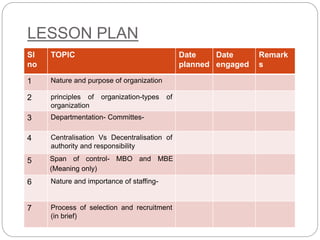
1 Nature and purpose of organization
2 principles of organization-types of
organization
3 Departmentation- Committes-
4 Centralisation Vs Decentralisation of
authority and responsibility
5 Span of control- MBO and MBE
(Meaning only)
6 Nature and importance of staffing-
7 Process of selection and recruitment
(in brief)
LESSON PLAN
ORGNISATION
5
 The process of identifying and grouping of the
work to be performed, defining and delegating
responsibility and authority and establishing
relationships for the purpose of enabling people
to work most effectively together in accomplishing
their objectives.
6/13/2024
MEANING OF ORGANIZING
6
 Koontz and O'Donnel "It is grouping of activities
necessary to attain enterprise objectives and the
assignment of each grouping to a manager with
authority necessary to supervise it".
 Amitai Etizoni- ”Organisation is social unit or human
grouping deliberately structured for the purpose of
attaining specific goals”.
 Sehein- “Orgainsation as the rational coordination of
activities of a number of people for the achievement of
some common explicit purpose or goal, through division
of labour and function, and through a hierarchy of
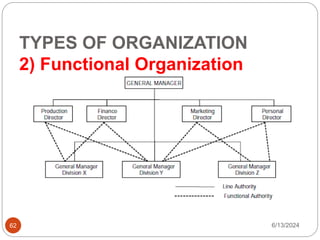
authority and responsibility. 6/13/2024
STEPS IN PROCESS OF
ORGANIZING
7
 While organizing, a manager differentiates and
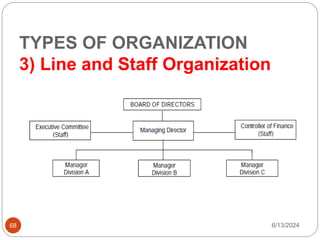
integrates the activities of his organization.
 By differentiation is meant the process of
departmentalization or segmentation of activities
on the basis of some homogeneity.
 Integration is the process of achieving unity of
effort among various departments, segments or
subsystems.
6/13/2024
STEPS IN ORGANIZING
(1) Consideration of objectives:
8
 The first step in organizing is to know the objectives
of the enterprise.
 Objectives determine resources and the various
activities which need to be performed and the type of
organization which needs to be built for this purpose.
 Objectives also serve as guidelines for the
management and workers.
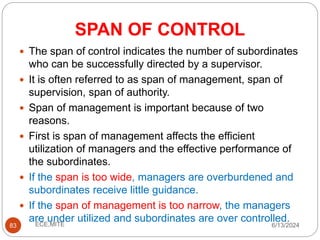
 They bring about unity of direction in the
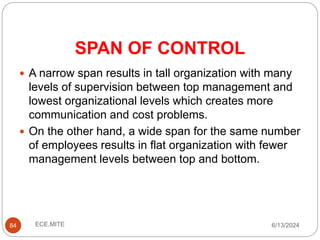
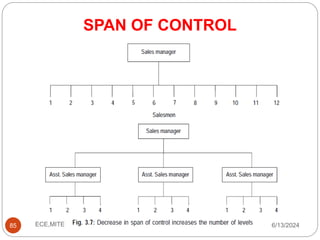
organization.
6/13/2024
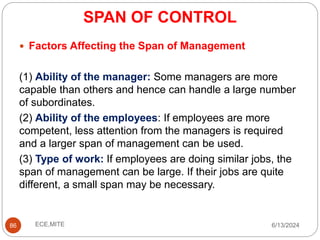
STEPS IN ORGANIZING
(2) Identification and grouping of activities:
9
 In order to achieve the objectives of the enterprise, certain
activities are necessary.
 The activities will depend upon the nature and size of the
enterprise.
 Each job should be properly classified and grouped.
 This will enable the people to know what is expected of
them as members of the group and will help in avoiding
duplication of efforts.
 For example, the total activities of an enterprise may be
divided into major functions like production, purchasing,
marketing, finance etc.
 such function is further subdivided into various jobs.
 For example, in production department separate sections
6/13/2024
STEPS IN ORGANIZING
3) Assignment of duties:
10
 After classifying and grouping the activities into
various jobs, they should be allotted to the
individuals for ensuring certainty of work
performance.
 Each individual should be given a specific job to do
according to his ability and made responsible for
that.
6/13/2024
STEPS IN ORGANIZING
(4) Delegation of authority
11
 Every individual is given the authority necessary to
perform the assigned activity effectively.
 By authority we mean power to take decisions, issue
instructions, guiding the subordinates, supervise and
control them.
6/13/2024
STEPS IN ORGANIZING
5) Coordinating activities
12
 The activities and efforts of different individuals are
then synchronized.
 Such coordination is necessary to ensure effective
performance of specialized functions.
 Interrelationship between different job and
individuals are clearly defined so that everybody
knows from whom he has to take orders and to
whom he is answerable.
6/13/2024
NATURE OF ORGANIZATION
13
(1) Organization is always related to certain objectives:
 Each organization has an objective.
 The operations are divided; authority and responsibility
are determined to achieve predetermined objectives.
(2) An organization is a group of people:
 Mc Farland has defined organization as “an identifiable
group of people contributing their efforts towards the
attainment of goals. People form groups or organizations
to accomplish common objectives and pool their efforts
by defining and dividing various activities, responsibility
and authority”.
6/13/2024
NATURE OF ORGANIZATION
14
(3) Communication is the nervous system of
organization: The organizational members are able to
communicate with each other and may coordinate their
activities.
 No organization can survive without an efficient system of
communication.
(4) Organizing is a basic function of management:
Organizing is done in relation to all other functions of
management, namely planning, staffing, directing and
controlling and in all the areas of business namely
production, marketing, purchasing, personnel.
(5) Organization is a continuous process:
 Managers are continuously engaged in organizing and
6/13/2024
NATURE OF ORGANIZATION
15
(6) Organization is a structure of relationship:
 The structure of relationship deliberately created by the
management is referred to as formal organization.
 An organization may also have a network of social relationships
that arise between people working together. Such relationships
are known as informal organization.
(7) Organization involves a network of authority and
responsibility relationship:
 Various positions are created; specific tasks are assigned to them.
 To perform the task, each position is delegated adequate
authority.
 Authority and responsibility relationships throughout the
organization must be clearly defined to achieve coordination and
to avoid conflicts between individuals and departments. 6/13/2024
PURPOSE OF ORGANIZATION
16
(1) To facilitate pattern of communication:
 Organization structure provide pattern of communication
and coordination.
 By grouping activities and people, structure facilitates
communication between people centered on their job
activities.
(2) To allocate authority and responsibility:
 Organization structure allocates authority and responsibility.
 It specifies who is to direct whom and who is accountable
for what results.
 The structure helps the organization members to know what
his role is and how it relates to others role.
6/13/2024
PURPOSE OF ORGANIZATION
17
(3) To locate decision centers:
 Organization structure determines the location of
decision making in the organization.
(4) To create proper balance:
 Organization structure creates the proper balance and
emphasis of activities.
 Those more critical to the enterprises success might be
placed higher in the organization.
 Activity of comparable importance might be placed at the
lower level.
6/13/2024
PURPOSE OF ORGANIZATION
18
(5) To stimulate creativity:
 organization stimulates independent, creative thinking and
initiative.
(6) To encourage growth:
 If the organization structure is flexible, it will help in meeting
challenges and creating opportunities for growth.
(7) To make use of technological improvements:
 organization structure which is adoptable to changes can make
the best possible use of latest technology.
 It can modify the existing pattern of authority-responsibility
relationships in the wake of technological improvements.
6/13/2024
PRINCIPLES OF ORGANIZATION
19
 In order to facilitate the achievement of objectives,
management thinkers have laid down certain
principles of organization.
 The principles are guidelines for planning
organization structure.
 (1) Objectives: (2) Specialization: (3) Span of control:
 (4) Exception: (5) Scalar principle: (6) Unity of command:
 (7) Delegation: (8) Responsibility: (9) Authority:
 (10) Efficiency: (11) Simplicity: (12) Flexibility:
 (13) Balance: (14) Unity of direction: (15) Personal abilities:
6/13/2024
PRINCIPLES OF ORGANIZATION
20
(1) Objectives:
 Objectives of the enterprise should be clearly
defined.
 Every part of the organization and organization as a
whole should be geared to the basic objective
determined by the enterprise.
6/13/2024
PRINCIPLES OF ORGANIZATION
21
(2) Specialization:
 Effective organization must promote specialization.
 The activities of the enterprise should be divided
according to functions and assigned to persons
according to their specialization.
6/13/2024
PRINCIPLES OF ORGANIZATION
22
 (3) Span of control:
 A manager can directly supervise only a limited
number of executives.
 Hence, it is necessary to have a proper number of
subordinates answerable to a manager.
 A maximum of six may be prescribed for this
purpose.
6/13/2024
PRINCIPLES OF ORGANIZATION
23
 (4) Exception:
 This principle requires that organization structure
should be so designed that managers are required to
go through the exceptional matters only.
 All the routine decisions should be taken by
subordinates, where as problems involving unusual
matters and policy decision should be referred to
higher levels.
6/13/2024
PRINCIPLES OF ORGANIZATION
24
 (5) Scalar principle:
 This is also known as chain of command. There
must be clear lines of authority running from the top
to the bottom.
 Unbroken line of authority from top level to bottom
level.
6/13/2024
PRINCIPLES OF ORGANIZATION
25
 (6) Unity of command:
 Each subordinate should have only one supervisor
whose command he has to obey.
 Dual subordination must be avoided, for it causes
uneasiness, disorder, and indiscipline.
6/13/2024
PRINCIPLES OF ORGANIZATION
26
 (7) Delegation:
 Proper authority should be delegated at the lower
levels of the organization also.
 The authority delegated must be equal to
responsibility i.e., the manager should have enough
authority to accomplish the task assigned to him.
 Handle special problems ,co ordinating and
planning evmts.
6/13/2024
PRINCIPLES OF ORGANIZATION
27
 (8) Responsibility: accountability
 A superior should be held responsible for the acts of
his subordinates.
 No superior should be allowed to avoid
responsibility by delegating authority to his
subordinates.
6/13/2024
PRINCIPLES OF ORGANIZATION
28
 (9) Authority:
 Right and power to act.
 The authority is the tool by which a manager is able
to accomplish the desired objective.
 Hence, the authority of each manager must be
clearly defined.
 The authority should be equal to responsibility.
6/13/2024
PRINCIPLES OF ORGANIZATION
29
 (10) Efficiency:
 The organisation structure should enable the
enterprise to function efficiency.
 The organization should be able to attain the mission
and objectives at the minimum cost.
6/13/2024
PRINCIPLES OF ORGANIZATION
30
 (11) Simplicity:
 The organization structure should be as simple as
possible with minimum number of levels.
 A large number of levels of organization means
difficulty of effective communication and
coordination.
6/13/2024
PRINCIPLES OF ORGANIZATION
31
 (12) Flexibility:
 The organization should be flexible, should be
adaptable to changing circumstances.
 It should permit expansion and replacement without
dislocation and disruption of the basic design.
 A organization must avoid complicated procedures
and excessive complication of control so that it may
adapt itself easily and economically to business and
technical changes.
6/13/2024
PRINCIPLES OF ORGANIZATION
32
 (13) Balance:
 There should be reasonable balance in the size of
various departments, between centralization and
decentralization, between span of control and among
all types of factors such as human, Technical and
financial.
6/13/2024
PRINCIPLES OF ORGANIZATION
33
 (14) Unity of direction:
 There must be one objective and one plan for a
group of activities having the same objective.
 Unity of direction facilitates unification and
coordination of activities at various levels.
6/13/2024
PRINCIPLES OF ORGANIZATION
34
 (15) Personal abilities:
 As organization is a formal group of people there is
need for proper selection, placement and training.
 Organization structure must ensure optimum use of
human resources.
6/13/2024
DEPARTMENTATION
35
 Horizontal differentiation of tasks or activities
into discrete segments is called
departmentation.
 Departmentation involves grouping of
operating tasks into jobs, combining of jobs
into effective work group and combining of
groups into divisions often termed as
‘departments’.
 The aim is to take advantages of division of
labour and specialization up to a certain limit.
6/13/2024
DEPARTMENTATION
36
1) Departmentation by functions:
2) Departmentation by product:
3) Departmentation by customers:
4) Departmentation by territory:
5) Departmentation by Process:
6) Departmentation by time:
6/13/2024
1)Departmentation by functions:
37
 This is the simplest and most commonly used base
for Departmentation.
 Each major function of the enterprise is grouped into
a department.
 For example there may be production, finance,
marketing and personnel department in an
organization .
 All functions related to production are grouped
together to form production department, similarly
other departments are formed on the basis of
function.
6/13/2024
1)Departmentation by functions:
38 6/13/2024
1)Departmentation by functions:
39
 Advantages
(1) It is simple and suitable for small organization
which manufactures limited number of products.
(2) It promotes specialization.
(3) It leads to improve planning and control of key
functions.
(4) Manpower and other resources of the company are
effectively used.
6/13/2024
1)Departmentation by functions:
40
 Drawbacks
(1) It fosters sub-goal loyalty. Department goal
becomes important than organizational goal resulting
into interdepartmental conflicts.
(2) Difficult to set up specific accountability and profit
centers within functional departments with the result
that performance cannot be accurately measured.
(3) It does not offer a good training for overall
development of a manager.
6/13/2024
2)Departmentation by product:
41
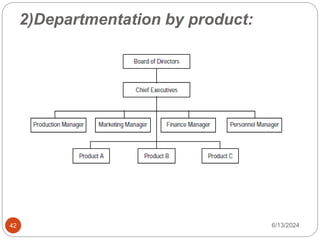
 This form is suited for a large organisation
manufacturing varity of products.
 All activities related to a particular product line may
be grouped together under the direction of a
semiautonomous division manager.
 Several companies such as Godrej, TATA have
product based departments.
6/13/2024
2)Departmentation by product:
42 6/13/2024
2)Departmentation by products:
43
 Advantages
 (1) It focuses individual attention on each product
line.
 (2) It leads to specialization of physical facilities on
the basis of product which results in economy.
 (3) It is easier to evaluate and compare the
performance of various product division and it
enables the top management to invest more in
profitable product groups.
6/13/2024
2)Departmentation by products:
44
 Drawbacks
 (1) This form results in duplication of staff.
 (2) Extra expenditure is incurred in maintaining a
sales force for each product.
 (3) Employment of a large number of managerial
personnel is required.
6/13/2024
3)Departmentation by customers:
45
 This is used in the enterprises engaged in providing
specialized services to different classes of customers.
 Management groups the activities on the basis of
customers to cater to the requirements of clearly
defined customer groups.
 For example, an automobile service company may
organize its departments as heavy vehicles servicing
division, car servicing division and scooter servicing
division
 Similarly an educational institute may have
departments for regular courses, evening and
corresponding courses etc.
6/13/2024
4)Departmentation by territory:
46
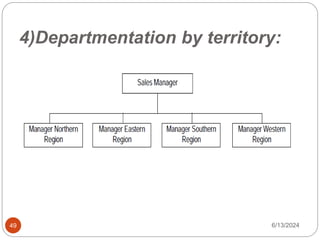
 Under this classification, the market area is broken
up into sales territories and a responsible executive
is put in-charge of each territory.
 The territory may be known as district, division or
region.
 The field salesmen under respective regions report
to their corresponding sales supervisors.
 Banks, Railways and big manufacturing companies
like petroleum companies are some example for this.
6/13/2024
4)Departmentation by territory:
47
 Advantages
1) Places responsibility at lower level.
2) Ensures a better coordination with in a region.
3) Provides region wise comparison of performance.
4) Takes advantage of economics of local operations.
6/13/2024
4)Departmentation by territory:
48
 Disadvantage
1) Requires more person with general manager
abilities.
2) Requires to maintain similar functional people at
all region.
3) Difficult to control from top management.
6/13/2024
4)Departmentation by territory:
49 6/13/2024
5)Departmentation by Process:
50
 Departmentation here, is done on the basis of
several discrete process or technologies involved in
the manufacture of a product.
 For example, a vegetable oil company may have
separate departments for crushing, refining and
finishing.
 A textile mill may have departments for ginning,
spinning, weaving and dyeing.
 A work that would otherwise be done in several
different locations in an enterprise is done in one
place because of special equipments used.
6/13/2024
6)Departmentation by Time:
51
 One of oldest forms of departmentation, generally used
at lower level of an organisation.
 It is grouping of activities on the basis of time.
 The use of shifts is common in some organistions due
to economical or technological reasons.
 For service organisation like hospital, fire department,
security round the clock work is essential.
 All these call for shift work is essential.
6/13/2024
6)Departmentation by Time:
52
 Advantages:
1) Service can be rendered, that goes beyond the
normal 8 hour shift.
2) Facilities use of processes that cannot be stopped
or interrupted.
3) Expensive capital equipment can be better
utilized.
4) High and continuous production per day.
6/13/2024
6)Departmentation by Time:
53
 Disadvantages:
1) Lacks good and efficient supervision during night
shift.
2) Lack of effective coordination and communication
from people of one shift to next shift.
3) Inconvenient for people to work in night shifts and
more difficult during shifts changes from day to
night.
6/13/2024
TYPES OF ORGANIZATION
54
1) Lineorganisation.
2) Functional or stafforganisation
3) Line and stafforganisation.
4) Committeeorganisation
5) Matrixorganisation
6/13/2024
TYPES OF ORGANIZATION
1) Line organisation
55
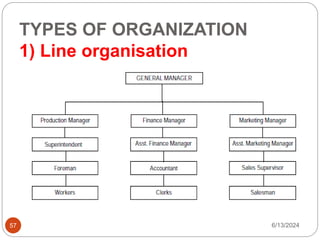
 Line organization is the simple and oldest type of
organization and is also known of scalar or military
organization.
 The line of authority flows vertically downward from
top to bottom throughout the organization.
 The nquantum of authority is highest at the top and
reduces at each successive level.
 The superior communicates his decision and orders
to his subordinates.
 The subordinates, in turn, can communicate them to
those who are immediately under them. 6/13/2024
TYPES OF ORGANIZATION
1) Line organisation
56
 Three important principles of this system are
 1) Command should be given to subordinate through
the immediate superior. There should be no skipping of
levels in chain of command.
 2) There should be only one chain i.e, command
should be received from only one immediate superior.
 3) The number of subordinates whose work is directly
commanded by the superior should be limited. 6/13/2024
TYPES OF ORGANIZATION
1) Line organisation
57 6/13/2024
TYPES OF ORGANIZATION
1) Line organisation
58
 Advantages
(1) Simple and easy to understand.
(2) Quick decision and speed of action.
(3) Clear division of authority and responsibility.
(4) Discipline and better coordination
(5) clear channel of communication.
6/13/2024
TYPES OF ORGANIZATION
1) Line organisation
59
 Disadvantages
(1) The organization is rigid and inflexible
(2) Being an autocratic system, managers may
become dictators and not leaders.
(3) due to task of specialisation there is more wastage
of material and man hour.
(4) Overload for few key executives.
(5) Lack of specialization.
6/13/2024
TYPES OF ORGANIZATION
2) Functional Organization
60
 The line organization does not provide specialists in
the structure.
 Many jobs require specialized knowledge to perform
them. In functional organization the specialists are
made available in the top positions throughout the
enterprise.
 Workers consult specialists in various areas to carry
out their work instead of referring to only boss.
 Functional authority is the right which is delegated to
an individual or a department that authorizes control of
specified processes.
 Functional authority remains confined to functional
6/13/2024
TYPES OF ORGANIZATION
2) Functional Organization
61
 Under functional organization, various activities of the enterprise are
classified according to certain functions like production, marketing,
finance, personnel etc., and are put under the charge of functional
specialists.
 A functional in charge directs the subordinates throughout the
organization in his particular area of business operation.
 That means that subordinates receives orders and instructions not
from one superior but from several functional specialists.
 For example personnel department would recruit, train and deal with
the people required to all other department.
6/13/2024
TYPES OF ORGANIZATION
2) Functional Organization
62 6/13/2024
TYPES OF ORGANIZATION
2) Functional Organization
63
 Advantages
(1) Specialization: Since a foreman is responsible for only
one function, he can perform his duties in better manner
and results better production rate at an improved quality
level.
(2) Cost reduction: Since for every operation expert
guidance is there, wastage of material, man and machine
hours are reduced.
(3) Mass production: This type of organisation helps mass
production through standardization and specialization.
(4) No need for all round executives: A functional
manager is required to have expertise in one function only.
This makes it easy for executive development. 6/13/2024
TYPES OF ORGANIZATION
2) Functional Organization
64
 Disadvantages
(1) Violates principles of unity of command.
(2) The operation of functional organization is too
complicated.
(3) It develops specialists rather than generalists.
(4) Lack of coordination among functional executives
which delays decision making.
6/13/2024
TYPES OF ORGANIZATION
3) Line and Staff Organization
65
 In order to reap the advantages of both line
organization and functional organization, a new type of
organization is developed i.e., line and staff
organization.
 In line and staff organization, the line authority remains
the same as it does in the line organization.
 In addition, the specialists are attached to line
managers to advice them on important matters.
 They were known as ‘staff’ as they were recruited to
perform staff or specialist function.
 These specialists stand ready with their speciality to
serve line men and to give help which will enable the
6/13/2024
TYPES OF ORGANIZATION
3) Line and Staff Organization
66
 The function of people in a pure staff capacity is to investigate,
research and give advice to line manager to whom they report.
 The final decision to accept/implement the recommendation of the
staff executives remains in the hands of the line executive.
 Staff officers are assigned an ‘authority of ideas’ and line officers
an ‘authority of command’ i.e., the line executives function is to
act, the staff executive function is to think.
 A staff officer’s job is to advice and not to command, then line
supervisor must take decision to issue instructions through the
scalar plan. 6/13/2024
TYPES OF ORGANIZATION
3) Line and Staff Organization
67
 Line and staff structure has gained popularity
because certain problems of management have
become very complex and, in order to deal with
them, expert knowledge is necessary which can be
provided by the staff officers.
6/13/2024
TYPES OF ORGANIZATION
3) Line and Staff Organization
68 6/13/2024
TYPES OF ORGANIZATION
3) Line and Staff Organization
69
Advantages.
 Specialized knowledge: Line managers get the benefit
of specialized knowledge of staff specialists at various
levels.
 Reduction of burden: Staff specialists relieve the line
managers of the botheration of concentrating on
specialized functions like accounting, selection and
training, public relations, etc.
 Proper weightage: Many problems that are ignored or
poorly handled in the line organization can be properly
covered in the line and staff organization by the use of
staff specialists.
6/13/2024
ECE,MITE
TYPES OF ORGANIZATION
3) Line and Staff Organization
70
Advantages.
 Flexibility. Line and staff organization is more flexible as
compared to the line organization.
 General staff can be employed to help line managers at
various levels.
 Unity of command. Under this system, the experts provide
special guidance without giving orders.
 It is the line manager who only has got the right to give orders.
 The result is that the enterprises takes advantage of functional
organization while maintaining the unity of command i.e., one
subordinate receiving orders from one boss only.
6/13/2024
ECE,MITE
TYPES OF ORGANIZATION
3) Line and Staff Organization
71
Disadvantages
1. There is generally a conflict between the line and
staff executives.
2. The allocation of duties between the line and staff
executives is generally not very clear. This may
hamper coordination in the organization.
3. There is a wide difference between the orientation of
the line and staff men. Line executives’ deals with
problems in a more practical manner. But staff
officials who are specialists in their fields tend to be
more theoretical. 6/13/2024
ECE,MITE
TYPES OF ORGANIZATION
4) Committee Organization
72
• Some of the adminstarive tasks cannot be performed by
a single person alone.
• Such sitiuation may call for two or more person to
perform such tasks. This calls for a committee
organisation.
 “A committee is a group of persons performing a group
task with the object of solving certain problems”.
 Committees help in taking corrective decision,
coordinating the affairs of different departments and
meeting communication requirements in the organization.
6/13/2024
ECE,MITE
TYPES OF ORGANIZATION
4) Committee Organization
73
 The committees may be of different types as follows.
1)Ad-hoc committee: It is a temporary committee formed
for a short period to solve a minor problem.
 For eg: a committee to decide the date and venue of
annual general body meeting.
2)Standing or Permanent committee: Such committees
is formed to solve problems which is repetitive in nature.
 Eg: Disciplinary committee to solve discipline related
issues of individual workers from time to time.
6/13/2024
ECE,MITE
TYPES OF ORGANIZATION
4) Committee Organization
74
3)Advisory committee: This committee studies the
various aspects of a problem and suggests courses of
action to the management thus reducing its burden. An
advisory committee does not have power to act.
 For eg: a committee in a manufacturing industry studying
the feasibility in going for modernization of the plant.
4)Educational committee: this is a committee which
guards the company policies and procedures. They often
educate and give an insight to the management about
the goals of the organisation whenever there is
confusion.
6/13/2024
ECE,MITE
TYPES OF ORGANIZATION
4) Committee Organization
75
Characteristics of a committee
1. The number of members in a committee should be a
minimum( 3 to 8).
2. An agenda has to be prepared by the chairman of the
committee well in advance of meeting and circulated
among the members so that they get sufficient time to
think over the problem to be discussed.
3. The duties, authority and responsibility of the
committee must be clearly defined.
4. The chairman must have enough authority to efficiently
conduct the meeting.
5. Problems which can be solved by individuals should
not be included in the agenda of the committee.
6. Committee should draw members from all the 6/13/2024
ECE,MITE
TYPES OF ORGANIZATION
4) Committee Organization
76
 Advantages
(1) Committees provide a forum for the pooling of knowledge
and experience of many persons of different skills, ages and
backgrounds.
(2) It helps in throwing up new ideas, innovation and new
schemes.
(3) Committees are impersonal in action and hence their
decisions are generally unbiased and are based on facts.
(4) When departmental heads are members of committee,
people get an opportunity to understand each others problems
and hence improve coordination. 6/13/2024
ECE,MITE
TYPES OF ORGANIZATION
4) Committee Organization
77
 Disadvantages
1) Sometimes a committee may take a week or two to
arrive at a decision.
2) In a committee, no individual can be held responsible
for anything.
3) Final decision may not be fully acceptable to everyone
on the committee.
4) Very often aggressive members in the committee may
influence the final decision.
5) Committee meeting get postponed often when key
members are absent.
6/13/2024
ECE,MITE
TYPES OF ORGANIZATION
5) Matrix organisation
78
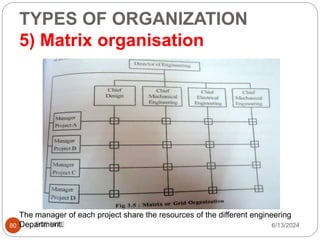
 There are several departments under matrix
organisation.
 Each department is assigned with a specific task or
project.
 The available resources can be effectively used by each
department with the coordination of other departments.
 Matrix organisation is used when an organisation has to
handle different projects but all using same set of
resources.
 This type of organisation is best suited where large
number of small project are to be managed.
6/13/2024
ECE,MITE
TYPES OF ORGANIZATION
5) Matrix organisation
79
 For the matrix organisation to function effectively, the
following condition should prevail.
1) Scalar chin of command is not followed. A project
manager will give reports to several superiors.
2) The physical, financial and human resources are to be
shared by people of different projects in a cooperative
way.
3) Sharing of resources may lead to conflicts if not
understood each other properly.
6/13/2024
ECE,MITE
TYPES OF ORGANIZATION
5) Matrix organisation
80
The manager of each project share the resources of the different engineering
Department. 6/13/2024
ECE,MITE
TYPES OF ORGANIZATION
5) Matrix organisation
81
 Advantages.
1) Organisation structure is very flexible.
2) The cost of project is reduced because of shring of
man power and other resources.
3) Organisation is oriented towards end results.
4) Responsibility of each project is clearly defined and
fixed with respective project manager, who control the
project from start to finish.
6/13/2024
ECE,MITE
TYPES OF ORGANIZATION
5) Matrix organisation
82
 Disadvantages.
1) Chances of conflicts in organisation authority exists.
2) Lack of unity of command in organisation.
3) Some times resources may not available owing to
other priority projects.
4) Requires extreme planning for optimum utilization of
resources.
5) Since too many supervisors controlling the activity,
work may be delayed.
6/13/2024
ECE,MITE
SPAN OF CONTROL
83
 The span of control indicates the number of subordinates
who can be successfully directed by a supervisor.
 It is often referred to as span of management, span of
supervision, span of authority.
 Span of management is important because of two
reasons.
 First is span of management affects the efficient
utilization of managers and the effective performance of
the subordinates.
 If the span is too wide, managers are overburdened and
subordinates receive little guidance.
 If the span of management is too narrow, the managers
are under utilized and subordinates are over controlled.
6/13/2024
ECE,MITE
SPAN OF CONTROL
84
 A narrow span results in tall organization with many
levels of supervision between top management and
lowest organizational levels which creates more
communication and cost problems.
 On the other hand, a wide span for the same number
of employees results in flat organization with fewer
management levels between top and bottom.
6/13/2024
ECE,MITE
SPAN OF CONTROL
85 6/13/2024
ECE,MITE
SPAN OF CONTROL
86
 Factors Affecting the Span of Management
(1) Ability of the manager: Some managers are more
capable than others and hence can handle a large number
of subordinates.
(2) Ability of the employees: If employees are more
competent, less attention from the managers is required
and a larger span of management can be used.
(3) Type of work: If employees are doing similar jobs, the
span of management can be large. If their jobs are quite
different, a small span may be necessary.
6/13/2024
ECE,MITE
SPAN OF CONTROL
6/13/2024
ECE,MITE
87
 Factors Affecting the Span of Management
(4) Geographic location: If all subordinates are located
at the same place span of management can be large. If
subordinates are geographically distributed, a lower
span is essential.
(5) Well-defined authority and responsibility: Clear-
cut authority and responsibility helps a manager to
supervise large number of subordinates.
(6) Economic considerations: Narrow the span, taller
is the structure is more is the cost. On the other hand,
wider span reduces the number of levels and cost.
SPAN OF CONTROL
88
 Advantage of a narrow span of control are
1. Tight control and close supervision of work are
possible.
2. Personal attention can be given to the overall
development of each worker.
3. Availability of time to think and act.
Advantage of a wider span of control are
1. Organisation structure can be made simpler if more
workers come under each manager.
2. Saving salaries because less number of manager.
3. Absence of over-supervision of worker.
6/13/2024
ECE,MITE
SPAN OF CONTROL
89
 Disadvantage of a narrow span of control are
1. Superior too much involved in subordinates work.
2. High cost due to many levels of management.
3. Excessive distance between lower level and top level.
Disadvantage of a wider span of control are
1. Tendency of overloading superior to become decision
bottle necks
2. Danger of superior’s loss of control.
3. Requires managers with exceptional qualities.
6/13/2024
ECE,MITE
1)Management by
objectives(MBO).
90
 The concepts of Management by objectives was first
introduced by Peter Drucker in 1954.
 In order to obtain the best result, the management
must be driven by clear cut objectives from highest
level to the lowest level in the organisation.
 Objectives are nothing but desired end result of the
management.
 Objectives are target of the organisation.
6/13/2024
ECE,MITE
1)Management by
objectives(MBO).
91
 The performance of all employees in the
organisation are measured directly against the
achievement of those activities.
 The actual result achieved are measured directly
against the expected result which each manager is
responsible for.
 MBO is a result oriented approach to the
management and therefore is also called as
“Management by result”
6/13/2024
ECE,MITE
1)Management by
objectives(MBO).
92
 MBO is a process wherein the superior and
subordinate manager of organisation come together
jointly
1) Identify the common goals
2) Define each individual’s responsibility and the
results expected of him
3) Assess the contribution of each member as
against the expected results and analyses the
reason for any failure.
6/13/2024
ECE,MITE
1)Management by objectives(MBO).
93
 Types of objectives.
 (1) Short term objectives: Those which are to be
achieved by the organisation in immediate future eg.,
Work which is running behind schedule.
 (2) Long term objectives: These are aimed to be
achieved over a long period of time say 5 t0 10 years.
 (3)tangible objectives: Objectives which can be
quantified in number are tangible objectives. Eg., No of
cars rolling out of the plant.
 (4) Intangible objectives: Objectives which cannot be
quantified but are qualitative in nature are called
intangible objectives. eg.,satisfaction level of customer in
a bank
6/13/2024
ECE,MITE
1)Management by objectives(MBO).
94
 Basis of objectives
1) Objectives must be reasonable and fair to the
working capabilities of all department.
2) Objectives should be specific rather than being
general.
3) Objectives must be specified in all areas on which
the survival of the business depends.
4) Objectives should be clearly defined and
communicated to all.
5) It is better to have multiple objectives than a single
objectives.
6) Objectives must take government rules and
regulation , taxes, restriction, price control etc into
consideration.
7) Objectives have to be reviewed from time to time.
6/13/2024
ECE,MITE
1)Management by objectives(MBO).
95
 Steps of process of MBO
1) Step 1 : The objectives of the whole organisation are established.
2) Step 2: A proper organisation structure is selected or the existing one
is revised to suit the needs.
3) Step 3 : Goals are set for each department.
4) Step 4: In each department superiors and subordinates discuss and
set goals to each subordinate and his juniors.
5) Step 5: The points at which every performance is checked and
compared.
6) Step 6: The performance of each individual is appraised by his
immediate boss.
7) Step 7: Corrective measures are taken in case of any deviation at
any level
6/13/2024
ECE,MITE
1)Management by objectives(MBO).
96
 Advantage of MBO
1) End result: the performance of every individual is
evaluated in terms of the end result as agreed between the
superior and subordinate.
2) Better relationship: MBO leads to greater satisfaction,
more agreement, greater comfort and less tension between
superior and subordinates.
3) Co ordination: It coordinates the efforts of various
departments of an organisation.
4) Direction: MBO keeps company objectives and target
constantly in view.
5) Weak links: By its result oriented approach, MBO helps in
identifying the weak link in the organisation.
6) Short term & Long term goals: MBO forces the
management to think ahead with respect to its short term
goals and long term goals.
7) Reduced wastage: It prevents wasted efforts and
unnecessary expenditures.
6/13/2024
ECE,MITE
1)Management by objectives(MBO).
97
 Disadvantage of MBO
 No flexibility: Measuring the performance of every individual
only with respect to the end result makes MBO too rigid and
without human values.
 Difficulty in setting objectives: Intangible objectives are
difficult to set and difficult to all levels.
 Lack of skills: Manager should have enough skills to
realistically set the objectives for his subordinates.
 MBO Philosophy: For MBO to succeed every individual must
understand the philosophy and underlying principles of MBO.
 Insecurity: Employment always feel insecure because they
are evaluated always against the end result.
6/13/2024
ECE,MITE
2)Management by Exception(MBE).
98
 The principle of “ Management by exception” was first
proposed by F.W Taylor in 1919.
 According to this principle, only unusual and
exceptional deviation in daily routines of the factory
should be brought to the management notice.
 All normal work going on as per schedule and as per
plans need not be brought to the manager’s attention.
 But if there is major deviation from standard, it should
be reported to the manager.
 Thus MBE is a systematic approach to handle the
problems in such a way that the manager is relieved
from demands of routine work which can be handled
by his subordinates.
6/13/2024
ECE,MITE
2)Management by Exception(MBE).
99
 Advantages
1) Managers would save time, efforts and their talents
and would rather apply these to more important
areas
2) Easier identification of problem areas in the
organisation.
3) Management by exception increases span of
control.
4) Critical problems are separated from non critical
problems.
5) It provides an opportunity to subordinates for using
their talents to solve less critical problems.
6) It prevents management from over managing their
workers.
6/13/2024
ECE,MITE
2)Management by Exception(MBE).
100
 Disadvantages
1) Subordinate may misuse the authority given to
them.
2) Worker may not work properly if there is less
supervision from superior.
3) A minor problems today could be a major problem
tomorrow. If a minor problem is not judged
properly by subordinates, it may grow into huge
one by the time it comes to notice of the manager.
6/13/2024
ECE,MITE
STAFFING
101
 “Staffing is the process of attracting and devoloping
human resources to work for an organisation and
also to evaluate them in their work”.
 It is now recognized as a separate management
function.
 Today the staffing function has assumed greater
importance because of rapid advancement of
technology, increasing the size of the organization
and complex behavior of human beings. 6/13/2024
ECE,MITE
STAFFING
102
 The organization structure spells out various positions of the
organization.
 Filling and keeping these positions with right people is the staffing
phase of the management function.
The staffing function performs the following sub functions:
 (1)Manpower planning.
 (2) Recruitment of employees.
 (3) Selection of the best qualified from those who seeks
job
 (4) Training and Development.
 (5) Decision on remuneration packages.
 (6) Performance appraisal .
 (7) Promotion and transfer. 6/13/2024
ECE,MITE
STAFFING
103
 In any organizations have separate department known as
personnel department or human resource (HR Dept.)
department to perform staffing function.
 They are all time involved in determining what personnel
are needed in what quantity and of what quality.
 Staffing is a development oriented function as it tries to
maintain and develop employees through appropriate
training and compensation program
6/13/2024
ECE,MITE
STAFFING
104
 Nature or features of staffing
(1) Staffing is a continuous process:
Staffing is a continuous process because the employees
leave the organisation for a number of reasons. Also to
meet the need of an organisation, fresh recruitment has
to be done from time to time.
(2) Staffing involves people:
Staffing involves people and hence it is the most difficult
job. Russi Mody once admitted that among 5 M’s of the
management( men,money, material, machines and
methods) , Men who are the most difficult to handle.
(3) Staffing is development oriented.
It aims at developing and orienting people to the needs
of the company through appropriate training programs.
6/13/2024
ECE,MITE
STAFFING
105
 Nature or features of staffing
(4) Staffing involves multidisciplinary knowledge.
Staffing as a function makes use of information drawn
from various branches of knowledge such as psychology,
sociology, economics etc.
(5) Staffing is step by step process.
Staffing has to be done in step by step process in order
order to be meaningful. It takes time and immense
patience on the part of people involved in staffing.
Various steps involved in staffing are human resource
planning, recruitment, selection, placement, training, and
development, remuneration, performance appraisal,
promotion, transfer, retirement etc
6/13/2024
ECE,MITE
RECRUITMENT
106
 “Recruitment is the process of identifying the
sources for prospective candidates and to stimulate
them to apply for the jobs”.
 It is a linking activity that brings together those
offering jobs and those seeking jobs.
• Recruitment enables management to select suitable
employees for its different job.
• The various sources of recruitment are divided into
two categories:
 (1) Internal Sources.
 (2) External Sources.
6/13/2024
ECE,MITE
RECRUITMENT
107
(1) Internal Sources.
 Internal sources involve transfer and promotion.
 Transfer involves the shifting of an employee from
one job to another.
 Many companies follow the practice of filling higher
jobs by promoting employees who are considered fit
for such positions.
 Filling higher positions by promotion motivates
employees.
6/13/2024
ECE,MITE
RECRUITMENT
108
Advantage of recruitment from Internal Sources.
 1) It provide them to develop financially.
 2)Employees from within the organisaton adjust to
new positions much faster than employees from
outside.
 3) This method is less time consuming and less
expensive.
 4) It encourages employees to work harder in order
to attract promotions and generates higher
motivation levels.
6/13/2024
ECE,MITE
RECRUITMENT
109
Disadvantage of recruitment from Internal
Sources.
1) It may not be possible to find the required talent,
skill from within the organisation.
2) There may be a limited choice for promotion.
3) No chance for new ideas and talents to flow into
the organisation.
4) Employees who are not successful in getting
promoted get de motivated. 6/13/2024
ECE,MITE
RECRUITMENT
110
(2) External Sources
 (1) Direct recruitment: An important source of
recruitment is direct recruitment by placing a notice
on the notice board of the enterprise by specifying
the details of the jobs available. This is also known
as recruitment at factory gate.
 (2) Voluntary or walk in applicant: Many qualified
persons apply for employment to reputed companies
on their own initiative.
6/13/2024
ECE,MITE
RECRUITMENT
111
(2) External Sources
 (3) Advertising: Advertisement in newspapers,
employment news, trade and professional journals,
internet etc., help to get prospective employees having
suitable skills and qualification.
 This helps in informing the candidates spread over
different parts of the country.
 The advertisement contains information about the
company, job description, and job specialization etc.
 (4) Labour unions: Labour unions also supply workers
to the factory for employment. This method of
employment has also lost its popularity. 6/13/2024
ECE,MITE
RECRUITMENT
112
(2) External Sources
 (5) Employment agencies: Many organisations these
days entrust their manpower requirements to private
agencies devoted to recruitment thus saving vital time
effort.
 (6) Recommendations: Applicants introduced by
friends, relatives and employees of the organization may
prove to be a good source of recruitment.
 Many employers prefer to take such persons because
something about their background is known.
6/13/2024
ECE,MITE
RECRUITMENT
113
(2) External Sources
 (7) Campus interview: Many industries visit engineering
colleges, polytechnics and other institution to conduct
campus interviews in order to recruit fresh employees.
6/13/2024
ECE,MITE
SELECTION
114
 Selection of candidates start after the completion of the
recruitment process.
 Selection is the process of picking out few suitable persons
from large number who have applied for the job and thus
eliminating the rest.
 The process of selection leads to employment of persons
having the ability and qualifications to perform the jobs
which have fallen vacant in an organization.
 In order to achieve this purpose, a well, organized selection
procedure involves many steps and at each step more and
more information is obtained about the candidates.
6/13/2024
ECE,MITE
SELECTION
115
 Steps involved in selection procedure are
 (1) Receipt of applications:
 Whenever there is vacancy, it is advertised or enquires
are made from suitable sources and applications in
standard form are received from the candidates.
 The applications give preliminary idea of the candidates
 like family background , age , qualifications, experience
etc.,
 Standard forms make the application processing very
easy.
 Candidates who do not posses the required qualification
are eliminated and others are called for preliminary
interview. 6/13/2024
ECE,MITE
SELECTION
116
 Steps involved in selection procedure are
 (2) Preliminary interview
 The purpose of preliminary interview is to eliminate unfit,
unqualified and less qualified applicants.
 Preliminary interview are brief and give a general idea
about candidates education, experience, appearance,
personality and salary requirement of the candidate.
6/13/2024
ECE,MITE
SELECTION
117
 Steps involved in selection procedure are
 (3) Employment Tests
 Candidates who pass the preliminary interview are asked to
appear for selection tests.
 Tests are conduct to measure the skills and abilities of
candidates in detail.
(1) Proficiency tests: To measure the knowledge and proficiency
in the areas already claimed in the application form.
(2) Aptitude tests: Aptitude tests consists of
(a) Intelligence test
(b) Attitude test
(c) Interest test
(3) Personality test: To check candidates balance in thoughts,
spontaneity, ability to meet stressful situation etc 6/13/2024
ECE,MITE
SELECTION
118
 Steps involved in selection procedure are
(4) Group Discussion
 In this test, candidates are assembled in small groups
and general topic of current interest is given for
discussion.
 This test gives an idea about candidates communication
skills, general awareness, ability to contribute in team
and ability to command the attention of others and so on.
6/13/2024
ECE,MITE
SELECTION
119
 Steps involved in selection procedure are
 (5) Final interview
 The employment tests do not provide the complete set of
information about the candidate.
 Interview may be used to secure more information about
the candidate.
 The main purpose of interview is to find out the suitability
of the candidate, to seek more information about the
candidate, to give an accurate picture of the job with
details of terms and conditions.
 In addition, interview help to check the information given
by the applicant in the application and to assess the
capability and personality of the applicant.
6/13/2024
ECE,MITE
SELECTION
120
 Steps involved in selection procedure are
 (6) Checking references.
 This is one of the last steps before candidate is offered a
job in the organisation.
 An investigation is made on the reference given by
candidates regarding his past employment, education,
character, personal reputation etc
6/13/2024
ECE,MITE
SELECTION
121
 Steps involved in selection procedure are
(7) Medical examination.
 A thorough medical check up of candidate is carried out
prior to placement.
(8)Final selection:
 After a candidate has cleared all the hurdles in the
selection procedure, he is formally appointed by issuing
him an appointment letter or by concluding with him a
service agreement.
 The appointment letter contains the terms and conditions
of employment, pay scale and other benefits associated
with the job. 6/13/2024
ECE,MITE
Authority and Responsibility
122
 According to Henri Fayol authority is defined as “The
right to give order and compel his subordinates to
perform certain task”
 The term authority refers to the rights conferred on a
person to order his subordinates.
 In an organisation, appropriate authority is given to a
particular person on his position on hierarchy.
 Each manager is given degree of authority in order
to meet his responsibilities.
6/13/2024
ECE,MITE
Authority and Responsibility
123
 Without required authority, a manager may find it
difficult to exercise power and work effectively in an
organisation.
6/13/2024
ECE,MITE
Responsibility
124
 Just an authority is the right of a superior to issue commands;
responsibility is the obligation of a subordinate to obey those
commands.
 When a superior assigns some work to subordinates, it
becomes his responsibility to perform it.
 Responsibility is divided into two parts namely operating
responsibility and ultimate responsibility.
 The subordinates assumes only operating responsibility and
superior retains ultimate responsibility.

 If the subordinate fails to perform the job (operating
responsibilities) the superior is held responsible for thisfailure
(Ultimate responsibility) 6/13/2024
ECE,MITE
Responsibility
125
 Responsibility may be specific or continuing.
 It is specific when on being discharged by a
subordinate, it does not arise again.
 The responsibility of a foreman is continuing nature.
 The more authority a person gets, the more
responsibility he will have to carry.
 Authority should equal responsibility.
6/13/2024
ECE,MITE
DELEGATION OF AUTHORITY
126
 A manager in an enterprise cannot do all the tasks
necessary for the accomplishment of group goals.
 He therefore assigns same part of his work to his
subordinates and grants them necessary authority to
make decisions.
 This downward pushing of authority to make
decisions is known as “delegation of authority”.
 The delegating manager always retains the overall
authority which was assigned to him to perform his
functions.
6/13/2024
ECE,MITE
DELEGATION OF AUTHORITY
127
 Advantages of delegation of authority.
(1) It relieves the manager of his heavy work load.
(2) It leads to better decision. This is because, the
subordinates are closest to the situation and have
the best view of the facts, are in better positions to
make decision.
(3) It speeds up decision-making.
(4) It helps to train the subordinates and builds moral.
6/13/2024
ECE,MITE
128
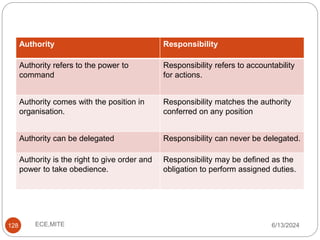
Authority Responsibility
Authority refers to the power to
command
Responsibility refers to accountability
for actions.
Authority comes with the position in
organisation.
Responsibility matches the authority
conferred on any position
Authority can be delegated Responsibility can never be delegated.
Authority is the right to give order and
power to take obedience.
Responsibility may be defined as the
obligation to perform assigned duties.
6/13/2024
ECE,MITE
CENTRALIZATION AND DECENTRALIZATION
129
 Centralisation refers to the extent to which decision
making process rests with the top management.
 If the top management makes all the important
decision in the organisation with little or no participation
from the lower level employees, then the organisation
is said to be a highly centralized orgainsation.
 Everything that goes to reduce the subordinate’s role in
decision making is centralization.
6/13/2024
ECE,MITE
CENTRALIZATION AND DECENTRALIZATION
130
 If the organisation encourages lower level personnel to
participate in the decision making process by giving them
greater freedom, the organisation is called a decentralized
organisation.
 In decentralized setup, ultimate authority to command and
ultimate responsibility for the results is localized as far down
in the organization.
 According to Allen “Decentralization refers to the systematic
effort to delegate to the lower levels all authority except that
which can only be exercised at central points”.
6/13/2024
ECE,MITE
CENTRALIZATION AND DECENTRALIZATION
131
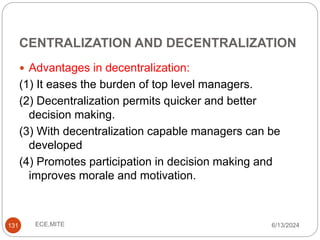
 Advantages in decentralization:
(1) It eases the burden of top level managers.
(2) Decentralization permits quicker and better
decision making.
(3) With decentralization capable managers can be
developed
(4) Promotes participation in decision making and
improves morale and motivation.
6/13/2024
ECE,MITE
CENTRALIZATION AND DECENTRALIZATION
132
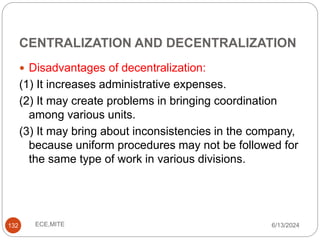
 Disadvantages of decentralization:
(1) It increases administrative expenses.
(2) It may create problems in bringing coordination
among various units.
(3) It may bring about inconsistencies in the company,
because uniform procedures may not be followed for
the same type of work in various divisions.
6/13/2024
ECE,MITE
133
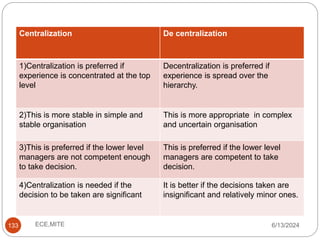
Centralization De centralization
1)Centralization is preferred if
experience is concentrated at the top
level
Decentralization is preferred if
experience is spread over the
hierarchy.
2)This is more stable in simple and
stable organisation
This is more appropriate in complex
and uncertain organisation
3)This is preferred if the lower level
managers are not competent enough
to take decision.
This is preferred if the lower level
managers are competent to take
decision.
4)Centralization is needed if the
decision to be taken are significant
It is better if the decisions taken are
insignificant and relatively minor ones.
6/13/2024
ECE,MITE
134
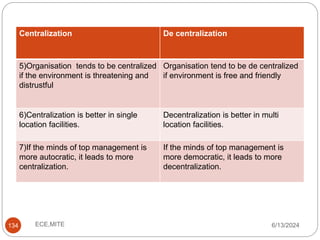
Centralization De centralization
5)Organisation tends to be centralized
if the environment is threatening and
distrustful
Organisation tend to be de centralized
if environment is free and friendly
6)Centralization is better in single
location facilities.
Decentralization is better in multi
location facilities.
7)If the minds of top management is
more autocratic, it leads to more
centralization.
If the minds of top management is
more democratic, it leads to more
decentralization.
6/13/2024
ECE,MITE
Questions
6/13/2024
ECE,MITE
135
1.Describe the departmentalisation based on functions
with its and demerits. 6marks,
dec/jan 2015
2. Explain the advantages of delegation of authority.
6marks, dec/jan 2015
3. Explain the various sources of recruitment.
8marks, dec/jan 2015
4. What does organization mean? Explain any four
types of organizations. 10marks,
june/july 2014
5. discuss the meaning, importance and factors
governing the span of management.
10marks, june/july 2014
Questions
6/13/2024
ECE,MITE
136
6. Briefly explain the principles of organization.
(10Marks)
7. Determine the process of selection and recruitment
process.
(10Marks)
8. Briefly Explain the Departmentation.
(10Marks)
9. Classify the types of organization.
(10Marks)
10. Explain the Following
(10Marks)
i)MBO
ii) Centralization Vs Decentralization
Unit 4
Directing and
Controlling
6/13/2024
137
Learning Objectives:
138
 Explain the meaning of direction and requirements
of effective direction.
 describe orders and the principles to be followed in
giving orders.
 Discuss the meaning, nature and process of
motivation
 Analyse the important content, process and
reinforcement in motivation theories.
 Describe the characteristics of leadership
 Examine the situational forces determining the
choice of leadership style
Sl
no
TOPIC Date
planned
Date
engaged
Remark
s
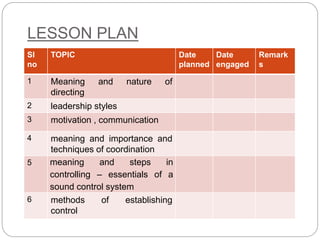
1 Meaning and nature of
directing
2 leadership styles
3 motivation , communication
4 meaning and importance and
techniques of coordination
5 meaning and steps in
controlling – essentials of a
sound control system
6 methods of establishing
control
LESSON PLAN
DEFINITION OF DIRECTING
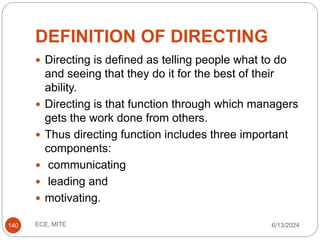
 Directing is defined as telling people what to do
and seeing that they do it for the best of their
ability.
 Directing is that function through which managers
gets the work done from others.
 Thus directing function includes three important
components:
 communicating
 leading and
 motivating.
6/13/2024
ECE, MITE
140
LEADERSHIP
6/13/2024
ECE, MITE
141
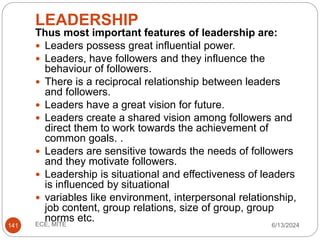
Thus most important features of leadership are:
 Leaders possess great influential power.
 Leaders, have followers and they influence the
behaviour of followers.
 There is a reciprocal relationship between leaders
and followers.
 Leaders have a great vision for future.
 Leaders create a shared vision among followers and
direct them to work towards the achievement of
common goals. .
 Leaders are sensitive towards the needs of followers
and they motivate followers.
 Leadership is situational and effectiveness of leaders
is influenced by situational
 variables like environment, interpersonal relationship,
job content, group relations, size of group, group
norms etc.
Importance of Leadership
6/13/2024
ECE, MITE
142
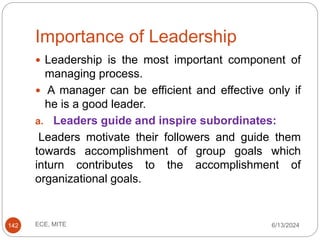
 Leadership is the most important component of
managing process.
 A manager can be efficient and effective only if
he is a good leader.
a. Leaders guide and inspire subordinates:
Leaders motivate their followers and guide them
towards accomplishment of group goals which
inturn contributes to the accomplishment of
organizational goals.
Importance of Leadership
6/13/2024
ECE, MITE
143
b. Leaders build good work environment: Leaders
create a work environment in which employees can
contribute by performing to the best of their abilities.
The environment creates a relationship based on
trust.
e. Leaders build confidence in followers: Leaders
recognize abilities of their followers and encourage
them to develop to their potential by building
confidence in them.
d. Leaders secure cooperation from the group:
Leaders influences the group members in such a
way that all the members work collectively towards
group objectives and thus instill cooperation among
all members.
Importance of Leadership
6/13/2024
ECE, MITE
144
e. Leaders act as change agents:
 organizations operate in an environment which is
subjected to continuous changes, and if the
organizations do not respond to these changes,
then survival of the organizations may be difficult.
 But organizational members resist any changes, as
they are accustomed to particular methods of work.
 It requires great leadership to reduce the resistance
to change and convince the employees to accept
the change.
 Thus leaders act as change agents of the
organization and helps in implementing successful
positive changes in the organization.
Importance of Leadership
6/13/2024
ECE, MITE
145
f. Leaders are representatives of the followers:
On one hand leaders direct the employees of the
organization, but on the other hand they are also
representatives of their followers. They always take
personal interest in helping their followers and
protect the interests of the followers while taking
any major organizational decisions.
g. Leaders develop great vision: Leaders are
known for their great vision and they develop the
vision for building great organizations.
MOTIVATION
6/13/2024
ECE, MITE
146
 Motivation is the process of stimulating people
to action to accomplish desired goals.
 Motivation represents inner drive within an
individual which directs him to behave in
specific way.
 Only highly motivated employees can
achieve the goals of an organization.
MOTIVATION
6/13/2024
ECE, MITE
147
 Motivation is also defined as the one which
accounts for direction, intensity and persistence of
efforts towards achievement of goal.
 Direction refers to quality of efforts, and if efforts are
not channelized in proper direction they may not
yield expected results.
 Intensity of efforts refers to how hard an individual
puts efforts.
 Persistence refers to sustenance of efforts till the
achievement of goals.
 Motivated individuals put same intensity of efforts
till they achieve the goals.
Importance of Motivation
6/13/2024
ECE, MITE
148
 Highly motivated workforce is absolutely essential for
any organization to achieve its objectives.
 Management basically aims at optimum utilization of
various resources of the organization.
 These resources are human resources, financial
resources, and physical resources like materials, tools,
machines, equipments etc.
 All these resources are very precious and they cannot
be wasted.
 Use of financial and physical resources always depends
on human resources and thus only motivated employees
can effectively convert financial and physicaJ resources
into useful products and services.
Importance of Motivation
6/13/2024
ECE, MITE
149
 Motivation results in desirable behaviour of employees.
 These behaviours are essential for implementation of
organizational plans successfully.
 Thus successful achievement of goals not only depends
on good plans but also on motivated workforce.
 Individuals may possess abilities or skills to perform a
task effectively and efficiently. But translation of these
abilities into actual performance will depend on their
willingness to do the task. This inturn will depend on his
or her motivation. Motivation thus bridges the gap
between ability to work and willingness to perform.
Hence motivation is essential for effectiveness and
efficiency.
Importance of Motivation
6/13/2024
ECE, MITE
150
 Motivation is an important factor which
contributes to employee retention and building a
stable workforce.
 Motivation brings down number of employee
grievances and complaints.
 Active involvement of employees in whatever
task they do will also brings down any chances of
accidents and losses resulting out of accidents.
 Highly motivated workforce can produce best
quality of products and services. This
COMMUNICATION
6/13/2024
ECE, MITE
151
 The source or sender or communicator:
Communication process starts with sender.
Sender is the person who has an intended
message to convey to some one. He has the
purpose of communicating information or
message to one or more persons.
 Encoding: Encoding means putting message
into a code. Encoding is the process of translating
message into a form which can be understood by
the receiver. It can be in the form of oral, written
or symbols.
Types of Communication
6/13/2024
ECE, MITE
152
 Formal and Informal Communication
 Formal communication is officially accepted
communication in the organization and it uses
official channel for transmitting messages.
 It follows official route for flow of communication
between various people in the organization.
 Commands, instruction, orders flowing from top
level to lower level, messages for coordination
between people at same level, suggestions from
people at different levels, requisitions from lower
level to higher level etc represent formal
communication.
Types of Communication
6/13/2024
ECE, MITE
153
 Formal and Informal Communication
 Informal communication is that communication
which is not officially accepted part of the
communication in an organization.
 It does not adhere to the organizational hierarchy.
Informal communication is based on the informal
relationship among the organizational members.
Types of Communication
6/13/2024
ECE, MITE
154
Oral and Written Communication
 Oral communication is face to face interpersonal
communication between individuals.
 Message is exchanged through word of mouth i.e. it
is exchanged through spoken words.
 Written communication is transmitted through
written document in the form of letters, circulars,
memos, reports, manuals etc.
 It is the most popular mode of formal
communication and it is very widely used.
 It creates a permanent and verifiable document
which serves as proof for communication process.
Types of Communication
6/13/2024
ECE, MITE
155
Merits of oral communication .
 It is very quick and saves time.
 Direct contact establishes personal touch and hence it is
more effective.
 Message can be transmitted to large number of people
at the same time (through speech).
 Easy to understand and scope for immediate feedback.
 Chances of misinterpretation are minimum.
Demerits :
There is no recorded proof for message and hence fixing
responsibility for both sender and receiver is difficult.
Keeping attention of receiver is difficult when messages
are lengthy. . Requires good oratory skills.
Types of Communication
6/13/2024
ECE, MITE
156
 Non Verbal Communication or Body Language
 Non verbal communication refers to messages sent
through human actions and behaviours rather than
words.
 We generally use body language in the form of
facial expressions,
body positions, gestures, eye contact, posture,
silence, etc to convey different messages.
 Body language is also a very powerful in conveying
messages.
 Research has proved that non verbal cues are
more impact on message interpretation than actual
spoken words.
Types of Communication
6/13/2024
ECE, MITE
157
 Vertical and Horizontal Communication
 Communication is said be vertical when messages
flow from one hierarchy level to another.
 Vertical communication can be downward or
upward.
 Downward communication starts from top
management and flows down to lower level through
different hierarchy levels.
 Downward communication is used to give orders,
instructions, ihform procedures, inform organization
goals etc.
 Job instruction sheets, circulars, memos, orders,
etc are examples for downward communication.
Types of Communication
6/13/2024
ECE, MITE
158
 Vertical and Horizontal Communication
 Upwards communication flows from lower level to
top management and it provides top management
information about what is happening at lower
levels.
 But upward communication is used more when
managers use open door policy and encourage
subordinates to share information.
 Examples for upward communication include
requests, applications, reports, suggestions etc.
Types of Communication
6/13/2024
ECE, MITE
159
 Vertical and Horizontal Communication
 Horizontal communication refers to exchange of
information between two people at same
hierarchy level or peer level.
 For example information exchanged between two
departmental heads of an organization, a
production engineer informing a maintenance
engineer about breakdown of a machine etc.
 It is also called as lateral communication.
COORDINATION
6/13/2024
ECE, MITE
160
 Coordination is the process of integration or
synchronization of the interdepartmental efforts of
individuals in order to attain common goals.
 For example coordination between various
departments like production, marketing, purchase,
quality, human resource management, finance etc are
very important for smooth functioning of the
organization.
 Coordination helps in unifying efforts of all these
departments and achieving the common
organizational objectives.
Need of Coordination
6/13/2024
ECE, MITE
161
 Coordination is very much essential due to
following reasons.
 Organizations 'are made up of various units and
departments, which are interdependent.
 The splitting of work into smaller and smaller units
through division of work creates the need for
coordination among many individuals who need
to complete the full task.
Requirements of Good
Coordination
6/13/2024
ECE, MITE
162
Good coordination requires the following
important prerequisites.
 Direct personal contact between individuals who
are responsible for task completion improves
coordination.
 Direct personal contact eliminates any
misunderstanding among individuals.
 Mutual consultation and joint planning ensures
better support for each other and commitment for
common goals.
 Defining clear objectives ensures clarity of role and
responsibility among individuals resulting in better
coordination.
 Clear definition of authority and responsibility of
individuals eliminates any ambiguities among
individuals.
Requirements of Good
Coordination
6/13/2024
ECE, MITE
163
 Good coordination requires the following
important prerequisites.
 Effective communication is very Communication
ensures harmonious different departments.
 Effective leadership ensures coordination among
groups and individuals since an effective leader
creates a sense of shared vision among them.
CONTROLLING
6/13/2024
ECE, MITE
164
 Controlling is defined as the process of measuring
the actual work and comparing it with a
predetermined standard in order to determine any
deviation so that timely corrective actions are taken
and tasks are completed as per original plans.
 Controlling is defined as the continuous function of
determining what is being performed, measuring its
actual results in relation with predetermined
objectives and devising such corrective measures
that may be necessary to make the performance
conform to the original plans.
Objectives of Controlling
6/13/2024
ECE, MITE
165
 To ensure effectiveness and efficiency in all
management functions.
 To determine what is happening in the organization
and measure actual progress from time to time.
 To ensure effective communication between various
units of organization.
 To keep a check on resource utilization.
 To reframe organizational plans in relation to
changes in the environment.
 To detect any deviation and take timely corrective
actions.
 To ensure that all the activities are performed
according to predetermined plans.
Questions:
6/13/2024
ECE, MITE
166
1. What is leadership? Explain. 4marks, june/july
2014
2. discuss the characteristics of motivation. 6marks,
june/july 2014
3. Define co-ordination .what are its characteristics?
5marks, june/july
2014
4. differentiate between co0ordination and co-
operation.5marks, june/july 2014
5. describe the maslow’s need- hierarchy theory of
motivation.
8marks, dec/jan
2015
6. explain any three techniques of co-ordiantion. 6marks,
dec/jan 2015
7. Describe any three essential factors of effective control
system.

Management module 2 organization and staffing

  • 1.
    ORGANIZING AND STAFFING DIRECTAND CONTROLLING 6/13/2024 1 MODULE 2
  • 2.
  • 3.
    Learning Objectives: 6/13/2024 3  Examinethe meaning, characteristics and topology of organisations and staffing  Learn the principles and process of organising  Understand the meaning and significance of the span of management and the factors governing it.  Describe the advantages and disadvantages of different bases of departmentalisation.  State the importance and need for proper staffing
  • 4.
    Sl no TOPIC Date planned Date engaged Remark s 1 Natureand purpose of organization 2 principles of organization-types of organization 3 Departmentation- Committes- 4 Centralisation Vs Decentralisation of authority and responsibility 5 Span of control- MBO and MBE (Meaning only) 6 Nature and importance of staffing- 7 Process of selection and recruitment (in brief) LESSON PLAN
  • 5.
    ORGNISATION 5  The processof identifying and grouping of the work to be performed, defining and delegating responsibility and authority and establishing relationships for the purpose of enabling people to work most effectively together in accomplishing their objectives. 6/13/2024
  • 6.
    MEANING OF ORGANIZING 6 Koontz and O'Donnel "It is grouping of activities necessary to attain enterprise objectives and the assignment of each grouping to a manager with authority necessary to supervise it".  Amitai Etizoni- ”Organisation is social unit or human grouping deliberately structured for the purpose of attaining specific goals”.  Sehein- “Orgainsation as the rational coordination of activities of a number of people for the achievement of some common explicit purpose or goal, through division of labour and function, and through a hierarchy of authority and responsibility. 6/13/2024
  • 7.
    STEPS IN PROCESSOF ORGANIZING 7  While organizing, a manager differentiates and integrates the activities of his organization.  By differentiation is meant the process of departmentalization or segmentation of activities on the basis of some homogeneity.  Integration is the process of achieving unity of effort among various departments, segments or subsystems. 6/13/2024
  • 8.
    STEPS IN ORGANIZING (1)Consideration of objectives: 8  The first step in organizing is to know the objectives of the enterprise.  Objectives determine resources and the various activities which need to be performed and the type of organization which needs to be built for this purpose.  Objectives also serve as guidelines for the management and workers.  They bring about unity of direction in the organization. 6/13/2024
  • 9.
    STEPS IN ORGANIZING (2)Identification and grouping of activities: 9  In order to achieve the objectives of the enterprise, certain activities are necessary.  The activities will depend upon the nature and size of the enterprise.  Each job should be properly classified and grouped.  This will enable the people to know what is expected of them as members of the group and will help in avoiding duplication of efforts.  For example, the total activities of an enterprise may be divided into major functions like production, purchasing, marketing, finance etc.  such function is further subdivided into various jobs.  For example, in production department separate sections 6/13/2024
  • 10.
    STEPS IN ORGANIZING 3)Assignment of duties: 10  After classifying and grouping the activities into various jobs, they should be allotted to the individuals for ensuring certainty of work performance.  Each individual should be given a specific job to do according to his ability and made responsible for that. 6/13/2024
  • 11.
    STEPS IN ORGANIZING (4)Delegation of authority 11  Every individual is given the authority necessary to perform the assigned activity effectively.  By authority we mean power to take decisions, issue instructions, guiding the subordinates, supervise and control them. 6/13/2024
  • 12.
    STEPS IN ORGANIZING 5)Coordinating activities 12  The activities and efforts of different individuals are then synchronized.  Such coordination is necessary to ensure effective performance of specialized functions.  Interrelationship between different job and individuals are clearly defined so that everybody knows from whom he has to take orders and to whom he is answerable. 6/13/2024
  • 13.
    NATURE OF ORGANIZATION 13 (1)Organization is always related to certain objectives:  Each organization has an objective.  The operations are divided; authority and responsibility are determined to achieve predetermined objectives. (2) An organization is a group of people:  Mc Farland has defined organization as “an identifiable group of people contributing their efforts towards the attainment of goals. People form groups or organizations to accomplish common objectives and pool their efforts by defining and dividing various activities, responsibility and authority”. 6/13/2024
  • 14.
    NATURE OF ORGANIZATION 14 (3)Communication is the nervous system of organization: The organizational members are able to communicate with each other and may coordinate their activities.  No organization can survive without an efficient system of communication. (4) Organizing is a basic function of management: Organizing is done in relation to all other functions of management, namely planning, staffing, directing and controlling and in all the areas of business namely production, marketing, purchasing, personnel. (5) Organization is a continuous process:  Managers are continuously engaged in organizing and 6/13/2024
  • 15.
    NATURE OF ORGANIZATION 15 (6)Organization is a structure of relationship:  The structure of relationship deliberately created by the management is referred to as formal organization.  An organization may also have a network of social relationships that arise between people working together. Such relationships are known as informal organization. (7) Organization involves a network of authority and responsibility relationship:  Various positions are created; specific tasks are assigned to them.  To perform the task, each position is delegated adequate authority.  Authority and responsibility relationships throughout the organization must be clearly defined to achieve coordination and to avoid conflicts between individuals and departments. 6/13/2024
  • 16.
    PURPOSE OF ORGANIZATION 16 (1)To facilitate pattern of communication:  Organization structure provide pattern of communication and coordination.  By grouping activities and people, structure facilitates communication between people centered on their job activities. (2) To allocate authority and responsibility:  Organization structure allocates authority and responsibility.  It specifies who is to direct whom and who is accountable for what results.  The structure helps the organization members to know what his role is and how it relates to others role. 6/13/2024
  • 17.
    PURPOSE OF ORGANIZATION 17 (3)To locate decision centers:  Organization structure determines the location of decision making in the organization. (4) To create proper balance:  Organization structure creates the proper balance and emphasis of activities.  Those more critical to the enterprises success might be placed higher in the organization.  Activity of comparable importance might be placed at the lower level. 6/13/2024
  • 18.
    PURPOSE OF ORGANIZATION 18 (5)To stimulate creativity:  organization stimulates independent, creative thinking and initiative. (6) To encourage growth:  If the organization structure is flexible, it will help in meeting challenges and creating opportunities for growth. (7) To make use of technological improvements:  organization structure which is adoptable to changes can make the best possible use of latest technology.  It can modify the existing pattern of authority-responsibility relationships in the wake of technological improvements. 6/13/2024
  • 19.
    PRINCIPLES OF ORGANIZATION 19 In order to facilitate the achievement of objectives, management thinkers have laid down certain principles of organization.  The principles are guidelines for planning organization structure.  (1) Objectives: (2) Specialization: (3) Span of control:  (4) Exception: (5) Scalar principle: (6) Unity of command:  (7) Delegation: (8) Responsibility: (9) Authority:  (10) Efficiency: (11) Simplicity: (12) Flexibility:  (13) Balance: (14) Unity of direction: (15) Personal abilities: 6/13/2024
  • 20.
    PRINCIPLES OF ORGANIZATION 20 (1)Objectives:  Objectives of the enterprise should be clearly defined.  Every part of the organization and organization as a whole should be geared to the basic objective determined by the enterprise. 6/13/2024
  • 21.
    PRINCIPLES OF ORGANIZATION 21 (2)Specialization:  Effective organization must promote specialization.  The activities of the enterprise should be divided according to functions and assigned to persons according to their specialization. 6/13/2024
  • 22.
    PRINCIPLES OF ORGANIZATION 22 (3) Span of control:  A manager can directly supervise only a limited number of executives.  Hence, it is necessary to have a proper number of subordinates answerable to a manager.  A maximum of six may be prescribed for this purpose. 6/13/2024
  • 23.
    PRINCIPLES OF ORGANIZATION 23 (4) Exception:  This principle requires that organization structure should be so designed that managers are required to go through the exceptional matters only.  All the routine decisions should be taken by subordinates, where as problems involving unusual matters and policy decision should be referred to higher levels. 6/13/2024
  • 24.
    PRINCIPLES OF ORGANIZATION 24 (5) Scalar principle:  This is also known as chain of command. There must be clear lines of authority running from the top to the bottom.  Unbroken line of authority from top level to bottom level. 6/13/2024
  • 25.
    PRINCIPLES OF ORGANIZATION 25 (6) Unity of command:  Each subordinate should have only one supervisor whose command he has to obey.  Dual subordination must be avoided, for it causes uneasiness, disorder, and indiscipline. 6/13/2024
  • 26.
    PRINCIPLES OF ORGANIZATION 26 (7) Delegation:  Proper authority should be delegated at the lower levels of the organization also.  The authority delegated must be equal to responsibility i.e., the manager should have enough authority to accomplish the task assigned to him.  Handle special problems ,co ordinating and planning evmts. 6/13/2024
  • 27.
    PRINCIPLES OF ORGANIZATION 27 (8) Responsibility: accountability  A superior should be held responsible for the acts of his subordinates.  No superior should be allowed to avoid responsibility by delegating authority to his subordinates. 6/13/2024
  • 28.
    PRINCIPLES OF ORGANIZATION 28 (9) Authority:  Right and power to act.  The authority is the tool by which a manager is able to accomplish the desired objective.  Hence, the authority of each manager must be clearly defined.  The authority should be equal to responsibility. 6/13/2024
  • 29.
    PRINCIPLES OF ORGANIZATION 29 (10) Efficiency:  The organisation structure should enable the enterprise to function efficiency.  The organization should be able to attain the mission and objectives at the minimum cost. 6/13/2024
  • 30.
    PRINCIPLES OF ORGANIZATION 30 (11) Simplicity:  The organization structure should be as simple as possible with minimum number of levels.  A large number of levels of organization means difficulty of effective communication and coordination. 6/13/2024
  • 31.
    PRINCIPLES OF ORGANIZATION 31 (12) Flexibility:  The organization should be flexible, should be adaptable to changing circumstances.  It should permit expansion and replacement without dislocation and disruption of the basic design.  A organization must avoid complicated procedures and excessive complication of control so that it may adapt itself easily and economically to business and technical changes. 6/13/2024
  • 32.
    PRINCIPLES OF ORGANIZATION 32 (13) Balance:  There should be reasonable balance in the size of various departments, between centralization and decentralization, between span of control and among all types of factors such as human, Technical and financial. 6/13/2024
  • 33.
    PRINCIPLES OF ORGANIZATION 33 (14) Unity of direction:  There must be one objective and one plan for a group of activities having the same objective.  Unity of direction facilitates unification and coordination of activities at various levels. 6/13/2024
  • 34.
    PRINCIPLES OF ORGANIZATION 34 (15) Personal abilities:  As organization is a formal group of people there is need for proper selection, placement and training.  Organization structure must ensure optimum use of human resources. 6/13/2024
  • 35.
    DEPARTMENTATION 35  Horizontal differentiationof tasks or activities into discrete segments is called departmentation.  Departmentation involves grouping of operating tasks into jobs, combining of jobs into effective work group and combining of groups into divisions often termed as ‘departments’.  The aim is to take advantages of division of labour and specialization up to a certain limit. 6/13/2024
  • 36.
    DEPARTMENTATION 36 1) Departmentation byfunctions: 2) Departmentation by product: 3) Departmentation by customers: 4) Departmentation by territory: 5) Departmentation by Process: 6) Departmentation by time: 6/13/2024
  • 37.
    1)Departmentation by functions: 37 This is the simplest and most commonly used base for Departmentation.  Each major function of the enterprise is grouped into a department.  For example there may be production, finance, marketing and personnel department in an organization .  All functions related to production are grouped together to form production department, similarly other departments are formed on the basis of function. 6/13/2024
  • 38.
  • 39.
    1)Departmentation by functions: 39 Advantages (1) It is simple and suitable for small organization which manufactures limited number of products. (2) It promotes specialization. (3) It leads to improve planning and control of key functions. (4) Manpower and other resources of the company are effectively used. 6/13/2024
  • 40.
    1)Departmentation by functions: 40 Drawbacks (1) It fosters sub-goal loyalty. Department goal becomes important than organizational goal resulting into interdepartmental conflicts. (2) Difficult to set up specific accountability and profit centers within functional departments with the result that performance cannot be accurately measured. (3) It does not offer a good training for overall development of a manager. 6/13/2024
  • 41.
    2)Departmentation by product: 41 This form is suited for a large organisation manufacturing varity of products.  All activities related to a particular product line may be grouped together under the direction of a semiautonomous division manager.  Several companies such as Godrej, TATA have product based departments. 6/13/2024
  • 42.
  • 43.
    2)Departmentation by products: 43 Advantages  (1) It focuses individual attention on each product line.  (2) It leads to specialization of physical facilities on the basis of product which results in economy.  (3) It is easier to evaluate and compare the performance of various product division and it enables the top management to invest more in profitable product groups. 6/13/2024
  • 44.
    2)Departmentation by products: 44 Drawbacks  (1) This form results in duplication of staff.  (2) Extra expenditure is incurred in maintaining a sales force for each product.  (3) Employment of a large number of managerial personnel is required. 6/13/2024
  • 45.
    3)Departmentation by customers: 45 This is used in the enterprises engaged in providing specialized services to different classes of customers.  Management groups the activities on the basis of customers to cater to the requirements of clearly defined customer groups.  For example, an automobile service company may organize its departments as heavy vehicles servicing division, car servicing division and scooter servicing division  Similarly an educational institute may have departments for regular courses, evening and corresponding courses etc. 6/13/2024
  • 46.
    4)Departmentation by territory: 46 Under this classification, the market area is broken up into sales territories and a responsible executive is put in-charge of each territory.  The territory may be known as district, division or region.  The field salesmen under respective regions report to their corresponding sales supervisors.  Banks, Railways and big manufacturing companies like petroleum companies are some example for this. 6/13/2024
  • 47.
    4)Departmentation by territory: 47 Advantages 1) Places responsibility at lower level. 2) Ensures a better coordination with in a region. 3) Provides region wise comparison of performance. 4) Takes advantage of economics of local operations. 6/13/2024
  • 48.
    4)Departmentation by territory: 48 Disadvantage 1) Requires more person with general manager abilities. 2) Requires to maintain similar functional people at all region. 3) Difficult to control from top management. 6/13/2024
  • 49.
  • 50.
    5)Departmentation by Process: 50 Departmentation here, is done on the basis of several discrete process or technologies involved in the manufacture of a product.  For example, a vegetable oil company may have separate departments for crushing, refining and finishing.  A textile mill may have departments for ginning, spinning, weaving and dyeing.  A work that would otherwise be done in several different locations in an enterprise is done in one place because of special equipments used. 6/13/2024
  • 51.
    6)Departmentation by Time: 51 One of oldest forms of departmentation, generally used at lower level of an organisation.  It is grouping of activities on the basis of time.  The use of shifts is common in some organistions due to economical or technological reasons.  For service organisation like hospital, fire department, security round the clock work is essential.  All these call for shift work is essential. 6/13/2024
  • 52.
    6)Departmentation by Time: 52 Advantages: 1) Service can be rendered, that goes beyond the normal 8 hour shift. 2) Facilities use of processes that cannot be stopped or interrupted. 3) Expensive capital equipment can be better utilized. 4) High and continuous production per day. 6/13/2024
  • 53.
    6)Departmentation by Time: 53 Disadvantages: 1) Lacks good and efficient supervision during night shift. 2) Lack of effective coordination and communication from people of one shift to next shift. 3) Inconvenient for people to work in night shifts and more difficult during shifts changes from day to night. 6/13/2024
  • 54.
    TYPES OF ORGANIZATION 54 1)Lineorganisation. 2) Functional or stafforganisation 3) Line and stafforganisation. 4) Committeeorganisation 5) Matrixorganisation 6/13/2024
  • 55.
    TYPES OF ORGANIZATION 1)Line organisation 55  Line organization is the simple and oldest type of organization and is also known of scalar or military organization.  The line of authority flows vertically downward from top to bottom throughout the organization.  The nquantum of authority is highest at the top and reduces at each successive level.  The superior communicates his decision and orders to his subordinates.  The subordinates, in turn, can communicate them to those who are immediately under them. 6/13/2024
  • 56.
    TYPES OF ORGANIZATION 1)Line organisation 56  Three important principles of this system are  1) Command should be given to subordinate through the immediate superior. There should be no skipping of levels in chain of command.  2) There should be only one chain i.e, command should be received from only one immediate superior.  3) The number of subordinates whose work is directly commanded by the superior should be limited. 6/13/2024
  • 57.
    TYPES OF ORGANIZATION 1)Line organisation 57 6/13/2024
  • 58.
    TYPES OF ORGANIZATION 1)Line organisation 58  Advantages (1) Simple and easy to understand. (2) Quick decision and speed of action. (3) Clear division of authority and responsibility. (4) Discipline and better coordination (5) clear channel of communication. 6/13/2024
  • 59.
    TYPES OF ORGANIZATION 1)Line organisation 59  Disadvantages (1) The organization is rigid and inflexible (2) Being an autocratic system, managers may become dictators and not leaders. (3) due to task of specialisation there is more wastage of material and man hour. (4) Overload for few key executives. (5) Lack of specialization. 6/13/2024
  • 60.
    TYPES OF ORGANIZATION 2)Functional Organization 60  The line organization does not provide specialists in the structure.  Many jobs require specialized knowledge to perform them. In functional organization the specialists are made available in the top positions throughout the enterprise.  Workers consult specialists in various areas to carry out their work instead of referring to only boss.  Functional authority is the right which is delegated to an individual or a department that authorizes control of specified processes.  Functional authority remains confined to functional 6/13/2024
  • 61.
    TYPES OF ORGANIZATION 2)Functional Organization 61  Under functional organization, various activities of the enterprise are classified according to certain functions like production, marketing, finance, personnel etc., and are put under the charge of functional specialists.  A functional in charge directs the subordinates throughout the organization in his particular area of business operation.  That means that subordinates receives orders and instructions not from one superior but from several functional specialists.  For example personnel department would recruit, train and deal with the people required to all other department. 6/13/2024
  • 62.
    TYPES OF ORGANIZATION 2)Functional Organization 62 6/13/2024
  • 63.
    TYPES OF ORGANIZATION 2)Functional Organization 63  Advantages (1) Specialization: Since a foreman is responsible for only one function, he can perform his duties in better manner and results better production rate at an improved quality level. (2) Cost reduction: Since for every operation expert guidance is there, wastage of material, man and machine hours are reduced. (3) Mass production: This type of organisation helps mass production through standardization and specialization. (4) No need for all round executives: A functional manager is required to have expertise in one function only. This makes it easy for executive development. 6/13/2024
  • 64.
    TYPES OF ORGANIZATION 2)Functional Organization 64  Disadvantages (1) Violates principles of unity of command. (2) The operation of functional organization is too complicated. (3) It develops specialists rather than generalists. (4) Lack of coordination among functional executives which delays decision making. 6/13/2024
  • 65.
    TYPES OF ORGANIZATION 3)Line and Staff Organization 65  In order to reap the advantages of both line organization and functional organization, a new type of organization is developed i.e., line and staff organization.  In line and staff organization, the line authority remains the same as it does in the line organization.  In addition, the specialists are attached to line managers to advice them on important matters.  They were known as ‘staff’ as they were recruited to perform staff or specialist function.  These specialists stand ready with their speciality to serve line men and to give help which will enable the 6/13/2024
  • 66.
    TYPES OF ORGANIZATION 3)Line and Staff Organization 66  The function of people in a pure staff capacity is to investigate, research and give advice to line manager to whom they report.  The final decision to accept/implement the recommendation of the staff executives remains in the hands of the line executive.  Staff officers are assigned an ‘authority of ideas’ and line officers an ‘authority of command’ i.e., the line executives function is to act, the staff executive function is to think.  A staff officer’s job is to advice and not to command, then line supervisor must take decision to issue instructions through the scalar plan. 6/13/2024
  • 67.
    TYPES OF ORGANIZATION 3)Line and Staff Organization 67  Line and staff structure has gained popularity because certain problems of management have become very complex and, in order to deal with them, expert knowledge is necessary which can be provided by the staff officers. 6/13/2024
  • 68.
    TYPES OF ORGANIZATION 3)Line and Staff Organization 68 6/13/2024
  • 69.
    TYPES OF ORGANIZATION 3)Line and Staff Organization 69 Advantages.  Specialized knowledge: Line managers get the benefit of specialized knowledge of staff specialists at various levels.  Reduction of burden: Staff specialists relieve the line managers of the botheration of concentrating on specialized functions like accounting, selection and training, public relations, etc.  Proper weightage: Many problems that are ignored or poorly handled in the line organization can be properly covered in the line and staff organization by the use of staff specialists. 6/13/2024 ECE,MITE
  • 70.
    TYPES OF ORGANIZATION 3)Line and Staff Organization 70 Advantages.  Flexibility. Line and staff organization is more flexible as compared to the line organization.  General staff can be employed to help line managers at various levels.  Unity of command. Under this system, the experts provide special guidance without giving orders.  It is the line manager who only has got the right to give orders.  The result is that the enterprises takes advantage of functional organization while maintaining the unity of command i.e., one subordinate receiving orders from one boss only. 6/13/2024 ECE,MITE
  • 71.
    TYPES OF ORGANIZATION 3)Line and Staff Organization 71 Disadvantages 1. There is generally a conflict between the line and staff executives. 2. The allocation of duties between the line and staff executives is generally not very clear. This may hamper coordination in the organization. 3. There is a wide difference between the orientation of the line and staff men. Line executives’ deals with problems in a more practical manner. But staff officials who are specialists in their fields tend to be more theoretical. 6/13/2024 ECE,MITE
  • 72.
    TYPES OF ORGANIZATION 4)Committee Organization 72 • Some of the adminstarive tasks cannot be performed by a single person alone. • Such sitiuation may call for two or more person to perform such tasks. This calls for a committee organisation.  “A committee is a group of persons performing a group task with the object of solving certain problems”.  Committees help in taking corrective decision, coordinating the affairs of different departments and meeting communication requirements in the organization. 6/13/2024 ECE,MITE
  • 73.
    TYPES OF ORGANIZATION 4)Committee Organization 73  The committees may be of different types as follows. 1)Ad-hoc committee: It is a temporary committee formed for a short period to solve a minor problem.  For eg: a committee to decide the date and venue of annual general body meeting. 2)Standing or Permanent committee: Such committees is formed to solve problems which is repetitive in nature.  Eg: Disciplinary committee to solve discipline related issues of individual workers from time to time. 6/13/2024 ECE,MITE
  • 74.
    TYPES OF ORGANIZATION 4)Committee Organization 74 3)Advisory committee: This committee studies the various aspects of a problem and suggests courses of action to the management thus reducing its burden. An advisory committee does not have power to act.  For eg: a committee in a manufacturing industry studying the feasibility in going for modernization of the plant. 4)Educational committee: this is a committee which guards the company policies and procedures. They often educate and give an insight to the management about the goals of the organisation whenever there is confusion. 6/13/2024 ECE,MITE
  • 75.
    TYPES OF ORGANIZATION 4)Committee Organization 75 Characteristics of a committee 1. The number of members in a committee should be a minimum( 3 to 8). 2. An agenda has to be prepared by the chairman of the committee well in advance of meeting and circulated among the members so that they get sufficient time to think over the problem to be discussed. 3. The duties, authority and responsibility of the committee must be clearly defined. 4. The chairman must have enough authority to efficiently conduct the meeting. 5. Problems which can be solved by individuals should not be included in the agenda of the committee. 6. Committee should draw members from all the 6/13/2024 ECE,MITE
  • 76.
    TYPES OF ORGANIZATION 4)Committee Organization 76  Advantages (1) Committees provide a forum for the pooling of knowledge and experience of many persons of different skills, ages and backgrounds. (2) It helps in throwing up new ideas, innovation and new schemes. (3) Committees are impersonal in action and hence their decisions are generally unbiased and are based on facts. (4) When departmental heads are members of committee, people get an opportunity to understand each others problems and hence improve coordination. 6/13/2024 ECE,MITE
  • 77.
    TYPES OF ORGANIZATION 4)Committee Organization 77  Disadvantages 1) Sometimes a committee may take a week or two to arrive at a decision. 2) In a committee, no individual can be held responsible for anything. 3) Final decision may not be fully acceptable to everyone on the committee. 4) Very often aggressive members in the committee may influence the final decision. 5) Committee meeting get postponed often when key members are absent. 6/13/2024 ECE,MITE
  • 78.
    TYPES OF ORGANIZATION 5)Matrix organisation 78  There are several departments under matrix organisation.  Each department is assigned with a specific task or project.  The available resources can be effectively used by each department with the coordination of other departments.  Matrix organisation is used when an organisation has to handle different projects but all using same set of resources.  This type of organisation is best suited where large number of small project are to be managed. 6/13/2024 ECE,MITE
  • 79.
    TYPES OF ORGANIZATION 5)Matrix organisation 79  For the matrix organisation to function effectively, the following condition should prevail. 1) Scalar chin of command is not followed. A project manager will give reports to several superiors. 2) The physical, financial and human resources are to be shared by people of different projects in a cooperative way. 3) Sharing of resources may lead to conflicts if not understood each other properly. 6/13/2024 ECE,MITE
  • 80.
    TYPES OF ORGANIZATION 5)Matrix organisation 80 The manager of each project share the resources of the different engineering Department. 6/13/2024 ECE,MITE
  • 81.
    TYPES OF ORGANIZATION 5)Matrix organisation 81  Advantages. 1) Organisation structure is very flexible. 2) The cost of project is reduced because of shring of man power and other resources. 3) Organisation is oriented towards end results. 4) Responsibility of each project is clearly defined and fixed with respective project manager, who control the project from start to finish. 6/13/2024 ECE,MITE
  • 82.
    TYPES OF ORGANIZATION 5)Matrix organisation 82  Disadvantages. 1) Chances of conflicts in organisation authority exists. 2) Lack of unity of command in organisation. 3) Some times resources may not available owing to other priority projects. 4) Requires extreme planning for optimum utilization of resources. 5) Since too many supervisors controlling the activity, work may be delayed. 6/13/2024 ECE,MITE
  • 83.
    SPAN OF CONTROL 83 The span of control indicates the number of subordinates who can be successfully directed by a supervisor.  It is often referred to as span of management, span of supervision, span of authority.  Span of management is important because of two reasons.  First is span of management affects the efficient utilization of managers and the effective performance of the subordinates.  If the span is too wide, managers are overburdened and subordinates receive little guidance.  If the span of management is too narrow, the managers are under utilized and subordinates are over controlled. 6/13/2024 ECE,MITE
  • 84.
    SPAN OF CONTROL 84 A narrow span results in tall organization with many levels of supervision between top management and lowest organizational levels which creates more communication and cost problems.  On the other hand, a wide span for the same number of employees results in flat organization with fewer management levels between top and bottom. 6/13/2024 ECE,MITE
  • 85.
    SPAN OF CONTROL 856/13/2024 ECE,MITE
  • 86.
    SPAN OF CONTROL 86 Factors Affecting the Span of Management (1) Ability of the manager: Some managers are more capable than others and hence can handle a large number of subordinates. (2) Ability of the employees: If employees are more competent, less attention from the managers is required and a larger span of management can be used. (3) Type of work: If employees are doing similar jobs, the span of management can be large. If their jobs are quite different, a small span may be necessary. 6/13/2024 ECE,MITE
  • 87.
    SPAN OF CONTROL 6/13/2024 ECE,MITE 87 Factors Affecting the Span of Management (4) Geographic location: If all subordinates are located at the same place span of management can be large. If subordinates are geographically distributed, a lower span is essential. (5) Well-defined authority and responsibility: Clear- cut authority and responsibility helps a manager to supervise large number of subordinates. (6) Economic considerations: Narrow the span, taller is the structure is more is the cost. On the other hand, wider span reduces the number of levels and cost.
  • 88.
    SPAN OF CONTROL 88 Advantage of a narrow span of control are 1. Tight control and close supervision of work are possible. 2. Personal attention can be given to the overall development of each worker. 3. Availability of time to think and act. Advantage of a wider span of control are 1. Organisation structure can be made simpler if more workers come under each manager. 2. Saving salaries because less number of manager. 3. Absence of over-supervision of worker. 6/13/2024 ECE,MITE
  • 89.
    SPAN OF CONTROL 89 Disadvantage of a narrow span of control are 1. Superior too much involved in subordinates work. 2. High cost due to many levels of management. 3. Excessive distance between lower level and top level. Disadvantage of a wider span of control are 1. Tendency of overloading superior to become decision bottle necks 2. Danger of superior’s loss of control. 3. Requires managers with exceptional qualities. 6/13/2024 ECE,MITE
  • 90.
    1)Management by objectives(MBO). 90  Theconcepts of Management by objectives was first introduced by Peter Drucker in 1954.  In order to obtain the best result, the management must be driven by clear cut objectives from highest level to the lowest level in the organisation.  Objectives are nothing but desired end result of the management.  Objectives are target of the organisation. 6/13/2024 ECE,MITE
  • 91.
    1)Management by objectives(MBO). 91  Theperformance of all employees in the organisation are measured directly against the achievement of those activities.  The actual result achieved are measured directly against the expected result which each manager is responsible for.  MBO is a result oriented approach to the management and therefore is also called as “Management by result” 6/13/2024 ECE,MITE
  • 92.
    1)Management by objectives(MBO). 92  MBOis a process wherein the superior and subordinate manager of organisation come together jointly 1) Identify the common goals 2) Define each individual’s responsibility and the results expected of him 3) Assess the contribution of each member as against the expected results and analyses the reason for any failure. 6/13/2024 ECE,MITE
  • 93.
    1)Management by objectives(MBO). 93 Types of objectives.  (1) Short term objectives: Those which are to be achieved by the organisation in immediate future eg., Work which is running behind schedule.  (2) Long term objectives: These are aimed to be achieved over a long period of time say 5 t0 10 years.  (3)tangible objectives: Objectives which can be quantified in number are tangible objectives. Eg., No of cars rolling out of the plant.  (4) Intangible objectives: Objectives which cannot be quantified but are qualitative in nature are called intangible objectives. eg.,satisfaction level of customer in a bank 6/13/2024 ECE,MITE
  • 94.
    1)Management by objectives(MBO). 94 Basis of objectives 1) Objectives must be reasonable and fair to the working capabilities of all department. 2) Objectives should be specific rather than being general. 3) Objectives must be specified in all areas on which the survival of the business depends. 4) Objectives should be clearly defined and communicated to all. 5) It is better to have multiple objectives than a single objectives. 6) Objectives must take government rules and regulation , taxes, restriction, price control etc into consideration. 7) Objectives have to be reviewed from time to time. 6/13/2024 ECE,MITE
  • 95.
    1)Management by objectives(MBO). 95 Steps of process of MBO 1) Step 1 : The objectives of the whole organisation are established. 2) Step 2: A proper organisation structure is selected or the existing one is revised to suit the needs. 3) Step 3 : Goals are set for each department. 4) Step 4: In each department superiors and subordinates discuss and set goals to each subordinate and his juniors. 5) Step 5: The points at which every performance is checked and compared. 6) Step 6: The performance of each individual is appraised by his immediate boss. 7) Step 7: Corrective measures are taken in case of any deviation at any level 6/13/2024 ECE,MITE
  • 96.
    1)Management by objectives(MBO). 96 Advantage of MBO 1) End result: the performance of every individual is evaluated in terms of the end result as agreed between the superior and subordinate. 2) Better relationship: MBO leads to greater satisfaction, more agreement, greater comfort and less tension between superior and subordinates. 3) Co ordination: It coordinates the efforts of various departments of an organisation. 4) Direction: MBO keeps company objectives and target constantly in view. 5) Weak links: By its result oriented approach, MBO helps in identifying the weak link in the organisation. 6) Short term & Long term goals: MBO forces the management to think ahead with respect to its short term goals and long term goals. 7) Reduced wastage: It prevents wasted efforts and unnecessary expenditures. 6/13/2024 ECE,MITE
  • 97.
    1)Management by objectives(MBO). 97 Disadvantage of MBO  No flexibility: Measuring the performance of every individual only with respect to the end result makes MBO too rigid and without human values.  Difficulty in setting objectives: Intangible objectives are difficult to set and difficult to all levels.  Lack of skills: Manager should have enough skills to realistically set the objectives for his subordinates.  MBO Philosophy: For MBO to succeed every individual must understand the philosophy and underlying principles of MBO.  Insecurity: Employment always feel insecure because they are evaluated always against the end result. 6/13/2024 ECE,MITE
  • 98.
    2)Management by Exception(MBE). 98 The principle of “ Management by exception” was first proposed by F.W Taylor in 1919.  According to this principle, only unusual and exceptional deviation in daily routines of the factory should be brought to the management notice.  All normal work going on as per schedule and as per plans need not be brought to the manager’s attention.  But if there is major deviation from standard, it should be reported to the manager.  Thus MBE is a systematic approach to handle the problems in such a way that the manager is relieved from demands of routine work which can be handled by his subordinates. 6/13/2024 ECE,MITE
  • 99.
    2)Management by Exception(MBE). 99 Advantages 1) Managers would save time, efforts and their talents and would rather apply these to more important areas 2) Easier identification of problem areas in the organisation. 3) Management by exception increases span of control. 4) Critical problems are separated from non critical problems. 5) It provides an opportunity to subordinates for using their talents to solve less critical problems. 6) It prevents management from over managing their workers. 6/13/2024 ECE,MITE
  • 100.
    2)Management by Exception(MBE). 100 Disadvantages 1) Subordinate may misuse the authority given to them. 2) Worker may not work properly if there is less supervision from superior. 3) A minor problems today could be a major problem tomorrow. If a minor problem is not judged properly by subordinates, it may grow into huge one by the time it comes to notice of the manager. 6/13/2024 ECE,MITE
  • 101.
    STAFFING 101  “Staffing isthe process of attracting and devoloping human resources to work for an organisation and also to evaluate them in their work”.  It is now recognized as a separate management function.  Today the staffing function has assumed greater importance because of rapid advancement of technology, increasing the size of the organization and complex behavior of human beings. 6/13/2024 ECE,MITE
  • 102.
    STAFFING 102  The organizationstructure spells out various positions of the organization.  Filling and keeping these positions with right people is the staffing phase of the management function. The staffing function performs the following sub functions:  (1)Manpower planning.  (2) Recruitment of employees.  (3) Selection of the best qualified from those who seeks job  (4) Training and Development.  (5) Decision on remuneration packages.  (6) Performance appraisal .  (7) Promotion and transfer. 6/13/2024 ECE,MITE
  • 103.
    STAFFING 103  In anyorganizations have separate department known as personnel department or human resource (HR Dept.) department to perform staffing function.  They are all time involved in determining what personnel are needed in what quantity and of what quality.  Staffing is a development oriented function as it tries to maintain and develop employees through appropriate training and compensation program 6/13/2024 ECE,MITE
  • 104.
    STAFFING 104  Nature orfeatures of staffing (1) Staffing is a continuous process: Staffing is a continuous process because the employees leave the organisation for a number of reasons. Also to meet the need of an organisation, fresh recruitment has to be done from time to time. (2) Staffing involves people: Staffing involves people and hence it is the most difficult job. Russi Mody once admitted that among 5 M’s of the management( men,money, material, machines and methods) , Men who are the most difficult to handle. (3) Staffing is development oriented. It aims at developing and orienting people to the needs of the company through appropriate training programs. 6/13/2024 ECE,MITE
  • 105.
    STAFFING 105  Nature orfeatures of staffing (4) Staffing involves multidisciplinary knowledge. Staffing as a function makes use of information drawn from various branches of knowledge such as psychology, sociology, economics etc. (5) Staffing is step by step process. Staffing has to be done in step by step process in order order to be meaningful. It takes time and immense patience on the part of people involved in staffing. Various steps involved in staffing are human resource planning, recruitment, selection, placement, training, and development, remuneration, performance appraisal, promotion, transfer, retirement etc 6/13/2024 ECE,MITE
  • 106.
    RECRUITMENT 106  “Recruitment isthe process of identifying the sources for prospective candidates and to stimulate them to apply for the jobs”.  It is a linking activity that brings together those offering jobs and those seeking jobs. • Recruitment enables management to select suitable employees for its different job. • The various sources of recruitment are divided into two categories:  (1) Internal Sources.  (2) External Sources. 6/13/2024 ECE,MITE
  • 107.
    RECRUITMENT 107 (1) Internal Sources. Internal sources involve transfer and promotion.  Transfer involves the shifting of an employee from one job to another.  Many companies follow the practice of filling higher jobs by promoting employees who are considered fit for such positions.  Filling higher positions by promotion motivates employees. 6/13/2024 ECE,MITE
  • 108.
    RECRUITMENT 108 Advantage of recruitmentfrom Internal Sources.  1) It provide them to develop financially.  2)Employees from within the organisaton adjust to new positions much faster than employees from outside.  3) This method is less time consuming and less expensive.  4) It encourages employees to work harder in order to attract promotions and generates higher motivation levels. 6/13/2024 ECE,MITE
  • 109.
    RECRUITMENT 109 Disadvantage of recruitmentfrom Internal Sources. 1) It may not be possible to find the required talent, skill from within the organisation. 2) There may be a limited choice for promotion. 3) No chance for new ideas and talents to flow into the organisation. 4) Employees who are not successful in getting promoted get de motivated. 6/13/2024 ECE,MITE
  • 110.
    RECRUITMENT 110 (2) External Sources (1) Direct recruitment: An important source of recruitment is direct recruitment by placing a notice on the notice board of the enterprise by specifying the details of the jobs available. This is also known as recruitment at factory gate.  (2) Voluntary or walk in applicant: Many qualified persons apply for employment to reputed companies on their own initiative. 6/13/2024 ECE,MITE
  • 111.
    RECRUITMENT 111 (2) External Sources (3) Advertising: Advertisement in newspapers, employment news, trade and professional journals, internet etc., help to get prospective employees having suitable skills and qualification.  This helps in informing the candidates spread over different parts of the country.  The advertisement contains information about the company, job description, and job specialization etc.  (4) Labour unions: Labour unions also supply workers to the factory for employment. This method of employment has also lost its popularity. 6/13/2024 ECE,MITE
  • 112.
    RECRUITMENT 112 (2) External Sources (5) Employment agencies: Many organisations these days entrust their manpower requirements to private agencies devoted to recruitment thus saving vital time effort.  (6) Recommendations: Applicants introduced by friends, relatives and employees of the organization may prove to be a good source of recruitment.  Many employers prefer to take such persons because something about their background is known. 6/13/2024 ECE,MITE
  • 113.
    RECRUITMENT 113 (2) External Sources (7) Campus interview: Many industries visit engineering colleges, polytechnics and other institution to conduct campus interviews in order to recruit fresh employees. 6/13/2024 ECE,MITE
  • 114.
    SELECTION 114  Selection ofcandidates start after the completion of the recruitment process.  Selection is the process of picking out few suitable persons from large number who have applied for the job and thus eliminating the rest.  The process of selection leads to employment of persons having the ability and qualifications to perform the jobs which have fallen vacant in an organization.  In order to achieve this purpose, a well, organized selection procedure involves many steps and at each step more and more information is obtained about the candidates. 6/13/2024 ECE,MITE
  • 115.
    SELECTION 115  Steps involvedin selection procedure are  (1) Receipt of applications:  Whenever there is vacancy, it is advertised or enquires are made from suitable sources and applications in standard form are received from the candidates.  The applications give preliminary idea of the candidates  like family background , age , qualifications, experience etc.,  Standard forms make the application processing very easy.  Candidates who do not posses the required qualification are eliminated and others are called for preliminary interview. 6/13/2024 ECE,MITE
  • 116.
    SELECTION 116  Steps involvedin selection procedure are  (2) Preliminary interview  The purpose of preliminary interview is to eliminate unfit, unqualified and less qualified applicants.  Preliminary interview are brief and give a general idea about candidates education, experience, appearance, personality and salary requirement of the candidate. 6/13/2024 ECE,MITE
  • 117.
    SELECTION 117  Steps involvedin selection procedure are  (3) Employment Tests  Candidates who pass the preliminary interview are asked to appear for selection tests.  Tests are conduct to measure the skills and abilities of candidates in detail. (1) Proficiency tests: To measure the knowledge and proficiency in the areas already claimed in the application form. (2) Aptitude tests: Aptitude tests consists of (a) Intelligence test (b) Attitude test (c) Interest test (3) Personality test: To check candidates balance in thoughts, spontaneity, ability to meet stressful situation etc 6/13/2024 ECE,MITE
  • 118.
    SELECTION 118  Steps involvedin selection procedure are (4) Group Discussion  In this test, candidates are assembled in small groups and general topic of current interest is given for discussion.  This test gives an idea about candidates communication skills, general awareness, ability to contribute in team and ability to command the attention of others and so on. 6/13/2024 ECE,MITE
  • 119.
    SELECTION 119  Steps involvedin selection procedure are  (5) Final interview  The employment tests do not provide the complete set of information about the candidate.  Interview may be used to secure more information about the candidate.  The main purpose of interview is to find out the suitability of the candidate, to seek more information about the candidate, to give an accurate picture of the job with details of terms and conditions.  In addition, interview help to check the information given by the applicant in the application and to assess the capability and personality of the applicant. 6/13/2024 ECE,MITE
  • 120.
    SELECTION 120  Steps involvedin selection procedure are  (6) Checking references.  This is one of the last steps before candidate is offered a job in the organisation.  An investigation is made on the reference given by candidates regarding his past employment, education, character, personal reputation etc 6/13/2024 ECE,MITE
  • 121.
    SELECTION 121  Steps involvedin selection procedure are (7) Medical examination.  A thorough medical check up of candidate is carried out prior to placement. (8)Final selection:  After a candidate has cleared all the hurdles in the selection procedure, he is formally appointed by issuing him an appointment letter or by concluding with him a service agreement.  The appointment letter contains the terms and conditions of employment, pay scale and other benefits associated with the job. 6/13/2024 ECE,MITE
  • 122.
    Authority and Responsibility 122 According to Henri Fayol authority is defined as “The right to give order and compel his subordinates to perform certain task”  The term authority refers to the rights conferred on a person to order his subordinates.  In an organisation, appropriate authority is given to a particular person on his position on hierarchy.  Each manager is given degree of authority in order to meet his responsibilities. 6/13/2024 ECE,MITE
  • 123.
    Authority and Responsibility 123 Without required authority, a manager may find it difficult to exercise power and work effectively in an organisation. 6/13/2024 ECE,MITE
  • 124.
    Responsibility 124  Just anauthority is the right of a superior to issue commands; responsibility is the obligation of a subordinate to obey those commands.  When a superior assigns some work to subordinates, it becomes his responsibility to perform it.  Responsibility is divided into two parts namely operating responsibility and ultimate responsibility.  The subordinates assumes only operating responsibility and superior retains ultimate responsibility.   If the subordinate fails to perform the job (operating responsibilities) the superior is held responsible for thisfailure (Ultimate responsibility) 6/13/2024 ECE,MITE
  • 125.
    Responsibility 125  Responsibility maybe specific or continuing.  It is specific when on being discharged by a subordinate, it does not arise again.  The responsibility of a foreman is continuing nature.  The more authority a person gets, the more responsibility he will have to carry.  Authority should equal responsibility. 6/13/2024 ECE,MITE
  • 126.
    DELEGATION OF AUTHORITY 126 A manager in an enterprise cannot do all the tasks necessary for the accomplishment of group goals.  He therefore assigns same part of his work to his subordinates and grants them necessary authority to make decisions.  This downward pushing of authority to make decisions is known as “delegation of authority”.  The delegating manager always retains the overall authority which was assigned to him to perform his functions. 6/13/2024 ECE,MITE
  • 127.
    DELEGATION OF AUTHORITY 127 Advantages of delegation of authority. (1) It relieves the manager of his heavy work load. (2) It leads to better decision. This is because, the subordinates are closest to the situation and have the best view of the facts, are in better positions to make decision. (3) It speeds up decision-making. (4) It helps to train the subordinates and builds moral. 6/13/2024 ECE,MITE
  • 128.
    128 Authority Responsibility Authority refersto the power to command Responsibility refers to accountability for actions. Authority comes with the position in organisation. Responsibility matches the authority conferred on any position Authority can be delegated Responsibility can never be delegated. Authority is the right to give order and power to take obedience. Responsibility may be defined as the obligation to perform assigned duties. 6/13/2024 ECE,MITE
  • 129.
    CENTRALIZATION AND DECENTRALIZATION 129 Centralisation refers to the extent to which decision making process rests with the top management.  If the top management makes all the important decision in the organisation with little or no participation from the lower level employees, then the organisation is said to be a highly centralized orgainsation.  Everything that goes to reduce the subordinate’s role in decision making is centralization. 6/13/2024 ECE,MITE
  • 130.
    CENTRALIZATION AND DECENTRALIZATION 130 If the organisation encourages lower level personnel to participate in the decision making process by giving them greater freedom, the organisation is called a decentralized organisation.  In decentralized setup, ultimate authority to command and ultimate responsibility for the results is localized as far down in the organization.  According to Allen “Decentralization refers to the systematic effort to delegate to the lower levels all authority except that which can only be exercised at central points”. 6/13/2024 ECE,MITE
  • 131.
    CENTRALIZATION AND DECENTRALIZATION 131 Advantages in decentralization: (1) It eases the burden of top level managers. (2) Decentralization permits quicker and better decision making. (3) With decentralization capable managers can be developed (4) Promotes participation in decision making and improves morale and motivation. 6/13/2024 ECE,MITE
  • 132.
    CENTRALIZATION AND DECENTRALIZATION 132 Disadvantages of decentralization: (1) It increases administrative expenses. (2) It may create problems in bringing coordination among various units. (3) It may bring about inconsistencies in the company, because uniform procedures may not be followed for the same type of work in various divisions. 6/13/2024 ECE,MITE
  • 133.
    133 Centralization De centralization 1)Centralizationis preferred if experience is concentrated at the top level Decentralization is preferred if experience is spread over the hierarchy. 2)This is more stable in simple and stable organisation This is more appropriate in complex and uncertain organisation 3)This is preferred if the lower level managers are not competent enough to take decision. This is preferred if the lower level managers are competent to take decision. 4)Centralization is needed if the decision to be taken are significant It is better if the decisions taken are insignificant and relatively minor ones. 6/13/2024 ECE,MITE
  • 134.
    134 Centralization De centralization 5)Organisationtends to be centralized if the environment is threatening and distrustful Organisation tend to be de centralized if environment is free and friendly 6)Centralization is better in single location facilities. Decentralization is better in multi location facilities. 7)If the minds of top management is more autocratic, it leads to more centralization. If the minds of top management is more democratic, it leads to more decentralization. 6/13/2024 ECE,MITE
  • 135.
    Questions 6/13/2024 ECE,MITE 135 1.Describe the departmentalisationbased on functions with its and demerits. 6marks, dec/jan 2015 2. Explain the advantages of delegation of authority. 6marks, dec/jan 2015 3. Explain the various sources of recruitment. 8marks, dec/jan 2015 4. What does organization mean? Explain any four types of organizations. 10marks, june/july 2014 5. discuss the meaning, importance and factors governing the span of management. 10marks, june/july 2014
  • 136.
    Questions 6/13/2024 ECE,MITE 136 6. Briefly explainthe principles of organization. (10Marks) 7. Determine the process of selection and recruitment process. (10Marks) 8. Briefly Explain the Departmentation. (10Marks) 9. Classify the types of organization. (10Marks) 10. Explain the Following (10Marks) i)MBO ii) Centralization Vs Decentralization
  • 137.
  • 138.
    Learning Objectives: 138  Explainthe meaning of direction and requirements of effective direction.  describe orders and the principles to be followed in giving orders.  Discuss the meaning, nature and process of motivation  Analyse the important content, process and reinforcement in motivation theories.  Describe the characteristics of leadership  Examine the situational forces determining the choice of leadership style
  • 139.
    Sl no TOPIC Date planned Date engaged Remark s 1 Meaningand nature of directing 2 leadership styles 3 motivation , communication 4 meaning and importance and techniques of coordination 5 meaning and steps in controlling – essentials of a sound control system 6 methods of establishing control LESSON PLAN
  • 140.
    DEFINITION OF DIRECTING Directing is defined as telling people what to do and seeing that they do it for the best of their ability.  Directing is that function through which managers gets the work done from others.  Thus directing function includes three important components:  communicating  leading and  motivating. 6/13/2024 ECE, MITE 140
  • 141.
    LEADERSHIP 6/13/2024 ECE, MITE 141 Thus mostimportant features of leadership are:  Leaders possess great influential power.  Leaders, have followers and they influence the behaviour of followers.  There is a reciprocal relationship between leaders and followers.  Leaders have a great vision for future.  Leaders create a shared vision among followers and direct them to work towards the achievement of common goals. .  Leaders are sensitive towards the needs of followers and they motivate followers.  Leadership is situational and effectiveness of leaders is influenced by situational  variables like environment, interpersonal relationship, job content, group relations, size of group, group norms etc.
  • 142.
    Importance of Leadership 6/13/2024 ECE,MITE 142  Leadership is the most important component of managing process.  A manager can be efficient and effective only if he is a good leader. a. Leaders guide and inspire subordinates: Leaders motivate their followers and guide them towards accomplishment of group goals which inturn contributes to the accomplishment of organizational goals.
  • 143.
    Importance of Leadership 6/13/2024 ECE,MITE 143 b. Leaders build good work environment: Leaders create a work environment in which employees can contribute by performing to the best of their abilities. The environment creates a relationship based on trust. e. Leaders build confidence in followers: Leaders recognize abilities of their followers and encourage them to develop to their potential by building confidence in them. d. Leaders secure cooperation from the group: Leaders influences the group members in such a way that all the members work collectively towards group objectives and thus instill cooperation among all members.
  • 144.
    Importance of Leadership 6/13/2024 ECE,MITE 144 e. Leaders act as change agents:  organizations operate in an environment which is subjected to continuous changes, and if the organizations do not respond to these changes, then survival of the organizations may be difficult.  But organizational members resist any changes, as they are accustomed to particular methods of work.  It requires great leadership to reduce the resistance to change and convince the employees to accept the change.  Thus leaders act as change agents of the organization and helps in implementing successful positive changes in the organization.
  • 145.
    Importance of Leadership 6/13/2024 ECE,MITE 145 f. Leaders are representatives of the followers: On one hand leaders direct the employees of the organization, but on the other hand they are also representatives of their followers. They always take personal interest in helping their followers and protect the interests of the followers while taking any major organizational decisions. g. Leaders develop great vision: Leaders are known for their great vision and they develop the vision for building great organizations.
  • 146.
    MOTIVATION 6/13/2024 ECE, MITE 146  Motivationis the process of stimulating people to action to accomplish desired goals.  Motivation represents inner drive within an individual which directs him to behave in specific way.  Only highly motivated employees can achieve the goals of an organization.
  • 147.
    MOTIVATION 6/13/2024 ECE, MITE 147  Motivationis also defined as the one which accounts for direction, intensity and persistence of efforts towards achievement of goal.  Direction refers to quality of efforts, and if efforts are not channelized in proper direction they may not yield expected results.  Intensity of efforts refers to how hard an individual puts efforts.  Persistence refers to sustenance of efforts till the achievement of goals.  Motivated individuals put same intensity of efforts till they achieve the goals.
  • 148.
    Importance of Motivation 6/13/2024 ECE,MITE 148  Highly motivated workforce is absolutely essential for any organization to achieve its objectives.  Management basically aims at optimum utilization of various resources of the organization.  These resources are human resources, financial resources, and physical resources like materials, tools, machines, equipments etc.  All these resources are very precious and they cannot be wasted.  Use of financial and physical resources always depends on human resources and thus only motivated employees can effectively convert financial and physicaJ resources into useful products and services.
  • 149.
    Importance of Motivation 6/13/2024 ECE,MITE 149  Motivation results in desirable behaviour of employees.  These behaviours are essential for implementation of organizational plans successfully.  Thus successful achievement of goals not only depends on good plans but also on motivated workforce.  Individuals may possess abilities or skills to perform a task effectively and efficiently. But translation of these abilities into actual performance will depend on their willingness to do the task. This inturn will depend on his or her motivation. Motivation thus bridges the gap between ability to work and willingness to perform. Hence motivation is essential for effectiveness and efficiency.
  • 150.
    Importance of Motivation 6/13/2024 ECE,MITE 150  Motivation is an important factor which contributes to employee retention and building a stable workforce.  Motivation brings down number of employee grievances and complaints.  Active involvement of employees in whatever task they do will also brings down any chances of accidents and losses resulting out of accidents.  Highly motivated workforce can produce best quality of products and services. This
  • 151.
    COMMUNICATION 6/13/2024 ECE, MITE 151  Thesource or sender or communicator: Communication process starts with sender. Sender is the person who has an intended message to convey to some one. He has the purpose of communicating information or message to one or more persons.  Encoding: Encoding means putting message into a code. Encoding is the process of translating message into a form which can be understood by the receiver. It can be in the form of oral, written or symbols.
  • 152.
    Types of Communication 6/13/2024 ECE,MITE 152  Formal and Informal Communication  Formal communication is officially accepted communication in the organization and it uses official channel for transmitting messages.  It follows official route for flow of communication between various people in the organization.  Commands, instruction, orders flowing from top level to lower level, messages for coordination between people at same level, suggestions from people at different levels, requisitions from lower level to higher level etc represent formal communication.
  • 153.
    Types of Communication 6/13/2024 ECE,MITE 153  Formal and Informal Communication  Informal communication is that communication which is not officially accepted part of the communication in an organization.  It does not adhere to the organizational hierarchy. Informal communication is based on the informal relationship among the organizational members.
  • 154.
    Types of Communication 6/13/2024 ECE,MITE 154 Oral and Written Communication  Oral communication is face to face interpersonal communication between individuals.  Message is exchanged through word of mouth i.e. it is exchanged through spoken words.  Written communication is transmitted through written document in the form of letters, circulars, memos, reports, manuals etc.  It is the most popular mode of formal communication and it is very widely used.  It creates a permanent and verifiable document which serves as proof for communication process.
  • 155.
    Types of Communication 6/13/2024 ECE,MITE 155 Merits of oral communication .  It is very quick and saves time.  Direct contact establishes personal touch and hence it is more effective.  Message can be transmitted to large number of people at the same time (through speech).  Easy to understand and scope for immediate feedback.  Chances of misinterpretation are minimum. Demerits : There is no recorded proof for message and hence fixing responsibility for both sender and receiver is difficult. Keeping attention of receiver is difficult when messages are lengthy. . Requires good oratory skills.
  • 156.
    Types of Communication 6/13/2024 ECE,MITE 156  Non Verbal Communication or Body Language  Non verbal communication refers to messages sent through human actions and behaviours rather than words.  We generally use body language in the form of facial expressions, body positions, gestures, eye contact, posture, silence, etc to convey different messages.  Body language is also a very powerful in conveying messages.  Research has proved that non verbal cues are more impact on message interpretation than actual spoken words.
  • 157.
    Types of Communication 6/13/2024 ECE,MITE 157  Vertical and Horizontal Communication  Communication is said be vertical when messages flow from one hierarchy level to another.  Vertical communication can be downward or upward.  Downward communication starts from top management and flows down to lower level through different hierarchy levels.  Downward communication is used to give orders, instructions, ihform procedures, inform organization goals etc.  Job instruction sheets, circulars, memos, orders, etc are examples for downward communication.
  • 158.
    Types of Communication 6/13/2024 ECE,MITE 158  Vertical and Horizontal Communication  Upwards communication flows from lower level to top management and it provides top management information about what is happening at lower levels.  But upward communication is used more when managers use open door policy and encourage subordinates to share information.  Examples for upward communication include requests, applications, reports, suggestions etc.
  • 159.
    Types of Communication 6/13/2024 ECE,MITE 159  Vertical and Horizontal Communication  Horizontal communication refers to exchange of information between two people at same hierarchy level or peer level.  For example information exchanged between two departmental heads of an organization, a production engineer informing a maintenance engineer about breakdown of a machine etc.  It is also called as lateral communication.
  • 160.
    COORDINATION 6/13/2024 ECE, MITE 160  Coordinationis the process of integration or synchronization of the interdepartmental efforts of individuals in order to attain common goals.  For example coordination between various departments like production, marketing, purchase, quality, human resource management, finance etc are very important for smooth functioning of the organization.  Coordination helps in unifying efforts of all these departments and achieving the common organizational objectives.
  • 161.
    Need of Coordination 6/13/2024 ECE,MITE 161  Coordination is very much essential due to following reasons.  Organizations 'are made up of various units and departments, which are interdependent.  The splitting of work into smaller and smaller units through division of work creates the need for coordination among many individuals who need to complete the full task.
  • 162.
    Requirements of Good Coordination 6/13/2024 ECE,MITE 162 Good coordination requires the following important prerequisites.  Direct personal contact between individuals who are responsible for task completion improves coordination.  Direct personal contact eliminates any misunderstanding among individuals.  Mutual consultation and joint planning ensures better support for each other and commitment for common goals.  Defining clear objectives ensures clarity of role and responsibility among individuals resulting in better coordination.  Clear definition of authority and responsibility of individuals eliminates any ambiguities among individuals.
  • 163.
    Requirements of Good Coordination 6/13/2024 ECE,MITE 163  Good coordination requires the following important prerequisites.  Effective communication is very Communication ensures harmonious different departments.  Effective leadership ensures coordination among groups and individuals since an effective leader creates a sense of shared vision among them.
  • 164.
    CONTROLLING 6/13/2024 ECE, MITE 164  Controllingis defined as the process of measuring the actual work and comparing it with a predetermined standard in order to determine any deviation so that timely corrective actions are taken and tasks are completed as per original plans.  Controlling is defined as the continuous function of determining what is being performed, measuring its actual results in relation with predetermined objectives and devising such corrective measures that may be necessary to make the performance conform to the original plans.
  • 165.
    Objectives of Controlling 6/13/2024 ECE,MITE 165  To ensure effectiveness and efficiency in all management functions.  To determine what is happening in the organization and measure actual progress from time to time.  To ensure effective communication between various units of organization.  To keep a check on resource utilization.  To reframe organizational plans in relation to changes in the environment.  To detect any deviation and take timely corrective actions.  To ensure that all the activities are performed according to predetermined plans.
  • 166.
    Questions: 6/13/2024 ECE, MITE 166 1. Whatis leadership? Explain. 4marks, june/july 2014 2. discuss the characteristics of motivation. 6marks, june/july 2014 3. Define co-ordination .what are its characteristics? 5marks, june/july 2014 4. differentiate between co0ordination and co- operation.5marks, june/july 2014 5. describe the maslow’s need- hierarchy theory of motivation. 8marks, dec/jan 2015 6. explain any three techniques of co-ordiantion. 6marks, dec/jan 2015 7. Describe any three essential factors of effective control system.