COURSE CODE:: MP101
Course ::Management theory
and Practice
Unit -3::ORGANIZATION AND ORGANIZING
OBJECTIVES
 Explain the concept of organization
 Define different types of organizations
 Discuss the organizing function of managers
 Comprehend the concept of vision
 Learn the concept of mission
 Discuss the importance of setting organizational objectives
 Detail upon Management by Objectives
 State the characteristics of organizational structure
 Identify the elements of organizational structure
INTRODUCTION
An organization refers to an administrative and functional structure formed to achieve a shared purpose. In other words, an organization can be defined as a group of
individuals that is systematically structured to accomplish common goals and objectives. Every organization selects a unique path to achieve its long and short-term
objectives. The vision statement of an organization describes the objectives that an organization aspires to achieve in the future; whereas, the mission statement defines the
means to achieve the vision. There can be various types of organizations, such as bureaucratic organizations, democratic organizations, participative organizations, and
pyramid organizations. However, organizations can be differentiated on the basis of structure, size, objectives, timeframe, and decision-making authority.
Organizing is one of the most crucial functions of management in which the primary resources, such as human, physical, and financial resources, of an organization are
combined and synchronized together. The organizing function of management is mainly concerned with the proper delegation of roles and responsibilities among individuals.
Organizational structure is a framework or hierarchy in which the tasks are allocated to individuals to achieve organizational goals and objectives. Apart from this, it helps in
determining how the business decisions are taken and implemented at different levels of the organization. Therefore, it is necessary for the organization to have an efficient
structure to accomplish its goals and objectives successfully.
DEFINE ORGANIZATION
 An organization comes into existence when there are a number of
persons in communication and relationship to each other and are
willing to contribute to a common endeavor. ---Barnard
 A social relationship which is either closed or limits the admission
of outsiders by rules, will be called a 'corporate group' (Verband)
so far as its order is enforced by the action of specific individuals
whose regular function this is, of a chief or 'head' (Leiter) and
usually also an administrative staff. These functionaries will
normally also have representative authorities. ---Weber
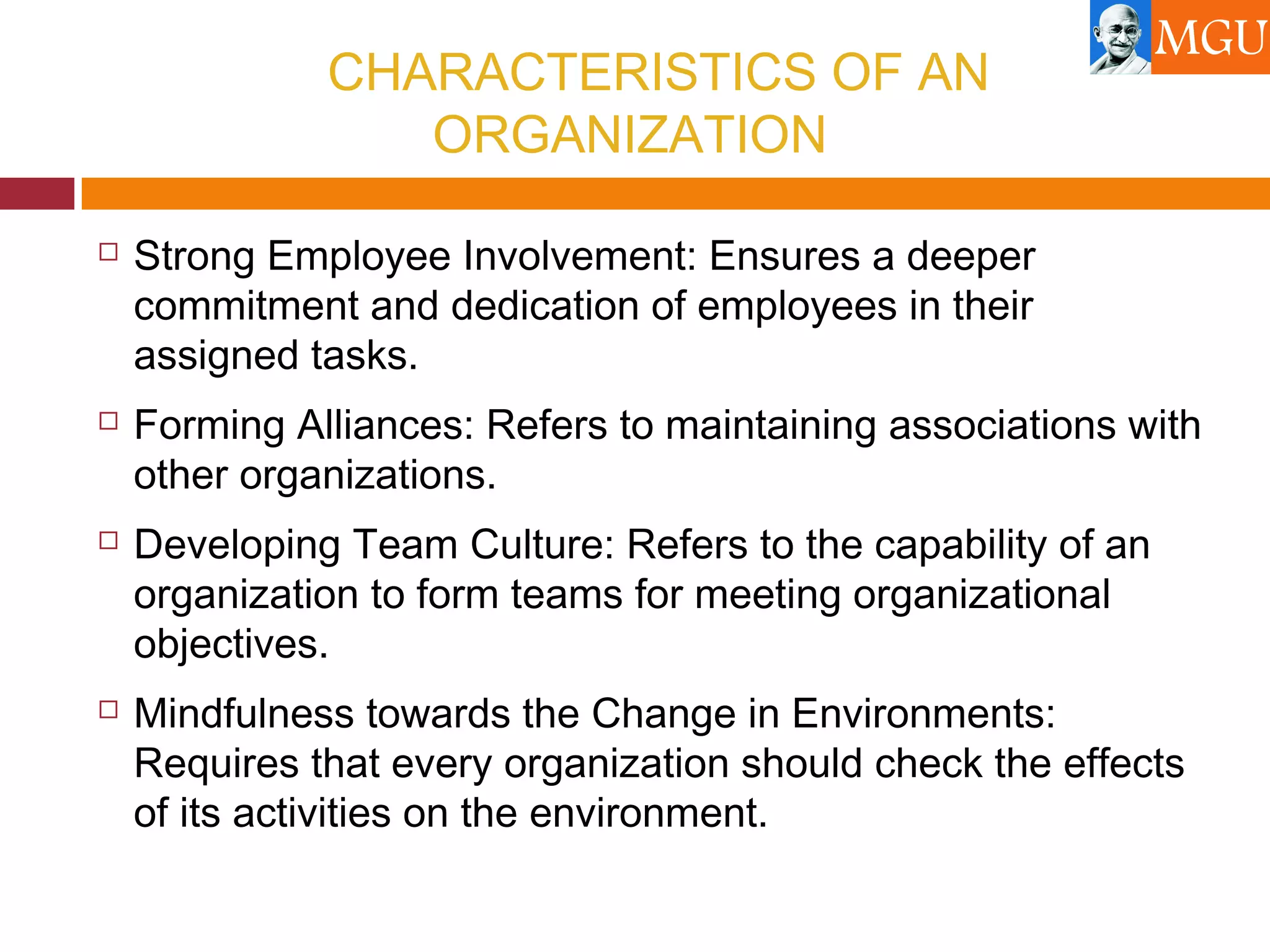
CHARACTERISTICS OF AN
ORGANIZATION
 Strong Employee Involvement: Ensures a deeper
commitment and dedication of employees in their
assigned tasks.
 Forming Alliances: Refers to maintaining associations with
other organizations.
 Developing Team Culture: Refers to the capability of an
organization to form teams for meeting organizational
objectives.
 Mindfulness towards the Change in Environments:
Requires that every organization should check the effects
of its activities on the environment.
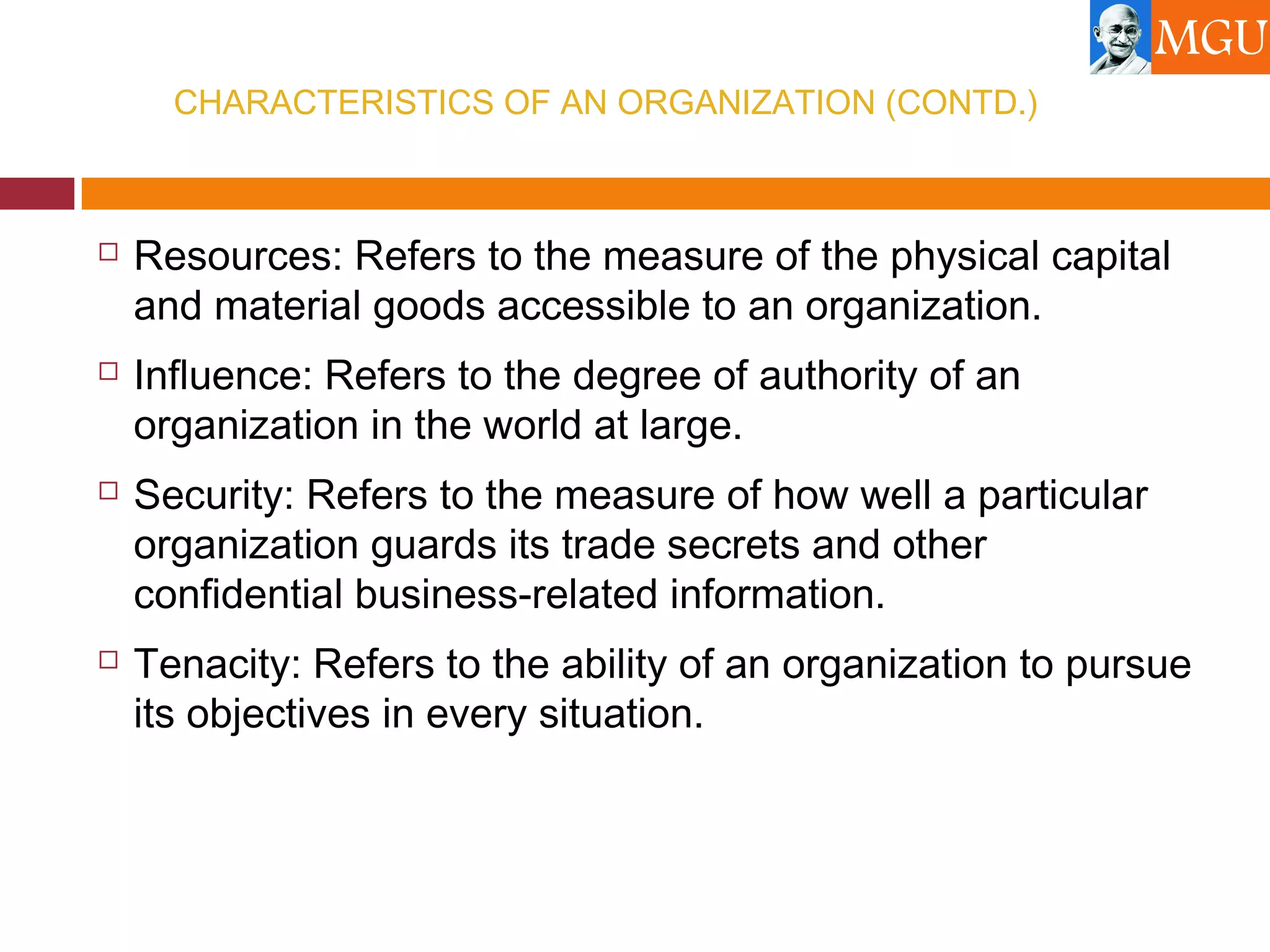
CHARACTERISTICS OF AN ORGANIZATION (CONTD.)
 Resources: Refers to the measure of the physical capital
and material goods accessible to an organization.
 Influence: Refers to the degree of authority of an
organization in the world at large.
 Security: Refers to the measure of how well a particular
organization guards its trade secrets and other
confidential business-related information.
 Tenacity: Refers to the ability of an organization to pursue
its objectives in every situation.
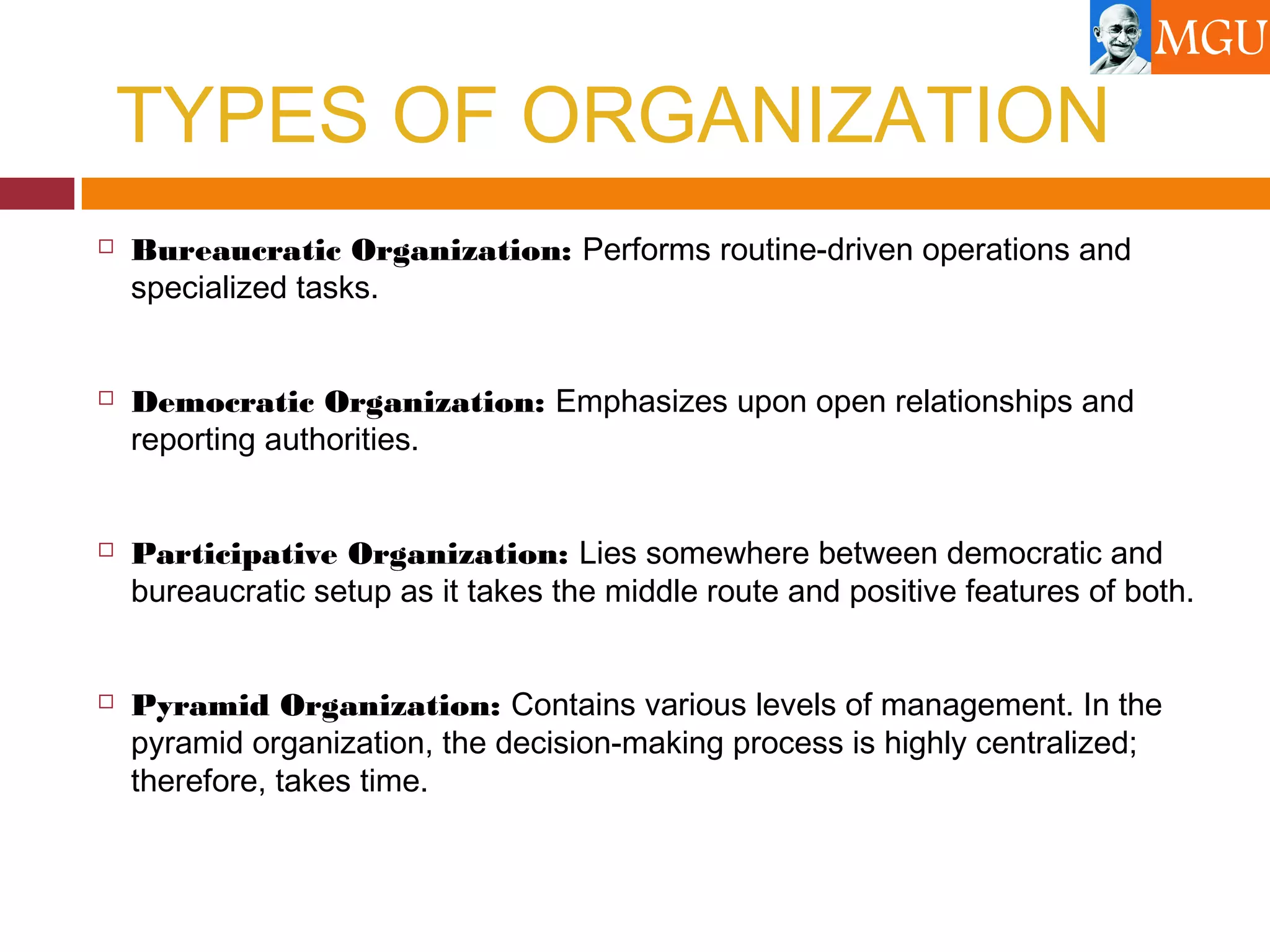
TYPES OF ORGANIZATION
 Bureaucratic Organization: Performs routine-driven operations and
specialized tasks.
 Democratic Organization: Emphasizes upon open relationships and
reporting authorities.
 Participative Organization: Lies somewhere between democratic and
bureaucratic setup as it takes the middle route and positive features of both.
 Pyramid Organization: Contains various levels of management. In the
pyramid organization, the decision-making process is highly centralized;
therefore, takes time.
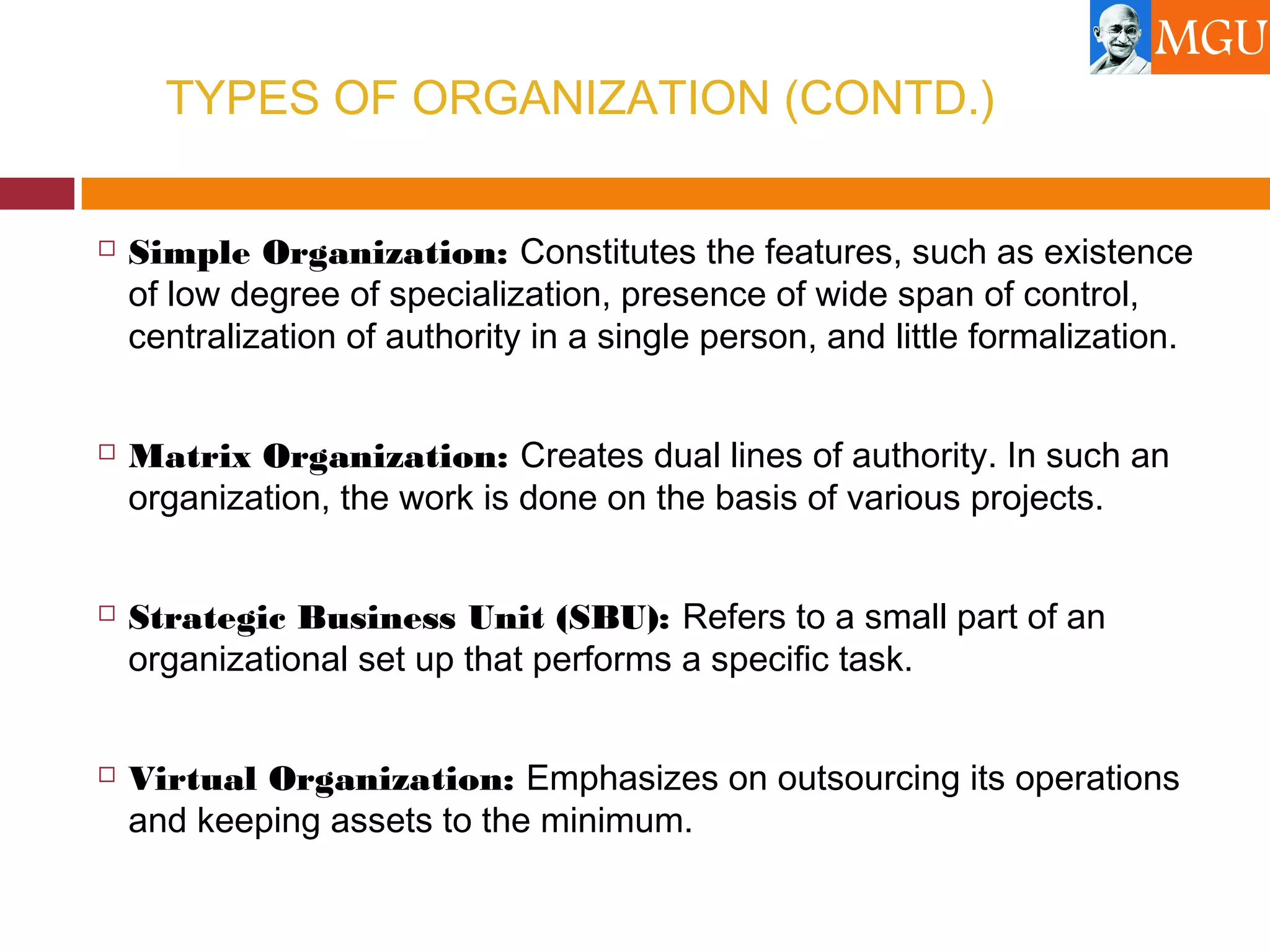
TYPES OF ORGANIZATION (CONTD.)
 Simple Organization: Constitutes the features, such as existence
of low degree of specialization, presence of wide span of control,
centralization of authority in a single person, and little formalization.
 Matrix Organization: Creates dual lines of authority. In such an
organization, the work is done on the basis of various projects.
 Strategic Business Unit (SBU): Refers to a small part of an
organizational set up that performs a specific task.
 Virtual Organization: Emphasizes on outsourcing its operations
and keeping assets to the minimum.
CONCEPT OF VISION
 Vision refers to the statement that consists of the vision of the organization
in a written form.
 It should be clear, concise, and inspiring to provide a base to form the
strategies for achieving the vision of the organization.
 The features of vision statement include:
 Creating an identity and a sense of purpose for an organization
 Inspiring the organization to achieve its aim
 Fostering long-term thinking in an organization
 Making sense in the marketplace by being competitive, unique, and original
 Fostering experimentation and innovation in the organization
 Elevating the energy and self-esteem of all the employees in the organization
CONCEPT OF MISSION
 Mission states the reason for the existence of an organization and
defines the path to achieve the vision.
 A mission is forward-looking view of an organization; whereas,
mission is what an organization is and why it exists.
 The features of the mission statement are as follows:
 Feasible: Implies that a mission statement should be realistic in nature.
 Clear: States that a mission statement should be transparent that is, it
should not be complex and unclear in nature.
 Motivational: Implies that a mission statement should encourage the
members of the organization to work towards the organizational goal.
 Unique: Implies that a mission statement should be unique and
distinctive to attract the attention of the society.
MANAGEMENT BY OBJECTIVES (MBO)
 Refers to a process of setting the discrete and
specific goals for the entire organization.
 The features of MBO are given as follows:
 Emphasizes participation in setting definite and
measurable goals
 Lays emphasis on what is to be accomplished rather than
how it is to be accomplished
 Provides systematic and rational approach to
management and helps in crisis management
 Concentrates on key result areas
MBO PROCESS
 The MBO process is explained as follows:
1. Establishing Long-Term Goals: Implies that an organization sets goals according
to its vision and mission statements.
2. Establishing Specific Performance Objectives: Refers to discrete performance
objectives, which are in congruence with the long-term goals of the organization.
3. Developing Action Plans: Refers to deciding upon the action plan that needs to
be followed to achieve the desired performance objectives.
4. Appraising Results: Refers to the stage, where the actual performance is tracked
at periodic intervals, generally twice a year to ensure if the organization is moving
in the desired direction to achieve its short-term as well as long-term goals.
5. Taking Corrective Actions: Refers to the last stage of MBO, where the actual
performance is compared with the desired performance to find if any discrepancy
exists.
ORGANIZING PROCESS
 The steps involved in the organizing process are explained as follows:
 Determining Activities: Involves identifying activities to be performed to attain
the set objectives.
 Grouping Activities: Refers to the second step in which the defined activities
are grouped into units, so that they can be allotted to individuals.
 Assigning Duties: Involves allotting various groups of activities to different
individuals.
 Delegating Authority: Involves passing on of authority from the top managers
to individuals at the lower level. The
 Coordinating Activities: Refers to the last step of the organizing process that
brings into line the activities and efforts of different individuals.
CONCEPT OF ORGANIZATIONAL
STRUCTURE
Organizational structure is an outline that determines the
level at which the roles and responsibilities are delegated
to individuals to fulfill the goals of an organization.
An organization needs to consider the following aspects
while determining its structure:
 The strengths and weaknesses of different organizational forms
 The legal aspects of all available organizational structures
 The growth patterns of the organization
 The relationship between the manager and its subordinates
 The flow of information and the frequency of communication
 The number of subordinates under a manager
 The autonomy given to employees at various levels of the organization
STAFFING
 Staffing aims at managing the organization structure effectively by
selecting efficient employees and developing them.
 The main objectives of the staffing function of an organization:
 Filling vacant positions: Aims at filling the vacant positions available in an
organization with efficient people in the minimum possible time.
 Developing employee competencies: Refers to the fact that staffing is concerned
with the overall development of employees to improve their work performance.
 Retaining employees: Aims at retaining the key talent by rewarding and
recognizing good performance.
SUMMARY
 An organization refers to a structure in which people come together to
attain some common goals.
 Organizations can be distinguished on the basis of structure, size,
objectives, timeframe, and decision-making authority. Figure
 In an organization, the vision, mission, and business definitions are set
as the long-run targets, whereas goals and objectives are set to
accomplish them.
 Thus, organizing function of managers involves creating an
organizational structure and organizing resources for various activities.
 Organizational structure can be defined as a mechanism in which the
overall work process of an organization is coordinated and supervised to
achieve the desired goals and objectives.
© Dreamtech Press

Unit 03

  • 1.
    COURSE CODE:: MP101 Course::Management theory and Practice Unit -3::ORGANIZATION AND ORGANIZING
  • 2.
    OBJECTIVES  Explain theconcept of organization  Define different types of organizations  Discuss the organizing function of managers  Comprehend the concept of vision  Learn the concept of mission  Discuss the importance of setting organizational objectives  Detail upon Management by Objectives  State the characteristics of organizational structure  Identify the elements of organizational structure
  • 3.
    INTRODUCTION An organization refersto an administrative and functional structure formed to achieve a shared purpose. In other words, an organization can be defined as a group of individuals that is systematically structured to accomplish common goals and objectives. Every organization selects a unique path to achieve its long and short-term objectives. The vision statement of an organization describes the objectives that an organization aspires to achieve in the future; whereas, the mission statement defines the means to achieve the vision. There can be various types of organizations, such as bureaucratic organizations, democratic organizations, participative organizations, and pyramid organizations. However, organizations can be differentiated on the basis of structure, size, objectives, timeframe, and decision-making authority. Organizing is one of the most crucial functions of management in which the primary resources, such as human, physical, and financial resources, of an organization are combined and synchronized together. The organizing function of management is mainly concerned with the proper delegation of roles and responsibilities among individuals. Organizational structure is a framework or hierarchy in which the tasks are allocated to individuals to achieve organizational goals and objectives. Apart from this, it helps in determining how the business decisions are taken and implemented at different levels of the organization. Therefore, it is necessary for the organization to have an efficient structure to accomplish its goals and objectives successfully.
  • 4.
    DEFINE ORGANIZATION  Anorganization comes into existence when there are a number of persons in communication and relationship to each other and are willing to contribute to a common endeavor. ---Barnard  A social relationship which is either closed or limits the admission of outsiders by rules, will be called a 'corporate group' (Verband) so far as its order is enforced by the action of specific individuals whose regular function this is, of a chief or 'head' (Leiter) and usually also an administrative staff. These functionaries will normally also have representative authorities. ---Weber
  • 5.
    CHARACTERISTICS OF AN ORGANIZATION Strong Employee Involvement: Ensures a deeper commitment and dedication of employees in their assigned tasks.  Forming Alliances: Refers to maintaining associations with other organizations.  Developing Team Culture: Refers to the capability of an organization to form teams for meeting organizational objectives.  Mindfulness towards the Change in Environments: Requires that every organization should check the effects of its activities on the environment.
  • 6.
    CHARACTERISTICS OF ANORGANIZATION (CONTD.)  Resources: Refers to the measure of the physical capital and material goods accessible to an organization.  Influence: Refers to the degree of authority of an organization in the world at large.  Security: Refers to the measure of how well a particular organization guards its trade secrets and other confidential business-related information.  Tenacity: Refers to the ability of an organization to pursue its objectives in every situation.
  • 7.
    TYPES OF ORGANIZATION Bureaucratic Organization: Performs routine-driven operations and specialized tasks.  Democratic Organization: Emphasizes upon open relationships and reporting authorities.  Participative Organization: Lies somewhere between democratic and bureaucratic setup as it takes the middle route and positive features of both.  Pyramid Organization: Contains various levels of management. In the pyramid organization, the decision-making process is highly centralized; therefore, takes time.
  • 8.
    TYPES OF ORGANIZATION(CONTD.)  Simple Organization: Constitutes the features, such as existence of low degree of specialization, presence of wide span of control, centralization of authority in a single person, and little formalization.  Matrix Organization: Creates dual lines of authority. In such an organization, the work is done on the basis of various projects.  Strategic Business Unit (SBU): Refers to a small part of an organizational set up that performs a specific task.  Virtual Organization: Emphasizes on outsourcing its operations and keeping assets to the minimum.
  • 9.
    CONCEPT OF VISION Vision refers to the statement that consists of the vision of the organization in a written form.  It should be clear, concise, and inspiring to provide a base to form the strategies for achieving the vision of the organization.  The features of vision statement include:  Creating an identity and a sense of purpose for an organization  Inspiring the organization to achieve its aim  Fostering long-term thinking in an organization  Making sense in the marketplace by being competitive, unique, and original  Fostering experimentation and innovation in the organization  Elevating the energy and self-esteem of all the employees in the organization
  • 10.
    CONCEPT OF MISSION Mission states the reason for the existence of an organization and defines the path to achieve the vision.  A mission is forward-looking view of an organization; whereas, mission is what an organization is and why it exists.  The features of the mission statement are as follows:  Feasible: Implies that a mission statement should be realistic in nature.  Clear: States that a mission statement should be transparent that is, it should not be complex and unclear in nature.  Motivational: Implies that a mission statement should encourage the members of the organization to work towards the organizational goal.  Unique: Implies that a mission statement should be unique and distinctive to attract the attention of the society.
  • 11.
    MANAGEMENT BY OBJECTIVES(MBO)  Refers to a process of setting the discrete and specific goals for the entire organization.  The features of MBO are given as follows:  Emphasizes participation in setting definite and measurable goals  Lays emphasis on what is to be accomplished rather than how it is to be accomplished  Provides systematic and rational approach to management and helps in crisis management  Concentrates on key result areas
  • 12.
    MBO PROCESS  TheMBO process is explained as follows: 1. Establishing Long-Term Goals: Implies that an organization sets goals according to its vision and mission statements. 2. Establishing Specific Performance Objectives: Refers to discrete performance objectives, which are in congruence with the long-term goals of the organization. 3. Developing Action Plans: Refers to deciding upon the action plan that needs to be followed to achieve the desired performance objectives. 4. Appraising Results: Refers to the stage, where the actual performance is tracked at periodic intervals, generally twice a year to ensure if the organization is moving in the desired direction to achieve its short-term as well as long-term goals. 5. Taking Corrective Actions: Refers to the last stage of MBO, where the actual performance is compared with the desired performance to find if any discrepancy exists.
  • 13.
    ORGANIZING PROCESS  Thesteps involved in the organizing process are explained as follows:  Determining Activities: Involves identifying activities to be performed to attain the set objectives.  Grouping Activities: Refers to the second step in which the defined activities are grouped into units, so that they can be allotted to individuals.  Assigning Duties: Involves allotting various groups of activities to different individuals.  Delegating Authority: Involves passing on of authority from the top managers to individuals at the lower level. The  Coordinating Activities: Refers to the last step of the organizing process that brings into line the activities and efforts of different individuals.
  • 14.
    CONCEPT OF ORGANIZATIONAL STRUCTURE Organizationalstructure is an outline that determines the level at which the roles and responsibilities are delegated to individuals to fulfill the goals of an organization. An organization needs to consider the following aspects while determining its structure:  The strengths and weaknesses of different organizational forms  The legal aspects of all available organizational structures  The growth patterns of the organization  The relationship between the manager and its subordinates  The flow of information and the frequency of communication  The number of subordinates under a manager  The autonomy given to employees at various levels of the organization
  • 15.
    STAFFING  Staffing aimsat managing the organization structure effectively by selecting efficient employees and developing them.  The main objectives of the staffing function of an organization:  Filling vacant positions: Aims at filling the vacant positions available in an organization with efficient people in the minimum possible time.  Developing employee competencies: Refers to the fact that staffing is concerned with the overall development of employees to improve their work performance.  Retaining employees: Aims at retaining the key talent by rewarding and recognizing good performance.
  • 16.
    SUMMARY  An organizationrefers to a structure in which people come together to attain some common goals.  Organizations can be distinguished on the basis of structure, size, objectives, timeframe, and decision-making authority. Figure  In an organization, the vision, mission, and business definitions are set as the long-run targets, whereas goals and objectives are set to accomplish them.  Thus, organizing function of managers involves creating an organizational structure and organizing resources for various activities.  Organizational structure can be defined as a mechanism in which the overall work process of an organization is coordinated and supervised to achieve the desired goals and objectives. © Dreamtech Press