M and B 3 3rd Edition Dean Croushore Solutions
Manual download
https://testbankdeal.com/product/m-and-b-3-3rd-edition-dean-
croushore-solutions-manual/
Visit testbankdeal.com today to download the complete set of
test bank or solution manual
We believe these products will be a great fit for you. Click
the link to download now, or visit testbankdeal.com
to discover even more!
M and B 3 Hybrid 3rd Edition Dean Croushore Solutions
Manual
https://testbankdeal.com/product/m-and-b-3-hybrid-3rd-edition-dean-
croushore-solutions-manual/
M and B 3 3rd Edition Dean Croushore Test Bank
https://testbankdeal.com/product/m-and-b-3-3rd-edition-dean-croushore-
test-bank/
ORGB 3 3rd Edition Nelson Solutions Manual
https://testbankdeal.com/product/orgb-3-3rd-edition-nelson-solutions-
manual/
Fundamentals of Law Office Management 5th Edition
Nollkamper Test Bank
https://testbankdeal.com/product/fundamentals-of-law-office-
management-5th-edition-nollkamper-test-bank/
Auditing And Assurance Services In Australia 6th Edition
Louwers Solutions Manual
https://testbankdeal.com/product/auditing-and-assurance-services-in-
australia-6th-edition-louwers-solutions-manual/
Statistics For Managers Using Microsoft Excel 7th Edition
Levine Solutions Manual
https://testbankdeal.com/product/statistics-for-managers-using-
microsoft-excel-7th-edition-levine-solutions-manual/
Management of Strategy Concepts International Edition 10th
Edition Ireland Solutions Manual
https://testbankdeal.com/product/management-of-strategy-concepts-
international-edition-10th-edition-ireland-solutions-manual/
We The People 12th Edition Ginsberg Test Bank
https://testbankdeal.com/product/we-the-people-12th-edition-ginsberg-
test-bank/
Principles of Finance 6th Edition Besley Solutions Manual
https://testbankdeal.com/product/principles-of-finance-6th-edition-
besley-solutions-manual/
Educational Psychology Theory and Practice 10th Edition
Slavin Test Bank
https://testbankdeal.com/product/educational-psychology-theory-and-
practice-10th-edition-slavin-test-bank/
© 2015 Cengage Learning. All Rights Reserved. May not be copied, scanned, or duplicated, in whole or in part, except for use as permitted in
a license distributed with a certain product or service or otherwise on a password-protected website for classroom use
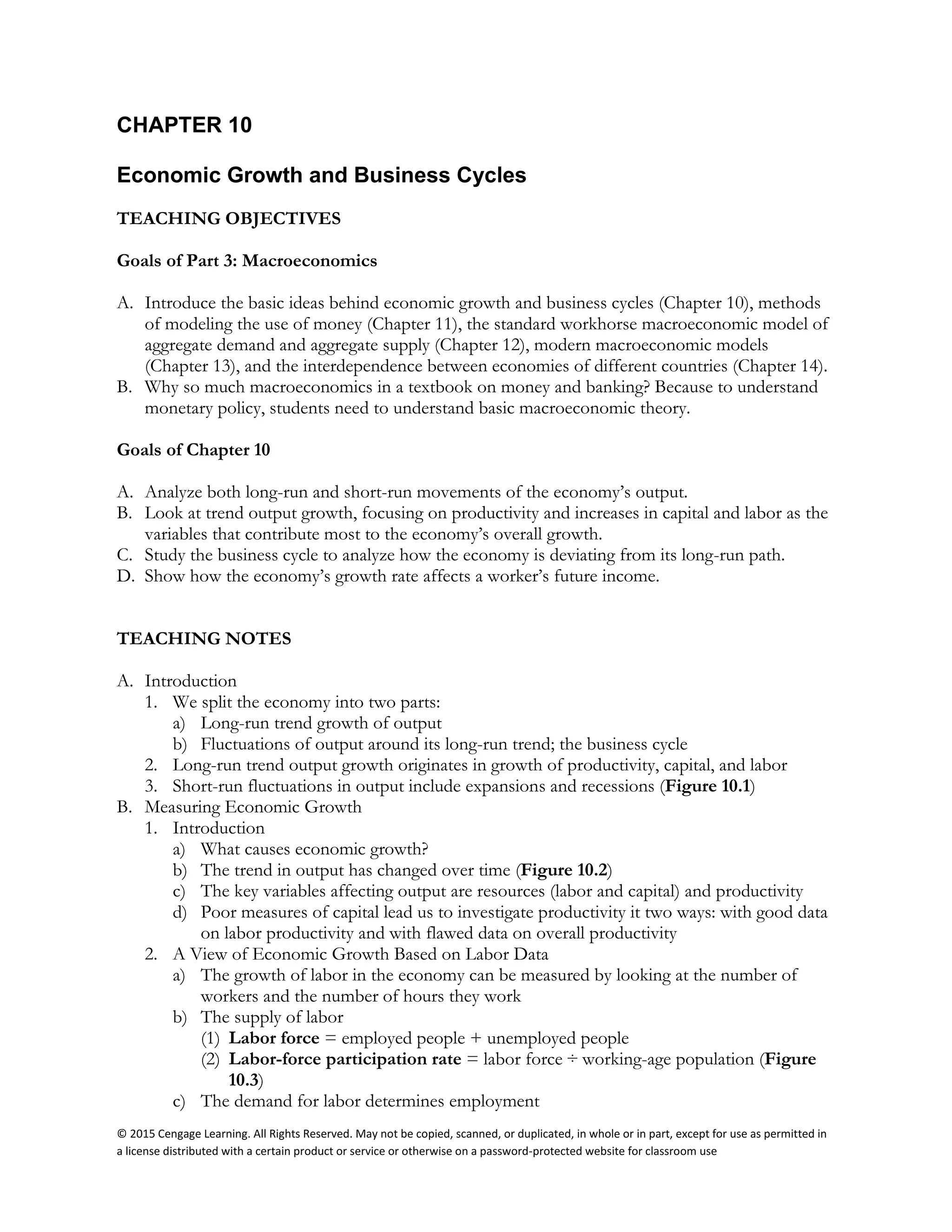
CHAPTER 10
Economic Growth and Business Cycles
TEACHING OBJECTIVES
Goals of Part 3: Macroeconomics
A. Introduce the basic ideas behind economic growth and business cycles (Chapter 10), methods
of modeling the use of money (Chapter 11), the standard workhorse macroeconomic model of
aggregate demand and aggregate supply (Chapter 12), modern macroeconomic models
(Chapter 13), and the interdependence between economies of different countries (Chapter 14).
B. Why so much macroeconomics in a textbook on money and banking? Because to understand
monetary policy, students need to understand basic macroeconomic theory.
Goals of Chapter 10
A. Analyze both long-run and short-run movements of the economy’s output.
B. Look at trend output growth, focusing on productivity and increases in capital and labor as the
variables that contribute most to the economy’s overall growth.
C. Study the business cycle to analyze how the economy is deviating from its long-run path.
D. Show how the economy’s growth rate affects a worker’s future income.
TEACHING NOTES
A. Introduction
1. We split the economy into two parts:
a) Long-run trend growth of output
b) Fluctuations of output around its long-run trend; the business cycle
2. Long-run trend output growth originates in growth of productivity, capital, and labor
3. Short-run fluctuations in output include expansions and recessions (Figure 10.1)
B. Measuring Economic Growth
1. Introduction
a) What causes economic growth?
b) The trend in output has changed over time (Figure 10.2)
c) The key variables affecting output are resources (labor and capital) and productivity
d) Poor measures of capital lead us to investigate productivity it two ways: with good data
on labor productivity and with flawed data on overall productivity
2. A View of Economic Growth Based on Labor Data
a) The growth of labor in the economy can be measured by looking at the number of
workers and the number of hours they work
b) The supply of labor
(1) Labor force = employed people + unemployed people
(2) Labor-force participation rate = labor force ÷ working-age population (Figure
10.3)
c) The demand for labor determines employment
Chapter 10: Economic Growth and Business Cycles 106
© 2015 Cengage Learning. All Rights Reserved. May not be copied, scanned, or duplicated, in whole or in part, except for use as permitted in
a license distributed with a certain product or service or otherwise on a password-protected website for classroom use
d) Population is split into working-age population and others (too young, in military, in
institutions); working-age population = labor force + not in labor force; labor force =
employed + unemployed (Figure 10.4); unemployment rate = unemployed ÷ labor
force (Figure 10.5)
e) Labor productivity = output ÷ number of hours worked (Figures 10.6 and 10.7)
f) Output growth = labor productivity growth + growth in hours worked
g) Economic Liftoff is the period from 1950 to 1970; Reorganization is the period from
1971 to 1982; Long Boom is the period from 1983 to 2007 (Table 10.1; Figure 10.8);
what will be the effect of the financial crisis of 2008? Use Data Bank: Why Is the
Economy More Stable in the Long Boom?
3. A View of Economic Growth Using Data on Both Labor and Capital
a) Economy’s production function: production mainly depends on capital and labor:
Y =F(K,L) (3)
b) A specific production function fits the data well:
Y =A × Ka
× L1−a
(4)
(1) The term A is a measure of the economy’s total factor productivity, TFP
(2) The growth-rate form of equation (4) shows how TFP growth contributes to
output growth:
%ΔY = %ΔA + (a × %ΔK) + [(1 − a) × %ΔL]
Output growth = TFP growth + [a × growth rate of capital] (5)
+ [(1 – a) × growth rate of labor]
(3) TFP growth is calculated using equation (5):
%ΔA = %ΔY − [a × %ΔK] − [(1 – a) × %ΔL] (6)
(3) It is vital to remember that the data on capital are questionable, so calculations of
TFP may be far from accurate
c) Table 10.2 shows the breakdown of growth in the three periods (Economic Liftoff,
Reorganization, and Long Boom); TFP growth changes over those periods in a similar
way to growth in labor productivity
C. Data Bank: Why Is the Economy More Stable in the Long Boom?
1. Research by Stock and Watson suggests that the economy became more stable at the start
of the Long Boom (Figure 10.A)
2. Better monetary policy is responsible for just a fraction of the increased stability; the rest
may be just good luck
D. Business Cycles
1. What Is a Business Cycle?
a) A business cycle is the short-term movement of output and other key economic
variables (such as income and employment) around their long-term trends; use Figure
10.9 to illustrate a hypothetical business cycle
b) Define economic expansion and peak, recession and depression, and trough
c) The NBER’s business cycle dating committee determines when recessions and
expansions begin and end (Figure 10.9 and Table 10.3)
d) A business cycle has two main characteristics (Figure 10.10):
Chapter 10: Economic Growth and Business Cycles 107
© 2015 Cengage Learning. All Rights Reserved. May not be copied, scanned, or duplicated, in whole or in part, except for use as permitted in
a license distributed with a certain product or service or otherwise on a password-protected website for classroom use
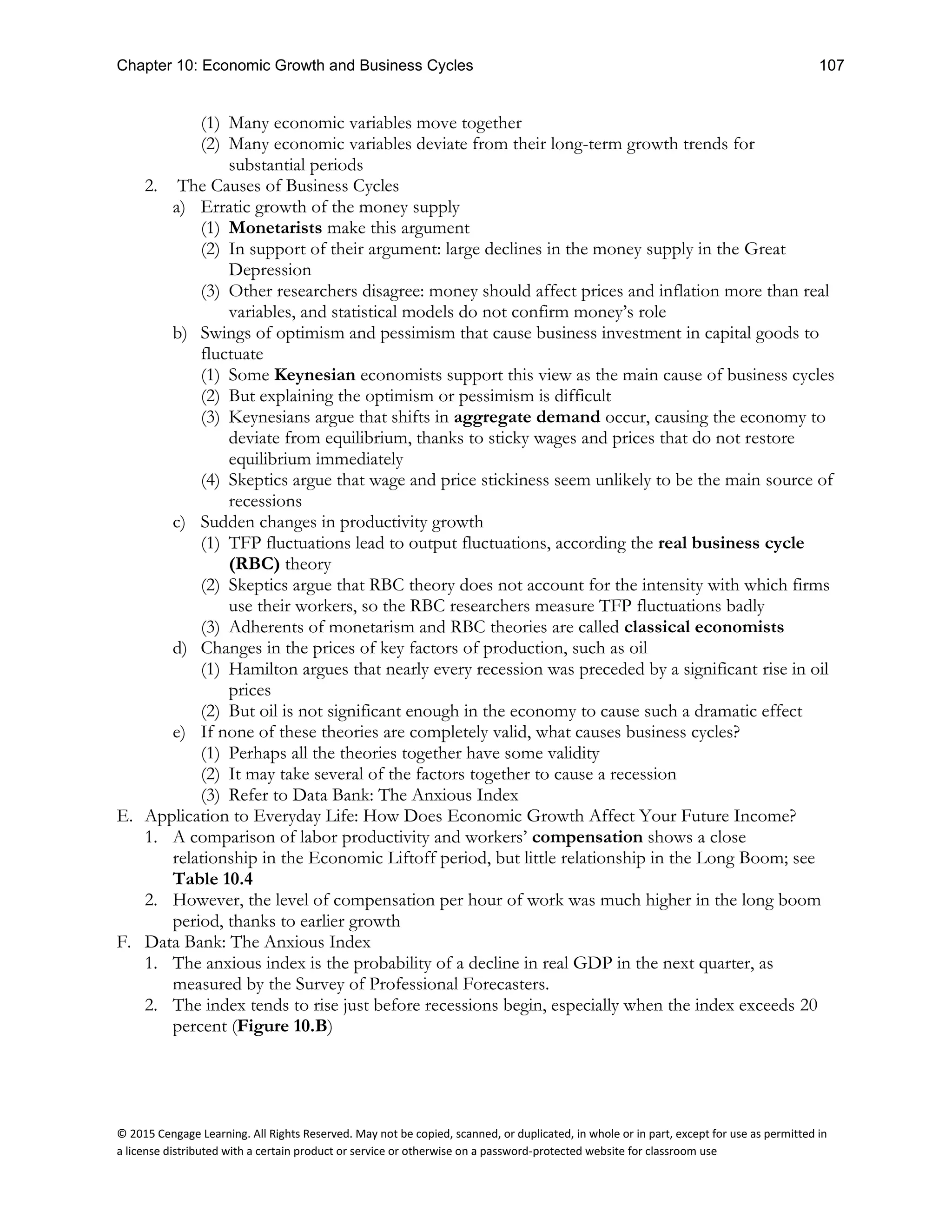
(1) Many economic variables move together
(2) Many economic variables deviate from their long-term growth trends for
substantial periods
2. The Causes of Business Cycles
a) Erratic growth of the money supply
(1) Monetarists make this argument
(2) In support of their argument: large declines in the money supply in the Great
Depression
(3) Other researchers disagree: money should affect prices and inflation more than real
variables, and statistical models do not confirm money’s role
b) Swings of optimism and pessimism that cause business investment in capital goods to
fluctuate
(1) Some Keynesian economists support this view as the main cause of business cycles
(2) But explaining the optimism or pessimism is difficult
(3) Keynesians argue that shifts in aggregate demand occur, causing the economy to
deviate from equilibrium, thanks to sticky wages and prices that do not restore
equilibrium immediately
(4) Skeptics argue that wage and price stickiness seem unlikely to be the main source of
recessions
c) Sudden changes in productivity growth
(1) TFP fluctuations lead to output fluctuations, according the real business cycle
(RBC) theory
(2) Skeptics argue that RBC theory does not account for the intensity with which firms
use their workers, so the RBC researchers measure TFP fluctuations badly
(3) Adherents of monetarism and RBC theories are called classical economists
d) Changes in the prices of key factors of production, such as oil
(1) Hamilton argues that nearly every recession was preceded by a significant rise in oil
prices
(2) But oil is not significant enough in the economy to cause such a dramatic effect
e) If none of these theories are completely valid, what causes business cycles?
(1) Perhaps all the theories together have some validity
(2) It may take several of the factors together to cause a recession
(3) Refer to Data Bank: The Anxious Index
E. Application to Everyday Life: How Does Economic Growth Affect Your Future Income?
1. A comparison of labor productivity and workers’ compensation shows a close
relationship in the Economic Liftoff period, but little relationship in the Long Boom; see
Table 10.4
2. However, the level of compensation per hour of work was much higher in the long boom
period, thanks to earlier growth
F. Data Bank: The Anxious Index
1. The anxious index is the probability of a decline in real GDP in the next quarter, as
measured by the Survey of Professional Forecasters.
2. The index tends to rise just before recessions begin, especially when the index exceeds 20
percent (Figure 10.B)
Chapter 10: Economic Growth and Business Cycles 108
© 2015 Cengage Learning. All Rights Reserved. May not be copied, scanned, or duplicated, in whole or in part, except for use as permitted in
a license distributed with a certain product or service or otherwise on a password-protected website for classroom use
ADDITIONAL ISSUES FOR CLASSROOM DISCUSSION
1. Take a poll of your students’ expectations for major macroeconomic variables and the
probability of a decline in real GDP for the next quarter. Compare their results to the Survey of
Professional Forecasters (on the Internet at: http://www.phil.frb.org/econ/spf/index.html).
2. Over the last 10 years, the labor force participation rate has trended down significantly, as
Figure 10.3 shows. Discuss the difficulty of determining trends at the end of a sample of data,
when no one knows what will happen to the variable next. For example, note the slight
downward trend in the early 1960s, which was only temporary.
3. Discuss why we need a committee to determine when business cycles begin and end. Even
looking at just the data in this chapter, not all variables change direction at the official peaks
and troughs of the cycle. You can look at the NBER’s web site (www.nber.org) to see some of
the current discussion about the state of the business cycle by the business cycle dating
committee.
ANSWERS TO TEXTBOOK NUMERICAL
EXERCISES AND ANALYTICAL PROBLEMS
Numerical Exercises
11. a. Working-age population ÷ population = 83/127 = 0.654 = 65.4 percent
b. Labor force = working-age population − number of people not in labor force = 83 − 25 =
58
Labor-force participation rate = labor force ÷ working-age population = 58/83 = 0.699 =
69.9 percent
c. Number of unemployed = labor force − employed = 58 − 52 = 6
Unemployment rate = number unemployed/labor force = 6/58 = 0.103 = 10.3 percent
12. a. Growth of output between;
1959 and 1969 =
2900 1864
1864
−
= 0.556 = 55.6%
1969 and 1979 =
4173 2900
2900
−
= 0.439 = 43.9%
1979 and 1989 =
5710 4173
4173
−
= 0.368 = 36.8%
1989 and 1999 =
8251 5710
5710
−
= 0.445 = 44.5%
1999 and 2009 =
9563 8251
8251
−
= 0.159 = 15.9%
Chapter 10: Economic Growth and Business Cycles 109
© 2015 Cengage Learning. All Rights Reserved. May not be copied, scanned, or duplicated, in whole or in part, except for use as permitted in
a license distributed with a certain product or service or otherwise on a password-protected website for classroom use
Growth of hours worked between;
1959 and 1969 =
58.88 49.15
49.15
−
= 0.198 = 19.8%
1969 and 1979 =
70.16 58.88
58.88
−
= 0.192 = 19.2%
1979 and 1989 =
83.14 70.16
70.16
−
= 0.185 = 18.5%
1989 and 1999 =
97.63 83.14
83.14
−
= 0.174 = 17.4%
1999 and 2009 =
88.36 97.63
97.63
−
= ˗0.095 = ˗ 9.5%
b. %∆ output = %∆ labor productivity + %∆ hours worked
Therefore, %∆ labor productivity = %∆ output %∆ hours worked
Therefore, 1959 to 1969 = 55.6% ˗ 19.8% = 35.8%
1969 to 1979 = 43.9% ˗ 19.2% = 24.7%
1979 to 1989 = 36.8% ˗ 18.5% = 18.3%
1989 to 1999 = 44.5% ˗ 17.4% = 27.1%
1999 to 2009 = 15.9% ˗ (˗ 9.5%) = 25.4%
c. Fastest growth in output is recorded in the 1960s, and the slowest growth in output is
recorded in the 2000s. The growth in output per hour worked is fastest in the 1960s and
slowest in the 1980s. The slow growth in output in the 2000s can be attributed to the
financial crisis of 2008 and the Great Recession. The fastest growth in output, recorded in
the 1960s, can be attributed to the Economic Liftoff.
13. From equation (4): Y = A × Ka
× L1−a
, so A = Y/( K 0.2
× L0.8
)
For 2013: A = Y/(K0.2
× L0.8
) = 10,000/(4500.2
× 5,0000.8
) = 3.2373
For 2014: A = Y/(K0.2
× L0.8
) = 10,300/(4800.2
× 5,0500.8
) = 3.2655
%ΔA = (3.2655 – 3.2373)/3.2373 = 0.87%.
14. We use the equation %ΔA = %ΔY − (a × %ΔK) − [(1 − a) × %ΔL].
In Bigcap, a = 0.3, %ΔK = 10%, %ΔL = 1%, %ΔY = 5%, so
%ΔA = %ΔY − (a × %ΔK) − [(1 − a) × %ΔL]
= 5% − (0.3 × 10%) − [(1 − 0.3) × 1%]
= 5% − 3% − 0.7%
Chapter 10: Economic Growth and Business Cycles 110
© 2015 Cengage Learning. All Rights Reserved. May not be copied, scanned, or duplicated, in whole or in part, except for use as permitted in
a license distributed with a certain product or service or otherwise on a password-protected website for classroom use
= 1.3%.
TFP is growing fast because of much capital growth.
In Smallcap, a = 0.1, %ΔK = 3%, %ΔL = 2%, %ΔY = 4%, so
%ΔA = %ΔY − (a × %ΔK) − [(1 − a) × %ΔL]
= 4% − (0.1 × 3%) − [(1 − 0.1) × 2%]
= 4% − 0.3% − 1.8%
= 1.9%.
This economy is growing slower than Bigcap’s because capital and labor are growing more
slowly, but fast TFP growth helps economic growth.
15. If you retire at age seventy, you will have worked for forty-nine years. If your salary increases 5
percent per year, you will earn $30,000 × 1.0549
= $327,640. If your salary increases 3 percent
per year, you will earn $30,000 × 1.0349
= $127,687. This is a huge difference, which shows that
growth rates matter!
Analytical Problems
16. Per-capita growth (growth rate of output per person) matters for well-being; per-capita growth
rate = output growth rate − growth rate of population.
Country A: per-capita growth rate = 6% − 4% = 2%
Country B: per-capita growth rate = 4% − 1% = 3%
Thus, people in country B are better off because their output per person is rising faster.
17. In economic expansions:
a. Output per hour rises because labor productivity rises.
b. Hours worked per worker rises because overtime work increases.
c. Employment as a fraction of the labor force increases because more people are employed.
d. The labor force as a fraction of the population increases because people re-enter the labor
force when wages increase and jobs are plentiful.
All four of these factors cause output to grow more rapidly in expansions.
ADDITIONAL TEACHING NOTES
What Causes Productivity to Change?
Changes in productivity growth cause changes in trend output growth, so investigating the forces
driving productivity growth will help us understand the sources of output growth. In the case of
Chapter 10: Economic Growth and Business Cycles 111
© 2015 Cengage Learning. All Rights Reserved. May not be copied, scanned, or duplicated, in whole or in part, except for use as permitted in
a license distributed with a certain product or service or otherwise on a password-protected website for classroom use
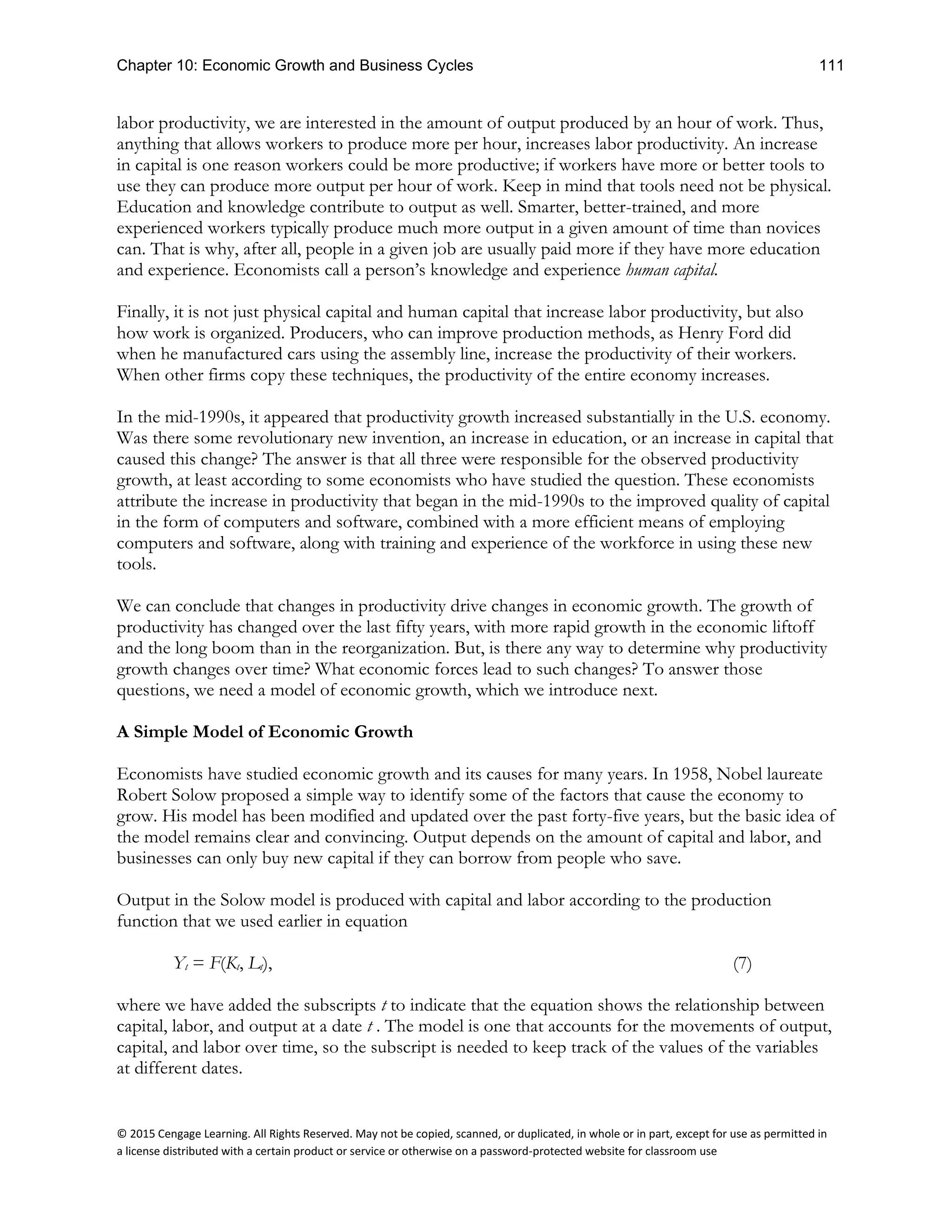
labor productivity, we are interested in the amount of output produced by an hour of work. Thus,
anything that allows workers to produce more per hour, increases labor productivity. An increase
in capital is one reason workers could be more productive; if workers have more or better tools to
use they can produce more output per hour of work. Keep in mind that tools need not be physical.
Education and knowledge contribute to output as well. Smarter, better-trained, and more
experienced workers typically produce much more output in a given amount of time than novices
can. That is why, after all, people in a given job are usually paid more if they have more education
and experience. Economists call a person’s knowledge and experience human capital.
Finally, it is not just physical capital and human capital that increase labor productivity, but also
how work is organized. Producers, who can improve production methods, as Henry Ford did
when he manufactured cars using the assembly line, increase the productivity of their workers.
When other firms copy these techniques, the productivity of the entire economy increases.
In the mid-1990s, it appeared that productivity growth increased substantially in the U.S. economy.
Was there some revolutionary new invention, an increase in education, or an increase in capital that
caused this change? The answer is that all three were responsible for the observed productivity
growth, at least according to some economists who have studied the question. These economists
attribute the increase in productivity that began in the mid-1990s to the improved quality of capital
in the form of computers and software, combined with a more efficient means of employing
computers and software, along with training and experience of the workforce in using these new
tools.
We can conclude that changes in productivity drive changes in economic growth. The growth of
productivity has changed over the last fifty years, with more rapid growth in the economic liftoff
and the long boom than in the reorganization. But, is there any way to determine why productivity
growth changes over time? What economic forces lead to such changes? To answer those
questions, we need a model of economic growth, which we introduce next.
A Simple Model of Economic Growth
Economists have studied economic growth and its causes for many years. In 1958, Nobel laureate
Robert Solow proposed a simple way to identify some of the factors that cause the economy to
grow. His model has been modified and updated over the past forty-five years, but the basic idea of
the model remains clear and convincing. Output depends on the amount of capital and labor, and
businesses can only buy new capital if they can borrow from people who save.
Output in the Solow model is produced with capital and labor according to the production
function that we used earlier in equation
Yt = F(Kt, Lt), (7)
where we have added the subscripts t to indicate that the equation shows the relationship between
capital, labor, and output at a date t . The model is one that accounts for the movements of output,
capital, and labor over time, so the subscript is needed to keep track of the values of the variables
at different dates.
Chapter 10: Economic Growth and Business Cycles 112
© 2015 Cengage Learning. All Rights Reserved. May not be copied, scanned, or duplicated, in whole or in part, except for use as permitted in
a license distributed with a certain product or service or otherwise on a password-protected website for classroom use
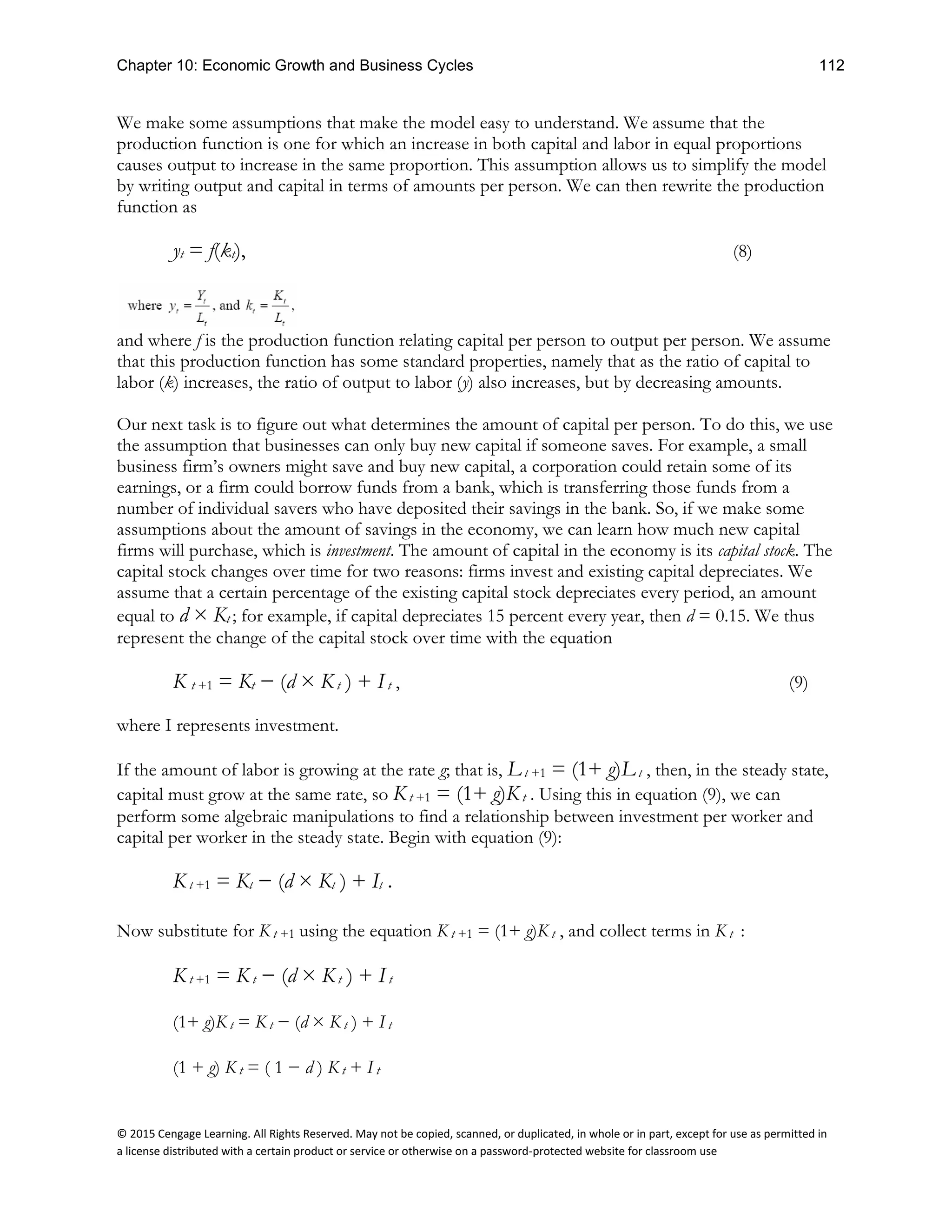
We make some assumptions that make the model easy to understand. We assume that the
production function is one for which an increase in both capital and labor in equal proportions
causes output to increase in the same proportion. This assumption allows us to simplify the model
by writing output and capital in terms of amounts per person. We can then rewrite the production
function as
yt = f(kt), (8)
and where f is the production function relating capital per person to output per person. We assume
that this production function has some standard properties, namely that as the ratio of capital to
labor (k) increases, the ratio of output to labor (y) also increases, but by decreasing amounts.
Our next task is to figure out what determines the amount of capital per person. To do this, we use
the assumption that businesses can only buy new capital if someone saves. For example, a small
business firm’s owners might save and buy new capital, a corporation could retain some of its
earnings, or a firm could borrow funds from a bank, which is transferring those funds from a
number of individual savers who have deposited their savings in the bank. So, if we make some
assumptions about the amount of savings in the economy, we can learn how much new capital
firms will purchase, which is investment. The amount of capital in the economy is its capital stock. The
capital stock changes over time for two reasons: firms invest and existing capital depreciates. We
assume that a certain percentage of the existing capital stock depreciates every period, an amount
equal to d × Kt ; for example, if capital depreciates 15 percent every year, then d = 0.15. We thus
represent the change of the capital stock over time with the equation
K t +1 = Kt − (d × K t ) + I t , (9)
where I represents investment.
If the amount of labor is growing at the rate g; that is, L t +1 = (1+ g)L t , then, in the steady state,
capital must grow at the same rate, so Kt +1 = (1+ g)Kt . Using this in equation (9), we can
perform some algebraic manipulations to find a relationship between investment per worker and
capital per worker in the steady state. Begin with equation (9):
K t +1 = Kt − (d × Kt ) + It .
Now substitute for K t +1 using the equation K t +1 = (1+ g)K t , and collect terms in K t :
K t +1 = K t − (d × Kt ) + I t
(1+ g)K t = K t − (d × K t ) + I t
(1 + g) K t = ( 1 − d ) K t + I t
Chapter 10: Economic Growth and Business Cycles 113
© 2015 Cengage Learning. All Rights Reserved. May not be copied, scanned, or duplicated, in whole or in part, except for use as permitted in
a license distributed with a certain product or service or otherwise on a password-protected website for classroom use
[( 1 + g ) − ( 1 − d )] K t = I t
( g + d ) K t = I t .
Now, if we switch around the two sides of the equation, then divide both sides by L t , and use the
definitions that y = Y/L and i = I/L, then we have
(10)
We make one more assumption, which is that in the long run the economy will reach a steady state,
a situation where capital, labor, and output are growing at the same rate. This means that many of
the variables that we have defined, namely those in lowercase letters that represent output per
worker, capital per worker, and investment per worker, will not change over time, so we can drop
the time subscripts in equations (8) and (10). The main equations of the model are now
y = f(k) (11)
and
i = (g + d )k . (12)
The last equation means that to keep the capital stock growing at the rate that would maintain a
constant ratio of capital to labor, investment per worker (i) must equal the growth rate of the
population plus the depreciation rate on capital times the amount of capital per worker. The first
amount (the population growth rate) reflects the investment needed to make the capital stock
increase at the same rate as population growth. The second amount (the depreciation rate)
represents the amount of investment needed to replace machinery and equipment that has worn
out.
For investment to occur, however, people must save. We will make the same assumption that
Solow did, namely, that savings per person (s) is a constant fraction (v) of output per person. That
is,
s = v × y. (13)
In this equation, v is the fraction of income that people save, and we assume it is constant over
time.
Now, if we set savings per person equal to investment per person, so s = i using equations (11) and
(12), we get
Chapter 10: Economic Growth and Business Cycles 114
© 2015 Cengage Learning. All Rights Reserved. May not be copied, scanned, or duplicated, in whole or in part, except for use as permitted in
a license distributed with a certain product or service or otherwise on a password-protected website for classroom use
s = i
v × y = ( g + d )k .
Dividing through both sides of this equation by v gives
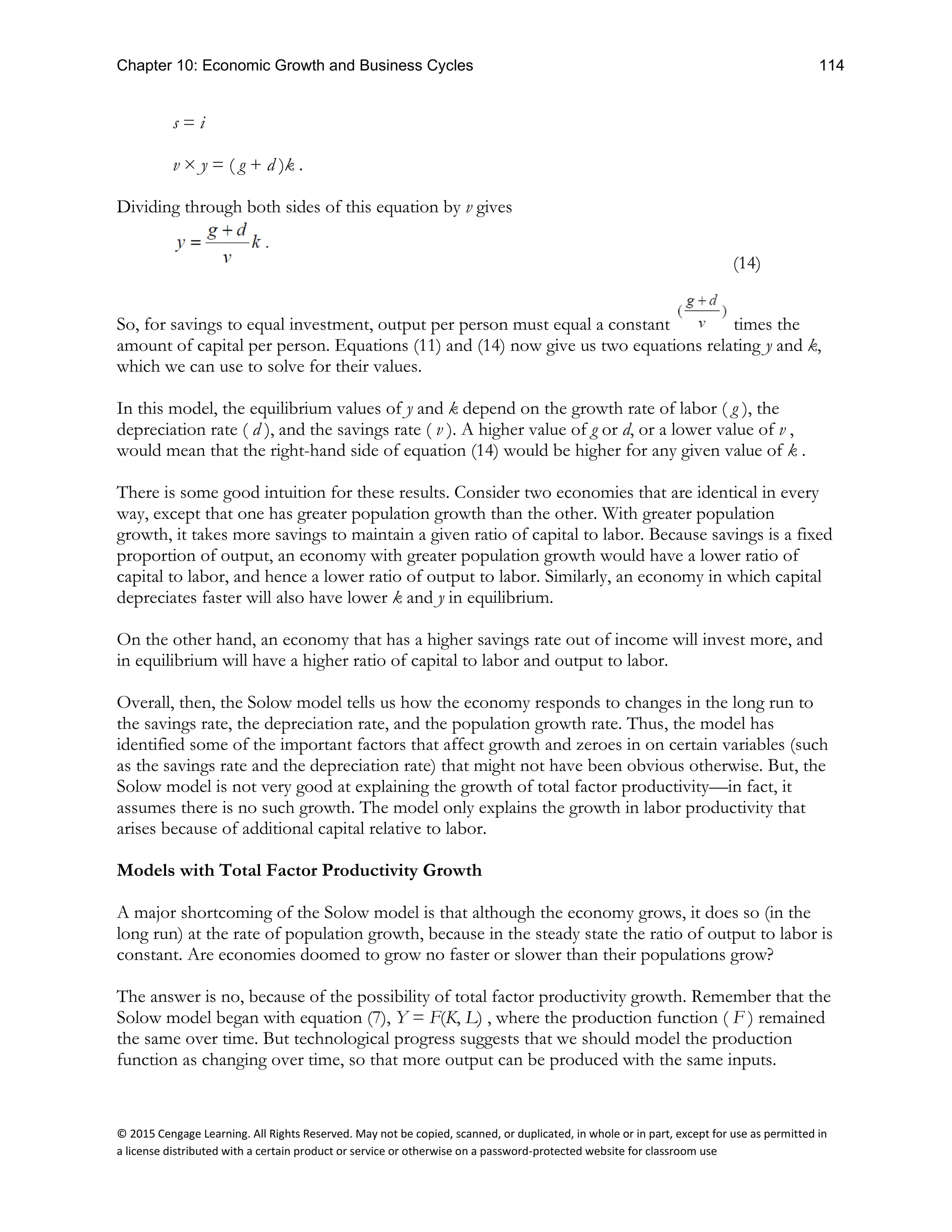
(14)
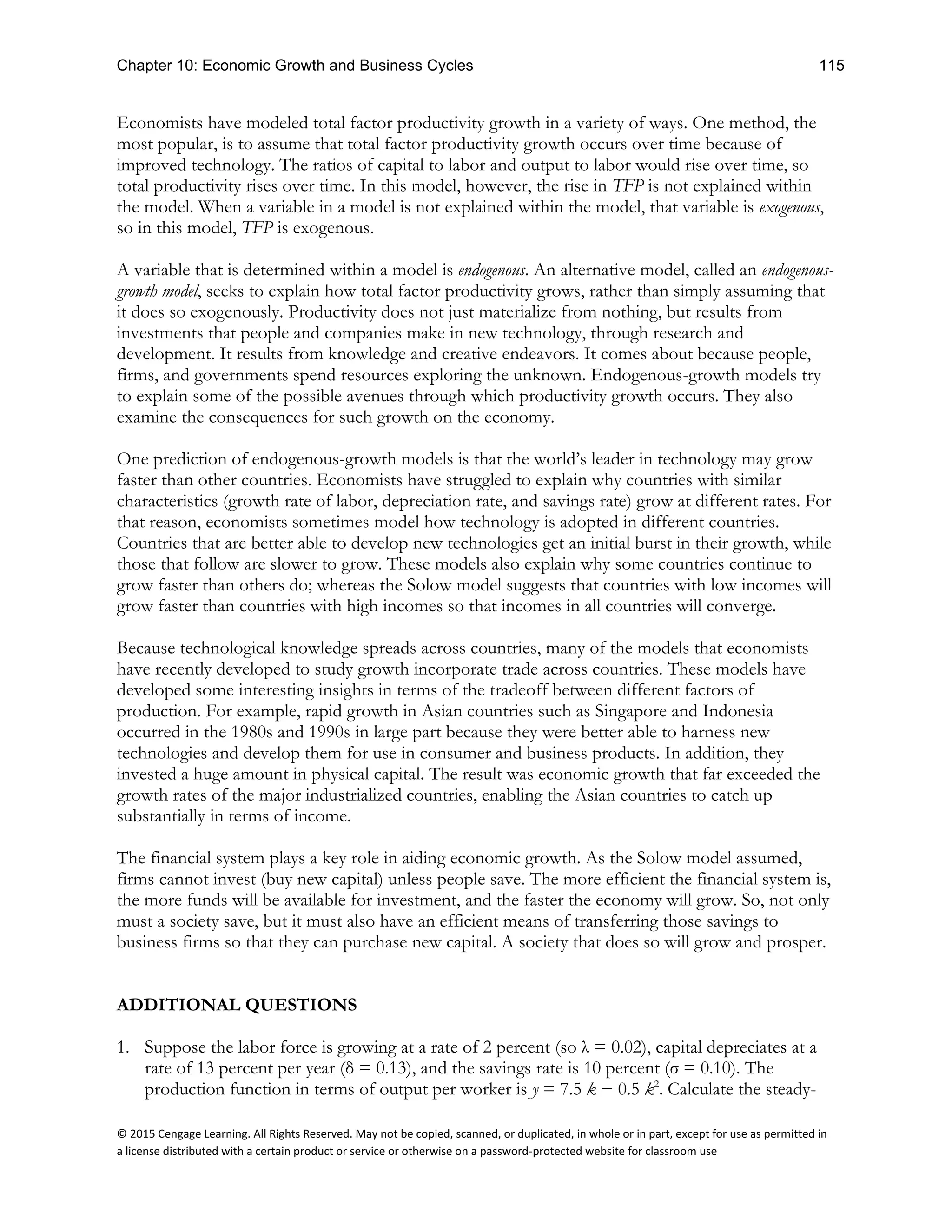
So, for savings to equal investment, output per person must equal a constant times the
amount of capital per person. Equations (11) and (14) now give us two equations relating y and k,
which we can use to solve for their values.
In this model, the equilibrium values of y and k depend on the growth rate of labor ( g ), the
depreciation rate ( d ), and the savings rate ( v ). A higher value of g or d, or a lower value of v ,
would mean that the right-hand side of equation (14) would be higher for any given value of k .
There is some good intuition for these results. Consider two economies that are identical in every
way, except that one has greater population growth than the other. With greater population
growth, it takes more savings to maintain a given ratio of capital to labor. Because savings is a fixed
proportion of output, an economy with greater population growth would have a lower ratio of
capital to labor, and hence a lower ratio of output to labor. Similarly, an economy in which capital
depreciates faster will also have lower k and y in equilibrium.
On the other hand, an economy that has a higher savings rate out of income will invest more, and
in equilibrium will have a higher ratio of capital to labor and output to labor.
Overall, then, the Solow model tells us how the economy responds to changes in the long run to
the savings rate, the depreciation rate, and the population growth rate. Thus, the model has
identified some of the important factors that affect growth and zeroes in on certain variables (such
as the savings rate and the depreciation rate) that might not have been obvious otherwise. But, the
Solow model is not very good at explaining the growth of total factor productivity—in fact, it
assumes there is no such growth. The model only explains the growth in labor productivity that
arises because of additional capital relative to labor.
Models with Total Factor Productivity Growth
A major shortcoming of the Solow model is that although the economy grows, it does so (in the
long run) at the rate of population growth, because in the steady state the ratio of output to labor is
constant. Are economies doomed to grow no faster or slower than their populations grow?
The answer is no, because of the possibility of total factor productivity growth. Remember that the
Solow model began with equation (7), Y = F(K, L) , where the production function ( F ) remained
the same over time. But technological progress suggests that we should model the production
function as changing over time, so that more output can be produced with the same inputs.
Chapter 10: Economic Growth and Business Cycles 115
© 2015 Cengage Learning. All Rights Reserved. May not be copied, scanned, or duplicated, in whole or in part, except for use as permitted in
a license distributed with a certain product or service or otherwise on a password-protected website for classroom use
Economists have modeled total factor productivity growth in a variety of ways. One method, the
most popular, is to assume that total factor productivity growth occurs over time because of
improved technology. The ratios of capital to labor and output to labor would rise over time, so
total productivity rises over time. In this model, however, the rise in TFP is not explained within
the model. When a variable in a model is not explained within the model, that variable is exogenous,
so in this model, TFP is exogenous.
A variable that is determined within a model is endogenous. An alternative model, called an endogenous-
growth model, seeks to explain how total factor productivity grows, rather than simply assuming that
it does so exogenously. Productivity does not just materialize from nothing, but results from
investments that people and companies make in new technology, through research and
development. It results from knowledge and creative endeavors. It comes about because people,
firms, and governments spend resources exploring the unknown. Endogenous-growth models try
to explain some of the possible avenues through which productivity growth occurs. They also
examine the consequences for such growth on the economy.
One prediction of endogenous-growth models is that the world’s leader in technology may grow
faster than other countries. Economists have struggled to explain why countries with similar
characteristics (growth rate of labor, depreciation rate, and savings rate) grow at different rates. For
that reason, economists sometimes model how technology is adopted in different countries.
Countries that are better able to develop new technologies get an initial burst in their growth, while
those that follow are slower to grow. These models also explain why some countries continue to
grow faster than others do; whereas the Solow model suggests that countries with low incomes will
grow faster than countries with high incomes so that incomes in all countries will converge.
Because technological knowledge spreads across countries, many of the models that economists
have recently developed to study growth incorporate trade across countries. These models have
developed some interesting insights in terms of the tradeoff between different factors of
production. For example, rapid growth in Asian countries such as Singapore and Indonesia
occurred in the 1980s and 1990s in large part because they were better able to harness new
technologies and develop them for use in consumer and business products. In addition, they
invested a huge amount in physical capital. The result was economic growth that far exceeded the
growth rates of the major industrialized countries, enabling the Asian countries to catch up
substantially in terms of income.
The financial system plays a key role in aiding economic growth. As the Solow model assumed,
firms cannot invest (buy new capital) unless people save. The more efficient the financial system is,
the more funds will be available for investment, and the faster the economy will grow. So, not only
must a society save, but it must also have an efficient means of transferring those savings to
business firms so that they can purchase new capital. A society that does so will grow and prosper.
ADDITIONAL QUESTIONS
1. Suppose the labor force is growing at a rate of 2 percent (so λ = 0.02), capital depreciates at a
rate of 13 percent per year (δ = 0.13), and the savings rate is 10 percent (σ = 0.10). The
production function in terms of output per worker is y = 7.5 k − 0.5 k2
. Calculate the steady-
Chapter 10: Economic Growth and Business Cycles 116
© 2015 Cengage Learning. All Rights Reserved. May not be copied, scanned, or duplicated, in whole or in part, except for use as permitted in
a license distributed with a certain product or service or otherwise on a password-protected website for classroom use
state values of capital per worker and output per worker. If the savings rate were only 5
percent, what would be the steady-state values of capital and output per worker?
2. According to the Solow model, which economy will grow faster in steady state, one with a high
savings rate or one with a low savings rate? Which economy will have a higher output per
worker in the steady state? Assume both economies have the same population growth rate of
workers and the same depreciation rate. Explain your answer using a diagram.
REFERENCES
Solow, Robert. “A Contribution to the Theory of Economic Growth,” Quarterly Journal of Economics,
February 1956, pp. 65-94.
Symposium on New Growth Theory, Journal of Economic Perspectives 8, (Winter 1994),
pp. 3-72.
Discovering Diverse Content Through
Random Scribd Documents
This eBook is for the use of anyone anywhere in the United
States and most other parts of the world at no cost and with
almost no restrictions whatsoever. You may copy it, give it away
or re-use it under the terms of the Project Gutenberg License
included with this eBook or online at www.gutenberg.org. If you
are not located in the United States, you will have to check the
laws of the country where you are located before using this
eBook.
1.E.2. If an individual Project Gutenberg™ electronic work is derived
from texts not protected by U.S. copyright law (does not contain a
notice indicating that it is posted with permission of the copyright
holder), the work can be copied and distributed to anyone in the
United States without paying any fees or charges. If you are
redistributing or providing access to a work with the phrase “Project
Gutenberg” associated with or appearing on the work, you must
comply either with the requirements of paragraphs 1.E.1 through
1.E.7 or obtain permission for the use of the work and the Project
Gutenberg™ trademark as set forth in paragraphs 1.E.8 or 1.E.9.
1.E.3. If an individual Project Gutenberg™ electronic work is posted
with the permission of the copyright holder, your use and distribution
must comply with both paragraphs 1.E.1 through 1.E.7 and any
additional terms imposed by the copyright holder. Additional terms
will be linked to the Project Gutenberg™ License for all works posted
with the permission of the copyright holder found at the beginning
of this work.
1.E.4. Do not unlink or detach or remove the full Project
Gutenberg™ License terms from this work, or any files containing a
part of this work or any other work associated with Project
Gutenberg™.
1.E.5. Do not copy, display, perform, distribute or redistribute this
electronic work, or any part of this electronic work, without
prominently displaying the sentence set forth in paragraph 1.E.1
with active links or immediate access to the full terms of the Project
Gutenberg™ License.
1.E.6. You may convert to and distribute this work in any binary,
compressed, marked up, nonproprietary or proprietary form,
including any word processing or hypertext form. However, if you
provide access to or distribute copies of a Project Gutenberg™ work
in a format other than “Plain Vanilla ASCII” or other format used in
the official version posted on the official Project Gutenberg™ website
(www.gutenberg.org), you must, at no additional cost, fee or
expense to the user, provide a copy, a means of exporting a copy, or
a means of obtaining a copy upon request, of the work in its original
“Plain Vanilla ASCII” or other form. Any alternate format must
include the full Project Gutenberg™ License as specified in
paragraph 1.E.1.
1.E.7. Do not charge a fee for access to, viewing, displaying,
performing, copying or distributing any Project Gutenberg™ works
unless you comply with paragraph 1.E.8 or 1.E.9.
1.E.8. You may charge a reasonable fee for copies of or providing
access to or distributing Project Gutenberg™ electronic works
provided that:
• You pay a royalty fee of 20% of the gross profits you derive
from the use of Project Gutenberg™ works calculated using the
method you already use to calculate your applicable taxes. The
fee is owed to the owner of the Project Gutenberg™ trademark,
but he has agreed to donate royalties under this paragraph to
the Project Gutenberg Literary Archive Foundation. Royalty
payments must be paid within 60 days following each date on
which you prepare (or are legally required to prepare) your
periodic tax returns. Royalty payments should be clearly marked
as such and sent to the Project Gutenberg Literary Archive
Foundation at the address specified in Section 4, “Information
about donations to the Project Gutenberg Literary Archive
Foundation.”
• You provide a full refund of any money paid by a user who
notifies you in writing (or by e-mail) within 30 days of receipt
that s/he does not agree to the terms of the full Project
Gutenberg™ License. You must require such a user to return or
destroy all copies of the works possessed in a physical medium
and discontinue all use of and all access to other copies of
Project Gutenberg™ works.
• You provide, in accordance with paragraph 1.F.3, a full refund of
any money paid for a work or a replacement copy, if a defect in
the electronic work is discovered and reported to you within 90
days of receipt of the work.
• You comply with all other terms of this agreement for free
distribution of Project Gutenberg™ works.
1.E.9. If you wish to charge a fee or distribute a Project Gutenberg™
electronic work or group of works on different terms than are set
forth in this agreement, you must obtain permission in writing from
the Project Gutenberg Literary Archive Foundation, the manager of
the Project Gutenberg™ trademark. Contact the Foundation as set
forth in Section 3 below.
1.F.
1.F.1. Project Gutenberg volunteers and employees expend
considerable effort to identify, do copyright research on, transcribe
and proofread works not protected by U.S. copyright law in creating
the Project Gutenberg™ collection. Despite these efforts, Project
Gutenberg™ electronic works, and the medium on which they may
be stored, may contain “Defects,” such as, but not limited to,
incomplete, inaccurate or corrupt data, transcription errors, a
copyright or other intellectual property infringement, a defective or
damaged disk or other medium, a computer virus, or computer
codes that damage or cannot be read by your equipment.
1.F.2. LIMITED WARRANTY, DISCLAIMER OF DAMAGES - Except for
the “Right of Replacement or Refund” described in paragraph 1.F.3,
the Project Gutenberg Literary Archive Foundation, the owner of the
Project Gutenberg™ trademark, and any other party distributing a
Project Gutenberg™ electronic work under this agreement, disclaim
all liability to you for damages, costs and expenses, including legal
fees. YOU AGREE THAT YOU HAVE NO REMEDIES FOR
NEGLIGENCE, STRICT LIABILITY, BREACH OF WARRANTY OR
BREACH OF CONTRACT EXCEPT THOSE PROVIDED IN PARAGRAPH
1.F.3. YOU AGREE THAT THE FOUNDATION, THE TRADEMARK
OWNER, AND ANY DISTRIBUTOR UNDER THIS AGREEMENT WILL
NOT BE LIABLE TO YOU FOR ACTUAL, DIRECT, INDIRECT,
CONSEQUENTIAL, PUNITIVE OR INCIDENTAL DAMAGES EVEN IF
YOU GIVE NOTICE OF THE POSSIBILITY OF SUCH DAMAGE.
1.F.3. LIMITED RIGHT OF REPLACEMENT OR REFUND - If you
discover a defect in this electronic work within 90 days of receiving
it, you can receive a refund of the money (if any) you paid for it by
sending a written explanation to the person you received the work
from. If you received the work on a physical medium, you must
return the medium with your written explanation. The person or
entity that provided you with the defective work may elect to provide
a replacement copy in lieu of a refund. If you received the work
electronically, the person or entity providing it to you may choose to
give you a second opportunity to receive the work electronically in
lieu of a refund. If the second copy is also defective, you may
demand a refund in writing without further opportunities to fix the
problem.
1.F.4. Except for the limited right of replacement or refund set forth
in paragraph 1.F.3, this work is provided to you ‘AS-IS’, WITH NO
OTHER WARRANTIES OF ANY KIND, EXPRESS OR IMPLIED,
INCLUDING BUT NOT LIMITED TO WARRANTIES OF
MERCHANTABILITY OR FITNESS FOR ANY PURPOSE.
1.F.5. Some states do not allow disclaimers of certain implied
warranties or the exclusion or limitation of certain types of damages.
If any disclaimer or limitation set forth in this agreement violates the
law of the state applicable to this agreement, the agreement shall be
interpreted to make the maximum disclaimer or limitation permitted
by the applicable state law. The invalidity or unenforceability of any
provision of this agreement shall not void the remaining provisions.
1.F.6. INDEMNITY - You agree to indemnify and hold the Foundation,
the trademark owner, any agent or employee of the Foundation,
anyone providing copies of Project Gutenberg™ electronic works in
accordance with this agreement, and any volunteers associated with
the production, promotion and distribution of Project Gutenberg™
electronic works, harmless from all liability, costs and expenses,
including legal fees, that arise directly or indirectly from any of the
following which you do or cause to occur: (a) distribution of this or
any Project Gutenberg™ work, (b) alteration, modification, or
additions or deletions to any Project Gutenberg™ work, and (c) any
Defect you cause.
Section 2. Information about the Mission
of Project Gutenberg™
Project Gutenberg™ is synonymous with the free distribution of
electronic works in formats readable by the widest variety of
computers including obsolete, old, middle-aged and new computers.
It exists because of the efforts of hundreds of volunteers and
donations from people in all walks of life.
Volunteers and financial support to provide volunteers with the
assistance they need are critical to reaching Project Gutenberg™’s
goals and ensuring that the Project Gutenberg™ collection will
remain freely available for generations to come. In 2001, the Project
Gutenberg Literary Archive Foundation was created to provide a
secure and permanent future for Project Gutenberg™ and future
generations. To learn more about the Project Gutenberg Literary
Archive Foundation and how your efforts and donations can help,
see Sections 3 and 4 and the Foundation information page at
www.gutenberg.org.
Section 3. Information about the Project
Gutenberg Literary Archive Foundation
The Project Gutenberg Literary Archive Foundation is a non-profit
501(c)(3) educational corporation organized under the laws of the
state of Mississippi and granted tax exempt status by the Internal
Revenue Service. The Foundation’s EIN or federal tax identification
number is 64-6221541. Contributions to the Project Gutenberg
Literary Archive Foundation are tax deductible to the full extent
permitted by U.S. federal laws and your state’s laws.
The Foundation’s business office is located at 809 North 1500 West,
Salt Lake City, UT 84116, (801) 596-1887. Email contact links and up
to date contact information can be found at the Foundation’s website
and official page at www.gutenberg.org/contact
Section 4. Information about Donations to
the Project Gutenberg Literary Archive
Foundation
Project Gutenberg™ depends upon and cannot survive without
widespread public support and donations to carry out its mission of
increasing the number of public domain and licensed works that can
be freely distributed in machine-readable form accessible by the
widest array of equipment including outdated equipment. Many
small donations ($1 to $5,000) are particularly important to
maintaining tax exempt status with the IRS.
The Foundation is committed to complying with the laws regulating
charities and charitable donations in all 50 states of the United
States. Compliance requirements are not uniform and it takes a
considerable effort, much paperwork and many fees to meet and
keep up with these requirements. We do not solicit donations in
locations where we have not received written confirmation of
compliance. To SEND DONATIONS or determine the status of
compliance for any particular state visit www.gutenberg.org/donate.
While we cannot and do not solicit contributions from states where
we have not met the solicitation requirements, we know of no
prohibition against accepting unsolicited donations from donors in
such states who approach us with offers to donate.
International donations are gratefully accepted, but we cannot make
any statements concerning tax treatment of donations received from
outside the United States. U.S. laws alone swamp our small staff.
Please check the Project Gutenberg web pages for current donation
methods and addresses. Donations are accepted in a number of
other ways including checks, online payments and credit card
donations. To donate, please visit: www.gutenberg.org/donate.
Section 5. General Information About
Project Gutenberg™ electronic works
Professor Michael S. Hart was the originator of the Project
Gutenberg™ concept of a library of electronic works that could be
freely shared with anyone. For forty years, he produced and
distributed Project Gutenberg™ eBooks with only a loose network of
volunteer support.
Project Gutenberg™ eBooks are often created from several printed
editions, all of which are confirmed as not protected by copyright in
the U.S. unless a copyright notice is included. Thus, we do not
necessarily keep eBooks in compliance with any particular paper
edition.
Most people start at our website which has the main PG search
facility: www.gutenberg.org.
This website includes information about Project Gutenberg™,
including how to make donations to the Project Gutenberg Literary
Archive Foundation, how to help produce our new eBooks, and how
to subscribe to our email newsletter to hear about new eBooks.
Welcome to our website – the perfect destination for book lovers and
knowledge seekers. We believe that every book holds a new world,
offering opportunities for learning, discovery, and personal growth.
That’s why we are dedicated to bringing you a diverse collection of
books, ranging from classic literature and specialized publications to
self-development guides and children's books.
More than just a book-buying platform, we strive to be a bridge
connecting you with timeless cultural and intellectual values. With an
elegant, user-friendly interface and a smart search system, you can
quickly find the books that best suit your interests. Additionally,
our special promotions and home delivery services help you save time
and fully enjoy the joy of reading.
Join us on a journey of knowledge exploration, passion nurturing, and
personal growth every day!
testbankdeal.com


M and B 3 3rd Edition Dean Croushore Solutions Manual

  • 1.
    M and B3 3rd Edition Dean Croushore Solutions Manual download https://testbankdeal.com/product/m-and-b-3-3rd-edition-dean- croushore-solutions-manual/ Visit testbankdeal.com today to download the complete set of test bank or solution manual
  • 2.
    We believe theseproducts will be a great fit for you. Click the link to download now, or visit testbankdeal.com to discover even more! M and B 3 Hybrid 3rd Edition Dean Croushore Solutions Manual https://testbankdeal.com/product/m-and-b-3-hybrid-3rd-edition-dean- croushore-solutions-manual/ M and B 3 3rd Edition Dean Croushore Test Bank https://testbankdeal.com/product/m-and-b-3-3rd-edition-dean-croushore- test-bank/ ORGB 3 3rd Edition Nelson Solutions Manual https://testbankdeal.com/product/orgb-3-3rd-edition-nelson-solutions- manual/ Fundamentals of Law Office Management 5th Edition Nollkamper Test Bank https://testbankdeal.com/product/fundamentals-of-law-office- management-5th-edition-nollkamper-test-bank/
  • 3.
    Auditing And AssuranceServices In Australia 6th Edition Louwers Solutions Manual https://testbankdeal.com/product/auditing-and-assurance-services-in- australia-6th-edition-louwers-solutions-manual/ Statistics For Managers Using Microsoft Excel 7th Edition Levine Solutions Manual https://testbankdeal.com/product/statistics-for-managers-using- microsoft-excel-7th-edition-levine-solutions-manual/ Management of Strategy Concepts International Edition 10th Edition Ireland Solutions Manual https://testbankdeal.com/product/management-of-strategy-concepts- international-edition-10th-edition-ireland-solutions-manual/ We The People 12th Edition Ginsberg Test Bank https://testbankdeal.com/product/we-the-people-12th-edition-ginsberg- test-bank/ Principles of Finance 6th Edition Besley Solutions Manual https://testbankdeal.com/product/principles-of-finance-6th-edition- besley-solutions-manual/
  • 4.
    Educational Psychology Theoryand Practice 10th Edition Slavin Test Bank https://testbankdeal.com/product/educational-psychology-theory-and- practice-10th-edition-slavin-test-bank/
  • 5.
    © 2015 CengageLearning. All Rights Reserved. May not be copied, scanned, or duplicated, in whole or in part, except for use as permitted in a license distributed with a certain product or service or otherwise on a password-protected website for classroom use CHAPTER 10 Economic Growth and Business Cycles TEACHING OBJECTIVES Goals of Part 3: Macroeconomics A. Introduce the basic ideas behind economic growth and business cycles (Chapter 10), methods of modeling the use of money (Chapter 11), the standard workhorse macroeconomic model of aggregate demand and aggregate supply (Chapter 12), modern macroeconomic models (Chapter 13), and the interdependence between economies of different countries (Chapter 14). B. Why so much macroeconomics in a textbook on money and banking? Because to understand monetary policy, students need to understand basic macroeconomic theory. Goals of Chapter 10 A. Analyze both long-run and short-run movements of the economy’s output. B. Look at trend output growth, focusing on productivity and increases in capital and labor as the variables that contribute most to the economy’s overall growth. C. Study the business cycle to analyze how the economy is deviating from its long-run path. D. Show how the economy’s growth rate affects a worker’s future income. TEACHING NOTES A. Introduction 1. We split the economy into two parts: a) Long-run trend growth of output b) Fluctuations of output around its long-run trend; the business cycle 2. Long-run trend output growth originates in growth of productivity, capital, and labor 3. Short-run fluctuations in output include expansions and recessions (Figure 10.1) B. Measuring Economic Growth 1. Introduction a) What causes economic growth? b) The trend in output has changed over time (Figure 10.2) c) The key variables affecting output are resources (labor and capital) and productivity d) Poor measures of capital lead us to investigate productivity it two ways: with good data on labor productivity and with flawed data on overall productivity 2. A View of Economic Growth Based on Labor Data a) The growth of labor in the economy can be measured by looking at the number of workers and the number of hours they work b) The supply of labor (1) Labor force = employed people + unemployed people (2) Labor-force participation rate = labor force ÷ working-age population (Figure 10.3) c) The demand for labor determines employment
  • 6.
    Chapter 10: EconomicGrowth and Business Cycles 106 © 2015 Cengage Learning. All Rights Reserved. May not be copied, scanned, or duplicated, in whole or in part, except for use as permitted in a license distributed with a certain product or service or otherwise on a password-protected website for classroom use d) Population is split into working-age population and others (too young, in military, in institutions); working-age population = labor force + not in labor force; labor force = employed + unemployed (Figure 10.4); unemployment rate = unemployed ÷ labor force (Figure 10.5) e) Labor productivity = output ÷ number of hours worked (Figures 10.6 and 10.7) f) Output growth = labor productivity growth + growth in hours worked g) Economic Liftoff is the period from 1950 to 1970; Reorganization is the period from 1971 to 1982; Long Boom is the period from 1983 to 2007 (Table 10.1; Figure 10.8); what will be the effect of the financial crisis of 2008? Use Data Bank: Why Is the Economy More Stable in the Long Boom? 3. A View of Economic Growth Using Data on Both Labor and Capital a) Economy’s production function: production mainly depends on capital and labor: Y =F(K,L) (3) b) A specific production function fits the data well: Y =A × Ka × L1−a (4) (1) The term A is a measure of the economy’s total factor productivity, TFP (2) The growth-rate form of equation (4) shows how TFP growth contributes to output growth: %ΔY = %ΔA + (a × %ΔK) + [(1 − a) × %ΔL] Output growth = TFP growth + [a × growth rate of capital] (5) + [(1 – a) × growth rate of labor] (3) TFP growth is calculated using equation (5): %ΔA = %ΔY − [a × %ΔK] − [(1 – a) × %ΔL] (6) (3) It is vital to remember that the data on capital are questionable, so calculations of TFP may be far from accurate c) Table 10.2 shows the breakdown of growth in the three periods (Economic Liftoff, Reorganization, and Long Boom); TFP growth changes over those periods in a similar way to growth in labor productivity C. Data Bank: Why Is the Economy More Stable in the Long Boom? 1. Research by Stock and Watson suggests that the economy became more stable at the start of the Long Boom (Figure 10.A) 2. Better monetary policy is responsible for just a fraction of the increased stability; the rest may be just good luck D. Business Cycles 1. What Is a Business Cycle? a) A business cycle is the short-term movement of output and other key economic variables (such as income and employment) around their long-term trends; use Figure 10.9 to illustrate a hypothetical business cycle b) Define economic expansion and peak, recession and depression, and trough c) The NBER’s business cycle dating committee determines when recessions and expansions begin and end (Figure 10.9 and Table 10.3) d) A business cycle has two main characteristics (Figure 10.10):
  • 7.
    Chapter 10: EconomicGrowth and Business Cycles 107 © 2015 Cengage Learning. All Rights Reserved. May not be copied, scanned, or duplicated, in whole or in part, except for use as permitted in a license distributed with a certain product or service or otherwise on a password-protected website for classroom use (1) Many economic variables move together (2) Many economic variables deviate from their long-term growth trends for substantial periods 2. The Causes of Business Cycles a) Erratic growth of the money supply (1) Monetarists make this argument (2) In support of their argument: large declines in the money supply in the Great Depression (3) Other researchers disagree: money should affect prices and inflation more than real variables, and statistical models do not confirm money’s role b) Swings of optimism and pessimism that cause business investment in capital goods to fluctuate (1) Some Keynesian economists support this view as the main cause of business cycles (2) But explaining the optimism or pessimism is difficult (3) Keynesians argue that shifts in aggregate demand occur, causing the economy to deviate from equilibrium, thanks to sticky wages and prices that do not restore equilibrium immediately (4) Skeptics argue that wage and price stickiness seem unlikely to be the main source of recessions c) Sudden changes in productivity growth (1) TFP fluctuations lead to output fluctuations, according the real business cycle (RBC) theory (2) Skeptics argue that RBC theory does not account for the intensity with which firms use their workers, so the RBC researchers measure TFP fluctuations badly (3) Adherents of monetarism and RBC theories are called classical economists d) Changes in the prices of key factors of production, such as oil (1) Hamilton argues that nearly every recession was preceded by a significant rise in oil prices (2) But oil is not significant enough in the economy to cause such a dramatic effect e) If none of these theories are completely valid, what causes business cycles? (1) Perhaps all the theories together have some validity (2) It may take several of the factors together to cause a recession (3) Refer to Data Bank: The Anxious Index E. Application to Everyday Life: How Does Economic Growth Affect Your Future Income? 1. A comparison of labor productivity and workers’ compensation shows a close relationship in the Economic Liftoff period, but little relationship in the Long Boom; see Table 10.4 2. However, the level of compensation per hour of work was much higher in the long boom period, thanks to earlier growth F. Data Bank: The Anxious Index 1. The anxious index is the probability of a decline in real GDP in the next quarter, as measured by the Survey of Professional Forecasters. 2. The index tends to rise just before recessions begin, especially when the index exceeds 20 percent (Figure 10.B)
  • 8.
    Chapter 10: EconomicGrowth and Business Cycles 108 © 2015 Cengage Learning. All Rights Reserved. May not be copied, scanned, or duplicated, in whole or in part, except for use as permitted in a license distributed with a certain product or service or otherwise on a password-protected website for classroom use ADDITIONAL ISSUES FOR CLASSROOM DISCUSSION 1. Take a poll of your students’ expectations for major macroeconomic variables and the probability of a decline in real GDP for the next quarter. Compare their results to the Survey of Professional Forecasters (on the Internet at: http://www.phil.frb.org/econ/spf/index.html). 2. Over the last 10 years, the labor force participation rate has trended down significantly, as Figure 10.3 shows. Discuss the difficulty of determining trends at the end of a sample of data, when no one knows what will happen to the variable next. For example, note the slight downward trend in the early 1960s, which was only temporary. 3. Discuss why we need a committee to determine when business cycles begin and end. Even looking at just the data in this chapter, not all variables change direction at the official peaks and troughs of the cycle. You can look at the NBER’s web site (www.nber.org) to see some of the current discussion about the state of the business cycle by the business cycle dating committee. ANSWERS TO TEXTBOOK NUMERICAL EXERCISES AND ANALYTICAL PROBLEMS Numerical Exercises 11. a. Working-age population ÷ population = 83/127 = 0.654 = 65.4 percent b. Labor force = working-age population − number of people not in labor force = 83 − 25 = 58 Labor-force participation rate = labor force ÷ working-age population = 58/83 = 0.699 = 69.9 percent c. Number of unemployed = labor force − employed = 58 − 52 = 6 Unemployment rate = number unemployed/labor force = 6/58 = 0.103 = 10.3 percent 12. a. Growth of output between; 1959 and 1969 = 2900 1864 1864 − = 0.556 = 55.6% 1969 and 1979 = 4173 2900 2900 − = 0.439 = 43.9% 1979 and 1989 = 5710 4173 4173 − = 0.368 = 36.8% 1989 and 1999 = 8251 5710 5710 − = 0.445 = 44.5% 1999 and 2009 = 9563 8251 8251 − = 0.159 = 15.9%
  • 9.
    Chapter 10: EconomicGrowth and Business Cycles 109 © 2015 Cengage Learning. All Rights Reserved. May not be copied, scanned, or duplicated, in whole or in part, except for use as permitted in a license distributed with a certain product or service or otherwise on a password-protected website for classroom use Growth of hours worked between; 1959 and 1969 = 58.88 49.15 49.15 − = 0.198 = 19.8% 1969 and 1979 = 70.16 58.88 58.88 − = 0.192 = 19.2% 1979 and 1989 = 83.14 70.16 70.16 − = 0.185 = 18.5% 1989 and 1999 = 97.63 83.14 83.14 − = 0.174 = 17.4% 1999 and 2009 = 88.36 97.63 97.63 − = ˗0.095 = ˗ 9.5% b. %∆ output = %∆ labor productivity + %∆ hours worked Therefore, %∆ labor productivity = %∆ output %∆ hours worked Therefore, 1959 to 1969 = 55.6% ˗ 19.8% = 35.8% 1969 to 1979 = 43.9% ˗ 19.2% = 24.7% 1979 to 1989 = 36.8% ˗ 18.5% = 18.3% 1989 to 1999 = 44.5% ˗ 17.4% = 27.1% 1999 to 2009 = 15.9% ˗ (˗ 9.5%) = 25.4% c. Fastest growth in output is recorded in the 1960s, and the slowest growth in output is recorded in the 2000s. The growth in output per hour worked is fastest in the 1960s and slowest in the 1980s. The slow growth in output in the 2000s can be attributed to the financial crisis of 2008 and the Great Recession. The fastest growth in output, recorded in the 1960s, can be attributed to the Economic Liftoff. 13. From equation (4): Y = A × Ka × L1−a , so A = Y/( K 0.2 × L0.8 ) For 2013: A = Y/(K0.2 × L0.8 ) = 10,000/(4500.2 × 5,0000.8 ) = 3.2373 For 2014: A = Y/(K0.2 × L0.8 ) = 10,300/(4800.2 × 5,0500.8 ) = 3.2655 %ΔA = (3.2655 – 3.2373)/3.2373 = 0.87%. 14. We use the equation %ΔA = %ΔY − (a × %ΔK) − [(1 − a) × %ΔL]. In Bigcap, a = 0.3, %ΔK = 10%, %ΔL = 1%, %ΔY = 5%, so %ΔA = %ΔY − (a × %ΔK) − [(1 − a) × %ΔL] = 5% − (0.3 × 10%) − [(1 − 0.3) × 1%] = 5% − 3% − 0.7%
  • 10.
    Chapter 10: EconomicGrowth and Business Cycles 110 © 2015 Cengage Learning. All Rights Reserved. May not be copied, scanned, or duplicated, in whole or in part, except for use as permitted in a license distributed with a certain product or service or otherwise on a password-protected website for classroom use = 1.3%. TFP is growing fast because of much capital growth. In Smallcap, a = 0.1, %ΔK = 3%, %ΔL = 2%, %ΔY = 4%, so %ΔA = %ΔY − (a × %ΔK) − [(1 − a) × %ΔL] = 4% − (0.1 × 3%) − [(1 − 0.1) × 2%] = 4% − 0.3% − 1.8% = 1.9%. This economy is growing slower than Bigcap’s because capital and labor are growing more slowly, but fast TFP growth helps economic growth. 15. If you retire at age seventy, you will have worked for forty-nine years. If your salary increases 5 percent per year, you will earn $30,000 × 1.0549 = $327,640. If your salary increases 3 percent per year, you will earn $30,000 × 1.0349 = $127,687. This is a huge difference, which shows that growth rates matter! Analytical Problems 16. Per-capita growth (growth rate of output per person) matters for well-being; per-capita growth rate = output growth rate − growth rate of population. Country A: per-capita growth rate = 6% − 4% = 2% Country B: per-capita growth rate = 4% − 1% = 3% Thus, people in country B are better off because their output per person is rising faster. 17. In economic expansions: a. Output per hour rises because labor productivity rises. b. Hours worked per worker rises because overtime work increases. c. Employment as a fraction of the labor force increases because more people are employed. d. The labor force as a fraction of the population increases because people re-enter the labor force when wages increase and jobs are plentiful. All four of these factors cause output to grow more rapidly in expansions. ADDITIONAL TEACHING NOTES What Causes Productivity to Change? Changes in productivity growth cause changes in trend output growth, so investigating the forces driving productivity growth will help us understand the sources of output growth. In the case of
  • 11.
    Chapter 10: EconomicGrowth and Business Cycles 111 © 2015 Cengage Learning. All Rights Reserved. May not be copied, scanned, or duplicated, in whole or in part, except for use as permitted in a license distributed with a certain product or service or otherwise on a password-protected website for classroom use labor productivity, we are interested in the amount of output produced by an hour of work. Thus, anything that allows workers to produce more per hour, increases labor productivity. An increase in capital is one reason workers could be more productive; if workers have more or better tools to use they can produce more output per hour of work. Keep in mind that tools need not be physical. Education and knowledge contribute to output as well. Smarter, better-trained, and more experienced workers typically produce much more output in a given amount of time than novices can. That is why, after all, people in a given job are usually paid more if they have more education and experience. Economists call a person’s knowledge and experience human capital. Finally, it is not just physical capital and human capital that increase labor productivity, but also how work is organized. Producers, who can improve production methods, as Henry Ford did when he manufactured cars using the assembly line, increase the productivity of their workers. When other firms copy these techniques, the productivity of the entire economy increases. In the mid-1990s, it appeared that productivity growth increased substantially in the U.S. economy. Was there some revolutionary new invention, an increase in education, or an increase in capital that caused this change? The answer is that all three were responsible for the observed productivity growth, at least according to some economists who have studied the question. These economists attribute the increase in productivity that began in the mid-1990s to the improved quality of capital in the form of computers and software, combined with a more efficient means of employing computers and software, along with training and experience of the workforce in using these new tools. We can conclude that changes in productivity drive changes in economic growth. The growth of productivity has changed over the last fifty years, with more rapid growth in the economic liftoff and the long boom than in the reorganization. But, is there any way to determine why productivity growth changes over time? What economic forces lead to such changes? To answer those questions, we need a model of economic growth, which we introduce next. A Simple Model of Economic Growth Economists have studied economic growth and its causes for many years. In 1958, Nobel laureate Robert Solow proposed a simple way to identify some of the factors that cause the economy to grow. His model has been modified and updated over the past forty-five years, but the basic idea of the model remains clear and convincing. Output depends on the amount of capital and labor, and businesses can only buy new capital if they can borrow from people who save. Output in the Solow model is produced with capital and labor according to the production function that we used earlier in equation Yt = F(Kt, Lt), (7) where we have added the subscripts t to indicate that the equation shows the relationship between capital, labor, and output at a date t . The model is one that accounts for the movements of output, capital, and labor over time, so the subscript is needed to keep track of the values of the variables at different dates.
  • 12.
    Chapter 10: EconomicGrowth and Business Cycles 112 © 2015 Cengage Learning. All Rights Reserved. May not be copied, scanned, or duplicated, in whole or in part, except for use as permitted in a license distributed with a certain product or service or otherwise on a password-protected website for classroom use We make some assumptions that make the model easy to understand. We assume that the production function is one for which an increase in both capital and labor in equal proportions causes output to increase in the same proportion. This assumption allows us to simplify the model by writing output and capital in terms of amounts per person. We can then rewrite the production function as yt = f(kt), (8) and where f is the production function relating capital per person to output per person. We assume that this production function has some standard properties, namely that as the ratio of capital to labor (k) increases, the ratio of output to labor (y) also increases, but by decreasing amounts. Our next task is to figure out what determines the amount of capital per person. To do this, we use the assumption that businesses can only buy new capital if someone saves. For example, a small business firm’s owners might save and buy new capital, a corporation could retain some of its earnings, or a firm could borrow funds from a bank, which is transferring those funds from a number of individual savers who have deposited their savings in the bank. So, if we make some assumptions about the amount of savings in the economy, we can learn how much new capital firms will purchase, which is investment. The amount of capital in the economy is its capital stock. The capital stock changes over time for two reasons: firms invest and existing capital depreciates. We assume that a certain percentage of the existing capital stock depreciates every period, an amount equal to d × Kt ; for example, if capital depreciates 15 percent every year, then d = 0.15. We thus represent the change of the capital stock over time with the equation K t +1 = Kt − (d × K t ) + I t , (9) where I represents investment. If the amount of labor is growing at the rate g; that is, L t +1 = (1+ g)L t , then, in the steady state, capital must grow at the same rate, so Kt +1 = (1+ g)Kt . Using this in equation (9), we can perform some algebraic manipulations to find a relationship between investment per worker and capital per worker in the steady state. Begin with equation (9): K t +1 = Kt − (d × Kt ) + It . Now substitute for K t +1 using the equation K t +1 = (1+ g)K t , and collect terms in K t : K t +1 = K t − (d × Kt ) + I t (1+ g)K t = K t − (d × K t ) + I t (1 + g) K t = ( 1 − d ) K t + I t
  • 13.
    Chapter 10: EconomicGrowth and Business Cycles 113 © 2015 Cengage Learning. All Rights Reserved. May not be copied, scanned, or duplicated, in whole or in part, except for use as permitted in a license distributed with a certain product or service or otherwise on a password-protected website for classroom use [( 1 + g ) − ( 1 − d )] K t = I t ( g + d ) K t = I t . Now, if we switch around the two sides of the equation, then divide both sides by L t , and use the definitions that y = Y/L and i = I/L, then we have (10) We make one more assumption, which is that in the long run the economy will reach a steady state, a situation where capital, labor, and output are growing at the same rate. This means that many of the variables that we have defined, namely those in lowercase letters that represent output per worker, capital per worker, and investment per worker, will not change over time, so we can drop the time subscripts in equations (8) and (10). The main equations of the model are now y = f(k) (11) and i = (g + d )k . (12) The last equation means that to keep the capital stock growing at the rate that would maintain a constant ratio of capital to labor, investment per worker (i) must equal the growth rate of the population plus the depreciation rate on capital times the amount of capital per worker. The first amount (the population growth rate) reflects the investment needed to make the capital stock increase at the same rate as population growth. The second amount (the depreciation rate) represents the amount of investment needed to replace machinery and equipment that has worn out. For investment to occur, however, people must save. We will make the same assumption that Solow did, namely, that savings per person (s) is a constant fraction (v) of output per person. That is, s = v × y. (13) In this equation, v is the fraction of income that people save, and we assume it is constant over time. Now, if we set savings per person equal to investment per person, so s = i using equations (11) and (12), we get
  • 14.
    Chapter 10: EconomicGrowth and Business Cycles 114 © 2015 Cengage Learning. All Rights Reserved. May not be copied, scanned, or duplicated, in whole or in part, except for use as permitted in a license distributed with a certain product or service or otherwise on a password-protected website for classroom use s = i v × y = ( g + d )k . Dividing through both sides of this equation by v gives (14) So, for savings to equal investment, output per person must equal a constant times the amount of capital per person. Equations (11) and (14) now give us two equations relating y and k, which we can use to solve for their values. In this model, the equilibrium values of y and k depend on the growth rate of labor ( g ), the depreciation rate ( d ), and the savings rate ( v ). A higher value of g or d, or a lower value of v , would mean that the right-hand side of equation (14) would be higher for any given value of k . There is some good intuition for these results. Consider two economies that are identical in every way, except that one has greater population growth than the other. With greater population growth, it takes more savings to maintain a given ratio of capital to labor. Because savings is a fixed proportion of output, an economy with greater population growth would have a lower ratio of capital to labor, and hence a lower ratio of output to labor. Similarly, an economy in which capital depreciates faster will also have lower k and y in equilibrium. On the other hand, an economy that has a higher savings rate out of income will invest more, and in equilibrium will have a higher ratio of capital to labor and output to labor. Overall, then, the Solow model tells us how the economy responds to changes in the long run to the savings rate, the depreciation rate, and the population growth rate. Thus, the model has identified some of the important factors that affect growth and zeroes in on certain variables (such as the savings rate and the depreciation rate) that might not have been obvious otherwise. But, the Solow model is not very good at explaining the growth of total factor productivity—in fact, it assumes there is no such growth. The model only explains the growth in labor productivity that arises because of additional capital relative to labor. Models with Total Factor Productivity Growth A major shortcoming of the Solow model is that although the economy grows, it does so (in the long run) at the rate of population growth, because in the steady state the ratio of output to labor is constant. Are economies doomed to grow no faster or slower than their populations grow? The answer is no, because of the possibility of total factor productivity growth. Remember that the Solow model began with equation (7), Y = F(K, L) , where the production function ( F ) remained the same over time. But technological progress suggests that we should model the production function as changing over time, so that more output can be produced with the same inputs.
  • 15.
    Chapter 10: EconomicGrowth and Business Cycles 115 © 2015 Cengage Learning. All Rights Reserved. May not be copied, scanned, or duplicated, in whole or in part, except for use as permitted in a license distributed with a certain product or service or otherwise on a password-protected website for classroom use Economists have modeled total factor productivity growth in a variety of ways. One method, the most popular, is to assume that total factor productivity growth occurs over time because of improved technology. The ratios of capital to labor and output to labor would rise over time, so total productivity rises over time. In this model, however, the rise in TFP is not explained within the model. When a variable in a model is not explained within the model, that variable is exogenous, so in this model, TFP is exogenous. A variable that is determined within a model is endogenous. An alternative model, called an endogenous- growth model, seeks to explain how total factor productivity grows, rather than simply assuming that it does so exogenously. Productivity does not just materialize from nothing, but results from investments that people and companies make in new technology, through research and development. It results from knowledge and creative endeavors. It comes about because people, firms, and governments spend resources exploring the unknown. Endogenous-growth models try to explain some of the possible avenues through which productivity growth occurs. They also examine the consequences for such growth on the economy. One prediction of endogenous-growth models is that the world’s leader in technology may grow faster than other countries. Economists have struggled to explain why countries with similar characteristics (growth rate of labor, depreciation rate, and savings rate) grow at different rates. For that reason, economists sometimes model how technology is adopted in different countries. Countries that are better able to develop new technologies get an initial burst in their growth, while those that follow are slower to grow. These models also explain why some countries continue to grow faster than others do; whereas the Solow model suggests that countries with low incomes will grow faster than countries with high incomes so that incomes in all countries will converge. Because technological knowledge spreads across countries, many of the models that economists have recently developed to study growth incorporate trade across countries. These models have developed some interesting insights in terms of the tradeoff between different factors of production. For example, rapid growth in Asian countries such as Singapore and Indonesia occurred in the 1980s and 1990s in large part because they were better able to harness new technologies and develop them for use in consumer and business products. In addition, they invested a huge amount in physical capital. The result was economic growth that far exceeded the growth rates of the major industrialized countries, enabling the Asian countries to catch up substantially in terms of income. The financial system plays a key role in aiding economic growth. As the Solow model assumed, firms cannot invest (buy new capital) unless people save. The more efficient the financial system is, the more funds will be available for investment, and the faster the economy will grow. So, not only must a society save, but it must also have an efficient means of transferring those savings to business firms so that they can purchase new capital. A society that does so will grow and prosper. ADDITIONAL QUESTIONS 1. Suppose the labor force is growing at a rate of 2 percent (so λ = 0.02), capital depreciates at a rate of 13 percent per year (δ = 0.13), and the savings rate is 10 percent (σ = 0.10). The production function in terms of output per worker is y = 7.5 k − 0.5 k2 . Calculate the steady-
  • 16.
    Chapter 10: EconomicGrowth and Business Cycles 116 © 2015 Cengage Learning. All Rights Reserved. May not be copied, scanned, or duplicated, in whole or in part, except for use as permitted in a license distributed with a certain product or service or otherwise on a password-protected website for classroom use state values of capital per worker and output per worker. If the savings rate were only 5 percent, what would be the steady-state values of capital and output per worker? 2. According to the Solow model, which economy will grow faster in steady state, one with a high savings rate or one with a low savings rate? Which economy will have a higher output per worker in the steady state? Assume both economies have the same population growth rate of workers and the same depreciation rate. Explain your answer using a diagram. REFERENCES Solow, Robert. “A Contribution to the Theory of Economic Growth,” Quarterly Journal of Economics, February 1956, pp. 65-94. Symposium on New Growth Theory, Journal of Economic Perspectives 8, (Winter 1994), pp. 3-72.
  • 17.
    Discovering Diverse ContentThrough Random Scribd Documents
  • 18.
    This eBook isfor the use of anyone anywhere in the United States and most other parts of the world at no cost and with almost no restrictions whatsoever. You may copy it, give it away or re-use it under the terms of the Project Gutenberg License included with this eBook or online at www.gutenberg.org. If you are not located in the United States, you will have to check the laws of the country where you are located before using this eBook. 1.E.2. If an individual Project Gutenberg™ electronic work is derived from texts not protected by U.S. copyright law (does not contain a notice indicating that it is posted with permission of the copyright holder), the work can be copied and distributed to anyone in the United States without paying any fees or charges. If you are redistributing or providing access to a work with the phrase “Project Gutenberg” associated with or appearing on the work, you must comply either with the requirements of paragraphs 1.E.1 through 1.E.7 or obtain permission for the use of the work and the Project Gutenberg™ trademark as set forth in paragraphs 1.E.8 or 1.E.9. 1.E.3. If an individual Project Gutenberg™ electronic work is posted with the permission of the copyright holder, your use and distribution must comply with both paragraphs 1.E.1 through 1.E.7 and any additional terms imposed by the copyright holder. Additional terms will be linked to the Project Gutenberg™ License for all works posted with the permission of the copyright holder found at the beginning of this work. 1.E.4. Do not unlink or detach or remove the full Project Gutenberg™ License terms from this work, or any files containing a part of this work or any other work associated with Project Gutenberg™. 1.E.5. Do not copy, display, perform, distribute or redistribute this electronic work, or any part of this electronic work, without prominently displaying the sentence set forth in paragraph 1.E.1
  • 19.
    with active linksor immediate access to the full terms of the Project Gutenberg™ License. 1.E.6. You may convert to and distribute this work in any binary, compressed, marked up, nonproprietary or proprietary form, including any word processing or hypertext form. However, if you provide access to or distribute copies of a Project Gutenberg™ work in a format other than “Plain Vanilla ASCII” or other format used in the official version posted on the official Project Gutenberg™ website (www.gutenberg.org), you must, at no additional cost, fee or expense to the user, provide a copy, a means of exporting a copy, or a means of obtaining a copy upon request, of the work in its original “Plain Vanilla ASCII” or other form. Any alternate format must include the full Project Gutenberg™ License as specified in paragraph 1.E.1. 1.E.7. Do not charge a fee for access to, viewing, displaying, performing, copying or distributing any Project Gutenberg™ works unless you comply with paragraph 1.E.8 or 1.E.9. 1.E.8. You may charge a reasonable fee for copies of or providing access to or distributing Project Gutenberg™ electronic works provided that: • You pay a royalty fee of 20% of the gross profits you derive from the use of Project Gutenberg™ works calculated using the method you already use to calculate your applicable taxes. The fee is owed to the owner of the Project Gutenberg™ trademark, but he has agreed to donate royalties under this paragraph to the Project Gutenberg Literary Archive Foundation. Royalty payments must be paid within 60 days following each date on which you prepare (or are legally required to prepare) your periodic tax returns. Royalty payments should be clearly marked as such and sent to the Project Gutenberg Literary Archive Foundation at the address specified in Section 4, “Information
  • 20.
    about donations tothe Project Gutenberg Literary Archive Foundation.” • You provide a full refund of any money paid by a user who notifies you in writing (or by e-mail) within 30 days of receipt that s/he does not agree to the terms of the full Project Gutenberg™ License. You must require such a user to return or destroy all copies of the works possessed in a physical medium and discontinue all use of and all access to other copies of Project Gutenberg™ works. • You provide, in accordance with paragraph 1.F.3, a full refund of any money paid for a work or a replacement copy, if a defect in the electronic work is discovered and reported to you within 90 days of receipt of the work. • You comply with all other terms of this agreement for free distribution of Project Gutenberg™ works. 1.E.9. If you wish to charge a fee or distribute a Project Gutenberg™ electronic work or group of works on different terms than are set forth in this agreement, you must obtain permission in writing from the Project Gutenberg Literary Archive Foundation, the manager of the Project Gutenberg™ trademark. Contact the Foundation as set forth in Section 3 below. 1.F. 1.F.1. Project Gutenberg volunteers and employees expend considerable effort to identify, do copyright research on, transcribe and proofread works not protected by U.S. copyright law in creating the Project Gutenberg™ collection. Despite these efforts, Project Gutenberg™ electronic works, and the medium on which they may be stored, may contain “Defects,” such as, but not limited to, incomplete, inaccurate or corrupt data, transcription errors, a copyright or other intellectual property infringement, a defective or
  • 21.
    damaged disk orother medium, a computer virus, or computer codes that damage or cannot be read by your equipment. 1.F.2. LIMITED WARRANTY, DISCLAIMER OF DAMAGES - Except for the “Right of Replacement or Refund” described in paragraph 1.F.3, the Project Gutenberg Literary Archive Foundation, the owner of the Project Gutenberg™ trademark, and any other party distributing a Project Gutenberg™ electronic work under this agreement, disclaim all liability to you for damages, costs and expenses, including legal fees. YOU AGREE THAT YOU HAVE NO REMEDIES FOR NEGLIGENCE, STRICT LIABILITY, BREACH OF WARRANTY OR BREACH OF CONTRACT EXCEPT THOSE PROVIDED IN PARAGRAPH 1.F.3. YOU AGREE THAT THE FOUNDATION, THE TRADEMARK OWNER, AND ANY DISTRIBUTOR UNDER THIS AGREEMENT WILL NOT BE LIABLE TO YOU FOR ACTUAL, DIRECT, INDIRECT, CONSEQUENTIAL, PUNITIVE OR INCIDENTAL DAMAGES EVEN IF YOU GIVE NOTICE OF THE POSSIBILITY OF SUCH DAMAGE. 1.F.3. LIMITED RIGHT OF REPLACEMENT OR REFUND - If you discover a defect in this electronic work within 90 days of receiving it, you can receive a refund of the money (if any) you paid for it by sending a written explanation to the person you received the work from. If you received the work on a physical medium, you must return the medium with your written explanation. The person or entity that provided you with the defective work may elect to provide a replacement copy in lieu of a refund. If you received the work electronically, the person or entity providing it to you may choose to give you a second opportunity to receive the work electronically in lieu of a refund. If the second copy is also defective, you may demand a refund in writing without further opportunities to fix the problem. 1.F.4. Except for the limited right of replacement or refund set forth in paragraph 1.F.3, this work is provided to you ‘AS-IS’, WITH NO OTHER WARRANTIES OF ANY KIND, EXPRESS OR IMPLIED,
  • 22.
    INCLUDING BUT NOTLIMITED TO WARRANTIES OF MERCHANTABILITY OR FITNESS FOR ANY PURPOSE. 1.F.5. Some states do not allow disclaimers of certain implied warranties or the exclusion or limitation of certain types of damages. If any disclaimer or limitation set forth in this agreement violates the law of the state applicable to this agreement, the agreement shall be interpreted to make the maximum disclaimer or limitation permitted by the applicable state law. The invalidity or unenforceability of any provision of this agreement shall not void the remaining provisions. 1.F.6. INDEMNITY - You agree to indemnify and hold the Foundation, the trademark owner, any agent or employee of the Foundation, anyone providing copies of Project Gutenberg™ electronic works in accordance with this agreement, and any volunteers associated with the production, promotion and distribution of Project Gutenberg™ electronic works, harmless from all liability, costs and expenses, including legal fees, that arise directly or indirectly from any of the following which you do or cause to occur: (a) distribution of this or any Project Gutenberg™ work, (b) alteration, modification, or additions or deletions to any Project Gutenberg™ work, and (c) any Defect you cause. Section 2. Information about the Mission of Project Gutenberg™ Project Gutenberg™ is synonymous with the free distribution of electronic works in formats readable by the widest variety of computers including obsolete, old, middle-aged and new computers. It exists because of the efforts of hundreds of volunteers and donations from people in all walks of life. Volunteers and financial support to provide volunteers with the assistance they need are critical to reaching Project Gutenberg™’s goals and ensuring that the Project Gutenberg™ collection will
  • 23.
    remain freely availablefor generations to come. In 2001, the Project Gutenberg Literary Archive Foundation was created to provide a secure and permanent future for Project Gutenberg™ and future generations. To learn more about the Project Gutenberg Literary Archive Foundation and how your efforts and donations can help, see Sections 3 and 4 and the Foundation information page at www.gutenberg.org. Section 3. Information about the Project Gutenberg Literary Archive Foundation The Project Gutenberg Literary Archive Foundation is a non-profit 501(c)(3) educational corporation organized under the laws of the state of Mississippi and granted tax exempt status by the Internal Revenue Service. The Foundation’s EIN or federal tax identification number is 64-6221541. Contributions to the Project Gutenberg Literary Archive Foundation are tax deductible to the full extent permitted by U.S. federal laws and your state’s laws. The Foundation’s business office is located at 809 North 1500 West, Salt Lake City, UT 84116, (801) 596-1887. Email contact links and up to date contact information can be found at the Foundation’s website and official page at www.gutenberg.org/contact Section 4. Information about Donations to the Project Gutenberg Literary Archive Foundation Project Gutenberg™ depends upon and cannot survive without widespread public support and donations to carry out its mission of increasing the number of public domain and licensed works that can be freely distributed in machine-readable form accessible by the widest array of equipment including outdated equipment. Many
  • 24.
    small donations ($1to $5,000) are particularly important to maintaining tax exempt status with the IRS. The Foundation is committed to complying with the laws regulating charities and charitable donations in all 50 states of the United States. Compliance requirements are not uniform and it takes a considerable effort, much paperwork and many fees to meet and keep up with these requirements. We do not solicit donations in locations where we have not received written confirmation of compliance. To SEND DONATIONS or determine the status of compliance for any particular state visit www.gutenberg.org/donate. While we cannot and do not solicit contributions from states where we have not met the solicitation requirements, we know of no prohibition against accepting unsolicited donations from donors in such states who approach us with offers to donate. International donations are gratefully accepted, but we cannot make any statements concerning tax treatment of donations received from outside the United States. U.S. laws alone swamp our small staff. Please check the Project Gutenberg web pages for current donation methods and addresses. Donations are accepted in a number of other ways including checks, online payments and credit card donations. To donate, please visit: www.gutenberg.org/donate. Section 5. General Information About Project Gutenberg™ electronic works Professor Michael S. Hart was the originator of the Project Gutenberg™ concept of a library of electronic works that could be freely shared with anyone. For forty years, he produced and distributed Project Gutenberg™ eBooks with only a loose network of volunteer support.
  • 25.
    Project Gutenberg™ eBooksare often created from several printed editions, all of which are confirmed as not protected by copyright in the U.S. unless a copyright notice is included. Thus, we do not necessarily keep eBooks in compliance with any particular paper edition. Most people start at our website which has the main PG search facility: www.gutenberg.org. This website includes information about Project Gutenberg™, including how to make donations to the Project Gutenberg Literary Archive Foundation, how to help produce our new eBooks, and how to subscribe to our email newsletter to hear about new eBooks.
  • 26.
    Welcome to ourwebsite – the perfect destination for book lovers and knowledge seekers. We believe that every book holds a new world, offering opportunities for learning, discovery, and personal growth. That’s why we are dedicated to bringing you a diverse collection of books, ranging from classic literature and specialized publications to self-development guides and children's books. More than just a book-buying platform, we strive to be a bridge connecting you with timeless cultural and intellectual values. With an elegant, user-friendly interface and a smart search system, you can quickly find the books that best suit your interests. Additionally, our special promotions and home delivery services help you save time and fully enjoy the joy of reading. Join us on a journey of knowledge exploration, passion nurturing, and personal growth every day! testbankdeal.com