By: Simran Kaur
Investment, in Economics,
refers to expenditure on the
purchase of such goods which
enhance overall production
capacity in the domestic
economy. It is an expenditure on
fixed assets such as plant and
machinery or expenditure on
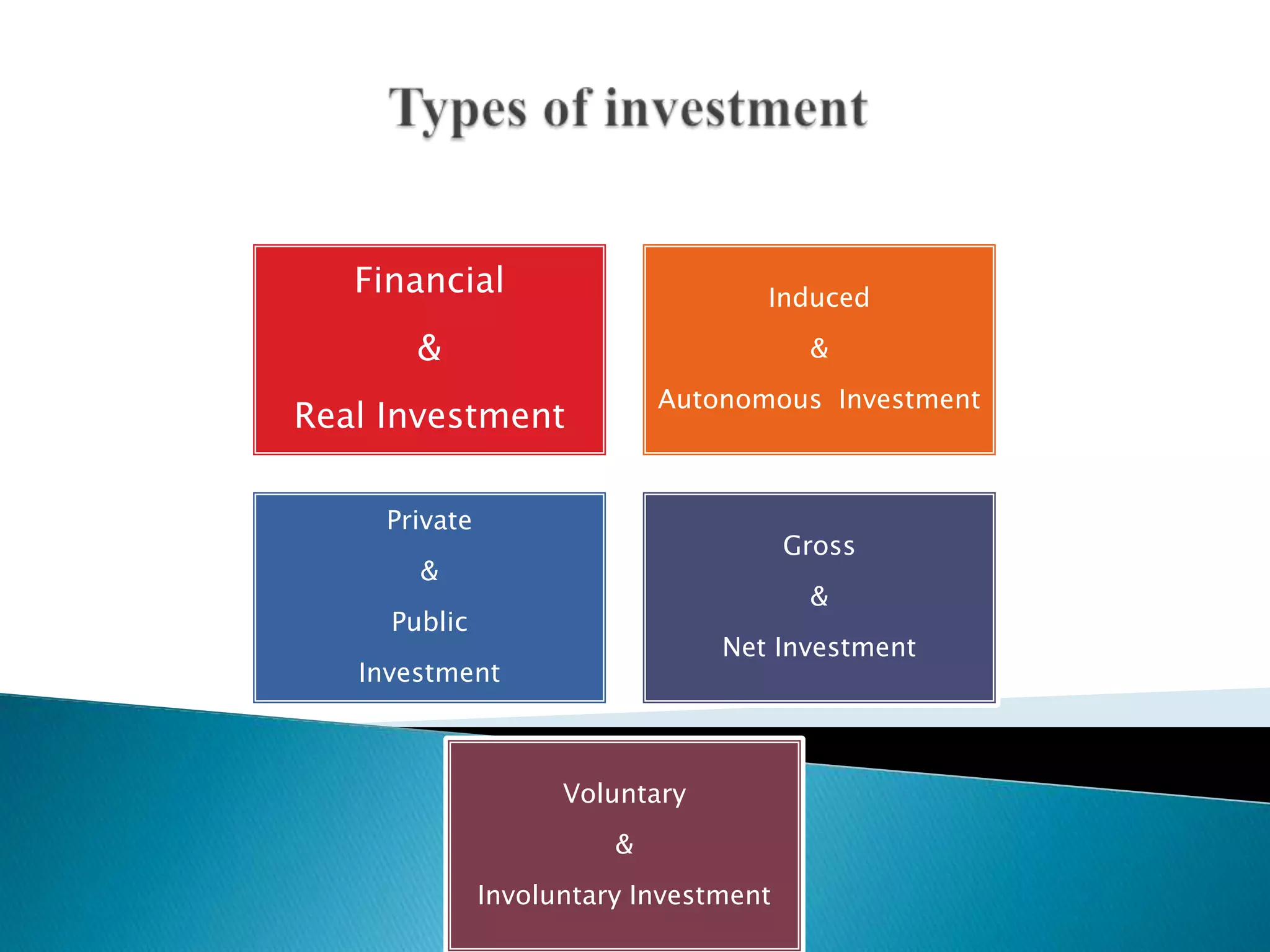
Financial

Induced

&

&

Real Investment

Autonomous Investment

Private

Gross

&

&

Public

Net Investment

Investment

Voluntary
&
Involuntary Investment
Financial investment refers to expenditure on the
purchase of stocks and shares of the existing
companies. It is indeed significant from the
individuals point of view as it implies an increase in
his total assets. But from the viewpoint of economy
as a whole, financial investment is of no significance,
unless it is undertaken by our residents in rest of the
world.
Real investment refers to expenditure on the
purchase of such goods which enhance overall
production in the domestic economy.
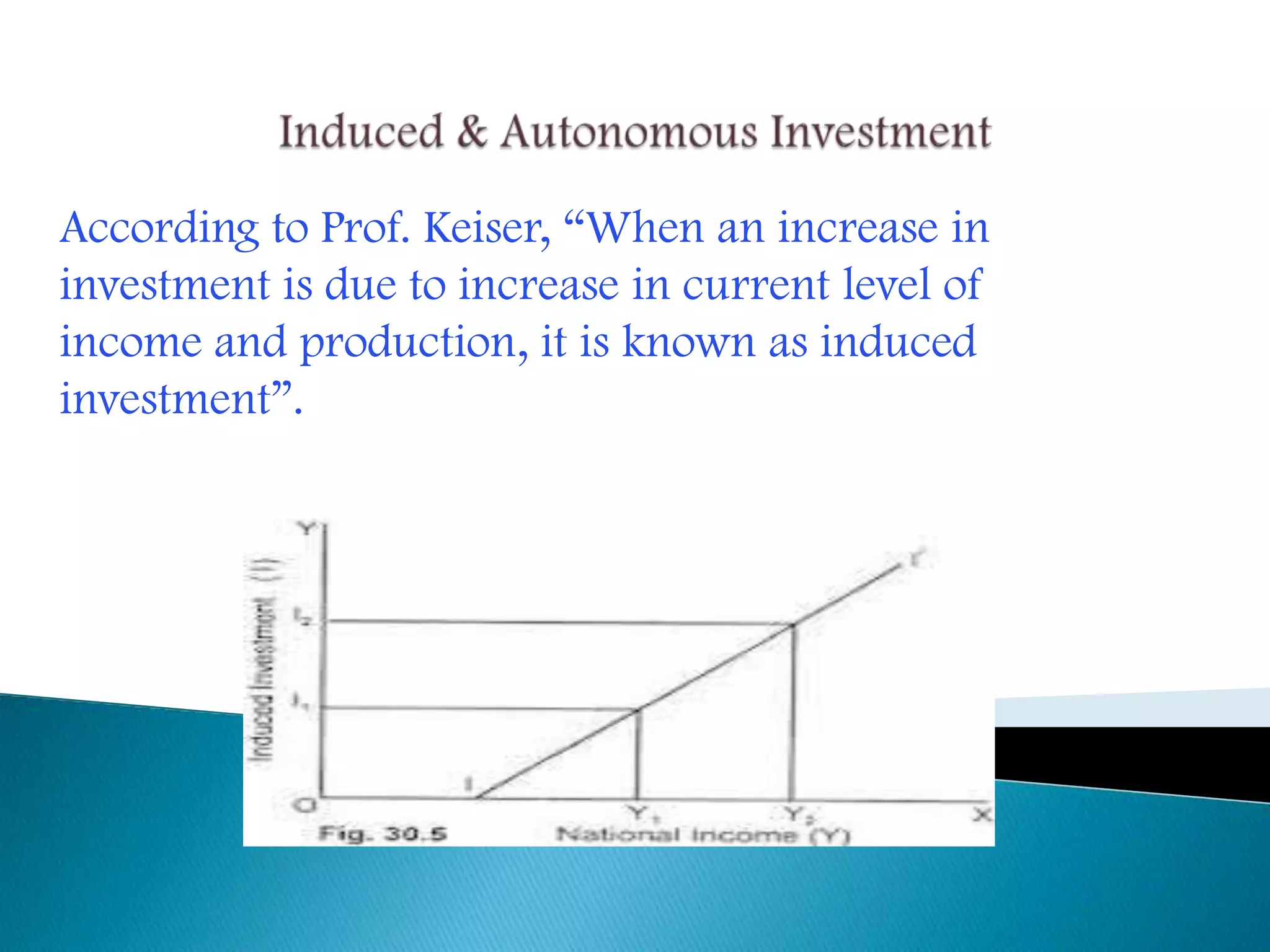
According to Prof. Keiser, “When an increase in
investment is due to increase in current level of
income and production, it is known as induced
investment”.
“Private investment refers to that investment which is
made by private individuals with the sole objective of
earning profit”
“Public investment is that investment which is made by
the central provincial or local-self government of a
country. The objective behind such an investment is
welfare of the people”
“The total expenditure incurred on capital goods at any
given time in an economy is called gross investment”
It includes two kinds of investments:1) Net investment 2)
Replacement investment.
“Replacement investment is that investment which
maintains intact a given stock of capital”
“Net investment is investment that enlarges economy’s
stock of real capital assets thereby adding to productive
capacity”
“When the entrepreneurs' make investment according to a definite
plan in order to achieve a given objective, it is called voluntary
investment”

“Involuntary investment is that investment which is
involuntarily incurred by an investor is called involuntary
investment”.
Investment is related to income.
Ordinarily, investment increases with an increase in
income and decrease with fall in income. It can be
expressed in the form of an equation as under:
PI=I/Y
(1)Average Propensity to Invest: It is the ratio of
total income and total investment .In the form of
an equation, it is expressed as:
API=Investment(I)/Income(Y)
(2)Marginal Propensity to invest: It is the ratio of
change in investment and change in income.i,e.
MPI=Change in investment/Change in Income
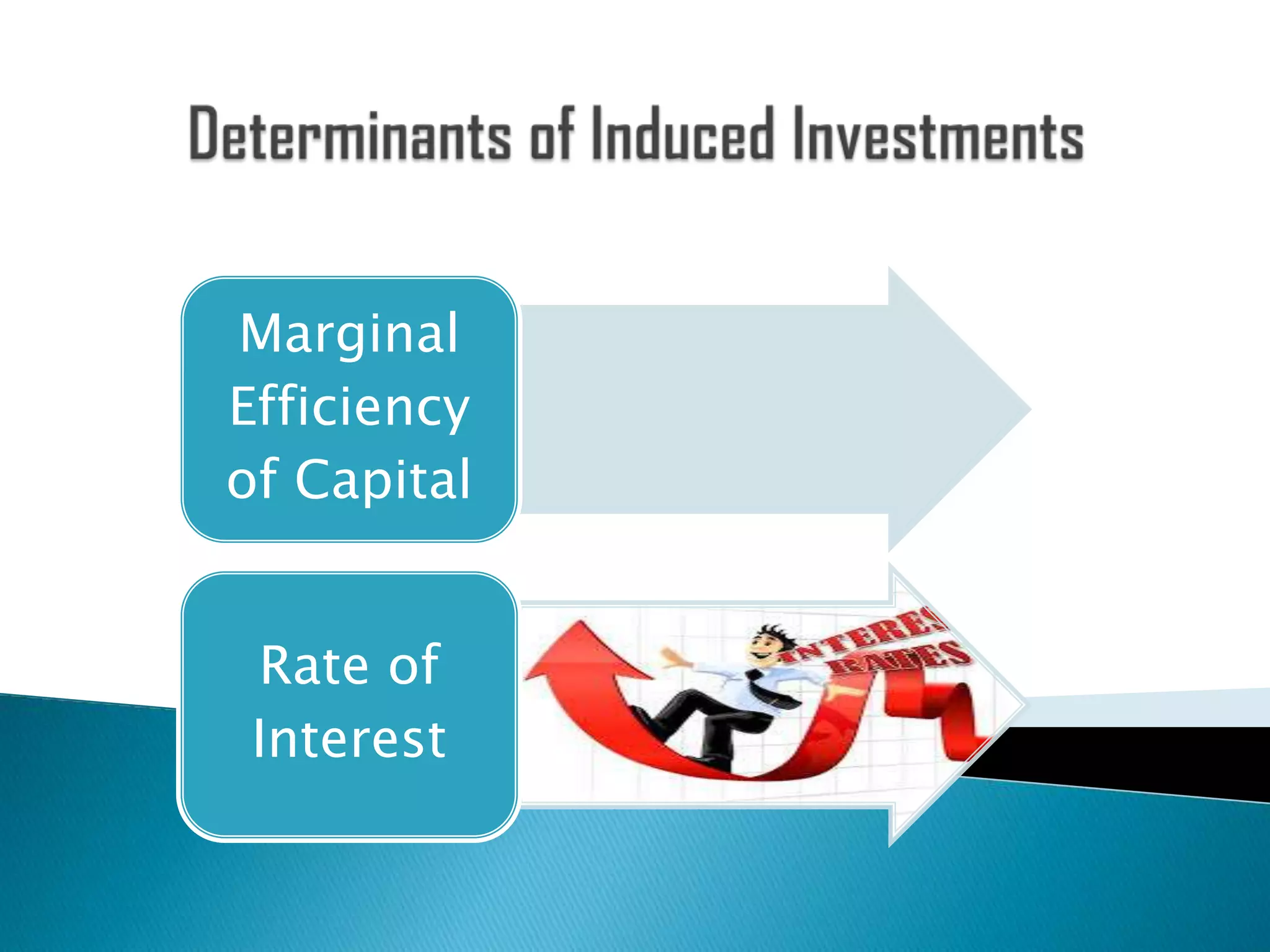
Marginal
Efficiency
of Capital
Rate of
Interest
Marginal efficiency of capital refers to the expected profitability by the
use of one more unit of capital. It depends upon two factors:
1.

Prospective Yield: Prospective Yield of a capital good like,
machine, means that net income which is available during
the full life-time of that machine.

2. Supply Price: Supply refers to the cost of a machine, but it
is not the cost of existing machine but that of a brand
new machine.
If money is borrowed from others to invest,
interest will have to be paid on it. On the
contrary, if the investors has his own money
that he uses in buying government securities,
bonds, etc. he will get regular interest on it.


Reduction in the rate of Interest



Reduction in Taxes



Increase in Government Expenditure



Price support Policy

Pump

Priming

Policy

of Wage Cut
Taxation

Loans

Deficit Financing
o

Determination of Income and Employment

oVolatile

Factor

oEconomic

Development
Credits:Simran Kaur
(1158)

investment function presentation

  • 1.
  • 2.
    Investment, in Economics, refersto expenditure on the purchase of such goods which enhance overall production capacity in the domestic economy. It is an expenditure on fixed assets such as plant and machinery or expenditure on
  • 3.
  • 4.
    Financial investment refersto expenditure on the purchase of stocks and shares of the existing companies. It is indeed significant from the individuals point of view as it implies an increase in his total assets. But from the viewpoint of economy as a whole, financial investment is of no significance, unless it is undertaken by our residents in rest of the world. Real investment refers to expenditure on the purchase of such goods which enhance overall production in the domestic economy.
  • 5.
    According to Prof.Keiser, “When an increase in investment is due to increase in current level of income and production, it is known as induced investment”.
  • 7.
    “Private investment refersto that investment which is made by private individuals with the sole objective of earning profit” “Public investment is that investment which is made by the central provincial or local-self government of a country. The objective behind such an investment is welfare of the people”
  • 8.
    “The total expenditureincurred on capital goods at any given time in an economy is called gross investment” It includes two kinds of investments:1) Net investment 2) Replacement investment. “Replacement investment is that investment which maintains intact a given stock of capital” “Net investment is investment that enlarges economy’s stock of real capital assets thereby adding to productive capacity”
  • 9.
    “When the entrepreneurs'make investment according to a definite plan in order to achieve a given objective, it is called voluntary investment” “Involuntary investment is that investment which is involuntarily incurred by an investor is called involuntary investment”.
  • 10.
    Investment is relatedto income. Ordinarily, investment increases with an increase in income and decrease with fall in income. It can be expressed in the form of an equation as under: PI=I/Y
  • 11.
    (1)Average Propensity toInvest: It is the ratio of total income and total investment .In the form of an equation, it is expressed as: API=Investment(I)/Income(Y) (2)Marginal Propensity to invest: It is the ratio of change in investment and change in income.i,e. MPI=Change in investment/Change in Income
  • 12.
  • 13.
    Marginal efficiency ofcapital refers to the expected profitability by the use of one more unit of capital. It depends upon two factors: 1. Prospective Yield: Prospective Yield of a capital good like, machine, means that net income which is available during the full life-time of that machine. 2. Supply Price: Supply refers to the cost of a machine, but it is not the cost of existing machine but that of a brand new machine.
  • 14.
    If money isborrowed from others to invest, interest will have to be paid on it. On the contrary, if the investors has his own money that he uses in buying government securities, bonds, etc. he will get regular interest on it.
  • 16.
     Reduction in therate of Interest  Reduction in Taxes  Increase in Government Expenditure  Price support Policy Pump Priming Policy of Wage Cut
  • 17.
  • 18.
    o Determination of Incomeand Employment oVolatile Factor oEconomic Development
  • 19.