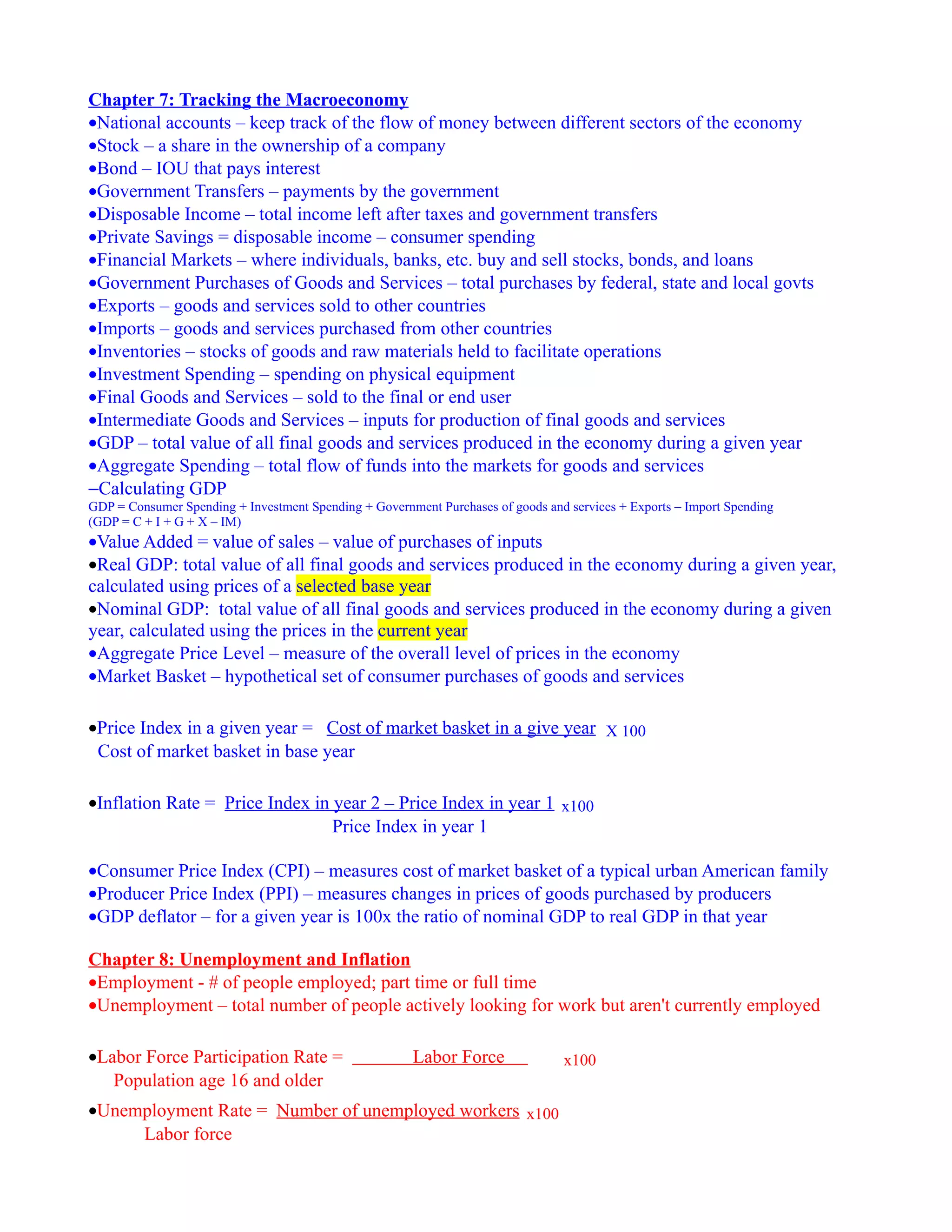
Chapter 7: Tracking the Macroeconomy
•National accounts – keep track of the flow of money between different sectors of the economy
•Stock – a share in the ownership of a company
•Bond – IOU that pays interest
•Government Transfers – payments by the government
•Disposable Income – total income left after taxes and government transfers
•Private Savings = disposable income – consumer spending
•Financial Markets – where individuals, banks, etc. buy and sell stocks, bonds, and loans
•Government Purchases of Goods and Services – total purchases by federal, state and local govts
•Exports – goods and services sold to other countries
•Imports – goods and services purchased from other countries
•Inventories – stocks of goods and raw materials held to facilitate operations
•Investment Spending – spending on physical equipment
•Final Goods and Services – sold to the final or end user
•Intermediate Goods and Services – inputs for production of final goods and services
•GDP – total value of all final goods and services produced in the economy during a given year
•Aggregate Spending – total flow of funds into the markets for goods and services
−Calculating GDP
GDP = Consumer Spending + Investment Spending + Government Purchases of goods and services + Exports – Import Spending
(GDP = C + I + G + X – IM)
•Value Added = value of sales – value of purchases of inputs
•Real GDP: total value of all final goods and services produced in the economy during a given year,
calculated using prices of a selected base year
•Nominal GDP: total value of all final goods and services produced in the economy during a given
year, calculated using the prices in the current year
•Aggregate Price Level – measure of the overall level of prices in the economy
•Market Basket – hypothetical set of consumer purchases of goods and services

•Price Index in a given year = Cost of market basket in a give year X 100
 Cost of market basket in base year

•Inflation Rate = Price Index in year 2 – Price Index in year 1 x100
                                 Price Index in year 1

•Consumer Price Index (CPI) – measures cost of market basket of a typical urban American family
•Producer Price Index (PPI) – measures changes in prices of goods purchased by producers
•GDP deflator – for a given year is 100x the ratio of nominal GDP to real GDP in that year

Chapter 8: Unemployment and Inflation
•Employment - # of people employed; part time or full time
•Unemployment – total number of people actively looking for work but aren't currently employed

•Labor Force Participation Rate =                      Labor Force               x100
   Population age 16 and older
•Unemployment Rate = Number of unemployed workers x100
     Labor force
•Discouraged Workers – nonworking people who are capable of working but have given up the job
search
•Underemployment - # of people who work part time because they can't find full-time jobs
•Frictional Unemployment – amount of time spent between jobs
•Structural Unemployment – more people seeking jobs than there are jobs available (economy
changing structure)
•Natural Rate of Unemployment = Frictional + Structural
•Cyclical Unemployment – deviation of the actual rate or unemployment from the natural rate
•Actual Unemployment = Natural + Cyclical

Chapter 9: Long-Run Economic Growth
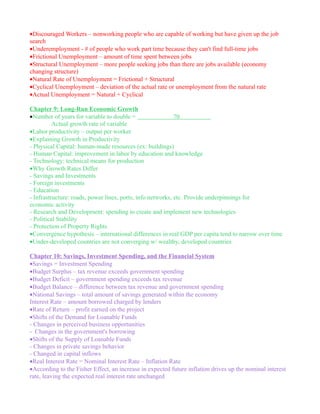
•Number of years for variable to double =                   70
          Actual growth rate of variable
•Labor productivity – output per worker
•Explaining Growth in Productivity
- Physical Capital: human-made resources (ex: buildings)
- Human Capital: improvement in labor by education and knowledge
- Technology: technical means for production
•Why Growth Rates Differ
- Savings and Investments
- Foreign investments
- Education
- Infrastructure: roads, power lines, ports, info networks, etc. Provide underpinnings for
economic activity
- Research and Development: spending to create and implement new technologies
- Political Stability
- Protection of Property Rights
•Convergence hypothesis – international differences in real GDP per capita tend to narrow over time
•Under-developed countries are not converging w/ wealthy, developed countries

Chapter 10: Savings, Investment Spending, and the Financial System
•Savings = Investment Spending
•Budget Surplus – tax revenue exceeds government spending
•Budget Deficit – government spending exceeds tax revenue
•Budget Balance – difference between tax revenue and government spending
•National Savings – total amount of savings generated within the economy
Interest Rate – amount borrowed charged by lenders
•Rate of Return – profit earned on the project
•Shifts of the Demand for Loanable Funds
- Changes in perceived business opportunities
- Changes in the government's borrowing
•Shifts of the Supply of Loanable Funds
- Changes in private savings behavior
- Changed in capital inflows
•Real Interest Rate = Nominal Interest Rate – Inflation Rate
•According to the Fisher Effect, an increase in expected future inflation drives up the nominal interest
rate, leaving the expected real interest rate unchanged
•Three Tasks of a Financial System
1. Reducing Transaction Costs (expenses of negotiating and executing a deal)
2. Reducing Risk (uncertainty about future outcomes that involve financial losses or gains)
3. Providing Liquidity
- An asset is liquid if it can be quickly converted into cash without much loss of value, illiquid if it
cannot.
•Financial Intermediates
1. Mutual Funds – creates a stock portfolio and then resells shares of this portfolio to individual
investors
2. Pension Funds (holds assets to provide retirement income) and Life Insurance Companies (sells
policies that guarantee a payment when the policy-holder dies)
3. Banks – provides liquid assets in the form of bank deposits
•Efficient Markets Hypothesis – asset prices embody all publicity available information
•The Great American Housing Bubble

Econ

  • 1.
    Chapter 7: Trackingthe Macroeconomy •National accounts – keep track of the flow of money between different sectors of the economy •Stock – a share in the ownership of a company •Bond – IOU that pays interest •Government Transfers – payments by the government •Disposable Income – total income left after taxes and government transfers •Private Savings = disposable income – consumer spending •Financial Markets – where individuals, banks, etc. buy and sell stocks, bonds, and loans •Government Purchases of Goods and Services – total purchases by federal, state and local govts •Exports – goods and services sold to other countries •Imports – goods and services purchased from other countries •Inventories – stocks of goods and raw materials held to facilitate operations •Investment Spending – spending on physical equipment •Final Goods and Services – sold to the final or end user •Intermediate Goods and Services – inputs for production of final goods and services •GDP – total value of all final goods and services produced in the economy during a given year •Aggregate Spending – total flow of funds into the markets for goods and services −Calculating GDP GDP = Consumer Spending + Investment Spending + Government Purchases of goods and services + Exports – Import Spending (GDP = C + I + G + X – IM) •Value Added = value of sales – value of purchases of inputs •Real GDP: total value of all final goods and services produced in the economy during a given year, calculated using prices of a selected base year •Nominal GDP: total value of all final goods and services produced in the economy during a given year, calculated using the prices in the current year •Aggregate Price Level – measure of the overall level of prices in the economy •Market Basket – hypothetical set of consumer purchases of goods and services •Price Index in a given year = Cost of market basket in a give year X 100 Cost of market basket in base year •Inflation Rate = Price Index in year 2 – Price Index in year 1 x100 Price Index in year 1 •Consumer Price Index (CPI) – measures cost of market basket of a typical urban American family •Producer Price Index (PPI) – measures changes in prices of goods purchased by producers •GDP deflator – for a given year is 100x the ratio of nominal GDP to real GDP in that year Chapter 8: Unemployment and Inflation •Employment - # of people employed; part time or full time •Unemployment – total number of people actively looking for work but aren't currently employed •Labor Force Participation Rate = Labor Force x100 Population age 16 and older •Unemployment Rate = Number of unemployed workers x100 Labor force
  • 2.
    •Discouraged Workers –nonworking people who are capable of working but have given up the job search •Underemployment - # of people who work part time because they can't find full-time jobs •Frictional Unemployment – amount of time spent between jobs •Structural Unemployment – more people seeking jobs than there are jobs available (economy changing structure) •Natural Rate of Unemployment = Frictional + Structural •Cyclical Unemployment – deviation of the actual rate or unemployment from the natural rate •Actual Unemployment = Natural + Cyclical Chapter 9: Long-Run Economic Growth •Number of years for variable to double = 70 Actual growth rate of variable •Labor productivity – output per worker •Explaining Growth in Productivity - Physical Capital: human-made resources (ex: buildings) - Human Capital: improvement in labor by education and knowledge - Technology: technical means for production •Why Growth Rates Differ - Savings and Investments - Foreign investments - Education - Infrastructure: roads, power lines, ports, info networks, etc. Provide underpinnings for economic activity - Research and Development: spending to create and implement new technologies - Political Stability - Protection of Property Rights •Convergence hypothesis – international differences in real GDP per capita tend to narrow over time •Under-developed countries are not converging w/ wealthy, developed countries Chapter 10: Savings, Investment Spending, and the Financial System •Savings = Investment Spending •Budget Surplus – tax revenue exceeds government spending •Budget Deficit – government spending exceeds tax revenue •Budget Balance – difference between tax revenue and government spending •National Savings – total amount of savings generated within the economy Interest Rate – amount borrowed charged by lenders •Rate of Return – profit earned on the project •Shifts of the Demand for Loanable Funds - Changes in perceived business opportunities - Changes in the government's borrowing •Shifts of the Supply of Loanable Funds - Changes in private savings behavior - Changed in capital inflows •Real Interest Rate = Nominal Interest Rate – Inflation Rate •According to the Fisher Effect, an increase in expected future inflation drives up the nominal interest rate, leaving the expected real interest rate unchanged
  • 3.
    •Three Tasks ofa Financial System 1. Reducing Transaction Costs (expenses of negotiating and executing a deal) 2. Reducing Risk (uncertainty about future outcomes that involve financial losses or gains) 3. Providing Liquidity - An asset is liquid if it can be quickly converted into cash without much loss of value, illiquid if it cannot. •Financial Intermediates 1. Mutual Funds – creates a stock portfolio and then resells shares of this portfolio to individual investors 2. Pension Funds (holds assets to provide retirement income) and Life Insurance Companies (sells policies that guarantee a payment when the policy-holder dies) 3. Banks – provides liquid assets in the form of bank deposits •Efficient Markets Hypothesis – asset prices embody all publicity available information •The Great American Housing Bubble