Java Programming: From Problem Analysis to Program Design, 3e Chapter 11 Inheritance and Polymorphism
Chapter Objectives Learn about inheritance Learn about subclasses and superclasses Explore how to override the methods of a superclass Examine how constructors of superclasses and subclasses work
Chapter Objectives (continued) Learn about polymorphism Examine abstract classes Become aware of interfaces Learn about composition
Inheritance “ is-a” relationship Single inheritance   Subclass is derived from one existing class (superclass) Multiple inheritance Subclass is derived from more than one superclass Not supported by Java In Java, a class can only extend the definition of one class
Inheritance (continued) modifier(s)   class  ClassName  extends   ExistingClassName  modifier(s) { memberList }
Inheritance:  class  Circle  Derived from  class   Shape public class  Circle  extends  Shape { . . . }
Inheritance Rules (continued) The  private  members of the superclass are private to the superclass The subclass can directly access the  public  members of the superclass The subclass can include additional data and/or method members
Inheritance Rules (continued) 4.  The subclass can override, that is, redefine the  public  methods of the superclass However, this redefinition applies only to the objects of the subclass, not to the objects of the superclass 5.  All data members of the superclass are also data members of the subclass Similarly, the methods of the superclass (unless overridden) are also the methods of the subclass Remember Rule 1 when accessing a member of the superclass in the subclass
Inheritance (continued) To write a method’s definition of a subclass, specify a call to the public method of the superclass If subclass overrides  public  method of superclass, specify call to  public  method of superclass:  super.MethodName(parameter list) If subclass does not override  public  method of superclass, specify call to  public  method of superclass:  MethodName(parameter list)
UML Class Diagram:  class  Rectangle
UML Class Diagram:  class  Box
class  Box public void  print() { super .print(); System.out.print("; Height = " + height); } public void  setDimension( double  l,  double  w,  double  h) { super .setDimension(l, w); if  (h >= 0) height = h; else height = 0; } public double  area() { return   2 * (getLength() * getWidth() + getLength() * height  + getWidth() * height); }
Defining Constructors of the Subclass Call to constructor of superclass   Must be first statement Specified by: super parameter list   public  Box() { super ();  height = 0; } public  Box( double  l,  double  w,  double  h) {  super (l, w); height = h; }
Objects  myRectangle  and  myBox Rectangle myRectangle =  new  Rectangle(5, 3); Box myBox =  new  Box(6, 5, 4);
UML Class Diagram
Protected Members of a Class
Protected Members of a Class (continued)
The  class  Object Directly or indirectly becomes the superclass of every class in Java public  members of  class  Object  can be overridden/invoked by object of any class type
The  class  Object :  Equivalent Definition of a Class public class   Clock { //Declare instance variables as given in Chapter 8 //Definition of instance methods as given in Chapter 8  //... } public class   Clock  extends   Object { //Declare instance variables as given in Chapter 8  //Definition of instance methods as given in Chapter 8 //... }
Some Constructors and Methods of the  class  Object
Hierarchy of Java Stream Classes
Polymorphism Java allows us to treat an object of a subclass as an object of its superclass In other words, a reference variable of a superclass type can point to an object of its subclass Person name, nameRef;  PartTimeEmployee employee, employeeRef;  name =  new  Person("John", "Blair");  employee =  new  PartTimeEmployee("Susan", "Johnson",  12.50, 45);   nameRef = employee; System.out.println("nameRef: " + nameRef);  nameRef: Susan Johnson wages are: $562.5
Polymorphism (continued) Late binding or dynamic binding (run-time binding) Method executed determined at execution time, not compile time The term polymorphism means assigning multiple meanings to the same method name   In Java, polymorphism is implemented using late binding The reference variable  name  or  nameRef  can point to any object of the  class  Person  or the  class   PartTimeEmployee
Polymorphism (continued) These reference variables have many forms; that is, they are polymorphic reference variables They can refer to objects of their own class or objects of the classes inherited from their class You can declare a method of a class final using the key word  final ; for example, the following method is final: public final  void doSomeThing() { //... }
Polymorphism (continued) If a method of a  class  is declared  final , it cannot be overridden with a new definition in a derived class In a similar manner, you can also declare a  class  final using the keyword  final   If a  class  is declared  final , then no other class can be derived from this class Java does not use late binding for methods that are  private , marked  final , or  static
Polymorphism (continued) You cannot automatically make reference variable of subclass type point to object of its superclass Suppose that  supRef  is a reference variable of a superclass type; moreover, suppose that  supRef  points to an object of its subclass  You can use an appropriate cast operator on  supRef  and make a reference variable of the subclass point to the object
Polymorphism (continued) On the other hand, if  supRef  does not point to a subclass object and you use a cast operator on  supRef  to make a reference variable of the subclass point to the object, then Java will throw a  ClassCastException—indicating  that the class cast is not allowed
Polymorphism (continued) Operator  instanceof : determines whether reference variable that points to object is of particular class type p  instanceof  BoxShape This expression evaluates to  true  if  p  points to an object of the  class   BoxShape ; otherwise it evaluates to  false
Abstract Methods Abstract method: method that has only the heading with no body Must be declared abstract public void abstract  print(); public abstract  object larger(object,  object); void abstract  insert( int  insertItem);
Abstract Classes Abstract class: class that is declared with the reserved word  abstract  in its heading An abstract class can contain instance variables, constructors, finalizer, and nonabstract methods An abstract class can contain abstract method(s) If a class contains an abstract method, then the class must be declared abstract You cannot instantiate an object of an abstract class type; you can only declare a reference variable of an abstract class type You can instantiate an object of a subclass of an abstract class, but only if the subclass gives the definitions of  all  the abstract methods of the superclass
Abstract Class Example public abstract class   AbstractClassExample { protected int   x; public void abstract   print(); public void   setX( int   a) { x = a; } public   AbstractClassExample() { x = 0; } }
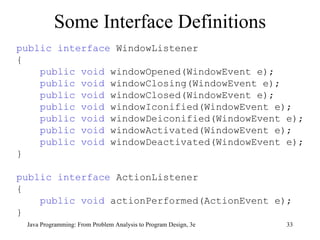
Interfaces Definition:  class that contains only abstract methods and/or named constants   How  Java implements multiple inheritance To be able to handle a variety of events, Java allows a class to implement more than one interface
Some Interface Definitions public interface  WindowListener { public void  windowOpened(WindowEvent e); public void  windowClosing(WindowEvent e); public void  windowClosed(WindowEvent e); public void  windowIconified(WindowEvent e); public void  windowDeiconified(WindowEvent e); public void  windowActivated(WindowEvent e); public void  windowDeactivated(WindowEvent e); } public interface  ActionListener { public void  actionPerformed(ActionEvent e); }
Composition Another way to relate two classes One or more members of a class are objects of another class type “ has-a” relation between classes  E.g. “every person has a date of birth”
Composition Example
Composition Example (continued)
Programming Example: Grade Report Components: student, course Operations on course Set course information Print course information Show credit hours Show course number
Components Course and Student
Components Course and Student (continued)
Programming Example: Grade Report Operations on student Set student information Print student information Calculate number of credit hours taken Calculate GPA Calculate billing amount Sort the courses according to the course number
Programming Example: Grade Report (continued) Main algorithm Declare variables Open input file Open output file Get number of students registered and tuition rate Load students’ data Print grade reports
Sample Output: Grade Report Program
Sample Output: After Clicking Next in Grade Report Program
Chapter Summary Inheritance Single and multiple Rules Uses Superclasses/subclasses (objects) Overriding/overloading methods Constructors The class Object
Chapter Summary (continued) Java Stream Classes Polymorphism Abstract methods Abstract classes Interfaces Composition

Chap11

  • 1.
    Java Programming: FromProblem Analysis to Program Design, 3e Chapter 11 Inheritance and Polymorphism
  • 2.
    Chapter Objectives Learnabout inheritance Learn about subclasses and superclasses Explore how to override the methods of a superclass Examine how constructors of superclasses and subclasses work
  • 3.
    Chapter Objectives (continued)Learn about polymorphism Examine abstract classes Become aware of interfaces Learn about composition
  • 4.
    Inheritance “ is-a”relationship Single inheritance Subclass is derived from one existing class (superclass) Multiple inheritance Subclass is derived from more than one superclass Not supported by Java In Java, a class can only extend the definition of one class
  • 5.
    Inheritance (continued) modifier(s) class ClassName extends ExistingClassName modifier(s) { memberList }
  • 6.
    Inheritance: class Circle Derived from class Shape public class Circle extends Shape { . . . }
  • 7.
    Inheritance Rules (continued)The private members of the superclass are private to the superclass The subclass can directly access the public members of the superclass The subclass can include additional data and/or method members
  • 8.
    Inheritance Rules (continued)4. The subclass can override, that is, redefine the public methods of the superclass However, this redefinition applies only to the objects of the subclass, not to the objects of the superclass 5. All data members of the superclass are also data members of the subclass Similarly, the methods of the superclass (unless overridden) are also the methods of the subclass Remember Rule 1 when accessing a member of the superclass in the subclass
  • 9.
    Inheritance (continued) Towrite a method’s definition of a subclass, specify a call to the public method of the superclass If subclass overrides public method of superclass, specify call to public method of superclass: super.MethodName(parameter list) If subclass does not override public method of superclass, specify call to public method of superclass: MethodName(parameter list)
  • 10.
    UML Class Diagram: class Rectangle
  • 11.
  • 12.
    class Boxpublic void print() { super .print(); System.out.print("; Height = " + height); } public void setDimension( double l, double w, double h) { super .setDimension(l, w); if (h >= 0) height = h; else height = 0; } public double area() { return 2 * (getLength() * getWidth() + getLength() * height + getWidth() * height); }
  • 13.
    Defining Constructors ofthe Subclass Call to constructor of superclass Must be first statement Specified by: super parameter list public Box() { super (); height = 0; } public Box( double l, double w, double h) { super (l, w); height = h; }
  • 14.
    Objects myRectangle and myBox Rectangle myRectangle = new Rectangle(5, 3); Box myBox = new Box(6, 5, 4);
  • 15.
  • 16.
  • 17.
    Protected Members ofa Class (continued)
  • 18.
    The class Object Directly or indirectly becomes the superclass of every class in Java public members of class Object can be overridden/invoked by object of any class type
  • 19.
    The class Object : Equivalent Definition of a Class public class Clock { //Declare instance variables as given in Chapter 8 //Definition of instance methods as given in Chapter 8 //... } public class Clock extends Object { //Declare instance variables as given in Chapter 8 //Definition of instance methods as given in Chapter 8 //... }
  • 20.
    Some Constructors andMethods of the class Object
  • 21.
    Hierarchy of JavaStream Classes
  • 22.
    Polymorphism Java allowsus to treat an object of a subclass as an object of its superclass In other words, a reference variable of a superclass type can point to an object of its subclass Person name, nameRef; PartTimeEmployee employee, employeeRef; name = new Person("John", "Blair"); employee = new PartTimeEmployee("Susan", "Johnson", 12.50, 45); nameRef = employee; System.out.println("nameRef: " + nameRef); nameRef: Susan Johnson wages are: $562.5
  • 23.
    Polymorphism (continued) Latebinding or dynamic binding (run-time binding) Method executed determined at execution time, not compile time The term polymorphism means assigning multiple meanings to the same method name In Java, polymorphism is implemented using late binding The reference variable name or nameRef can point to any object of the class Person or the class PartTimeEmployee
  • 24.
    Polymorphism (continued) Thesereference variables have many forms; that is, they are polymorphic reference variables They can refer to objects of their own class or objects of the classes inherited from their class You can declare a method of a class final using the key word final ; for example, the following method is final: public final void doSomeThing() { //... }
  • 25.
    Polymorphism (continued) Ifa method of a class is declared final , it cannot be overridden with a new definition in a derived class In a similar manner, you can also declare a class final using the keyword final If a class is declared final , then no other class can be derived from this class Java does not use late binding for methods that are private , marked final , or static
  • 26.
    Polymorphism (continued) Youcannot automatically make reference variable of subclass type point to object of its superclass Suppose that supRef is a reference variable of a superclass type; moreover, suppose that supRef points to an object of its subclass You can use an appropriate cast operator on supRef and make a reference variable of the subclass point to the object
  • 27.
    Polymorphism (continued) Onthe other hand, if supRef does not point to a subclass object and you use a cast operator on supRef to make a reference variable of the subclass point to the object, then Java will throw a ClassCastException—indicating that the class cast is not allowed
  • 28.
    Polymorphism (continued) Operator instanceof : determines whether reference variable that points to object is of particular class type p instanceof BoxShape This expression evaluates to true if p points to an object of the class BoxShape ; otherwise it evaluates to false
  • 29.
    Abstract Methods Abstractmethod: method that has only the heading with no body Must be declared abstract public void abstract print(); public abstract object larger(object, object); void abstract insert( int insertItem);
  • 30.
    Abstract Classes Abstractclass: class that is declared with the reserved word abstract in its heading An abstract class can contain instance variables, constructors, finalizer, and nonabstract methods An abstract class can contain abstract method(s) If a class contains an abstract method, then the class must be declared abstract You cannot instantiate an object of an abstract class type; you can only declare a reference variable of an abstract class type You can instantiate an object of a subclass of an abstract class, but only if the subclass gives the definitions of all the abstract methods of the superclass
  • 31.
    Abstract Class Examplepublic abstract class AbstractClassExample { protected int x; public void abstract print(); public void setX( int a) { x = a; } public AbstractClassExample() { x = 0; } }
  • 32.
    Interfaces Definition: class that contains only abstract methods and/or named constants How Java implements multiple inheritance To be able to handle a variety of events, Java allows a class to implement more than one interface
  • 33.
    Some Interface Definitionspublic interface WindowListener { public void windowOpened(WindowEvent e); public void windowClosing(WindowEvent e); public void windowClosed(WindowEvent e); public void windowIconified(WindowEvent e); public void windowDeiconified(WindowEvent e); public void windowActivated(WindowEvent e); public void windowDeactivated(WindowEvent e); } public interface ActionListener { public void actionPerformed(ActionEvent e); }
  • 34.
    Composition Another wayto relate two classes One or more members of a class are objects of another class type “ has-a” relation between classes E.g. “every person has a date of birth”
  • 35.
  • 36.
  • 37.
    Programming Example: GradeReport Components: student, course Operations on course Set course information Print course information Show credit hours Show course number
  • 38.
  • 39.
    Components Course andStudent (continued)
  • 40.
    Programming Example: GradeReport Operations on student Set student information Print student information Calculate number of credit hours taken Calculate GPA Calculate billing amount Sort the courses according to the course number
  • 41.
    Programming Example: GradeReport (continued) Main algorithm Declare variables Open input file Open output file Get number of students registered and tuition rate Load students’ data Print grade reports
  • 42.
    Sample Output: GradeReport Program
  • 43.
    Sample Output: AfterClicking Next in Grade Report Program
  • 44.
    Chapter Summary InheritanceSingle and multiple Rules Uses Superclasses/subclasses (objects) Overriding/overloading methods Constructors The class Object
  • 45.
    Chapter Summary (continued)Java Stream Classes Polymorphism Abstract methods Abstract classes Interfaces Composition