Jul 25, 2016
Abstract Classes and Interfaces
Java is “safer” than Python
 Python is very dynamic—classes and methods can be
added, modified, and deleted as the program runs
 If you have a call to a function that doesn’t exist, Python will
give you a runtime error when you try to call it
 In Java, everything has to be defined before the program
begins to execute
 If you have a call to a function that doesn’t exist, the compiler
marks it as a syntax error
 Syntax errors are far better than runtime errors

Among other things, they won’t make it into distributed code
 To achieve this, Java requires some additional kinds of classes
2
3
Abstract methods
 You can declare an object without defining it:
Person p;
 Similarly, you can declare a method without defining it:
public abstract void draw(int size);
 Notice that the body of the method is missing
 A method that has been declared but not defined is an
abstract method
4
Abstract classes I
 Any class containing an abstract method is an abstract
class
 You must declare the class with the keyword abstract:
abstract class MyClass {...}
 An abstract class is incomplete
 It has “missing” method bodies
 You cannot instantiate (create a new instance of) an
abstract class
5
Abstract classes II
 You can extend (subclass) an abstract class
 If the subclass defines all the inherited abstract methods, it
is “complete” and can be instantiated
 If the subclass does not define all the inherited abstract
methods, it too must be abstract
 You can declare a class to be abstract even if it does
not contain any abstract methods
 This prevents the class from being instantiated
6
Why have abstract classes?
 Suppose you wanted to create a class Shape, with
subclasses Oval, Rectangle, Triangle, Hexagon, etc.
 You don’t want to allow creation of a “Shape”
 Only particular shapes make sense, not generic ones
 If Shape is abstract, you can’t create a new Shape
 You can create a new Oval, a new Rectangle, etc.
 Abstract classes are good for defining a general
category containing specific, “concrete” classes
7
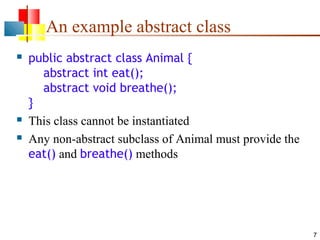
An example abstract class
 public abstract class Animal {
abstract int eat();
abstract void breathe();
}
 This class cannot be instantiated
 Any non-abstract subclass of Animal must provide the
eat() and breathe() methods
8
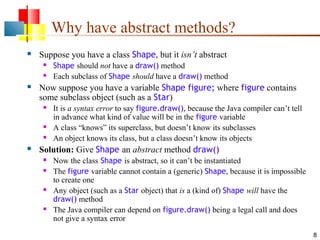
Why have abstract methods?
 Suppose you have a class Shape, but it isn’t abstract
 Shape should not have a draw() method
 Each subclass of Shape should have a draw() method
 Now suppose you have a variable Shape figure; where figure contains
some subclass object (such as a Star)
 It is a syntax error to say figure.draw(), because the Java compiler can’t tell
in advance what kind of value will be in the figure variable
 A class “knows” its superclass, but doesn’t know its subclasses
 An object knows its class, but a class doesn’t know its objects
 Solution: Give Shape an abstract method draw()
 Now the class Shape is abstract, so it can’t be instantiated
 The figure variable cannot contain a (generic) Shape, because it is impossible
to create one
 Any object (such as a Star object) that is a (kind of) Shape will have the
draw() method
 The Java compiler can depend on figure.draw() being a legal call and does
not give a syntax error
9
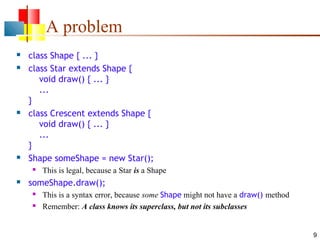
A problem
 class Shape { ... }
 class Star extends Shape {
void draw() { ... }
...
}
 class Crescent extends Shape {
void draw() { ... }
...
}
 Shape someShape = new Star();
 This is legal, because a Star is a Shape
 someShape.draw();
 This is a syntax error, because some Shape might not have a draw() method
 Remember: A class knows its superclass, but not its subclasses
10
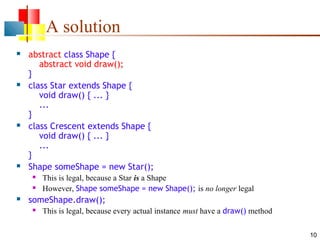
A solution
 abstract class Shape {
abstract void draw();
}
 class Star extends Shape {
void draw() { ... }
...
}
 class Crescent extends Shape {
void draw() { ... }
...
}
 Shape someShape = new Star();
 This is legal, because a Star is a Shape
 However, Shape someShape = new Shape(); is no longer legal
 someShape.draw();
 This is legal, because every actual instance must have a draw() method
11
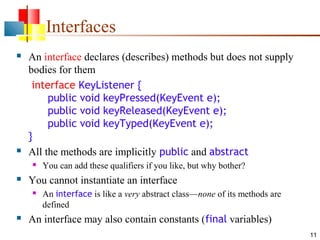
Interfaces
 An interface declares (describes) methods but does not supply
bodies for them
 interface KeyListener {
public void keyPressed(KeyEvent e);
public void keyReleased(KeyEvent e);
public void keyTyped(KeyEvent e);
}
 All the methods are implicitly public and abstract
 You can add these qualifiers if you like, but why bother?
 You cannot instantiate an interface
 An interface is like a very abstract class—none of its methods are
defined
 An interface may also contain constants (final variables)
12
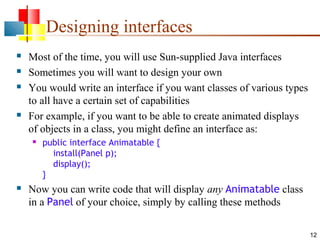
Designing interfaces
 Most of the time, you will use Sun-supplied Java interfaces
 Sometimes you will want to design your own
 You would write an interface if you want classes of various types
to all have a certain set of capabilities
 For example, if you want to be able to create animated displays
of objects in a class, you might define an interface as:
 public interface Animatable {
install(Panel p);
display();
}
 Now you can write code that will display any Animatable class
in a Panel of your choice, simply by calling these methods
13
Implementing an interface I
 You extend a class, but you implement an interface
 A class can only extend (subclass) one other class, but it
can implement as many interfaces as you like
 Example:
class MyListener
implements KeyListener, ActionListener { … }
14
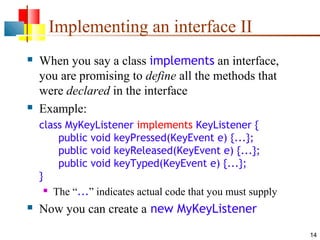
Implementing an interface II
 When you say a class implements an interface,
you are promising to define all the methods that
were declared in the interface
 Example:
class MyKeyListener implements KeyListener {
public void keyPressed(KeyEvent e) {...};
public void keyReleased(KeyEvent e) {...};
public void keyTyped(KeyEvent e) {...};
}
 The “...” indicates actual code that you must supply
 Now you can create a new MyKeyListener
15
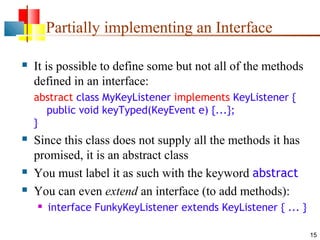
Partially implementing an Interface
 It is possible to define some but not all of the methods
defined in an interface:
abstract class MyKeyListener implements KeyListener {
public void keyTyped(KeyEvent e) {...};
}
 Since this class does not supply all the methods it has
promised, it is an abstract class
 You must label it as such with the keyword abstract
 You can even extend an interface (to add methods):
 interface FunkyKeyListener extends KeyListener { ... }
16
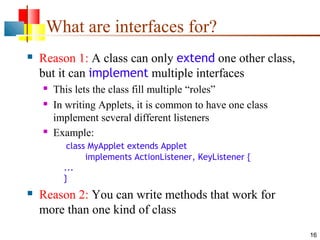
What are interfaces for?
 Reason 1: A class can only extend one other class,
but it can implement multiple interfaces
 This lets the class fill multiple “roles”
 In writing Applets, it is common to have one class
implement several different listeners
 Example:
class MyApplet extends Applet
implements ActionListener, KeyListener {
...
}
 Reason 2: You can write methods that work for
more than one kind of class
17
How to use interfaces
 You can write methods that work with more than one class
 interface RuleSet { boolean isLegal(Move m, Board b);
void makeMove(Move m); }
 Every class that implements RuleSet must have these methods
 class CheckersRules implements RuleSet { // one implementation
public boolean isLegal(Move m, Board b) { ... }
public void makeMove(Move m) { ... }
}
 class ChessRules implements RuleSet { ... } // another implementation
 class LinesOfActionRules implements RuleSet { ... } // and another
 RuleSet rulesOfThisGame = new ChessRules();
 This assignment is legal because a rulesOfThisGame object is a RuleSet object
 if (rulesOfThisGame.isLegal(m, b)) { makeMove(m); }
 This statement is legal because, whatever kind of RuleSet object rulesOfThisGame
is, it must have isLegal and makeMove methods
18
instanceof
 instanceof is a keyword that tells you whether a variable
“is a” member of a class or interface
 For example, if
class Dog extends Animal implements Pet {...}
Animal fido = new Dog();
then the following are all true:
fido instanceof Dog
fido instanceof Animal
fido instanceof Pet
 instanceof is seldom used
 When you find yourself wanting to use instanceof, think about
whether the method you are writing should be moved to the individual
subclasses
19
Interfaces, again
 When you implement an interface, you promise to
define all the functions it declares
 There can be a lot of methods
interface KeyListener {
public void keyPressed(KeyEvent e);
public void keyReleased(KeyEvent e);
public void keyTyped(KeyEvent e);
}
 What if you only care about a couple of these
methods?
20
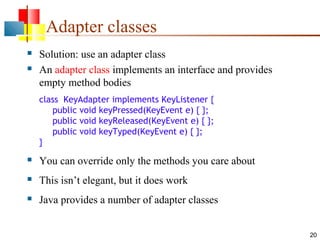
Adapter classes
 Solution: use an adapter class
 An adapter class implements an interface and provides
empty method bodies
class KeyAdapter implements KeyListener {
public void keyPressed(KeyEvent e) { };
public void keyReleased(KeyEvent e) { };
public void keyTyped(KeyEvent e) { };
}
 You can override only the methods you care about
 This isn’t elegant, but it does work
 Java provides a number of adapter classes

06 abstract-classes

  • 1.
    Jul 25, 2016 AbstractClasses and Interfaces
  • 2.
    Java is “safer”than Python  Python is very dynamic—classes and methods can be added, modified, and deleted as the program runs  If you have a call to a function that doesn’t exist, Python will give you a runtime error when you try to call it  In Java, everything has to be defined before the program begins to execute  If you have a call to a function that doesn’t exist, the compiler marks it as a syntax error  Syntax errors are far better than runtime errors  Among other things, they won’t make it into distributed code  To achieve this, Java requires some additional kinds of classes 2
  • 3.
    3 Abstract methods  Youcan declare an object without defining it: Person p;  Similarly, you can declare a method without defining it: public abstract void draw(int size);  Notice that the body of the method is missing  A method that has been declared but not defined is an abstract method
  • 4.
    4 Abstract classes I Any class containing an abstract method is an abstract class  You must declare the class with the keyword abstract: abstract class MyClass {...}  An abstract class is incomplete  It has “missing” method bodies  You cannot instantiate (create a new instance of) an abstract class
  • 5.
    5 Abstract classes II You can extend (subclass) an abstract class  If the subclass defines all the inherited abstract methods, it is “complete” and can be instantiated  If the subclass does not define all the inherited abstract methods, it too must be abstract  You can declare a class to be abstract even if it does not contain any abstract methods  This prevents the class from being instantiated
  • 6.
    6 Why have abstractclasses?  Suppose you wanted to create a class Shape, with subclasses Oval, Rectangle, Triangle, Hexagon, etc.  You don’t want to allow creation of a “Shape”  Only particular shapes make sense, not generic ones  If Shape is abstract, you can’t create a new Shape  You can create a new Oval, a new Rectangle, etc.  Abstract classes are good for defining a general category containing specific, “concrete” classes
  • 7.
    7 An example abstractclass  public abstract class Animal { abstract int eat(); abstract void breathe(); }  This class cannot be instantiated  Any non-abstract subclass of Animal must provide the eat() and breathe() methods
  • 8.
    8 Why have abstractmethods?  Suppose you have a class Shape, but it isn’t abstract  Shape should not have a draw() method  Each subclass of Shape should have a draw() method  Now suppose you have a variable Shape figure; where figure contains some subclass object (such as a Star)  It is a syntax error to say figure.draw(), because the Java compiler can’t tell in advance what kind of value will be in the figure variable  A class “knows” its superclass, but doesn’t know its subclasses  An object knows its class, but a class doesn’t know its objects  Solution: Give Shape an abstract method draw()  Now the class Shape is abstract, so it can’t be instantiated  The figure variable cannot contain a (generic) Shape, because it is impossible to create one  Any object (such as a Star object) that is a (kind of) Shape will have the draw() method  The Java compiler can depend on figure.draw() being a legal call and does not give a syntax error
  • 9.
    9 A problem  classShape { ... }  class Star extends Shape { void draw() { ... } ... }  class Crescent extends Shape { void draw() { ... } ... }  Shape someShape = new Star();  This is legal, because a Star is a Shape  someShape.draw();  This is a syntax error, because some Shape might not have a draw() method  Remember: A class knows its superclass, but not its subclasses
  • 10.
    10 A solution  abstractclass Shape { abstract void draw(); }  class Star extends Shape { void draw() { ... } ... }  class Crescent extends Shape { void draw() { ... } ... }  Shape someShape = new Star();  This is legal, because a Star is a Shape  However, Shape someShape = new Shape(); is no longer legal  someShape.draw();  This is legal, because every actual instance must have a draw() method
  • 11.
    11 Interfaces  An interfacedeclares (describes) methods but does not supply bodies for them  interface KeyListener { public void keyPressed(KeyEvent e); public void keyReleased(KeyEvent e); public void keyTyped(KeyEvent e); }  All the methods are implicitly public and abstract  You can add these qualifiers if you like, but why bother?  You cannot instantiate an interface  An interface is like a very abstract class—none of its methods are defined  An interface may also contain constants (final variables)
  • 12.
    12 Designing interfaces  Mostof the time, you will use Sun-supplied Java interfaces  Sometimes you will want to design your own  You would write an interface if you want classes of various types to all have a certain set of capabilities  For example, if you want to be able to create animated displays of objects in a class, you might define an interface as:  public interface Animatable { install(Panel p); display(); }  Now you can write code that will display any Animatable class in a Panel of your choice, simply by calling these methods
  • 13.
    13 Implementing an interfaceI  You extend a class, but you implement an interface  A class can only extend (subclass) one other class, but it can implement as many interfaces as you like  Example: class MyListener implements KeyListener, ActionListener { … }
  • 14.
    14 Implementing an interfaceII  When you say a class implements an interface, you are promising to define all the methods that were declared in the interface  Example: class MyKeyListener implements KeyListener { public void keyPressed(KeyEvent e) {...}; public void keyReleased(KeyEvent e) {...}; public void keyTyped(KeyEvent e) {...}; }  The “...” indicates actual code that you must supply  Now you can create a new MyKeyListener
  • 15.
    15 Partially implementing anInterface  It is possible to define some but not all of the methods defined in an interface: abstract class MyKeyListener implements KeyListener { public void keyTyped(KeyEvent e) {...}; }  Since this class does not supply all the methods it has promised, it is an abstract class  You must label it as such with the keyword abstract  You can even extend an interface (to add methods):  interface FunkyKeyListener extends KeyListener { ... }
  • 16.
    16 What are interfacesfor?  Reason 1: A class can only extend one other class, but it can implement multiple interfaces  This lets the class fill multiple “roles”  In writing Applets, it is common to have one class implement several different listeners  Example: class MyApplet extends Applet implements ActionListener, KeyListener { ... }  Reason 2: You can write methods that work for more than one kind of class
  • 17.
    17 How to useinterfaces  You can write methods that work with more than one class  interface RuleSet { boolean isLegal(Move m, Board b); void makeMove(Move m); }  Every class that implements RuleSet must have these methods  class CheckersRules implements RuleSet { // one implementation public boolean isLegal(Move m, Board b) { ... } public void makeMove(Move m) { ... } }  class ChessRules implements RuleSet { ... } // another implementation  class LinesOfActionRules implements RuleSet { ... } // and another  RuleSet rulesOfThisGame = new ChessRules();  This assignment is legal because a rulesOfThisGame object is a RuleSet object  if (rulesOfThisGame.isLegal(m, b)) { makeMove(m); }  This statement is legal because, whatever kind of RuleSet object rulesOfThisGame is, it must have isLegal and makeMove methods
  • 18.
    18 instanceof  instanceof isa keyword that tells you whether a variable “is a” member of a class or interface  For example, if class Dog extends Animal implements Pet {...} Animal fido = new Dog(); then the following are all true: fido instanceof Dog fido instanceof Animal fido instanceof Pet  instanceof is seldom used  When you find yourself wanting to use instanceof, think about whether the method you are writing should be moved to the individual subclasses
  • 19.
    19 Interfaces, again  Whenyou implement an interface, you promise to define all the functions it declares  There can be a lot of methods interface KeyListener { public void keyPressed(KeyEvent e); public void keyReleased(KeyEvent e); public void keyTyped(KeyEvent e); }  What if you only care about a couple of these methods?
  • 20.
    20 Adapter classes  Solution:use an adapter class  An adapter class implements an interface and provides empty method bodies class KeyAdapter implements KeyListener { public void keyPressed(KeyEvent e) { }; public void keyReleased(KeyEvent e) { }; public void keyTyped(KeyEvent e) { }; }  You can override only the methods you care about  This isn’t elegant, but it does work  Java provides a number of adapter classes