CChhaapptteerr 2288 
SSeeccuurriittyy 
Objectives 
Upon completion you will be able to: 
• Differentiate between two categories of cryptography schemes 
• Understand four aspects of security 
• Understand the concept of digital signature 
• Understand the role of key management in entity authentication 
• Know how and where IPSec, TLS, and PPG provide security 
TCP/IP Protocol Suite 1
28.1 CRYPTOGRAPHY 
The word cryptography in Greek means “secret writing.” TThhee tteerrmm ttooddaayy 
rreeffeerrss ttoo tthhee sscciieennccee aanndd aarrtt ooff ttrraannssffoorrmmiinngg mmeessssaaggeess ttoo mmaakkee tthheemm 
sseeccuurree aanndd iimmmmuunnee ttoo aattttaacckkss.. 
TThhee ttooppiiccss ddiissccuusssseedd iinn tthhiiss sseeccttiioonn iinncclluuddee:: 
SSyymmmmeettrriicc--KKeeyy CCrryyppttooggrraapphhyy 
AAssyymmmmeettrriicc--KKeeyy CCrryyppttooggrraapphhyy 
CCoommppaarriissoonn 
TCP/IP Protocol Suite 2
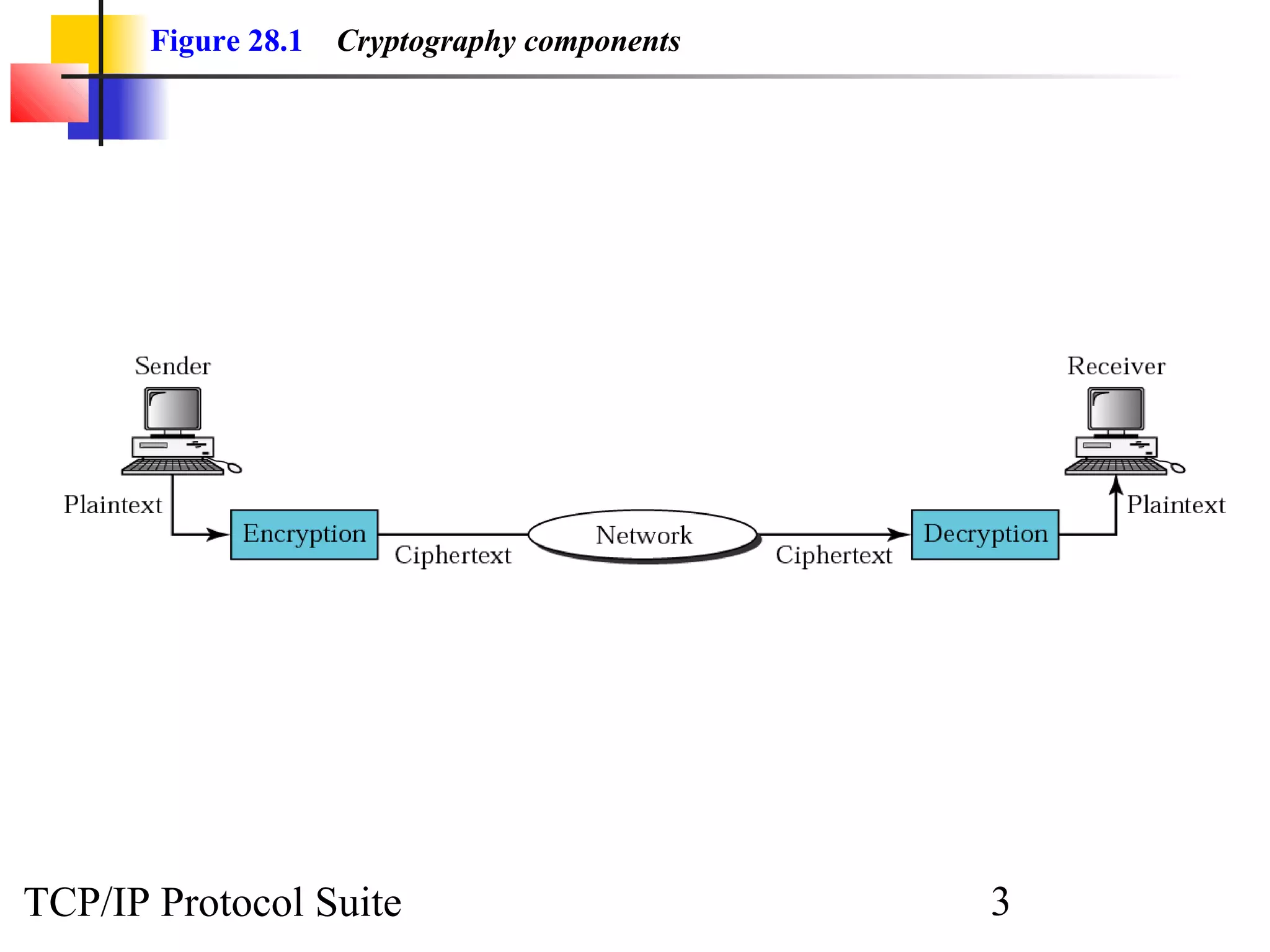
Figure 28.1 Cryptography components 
TCP/IP Protocol Suite 3
NNoottee:: 
In cryptography, the 
encryption/decryption algorithms are 
public; the keys are secret. 
TCP/IP Protocol Suite 4
NNoottee:: 
In symmetric-key cryptography, the 
same key is used by the sender (for 
encryption) and the receiver (for 
decryption). The key is shared. 
TCP/IP Protocol Suite 5
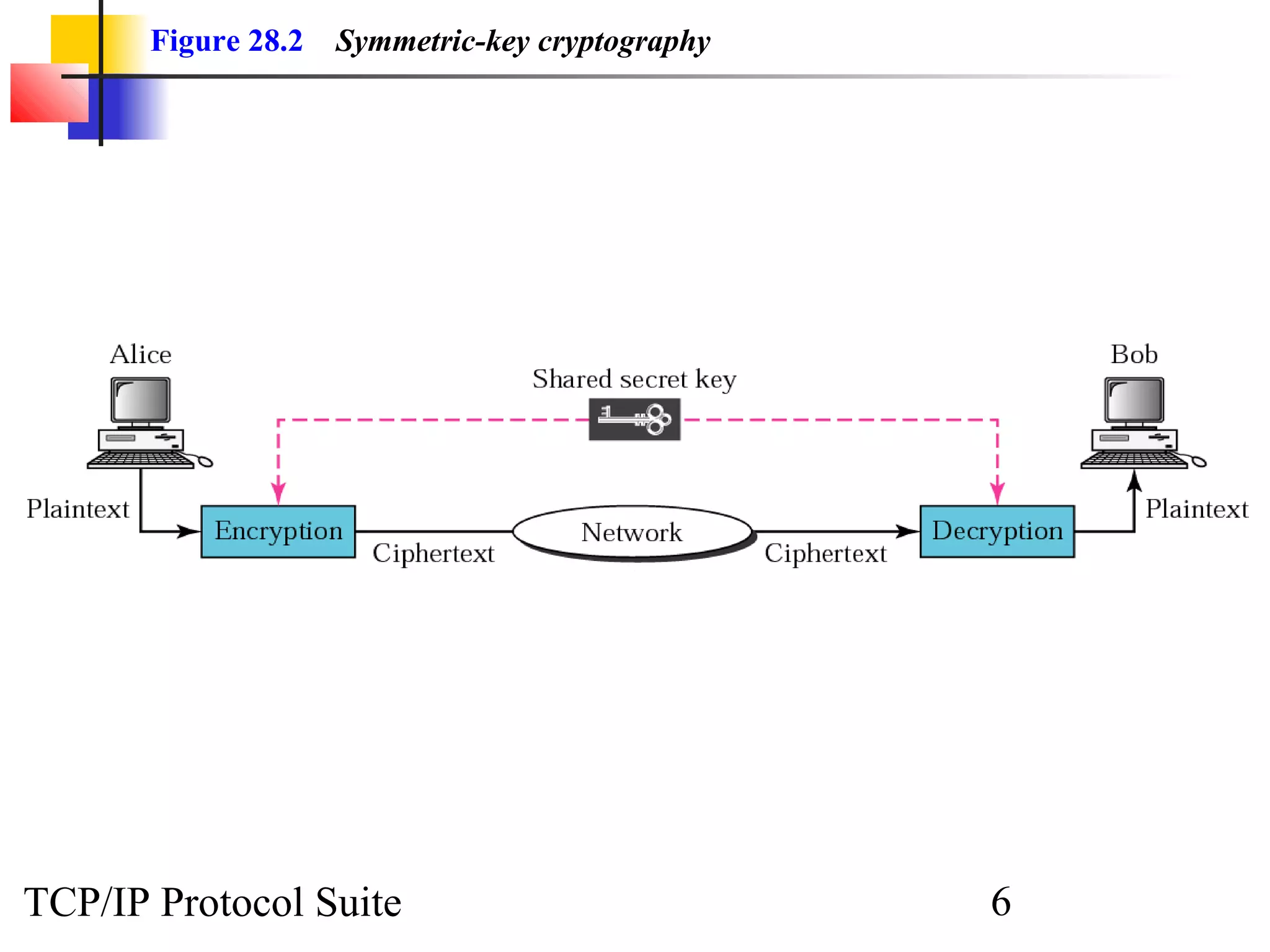
Figure 28.2 Symmetric-key cryptography 
TCP/IP Protocol Suite 6
NNoottee:: 
In symmetric-key cryptography, the 
same key is used in both directions. 
TCP/IP Protocol Suite 7
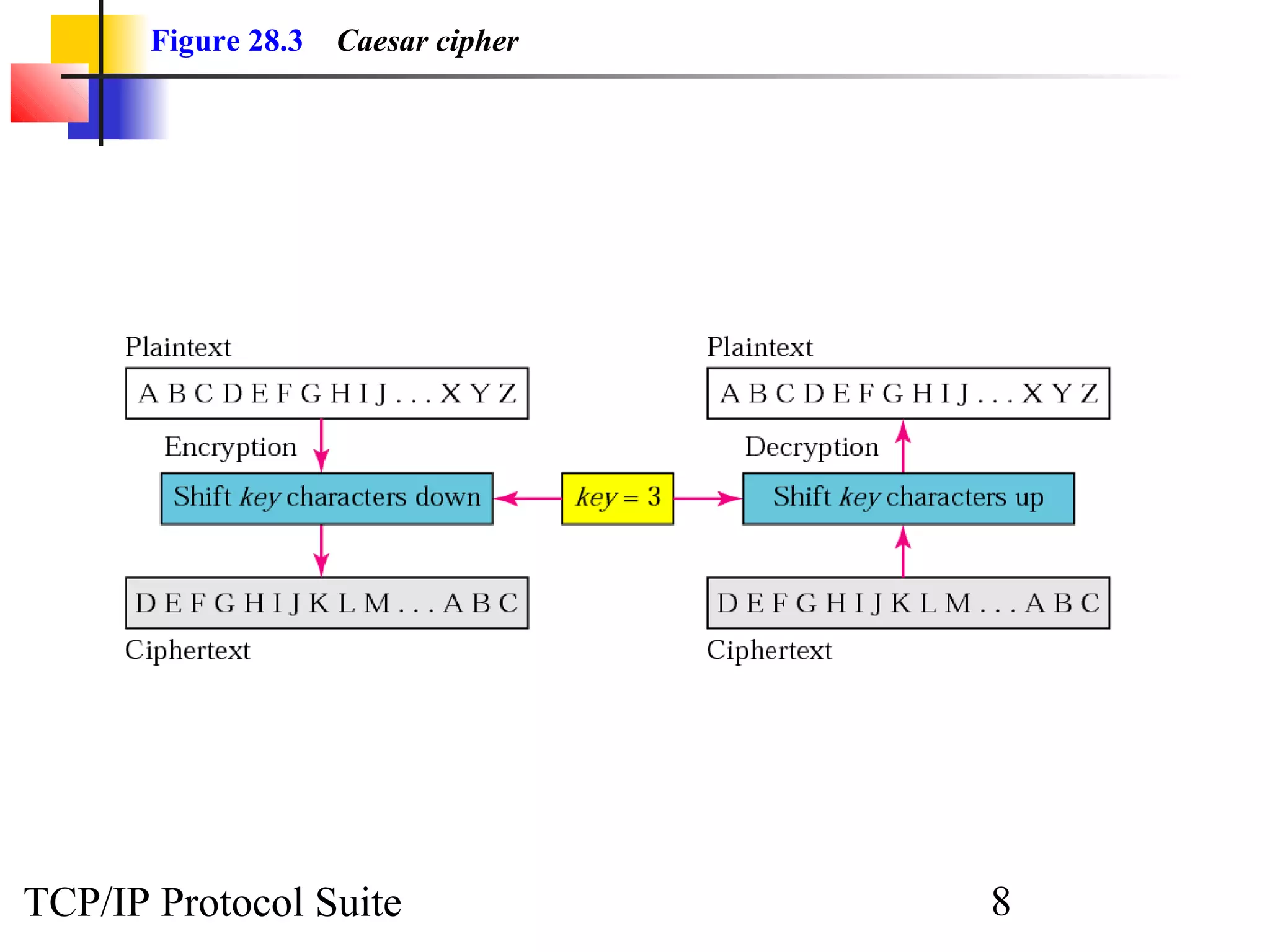
Figure 28.3 Caesar cipher 
TCP/IP Protocol Suite 8
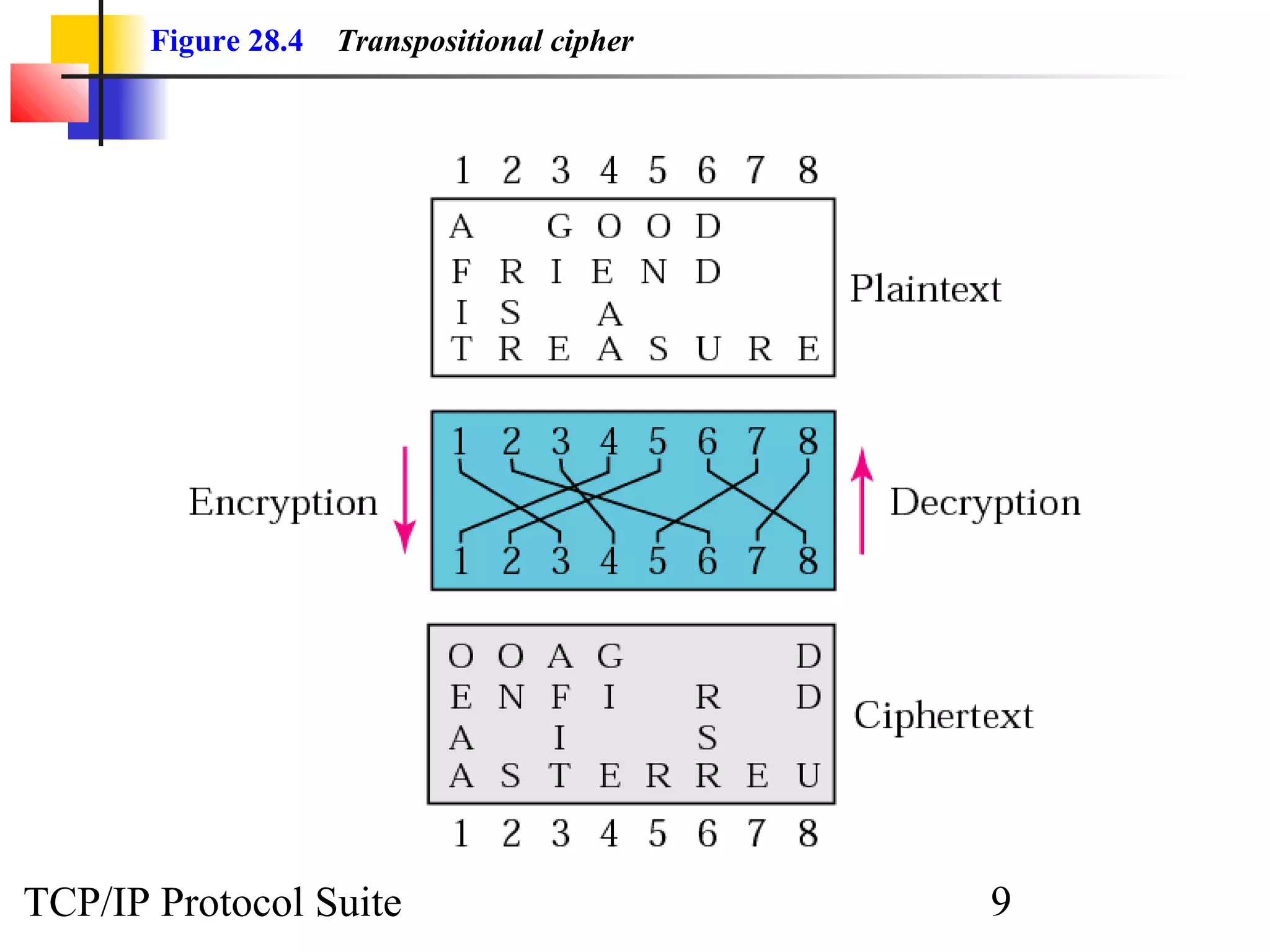
Figure 28.4 Transpositional cipher 
TCP/IP Protocol Suite 9
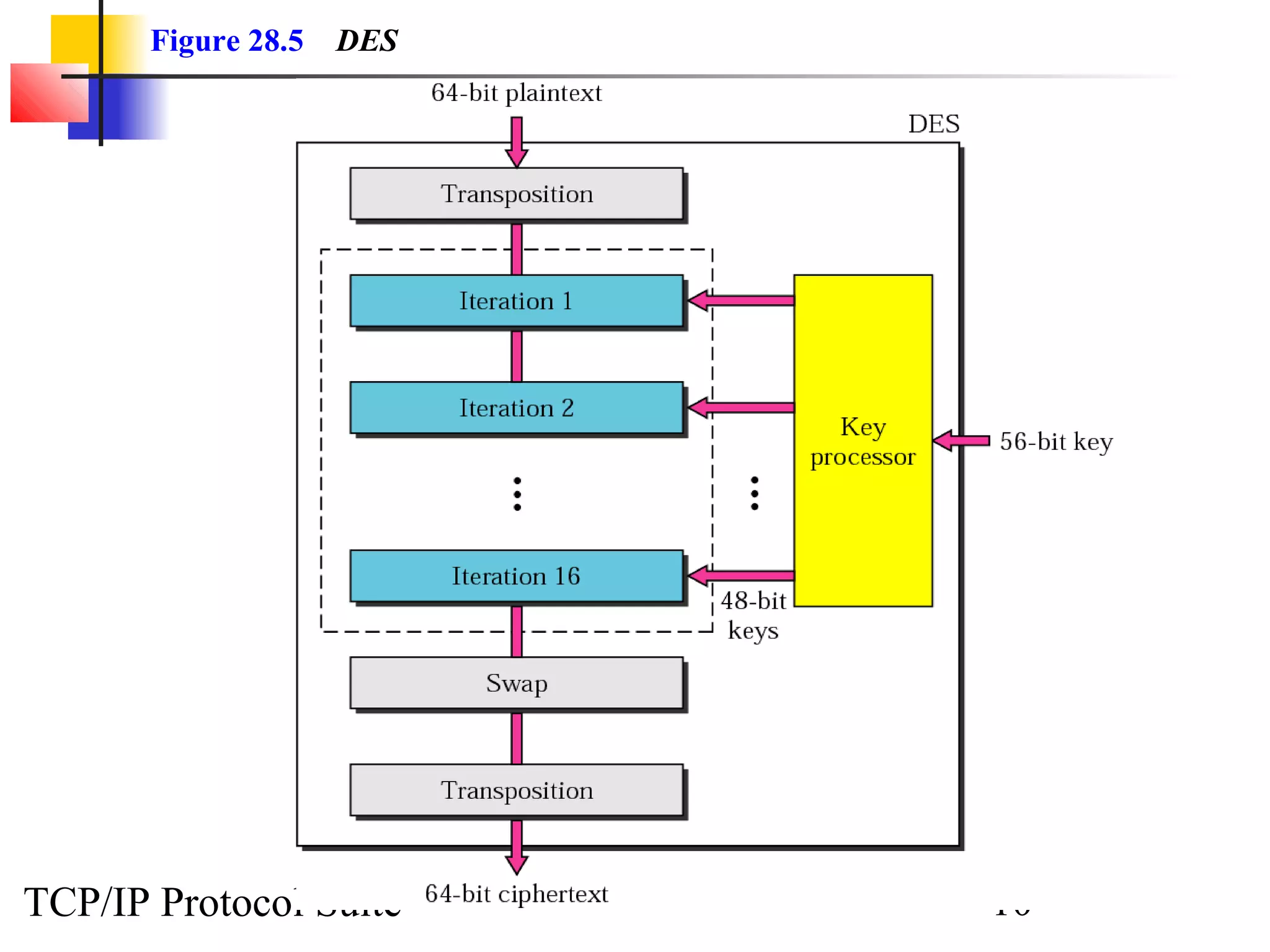
Figure 28.5 DES 
TCP/IP Protocol Suite 10
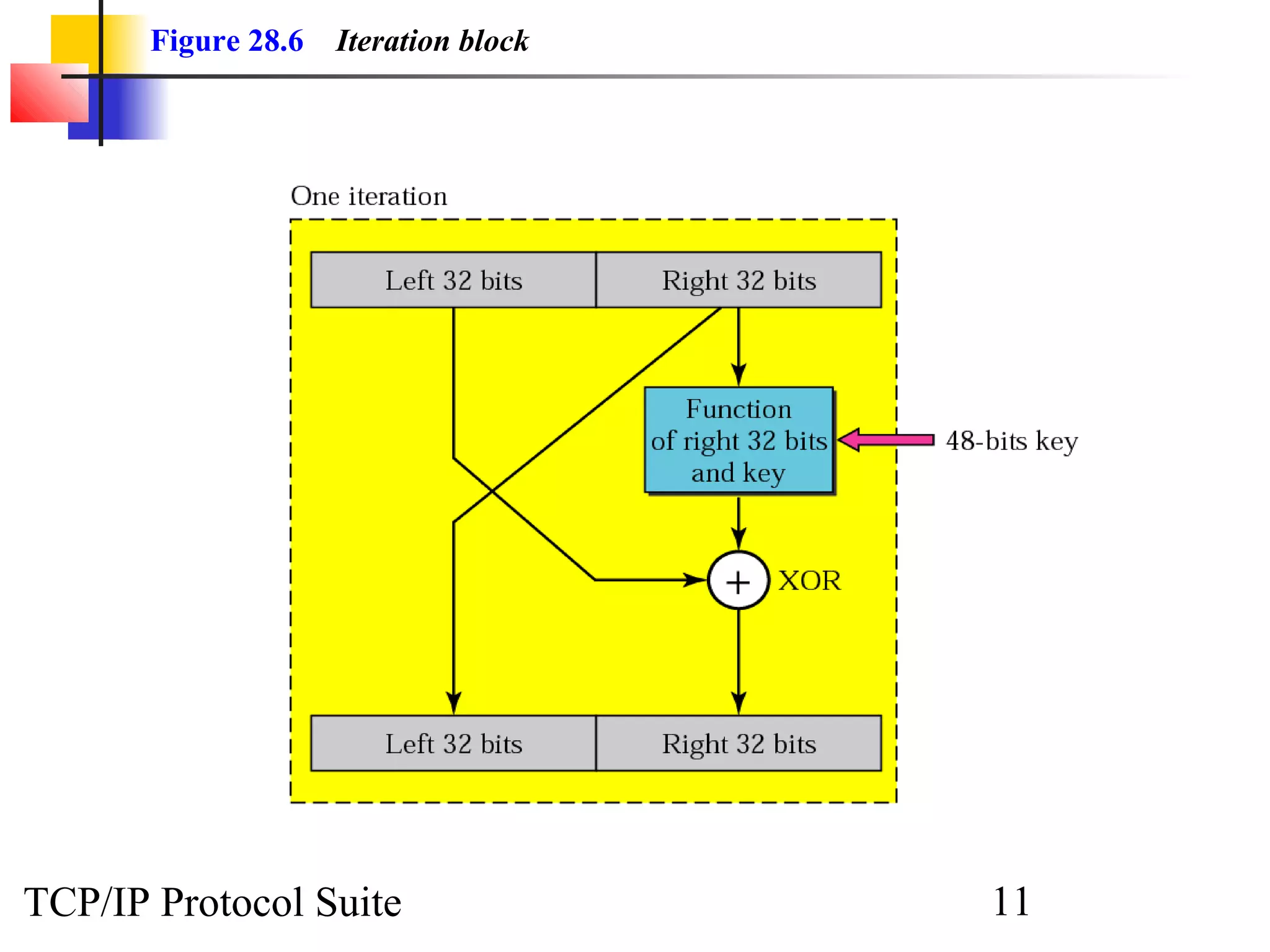
Figure 28.6 Iteration block 
TCP/IP Protocol Suite 11
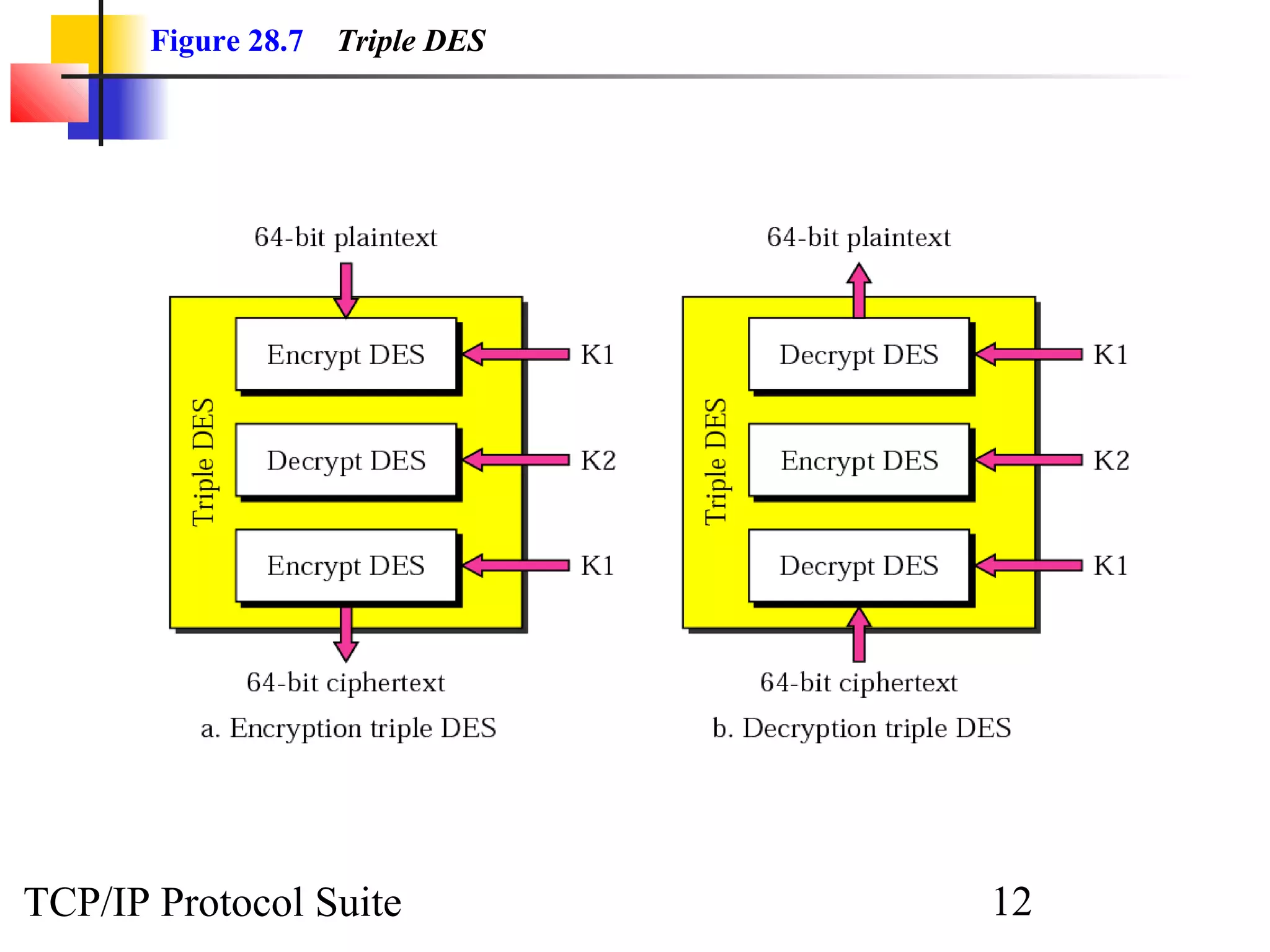
Figure 28.7 Triple DES 
TCP/IP Protocol Suite 12
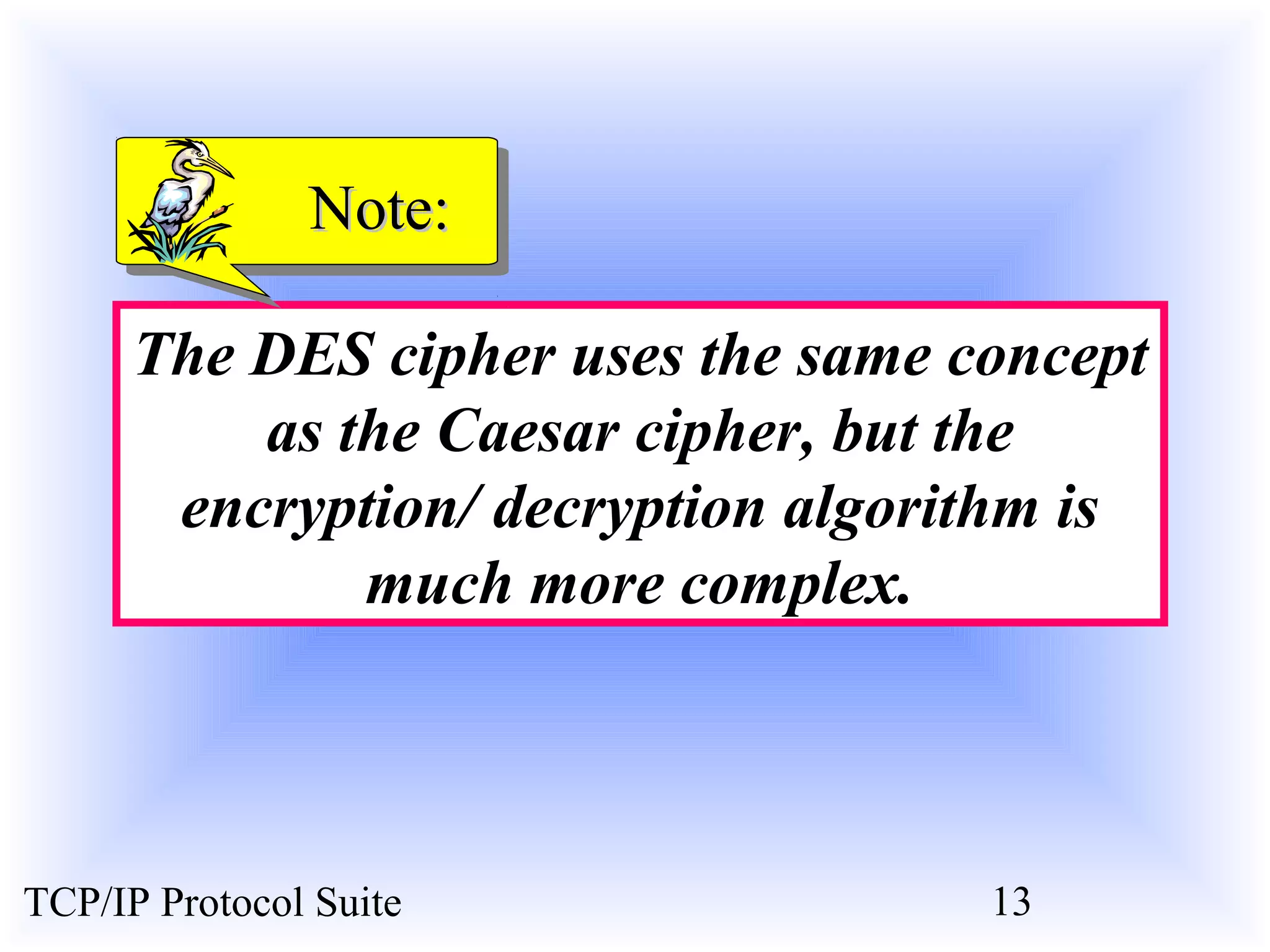
NNoottee:: 
The DES cipher uses the same concept 
as the Caesar cipher, but the 
encryption/ decryption algorithm is 
much more complex. 
TCP/IP Protocol Suite 13
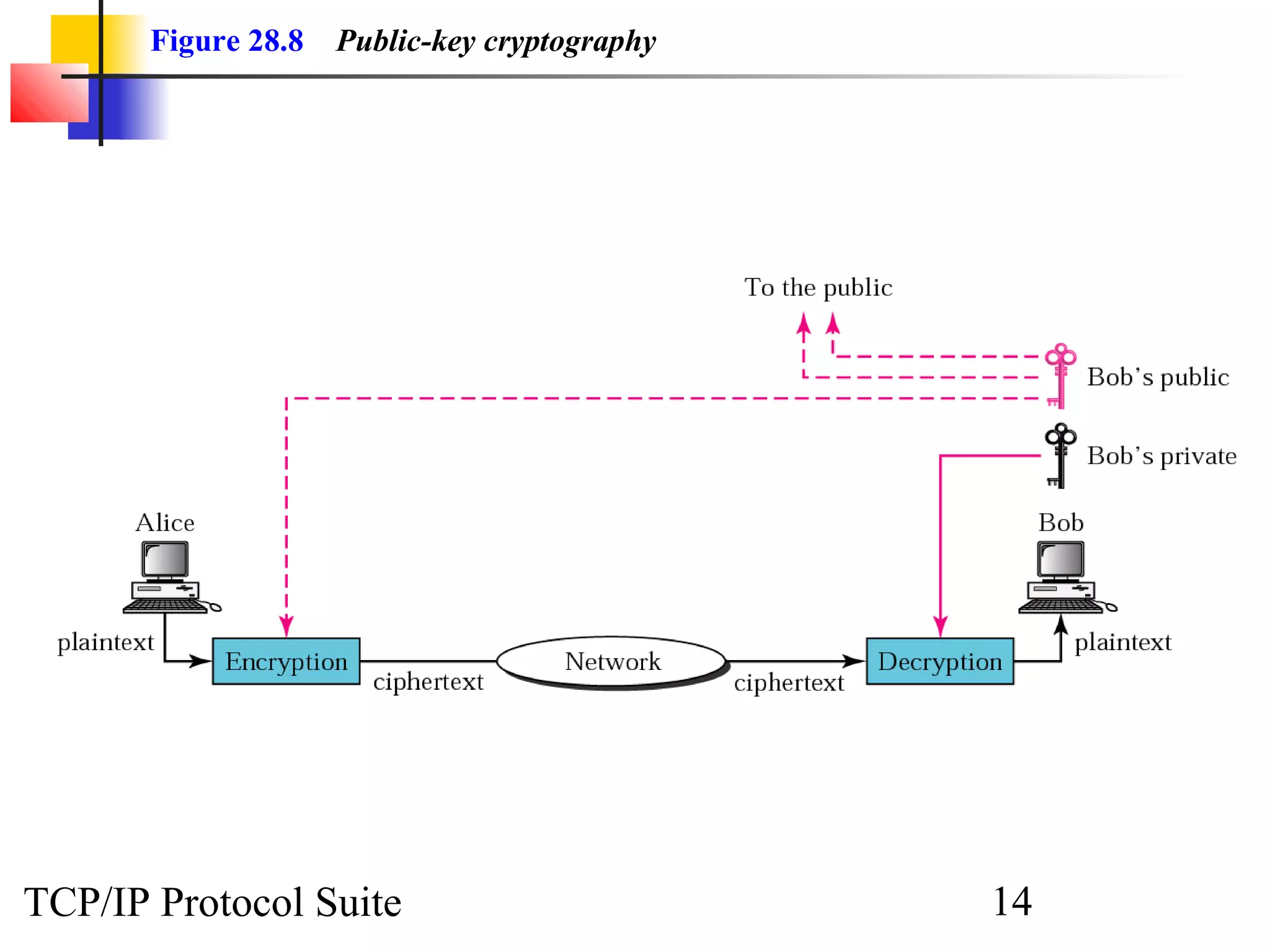
Figure 28.8 Public-key cryptography 
TCP/IP Protocol Suite 14
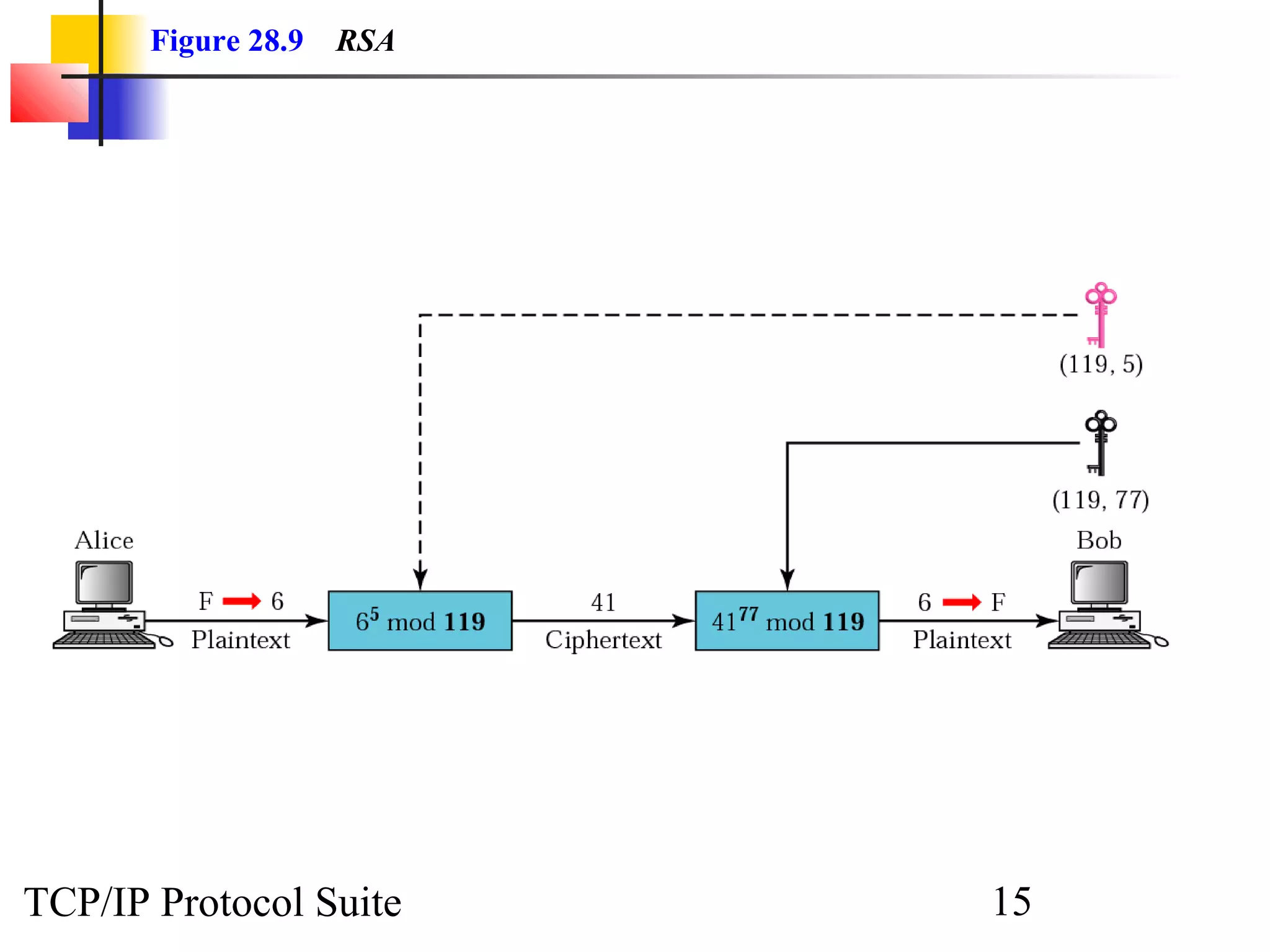
Figure 28.9 RSA 
TCP/IP Protocol Suite 15
NNoottee:: 
Symmetric-key cryptography is often 
used for long messages. 
TCP/IP Protocol Suite 16
NNoottee:: 
Asymmetric-key algorithms are more 
efficient for short messages. 
TCP/IP Protocol Suite 17
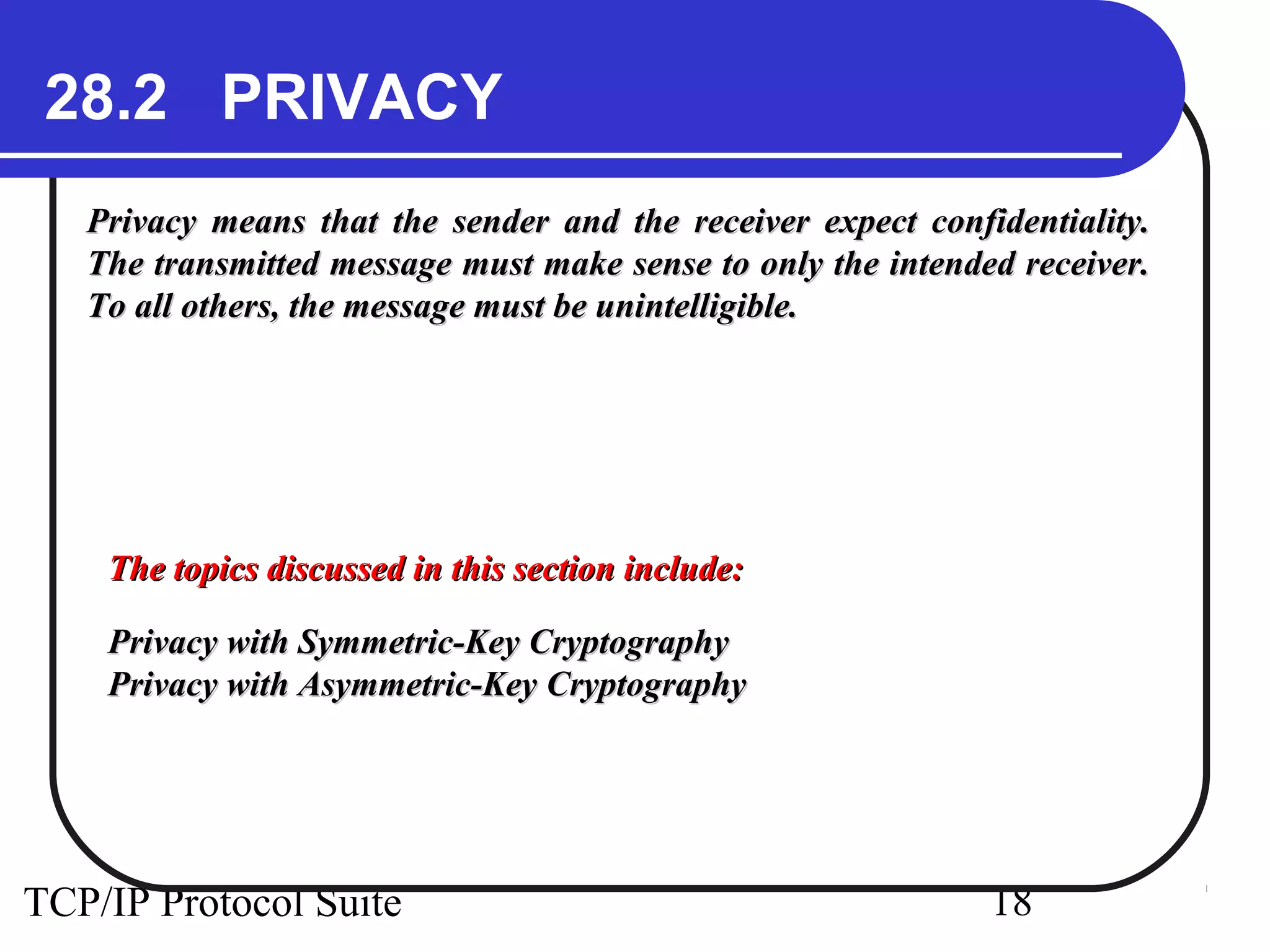
28.2 PRIVACY 
Privacy means that the sender and the receiver expect ccoonnffiiddeennttiiaalliittyy.. 
TThhee ttrraannssmmiitttteedd mmeessssaaggee mmuusstt mmaakkee sseennssee ttoo oonnllyy tthhee iinntteennddeedd rreecceeiivveerr.. 
TToo aallll ootthheerrss,, tthhee mmeessssaaggee mmuusstt bbee uunniinntteelllliiggiibbllee.. 
TThhee ttooppiiccss ddiissccuusssseedd iinn tthhiiss sseeccttiioonn iinncclluuddee:: 
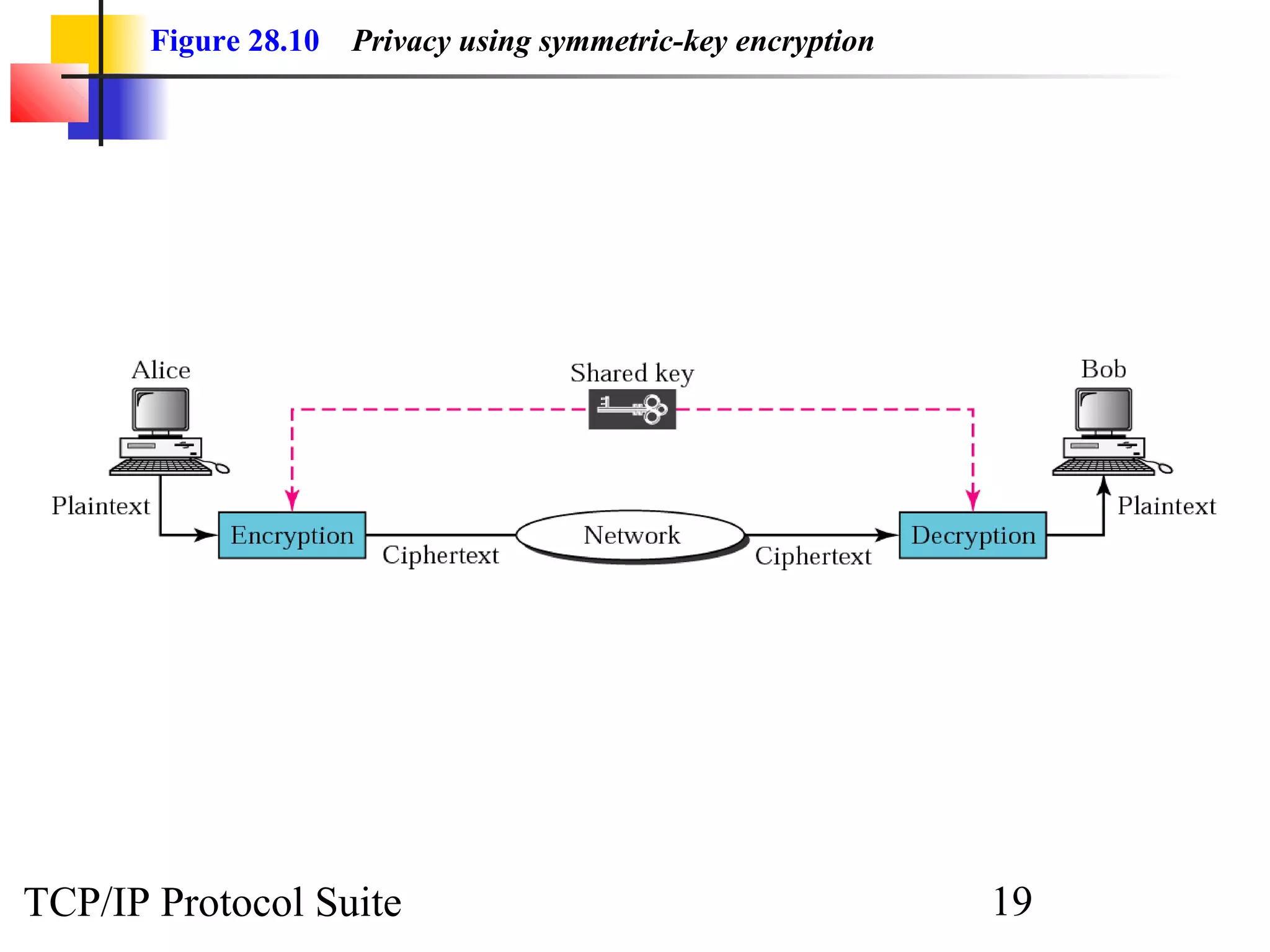
PPrriivvaaccyy wwiitthh SSyymmmmeettrriicc--KKeeyy CCrryyppttooggrraapphhyy 
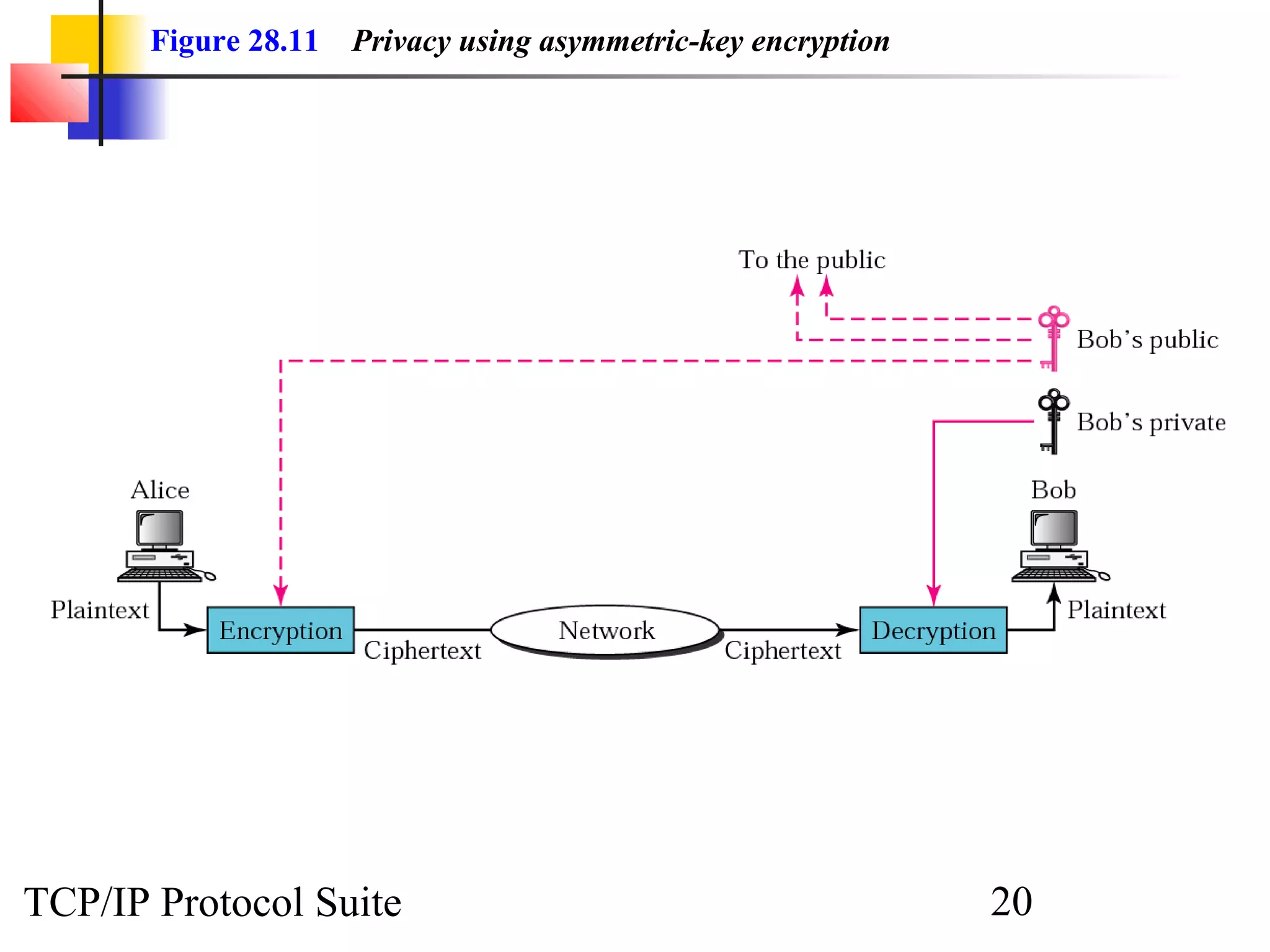
PPrriivvaaccyy wwiitthh AAssyymmmmeettrriicc--KKeeyy CCrryyppttooggrraapphhyy 
TCP/IP Protocol Suite 18
Figure 28.10 Privacy using symmetric-key encryption 
TCP/IP Protocol Suite 19
Figure 28.11 Privacy using asymmetric-key encryption 
TCP/IP Protocol Suite 20
NNoottee:: 
Digital signature can provide 
authentication, integrity, and 
nonrepudiation for a message. 
TCP/IP Protocol Suite 21
28.3 DIGITAL SIGNATURE 
Digital signature can provide authentication, iinntteeggrriittyy,, aanndd 
nnoonnrreeppuuddiiaattiioonn ffoorr aa mmeessssaaggee.. 
TThhee ttooppiiccss ddiissccuusssseedd iinn tthhiiss sseeccttiioonn iinncclluuddee:: 
SSiiggnniinngg tthhee WWhhoollee DDooccuummeenntt 
SSiiggnniinngg tthhee DDiiggeesstt 
TCP/IP Protocol Suite 22
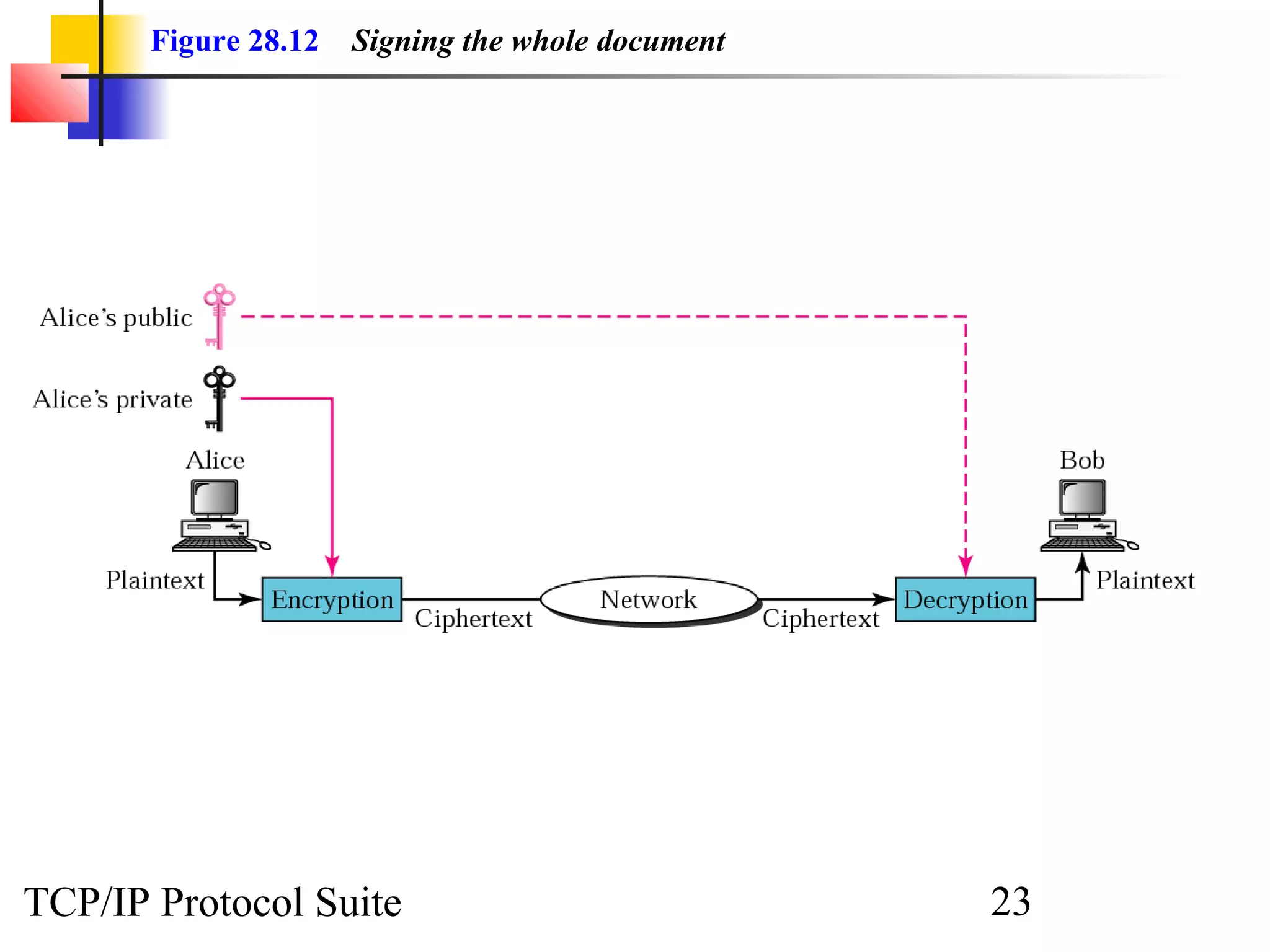
Figure 28.12 Signing the whole document 
TCP/IP Protocol Suite 23
NNoottee:: 
Digital signature does not provide 
privacy. If there is a need for privacy, 
another layer of encryption/decryption 
must be applied. 
TCP/IP Protocol Suite 24
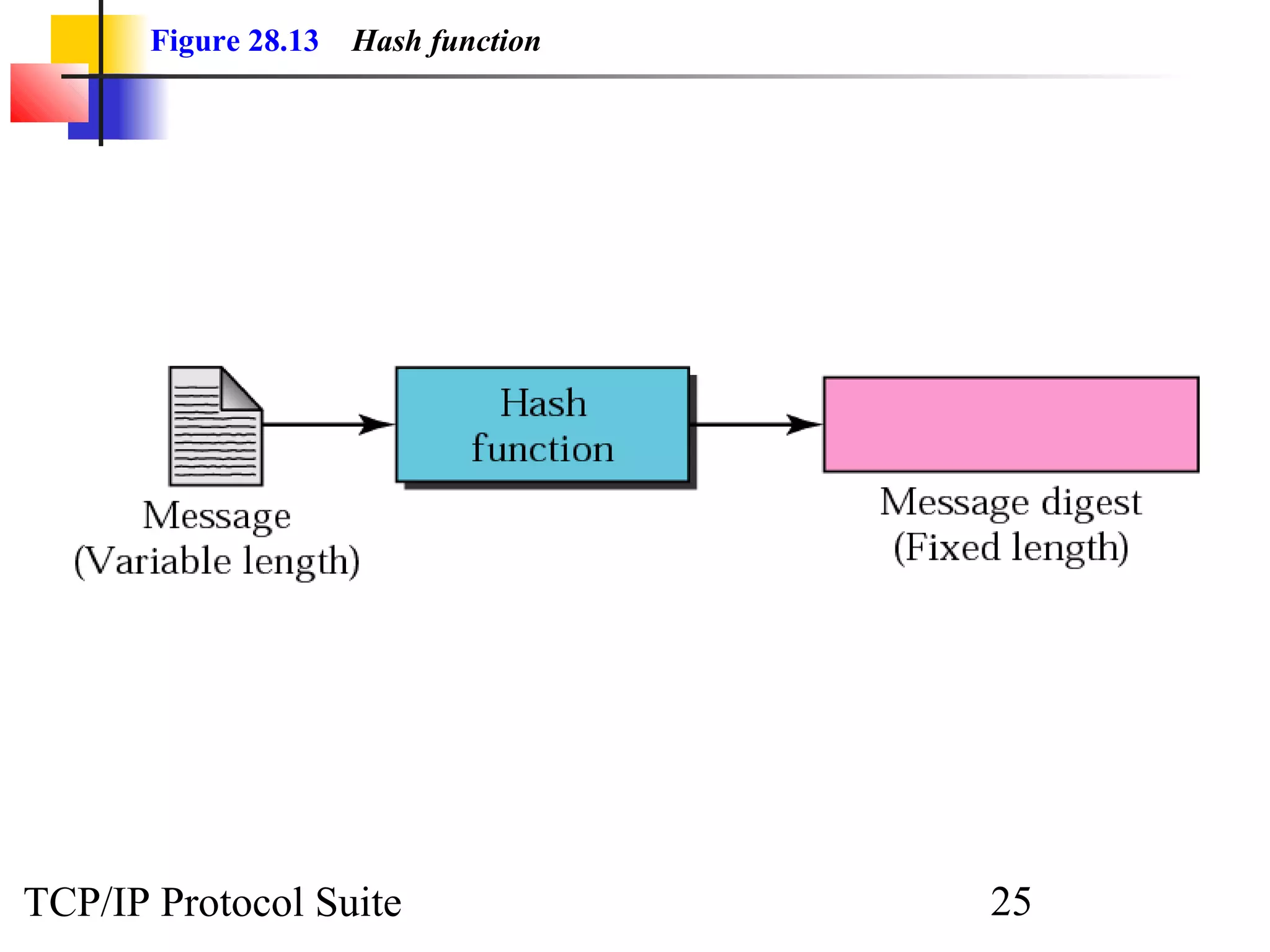
Figure 28.13 Hash function 
TCP/IP Protocol Suite 25
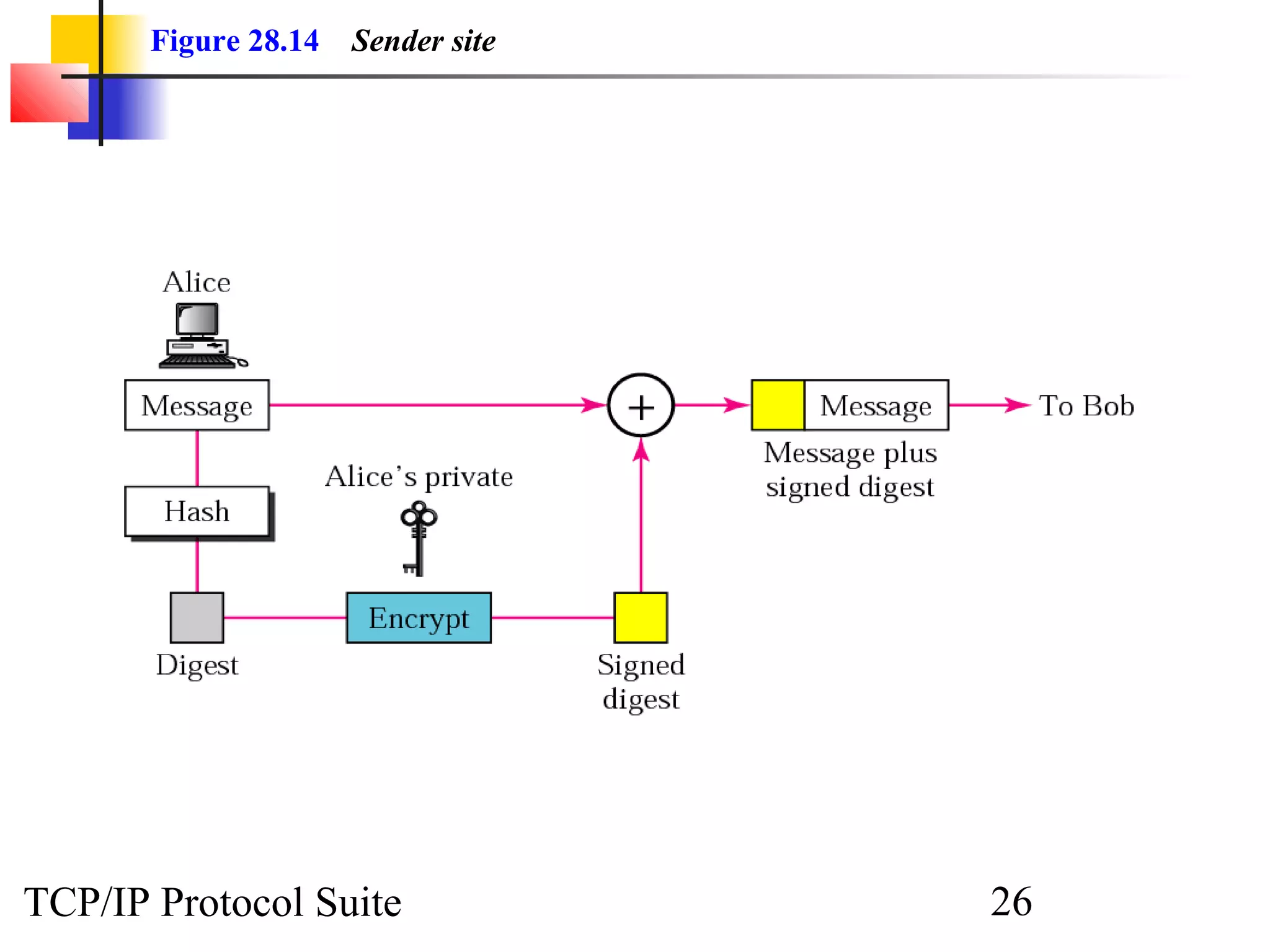
Figure 28.14 Sender site 
TCP/IP Protocol Suite 26
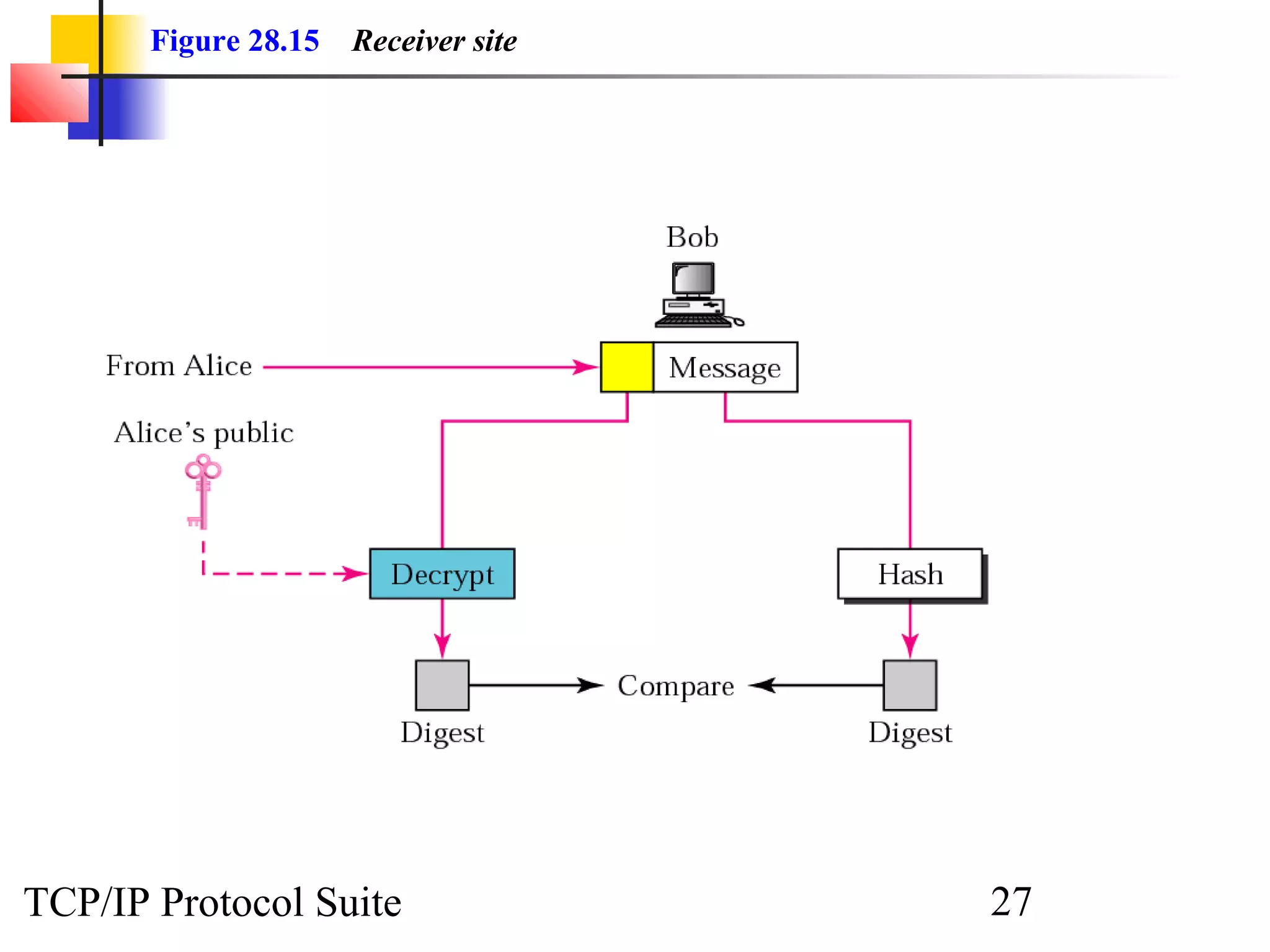
Figure 28.15 Receiver site 
TCP/IP Protocol Suite 27
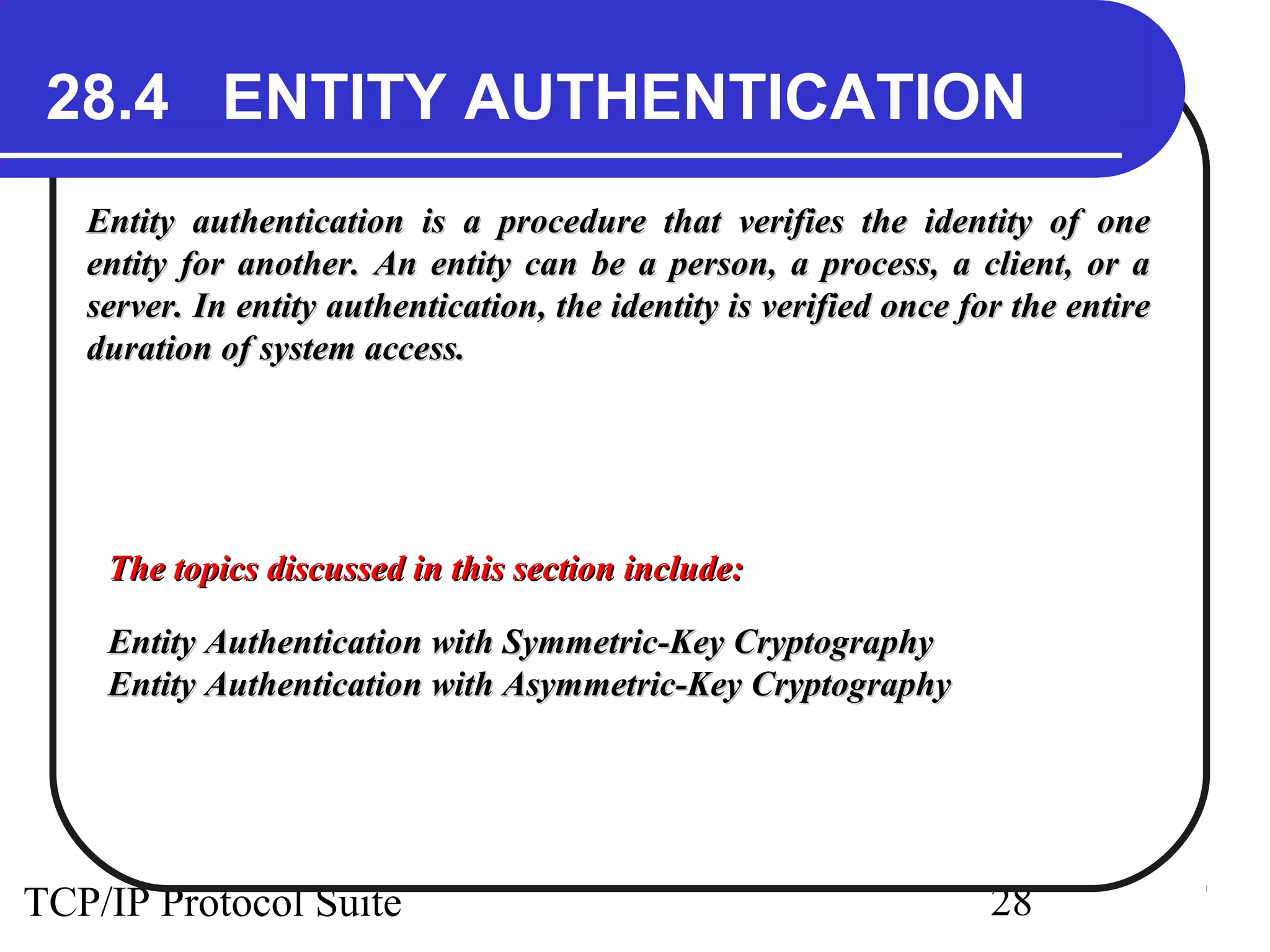
28.4 ENTITY AUTHENTICATION 
Entity authentication is a procedure that verifies the iiddeennttiittyy ooff oonnee 
eennttiittyy ffoorr aannootthheerr.. AAnn eennttiittyy ccaann bbee aa ppeerrssoonn,, aa pprroocceessss,, aa cclliieenntt,, oorr aa 
sseerrvveerr.. IInn eennttiittyy aauutthheennttiiccaattiioonn,, tthhee iiddeennttiittyy iiss vveerriiffiieedd oonnccee ffoorr tthhee eennttiirree 
dduurraattiioonn ooff ssyysstteemm aacccceessss.. 
TThhee ttooppiiccss ddiissccuusssseedd iinn tthhiiss sseeccttiioonn iinncclluuddee:: 
EEnnttiittyy AAuutthheennttiiccaattiioonn wwiitthh SSyymmmmeettrriicc--KKeeyy CCrryyppttooggrraapphhyy 
EEnnttiittyy AAuutthheennttiiccaattiioonn wwiitthh AAssyymmmmeettrriicc--KKeeyy CCrryyppttooggrraapphhyy 
TCP/IP Protocol Suite 28
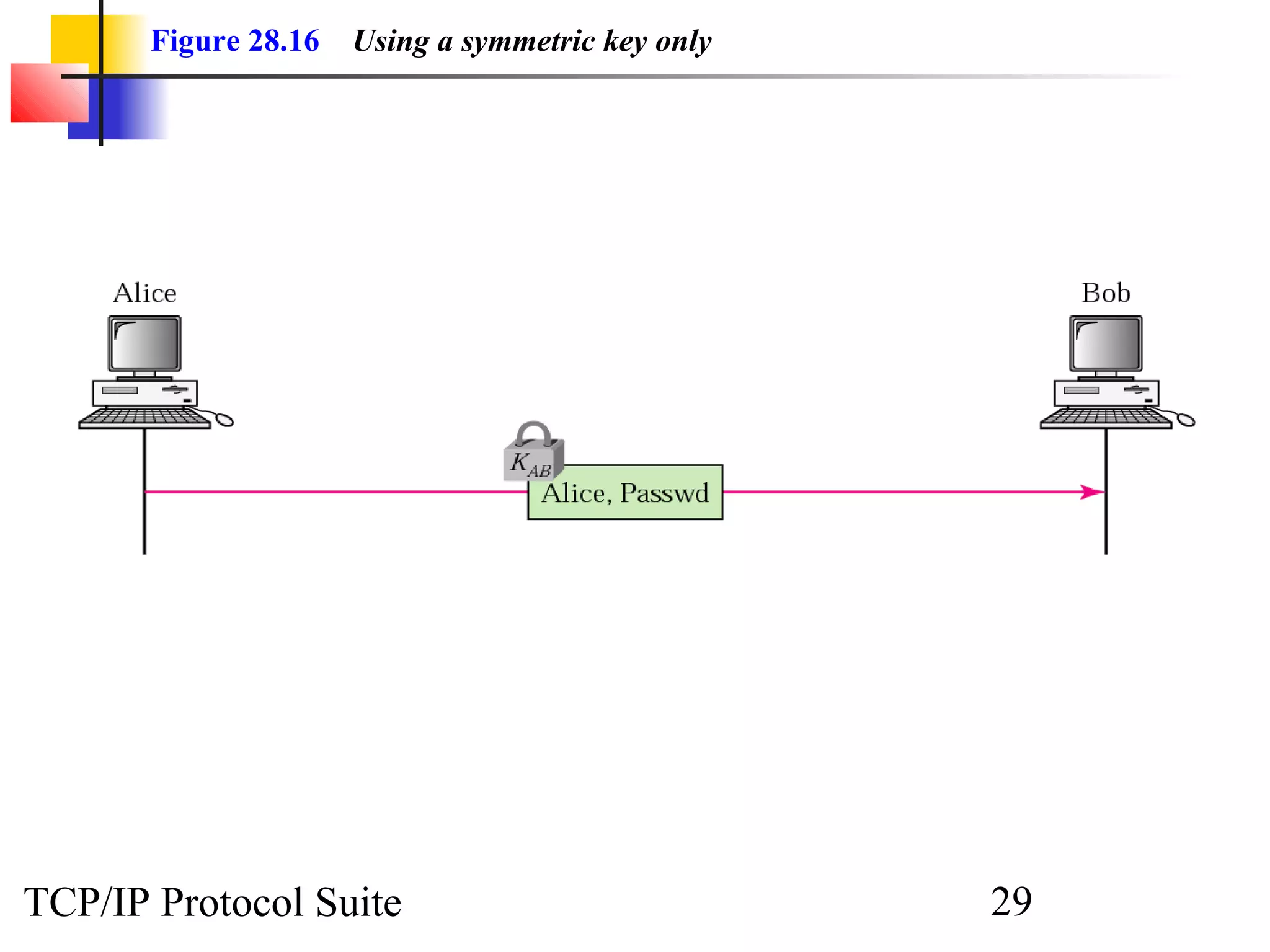
Figure 28.16 Using a symmetric key only 
TCP/IP Protocol Suite 29
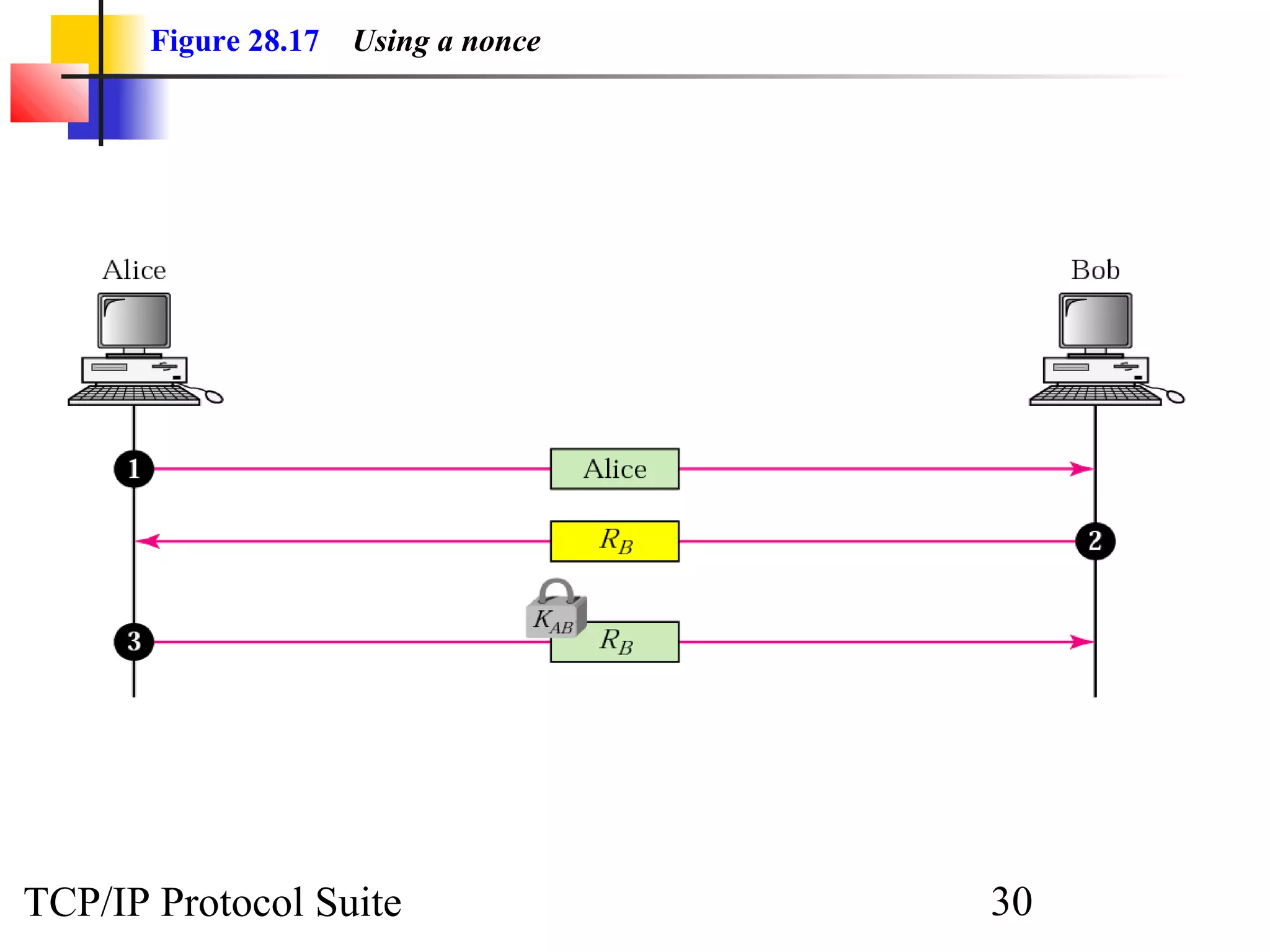
Figure 28.17 Using a nonce 
TCP/IP Protocol Suite 30
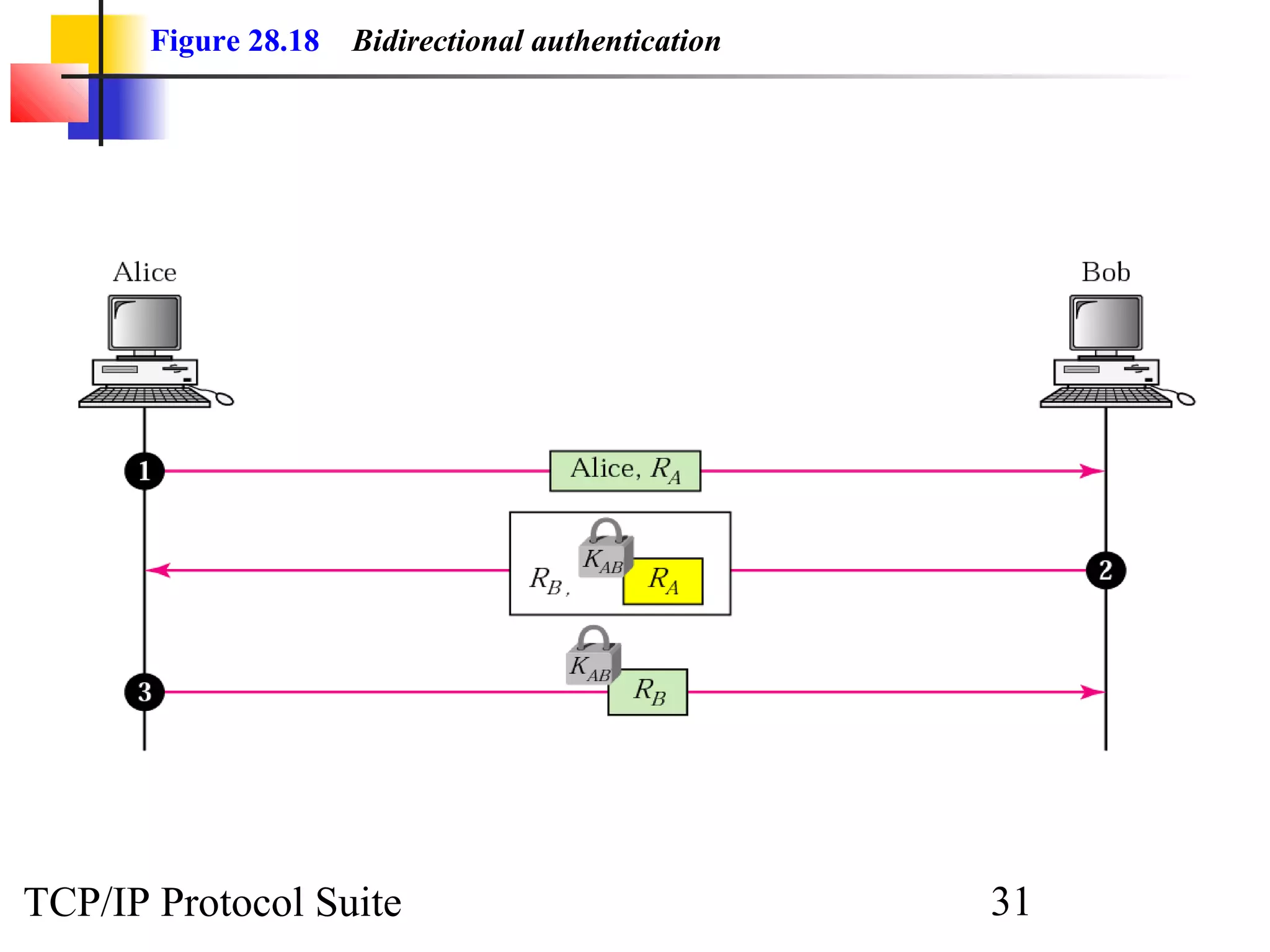
Figure 28.18 Bidirectional authentication 
TCP/IP Protocol Suite 31
28.5 KEY MANAGEMENT 
In this section we explain how symmetric keys aarree ddiissttrriibbuutteedd aanndd hhooww 
ppuubblliicc kkeeyyss aarree cceerrttiiffiieedd.. 
TThhee ttooppiiccss ddiissccuusssseedd iinn tthhiiss sseeccttiioonn iinncclluuddee:: 
SSyymmmmeettrriicc--KKeeyy DDiissttrriibbuuttiioonn 
PPuubblliicc--KKeeyy CCeerrttiiffiiccaattiioonn 
KKeerrbbeerrooss 
TCP/IP Protocol Suite 32
NNoottee:: 
A symmetric key between two parties is 
useful if it is used only once; it must be 
created for one session and destroyed 
when the session is over. 
TCP/IP Protocol Suite 33
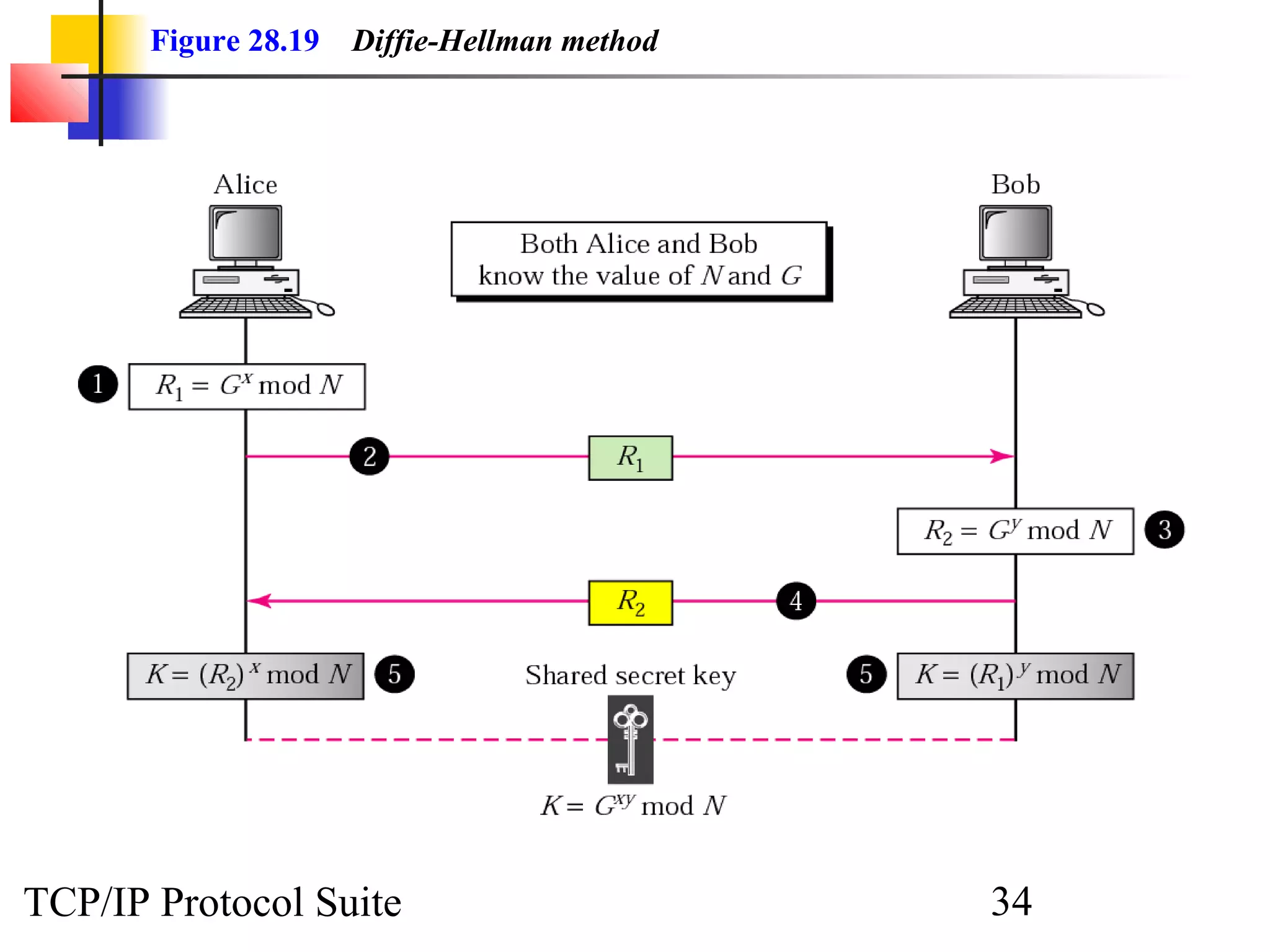
Figure 28.19 Diffie-Hellman method 
TCP/IP Protocol Suite 34
NNoottee:: 
The symmetric (shared) key in the 
Diffie-Hellman protocol is 
K = G xy mod N. 
TCP/IP Protocol Suite 35
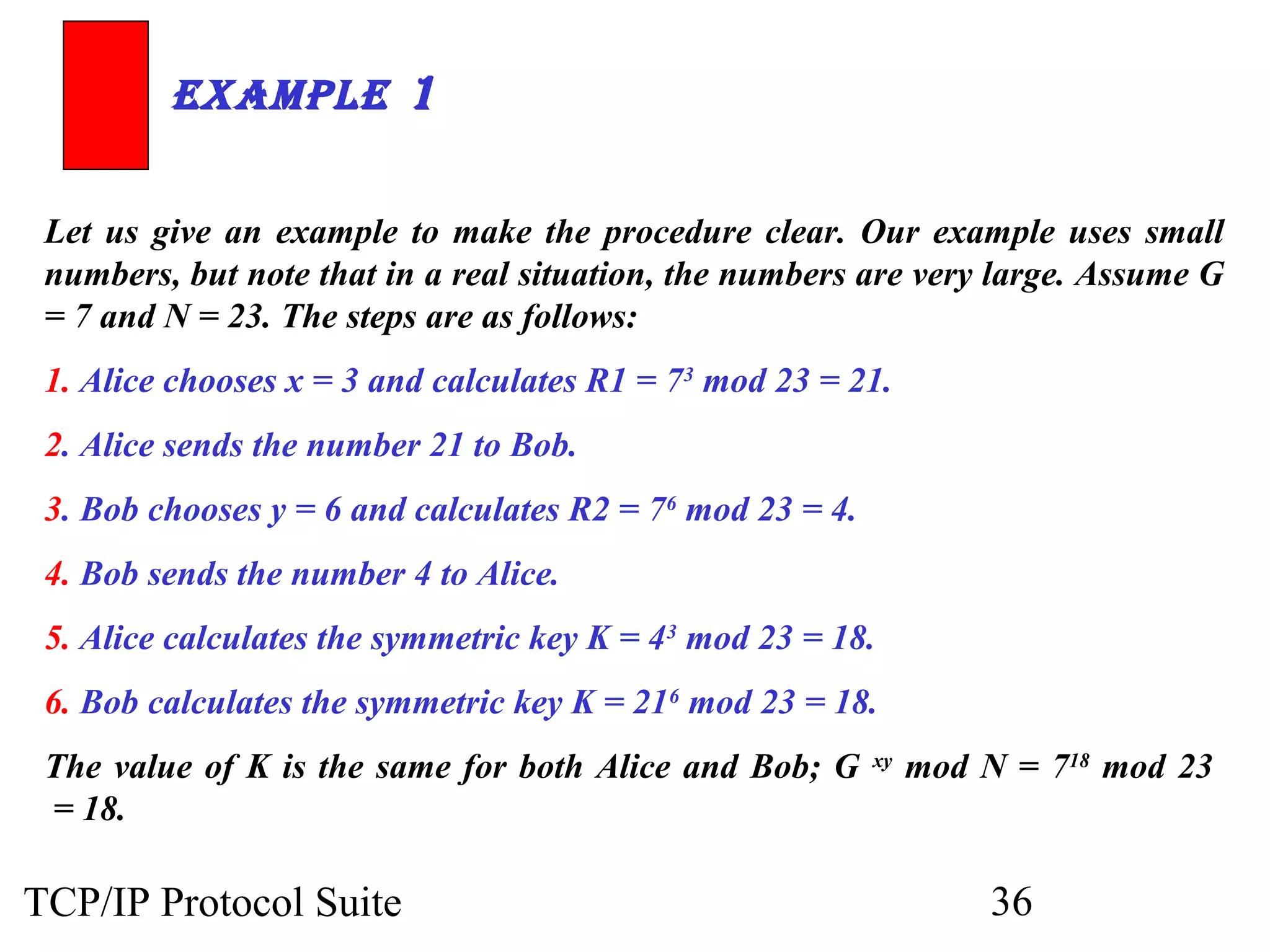
ExamplE 1 
Let us give an example to make the procedure clear. Our example uses small 
numbers, but note that in a real situation, the numbers are very large. Assume G 
= 7 and N = 23. The steps are as follows: 
1. Alice chooses x = 3 and calculates R1 = 73 mod 23 = 21. 
2. Alice sends the number 21 to Bob. 
3. Bob chooses y = 6 and calculates R2 = 76 mod 23 = 4. 
4. Bob sends the number 4 to Alice. 
5. Alice calculates the symmetric key K = 43 mod 23 = 18. 
6. Bob calculates the symmetric key K = 216 mod 23 = 18. 
The value of K is the same for both Alice and Bob; G xy mod N = 718 mod 23 
= 18. 
TCP/IP Protocol Suite 36
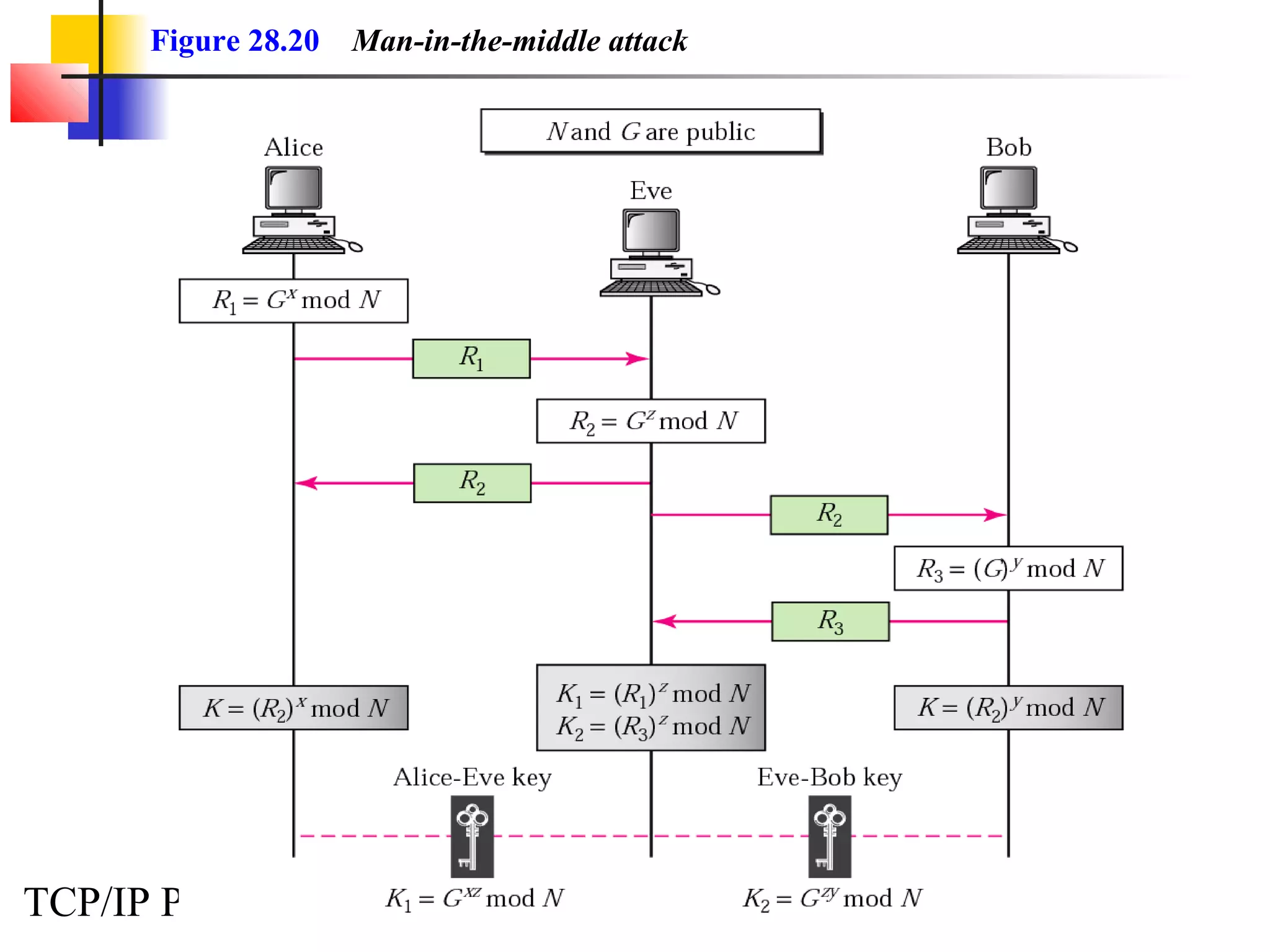
Figure 28.20 Man-in-the-middle attack 
TCP/IP Protocol Suite 37
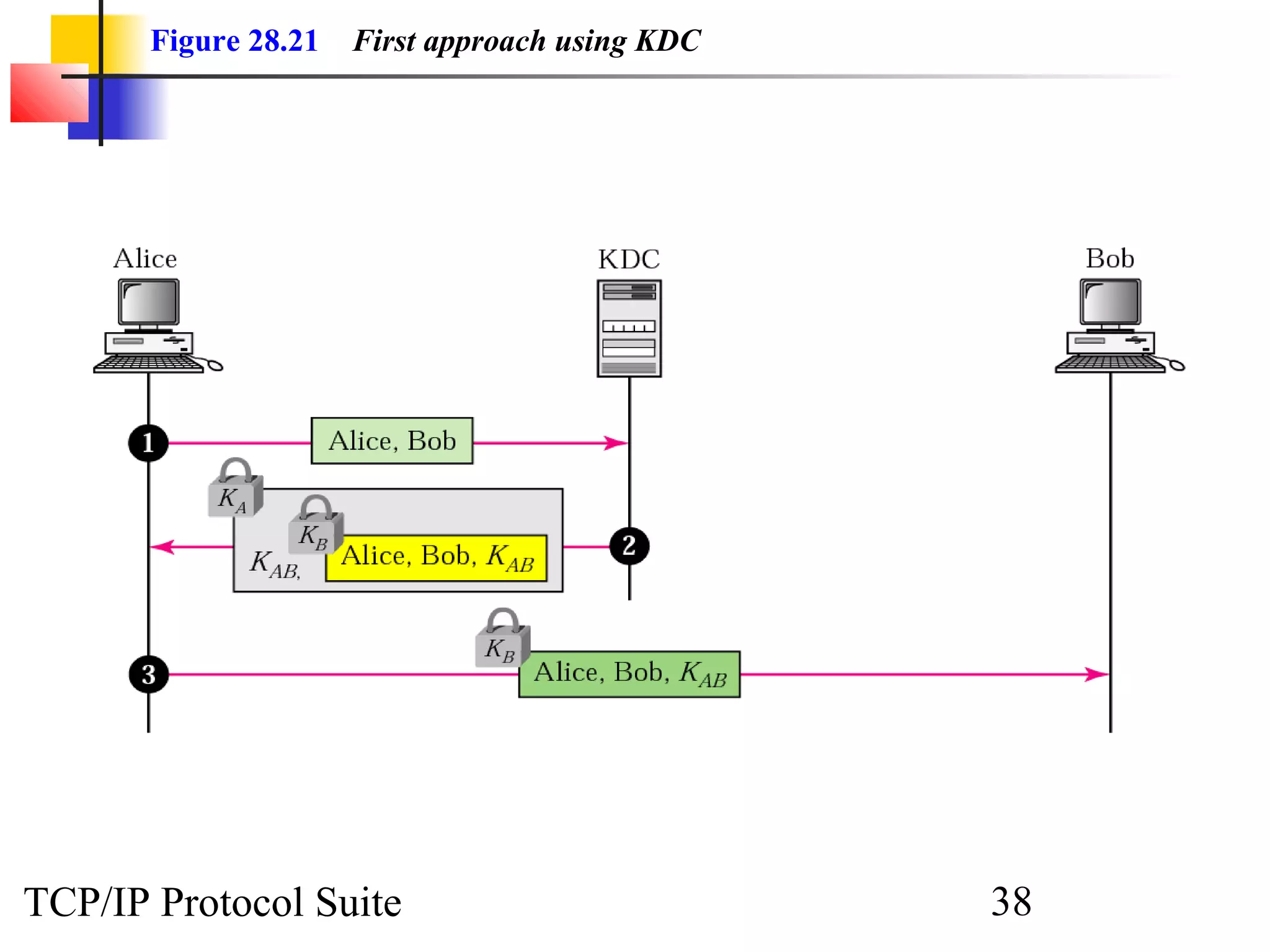
Figure 28.21 First approach using KDC 
TCP/IP Protocol Suite 38
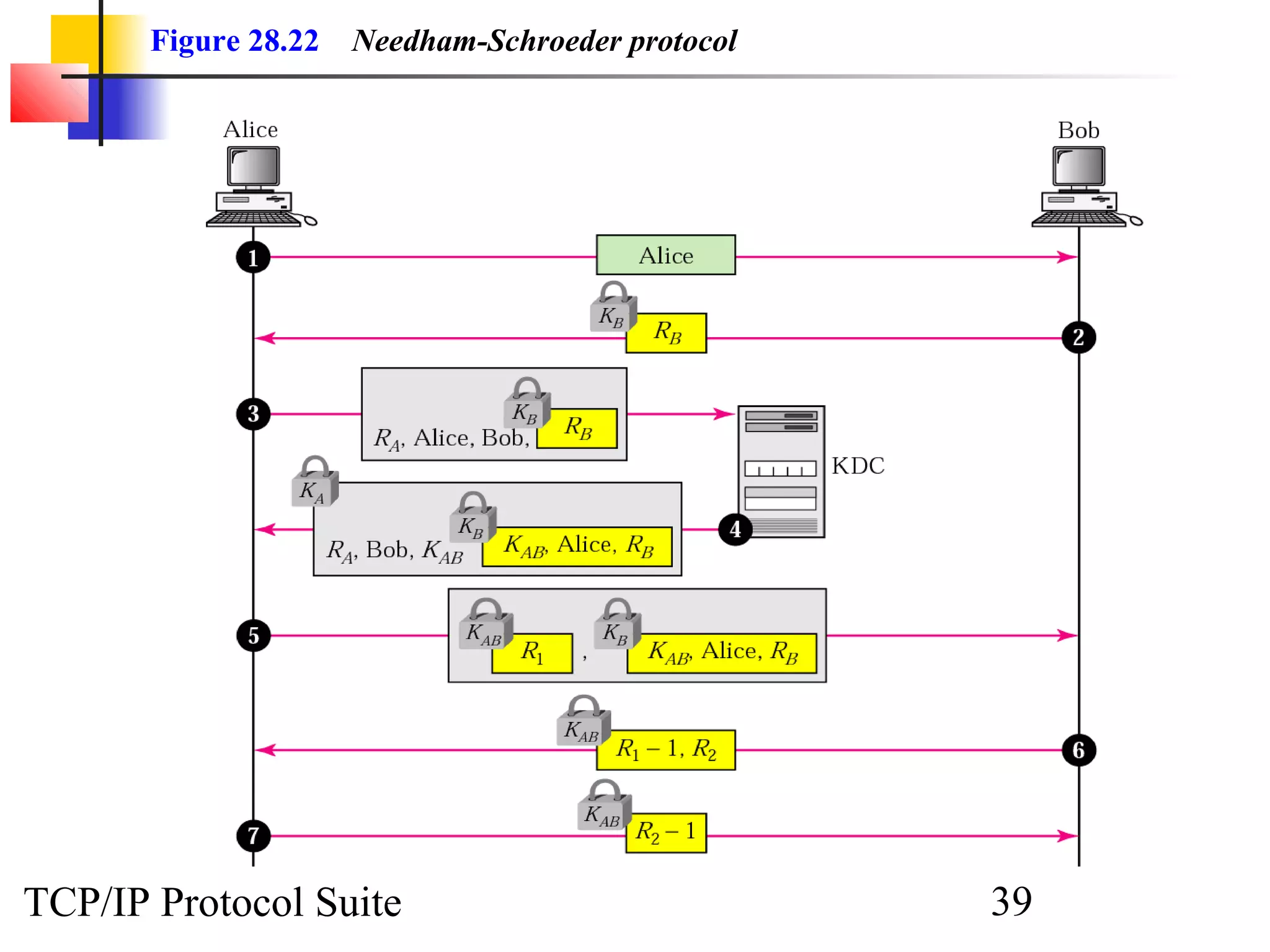
Figure 28.22 Needham-Schroeder protocol 
TCP/IP Protocol Suite 39
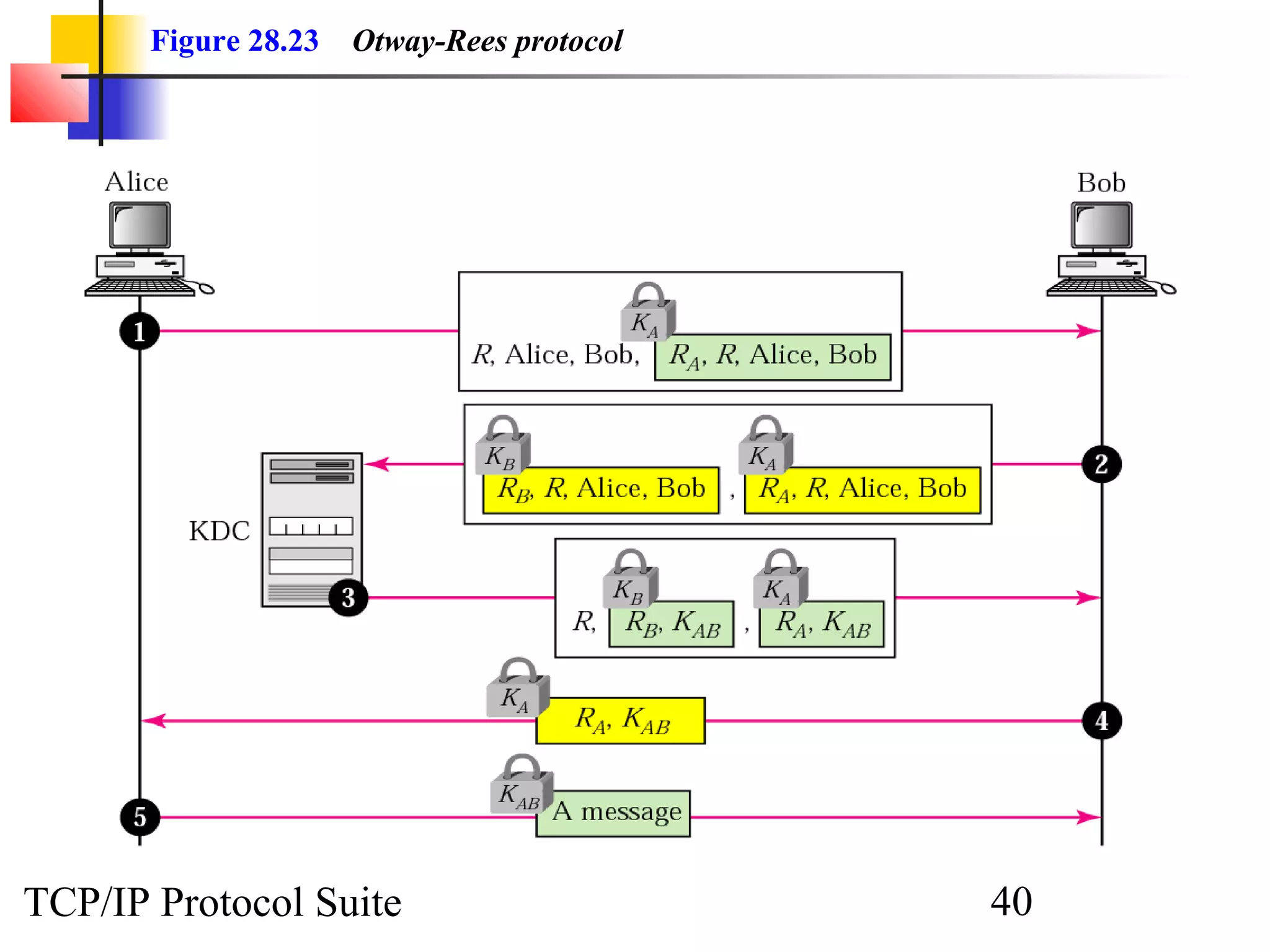
Figure 28.23 Otway-Rees protocol 
TCP/IP Protocol Suite 40
NNoottee:: 
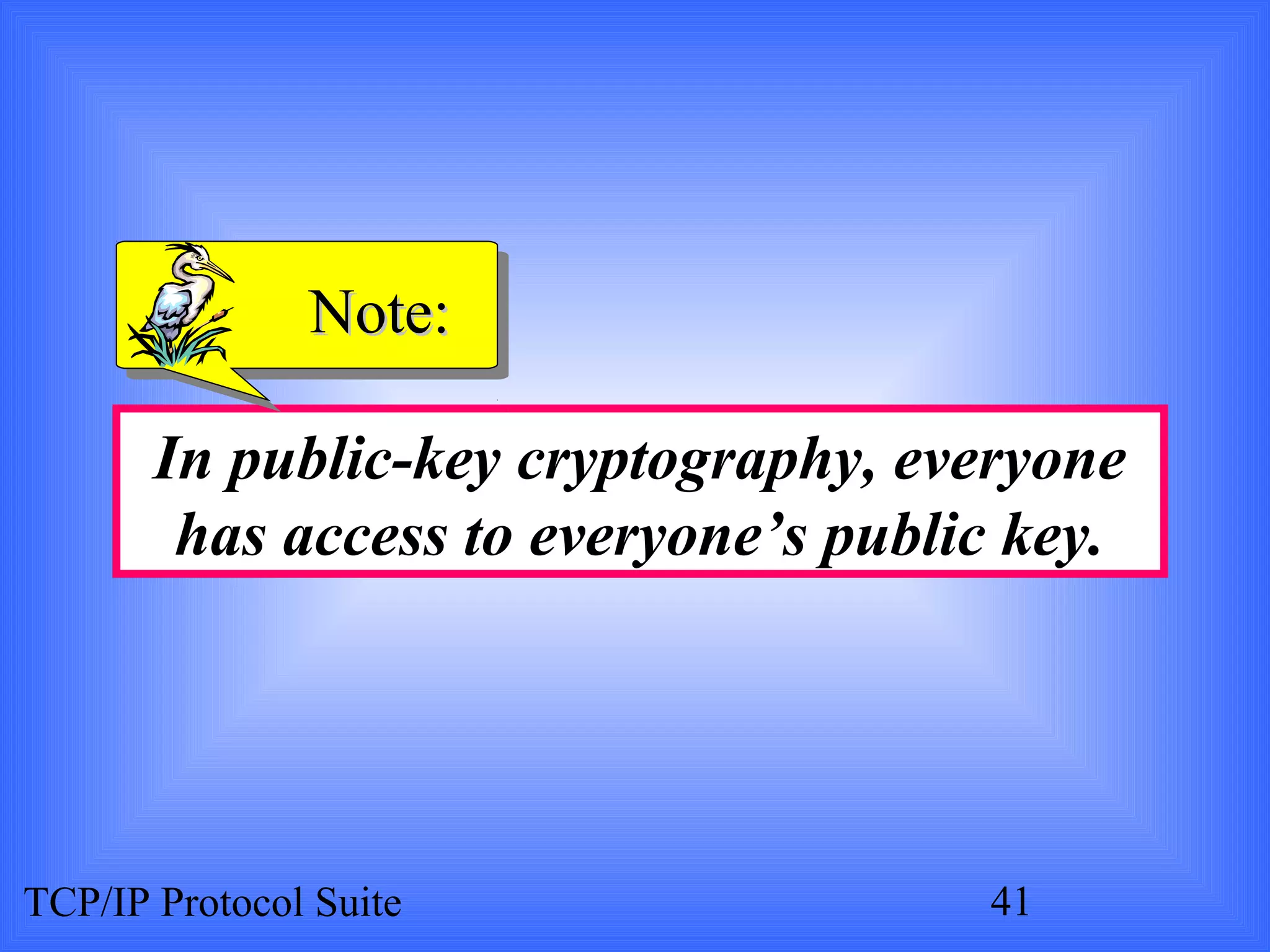
In public-key cryptography, everyone 
has access to everyone’s public key. 
TCP/IP Protocol Suite 41
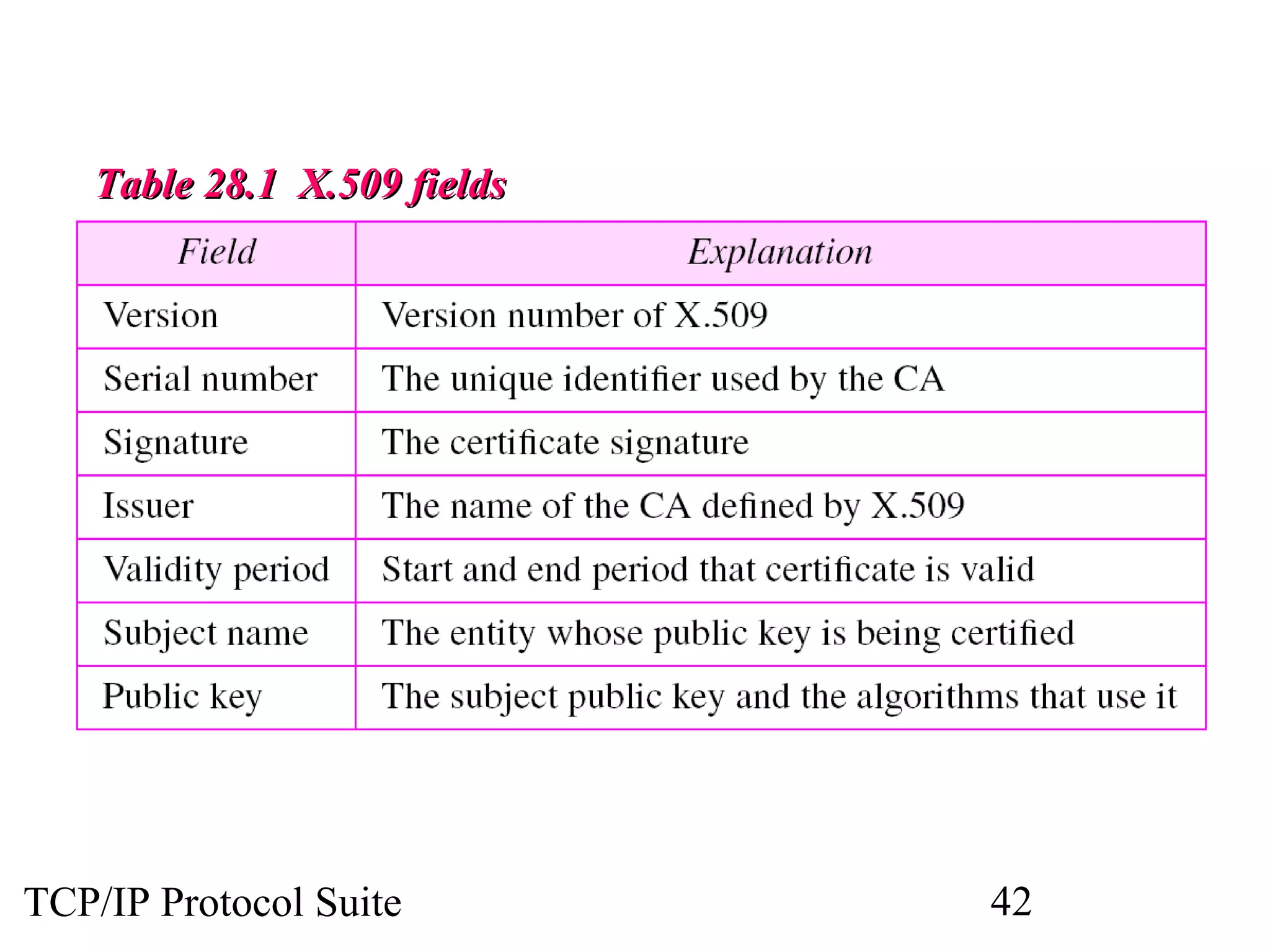
TTaabbllee 2288..11 XX..550099 ffiieellddss 
TCP/IP Protocol Suite 42
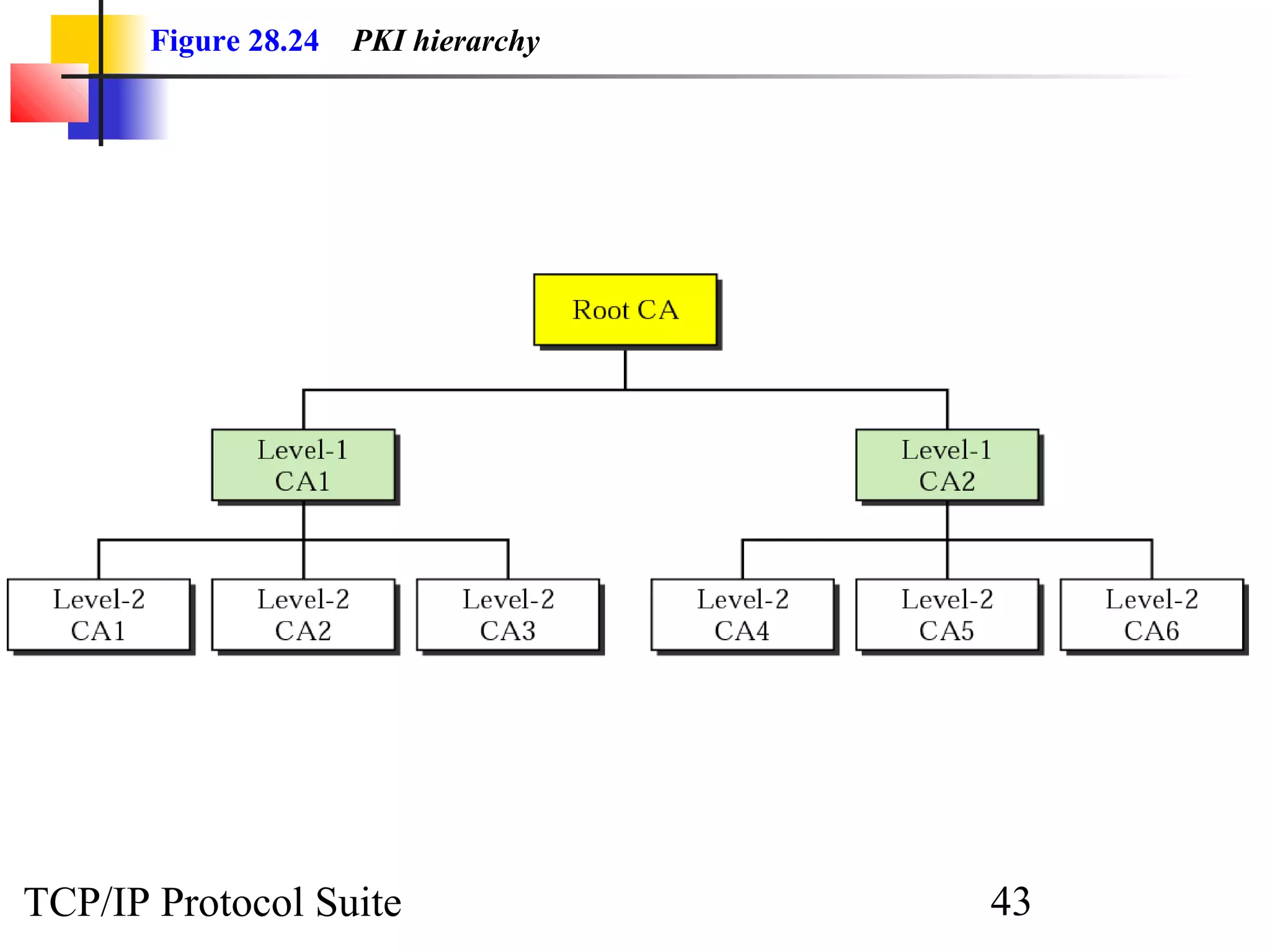
Figure 28.24 PKI hierarchy 
TCP/IP Protocol Suite 43
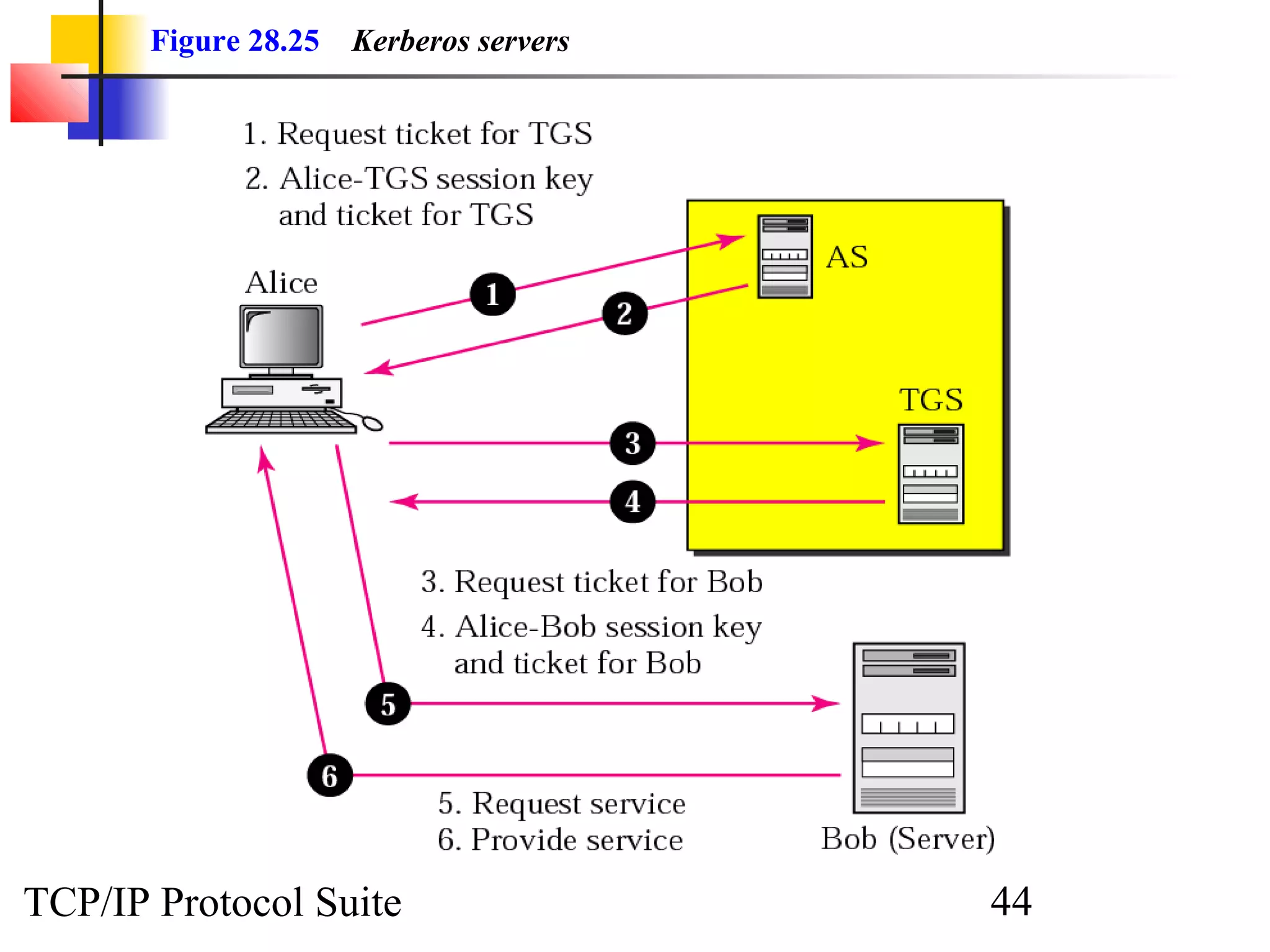
Figure 28.25 Kerberos servers 
TCP/IP Protocol Suite 44
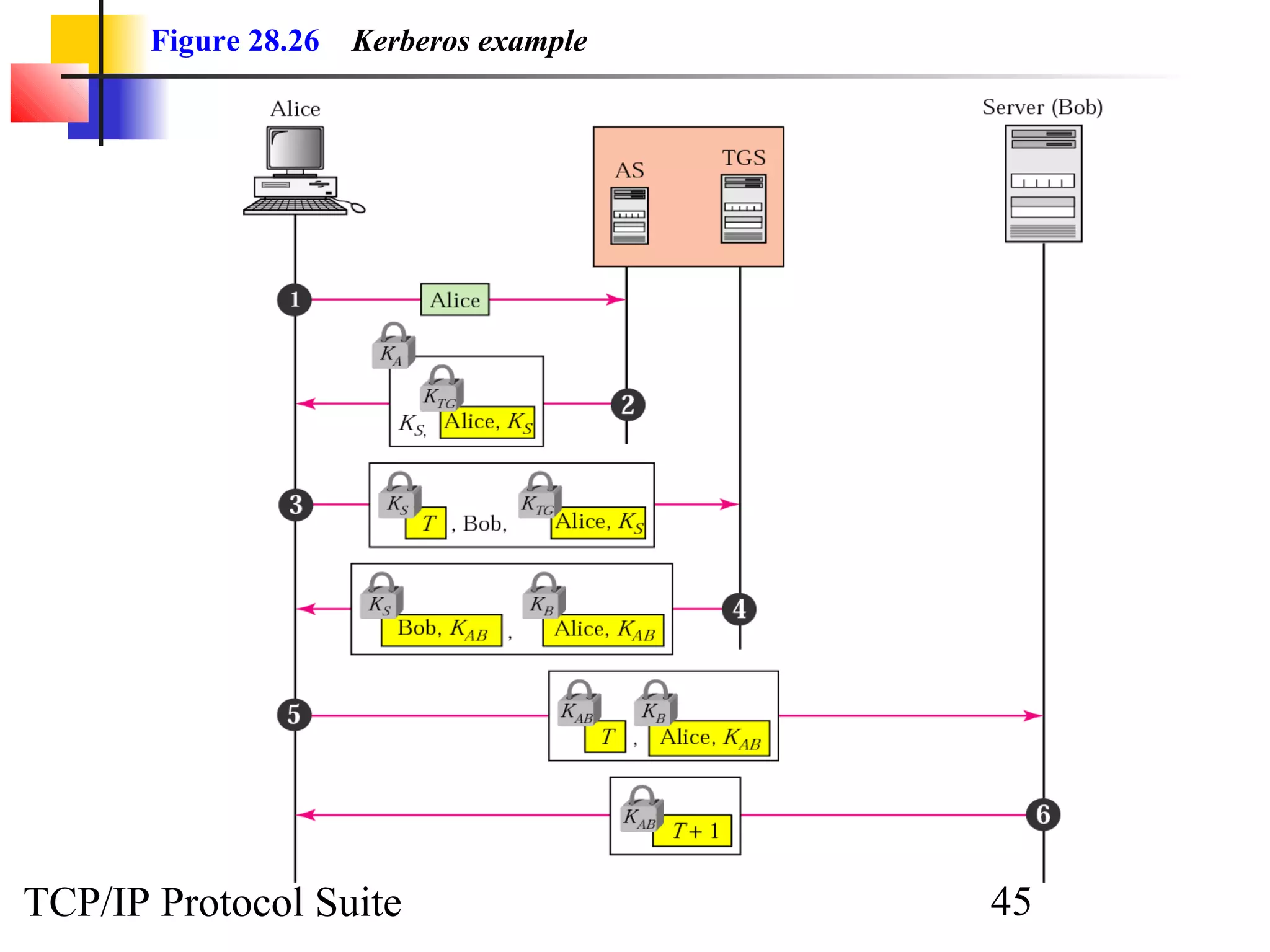
Figure 28.26 Kerberos example 
TCP/IP Protocol Suite 45
28.6 SECURITY IN THE INTERNET 
In this section we discuss a security method for each ooff tthhee ttoopp 33 llaayyeerrss 
ooff tthhee IInntteerrnneett mmooddeell.. AAtt tthhee IIPP lleevveell wwee ddiissccuussss aa pprroottooccooll ccaalllleedd IIPPSSeecc;; 
aatt tthhee ttrraannssppoorrtt llaayyeerr wwee ddiissccuussss aa pprroottooccooll tthhaatt ““gglluueess”” aa nneeww llaayyeerr ttoo 
tthhee ttrraannssppoorrtt llaayyeerr;; aatt tthhee aapppplliiccaattiioonn llaayyeerr wwee ddiissccuussss aa sseeccuurriittyy mmeetthhoodd 
ccaalllleedd PPGGPP.. 
TThhee ttooppiiccss ddiissccuusssseedd iinn tthhiiss sseeccttiioonn iinncclluuddee:: 
IIPP LLeevveell SSeeccuurriittyy:: IIPPSSeecc 
TTrraannssppoorrtt LLaayyeerr SSeeccuurriittyy 
AApppplliiccaattiioonn LLaayyeerr SSeeccuurriittyy:: PPGGPP 
TCP/IP Protocol Suite 46
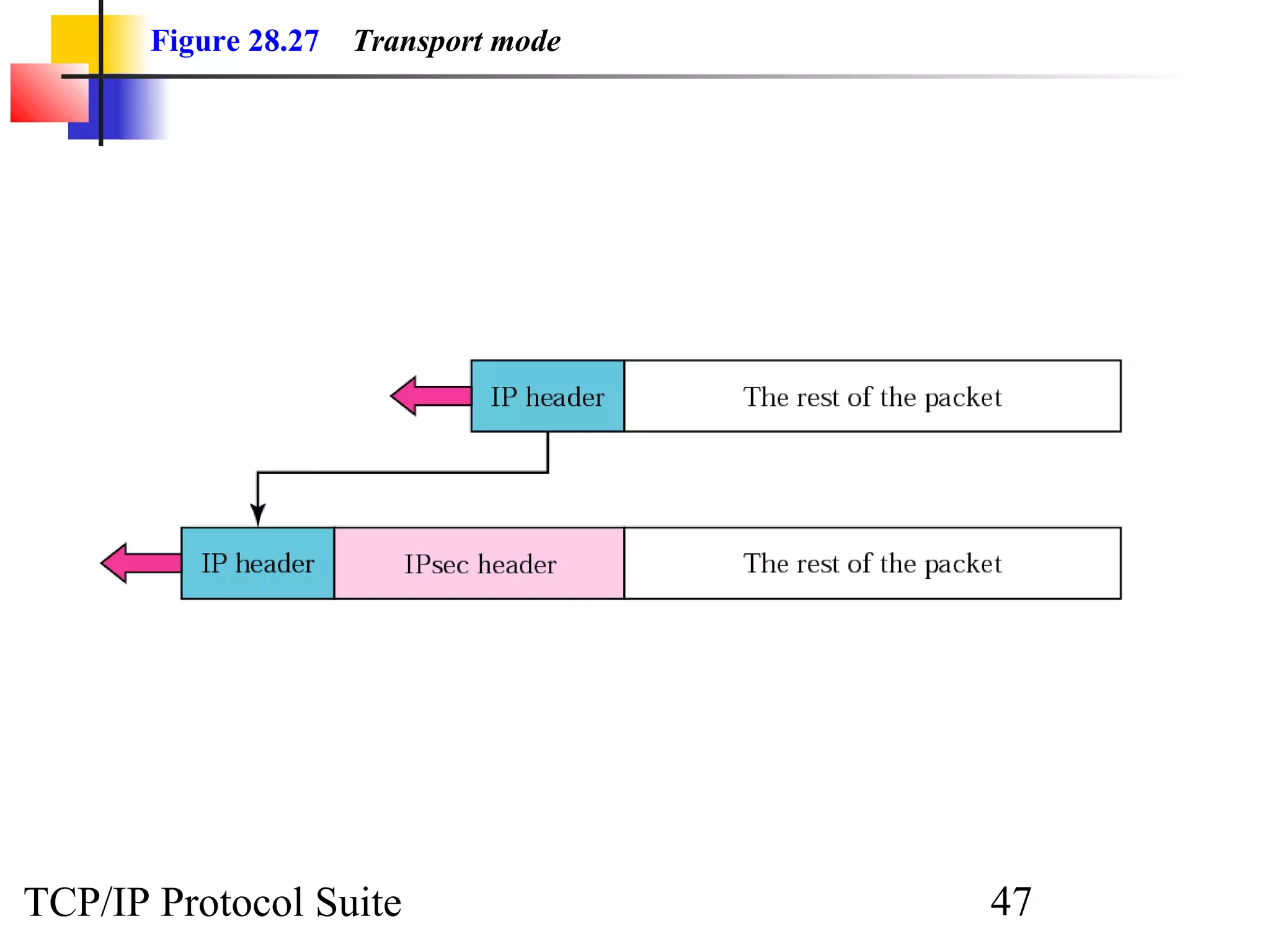
Figure 28.27 Transport mode 
TCP/IP Protocol Suite 47
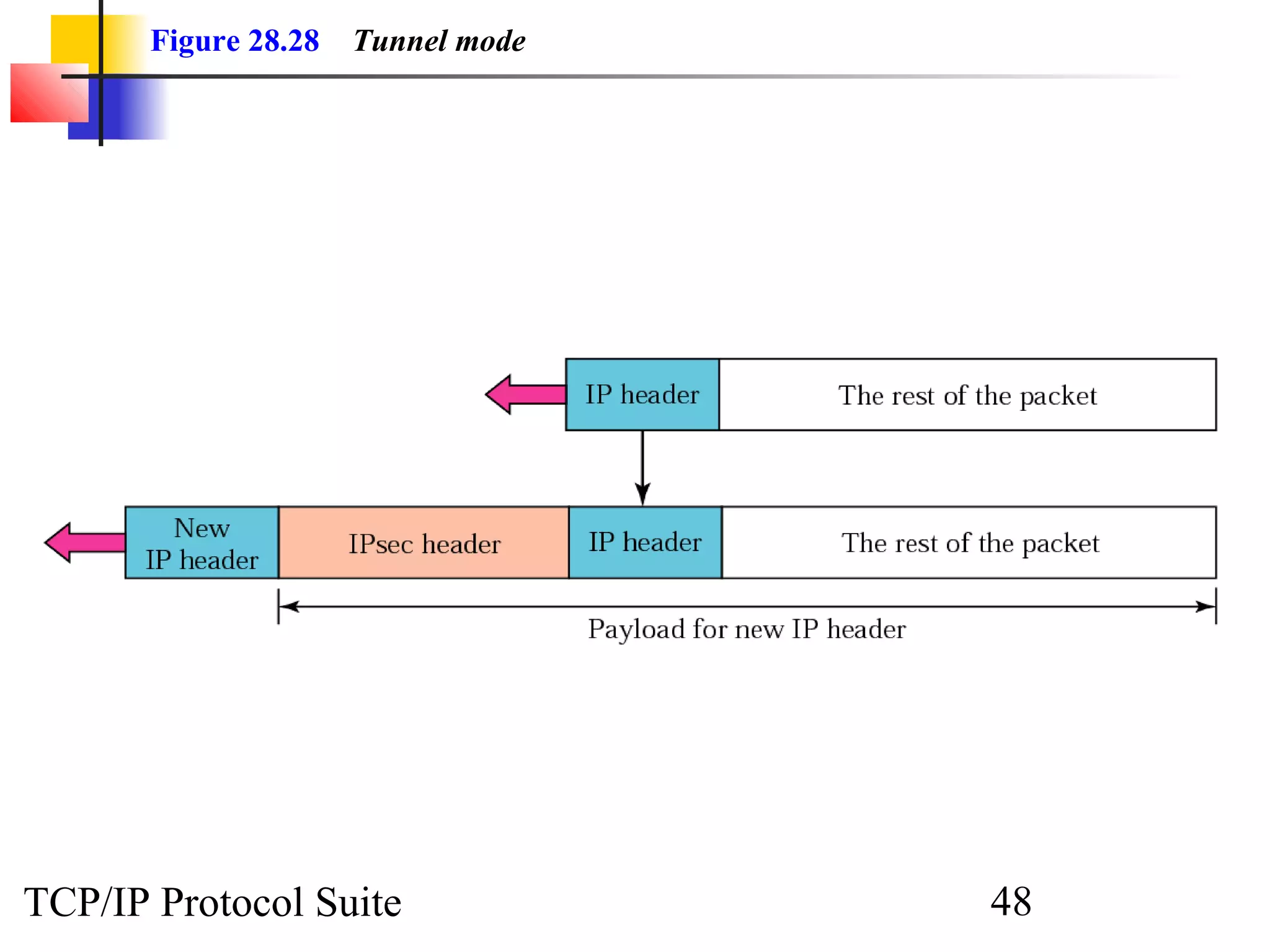
Figure 28.28 Tunnel mode 
TCP/IP Protocol Suite 48
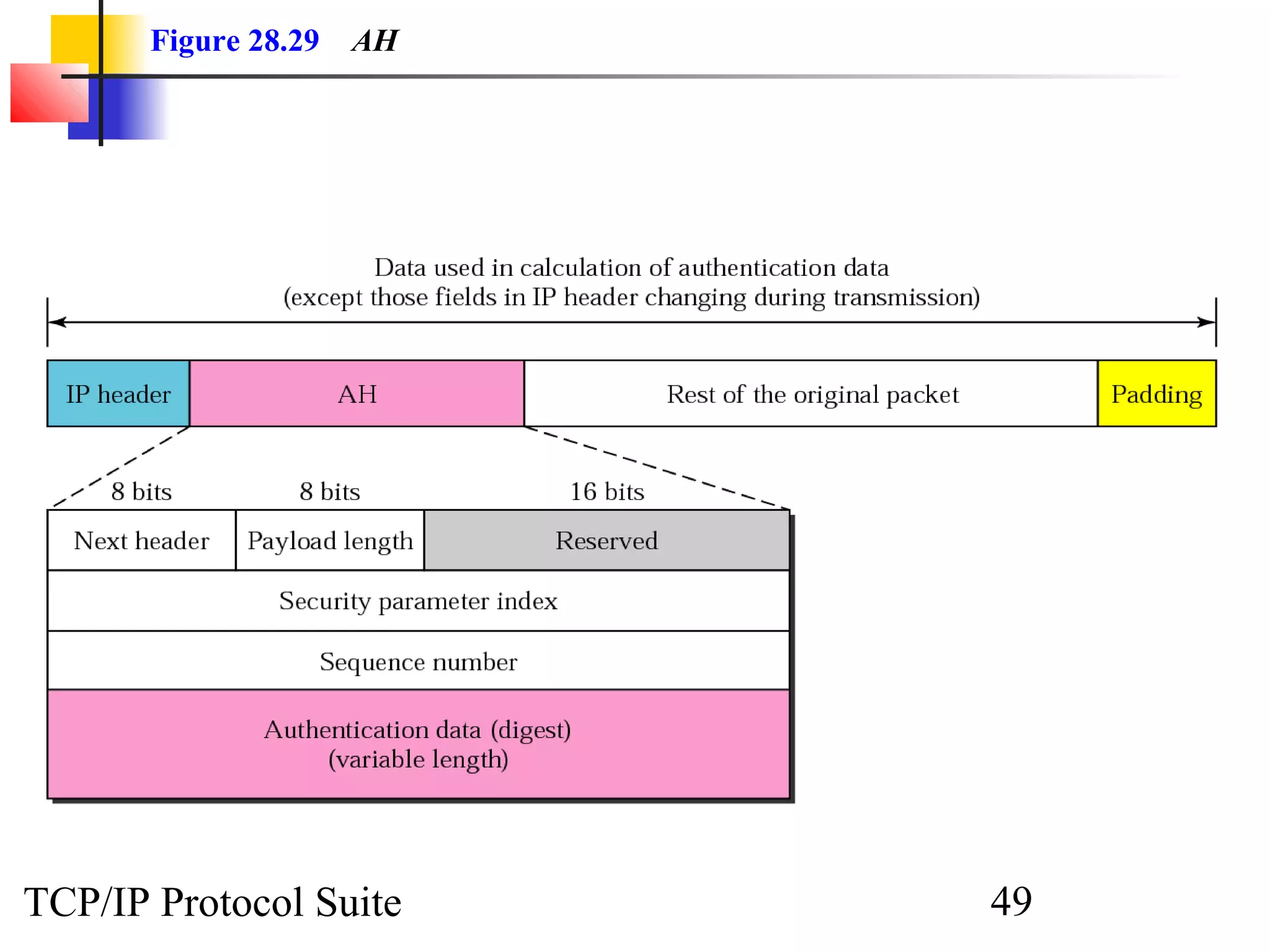
Figure 28.29 AH 
TCP/IP Protocol Suite 49
NNoottee:: 
The AH protocol provides message 
authentication and integrity, 
but not privacy. 
TCP/IP Protocol Suite 50
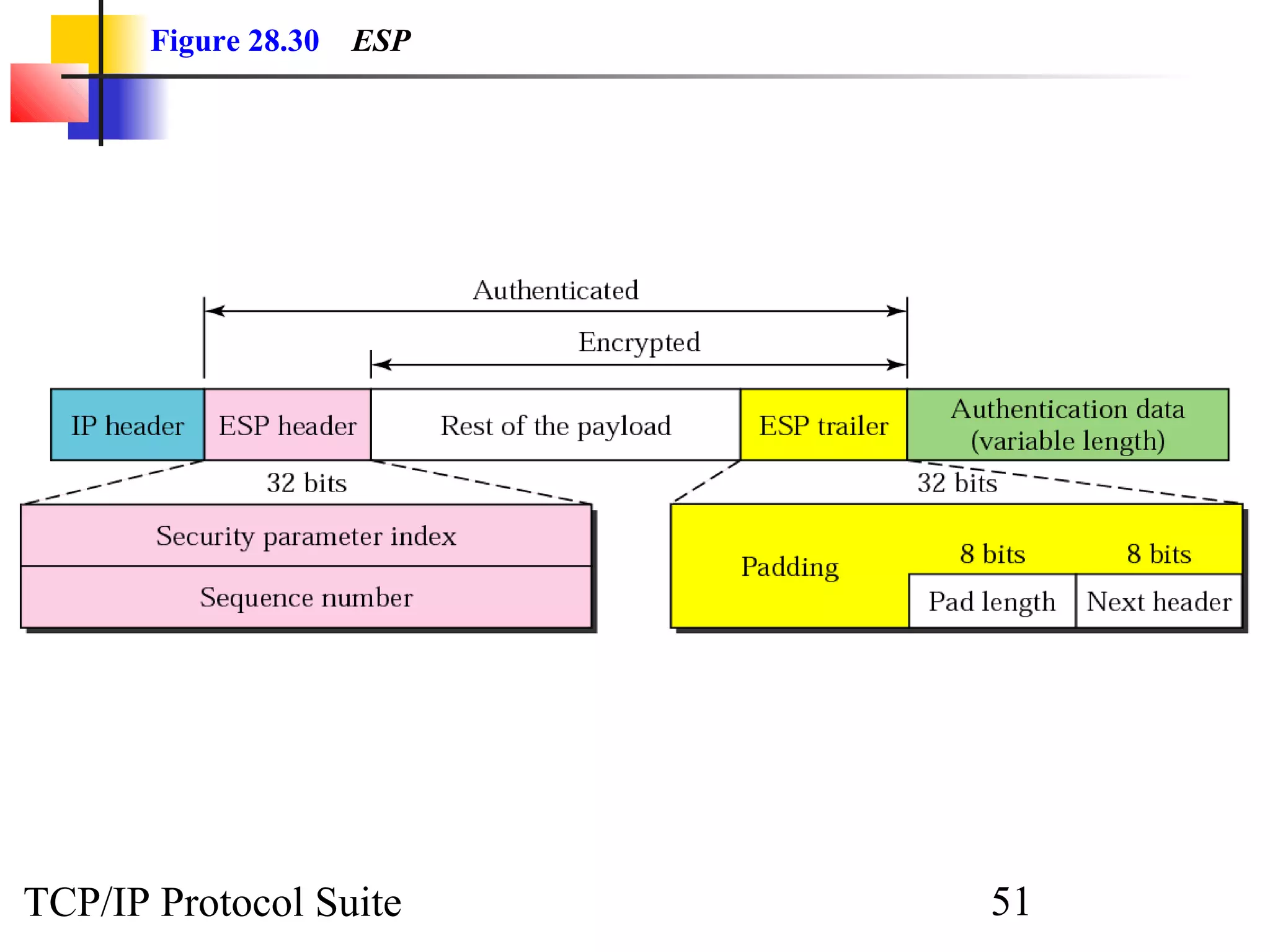
Figure 28.30 ESP 
TCP/IP Protocol Suite 51
NNoottee:: 
ESP provides message authentication, 
integrity, and privacy. 
TCP/IP Protocol Suite 52
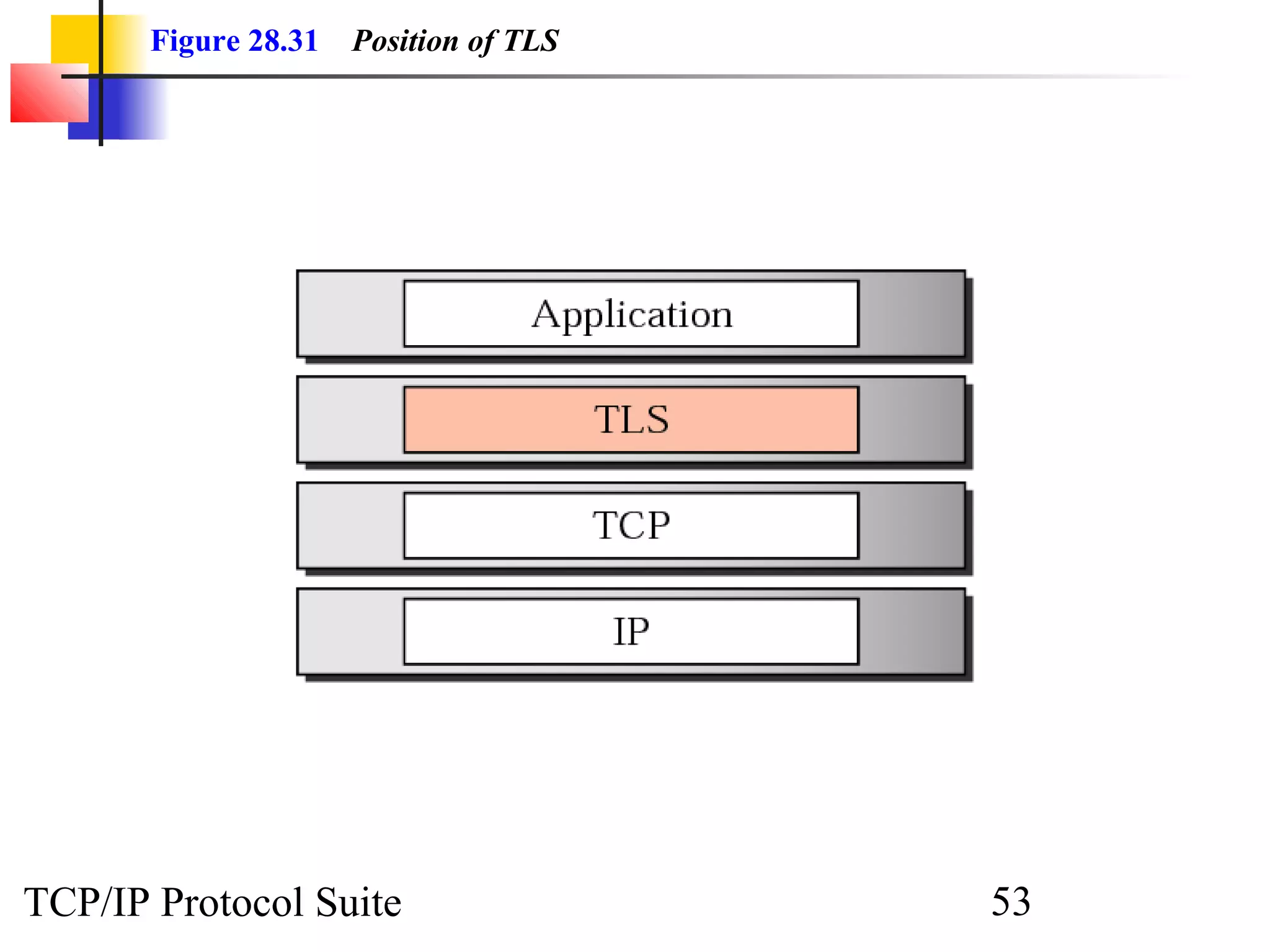
Figure 28.31 Position of TLS 
TCP/IP Protocol Suite 53
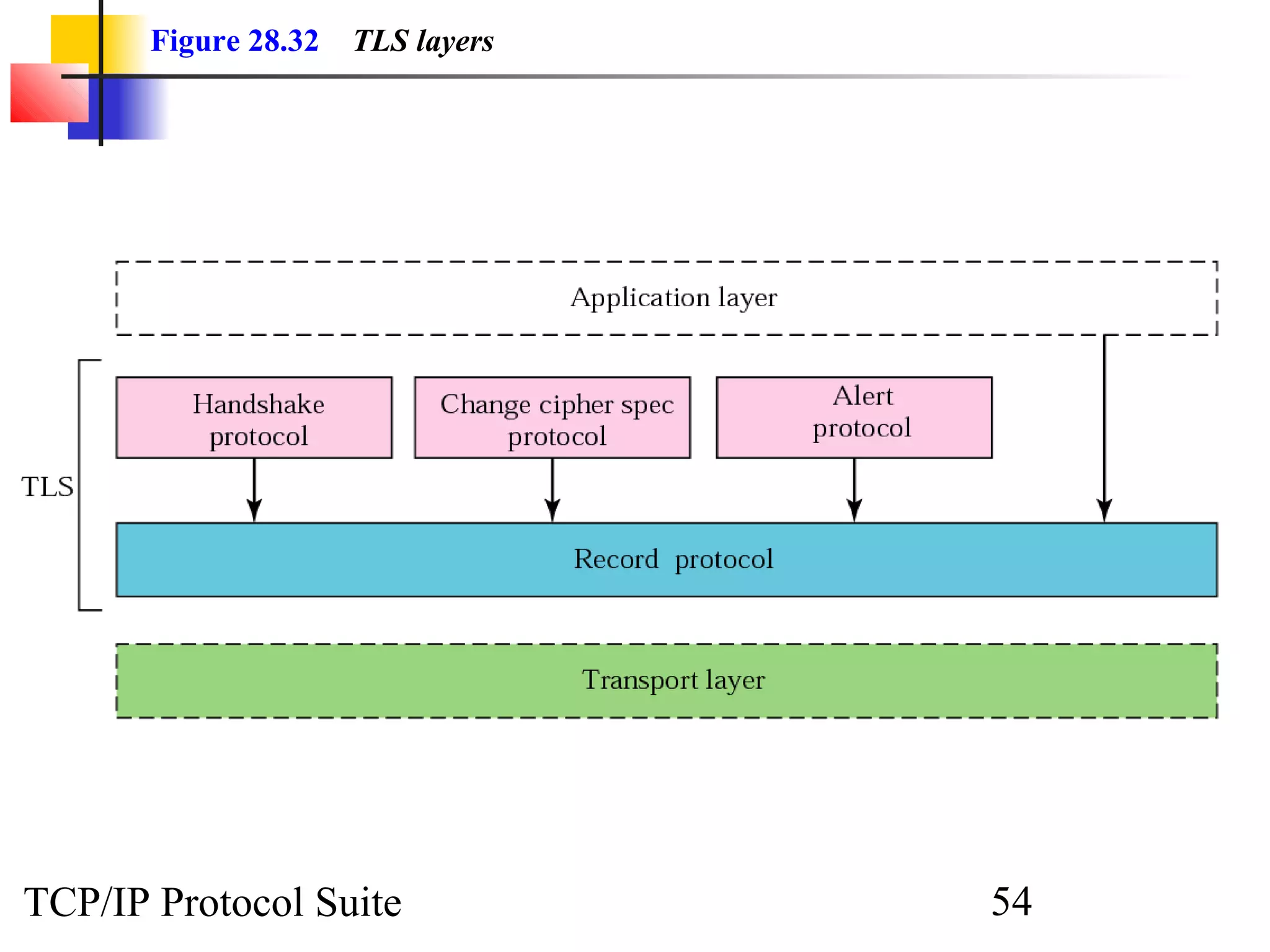
Figure 28.32 TLS layers 
TCP/IP Protocol Suite 54
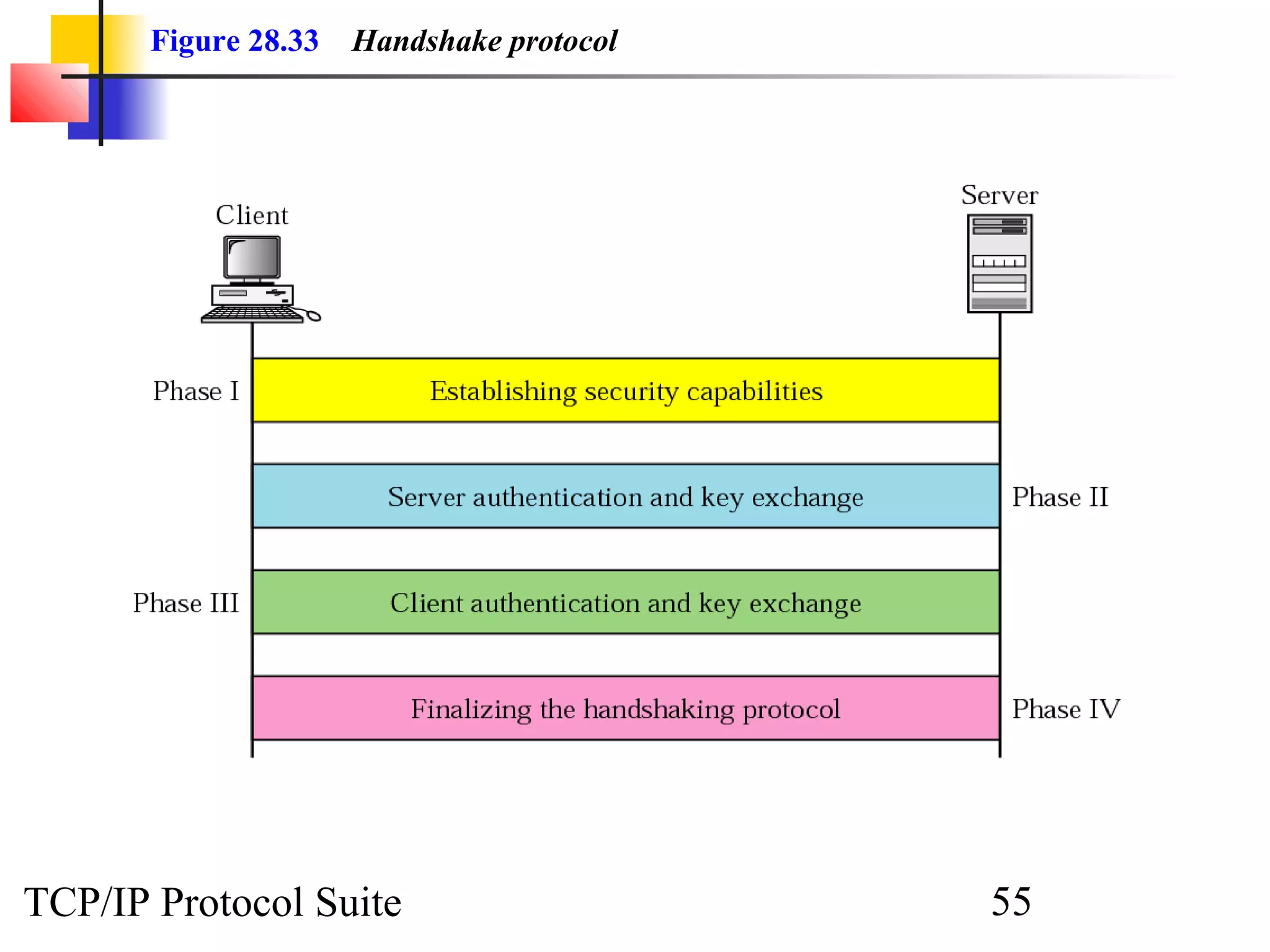
Figure 28.33 Handshake protocol 
TCP/IP Protocol Suite 55
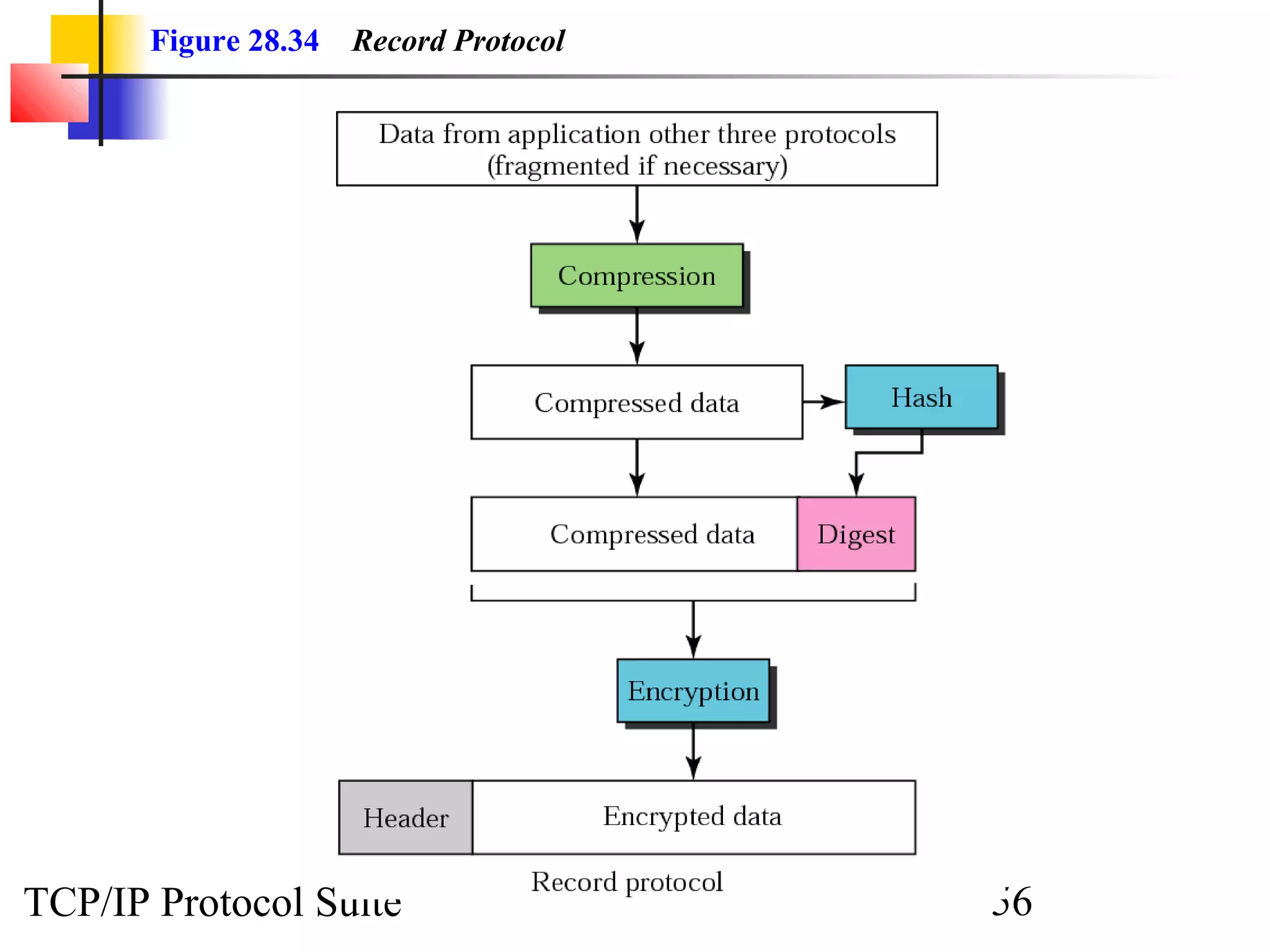
Figure 28.34 Record Protocol 
TCP/IP Protocol Suite 56
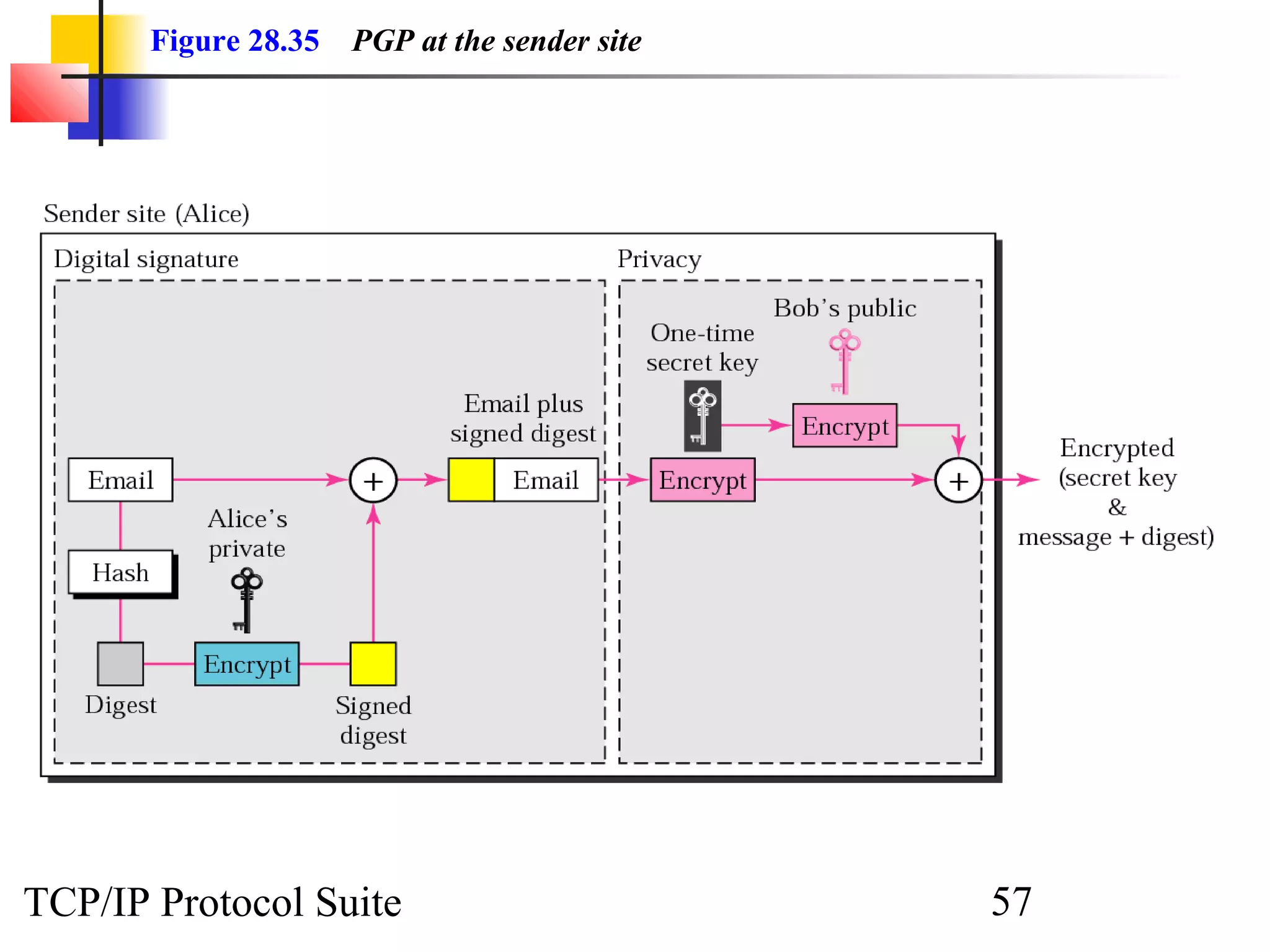
Figure 28.35 PGP at the sender site 
TCP/IP Protocol Suite 57
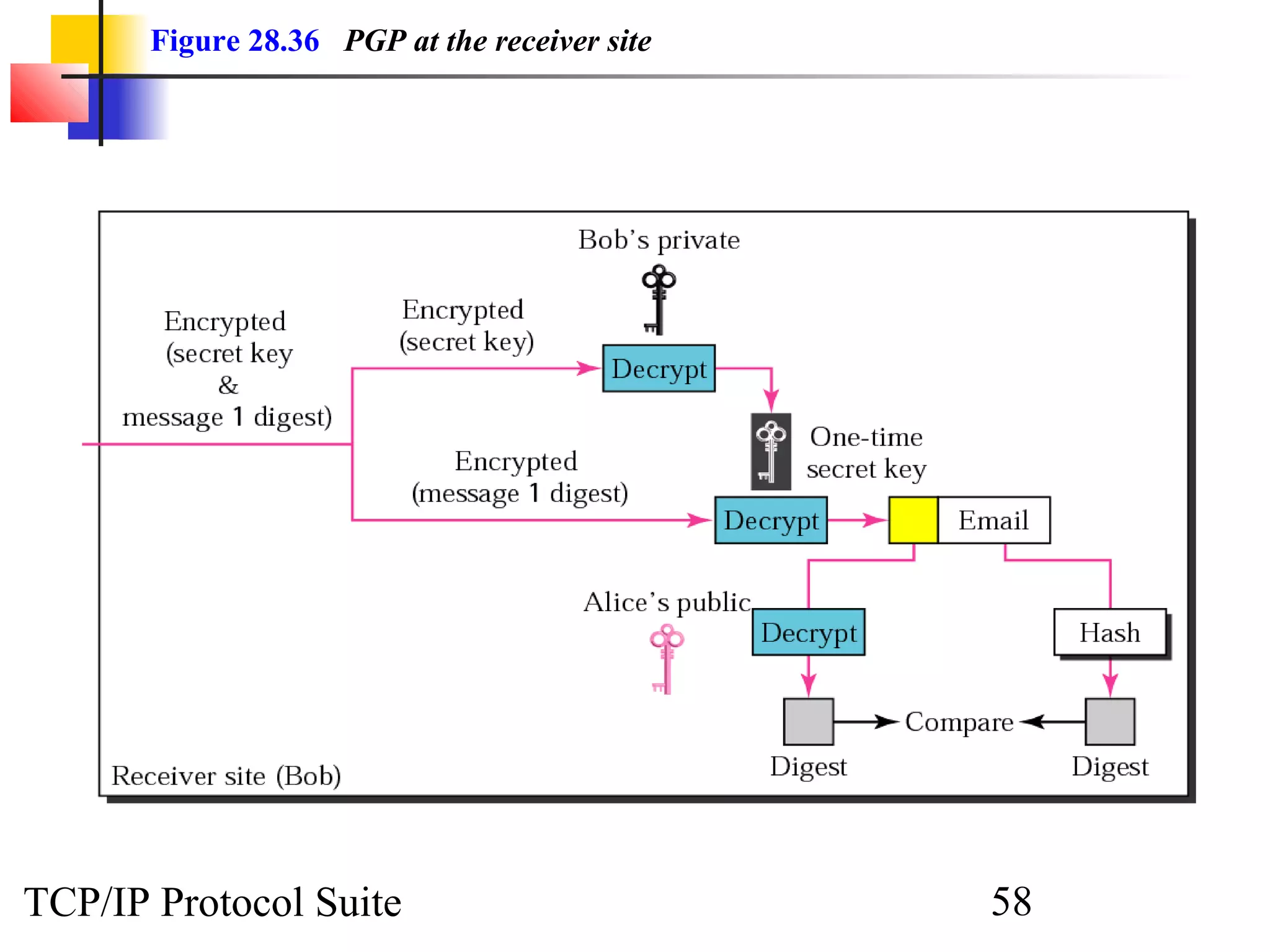
Figure 28.36 PGP at the receiver site 
TCP/IP Protocol Suite 58
28.7 FIREWALLS 
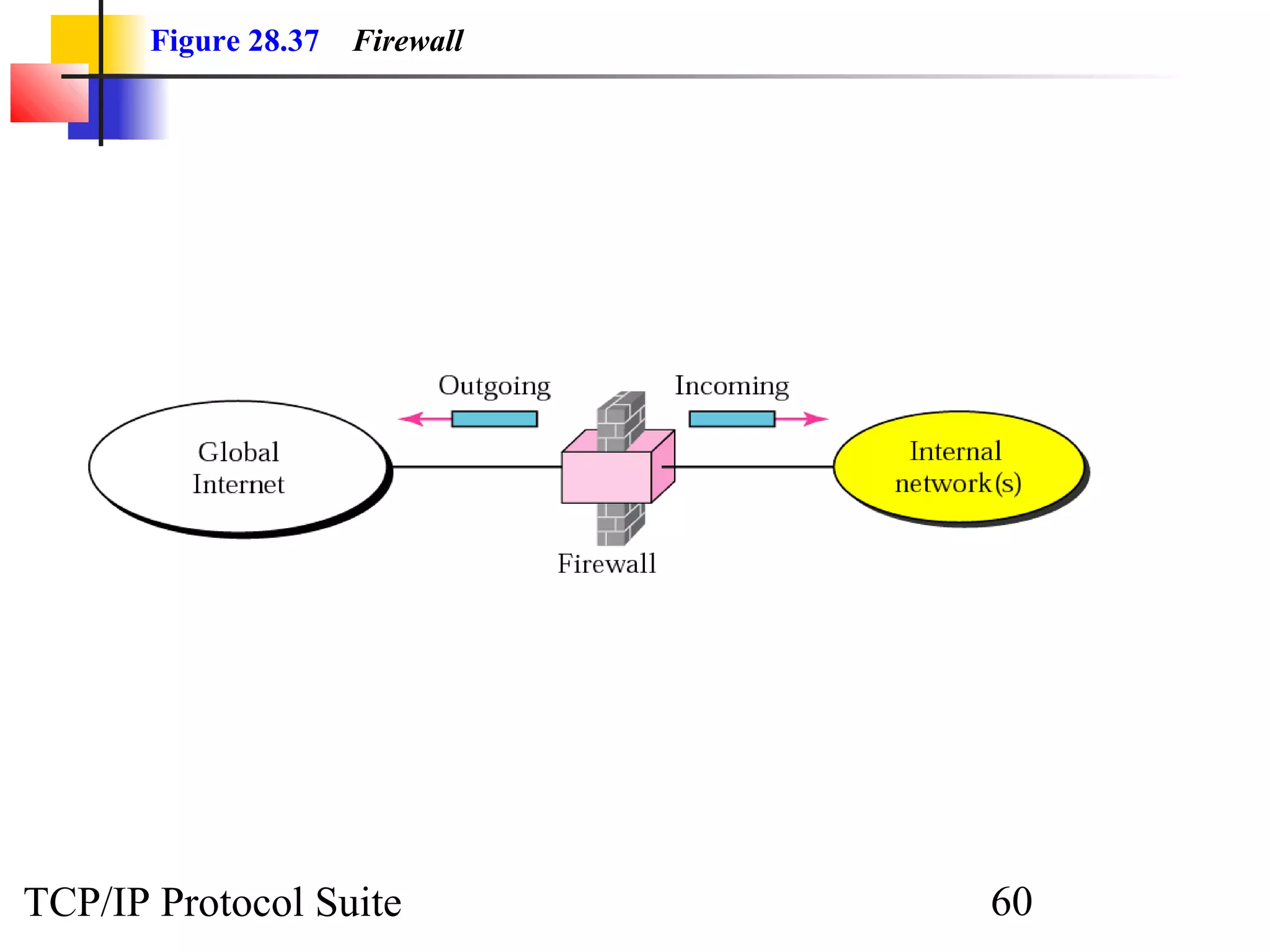
A firewall is a device (usually a router or a computer) iinnssttaalllleedd bbeettwweeeenn 
tthhee iinntteerrnnaall nneettwwoorrkk ooff aann oorrggaanniizzaattiioonn aanndd tthhee rreesstt ooff tthhee IInntteerrnneett.. IItt iiss 
ddeessiiggnneedd ttoo ffoorrwwaarrdd ssoommee ppaacckkeettss aanndd ffiilltteerr ((nnoott ffoorrwwaarrdd)) ootthheerrss.. 
TThhee ttooppiiccss ddiissccuusssseedd iinn tthhiiss sseeccttiioonn iinncclluuddee:: 
PPaacckkeett--FFiilltteerr FFiirreewwaallll 
PPrrooxxyy FFiirreewwaallll 
TCP/IP Protocol Suite 59
Figure 28.37 Firewall 
TCP/IP Protocol Suite 60
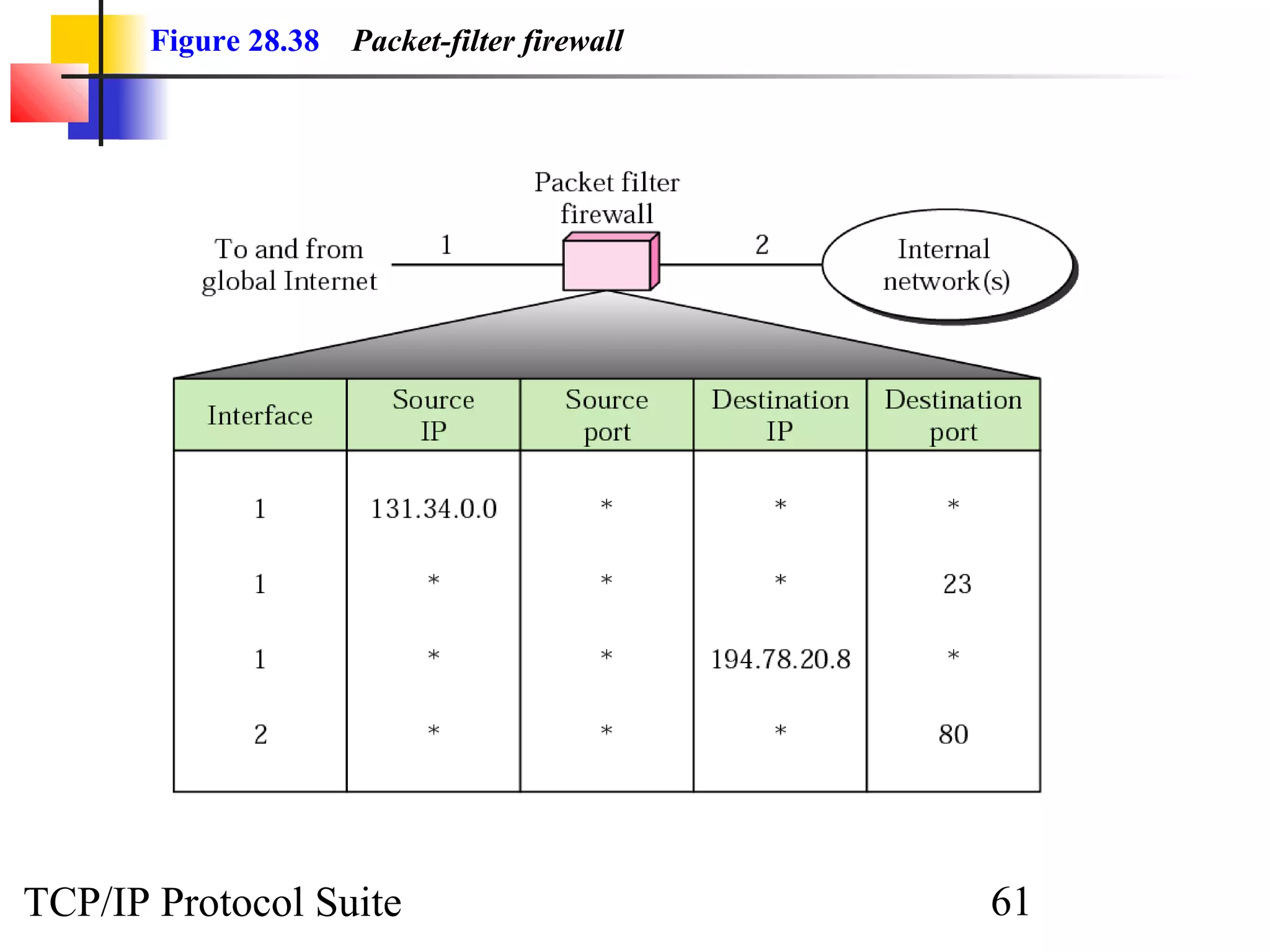
Figure 28.38 Packet-filter firewall 
TCP/IP Protocol Suite 61
NNoottee:: 
A packet-filter firewall filters at the 
network or transport layer. 
TCP/IP Protocol Suite 62
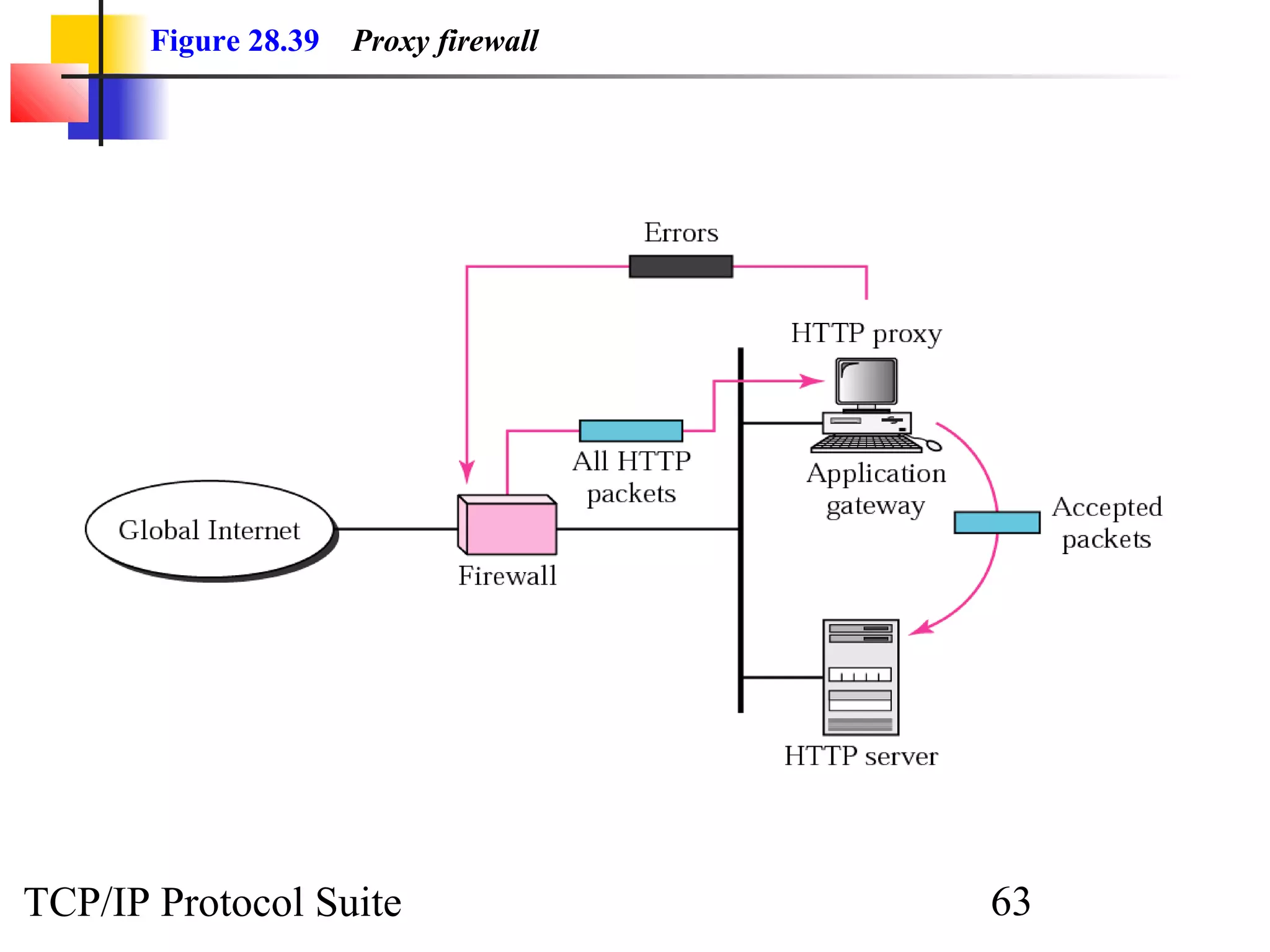
Figure 28.39 Proxy firewall 
TCP/IP Protocol Suite 63
NNoottee:: 
A proxy firewall filters at the 
application layer. 
TCP/IP Protocol Suite 64

Chap 28 security

  • 1.
    CChhaapptteerr 2288 SSeeccuurriittyy Objectives Upon completion you will be able to: • Differentiate between two categories of cryptography schemes • Understand four aspects of security • Understand the concept of digital signature • Understand the role of key management in entity authentication • Know how and where IPSec, TLS, and PPG provide security TCP/IP Protocol Suite 1
  • 2.
    28.1 CRYPTOGRAPHY Theword cryptography in Greek means “secret writing.” TThhee tteerrmm ttooddaayy rreeffeerrss ttoo tthhee sscciieennccee aanndd aarrtt ooff ttrraannssffoorrmmiinngg mmeessssaaggeess ttoo mmaakkee tthheemm sseeccuurree aanndd iimmmmuunnee ttoo aattttaacckkss.. TThhee ttooppiiccss ddiissccuusssseedd iinn tthhiiss sseeccttiioonn iinncclluuddee:: SSyymmmmeettrriicc--KKeeyy CCrryyppttooggrraapphhyy AAssyymmmmeettrriicc--KKeeyy CCrryyppttooggrraapphhyy CCoommppaarriissoonn TCP/IP Protocol Suite 2
  • 3.
    Figure 28.1 Cryptographycomponents TCP/IP Protocol Suite 3
  • 4.
    NNoottee:: In cryptography,the encryption/decryption algorithms are public; the keys are secret. TCP/IP Protocol Suite 4
  • 5.
    NNoottee:: In symmetric-keycryptography, the same key is used by the sender (for encryption) and the receiver (for decryption). The key is shared. TCP/IP Protocol Suite 5
  • 6.
    Figure 28.2 Symmetric-keycryptography TCP/IP Protocol Suite 6
  • 7.
    NNoottee:: In symmetric-keycryptography, the same key is used in both directions. TCP/IP Protocol Suite 7
  • 8.
    Figure 28.3 Caesarcipher TCP/IP Protocol Suite 8
  • 9.
    Figure 28.4 Transpositionalcipher TCP/IP Protocol Suite 9
  • 10.
    Figure 28.5 DES TCP/IP Protocol Suite 10
  • 11.
    Figure 28.6 Iterationblock TCP/IP Protocol Suite 11
  • 12.
    Figure 28.7 TripleDES TCP/IP Protocol Suite 12
  • 13.
    NNoottee:: The DEScipher uses the same concept as the Caesar cipher, but the encryption/ decryption algorithm is much more complex. TCP/IP Protocol Suite 13
  • 14.
    Figure 28.8 Public-keycryptography TCP/IP Protocol Suite 14
  • 15.
    Figure 28.9 RSA TCP/IP Protocol Suite 15
  • 16.
    NNoottee:: Symmetric-key cryptographyis often used for long messages. TCP/IP Protocol Suite 16
  • 17.
    NNoottee:: Asymmetric-key algorithmsare more efficient for short messages. TCP/IP Protocol Suite 17
  • 18.
    28.2 PRIVACY Privacymeans that the sender and the receiver expect ccoonnffiiddeennttiiaalliittyy.. TThhee ttrraannssmmiitttteedd mmeessssaaggee mmuusstt mmaakkee sseennssee ttoo oonnllyy tthhee iinntteennddeedd rreecceeiivveerr.. TToo aallll ootthheerrss,, tthhee mmeessssaaggee mmuusstt bbee uunniinntteelllliiggiibbllee.. TThhee ttooppiiccss ddiissccuusssseedd iinn tthhiiss sseeccttiioonn iinncclluuddee:: PPrriivvaaccyy wwiitthh SSyymmmmeettrriicc--KKeeyy CCrryyppttooggrraapphhyy PPrriivvaaccyy wwiitthh AAssyymmmmeettrriicc--KKeeyy CCrryyppttooggrraapphhyy TCP/IP Protocol Suite 18
  • 19.
    Figure 28.10 Privacyusing symmetric-key encryption TCP/IP Protocol Suite 19
  • 20.
    Figure 28.11 Privacyusing asymmetric-key encryption TCP/IP Protocol Suite 20
  • 21.
    NNoottee:: Digital signaturecan provide authentication, integrity, and nonrepudiation for a message. TCP/IP Protocol Suite 21
  • 22.
    28.3 DIGITAL SIGNATURE Digital signature can provide authentication, iinntteeggrriittyy,, aanndd nnoonnrreeppuuddiiaattiioonn ffoorr aa mmeessssaaggee.. TThhee ttooppiiccss ddiissccuusssseedd iinn tthhiiss sseeccttiioonn iinncclluuddee:: SSiiggnniinngg tthhee WWhhoollee DDooccuummeenntt SSiiggnniinngg tthhee DDiiggeesstt TCP/IP Protocol Suite 22
  • 23.
    Figure 28.12 Signingthe whole document TCP/IP Protocol Suite 23
  • 24.
    NNoottee:: Digital signaturedoes not provide privacy. If there is a need for privacy, another layer of encryption/decryption must be applied. TCP/IP Protocol Suite 24
  • 25.
    Figure 28.13 Hashfunction TCP/IP Protocol Suite 25
  • 26.
    Figure 28.14 Sendersite TCP/IP Protocol Suite 26
  • 27.
    Figure 28.15 Receiversite TCP/IP Protocol Suite 27
  • 28.
    28.4 ENTITY AUTHENTICATION Entity authentication is a procedure that verifies the iiddeennttiittyy ooff oonnee eennttiittyy ffoorr aannootthheerr.. AAnn eennttiittyy ccaann bbee aa ppeerrssoonn,, aa pprroocceessss,, aa cclliieenntt,, oorr aa sseerrvveerr.. IInn eennttiittyy aauutthheennttiiccaattiioonn,, tthhee iiddeennttiittyy iiss vveerriiffiieedd oonnccee ffoorr tthhee eennttiirree dduurraattiioonn ooff ssyysstteemm aacccceessss.. TThhee ttooppiiccss ddiissccuusssseedd iinn tthhiiss sseeccttiioonn iinncclluuddee:: EEnnttiittyy AAuutthheennttiiccaattiioonn wwiitthh SSyymmmmeettrriicc--KKeeyy CCrryyppttooggrraapphhyy EEnnttiittyy AAuutthheennttiiccaattiioonn wwiitthh AAssyymmmmeettrriicc--KKeeyy CCrryyppttooggrraapphhyy TCP/IP Protocol Suite 28
  • 29.
    Figure 28.16 Usinga symmetric key only TCP/IP Protocol Suite 29
  • 30.
    Figure 28.17 Usinga nonce TCP/IP Protocol Suite 30
  • 31.
    Figure 28.18 Bidirectionalauthentication TCP/IP Protocol Suite 31
  • 32.
    28.5 KEY MANAGEMENT In this section we explain how symmetric keys aarree ddiissttrriibbuutteedd aanndd hhooww ppuubblliicc kkeeyyss aarree cceerrttiiffiieedd.. TThhee ttooppiiccss ddiissccuusssseedd iinn tthhiiss sseeccttiioonn iinncclluuddee:: SSyymmmmeettrriicc--KKeeyy DDiissttrriibbuuttiioonn PPuubblliicc--KKeeyy CCeerrttiiffiiccaattiioonn KKeerrbbeerrooss TCP/IP Protocol Suite 32
  • 33.
    NNoottee:: A symmetrickey between two parties is useful if it is used only once; it must be created for one session and destroyed when the session is over. TCP/IP Protocol Suite 33
  • 34.
    Figure 28.19 Diffie-Hellmanmethod TCP/IP Protocol Suite 34
  • 35.
    NNoottee:: The symmetric(shared) key in the Diffie-Hellman protocol is K = G xy mod N. TCP/IP Protocol Suite 35
  • 36.
    ExamplE 1 Letus give an example to make the procedure clear. Our example uses small numbers, but note that in a real situation, the numbers are very large. Assume G = 7 and N = 23. The steps are as follows: 1. Alice chooses x = 3 and calculates R1 = 73 mod 23 = 21. 2. Alice sends the number 21 to Bob. 3. Bob chooses y = 6 and calculates R2 = 76 mod 23 = 4. 4. Bob sends the number 4 to Alice. 5. Alice calculates the symmetric key K = 43 mod 23 = 18. 6. Bob calculates the symmetric key K = 216 mod 23 = 18. The value of K is the same for both Alice and Bob; G xy mod N = 718 mod 23 = 18. TCP/IP Protocol Suite 36
  • 37.
    Figure 28.20 Man-in-the-middleattack TCP/IP Protocol Suite 37
  • 38.
    Figure 28.21 Firstapproach using KDC TCP/IP Protocol Suite 38
  • 39.
    Figure 28.22 Needham-Schroederprotocol TCP/IP Protocol Suite 39
  • 40.
    Figure 28.23 Otway-Reesprotocol TCP/IP Protocol Suite 40
  • 41.
    NNoottee:: In public-keycryptography, everyone has access to everyone’s public key. TCP/IP Protocol Suite 41
  • 42.
    TTaabbllee 2288..11 XX..550099ffiieellddss TCP/IP Protocol Suite 42
  • 43.
    Figure 28.24 PKIhierarchy TCP/IP Protocol Suite 43
  • 44.
    Figure 28.25 Kerberosservers TCP/IP Protocol Suite 44
  • 45.
    Figure 28.26 Kerberosexample TCP/IP Protocol Suite 45
  • 46.
    28.6 SECURITY INTHE INTERNET In this section we discuss a security method for each ooff tthhee ttoopp 33 llaayyeerrss ooff tthhee IInntteerrnneett mmooddeell.. AAtt tthhee IIPP lleevveell wwee ddiissccuussss aa pprroottooccooll ccaalllleedd IIPPSSeecc;; aatt tthhee ttrraannssppoorrtt llaayyeerr wwee ddiissccuussss aa pprroottooccooll tthhaatt ““gglluueess”” aa nneeww llaayyeerr ttoo tthhee ttrraannssppoorrtt llaayyeerr;; aatt tthhee aapppplliiccaattiioonn llaayyeerr wwee ddiissccuussss aa sseeccuurriittyy mmeetthhoodd ccaalllleedd PPGGPP.. TThhee ttooppiiccss ddiissccuusssseedd iinn tthhiiss sseeccttiioonn iinncclluuddee:: IIPP LLeevveell SSeeccuurriittyy:: IIPPSSeecc TTrraannssppoorrtt LLaayyeerr SSeeccuurriittyy AApppplliiccaattiioonn LLaayyeerr SSeeccuurriittyy:: PPGGPP TCP/IP Protocol Suite 46
  • 47.
    Figure 28.27 Transportmode TCP/IP Protocol Suite 47
  • 48.
    Figure 28.28 Tunnelmode TCP/IP Protocol Suite 48
  • 49.
    Figure 28.29 AH TCP/IP Protocol Suite 49
  • 50.
    NNoottee:: The AHprotocol provides message authentication and integrity, but not privacy. TCP/IP Protocol Suite 50
  • 51.
    Figure 28.30 ESP TCP/IP Protocol Suite 51
  • 52.
    NNoottee:: ESP providesmessage authentication, integrity, and privacy. TCP/IP Protocol Suite 52
  • 53.
    Figure 28.31 Positionof TLS TCP/IP Protocol Suite 53
  • 54.
    Figure 28.32 TLSlayers TCP/IP Protocol Suite 54
  • 55.
    Figure 28.33 Handshakeprotocol TCP/IP Protocol Suite 55
  • 56.
    Figure 28.34 RecordProtocol TCP/IP Protocol Suite 56
  • 57.
    Figure 28.35 PGPat the sender site TCP/IP Protocol Suite 57
  • 58.
    Figure 28.36 PGPat the receiver site TCP/IP Protocol Suite 58
  • 59.
    28.7 FIREWALLS Afirewall is a device (usually a router or a computer) iinnssttaalllleedd bbeettwweeeenn tthhee iinntteerrnnaall nneettwwoorrkk ooff aann oorrggaanniizzaattiioonn aanndd tthhee rreesstt ooff tthhee IInntteerrnneett.. IItt iiss ddeessiiggnneedd ttoo ffoorrwwaarrdd ssoommee ppaacckkeettss aanndd ffiilltteerr ((nnoott ffoorrwwaarrdd)) ootthheerrss.. TThhee ttooppiiccss ddiissccuusssseedd iinn tthhiiss sseeccttiioonn iinncclluuddee:: PPaacckkeett--FFiilltteerr FFiirreewwaallll PPrrooxxyy FFiirreewwaallll TCP/IP Protocol Suite 59
  • 60.
    Figure 28.37 Firewall TCP/IP Protocol Suite 60
  • 61.
    Figure 28.38 Packet-filterfirewall TCP/IP Protocol Suite 61
  • 62.
    NNoottee:: A packet-filterfirewall filters at the network or transport layer. TCP/IP Protocol Suite 62
  • 63.
    Figure 28.39 Proxyfirewall TCP/IP Protocol Suite 63
  • 64.
    NNoottee:: A proxyfirewall filters at the application layer. TCP/IP Protocol Suite 64