Introduction to TCP
TCP is a fundamental protocol of the Internet Protocol suite. It's
essential for reliable and ordered data transmission between
computers.
by walid walid
Definition of TCP
TCP stands for Transmission Control Protocol. It's a connection-oriented
protocol responsible for reliable data transfer.
Connection-Oriented
TCP establishes a connection
between devices before data
transfer begins, ensuring
reliable communication.
Reliable
TCP guarantees data delivery
without errors, retransmitting
lost packets and managing
data flow.
Byte-Stream
TCP treats data as a continuous stream of bytes, ensuring data
arrives in the correct order.
Purpose of TCP
TCP's primary goal is to enable seamless and reliable communication
over the internet. This involves ensuring data delivery without loss, in
the correct order, and without corruption.
1 Data Integrity
TCP implements error
detection and correction
mechanisms to ensure data
arrives accurately.
2 Orderly Delivery
TCP ensures data packets
are delivered in the same
order they were sent,
preventing data corruption.
3 Congestion Management
TCP helps prevent network congestion by adjusting data
transmission rates, ensuring efficient network usage.
Role of TCP in the OSI model
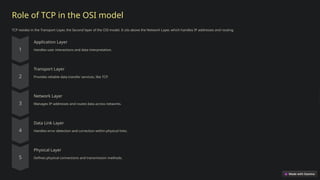
TCP resides in the Transport Layer, the Second layer of the OSI model. It sits above the Network Layer, which handles IP addresses and routing.
Application Layer
Handles user interactions and data interpretation.
Transport Layer
Provides reliable data transfer services, like TCP.
Network Layer
Manages IP addresses and routes data across networks.
Data Link Layer
Handles error detection and correction within physical links.
Physical Layer
Defines physical connections and transmission methods.
Connection-oriented protocol
TCP uses a three-way handshake to establish a connection. This ensures both
ends are ready to communicate reliably before any data transfer.
1 SYN (Synchronization)
The sender initiates a connection request.
2 SYN-ACK (Synchronization-Acknowledgement)
The receiver acknowledges the request and sends its own SYN.
3 ACK (Acknowledgement)
The sender confirms the connection is established.
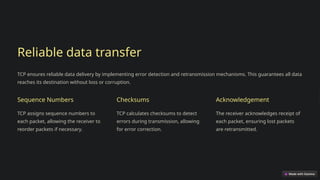
Reliable data transfer
TCP ensures reliable data delivery by implementing error detection and retransmission mechanisms. This guarantees all data
reaches its destination without loss or corruption.
Sequence Numbers
TCP assigns sequence numbers to
each packet, allowing the receiver to
reorder packets if necessary.
Checksums
TCP calculates checksums to detect
errors during transmission, allowing
for error correction.
Acknowledgement
The receiver acknowledges receipt of
each packet, ensuring lost packets
are retransmitted.
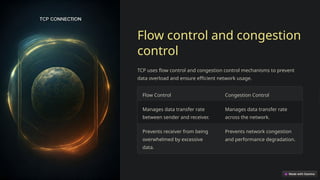
Flow control and congestion
control
TCP uses flow control and congestion control mechanisms to prevent
data overload and ensure efficient network usage.
Flow Control Congestion Control
Manages data transfer rate
between sender and receiver.
Manages data transfer rate
across the network.
Prevents receiver from being
overwhelmed by excessive
data.
Prevents network congestion
and performance degradation.
Conclusion
TCP plays a crucial role in modern communication, enabling reliable and efficient
data transfer across networks. Its mechanisms ensure data arrives accurately, in
the correct order, and without overloading network resources.
Connection Establishment
TCP ensures a reliable connection
before data transfer.
Data Integrity
TCP guarantees data delivery without
errors or loss.
Ordered Delivery
TCP ensures data arrives in the same
order it was sent.
Network Efficiency
TCP manages data flow to prevent
network congestion.

Introduction-to-TCP-how-it-work-and.pptx

  • 1.
    Introduction to TCP TCPis a fundamental protocol of the Internet Protocol suite. It's essential for reliable and ordered data transmission between computers. by walid walid
  • 2.
    Definition of TCP TCPstands for Transmission Control Protocol. It's a connection-oriented protocol responsible for reliable data transfer. Connection-Oriented TCP establishes a connection between devices before data transfer begins, ensuring reliable communication. Reliable TCP guarantees data delivery without errors, retransmitting lost packets and managing data flow. Byte-Stream TCP treats data as a continuous stream of bytes, ensuring data arrives in the correct order.
  • 3.
    Purpose of TCP TCP'sprimary goal is to enable seamless and reliable communication over the internet. This involves ensuring data delivery without loss, in the correct order, and without corruption. 1 Data Integrity TCP implements error detection and correction mechanisms to ensure data arrives accurately. 2 Orderly Delivery TCP ensures data packets are delivered in the same order they were sent, preventing data corruption. 3 Congestion Management TCP helps prevent network congestion by adjusting data transmission rates, ensuring efficient network usage.
  • 4.
    Role of TCPin the OSI model TCP resides in the Transport Layer, the Second layer of the OSI model. It sits above the Network Layer, which handles IP addresses and routing. Application Layer Handles user interactions and data interpretation. Transport Layer Provides reliable data transfer services, like TCP. Network Layer Manages IP addresses and routes data across networks. Data Link Layer Handles error detection and correction within physical links. Physical Layer Defines physical connections and transmission methods.
  • 5.
    Connection-oriented protocol TCP usesa three-way handshake to establish a connection. This ensures both ends are ready to communicate reliably before any data transfer. 1 SYN (Synchronization) The sender initiates a connection request. 2 SYN-ACK (Synchronization-Acknowledgement) The receiver acknowledges the request and sends its own SYN. 3 ACK (Acknowledgement) The sender confirms the connection is established.
  • 6.
    Reliable data transfer TCPensures reliable data delivery by implementing error detection and retransmission mechanisms. This guarantees all data reaches its destination without loss or corruption. Sequence Numbers TCP assigns sequence numbers to each packet, allowing the receiver to reorder packets if necessary. Checksums TCP calculates checksums to detect errors during transmission, allowing for error correction. Acknowledgement The receiver acknowledges receipt of each packet, ensuring lost packets are retransmitted.
  • 7.
    Flow control andcongestion control TCP uses flow control and congestion control mechanisms to prevent data overload and ensure efficient network usage. Flow Control Congestion Control Manages data transfer rate between sender and receiver. Manages data transfer rate across the network. Prevents receiver from being overwhelmed by excessive data. Prevents network congestion and performance degradation.
  • 8.
    Conclusion TCP plays acrucial role in modern communication, enabling reliable and efficient data transfer across networks. Its mechanisms ensure data arrives accurately, in the correct order, and without overloading network resources. Connection Establishment TCP ensures a reliable connection before data transfer. Data Integrity TCP guarantees data delivery without errors or loss. Ordered Delivery TCP ensures data arrives in the same order it was sent. Network Efficiency TCP manages data flow to prevent network congestion.