For the teacherʼs guide and all answers
please contact info@putterking.com


                                     Future KingsTM Education Program
                                                Subject: Physics
                                               Level 2 (Princess)


Putter King LLC                                                         All materials copyright © 2011
Level 28 Shinagawa Intercity Tower A                                    Putter King LLC
2-15-1 Konan Minato-ku Tokyo, Japan                                     All rights reserved
  108-6028                                                              Unit #: 2011020202
Physics
Level 2 - Princess


        2
Summary

Area of focus: force and motion

Topics covered:
  • Force
  • Gravity
  • Law of Universal Gravitation
  • Mass vs. weight
  • Newtonʼs First Law of Motion
  • Newtonʼs Second Law of Motion
  • Newtonʼs Third Law of Motion
Suggested time to complete (2 hrs):
  • Teaching material (40 minutes)
  • Practice activity (20 minutes)
  • Final project (60 minutes)


                   3
Force
                 A force is a push or a pull.


                                 F
A force has both magnitude and direction, making it a vector quantity.

          Scientists measure forces in units called newtons
             • The newton (N) is the SI unit for force
             • 1 N = 1 kg·m/s2


                                  4
Gravity
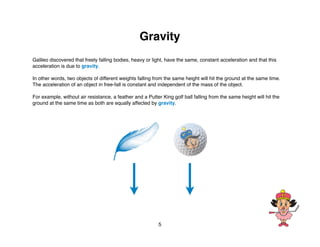
Galileo discovered that freely falling bodies, heavy or light, have the same, constant acceleration and that this
acceleration is due to gravity.

In other words, two objects of different weights falling from the same height will hit the ground at the same time.
The acceleration of an object in free-fall is constant and independent of the mass of the object.

For example, without air resistance, a feather and a Putter King golf ball falling from the same height will hit the
ground at the same time as both are equally affected by gravity.


                                                           5
Law of Universal Gravitation
Newtonʼs law of universal gravitation states that every point mass in the universe
attracts every other point mass with a force that is directly proportional to the product of
their masses and inversely proportional to the square of the distance between them.


                      m1 · m2                       G    = universal gravitational constant

      Fg    =    G                                         G ≈ 6.674 x 10⁻¹¹ N (m/kg)2
                                                    m1 = mass of object 1
                            r2
                                                    m2 = mass of object 2
                                                    r = distance between the two objects


From this equation, we can derive the acceleration due to Earthʼs gravity on an object:


                   G · Me                           G    = universal gravitational constant
          g =                                              G ≈ 6.674 x 10⁻¹¹ N (m/kg)2
                       r2                           Me = mass of Earth
                                                           mEarth ≈ 5.9736 x 1024 kg
                                                    r    = radius of Earth
          g ≈ 9.81 m/s2                                    rEarth = 6.371 x 10⁶ m


                                             6
Mass vs. Weight
Mass is the quantity of matter in an object, or in other words, mass is the measure of the amount of "stuff" in something.
  • Metric unit = kilograms (kg)
  • Imperial unit = slug
Weight is the force of gravity on an object.
  • Metric unit = newton (N)
  • US unit = pound (lb)

                    If you go to the moon, your weight will change but your mass will stay the same.


                                      Putty Mass: 70 kg
                                      Putty WeightEarth: 70 kg * 9.81 m/s2 = 687 N
                                      Putty WeightMoon: 70 kg * 1.63 m/s2 = 114 N


                                                            7
Newtonʼs First Law of Motion
An object at rest will remain at rest unless acted on by an unbalanced (outside) force. An object in
motion continues in motion with the same speed and in the same direction unless acted upon by an
unbalanced (outside) force.


       Newtonʼs First Law of Motion was derived from Galileoʼs Law of Inertia. Isaac
       Newton developed the idea of Galileo further.

       Newton concluded that an object will remain at rest or move with constant velocity
       when there is no net force acting on it. Net force is the sum of all forces acting on an
       object.


                                                   8
Newtonʼs Second Law of Motion
Acceleration is produced when a force acts on a mass. The greater the mass (of the object being
accelerated) the greater the amount of force needed (to accelerate the object).


                    In other words, force is equal to mass times acceleration:


                                        F = ma
                                                     golf ball acceleration = 5 m/s2


                                                                F = .225 N


                                    golf ball mass = 0.045 kg


                                                9
Newtonʼs Third Law of Motion
         For every action, there is an equal and opposite reaction.


                                              n
                                              n = 0.44 N


golf ball mass = 0.045 kg


                                            Fg = mg
                                            Fg = (0.045 kg) * 9.81 m/s2
                                            Fg = 0.44 N


Gravity is acting downward.  The ball is at rest.  The ground must exert a
force equal in magnitude and opposite in direction on the ball.  This force is
called the normal force, n, since it is normal to the surface.


                                      10
Practice Activity
                                               1) Calculate the normal force exerted by the ground
                             (1)
                                               2) Calculate the weight of Bogey (the Putter Prince)

                                               3) Calculate the net force on the golf club when the ball is struck
                              (2)
                                               4) Calculate the net force on the golf ball when the ball is struck

(3)


                                   (4)


  Assumptions:
     • Golf ball mass = 45 g
     • Golf ball acceleration = 7 m/s2
     • Bogeyʼs (the Putter Princeʼs) mass = 34 kg


                                                      11
Final Project


Requirements

Design and label a miniature golf hole (with a golfer) that includes at least:
  • 4 different forces
  • A demostration of each of Newtonʼs three laws of motion
For full points, be sure to:
  • Label the forces at work
  • Label and write a short explanation on the part of your diagram that
  demonstrates each of the three laws of motion
  • be creative!


                                      12
Grading Rubric

                       Bogey                                    Par                            Birdie
                    (70% - 79%)                          (80% - 89%)                      (90% - 100%)


                 • Student did not include four                                         • Student included at least four
                 required forces                                                        forces
   Forces        • Student incorrectly calculated    • Student incorrectly calculated
                                                     or labeled a force                 • Student correctly calculated
                 or labeled more than one force                                         and labeled all forces


                 • Student diagram does not                                             • Student diagram correctly
                 correctly demonstrate the laws
                                                     • Student diagram does not         demonstrates the laws of
Newtonʼs Three   of motion
                                or
                                                     correctly or accurately            motion
                                                     demonstrate one of the laws of     • Student included a
Laws of Motion   • Student did not include a
                 demonstration of all three laws
                                                     motion                             demonstration of all three laws
                                                                                        of motion
                 of motion


                 • Miniature golf hole design is                                        • Miniature golf hole design is
                                                                                        playable and aesthetically
                 plain and simple                    • Miniature golf hole design is    pleasing
                 • Student diagrams are sloppy       playable
   Design        or incorrectly labeled              • Student diagrams are neatly      • Student diagrams are neatly
                                                                                        drawn and labeled
                 • Miniature golf hole design        drawn and labeled
                                                                                        • Miniature golf hole design is
                 does not exhibit creativity
                                                                                        creative and original


                                                    13

Putter King Education - Physics (Level 2)

  • 1.
    For the teacherʼsguide and all answers please contact info@putterking.com Future KingsTM Education Program Subject: Physics Level 2 (Princess) Putter King LLC All materials copyright © 2011 Level 28 Shinagawa Intercity Tower A Putter King LLC 2-15-1 Konan Minato-ku Tokyo, Japan All rights reserved 108-6028 Unit #: 2011020202
  • 2.
  • 3.
    Summary Area of focus:force and motion Topics covered: • Force • Gravity • Law of Universal Gravitation • Mass vs. weight • Newtonʼs First Law of Motion • Newtonʼs Second Law of Motion • Newtonʼs Third Law of Motion Suggested time to complete (2 hrs): • Teaching material (40 minutes) • Practice activity (20 minutes) • Final project (60 minutes) 3
  • 4.
    Force A force is a push or a pull. F A force has both magnitude and direction, making it a vector quantity. Scientists measure forces in units called newtons • The newton (N) is the SI unit for force • 1 N = 1 kg·m/s2 4
  • 5.
    Gravity Galileo discovered thatfreely falling bodies, heavy or light, have the same, constant acceleration and that this acceleration is due to gravity. In other words, two objects of different weights falling from the same height will hit the ground at the same time. The acceleration of an object in free-fall is constant and independent of the mass of the object. For example, without air resistance, a feather and a Putter King golf ball falling from the same height will hit the ground at the same time as both are equally affected by gravity. 5
  • 6.
    Law of UniversalGravitation Newtonʼs law of universal gravitation states that every point mass in the universe attracts every other point mass with a force that is directly proportional to the product of their masses and inversely proportional to the square of the distance between them. m1 · m2 G = universal gravitational constant Fg = G G ≈ 6.674 x 10⁻¹¹ N (m/kg)2 m1 = mass of object 1 r2 m2 = mass of object 2 r = distance between the two objects From this equation, we can derive the acceleration due to Earthʼs gravity on an object: G · Me G = universal gravitational constant g = G ≈ 6.674 x 10⁻¹¹ N (m/kg)2 r2 Me = mass of Earth mEarth ≈ 5.9736 x 1024 kg r = radius of Earth g ≈ 9.81 m/s2 rEarth = 6.371 x 10⁶ m 6
  • 7.
    Mass vs. Weight Massis the quantity of matter in an object, or in other words, mass is the measure of the amount of "stuff" in something. • Metric unit = kilograms (kg) • Imperial unit = slug Weight is the force of gravity on an object. • Metric unit = newton (N) • US unit = pound (lb) If you go to the moon, your weight will change but your mass will stay the same. Putty Mass: 70 kg Putty WeightEarth: 70 kg * 9.81 m/s2 = 687 N Putty WeightMoon: 70 kg * 1.63 m/s2 = 114 N 7
  • 8.
    Newtonʼs First Lawof Motion An object at rest will remain at rest unless acted on by an unbalanced (outside) force. An object in motion continues in motion with the same speed and in the same direction unless acted upon by an unbalanced (outside) force. Newtonʼs First Law of Motion was derived from Galileoʼs Law of Inertia. Isaac Newton developed the idea of Galileo further. Newton concluded that an object will remain at rest or move with constant velocity when there is no net force acting on it. Net force is the sum of all forces acting on an object. 8
  • 9.
    Newtonʼs Second Lawof Motion Acceleration is produced when a force acts on a mass. The greater the mass (of the object being accelerated) the greater the amount of force needed (to accelerate the object). In other words, force is equal to mass times acceleration: F = ma golf ball acceleration = 5 m/s2 F = .225 N golf ball mass = 0.045 kg 9
  • 10.
    Newtonʼs Third Lawof Motion For every action, there is an equal and opposite reaction. n n = 0.44 N golf ball mass = 0.045 kg Fg = mg Fg = (0.045 kg) * 9.81 m/s2 Fg = 0.44 N Gravity is acting downward.  The ball is at rest.  The ground must exert a force equal in magnitude and opposite in direction on the ball.  This force is called the normal force, n, since it is normal to the surface. 10
  • 11.
    Practice Activity 1) Calculate the normal force exerted by the ground (1) 2) Calculate the weight of Bogey (the Putter Prince) 3) Calculate the net force on the golf club when the ball is struck (2) 4) Calculate the net force on the golf ball when the ball is struck (3) (4) Assumptions: • Golf ball mass = 45 g • Golf ball acceleration = 7 m/s2 • Bogeyʼs (the Putter Princeʼs) mass = 34 kg 11
  • 12.
    Final Project Requirements Design andlabel a miniature golf hole (with a golfer) that includes at least: • 4 different forces • A demostration of each of Newtonʼs three laws of motion For full points, be sure to: • Label the forces at work • Label and write a short explanation on the part of your diagram that demonstrates each of the three laws of motion • be creative! 12
  • 13.
    Grading Rubric Bogey Par Birdie (70% - 79%) (80% - 89%) (90% - 100%) • Student did not include four • Student included at least four required forces forces Forces • Student incorrectly calculated • Student incorrectly calculated or labeled a force • Student correctly calculated or labeled more than one force and labeled all forces • Student diagram does not • Student diagram correctly correctly demonstrate the laws • Student diagram does not demonstrates the laws of Newtonʼs Three of motion or correctly or accurately motion demonstrate one of the laws of • Student included a Laws of Motion • Student did not include a demonstration of all three laws motion demonstration of all three laws of motion of motion • Miniature golf hole design is • Miniature golf hole design is playable and aesthetically plain and simple • Miniature golf hole design is pleasing • Student diagrams are sloppy playable Design or incorrectly labeled • Student diagrams are neatly • Student diagrams are neatly drawn and labeled • Miniature golf hole design drawn and labeled • Miniature golf hole design is does not exhibit creativity creative and original 13