2
Chapter
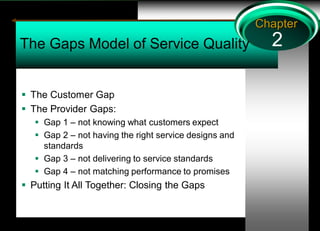
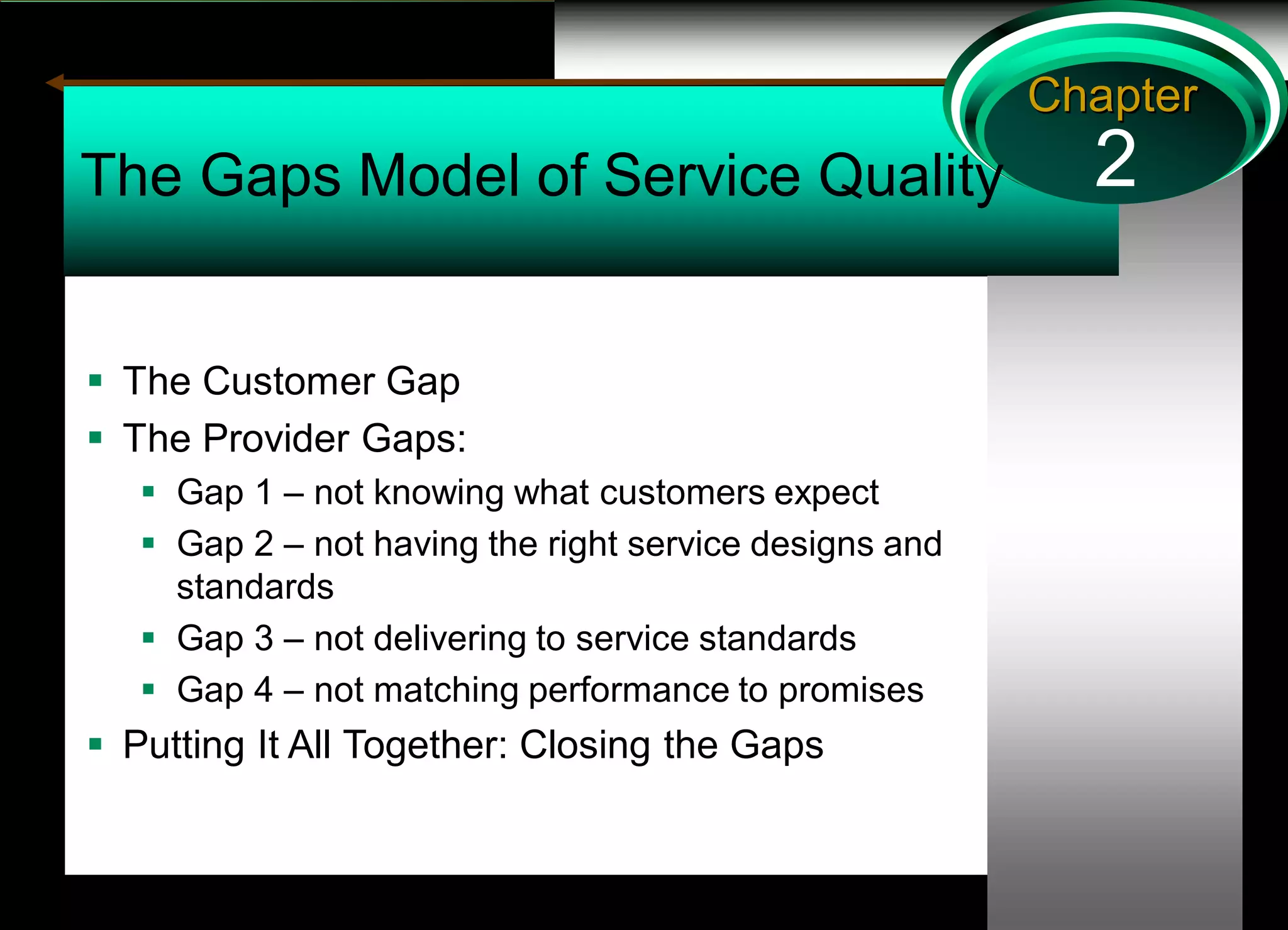
The Gaps Model of Service Quality
 The Customer Gap
 The Provider Gaps:
 Gap 1 – not knowing what customers expect
 Gap 2 – not having the right service designs and
standards
 Gap 3 – not delivering to service standards
 Gap 4 – not matching performance to promises
 Putting It All Together: Closing the Gaps
© 2006 The McGraw-Hill Companies, Inc. All rights reserved.McGraw-Hill/Irwin
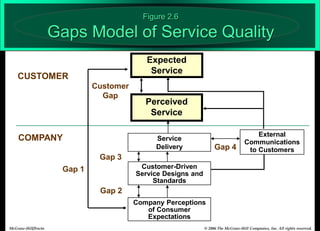
Perceived
Service
Expected
Service
CUSTOMER
COMPANY
Customer
Gap
Gap 1
Gap 2
Gap 3
External
Communications
to CustomersGap 4
Service
Delivery
Customer-Driven
Service Designs and
Standards
Company Perceptions
of Consumer
Expectations
Figure 2.6
Gaps Model of Service Quality
© 2006 The McGraw-Hill Companies, Inc. All rights reserved.McGraw-Hill/Irwin
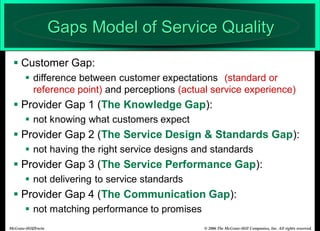
Gaps Model of Service Quality
 Customer Gap:
 difference between customer expectations (standard or
reference point) and perceptions (actual service experience)
 Provider Gap 1 (The Knowledge Gap):
 not knowing what customers expect
 Provider Gap 2 (The Service Design & Standards Gap):
 not having the right service designs and standards
 Provider Gap 3 (The Service Performance Gap):
 not delivering to service standards
 Provider Gap 4 (The Communication Gap):
 not matching performance to promises
© 2006 The McGraw-Hill Companies, Inc. All rights reserved.McGraw-Hill/Irwin
Expected
service
Perceived
service
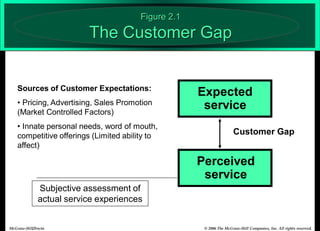
Customer Gap
Figure 2.1
The Customer Gap
Sources of Customer Expectations:
• Pricing, Advertising, Sales Promotion
(Market Controlled Factors)
• Innate personal needs, word of mouth,
competitive offerings (Limited ability to
affect)
Subjective assessment of
actual service experiences
© 2006 The McGraw-Hill Companies, Inc. All rights reserved.McGraw-Hill/Irwin
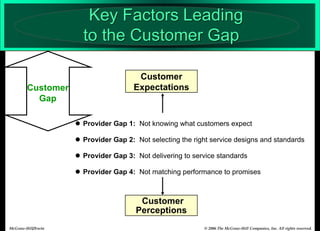
 Provider Gap 1: Not knowing what customers expect
 Provider Gap 2: Not selecting the right service designs and standards
 Provider Gap 3: Not delivering to service standards
 Provider Gap 4: Not matching performance to promises
Customer
Expectations
Customer
Perceptions
Key Factors Leading
to the Customer Gap
Customer
Gap
© 2006 The McGraw-Hill Companies, Inc. All rights reserved.McGraw-Hill/Irwin
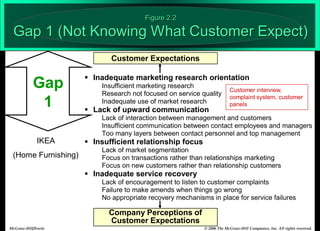
Customer Expectations
Company Perceptions of
Customer Expectations
 Inadequate marketing research orientation
Insufficient marketing research
Research not focused on service quality
Inadequate use of market research
 Lack of upward communication
Lack of interaction between management and customers
Insufficient communication between contact employees and managers
Too many layers between contact personnel and top management
 Insufficient relationship focus
Lack of market segmentation
Focus on transactions rather than relationships
Focus on new customers rather than relationship customers
 Inadequate service recovery
Lack of encouragement to listen to customer complaints
Failure to make amends when things go wrong
No appropriate recovery mechanisms in place for service failures
Figure 2.2
Gap 1 (Not Knowing What Customer Expect)
Gap
1
Customer interview,
complaint system, customer
panels
marketing
IKEA
(Home Furnishing)
© 2006 The McGraw-Hill Companies, Inc. All rights reserved.McGraw-Hill/Irwin
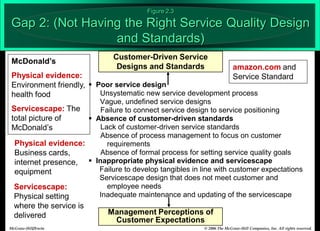
Customer-Driven Service
Designs and Standards
Management Perceptions of
Customer Expectations
 Poor service design
Unsystematic new service development process
Vague, undefined service designs
Failure to connect service design to service positioning
 Absence of customer-driven standards
Lack of customer-driven service standards
Absence of process management to focus on customer
requirements
Absence of formal process for setting service quality goals
 Inappropriate physical evidence and servicescape
Failure to develop tangibles in line with customer expectations
Servicescape design that does not meet customer and
employee needs
Inadequate maintenance and updating of the servicescape
Figure 2.3
Gap 2: (Not Having the Right Service Quality Design
and Standards)
Physical evidence:
Business cards,
internet presence,
equipment
Servicescape:
Physical setting
where the service is
delivered
amazon.com and
Service Standard
McDonald’s
Physical evidence:
Environment friendly,
health food
Servicescape: The
total picture of
McDonald’s
© 2006 The McGraw-Hill Companies, Inc. All rights reserved.McGraw-Hill/Irwin
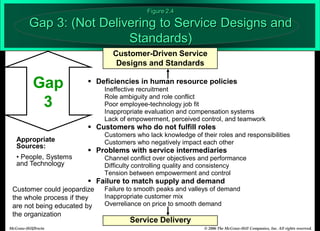
Service Delivery
Customer-Driven Service
Designs and Standards
 Deficiencies in human resource policies
Ineffective recruitment
Role ambiguity and role conflict
Poor employee-technology job fit
Inappropriate evaluation and compensation systems
Lack of empowerment, perceived control, and teamwork
 Customers who do not fulfill roles
Customers who lack knowledge of their roles and responsibilities
Customers who negatively impact each other
 Problems with service intermediaries
Channel conflict over objectives and performance
Difficulty controlling quality and consistency
Tension between empowerment and control
 Failure to match supply and demand
Failure to smooth peaks and valleys of demand
Inappropriate customer mix
Overreliance on price to smooth demand
Figure 2.4
Gap 3: (Not Delivering to Service Designs and
Standards)
Gap
3
Appropriate
Sources:
• People, Systems
and Technology
Customer could jeopardize
the whole process if they
are not being educated by
the organization
© 2006 The McGraw-Hill Companies, Inc. All rights reserved.McGraw-Hill/Irwin
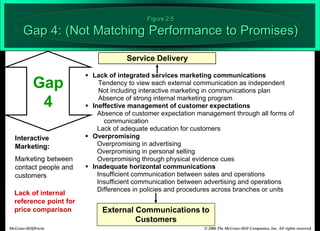
Service Delivery
 Lack of integrated services marketing communications
Tendency to view each external communication as independent
Not including interactive marketing in communications plan
Absence of strong internal marketing program
 Ineffective management of customer expectations
Absence of customer expectation management through all forms of
communication
Lack of adequate education for customers
 Overpromising
Overpromising in advertising
Overpromising in personal selling
Overpromising through physical evidence cues
 Inadequate horizontal communications
Insufficient communication between sales and operations
Insufficient communication between advertising and operations
Differences in policies and procedures across branches or units
External Communications to
Customers
Figure 2.5
Gap 4: (Not Matching Performance to Promises)
Gap
4
Interactive
Marketing:
Marketing between
contact people and
customers
Lack of internal
reference point for
price comparison
© 2006 The McGraw-Hill Companies, Inc. All rights reserved.McGraw-Hill/Irwin
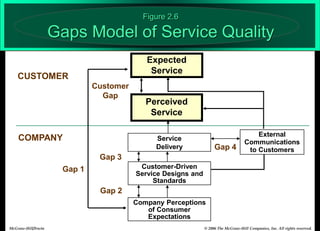
Perceived
Service
Expected
Service
CUSTOMER
COMPANY
Customer
Gap
Gap 1
Gap 2
Gap 3
External
Communications
to CustomersGap 4
Service
Delivery
Customer-Driven
Service Designs and
Standards
Company Perceptions
of Consumer
Expectations
Figure 2.6
Gaps Model of Service Quality

Chap 2 gap model

  • 1.
    2 Chapter The Gaps Modelof Service Quality  The Customer Gap  The Provider Gaps:  Gap 1 – not knowing what customers expect  Gap 2 – not having the right service designs and standards  Gap 3 – not delivering to service standards  Gap 4 – not matching performance to promises  Putting It All Together: Closing the Gaps
  • 2.
    © 2006 TheMcGraw-Hill Companies, Inc. All rights reserved.McGraw-Hill/Irwin Perceived Service Expected Service CUSTOMER COMPANY Customer Gap Gap 1 Gap 2 Gap 3 External Communications to CustomersGap 4 Service Delivery Customer-Driven Service Designs and Standards Company Perceptions of Consumer Expectations Figure 2.6 Gaps Model of Service Quality
  • 3.
    © 2006 TheMcGraw-Hill Companies, Inc. All rights reserved.McGraw-Hill/Irwin Gaps Model of Service Quality  Customer Gap:  difference between customer expectations (standard or reference point) and perceptions (actual service experience)  Provider Gap 1 (The Knowledge Gap):  not knowing what customers expect  Provider Gap 2 (The Service Design & Standards Gap):  not having the right service designs and standards  Provider Gap 3 (The Service Performance Gap):  not delivering to service standards  Provider Gap 4 (The Communication Gap):  not matching performance to promises
  • 4.
    © 2006 TheMcGraw-Hill Companies, Inc. All rights reserved.McGraw-Hill/Irwin Expected service Perceived service Customer Gap Figure 2.1 The Customer Gap Sources of Customer Expectations: • Pricing, Advertising, Sales Promotion (Market Controlled Factors) • Innate personal needs, word of mouth, competitive offerings (Limited ability to affect) Subjective assessment of actual service experiences
  • 5.
    © 2006 TheMcGraw-Hill Companies, Inc. All rights reserved.McGraw-Hill/Irwin  Provider Gap 1: Not knowing what customers expect  Provider Gap 2: Not selecting the right service designs and standards  Provider Gap 3: Not delivering to service standards  Provider Gap 4: Not matching performance to promises Customer Expectations Customer Perceptions Key Factors Leading to the Customer Gap Customer Gap
  • 6.
    © 2006 TheMcGraw-Hill Companies, Inc. All rights reserved.McGraw-Hill/Irwin Customer Expectations Company Perceptions of Customer Expectations  Inadequate marketing research orientation Insufficient marketing research Research not focused on service quality Inadequate use of market research  Lack of upward communication Lack of interaction between management and customers Insufficient communication between contact employees and managers Too many layers between contact personnel and top management  Insufficient relationship focus Lack of market segmentation Focus on transactions rather than relationships Focus on new customers rather than relationship customers  Inadequate service recovery Lack of encouragement to listen to customer complaints Failure to make amends when things go wrong No appropriate recovery mechanisms in place for service failures Figure 2.2 Gap 1 (Not Knowing What Customer Expect) Gap 1 Customer interview, complaint system, customer panels marketing IKEA (Home Furnishing)
  • 8.
    © 2006 TheMcGraw-Hill Companies, Inc. All rights reserved.McGraw-Hill/Irwin Customer-Driven Service Designs and Standards Management Perceptions of Customer Expectations  Poor service design Unsystematic new service development process Vague, undefined service designs Failure to connect service design to service positioning  Absence of customer-driven standards Lack of customer-driven service standards Absence of process management to focus on customer requirements Absence of formal process for setting service quality goals  Inappropriate physical evidence and servicescape Failure to develop tangibles in line with customer expectations Servicescape design that does not meet customer and employee needs Inadequate maintenance and updating of the servicescape Figure 2.3 Gap 2: (Not Having the Right Service Quality Design and Standards) Physical evidence: Business cards, internet presence, equipment Servicescape: Physical setting where the service is delivered amazon.com and Service Standard McDonald’s Physical evidence: Environment friendly, health food Servicescape: The total picture of McDonald’s
  • 9.
    © 2006 TheMcGraw-Hill Companies, Inc. All rights reserved.McGraw-Hill/Irwin Service Delivery Customer-Driven Service Designs and Standards  Deficiencies in human resource policies Ineffective recruitment Role ambiguity and role conflict Poor employee-technology job fit Inappropriate evaluation and compensation systems Lack of empowerment, perceived control, and teamwork  Customers who do not fulfill roles Customers who lack knowledge of their roles and responsibilities Customers who negatively impact each other  Problems with service intermediaries Channel conflict over objectives and performance Difficulty controlling quality and consistency Tension between empowerment and control  Failure to match supply and demand Failure to smooth peaks and valleys of demand Inappropriate customer mix Overreliance on price to smooth demand Figure 2.4 Gap 3: (Not Delivering to Service Designs and Standards) Gap 3 Appropriate Sources: • People, Systems and Technology Customer could jeopardize the whole process if they are not being educated by the organization
  • 10.
    © 2006 TheMcGraw-Hill Companies, Inc. All rights reserved.McGraw-Hill/Irwin Service Delivery  Lack of integrated services marketing communications Tendency to view each external communication as independent Not including interactive marketing in communications plan Absence of strong internal marketing program  Ineffective management of customer expectations Absence of customer expectation management through all forms of communication Lack of adequate education for customers  Overpromising Overpromising in advertising Overpromising in personal selling Overpromising through physical evidence cues  Inadequate horizontal communications Insufficient communication between sales and operations Insufficient communication between advertising and operations Differences in policies and procedures across branches or units External Communications to Customers Figure 2.5 Gap 4: (Not Matching Performance to Promises) Gap 4 Interactive Marketing: Marketing between contact people and customers Lack of internal reference point for price comparison
  • 11.
    © 2006 TheMcGraw-Hill Companies, Inc. All rights reserved.McGraw-Hill/Irwin Perceived Service Expected Service CUSTOMER COMPANY Customer Gap Gap 1 Gap 2 Gap 3 External Communications to CustomersGap 4 Service Delivery Customer-Driven Service Designs and Standards Company Perceptions of Consumer Expectations Figure 2.6 Gaps Model of Service Quality