Copyright © 2015 McGraw-Hill Education. All rights reserved. No reproduction or distribution without the prior written consent of McGraw-Hill
Education.
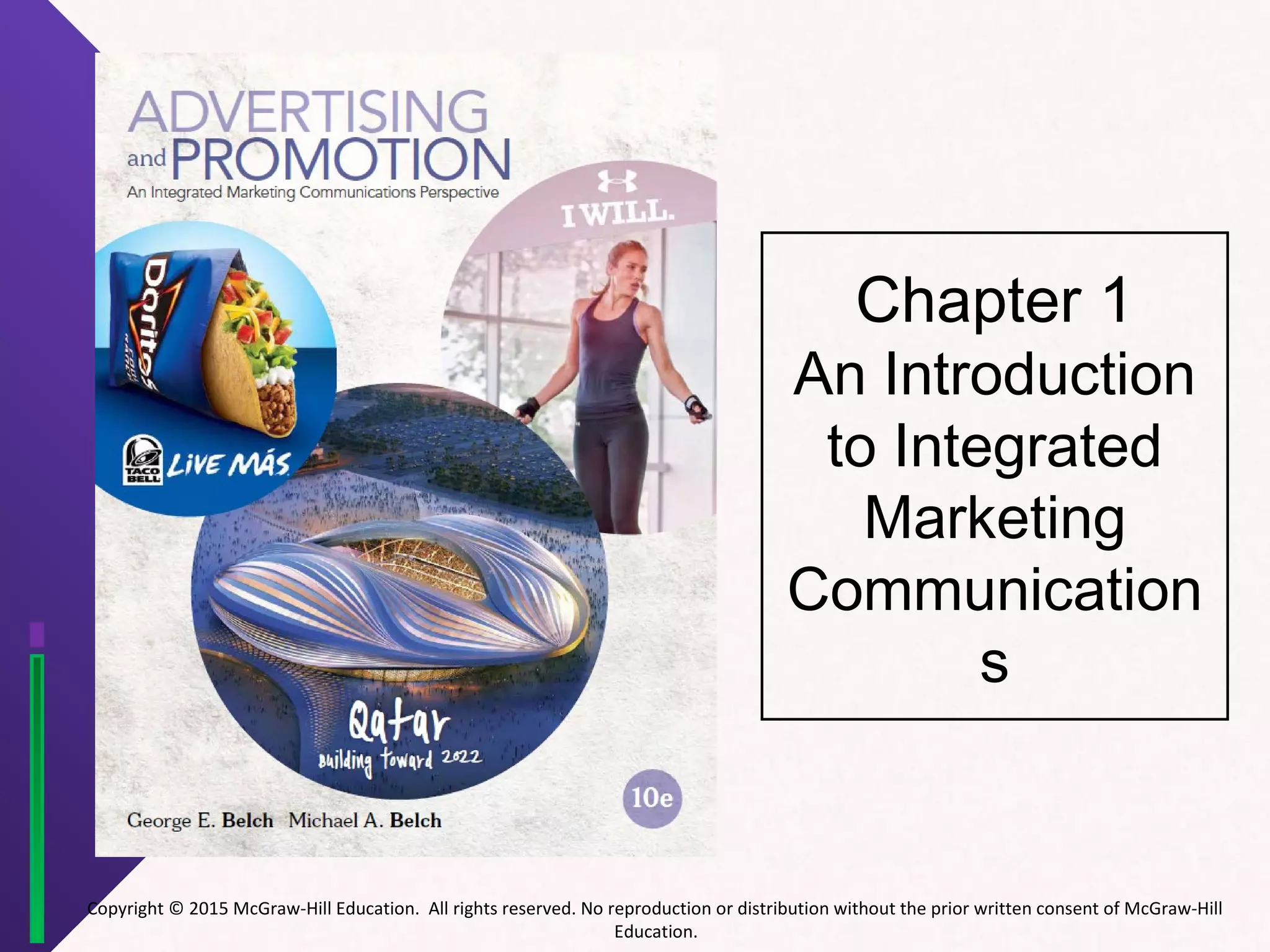
Chapter 1
An Introduction
to Integrated
Marketing
Communication
s
Copyright © 2015 McGraw-Hill Education. All rights reserved. No reproduction or distribution without the prior written consent of
McGraw-Hill Education.
Marketing
 Activity, set of institutions, and processes for
creating, communicating, delivering and
exchanging offerings that have value for:
 Customers, clients, partners, and society at large
 Exchange: Involves parties with:
 Something of value to one another
 Desire and ability to give up something to the other
party
 Way to communicate with each other
2
Copyright © 2015 McGraw-Hill Education. All rights reserved. No reproduction or distribution without the prior written consent of
McGraw-Hill Education.
Marketing Mix
 Product, price, place, and promotion
 To develop an effective marketing mix, marketers
must:
 Be knowledgeable about the issues and options of
each element of the mix
 Know how to combine the elements to form an
effective marketing program
 Analyze the market and use the data to develop the
marketing strategy and mix
3
Copyright © 2015 McGraw-Hill Education. All rights reserved. No reproduction or distribution without the prior written consent of
McGraw-Hill Education.
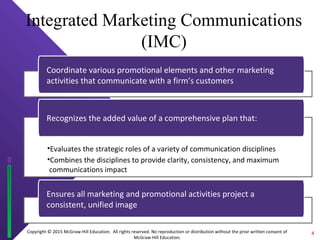
Integrated Marketing Communications
(IMC)
Coordinate various promotional elements and other marketing
activities that communicate with a firm’s customers
•Evaluates the strategic roles of a variety of communication disciplines
•Combines the disciplines to provide clarity, consistency, and maximum
communications impact
Recognizes the added value of a comprehensive plan that:
Ensures all marketing and promotional activities project a
consistent, unified image
4
Copyright © 2015 McGraw-Hill Education. All rights reserved. No reproduction or distribution without the prior written consent of
McGraw-Hill Education.
Integrated Marketing Communications
(IMC)
 Criticism - Inside-out marketing approach
 Packs promotional mix elements together, making
them look and sound alike
 Contemporary perspective
 Goal - Generate short-term financial returns and
build long-term brand and shareholder value
 Views IMC ongoing strategic business process
5
Copyright © 2015 McGraw-Hill Education. All rights reserved. No reproduction or distribution without the prior written consent of
McGraw-Hill Education.
Growing Importance of IMC
Strategically integrates the various communications functions
Avoids duplication and takes advantage of synergy among
promotional tools
Develops more efficient and effective marketing
communications programs
•Evolution to micromarketing
•Consumers’ unresponsiveness to traditional advertising
•Changing rules of marketing
Changing environment
6
Copyright © 2015 McGraw-Hill Education. All rights reserved. No reproduction or distribution without the prior written consent of
McGraw-Hill Education.
Integrated Marketing Communications
(IMC): Role in Branding
Helps develop and sustain brand identity and
equity
Recognizes the need for companies to connect
with consumers based on trust, transparency,
and authenticity
7
Copyright © 2015 McGraw-Hill Education. All rights reserved. No reproduction or distribution without the prior written consent of
McGraw-Hill Education.
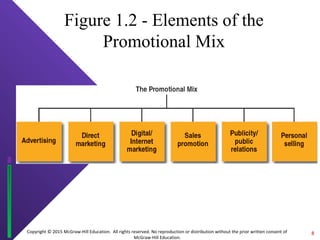
Figure 1.2 - Elements of the
Promotional Mix
8
Copyright © 2015 McGraw-Hill Education. All rights reserved. No reproduction or distribution without the prior written consent of
McGraw-Hill Education.
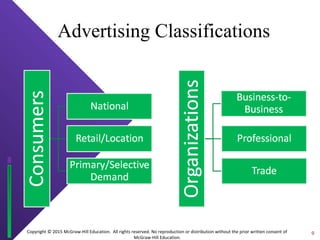
Advertising Classifications
9
Copyright © 2015 McGraw-Hill Education. All rights reserved. No reproduction or distribution without the prior written consent of
McGraw-Hill Education.
Direct Marketing
 Communicating directly with target customers to
generate a response and/or a transaction
 Involves:
 Database management
 Direct selling
 Telemarketing
 Direct-response advertising
 Encourages the consumer to purchase directly from the
manufacturer
10
Copyright © 2015 McGraw-Hill Education. All rights reserved. No reproduction or distribution without the prior written consent of
McGraw-Hill Education.
Digital/Internet Marketing
Interactive media
• Allow users to participate in and modify the form and content
of the information they receive in real time
Social media
• Online means of communication and interactions used to
create, share, and exchange content
Mobile marketing
• Messages delivered are specific to a consumer’s location or
consumption situation
11
Copyright © 2015 McGraw-Hill Education. All rights reserved. No reproduction or distribution without the prior written consent of
McGraw-Hill Education.
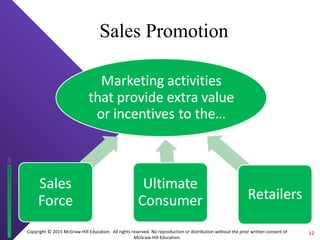
Sales Promotion
12
Copyright © 2015 McGraw-Hill Education. All rights reserved. No reproduction or distribution without the prior written consent of
McGraw-Hill Education.
Publicity
 Nonpersonal communications regarding an
organization, product, service, or idea not directly
paid for or run under identified sponsorship
 Advantage
 High credibility and low cost
 Disadvantages
 Not always under the control of an organization
 Negative stories are highly damaging
13
Copyright © 2015 McGraw-Hill Education. All rights reserved. No reproduction or distribution without the prior written consent of
McGraw-Hill Education.
Public Relations
 Evaluates public attitudes
 Identifies policies and procedures of an individual
or organization with the public interest
 Goal - Establish and maintain a positive image
among various publics
14
Copyright © 2015 McGraw-Hill Education. All rights reserved. No reproduction or distribution without the prior written consent of
McGraw-Hill Education.
Personal Selling
 Person-to-person communication in which seller
attempts to assist and/or persuade prospective
buyers to:
 Purchase a company’s product
 Act on an idea
 Allows seller to tailor messages to the customer’s
specific needs or situation
 Involves immediate and precise feedback
15
Copyright © 2015 McGraw-Hill Education. All rights reserved. No reproduction or distribution without the prior written consent of
McGraw-Hill Education.
Contact or Touch Point
 Every opportunity a customer has to see or hear
about a company and/or its brands or have an
encounter or experience with it
 Categories
 Company created
 Intrinsic
 Unexpected
 Customer-initiated
16
Copyright © 2015 McGraw-Hill Education. All rights reserved. No reproduction or distribution without the prior written consent of
McGraw-Hill Education.
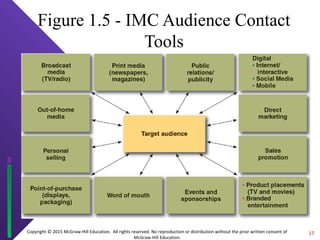
Figure 1.5 - IMC Audience Contact
Tools
17
Copyright © 2015 McGraw-Hill Education. All rights reserved. No reproduction or distribution without the prior written consent of
McGraw-Hill Education.
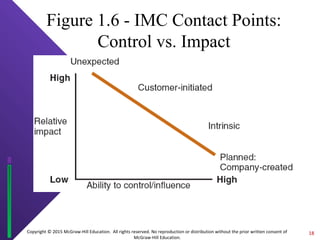
Figure 1.6 - IMC Contact Points:
Control vs. Impact
18
Copyright © 2015 McGraw-Hill Education. All rights reserved. No reproduction or distribution without the prior written consent of
McGraw-Hill Education.
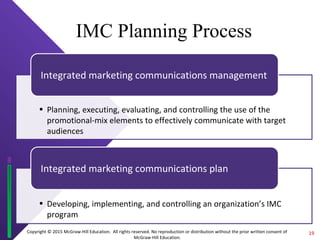
IMC Planning Process
• Planning, executing, evaluating, and controlling the use of the
promotional-mix elements to effectively communicate with target
audiences
Integrated marketing communications management
• Developing, implementing, and controlling an organization’s IMC
program
Integrated marketing communications plan
19
Copyright © 2015 McGraw-Hill Education. All rights reserved. No reproduction or distribution without the prior written consent of
McGraw-Hill Education.
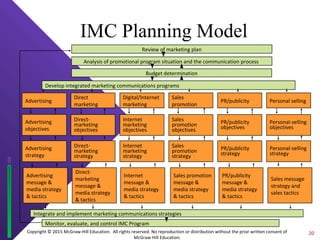
IMC Planning Model
Analysis of promotional program situation and the communication process
Budget determination
Develop integrated marketing communications programs
Review of marketing plan
Advertising
Direct
marketing
Digital/Internet
marketing
Sales
promotion
PR/publicity
Advertising
objectives
Direct-
marketing
objectives
Internet
marketing
objectives
Sales
promotion
objectives
PR/publicity
objectives
Advertising
strategy
Direct-
marketing
strategy
Internet
marketing
strategy
Sales
promotion
strategy
PR/publicity
strategy
Integrate and implement marketing communications strategies
Monitor, evaluate, and control IMC Program
Personal selling
Personal-selling
objectives
Personal-selling
strategy
Advertising
message &
media strategy
& tactics
Direct-
marketing
message &
media strategy
& tactics
Internet
message &
media strategy
& tactics
Sales promotion
message &
media strategy
& tactics
PR/publicity
message &
media strategy
& tactics
Sales message
strategy and
sales tactics
20
Copyright © 2015 McGraw-Hill Education. All rights reserved. No reproduction or distribution without the prior written consent of
McGraw-Hill Education.
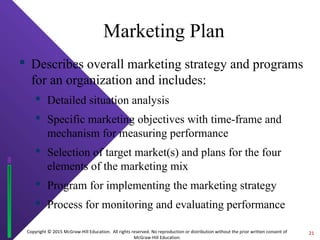
Marketing Plan
 Describes overall marketing strategy and programs
for an organization and includes:
 Detailed situation analysis
 Specific marketing objectives with time-frame and
mechanism for measuring performance
 Selection of target market(s) and plans for the four
elements of the marketing mix
 Program for implementing the marketing strategy
 Process for monitoring and evaluating performance
21
Copyright © 2015 McGraw-Hill Education. All rights reserved. No reproduction or distribution without the prior written consent of
McGraw-Hill Education.
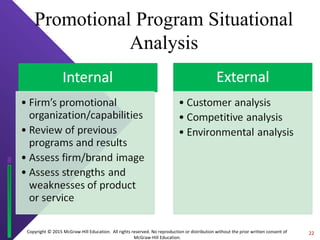
Promotional Program Situational
Analysis
22
Copyright © 2015 McGraw-Hill Education. All rights reserved. No reproduction or distribution without the prior written consent of
McGraw-Hill Education.
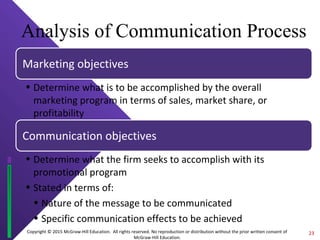
Analysis of Communication Process
Marketing objectives
• Determine what is to be accomplished by the overall
marketing program in terms of sales, market share, or
profitability
Communication objectives
• Determine what the firm seeks to accomplish with its
promotional program
• Stated in terms of:
• Nature of the message to be communicated
• Specific communication effects to be achieved
23
Copyright © 2015 McGraw-Hill Education. All rights reserved. No reproduction or distribution without the prior written consent of
McGraw-Hill Education.
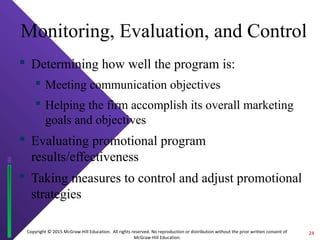
Monitoring, Evaluation, and Control
 Determining how well the program is:
 Meeting communication objectives
 Helping the firm accomplish its overall marketing
goals and objectives
 Evaluating promotional program
results/effectiveness
 Taking measures to control and adjust promotional
strategies
24

Belch 10e ch01_ppt

  • 1.
    Copyright © 2015McGraw-Hill Education. All rights reserved. No reproduction or distribution without the prior written consent of McGraw-Hill Education. Chapter 1 An Introduction to Integrated Marketing Communication s
  • 2.
    Copyright © 2015McGraw-Hill Education. All rights reserved. No reproduction or distribution without the prior written consent of McGraw-Hill Education. Marketing  Activity, set of institutions, and processes for creating, communicating, delivering and exchanging offerings that have value for:  Customers, clients, partners, and society at large  Exchange: Involves parties with:  Something of value to one another  Desire and ability to give up something to the other party  Way to communicate with each other 2
  • 3.
    Copyright © 2015McGraw-Hill Education. All rights reserved. No reproduction or distribution without the prior written consent of McGraw-Hill Education. Marketing Mix  Product, price, place, and promotion  To develop an effective marketing mix, marketers must:  Be knowledgeable about the issues and options of each element of the mix  Know how to combine the elements to form an effective marketing program  Analyze the market and use the data to develop the marketing strategy and mix 3
  • 4.
    Copyright © 2015McGraw-Hill Education. All rights reserved. No reproduction or distribution without the prior written consent of McGraw-Hill Education. Integrated Marketing Communications (IMC) Coordinate various promotional elements and other marketing activities that communicate with a firm’s customers •Evaluates the strategic roles of a variety of communication disciplines •Combines the disciplines to provide clarity, consistency, and maximum communications impact Recognizes the added value of a comprehensive plan that: Ensures all marketing and promotional activities project a consistent, unified image 4
  • 5.
    Copyright © 2015McGraw-Hill Education. All rights reserved. No reproduction or distribution without the prior written consent of McGraw-Hill Education. Integrated Marketing Communications (IMC)  Criticism - Inside-out marketing approach  Packs promotional mix elements together, making them look and sound alike  Contemporary perspective  Goal - Generate short-term financial returns and build long-term brand and shareholder value  Views IMC ongoing strategic business process 5
  • 6.
    Copyright © 2015McGraw-Hill Education. All rights reserved. No reproduction or distribution without the prior written consent of McGraw-Hill Education. Growing Importance of IMC Strategically integrates the various communications functions Avoids duplication and takes advantage of synergy among promotional tools Develops more efficient and effective marketing communications programs •Evolution to micromarketing •Consumers’ unresponsiveness to traditional advertising •Changing rules of marketing Changing environment 6
  • 7.
    Copyright © 2015McGraw-Hill Education. All rights reserved. No reproduction or distribution without the prior written consent of McGraw-Hill Education. Integrated Marketing Communications (IMC): Role in Branding Helps develop and sustain brand identity and equity Recognizes the need for companies to connect with consumers based on trust, transparency, and authenticity 7
  • 8.
    Copyright © 2015McGraw-Hill Education. All rights reserved. No reproduction or distribution without the prior written consent of McGraw-Hill Education. Figure 1.2 - Elements of the Promotional Mix 8
  • 9.
    Copyright © 2015McGraw-Hill Education. All rights reserved. No reproduction or distribution without the prior written consent of McGraw-Hill Education. Advertising Classifications 9
  • 10.
    Copyright © 2015McGraw-Hill Education. All rights reserved. No reproduction or distribution without the prior written consent of McGraw-Hill Education. Direct Marketing  Communicating directly with target customers to generate a response and/or a transaction  Involves:  Database management  Direct selling  Telemarketing  Direct-response advertising  Encourages the consumer to purchase directly from the manufacturer 10
  • 11.
    Copyright © 2015McGraw-Hill Education. All rights reserved. No reproduction or distribution without the prior written consent of McGraw-Hill Education. Digital/Internet Marketing Interactive media • Allow users to participate in and modify the form and content of the information they receive in real time Social media • Online means of communication and interactions used to create, share, and exchange content Mobile marketing • Messages delivered are specific to a consumer’s location or consumption situation 11
  • 12.
    Copyright © 2015McGraw-Hill Education. All rights reserved. No reproduction or distribution without the prior written consent of McGraw-Hill Education. Sales Promotion 12
  • 13.
    Copyright © 2015McGraw-Hill Education. All rights reserved. No reproduction or distribution without the prior written consent of McGraw-Hill Education. Publicity  Nonpersonal communications regarding an organization, product, service, or idea not directly paid for or run under identified sponsorship  Advantage  High credibility and low cost  Disadvantages  Not always under the control of an organization  Negative stories are highly damaging 13
  • 14.
    Copyright © 2015McGraw-Hill Education. All rights reserved. No reproduction or distribution without the prior written consent of McGraw-Hill Education. Public Relations  Evaluates public attitudes  Identifies policies and procedures of an individual or organization with the public interest  Goal - Establish and maintain a positive image among various publics 14
  • 15.
    Copyright © 2015McGraw-Hill Education. All rights reserved. No reproduction or distribution without the prior written consent of McGraw-Hill Education. Personal Selling  Person-to-person communication in which seller attempts to assist and/or persuade prospective buyers to:  Purchase a company’s product  Act on an idea  Allows seller to tailor messages to the customer’s specific needs or situation  Involves immediate and precise feedback 15
  • 16.
    Copyright © 2015McGraw-Hill Education. All rights reserved. No reproduction or distribution without the prior written consent of McGraw-Hill Education. Contact or Touch Point  Every opportunity a customer has to see or hear about a company and/or its brands or have an encounter or experience with it  Categories  Company created  Intrinsic  Unexpected  Customer-initiated 16
  • 17.
    Copyright © 2015McGraw-Hill Education. All rights reserved. No reproduction or distribution without the prior written consent of McGraw-Hill Education. Figure 1.5 - IMC Audience Contact Tools 17
  • 18.
    Copyright © 2015McGraw-Hill Education. All rights reserved. No reproduction or distribution without the prior written consent of McGraw-Hill Education. Figure 1.6 - IMC Contact Points: Control vs. Impact 18
  • 19.
    Copyright © 2015McGraw-Hill Education. All rights reserved. No reproduction or distribution without the prior written consent of McGraw-Hill Education. IMC Planning Process • Planning, executing, evaluating, and controlling the use of the promotional-mix elements to effectively communicate with target audiences Integrated marketing communications management • Developing, implementing, and controlling an organization’s IMC program Integrated marketing communications plan 19
  • 20.
    Copyright © 2015McGraw-Hill Education. All rights reserved. No reproduction or distribution without the prior written consent of McGraw-Hill Education. IMC Planning Model Analysis of promotional program situation and the communication process Budget determination Develop integrated marketing communications programs Review of marketing plan Advertising Direct marketing Digital/Internet marketing Sales promotion PR/publicity Advertising objectives Direct- marketing objectives Internet marketing objectives Sales promotion objectives PR/publicity objectives Advertising strategy Direct- marketing strategy Internet marketing strategy Sales promotion strategy PR/publicity strategy Integrate and implement marketing communications strategies Monitor, evaluate, and control IMC Program Personal selling Personal-selling objectives Personal-selling strategy Advertising message & media strategy & tactics Direct- marketing message & media strategy & tactics Internet message & media strategy & tactics Sales promotion message & media strategy & tactics PR/publicity message & media strategy & tactics Sales message strategy and sales tactics 20
  • 21.
    Copyright © 2015McGraw-Hill Education. All rights reserved. No reproduction or distribution without the prior written consent of McGraw-Hill Education. Marketing Plan  Describes overall marketing strategy and programs for an organization and includes:  Detailed situation analysis  Specific marketing objectives with time-frame and mechanism for measuring performance  Selection of target market(s) and plans for the four elements of the marketing mix  Program for implementing the marketing strategy  Process for monitoring and evaluating performance 21
  • 22.
    Copyright © 2015McGraw-Hill Education. All rights reserved. No reproduction or distribution without the prior written consent of McGraw-Hill Education. Promotional Program Situational Analysis 22
  • 23.
    Copyright © 2015McGraw-Hill Education. All rights reserved. No reproduction or distribution without the prior written consent of McGraw-Hill Education. Analysis of Communication Process Marketing objectives • Determine what is to be accomplished by the overall marketing program in terms of sales, market share, or profitability Communication objectives • Determine what the firm seeks to accomplish with its promotional program • Stated in terms of: • Nature of the message to be communicated • Specific communication effects to be achieved 23
  • 24.
    Copyright © 2015McGraw-Hill Education. All rights reserved. No reproduction or distribution without the prior written consent of McGraw-Hill Education. Monitoring, Evaluation, and Control  Determining how well the program is:  Meeting communication objectives  Helping the firm accomplish its overall marketing goals and objectives  Evaluating promotional program results/effectiveness  Taking measures to control and adjust promotional strategies 24