0
SERVQUAL FOR FAST
FOOD CHAINS `
Nimisha Sahal | Akash Majumder | Deepak Soni | Aayushi Gupta
SV Ganesh | Arjun Sethi |Debjit Nath | Snehil Shrivastava
1
Contents
Abstracts .............................................................................................................................. 2
Introduction ......................................................................................................................... 2
Service Quality...................................................................................................................... 3
Model of Service Quality Gaps ............................................................................................. 3
Gap Model of Service Quality............................................................................................... 4
Methodology........................................................................................................................ 4
Discussion............................................................................................................................. 9
Conclusion............................................................................................................................ 9
Appendix 1: ServQual Survey ............................................................................................. 10
2
Service Quality of Fast Food Chains
McDonalds, KFC, Subway, Dominos
Abstracts
The services are the activities are difficult to evaluate because of intangibility and
heterogeneity. But these features have not limited the scope of services which is very wide
and becoming popular in emerging economies like India, especially the services offered by
fast food industry. The growth of fast food industry in India has been manifolds. With the
changing lifestyle of young professionals and their busy schedule and ease of doing business,
the demand of chain of fast food restaurants has been on a higher side. Service firms are
realizing the significance of customer centred philosophies and service quality are turning to
quality management approaches to help managing their businesses. Thus, this paper studies
the service quality of the famous fast food chain of restaurants - McDonald’s, KFC, Subway
and Dominos. In this study, Servqual instrument has been used to identify the gaps between
the customers’ expectations and perceptions regarding various Fast Food Chains.
Keywords: Service, Quality, Gaps, SERVQUAL, Customer, Expectations, Perceptions
Introduction
Managers in the service sector are moving toward making their services more customer-
centric and also focus on improving performance. With constraints of finances and resources
under which service organisations operate, it becomes essentials that customer expectations
are properly understood and measured and from the customers’ perspective, any gaps in
service quality are identified. Which in turn helps the organisation with information which a
manager uses to identify cost-effective ways of closing service quality gaps and of prioritizing
which gaps to focus on – a critical decision given scarce resources.
While there have been efforts to study service quality, there has been no general agreement
on the measurement of the concept. The majority of the work to date has attempted to use
the SERVQUAL (Parasuraman et al., 1985; 1988) methodology in an effort to measure service
quality (e.g. Brooks et al., 1999; Chaston, 1994; Edvardsson et al., 1997; Lings and Brooks,
1998; Reynoso and Moore,1995; Young and Varble, 1997; Sahney et al., 2004).
One of the aims of this report involves the use of SERVQUAL instrument in order to ascertain
any actual or perceived gaps between customer expectations and perceptions of the service
offered in various fast food chains. In the following, after a brief review of the service quality
concept, the model of service quality gaps and the SERVQUAL methodology is demonstrated.
Then, after a discussion, major conclusions are derived.
3
Service Quality
One of the method used for managing service quality is Servqual. Earlier Servqual is known as
RATER, a quality management framework. Servqual to measure quality in the service sector.
The Servqual originally consist ten elements of service quality, but later, these were collapsed
into five factors - Reliability, Assurance, Tangibles, Empathy and Responsiveness (RATER).
• Reliability: the ability to perform the promised service dependably and accurately.
• Assurance: the knowledge and courtesy of employees and their ability to convey
trust and confidence.
• Tangibles: the appearance of physical facilities, equipment, personnel and
communication materials.
• Empathy: the provision of caring, individualized attention to customers.
• Responsiveness: the willingness to help customers and to provide prompt service.
Different service sectors using Servqual to measure and manage service quality by analysing
questionnaire that measures both the customer expectations regarding service quality in
terms of five dimensions (RATER), and their perceptions about service they receive. When
customer’s expectations are more than their perceptions service quality is deemed to be low.
Model of Service Quality Gaps
The Servqual identified five Gaps that may cause customers to experience poor service
quality, which are shown in Figure 1. The model is an extension of Parasuraman et al. (1985).
Following are the gaps in service quality
 Gap 1: Customers’ expectations versus management perceptions: as a result of the
lack of a marketing research orientation, inadequate upward communication and too
many layers of management.
 Gap 2: Management perceptions versus service specifications: as a result of
inadequate commitment to service quality, a perception of unfeasibility, inadequate
task standardisation and an absence of goal setting.
 Gap 3: Service specifications versus service delivery: as a result of role ambiguity and
conflict, poor employee-job fit and poor technology-job fit, inappropriate supervisory
control systems, lack of perceived control and lack of teamwork.
 Gap 4: Service delivery versus external communication: as a result of inadequate
horizontal communications and propensity to over-promise.
 Gap 5: The discrepancy between customer expectations and their perceptions of the
service delivered: as a result of the influences exerted from the customer side and the
shortfalls (gaps) on the part of the service provider. In this case, customer
expectations are influenced by the extent of personal needs, word of mouth
recommendation and past service experiences.
4
Gap Model of Service Quality
Methodology
The SERVQUAL instrument has been the method used to measure consumers’ perceptions of
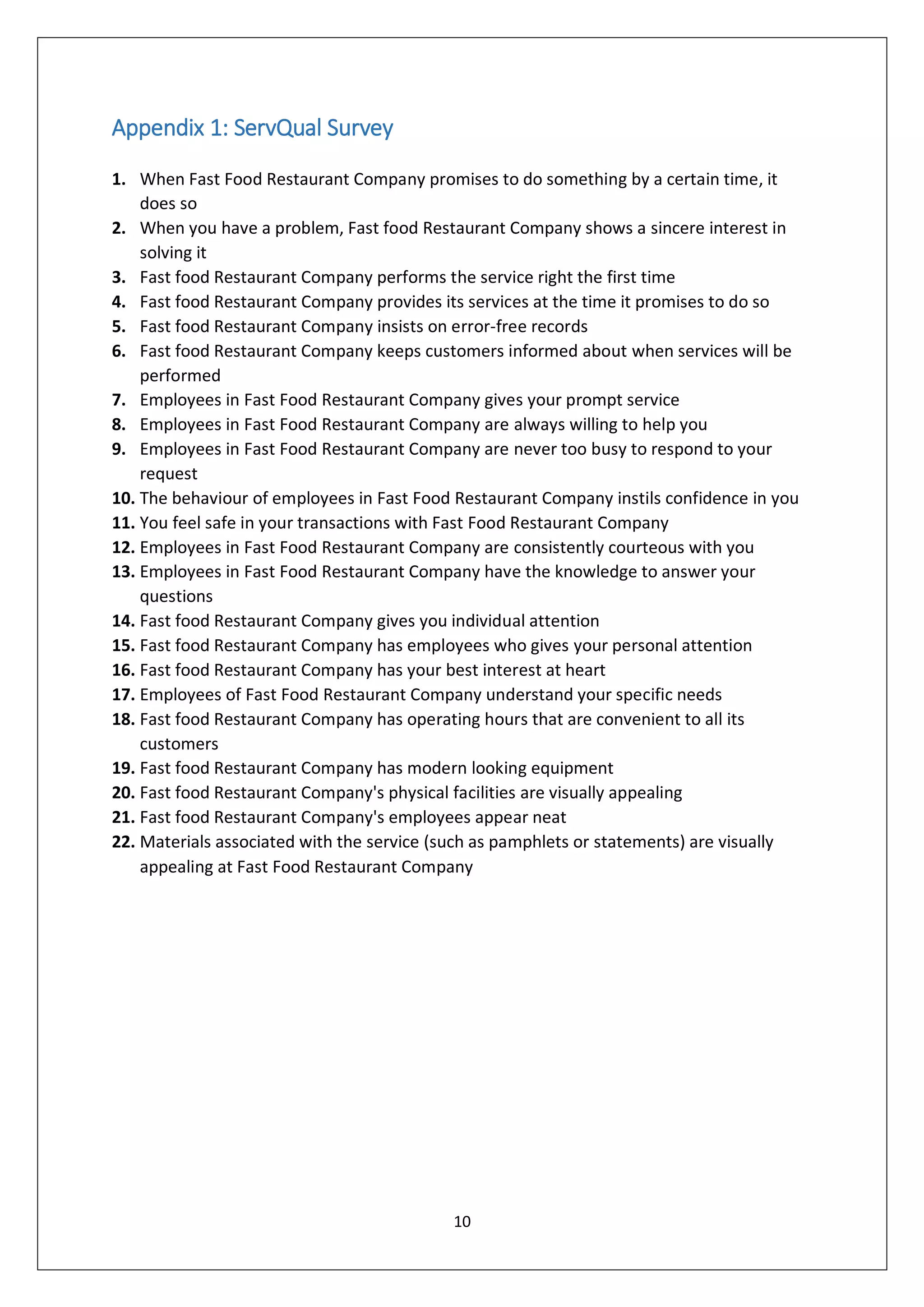
service quality. In the SERVQUAL instrument, 22 statements (Appendix I) measure the
performance across these five dimensions, using a seven point likert scale measuring both
customer expectations and perceptions (Gabbie and O'neill, 1996). It is important to note that
without adequate information on both the quality of services expected and perceptions of
services received then feedback from customer surveys can be highly misleading from both a
policy and an operational perspective. In the following, the application of SERVQUAL
approach is more specified keeping in mind the fast food industry.
In a research conducted by us, a total of 100 questionnaires were distributed to the customers
in Kolkata and 20 useable questionnaires were returned, resulting in a 20 per cent response
rate. This survey was conducted for 4 fast food chains in Kolkata, namely McDonalds, KFC,
Subway and Dominos.
The four fast food chains were compared on the basis of 5 Servqual dimensions and their
relative GAP scores. Following are the findings:
As can be seen from the reliability chart the highest gap score is observed for KFC (-2.8733).
This is a real cause for concern for KFC. The customer feels that they cannot perform the
service dependably and accurately all the time. So this is the parameter that they must work
5
upon to bridge the gap between customer expectation and perception. All the other three
firms have almost similar scores on reliability.
According to the tangibility chart, McDonalds has the lowest gap, which indicates that the
appearance of their physical facilities appeals to customer. They also have modern equipment
and maintain proper hygiene. This helps this firm to attract larger customer base than its
competitors. KFC again has the highest gap so they need to work on it.
Responsiveness of Dominos has the lowest score (-0.6125). According to the score Dominos
is willing to help customer and to provide prompt service. Which can be observed in their
delivery mechanism, as well as customer complain handling. For example, Dominos generally
replaces quickly if there is some problem in the order, giving customer best quality response.
On the other hand, KFC is unable to provide prompt services/responses.
-0.92
-2.8733
-0.959
-0.66
DO MINO S KFC SUB WAY MC DO NAL DS
AV G . G AP SC O R E
RELIABILITY
-0.95
-3.14375
-0.929375
-0.65
DO MINO S KFC SUB WAY MC DO NAL DS
AV G . G AP SC O R E
TANGIBILITY
6
Assurance is the knowledge and courtesy of employees and their ability to convey trust and
confidence. Subway, clearly has the minimum gap score, which can be justified as the process
of making the sub (sandwich), is right in front of the customer, as well as customised to their
choice. The employees are friendly as well as knowledgeable and also guide customers from
time to time. Also dominos, with their open kitchen concept provide the similar level of
assurance. While KFC again remains far behind.
As can be inferred from the graph, KFC and McDonalds have the highest gap score, they have
a very little contact with the customers other than for taking the orders. But in subway and
dominos the individual curiosity of the customers was met by the employees and also helps
the customers to choose from the variety of choices available.
-0.6125
-2.90208
-0.663125
-1.125
DO MINO S KFC SUB WAY MC DO NAL DS
AV G . G AP SC O R E
RESPONSIVENESS
-0.6875
-2.70833
-0.66875
-0.925
DO MINO S KFC SUB WAY MC DO NAL DS
AV G . G AP SC O R E
ASSURANCE
7
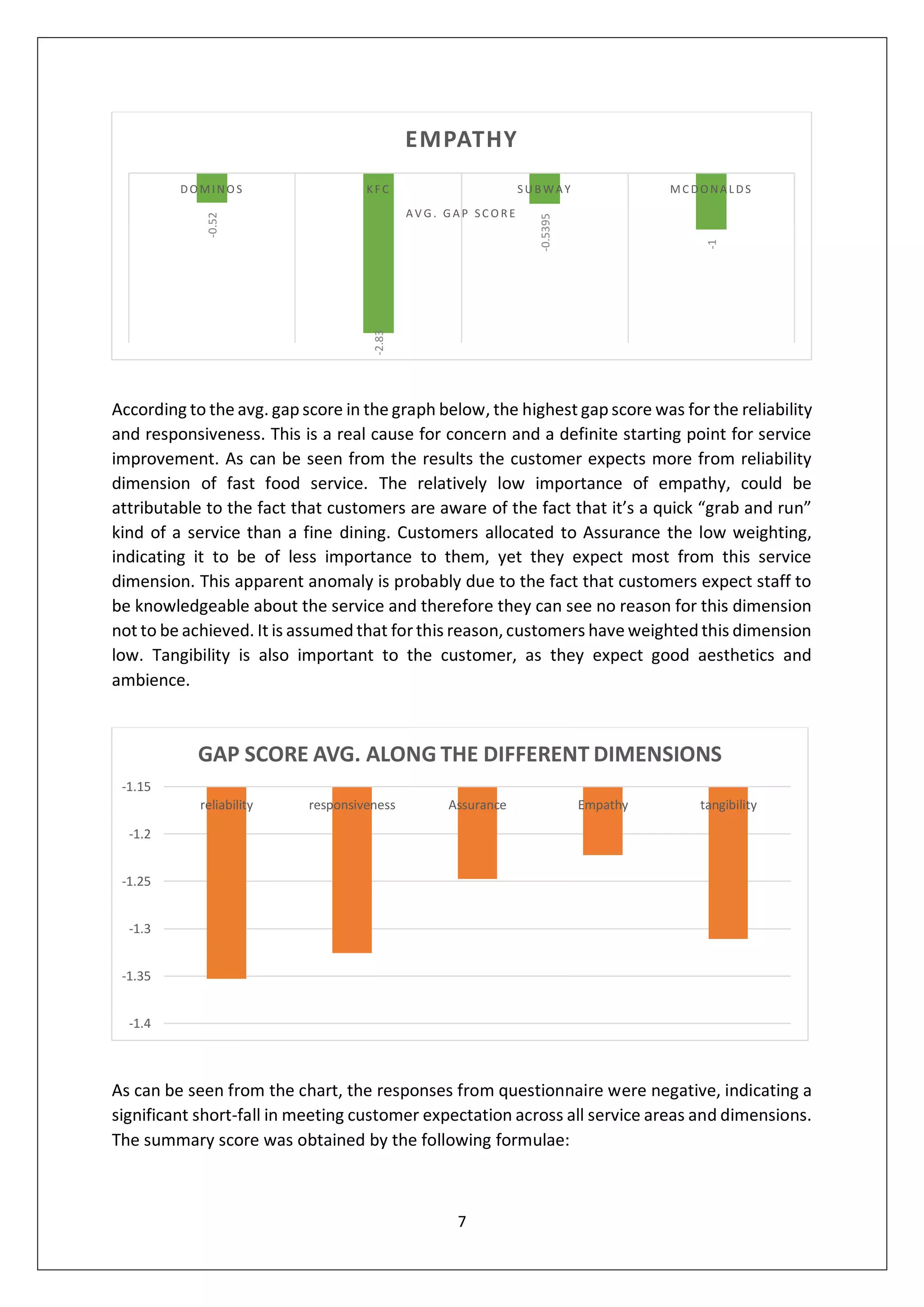
According to the avg. gap score in the graph below, the highest gap score was for the reliability
and responsiveness. This is a real cause for concern and a definite starting point for service
improvement. As can be seen from the results the customer expects more from reliability
dimension of fast food service. The relatively low importance of empathy, could be
attributable to the fact that customers are aware of the fact that it’s a quick “grab and run”
kind of a service than a fine dining. Customers allocated to Assurance the low weighting,
indicating it to be of less importance to them, yet they expect most from this service
dimension. This apparent anomaly is probably due to the fact that customers expect staff to
be knowledgeable about the service and therefore they can see no reason for this dimension
not to be achieved. It is assumed that for this reason,customers have weighted this dimension
low. Tangibility is also important to the customer, as they expect good aesthetics and
ambience.
As can be seen from the chart, the responses from questionnaire were negative, indicating a
significant short-fall in meeting customer expectation across all service areas and dimensions.
The summary score was obtained by the following formulae:
-0.52
-2.83
-0.5395
-1
DO MINO S KFC SUB WAY MC DO NAL DS
AV G . G AP SC O R E
EMPATHY
-1.4
-1.35
-1.3
-1.25
-1.2
-1.15
reliability responsiveness Assurance Empathy tangibility
GAP SCORE AVG. ALONG THE DIFFERENT DIMENSIONS
8
𝑆𝑒𝑟𝑣𝑄𝑢𝑎𝑙 𝑆𝑐𝑜𝑟𝑒 =
∑(𝐴𝑣𝑔.𝑠𝑐𝑜𝑟𝑒 𝑜𝑓 𝑡ℎ𝑒 𝑑𝑖𝑚𝑒𝑛𝑠𝑖𝑜𝑛×𝑖𝑚𝑝𝑜𝑟𝑡𝑎𝑛𝑐𝑒 𝑤𝑒𝑖𝑔ℎ𝑡 𝑜𝑓 𝑡ℎ𝑒 𝑑𝑖𝑚𝑒𝑛𝑠𝑖𝑜𝑛)
5
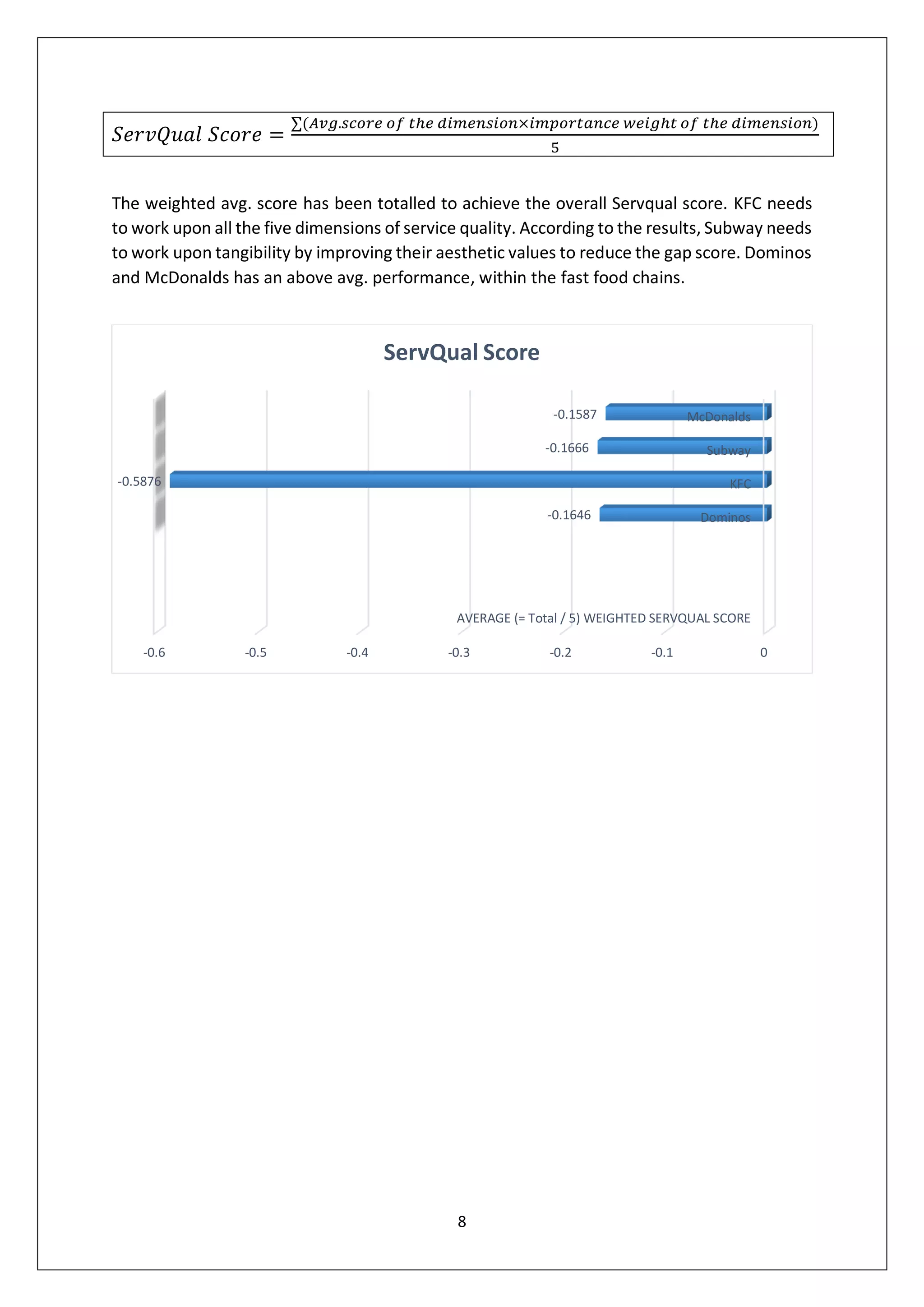
The weighted avg. score has been totalled to achieve the overall Servqual score. KFC needs
to work upon all the five dimensions of service quality. According to the results, Subway needs
to work upon tangibility by improving their aesthetic values to reduce the gap score. Dominos
and McDonalds has an above avg. performance, within the fast food chains.
-0.6 -0.5 -0.4 -0.3 -0.2 -0.1 0
AVERAGE (= Total / 5) WEIGHTED SERVQUAL SCORE
Dominos
KFC
Subway
McDonalds
-0.1646
-0.5876
-0.1666
-0.1587
ServQual Score
9
Discussion
The largest negative gaps, combined with assessment of where expectations are highest,
facilitates prioritization of performance improvement. Equally, if gap scores in some aspects
of service do turn out to be positive, implying expectations are actually not just being met but
exceeded, then this allows managers to review whether they may be "over-supplying" this
particular feature of the service and whether there is potential for re-deployment of
resources into features which are underperforming. It seems that in almost all the existing
resources, the SERVQUAL approach has been used only for closing Gap 5. However, its
application could also be extended to the analysis of other gaps. It is important to note that
SERVQUAL is only one of the instruments used in service quality analysis and there are
different approaches which might be stronger in closing gaps.
Service provision is complex, it is not simply a matter of meeting expressed needs, but of
finding out unexpressed needs, setting priorities, allocating resources and publicly justifying
and accounting for what has been done". Service organizations are responsible and
accountable to citizens and communities as well as to customers and service users. It is
important to note that the measurement systems themselves are often inappropriate
because the system designers do not know enough about what is to be measured. Measuring
customer perceptions of service may increase expectations and measuring too often may well
result in customers losing their motivation to answer correctly. Finally, there is no point in
measuring service quality if one is not willing to take appropriate action on the findings
Conclusion
The results of our survey shows, other than KFC, all the 3 firms have almost similar Servqual
score that is because most of the respondents were vegetarian. And in KFC the choice for
vegetarians are very low, so it is never the first choice for them.
10
Appendix 1: ServQual Survey
1. When Fast Food Restaurant Company promises to do something by a certain time, it
does so
2. When you have a problem, Fast food Restaurant Company shows a sincere interest in
solving it
3. Fast food Restaurant Company performs the service right the first time
4. Fast food Restaurant Company provides its services at the time it promises to do so
5. Fast food Restaurant Company insists on error-free records
6. Fast food Restaurant Company keeps customers informed about when services will be
performed
7. Employees in Fast Food Restaurant Company gives your prompt service
8. Employees in Fast Food Restaurant Company are always willing to help you
9. Employees in Fast Food Restaurant Company are never too busy to respond to your
request
10. The behaviour of employees in Fast Food Restaurant Company instils confidence in you
11. You feel safe in your transactions with Fast Food Restaurant Company
12. Employees in Fast Food Restaurant Company are consistently courteous with you
13. Employees in Fast Food Restaurant Company have the knowledge to answer your
questions
14. Fast food Restaurant Company gives you individual attention
15. Fast food Restaurant Company has employees who gives your personal attention
16. Fast food Restaurant Company has your best interest at heart
17. Employees of Fast Food Restaurant Company understand your specific needs
18. Fast food Restaurant Company has operating hours that are convenient to all its
customers
19. Fast food Restaurant Company has modern looking equipment
20. Fast food Restaurant Company's physical facilities are visually appealing
21. Fast food Restaurant Company's employees appear neat
22. Materials associated with the service (such as pamphlets or statements) are visually
appealing at Fast Food Restaurant Company

Service quality of fast food chains

  • 1.
    0 SERVQUAL FOR FAST FOODCHAINS ` Nimisha Sahal | Akash Majumder | Deepak Soni | Aayushi Gupta SV Ganesh | Arjun Sethi |Debjit Nath | Snehil Shrivastava
  • 2.
    1 Contents Abstracts .............................................................................................................................. 2 Introduction......................................................................................................................... 2 Service Quality...................................................................................................................... 3 Model of Service Quality Gaps ............................................................................................. 3 Gap Model of Service Quality............................................................................................... 4 Methodology........................................................................................................................ 4 Discussion............................................................................................................................. 9 Conclusion............................................................................................................................ 9 Appendix 1: ServQual Survey ............................................................................................. 10
  • 3.
    2 Service Quality ofFast Food Chains McDonalds, KFC, Subway, Dominos Abstracts The services are the activities are difficult to evaluate because of intangibility and heterogeneity. But these features have not limited the scope of services which is very wide and becoming popular in emerging economies like India, especially the services offered by fast food industry. The growth of fast food industry in India has been manifolds. With the changing lifestyle of young professionals and their busy schedule and ease of doing business, the demand of chain of fast food restaurants has been on a higher side. Service firms are realizing the significance of customer centred philosophies and service quality are turning to quality management approaches to help managing their businesses. Thus, this paper studies the service quality of the famous fast food chain of restaurants - McDonald’s, KFC, Subway and Dominos. In this study, Servqual instrument has been used to identify the gaps between the customers’ expectations and perceptions regarding various Fast Food Chains. Keywords: Service, Quality, Gaps, SERVQUAL, Customer, Expectations, Perceptions Introduction Managers in the service sector are moving toward making their services more customer- centric and also focus on improving performance. With constraints of finances and resources under which service organisations operate, it becomes essentials that customer expectations are properly understood and measured and from the customers’ perspective, any gaps in service quality are identified. Which in turn helps the organisation with information which a manager uses to identify cost-effective ways of closing service quality gaps and of prioritizing which gaps to focus on – a critical decision given scarce resources. While there have been efforts to study service quality, there has been no general agreement on the measurement of the concept. The majority of the work to date has attempted to use the SERVQUAL (Parasuraman et al., 1985; 1988) methodology in an effort to measure service quality (e.g. Brooks et al., 1999; Chaston, 1994; Edvardsson et al., 1997; Lings and Brooks, 1998; Reynoso and Moore,1995; Young and Varble, 1997; Sahney et al., 2004). One of the aims of this report involves the use of SERVQUAL instrument in order to ascertain any actual or perceived gaps between customer expectations and perceptions of the service offered in various fast food chains. In the following, after a brief review of the service quality concept, the model of service quality gaps and the SERVQUAL methodology is demonstrated. Then, after a discussion, major conclusions are derived.
  • 4.
    3 Service Quality One ofthe method used for managing service quality is Servqual. Earlier Servqual is known as RATER, a quality management framework. Servqual to measure quality in the service sector. The Servqual originally consist ten elements of service quality, but later, these were collapsed into five factors - Reliability, Assurance, Tangibles, Empathy and Responsiveness (RATER). • Reliability: the ability to perform the promised service dependably and accurately. • Assurance: the knowledge and courtesy of employees and their ability to convey trust and confidence. • Tangibles: the appearance of physical facilities, equipment, personnel and communication materials. • Empathy: the provision of caring, individualized attention to customers. • Responsiveness: the willingness to help customers and to provide prompt service. Different service sectors using Servqual to measure and manage service quality by analysing questionnaire that measures both the customer expectations regarding service quality in terms of five dimensions (RATER), and their perceptions about service they receive. When customer’s expectations are more than their perceptions service quality is deemed to be low. Model of Service Quality Gaps The Servqual identified five Gaps that may cause customers to experience poor service quality, which are shown in Figure 1. The model is an extension of Parasuraman et al. (1985). Following are the gaps in service quality  Gap 1: Customers’ expectations versus management perceptions: as a result of the lack of a marketing research orientation, inadequate upward communication and too many layers of management.  Gap 2: Management perceptions versus service specifications: as a result of inadequate commitment to service quality, a perception of unfeasibility, inadequate task standardisation and an absence of goal setting.  Gap 3: Service specifications versus service delivery: as a result of role ambiguity and conflict, poor employee-job fit and poor technology-job fit, inappropriate supervisory control systems, lack of perceived control and lack of teamwork.  Gap 4: Service delivery versus external communication: as a result of inadequate horizontal communications and propensity to over-promise.  Gap 5: The discrepancy between customer expectations and their perceptions of the service delivered: as a result of the influences exerted from the customer side and the shortfalls (gaps) on the part of the service provider. In this case, customer expectations are influenced by the extent of personal needs, word of mouth recommendation and past service experiences.
  • 5.
    4 Gap Model ofService Quality Methodology The SERVQUAL instrument has been the method used to measure consumers’ perceptions of service quality. In the SERVQUAL instrument, 22 statements (Appendix I) measure the performance across these five dimensions, using a seven point likert scale measuring both customer expectations and perceptions (Gabbie and O'neill, 1996). It is important to note that without adequate information on both the quality of services expected and perceptions of services received then feedback from customer surveys can be highly misleading from both a policy and an operational perspective. In the following, the application of SERVQUAL approach is more specified keeping in mind the fast food industry. In a research conducted by us, a total of 100 questionnaires were distributed to the customers in Kolkata and 20 useable questionnaires were returned, resulting in a 20 per cent response rate. This survey was conducted for 4 fast food chains in Kolkata, namely McDonalds, KFC, Subway and Dominos. The four fast food chains were compared on the basis of 5 Servqual dimensions and their relative GAP scores. Following are the findings: As can be seen from the reliability chart the highest gap score is observed for KFC (-2.8733). This is a real cause for concern for KFC. The customer feels that they cannot perform the service dependably and accurately all the time. So this is the parameter that they must work
  • 6.
    5 upon to bridgethe gap between customer expectation and perception. All the other three firms have almost similar scores on reliability. According to the tangibility chart, McDonalds has the lowest gap, which indicates that the appearance of their physical facilities appeals to customer. They also have modern equipment and maintain proper hygiene. This helps this firm to attract larger customer base than its competitors. KFC again has the highest gap so they need to work on it. Responsiveness of Dominos has the lowest score (-0.6125). According to the score Dominos is willing to help customer and to provide prompt service. Which can be observed in their delivery mechanism, as well as customer complain handling. For example, Dominos generally replaces quickly if there is some problem in the order, giving customer best quality response. On the other hand, KFC is unable to provide prompt services/responses. -0.92 -2.8733 -0.959 -0.66 DO MINO S KFC SUB WAY MC DO NAL DS AV G . G AP SC O R E RELIABILITY -0.95 -3.14375 -0.929375 -0.65 DO MINO S KFC SUB WAY MC DO NAL DS AV G . G AP SC O R E TANGIBILITY
  • 7.
    6 Assurance is theknowledge and courtesy of employees and their ability to convey trust and confidence. Subway, clearly has the minimum gap score, which can be justified as the process of making the sub (sandwich), is right in front of the customer, as well as customised to their choice. The employees are friendly as well as knowledgeable and also guide customers from time to time. Also dominos, with their open kitchen concept provide the similar level of assurance. While KFC again remains far behind. As can be inferred from the graph, KFC and McDonalds have the highest gap score, they have a very little contact with the customers other than for taking the orders. But in subway and dominos the individual curiosity of the customers was met by the employees and also helps the customers to choose from the variety of choices available. -0.6125 -2.90208 -0.663125 -1.125 DO MINO S KFC SUB WAY MC DO NAL DS AV G . G AP SC O R E RESPONSIVENESS -0.6875 -2.70833 -0.66875 -0.925 DO MINO S KFC SUB WAY MC DO NAL DS AV G . G AP SC O R E ASSURANCE
  • 8.
    7 According to theavg. gap score in the graph below, the highest gap score was for the reliability and responsiveness. This is a real cause for concern and a definite starting point for service improvement. As can be seen from the results the customer expects more from reliability dimension of fast food service. The relatively low importance of empathy, could be attributable to the fact that customers are aware of the fact that it’s a quick “grab and run” kind of a service than a fine dining. Customers allocated to Assurance the low weighting, indicating it to be of less importance to them, yet they expect most from this service dimension. This apparent anomaly is probably due to the fact that customers expect staff to be knowledgeable about the service and therefore they can see no reason for this dimension not to be achieved. It is assumed that for this reason,customers have weighted this dimension low. Tangibility is also important to the customer, as they expect good aesthetics and ambience. As can be seen from the chart, the responses from questionnaire were negative, indicating a significant short-fall in meeting customer expectation across all service areas and dimensions. The summary score was obtained by the following formulae: -0.52 -2.83 -0.5395 -1 DO MINO S KFC SUB WAY MC DO NAL DS AV G . G AP SC O R E EMPATHY -1.4 -1.35 -1.3 -1.25 -1.2 -1.15 reliability responsiveness Assurance Empathy tangibility GAP SCORE AVG. ALONG THE DIFFERENT DIMENSIONS
  • 9.
    8 𝑆𝑒𝑟𝑣𝑄𝑢𝑎𝑙 𝑆𝑐𝑜𝑟𝑒 = ∑(𝐴𝑣𝑔.𝑠𝑐𝑜𝑟𝑒𝑜𝑓 𝑡ℎ𝑒 𝑑𝑖𝑚𝑒𝑛𝑠𝑖𝑜𝑛×𝑖𝑚𝑝𝑜𝑟𝑡𝑎𝑛𝑐𝑒 𝑤𝑒𝑖𝑔ℎ𝑡 𝑜𝑓 𝑡ℎ𝑒 𝑑𝑖𝑚𝑒𝑛𝑠𝑖𝑜𝑛) 5 The weighted avg. score has been totalled to achieve the overall Servqual score. KFC needs to work upon all the five dimensions of service quality. According to the results, Subway needs to work upon tangibility by improving their aesthetic values to reduce the gap score. Dominos and McDonalds has an above avg. performance, within the fast food chains. -0.6 -0.5 -0.4 -0.3 -0.2 -0.1 0 AVERAGE (= Total / 5) WEIGHTED SERVQUAL SCORE Dominos KFC Subway McDonalds -0.1646 -0.5876 -0.1666 -0.1587 ServQual Score
  • 10.
    9 Discussion The largest negativegaps, combined with assessment of where expectations are highest, facilitates prioritization of performance improvement. Equally, if gap scores in some aspects of service do turn out to be positive, implying expectations are actually not just being met but exceeded, then this allows managers to review whether they may be "over-supplying" this particular feature of the service and whether there is potential for re-deployment of resources into features which are underperforming. It seems that in almost all the existing resources, the SERVQUAL approach has been used only for closing Gap 5. However, its application could also be extended to the analysis of other gaps. It is important to note that SERVQUAL is only one of the instruments used in service quality analysis and there are different approaches which might be stronger in closing gaps. Service provision is complex, it is not simply a matter of meeting expressed needs, but of finding out unexpressed needs, setting priorities, allocating resources and publicly justifying and accounting for what has been done". Service organizations are responsible and accountable to citizens and communities as well as to customers and service users. It is important to note that the measurement systems themselves are often inappropriate because the system designers do not know enough about what is to be measured. Measuring customer perceptions of service may increase expectations and measuring too often may well result in customers losing their motivation to answer correctly. Finally, there is no point in measuring service quality if one is not willing to take appropriate action on the findings Conclusion The results of our survey shows, other than KFC, all the 3 firms have almost similar Servqual score that is because most of the respondents were vegetarian. And in KFC the choice for vegetarians are very low, so it is never the first choice for them.
  • 11.
    10 Appendix 1: ServQualSurvey 1. When Fast Food Restaurant Company promises to do something by a certain time, it does so 2. When you have a problem, Fast food Restaurant Company shows a sincere interest in solving it 3. Fast food Restaurant Company performs the service right the first time 4. Fast food Restaurant Company provides its services at the time it promises to do so 5. Fast food Restaurant Company insists on error-free records 6. Fast food Restaurant Company keeps customers informed about when services will be performed 7. Employees in Fast Food Restaurant Company gives your prompt service 8. Employees in Fast Food Restaurant Company are always willing to help you 9. Employees in Fast Food Restaurant Company are never too busy to respond to your request 10. The behaviour of employees in Fast Food Restaurant Company instils confidence in you 11. You feel safe in your transactions with Fast Food Restaurant Company 12. Employees in Fast Food Restaurant Company are consistently courteous with you 13. Employees in Fast Food Restaurant Company have the knowledge to answer your questions 14. Fast food Restaurant Company gives you individual attention 15. Fast food Restaurant Company has employees who gives your personal attention 16. Fast food Restaurant Company has your best interest at heart 17. Employees of Fast Food Restaurant Company understand your specific needs 18. Fast food Restaurant Company has operating hours that are convenient to all its customers 19. Fast food Restaurant Company has modern looking equipment 20. Fast food Restaurant Company's physical facilities are visually appealing 21. Fast food Restaurant Company's employees appear neat 22. Materials associated with the service (such as pamphlets or statements) are visually appealing at Fast Food Restaurant Company