


The Changing Digital Landscape Three revolutions … and the three upheavals yet to come Meeting of Center for Digital Information October 22, 2010 Lee Rainie: Director, Pew Internet Project
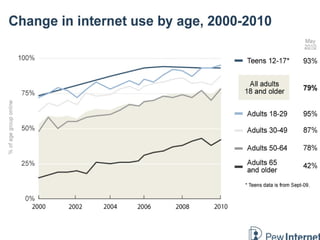
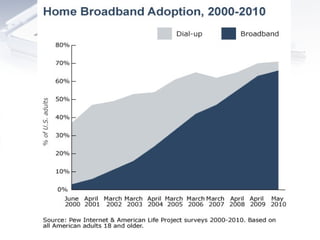
October 22, 2010 Apology Revolution 1 Internet and broadband
 
 
October 22, 2010 Apology Revolution 2 Wireless connectivity
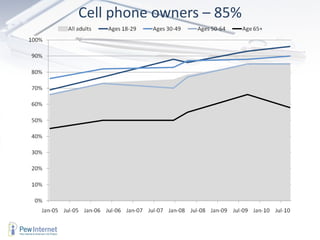
Cell phone owners – 85%
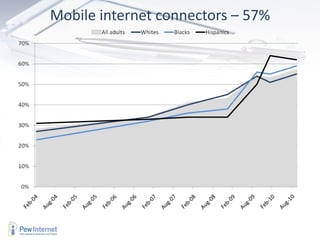
Mobile internet connectors – 57%
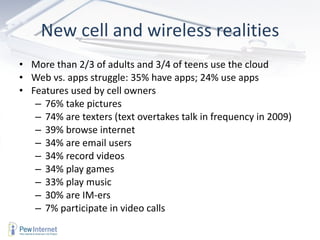
New cell and wireless realities More than 2/3 of adults and 3/4 of teens use the cloud Web vs. apps struggle: 35% have apps; 24% use apps Features used by cell owners 76% take pictures 74% are texters (text overtakes talk in frequency in 2009) 39% browse internet 34% are email users 34% record videos 34% play games 33% play music 30% are IM-ers 7% participate in video calls
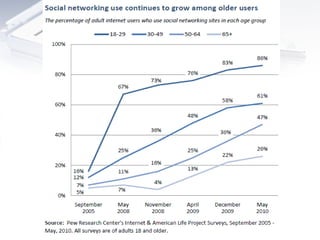
October 22, 2010 Apology Revolution 3 Social networking
 
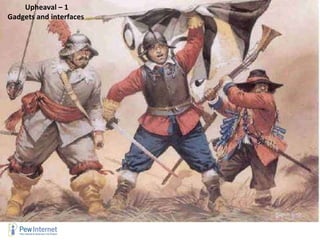
Upheaval – 1 Gadgets and interfaces
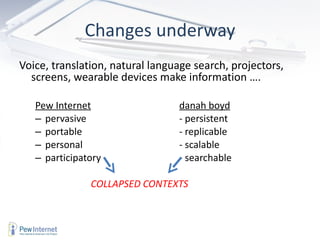
Changes underway Voice, translation, natural language search, projectors, screens, wearable devices make information …. Pew Internet danah boyd pervasive - persistent portable - replicable personal - scalable participatory - searchable     COLLAPSED CONTEXTS
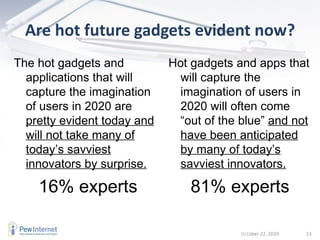
Are hot future gadgets evident now? October 22, 2010 July 9, 2010 Hot gadgets and apps that will capture the imagination of users in 2020 will often come “out of the blue”  and not have been anticipated by many of today’s savviest innovators.   81% experts The hot gadgets and applications that will capture the imagination of users in 2020 are  pretty evident today and will not take many of today’s savviest innovators by surprise. 16% experts
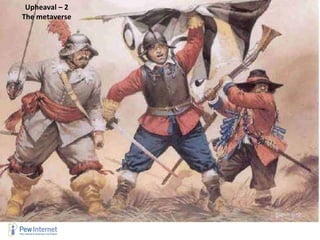
Upheaval – 2 The metaverse
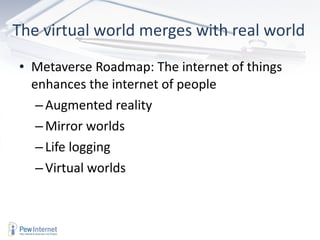
The virtual world merges with real world Metaverse Roadmap: The internet of things enhances the internet of people Augmented reality Mirror worlds Life logging  Virtual worlds
Upheaval – 3 The exaflood
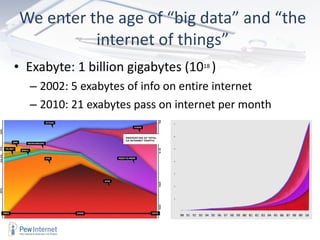
We enter the age of “big data” and “the internet of things” Exabyte: 1 billion gigabytes (10 18   ) 2002: 5 exabytes of info on entire internet 2010: 21 exabytes pass on internet per month
Implications Constant connectivity changes social patterns and info flows: need for real-time info/analytics Niches proliferate Media power balances shift and boundaries blur Old media vs. new media Producers vs. consumers New intermediaries Influence shifts to social networks Attention to info Evaluation of info Action on info, including creation
Choices organizations face Soul strategy – commodity vs. franchise Networking strategy – identifying influencers, natural alliances, availability AAA Engagement strategy – VOG vs. VOBW Learning and innovation strategy
The end
What kind of internet we have  Architecture - “do-over” internet Security, mobility, instrumentation, protocols What kind of information policies we have property in the digital age cultural concerns and national policies What kinds of policies and norms we have about privacy and identity Critical uncertainties October 22, 2010

Changing digital landscape

  • 1.
    The Changing DigitalLandscape Three revolutions … and the three upheavals yet to come Meeting of Center for Digital Information October 22, 2010 Lee Rainie: Director, Pew Internet Project
  • 2.
    October 22, 2010Apology Revolution 1 Internet and broadband
  • 3.
  • 4.
  • 5.
    October 22, 2010Apology Revolution 2 Wireless connectivity
  • 6.
  • 7.
  • 8.
    New cell andwireless realities More than 2/3 of adults and 3/4 of teens use the cloud Web vs. apps struggle: 35% have apps; 24% use apps Features used by cell owners 76% take pictures 74% are texters (text overtakes talk in frequency in 2009) 39% browse internet 34% are email users 34% record videos 34% play games 33% play music 30% are IM-ers 7% participate in video calls
  • 9.
    October 22, 2010Apology Revolution 3 Social networking
  • 10.
  • 11.
    Upheaval – 1Gadgets and interfaces
  • 12.
    Changes underway Voice,translation, natural language search, projectors, screens, wearable devices make information …. Pew Internet danah boyd pervasive - persistent portable - replicable personal - scalable participatory - searchable COLLAPSED CONTEXTS
  • 13.
    Are hot futuregadgets evident now? October 22, 2010 July 9, 2010 Hot gadgets and apps that will capture the imagination of users in 2020 will often come “out of the blue” and not have been anticipated by many of today’s savviest innovators. 81% experts The hot gadgets and applications that will capture the imagination of users in 2020 are pretty evident today and will not take many of today’s savviest innovators by surprise. 16% experts
  • 14.
    Upheaval – 2The metaverse
  • 15.
    The virtual worldmerges with real world Metaverse Roadmap: The internet of things enhances the internet of people Augmented reality Mirror worlds Life logging Virtual worlds
  • 16.
    Upheaval – 3The exaflood
  • 17.
    We enter theage of “big data” and “the internet of things” Exabyte: 1 billion gigabytes (10 18 ) 2002: 5 exabytes of info on entire internet 2010: 21 exabytes pass on internet per month
  • 18.
    Implications Constant connectivitychanges social patterns and info flows: need for real-time info/analytics Niches proliferate Media power balances shift and boundaries blur Old media vs. new media Producers vs. consumers New intermediaries Influence shifts to social networks Attention to info Evaluation of info Action on info, including creation
  • 19.
    Choices organizations faceSoul strategy – commodity vs. franchise Networking strategy – identifying influencers, natural alliances, availability AAA Engagement strategy – VOG vs. VOBW Learning and innovation strategy
  • 20.
  • 21.
    What kind ofinternet we have Architecture - “do-over” internet Security, mobility, instrumentation, protocols What kind of information policies we have property in the digital age cultural concerns and national policies What kinds of policies and norms we have about privacy and identity Critical uncertainties October 22, 2010

Editor's Notes

  • #12 Cromwell’s soldiers http://www.doyle.com.au/history_pt3.htm
  • #15 Cromwell’s soldiers http://www.doyle.com.au/history_pt3.htm
  • #17 Cromwell’s soldiers http://www.doyle.com.au/history_pt3.htm
  • #22 Security: No one expected that the level of malevolence online to be what it is, so the “start over” crowd would love to build a new system that would do a better job of authenticating people and their computers in a way that would keep hazards like viruses far away so that you wouldn’t have to buy special software for protection.   Mobility: The internet was invented with fixed and stationary computers in mind and the fact that wireless connectivity has exploded the way it has … has caught many by surprise. The “start over” folks want to create a new system to assign internet addresses to small and mobile devices such as sensors, phones, and embedded processors in cars would allow them to connect to the internet securely.   Instrumentation: When we asked experts three years ago what had surprised them most their first answer was the growth of the Web itself. Their second answer was the way file-sharing through peer-to-peer networks had emerged. Basically no one foresaw the level of traffic the internet would bear and there are all sorts of hassles in the way data moves on the internet these days. So, the “start over” folks would like to build something allowing all pieces of the network to have the ability to detect and report emerging problems such as technical breakdowns, traffic jams, or replicating worms to network administrators.   Protocols: These traffic flow concerns also prompt “start over” architects to want to structure better traffic routing agreements between internet service providers that would allow them to collaborate on advance services without compromising their businesses.   See http://www.technologyreview.com/InfoTech-Networks/wtr_16051,258,p1.html