Lean Introduction Overview
Automotive Tier One
Date 5/31/2013
CIP 3 001 Lean Presentation.Kickoff Confidential and Proprietary Property of Ryder
What is Lean?
Listing to the right or left?
Cut of meat with no fat?
Non fat foods?
Car running on too much air?
Doing more with less?
2
CIP 3 001 Lean Presentation.Kickoff Confidential and Proprietary Property of Ryder
What Lean is not
 Lean is not about eliminating people.
 Lean is not about blaming people
 Lean is not about creating checklists and inspections
 Lean is not about painting lines on the floor
 Lean is not about putting up boards
CIP 3 001 Lean Presentation.Kickoff Confidential and Proprietary Property of RyderCIP 3 001 Lean Presentation.Kickoff 4
What is Lean? (Textbook definition)*
Produce Only
 What the customer wants,
 Only in the quantities they want,
 Only when they want it
 By doing only those things that add value
 Driving continuous improvement at all levels of the organization
4 * Womack & Jones (2003). “Lean thinking”
“All we are doing is looking at the
Time Line – from the moment a
customer gives us an order to the
point we collect cash. And we are
Reducing that Time Line by
removing the non-value added
wastes”
-Taiichi Ohno
CIP 3 001 Lean Presentation.Kickoff Confidential and Proprietary Property of RyderCIP 3 001 Lean Presentation.Kickoff 5
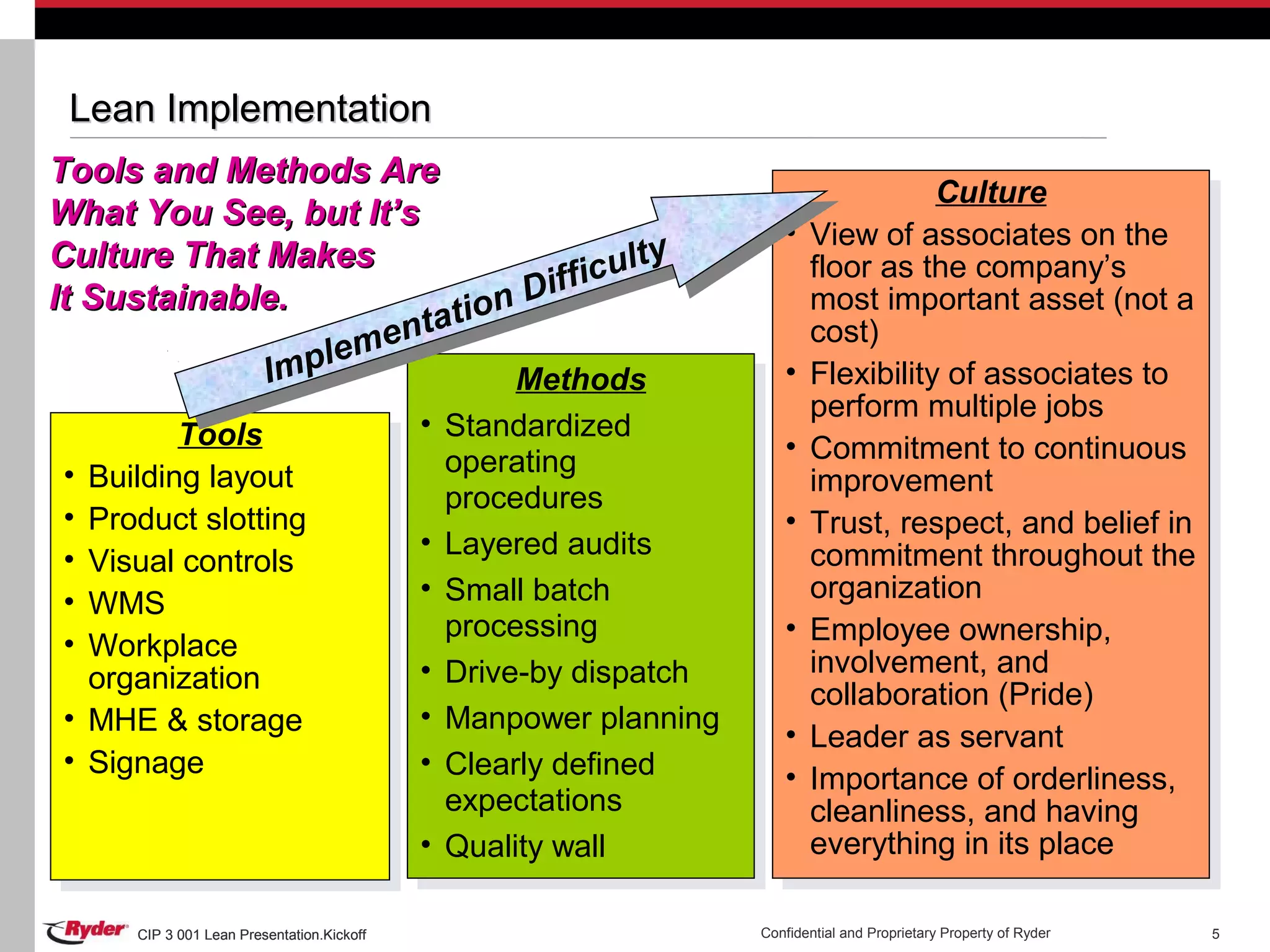
Tools
• Building layout
• Product slotting
• Visual controls
• WMS
• Workplace
organization
• MHE & storage
• Signage
Tools
• Building layout
• Product slotting
• Visual controls
• WMS
• Workplace
organization
• MHE & storage
• Signage
Methods
• Standardized
operating
procedures
• Layered audits
• Small batch
processing
• Drive-by dispatch
• Manpower planning
• Clearly defined
expectations
• Quality wall
Methods
• Standardized
operating
procedures
• Layered audits
• Small batch
processing
• Drive-by dispatch
• Manpower planning
• Clearly defined
expectations
• Quality wall
Culture
• View of associates on the
floor as the company’s
most important asset (not a
cost)
• Flexibility of associates to
perform multiple jobs
• Commitment to continuous
improvement
• Trust, respect, and belief in
commitment throughout the
organization
• Employee ownership,
involvement, and
collaboration (Pride)
• Leader as servant
• Importance of orderliness,
cleanliness, and having
everything in its place
Culture
• View of associates on the
floor as the company’s
most important asset (not a
cost)
• Flexibility of associates to
perform multiple jobs
• Commitment to continuous
improvement
• Trust, respect, and belief in
commitment throughout the
organization
• Employee ownership,
involvement, and
collaboration (Pride)
• Leader as servant
• Importance of orderliness,
cleanliness, and having
everything in its place
Implementation Difficulty
Tools and Methods AreTools and Methods Are
What You See, but It’sWhat You See, but It’s
Culture That MakesCulture That Makes
It Sustainable.It Sustainable.
Lean ImplementationLean Implementation
CIP 3 001 Lean Presentation.Kickoff Confidential and Proprietary Property of RyderCIP 3 001 Lean Presentation.Kickoff 6
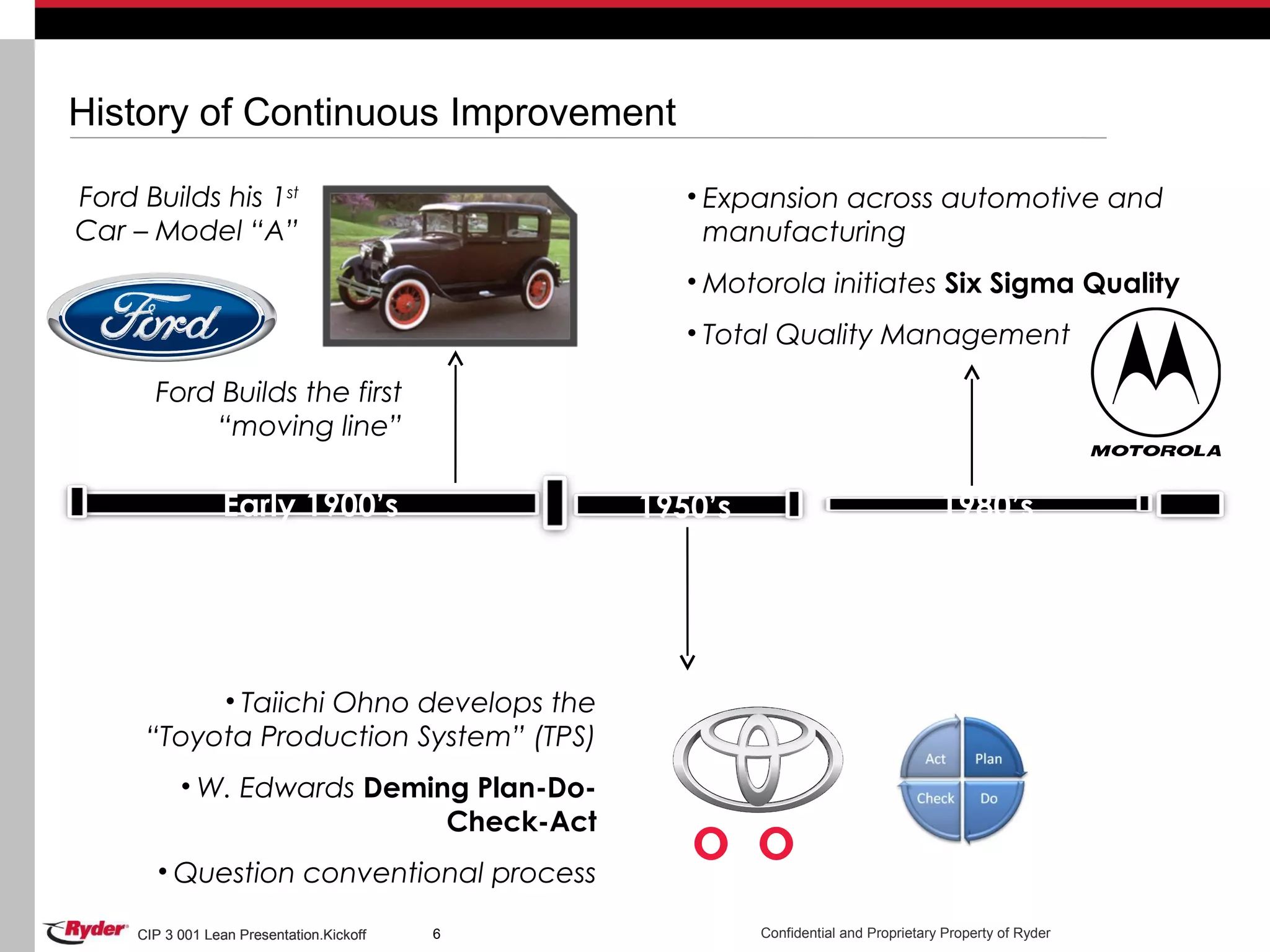
1980’s1950’s
History of Continuous Improvement
Ford Builds his 1st
Car – Model “A”
Ford Builds the first
“moving line”
• Taiichi Ohno develops the
“Toyota Production System” (TPS)
• W. Edwards Deming Plan-Do-
Check-Act
• Question conventional process
Early 1900’s
• Expansion across automotive and
manufacturing
• Motorola initiates Six Sigma Quality
• Total Quality Management
CIP 3 001 Lean Presentation.Kickoff Confidential and Proprietary Property of RyderCIP 3 001 Lean Presentation.Kickoff 7
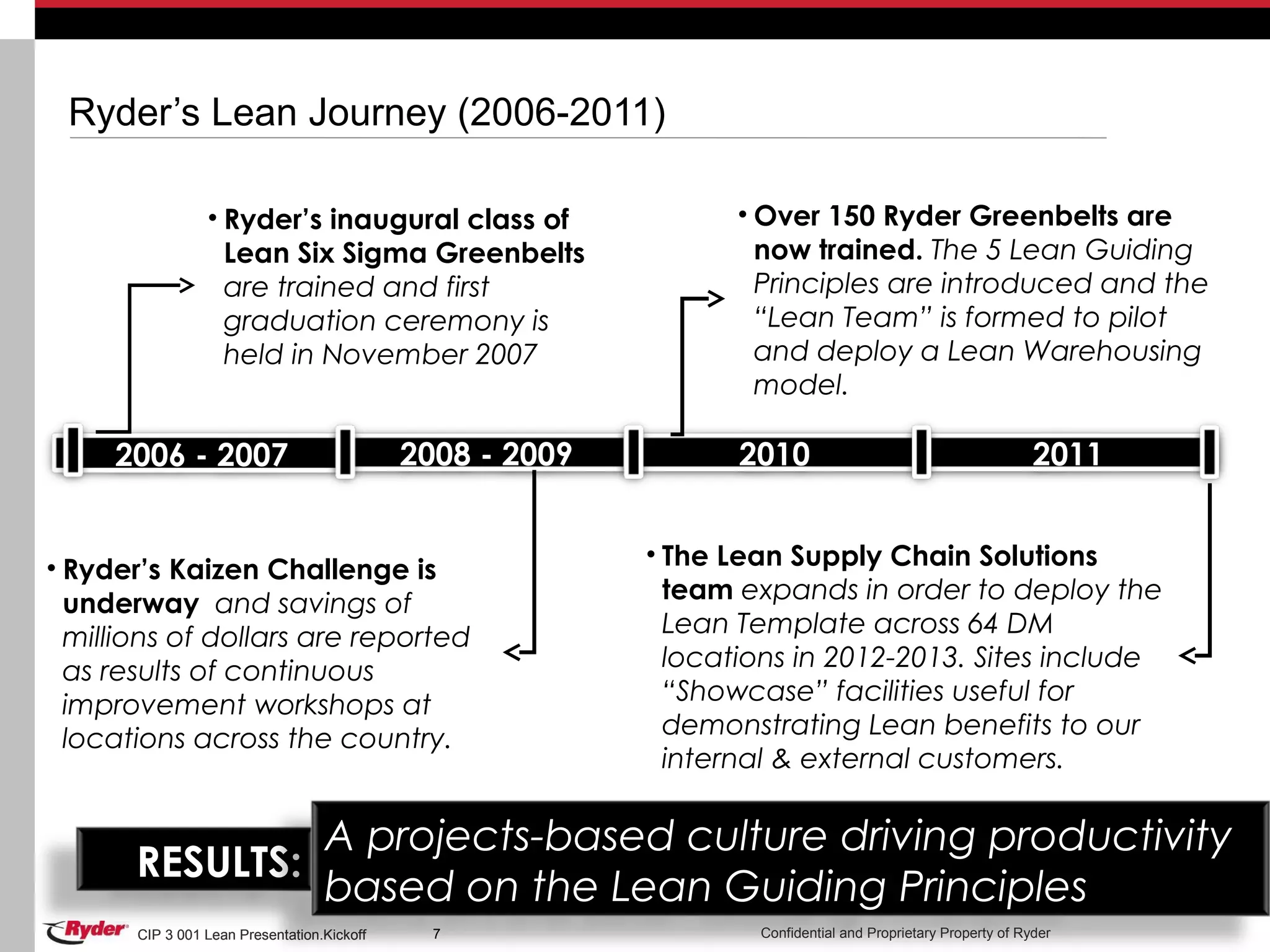
2006 - 2007 2008 - 2009 2010 2011
Ryder’s Lean Journey (2006-2011)
• Ryder’s Kaizen Challenge is
underway and savings of
millions of dollars are reported
as results of continuous
improvement workshops at
locations across the country.
• Over 150 Ryder Greenbelts are
now trained. The 5 Lean Guiding
Principles are introduced and the
“Lean Team” is formed to pilot
and deploy a Lean Warehousing
model.
• The Lean Supply Chain Solutions
team expands in order to deploy the
Lean Template across 64 DM
locations in 2012-2013. Sites include
“Showcase” facilities useful for
demonstrating Lean benefits to our
internal & external customers.
• Ryder’s inaugural class of
Lean Six Sigma Greenbelts
are trained and first
graduation ceremony is
held in November 2007
RESULTS:
A projects-based culture driving productivity
based on the Lean Guiding Principles
CIP 3 001 Lean Presentation.Kickoff Confidential and Proprietary Property of Ryder 8
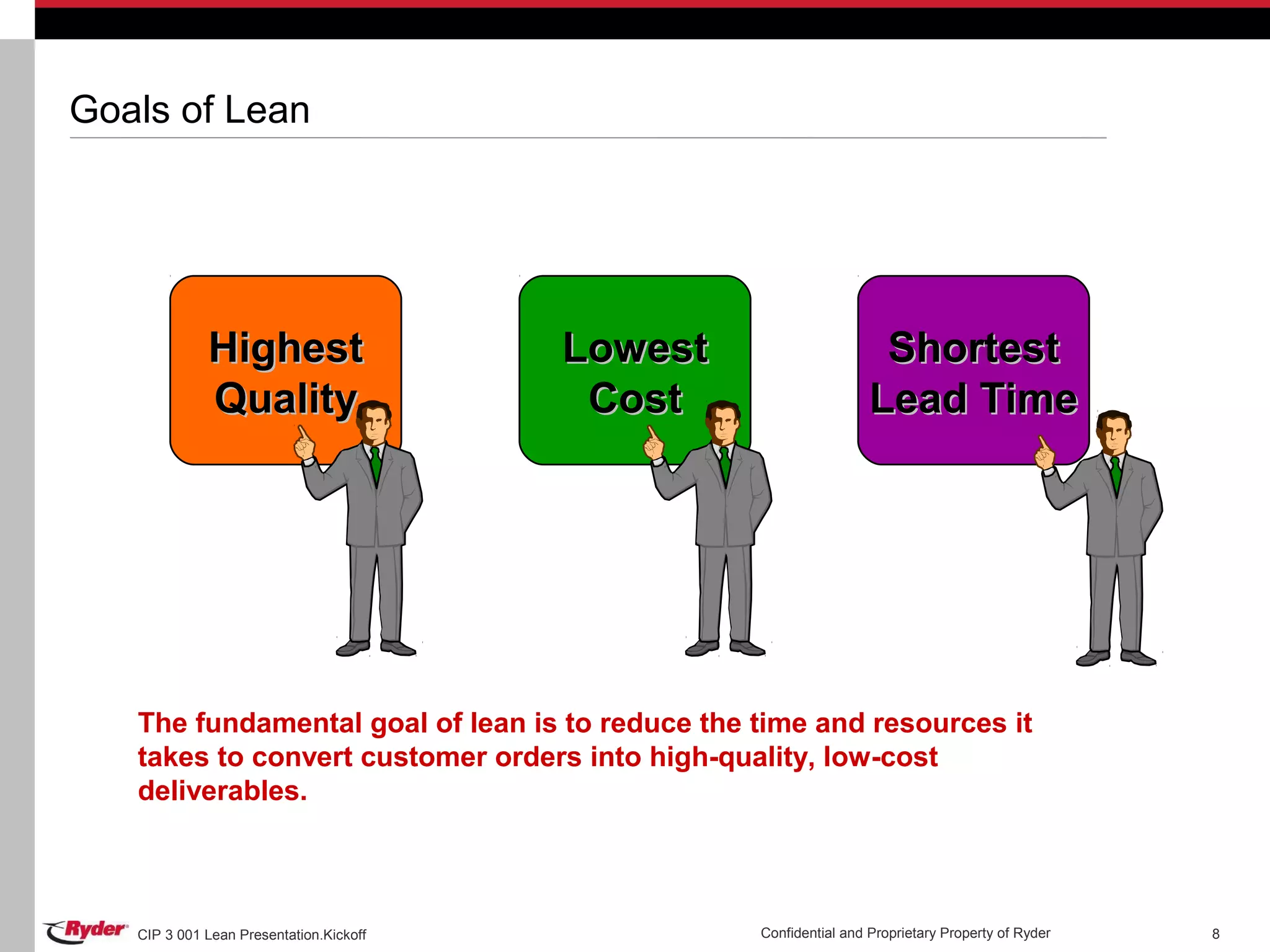
Goals of Lean
The fundamental goal of lean is to reduce the time and resources it
takes to convert customer orders into high-quality, low-cost
deliverables.
HighestHighest
QualityQuality
LowestLowest
CostCost
ShortestShortest
Lead TimeLead Time
CIP 3 001 Lean Presentation.Kickoff Confidential and Proprietary Property of RyderCIP 3 001 Lean Presentation.Kickoff 9
Lean Culture
It’s people who drive results.It’s people who drive results.
Numbers tell us where we’ve been.Numbers tell us where we’ve been.
People determine where we’ll go.People determine where we’ll go.
CIP 3 001 Lean Presentation.Kickoff Confidential and Proprietary Property of RyderCIP 3 001 Lean Presentation.Kickoff 10
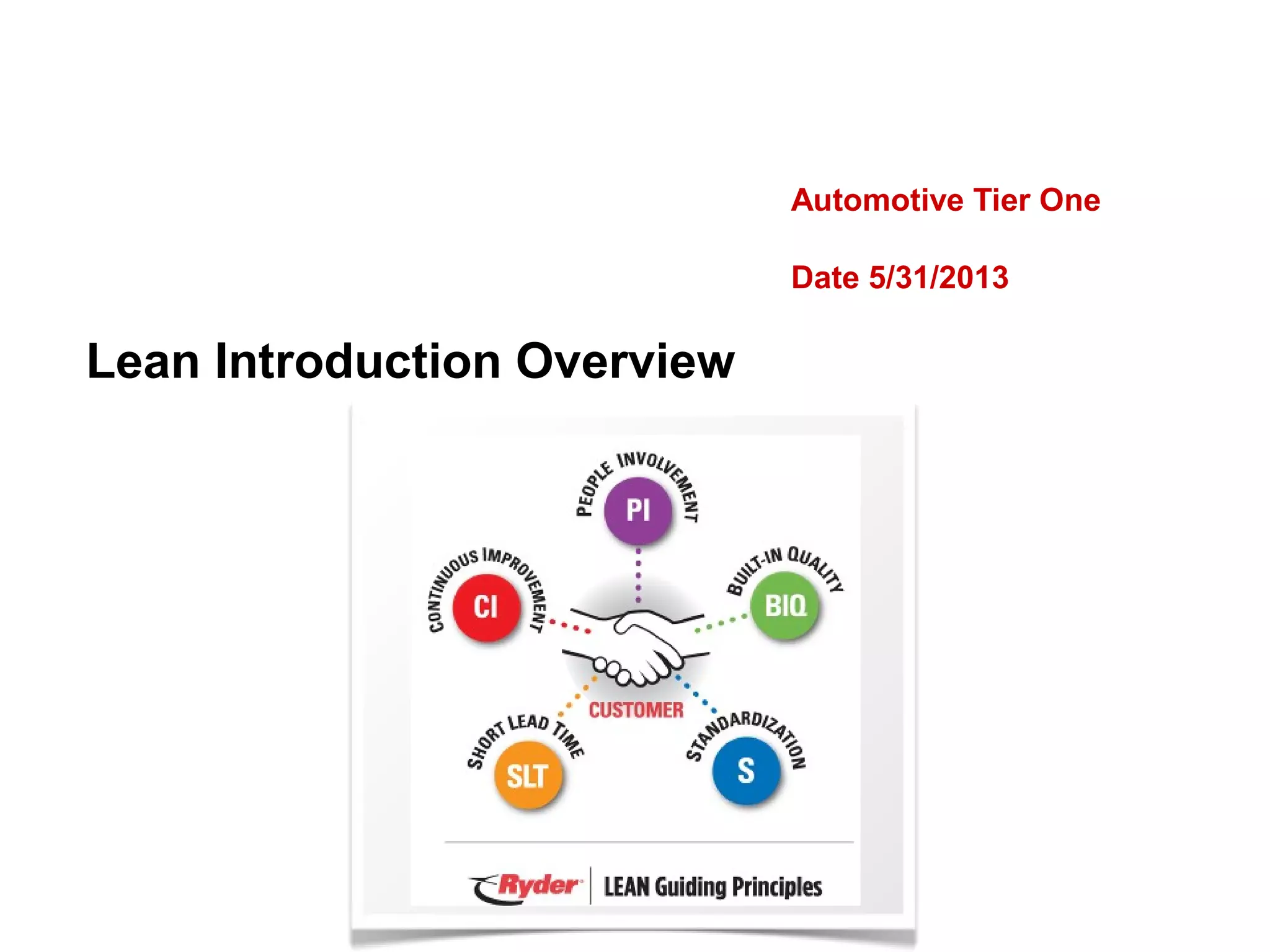
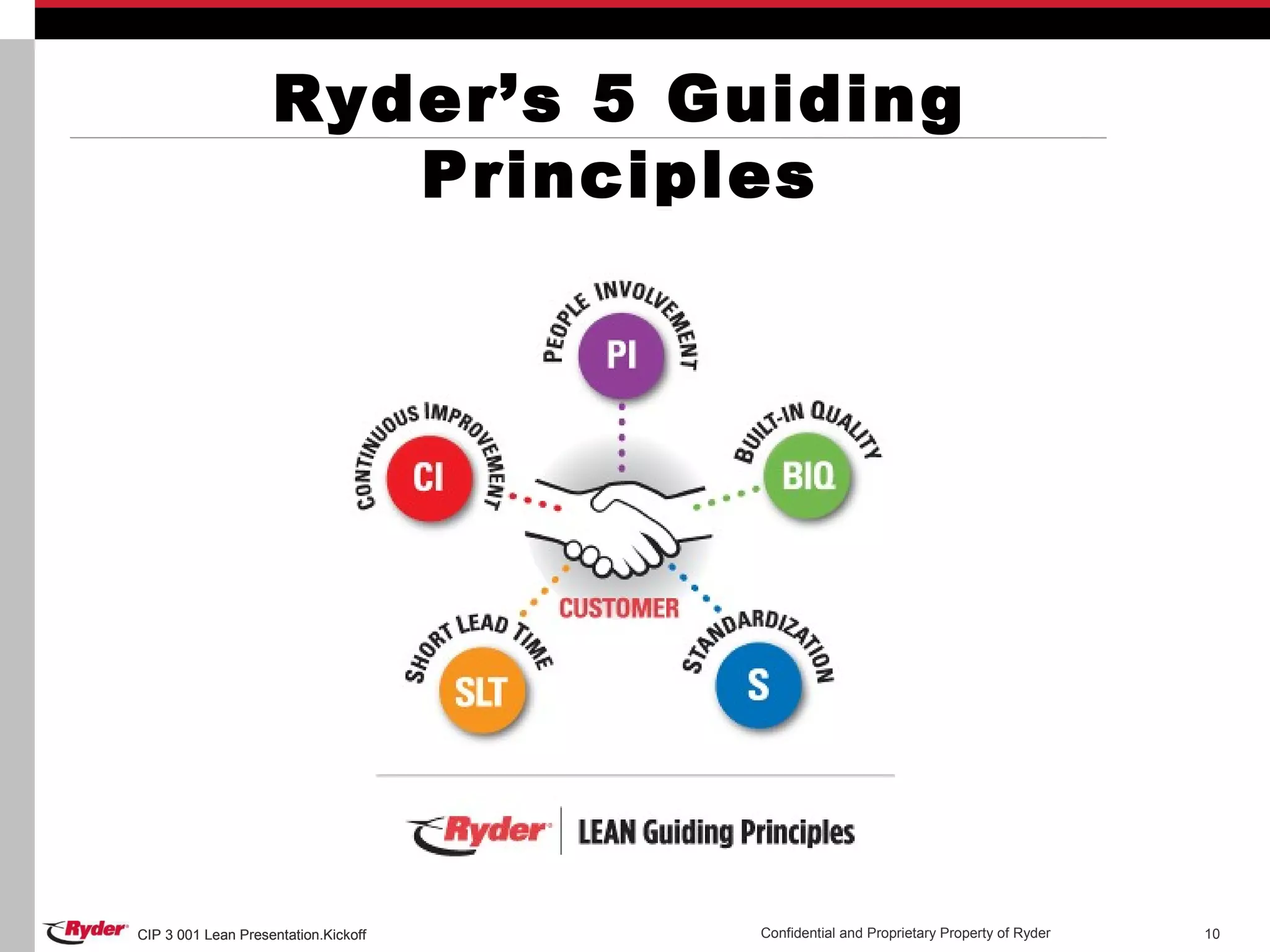
Ryder’s 5 Guiding
Principles
CIP 3 001 Lean Presentation.Kickoff Confidential and Proprietary Property of RyderCIP 3 001 Lean Presentation.Kickoff
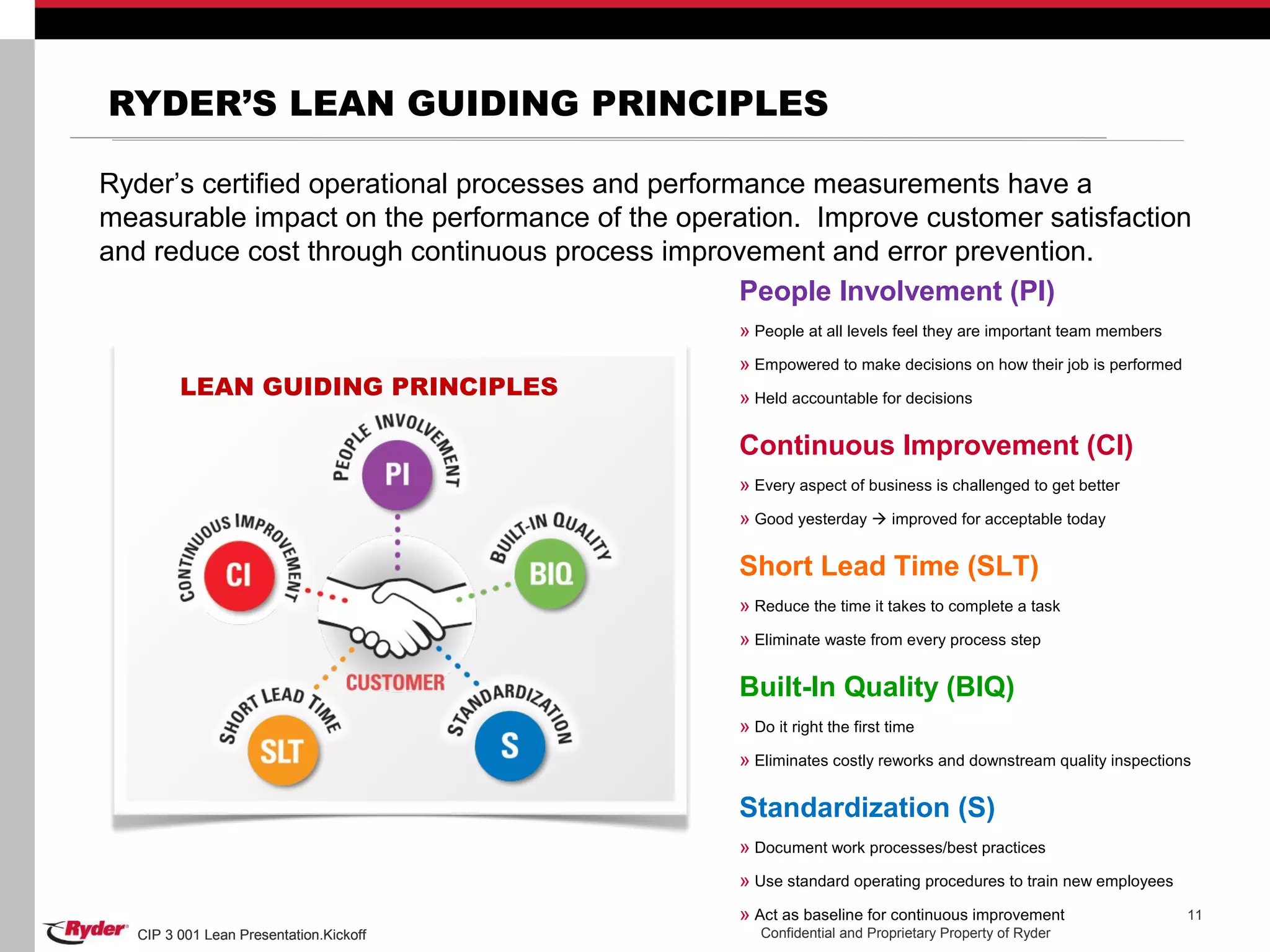
Ryder’s certified operational processes and performance measurements have a
measurable impact on the performance of the operation. Improve customer satisfaction
and reduce cost through continuous process improvement and error prevention.
People Involvement (PI)
» People at all levels feel they are important team members
» Empowered to make decisions on how their job is performed
» Held accountable for decisions
Continuous Improvement (CI)
» Every aspect of business is challenged to get better
» Good yesterday  improved for acceptable today
Short Lead Time (SLT)
» Reduce the time it takes to complete a task
» Eliminate waste from every process step
Built-In Quality (BIQ)
» Do it right the first time
» Eliminates costly reworks and downstream quality inspections
Standardization (S)
» Document work processes/best practices
» Use standard operating procedures to train new employees
» Act as baseline for continuous improvement
LEAN GUIDING PRINCIPLES
RYDER’S LEAN GUIDING PRINCIPLES
11
CIP 3 001 Lean Presentation.Kickoff Confidential and Proprietary Property of RyderCIP 3 001 Lean Presentation.Kickoff 12
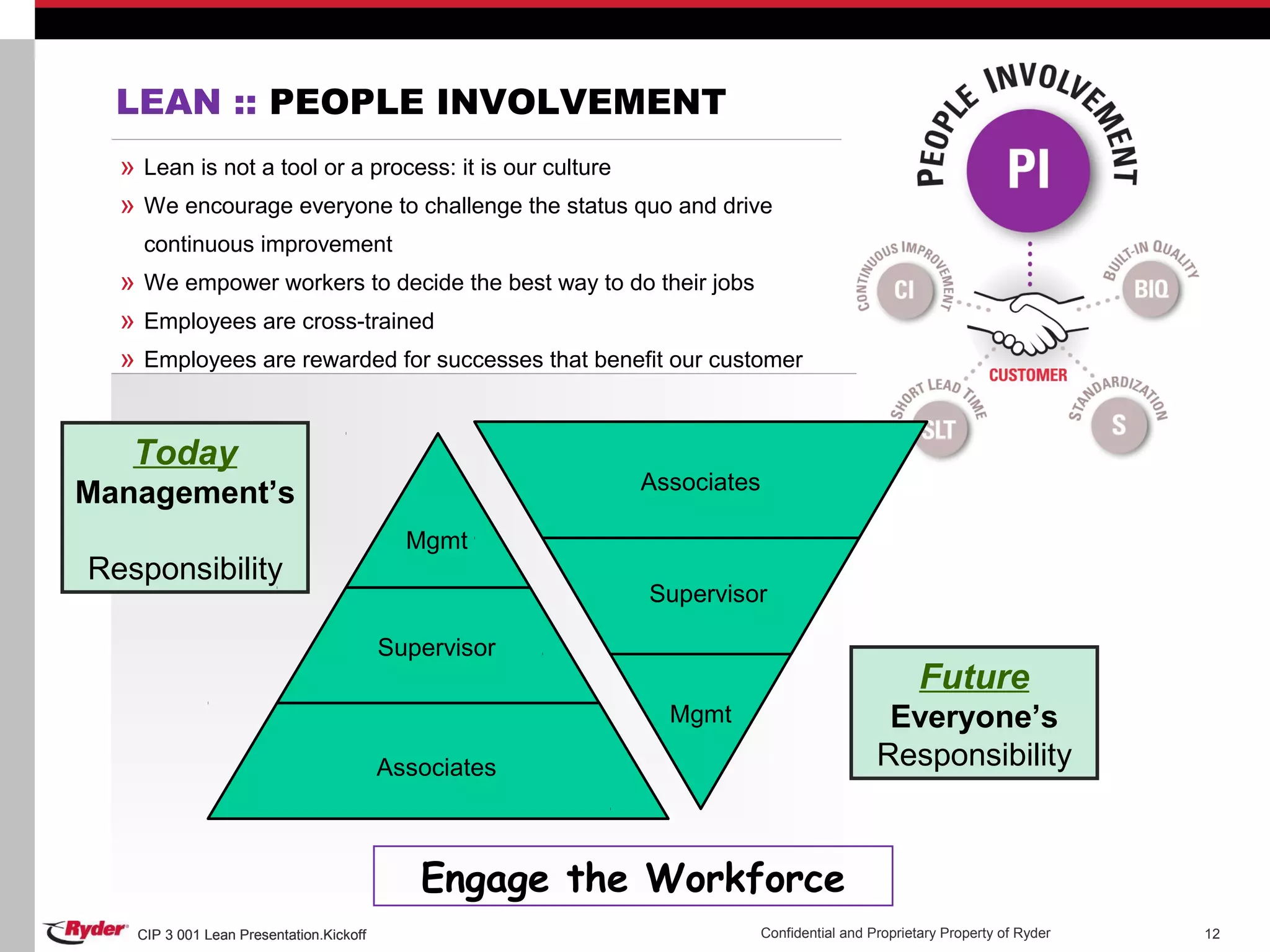
LEAN :: PEOPLE INVOLVEMENT
» Lean is not a tool or a process: it is our culture
» We encourage everyone to challenge the status quo and drive
continuous improvement
» We empower workers to decide the best way to do their jobs
» Employees are cross-trained
» Employees are rewarded for successes that benefit our customer
Engage the Workforce
Today
Management’s
Responsibility
Future
Everyone’s
Responsibility
Mgmt
Supervisor
Associates
Associates
Supervisor
Mgmt
CIP 3 001 Lean Presentation.Kickoff Confidential and Proprietary Property of RyderCIP 3 001 Lean Presentation.Kickoff 13
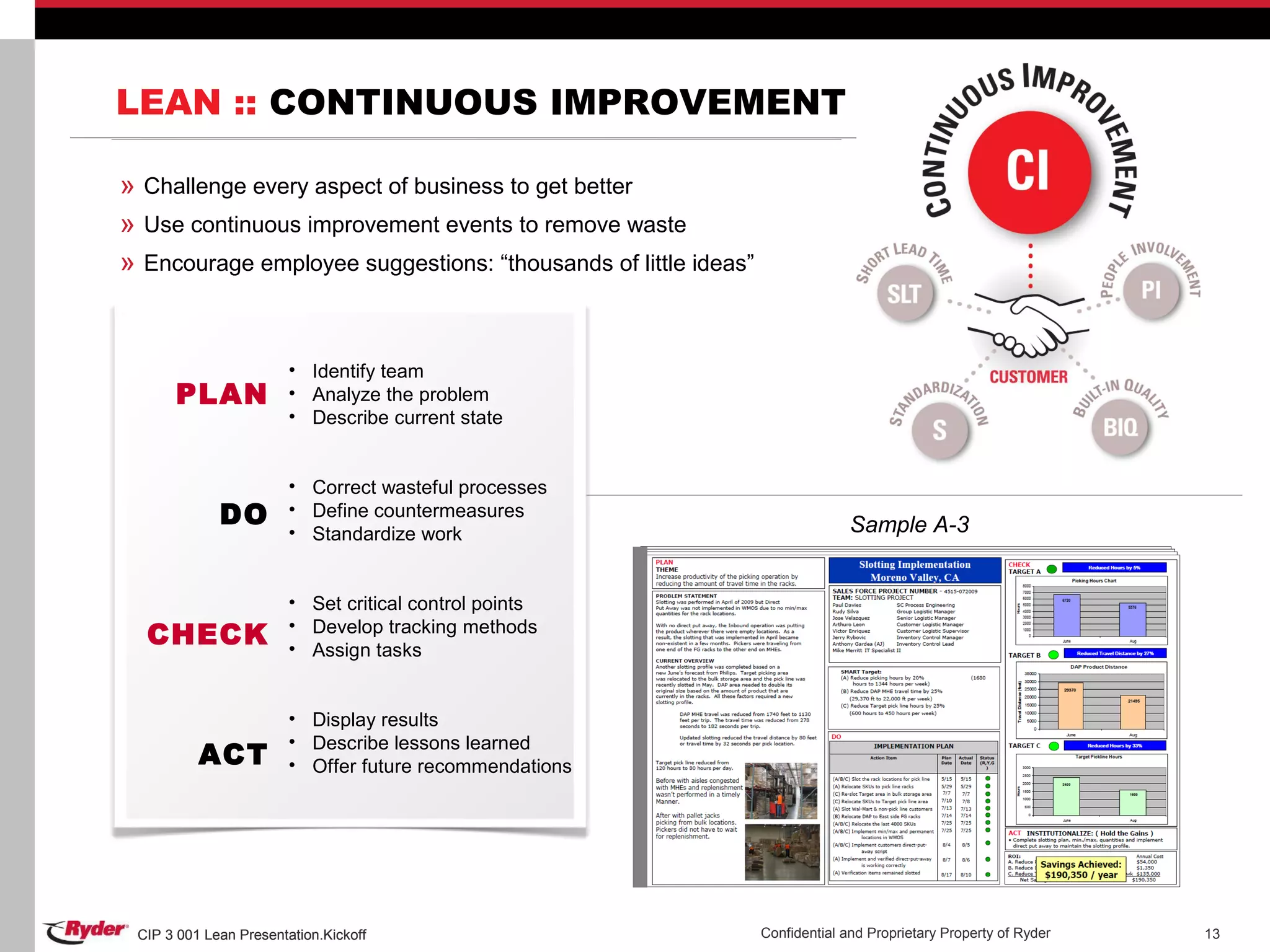
Sample A-3
LEAN :: CONTINUOUS IMPROVEMENT
» Challenge every aspect of business to get better
» Use continuous improvement events to remove waste
» Encourage employee suggestions: “thousands of little ideas”
• Identify team
• Analyze the problem
• Describe current state
• Correct wasteful processes
• Define countermeasures
• Standardize work
• Set critical control points
• Develop tracking methods
• Assign tasks
• Display results
• Describe lessons learned
• Offer future recommendations
PLAN
DO
CHECK
ACT
CIP 3 001 Lean Presentation.Kickoff Confidential and Proprietary Property of RyderCIP 3 001 Lean Presentation.Kickoff 14
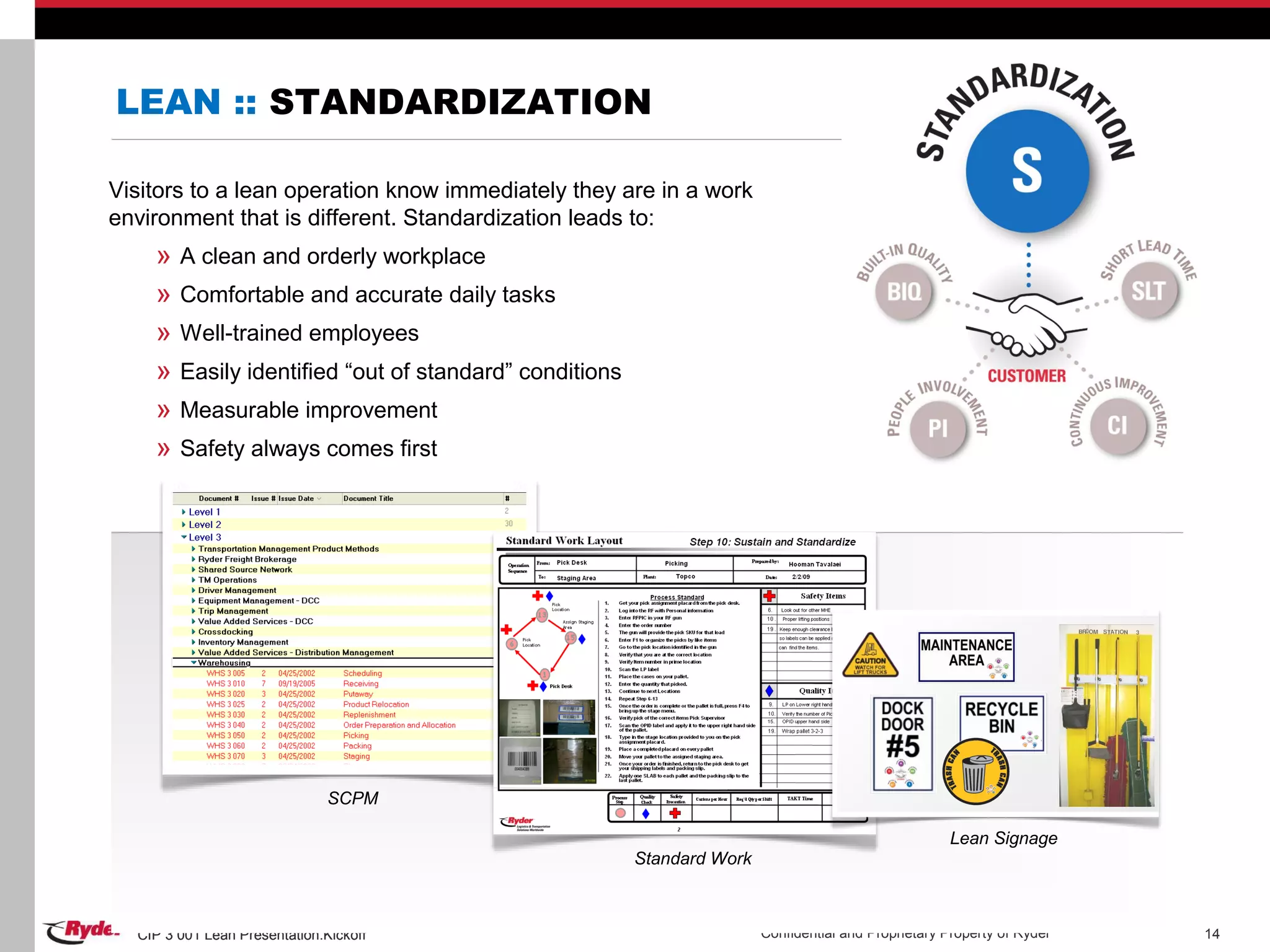
LEAN :: STANDARDIZATION
SCPM
Lean Signage
Standard Work
Visitors to a lean operation know immediately they are in a work
environment that is different. Standardization leads to:
» A clean and orderly workplace
» Comfortable and accurate daily tasks
» Well-trained employees
» Easily identified “out of standard” conditions
» Measurable improvement
» Safety always comes first
CIP 3 001 Lean Presentation.Kickoff Confidential and Proprietary Property of RyderCIP 3 001 Lean Presentation.Kickoff 15
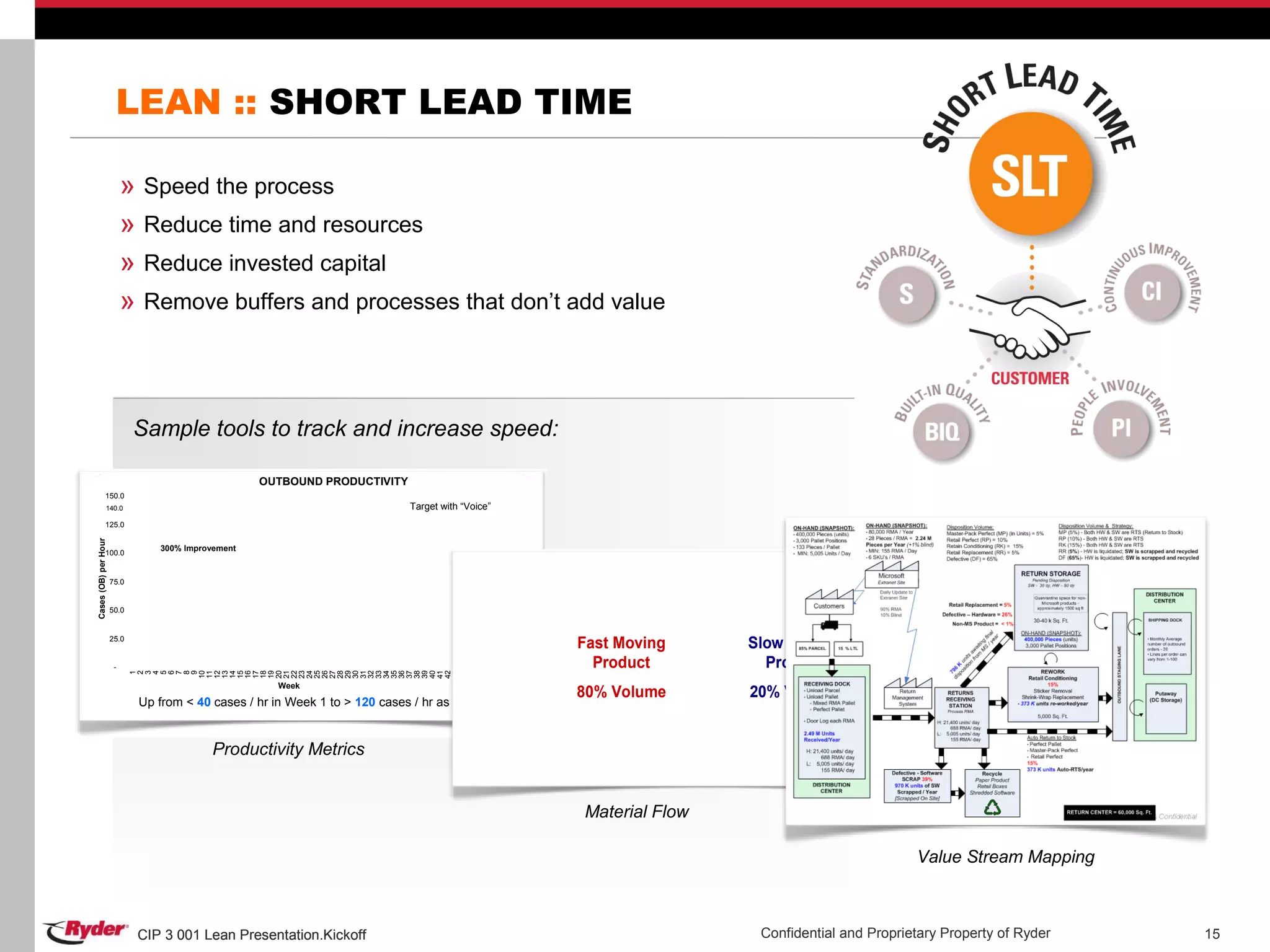
Up from < 40 cases / hr in Week 1 to > 120 cases / hr as of Week 40
OUTBOUND PRODUCTIVITY
-
25.0
50.0
75.0
100.0
125.0
150.0
1
2
3
4
5
6
7
8
9
10
11
12
13
14
15
16
17
18
19
20
21
22
23
24
25
26
27
28
29
30
31
32
33
34
35
36
37
38
39
40
41
42
43
44
45
46
47
48
49
50
51
52
Cases(OB)perHour
300% Improvement
Target with “Voice”140.0
Week
Productivity Metrics
Sample tools to track and increase speed:
LEAN :: SHORT LEAD TIME
Material Flow
Value Stream Mapping
Material Flow
Receiving &
Inspection
Outbound
Staging
Slow Moving
Product
20% Volume
Fast Moving
Product
80% Volume
» Speed the process
» Reduce time and resources
» Reduce invested capital
» Remove buffers and processes that don’t add value
CIP 3 001 Lean Presentation.Kickoff Confidential and Proprietary Property of RyderCIP 3 001 Lean Presentation.Kickoff
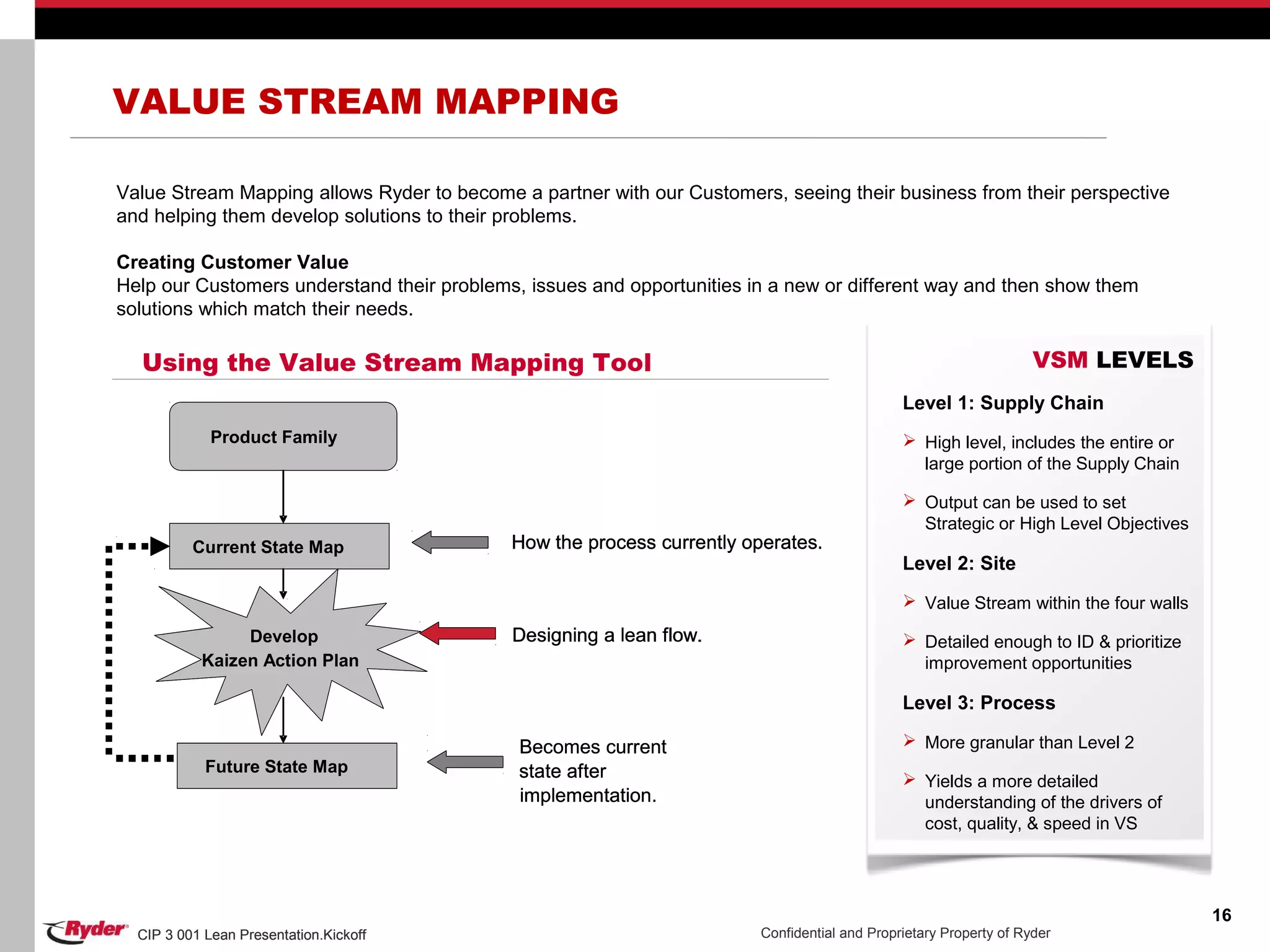
Value Stream Mapping allows Ryder to become a partner with our Customers, seeing their business from their perspective
and helping them develop solutions to their problems.
Creating Customer Value
Help our Customers understand their problems, issues and opportunities in a new or different way and then show them
solutions which match their needs.
16
Using the Value Stream Mapping Tool
VALUE STREAM MAPPING
VSM LEVELS
Level 1: Supply Chain
 High level, includes the entire or
large portion of the Supply Chain
 Output can be used to set
Strategic or High Level Objectives
Level 2: Site
 Value Stream within the four walls
 Detailed enough to ID & prioritize
improvement opportunities
Level 3: Process
 More granular than Level 2
 Yields a more detailed
understanding of the drivers of
cost, quality, & speed in VS
Product Family
Current State Map
Future State Map
Develop
Kaizen Action Plan
How the process currently operates.
Designing a lean flow.
Becomes current
state after
implementation.
Product Family
Current State Map
Future State Map
Develop
Kaizen Action Plan
How the process currently operates.
Designing a lean flow.
Becomes current
state after
implementation.
Product Family
Current State Map
Future State Map
Develop
Kaizen Action Plan
How the process currently operates.
Designing a lean flow.
How the process currently operates.
Designing a lean flow.
Becomes current
state after
implementation.
CIP 3 001 Lean Presentation.Kickoff Confidential and Proprietary Property of RyderCIP 3 001 Lean Presentation.Kickoff 17
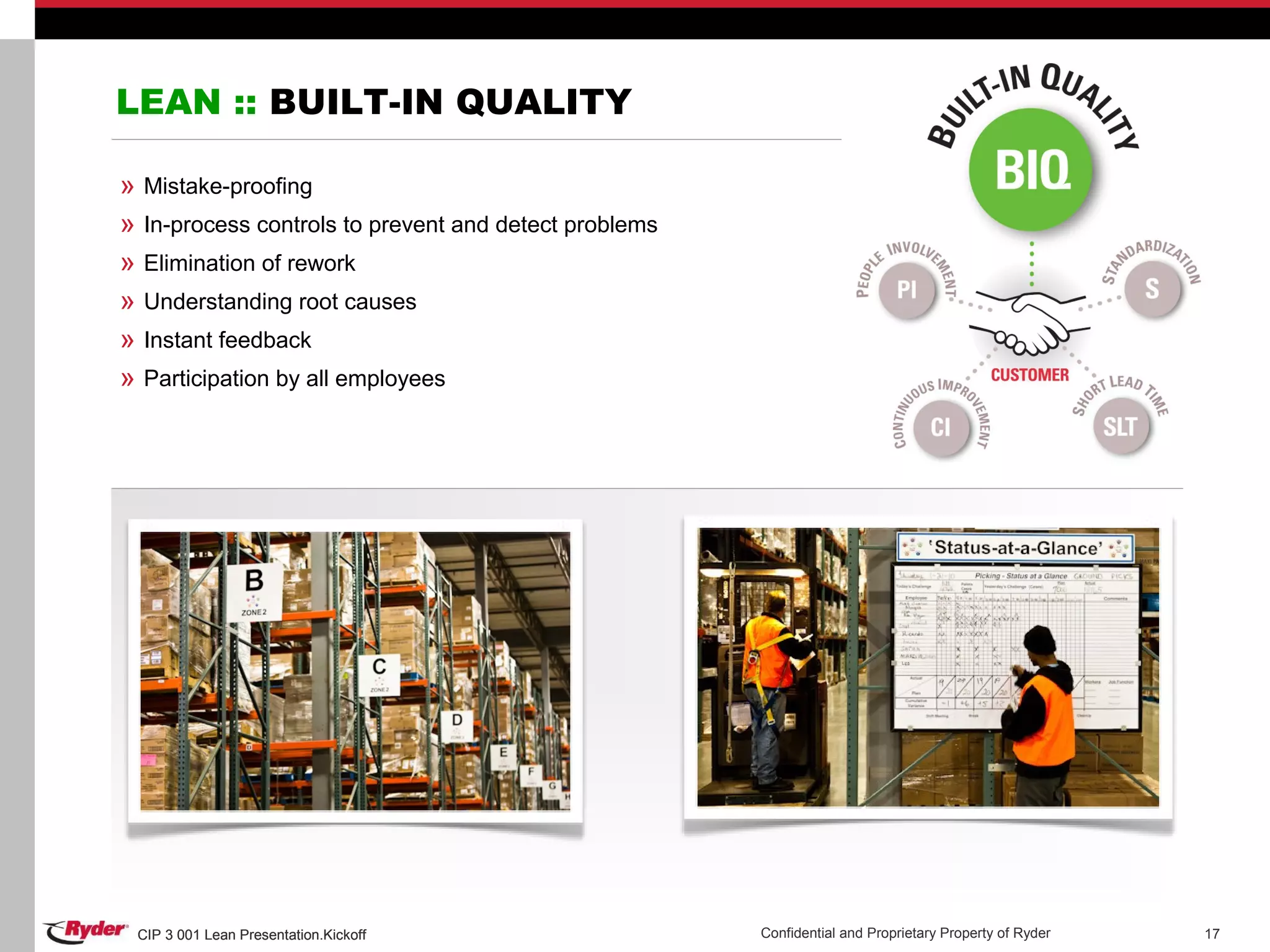
LEAN :: BUILT-IN QUALITY
» Mistake-proofing
» In-process controls to prevent and detect problems
» Elimination of rework
» Understanding root causes
» Instant feedback
» Participation by all employees
CIP 3 001 Lean Presentation.Kickoff Confidential and Proprietary Property of Ryder 18
Process for Change
 Demonstrate a Reason for Change
 Create a Vision
 Create a Partnership - Mgt./Work Force
 Leadership Involvement
 Create Commitment
 Create Sense of Urgency
 Drive Results through improved processes
CIP 3 001 Lean Presentation.Kickoff Confidential and Proprietary Property of Ryder 19
Impediments to Change
 Do not have a vision
 Lack of shared vision
 Defensiveness
 Old ways of thinking
 Culture
 Lack of support structure for change
 Lack of trust
 Lack of leadership
 Lack of self-esteem
 Success
CIP 3 001 Lean Presentation.Kickoff Confidential and Proprietary Property of Ryder 20
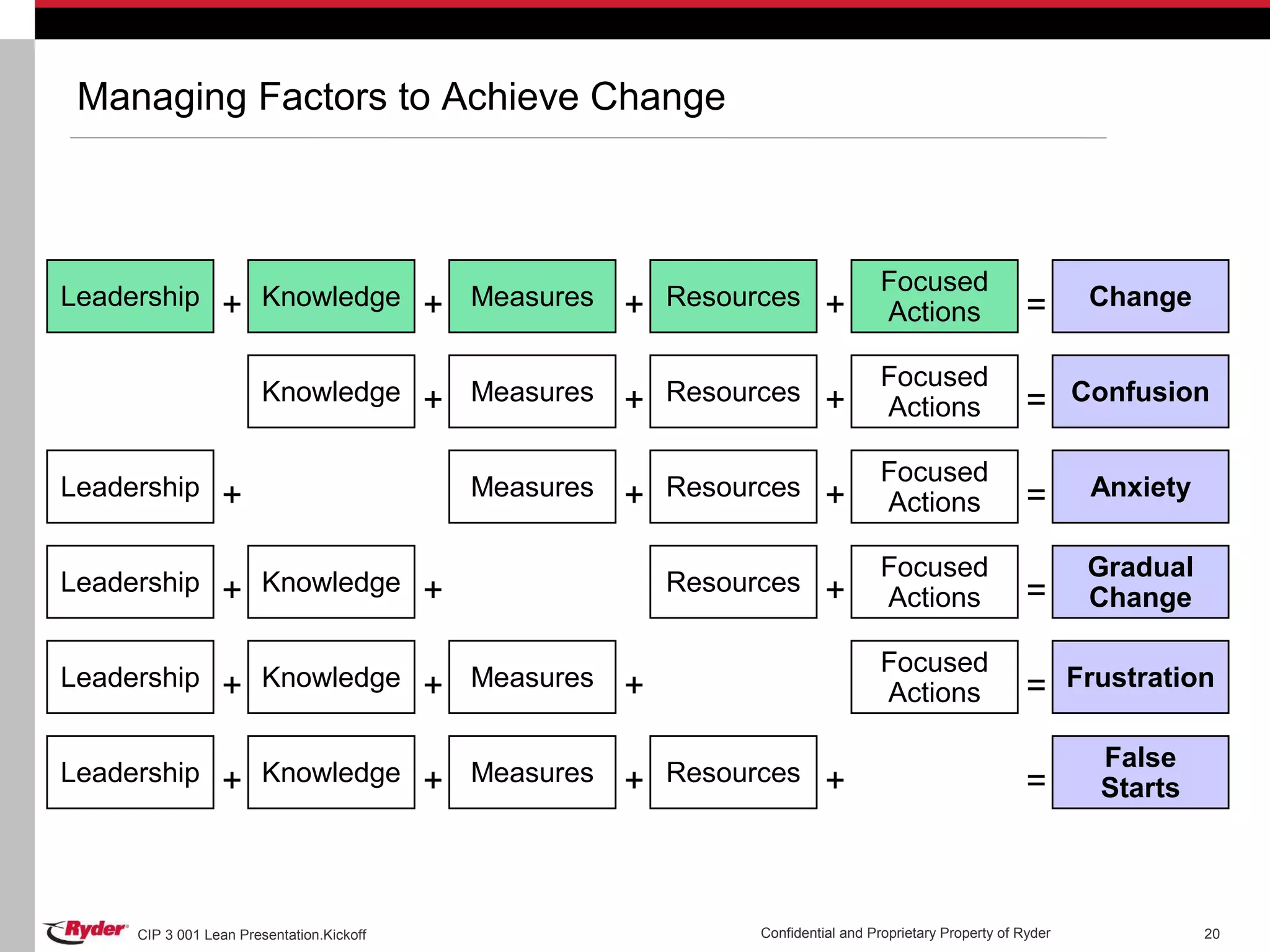
Managing Factors to Achieve Change
Leadership Knowledge Measures Resources
Focused
Actions
Change+ + + + =
Knowledge Measures Resources
Focused
Actions
Confusion+ + + =
Leadership Measures Resources
Focused
Actions
Anxiety+ + + =
Leadership Knowledge Resources
Focused
Actions
Gradual
Change+ + + =
Leadership Knowledge Measures
Focused
Actions
Frustration+ + + =
Leadership Knowledge Measures Resources
False
Starts+ + + + =
CIP 3 001 Lean Presentation.Kickoff Confidential and Proprietary Property of RyderCIP 3 001 Lean Presentation.Kickoff
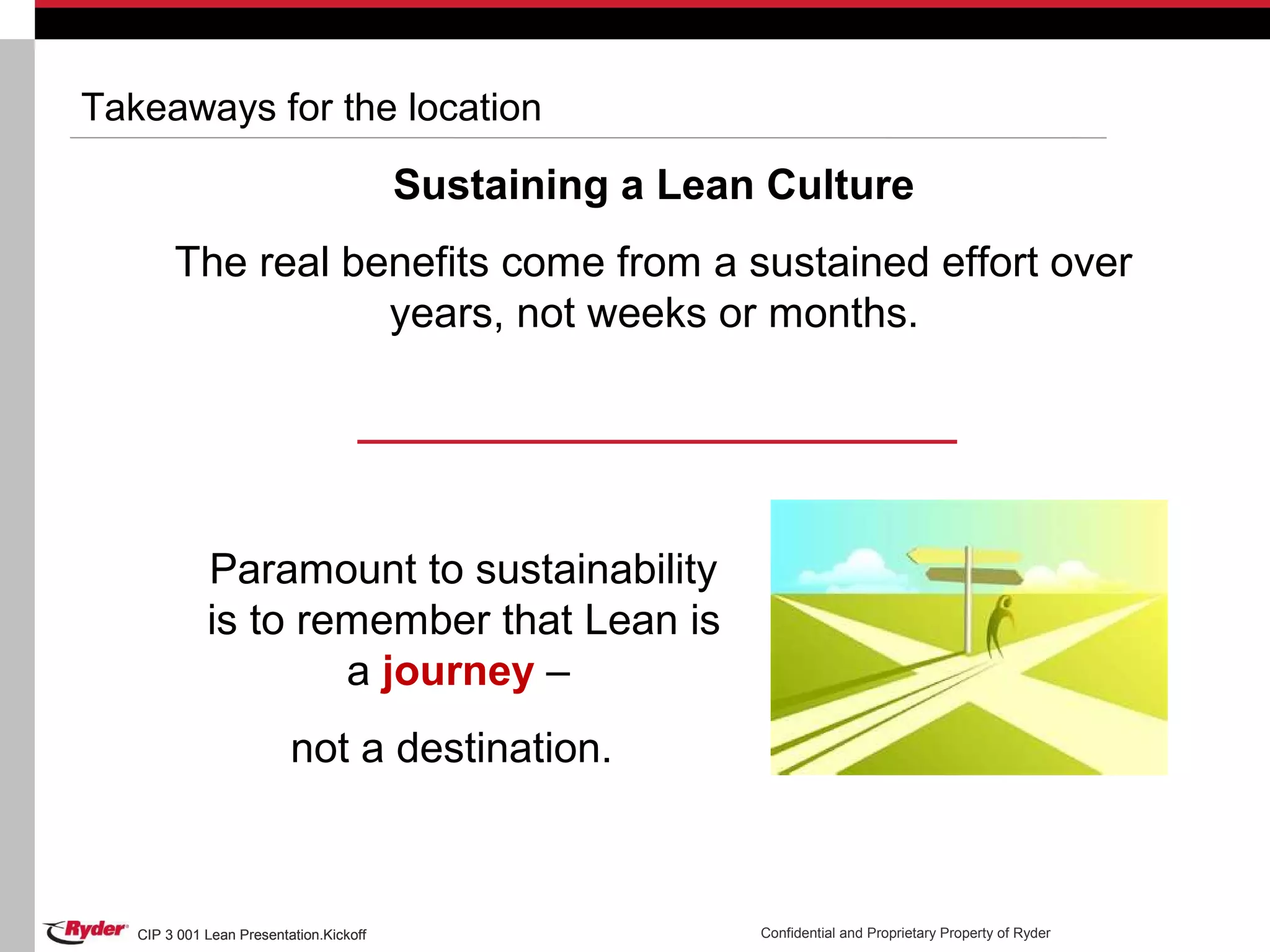
Takeaways for the location
Sustaining a Lean Culture
The real benefits come from a sustained effort over
years, not weeks or months.
Paramount to sustainability
is to remember that Lean is
a journey –
not a destination.
CIP 3 001 Lean Presentation.Kickoff Confidential and Proprietary Property of RyderCIP 3 001 Lean Presentation.Kickoff
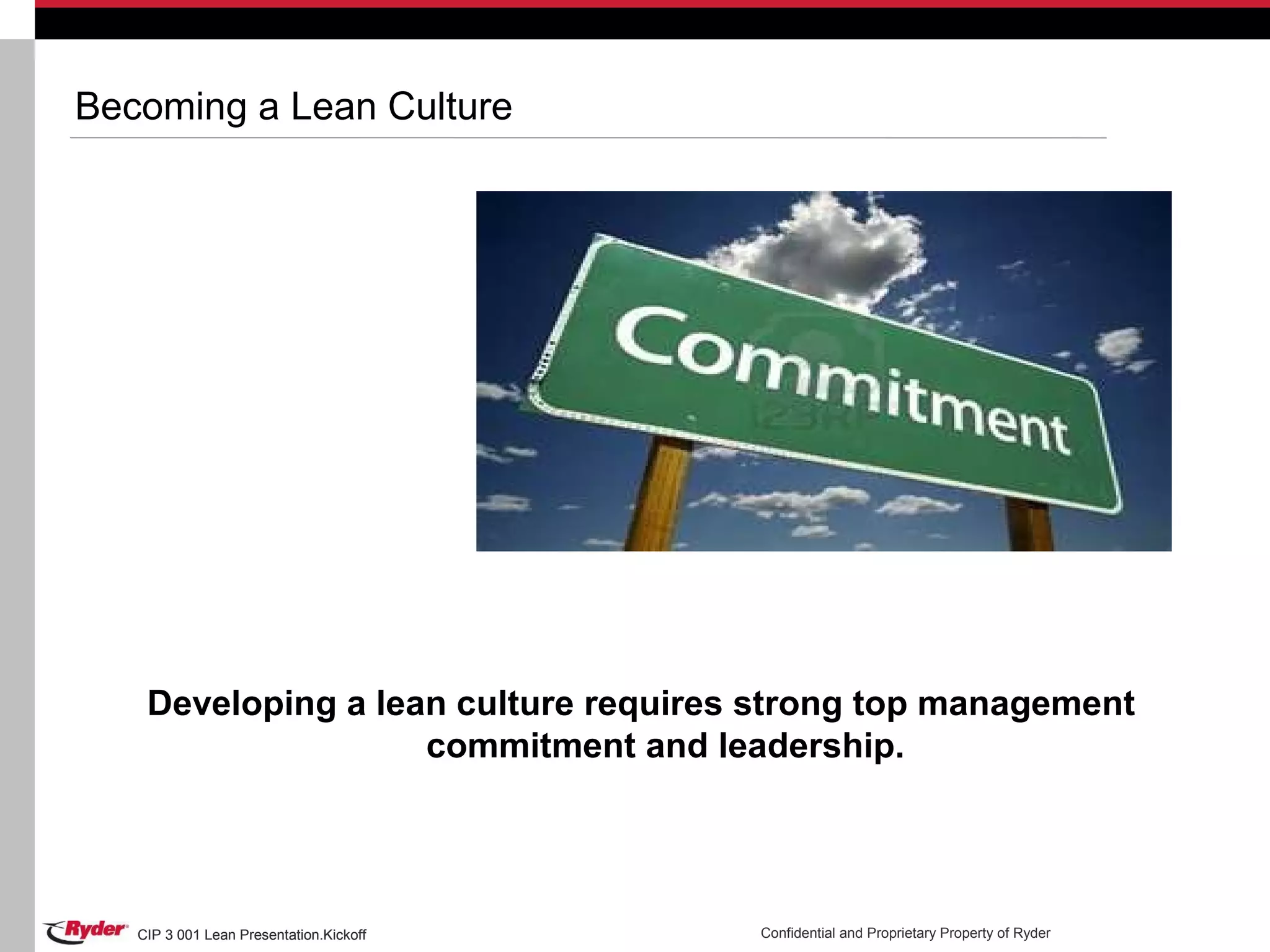
Becoming a Lean Culture
Developing a lean culture requires strong top management
commitment and leadership.
CIP 3 001 Lean Presentation.Kickoff Confidential and Proprietary Property of RyderCIP 3 001 Lean Presentation.Kickoff
QUESTIONS

Lean presentation tier1 v2 053113

  • 1.
  • 2.
    CIP 3 001Lean Presentation.Kickoff Confidential and Proprietary Property of Ryder What is Lean? Listing to the right or left? Cut of meat with no fat? Non fat foods? Car running on too much air? Doing more with less? 2
  • 3.
    CIP 3 001Lean Presentation.Kickoff Confidential and Proprietary Property of Ryder What Lean is not  Lean is not about eliminating people.  Lean is not about blaming people  Lean is not about creating checklists and inspections  Lean is not about painting lines on the floor  Lean is not about putting up boards
  • 4.
    CIP 3 001Lean Presentation.Kickoff Confidential and Proprietary Property of RyderCIP 3 001 Lean Presentation.Kickoff 4 What is Lean? (Textbook definition)* Produce Only  What the customer wants,  Only in the quantities they want,  Only when they want it  By doing only those things that add value  Driving continuous improvement at all levels of the organization 4 * Womack & Jones (2003). “Lean thinking” “All we are doing is looking at the Time Line – from the moment a customer gives us an order to the point we collect cash. And we are Reducing that Time Line by removing the non-value added wastes” -Taiichi Ohno
  • 5.
    CIP 3 001Lean Presentation.Kickoff Confidential and Proprietary Property of RyderCIP 3 001 Lean Presentation.Kickoff 5 Tools • Building layout • Product slotting • Visual controls • WMS • Workplace organization • MHE & storage • Signage Tools • Building layout • Product slotting • Visual controls • WMS • Workplace organization • MHE & storage • Signage Methods • Standardized operating procedures • Layered audits • Small batch processing • Drive-by dispatch • Manpower planning • Clearly defined expectations • Quality wall Methods • Standardized operating procedures • Layered audits • Small batch processing • Drive-by dispatch • Manpower planning • Clearly defined expectations • Quality wall Culture • View of associates on the floor as the company’s most important asset (not a cost) • Flexibility of associates to perform multiple jobs • Commitment to continuous improvement • Trust, respect, and belief in commitment throughout the organization • Employee ownership, involvement, and collaboration (Pride) • Leader as servant • Importance of orderliness, cleanliness, and having everything in its place Culture • View of associates on the floor as the company’s most important asset (not a cost) • Flexibility of associates to perform multiple jobs • Commitment to continuous improvement • Trust, respect, and belief in commitment throughout the organization • Employee ownership, involvement, and collaboration (Pride) • Leader as servant • Importance of orderliness, cleanliness, and having everything in its place Implementation Difficulty Implementation Difficulty Tools and Methods AreTools and Methods Are What You See, but It’sWhat You See, but It’s Culture That MakesCulture That Makes It Sustainable.It Sustainable. Lean ImplementationLean Implementation
  • 6.
    CIP 3 001Lean Presentation.Kickoff Confidential and Proprietary Property of RyderCIP 3 001 Lean Presentation.Kickoff 6 1980’s1950’s History of Continuous Improvement Ford Builds his 1st Car – Model “A” Ford Builds the first “moving line” • Taiichi Ohno develops the “Toyota Production System” (TPS) • W. Edwards Deming Plan-Do- Check-Act • Question conventional process Early 1900’s • Expansion across automotive and manufacturing • Motorola initiates Six Sigma Quality • Total Quality Management
  • 7.
    CIP 3 001Lean Presentation.Kickoff Confidential and Proprietary Property of RyderCIP 3 001 Lean Presentation.Kickoff 7 2006 - 2007 2008 - 2009 2010 2011 Ryder’s Lean Journey (2006-2011) • Ryder’s Kaizen Challenge is underway and savings of millions of dollars are reported as results of continuous improvement workshops at locations across the country. • Over 150 Ryder Greenbelts are now trained. The 5 Lean Guiding Principles are introduced and the “Lean Team” is formed to pilot and deploy a Lean Warehousing model. • The Lean Supply Chain Solutions team expands in order to deploy the Lean Template across 64 DM locations in 2012-2013. Sites include “Showcase” facilities useful for demonstrating Lean benefits to our internal & external customers. • Ryder’s inaugural class of Lean Six Sigma Greenbelts are trained and first graduation ceremony is held in November 2007 RESULTS: A projects-based culture driving productivity based on the Lean Guiding Principles
  • 8.
    CIP 3 001Lean Presentation.Kickoff Confidential and Proprietary Property of Ryder 8 Goals of Lean The fundamental goal of lean is to reduce the time and resources it takes to convert customer orders into high-quality, low-cost deliverables. HighestHighest QualityQuality LowestLowest CostCost ShortestShortest Lead TimeLead Time
  • 9.
    CIP 3 001Lean Presentation.Kickoff Confidential and Proprietary Property of RyderCIP 3 001 Lean Presentation.Kickoff 9 Lean Culture It’s people who drive results.It’s people who drive results. Numbers tell us where we’ve been.Numbers tell us where we’ve been. People determine where we’ll go.People determine where we’ll go.
  • 10.
    CIP 3 001Lean Presentation.Kickoff Confidential and Proprietary Property of RyderCIP 3 001 Lean Presentation.Kickoff 10 Ryder’s 5 Guiding Principles
  • 11.
    CIP 3 001Lean Presentation.Kickoff Confidential and Proprietary Property of RyderCIP 3 001 Lean Presentation.Kickoff Ryder’s certified operational processes and performance measurements have a measurable impact on the performance of the operation. Improve customer satisfaction and reduce cost through continuous process improvement and error prevention. People Involvement (PI) » People at all levels feel they are important team members » Empowered to make decisions on how their job is performed » Held accountable for decisions Continuous Improvement (CI) » Every aspect of business is challenged to get better » Good yesterday  improved for acceptable today Short Lead Time (SLT) » Reduce the time it takes to complete a task » Eliminate waste from every process step Built-In Quality (BIQ) » Do it right the first time » Eliminates costly reworks and downstream quality inspections Standardization (S) » Document work processes/best practices » Use standard operating procedures to train new employees » Act as baseline for continuous improvement LEAN GUIDING PRINCIPLES RYDER’S LEAN GUIDING PRINCIPLES 11
  • 12.
    CIP 3 001Lean Presentation.Kickoff Confidential and Proprietary Property of RyderCIP 3 001 Lean Presentation.Kickoff 12 LEAN :: PEOPLE INVOLVEMENT » Lean is not a tool or a process: it is our culture » We encourage everyone to challenge the status quo and drive continuous improvement » We empower workers to decide the best way to do their jobs » Employees are cross-trained » Employees are rewarded for successes that benefit our customer Engage the Workforce Today Management’s Responsibility Future Everyone’s Responsibility Mgmt Supervisor Associates Associates Supervisor Mgmt
  • 13.
    CIP 3 001Lean Presentation.Kickoff Confidential and Proprietary Property of RyderCIP 3 001 Lean Presentation.Kickoff 13 Sample A-3 LEAN :: CONTINUOUS IMPROVEMENT » Challenge every aspect of business to get better » Use continuous improvement events to remove waste » Encourage employee suggestions: “thousands of little ideas” • Identify team • Analyze the problem • Describe current state • Correct wasteful processes • Define countermeasures • Standardize work • Set critical control points • Develop tracking methods • Assign tasks • Display results • Describe lessons learned • Offer future recommendations PLAN DO CHECK ACT
  • 14.
    CIP 3 001Lean Presentation.Kickoff Confidential and Proprietary Property of RyderCIP 3 001 Lean Presentation.Kickoff 14 LEAN :: STANDARDIZATION SCPM Lean Signage Standard Work Visitors to a lean operation know immediately they are in a work environment that is different. Standardization leads to: » A clean and orderly workplace » Comfortable and accurate daily tasks » Well-trained employees » Easily identified “out of standard” conditions » Measurable improvement » Safety always comes first
  • 15.
    CIP 3 001Lean Presentation.Kickoff Confidential and Proprietary Property of RyderCIP 3 001 Lean Presentation.Kickoff 15 Up from < 40 cases / hr in Week 1 to > 120 cases / hr as of Week 40 OUTBOUND PRODUCTIVITY - 25.0 50.0 75.0 100.0 125.0 150.0 1 2 3 4 5 6 7 8 9 10 11 12 13 14 15 16 17 18 19 20 21 22 23 24 25 26 27 28 29 30 31 32 33 34 35 36 37 38 39 40 41 42 43 44 45 46 47 48 49 50 51 52 Cases(OB)perHour 300% Improvement Target with “Voice”140.0 Week Productivity Metrics Sample tools to track and increase speed: LEAN :: SHORT LEAD TIME Material Flow Value Stream Mapping Material Flow Receiving & Inspection Outbound Staging Slow Moving Product 20% Volume Fast Moving Product 80% Volume » Speed the process » Reduce time and resources » Reduce invested capital » Remove buffers and processes that don’t add value
  • 16.
    CIP 3 001Lean Presentation.Kickoff Confidential and Proprietary Property of RyderCIP 3 001 Lean Presentation.Kickoff Value Stream Mapping allows Ryder to become a partner with our Customers, seeing their business from their perspective and helping them develop solutions to their problems. Creating Customer Value Help our Customers understand their problems, issues and opportunities in a new or different way and then show them solutions which match their needs. 16 Using the Value Stream Mapping Tool VALUE STREAM MAPPING VSM LEVELS Level 1: Supply Chain  High level, includes the entire or large portion of the Supply Chain  Output can be used to set Strategic or High Level Objectives Level 2: Site  Value Stream within the four walls  Detailed enough to ID & prioritize improvement opportunities Level 3: Process  More granular than Level 2  Yields a more detailed understanding of the drivers of cost, quality, & speed in VS Product Family Current State Map Future State Map Develop Kaizen Action Plan How the process currently operates. Designing a lean flow. Becomes current state after implementation. Product Family Current State Map Future State Map Develop Kaizen Action Plan How the process currently operates. Designing a lean flow. Becomes current state after implementation. Product Family Current State Map Future State Map Develop Kaizen Action Plan How the process currently operates. Designing a lean flow. How the process currently operates. Designing a lean flow. Becomes current state after implementation.
  • 17.
    CIP 3 001Lean Presentation.Kickoff Confidential and Proprietary Property of RyderCIP 3 001 Lean Presentation.Kickoff 17 LEAN :: BUILT-IN QUALITY » Mistake-proofing » In-process controls to prevent and detect problems » Elimination of rework » Understanding root causes » Instant feedback » Participation by all employees
  • 18.
    CIP 3 001Lean Presentation.Kickoff Confidential and Proprietary Property of Ryder 18 Process for Change  Demonstrate a Reason for Change  Create a Vision  Create a Partnership - Mgt./Work Force  Leadership Involvement  Create Commitment  Create Sense of Urgency  Drive Results through improved processes
  • 19.
    CIP 3 001Lean Presentation.Kickoff Confidential and Proprietary Property of Ryder 19 Impediments to Change  Do not have a vision  Lack of shared vision  Defensiveness  Old ways of thinking  Culture  Lack of support structure for change  Lack of trust  Lack of leadership  Lack of self-esteem  Success
  • 20.
    CIP 3 001Lean Presentation.Kickoff Confidential and Proprietary Property of Ryder 20 Managing Factors to Achieve Change Leadership Knowledge Measures Resources Focused Actions Change+ + + + = Knowledge Measures Resources Focused Actions Confusion+ + + = Leadership Measures Resources Focused Actions Anxiety+ + + = Leadership Knowledge Resources Focused Actions Gradual Change+ + + = Leadership Knowledge Measures Focused Actions Frustration+ + + = Leadership Knowledge Measures Resources False Starts+ + + + =
  • 21.
    CIP 3 001Lean Presentation.Kickoff Confidential and Proprietary Property of RyderCIP 3 001 Lean Presentation.Kickoff Takeaways for the location Sustaining a Lean Culture The real benefits come from a sustained effort over years, not weeks or months. Paramount to sustainability is to remember that Lean is a journey – not a destination.
  • 22.
    CIP 3 001Lean Presentation.Kickoff Confidential and Proprietary Property of RyderCIP 3 001 Lean Presentation.Kickoff Becoming a Lean Culture Developing a lean culture requires strong top management commitment and leadership.
  • 23.
    CIP 3 001Lean Presentation.Kickoff Confidential and Proprietary Property of RyderCIP 3 001 Lean Presentation.Kickoff QUESTIONS

Editor's Notes

  • #4 Lean is a Journey, it does not come in a box and requires commitment, time, and the ability to accept that we can make things better through continuous improvement
  • #5 Simple statement but hard to do because of the variation and waste in our processes. Our goal is to only do those things that add value Explain Taiichi Ono’s quote and that Lean applies to all process both the manufacture of products in our plants and the transforming of information and other activities throughout the company
  • #6 20% Tools and Methods; 80% Culture Without the culture, lean initiatives will fail It is crucial to start off by acknowledging that this won&amp;apos;t be easy; Lean isn&amp;apos;t easy as it requires a culture change that can only be achieved over time
  • #7 Say: Now, let’s review the history of Continuous Improvement. The history of Continuous improvement is important because it is not a new process, but a tried and true process that started over 100 years ago with mass production. Notes: The purpose of this slide is to say there are many tools. We use continuous improvement and continually upgrade our tool set. The invention of the moving assembly line signaled the end of craft production and the introduction of standardized production systems. Toyota was founded in 1933. Toyota after the war in 1947 almost went bankrupt until developing single piece flow (TPS). And then in the 1950’s PDCA with Deming, which is the DNA of almost everything we do in CI.
  • #9 Who has heard of quality, cost, and speed?
  • #10 Improvements in quality, cost, and speed are dependent upon our people
  • #13 It starts with our people - the people closest to the work we perform
  • #14 If work is not standardized, it cannot be effectively measured or improved.
  • #15 It is an important training tool for new employees, step-by-step examples of what to do and expect. It is an important tool for identifying waste. It is a quality-control measure to identify excess variation and acceptability. It is required to build predictable processes meeting the next customer’s expectation.
  • #17 SME’s to assist with content for each engineering service – 1 slide for each service on slide 2. Introduce the service with high level statement Provide high level statistics statement about the service Highlight specific features of the service Pictures – show where we perform service Typical results of the services
  • #21 Spend a few minutes on this slide as we acknowledge why we may have missed opportunities in the past. Remind the team that we are here to support as a Lean Team
  • #22 Email a copy of the ppt to attendees Leave a one page case study (which one?) Leave a copy of the Template Overview
  • #23 Discuss the importance of support and commitment from top leadership. Leadership at all levels within the site will need to be on board in order for Lean to become part of the culture. This should be shared at the same time as the Roles and Responsibilities slide with the leadership
  • #24 Ask your audience if they have any questions as they begin their Lean Journey Finally….thank them for their participation and let’s begin the Journey