
What HR people need to know
by Toronto Training and HR
April 2013
CONTENTS
3-4 Introduction to Toronto Training and HR 47-48 Fast-track to the top
5-6 Perception of HR 49-50 Deploying workforce reporting and
7-8 Contribution of the various HR roles analytics
9-10 Avoiding costly HR mistakes 51-52 Clouds in the forecast
11-14 Foundations of business savvy 53-54 Stay in front with an effective sales
15-16 Role of HR in business strategy force
17-18 Components of strategic HR 55-56 Drill C
19-20 Talent plan vs. workplace strategy 57-65 Human Resource Management
21-22 Strategy for mobile devices and social media (HRM)
23-24 Drill A 66-69 Return on investment
25-26 Fundamental HR competencies 70-72 Self-service functionality
27-28 Changing priorities 73-74 Remote working
29-30 Employee surveys 75-77 Service delivery issues
31-32 Auditing existing HR policies 78-81 Changing the current structure
33-34 Effect of talent constraints 82-89 HR planning
35-36 Outsourcing for cost optimization 90-93 World’s Most Admired Companies
37-38 Work measurement programs 94-97 Tomorrow’s HR professional
39-40 Avoiding union-led disruptions 98-99 Case studies
41-42 Drill B 100-101 Conclusion and questions
43-44 Helping the President achieve growth
45-46 Operation globalization
Page 2
Page 3
Introduction
Page 4
Introduction to Toronto Training
and HR
Toronto Training and HR is a specialist training and
human resources consultancy headed by Timothy Holden
10 years in banking
10 years in training and human resources
Freelance practitioner since 2006
The core services provided by Toronto Training and HR
are:
Training event design
Training event delivery
Reducing costs, saving time plus improving
employee engagement and morale
Services for job seekers
Page 5
Perception of HR
Perception of HR
• Agony Aunt
• Paper pushers
• Employee’s best friend
• Talent officer
• Vanish in air
Page 6
Page 7
Contribution of the various
HR roles
Contribution of the various HR roles
• Strategic partner
• Change champion
• Employee champion
• Administrative expert
Page 8
Page 9
Avoiding costly HR
mistakes
Avoiding costly HR mistakes
• Prioritize before you hire
• Get your hiring right
• Leaders are key to results
and retention
• Watch your benefits costs
• Keep compensation
competitive
• Never copy employment
policies without involving
an expert
Page 10
Page 11
Foundations of business
savvy
Foundations of business savvy 1 of 3
• Understanding the
business model at depth
• Generating insight and
impact through evidence
and data
• Connecting and
collaborating with
curiosity, purpose and
impact
• Leading with integrity,
consideration and
challenge
Page 12
Foundations of business savvy 2 of 3
INDICATORS
• Values, integrity and
conviction
• Showing consideration
but not avoiding difficult
decisions
• Facing and managing the
emotional consequences
of business decisions
Page 13
Foundations of business savvy 3 of 3
THREE PRODUCT LINES
• Basic administrative services and
transactions involved with
reward, hiring, training and
recruitment
• Business Partner services involved
with developing effective HR systems
and helping implement business
plans and talent management
• Strategic Partner role contributing to
business strategy based on
considerations of human
capital, organizational
capabilities, readiness and
Page 15
Role of HR in business
strategy
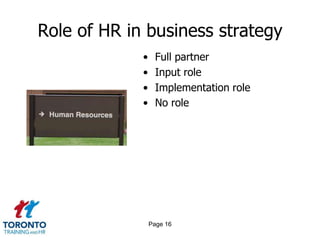
Role of HR in business strategy
• Full partner
• Input role
• Implementation role
• No role
Page 16
Page 17
Components of strategic
HR
Components of strategic HR
• Structure
• Roles
• Competencies
Page 18
Page 19
Talent plan vs. workforce
strategy
Talent plan vs. workforce strategy
• Goal
• Focus
• Value
• Ownership
Page 20
Page 21
Strategy for mobile
devices and social media
Strategy for mobile devices and
social media
• Create a holistic strategy and
value proposition with other
business functions
• Enable HR to drive mobile and
social adoption
• Consider the specific needs of
each customer segment
• Define success
• Develop and implement an
integrated solution
Page 22
Page 23
Drill A
Page 24
Drill A
Page 25
Fundamental HR
competencies
Fundamental HR competencies
• Outside/in
• Business/people
• Individual/organizational
• Event/sustainability over
time
• Past/future
• Administrative/strategic
Page 26
Page 27
Changing priorities
Changing priorities
• Last five years
• Now
• Next five years
Page 28
Page 29
Employee surveys
Employee surveys
• Conditions for conducting
a survey
• Types of instruments
• Feedback
• Frequently encountered
problems
Page 30
Page 31
Auditing existing HR
practices
Auditing existing HR practices
• HR expertise
• Hiring
• Onboarding and orientation
• Performance management
• Employee retention
• Discipline and termination
• Compliance
• Benefits
Page 32
Page 33
Effect of talent constraints
• Cost of talent-related
expenses
• Inability to innovate
effectively
• Inability to pursue a
market opportunity
• Failure to achieve growth
forecasts
• Cancelling or delay of a
key strategic initiative
• Fall in production or
service delivery standards
Page 34
Page 35
Outsourcing for cost
optimization
Outsourcing for cost optimization
• Employee engagement
• Employee shared services
• Learning & development
• Recruitment process
Page 36
Page 37
Work measurement
programs
Work measurement programs
• Set base pay ranges
• Manage internal equity
• Benchmark against the market
• Maintain grade structures
• Identify key/critical roles
• Manage career pathing
• Manage talent
• Shape organization design
• Control reward/other HR costs
• Succession plan
Page 38
Page 39
Avoiding union-led
disruptions
Avoiding union-led disruptions
• Ignore union directives at
your peril
• Get help before you need
it
• Move quickly to evaluate
your organization and
assess vulnerabilities
• Prepare for the worst
• Be a good communicator
• Keep your eye on the ball
Page 40
Page 41
Drill B
Page 42
Drill B
Page 43
Helping the President
achieve growth
Helping the President achieve
growth
• Manage talent with growth in
mind
• Help groom business leaders
and managers who can drive
growth and innovation globally
• Be a “special teams” coach to
executive leadership
Page 44
Page 45
Operation globalization
• Invest in HR leaders with the
knowledge, skills and
motivation for global
operations
• Expand HR’s services
• Align HR around a global
operating model
• Ratchet up HR’s change
management capabilities
• Harness the power of
advanced analytics
Page 46
Page 47
Fast-track to the top
• Work to avoid a leadership
backlash
• Align development activities
with leadership strategy
• Walk the talk
• What makes a good leader?
• Attributes
Page 48
Page 49
Deploying workforce
reporting and analytics
Deploying workforce reporting and
analytics
• Start small and build
momentum
• Focus on capabilities, not just
point solutions
• Leverage existing technology
investments
• Consider cloud to jump-start
the effort
• Use what you learn
Page 50
Page 51
Clouds in the forecast
• Mind the organization
• Create a cloud culture
• Attract, manage and develop
cloud-savvy talent
• Develop cloud-savvy leaders
• Prepare for warp speed
Page 52
Page 53
Stay in front with an
effective sales force
Stay in front with an effective sales
force
• Different talent for a different way of
selling
• New skills, competencies and
organizational structures that foster
collaboration
• Governance that balances control
and flexibility
• Stronger integration across channels
and functions
• Effective sales management
• Overcome resistance to change
• Rewards that drive desired
behaviours
Page 55
Drill C
Page 56
Drill C
Page 57
Human Resource
Management (HRM)
Human Resource Management
(HRM) 1 of 8
• Definition
• Past view
• Present view
• Challenges
• Strategic view
• Technology and
knowledge
• Skills
• Trends and issues in HRM
Page 58
Human Resource Management
(HRM) 2 of 8
LINE MANAGEMENT
• Line versus staff
management
• Major HR responsibilities
Page 59
Human Resource Management
(HRM) 3 of 8
DISCIPLINES WITHIN HRM
• The legal environment
and diversity
• Staffing
• Learning & development
• Employee relations
• Labour and industrial
relations
• Compensation and
benefits
Page 60
Human Resource Management
(HRM) 4 of 8
DISCIPLINES WITHIN HRM
• Safety and security
• Ethics and sustainability
Page 61
Human Resource Management
(HRM) 5 of 8
BEST PRACTICE
• Employment security
• Selective hiring
• Self-managed
teams/team working
• High compensation
contingent on
organizational
performance
• Extensive training
• Reduction in status
difference
• Sharing information
Human Resource Management
(HRM) 6 of 8
BUNDLE OF KEY PRACTICES
• Careful recruitment and
selection
• Extensive remuneration
systems
• Team working and
flexible job design
• Learning & development
• Employee involvement
• Performance reviews with
links to contingent reward
systems
Page 63
Human Resource Management
(HRM) 7 of 8
FACTORS AFFECTING HRM
PRACTICES
• External factors
• Internal factors
MODELS OF HRM
OTHER VARIABLES
Page 64
Human Resource Management
(HRM) 8 of 8
Page 6
Page 66
Return on investment
Return on investment 1 of 3
• Talent management
initiatives linked to
greater shareholder
return
• Employee engagement
linked to a business’s
operating margin
• Investment in leadership
linked to financial
performance
Page 67
Return on investment 2 of 3
EMPLOYEE LIFE CYCLE
• Performance
management
• Engagement
• Learning & development
• Deployment
• Retention
• Succession planning
Page 68
Return on investment 3 of 3
PROFIT
• Definition
• How does HR link in?
Page 69
Page 70
Self-service functionality
Self-service functionality 1 of 2
EMPLOYEE
• Change personal data
• View pay stub/pay slip
• View total reward statement
• View vacation/sick-time usage
• Update skills, competencies,
education and certifications
• Update performance goals
and results
• View career ladders and job
definitions
Page 71
Self-service functionality 2 of 2
MANAGER
• Register/approve training
events for employees
• Change salary
• Determine bonus/variable
compensation
• Make/extend offers
• Initiate/approve job
requisitions
• Perform succession-planning
activities
Page 72
Page 73
Remote working
Remote working
RECIPE FOR SUCCESS
• Having the right
leader, capable of managing a
remote team
• Making optimal use of time
during conference calls
• Maintaining a dashboard that
constantly and publicly shares
progress and issues
• Keeping everyone on point
and on target for delivery
Page 74
Page 75
Service delivery issues
Service delivery issues 1 of 2
• Talent and performance
systems
• Streamline business processes
• Recruitment and staffing
• More involvement in strategic
business-driven issues
• Training
• Implement a new HRM
system
• Improve line managers’
people management
capabilities
Service delivery issues 2 of 2
• Compensation services and
systems
• Cost reduction related to HR
administration
• Upgrade the HR management
system
• Payroll and time management
systems/services
• Define or deploy human
capital metrics and
dashboards
Page 77
Page 78
Changing the current
structure
Changing the current structure 1 of 3
REASONS FOR CHANGING
• Realization of further
efficiency potentials
• Realization of synergies
• Quality improvements
• Cost savings
• Globalization initiative
• Change of business strategy
• Business reorganization
Page 79
Changing the current structure 2 of 3
ANTICIPATED CHANGES
• Move to a shared services
environment (SSE)
• Bring additional services into
the SSE
• Outsource some or more
functions
• Move to a single HR
organization
• Decentralize HR
Page 80
Changing the current structure 3 of 3
CANADA
• US
• Asia Pacific
• Europe
• Middle East/Africa
Page 81
Page 82
HR planning
HR planning 1 of 7
• Definition
• Benefits of good HR
planning
• Costs of poor or absent
HR planning
• Documenting the HR plan
• Communicating the HR
plan
• HR planning model
Page 83
HR planning 2 of 7
THE HR PLANNING
PROCESS
• Develop and review the
organizational profile
• Forecasting your HR
requirements
• Forecasting your HR
availability
• Gap analysis
• Planning HR initiatives
• Measure/evaluate
Page 84
HR planning 3 of 7
• Occupations in Canada
with a labour shortage
• Supply-internal and
external
• Forecasting demand
• Gap analysis and staffing
tables
• Possible scenarios
• Ways to ensure legal
compliance
Page 85
HR planning 4 of 7
FUTURE HR DEMAND
• Trend analysis
• Ratio analysis
• Scatter plots
• Regression analysis
• Nominal group technique
• Delphi technique
Page 86
HR planning 5 of 7
INTERNAL HR SUPPLY
• Markov analysis
• Skills and management
inventories
• Replacement charts and
summaries
• Succession planning
Page 87
HR planning 6 of 7
LABOUR SURPLUS
• Hiring freeze
• Downsizing through attrition
• Early retirement buyout
programs
• Reduced hours through job
sharing
• Part-time work, work sharing or
reduced work weeks
• Leaves of absence
• Termination of employment
Page 88
HR planning 7 of 7
HR SHORTAGE
• Hiring employers
• Employee transfers and
promotions
• Retention programs
Page 89
Page 90
World’s Most Admired
Companies
World’s Most Admired Companies
1 of 3
ESSENTIAL INGREDIENTS
• Strategic excellence
• Structures and processes
that sustain performance
over time
• Achieving success through
people
• Placing a high value on
leadership and talent
Page 91
World’s Most Admired Companies
2 of 3
PERFORMANCE DIMENSIONS
• Innovation
• Quality of management
• Long-term investment value
• Social responsibility to the
community and the
environment
• Ability to attract, develop
and retain talented people
• Quality of products and
services
Page 92
World’s Most Admired Companies
3 of 3
PERFORMANCE DIMENSIONS
• Financial soundness
• Wide use of corporate
assets
• Effectiveness in doing
business globally
Page 93
Page 94
Tomorrow’s HR
professional
Tomorrow’s HR professional 1 of 3
• Shaper
• Builder
• Catalyst
• Connector
• Achiever
Page 95
Tomorrow’s HR professional 2 of 3
WHAT’S NEW?
• Work models
• People practices
• Talent sources
Page 96
Tomorrow’s HR professional 3 of 3
SKILLS REQUIRED
• Brand ambassador
• Change agent
• PR for HR
• ROI focused
• Strategic business partner
attitude
Page 97
Page 98
Case studies
Page 99
Case studies
Page 100
Conclusion and questions
Page 101
Conclusion and questions
Summary
Videos
Questions

HR April 2013

  • 1.
    What HR peopleneed to know by Toronto Training and HR April 2013
  • 2.
    CONTENTS 3-4 Introduction toToronto Training and HR 47-48 Fast-track to the top 5-6 Perception of HR 49-50 Deploying workforce reporting and 7-8 Contribution of the various HR roles analytics 9-10 Avoiding costly HR mistakes 51-52 Clouds in the forecast 11-14 Foundations of business savvy 53-54 Stay in front with an effective sales 15-16 Role of HR in business strategy force 17-18 Components of strategic HR 55-56 Drill C 19-20 Talent plan vs. workplace strategy 57-65 Human Resource Management 21-22 Strategy for mobile devices and social media (HRM) 23-24 Drill A 66-69 Return on investment 25-26 Fundamental HR competencies 70-72 Self-service functionality 27-28 Changing priorities 73-74 Remote working 29-30 Employee surveys 75-77 Service delivery issues 31-32 Auditing existing HR policies 78-81 Changing the current structure 33-34 Effect of talent constraints 82-89 HR planning 35-36 Outsourcing for cost optimization 90-93 World’s Most Admired Companies 37-38 Work measurement programs 94-97 Tomorrow’s HR professional 39-40 Avoiding union-led disruptions 98-99 Case studies 41-42 Drill B 100-101 Conclusion and questions 43-44 Helping the President achieve growth 45-46 Operation globalization Page 2
  • 3.
  • 4.
    Page 4 Introduction toToronto Training and HR Toronto Training and HR is a specialist training and human resources consultancy headed by Timothy Holden 10 years in banking 10 years in training and human resources Freelance practitioner since 2006 The core services provided by Toronto Training and HR are: Training event design Training event delivery Reducing costs, saving time plus improving employee engagement and morale Services for job seekers
  • 5.
  • 6.
    Perception of HR •Agony Aunt • Paper pushers • Employee’s best friend • Talent officer • Vanish in air Page 6
  • 7.
    Page 7 Contribution ofthe various HR roles
  • 8.
    Contribution of thevarious HR roles • Strategic partner • Change champion • Employee champion • Administrative expert Page 8
  • 9.
  • 10.
    Avoiding costly HRmistakes • Prioritize before you hire • Get your hiring right • Leaders are key to results and retention • Watch your benefits costs • Keep compensation competitive • Never copy employment policies without involving an expert Page 10
  • 11.
    Page 11 Foundations ofbusiness savvy
  • 12.
    Foundations of businesssavvy 1 of 3 • Understanding the business model at depth • Generating insight and impact through evidence and data • Connecting and collaborating with curiosity, purpose and impact • Leading with integrity, consideration and challenge Page 12
  • 13.
    Foundations of businesssavvy 2 of 3 INDICATORS • Values, integrity and conviction • Showing consideration but not avoiding difficult decisions • Facing and managing the emotional consequences of business decisions Page 13
  • 14.
    Foundations of businesssavvy 3 of 3 THREE PRODUCT LINES • Basic administrative services and transactions involved with reward, hiring, training and recruitment • Business Partner services involved with developing effective HR systems and helping implement business plans and talent management • Strategic Partner role contributing to business strategy based on considerations of human capital, organizational capabilities, readiness and
  • 15.
    Page 15 Role ofHR in business strategy
  • 16.
    Role of HRin business strategy • Full partner • Input role • Implementation role • No role Page 16
  • 17.
  • 18.
    Components of strategicHR • Structure • Roles • Competencies Page 18
  • 19.
    Page 19 Talent planvs. workforce strategy
  • 20.
    Talent plan vs.workforce strategy • Goal • Focus • Value • Ownership Page 20
  • 21.
    Page 21 Strategy formobile devices and social media
  • 22.
    Strategy for mobiledevices and social media • Create a holistic strategy and value proposition with other business functions • Enable HR to drive mobile and social adoption • Consider the specific needs of each customer segment • Define success • Develop and implement an integrated solution Page 22
  • 23.
  • 24.
  • 25.
  • 26.
    Fundamental HR competencies •Outside/in • Business/people • Individual/organizational • Event/sustainability over time • Past/future • Administrative/strategic Page 26
  • 27.
  • 28.
    Changing priorities • Lastfive years • Now • Next five years Page 28
  • 29.
  • 30.
    Employee surveys • Conditionsfor conducting a survey • Types of instruments • Feedback • Frequently encountered problems Page 30
  • 31.
  • 32.
    Auditing existing HRpractices • HR expertise • Hiring • Onboarding and orientation • Performance management • Employee retention • Discipline and termination • Compliance • Benefits Page 32
  • 33.
    Page 33 Effect oftalent constraints
  • 34.
    Effect of talentconstraints • Cost of talent-related expenses • Inability to innovate effectively • Inability to pursue a market opportunity • Failure to achieve growth forecasts • Cancelling or delay of a key strategic initiative • Fall in production or service delivery standards Page 34
  • 35.
    Page 35 Outsourcing forcost optimization
  • 36.
    Outsourcing for costoptimization • Employee engagement • Employee shared services • Learning & development • Recruitment process Page 36
  • 37.
  • 38.
    Work measurement programs •Set base pay ranges • Manage internal equity • Benchmark against the market • Maintain grade structures • Identify key/critical roles • Manage career pathing • Manage talent • Shape organization design • Control reward/other HR costs • Succession plan Page 38
  • 39.
  • 40.
    Avoiding union-led disruptions •Ignore union directives at your peril • Get help before you need it • Move quickly to evaluate your organization and assess vulnerabilities • Prepare for the worst • Be a good communicator • Keep your eye on the ball Page 40
  • 41.
  • 42.
  • 43.
    Page 43 Helping thePresident achieve growth
  • 44.
    Helping the Presidentachieve growth • Manage talent with growth in mind • Help groom business leaders and managers who can drive growth and innovation globally • Be a “special teams” coach to executive leadership Page 44
  • 45.
  • 46.
    Operation globalization • Investin HR leaders with the knowledge, skills and motivation for global operations • Expand HR’s services • Align HR around a global operating model • Ratchet up HR’s change management capabilities • Harness the power of advanced analytics Page 46
  • 47.
  • 48.
    Fast-track to thetop • Work to avoid a leadership backlash • Align development activities with leadership strategy • Walk the talk • What makes a good leader? • Attributes Page 48
  • 49.
  • 50.
    Deploying workforce reportingand analytics • Start small and build momentum • Focus on capabilities, not just point solutions • Leverage existing technology investments • Consider cloud to jump-start the effort • Use what you learn Page 50
  • 51.
    Page 51 Clouds inthe forecast
  • 52.
    Clouds in theforecast • Mind the organization • Create a cloud culture • Attract, manage and develop cloud-savvy talent • Develop cloud-savvy leaders • Prepare for warp speed Page 52
  • 53.
    Page 53 Stay infront with an effective sales force
  • 54.
    Stay in frontwith an effective sales force • Different talent for a different way of selling • New skills, competencies and organizational structures that foster collaboration • Governance that balances control and flexibility • Stronger integration across channels and functions • Effective sales management • Overcome resistance to change • Rewards that drive desired behaviours
  • 55.
  • 56.
  • 57.
  • 58.
    Human Resource Management (HRM)1 of 8 • Definition • Past view • Present view • Challenges • Strategic view • Technology and knowledge • Skills • Trends and issues in HRM Page 58
  • 59.
    Human Resource Management (HRM)2 of 8 LINE MANAGEMENT • Line versus staff management • Major HR responsibilities Page 59
  • 60.
    Human Resource Management (HRM)3 of 8 DISCIPLINES WITHIN HRM • The legal environment and diversity • Staffing • Learning & development • Employee relations • Labour and industrial relations • Compensation and benefits Page 60
  • 61.
    Human Resource Management (HRM)4 of 8 DISCIPLINES WITHIN HRM • Safety and security • Ethics and sustainability Page 61
  • 62.
    Human Resource Management (HRM)5 of 8 BEST PRACTICE • Employment security • Selective hiring • Self-managed teams/team working • High compensation contingent on organizational performance • Extensive training • Reduction in status difference • Sharing information
  • 63.
    Human Resource Management (HRM)6 of 8 BUNDLE OF KEY PRACTICES • Careful recruitment and selection • Extensive remuneration systems • Team working and flexible job design • Learning & development • Employee involvement • Performance reviews with links to contingent reward systems Page 63
  • 64.
    Human Resource Management (HRM)7 of 8 FACTORS AFFECTING HRM PRACTICES • External factors • Internal factors MODELS OF HRM OTHER VARIABLES Page 64
  • 65.
  • 66.
  • 67.
    Return on investment1 of 3 • Talent management initiatives linked to greater shareholder return • Employee engagement linked to a business’s operating margin • Investment in leadership linked to financial performance Page 67
  • 68.
    Return on investment2 of 3 EMPLOYEE LIFE CYCLE • Performance management • Engagement • Learning & development • Deployment • Retention • Succession planning Page 68
  • 69.
    Return on investment3 of 3 PROFIT • Definition • How does HR link in? Page 69
  • 70.
  • 71.
    Self-service functionality 1of 2 EMPLOYEE • Change personal data • View pay stub/pay slip • View total reward statement • View vacation/sick-time usage • Update skills, competencies, education and certifications • Update performance goals and results • View career ladders and job definitions Page 71
  • 72.
    Self-service functionality 2of 2 MANAGER • Register/approve training events for employees • Change salary • Determine bonus/variable compensation • Make/extend offers • Initiate/approve job requisitions • Perform succession-planning activities Page 72
  • 73.
  • 74.
    Remote working RECIPE FORSUCCESS • Having the right leader, capable of managing a remote team • Making optimal use of time during conference calls • Maintaining a dashboard that constantly and publicly shares progress and issues • Keeping everyone on point and on target for delivery Page 74
  • 75.
  • 76.
    Service delivery issues1 of 2 • Talent and performance systems • Streamline business processes • Recruitment and staffing • More involvement in strategic business-driven issues • Training • Implement a new HRM system • Improve line managers’ people management capabilities
  • 77.
    Service delivery issues2 of 2 • Compensation services and systems • Cost reduction related to HR administration • Upgrade the HR management system • Payroll and time management systems/services • Define or deploy human capital metrics and dashboards Page 77
  • 78.
    Page 78 Changing thecurrent structure
  • 79.
    Changing the currentstructure 1 of 3 REASONS FOR CHANGING • Realization of further efficiency potentials • Realization of synergies • Quality improvements • Cost savings • Globalization initiative • Change of business strategy • Business reorganization Page 79
  • 80.
    Changing the currentstructure 2 of 3 ANTICIPATED CHANGES • Move to a shared services environment (SSE) • Bring additional services into the SSE • Outsource some or more functions • Move to a single HR organization • Decentralize HR Page 80
  • 81.
    Changing the currentstructure 3 of 3 CANADA • US • Asia Pacific • Europe • Middle East/Africa Page 81
  • 82.
  • 83.
    HR planning 1of 7 • Definition • Benefits of good HR planning • Costs of poor or absent HR planning • Documenting the HR plan • Communicating the HR plan • HR planning model Page 83
  • 84.
    HR planning 2of 7 THE HR PLANNING PROCESS • Develop and review the organizational profile • Forecasting your HR requirements • Forecasting your HR availability • Gap analysis • Planning HR initiatives • Measure/evaluate Page 84
  • 85.
    HR planning 3of 7 • Occupations in Canada with a labour shortage • Supply-internal and external • Forecasting demand • Gap analysis and staffing tables • Possible scenarios • Ways to ensure legal compliance Page 85
  • 86.
    HR planning 4of 7 FUTURE HR DEMAND • Trend analysis • Ratio analysis • Scatter plots • Regression analysis • Nominal group technique • Delphi technique Page 86
  • 87.
    HR planning 5of 7 INTERNAL HR SUPPLY • Markov analysis • Skills and management inventories • Replacement charts and summaries • Succession planning Page 87
  • 88.
    HR planning 6of 7 LABOUR SURPLUS • Hiring freeze • Downsizing through attrition • Early retirement buyout programs • Reduced hours through job sharing • Part-time work, work sharing or reduced work weeks • Leaves of absence • Termination of employment Page 88
  • 89.
    HR planning 7of 7 HR SHORTAGE • Hiring employers • Employee transfers and promotions • Retention programs Page 89
  • 90.
    Page 90 World’s MostAdmired Companies
  • 91.
    World’s Most AdmiredCompanies 1 of 3 ESSENTIAL INGREDIENTS • Strategic excellence • Structures and processes that sustain performance over time • Achieving success through people • Placing a high value on leadership and talent Page 91
  • 92.
    World’s Most AdmiredCompanies 2 of 3 PERFORMANCE DIMENSIONS • Innovation • Quality of management • Long-term investment value • Social responsibility to the community and the environment • Ability to attract, develop and retain talented people • Quality of products and services Page 92
  • 93.
    World’s Most AdmiredCompanies 3 of 3 PERFORMANCE DIMENSIONS • Financial soundness • Wide use of corporate assets • Effectiveness in doing business globally Page 93
  • 94.
  • 95.
    Tomorrow’s HR professional1 of 3 • Shaper • Builder • Catalyst • Connector • Achiever Page 95
  • 96.
    Tomorrow’s HR professional2 of 3 WHAT’S NEW? • Work models • People practices • Talent sources Page 96
  • 97.
    Tomorrow’s HR professional3 of 3 SKILLS REQUIRED • Brand ambassador • Change agent • PR for HR • ROI focused • Strategic business partner attitude Page 97
  • 98.
  • 99.
  • 100.
  • 101.
    Page 101 Conclusion andquestions Summary Videos Questions