Run-Time Environments Chapter 7 COP5621 Compiler Construction Copyright Robert van Engelen, Florida State University, 2007-2009
Procedure Activation and Lifetime A procedure is  activated  when called The  lifetime  of an activation of a procedure is the sequence of steps between the first and last steps in the execution of the procedure body A procedure is  recursive  if a new activation can begin before an earlier activation of the same procedure has ended
Procedure Activations: Example program sort(input, output)   var a : array [0..10] of integer;   procedure readarray;   var i : integer;   begin   for i := 1 to 9 do read(a[i])   end;   function partition(y, z : integer) : integer   var i, j, x, v : integer;   begin …   end   procedure quicksort(m, n : integer);   var i : integer;   begin   if (n > m) then begin   i := partition(m, n);   quicksort(m, i - 1);   quicksort(i + 1, n)   end   end;   begin   a[0] := -9999; a[10] := 9999;   readarray;   quicksort(1, 9)   end. Activations: begin sort  enter readarray  leave readarray  enter quicksort(1,9)   enter partition(1,9)   leave partition(1,9)   enter quicksort(1,3)   …   leave quicksort(1,3)   enter quicksort(5,9) …   leave quicksort(5,9)  leave quicksort(1,9) end sort.
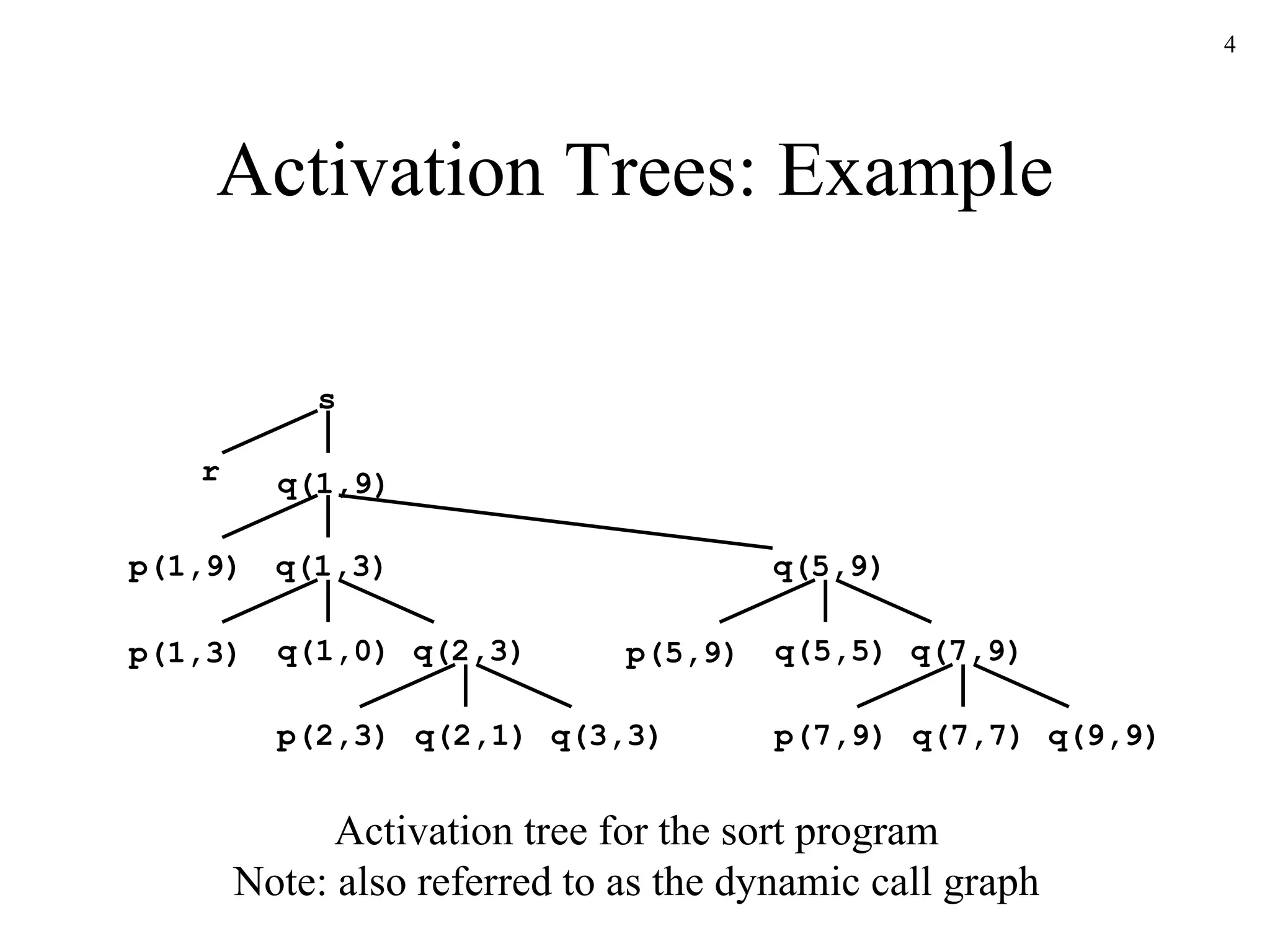
Activation Trees: Example s q(1,9) q(1,3) p(1,3) q(1,0) q(2,3) q(2,1) p(2,3) q(3,3) p(1,9) r q(5,9) p(5,9) q(5,5) q(7,9) q(7,7) p(7,9) q(9,9) Activation tree for the sort program Note: also referred to as the dynamic call graph
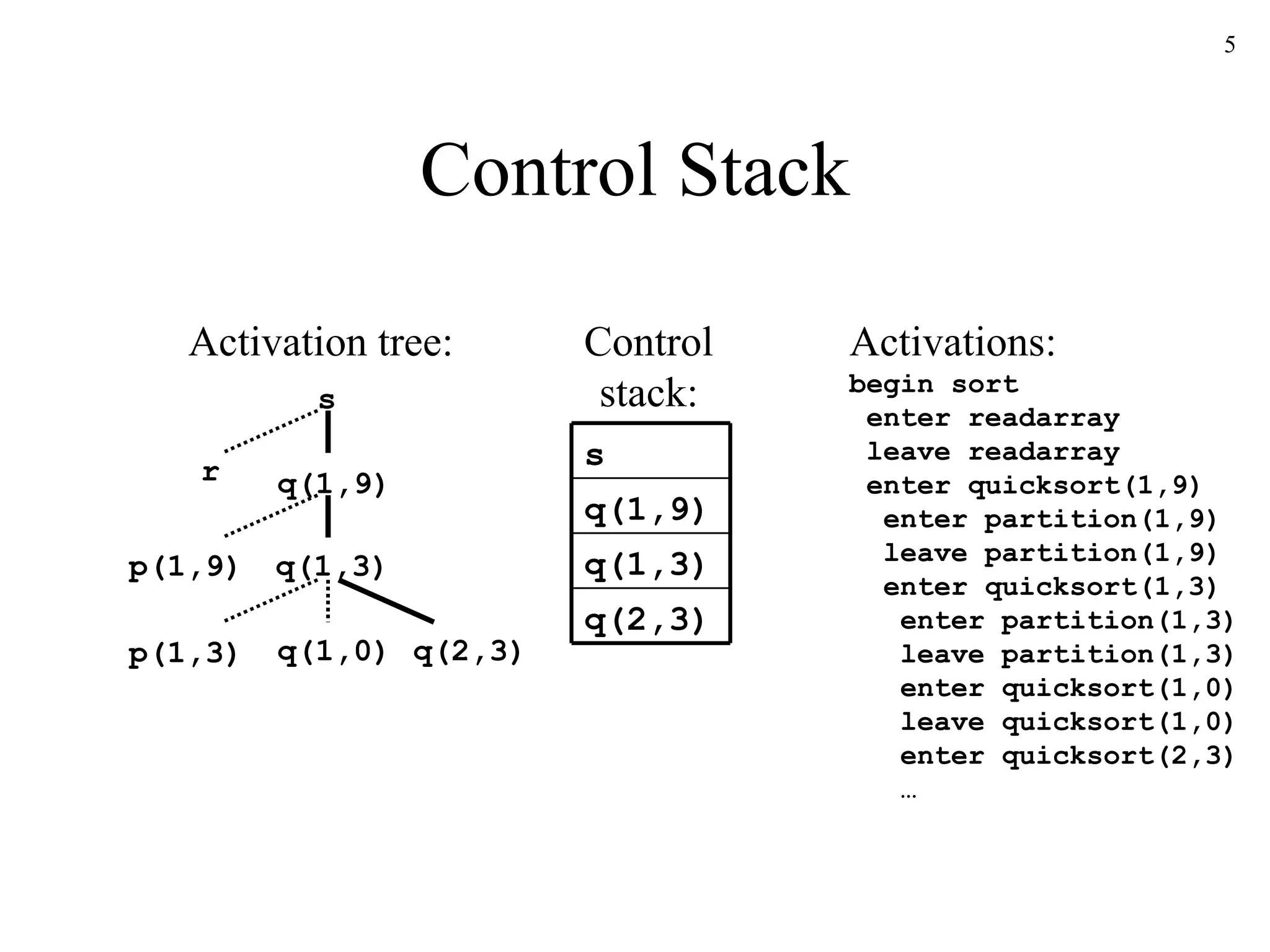
Control Stack s q(1,9) q(1,3) p(1,3) q(1,0) q(2,3) p(1,9) r Activations: begin sort  enter readarray  leave readarray  enter quicksort(1,9)   enter partition(1,9)   leave partition(1,9)   enter quicksort(1,3)   enter partition(1,3)   leave partition(1,3)   enter quicksort(1,0) leave quicksort(1,0)   enter quicksort(2,3)   … Control stack: Activation tree: s q(1,9) q(1,3) q(2,3)
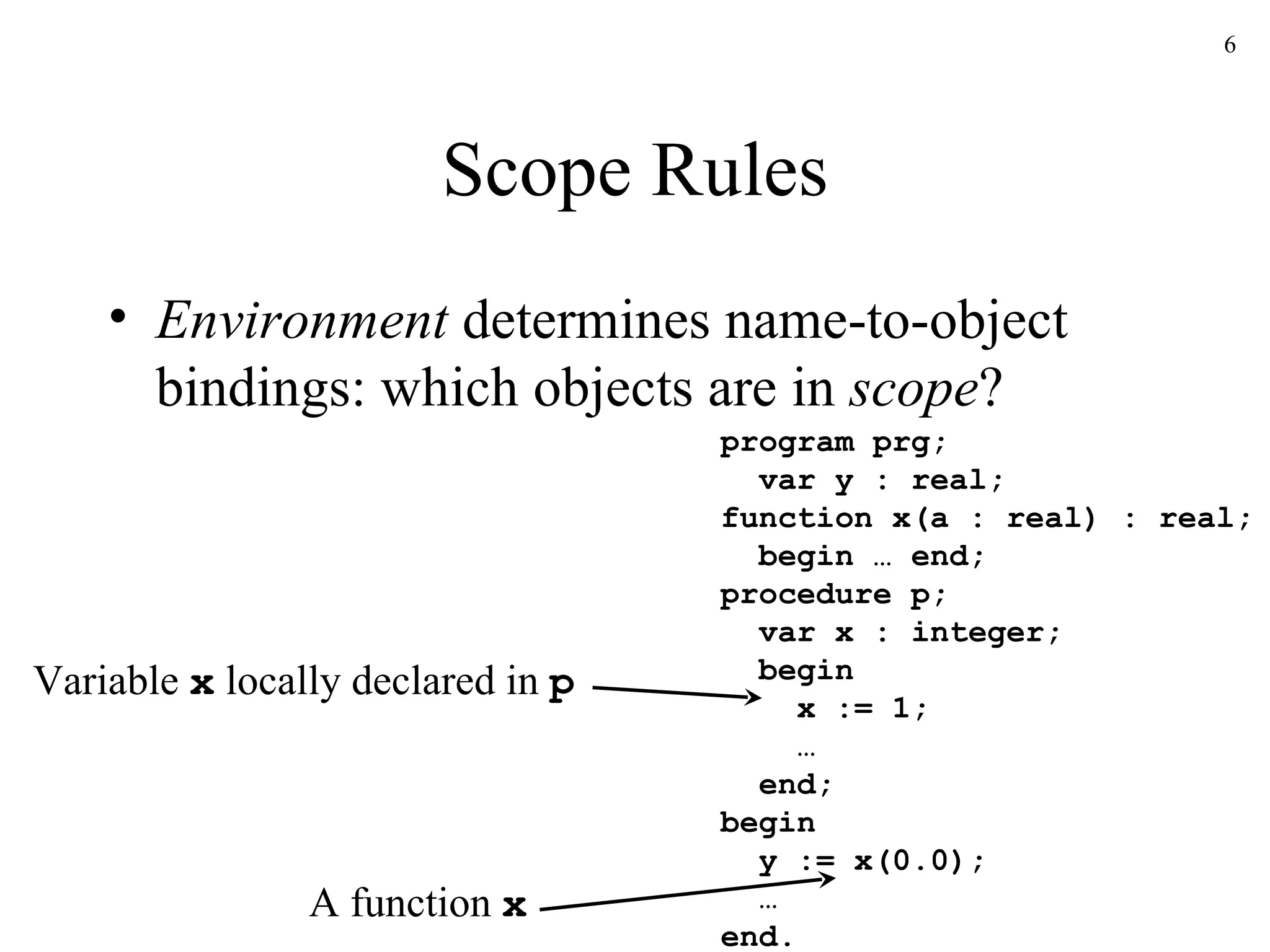
Scope Rules Environment  determines name-to-object bindings: which objects are in  scope ? program prg;   var y : real; function x(a : real) : real;   begin … end; procedure p;   var x : integer;   begin   x := 1;   …   end; begin y := x(0.0);   … end. Variable  x  locally declared in  p A function  x
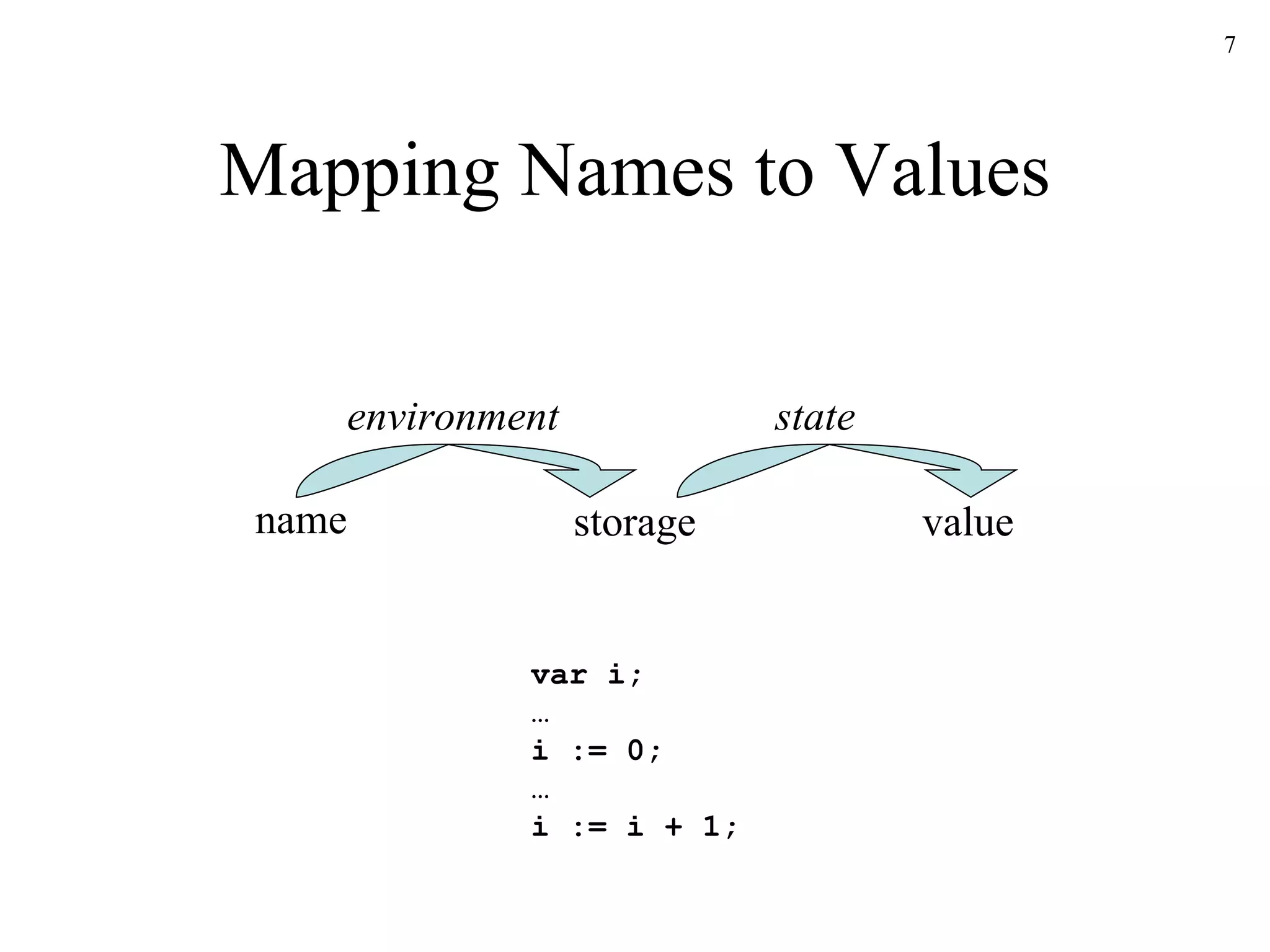
Mapping Names to Values name storage value environment state var i; … i := 0; … i := i + 1;
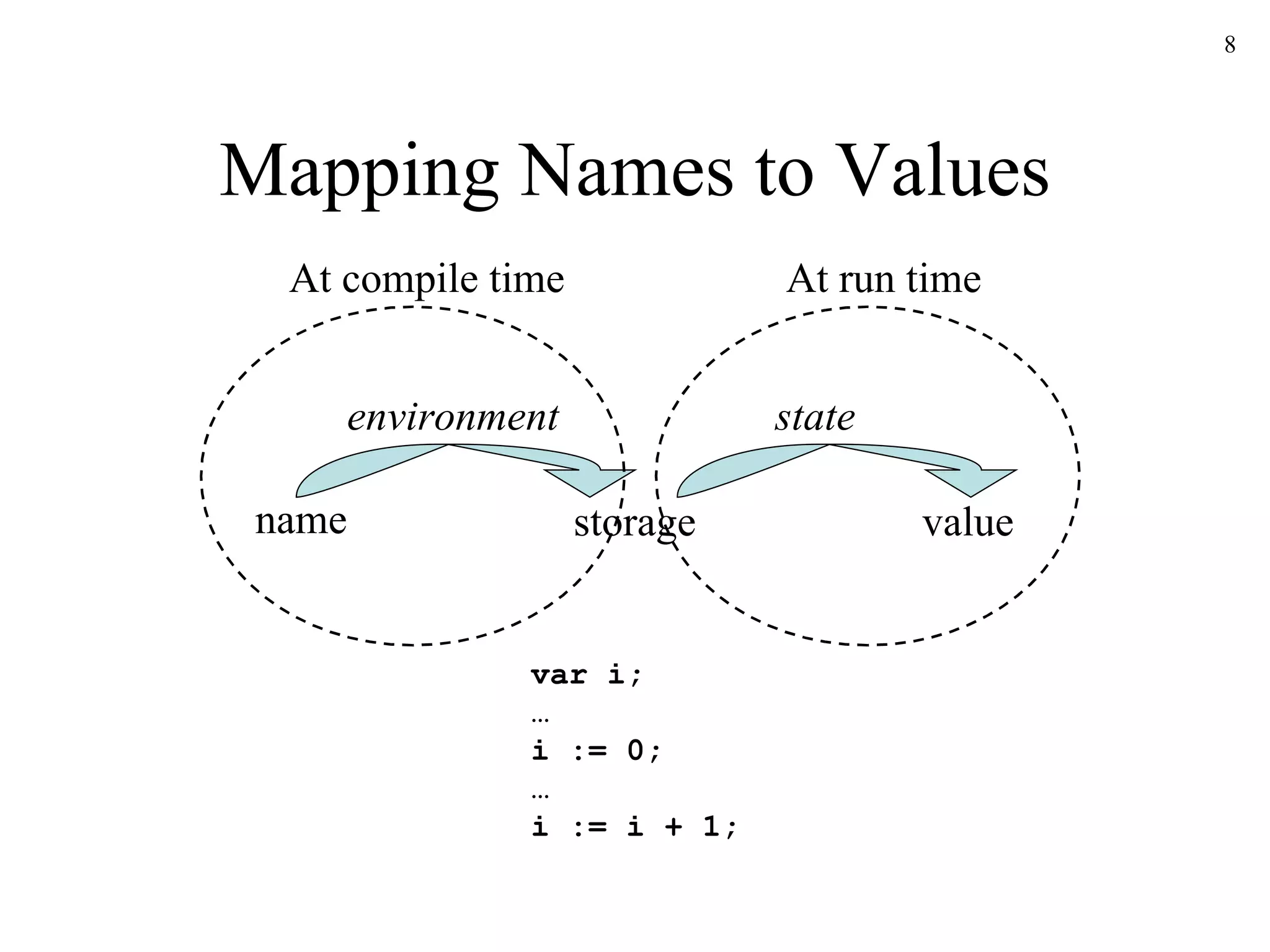
Mapping Names to Values name storage value environment state var i; … i := 0; … i := i + 1; At compile time At run time
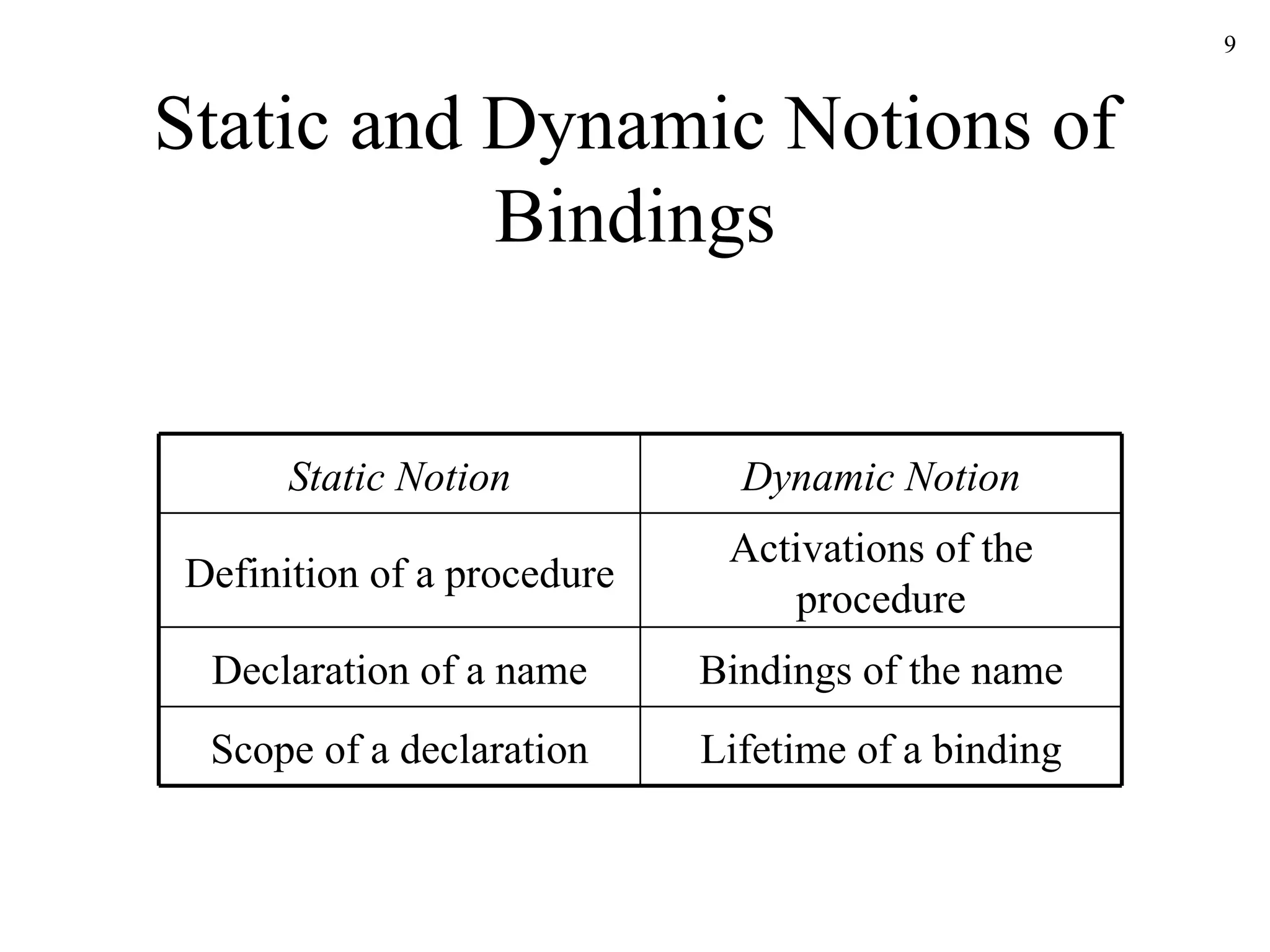
Static and Dynamic Notions of Bindings Static Notion Dynamic Notion Definition of a procedure Activations of the procedure Declaration of a name Bindings of the name Scope of a declaration Lifetime of a binding
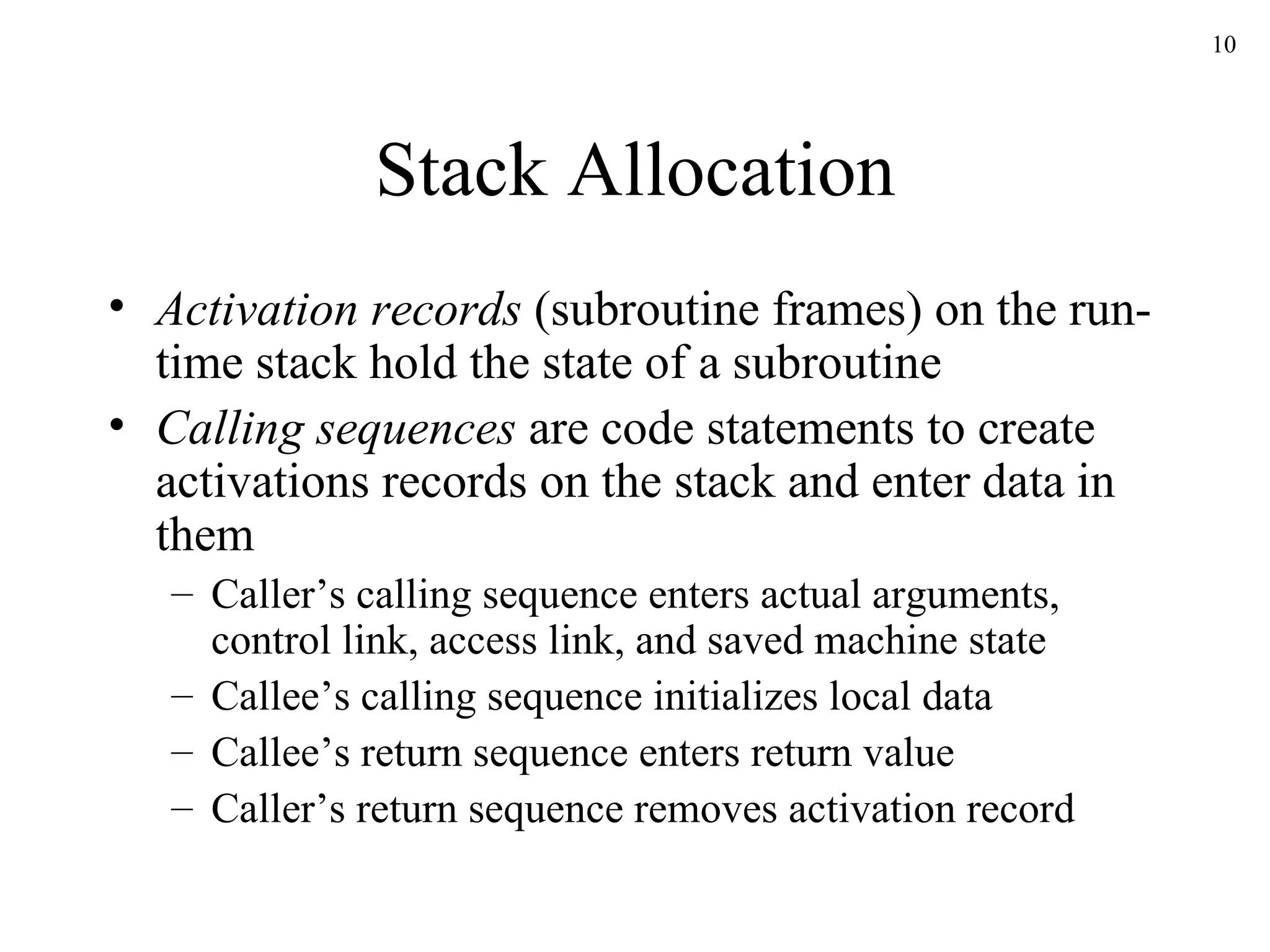
Stack Allocation Activation records  (subroutine frames) on the run-time stack hold the state of a subroutine Calling sequences  are code statements to create activations records on the stack and enter data in them Caller’s calling sequence enters actual arguments, control link, access link, and saved machine state Callee’s calling sequence initializes local data Callee’s return sequence enters return value Caller’s return sequence removes activation record
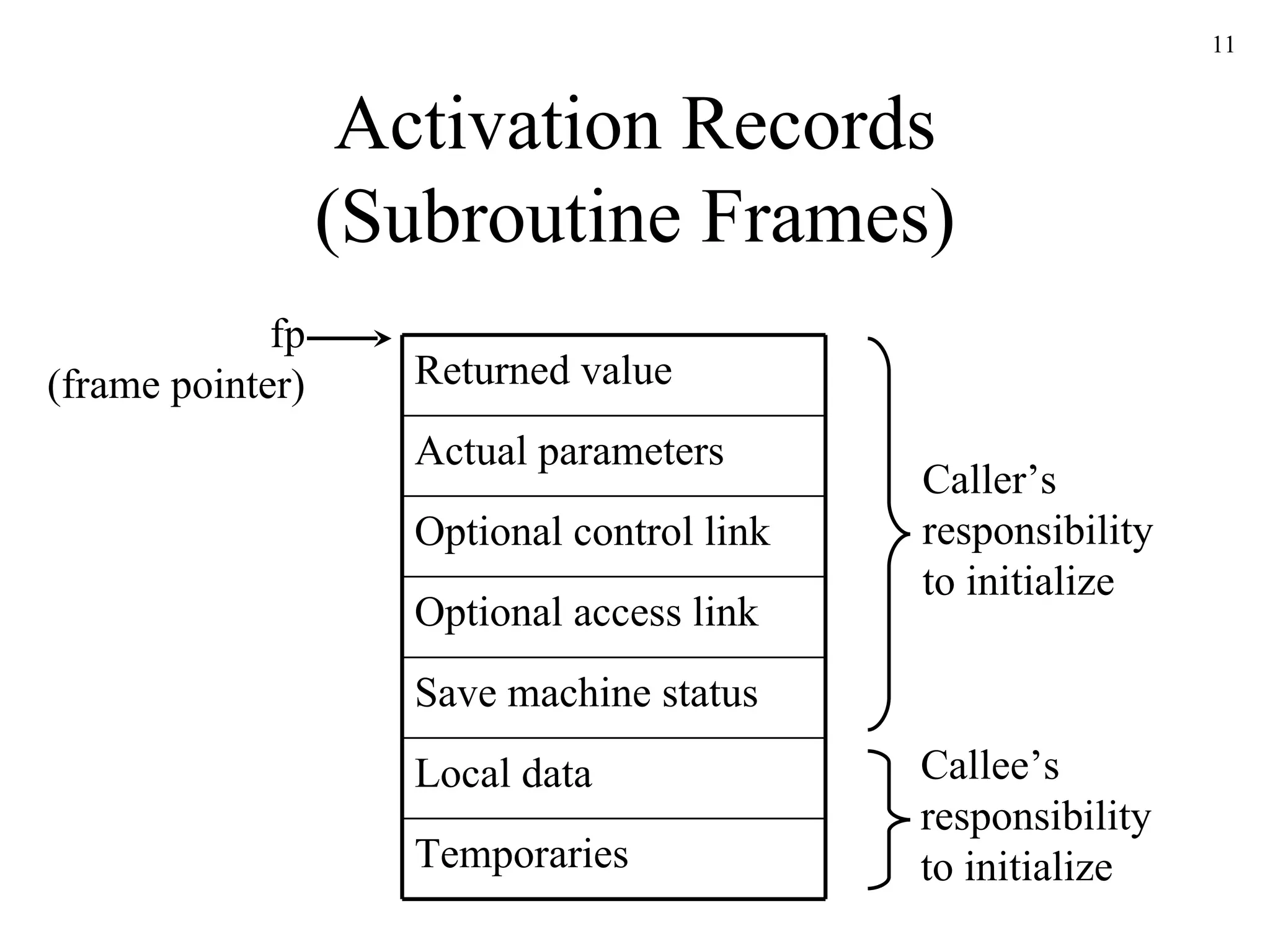
Activation Records (Subroutine Frames) Caller’s responsibility to initialize Callee’s responsibility to initialize fp (frame pointer) Returned value Actual parameters Optional control link Optional access link Save machine status Local data Temporaries
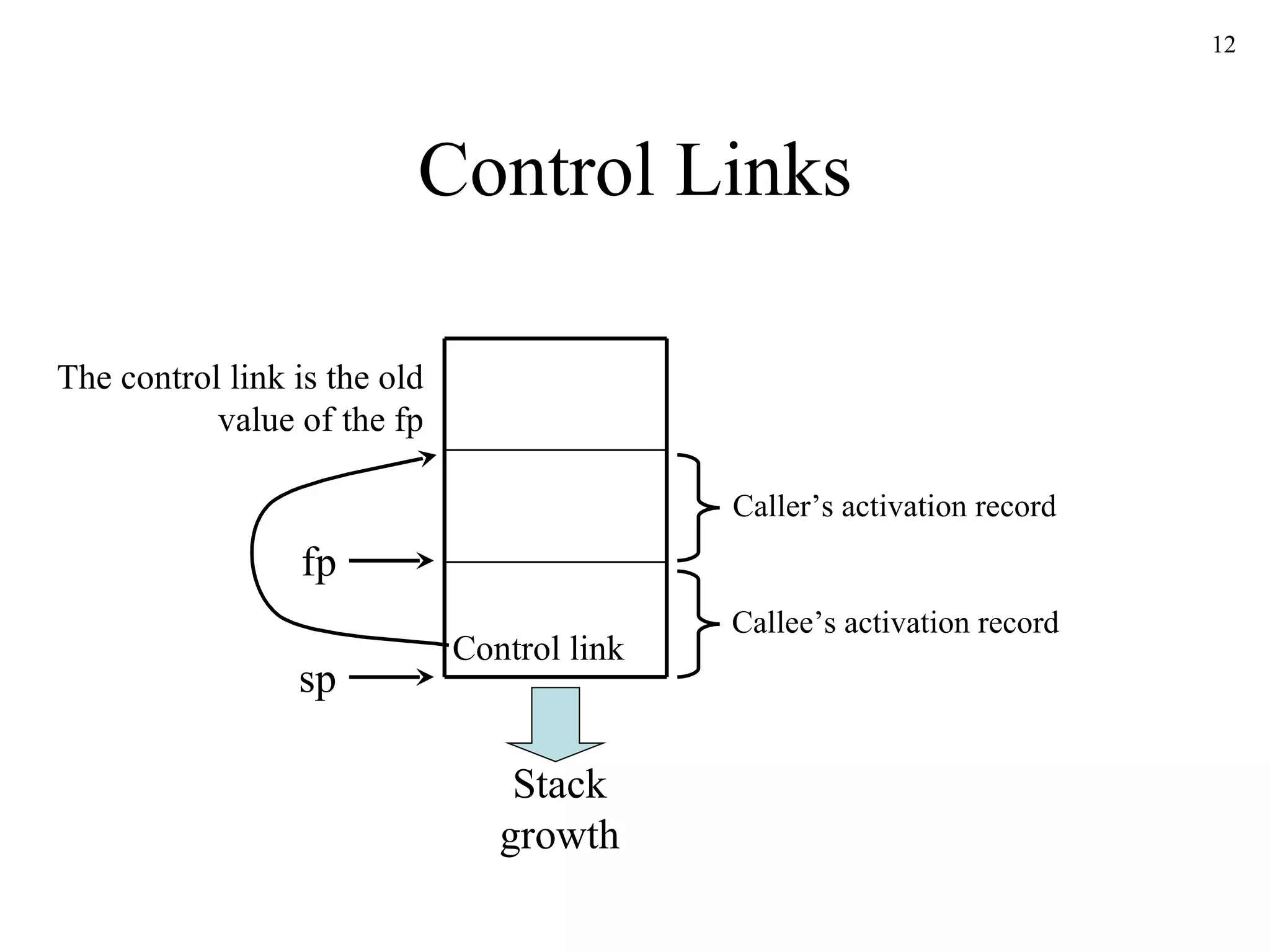
Control Links fp sp Control link Stack growth Callee’s activation record Caller’s activation record The control link is the old value of the fp
Scope with Nested Procedures program sort(input, output)   var a : array [0..10] of integer;   x : integer;   procedure readarray;   var i : integer;   begin … end;   procedure exchange(i, j : integer);   begin x := a[i]; a[i] := a[j]; a[j] := x end;   procedure quicksort(m, n : integer);   var k, v : integer;   function partition(y, z : integer) : integer   var i, j : integer;   begin … exchange(i, j) … end   begin   if (n > m) then begin   i := partition(m, n);   quicksort(m, i - 1);   quicksort(i + 1, n)   end   end;   begin   …   quicksort(1, 9)   end.
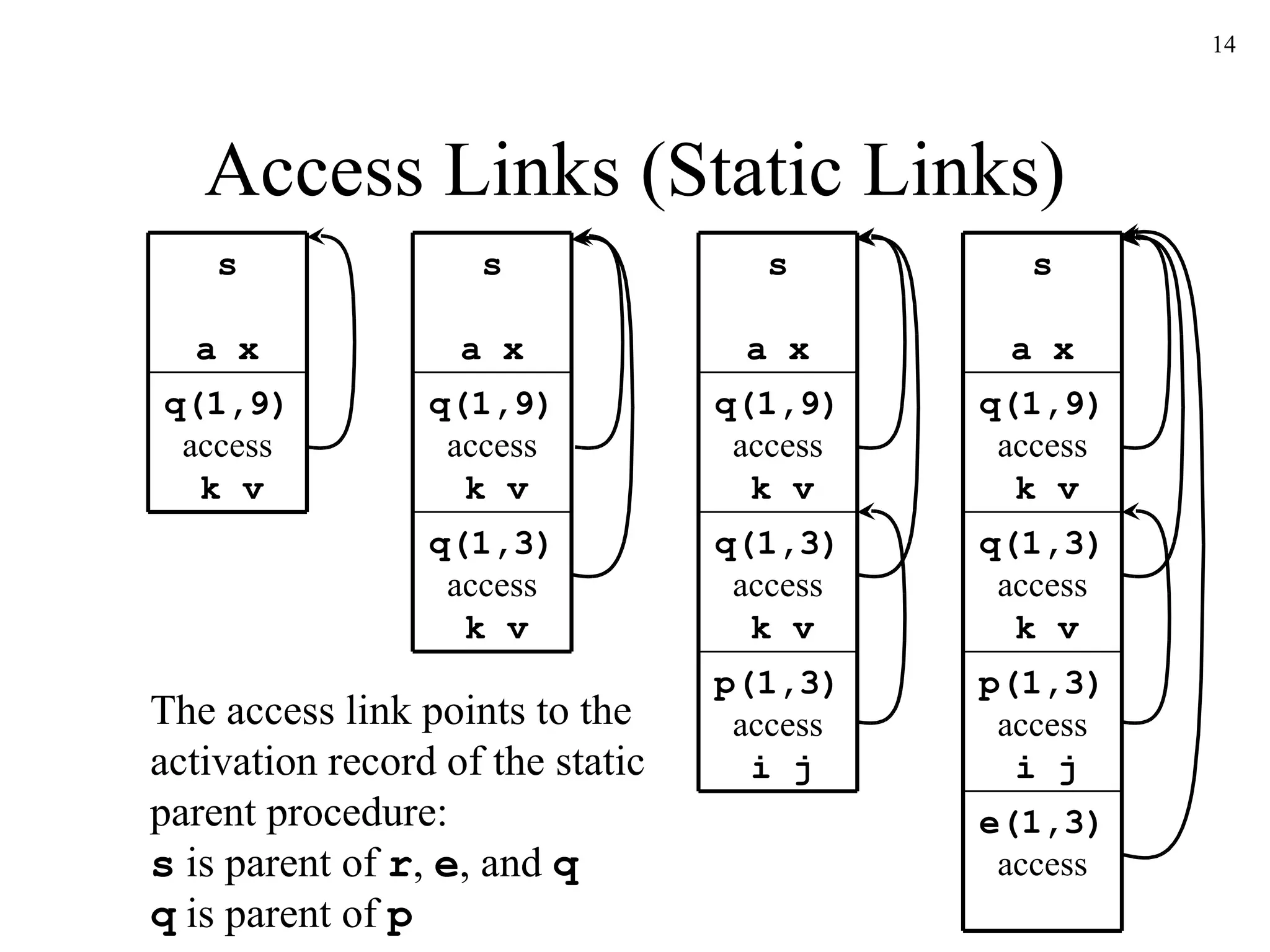
Access Links (Static Links) The access link points to the activation record of the static parent procedure: s  is parent of  r ,  e , and  q q  is parent of  p s a x q(1,9)  access   k v s a x q(1,9)  access   k v q(1,3)  access   k v s a x q(1,9)  access   k v q(1,3)  access   k v p(1,3)  access   i j s a x q(1,9)  access   k v q(1,3)  access   k v p(1,3)  access   i j e(1,3)  access
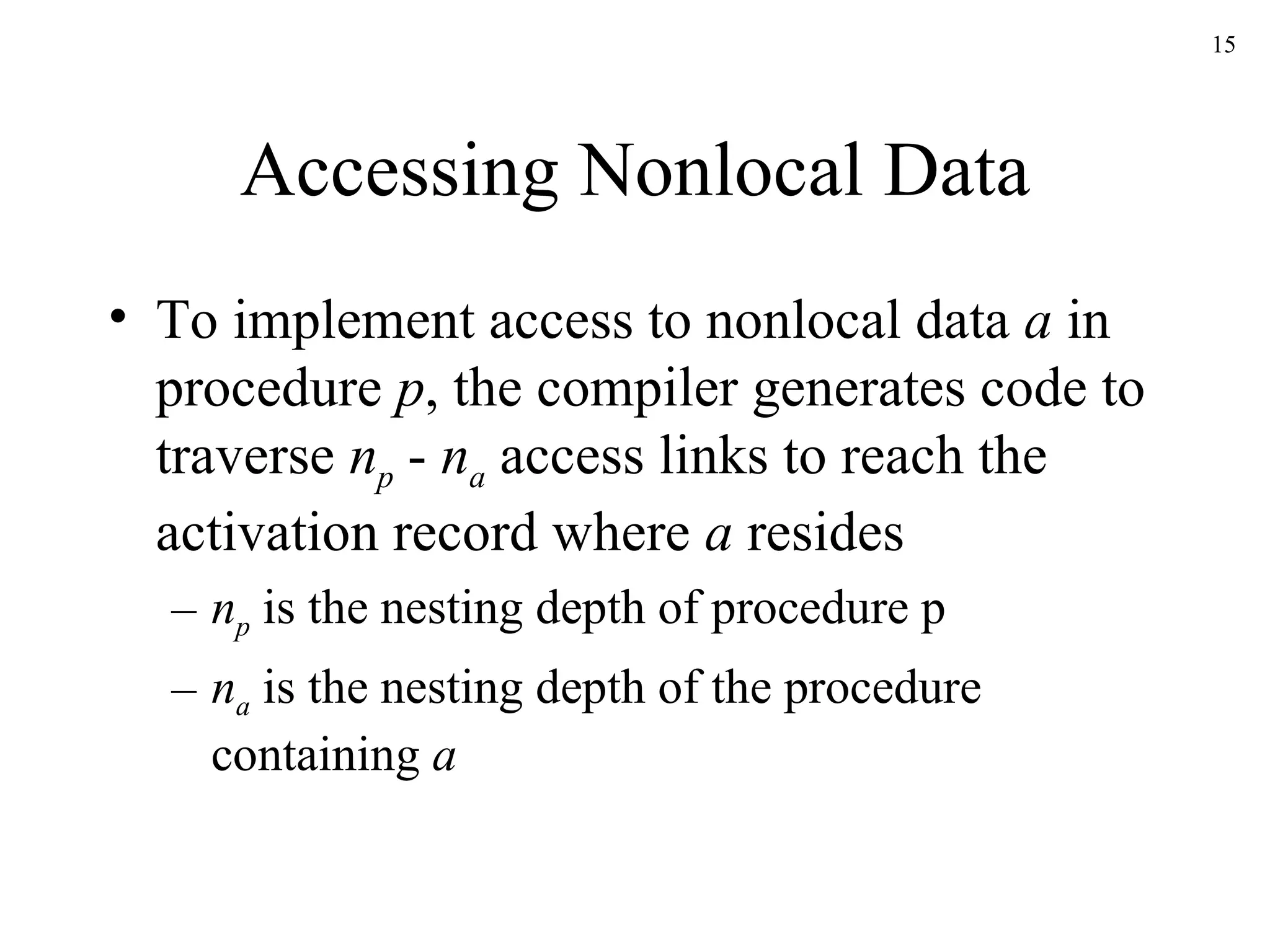
Accessing Nonlocal Data To implement access to nonlocal data  a  in procedure  p , the compiler generates code to traverse  n p  -  n a  access links to reach the activation record where  a  resides n p  is the nesting depth of procedure p n a  is the nesting depth of the procedure containing  a
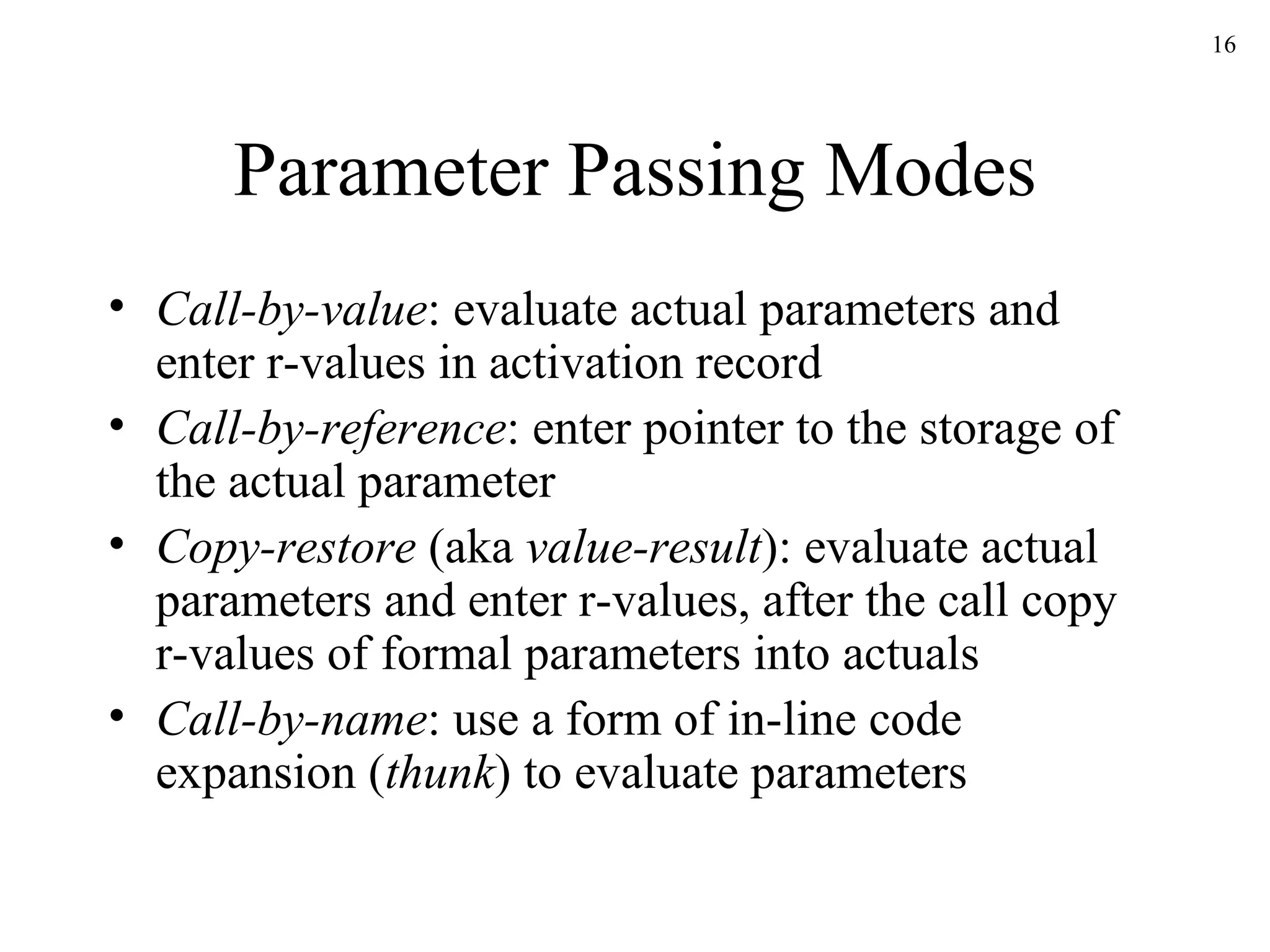
Parameter Passing Modes Call-by-value : evaluate actual parameters and enter r-values in activation record Call-by-reference : enter pointer to the storage of the actual parameter Copy-restore  (aka  value-result ): evaluate actual parameters and enter r-values, after the call copy r-values of formal parameters into actuals Call-by-name : use a form of in-line code expansion ( thunk ) to evaluate parameters

Ch7

  • 1.
    Run-Time Environments Chapter7 COP5621 Compiler Construction Copyright Robert van Engelen, Florida State University, 2007-2009
  • 2.
    Procedure Activation andLifetime A procedure is activated when called The lifetime of an activation of a procedure is the sequence of steps between the first and last steps in the execution of the procedure body A procedure is recursive if a new activation can begin before an earlier activation of the same procedure has ended
  • 3.
    Procedure Activations: Exampleprogram sort(input, output) var a : array [0..10] of integer; procedure readarray; var i : integer; begin for i := 1 to 9 do read(a[i]) end; function partition(y, z : integer) : integer var i, j, x, v : integer; begin … end procedure quicksort(m, n : integer); var i : integer; begin if (n > m) then begin i := partition(m, n); quicksort(m, i - 1); quicksort(i + 1, n) end end; begin a[0] := -9999; a[10] := 9999; readarray; quicksort(1, 9) end. Activations: begin sort enter readarray leave readarray enter quicksort(1,9) enter partition(1,9) leave partition(1,9) enter quicksort(1,3) … leave quicksort(1,3) enter quicksort(5,9) … leave quicksort(5,9) leave quicksort(1,9) end sort.
  • 4.
    Activation Trees: Examples q(1,9) q(1,3) p(1,3) q(1,0) q(2,3) q(2,1) p(2,3) q(3,3) p(1,9) r q(5,9) p(5,9) q(5,5) q(7,9) q(7,7) p(7,9) q(9,9) Activation tree for the sort program Note: also referred to as the dynamic call graph
  • 5.
    Control Stack sq(1,9) q(1,3) p(1,3) q(1,0) q(2,3) p(1,9) r Activations: begin sort enter readarray leave readarray enter quicksort(1,9) enter partition(1,9) leave partition(1,9) enter quicksort(1,3) enter partition(1,3) leave partition(1,3) enter quicksort(1,0) leave quicksort(1,0) enter quicksort(2,3) … Control stack: Activation tree: s q(1,9) q(1,3) q(2,3)
  • 6.
    Scope Rules Environment determines name-to-object bindings: which objects are in scope ? program prg; var y : real; function x(a : real) : real; begin … end; procedure p; var x : integer; begin x := 1; … end; begin y := x(0.0); … end. Variable x locally declared in p A function x
  • 7.
    Mapping Names toValues name storage value environment state var i; … i := 0; … i := i + 1;
  • 8.
    Mapping Names toValues name storage value environment state var i; … i := 0; … i := i + 1; At compile time At run time
  • 9.
    Static and DynamicNotions of Bindings Static Notion Dynamic Notion Definition of a procedure Activations of the procedure Declaration of a name Bindings of the name Scope of a declaration Lifetime of a binding
  • 10.
    Stack Allocation Activationrecords (subroutine frames) on the run-time stack hold the state of a subroutine Calling sequences are code statements to create activations records on the stack and enter data in them Caller’s calling sequence enters actual arguments, control link, access link, and saved machine state Callee’s calling sequence initializes local data Callee’s return sequence enters return value Caller’s return sequence removes activation record
  • 11.
    Activation Records (SubroutineFrames) Caller’s responsibility to initialize Callee’s responsibility to initialize fp (frame pointer) Returned value Actual parameters Optional control link Optional access link Save machine status Local data Temporaries
  • 12.
    Control Links fpsp Control link Stack growth Callee’s activation record Caller’s activation record The control link is the old value of the fp
  • 13.
    Scope with NestedProcedures program sort(input, output) var a : array [0..10] of integer; x : integer; procedure readarray; var i : integer; begin … end; procedure exchange(i, j : integer); begin x := a[i]; a[i] := a[j]; a[j] := x end; procedure quicksort(m, n : integer); var k, v : integer; function partition(y, z : integer) : integer var i, j : integer; begin … exchange(i, j) … end begin if (n > m) then begin i := partition(m, n); quicksort(m, i - 1); quicksort(i + 1, n) end end; begin … quicksort(1, 9) end.
  • 14.
    Access Links (StaticLinks) The access link points to the activation record of the static parent procedure: s is parent of r , e , and q q is parent of p s a x q(1,9) access k v s a x q(1,9) access k v q(1,3) access k v s a x q(1,9) access k v q(1,3) access k v p(1,3) access i j s a x q(1,9) access k v q(1,3) access k v p(1,3) access i j e(1,3) access
  • 15.
    Accessing Nonlocal DataTo implement access to nonlocal data a in procedure p , the compiler generates code to traverse n p - n a access links to reach the activation record where a resides n p is the nesting depth of procedure p n a is the nesting depth of the procedure containing a
  • 16.
    Parameter Passing ModesCall-by-value : evaluate actual parameters and enter r-values in activation record Call-by-reference : enter pointer to the storage of the actual parameter Copy-restore (aka value-result ): evaluate actual parameters and enter r-values, after the call copy r-values of formal parameters into actuals Call-by-name : use a form of in-line code expansion ( thunk ) to evaluate parameters