Threaded Awesome
   (that’s an oxymoron)

 Joe Damato and Aman Gupta
About Joe Damato
From NJ, Godfather II is actually my
Biography

CMU/VMWare alum

http://timetobleed.com

@joedamato
About Aman Gupta
EventMachine, amqp

Ruby Hero 2009

github.com/tmm1

@tmm1
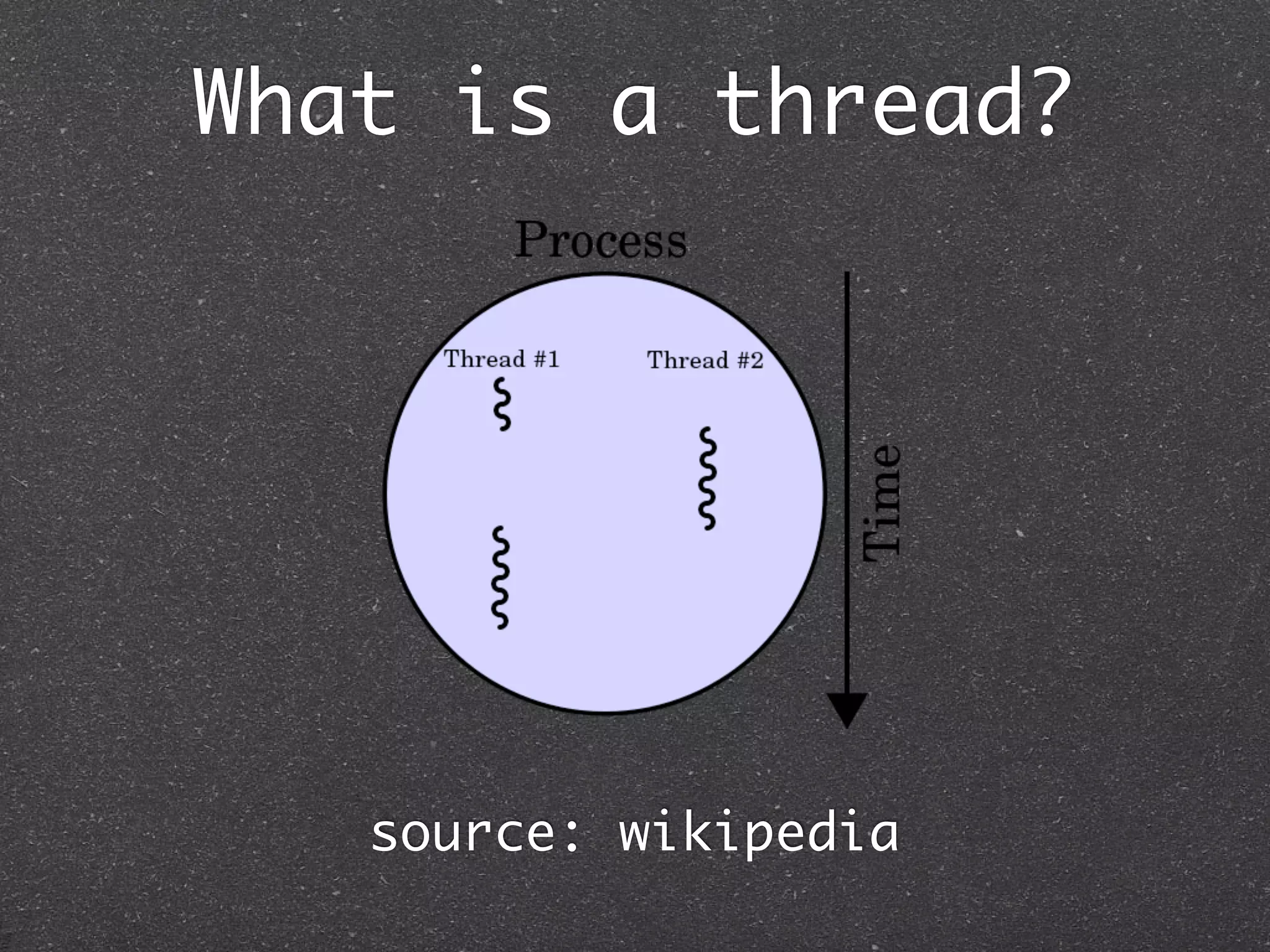
What is a thread?


   source: wikipedia
What is a thread?
What is a thread?
A thread is just a set of execution
state
What is a thread?
A thread is just a set of execution
state

This state usually includes:
What is a thread?
A thread is just a set of execution
state

This state usually includes:

  instruction & stack pointers
What is a thread?
A thread is just a set of execution
state

This state usually includes:

  instruction & stack pointers

  scheduling priority
What is a thread?
A thread is just a set of execution
state

This state usually includes:

  instruction & stack pointers

  scheduling priority

  other CPU state
Threading Models
  Green threads (1:N)

  Native Threads (1:1)

  Hybrid (M:N)
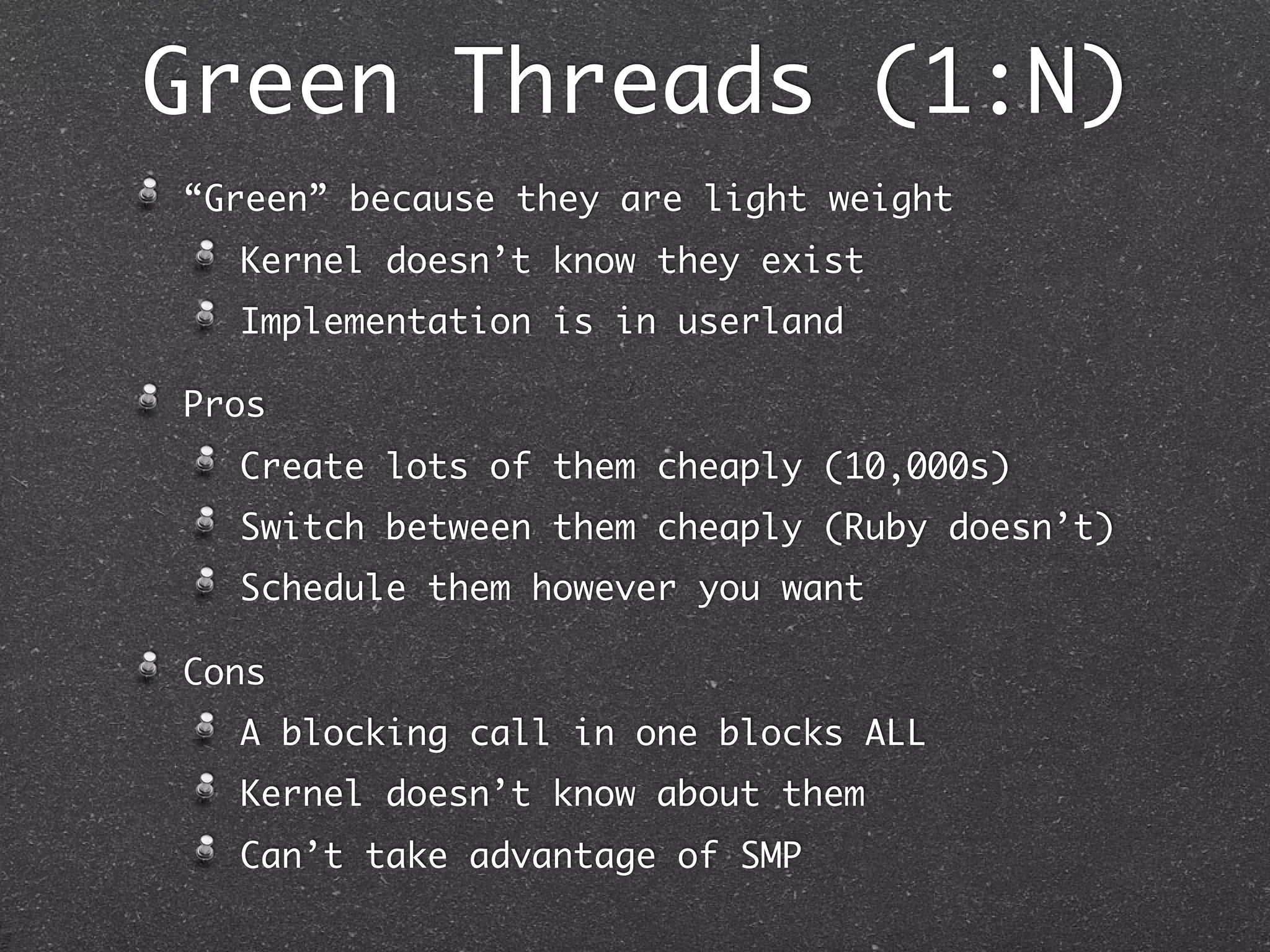
Green Threads (1:N)
Green Threads (1:N)
“Green” because they are light weight
Green Threads (1:N)
“Green” because they are light weight
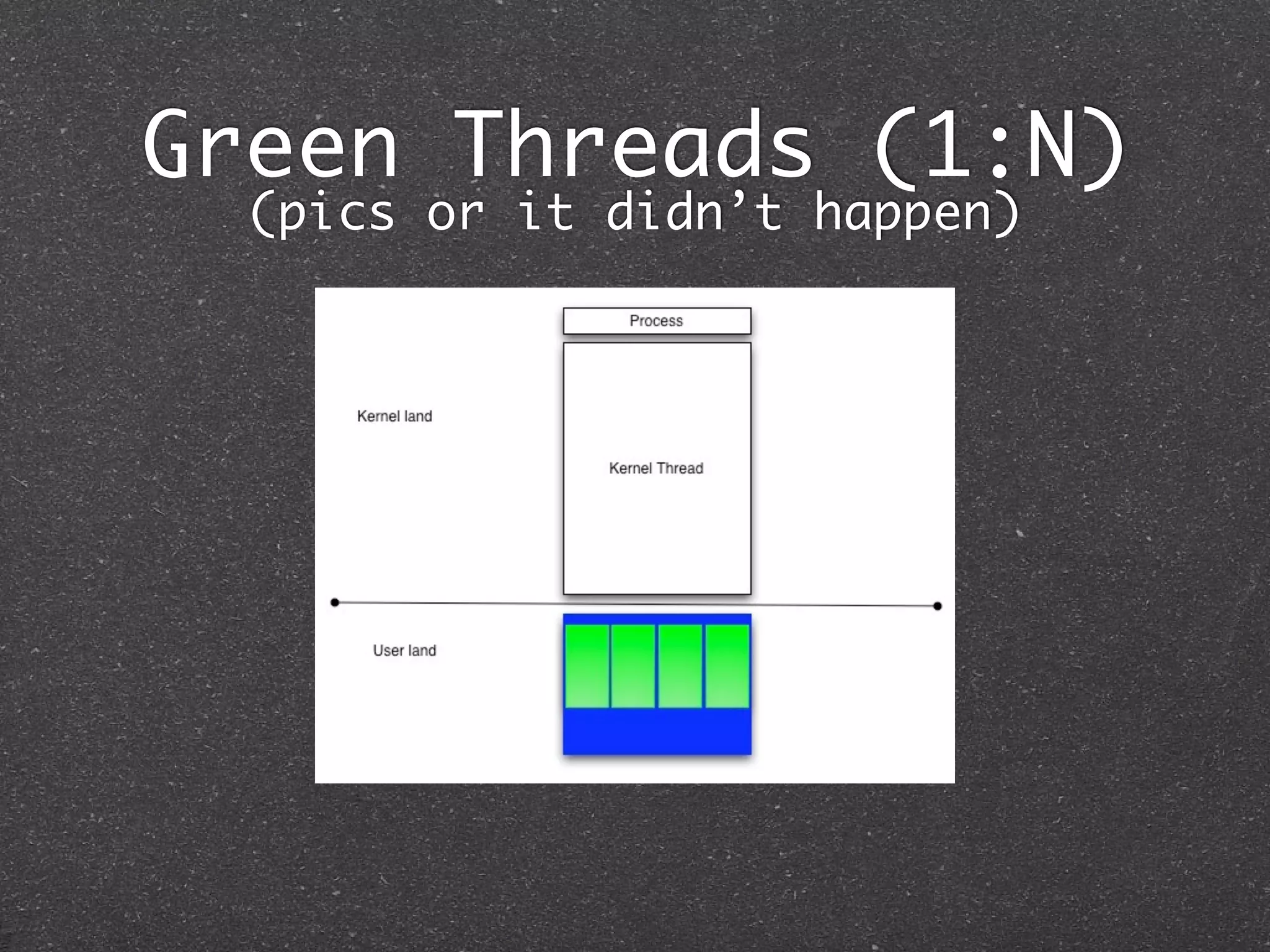
  Kernel doesn’t know they exist
Green Threads (1:N)
“Green” because they are light weight
  Kernel doesn’t know they exist
  Implementation is in userland
Green Threads (1:N)
“Green” because they are light weight
  Kernel doesn’t know they exist
  Implementation is in userland

Pros
Green Threads (1:N)
“Green” because they are light weight
  Kernel doesn’t know they exist
  Implementation is in userland

Pros
  Create lots of them cheaply (10,000s)
Green Threads (1:N)
“Green” because they are light weight
  Kernel doesn’t know they exist
  Implementation is in userland

Pros
  Create lots of them cheaply (10,000s)
  Switch between them cheaply (Ruby doesn’t)
Green Threads (1:N)
“Green” because they are light weight
  Kernel doesn’t know they exist
  Implementation is in userland

Pros
  Create lots of them cheaply (10,000s)
  Switch between them cheaply (Ruby doesn’t)
  Schedule them however you want
Green Threads (1:N)
“Green” because they are light weight
  Kernel doesn’t know they exist
  Implementation is in userland

Pros
  Create lots of them cheaply (10,000s)
  Switch between them cheaply (Ruby doesn’t)
  Schedule them however you want

Cons
Green Threads (1:N)
“Green” because they are light weight
  Kernel doesn’t know they exist
  Implementation is in userland

Pros
  Create lots of them cheaply (10,000s)
  Switch between them cheaply (Ruby doesn’t)
  Schedule them however you want

Cons
  A blocking call in one blocks ALL
Green Threads (1:N)
“Green” because they are light weight
  Kernel doesn’t know they exist
  Implementation is in userland

Pros
  Create lots of them cheaply (10,000s)
  Switch between them cheaply (Ruby doesn’t)
  Schedule them however you want

Cons
  A blocking call in one blocks ALL
  Kernel doesn’t know about them
Green Threads (1:N)
“Green” because they are light weight
  Kernel doesn’t know they exist
  Implementation is in userland

Pros
  Create lots of them cheaply (10,000s)
  Switch between them cheaply (Ruby doesn’t)
  Schedule them however you want

Cons
  A blocking call in one blocks ALL
  Kernel doesn’t know about them
  Can’t take advantage of SMP
Green Threads (1:N)
  (pics or it didn’t happen)
Ruby 1.8 uses Green Threads
     (and does it wrong)
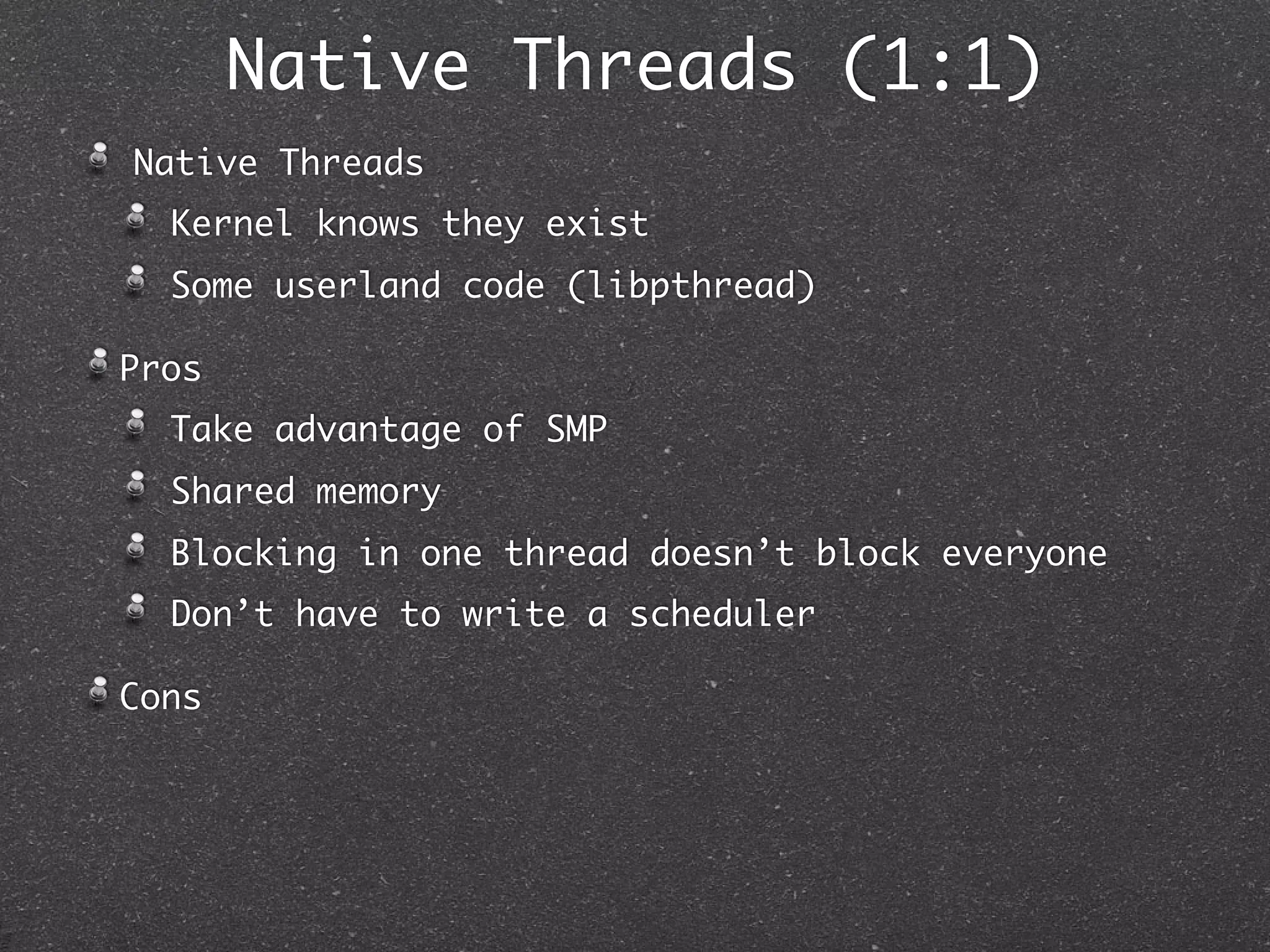
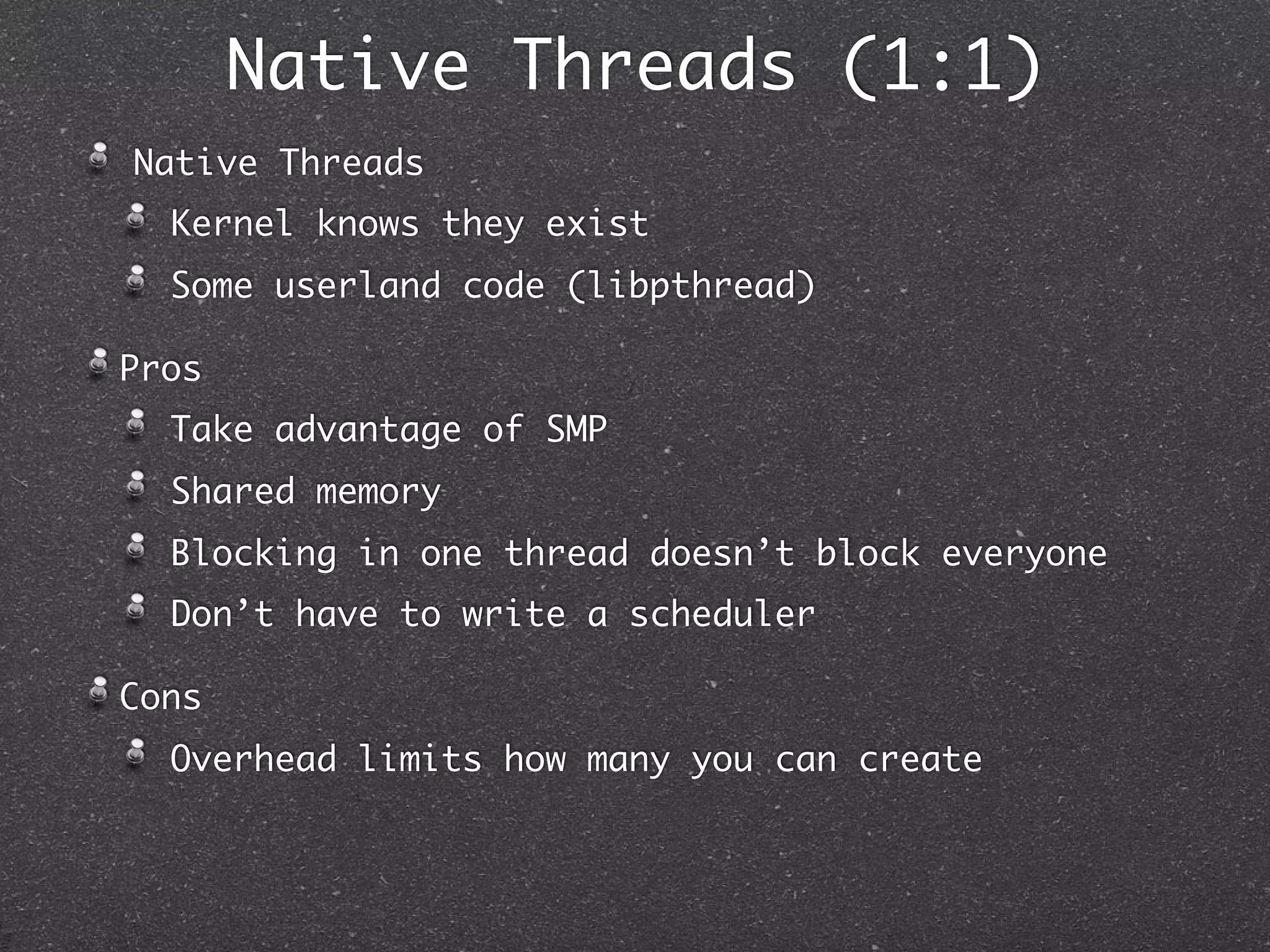
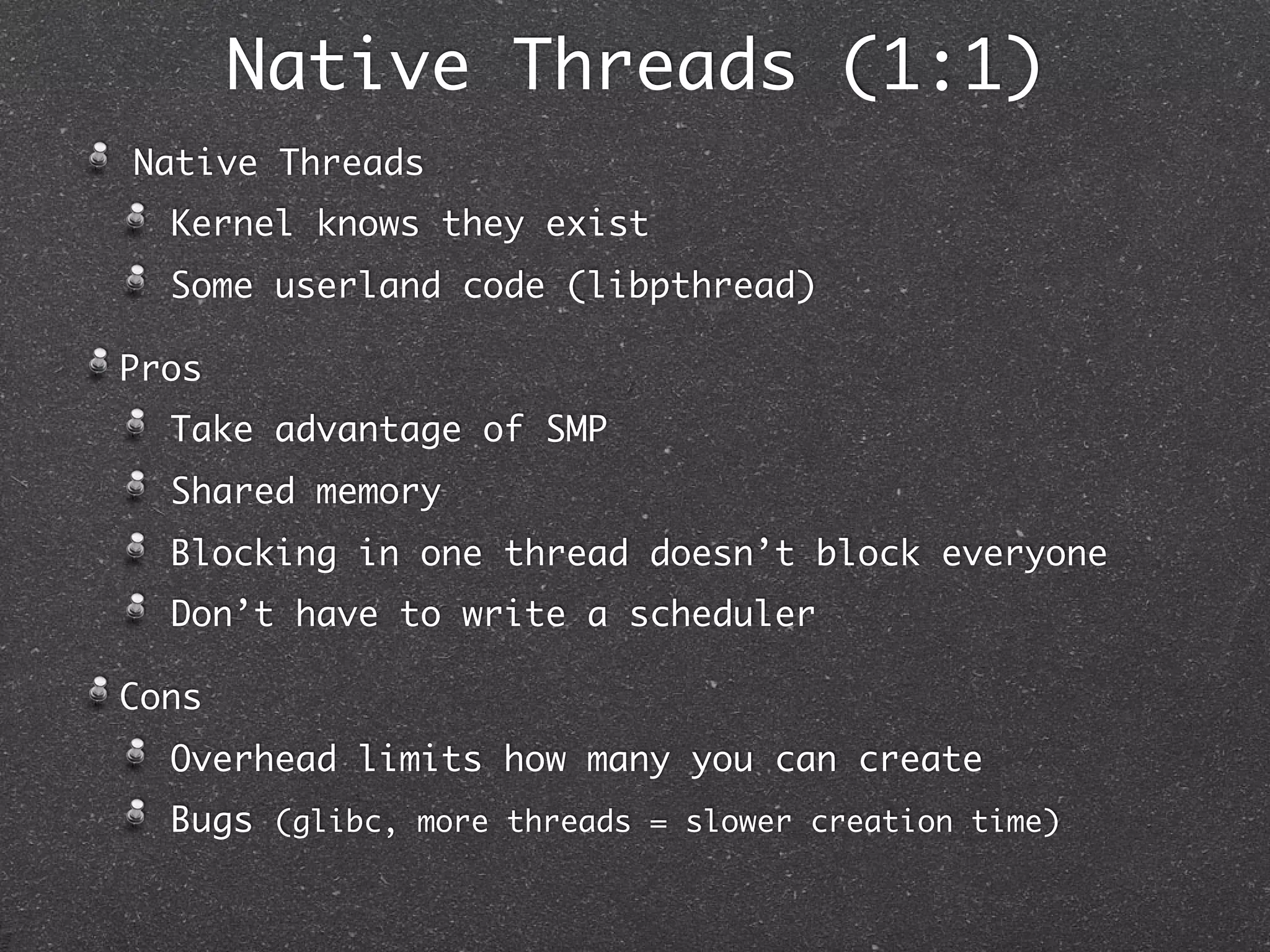
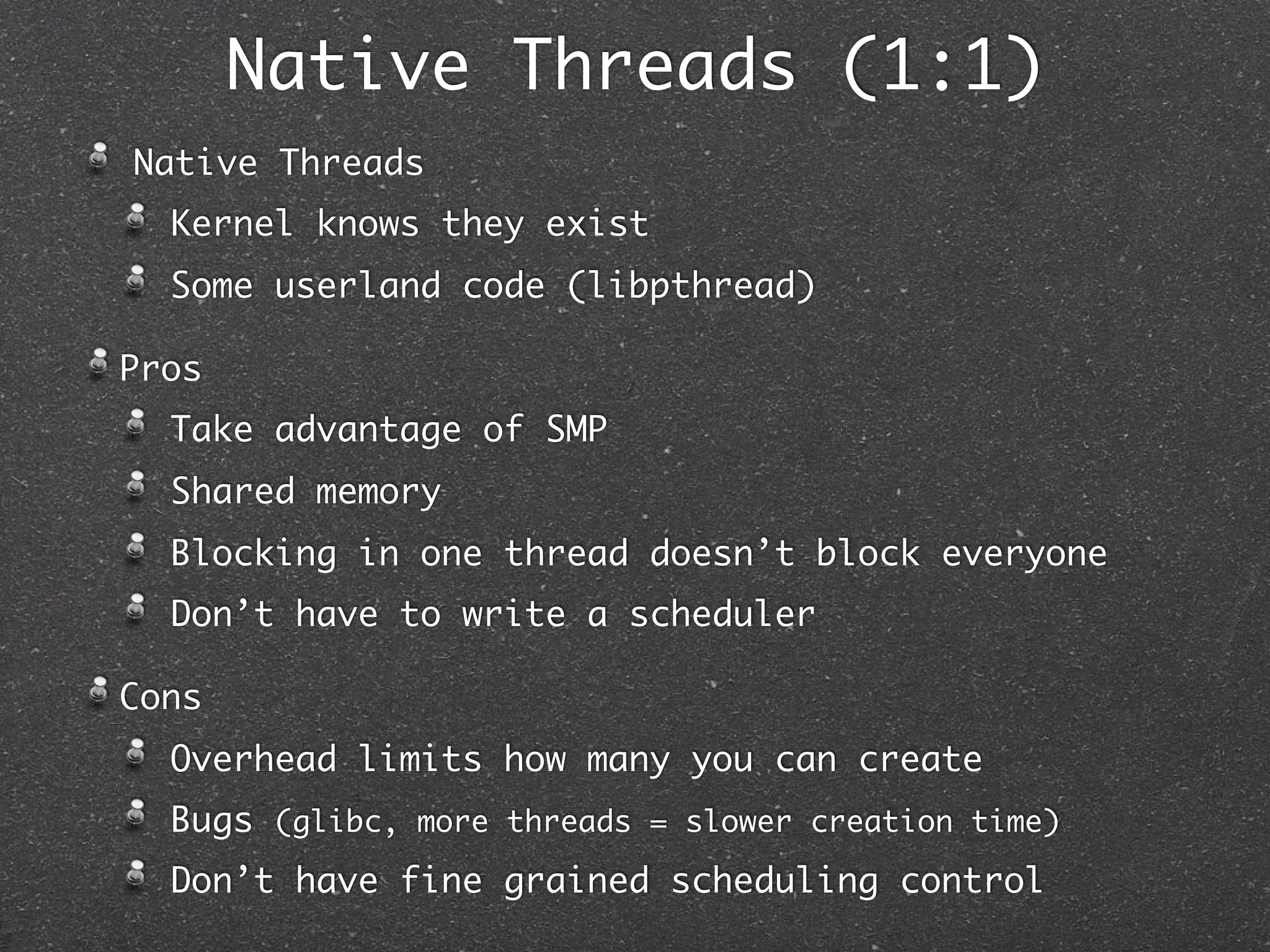
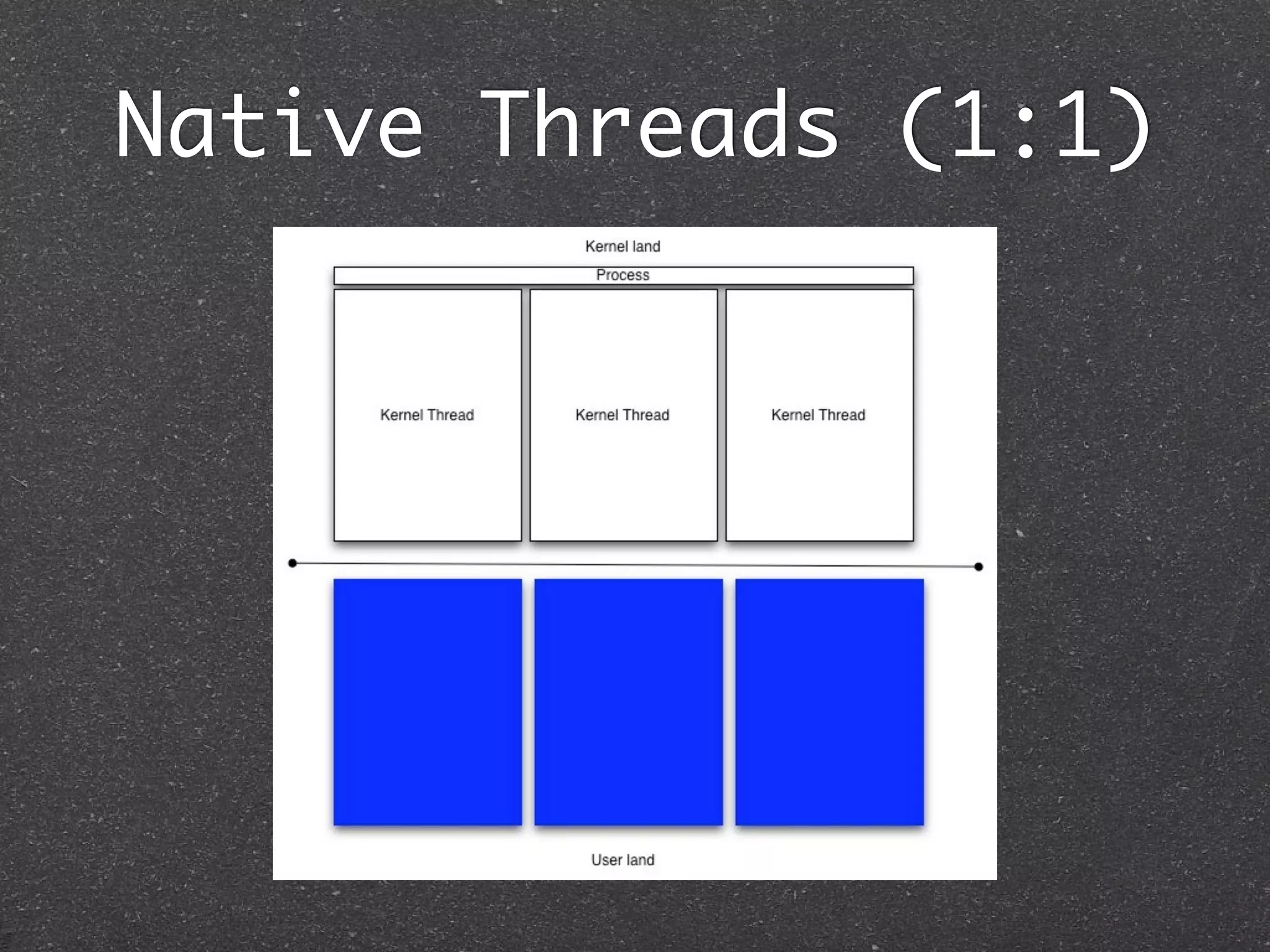
Native Threads (1:1)
Native Threads
Native Threads (1:1)
Native Threads
 Kernel knows they exist
Native Threads (1:1)
Native Threads
 Kernel knows they exist
 Some userland code (libpthread)
Native Threads (1:1)
Native Threads
  Kernel knows they exist
  Some userland code (libpthread)

Pros
Native Threads (1:1)
Native Threads
  Kernel knows they exist
  Some userland code (libpthread)

Pros
  Take advantage of SMP
Native Threads (1:1)
Native Threads
  Kernel knows they exist
  Some userland code (libpthread)

Pros
  Take advantage of SMP
  Shared memory
Native Threads (1:1)
Native Threads
  Kernel knows they exist
  Some userland code (libpthread)

Pros
  Take advantage of SMP
  Shared memory
  Blocking in one thread doesn’t block everyone
Native Threads (1:1)
Native Threads
  Kernel knows they exist
  Some userland code (libpthread)

Pros
  Take advantage of SMP
  Shared memory
  Blocking in one thread doesn’t block everyone
  Don’t have to write a scheduler
Native Threads (1:1)
Native Threads
  Kernel knows they exist
  Some userland code (libpthread)

Pros
  Take advantage of SMP
  Shared memory
  Blocking in one thread doesn’t block everyone
  Don’t have to write a scheduler

Cons
Native Threads (1:1)
Native Threads
  Kernel knows they exist
  Some userland code (libpthread)

Pros
  Take advantage of SMP
  Shared memory
  Blocking in one thread doesn’t block everyone
  Don’t have to write a scheduler

Cons
  Overhead limits how many you can create
Native Threads (1:1)
Native Threads
  Kernel knows they exist
  Some userland code (libpthread)

Pros
  Take advantage of SMP
  Shared memory
  Blocking in one thread doesn’t block everyone
  Don’t have to write a scheduler

Cons
  Overhead limits how many you can create
  Bugs (glibc, more threads = slower creation time)
Native Threads (1:1)
Native Threads
  Kernel knows they exist
  Some userland code (libpthread)

Pros
  Take advantage of SMP
  Shared memory
  Blocking in one thread doesn’t block everyone
  Don’t have to write a scheduler

Cons
  Overhead limits how many you can create
  Bugs (glibc, more threads = slower creation time)
  Don’t have fine grained scheduling control
Native Threads (1:1)
Ruby 1.9 uses Native Threads
(but.. they don’t execute in parallel)
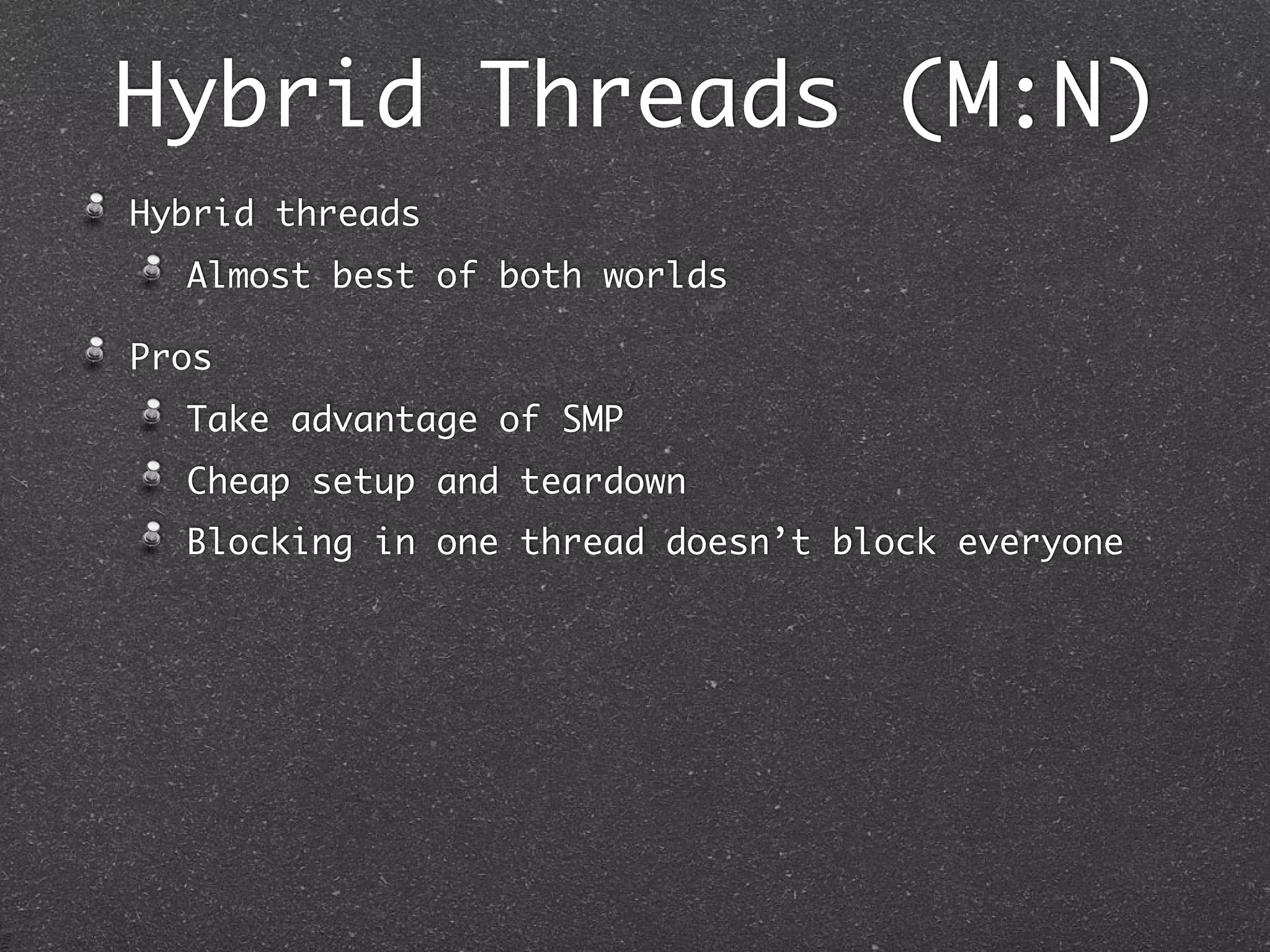
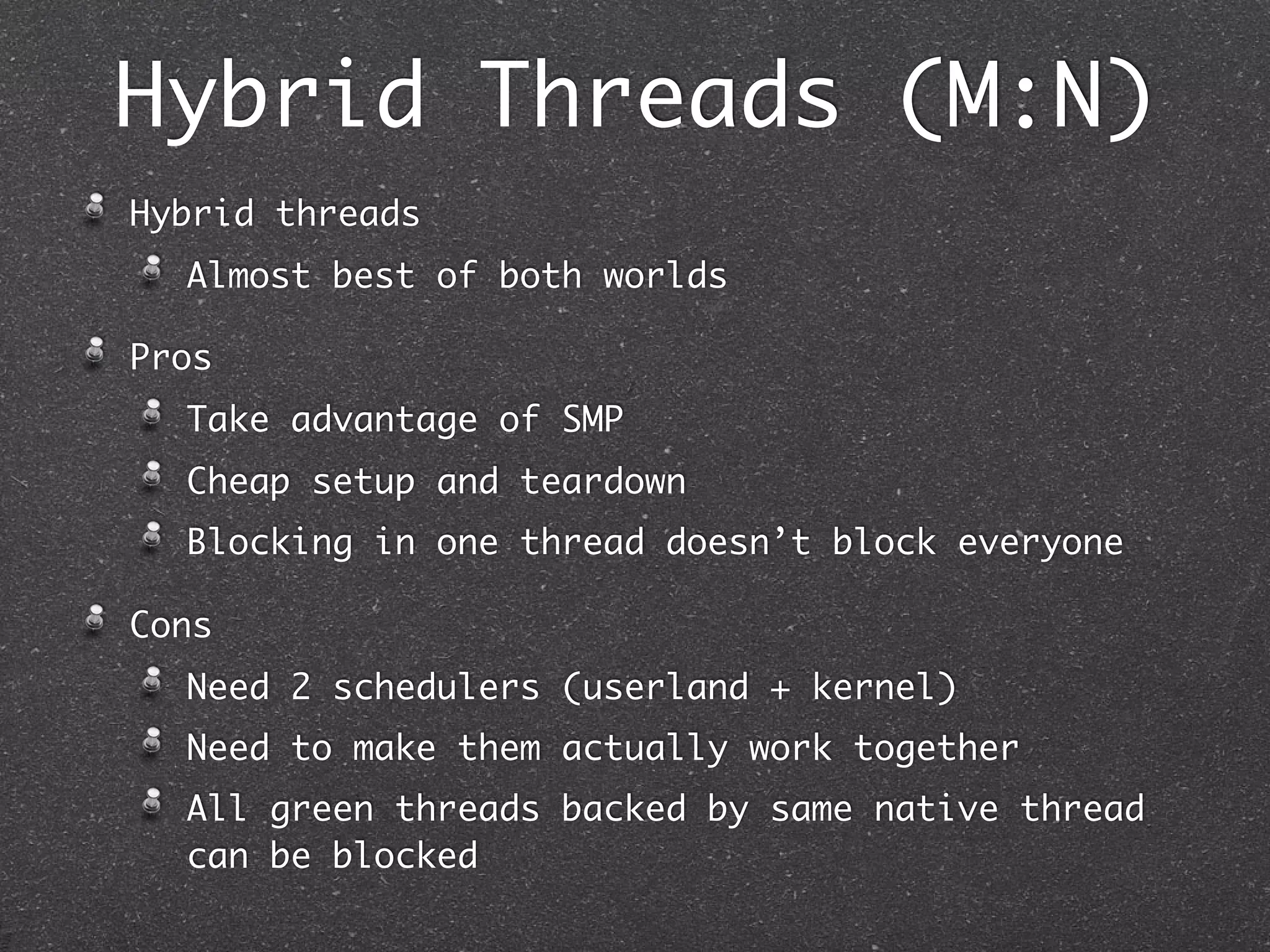
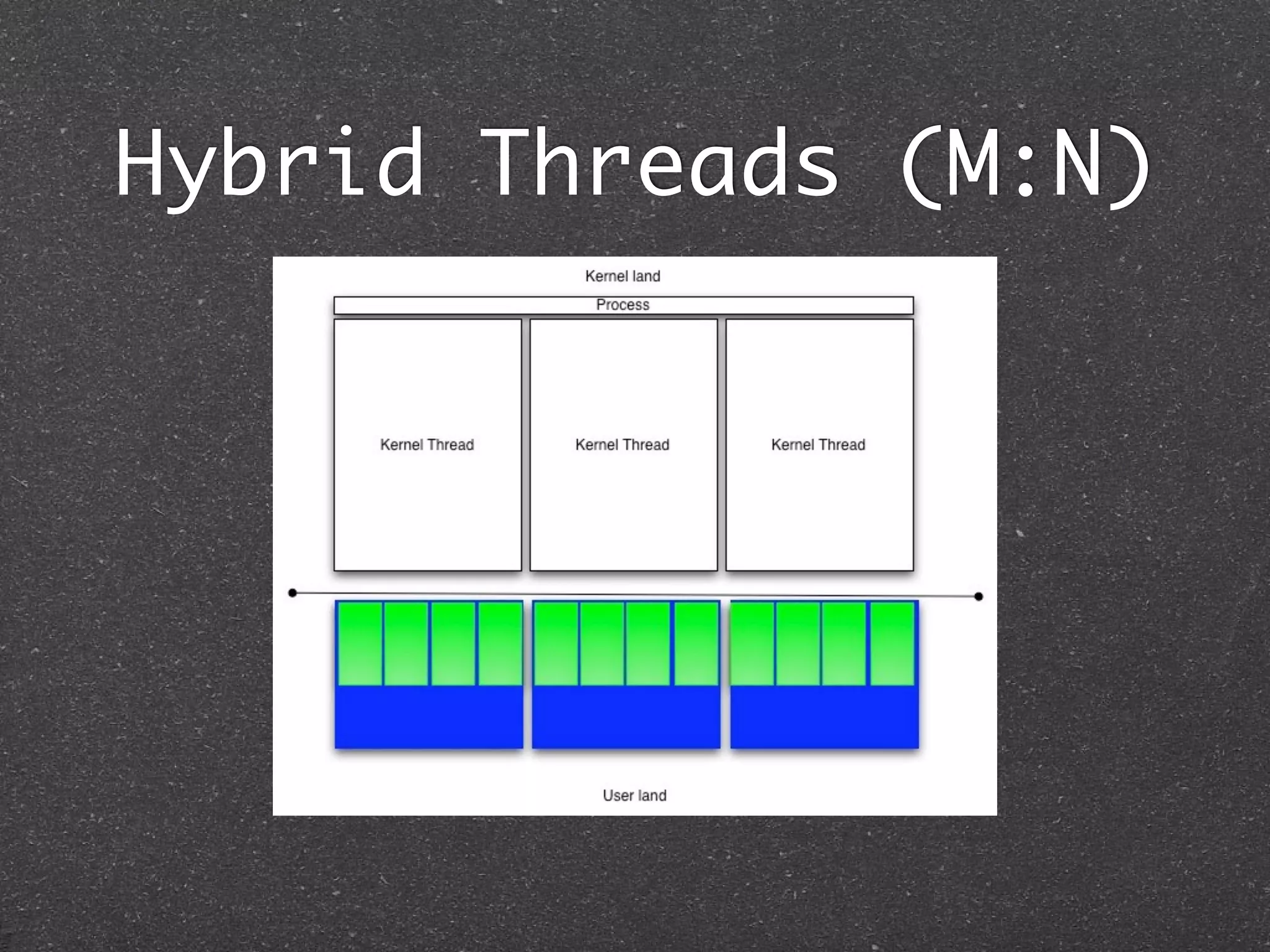
Hybrid Threads (M:N)
Hybrid threads
Hybrid Threads (M:N)
Hybrid threads
  Almost best of both worlds
Hybrid Threads (M:N)
Hybrid threads
  Almost best of both worlds

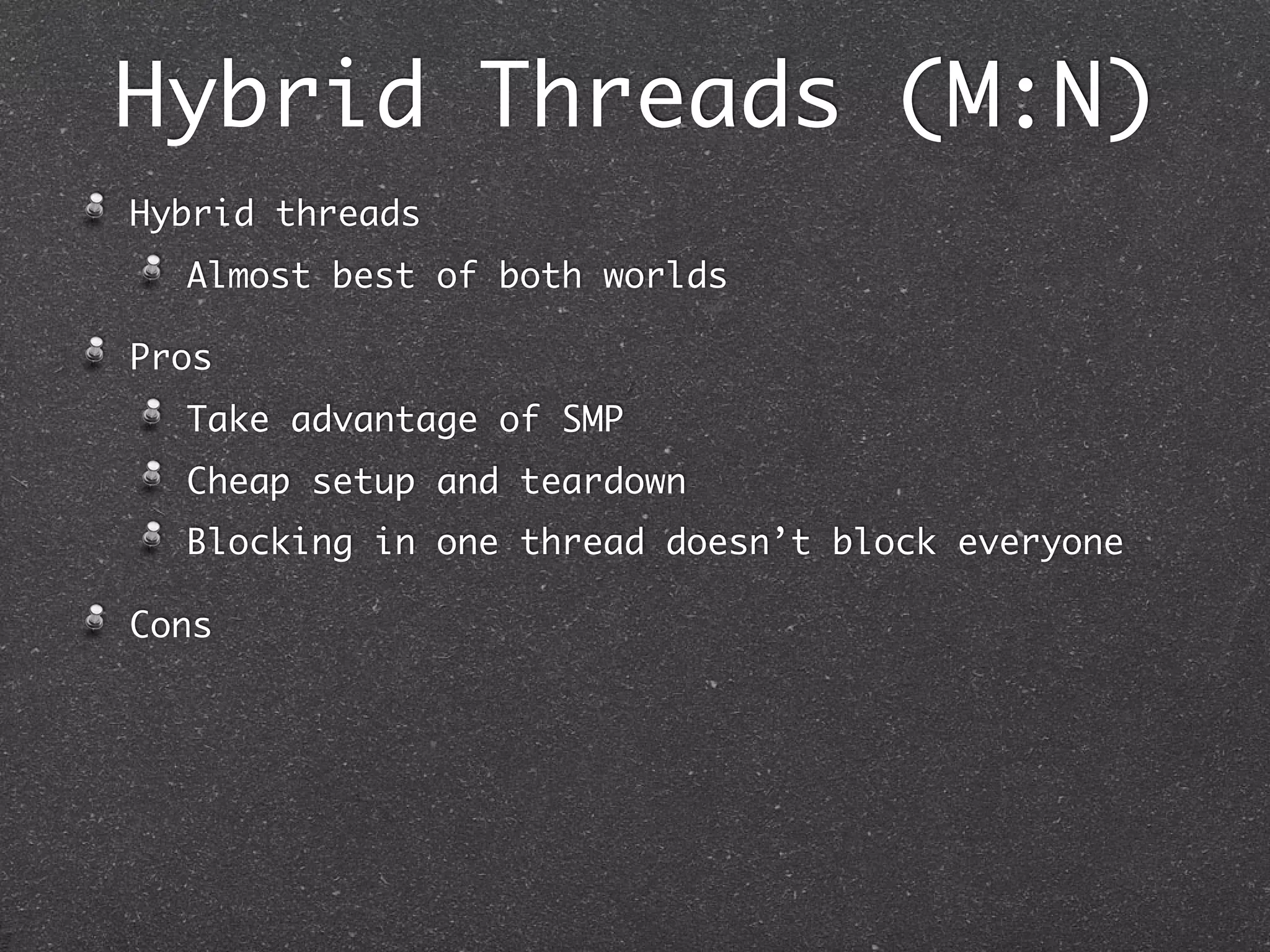
Pros
Hybrid Threads (M:N)
Hybrid threads
  Almost best of both worlds

Pros
  Take advantage of SMP
Hybrid Threads (M:N)
Hybrid threads
  Almost best of both worlds

Pros
  Take advantage of SMP
  Cheap setup and teardown
Hybrid Threads (M:N)
Hybrid threads
  Almost best of both worlds

Pros
  Take advantage of SMP
  Cheap setup and teardown
  Blocking in one thread doesn’t block everyone
Hybrid Threads (M:N)
Hybrid threads
  Almost best of both worlds

Pros
  Take advantage of SMP
  Cheap setup and teardown
  Blocking in one thread doesn’t block everyone

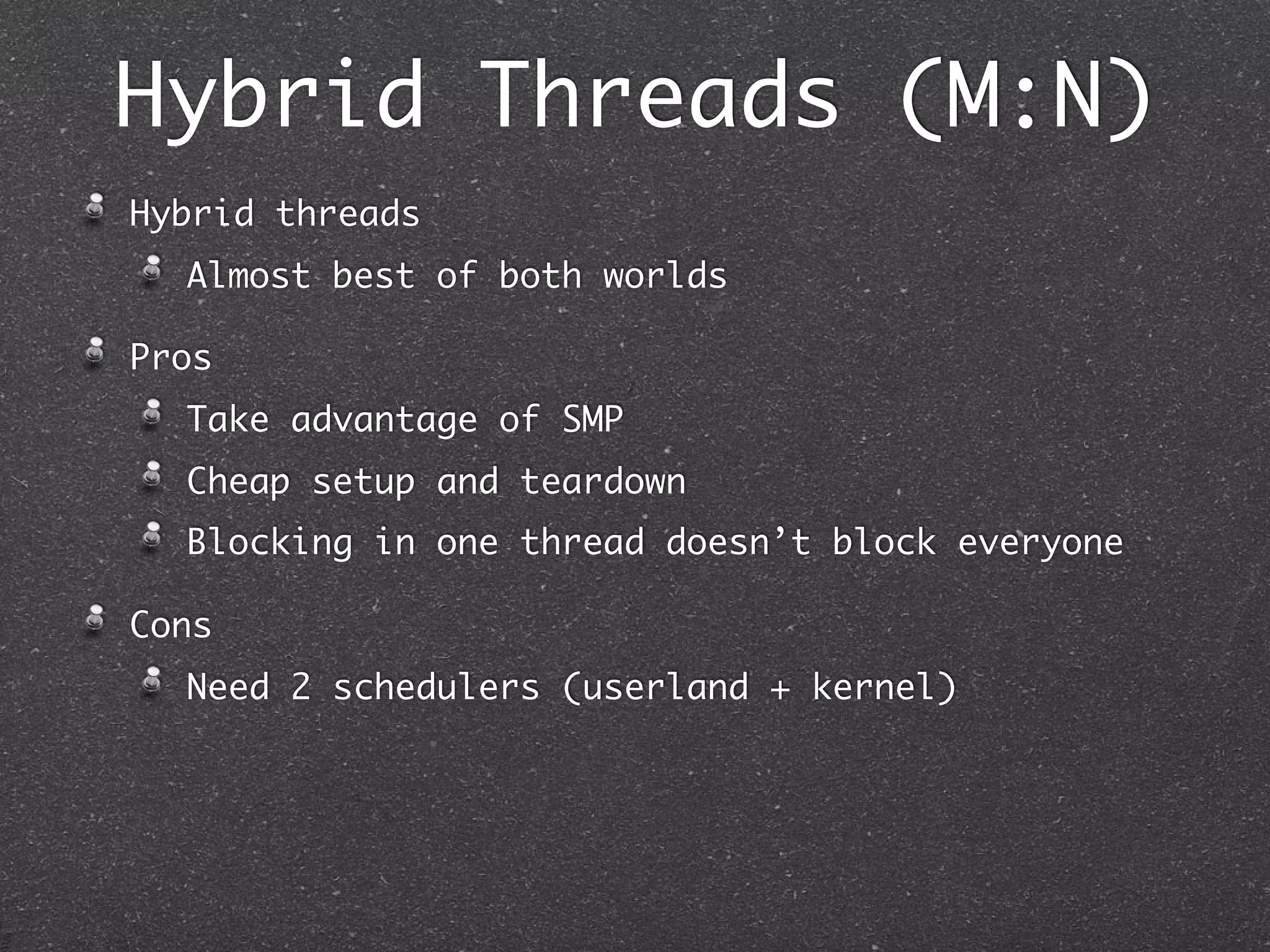
Cons
Hybrid Threads (M:N)
Hybrid threads
  Almost best of both worlds

Pros
  Take advantage of SMP
  Cheap setup and teardown
  Blocking in one thread doesn’t block everyone

Cons
  Need 2 schedulers (userland + kernel)
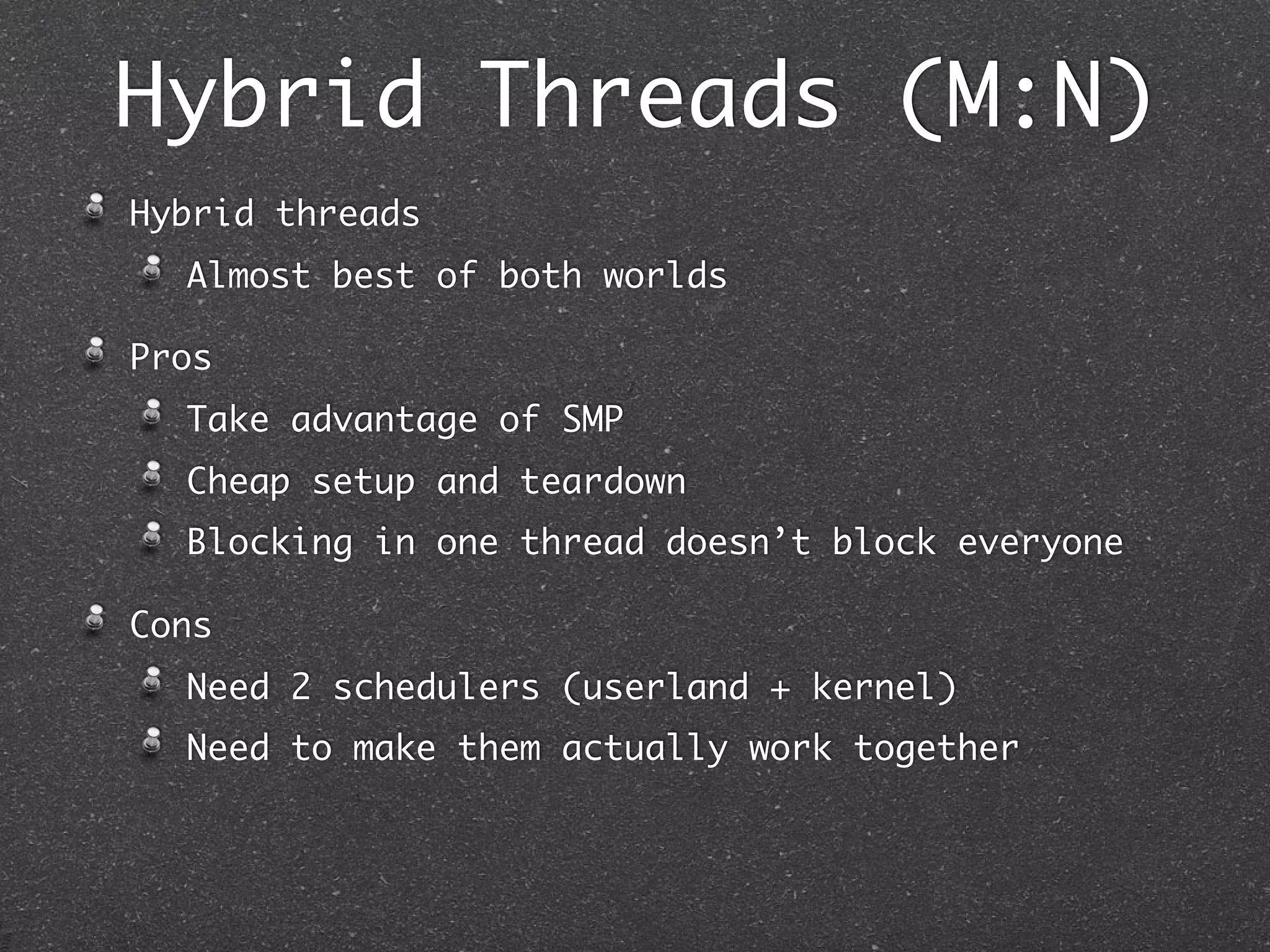
Hybrid Threads (M:N)
Hybrid threads
  Almost best of both worlds

Pros
  Take advantage of SMP
  Cheap setup and teardown
  Blocking in one thread doesn’t block everyone

Cons
  Need 2 schedulers (userland + kernel)
  Need to make them actually work together
Hybrid Threads (M:N)
Hybrid threads
  Almost best of both worlds

Pros
  Take advantage of SMP
  Cheap setup and teardown
  Blocking in one thread doesn’t block everyone

Cons
  Need 2 schedulers (userland + kernel)
  Need to make them actually work together
  All green threads backed by same native thread
  can be blocked
Hybrid Threads (M:N)
Erlang uses Hybrid Threads
   Ruby 1.9, too (with fibers)
Multitasking Types

  Preemptive Multitasking

  Cooperative Multitasking
Preemptive
Multitasking
Preemptive
        Multitasking
Outside event (timer) signals end of CPU slice
Preemptive
        Multitasking
Outside event (timer) signals end of CPU slice
  Handle important events quickly
Preemptive
        Multitasking
Outside event (timer) signals end of CPU slice
  Handle important events quickly
  Can help ensure everyone gets to execute
Preemptive
        Multitasking
Outside event (timer) signals end of CPU slice
  Handle important events quickly
  Can help ensure everyone gets to execute

But..
Preemptive
        Multitasking
Outside event (timer) signals end of CPU slice
  Handle important events quickly
  Can help ensure everyone gets to execute

But..
  Need to build a smart scheduler
Preemptive
        Multitasking
Outside event (timer) signals end of CPU slice
  Handle important events quickly
  Can help ensure everyone gets to execute

But..
  Need to build a smart scheduler
  Can yield non-determistic execution order
Cooperative
Multitasking
Cooperative
        Multitasking
Threads voluntarily release the CPU
Cooperative
        Multitasking
Threads voluntarily release the CPU
 Give up the CPU when it is “optimal”
Cooperative
        Multitasking
Threads voluntarily release the CPU
 Give up the CPU when it is “optimal”
 Can guarantee deterministic execution order
Cooperative
        Multitasking
Threads voluntarily release the CPU
 Give up the CPU when it is “optimal”
 Can guarantee deterministic execution order
 Very simple “scheduler”
Cooperative
        Multitasking
Threads voluntarily release the CPU
 Give up the CPU when it is “optimal”
 Can guarantee deterministic execution order
 Very simple “scheduler”

But..
Cooperative
        Multitasking
Threads voluntarily release the CPU
 Give up the CPU when it is “optimal”
 Can guarantee deterministic execution order
 Very simple “scheduler”

But..
 Badly written code can hang all threads
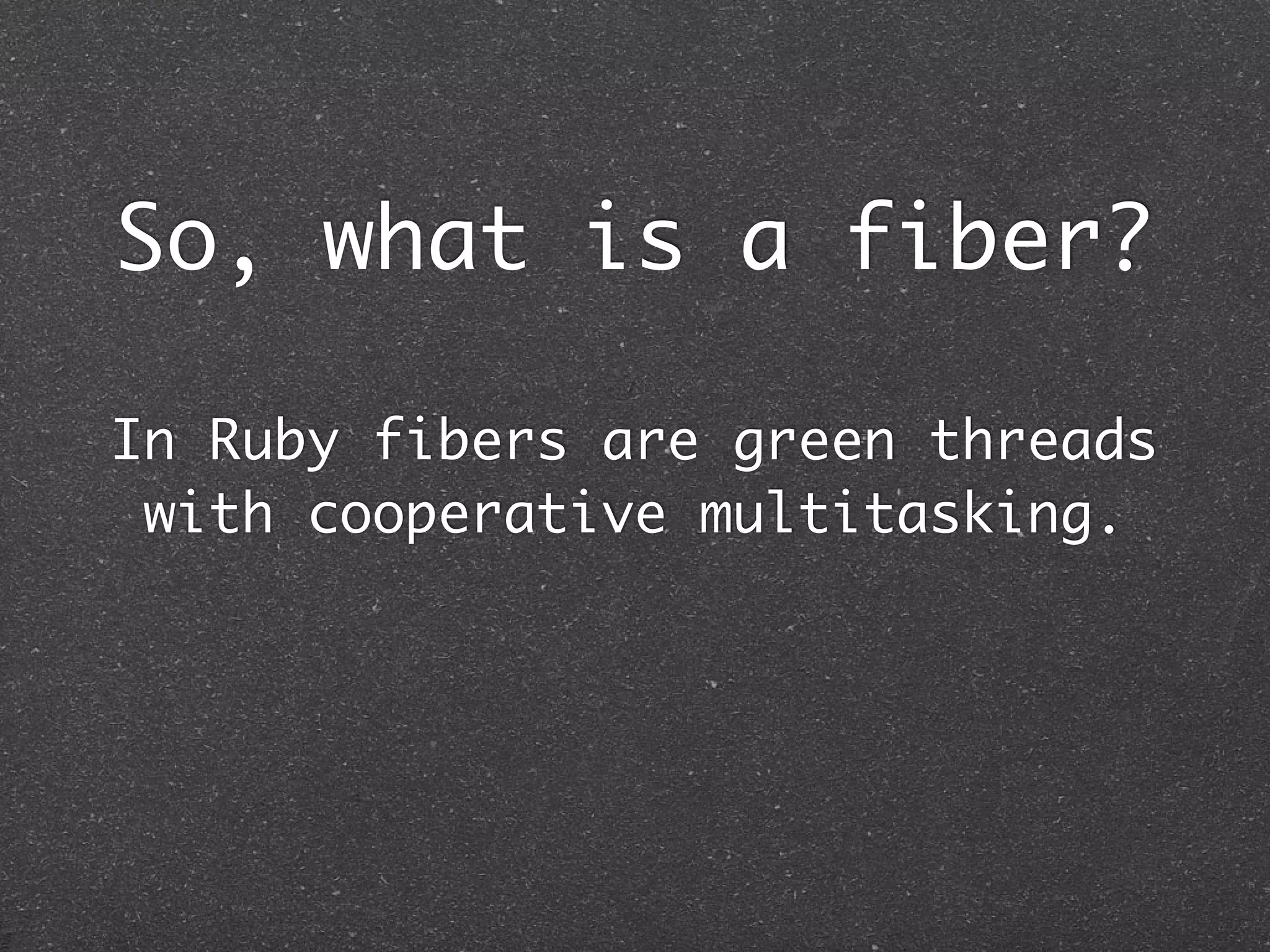
So, what is a fiber?

In Ruby fibers are green threads
 with cooperative multitasking.
So what’s the deal
with ruby threads?
     strace

     google-perftools

     ltrace

     gdb
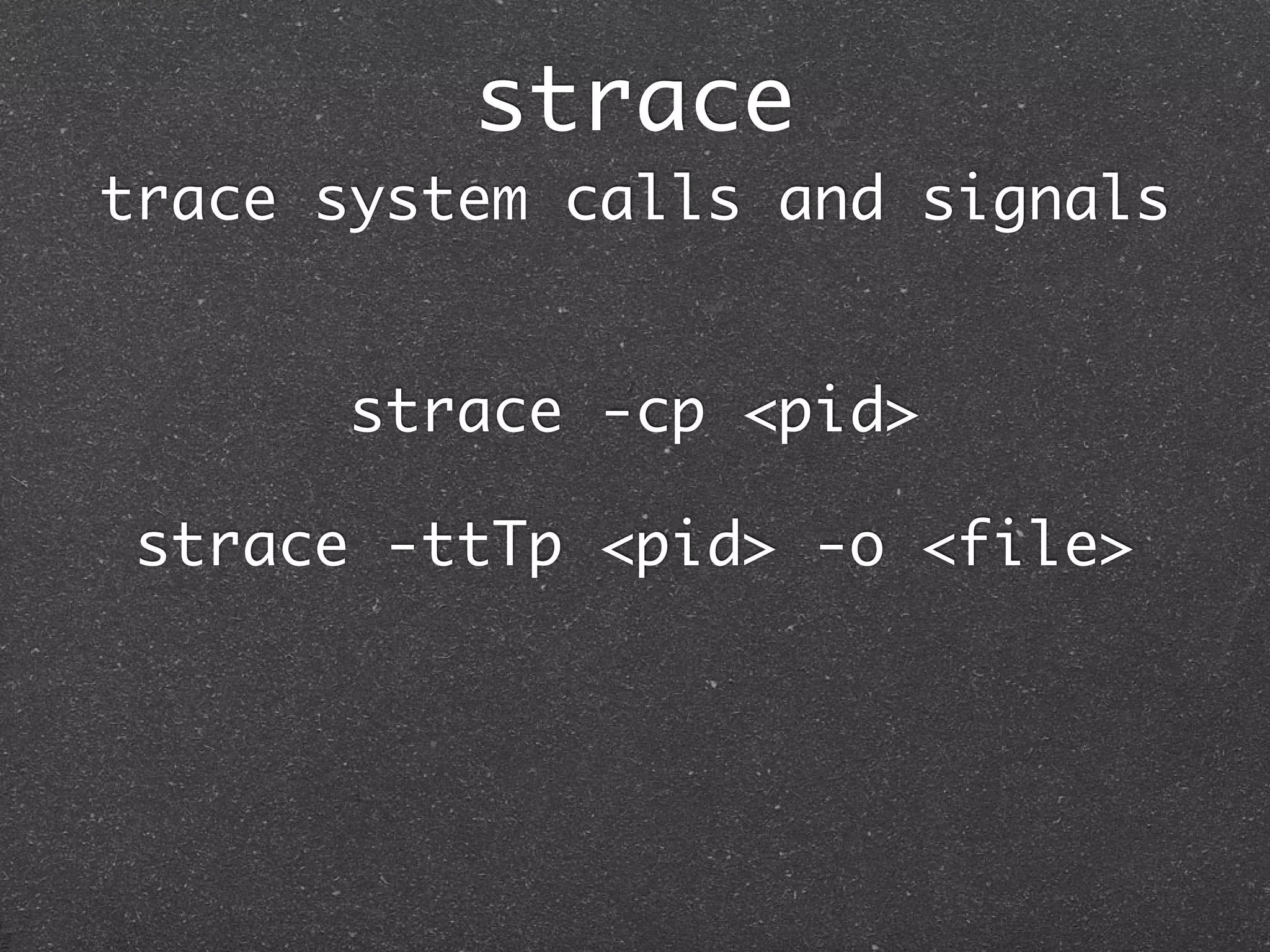
strace
trace system calls and signals


       strace -cp <pid>

 strace -ttTp <pid> -o <file>
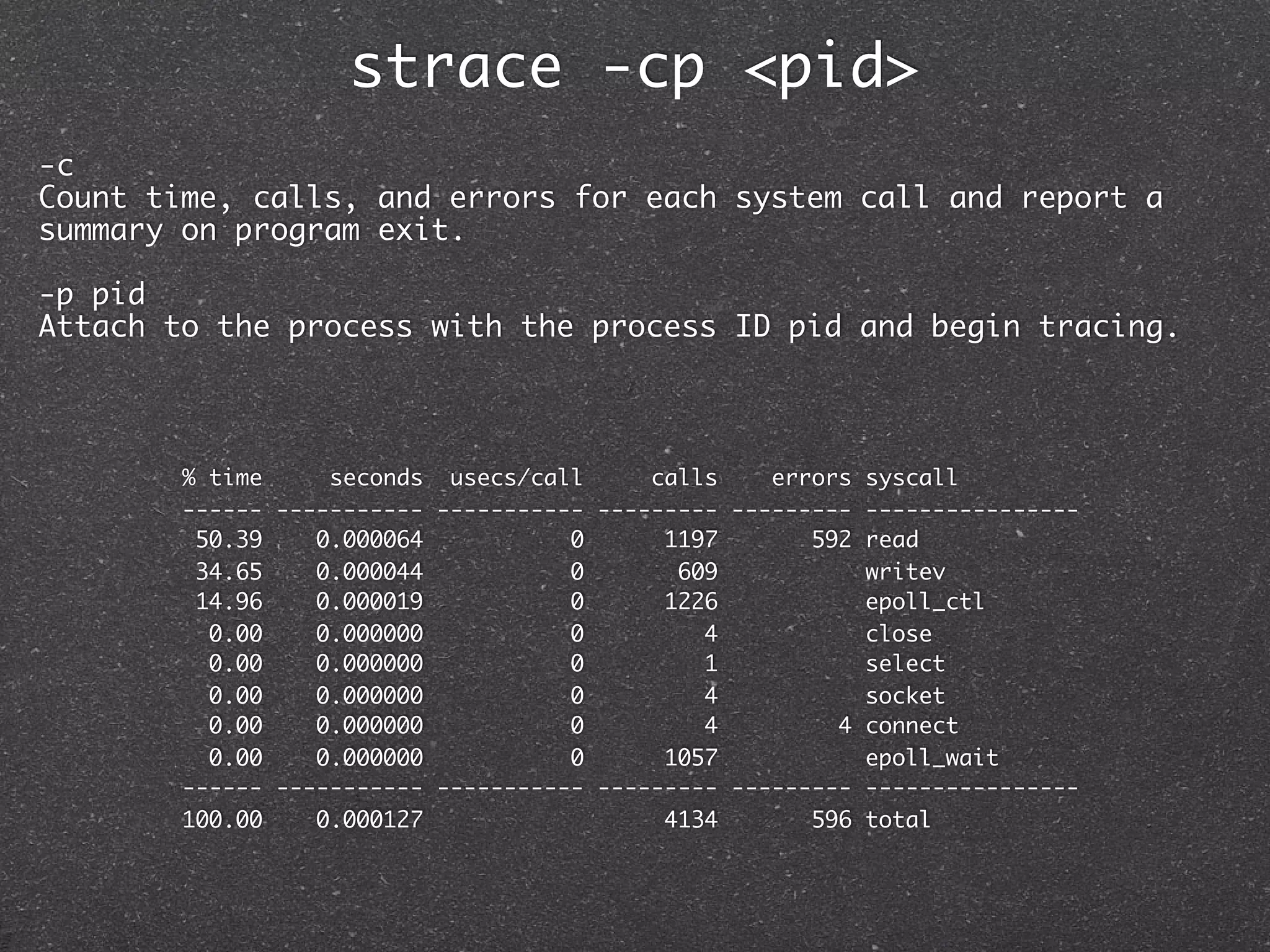
strace -cp <pid>
-c
Count time, calls, and errors for each system call and report a
summary on program exit.

-p pid
Attach to the process with the process ID pid and begin tracing.


        % time     seconds usecs/call      calls    errors syscall
        ------ ----------- ----------- --------- --------- ----------------
         50.39    0.000064           0      1197       592 read
         34.65    0.000044           0       609           writev
         14.96    0.000019           0      1226           epoll_ctl
          0.00    0.000000           0         4           close
          0.00    0.000000           0         1           select
          0.00    0.000000           0         4           socket
          0.00    0.000000           0         4         4 connect
          0.00    0.000000           0      1057           epoll_wait
        ------ ----------- ----------- --------- --------- ----------------
        100.00    0.000127                  4134       596 total
strace -ttTp <pid> -o <file>
-t
Prefix each line of the trace with the time of day.

-tt
If given twice, the time printed will include the microseconds.

-T
Show the time spent in system calls. This records the time
difference between the beginning and the end of each system call.

-o filename
Write the trace output to the file filename rather than to stderr.

01:09:11.266949   epoll_wait(9, {{EPOLLIN, {u32=68841296, u64=68841296}}}, 4096, 50) = 1 <0.033109>
01:09:11.300102   accept(10, {sa_family=AF_INET, sin_port=38313, sin_addr="127.0.0.1"}, [1226]) = 22 <0.000014>
01:09:11.300190   fcntl(22, F_GETFL) = 0x2 (flags O_RDWR) <0.000007>
01:09:11.300237   fcntl(22, F_SETFL, O_RDWR|O_NONBLOCK) = 0 <0.000008>
01:09:11.300277   setsockopt(22, SOL_TCP, TCP_NODELAY, [1], 4) = 0 <0.000008>
01:09:11.300489   accept(10, 0x7fff5d9c07d0, [1226]) = -1 EAGAIN <0.000014>
01:09:11.300547   epoll_ctl(9, EPOLL_CTL_ADD, 22, {EPOLLIN, {u32=108750368, u64=108750368}}) = 0 <0.000009>
01:09:11.300593   epoll_wait(9, {{EPOLLIN, {u32=108750368, u64=108750368}}}, 4096, 50) = 1 <0.000007>
01:09:11.300633   read(22, "GET / HTTP/1.1r"..., 16384) = 772 <0.000012>
01:09:11.301727   rt_sigprocmask(SIG_SETMASK, [], NULL, 8) = 0 <0.000007>
01:09:11.302095   poll([{fd=5, events=POLLIN|POLLPRI}], 1, 0) = 0 (Timeout) <0.000008>
01:09:11.302144   write(5, "1000000-0003SELECT * FROM `table`"..., 56) = 56 <0.000023>
01:09:11.302221   read(5, "25101,20x234m"..., 16384) = 284 <1.300897>
strace -ttTp <pid> -o <file>
-t
Prefix each line of the trace with the time of day.

-tt
If given twice, the time printed will include the microseconds.

-T
Show the time spent in system calls. This records the time
difference between the beginning and the end of each system call.

-o filename
Write the trace output to the file filename rather than to stderr.

01:09:11.266949   epoll_wait(9, {{EPOLLIN, {u32=68841296, u64=68841296}}}, 4096, 50) = 1 <0.033109>
01:09:11.300102   accept(10, {sa_family=AF_INET, sin_port=38313, sin_addr="127.0.0.1"}, [1226]) = 22 <0.000014>
01:09:11.300190   fcntl(22, F_GETFL) = 0x2 (flags O_RDWR) <0.000007>
01:09:11.300237   fcntl(22, F_SETFL, O_RDWR|O_NONBLOCK) = 0 <0.000008>
01:09:11.300277   setsockopt(22, SOL_TCP, TCP_NODELAY, [1], 4) = 0 <0.000008>
01:09:11.300489   accept(10, 0x7fff5d9c07d0, [1226]) = -1 EAGAIN <0.000014>
01:09:11.300547   epoll_ctl(9, EPOLL_CTL_ADD, 22, {EPOLLIN, {u32=108750368, u64=108750368}}) = 0 <0.000009>
01:09:11.300593   epoll_wait(9, {{EPOLLIN, {u32=108750368, u64=108750368}}}, 4096, 50) = 1 <0.000007>
01:09:11.300633   read(22, "GET / HTTP/1.1r"..., 16384) = 772 <0.000012>
01:09:11.301727   rt_sigprocmask(SIG_SETMASK, [], NULL, 8) = 0 <0.000007>
01:09:11.302095   poll([{fd=5, events=POLLIN|POLLPRI}], 1, 0) = 0 (Timeout) <0.000008>
01:09:11.302144   write(5, "1000000-0003SELECT * FROM `table`"..., 56) = 56 <0.000023>
01:09:11.302221   read(5, "25101,20x234m"..., 16384) = 284 <1.300897>
strace -ttTp <pid> -o <file>
-t
Prefix each line of the trace with the time of day.

-tt
If given twice, the time printed will include the microseconds.

-T
Show the time spent in system calls. This records the time
difference between the beginning and the end of each system call.

-o filename
Write the trace output to the file filename rather than to stderr.

01:09:11.266949   epoll_wait(9, {{EPOLLIN, {u32=68841296, u64=68841296}}}, 4096, 50) = 1 <0.033109>
01:09:11.300102   accept(10, {sa_family=AF_INET, sin_port=38313, sin_addr="127.0.0.1"}, [1226]) = 22 <0.000014>
01:09:11.300190   fcntl(22, F_GETFL) = 0x2 (flags O_RDWR) <0.000007>
01:09:11.300237   fcntl(22, F_SETFL, O_RDWR|O_NONBLOCK) = 0 <0.000008>
01:09:11.300277   setsockopt(22, SOL_TCP, TCP_NODELAY, [1], 4) = 0 <0.000008>
01:09:11.300489   accept(10, 0x7fff5d9c07d0, [1226]) = -1 EAGAIN <0.000014>
01:09:11.300547   epoll_ctl(9, EPOLL_CTL_ADD, 22, {EPOLLIN, {u32=108750368, u64=108750368}}) = 0 <0.000009>
01:09:11.300593   epoll_wait(9, {{EPOLLIN, {u32=108750368, u64=108750368}}}, 4096, 50) = 1 <0.000007>
01:09:11.300633   read(22, "GET / HTTP/1.1r"..., 16384) = 772 <0.000012>
01:09:11.301727   rt_sigprocmask(SIG_SETMASK, [], NULL, 8) = 0 <0.000007>
01:09:11.302095   poll([{fd=5, events=POLLIN|POLLPRI}], 1, 0) = 0 (Timeout) <0.000008>
01:09:11.302144   write(5, "1000000-0003SELECT * FROM `table`"..., 56) = 56 <0.000023>
01:09:11.302221   read(5, "25101,20x234m"..., 16384) = 284 <1.300897>
strace -ttTp <pid> -o <file>
-t
Prefix each line of the trace with the time of day.

-tt
If given twice, the time printed will include the microseconds.

-T
Show the time spent in system calls. This records the time
difference between the beginning and the end of each system call.

-o filename
Write the trace output to the file filename rather than to stderr.

01:09:11.266949   epoll_wait(9, {{EPOLLIN, {u32=68841296, u64=68841296}}}, 4096, 50) = 1 <0.033109>
01:09:11.300102   accept(10, {sa_family=AF_INET, sin_port=38313, sin_addr="127.0.0.1"}, [1226]) = 22 <0.000014>
01:09:11.300190   fcntl(22, F_GETFL) = 0x2 (flags O_RDWR) <0.000007>
01:09:11.300237   fcntl(22, F_SETFL, O_RDWR|O_NONBLOCK) = 0 <0.000008>
01:09:11.300277   setsockopt(22, SOL_TCP, TCP_NODELAY, [1], 4) = 0 <0.000008>
01:09:11.300489   accept(10, 0x7fff5d9c07d0, [1226]) = -1 EAGAIN <0.000014>
01:09:11.300547   epoll_ctl(9, EPOLL_CTL_ADD, 22, {EPOLLIN, {u32=108750368, u64=108750368}}) = 0 <0.000009>
01:09:11.300593   epoll_wait(9, {{EPOLLIN, {u32=108750368, u64=108750368}}}, 4096, 50) = 1 <0.000007>
01:09:11.300633   read(22, "GET / HTTP/1.1r"..., 16384) = 772 <0.000012>
01:09:11.301727   rt_sigprocmask(SIG_SETMASK, [], NULL, 8) = 0 <0.000007>
01:09:11.302095   poll([{fd=5, events=POLLIN|POLLPRI}], 1, 0) = 0 (Timeout) <0.000008>
01:09:11.302144   write(5, "1000000-0003SELECT * FROM `table`"..., 56) = 56 <0.000023>
01:09:11.302221   read(5, "25101,20x234m"..., 16384) = 284 <1.300897>
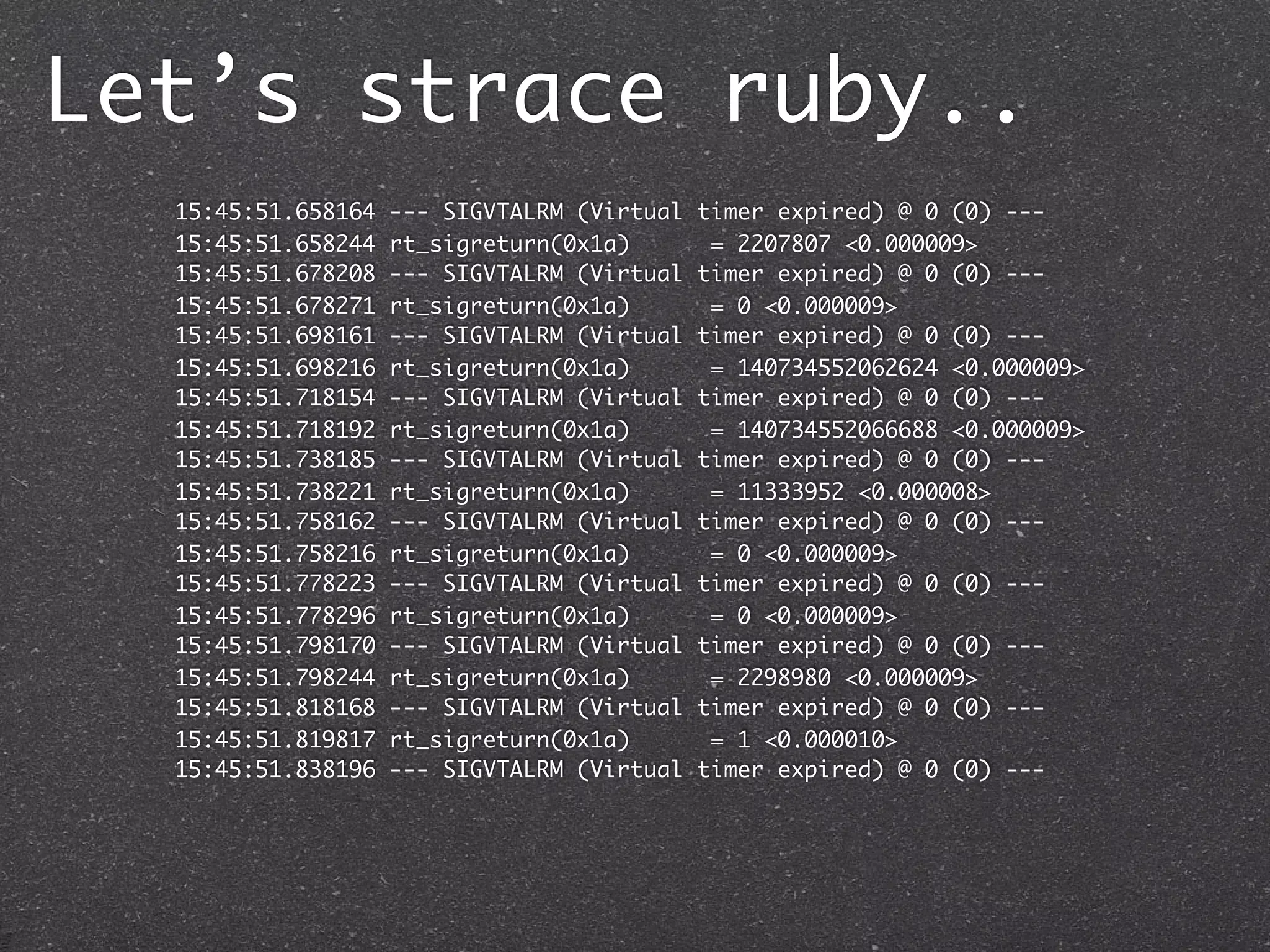
Let’s strace ruby..
Let’s strace ruby..
  15:45:51.658164   --- SIGVTALRM (Virtual   timer expired) @ 0 (0) ---
  15:45:51.658244   rt_sigreturn(0x1a)        = 2207807 <0.000009>
  15:45:51.678208   --- SIGVTALRM (Virtual   timer expired) @ 0 (0) ---
  15:45:51.678271   rt_sigreturn(0x1a)        = 0 <0.000009>
  15:45:51.698161   --- SIGVTALRM (Virtual   timer expired) @ 0 (0) ---
  15:45:51.698216   rt_sigreturn(0x1a)        = 140734552062624 <0.000009>
  15:45:51.718154   --- SIGVTALRM (Virtual   timer expired) @ 0 (0) ---
  15:45:51.718192   rt_sigreturn(0x1a)        = 140734552066688 <0.000009>
  15:45:51.738185   --- SIGVTALRM (Virtual   timer expired) @ 0 (0) ---
  15:45:51.738221   rt_sigreturn(0x1a)        = 11333952 <0.000008>
  15:45:51.758162   --- SIGVTALRM (Virtual   timer expired) @ 0 (0) ---
  15:45:51.758216   rt_sigreturn(0x1a)        = 0 <0.000009>
  15:45:51.778223   --- SIGVTALRM (Virtual   timer expired) @ 0 (0) ---
  15:45:51.778296   rt_sigreturn(0x1a)        = 0 <0.000009>
  15:45:51.798170   --- SIGVTALRM (Virtual   timer expired) @ 0 (0) ---
  15:45:51.798244   rt_sigreturn(0x1a)        = 2298980 <0.000009>
  15:45:51.818168   --- SIGVTALRM (Virtual   timer expired) @ 0 (0) ---
  15:45:51.819817   rt_sigreturn(0x1a)        = 1 <0.000010>
  15:45:51.838196   --- SIGVTALRM (Virtual   timer expired) @ 0 (0) ---
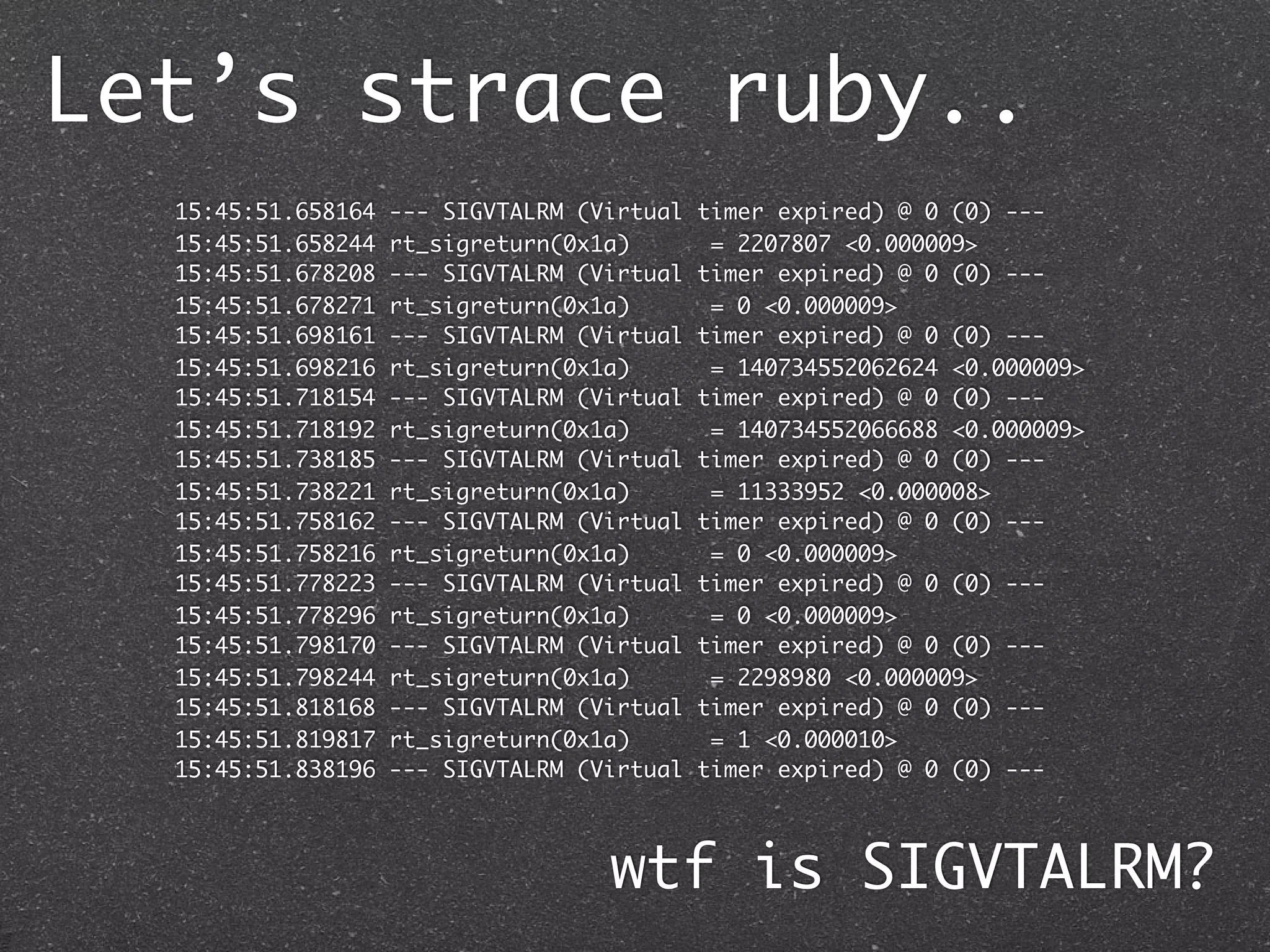
Let’s strace ruby..
  15:45:51.658164   --- SIGVTALRM (Virtual   timer expired) @ 0 (0) ---
  15:45:51.658244   rt_sigreturn(0x1a)        = 2207807 <0.000009>
  15:45:51.678208   --- SIGVTALRM (Virtual   timer expired) @ 0 (0) ---
  15:45:51.678271   rt_sigreturn(0x1a)        = 0 <0.000009>
  15:45:51.698161   --- SIGVTALRM (Virtual   timer expired) @ 0 (0) ---
  15:45:51.698216   rt_sigreturn(0x1a)        = 140734552062624 <0.000009>
  15:45:51.718154   --- SIGVTALRM (Virtual   timer expired) @ 0 (0) ---
  15:45:51.718192   rt_sigreturn(0x1a)        = 140734552066688 <0.000009>
  15:45:51.738185   --- SIGVTALRM (Virtual   timer expired) @ 0 (0) ---
  15:45:51.738221   rt_sigreturn(0x1a)        = 11333952 <0.000008>
  15:45:51.758162   --- SIGVTALRM (Virtual   timer expired) @ 0 (0) ---
  15:45:51.758216   rt_sigreturn(0x1a)        = 0 <0.000009>
  15:45:51.778223   --- SIGVTALRM (Virtual   timer expired) @ 0 (0) ---
  15:45:51.778296   rt_sigreturn(0x1a)        = 0 <0.000009>
  15:45:51.798170   --- SIGVTALRM (Virtual   timer expired) @ 0 (0) ---
  15:45:51.798244   rt_sigreturn(0x1a)        = 2298980 <0.000009>
  15:45:51.818168   --- SIGVTALRM (Virtual   timer expired) @ 0 (0) ---
  15:45:51.819817   rt_sigreturn(0x1a)        = 1 <0.000010>
  15:45:51.838196   --- SIGVTALRM (Virtual   timer expired) @ 0 (0) ---


                                    wtf is SIGVTALRM?
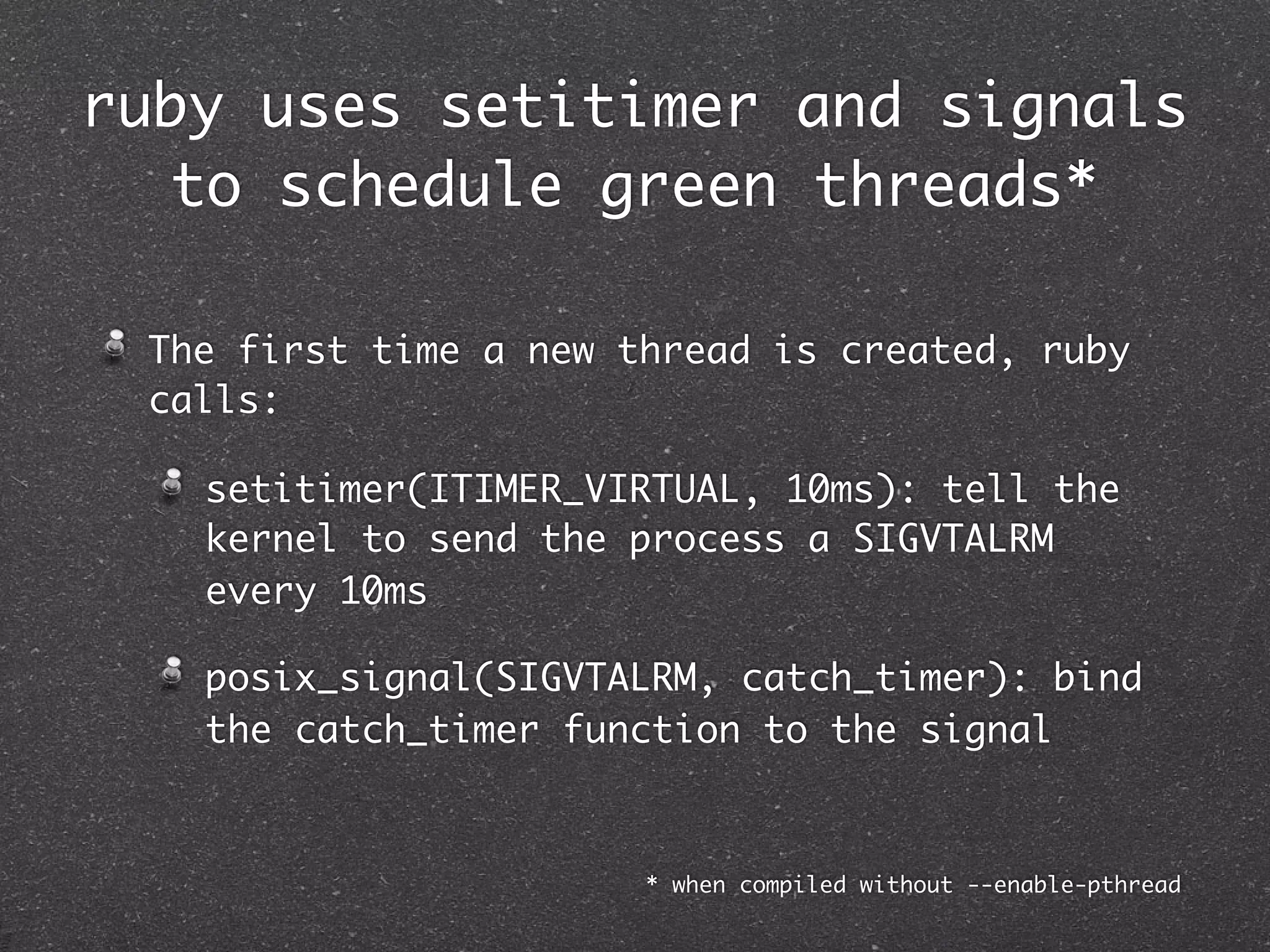
ruby uses setitimer and signals
   to schedule green threads*

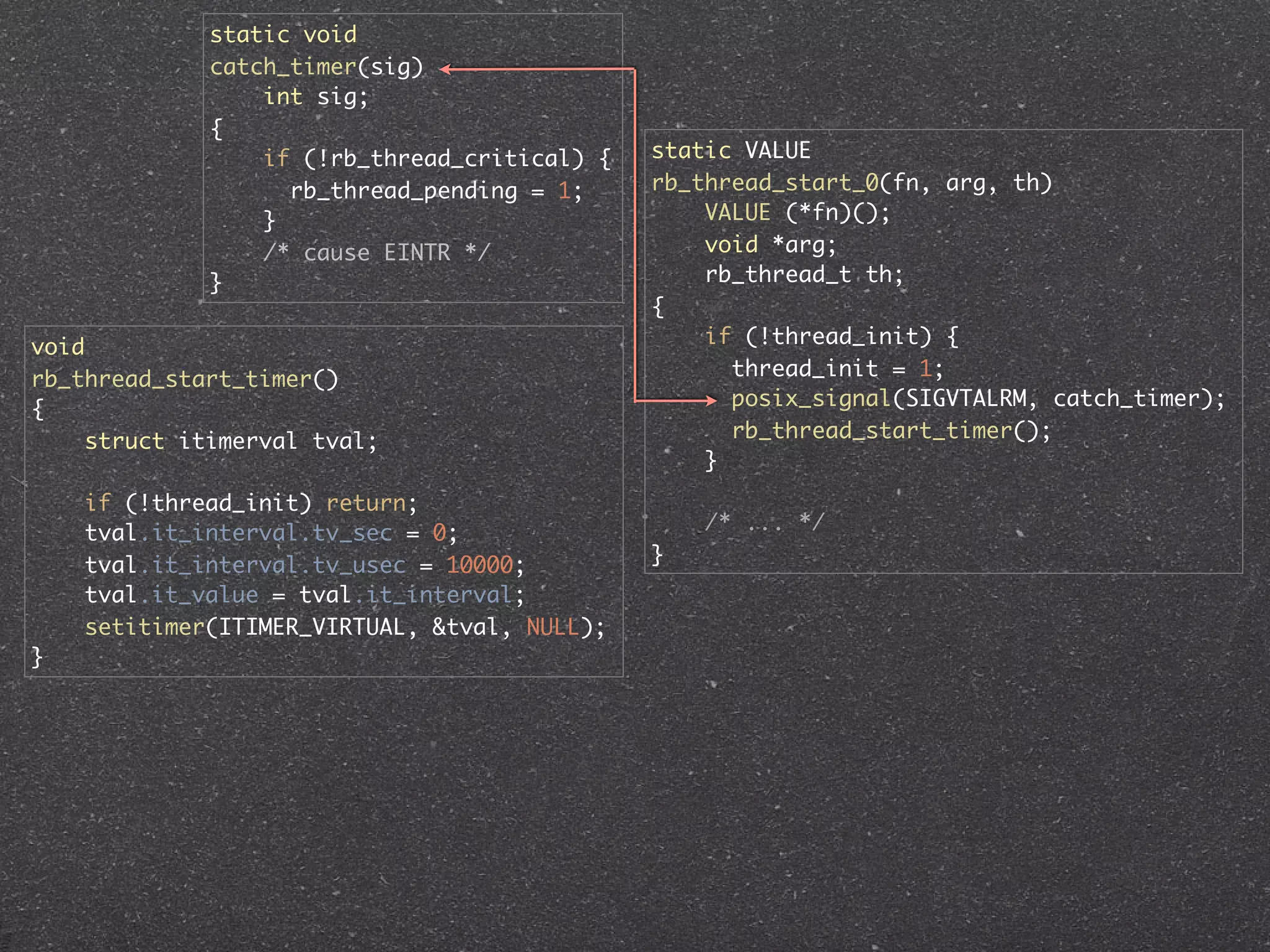
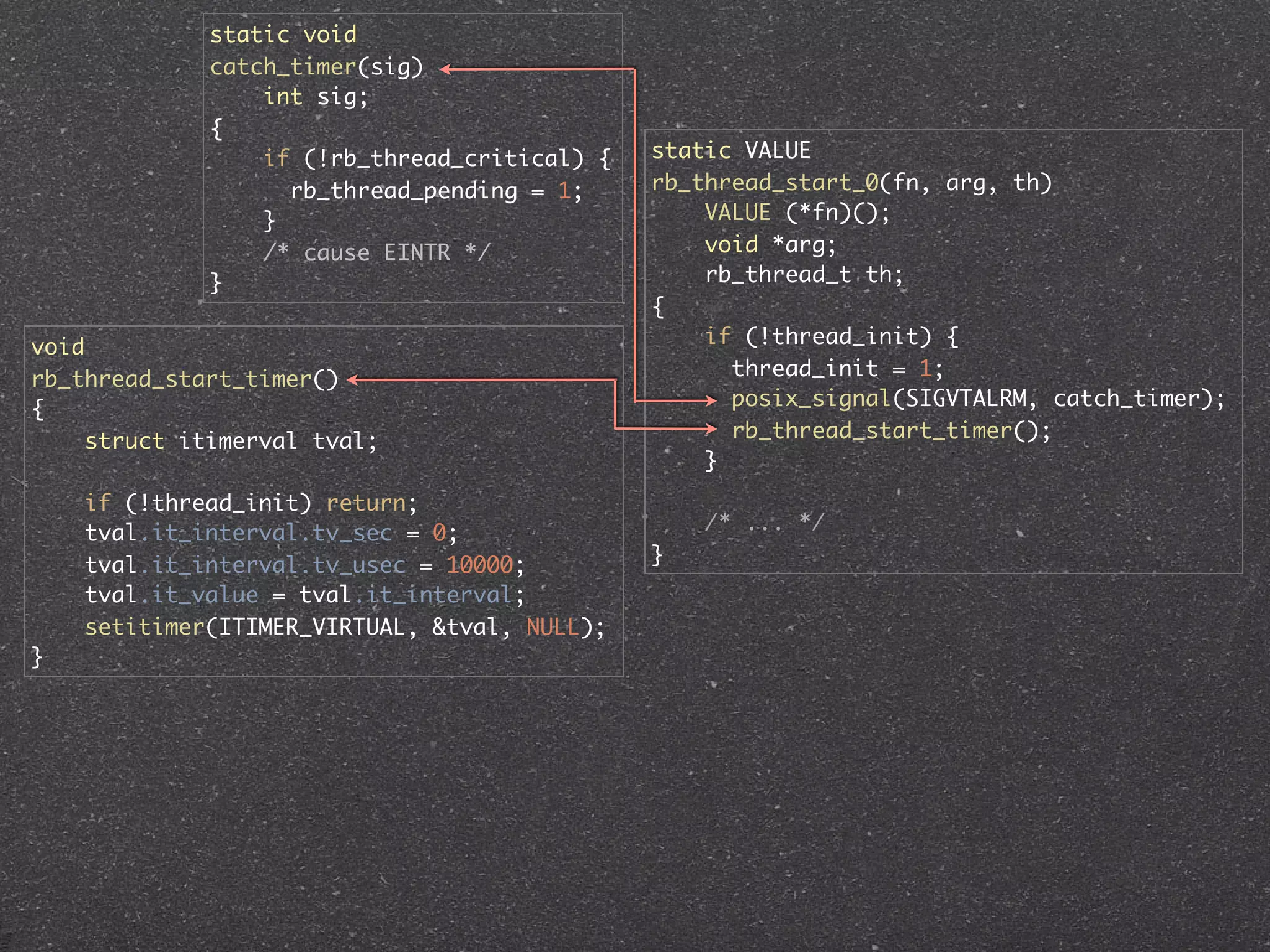
 The first time a new thread is created, ruby
 calls:

   setitimer(ITIMER_VIRTUAL, 10ms): tell the
   kernel to send the process a SIGVTALRM
   every 10ms

   posix_signal(SIGVTALRM, catch_timer): bind
   the catch_timer function to the signal


                       * when compiled without --enable-pthread
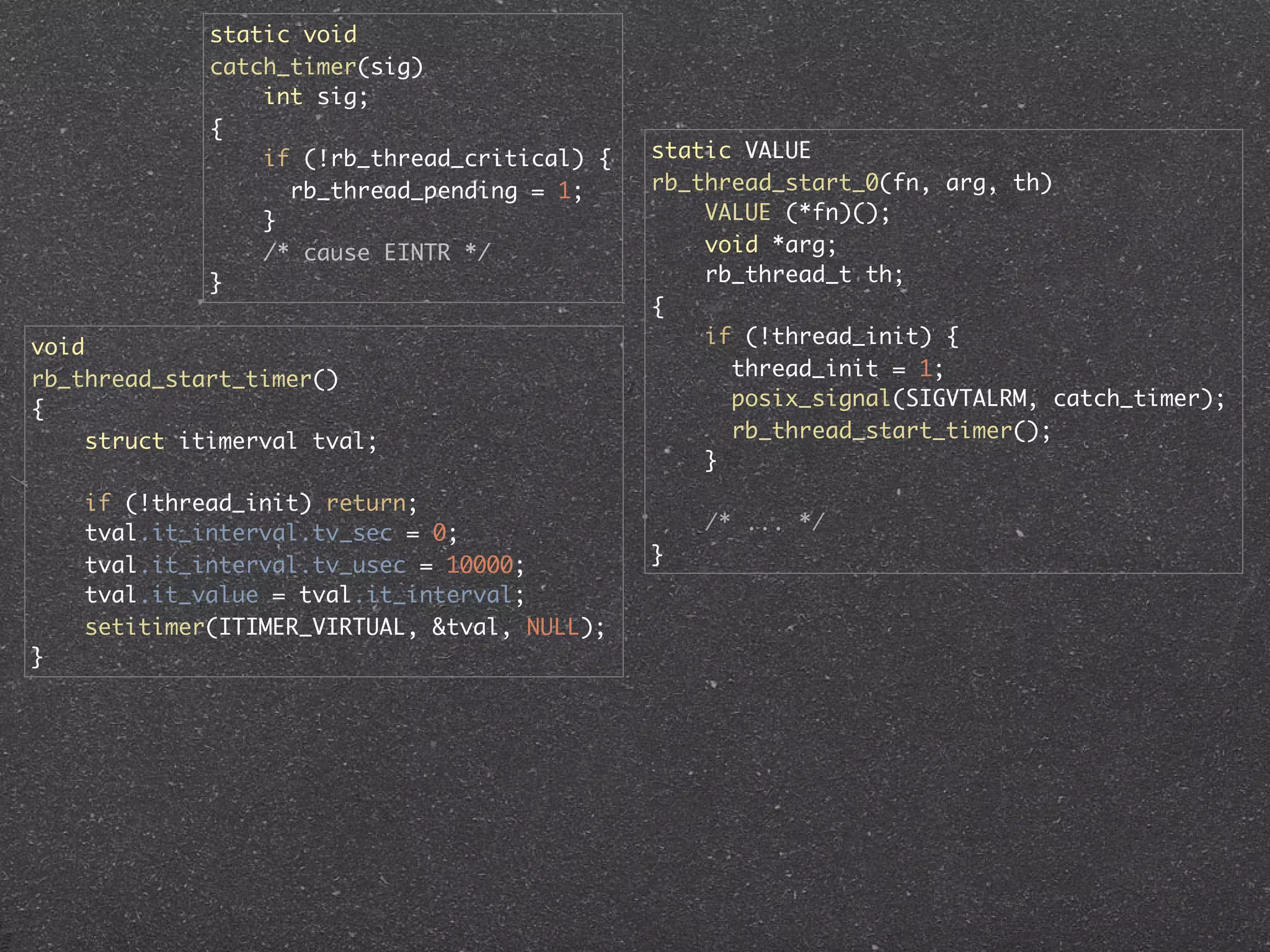
static void
             catch_timer(sig)
                 int sig;
             {
                 if (!rb_thread_critical) {   static VALUE
                   rb_thread_pending = 1;     rb_thread_start_0(fn, arg, th)
                 }                                VALUE (*fn)();
                 /* cause EINTR */                void *arg;
             }                                    rb_thread_t th;
                                              {
void                                              if (!thread_init) {
rb_thread_start_timer()                             thread_init = 1;
{                                                   posix_signal(SIGVTALRM, catch_timer);
     struct itimerval tval;                         rb_thread_start_timer();
                                                  }
    if (!thread_init) return;
    tval.it_interval.tv_sec = 0;                  /* ... */
    tval.it_interval.tv_usec = 10000;         }
    tval.it_value = tval.it_interval;
    setitimer(ITIMER_VIRTUAL, &tval, NULL);
}
static void
             catch_timer(sig)
                 int sig;
             {
                 if (!rb_thread_critical) {   static VALUE
                   rb_thread_pending = 1;     rb_thread_start_0(fn, arg, th)
                 }                                VALUE (*fn)();
                 /* cause EINTR */                void *arg;
             }                                    rb_thread_t th;
                                              {
void                                              if (!thread_init) {
rb_thread_start_timer()                             thread_init = 1;
{                                                   posix_signal(SIGVTALRM, catch_timer);
     struct itimerval tval;                         rb_thread_start_timer();
                                                  }
    if (!thread_init) return;
    tval.it_interval.tv_sec = 0;                  /* ... */
    tval.it_interval.tv_usec = 10000;         }
    tval.it_value = tval.it_interval;
    setitimer(ITIMER_VIRTUAL, &tval, NULL);
}
static void
             catch_timer(sig)
                 int sig;
             {
                 if (!rb_thread_critical) {   static VALUE
                   rb_thread_pending = 1;     rb_thread_start_0(fn, arg, th)
                 }                                VALUE (*fn)();
                 /* cause EINTR */                void *arg;
             }                                    rb_thread_t th;
                                              {
void                                              if (!thread_init) {
rb_thread_start_timer()                             thread_init = 1;
{                                                   posix_signal(SIGVTALRM, catch_timer);
     struct itimerval tval;                         rb_thread_start_timer();
                                                  }
    if (!thread_init) return;
    tval.it_interval.tv_sec = 0;                  /* ... */
    tval.it_interval.tv_usec = 10000;         }
    tval.it_value = tval.it_interval;
    setitimer(ITIMER_VIRTUAL, &tval, NULL);
}
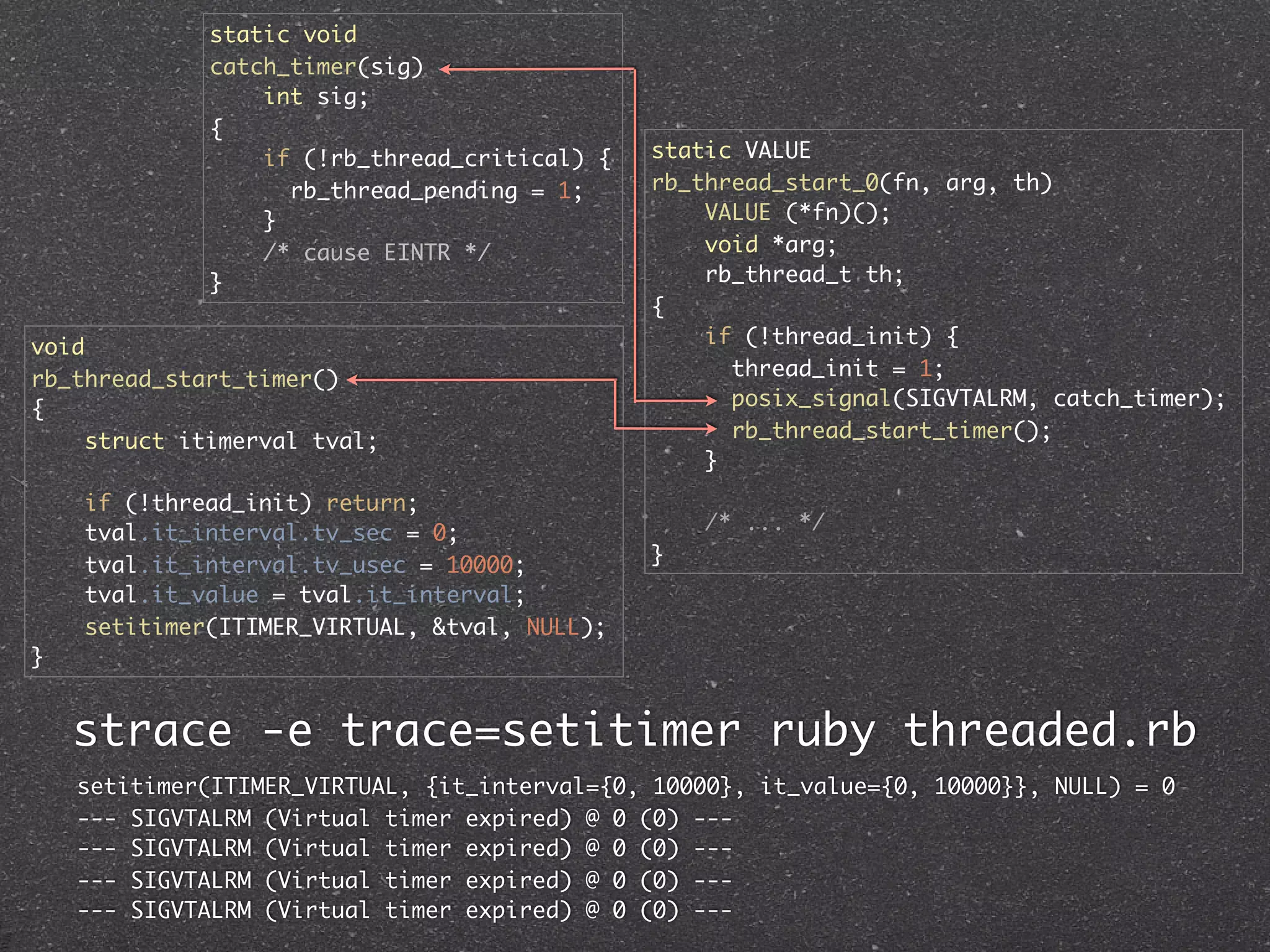
static void
             catch_timer(sig)
                 int sig;
             {
                 if (!rb_thread_critical) {   static VALUE
                   rb_thread_pending = 1;     rb_thread_start_0(fn, arg, th)
                 }                                VALUE (*fn)();
                 /* cause EINTR */                void *arg;
             }                                    rb_thread_t th;
                                              {
void                                              if (!thread_init) {
rb_thread_start_timer()                             thread_init = 1;
{                                                   posix_signal(SIGVTALRM, catch_timer);
     struct itimerval tval;                         rb_thread_start_timer();
                                                  }
    if (!thread_init) return;
    tval.it_interval.tv_sec = 0;                  /* ... */
    tval.it_interval.tv_usec = 10000;         }
    tval.it_value = tval.it_interval;
    setitimer(ITIMER_VIRTUAL, &tval, NULL);
}


    strace -e trace=setitimer ruby threaded.rb
    setitimer(ITIMER_VIRTUAL, {it_interval={0, 10000}, it_value={0, 10000}}, NULL) = 0
    --- SIGVTALRM (Virtual timer expired) @ 0 (0) ---
    --- SIGVTALRM (Virtual timer expired) @ 0 (0) ---
    --- SIGVTALRM (Virtual timer expired) @ 0 (0) ---
    --- SIGVTALRM (Virtual timer expired) @ 0 (0) ---
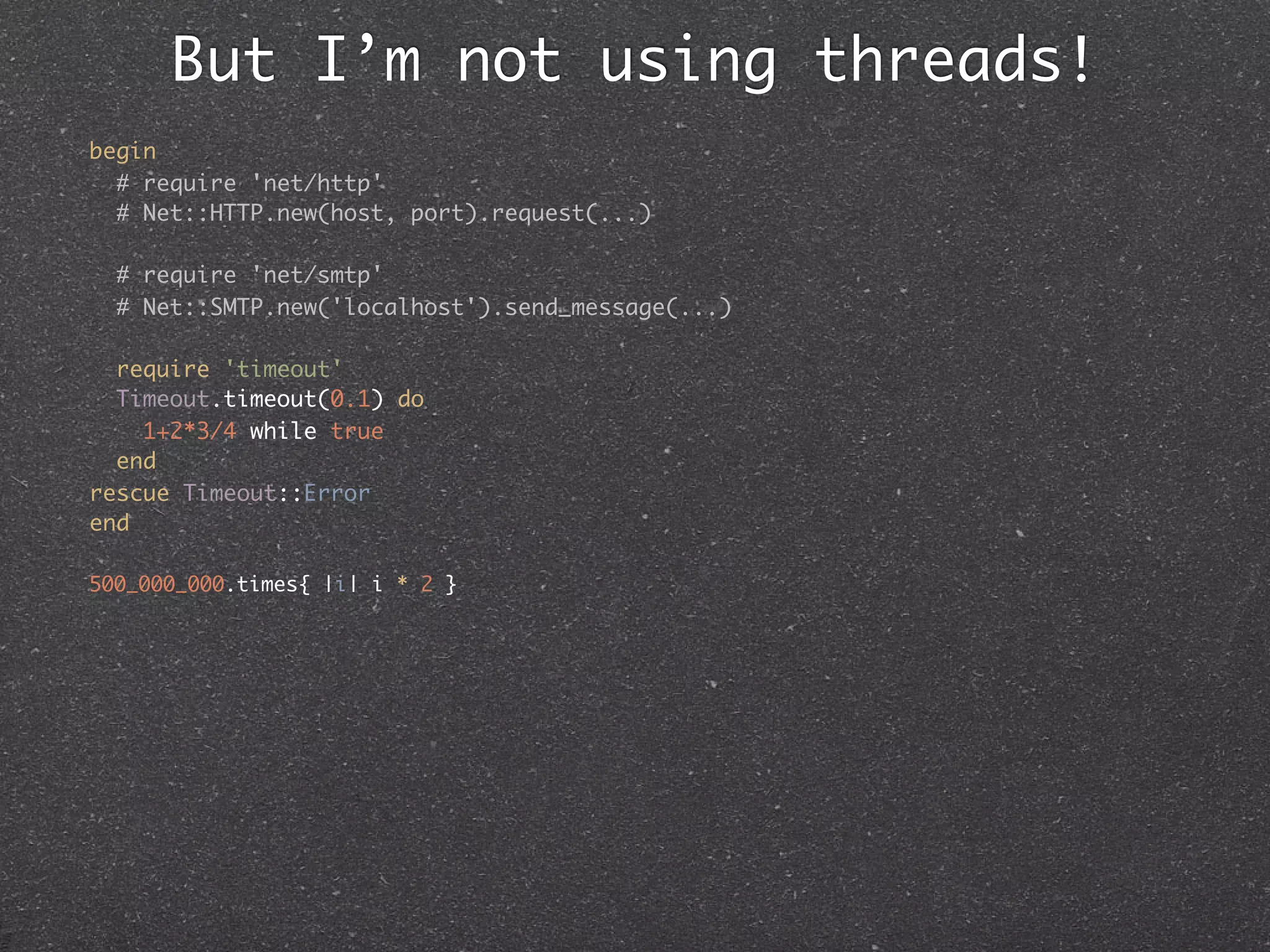
But I’m not using threads!
begin
  # require 'net/http'
  # Net::HTTP.new(host, port).request(...)

  # require 'net/smtp'
  # Net::SMTP.new('localhost').send_message(...)

  require 'timeout'
  Timeout.timeout(0.1) do
    1+2*3/4 while true
  end
rescue Timeout::Error
end

500_000_000.times{ |i| i * 2 }
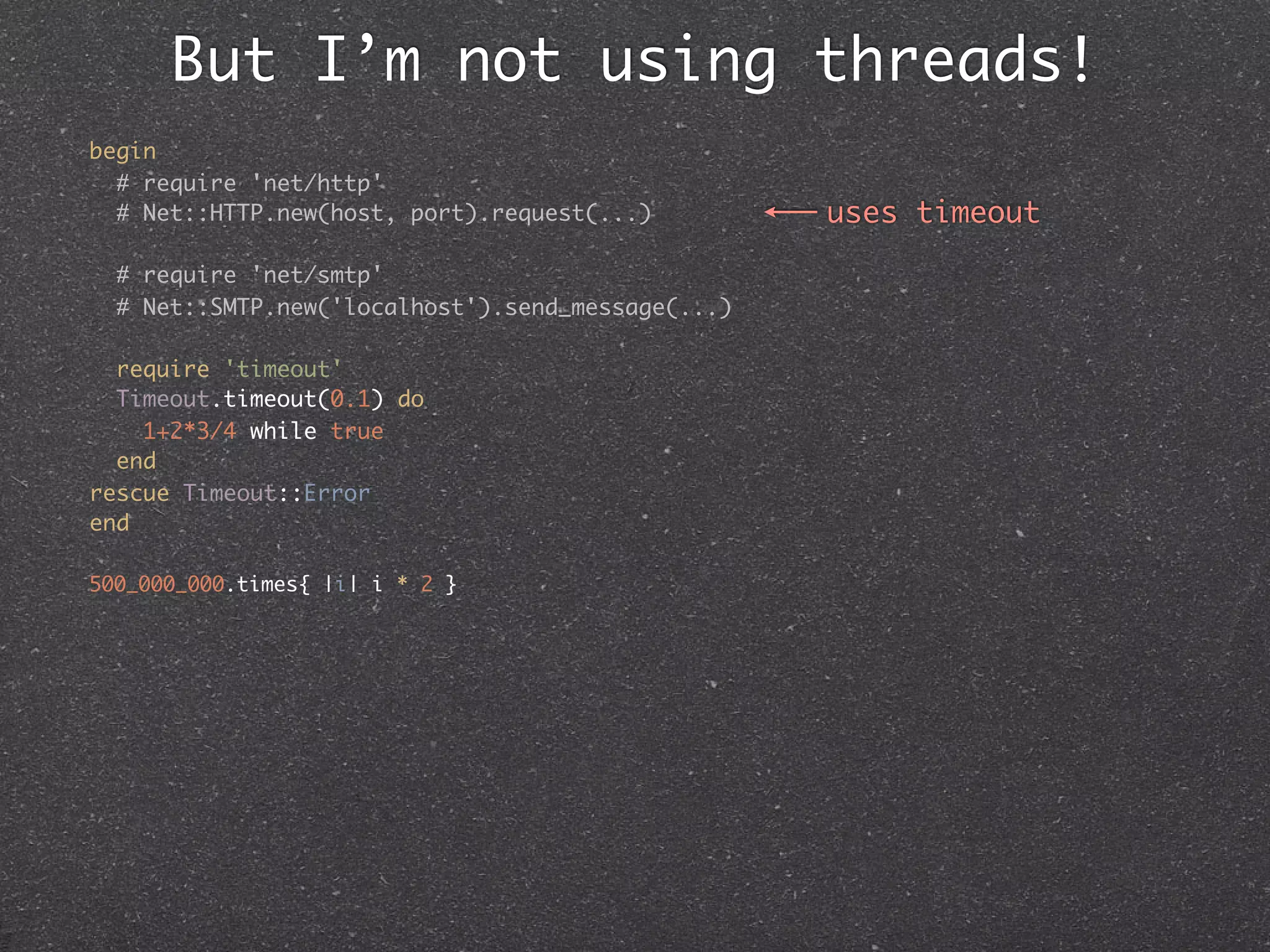
But I’m not using threads!
begin
  # require 'net/http'
  # Net::HTTP.new(host, port).request(...)         uses timeout

  # require 'net/smtp'
  # Net::SMTP.new('localhost').send_message(...)

  require 'timeout'
  Timeout.timeout(0.1) do
    1+2*3/4 while true
  end
rescue Timeout::Error
end

500_000_000.times{ |i| i * 2 }
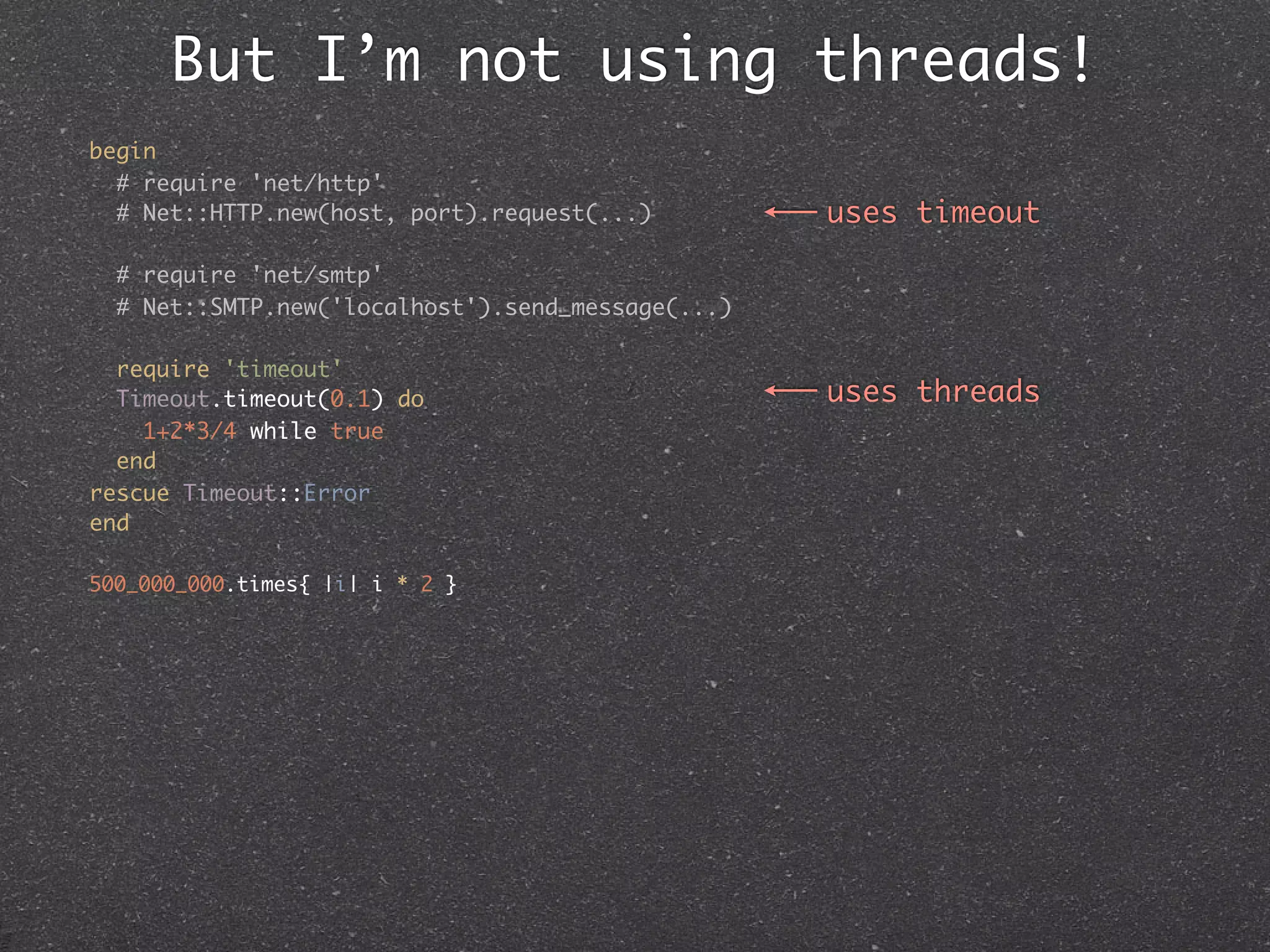
But I’m not using threads!
begin
  # require 'net/http'
  # Net::HTTP.new(host, port).request(...)         uses timeout

  # require 'net/smtp'
  # Net::SMTP.new('localhost').send_message(...)

  require 'timeout'
  Timeout.timeout(0.1) do                          uses threads
    1+2*3/4 while true
  end
rescue Timeout::Error
end

500_000_000.times{ |i| i * 2 }
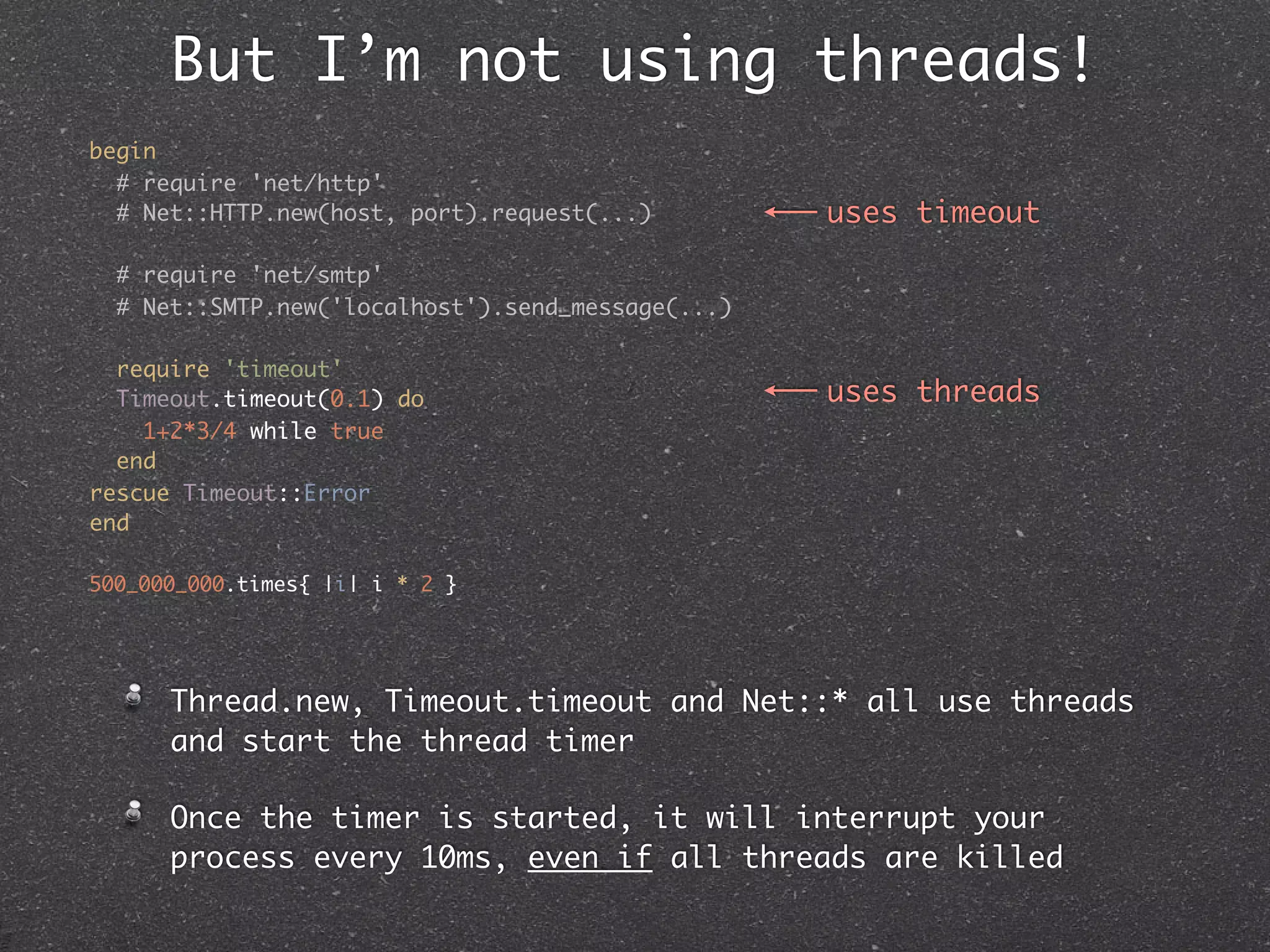
But I’m not using threads!
begin
  # require 'net/http'
  # Net::HTTP.new(host, port).request(...)         uses timeout

  # require 'net/smtp'
  # Net::SMTP.new('localhost').send_message(...)

  require 'timeout'
  Timeout.timeout(0.1) do                          uses threads
    1+2*3/4 while true
  end
rescue Timeout::Error
end

500_000_000.times{ |i| i * 2 }


      Thread.new, Timeout.timeout and Net::* all use threads
      and start the thread timer

      Once the timer is started, it will interrupt your
      process every 10ms, even if all threads are killed
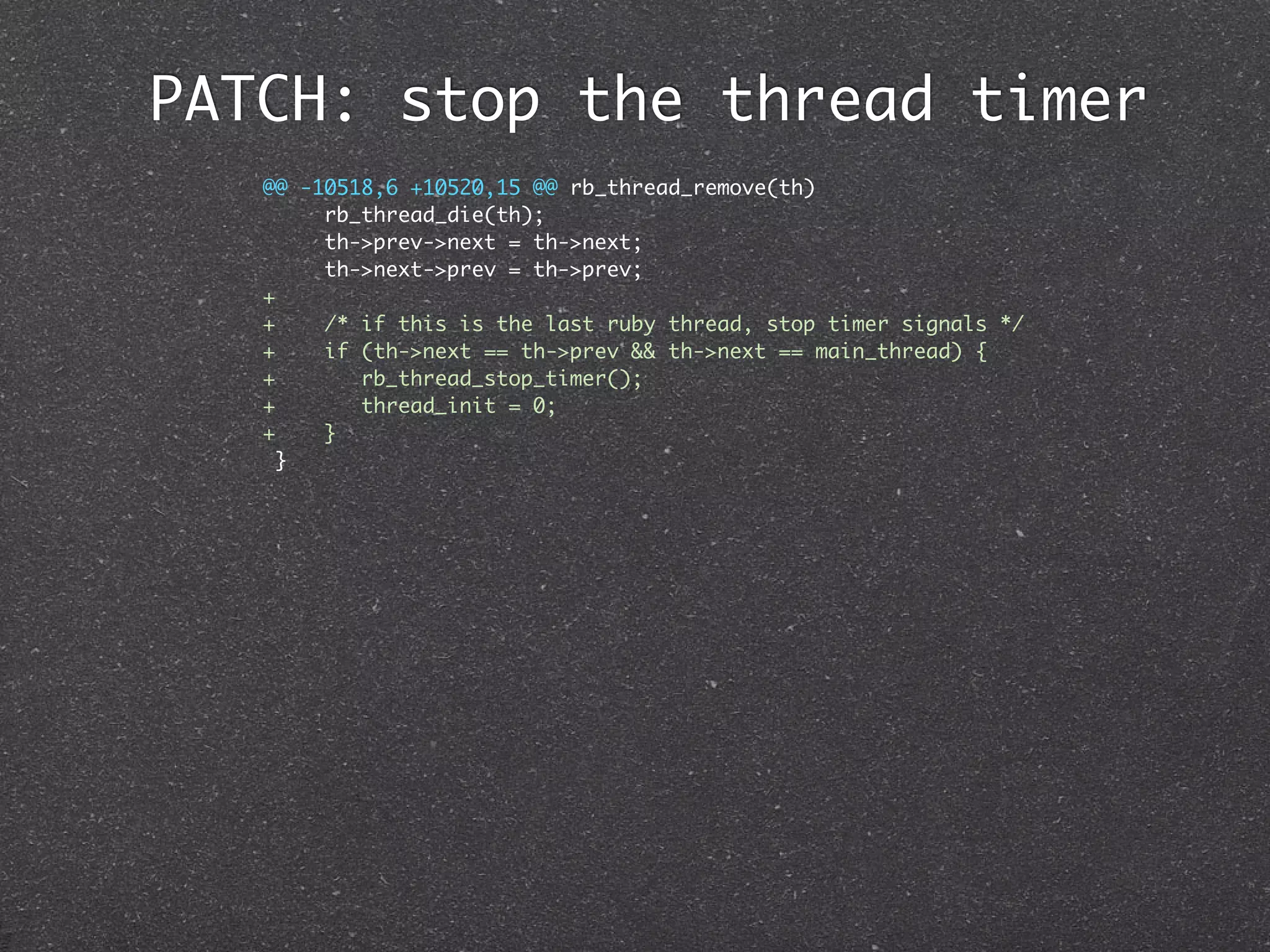
PATCH: stop the thread timer
   @@ -10518,6 +10520,15 @@ rb_thread_remove(th)
        rb_thread_die(th);
        th->prev->next = th->next;
        th->next->prev = th->prev;
   +
   +    /* if this is the last ruby thread, stop timer signals */
   +    if (th->next == th->prev && th->next == main_thread) {
   +       rb_thread_stop_timer();
   +       thread_init = 0;
   +    }
     }
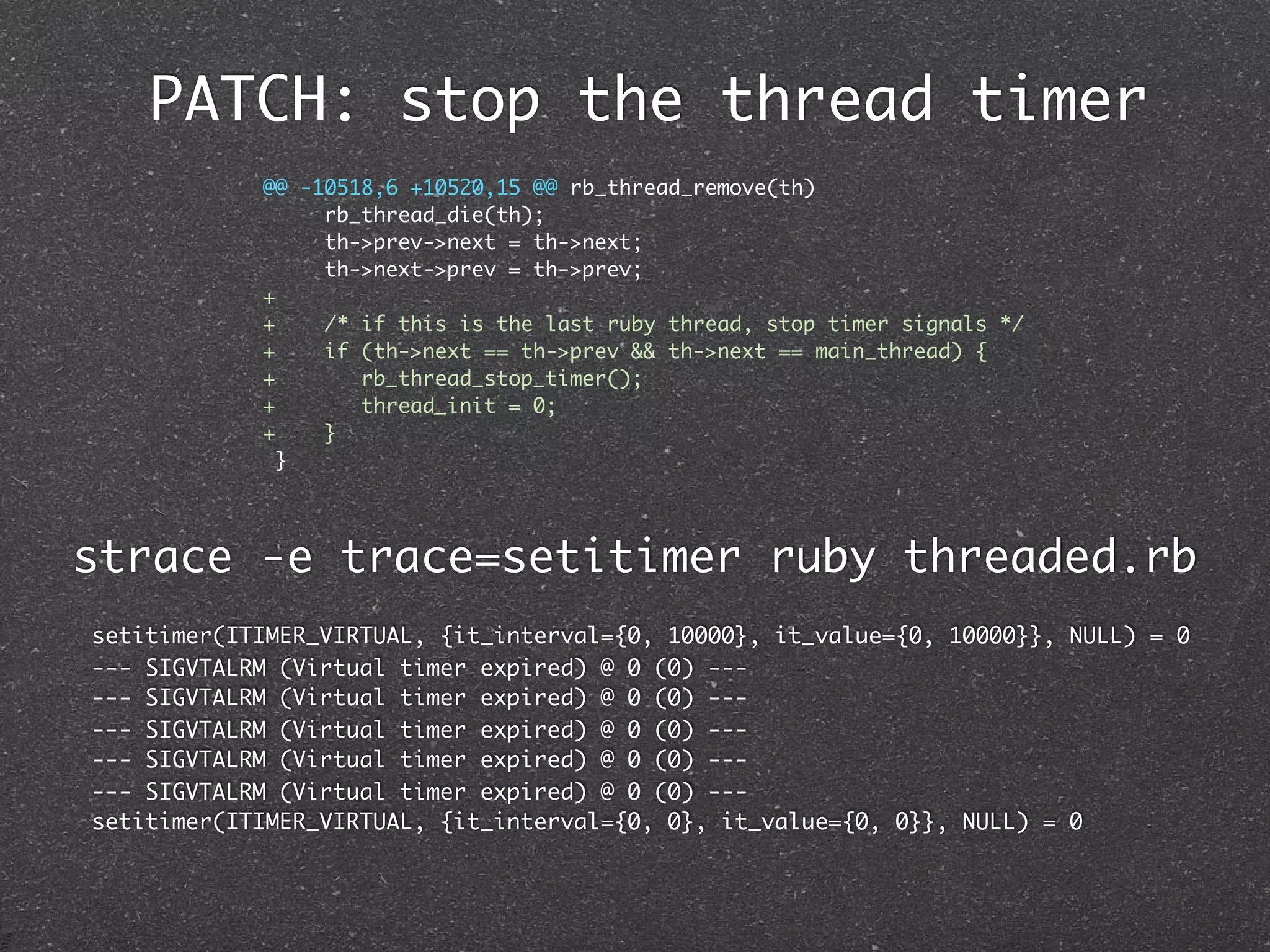
PATCH: stop the thread timer
            @@ -10518,6 +10520,15 @@ rb_thread_remove(th)
                 rb_thread_die(th);
                 th->prev->next = th->next;
                 th->next->prev = th->prev;
            +
            +    /* if this is the last ruby thread, stop timer signals */
            +    if (th->next == th->prev && th->next == main_thread) {
            +       rb_thread_stop_timer();
            +       thread_init = 0;
            +    }
              }


strace -e trace=setitimer ruby threaded.rb
setitimer(ITIMER_VIRTUAL, {it_interval={0, 10000}, it_value={0, 10000}}, NULL) = 0
--- SIGVTALRM (Virtual timer expired) @ 0 (0) ---
setitimer(ITIMER_VIRTUAL, {it_interval={0, 0}, it_value={0, 0}}, NULL) = 0
Why are our debian servers so slow?


          strace -ttT ruby threaded.rb
   18:42:39.566788   rt_sigprocmask(SIG_BLOCK, NULL,   [], 8) =   0   <0.000006>
   18:42:39.566836   rt_sigprocmask(SIG_BLOCK, NULL,   [], 8) =   0   <0.000006>
   18:42:39.567083   rt_sigprocmask(SIG_SETMASK, [],   NULL, 8)   =   0 <0.000006>
   18:42:39.567131   rt_sigprocmask(SIG_BLOCK, NULL,   [], 8) =   0   <0.000006>
   18:42:39.567415   rt_sigprocmask(SIG_BLOCK, NULL,   [], 8) =   0   <0.000006>
Why are our debian servers so slow?
            strace -c ruby threaded.rb
     % time     seconds usecs/call      calls    errors syscall
     ------ ----------- ----------- --------- --------- ----------------
     100.00    0.326334           0   3568567           rt_sigprocmask
       0.00    0.000000           0         9           read
       0.00    0.000000           0        10           open
       0.00    0.000000           0        10           close
       0.00    0.000000           0         9           fstat
       0.00    0.000000           0        25           mmap
     ------ ----------- ----------- --------- --------- ----------------
     100.00    0.326334               3568685         0 total


          strace -ttT ruby threaded.rb
   18:42:39.566788   rt_sigprocmask(SIG_BLOCK, NULL,   [], 8) =   0   <0.000006>
   18:42:39.566836   rt_sigprocmask(SIG_BLOCK, NULL,   [], 8) =   0   <0.000006>
   18:42:39.567083   rt_sigprocmask(SIG_SETMASK, [],   NULL, 8)   =   0 <0.000006>
   18:42:39.567131   rt_sigprocmask(SIG_BLOCK, NULL,   [], 8) =   0   <0.000006>
   18:42:39.567415   rt_sigprocmask(SIG_BLOCK, NULL,   [], 8) =   0   <0.000006>
Why are our debian servers so slow?
            strace -c ruby threaded.rb
     % time     seconds usecs/call      calls    errors syscall
     ------ ----------- ----------- --------- --------- ----------------
     100.00    0.326334           0   3568567           rt_sigprocmask
       0.00    0.000000           0         9           read
       0.00    0.000000           0        10           open
       0.00    0.000000           0        10           close
       0.00    0.000000           0         9           fstat
       0.00    0.000000           0        25           mmap
     ------ ----------- ----------- --------- --------- ----------------
     100.00    0.326334               3568685         0 total


          strace -ttT ruby threaded.rb
   18:42:39.566788   rt_sigprocmask(SIG_BLOCK, NULL,   [], 8) =   0   <0.000006>
   18:42:39.566836   rt_sigprocmask(SIG_BLOCK, NULL,   [], 8) =   0   <0.000006>
   18:42:39.567083   rt_sigprocmask(SIG_SETMASK, [],   NULL, 8)   =   0 <0.000006>
   18:42:39.567131   rt_sigprocmask(SIG_BLOCK, NULL,   [], 8) =   0   <0.000006>
   18:42:39.567415   rt_sigprocmask(SIG_BLOCK, NULL,   [], 8) =   0   <0.000006>


                       3.5 million sigprocmasks.. wtf?
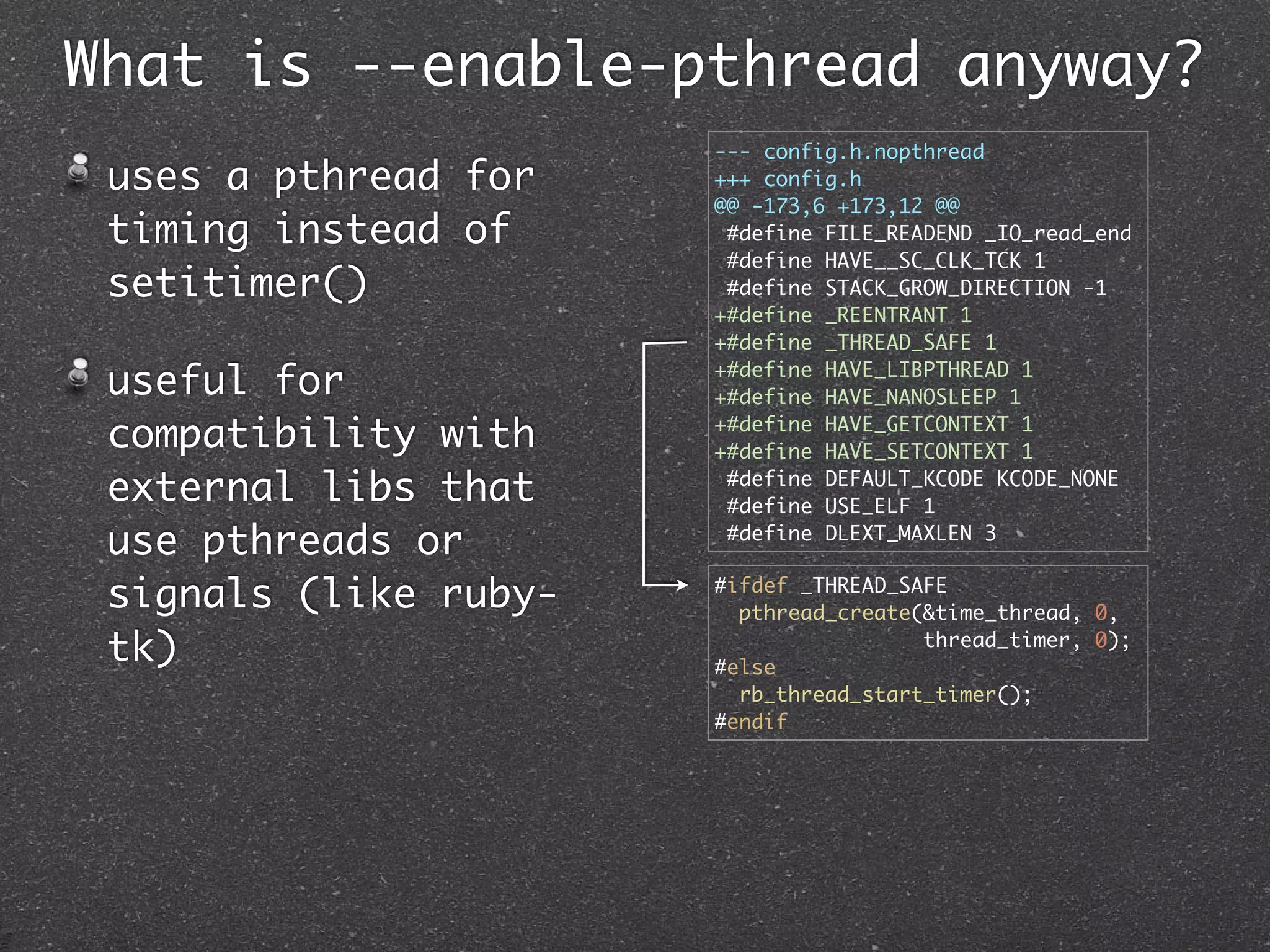
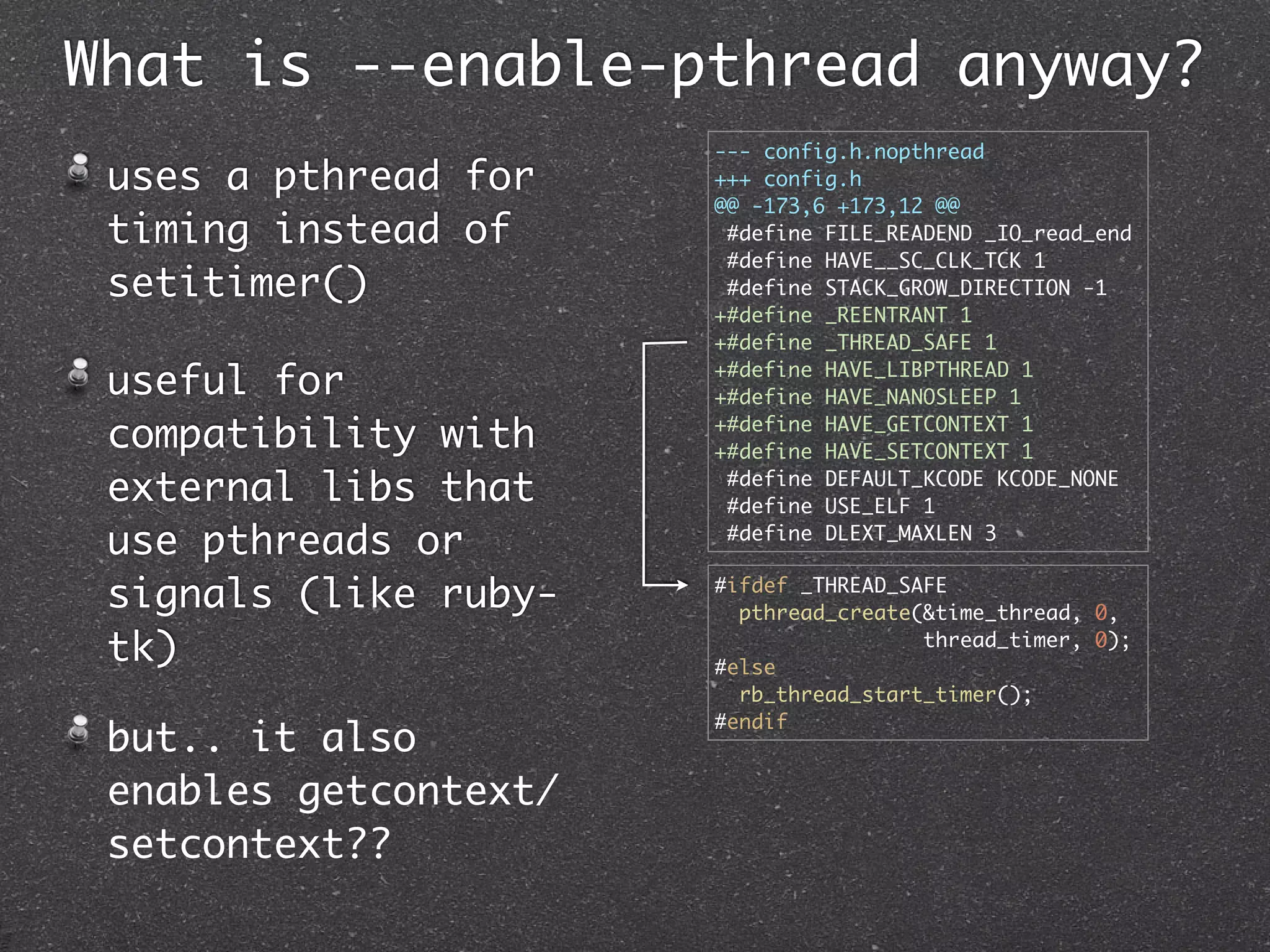
What is --enable-pthread anyway?
                       --- config.h.nopthread
 uses a pthread for    +++ config.h
                       @@ -173,6 +173,12 @@
 timing instead of      #define FILE_READEND _IO_read_end
                        #define HAVE__SC_CLK_TCK 1
 setitimer()            #define STACK_GROW_DIRECTION -1
                       +#define _REENTRANT 1
                       +#define _THREAD_SAFE 1

 useful for            +#define HAVE_LIBPTHREAD 1
                       +#define HAVE_NANOSLEEP 1

 compatibility with    +#define HAVE_GETCONTEXT 1
                       +#define HAVE_SETCONTEXT 1

 external libs that     #define DEFAULT_KCODE KCODE_NONE
                        #define USE_ELF 1

 use pthreads or        #define DLEXT_MAXLEN 3


 signals (like ruby-   #ifdef _THREAD_SAFE
                         pthread_create(&time_thread, 0,

 tk)                   #else
                                        thread_timer, 0);

                         rb_thread_start_timer();
                       #endif
What is --enable-pthread anyway?
                       --- config.h.nopthread
 uses a pthread for    +++ config.h
                       @@ -173,6 +173,12 @@
 timing instead of      #define FILE_READEND _IO_read_end
                        #define HAVE__SC_CLK_TCK 1
 setitimer()            #define STACK_GROW_DIRECTION -1
                       +#define _REENTRANT 1
                       +#define _THREAD_SAFE 1

 useful for            +#define HAVE_LIBPTHREAD 1
                       +#define HAVE_NANOSLEEP 1

 compatibility with    +#define HAVE_GETCONTEXT 1
                       +#define HAVE_SETCONTEXT 1

 external libs that     #define DEFAULT_KCODE KCODE_NONE
                        #define USE_ELF 1

 use pthreads or        #define DLEXT_MAXLEN 3


 signals (like ruby-   #ifdef _THREAD_SAFE
                         pthread_create(&time_thread, 0,

 tk)                   #else
                                        thread_timer, 0);

                         rb_thread_start_timer();
                       #endif
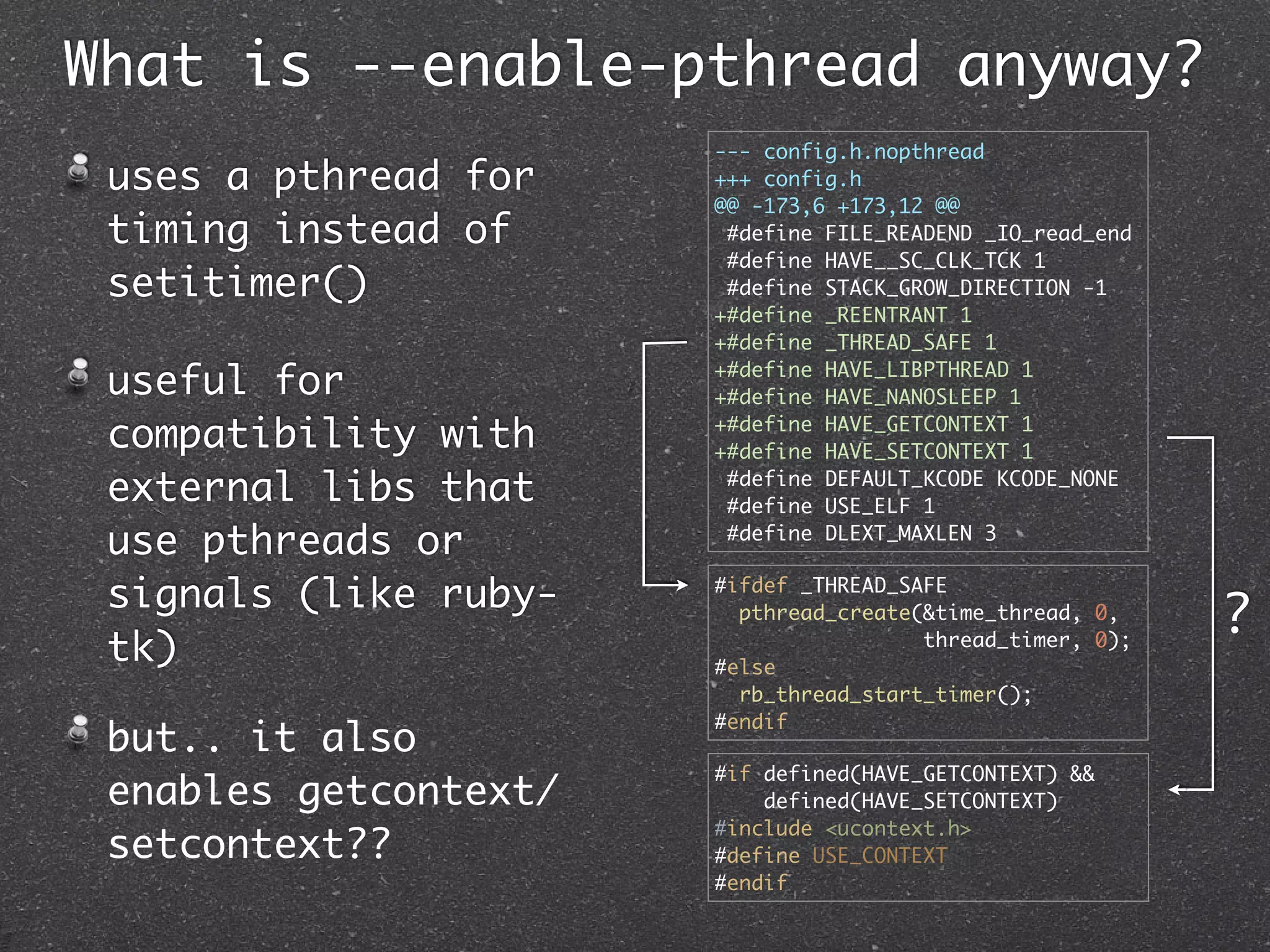
 but.. it also
 enables getcontext/
 setcontext??
What is --enable-pthread anyway?
                       --- config.h.nopthread
 uses a pthread for    +++ config.h
                       @@ -173,6 +173,12 @@
 timing instead of      #define FILE_READEND _IO_read_end
                        #define HAVE__SC_CLK_TCK 1
 setitimer()            #define STACK_GROW_DIRECTION -1
                       +#define _REENTRANT 1
                       +#define _THREAD_SAFE 1

 useful for            +#define HAVE_LIBPTHREAD 1
                       +#define HAVE_NANOSLEEP 1

 compatibility with    +#define HAVE_GETCONTEXT 1
                       +#define HAVE_SETCONTEXT 1

 external libs that     #define DEFAULT_KCODE KCODE_NONE
                        #define USE_ELF 1

 use pthreads or        #define DLEXT_MAXLEN 3


 signals (like ruby-   #ifdef _THREAD_SAFE
                         pthread_create(&time_thread, 0,
                                                            ?
 tk)                   #else
                                        thread_timer, 0);

                         rb_thread_start_timer();
                       #endif
 but.. it also
                       #if defined(HAVE_GETCONTEXT) &&
 enables getcontext/       defined(HAVE_SETCONTEXT)
                       #include <ucontext.h>
 setcontext??          #define USE_CONTEXT
                       #endif
ucontext?
ucontext?
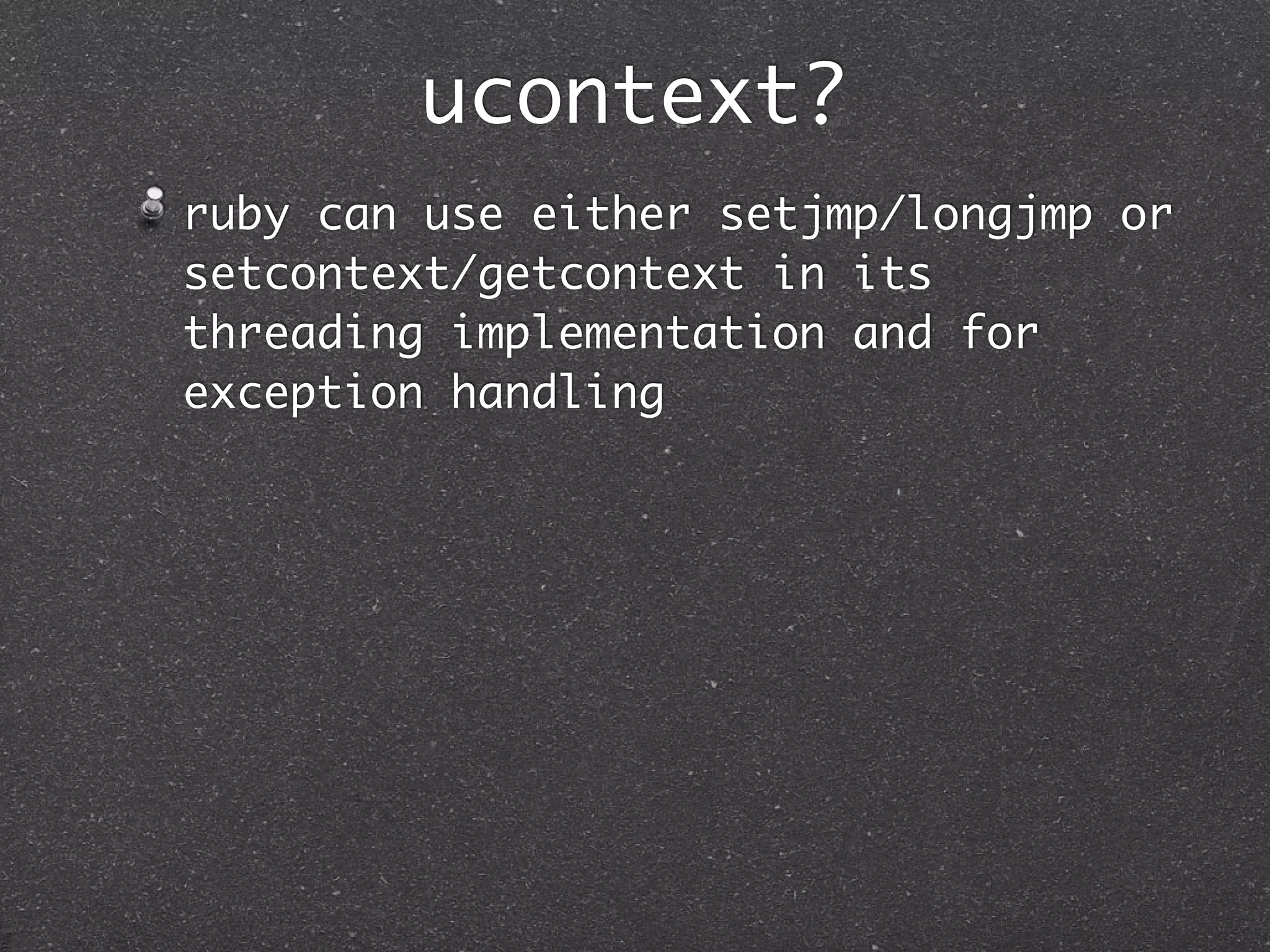
ruby can use either setjmp/longjmp or
setcontext/getcontext in its
threading implementation and for
exception handling
ucontext?
ruby can use either setjmp/longjmp or
setcontext/getcontext in its
threading implementation and for
exception handling

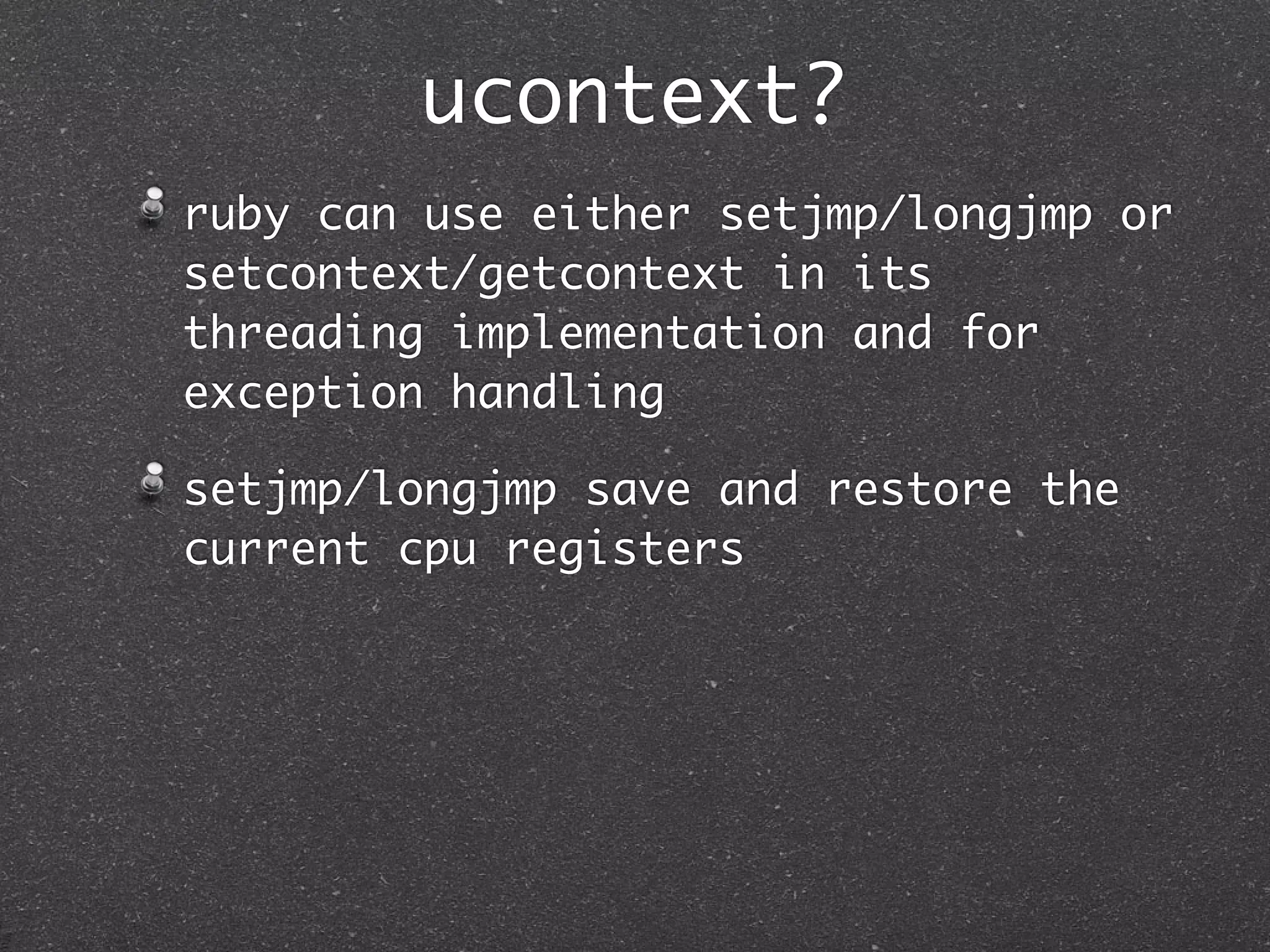
setjmp/longjmp save and restore the
current cpu registers
ucontext?
ruby can use either setjmp/longjmp or
setcontext/getcontext in its
threading implementation and for
exception handling

setjmp/longjmp save and restore the
current cpu registers

setcontext/getcontext are an advanced
version of setjmp/longjmp, but they
also call sigprocmask to save/restore
the signal mask before each jump
PATCH: --disable-ucontext
--- a/configure.in
+++ b/configure.in
@@ -368,6 +368,10 @@
+AC_ARG_ENABLE(ucontext,
+       [ --disable-ucontext       do not use getcontext()/setcontext().],
+       [disable_ucontext=yes], [disable_ucontext=no])
+

 AC_ARG_ENABLE(pthread,
        [ --enable-pthread         use pthread library.],
        [enable_pthread=$enableval], [enable_pthread=no])
@@ -1038,7 +1042,8 @@
-if test x"$ac_cv_header_ucontext_h" = xyes; then
+if test x"$ac_cv_header_ucontext_h" = xyes && test x"$disable_ucontext" = xno; then
     if test x"$rb_with_pthread" = xyes; then
        AC_CHECK_FUNCS(getcontext setcontext)
     fi


        ./configure --enable-pthread --disable-ucontext
PATCH: --disable-ucontext
--- a/configure.in
+++ b/configure.in
@@ -368,6 +368,10 @@
+AC_ARG_ENABLE(ucontext,
+       [ --disable-ucontext       do not use getcontext()/setcontext().],
+       [disable_ucontext=yes], [disable_ucontext=no])
+

 AC_ARG_ENABLE(pthread,
        [ --enable-pthread         use pthread library.],
        [enable_pthread=$enableval], [enable_pthread=no])
@@ -1038,7 +1042,8 @@
-if test x"$ac_cv_header_ucontext_h" = xyes; then
+if test x"$ac_cv_header_ucontext_h" = xyes && test x"$disable_ucontext" = xno; then
     if test x"$rb_with_pthread" = xyes; then
        AC_CHECK_FUNCS(getcontext setcontext)
     fi


        ./configure --enable-pthread --disable-ucontext

     % time     seconds usecs/call      calls    errors syscall
     ------ ----------- ----------- --------- --------- ----------------
        nan    0.000000           0        13           read
        nan    0.000000           0        21        10 open
        nan    0.000000           0        11           close
     ------ ----------- ----------- --------- --------- ----------------
     100.00    0.000000                    45        10 total
EventMachine + threads = slow??
EventMachine allocates large buffers on the
stack to read/write from the network

Using threads with EM made ruby extremely
slow..
EventMachine + threads = slow??
EventMachine allocates large buffers on the
stack to read/write from the network

Using threads with EM made ruby extremely
slow..


                                 ...profile?
EventMachine + threads = slow??
  EventMachine allocates large buffers on the
  stack to read/write from the network

  Using threads with EM made ruby extremely
  slow..
                       #include "ruby.h"
require 'cext'
                       VALUE bigstack(VALUE self)
(1..2).map{            {
  Thread.new{            char buffer[ 50 * 1024 ]; /* large stack frame */
    CExt.bigstack{       if (rb_block_given_p()) rb_yield(Qnil);
      100_000.times{     return Qnil;
        1*2+3/4        }
        Thread.pass
      }                void Init_cext()
    }                  {
  }                      VALUE CExt = rb_define_module("CExt");
}.map{ |t| t.join }      rb_define_singleton_method(CExt, "bigstack", bigstack, 0);
                       }


                                                            ...profile?
EventMachine + threads = slow??
  EventMachine allocates large buffers on the
  stack to read/write from the network

  Using threads with EM made ruby extremely
  slow..
                       #include "ruby.h"
require 'cext'
                       VALUE bigstack(VALUE self)
(1..2).map{            {
  Thread.new{            char buffer[ 50 * 1024 ]; /* large stack frame */
    CExt.bigstack{       if (rb_block_given_p()) rb_yield(Qnil);
      100_000.times{     return Qnil;
        1*2+3/4        }
        Thread.pass
      }                void Init_cext()
    }                  {
  }                      VALUE CExt = rb_define_module("CExt");
}.map{ |t| t.join }      rb_define_singleton_method(CExt, "bigstack", bigstack, 0);
                       }


                                                            ...profile?
EventMachine + threads = slow??
  EventMachine allocates large buffers on the
  stack to read/write from the network

  Using threads with EM made ruby extremely
  slow..
                       #include "ruby.h"
require 'cext'
                       VALUE bigstack(VALUE self)
(1..2).map{            {
  Thread.new{            char buffer[ 50 * 1024 ]; /* large stack frame */
    CExt.bigstack{       if (rb_block_given_p()) rb_yield(Qnil);
      100_000.times{     return Qnil;
        1*2+3/4        }
        Thread.pass
      }                void Init_cext()
    }                  {
  }                      VALUE CExt = rb_define_module("CExt");
}.map{ |t| t.join }      rb_define_singleton_method(CExt, "bigstack", bigstack, 0);
                       }


                                                            ...profile?
EventMachine + threads = slow??
  EventMachine allocates large buffers on the
  stack to read/write from the network

  Using threads with EM made ruby extremely
  slow..
                       #include "ruby.h"
require 'cext'
                       VALUE bigstack(VALUE self)
(1..2).map{            {
  Thread.new{            char buffer[ 50 * 1024 ]; /* large stack frame */
    CExt.bigstack{       if (rb_block_given_p()) rb_yield(Qnil);
      100_000.times{     return Qnil;
        1*2+3/4        }
        Thread.pass
      }                void Init_cext()
    }                  {
  }                      VALUE CExt = rb_define_module("CExt");
}.map{ |t| t.join }      rb_define_singleton_method(CExt, "bigstack", bigstack, 0);
                       }


                                                            ...profile?
EventMachine + threads = slow??
  EventMachine allocates large buffers on the
  stack to read/write from the network

  Using threads with EM made ruby extremely
  slow..
                       #include "ruby.h"
require 'cext'
                       VALUE bigstack(VALUE self)
(1..2).map{            {
  Thread.new{            char buffer[ 50 * 1024 ]; /* large stack frame */
    CExt.bigstack{       if (rb_block_given_p()) rb_yield(Qnil);
      100_000.times{     return Qnil;
        1*2+3/4        }
        Thread.pass
      }                void Init_cext()
    }                  {
  }                      VALUE CExt = rb_define_module("CExt");
}.map{ |t| t.join }      rb_define_singleton_method(CExt, "bigstack", bigstack, 0);
                       }


                                                            ...profile?
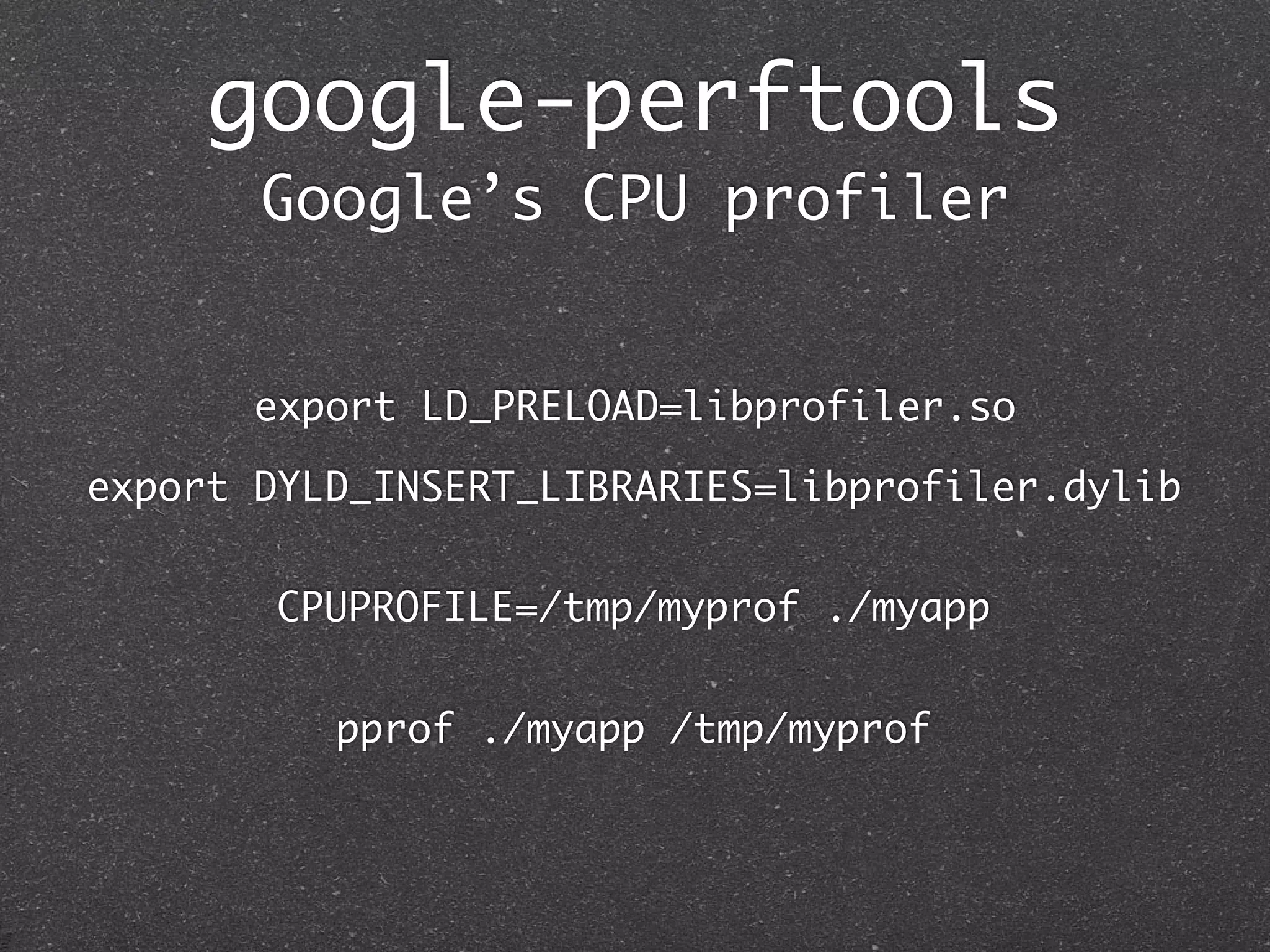
google-perftools
       Google’s CPU profiler


       export LD_PRELOAD=libprofiler.so

export DYLD_INSERT_LIBRARIES=libprofiler.dylib


       CPUPROFILE=/tmp/myprof ./myapp


          pprof ./myapp /tmp/myprof
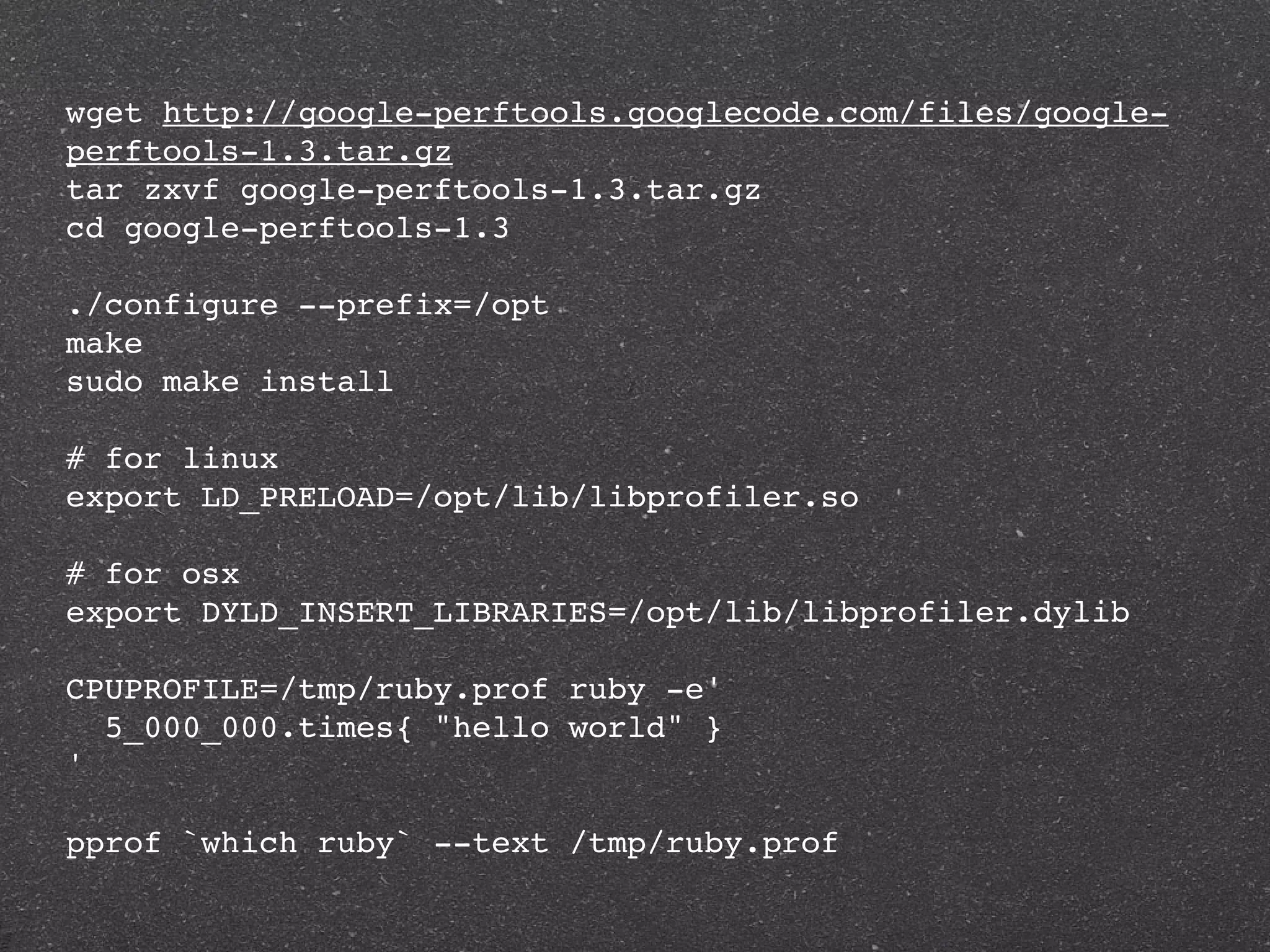
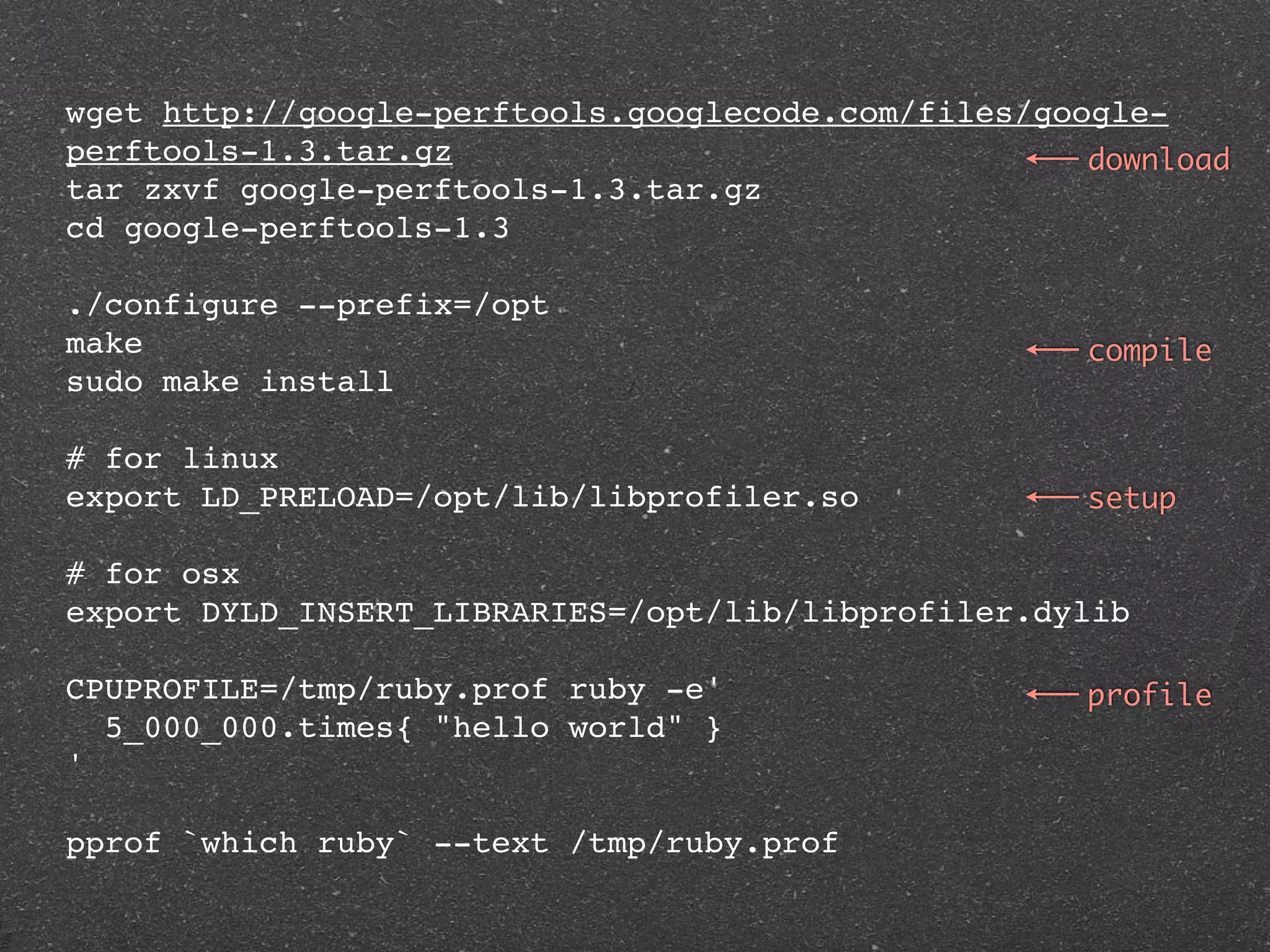
wget http://google-perftools.googlecode.com/files/google-
perftools-1.3.tar.gz
tar zxvf google-perftools-1.3.tar.gz
cd google-perftools-1.3

./configure --prefix=/opt
make
sudo make install

# for linux
export LD_PRELOAD=/opt/lib/libprofiler.so

# for osx
export DYLD_INSERT_LIBRARIES=/opt/lib/libprofiler.dylib

CPUPROFILE=/tmp/ruby.prof ruby -e'
  5_000_000.times{ "hello world" }
'

pprof `which ruby` --text /tmp/ruby.prof
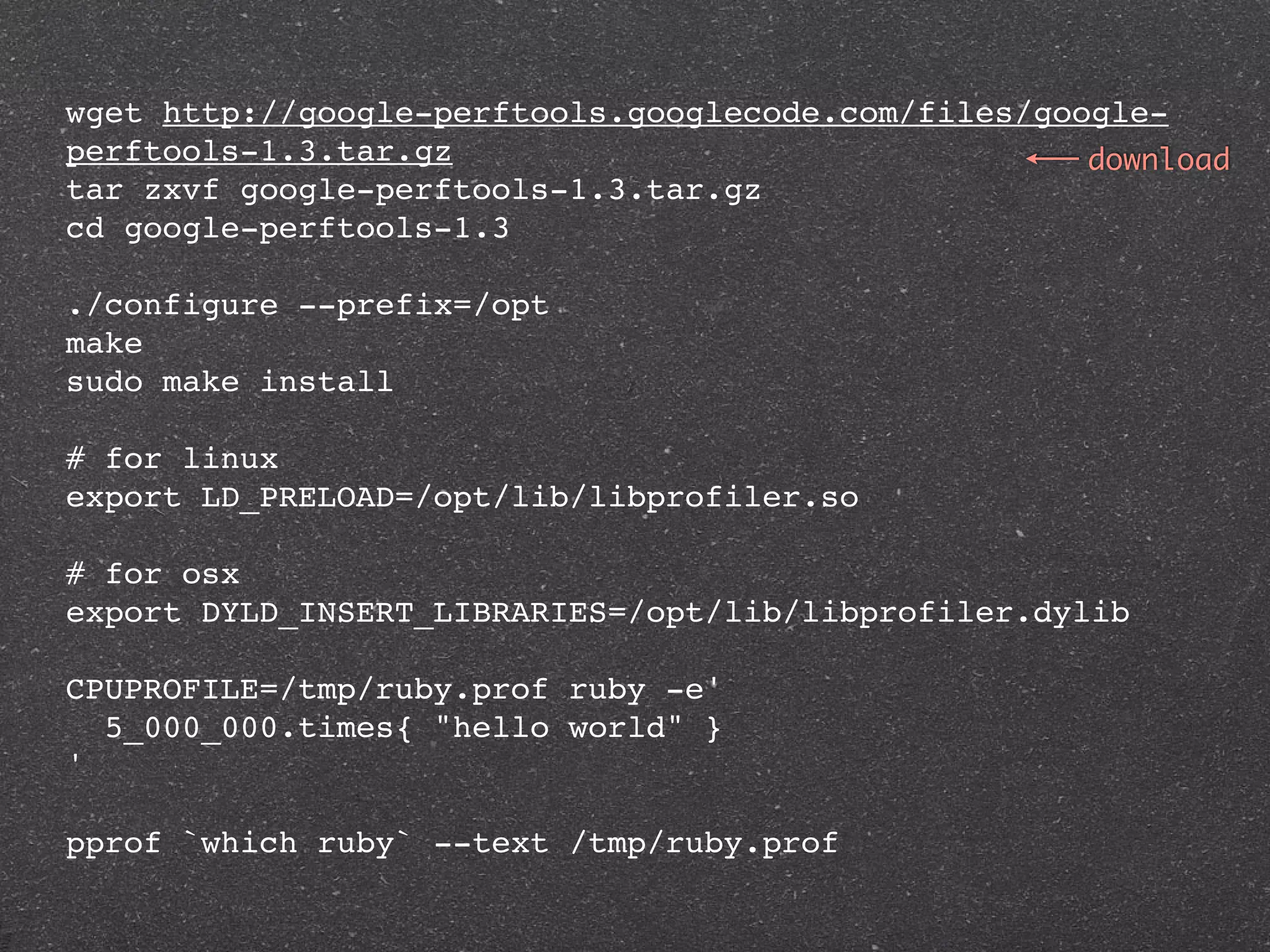
wget http://google-perftools.googlecode.com/files/google-
perftools-1.3.tar.gz                                 download
tar zxvf google-perftools-1.3.tar.gz
cd google-perftools-1.3

./configure --prefix=/opt
make
sudo make install

# for linux
export LD_PRELOAD=/opt/lib/libprofiler.so

# for osx
export DYLD_INSERT_LIBRARIES=/opt/lib/libprofiler.dylib

CPUPROFILE=/tmp/ruby.prof ruby -e'
  5_000_000.times{ "hello world" }
'

pprof `which ruby` --text /tmp/ruby.prof
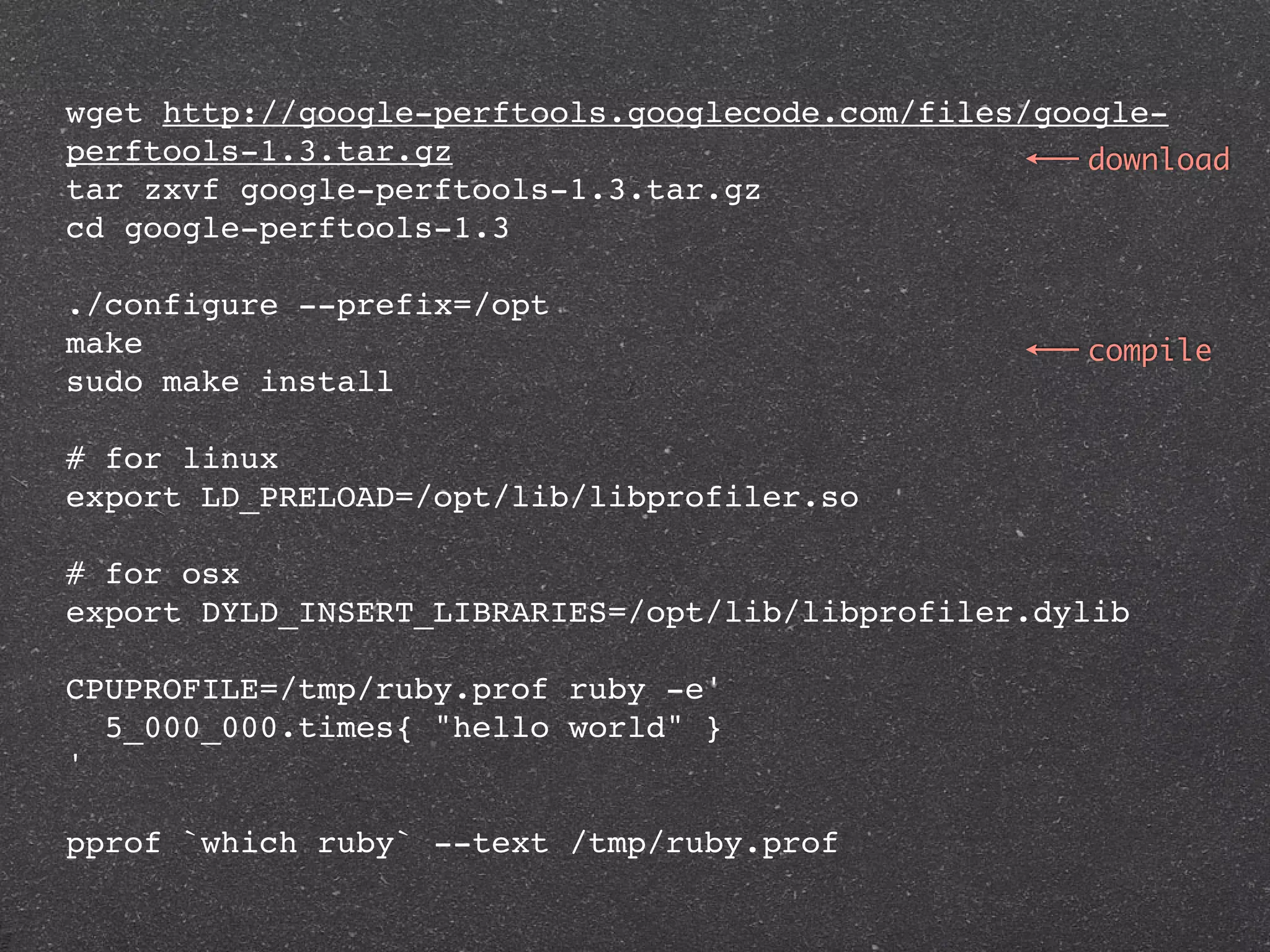
wget http://google-perftools.googlecode.com/files/google-
perftools-1.3.tar.gz                                 download
tar zxvf google-perftools-1.3.tar.gz
cd google-perftools-1.3

./configure --prefix=/opt
make                                                 compile
sudo make install

# for linux
export LD_PRELOAD=/opt/lib/libprofiler.so

# for osx
export DYLD_INSERT_LIBRARIES=/opt/lib/libprofiler.dylib

CPUPROFILE=/tmp/ruby.prof ruby -e'
  5_000_000.times{ "hello world" }
'

pprof `which ruby` --text /tmp/ruby.prof
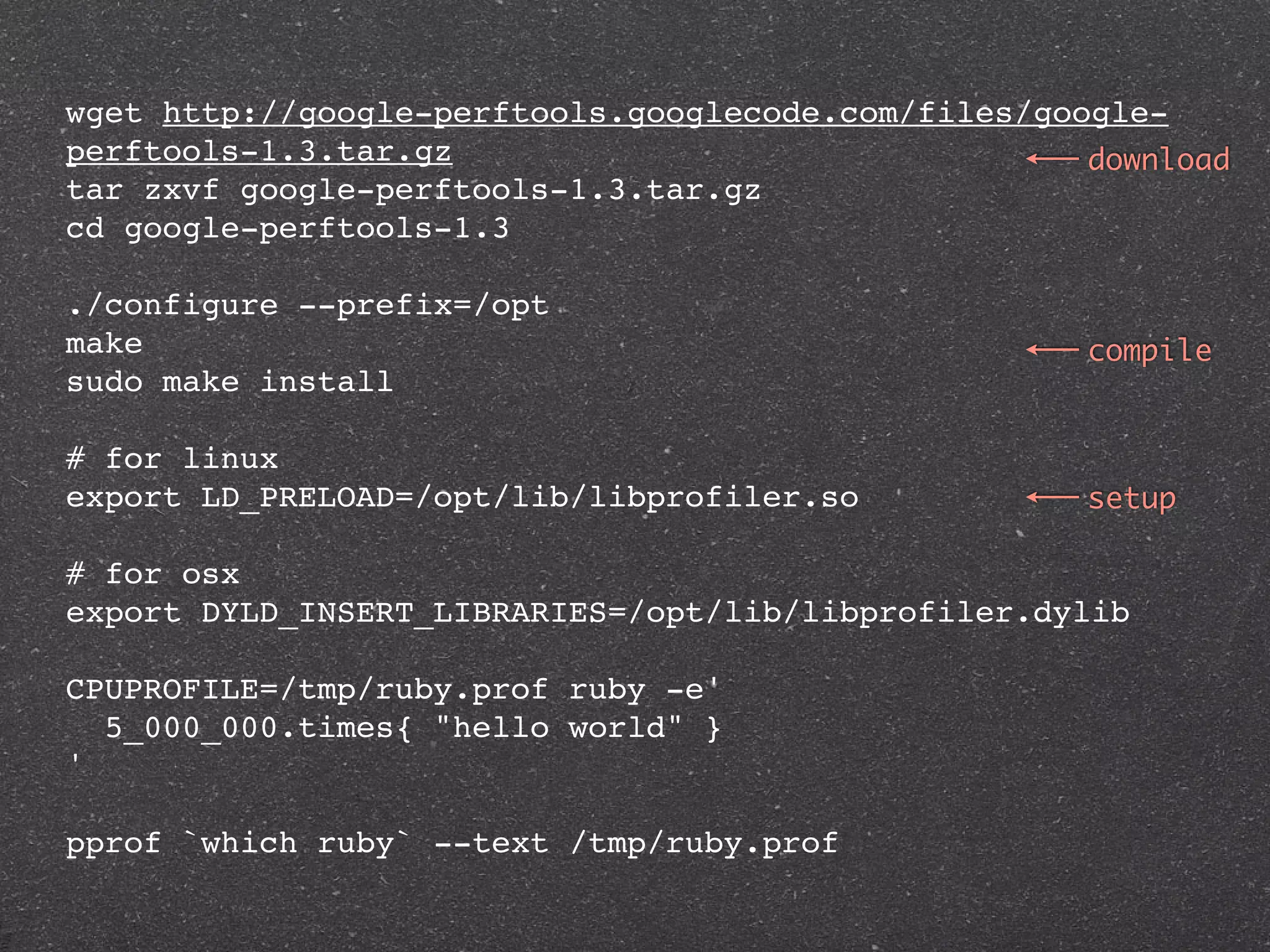
wget http://google-perftools.googlecode.com/files/google-
perftools-1.3.tar.gz                                 download
tar zxvf google-perftools-1.3.tar.gz
cd google-perftools-1.3

./configure --prefix=/opt
make                                                 compile
sudo make install

# for linux
export LD_PRELOAD=/opt/lib/libprofiler.so            setup

# for osx
export DYLD_INSERT_LIBRARIES=/opt/lib/libprofiler.dylib

CPUPROFILE=/tmp/ruby.prof ruby -e'
  5_000_000.times{ "hello world" }
'

pprof `which ruby` --text /tmp/ruby.prof
wget http://google-perftools.googlecode.com/files/google-
perftools-1.3.tar.gz                                 download
tar zxvf google-perftools-1.3.tar.gz
cd google-perftools-1.3

./configure --prefix=/opt
make                                                 compile
sudo make install

# for linux
export LD_PRELOAD=/opt/lib/libprofiler.so            setup

# for osx
export DYLD_INSERT_LIBRARIES=/opt/lib/libprofiler.dylib

CPUPROFILE=/tmp/ruby.prof ruby -e'                   profile
  5_000_000.times{ "hello world" }
'

pprof `which ruby` --text /tmp/ruby.prof
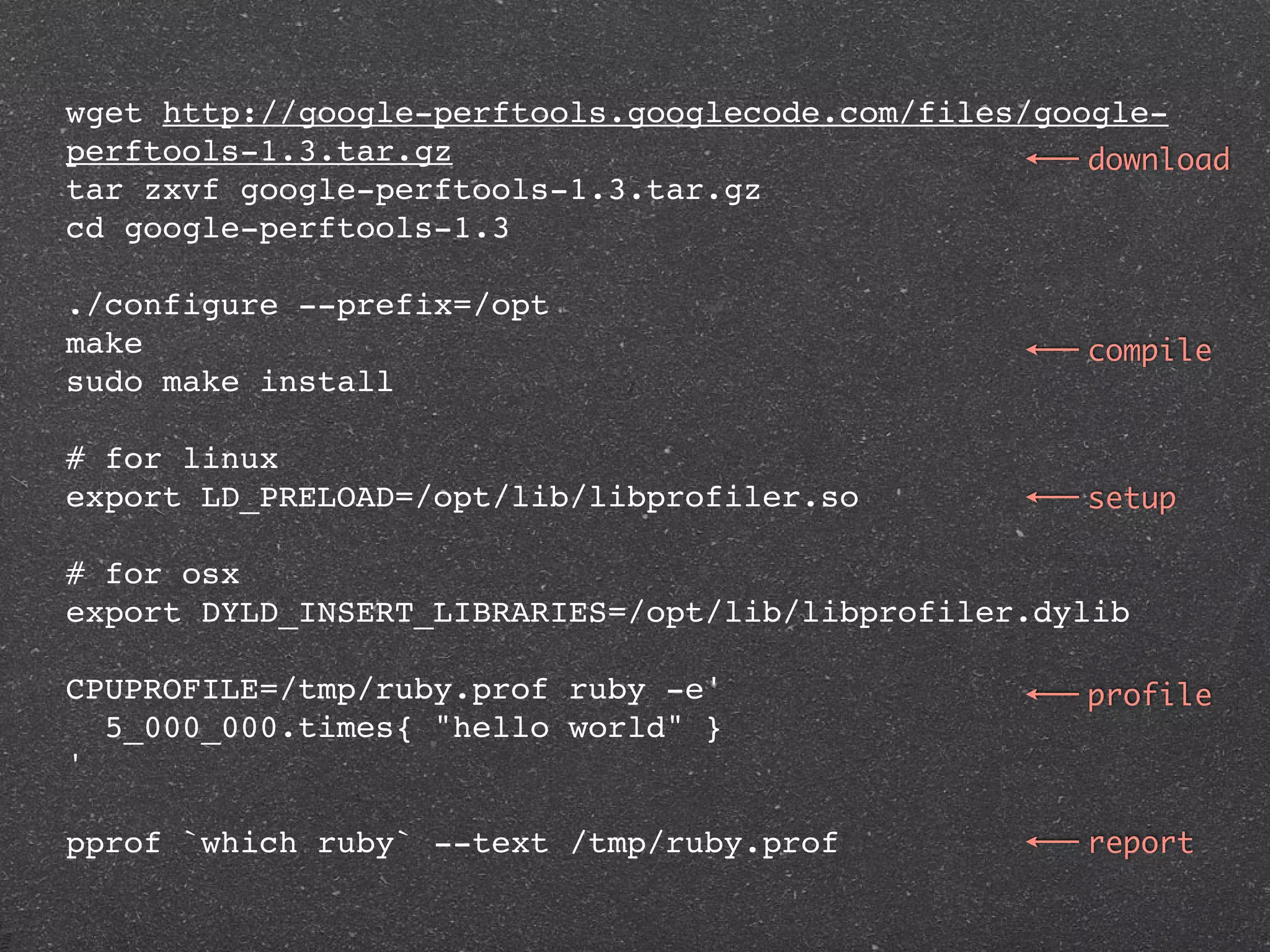
wget http://google-perftools.googlecode.com/files/google-
perftools-1.3.tar.gz                                 download
tar zxvf google-perftools-1.3.tar.gz
cd google-perftools-1.3

./configure --prefix=/opt
make                                                 compile
sudo make install

# for linux
export LD_PRELOAD=/opt/lib/libprofiler.so            setup

# for osx
export DYLD_INSERT_LIBRARIES=/opt/lib/libprofiler.dylib

CPUPROFILE=/tmp/ruby.prof ruby -e'                   profile
  5_000_000.times{ "hello world" }
'

pprof `which ruby` --text /tmp/ruby.prof             report
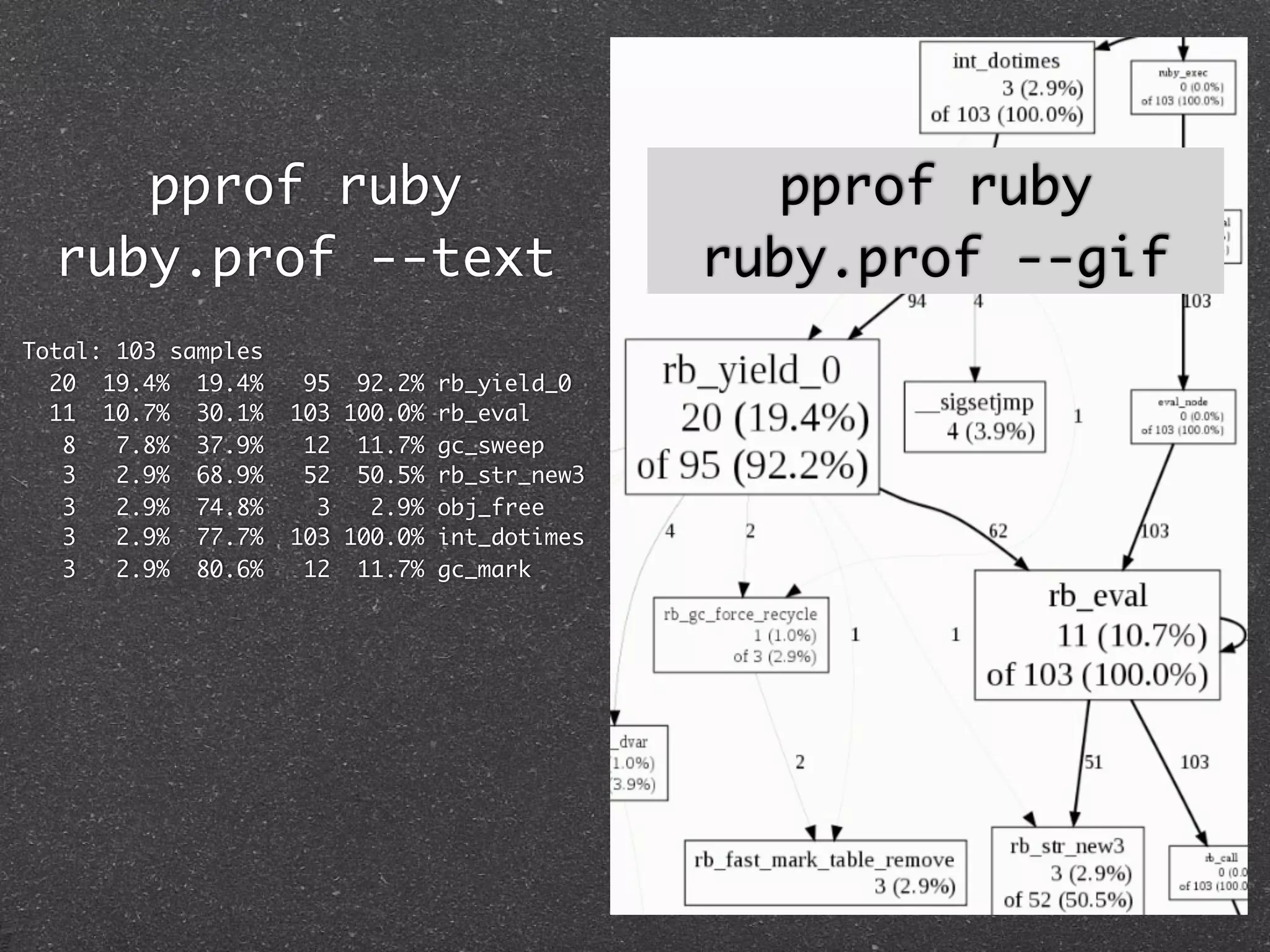
pprof ruby                                  pprof ruby
  ruby.prof --text                            ruby.prof --gif
Total: 103 samples
  20 19.4% 19.4%      95 92.2% rb_yield_0
  11 10.7% 30.1%     103 100.0% rb_eval
   8   7.8% 37.9%     12 11.7% gc_sweep
   3   2.9% 68.9%     52 50.5% rb_str_new3
   3   2.9% 74.8%      3   2.9% obj_free
   3   2.9% 77.7%    103 100.0% int_dotimes
   3   2.9% 80.6%     12 11.7% gc_mark
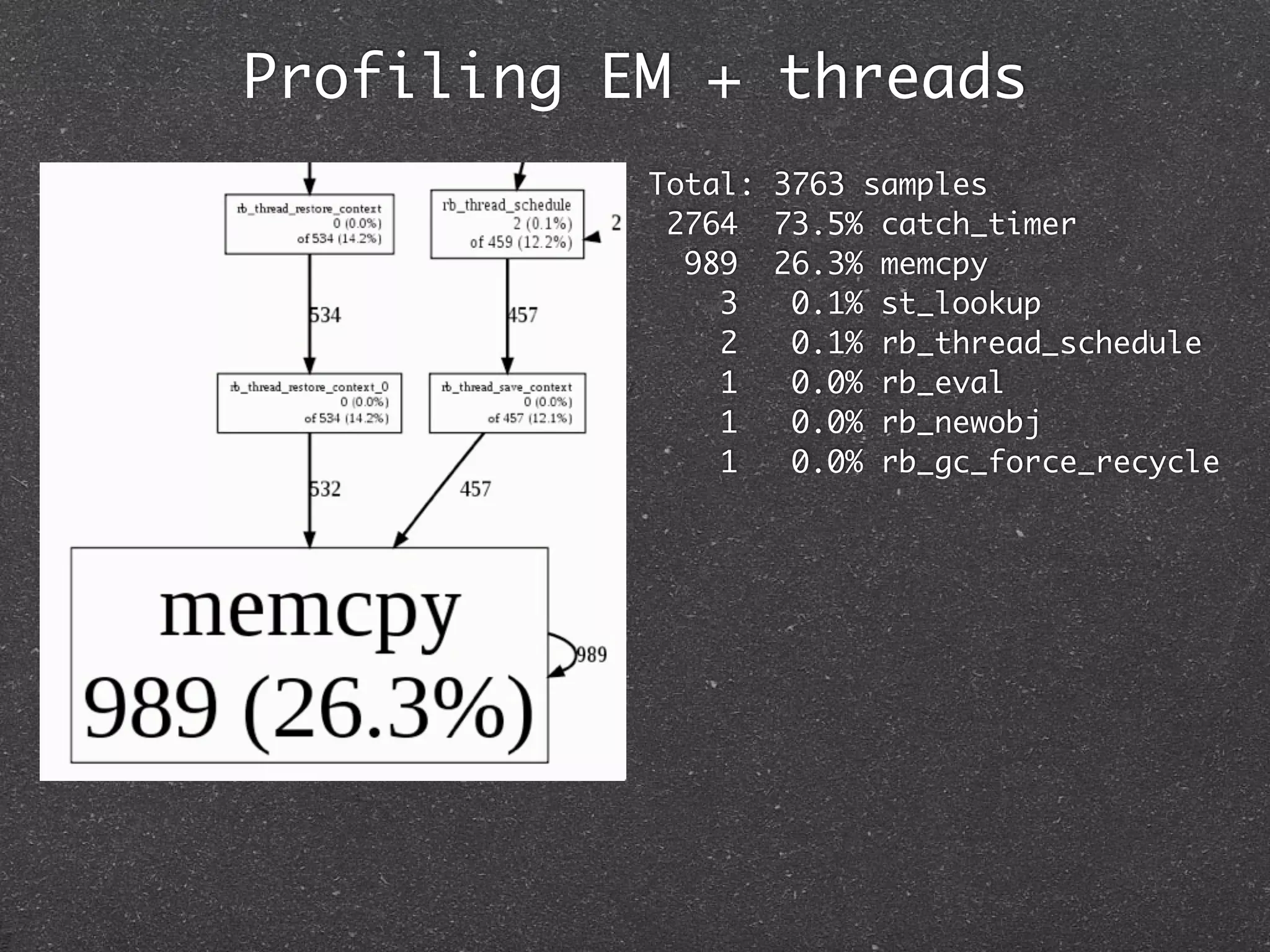
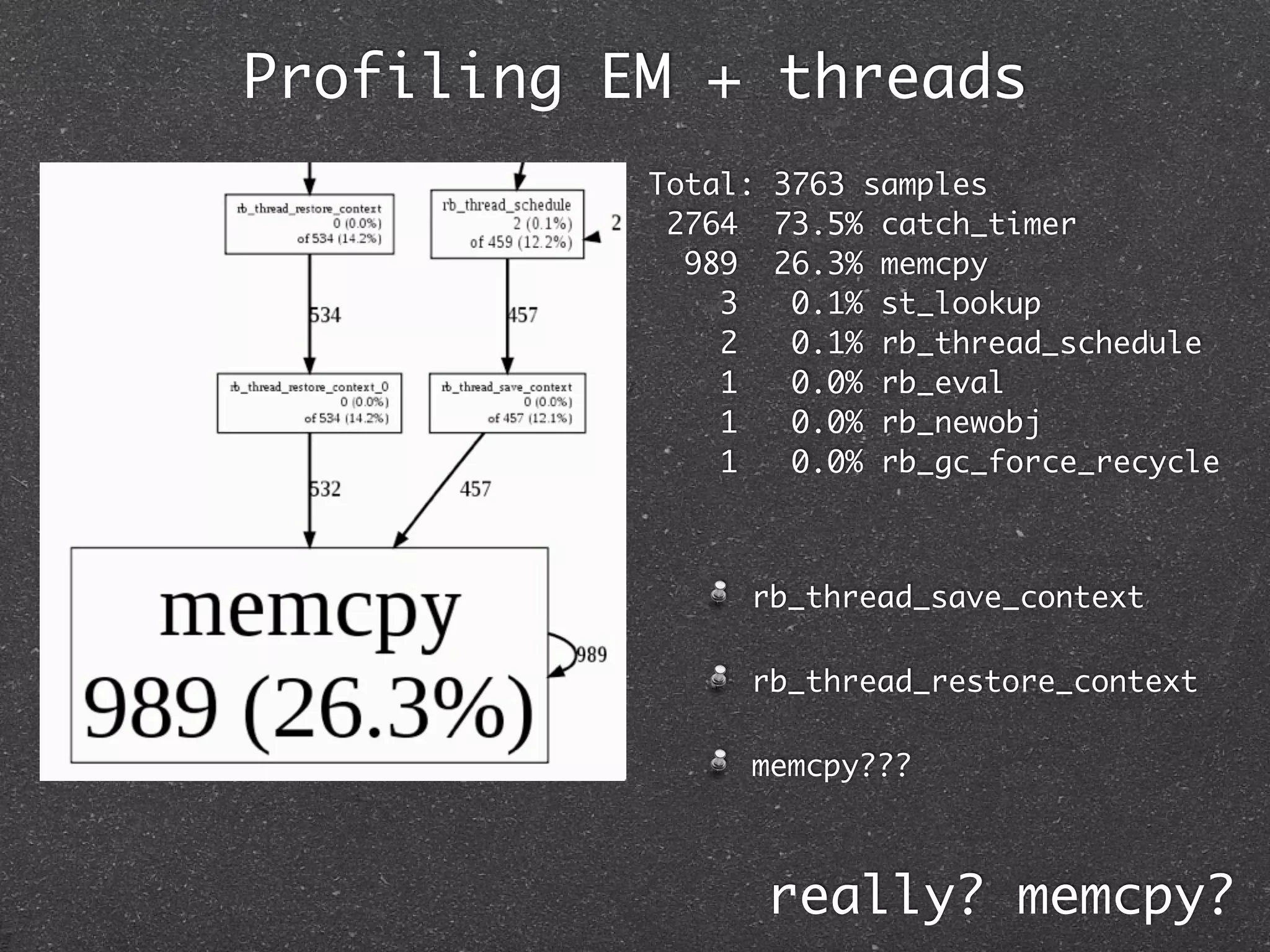
Profiling EM + threads
           Total: 3763 samples
            2764 73.5% catch_timer
             989 26.3% memcpy
               3   0.1% st_lookup
               2   0.1% rb_thread_schedule
               1   0.0% rb_eval
               1   0.0% rb_newobj
               1   0.0% rb_gc_force_recycle
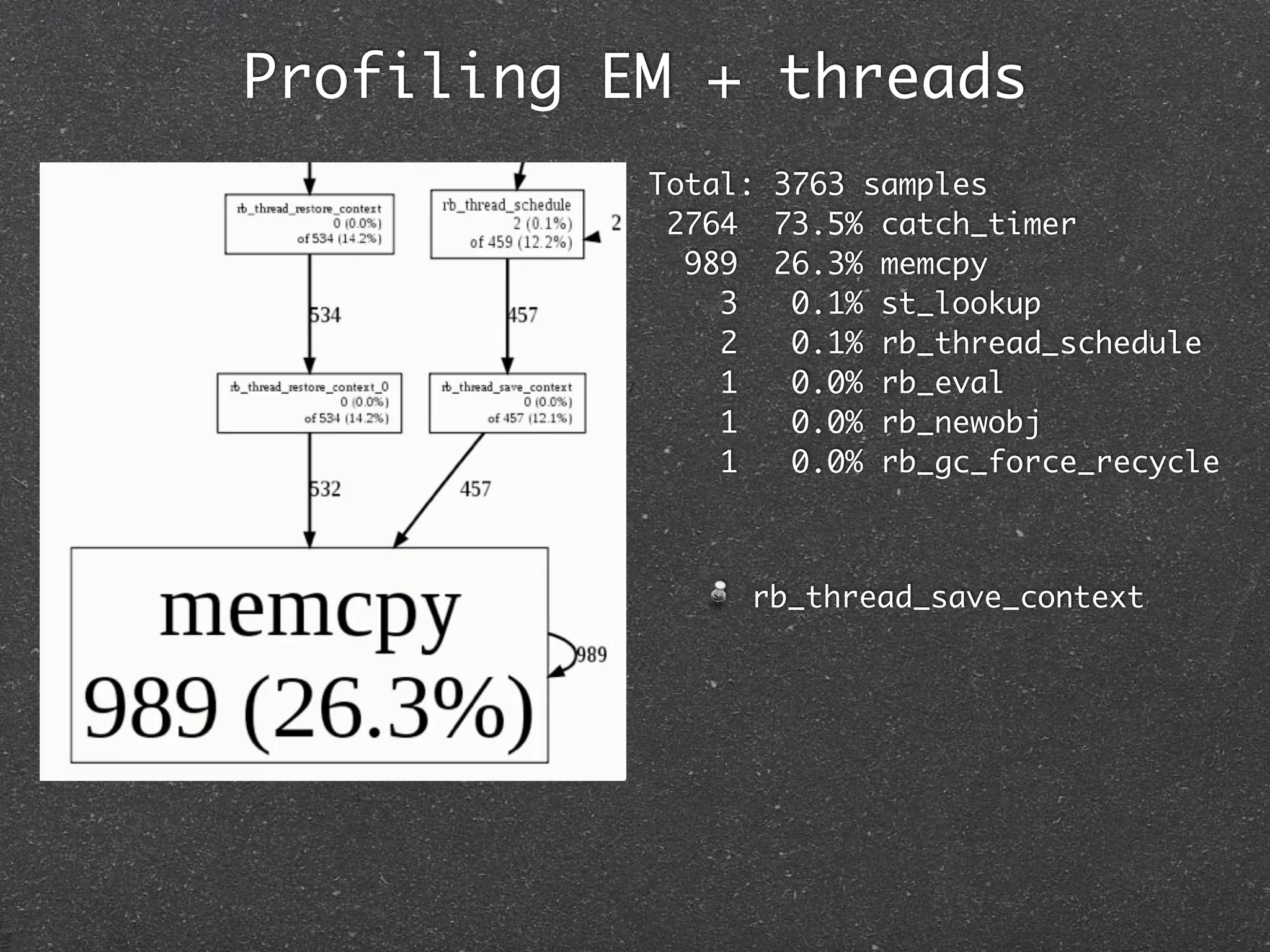
Profiling EM + threads
           Total: 3763 samples
            2764 73.5% catch_timer
             989 26.3% memcpy
               3   0.1% st_lookup
               2   0.1% rb_thread_schedule
               1   0.0% rb_eval
               1   0.0% rb_newobj
               1   0.0% rb_gc_force_recycle


                rb_thread_save_context
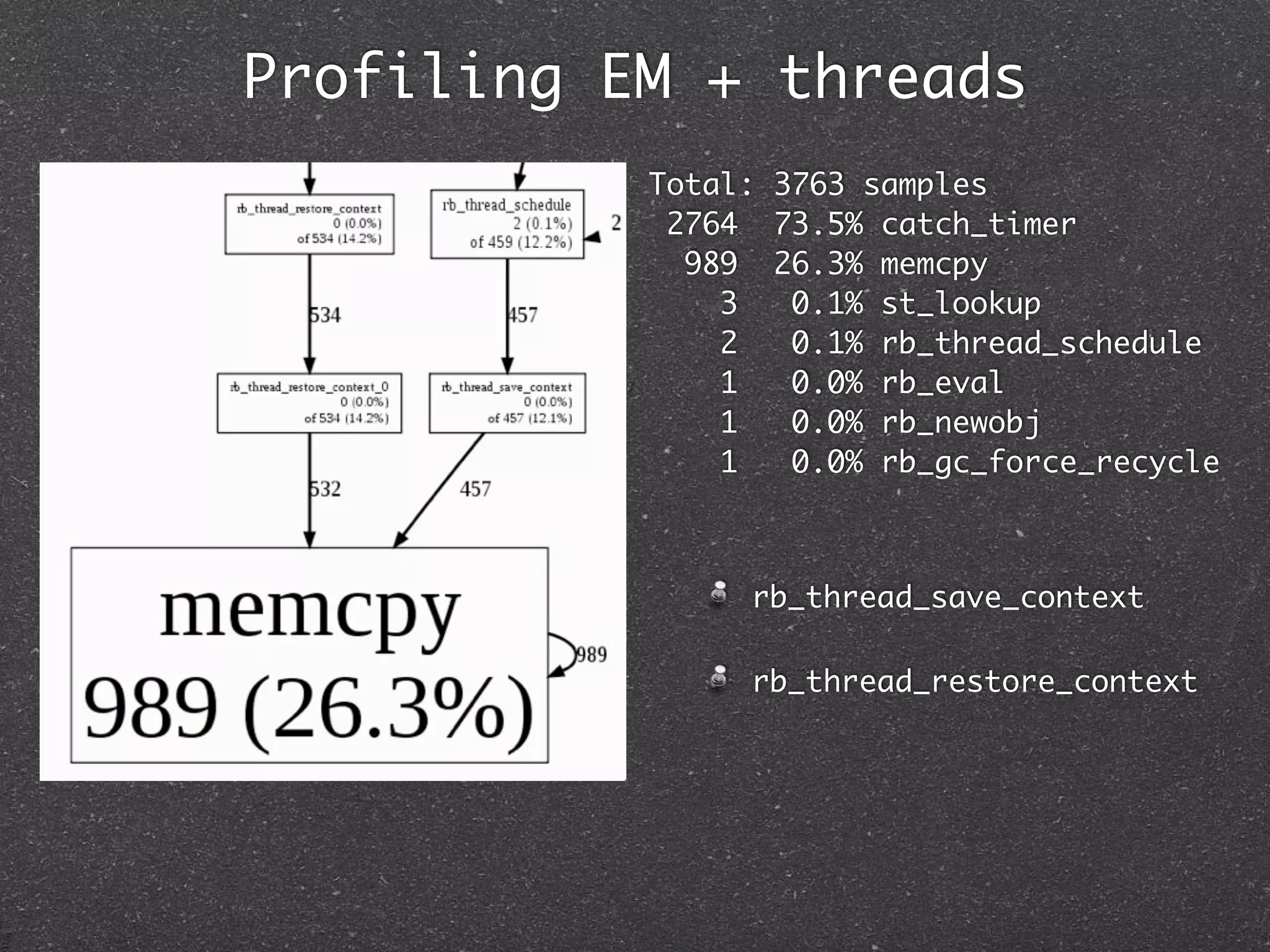
Profiling EM + threads
           Total: 3763 samples
            2764 73.5% catch_timer
             989 26.3% memcpy
               3   0.1% st_lookup
               2   0.1% rb_thread_schedule
               1   0.0% rb_eval
               1   0.0% rb_newobj
               1   0.0% rb_gc_force_recycle


                rb_thread_save_context

                rb_thread_restore_context
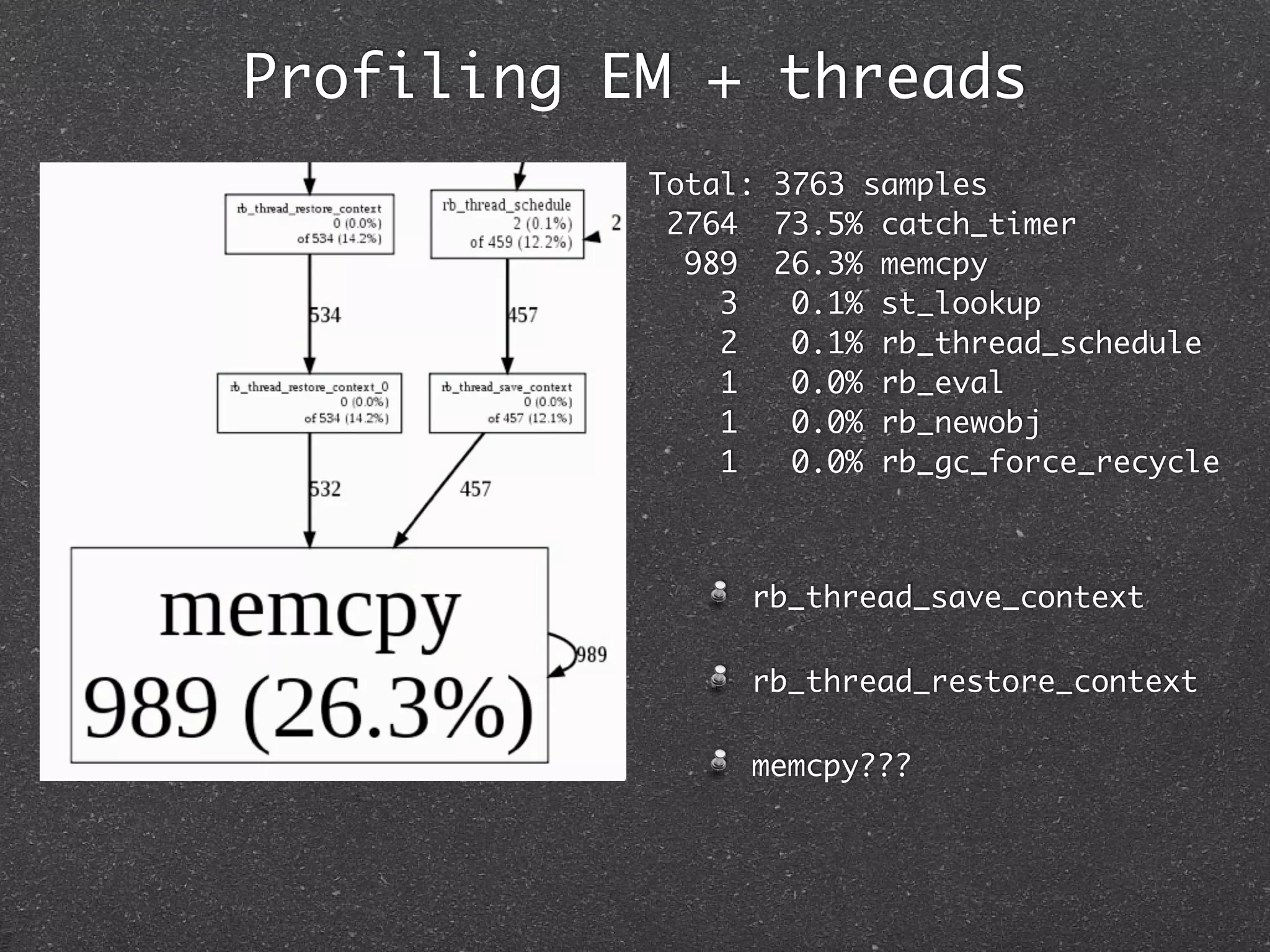
Profiling EM + threads
           Total: 3763 samples
            2764 73.5% catch_timer
             989 26.3% memcpy
               3   0.1% st_lookup
               2   0.1% rb_thread_schedule
               1   0.0% rb_eval
               1   0.0% rb_newobj
               1   0.0% rb_gc_force_recycle


                rb_thread_save_context

                rb_thread_restore_context

                memcpy???
Profiling EM + threads
           Total: 3763 samples
            2764 73.5% catch_timer
             989 26.3% memcpy
               3   0.1% st_lookup
               2   0.1% rb_thread_schedule
               1   0.0% rb_eval
               1   0.0% rb_newobj
               1   0.0% rb_gc_force_recycle


                rb_thread_save_context

                rb_thread_restore_context

                memcpy???


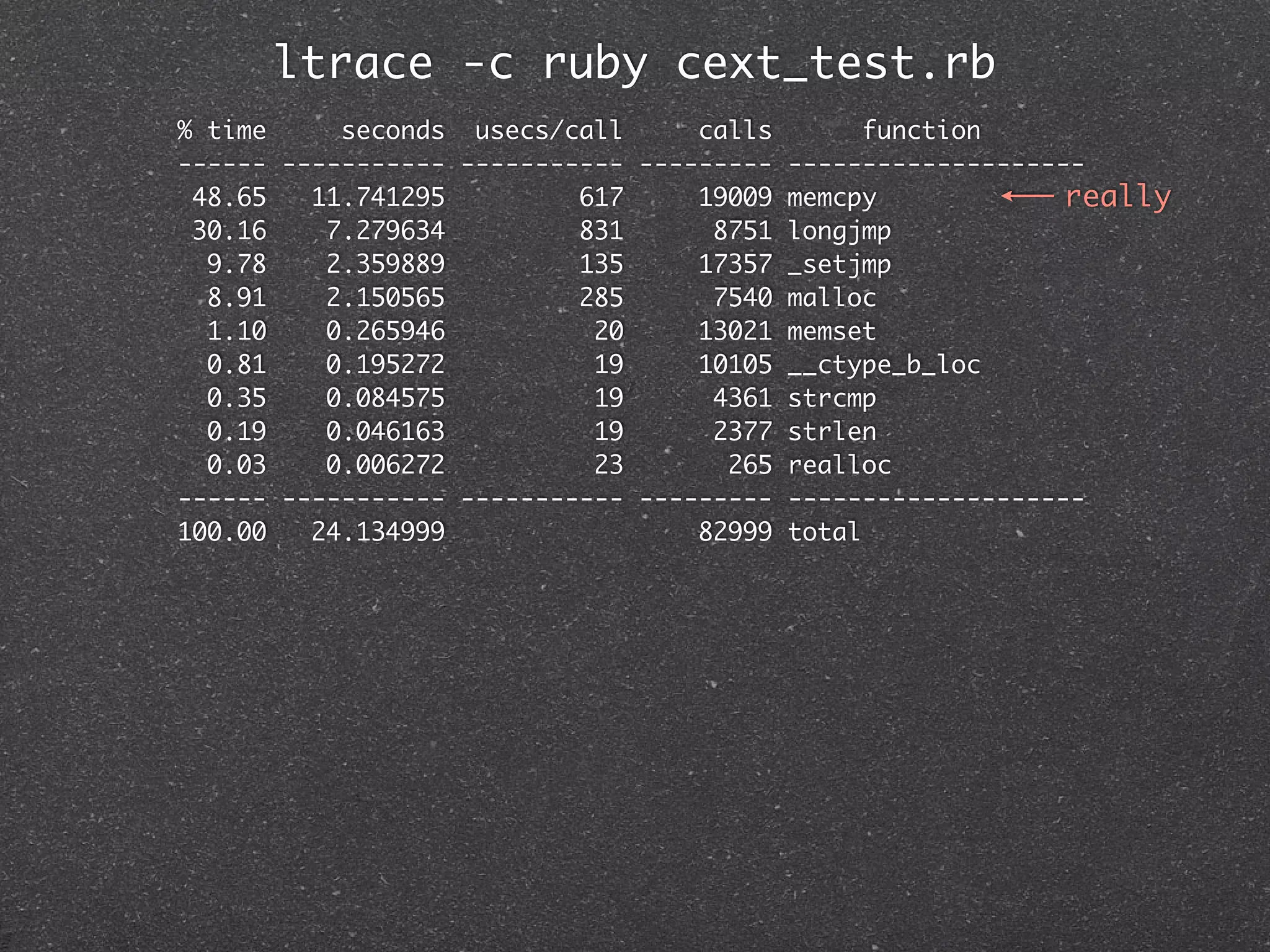
                 really? memcpy?
ltrace
    trace library calls


      ltrace -cp <pid>

ltrace -ttTp <pid> -o <file>
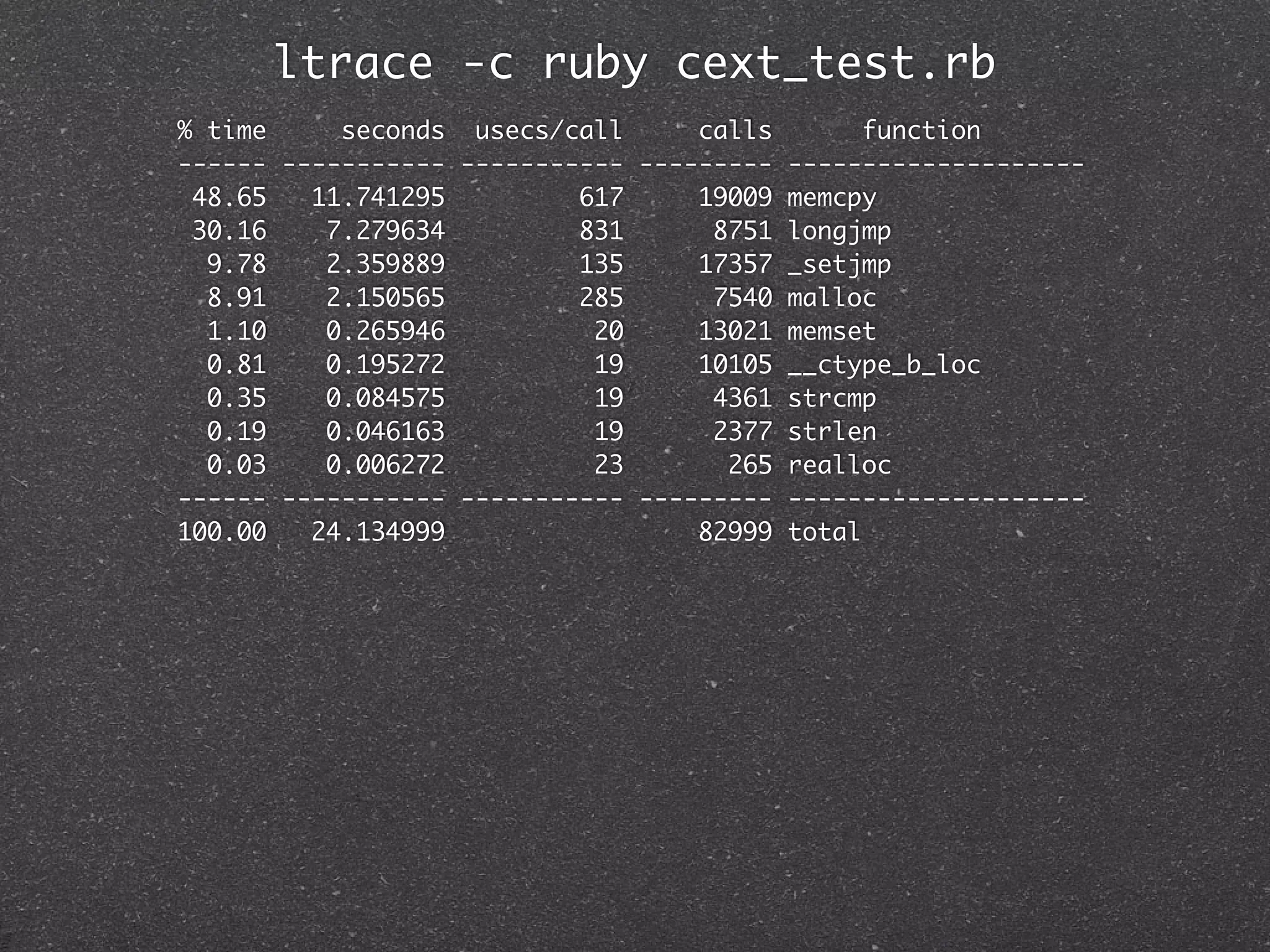
ltrace -c ruby cext_test.rb
% time     seconds usecs/call      calls       function
------ ----------- ----------- --------- --------------------
 48.65   11.741295         617     19009 memcpy
 30.16    7.279634         831      8751 longjmp
  9.78    2.359889         135     17357 _setjmp
  8.91    2.150565         285      7540 malloc
  1.10    0.265946          20     13021 memset
  0.81    0.195272          19     10105 __ctype_b_loc
  0.35    0.084575          19      4361 strcmp
  0.19    0.046163          19      2377 strlen
  0.03    0.006272          23       265 realloc
------ ----------- ----------- --------- --------------------
100.00   24.134999                 82999 total
ltrace -c ruby cext_test.rb
% time     seconds usecs/call      calls       function
------ ----------- ----------- --------- --------------------
 48.65   11.741295         617     19009 memcpy             really
 30.16    7.279634         831      8751 longjmp
  9.78    2.359889         135     17357 _setjmp
  8.91    2.150565         285      7540 malloc
  1.10    0.265946          20     13021 memset
  0.81    0.195272          19     10105 __ctype_b_loc
  0.35    0.084575          19      4361 strcmp
  0.19    0.046163          19      2377 strlen
  0.03    0.006272          23       265 realloc
------ ----------- ----------- --------- --------------------
100.00   24.134999                 82999 total
ltrace -c ruby cext_test.rb
         % time     seconds usecs/call      calls       function
         ------ ----------- ----------- --------- --------------------
          48.65   11.741295         617     19009 memcpy             really
          30.16    7.279634         831      8751 longjmp
           9.78    2.359889         135     17357 _setjmp
           8.91    2.150565         285      7540 malloc
           1.10    0.265946          20     13021 memset
           0.81    0.195272          19     10105 __ctype_b_loc
           0.35    0.084575          19      4361 strcmp
           0.19    0.046163          19      2377 strlen
           0.03    0.006272          23       265 realloc
         ------ ----------- ----------- --------- --------------------
         100.00   24.134999                 82999 total


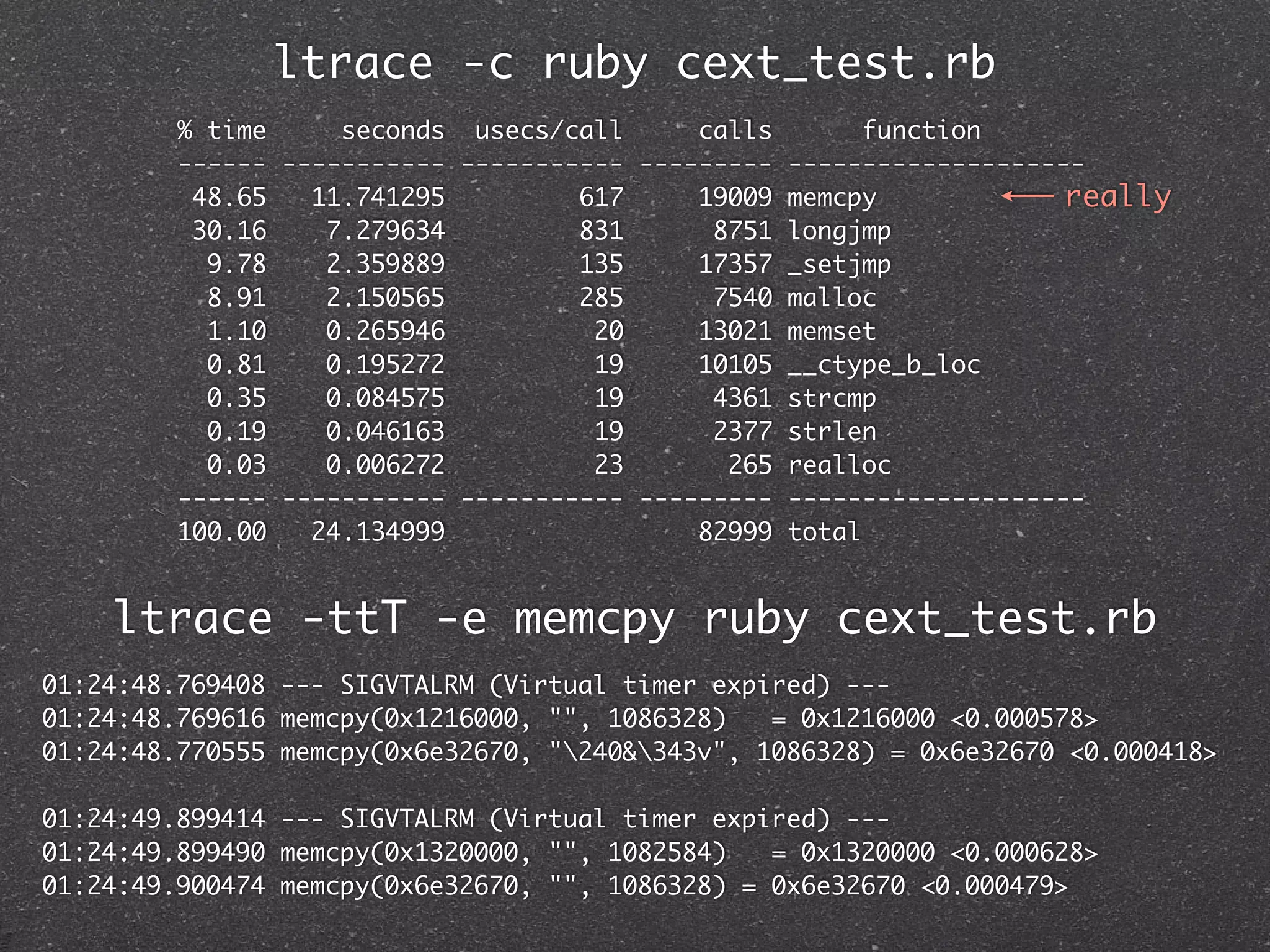
    ltrace -ttT -e memcpy ruby cext_test.rb
01:24:48.769408 --- SIGVTALRM (Virtual timer expired) ---
01:24:48.769616 memcpy(0x1216000, "", 1086328)   = 0x1216000 <0.000578>
01:24:48.770555 memcpy(0x6e32670, "240&343v", 1086328) = 0x6e32670 <0.000418>

01:24:49.899414 --- SIGVTALRM (Virtual timer expired) ---
01:24:49.899490 memcpy(0x1320000, "", 1082584)   = 0x1320000 <0.000628>
01:24:49.900474 memcpy(0x6e32670, "", 1086328) = 0x6e32670 <0.000479>
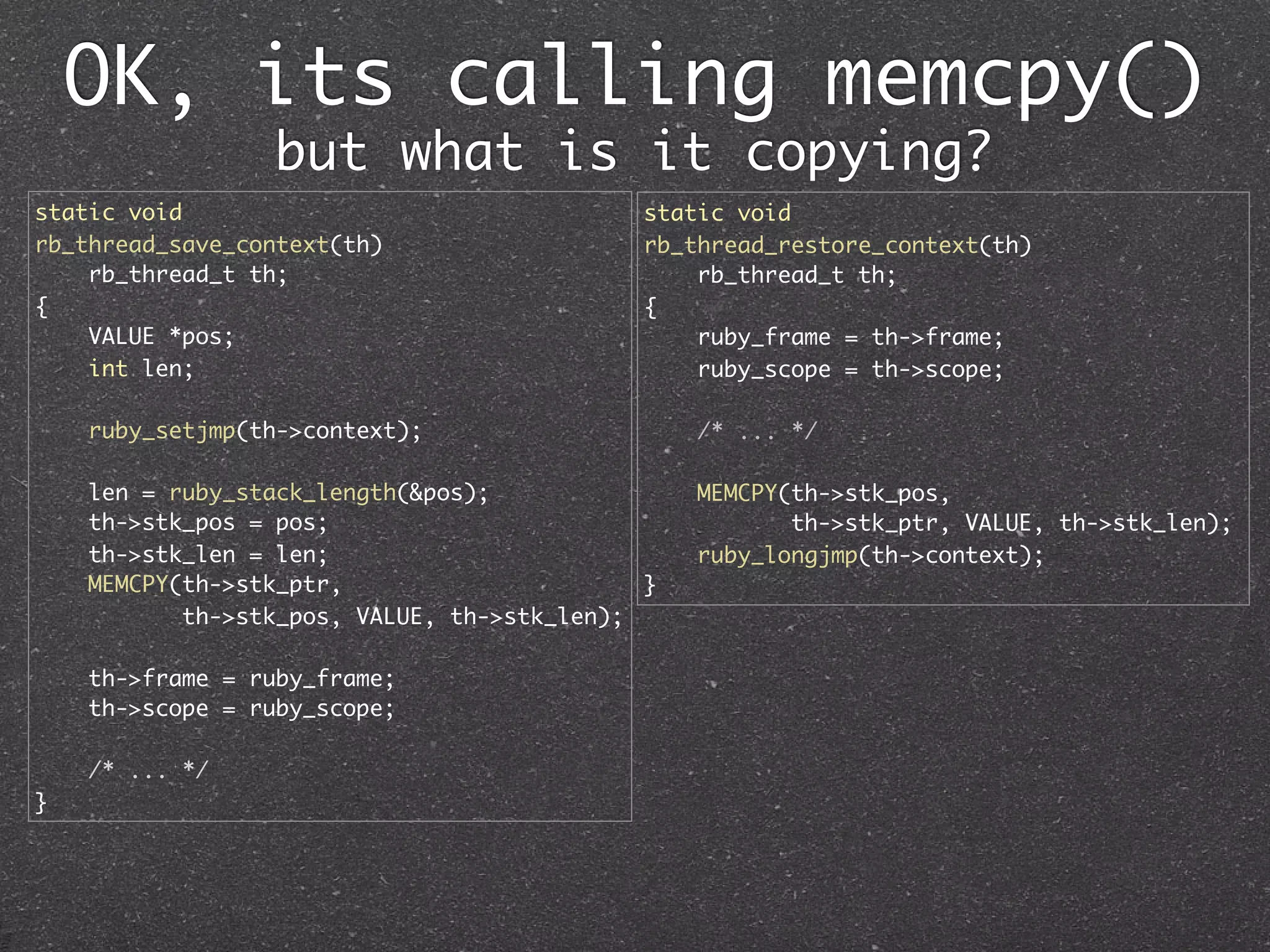
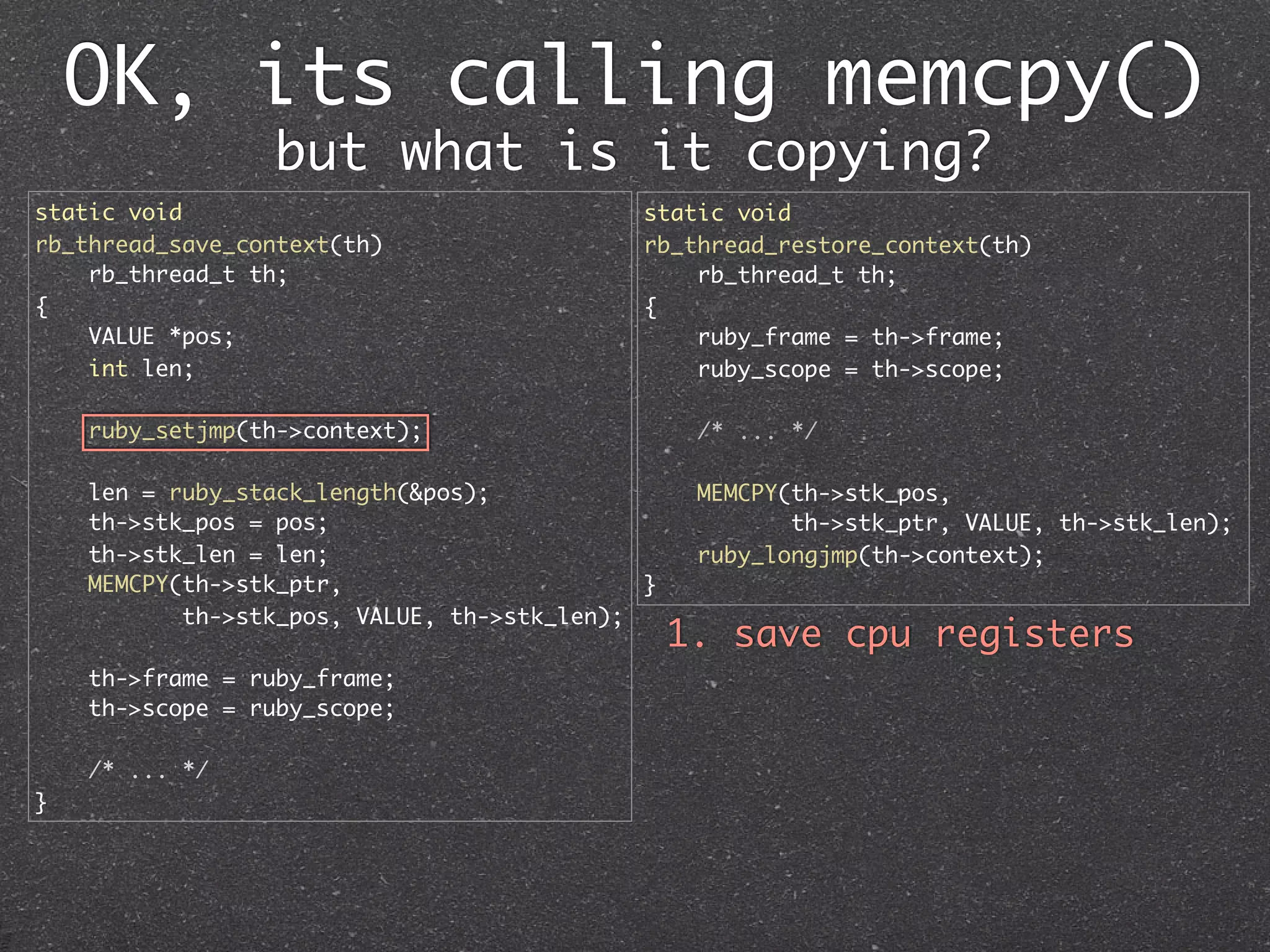
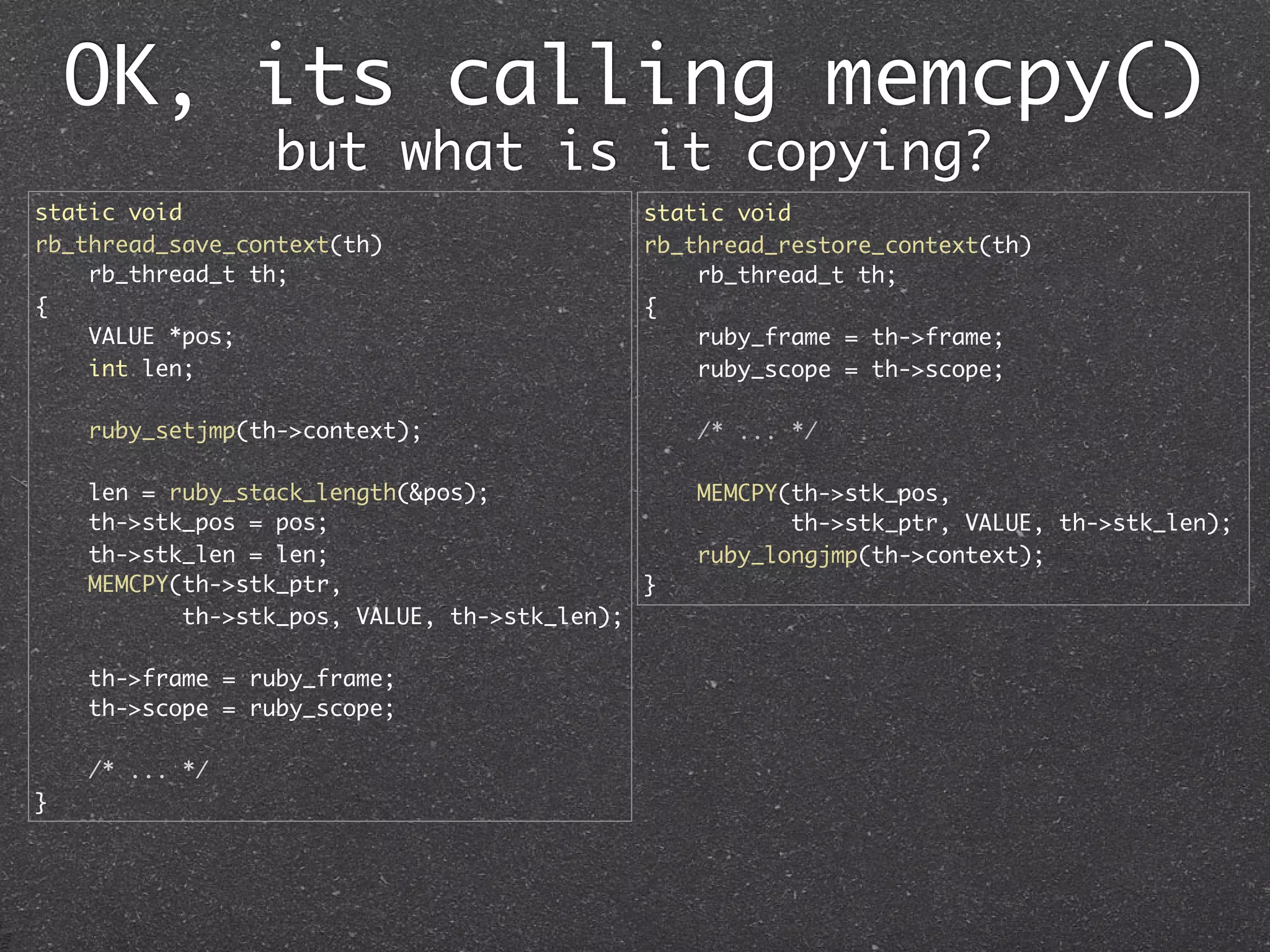
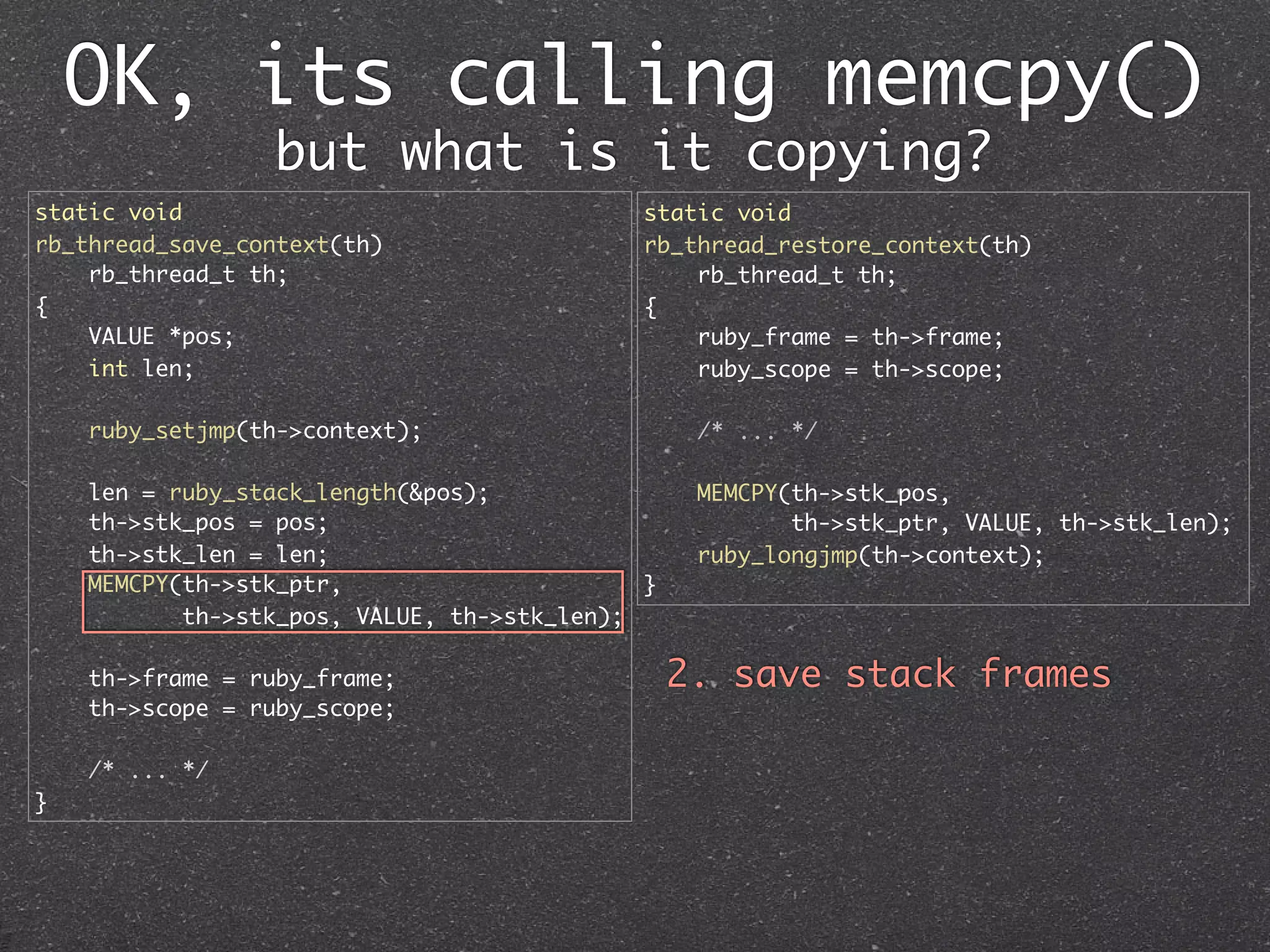
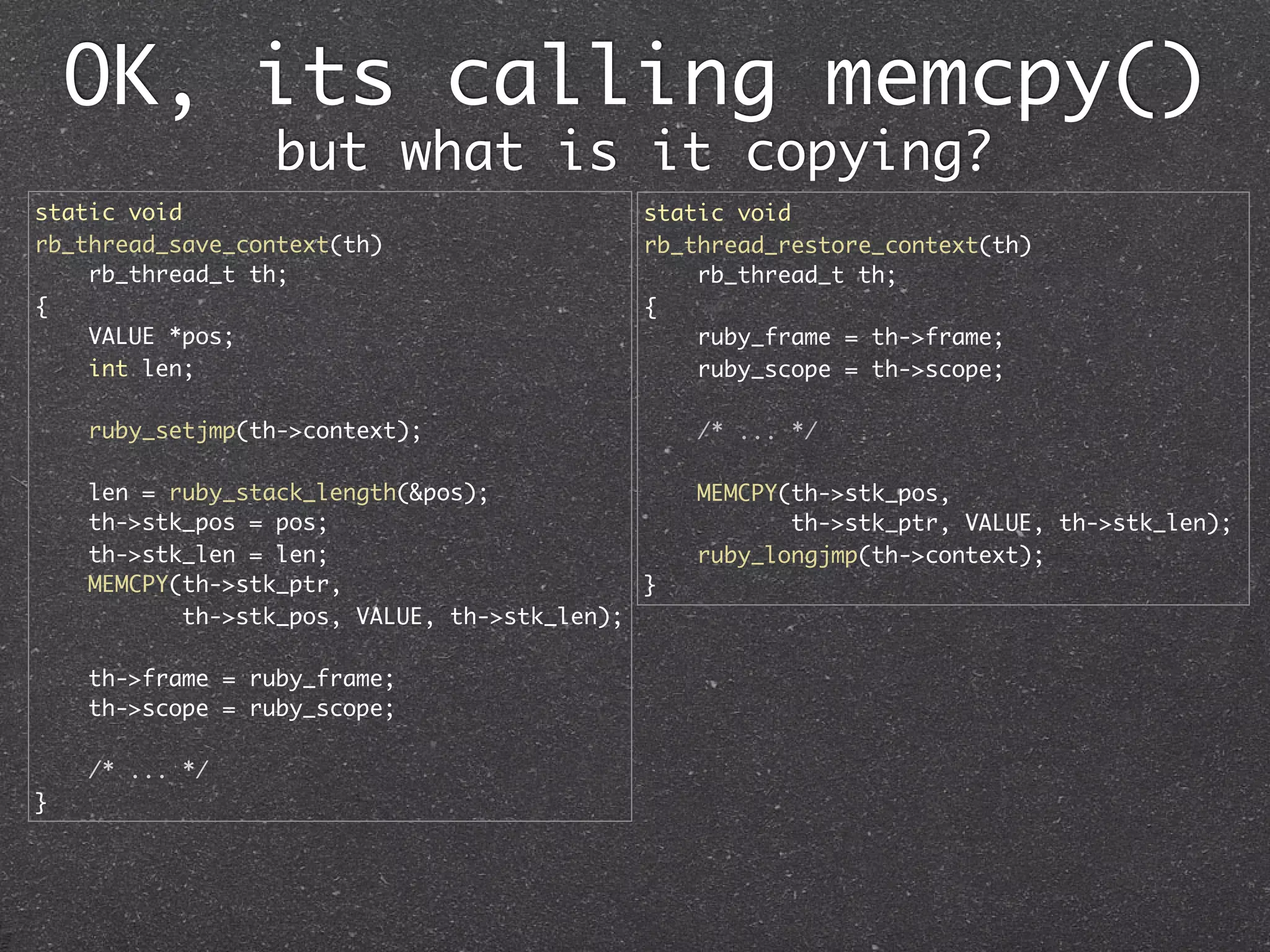
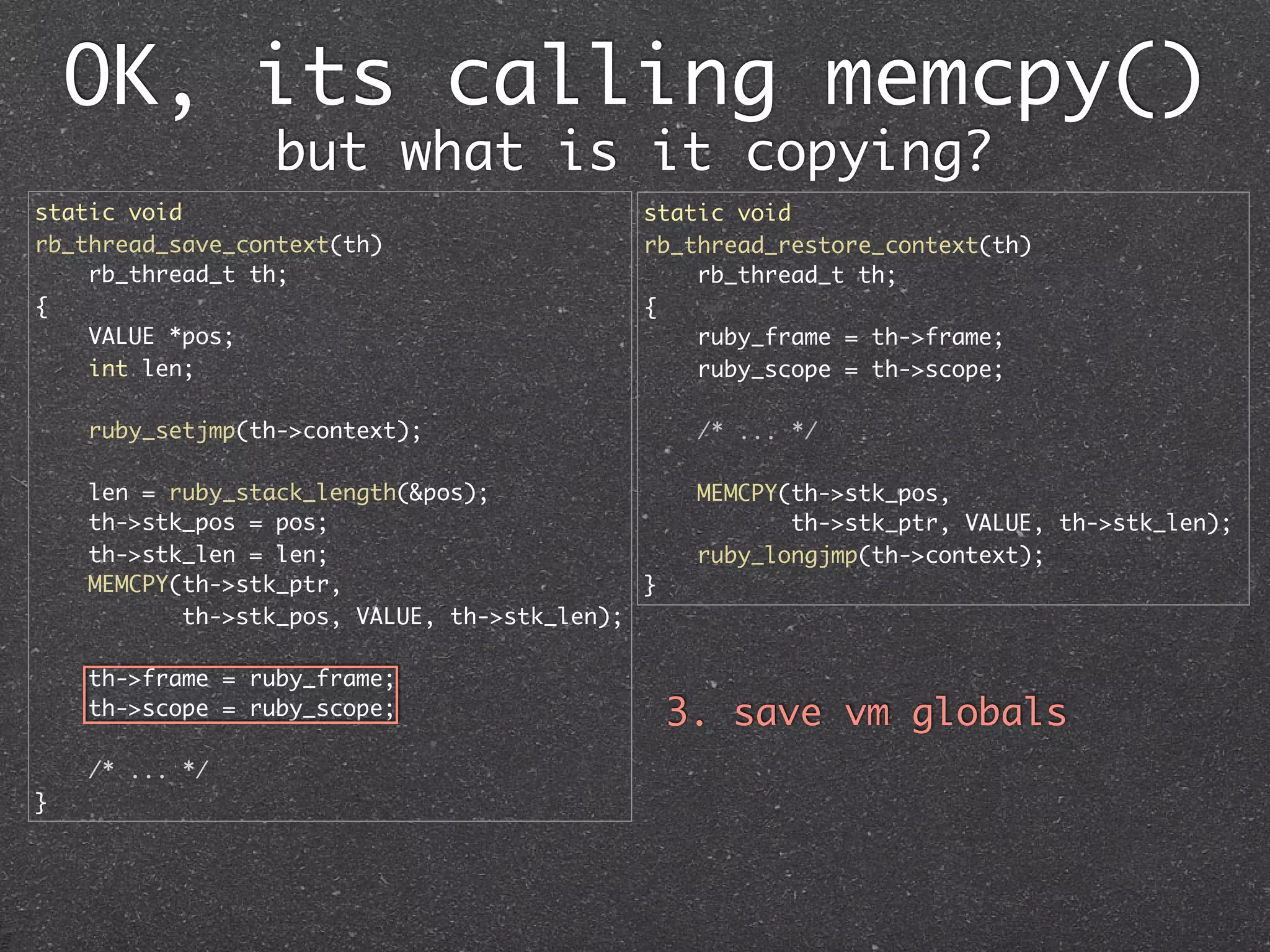
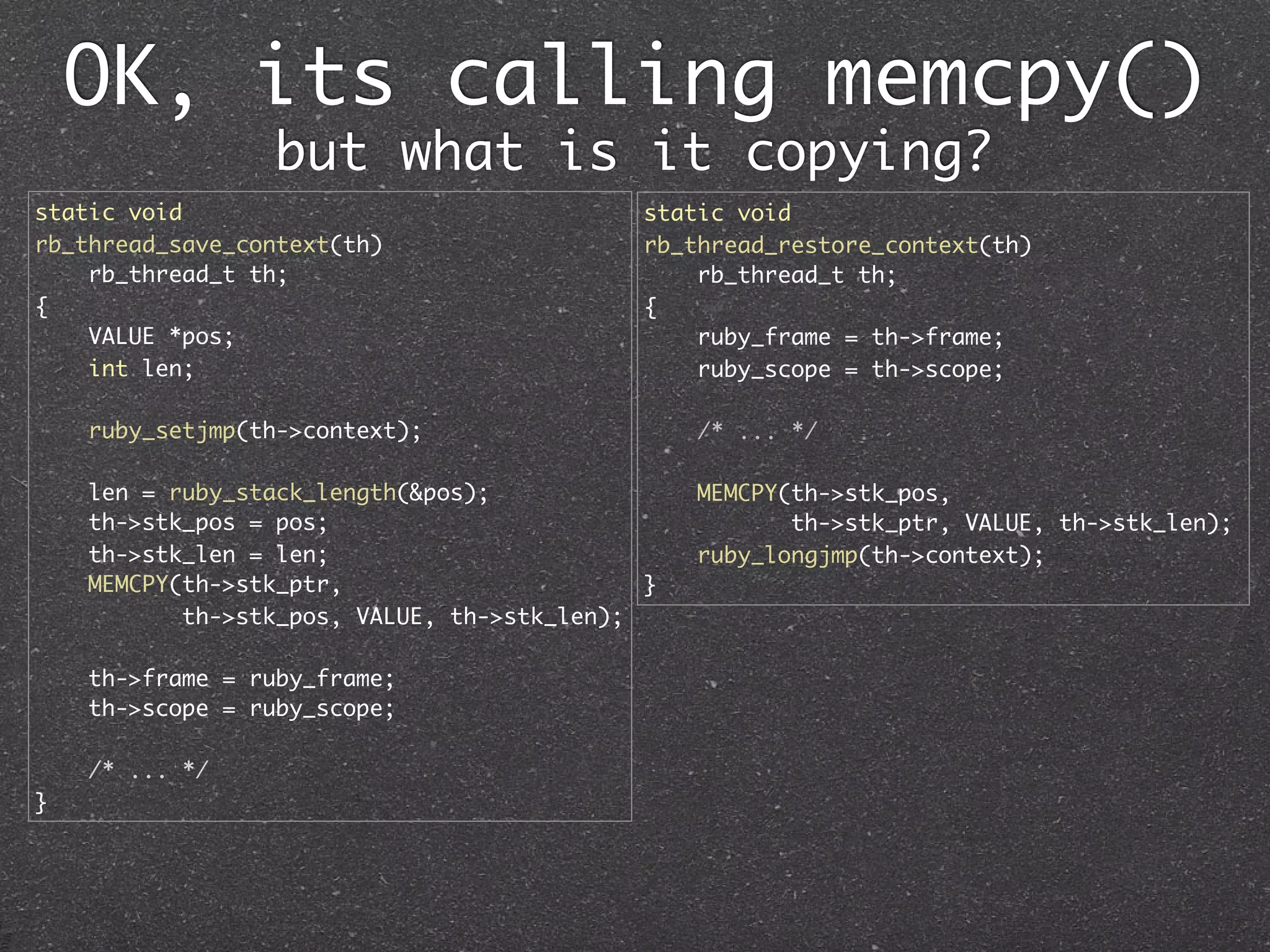
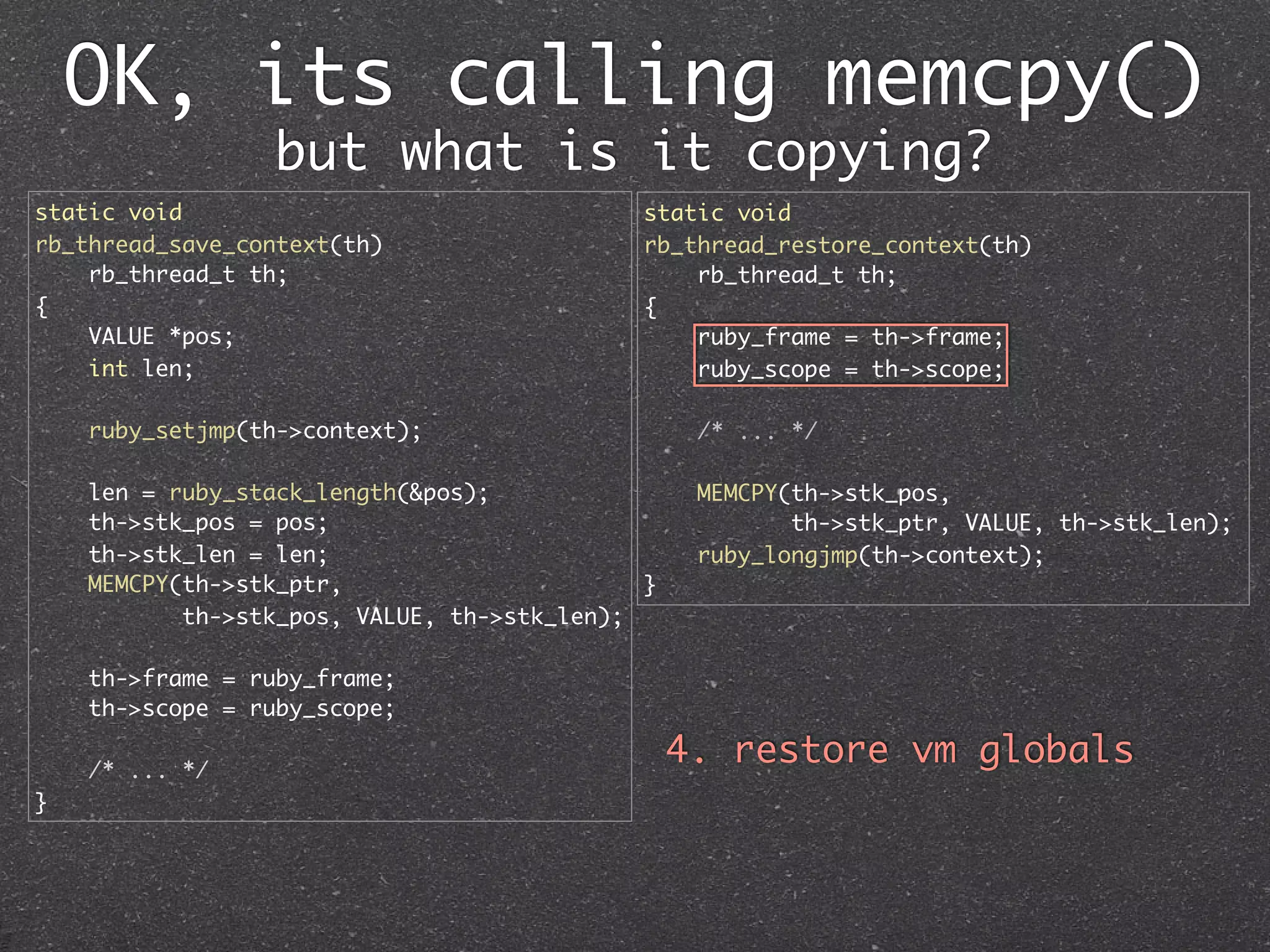
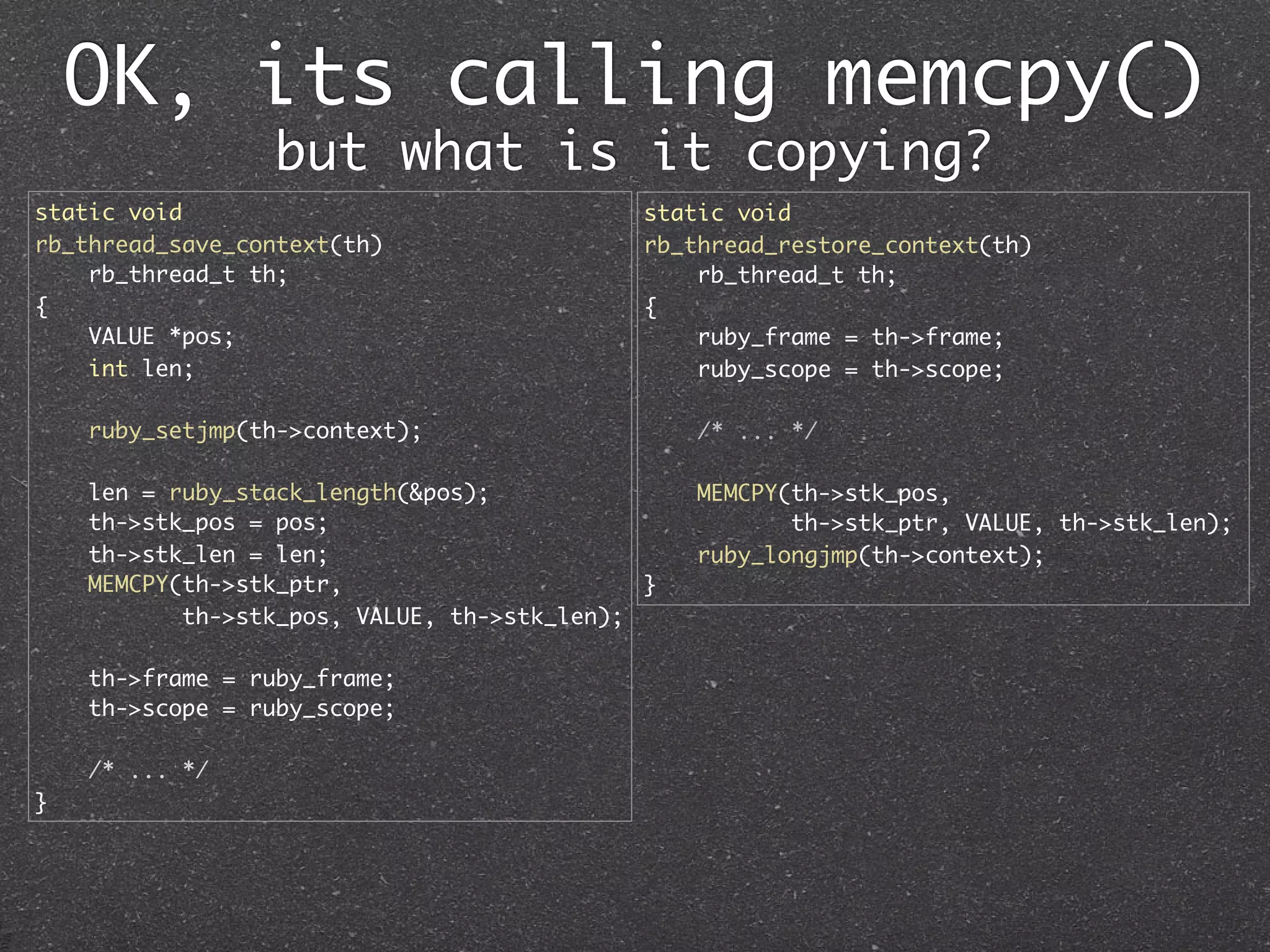
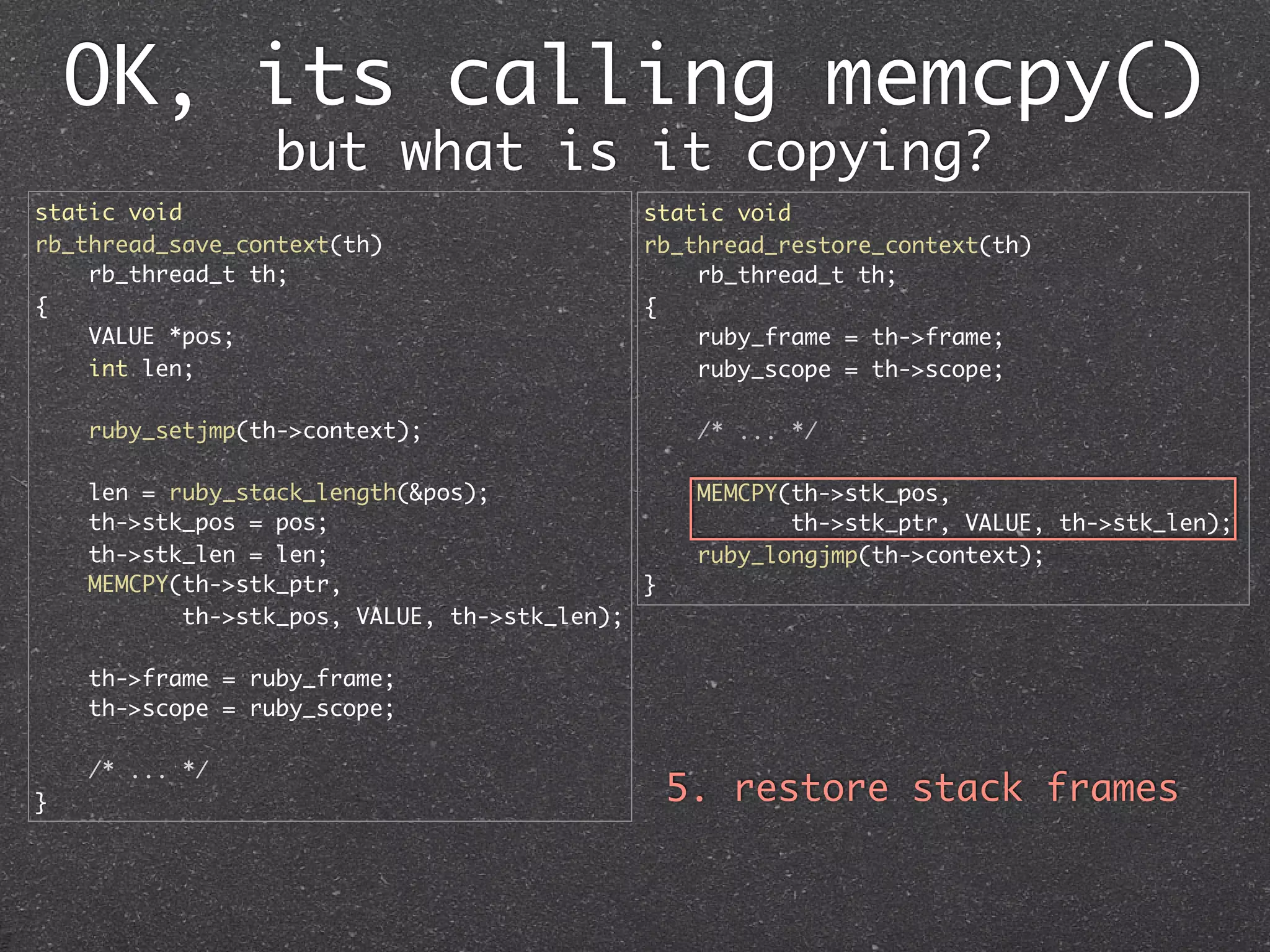
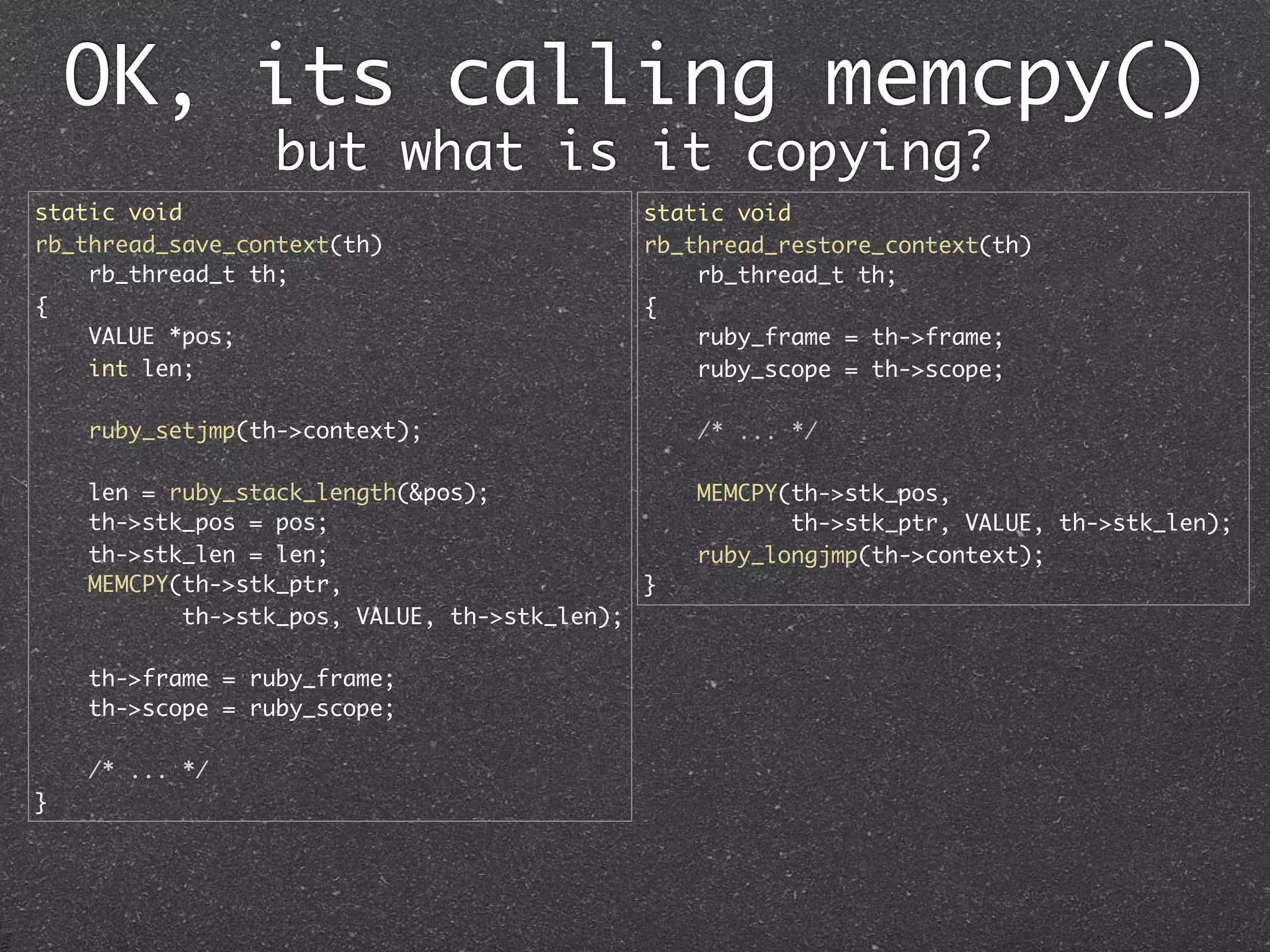
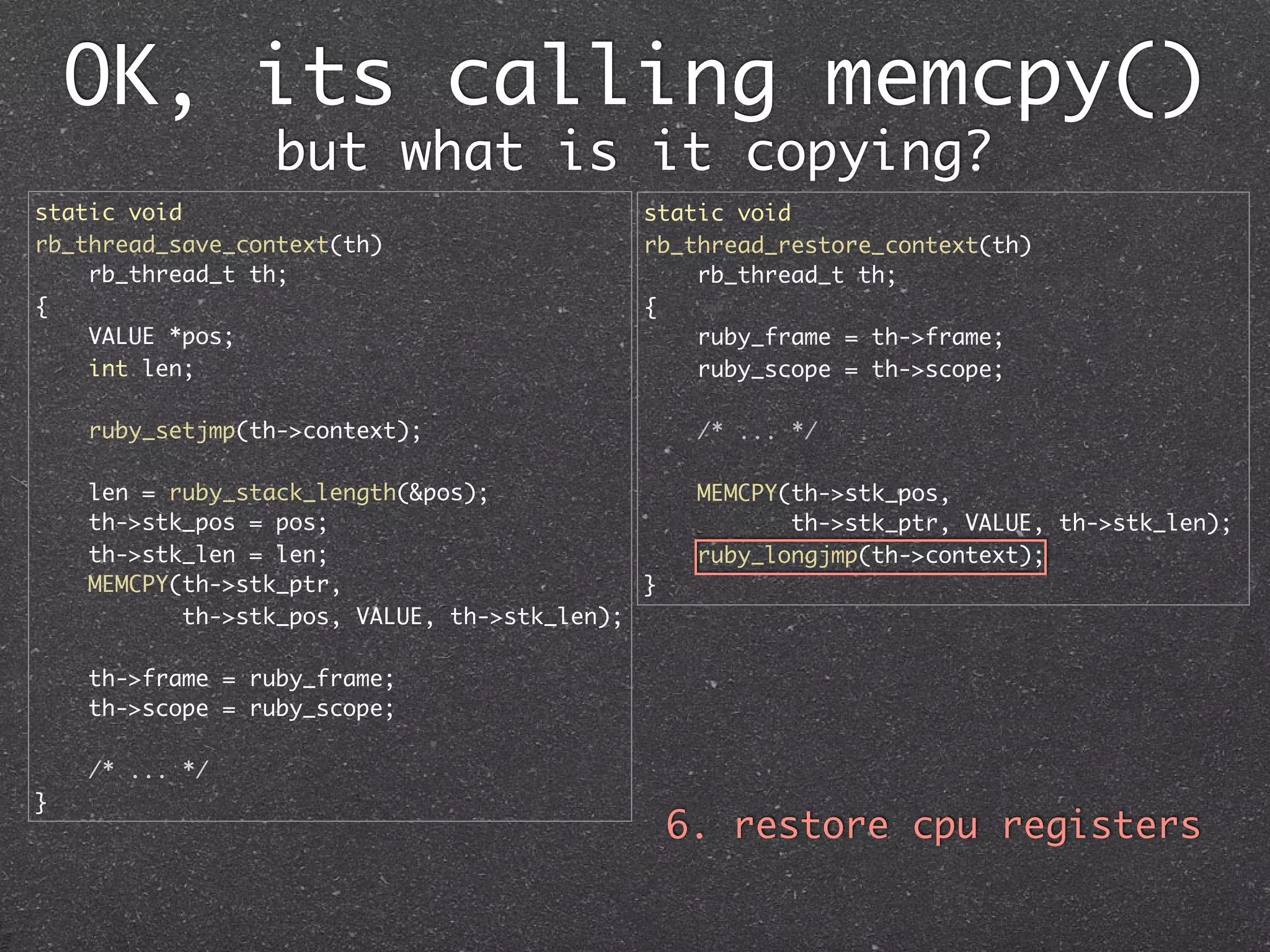
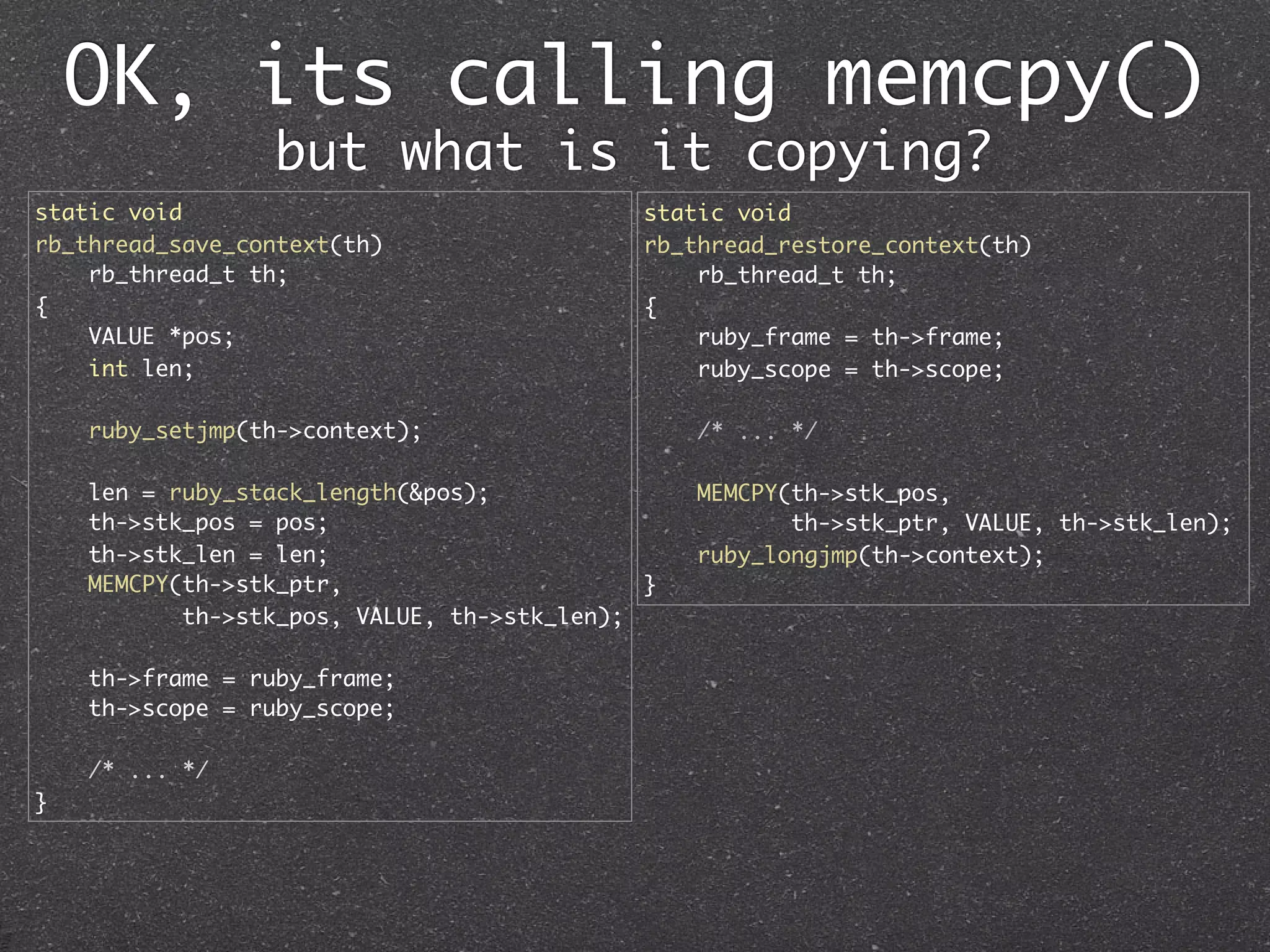
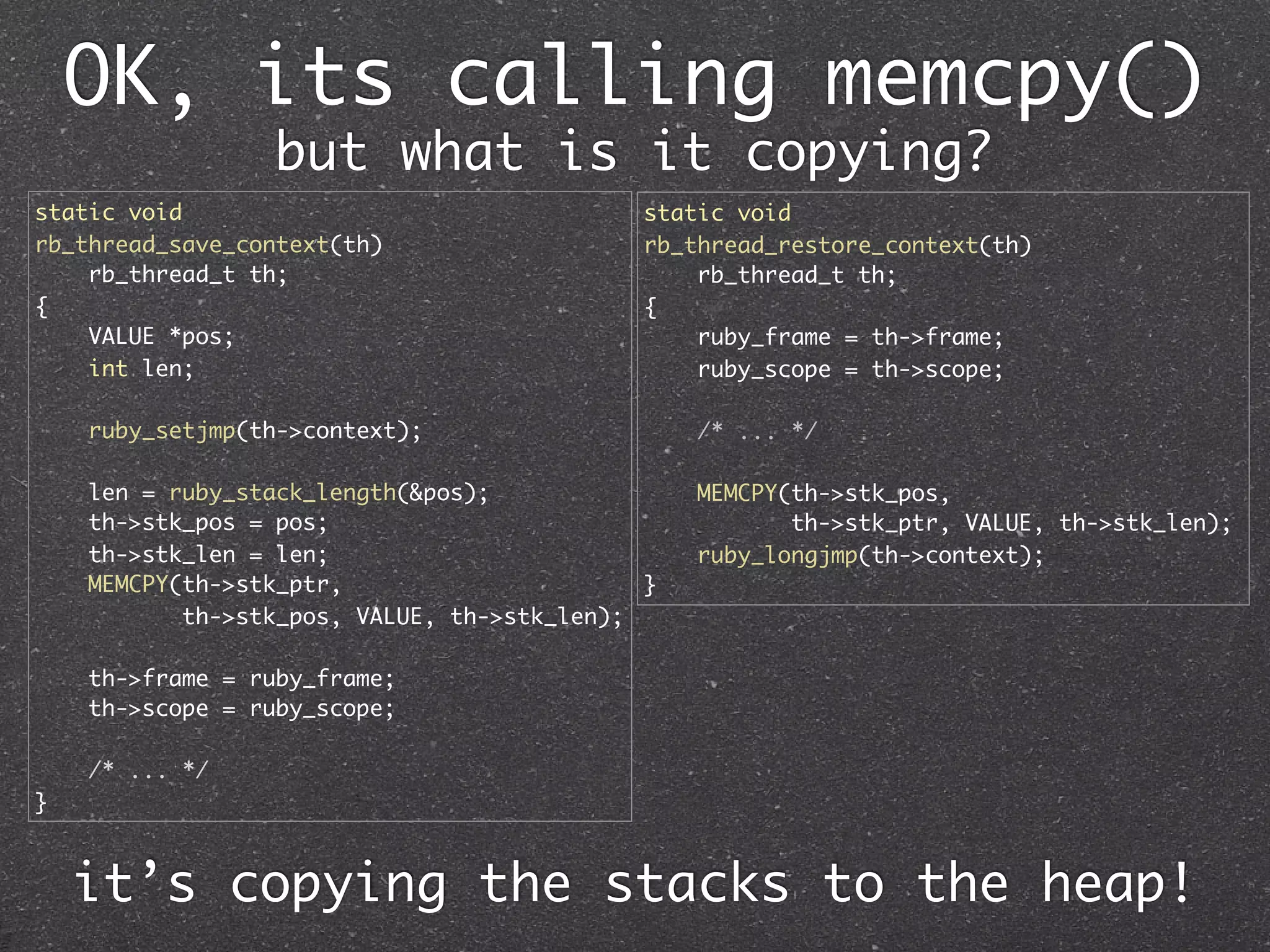
OK, its calling memcpy()
    but what is it copying?
OK, its calling memcpy()
                 but what is it copying?
static void                                  static void
rb_thread_save_context(th)                   rb_thread_restore_context(th)
    rb_thread_t th;                              rb_thread_t th;
{                                            {
    VALUE *pos;                                  ruby_frame = th->frame;
    int len;                                     ruby_scope = th->scope;

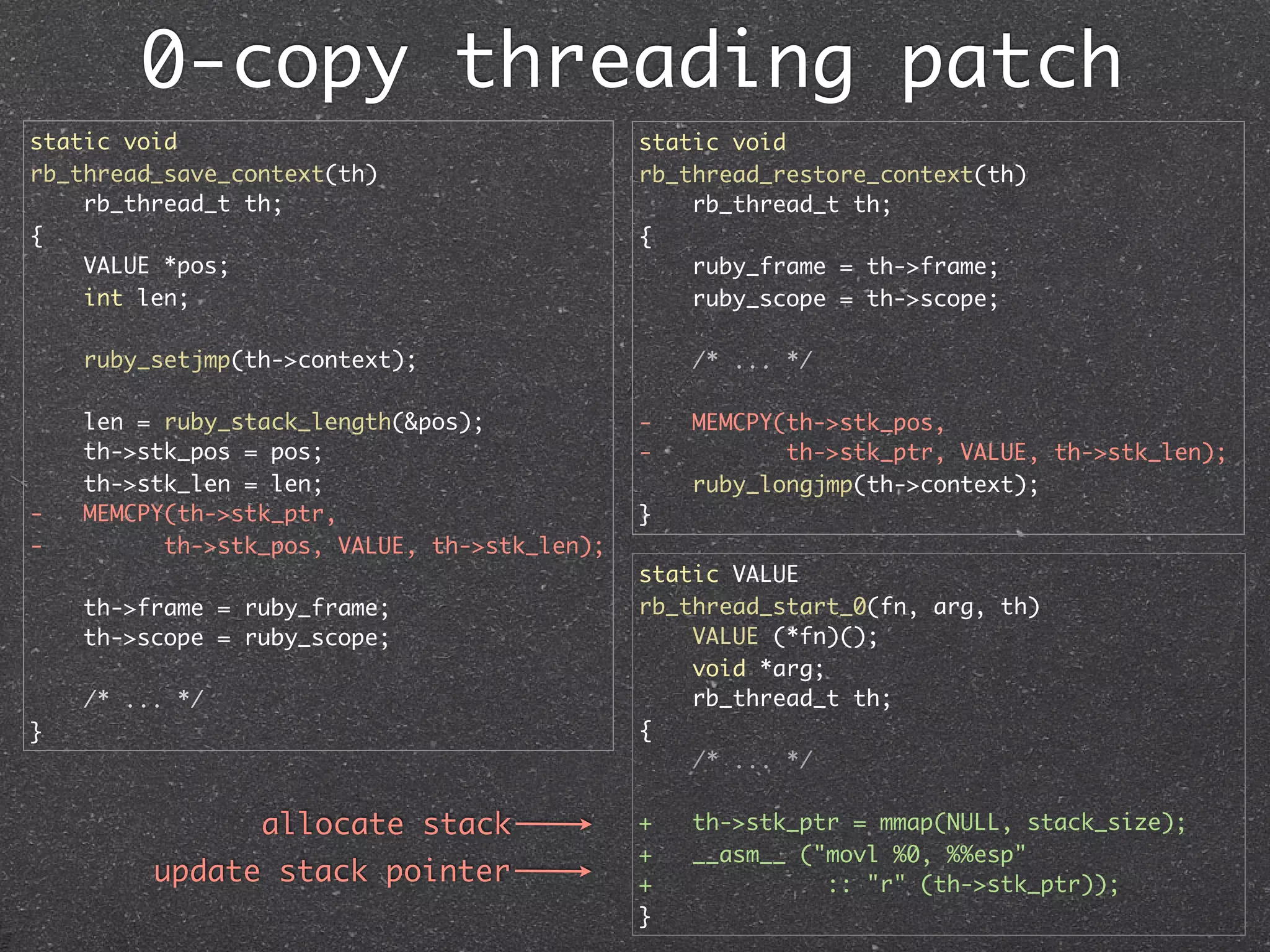
    ruby_setjmp(th->context);                    /* ... */

    len = ruby_stack_length(&pos);               MEMCPY(th->stk_pos,
    th->stk_pos = pos;                                  th->stk_ptr, VALUE, th->stk_len);
    th->stk_len = len;                           ruby_longjmp(th->context);
    MEMCPY(th->stk_ptr,                      }
           th->stk_pos, VALUE, th->stk_len);

    th->frame = ruby_frame;
    th->scope = ruby_scope;

    /* ... */
}
OK, its calling memcpy()
                 but what is it copying?
static void                                  static void
rb_thread_save_context(th)                   rb_thread_restore_context(th)
    rb_thread_t th;                              rb_thread_t th;
{                                            {
    VALUE *pos;                                  ruby_frame = th->frame;
    int len;                                     ruby_scope = th->scope;

    ruby_setjmp(th->context);                     /* ... */

    len = ruby_stack_length(&pos);                MEMCPY(th->stk_pos,
    th->stk_pos = pos;                                   th->stk_ptr, VALUE, th->stk_len);
    th->stk_len = len;                            ruby_longjmp(th->context);
    MEMCPY(th->stk_ptr,                      }
           th->stk_pos, VALUE, th->stk_len);
                                                 1. save cpu registers
    th->frame = ruby_frame;
    th->scope = ruby_scope;

    /* ... */
}
OK, its calling memcpy()
                 but what is it copying?
static void                                  static void
rb_thread_save_context(th)                   rb_thread_restore_context(th)
    rb_thread_t th;                              rb_thread_t th;
{                                            {
    VALUE *pos;                                  ruby_frame = th->frame;
    int len;                                     ruby_scope = th->scope;

    ruby_setjmp(th->context);                    /* ... */

    len = ruby_stack_length(&pos);               MEMCPY(th->stk_pos,
    th->stk_pos = pos;                                  th->stk_ptr, VALUE, th->stk_len);
    th->stk_len = len;                           ruby_longjmp(th->context);
    MEMCPY(th->stk_ptr,                      }
           th->stk_pos, VALUE, th->stk_len);

    th->frame = ruby_frame;
    th->scope = ruby_scope;

    /* ... */
}
OK, its calling memcpy()
                 but what is it copying?
static void                                  static void
rb_thread_save_context(th)                   rb_thread_restore_context(th)
    rb_thread_t th;                              rb_thread_t th;
{                                            {
    VALUE *pos;                                  ruby_frame = th->frame;
    int len;                                     ruby_scope = th->scope;

    ruby_setjmp(th->context);                     /* ... */

    len = ruby_stack_length(&pos);                MEMCPY(th->stk_pos,
    th->stk_pos = pos;                                   th->stk_ptr, VALUE, th->stk_len);
    th->stk_len = len;                            ruby_longjmp(th->context);
    MEMCPY(th->stk_ptr,                      }
           th->stk_pos, VALUE, th->stk_len);

    th->frame = ruby_frame;                      2. save stack frames
    th->scope = ruby_scope;

    /* ... */
}
OK, its calling memcpy()
                 but what is it copying?
static void                                  static void
rb_thread_save_context(th)                   rb_thread_restore_context(th)
    rb_thread_t th;                              rb_thread_t th;
{                                            {
    VALUE *pos;                                  ruby_frame = th->frame;
    int len;                                     ruby_scope = th->scope;

    ruby_setjmp(th->context);                    /* ... */

    len = ruby_stack_length(&pos);               MEMCPY(th->stk_pos,
    th->stk_pos = pos;                                  th->stk_ptr, VALUE, th->stk_len);
    th->stk_len = len;                           ruby_longjmp(th->context);
    MEMCPY(th->stk_ptr,                      }
           th->stk_pos, VALUE, th->stk_len);

    th->frame = ruby_frame;
    th->scope = ruby_scope;

    /* ... */
}
OK, its calling memcpy()
                 but what is it copying?
static void                                  static void
rb_thread_save_context(th)                   rb_thread_restore_context(th)
    rb_thread_t th;                              rb_thread_t th;
{                                            {
    VALUE *pos;                                  ruby_frame = th->frame;
    int len;                                     ruby_scope = th->scope;

    ruby_setjmp(th->context);                     /* ... */

    len = ruby_stack_length(&pos);                MEMCPY(th->stk_pos,
    th->stk_pos = pos;                                   th->stk_ptr, VALUE, th->stk_len);
    th->stk_len = len;                            ruby_longjmp(th->context);
    MEMCPY(th->stk_ptr,                      }
           th->stk_pos, VALUE, th->stk_len);

    th->frame = ruby_frame;
    th->scope = ruby_scope;                      3. save vm globals
    /* ... */
}
OK, its calling memcpy()
                 but what is it copying?
static void                                  static void
rb_thread_save_context(th)                   rb_thread_restore_context(th)
    rb_thread_t th;                              rb_thread_t th;
{                                            {
    VALUE *pos;                                  ruby_frame = th->frame;
    int len;                                     ruby_scope = th->scope;

    ruby_setjmp(th->context);                    /* ... */

    len = ruby_stack_length(&pos);               MEMCPY(th->stk_pos,
    th->stk_pos = pos;                                  th->stk_ptr, VALUE, th->stk_len);
    th->stk_len = len;                           ruby_longjmp(th->context);
    MEMCPY(th->stk_ptr,                      }
           th->stk_pos, VALUE, th->stk_len);

    th->frame = ruby_frame;
    th->scope = ruby_scope;

    /* ... */
}
OK, its calling memcpy()
                 but what is it copying?
static void                                  static void
rb_thread_save_context(th)                   rb_thread_restore_context(th)
    rb_thread_t th;                              rb_thread_t th;
{                                            {
    VALUE *pos;                                  ruby_frame = th->frame;
    int len;                                     ruby_scope = th->scope;

    ruby_setjmp(th->context);                     /* ... */

    len = ruby_stack_length(&pos);                MEMCPY(th->stk_pos,
    th->stk_pos = pos;                                   th->stk_ptr, VALUE, th->stk_len);
    th->stk_len = len;                            ruby_longjmp(th->context);
    MEMCPY(th->stk_ptr,                      }
           th->stk_pos, VALUE, th->stk_len);

    th->frame = ruby_frame;
    th->scope = ruby_scope;

    /* ... */
                                                 4. restore vm globals
}
OK, its calling memcpy()
                 but what is it copying?
static void                                  static void
rb_thread_save_context(th)                   rb_thread_restore_context(th)
    rb_thread_t th;                              rb_thread_t th;
{                                            {
    VALUE *pos;                                  ruby_frame = th->frame;
    int len;                                     ruby_scope = th->scope;

    ruby_setjmp(th->context);                    /* ... */

    len = ruby_stack_length(&pos);               MEMCPY(th->stk_pos,
    th->stk_pos = pos;                                  th->stk_ptr, VALUE, th->stk_len);
    th->stk_len = len;                           ruby_longjmp(th->context);
    MEMCPY(th->stk_ptr,                      }
           th->stk_pos, VALUE, th->stk_len);

    th->frame = ruby_frame;
    th->scope = ruby_scope;

    /* ... */
}
OK, its calling memcpy()
                 but what is it copying?
static void                                  static void
rb_thread_save_context(th)                   rb_thread_restore_context(th)
    rb_thread_t th;                              rb_thread_t th;
{                                            {
    VALUE *pos;                                  ruby_frame = th->frame;
    int len;                                     ruby_scope = th->scope;

    ruby_setjmp(th->context);                     /* ... */

    len = ruby_stack_length(&pos);                MEMCPY(th->stk_pos,
    th->stk_pos = pos;                                   th->stk_ptr, VALUE, th->stk_len);
    th->stk_len = len;                            ruby_longjmp(th->context);
    MEMCPY(th->stk_ptr,                      }
           th->stk_pos, VALUE, th->stk_len);

    th->frame = ruby_frame;
    th->scope = ruby_scope;

    /* ... */
}                                                5. restore stack frames
OK, its calling memcpy()
                 but what is it copying?
static void                                  static void
rb_thread_save_context(th)                   rb_thread_restore_context(th)
    rb_thread_t th;                              rb_thread_t th;
{                                            {
    VALUE *pos;                                  ruby_frame = th->frame;
    int len;                                     ruby_scope = th->scope;

    ruby_setjmp(th->context);                    /* ... */

    len = ruby_stack_length(&pos);               MEMCPY(th->stk_pos,
    th->stk_pos = pos;                                  th->stk_ptr, VALUE, th->stk_len);
    th->stk_len = len;                           ruby_longjmp(th->context);
    MEMCPY(th->stk_ptr,                      }
           th->stk_pos, VALUE, th->stk_len);

    th->frame = ruby_frame;
    th->scope = ruby_scope;

    /* ... */
}
OK, its calling memcpy()
                 but what is it copying?
static void                                  static void
rb_thread_save_context(th)                   rb_thread_restore_context(th)
    rb_thread_t th;                              rb_thread_t th;
{                                            {
    VALUE *pos;                                  ruby_frame = th->frame;
    int len;                                     ruby_scope = th->scope;

    ruby_setjmp(th->context);                     /* ... */

    len = ruby_stack_length(&pos);                MEMCPY(th->stk_pos,
    th->stk_pos = pos;                                   th->stk_ptr, VALUE, th->stk_len);
    th->stk_len = len;                            ruby_longjmp(th->context);
    MEMCPY(th->stk_ptr,                      }
           th->stk_pos, VALUE, th->stk_len);

    th->frame = ruby_frame;
    th->scope = ruby_scope;

    /* ... */
}
                                                 6. restore cpu registers
OK, its calling memcpy()
                 but what is it copying?
static void                                  static void
rb_thread_save_context(th)                   rb_thread_restore_context(th)
    rb_thread_t th;                              rb_thread_t th;
{                                            {
    VALUE *pos;                                  ruby_frame = th->frame;
    int len;                                     ruby_scope = th->scope;

    ruby_setjmp(th->context);                    /* ... */

    len = ruby_stack_length(&pos);               MEMCPY(th->stk_pos,
    th->stk_pos = pos;                                  th->stk_ptr, VALUE, th->stk_len);
    th->stk_len = len;                           ruby_longjmp(th->context);
    MEMCPY(th->stk_ptr,                      }
           th->stk_pos, VALUE, th->stk_len);

    th->frame = ruby_frame;
    th->scope = ruby_scope;

    /* ... */
}
OK, its calling memcpy()
                 but what is it copying?
static void                                  static void
rb_thread_save_context(th)                   rb_thread_restore_context(th)
    rb_thread_t th;                              rb_thread_t th;
{                                            {
    VALUE *pos;                                  ruby_frame = th->frame;
    int len;                                     ruby_scope = th->scope;

    ruby_setjmp(th->context);                    /* ... */

    len = ruby_stack_length(&pos);               MEMCPY(th->stk_pos,
    th->stk_pos = pos;                                  th->stk_ptr, VALUE, th->stk_len);
    th->stk_len = len;                           ruby_longjmp(th->context);
    MEMCPY(th->stk_ptr,                      }
           th->stk_pos, VALUE, th->stk_len);

    th->frame = ruby_frame;
    th->scope = ruby_scope;

    /* ... */
}


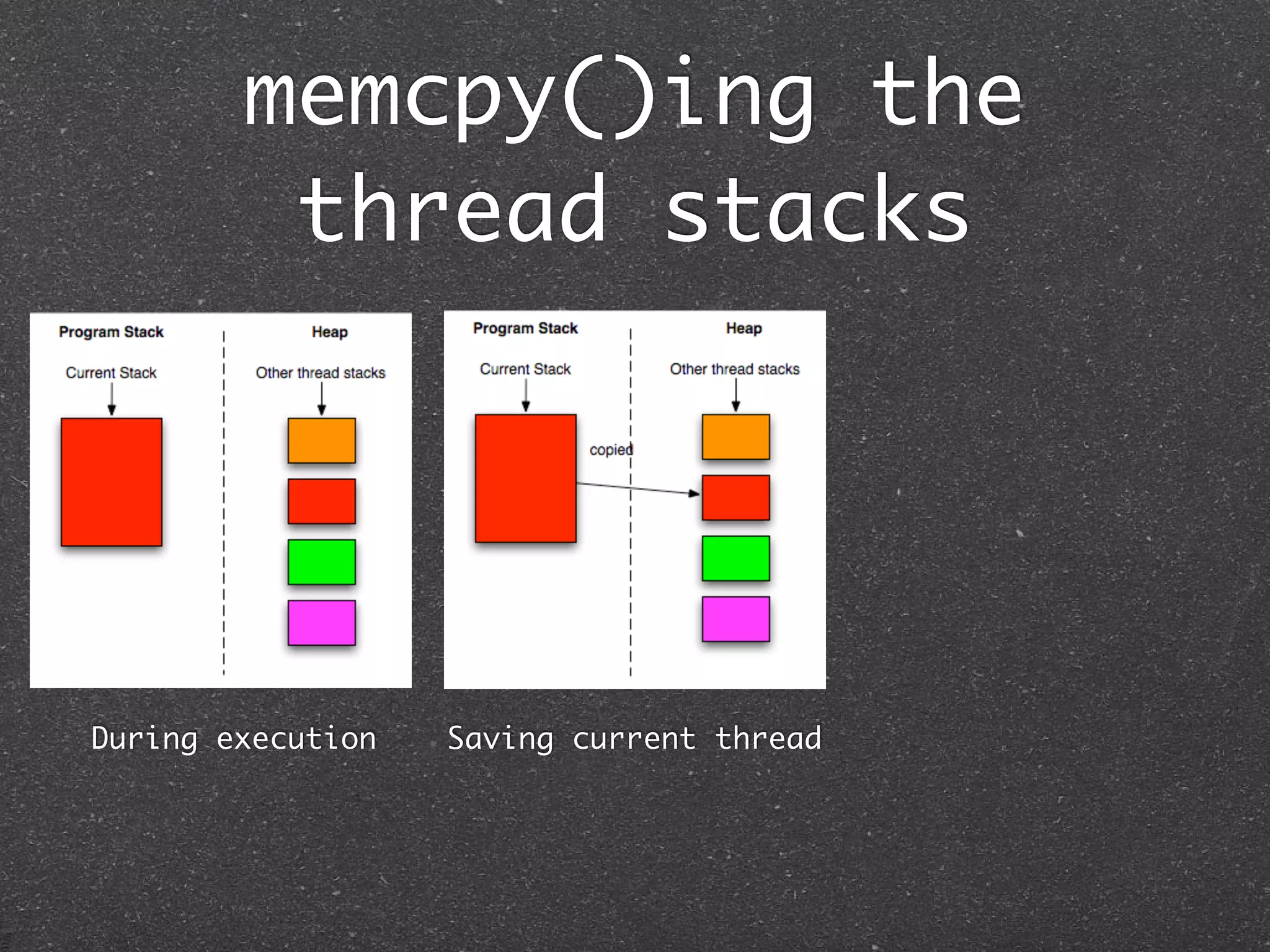
    it’s copying the stacks to the heap!
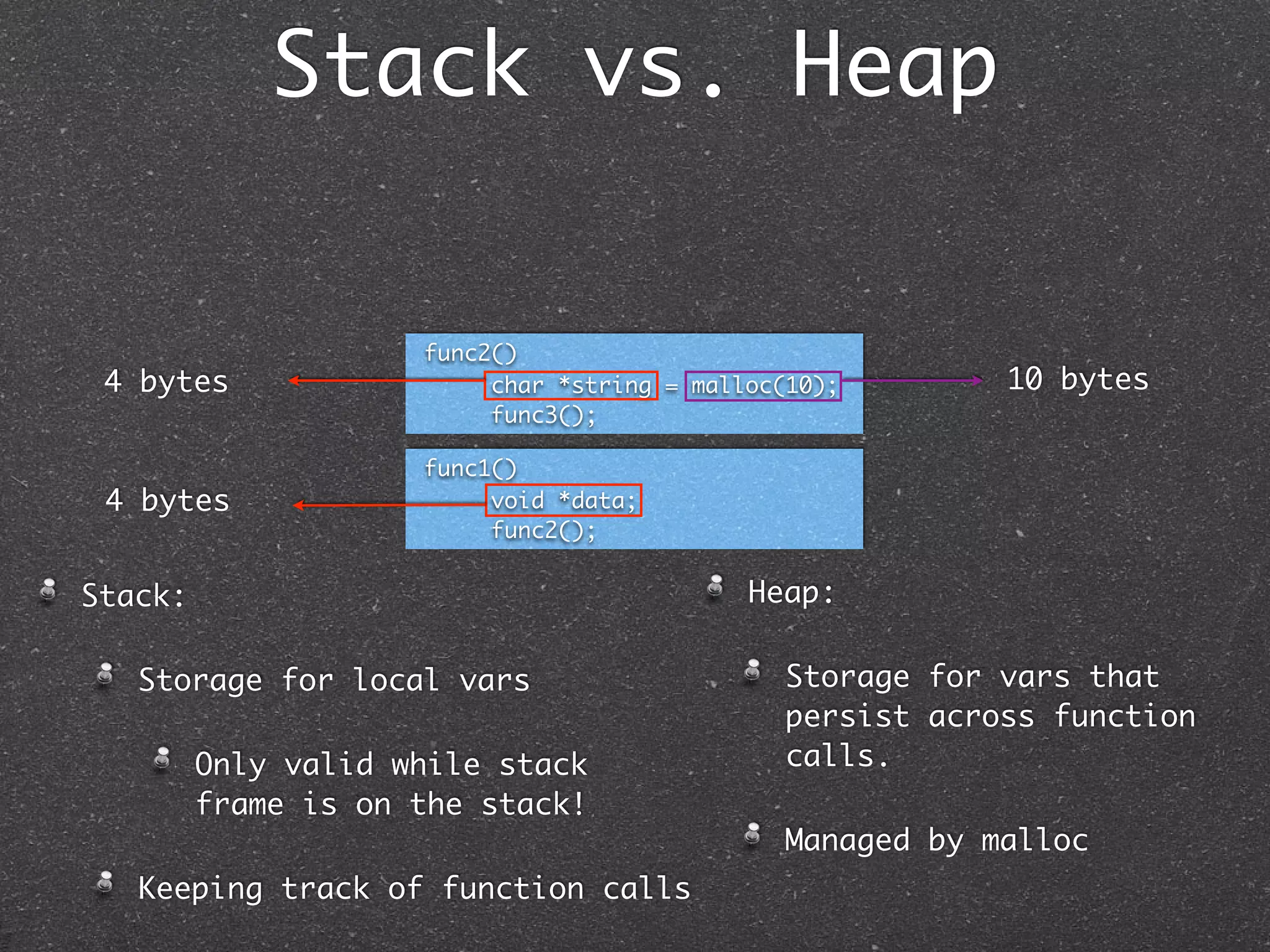
Stack vs. Heap
Stack vs. Heap


Stack:
Stack vs. Heap


Stack:

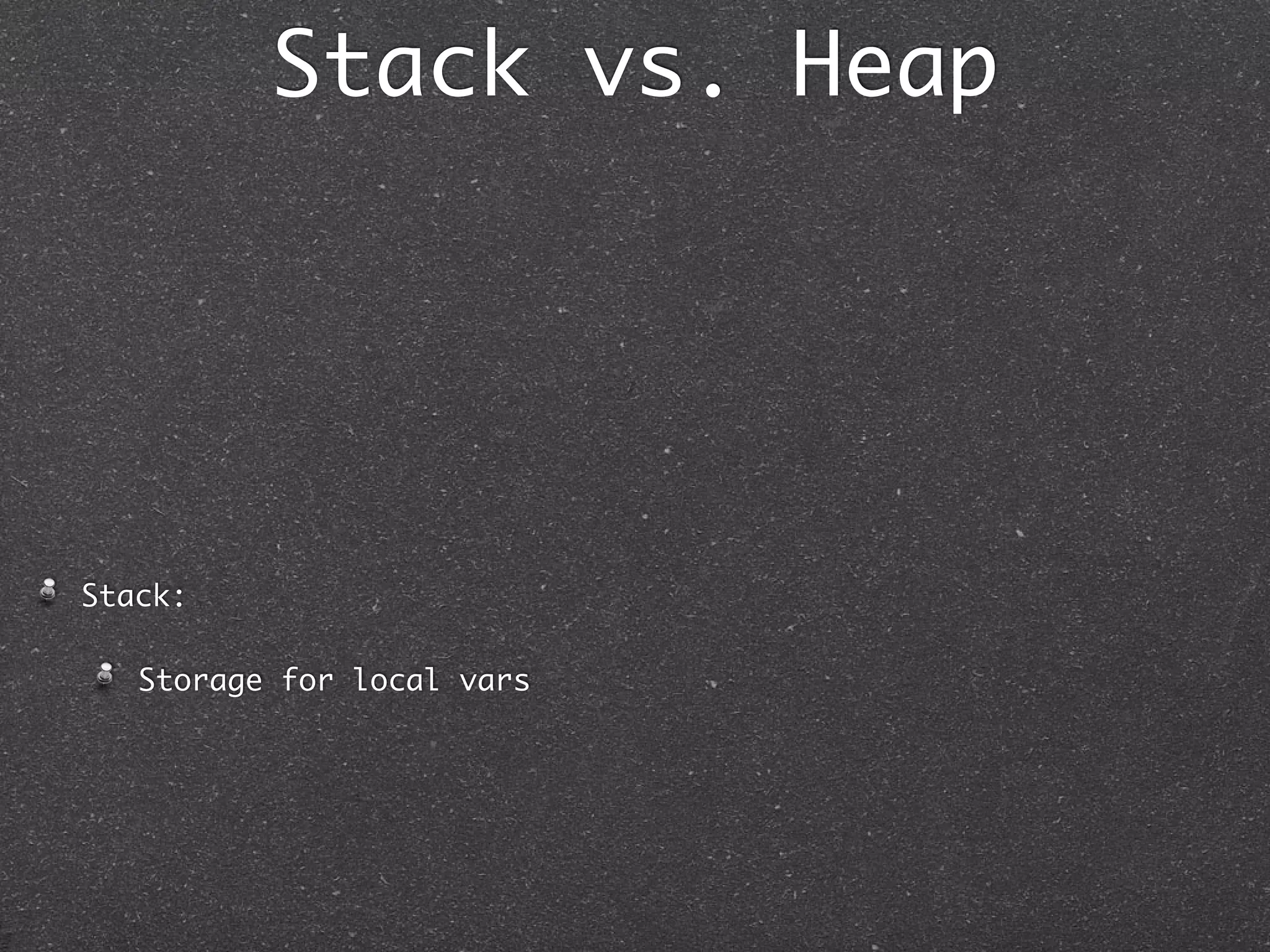
   Storage for local vars
Stack vs. Heap


Stack:

   Storage for local vars

         Only valid while stack
         frame is on the stack!
Stack vs. Heap


Stack:

   Storage for local vars

         Only valid while stack
         frame is on the stack!

   Keeping track of function calls
Stack vs. Heap


Stack:                               Heap:

   Storage for local vars

         Only valid while stack
         frame is on the stack!

   Keeping track of function calls
Stack vs. Heap


Stack:                               Heap:

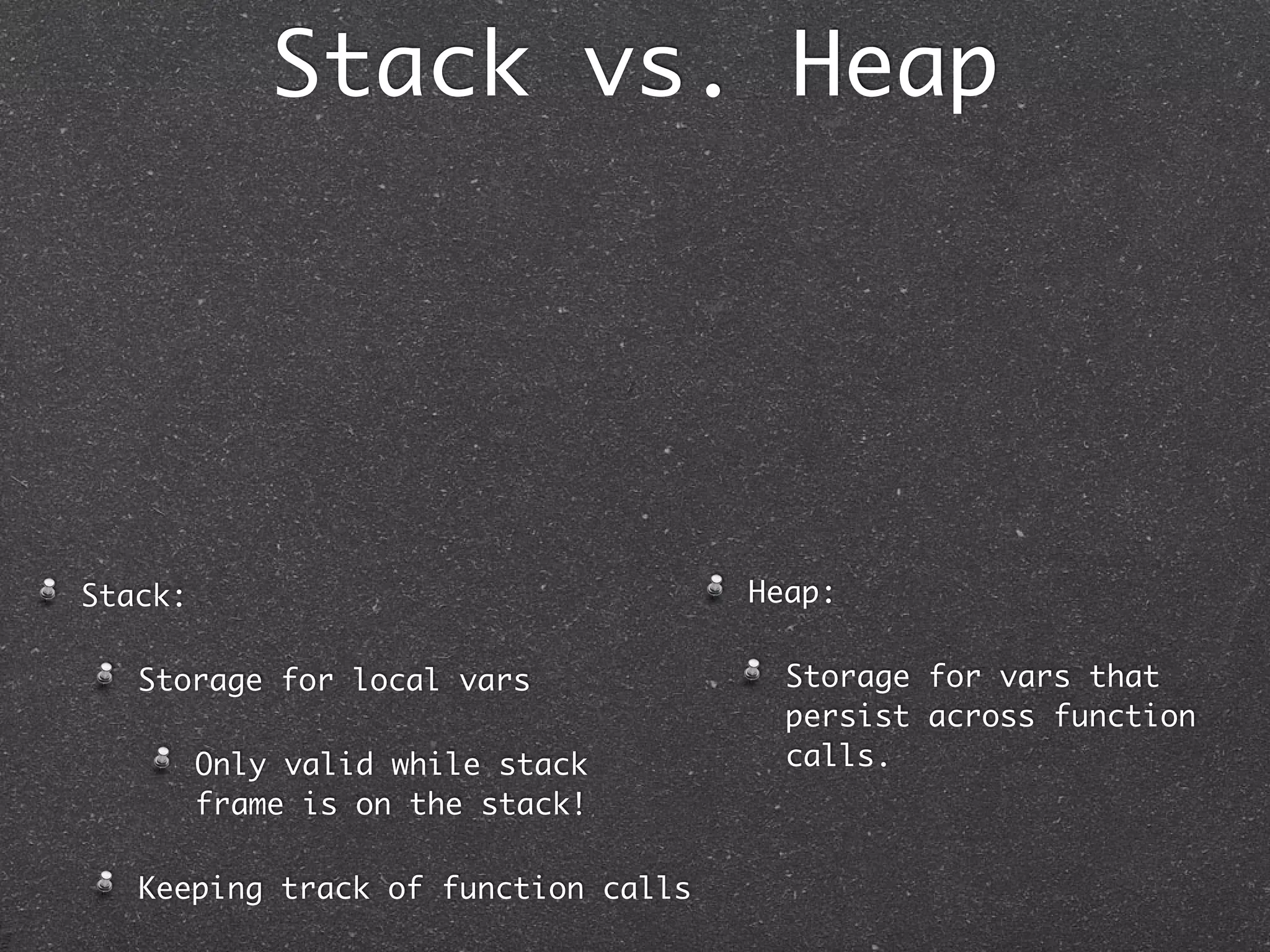
   Storage for local vars              Storage for vars that
                                       persist across function
         Only valid while stack        calls.
         frame is on the stack!

   Keeping track of function calls
Stack vs. Heap


Stack:                               Heap:

   Storage for local vars              Storage for vars that
                                       persist across function
         Only valid while stack        calls.
         frame is on the stack!
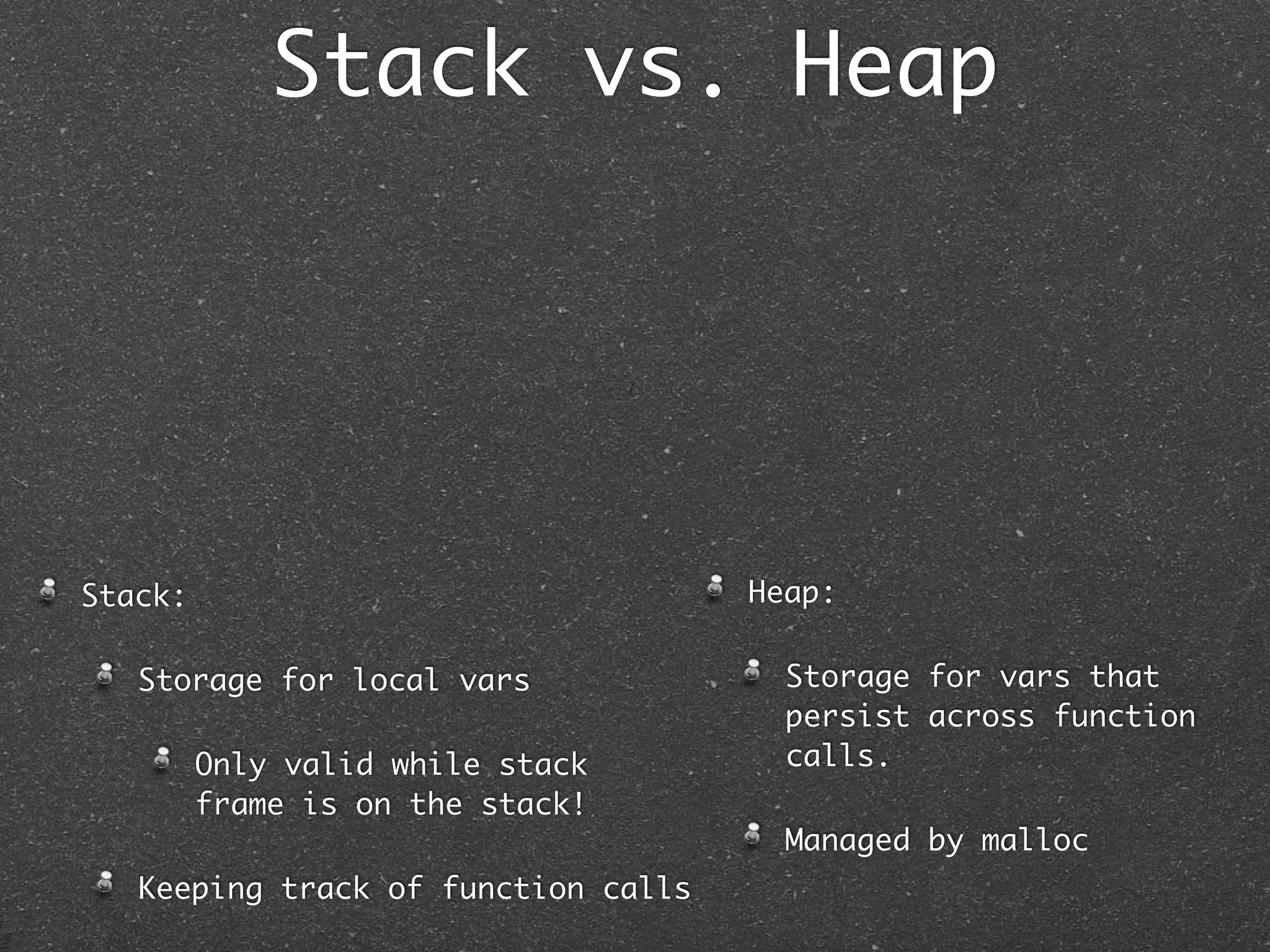
                                       Managed by malloc
   Keeping track of function calls
Stack vs. Heap


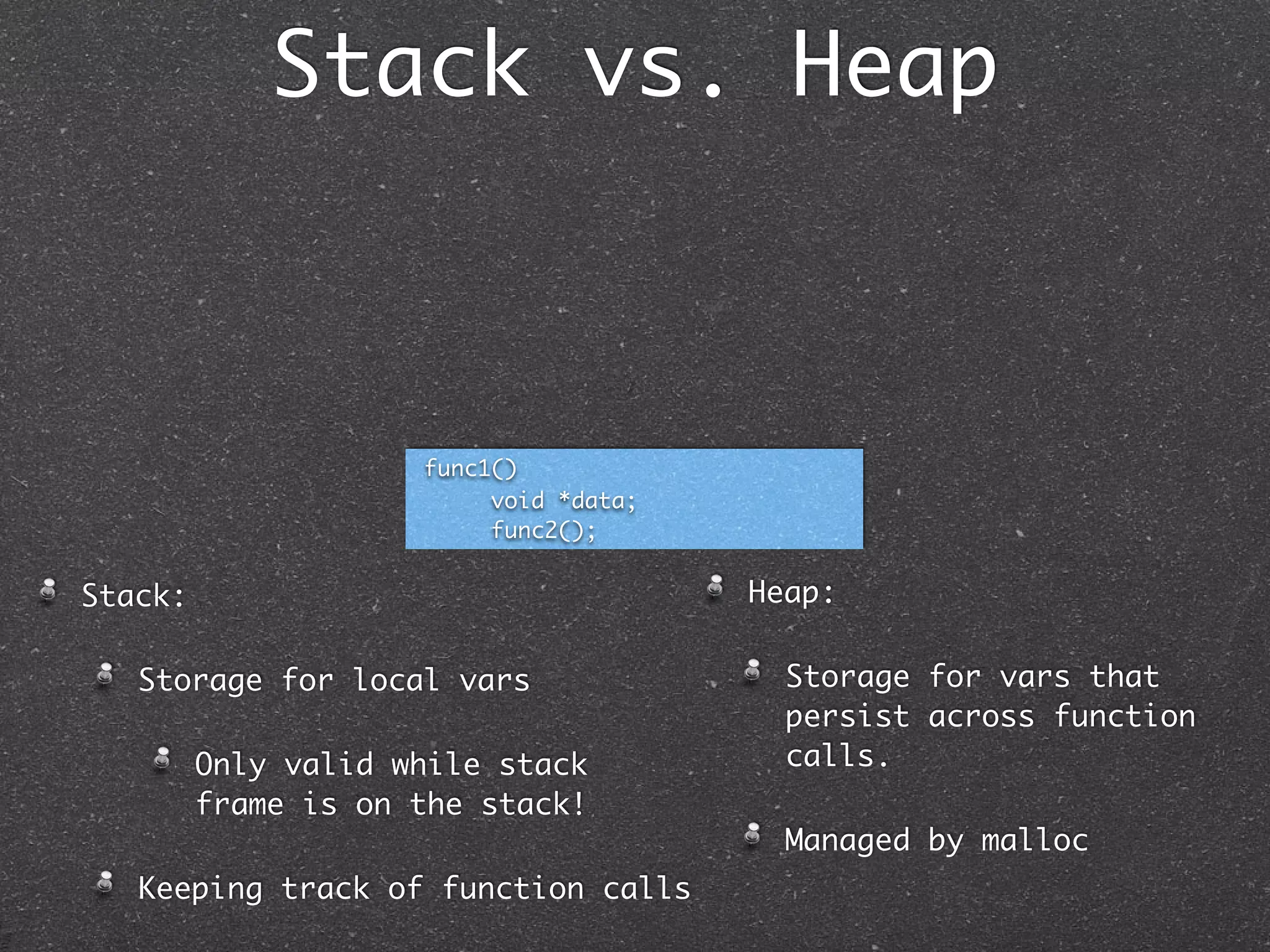
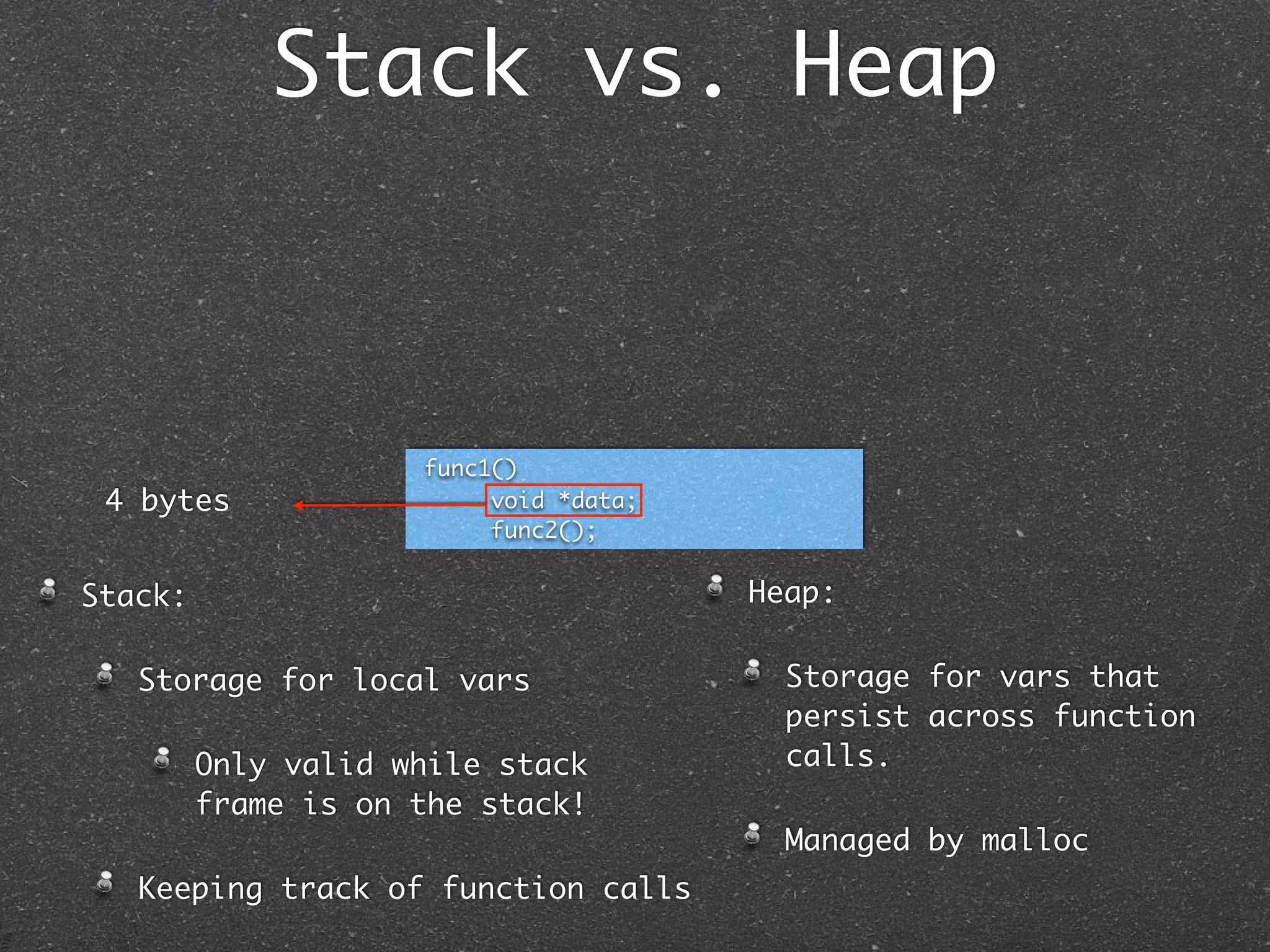
                     func1()
                          void *data;
                          func2();


Stack:                                  Heap:

   Storage for local vars                 Storage for vars that
                                          persist across function
         Only valid while stack           calls.
         frame is on the stack!
                                          Managed by malloc
   Keeping track of function calls
Stack vs. Heap


                     func1()
 4 bytes                  void *data;
                          func2();


Stack:                                  Heap:

   Storage for local vars                 Storage for vars that
                                          persist across function
         Only valid while stack           calls.
         frame is on the stack!
                                          Managed by malloc
   Keeping track of function calls
Stack vs. Heap


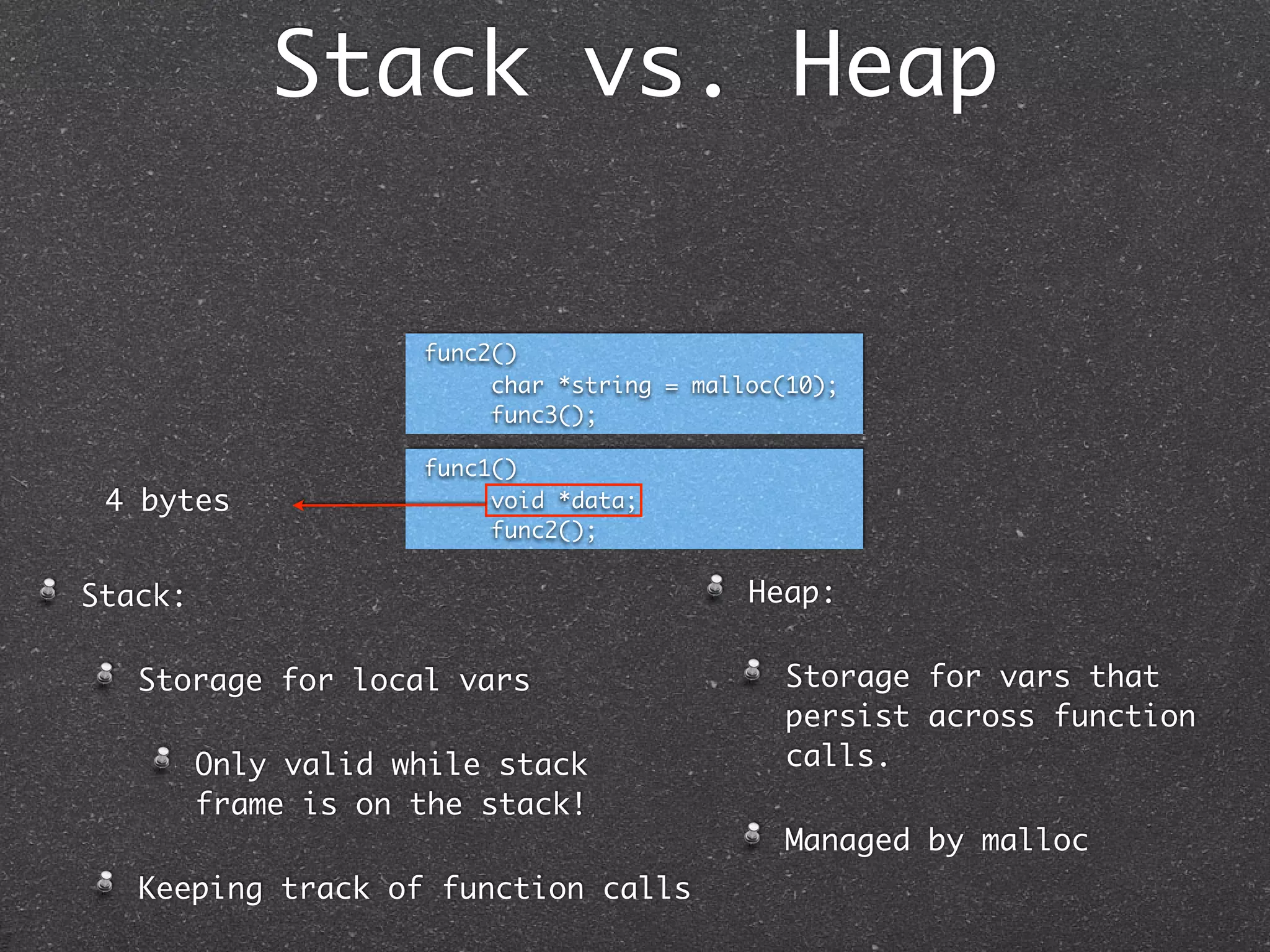
                     func2()
                          char *string = malloc(10);
                          func3();

                     func1()
 4 bytes                  void *data;
                          func2();


Stack:                                       Heap:

   Storage for local vars                      Storage for vars that
                                               persist across function
         Only valid while stack                calls.
         frame is on the stack!
                                               Managed by malloc
   Keeping track of function calls
Stack vs. Heap


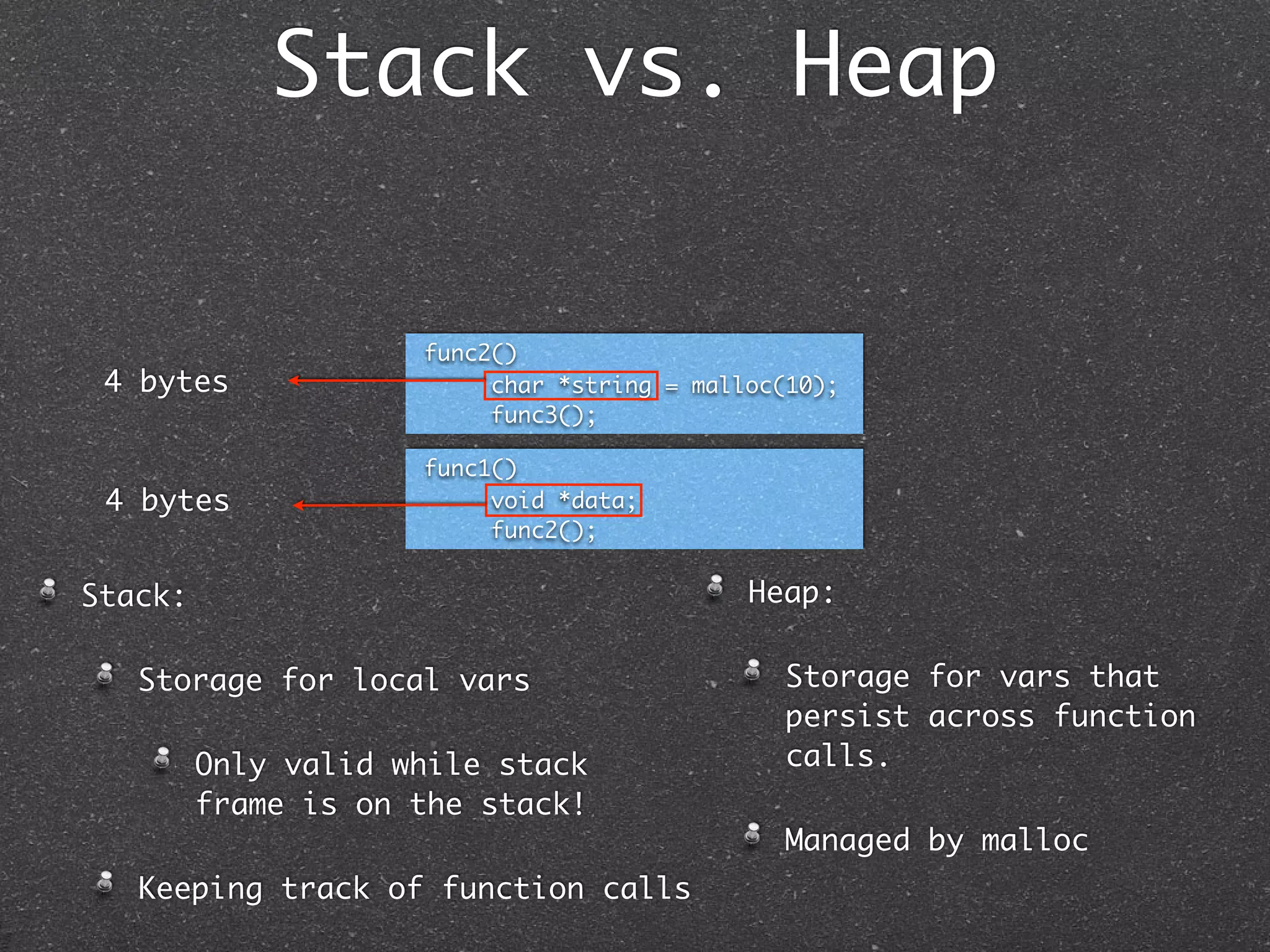
                     func2()
 4 bytes                  char *string = malloc(10);
                          func3();

                     func1()
 4 bytes                  void *data;
                          func2();


Stack:                                       Heap:

   Storage for local vars                      Storage for vars that
                                               persist across function
         Only valid while stack                calls.
         frame is on the stack!
                                               Managed by malloc
   Keeping track of function calls
Stack vs. Heap


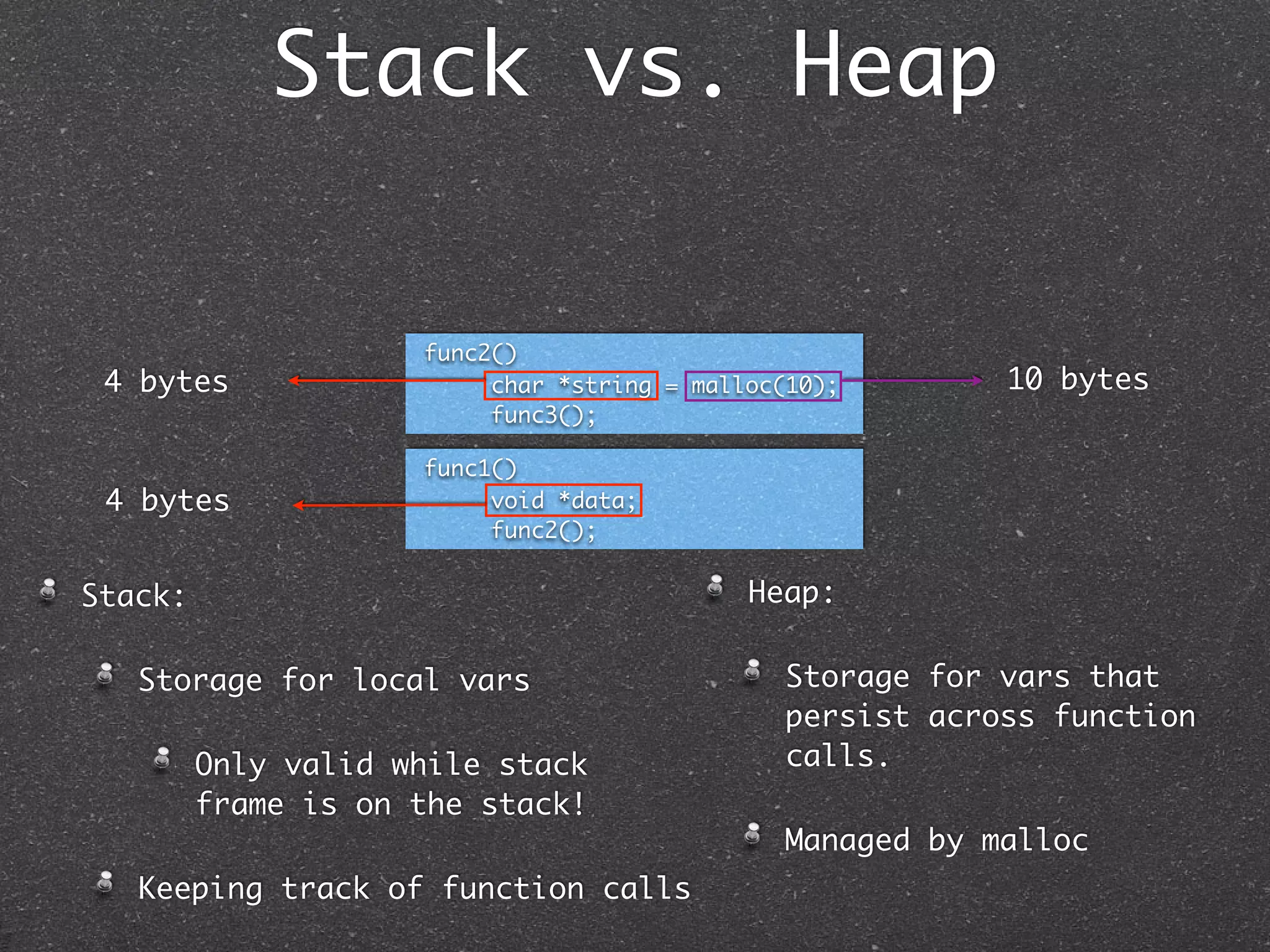
                     func2()
 4 bytes                  char *string = malloc(10);       10 bytes
                          func3();

                     func1()
 4 bytes                  void *data;
                          func2();


Stack:                                       Heap:

   Storage for local vars                      Storage for vars that
                                               persist across function
         Only valid while stack                calls.
         frame is on the stack!
                                               Managed by malloc
   Keeping track of function calls
Stack vs. Heap
                     func3()
                         char buffer[8];


                     func2()
 4 bytes                  char *string = malloc(10);       10 bytes
                          func3();

                     func1()
 4 bytes                  void *data;
                          func2();


Stack:                                       Heap:

   Storage for local vars                      Storage for vars that
                                               persist across function
         Only valid while stack                calls.
         frame is on the stack!
                                               Managed by malloc
   Keeping track of function calls
Stack vs. Heap
                     func3()
 8 bytes                 char buffer[8];


                     func2()
 4 bytes                  char *string = malloc(10);       10 bytes
                          func3();

                     func1()
 4 bytes                  void *data;
                          func2();


Stack:                                       Heap:

   Storage for local vars                      Storage for vars that
                                               persist across function
         Only valid while stack                calls.
         frame is on the stack!
                                               Managed by malloc
   Keeping track of function calls
Stack vs. Heap
                     func3()
                         char buffer[8];


                     func2()
 4 bytes                  char *string = malloc(10);       10 bytes
                          func3();

                     func1()
 4 bytes                  void *data;
                          func2();


Stack:                                       Heap:

   Storage for local vars                      Storage for vars that
                                               persist across function
         Only valid while stack                calls.
         frame is on the stack!
                                               Managed by malloc
   Keeping track of function calls
Stack vs. Heap


                     func2()
 4 bytes                  char *string = malloc(10);       10 bytes
                          func3();

                     func1()
 4 bytes                  void *data;
                          func2();


Stack:                                       Heap:

   Storage for local vars                      Storage for vars that
                                               persist across function
         Only valid while stack                calls.
         frame is on the stack!
                                               Managed by malloc
   Keeping track of function calls
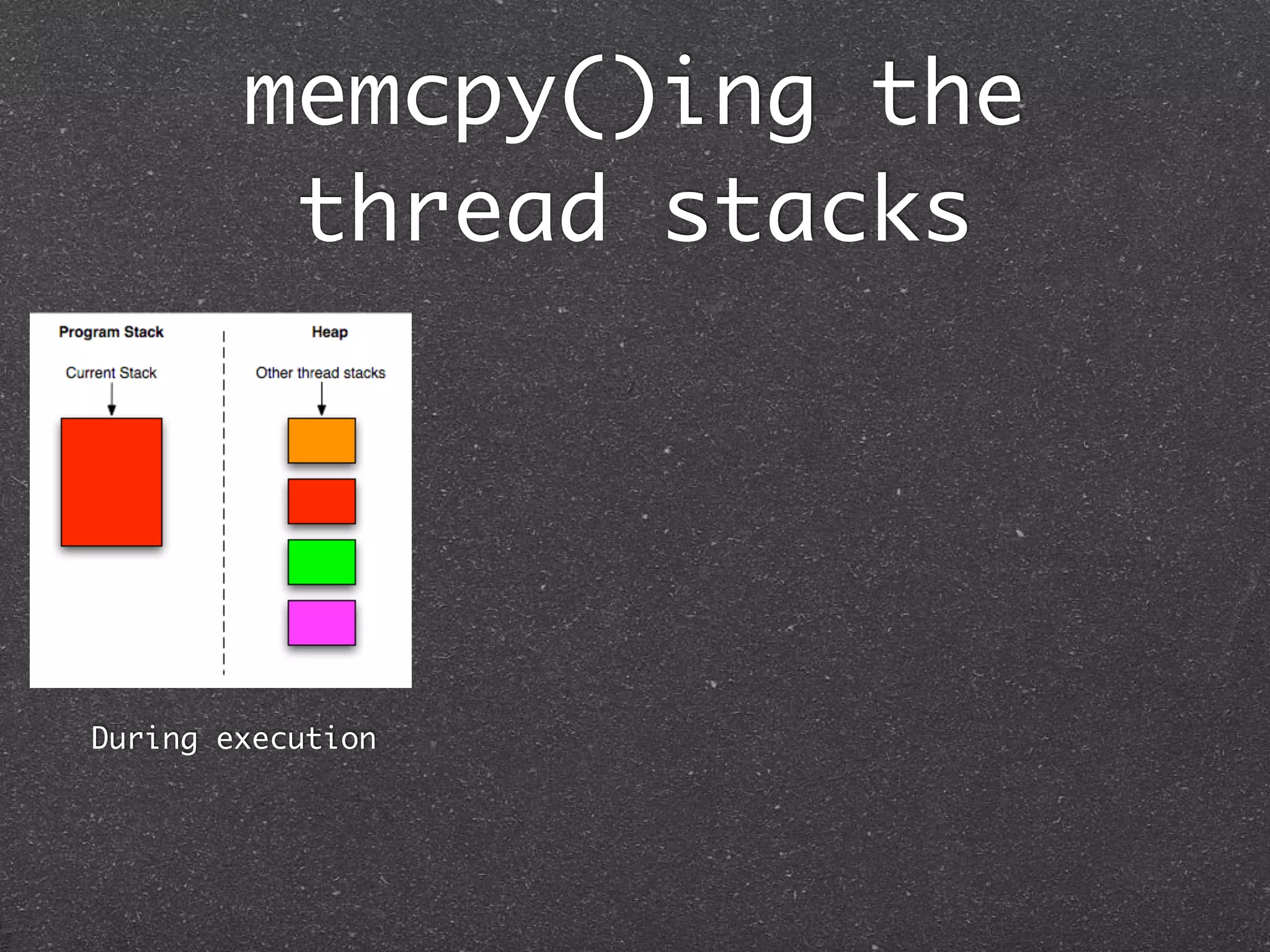
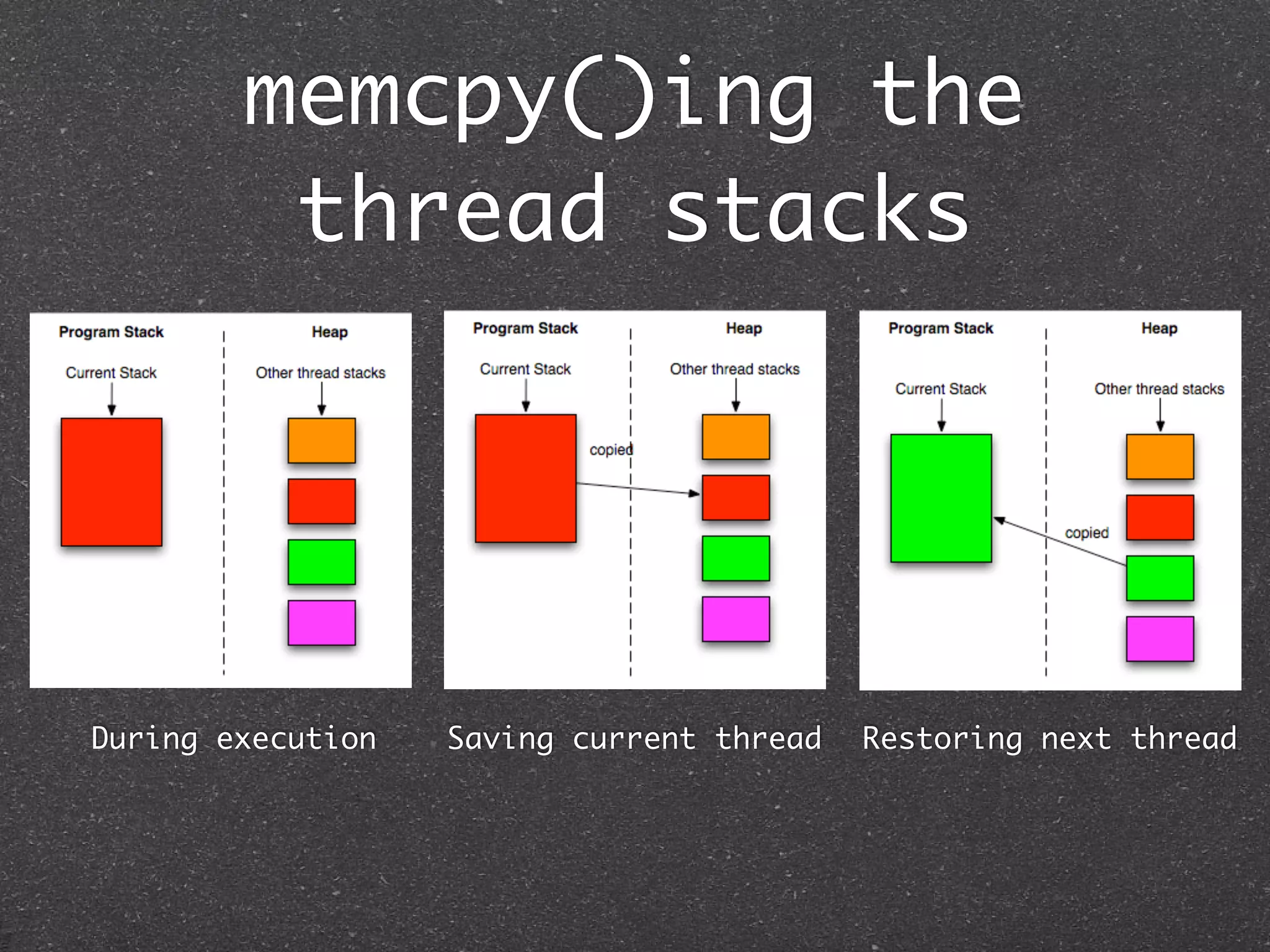
memcpy()ing the
 thread stacks
memcpy()ing the
         thread stacks


During execution
memcpy()ing the
         thread stacks


During execution   Saving current thread
memcpy()ing the
         thread stacks


During execution   Saving current thread   Restoring next thread
memcpy()ing the
         thread stacks


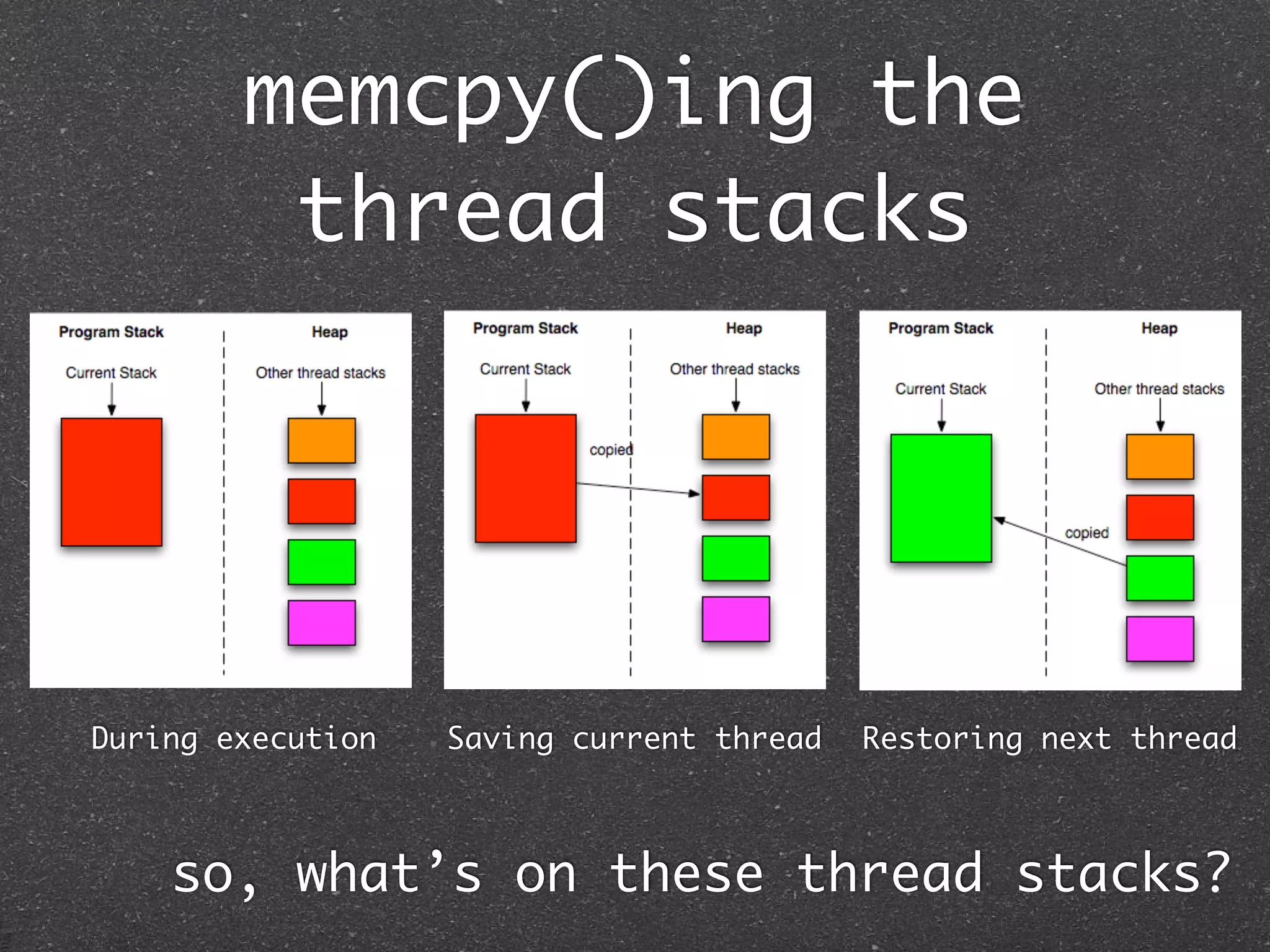
During execution   Saving current thread   Restoring next thread


    so, what’s on these thread stacks?
gdb
 the GNU debugger


   gdb <program>
gdb <program> <pid>


  Be sure to build with:
           -ggdb
            -O0
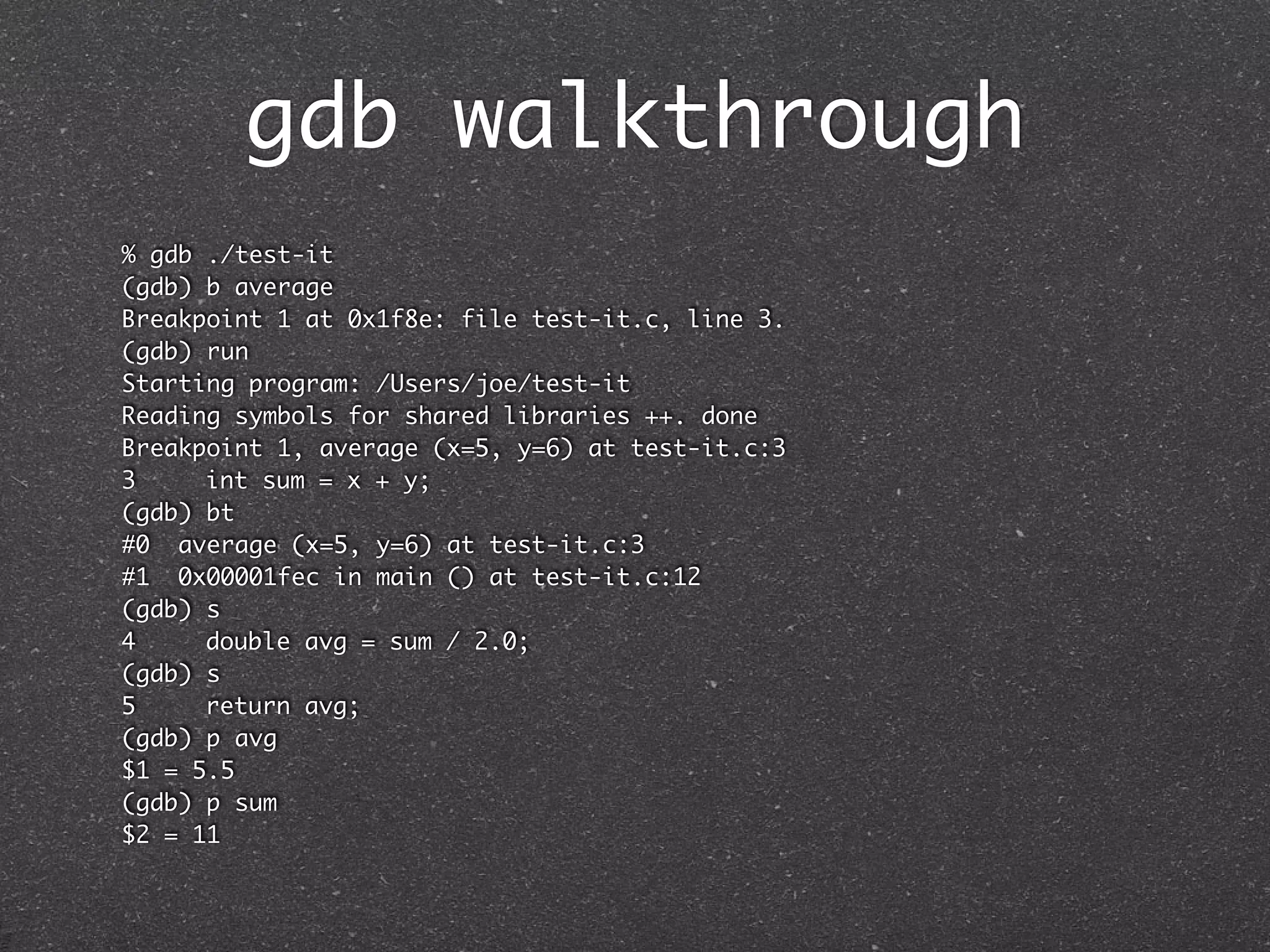
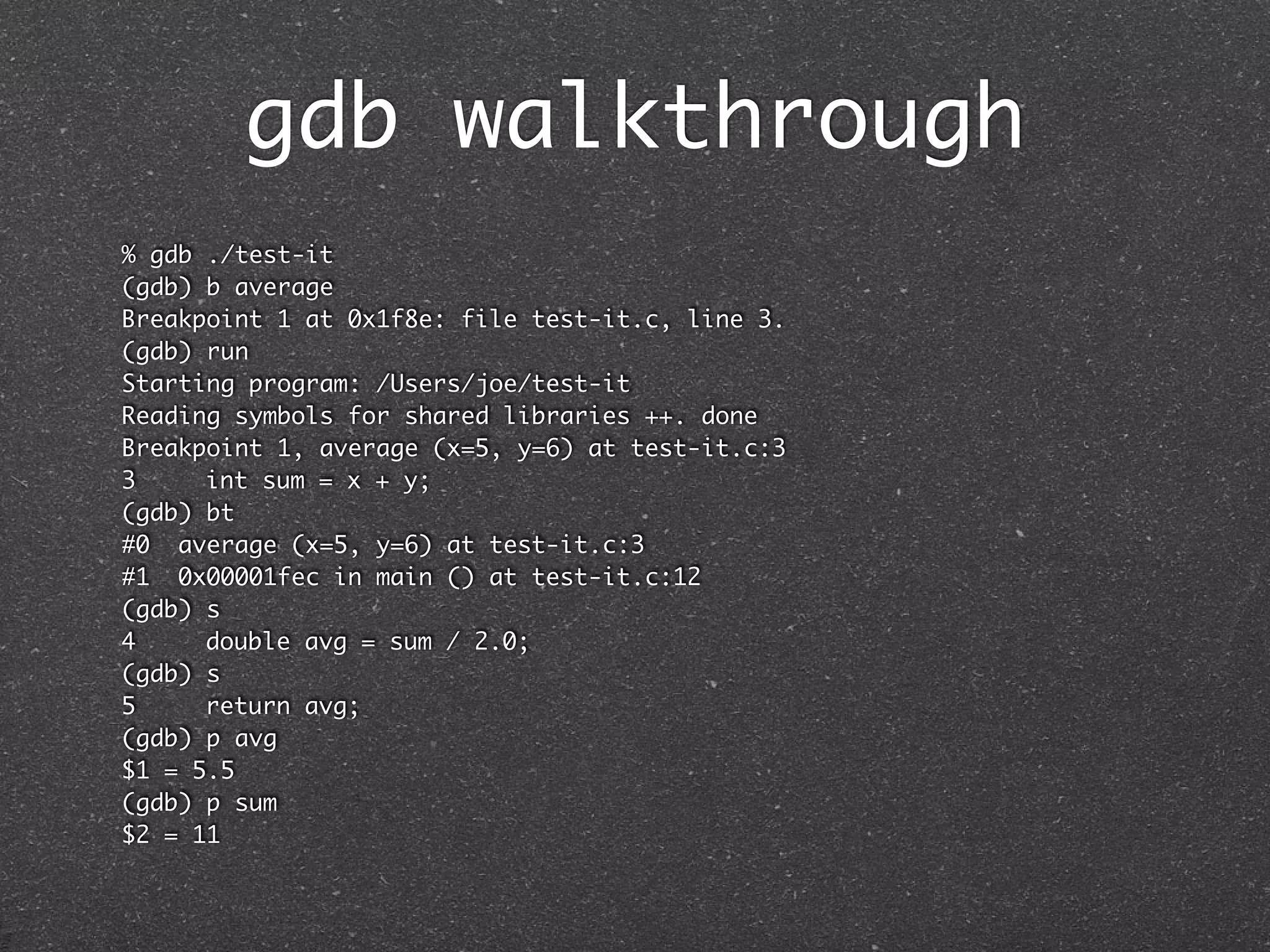
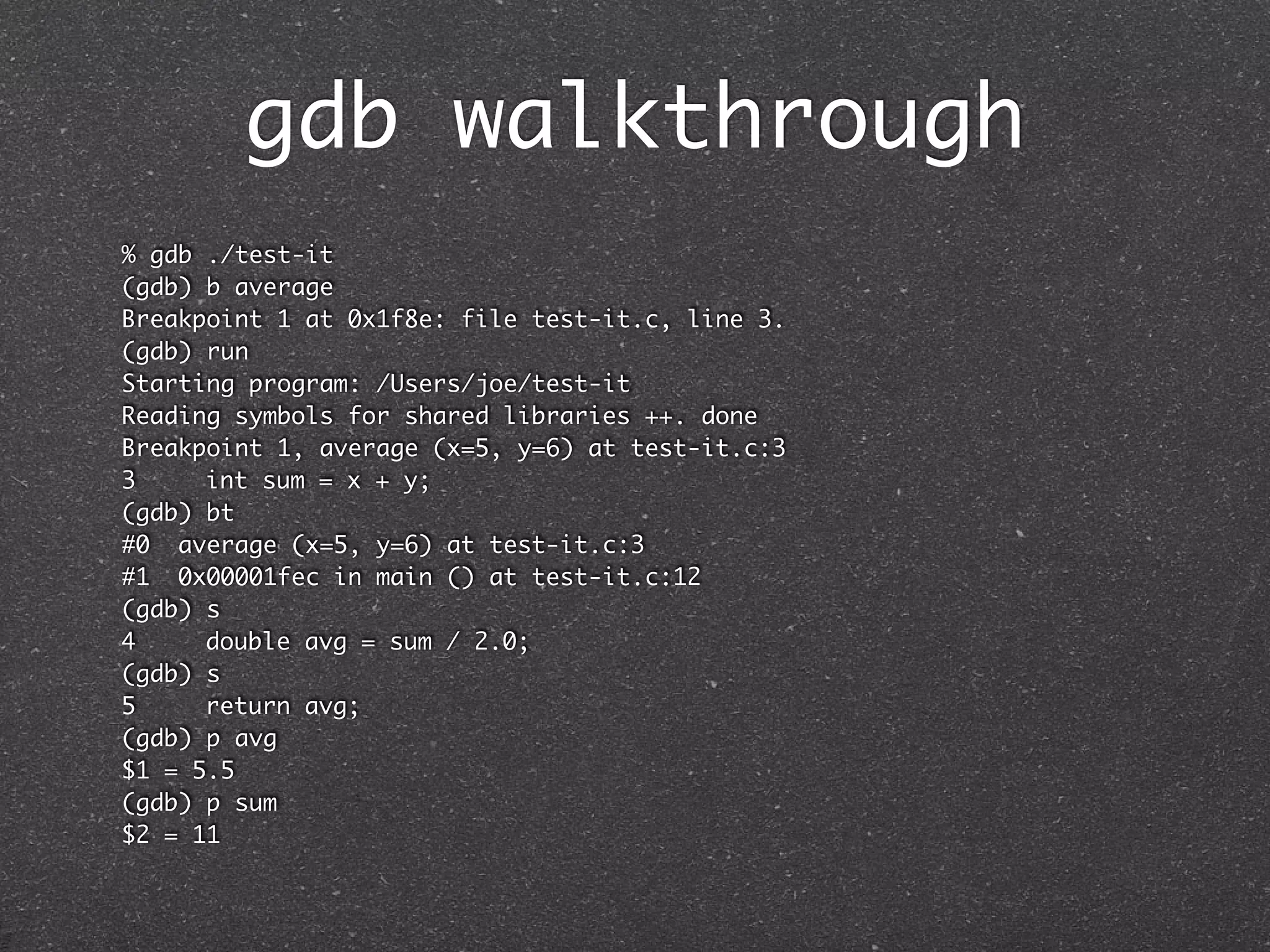
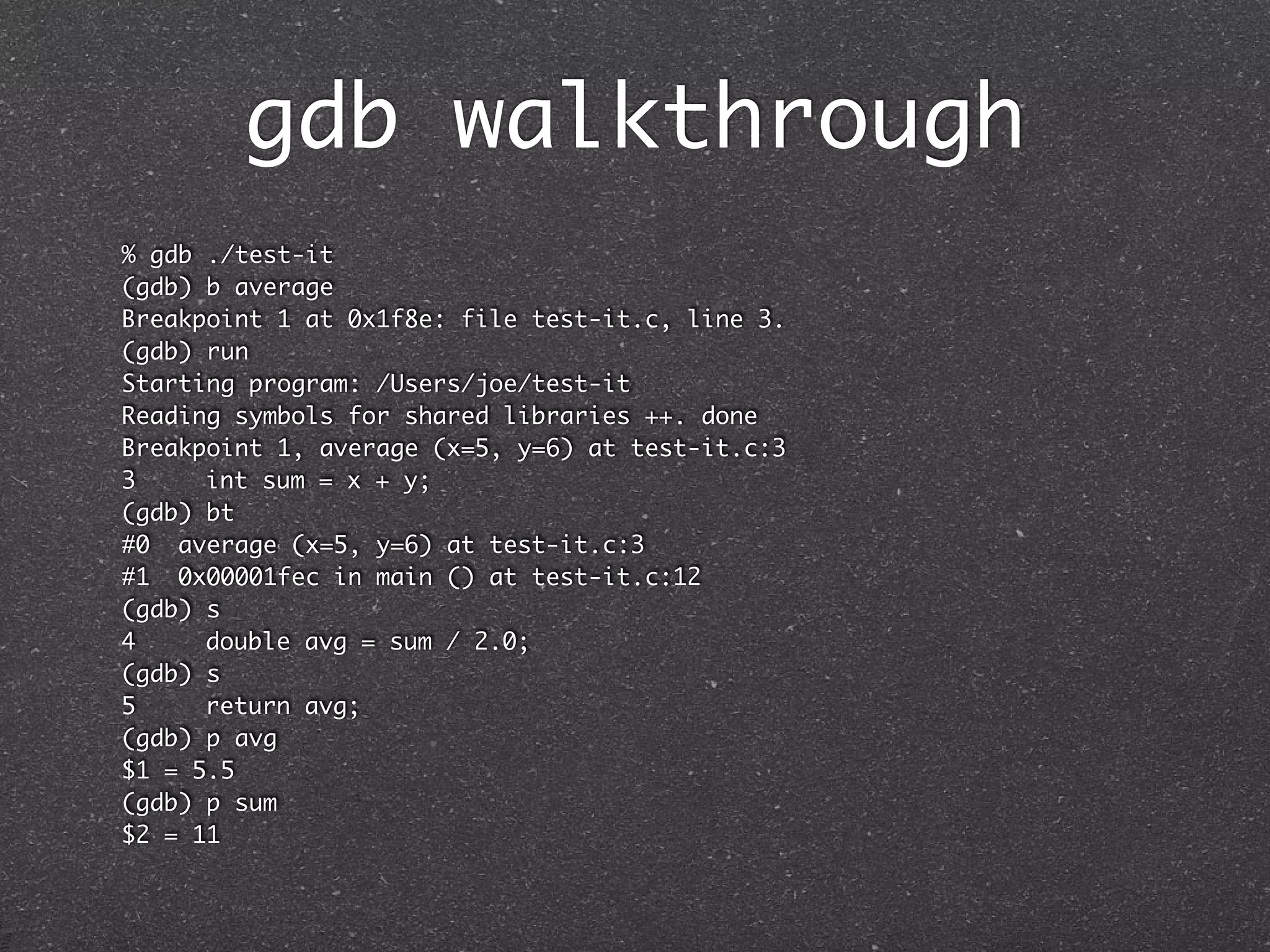
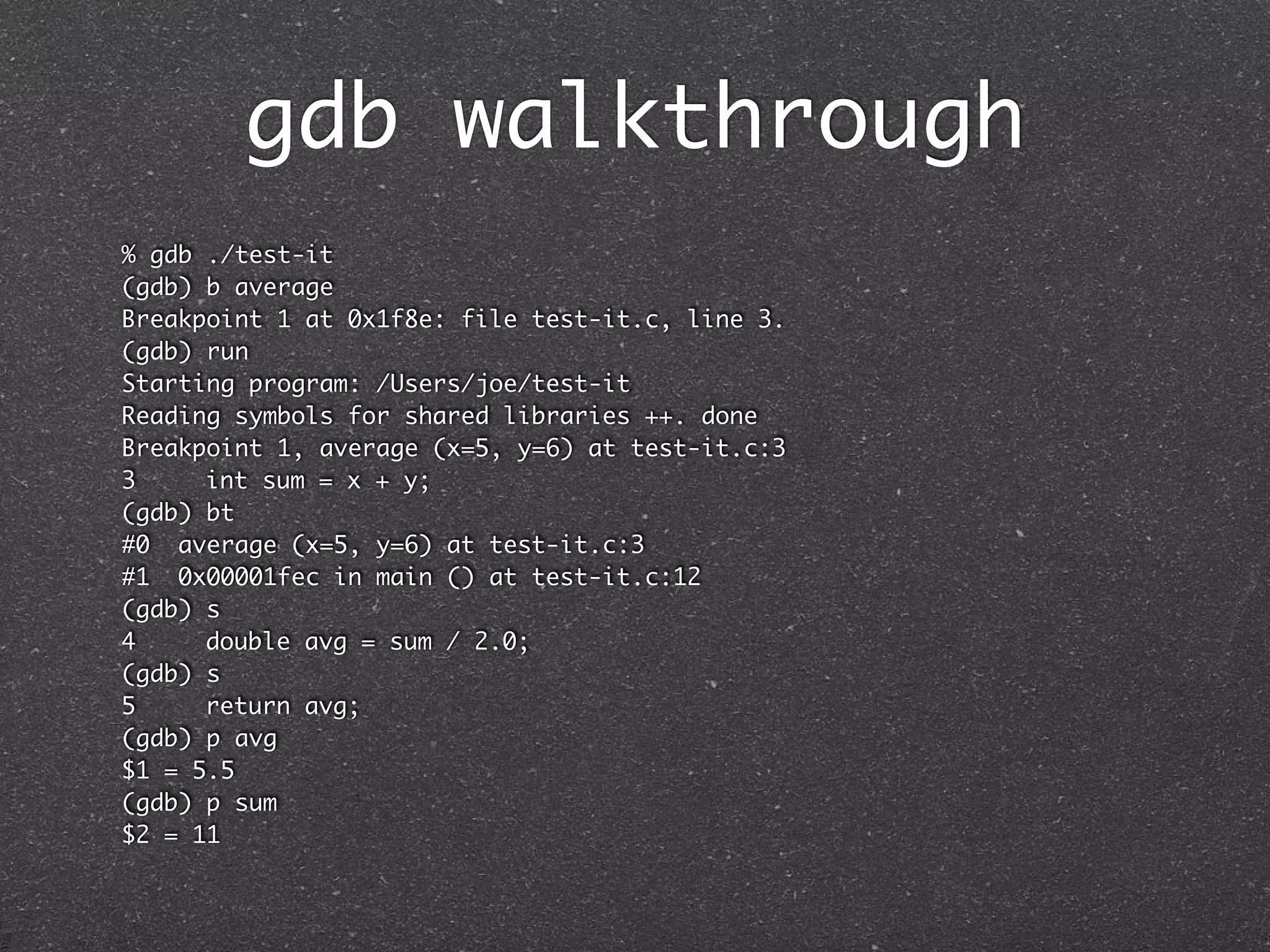
gdb walkthrough
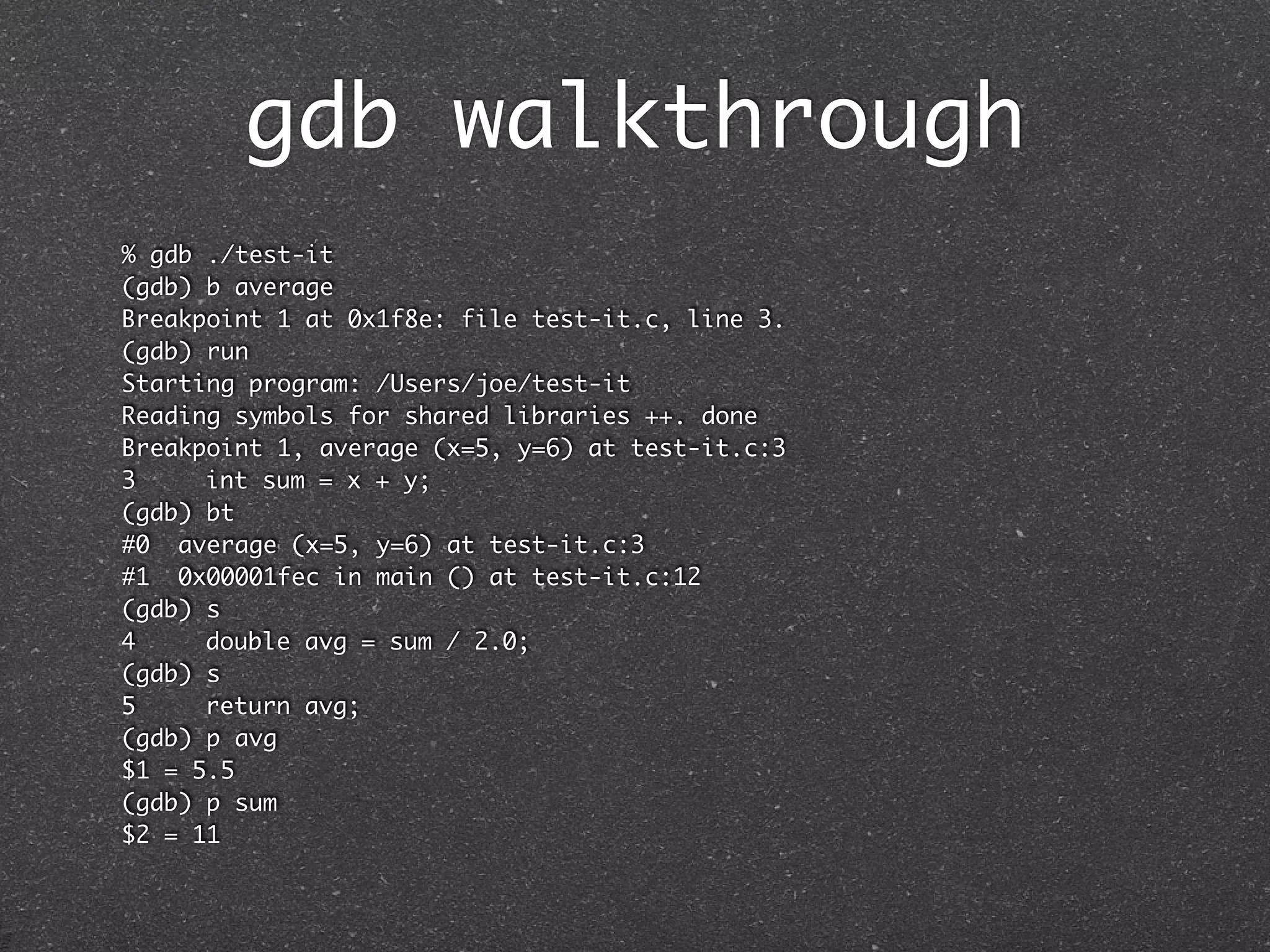
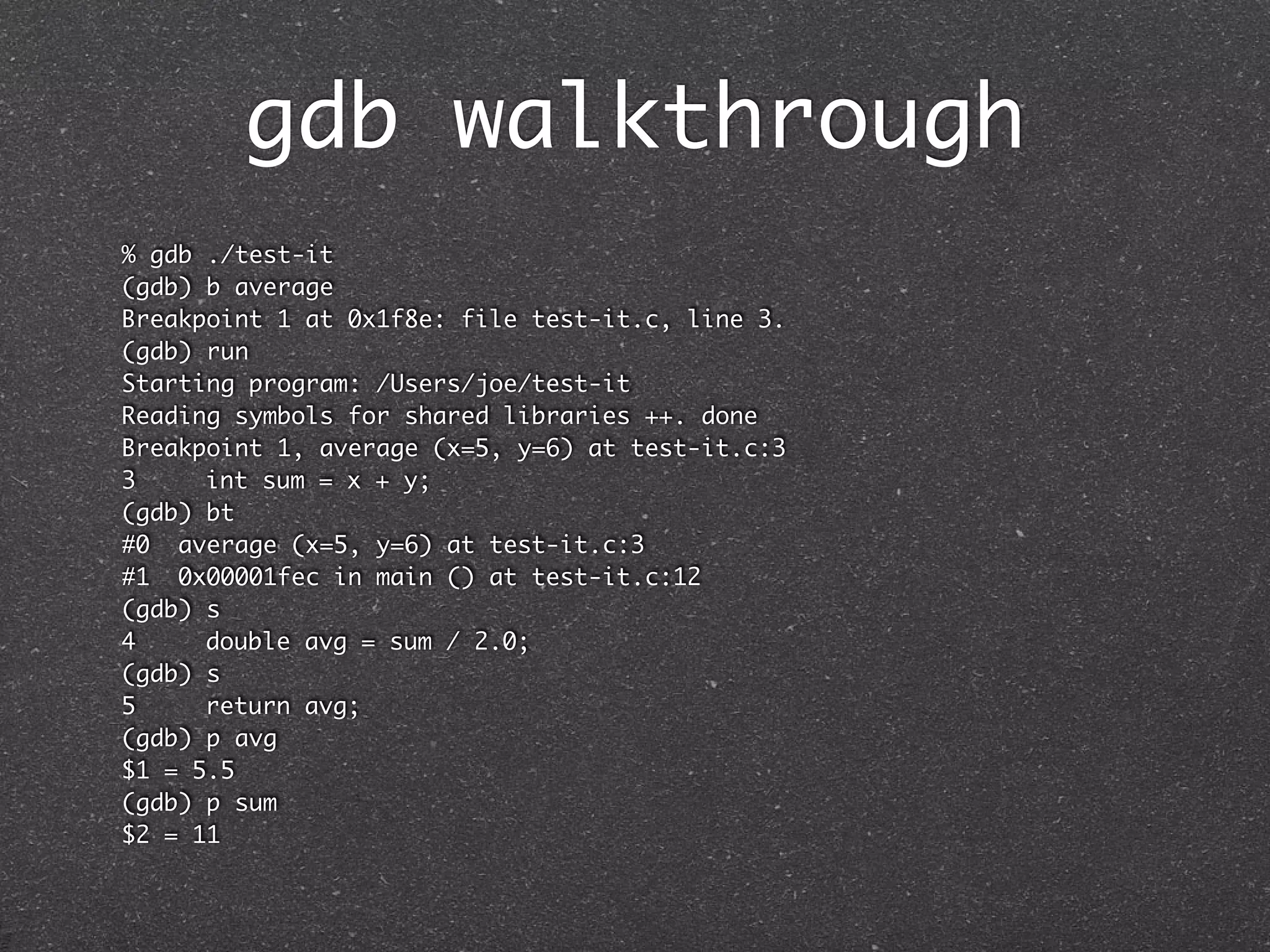
gdb walkthrough
% gdb ./test-it
(gdb) b average
Breakpoint 1 at 0x1f8e: file test-it.c, line 3.
(gdb) run
Starting program: /Users/joe/test-it
Reading symbols for shared libraries ++. done
Breakpoint 1, average (x=5, y=6) at test-it.c:3
3	    int sum = x + y;
(gdb) bt
#0 average (x=5, y=6) at test-it.c:3
#1 0x00001fec in main () at test-it.c:12
(gdb) s
4	    double avg = sum / 2.0;
(gdb) s
5	    return avg;
(gdb) p avg
$1 = 5.5
(gdb) p sum
$2 = 11
gdb walkthrough
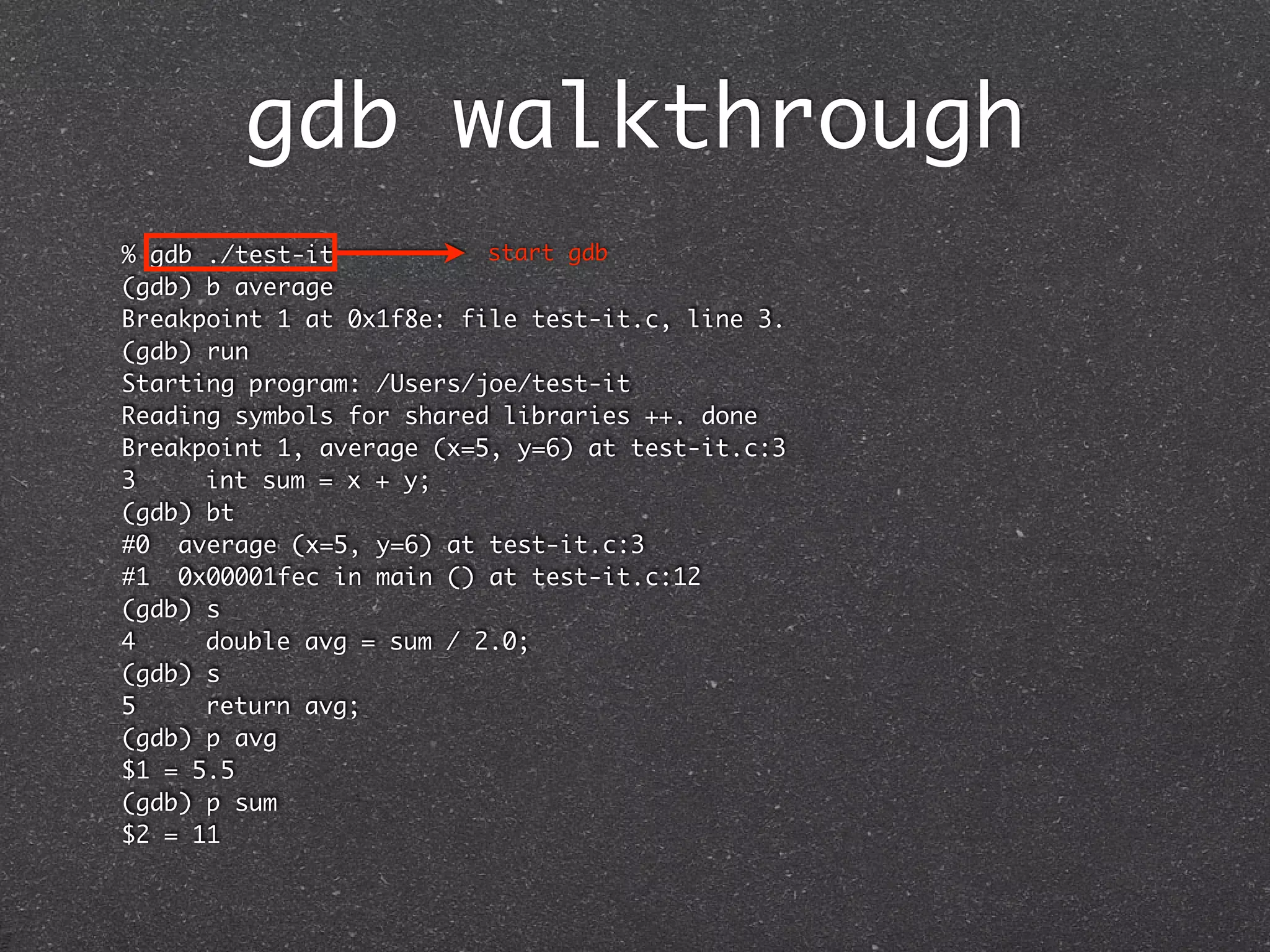
% gdb ./test-it           start gdb
(gdb) b average
Breakpoint 1 at 0x1f8e: file test-it.c, line 3.
(gdb) run
Starting program: /Users/joe/test-it
Reading symbols for shared libraries ++. done
Breakpoint 1, average (x=5, y=6) at test-it.c:3
3	    int sum = x + y;
(gdb) bt
#0 average (x=5, y=6) at test-it.c:3
#1 0x00001fec in main () at test-it.c:12
(gdb) s
4	    double avg = sum / 2.0;
(gdb) s
5	    return avg;
(gdb) p avg
$1 = 5.5
(gdb) p sum
$2 = 11
gdb walkthrough
% gdb ./test-it
(gdb) b average
Breakpoint 1 at 0x1f8e: file test-it.c, line 3.
(gdb) run
Starting program: /Users/joe/test-it
Reading symbols for shared libraries ++. done
Breakpoint 1, average (x=5, y=6) at test-it.c:3
3	    int sum = x + y;
(gdb) bt
#0 average (x=5, y=6) at test-it.c:3
#1 0x00001fec in main () at test-it.c:12
(gdb) s
4	    double avg = sum / 2.0;
(gdb) s
5	    return avg;
(gdb) p avg
$1 = 5.5
(gdb) p sum
$2 = 11
gdb walkthrough
% gdb ./test-it
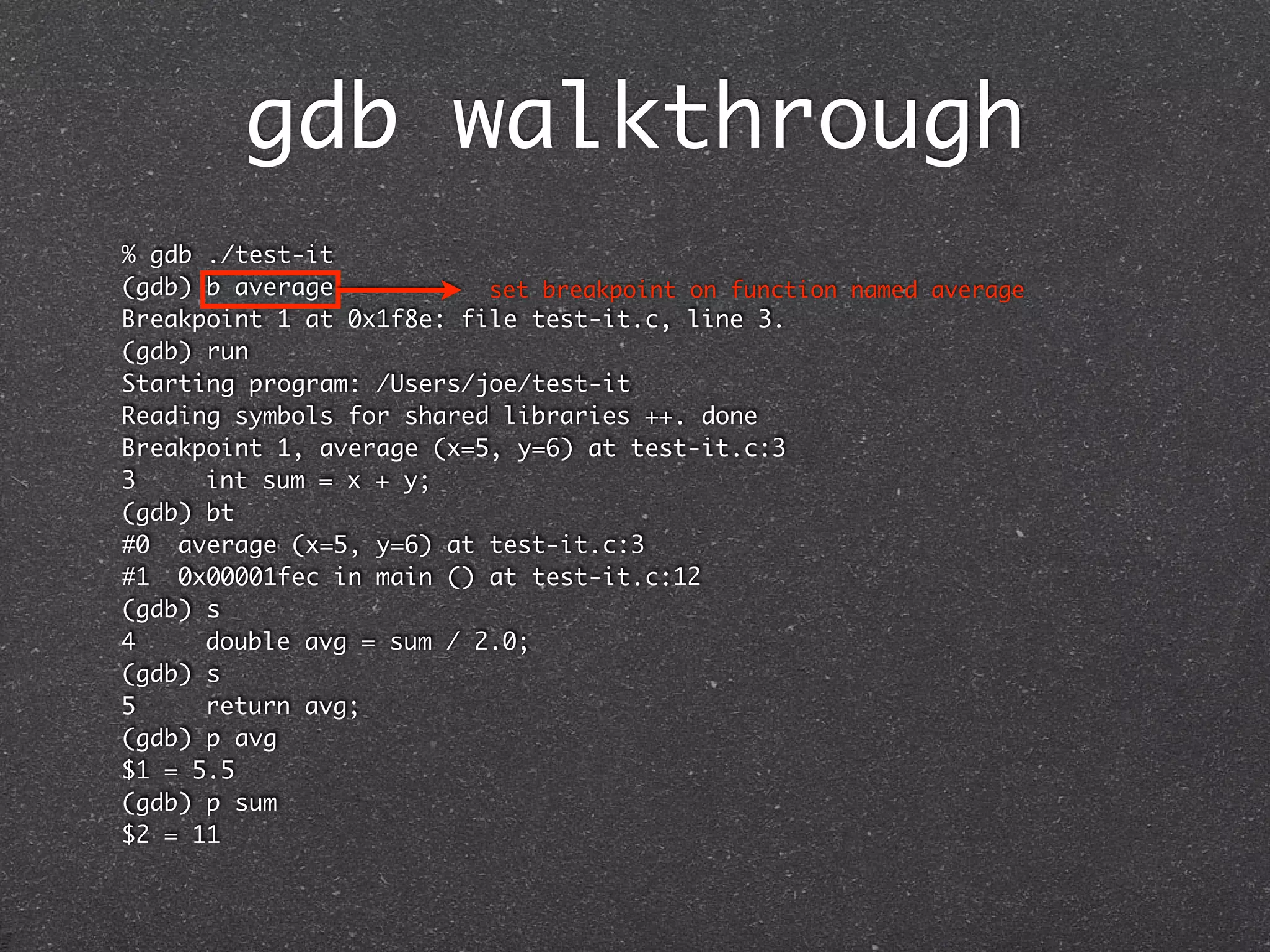
(gdb) b average           set breakpoint on function named average
Breakpoint 1 at 0x1f8e: file test-it.c, line 3.
(gdb) run
Starting program: /Users/joe/test-it
Reading symbols for shared libraries ++. done
Breakpoint 1, average (x=5, y=6) at test-it.c:3
3	    int sum = x + y;
(gdb) bt
#0 average (x=5, y=6) at test-it.c:3
#1 0x00001fec in main () at test-it.c:12
(gdb) s
4	    double avg = sum / 2.0;
(gdb) s
5	    return avg;
(gdb) p avg
$1 = 5.5
(gdb) p sum
$2 = 11
gdb walkthrough
% gdb ./test-it
(gdb) b average
Breakpoint 1 at 0x1f8e: file test-it.c, line 3.
(gdb) run
Starting program: /Users/joe/test-it
Reading symbols for shared libraries ++. done
Breakpoint 1, average (x=5, y=6) at test-it.c:3
3	    int sum = x + y;
(gdb) bt
#0 average (x=5, y=6) at test-it.c:3
#1 0x00001fec in main () at test-it.c:12
(gdb) s
4	    double avg = sum / 2.0;
(gdb) s
5	    return avg;
(gdb) p avg
$1 = 5.5
(gdb) p sum
$2 = 11
gdb walkthrough
% gdb ./test-it
(gdb) b average
Breakpoint 1 at 0x1f8e: file test-it.c, line 3.
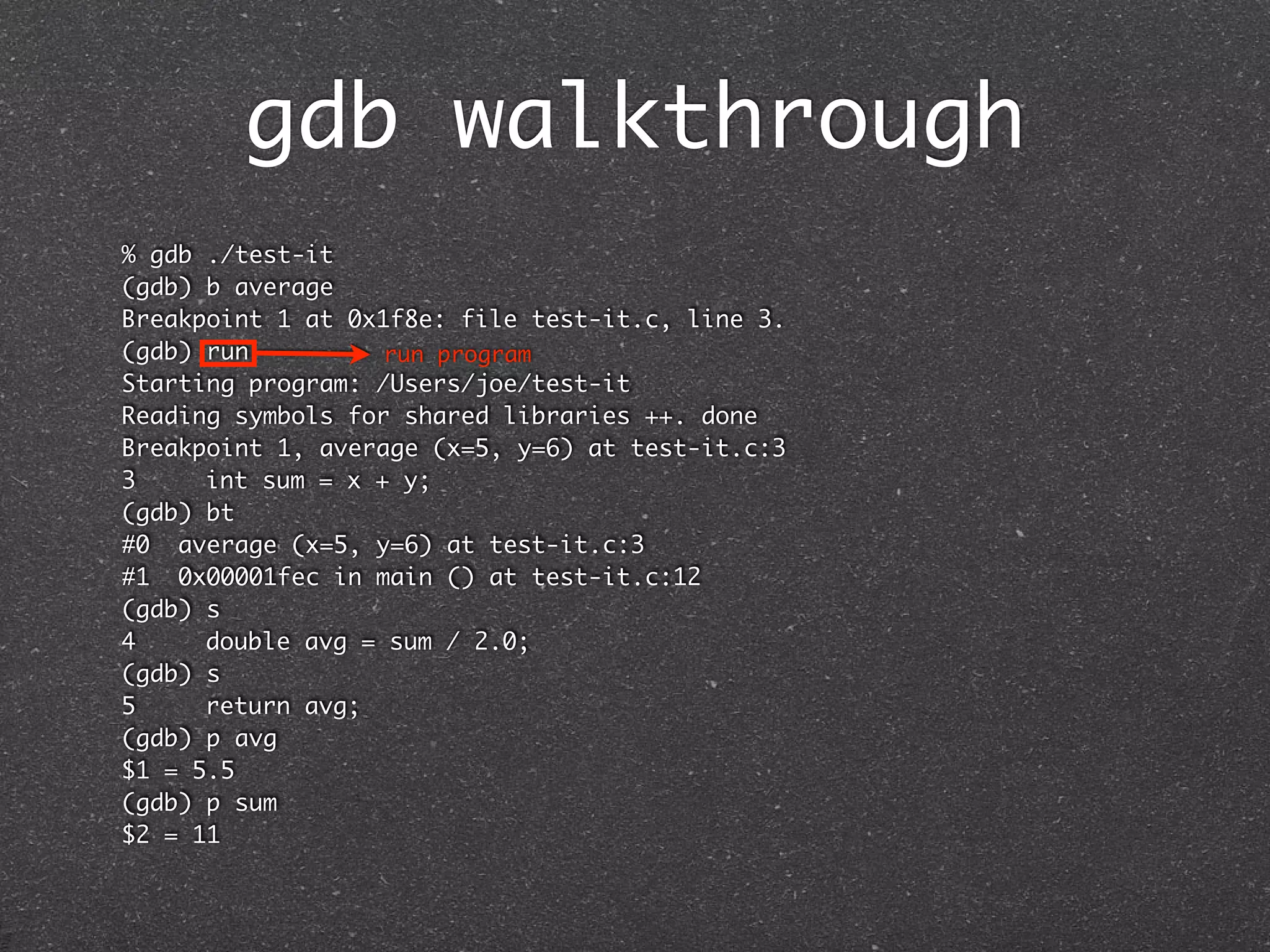
(gdb) run          run program
Starting program: /Users/joe/test-it
Reading symbols for shared libraries ++. done
Breakpoint 1, average (x=5, y=6) at test-it.c:3
3	    int sum = x + y;
(gdb) bt
#0 average (x=5, y=6) at test-it.c:3
#1 0x00001fec in main () at test-it.c:12
(gdb) s
4	    double avg = sum / 2.0;
(gdb) s
5	    return avg;
(gdb) p avg
$1 = 5.5
(gdb) p sum
$2 = 11
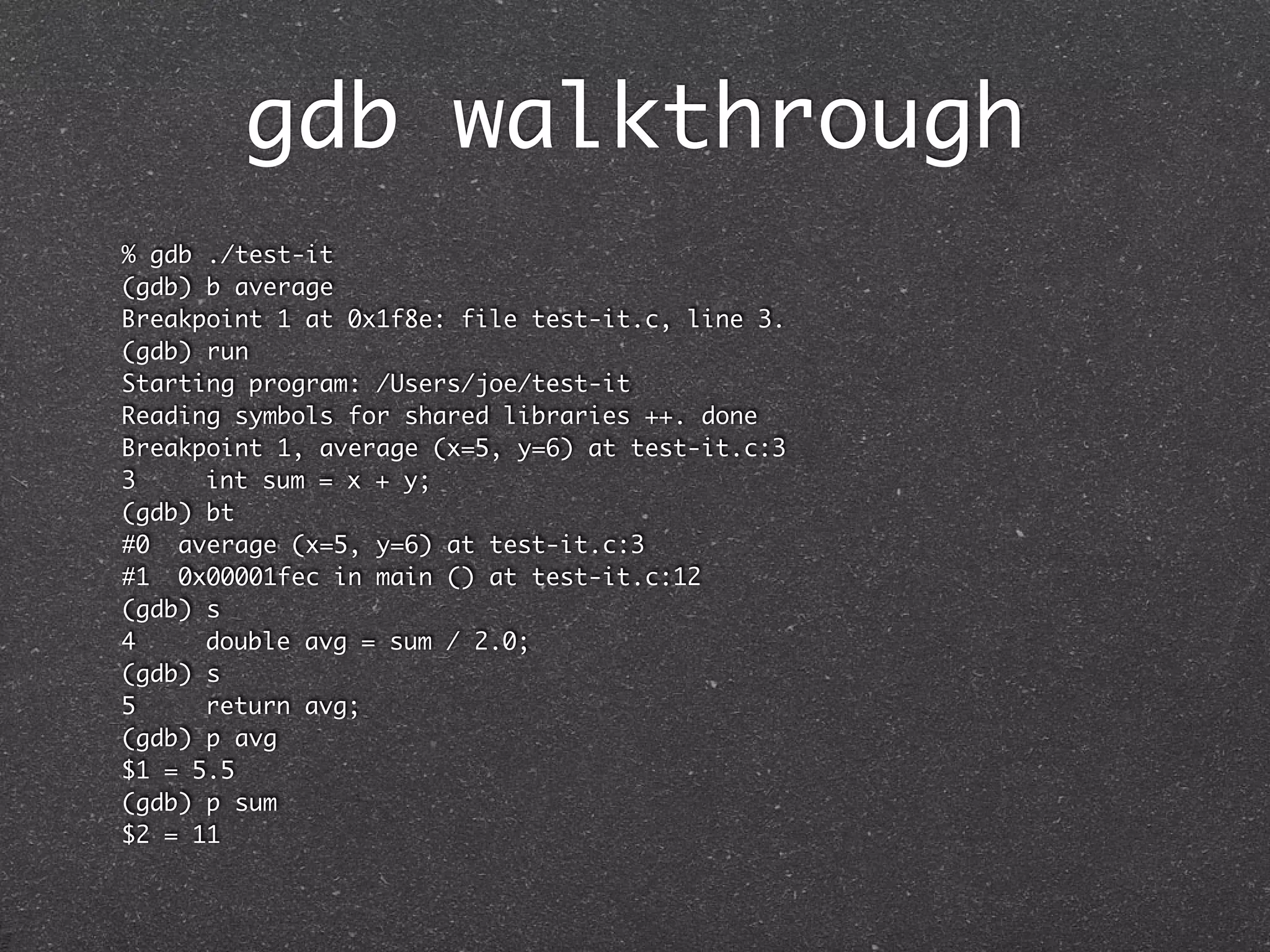
gdb walkthrough
% gdb ./test-it
(gdb) b average
Breakpoint 1 at 0x1f8e: file test-it.c, line 3.
(gdb) run
Starting program: /Users/joe/test-it
Reading symbols for shared libraries ++. done
Breakpoint 1, average (x=5, y=6) at test-it.c:3
3	    int sum = x + y;
(gdb) bt
#0 average (x=5, y=6) at test-it.c:3
#1 0x00001fec in main () at test-it.c:12
(gdb) s
4	    double avg = sum / 2.0;
(gdb) s
5	    return avg;
(gdb) p avg
$1 = 5.5
(gdb) p sum
$2 = 11
gdb walkthrough
% gdb ./test-it
(gdb) b average
Breakpoint 1 at 0x1f8e: file test-it.c, line 3.
(gdb) run
Starting program: /Users/joe/test-it
Reading symbols for shared libraries ++. done
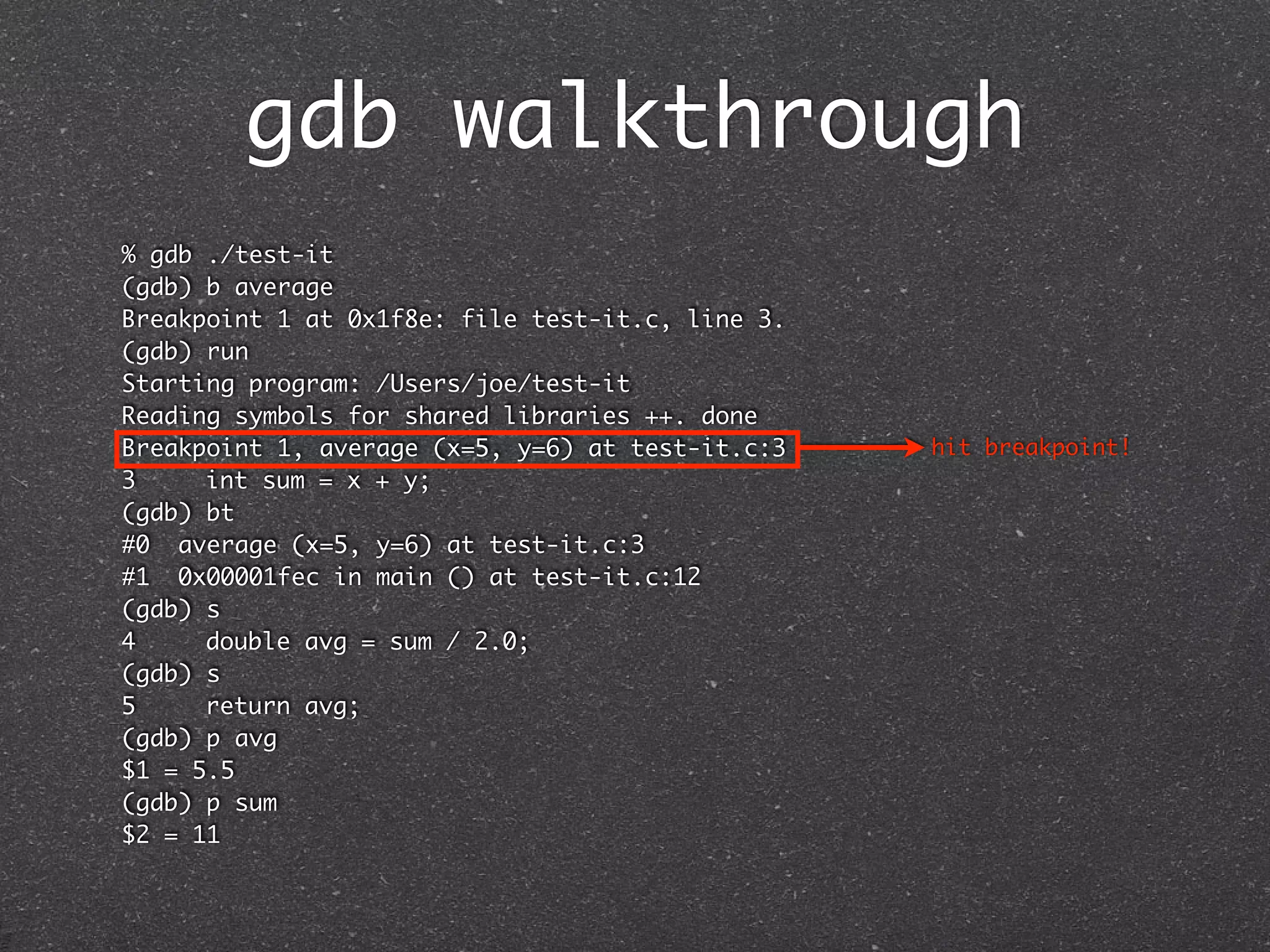
Breakpoint 1, average (x=5, y=6) at test-it.c:3   hit breakpoint!
3	    int sum = x + y;
(gdb) bt
#0 average (x=5, y=6) at test-it.c:3
#1 0x00001fec in main () at test-it.c:12
(gdb) s
4	    double avg = sum / 2.0;
(gdb) s
5	    return avg;
(gdb) p avg
$1 = 5.5
(gdb) p sum
$2 = 11
gdb walkthrough
% gdb ./test-it
(gdb) b average
Breakpoint 1 at 0x1f8e: file test-it.c, line 3.
(gdb) run
Starting program: /Users/joe/test-it
Reading symbols for shared libraries ++. done
Breakpoint 1, average (x=5, y=6) at test-it.c:3
3	    int sum = x + y;
(gdb) bt
#0 average (x=5, y=6) at test-it.c:3
#1 0x00001fec in main () at test-it.c:12
(gdb) s
4	    double avg = sum / 2.0;
(gdb) s
5	    return avg;
(gdb) p avg
$1 = 5.5
(gdb) p sum
$2 = 11
gdb walkthrough
% gdb ./test-it
(gdb) b average
Breakpoint 1 at 0x1f8e: file test-it.c, line 3.
(gdb) run
Starting program: /Users/joe/test-it
Reading symbols for shared libraries ++. done
Breakpoint 1, average (x=5, y=6) at test-it.c:3
3	    int sum = x + y;
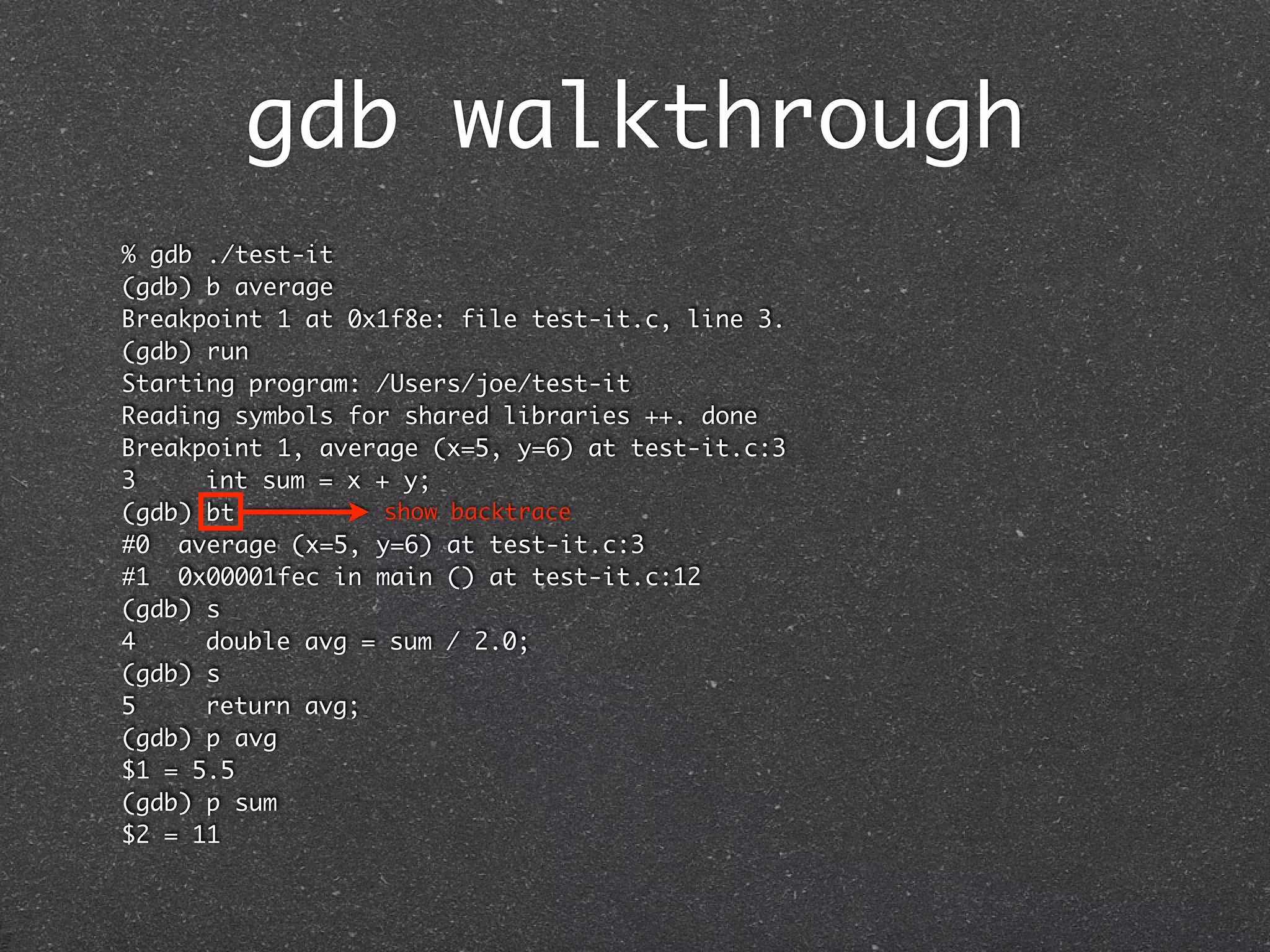
(gdb) bt           show backtrace
#0 average (x=5, y=6) at test-it.c:3
#1 0x00001fec in main () at test-it.c:12
(gdb) s
4	    double avg = sum / 2.0;
(gdb) s
5	    return avg;
(gdb) p avg
$1 = 5.5
(gdb) p sum
$2 = 11
gdb walkthrough
% gdb ./test-it
(gdb) b average
Breakpoint 1 at 0x1f8e: file test-it.c, line 3.
(gdb) run
Starting program: /Users/joe/test-it
Reading symbols for shared libraries ++. done
Breakpoint 1, average (x=5, y=6) at test-it.c:3
3	    int sum = x + y;
(gdb) bt
#0 average (x=5, y=6) at test-it.c:3
#1 0x00001fec in main () at test-it.c:12
(gdb) s
4	    double avg = sum / 2.0;
(gdb) s
5	    return avg;
(gdb) p avg
$1 = 5.5
(gdb) p sum
$2 = 11
gdb walkthrough
% gdb ./test-it
(gdb) b average
Breakpoint 1 at 0x1f8e: file test-it.c, line 3.
(gdb) run
Starting program: /Users/joe/test-it
Reading symbols for shared libraries ++. done
Breakpoint 1, average (x=5, y=6) at test-it.c:3
3	    int sum = x + y;
(gdb) bt
#0 average (x=5, y=6) at test-it.c:3
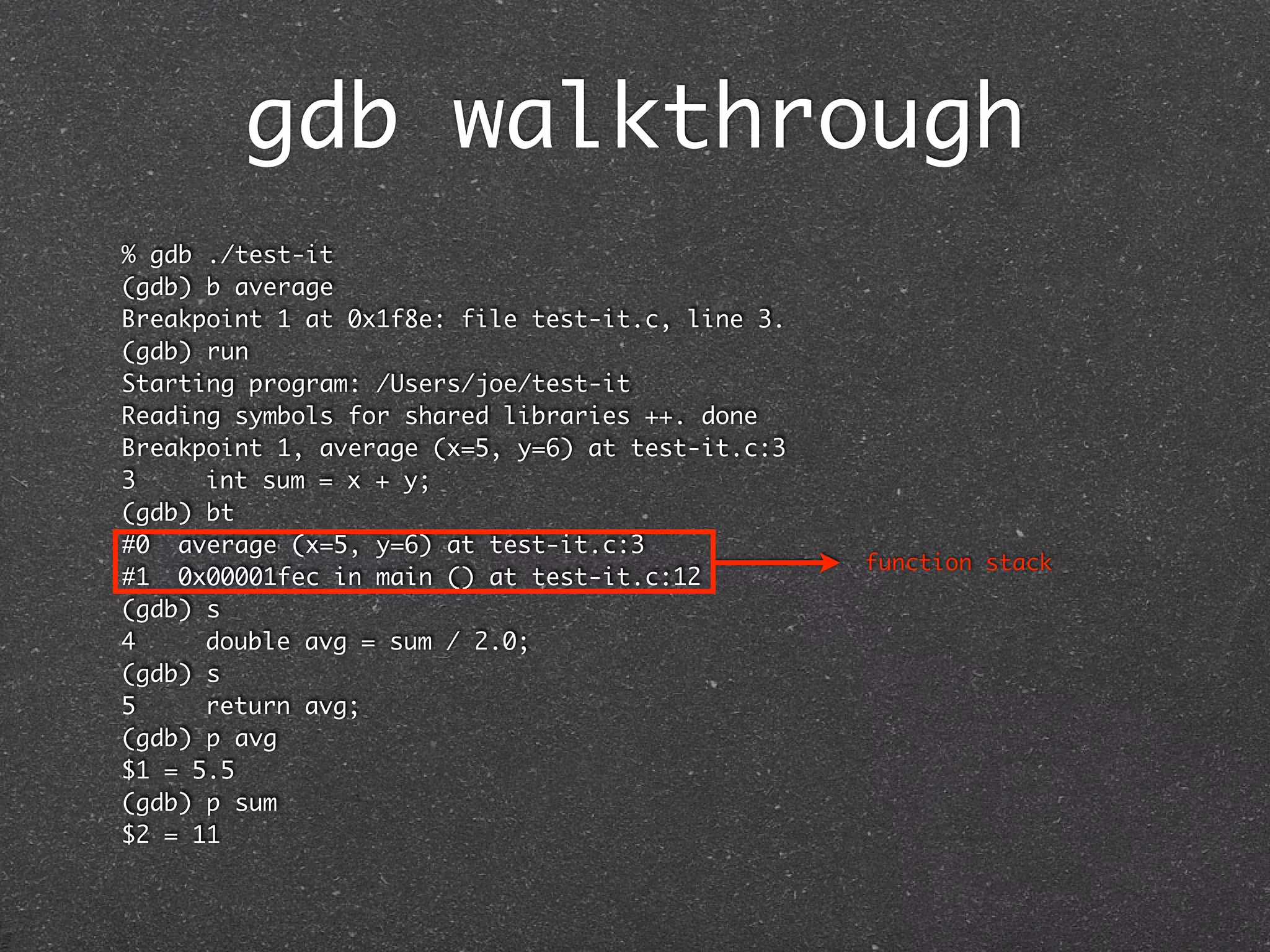
                                                  function stack
#1 0x00001fec in main () at test-it.c:12
(gdb) s
4	    double avg = sum / 2.0;
(gdb) s
5	    return avg;
(gdb) p avg
$1 = 5.5
(gdb) p sum
$2 = 11
gdb walkthrough
% gdb ./test-it
(gdb) b average
Breakpoint 1 at 0x1f8e: file test-it.c, line 3.
(gdb) run
Starting program: /Users/joe/test-it
Reading symbols for shared libraries ++. done
Breakpoint 1, average (x=5, y=6) at test-it.c:3
3	    int sum = x + y;
(gdb) bt
#0 average (x=5, y=6) at test-it.c:3
#1 0x00001fec in main () at test-it.c:12
(gdb) s
4	    double avg = sum / 2.0;
(gdb) s
5	    return avg;
(gdb) p avg
$1 = 5.5
(gdb) p sum
$2 = 11
gdb walkthrough
% gdb ./test-it
(gdb) b average
Breakpoint 1 at 0x1f8e: file test-it.c, line 3.
(gdb) run
Starting program: /Users/joe/test-it
Reading symbols for shared libraries ++. done
Breakpoint 1, average (x=5, y=6) at test-it.c:3
3	    int sum = x + y;
(gdb) bt
#0 average (x=5, y=6) at test-it.c:3
#1 0x00001fec in main () at test-it.c:12
(gdb) s
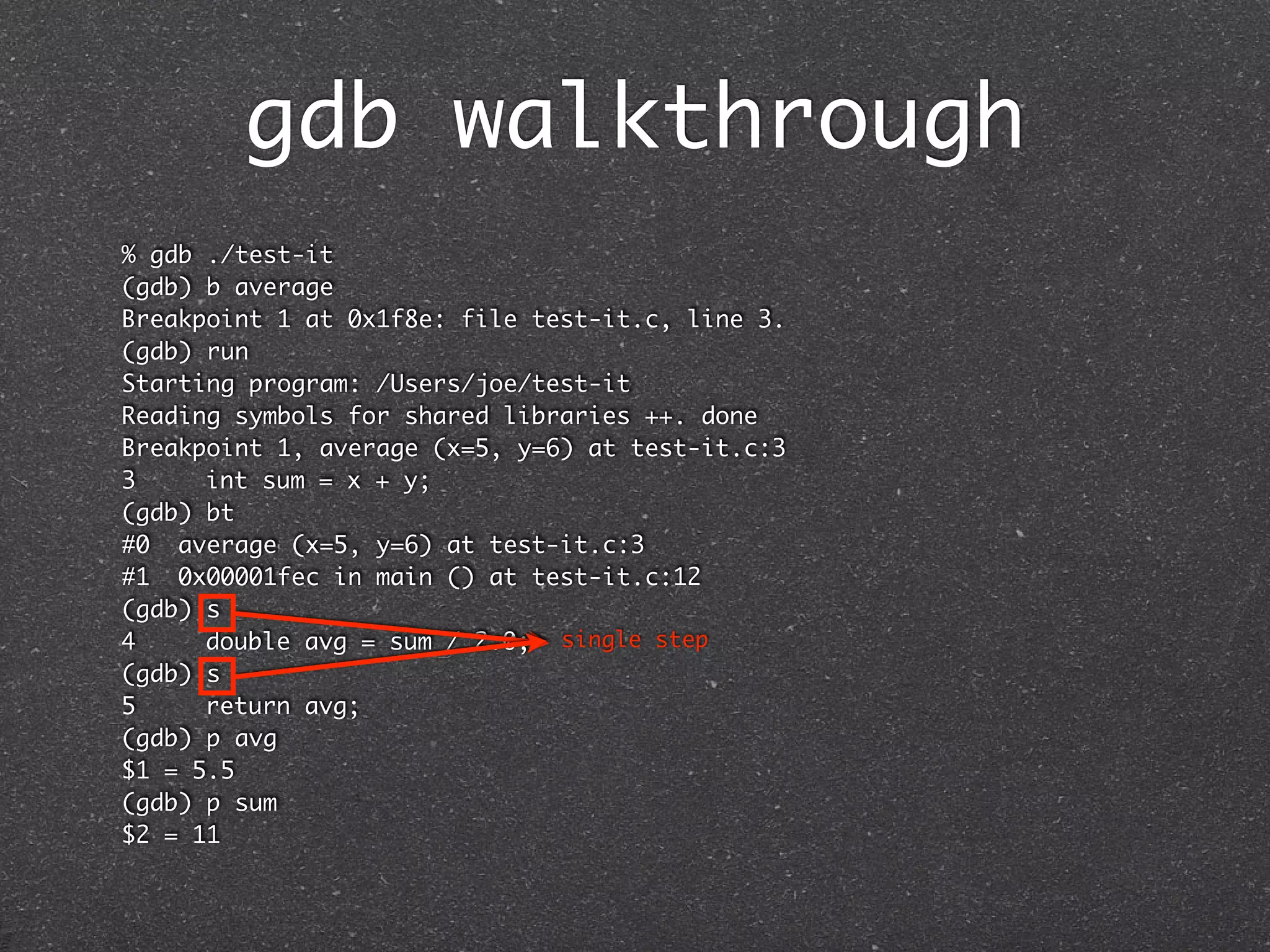
4	    double avg = sum / 2.0; single step
(gdb) s
5	    return avg;
(gdb) p avg
$1 = 5.5
(gdb) p sum
$2 = 11
gdb walkthrough
% gdb ./test-it
(gdb) b average
Breakpoint 1 at 0x1f8e: file test-it.c, line 3.
(gdb) run
Starting program: /Users/joe/test-it
Reading symbols for shared libraries ++. done
Breakpoint 1, average (x=5, y=6) at test-it.c:3
3	    int sum = x + y;
(gdb) bt
#0 average (x=5, y=6) at test-it.c:3
#1 0x00001fec in main () at test-it.c:12
(gdb) s
4	    double avg = sum / 2.0;
(gdb) s
5	    return avg;
(gdb) p avg
$1 = 5.5
(gdb) p sum
$2 = 11
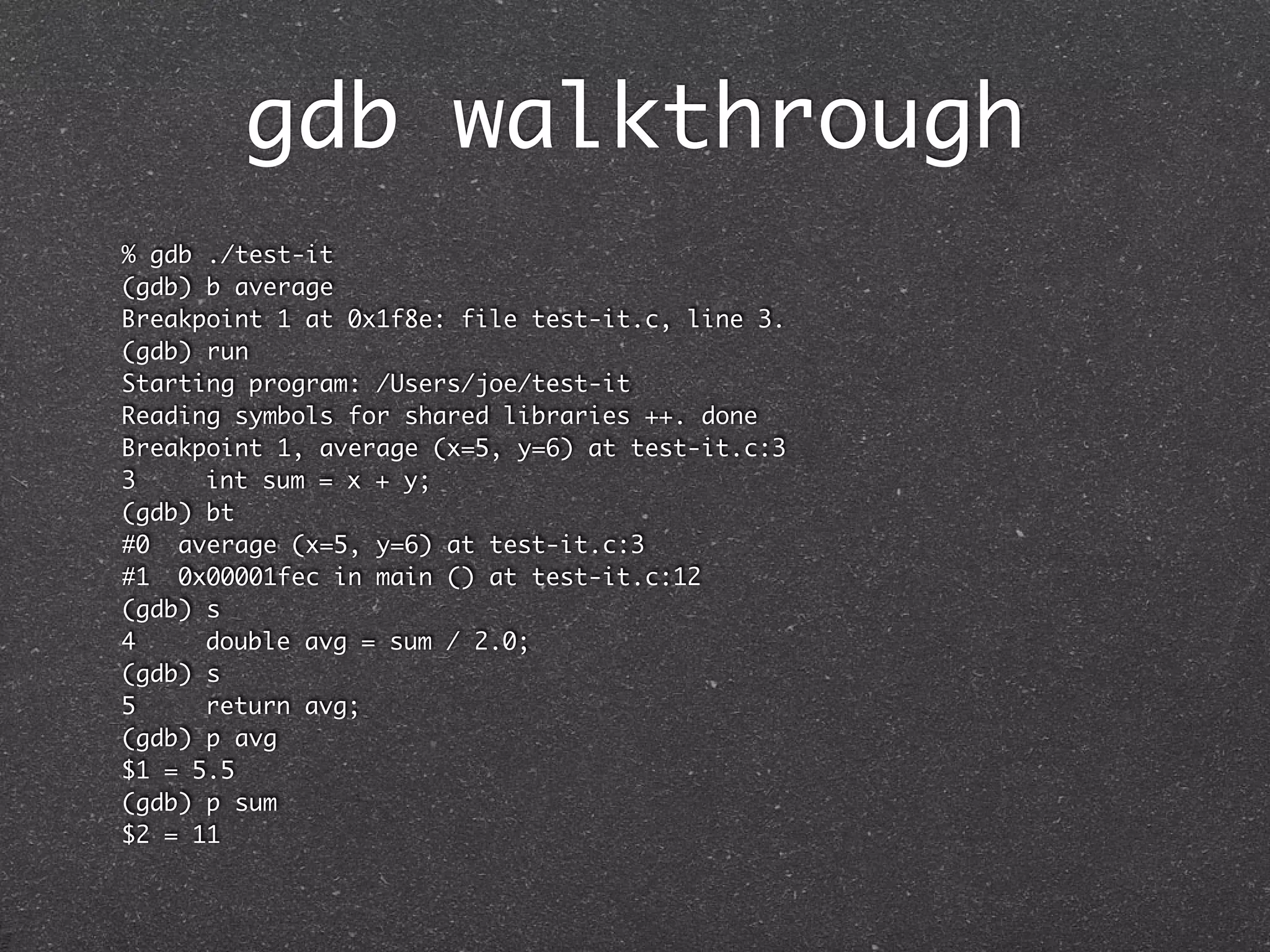
gdb walkthrough
% gdb ./test-it
(gdb) b average
Breakpoint 1 at 0x1f8e: file test-it.c, line 3.
(gdb) run
Starting program: /Users/joe/test-it
Reading symbols for shared libraries ++. done
Breakpoint 1, average (x=5, y=6) at test-it.c:3
3	    int sum = x + y;
(gdb) bt
#0 average (x=5, y=6) at test-it.c:3
#1 0x00001fec in main () at test-it.c:12
(gdb) s
4	    double avg = sum / 2.0;
(gdb) s
5	    return avg;
(gdb) p avg
$1 = 5.5                          print variables
(gdb) p sum
$2 = 11
gdb walkthrough
% gdb ./test-it
(gdb) b average
Breakpoint 1 at 0x1f8e: file test-it.c, line 3.
(gdb) run
Starting program: /Users/joe/test-it
Reading symbols for shared libraries ++. done
Breakpoint 1, average (x=5, y=6) at test-it.c:3
3	    int sum = x + y;
(gdb) bt
#0 average (x=5, y=6) at test-it.c:3
#1 0x00001fec in main () at test-it.c:12
(gdb) s
4	    double avg = sum / 2.0;
(gdb) s
5	    return avg;
(gdb) p avg
$1 = 5.5
(gdb) p sum
$2 = 11
What’s on the ruby stack?
(gdb) where
#0 0x0002a55e in rb_call (klass=1386800, recv=5056455, mid=42, argc=1, argv=0xbfffe5c0,
scope=0, self=1403220) at eval.c:6125
#1 0x000226ef in rb_eval (self=1403220, n=0x1461e4) at eval.c:3493
#2 0x00026d01 in rb_yield_0 (val=5056455, self=1403220, klass=0, flags=0, avalue=0) at
eval.c:5083
#3 0x000270e8 in rb_yield (val=5056455) at eval.c:5168
#4 0x0005c30c in int_dotimes (num=1000000001) at numeric.c:2946
#5 0x00029be3 in call_cfunc (func=0x5c2a0 <int_dotimes>, recv=1000000001, len=0, argc=0,
argv=0x0) at eval.c:5759
#6 0x00028fd4 in rb_call0 (klass=1387580, recv=1000000001, id=5785, oid=5785, argc=0,
argv=0x0, body=0x152b24, flags=0) at eval.c:5911
#7 0x0002a7a7 in rb_call (klass=1387580, recv=1000000001, mid=5785, argc=0, argv=0x0,
scope=0, self=1403220) at eval.c:6158
#8 0x000226ef in rb_eval (self=1403220, n=0x146284) at eval.c:3493
#9 0x000213e3 in rb_eval (self=1403220, n=0x1461a8) at eval.c:3223
#10 0x0001ceea in eval_node (self=1403220, node=0x1461a8) at eval.c:1437
#11 0x0001d60f in ruby_exec_internal () at eval.c:1642
#12 0x0001d660 in ruby_exec () at eval.c:1662
#13 0x0001d68e in ruby_run () at eval.c:1672
#14 0x000023dc in main (argc=2, argv=0xbffff7c4, envp=0xbffff7d0) at main.c:48
What’s on the ruby stack?
(gdb) where
#0 0x0002a55e in rb_call (klass=1386800, recv=5056455, mid=42, argc=1, argv=0xbfffe5c0,
scope=0, self=1403220) at eval.c:6125
#1 0x000226ef in rb_eval (self=1403220, n=0x1461e4) at eval.c:3493
#2 0x00026d01 in rb_yield_0 (val=5056455, self=1403220, klass=0, flags=0, avalue=0) at
eval.c:5083
#3 0x000270e8 in rb_yield (val=5056455) at eval.c:5168
#4 0x0005c30c in int_dotimes (num=1000000001) at numeric.c:2946
#5 0x00029be3 in call_cfunc (func=0x5c2a0 <int_dotimes>, recv=1000000001, len=0, argc=0,
argv=0x0) at eval.c:5759
#6 0x00028fd4 in rb_call0 (klass=1387580, recv=1000000001, id=5785, oid=5785, argc=0,
argv=0x0, body=0x152b24, flags=0) at eval.c:5911
#7 0x0002a7a7 in rb_call (klass=1387580, recv=1000000001, mid=5785, argc=0, argv=0x0,
scope=0, self=1403220) at eval.c:6158
#8 0x000226ef in rb_eval (self=1403220, n=0x146284) at eval.c:3493
#9 0x000213e3 in rb_eval (self=1403220, n=0x1461a8) at eval.c:3223
#10 0x0001ceea in eval_node (self=1403220, node=0x1461a8) at eval.c:1437
#11 0x0001d60f in ruby_exec_internal () at eval.c:1642
#12 0x0001d660 in ruby_exec () at eval.c:1662
#13 0x0001d68e in ruby_run () at eval.c:1672
#14 0x000023dc in main (argc=2, argv=0xbffff7c4, envp=0xbffff7d0) at main.c:48
What’s on the ruby stack?
(gdb) where
#0 0x0002a55e in rb_call (klass=1386800, recv=5056455, mid=42, argc=1, argv=0xbfffe5c0,
scope=0, self=1403220) at eval.c:6125
#1 0x000226ef in rb_eval (self=1403220, n=0x1461e4) at eval.c:3493
#2 0x00026d01 in rb_yield_0 (val=5056455, self=1403220, klass=0, flags=0, avalue=0) at
eval.c:5083
#3 0x000270e8 in rb_yield (val=5056455) at eval.c:5168
#4 0x0005c30c in int_dotimes (num=1000000001) at numeric.c:2946
#5 0x00029be3 in call_cfunc (func=0x5c2a0 <int_dotimes>, recv=1000000001, len=0, argc=0,
argv=0x0) at eval.c:5759
#6 0x00028fd4 in rb_call0 (klass=1387580, recv=1000000001, id=5785, oid=5785, argc=0,
argv=0x0, body=0x152b24, flags=0) at eval.c:5911
#7 0x0002a7a7 in rb_call (klass=1387580, recv=1000000001, mid=5785, argc=0, argv=0x0,
scope=0, self=1403220) at eval.c:6158
#8 0x000226ef in rb_eval (self=1403220, n=0x146284) at eval.c:3493
#9 0x000213e3 in rb_eval (self=1403220, n=0x1461a8) at eval.c:3223
#10 0x0001ceea in eval_node (self=1403220, node=0x1461a8) at eval.c:1437
#11 0x0001d60f in ruby_exec_internal () at eval.c:1642
#12 0x0001d660 in ruby_exec () at eval.c:1662
#13 0x0001d68e in ruby_run () at eval.c:1672
#14 0x000023dc in main (argc=2, argv=0xbffff7c4, envp=0xbffff7d0) at main.c:48
What’s on the ruby stack?
(gdb) where
#0 0x0002a55e in rb_call (klass=1386800, recv=5056455, mid=42, argc=1, argv=0xbfffe5c0,
scope=0, self=1403220) at eval.c:6125
#1 0x000226ef in rb_eval (self=1403220, n=0x1461e4) at eval.c:3493
#2 0x00026d01 in rb_yield_0 (val=5056455, self=1403220, klass=0, flags=0, avalue=0) at
eval.c:5083
#3 0x000270e8 in rb_yield (val=5056455) at eval.c:5168
#4 0x0005c30c in int_dotimes (num=1000000001) at numeric.c:2946
#5 0x00029be3 in call_cfunc (func=0x5c2a0 <int_dotimes>, recv=1000000001, len=0, argc=0,
argv=0x0) at eval.c:5759
#6 0x00028fd4 in rb_call0 (klass=1387580, recv=1000000001, id=5785, oid=5785, argc=0,
argv=0x0, body=0x152b24, flags=0) at eval.c:5911
#7 0x0002a7a7 in rb_call (klass=1387580, recv=1000000001, mid=5785, argc=0, argv=0x0,
scope=0, self=1403220) at eval.c:6158
#8 0x000226ef in rb_eval (self=1403220, n=0x146284) at eval.c:3493
#9 0x000213e3 in rb_eval (self=1403220, n=0x1461a8) at eval.c:3223
#10 0x0001ceea in eval_node (self=1403220, node=0x1461a8) at eval.c:1437
#11 0x0001d60f in ruby_exec_internal () at eval.c:1642
#12 0x0001d660 in ruby_exec () at eval.c:1662
#13 0x0001d68e in ruby_run () at eval.c:1672
#14 0x000023dc in main (argc=2, argv=0xbffff7c4, envp=0xbffff7d0) at main.c:48
What’s on the ruby stack?
(gdb) where
#0 0x0002a55e in rb_call (klass=1386800, recv=5056455, mid=42, argc=1, argv=0xbfffe5c0,
scope=0, self=1403220) at eval.c:6125
#1 0x000226ef in rb_eval (self=1403220, n=0x1461e4) at eval.c:3493
#2 0x00026d01 in rb_yield_0 (val=5056455, self=1403220, klass=0, flags=0, avalue=0) at
eval.c:5083
#3 0x000270e8 in rb_yield (val=5056455) at eval.c:5168
#4 0x0005c30c in int_dotimes (num=1000000001) at numeric.c:2946
#5 0x00029be3 in call_cfunc (func=0x5c2a0 <int_dotimes>, recv=1000000001, len=0, argc=0,
argv=0x0) at eval.c:5759
#6 0x00028fd4 in rb_call0 (klass=1387580, recv=1000000001, id=5785, oid=5785, argc=0,
argv=0x0, body=0x152b24, flags=0) at eval.c:5911
#7 0x0002a7a7 in rb_call (klass=1387580, recv=1000000001, mid=5785, argc=0, argv=0x0,
scope=0, self=1403220) at eval.c:6158
#8 0x000226ef in rb_eval (self=1403220, n=0x146284) at eval.c:3493
#9 0x000213e3 in rb_eval (self=1403220, n=0x1461a8) at eval.c:3223
#10 0x0001ceea in eval_node (self=1403220, node=0x1461a8) at eval.c:1437
#11 0x0001d60f in ruby_exec_internal () at eval.c:1642
#12 0x0001d660 in ruby_exec () at eval.c:1662
#13 0x0001d68e in ruby_run () at eval.c:1672
#14 0x000023dc in main (argc=2, argv=0xbffff7c4, envp=0xbffff7d0) at main.c:48
What’s on the ruby stack?
(gdb) where
#0 0x0002a55e in rb_call (klass=1386800, recv=5056455, mid=42, argc=1, argv=0xbfffe5c0,
scope=0, self=1403220) at eval.c:6125
#1 0x000226ef in rb_eval (self=1403220, n=0x1461e4) at eval.c:3493
#2 0x00026d01 in rb_yield_0 (val=5056455, self=1403220, klass=0, flags=0, avalue=0) at
eval.c:5083
#3 0x000270e8 in rb_yield (val=5056455) at eval.c:5168
#4 0x0005c30c in int_dotimes (num=1000000001) at numeric.c:2946
#5 0x00029be3 in call_cfunc (func=0x5c2a0 <int_dotimes>, recv=1000000001, len=0, argc=0,
argv=0x0) at eval.c:5759
#6 0x00028fd4 in rb_call0 (klass=1387580, recv=1000000001, id=5785, oid=5785, argc=0,
argv=0x0, body=0x152b24, flags=0) at eval.c:5911
#7 0x0002a7a7 in rb_call (klass=1387580, recv=1000000001, mid=5785, argc=0, argv=0x0,
scope=0, self=1403220) at eval.c:6158
#8 0x000226ef in rb_eval (self=1403220, n=0x146284) at eval.c:3493
#9 0x000213e3 in rb_eval (self=1403220, n=0x1461a8) at eval.c:3223
#10 0x0001ceea in eval_node (self=1403220, node=0x1461a8) at eval.c:1437
#11 0x0001d60f in ruby_exec_internal () at eval.c:1642
#12 0x0001d660 in ruby_exec () at eval.c:1662
#13 0x0001d68e in ruby_run () at eval.c:1672
#14 0x000023dc in main (argc=2, argv=0xbffff7c4, envp=0xbffff7d0) at main.c:48
What’s on the ruby stack?
(gdb) where
#0 0x0002a55e in rb_call (klass=1386800, recv=5056455, mid=42, argc=1, argv=0xbfffe5c0,
scope=0, self=1403220) at eval.c:6125
#1 0x000226ef in rb_eval (self=1403220, n=0x1461e4) at eval.c:3493
#2 0x00026d01 in rb_yield_0 (val=5056455, self=1403220, klass=0, flags=0, avalue=0) at
eval.c:5083
#3 0x000270e8 in rb_yield (val=5056455) at eval.c:5168
#4 0x0005c30c in int_dotimes (num=1000000001) at numeric.c:2946
#5 0x00029be3 in call_cfunc (func=0x5c2a0 <int_dotimes>, recv=1000000001, len=0, argc=0,
argv=0x0) at eval.c:5759
#6 0x00028fd4 in rb_call0 (klass=1387580, recv=1000000001, id=5785, oid=5785, argc=0,
argv=0x0, body=0x152b24, flags=0) at eval.c:5911
#7 0x0002a7a7 in rb_call (klass=1387580, recv=1000000001, mid=5785, argc=0, argv=0x0,
scope=0, self=1403220) at eval.c:6158
#8 0x000226ef in rb_eval (self=1403220, n=0x146284) at eval.c:3493
#9 0x000213e3 in rb_eval (self=1403220, n=0x1461a8) at eval.c:3223
#10 0x0001ceea in eval_node (self=1403220, node=0x1461a8) at eval.c:1437
#11 0x0001d60f in ruby_exec_internal () at eval.c:1642
#12 0x0001d660 in ruby_exec () at eval.c:1662
#13 0x0001d68e in ruby_run () at eval.c:1672
#14 0x000023dc in main (argc=2, argv=0xbffff7c4, envp=0xbffff7d0) at main.c:48
What’s on the ruby stack?
(gdb) where
#0 0x0002a55e in rb_call (klass=1386800, recv=5056455, mid=42, argc=1, argv=0xbfffe5c0,
scope=0, self=1403220) at eval.c:6125
#1 0x000226ef in rb_eval (self=1403220, n=0x1461e4) at eval.c:3493
#2 0x00026d01 in rb_yield_0 (val=5056455, self=1403220, klass=0, flags=0, avalue=0) at
eval.c:5083
#3 0x000270e8 in rb_yield (val=5056455) at eval.c:5168
#4 0x0005c30c in int_dotimes (num=1000000001) at numeric.c:2946
#5 0x00029be3 in call_cfunc (func=0x5c2a0 <int_dotimes>, recv=1000000001, len=0, argc=0,
argv=0x0) at eval.c:5759
#6 0x00028fd4 in rb_call0 (klass=1387580, recv=1000000001, id=5785, oid=5785, argc=0,
argv=0x0, body=0x152b24, flags=0) at eval.c:5911
#7 0x0002a7a7 in rb_call (klass=1387580, recv=1000000001, mid=5785, argc=0, argv=0x0,
scope=0, self=1403220) at eval.c:6158
#8 0x000226ef in rb_eval (self=1403220, n=0x146284) at eval.c:3493
#9 0x000213e3 in rb_eval (self=1403220, n=0x1461a8) at eval.c:3223
#10 0x0001ceea in eval_node (self=1403220, node=0x1461a8) at eval.c:1437
#11 0x0001d60f in ruby_exec_internal () at eval.c:1642
#12 0x0001d660 in ruby_exec () at eval.c:1662
#13 0x0001d68e in ruby_run () at eval.c:1672
#14 0x000023dc in main (argc=2, argv=0xbffff7c4, envp=0xbffff7d0) at main.c:48
What’s on the ruby stack?
(gdb) where
#0 0x0002a55e in rb_call (klass=1386800, recv=5056455, mid=42, argc=1, argv=0xbfffe5c0,
scope=0, self=1403220) at eval.c:6125
#1 0x000226ef in rb_eval (self=1403220, n=0x1461e4) at eval.c:3493
#2 0x00026d01 in rb_yield_0 (val=5056455, self=1403220, klass=0, flags=0, avalue=0) at
eval.c:5083
#3 0x000270e8 in rb_yield (val=5056455) at eval.c:5168
#4 0x0005c30c in int_dotimes (num=1000000001) at numeric.c:2946
#5 0x00029be3 in call_cfunc (func=0x5c2a0 <int_dotimes>, recv=1000000001, len=0, argc=0,
argv=0x0) at eval.c:5759
#6 0x00028fd4 in rb_call0 (klass=1387580, recv=1000000001, id=5785, oid=5785, argc=0,
argv=0x0, body=0x152b24, flags=0) at eval.c:5911
#7 0x0002a7a7 in rb_call (klass=1387580, recv=1000000001, mid=5785, argc=0, argv=0x0,
scope=0, self=1403220) at eval.c:6158
#8 0x000226ef in rb_eval (self=1403220, n=0x146284) at eval.c:3493
#9 0x000213e3 in rb_eval (self=1403220, n=0x1461a8) at eval.c:3223
#10 0x0001ceea in eval_node (self=1403220, node=0x1461a8) at eval.c:1437
#11 0x0001d60f in ruby_exec_internal () at eval.c:1642
#12 0x0001d660 in ruby_exec () at eval.c:1662
#13 0x0001d68e in ruby_run () at eval.c:1672
#14 0x000023dc in main (argc=2, argv=0xbffff7c4, envp=0xbffff7d0) at main.c:48
What’s on the ruby stack?
(gdb) where
#0 0x0002a55e in rb_call (klass=1386800, recv=5056455, mid=42, argc=1, argv=0xbfffe5c0,
scope=0, self=1403220) at eval.c:6125
#1 0x000226ef in rb_eval (self=1403220, n=0x1461e4) at eval.c:3493
#2 0x00026d01 in rb_yield_0 (val=5056455, self=1403220, klass=0, flags=0, avalue=0) at
eval.c:5083
#3 0x000270e8 in rb_yield (val=5056455) at eval.c:5168
#4 0x0005c30c in int_dotimes (num=1000000001) at numeric.c:2946
#5 0x00029be3 in call_cfunc (func=0x5c2a0 <int_dotimes>, recv=1000000001, len=0, argc=0,
argv=0x0) at eval.c:5759
#6 0x00028fd4 in rb_call0 (klass=1387580, recv=1000000001, id=5785, oid=5785, argc=0,
argv=0x0, body=0x152b24, flags=0) at eval.c:5911
#7 0x0002a7a7 in rb_call (klass=1387580, recv=1000000001, mid=5785, argc=0, argv=0x0,
scope=0, self=1403220) at eval.c:6158
#8 0x000226ef in rb_eval (self=1403220, n=0x146284) at eval.c:3493
#9 0x000213e3 in rb_eval (self=1403220, n=0x1461a8) at eval.c:3223
#10 0x0001ceea in eval_node (self=1403220, node=0x1461a8) at eval.c:1437
#11 0x0001d60f in ruby_exec_internal () at eval.c:1642
#12 0x0001d660 in ruby_exec () at eval.c:1662
#13 0x0001d68e in ruby_run () at eval.c:1672
#14 0x000023dc in main (argc=2, argv=0xbffff7c4, envp=0xbffff7d0) at main.c:48


rb_eval recursively executes ruby code in 1.8
How big is the stack?
#8   rb_eval at eval.c:3493

(gdb) p $ebp - $esp
$1 = 968
How big is the stack?
#8   rb_eval at eval.c:3493

(gdb) p $ebp - $esp     base - stack ptr = frame size

$1 = 968
How big is the stack?
#8   rb_eval at eval.c:3493

(gdb) p $ebp - $esp         base - stack ptr = frame size

$1 = 968          each   rb_eval stack frame is almost 1k!
How big is the stack?
#8   rb_eval at eval.c:3493

(gdb) p $ebp - $esp         base - stack ptr = frame size

$1 = 968          each   rb_eval stack frame is almost 1k!


#0   rb_thread_save_context at eval.c:10597

(gdb) p (void*)rb_gc_stack_start - $esp
$1 = 10572
How big is the stack?
#8   rb_eval at eval.c:3493

(gdb) p $ebp - $esp          base - stack ptr = frame size

$1 = 968          each    rb_eval stack frame is almost 1k!


#0   rb_thread_save_context at eval.c:10597

(gdb) p (void*)rb_gc_stack_start - $esp
$1 = 10572             10.5k stack will be memcpy()’d
How big is the stack?
#8   rb_eval at eval.c:3493

(gdb) p $ebp - $esp          base - stack ptr = frame size

$1 = 968          each    rb_eval stack frame is almost 1k!


#0   rb_thread_save_context at eval.c:10597

(gdb) p (void*)rb_gc_stack_start - $esp
$1 = 10572             10.5k stack will be memcpy()’d


 50 method calls * 1k ≈ 50k stack
Recap: How do Ruby threads work?

 Each thread has it’s own execution context:

   saved cpu registers (setjmp/longjmp)

   copy of vm globals (current frame, scope, block)

   stack (memcpy)
Recap: How do Ruby threads work?

 Each thread has it’s own execution context:

   saved cpu registers (setjmp/longjmp)

   copy of vm globals (current frame, scope, block)

   stack (memcpy)

 How does Ruby switch between threads?

   Thread executes until time is up (SIGVTALRM)

   rb_thread_save_context() saves state

   rb_thread_schedule() picks the next thread

   rb_thread_restore_context() restores new thread state
Recap: How do Ruby threads work?

 Each thread has it’s own execution context:

   saved cpu registers (setjmp/longjmp)

   copy of vm globals (current frame, scope, block)

   stack (memcpy)

 How does Ruby switch between threads?

   Thread executes until time is up (SIGVTALRM)

   rb_thread_save_context() saves state

   rb_thread_schedule() picks the next thread

   rb_thread_restore_context() restores new thread state

 memcpy
But I thought you said...
  The whole point of green threads is
  that they are fast and cheap (at the
  loss of SMP).
But I thought you said...
  The whole point of green threads is
  that they are fast and cheap (at the
  loss of SMP).

  That much copying is neither fast nor
  cheap.
But I thought you said...
  The whole point of green threads is
  that they are fast and cheap (at the
  loss of SMP).

  That much copying is neither fast nor
  cheap.

  So how can we fix it?
Stop copying stuff!
Stop copying stuff!

A stack is just a region of memory.
Stop copying stuff!

A stack is just a region of memory.

Why not just point the CPU at a
region on the heap?
Stop copying stuff!

A stack is just a region of memory.

Why not just point the CPU at a
region on the heap?

Then, each switch we just swap
registers and do no copying at all!
Tradeoffs!
Switching will be really, really
fast, but...

  Can’t grow stacks anymore

  What happens if/when you fall
  off the edge?

  How big should they be?

  Heap or mmap area?
If they go on the heap..
  use malloc/free (easier than mmap!)

    malloc overhead, though

  could try to grow stacks with realloc

    need to make sure realloc returns the
    same address!

  overflow and you’ll corrupt the heap

    won’t know until it’s too late!
If they are mmaped...

 mmap-family of functions can be hard to
 use

 could try to grow stacks with mremap

 put guard pages under stacks to catch
 overflow
We decided to...
mmap the stacks

use guard pages to protect from
overflow

do not grow stacks

stacks are 1MB, but provide a tuning
knob for advanced users
0-copy threading patch
static void                                   static void
rb_thread_save_context(th)                    rb_thread_restore_context(th)
    rb_thread_t th;                               rb_thread_t th;
{                                             {
    VALUE *pos;                                   ruby_frame = th->frame;
    int len;                                      ruby_scope = th->scope;

    ruby_setjmp(th->context);                     /* ... */

    len = ruby_stack_length(&pos);            -   MEMCPY(th->stk_pos,
    th->stk_pos = pos;                        -          th->stk_ptr, VALUE, th->stk_len);
    th->stk_len = len;                            ruby_longjmp(th->context);
-   MEMCPY(th->stk_ptr,                       }
-         th->stk_pos, VALUE, th->stk_len);
                                              static VALUE
    th->frame = ruby_frame;                   rb_thread_start_0(fn, arg, th)
    th->scope = ruby_scope;                       VALUE (*fn)();
                                                  void *arg;
    /* ... */                                     rb_thread_t th;
}                                             {
                                                  /* ... */

                                              +   th->stk_ptr = mmap(NULL, stack_size);
                                              +   __asm__ ("movl %0, %%esp"
                                              +             :: "r" (th->stk_ptr));
                                              }
0-copy threading patch
static void                                   static void
rb_thread_save_context(th)                    rb_thread_restore_context(th)
    rb_thread_t th;                               rb_thread_t th;
{                                             {
    VALUE *pos;                                   ruby_frame = th->frame;
    int len;                                      ruby_scope = th->scope;

    ruby_setjmp(th->context);                     /* ... */

    len = ruby_stack_length(&pos);            -   MEMCPY(th->stk_pos,
    th->stk_pos = pos;                        -          th->stk_ptr, VALUE, th->stk_len);
    th->stk_len = len;                            ruby_longjmp(th->context);
-   MEMCPY(th->stk_ptr,                       }
-         th->stk_pos, VALUE, th->stk_len);
                                              static VALUE
    th->frame = ruby_frame;                   rb_thread_start_0(fn, arg, th)
    th->scope = ruby_scope;                       VALUE (*fn)();
                                                  void *arg;
    /* ... */                                     rb_thread_t th;
}                                             {
                                                  /* ... */

                 allocate stack               +   th->stk_ptr = mmap(NULL, stack_size);
                                              +   __asm__ ("movl %0, %%esp"
                                              +             :: "r" (th->stk_ptr));
                                              }
0-copy threading patch
static void                                   static void
rb_thread_save_context(th)                    rb_thread_restore_context(th)
    rb_thread_t th;                               rb_thread_t th;
{                                             {
    VALUE *pos;                                   ruby_frame = th->frame;
    int len;                                      ruby_scope = th->scope;

    ruby_setjmp(th->context);                     /* ... */

    len = ruby_stack_length(&pos);            -   MEMCPY(th->stk_pos,
    th->stk_pos = pos;                        -          th->stk_ptr, VALUE, th->stk_len);
    th->stk_len = len;                            ruby_longjmp(th->context);
-   MEMCPY(th->stk_ptr,                       }
-         th->stk_pos, VALUE, th->stk_len);
                                              static VALUE
    th->frame = ruby_frame;                   rb_thread_start_0(fn, arg, th)
    th->scope = ruby_scope;                       VALUE (*fn)();
                                                  void *arg;
    /* ... */                                     rb_thread_t th;
}                                             {
                                                  /* ... */

                 allocate stack               +   th->stk_ptr = mmap(NULL, stack_size);
                                              +   __asm__ ("movl %0, %%esp"
         update stack pointer                 +             :: "r" (th->stk_ptr));
                                              }
0-copy thread switches


Main Thread
0-copy thread switches


Main Thread   Thread Switch
0-copy thread switches


Main Thread   Thread Switch   Thread Switch
Benchmark
Computer Language Benchmark Game:
http://shootout.alioth.debian.org/

Let’s use the thread-ring benchmark

  Let’s also grow the program stack
  a bit to illustrate the speed
  boost.
Benchmark
Computer Language Benchmark Game:
http://shootout.alioth.debian.org/

Let’s use the thread-ring benchmark

  Let’s also grow the program stack
  a bit to illustrate the speed
  boost.
                   def grow_stack n=0, &blk
                     unless n > 20
                       grow_stack n+1, &blk
                     else
                       yield
                     end
                   end
thread-ring
number = 50_000_000
threads = []

for i in 1..503
  threads << Thread.new(i) do |thr_num|
    grow_stack do
      while true
        Thread.stop
        if number > 0
          number -= 1
        else
          puts thr_num
          exit 0
        end
      end
    end
  end
end
thread-ring
number = 50_000_000
threads = []

for i in 1..503
  threads << Thread.new(i) do |thr_num|   create 503 threads
    grow_stack do
      while true
        Thread.stop
        if number > 0
          number -= 1
        else
          puts thr_num
          exit 0
        end
      end
    end
  end
end
thread-ring
number = 50_000_000
threads = []

for i in 1..503
  threads << Thread.new(i) do |thr_num|      create 503 threads
    grow_stack do                    increase the thread stacks
      while true
        Thread.stop
        if number > 0
          number -= 1
        else
          puts thr_num
          exit 0
        end
      end
    end
  end
end
thread-ring
number = 50_000_000
threads = []

for i in 1..503
  threads << Thread.new(i) do |thr_num|      create 503 threads
    grow_stack do                    increase the thread stacks
      while true
        Thread.stop                            pause the thread
        if number > 0
          number -= 1
        else
          puts thr_num
          exit 0
        end
      end
    end
  end
end
thread-ring
number = 50_000_000
threads = []

for i in 1..503
  threads << Thread.new(i) do |thr_num|       create 503 threads
    grow_stack do                     increase the thread stacks
      while true
        Thread.stop                             pause the thread
        if number > 0
          number -= 1             when resumed, decrement number
        else
          puts thr_num
          exit 0
        end
      end
    end
  end
end
thread-ring
number = 50_000_000
threads = []

for i in 1..503
  threads << Thread.new(i) do |thr_num|         create 503 threads
    grow_stack do                       increase the thread stacks
      while true
        Thread.stop                               pause the thread
        if number > 0
          number -= 1               when resumed, decrement number
        else              prev_thread = threads.last
          puts thr_num    while true
          exit 0              for thread in threads
        end                       Thread.pass until prev_thread.stop?
      end                        thread.run
    end                          prev_thread = thread
  end                         end
end                       end
thread-ring
number = 50_000_000
threads = []

for i in 1..503
  threads << Thread.new(i) do |thr_num|         create 503 threads
    grow_stack do                       increase the thread stacks
      while true
        Thread.stop                               pause the thread
        if number > 0
          number -= 1               when resumed, decrement number
        else              prev_thread = threads.last
          puts thr_num    while true
          exit 0              for thread in threads
        end                       Thread.pass until prev_thread.stop?
      end                        thread.run
    end                          prev_thread = thread
  end                         end
end                       end
                          schedule each thread until number == 0
Results
Results
token = 50_000_000
Results
token = 50_000_000

Ruby 1.8.6 	7493.50s
Results
token = 50_000_000

Ruby 1.8.6 	7493.50s

  ~ 2.081 hours!
Results
token = 50_000_000

Ruby 1.8.6 	7493.50s

  ~ 2.081 hours!

Ruby 1.8.6 w/ thread fix 799.52s
Results
token = 50_000_000

Ruby 1.8.6 	7493.50s

  ~ 2.081 hours!

Ruby 1.8.6 w/ thread fix 799.52s

  ~13 mins!
rb_thread_schedule() sucks
 Thread switching might be
 fast now, but the
 scheduler is still pretty
 bad.
rb_thread_schedule() sucks
 Thread switching might be   FOREACH_THREAD_FROM(curr, th) {
                                /* */
 fast now, but the           }
                             END_FOREACH_FROM(curr, th);
 scheduler is still pretty
                             FOREACH_THREAD_FROM(curr, th) {
 bad.                           /* */
                             }
                             END_FOREACH_FROM(curr, th);

                             FOREACH_THREAD_FROM(curr, th) {
                                /* */
                             }
                             END_FOREACH_FROM(curr, th);

                             FOREACH_THREAD_FROM(curr, th) {
                                /* */
                             }
                             END_FOREACH_FROM(curr, th);

                             FOREACH_THREAD_FROM(curr, th) {
                                /* */
                             }
                             END_FOREACH_FROM(curr, th);
rb_thread_schedule() sucks
 Thread switching might be   FOREACH_THREAD_FROM(curr, th) {
                                /* */
 fast now, but the           }
                             END_FOREACH_FROM(curr, th);
 scheduler is still pretty
                             FOREACH_THREAD_FROM(curr, th) {
 bad.                           /* */
                             }
                             END_FOREACH_FROM(curr, th);
 Loops over each thread 5+
                             FOREACH_THREAD_FROM(curr, th) {
 times                          /* */
                             }
                             END_FOREACH_FROM(curr, th);

                             FOREACH_THREAD_FROM(curr, th) {
                                /* */
                             }
                             END_FOREACH_FROM(curr, th);

                             FOREACH_THREAD_FROM(curr, th) {
                                /* */
                             }
                             END_FOREACH_FROM(curr, th);
rb_thread_schedule() sucks
 Thread switching might be   FOREACH_THREAD_FROM(curr, th) {
                                /* */
 fast now, but the           }
                             END_FOREACH_FROM(curr, th);
 scheduler is still pretty
                             FOREACH_THREAD_FROM(curr, th) {
 bad.                           /* */
                             }
                             END_FOREACH_FROM(curr, th);
 Loops over each thread 5+
                             FOREACH_THREAD_FROM(curr, th) {
 times                          /* */
                             }
                             END_FOREACH_FROM(curr, th);
 Complexity theory says
                             FOREACH_THREAD_FROM(curr, th) {
 constants don’t matter,        /* */
                             }
 but...                      END_FOREACH_FROM(curr, th);

                             FOREACH_THREAD_FROM(curr, th) {
                                /* */
                             }
                             END_FOREACH_FROM(curr, th);
rb_thread_schedule() sucks
 Thread switching might be   FOREACH_THREAD_FROM(curr, th) {
                                /* */
 fast now, but the           }
                             END_FOREACH_FROM(curr, th);
 scheduler is still pretty
                             FOREACH_THREAD_FROM(curr, th) {
 bad.                           /* */
                             }
                             END_FOREACH_FROM(curr, th);
 Loops over each thread 5+
                             FOREACH_THREAD_FROM(curr, th) {
 times                          /* */
                             }
                             END_FOREACH_FROM(curr, th);
 Complexity theory says
                             FOREACH_THREAD_FROM(curr, th) {
 constants don’t matter,        /* */
                             }
 but...                      END_FOREACH_FROM(curr, th);

                             FOREACH_THREAD_FROM(curr, th) {
 What now?                      /* */
                             }
                             END_FOREACH_FROM(curr, th);
Rewrite the scheduler.
Remove the scheduler!
Fibers!
Fibers!
We’re backporting the Fibers API to MRI
Fibers!
We’re backporting the Fibers API to MRI

Behind the scenes:
Fibers!
We’re backporting the Fibers API to MRI

Behind the scenes:

  Create a thread
Fibers!
We’re backporting the Fibers API to MRI

Behind the scenes:

  Create a thread

  Don’t add to schedule list
Fibers!
We’re backporting the Fibers API to MRI

Behind the scenes:

  Create a thread

  Don’t add to schedule list

  “Schedule” manually with yield and
  resume
Where can I get all
this awesome stuff?
GitHub
http://github.com/ice799/matzruby

  heap_stacks branch

  heap_stacks_186 branch

http://github.com/tmm1/ruby187

  fibers branch
Ruby Enterprise Edition
  Based on Ruby 1.8.6

  Thread timer fix is in the current
  release.

  0-copy threading patch will be in the
  next release.

  Next release also merges MBARI for
  smaller rb_eval stack frames.

  http://www.rubyenterpriseedition.com/
Questions?

  @joedamato           @tmm1

timetobleed.com   github.com/tmm1


      Thanks for listening!

Threaded Awesome

  • 1.
    Threaded Awesome (that’s an oxymoron) Joe Damato and Aman Gupta
  • 2.
    About Joe Damato FromNJ, Godfather II is actually my Biography CMU/VMWare alum http://timetobleed.com @joedamato
  • 3.
    About Aman Gupta EventMachine,amqp Ruby Hero 2009 github.com/tmm1 @tmm1
  • 4.
    What is athread? source: wikipedia
  • 5.
    What is athread?
  • 6.
    What is athread? A thread is just a set of execution state
  • 7.
    What is athread? A thread is just a set of execution state This state usually includes:
  • 8.
    What is athread? A thread is just a set of execution state This state usually includes: instruction & stack pointers
  • 9.
    What is athread? A thread is just a set of execution state This state usually includes: instruction & stack pointers scheduling priority
  • 10.
    What is athread? A thread is just a set of execution state This state usually includes: instruction & stack pointers scheduling priority other CPU state
  • 11.
    Threading Models Green threads (1:N) Native Threads (1:1) Hybrid (M:N)
  • 12.
  • 13.
    Green Threads (1:N) “Green”because they are light weight
  • 14.
    Green Threads (1:N) “Green”because they are light weight Kernel doesn’t know they exist
  • 15.
    Green Threads (1:N) “Green”because they are light weight Kernel doesn’t know they exist Implementation is in userland
  • 16.
    Green Threads (1:N) “Green”because they are light weight Kernel doesn’t know they exist Implementation is in userland Pros
  • 17.
    Green Threads (1:N) “Green”because they are light weight Kernel doesn’t know they exist Implementation is in userland Pros Create lots of them cheaply (10,000s)
  • 18.
    Green Threads (1:N) “Green”because they are light weight Kernel doesn’t know they exist Implementation is in userland Pros Create lots of them cheaply (10,000s) Switch between them cheaply (Ruby doesn’t)
  • 19.
    Green Threads (1:N) “Green”because they are light weight Kernel doesn’t know they exist Implementation is in userland Pros Create lots of them cheaply (10,000s) Switch between them cheaply (Ruby doesn’t) Schedule them however you want
  • 20.
    Green Threads (1:N) “Green”because they are light weight Kernel doesn’t know they exist Implementation is in userland Pros Create lots of them cheaply (10,000s) Switch between them cheaply (Ruby doesn’t) Schedule them however you want Cons
  • 21.
    Green Threads (1:N) “Green”because they are light weight Kernel doesn’t know they exist Implementation is in userland Pros Create lots of them cheaply (10,000s) Switch between them cheaply (Ruby doesn’t) Schedule them however you want Cons A blocking call in one blocks ALL
  • 22.
    Green Threads (1:N) “Green”because they are light weight Kernel doesn’t know they exist Implementation is in userland Pros Create lots of them cheaply (10,000s) Switch between them cheaply (Ruby doesn’t) Schedule them however you want Cons A blocking call in one blocks ALL Kernel doesn’t know about them
  • 23.
    Green Threads (1:N) “Green”because they are light weight Kernel doesn’t know they exist Implementation is in userland Pros Create lots of them cheaply (10,000s) Switch between them cheaply (Ruby doesn’t) Schedule them however you want Cons A blocking call in one blocks ALL Kernel doesn’t know about them Can’t take advantage of SMP
  • 24.
    Green Threads (1:N) (pics or it didn’t happen)
  • 25.
    Ruby 1.8 usesGreen Threads (and does it wrong)
  • 26.
  • 27.
  • 28.
    Native Threads (1:1) NativeThreads Kernel knows they exist
  • 29.
    Native Threads (1:1) NativeThreads Kernel knows they exist Some userland code (libpthread)
  • 30.
    Native Threads (1:1) NativeThreads Kernel knows they exist Some userland code (libpthread) Pros
  • 31.
    Native Threads (1:1) NativeThreads Kernel knows they exist Some userland code (libpthread) Pros Take advantage of SMP
  • 32.
    Native Threads (1:1) NativeThreads Kernel knows they exist Some userland code (libpthread) Pros Take advantage of SMP Shared memory
  • 33.
    Native Threads (1:1) NativeThreads Kernel knows they exist Some userland code (libpthread) Pros Take advantage of SMP Shared memory Blocking in one thread doesn’t block everyone
  • 34.
    Native Threads (1:1) NativeThreads Kernel knows they exist Some userland code (libpthread) Pros Take advantage of SMP Shared memory Blocking in one thread doesn’t block everyone Don’t have to write a scheduler
  • 35.
    Native Threads (1:1) NativeThreads Kernel knows they exist Some userland code (libpthread) Pros Take advantage of SMP Shared memory Blocking in one thread doesn’t block everyone Don’t have to write a scheduler Cons
  • 36.
    Native Threads (1:1) NativeThreads Kernel knows they exist Some userland code (libpthread) Pros Take advantage of SMP Shared memory Blocking in one thread doesn’t block everyone Don’t have to write a scheduler Cons Overhead limits how many you can create
  • 37.
    Native Threads (1:1) NativeThreads Kernel knows they exist Some userland code (libpthread) Pros Take advantage of SMP Shared memory Blocking in one thread doesn’t block everyone Don’t have to write a scheduler Cons Overhead limits how many you can create Bugs (glibc, more threads = slower creation time)
  • 38.
    Native Threads (1:1) NativeThreads Kernel knows they exist Some userland code (libpthread) Pros Take advantage of SMP Shared memory Blocking in one thread doesn’t block everyone Don’t have to write a scheduler Cons Overhead limits how many you can create Bugs (glibc, more threads = slower creation time) Don’t have fine grained scheduling control
  • 39.
  • 40.
    Ruby 1.9 usesNative Threads (but.. they don’t execute in parallel)
  • 41.
  • 42.
  • 43.
    Hybrid Threads (M:N) Hybridthreads Almost best of both worlds
  • 44.
    Hybrid Threads (M:N) Hybridthreads Almost best of both worlds Pros
  • 45.
    Hybrid Threads (M:N) Hybridthreads Almost best of both worlds Pros Take advantage of SMP
  • 46.
    Hybrid Threads (M:N) Hybridthreads Almost best of both worlds Pros Take advantage of SMP Cheap setup and teardown
  • 47.
    Hybrid Threads (M:N) Hybridthreads Almost best of both worlds Pros Take advantage of SMP Cheap setup and teardown Blocking in one thread doesn’t block everyone
  • 48.
    Hybrid Threads (M:N) Hybridthreads Almost best of both worlds Pros Take advantage of SMP Cheap setup and teardown Blocking in one thread doesn’t block everyone Cons
  • 49.
    Hybrid Threads (M:N) Hybridthreads Almost best of both worlds Pros Take advantage of SMP Cheap setup and teardown Blocking in one thread doesn’t block everyone Cons Need 2 schedulers (userland + kernel)
  • 50.
    Hybrid Threads (M:N) Hybridthreads Almost best of both worlds Pros Take advantage of SMP Cheap setup and teardown Blocking in one thread doesn’t block everyone Cons Need 2 schedulers (userland + kernel) Need to make them actually work together
  • 51.
    Hybrid Threads (M:N) Hybridthreads Almost best of both worlds Pros Take advantage of SMP Cheap setup and teardown Blocking in one thread doesn’t block everyone Cons Need 2 schedulers (userland + kernel) Need to make them actually work together All green threads backed by same native thread can be blocked
  • 52.
  • 53.
    Erlang uses HybridThreads Ruby 1.9, too (with fibers)
  • 54.
    Multitasking Types Preemptive Multitasking Cooperative Multitasking
  • 55.
  • 56.
    Preemptive Multitasking Outside event (timer) signals end of CPU slice
  • 57.
    Preemptive Multitasking Outside event (timer) signals end of CPU slice Handle important events quickly
  • 58.
    Preemptive Multitasking Outside event (timer) signals end of CPU slice Handle important events quickly Can help ensure everyone gets to execute
  • 59.
    Preemptive Multitasking Outside event (timer) signals end of CPU slice Handle important events quickly Can help ensure everyone gets to execute But..
  • 60.
    Preemptive Multitasking Outside event (timer) signals end of CPU slice Handle important events quickly Can help ensure everyone gets to execute But.. Need to build a smart scheduler
  • 61.
    Preemptive Multitasking Outside event (timer) signals end of CPU slice Handle important events quickly Can help ensure everyone gets to execute But.. Need to build a smart scheduler Can yield non-determistic execution order
  • 62.
  • 63.
    Cooperative Multitasking Threads voluntarily release the CPU
  • 64.
    Cooperative Multitasking Threads voluntarily release the CPU Give up the CPU when it is “optimal”
  • 65.
    Cooperative Multitasking Threads voluntarily release the CPU Give up the CPU when it is “optimal” Can guarantee deterministic execution order
  • 66.
    Cooperative Multitasking Threads voluntarily release the CPU Give up the CPU when it is “optimal” Can guarantee deterministic execution order Very simple “scheduler”
  • 67.
    Cooperative Multitasking Threads voluntarily release the CPU Give up the CPU when it is “optimal” Can guarantee deterministic execution order Very simple “scheduler” But..
  • 68.
    Cooperative Multitasking Threads voluntarily release the CPU Give up the CPU when it is “optimal” Can guarantee deterministic execution order Very simple “scheduler” But.. Badly written code can hang all threads
  • 69.
    So, what isa fiber? In Ruby fibers are green threads with cooperative multitasking.
  • 70.
    So what’s thedeal with ruby threads? strace google-perftools ltrace gdb
  • 71.
    strace trace system callsand signals strace -cp <pid> strace -ttTp <pid> -o <file>
  • 72.
    strace -cp <pid> -c Counttime, calls, and errors for each system call and report a summary on program exit. -p pid Attach to the process with the process ID pid and begin tracing. % time seconds usecs/call calls errors syscall ------ ----------- ----------- --------- --------- ---------------- 50.39 0.000064 0 1197 592 read 34.65 0.000044 0 609 writev 14.96 0.000019 0 1226 epoll_ctl 0.00 0.000000 0 4 close 0.00 0.000000 0 1 select 0.00 0.000000 0 4 socket 0.00 0.000000 0 4 4 connect 0.00 0.000000 0 1057 epoll_wait ------ ----------- ----------- --------- --------- ---------------- 100.00 0.000127 4134 596 total
  • 73.
    strace -ttTp <pid>-o <file> -t Prefix each line of the trace with the time of day. -tt If given twice, the time printed will include the microseconds. -T Show the time spent in system calls. This records the time difference between the beginning and the end of each system call. -o filename Write the trace output to the file filename rather than to stderr. 01:09:11.266949 epoll_wait(9, {{EPOLLIN, {u32=68841296, u64=68841296}}}, 4096, 50) = 1 <0.033109> 01:09:11.300102 accept(10, {sa_family=AF_INET, sin_port=38313, sin_addr="127.0.0.1"}, [1226]) = 22 <0.000014> 01:09:11.300190 fcntl(22, F_GETFL) = 0x2 (flags O_RDWR) <0.000007> 01:09:11.300237 fcntl(22, F_SETFL, O_RDWR|O_NONBLOCK) = 0 <0.000008> 01:09:11.300277 setsockopt(22, SOL_TCP, TCP_NODELAY, [1], 4) = 0 <0.000008> 01:09:11.300489 accept(10, 0x7fff5d9c07d0, [1226]) = -1 EAGAIN <0.000014> 01:09:11.300547 epoll_ctl(9, EPOLL_CTL_ADD, 22, {EPOLLIN, {u32=108750368, u64=108750368}}) = 0 <0.000009> 01:09:11.300593 epoll_wait(9, {{EPOLLIN, {u32=108750368, u64=108750368}}}, 4096, 50) = 1 <0.000007> 01:09:11.300633 read(22, "GET / HTTP/1.1r"..., 16384) = 772 <0.000012> 01:09:11.301727 rt_sigprocmask(SIG_SETMASK, [], NULL, 8) = 0 <0.000007> 01:09:11.302095 poll([{fd=5, events=POLLIN|POLLPRI}], 1, 0) = 0 (Timeout) <0.000008> 01:09:11.302144 write(5, "1000000-0003SELECT * FROM `table`"..., 56) = 56 <0.000023> 01:09:11.302221 read(5, "25101,20x234m"..., 16384) = 284 <1.300897>
  • 74.
    strace -ttTp <pid>-o <file> -t Prefix each line of the trace with the time of day. -tt If given twice, the time printed will include the microseconds. -T Show the time spent in system calls. This records the time difference between the beginning and the end of each system call. -o filename Write the trace output to the file filename rather than to stderr. 01:09:11.266949 epoll_wait(9, {{EPOLLIN, {u32=68841296, u64=68841296}}}, 4096, 50) = 1 <0.033109> 01:09:11.300102 accept(10, {sa_family=AF_INET, sin_port=38313, sin_addr="127.0.0.1"}, [1226]) = 22 <0.000014> 01:09:11.300190 fcntl(22, F_GETFL) = 0x2 (flags O_RDWR) <0.000007> 01:09:11.300237 fcntl(22, F_SETFL, O_RDWR|O_NONBLOCK) = 0 <0.000008> 01:09:11.300277 setsockopt(22, SOL_TCP, TCP_NODELAY, [1], 4) = 0 <0.000008> 01:09:11.300489 accept(10, 0x7fff5d9c07d0, [1226]) = -1 EAGAIN <0.000014> 01:09:11.300547 epoll_ctl(9, EPOLL_CTL_ADD, 22, {EPOLLIN, {u32=108750368, u64=108750368}}) = 0 <0.000009> 01:09:11.300593 epoll_wait(9, {{EPOLLIN, {u32=108750368, u64=108750368}}}, 4096, 50) = 1 <0.000007> 01:09:11.300633 read(22, "GET / HTTP/1.1r"..., 16384) = 772 <0.000012> 01:09:11.301727 rt_sigprocmask(SIG_SETMASK, [], NULL, 8) = 0 <0.000007> 01:09:11.302095 poll([{fd=5, events=POLLIN|POLLPRI}], 1, 0) = 0 (Timeout) <0.000008> 01:09:11.302144 write(5, "1000000-0003SELECT * FROM `table`"..., 56) = 56 <0.000023> 01:09:11.302221 read(5, "25101,20x234m"..., 16384) = 284 <1.300897>
  • 75.
    strace -ttTp <pid>-o <file> -t Prefix each line of the trace with the time of day. -tt If given twice, the time printed will include the microseconds. -T Show the time spent in system calls. This records the time difference between the beginning and the end of each system call. -o filename Write the trace output to the file filename rather than to stderr. 01:09:11.266949 epoll_wait(9, {{EPOLLIN, {u32=68841296, u64=68841296}}}, 4096, 50) = 1 <0.033109> 01:09:11.300102 accept(10, {sa_family=AF_INET, sin_port=38313, sin_addr="127.0.0.1"}, [1226]) = 22 <0.000014> 01:09:11.300190 fcntl(22, F_GETFL) = 0x2 (flags O_RDWR) <0.000007> 01:09:11.300237 fcntl(22, F_SETFL, O_RDWR|O_NONBLOCK) = 0 <0.000008> 01:09:11.300277 setsockopt(22, SOL_TCP, TCP_NODELAY, [1], 4) = 0 <0.000008> 01:09:11.300489 accept(10, 0x7fff5d9c07d0, [1226]) = -1 EAGAIN <0.000014> 01:09:11.300547 epoll_ctl(9, EPOLL_CTL_ADD, 22, {EPOLLIN, {u32=108750368, u64=108750368}}) = 0 <0.000009> 01:09:11.300593 epoll_wait(9, {{EPOLLIN, {u32=108750368, u64=108750368}}}, 4096, 50) = 1 <0.000007> 01:09:11.300633 read(22, "GET / HTTP/1.1r"..., 16384) = 772 <0.000012> 01:09:11.301727 rt_sigprocmask(SIG_SETMASK, [], NULL, 8) = 0 <0.000007> 01:09:11.302095 poll([{fd=5, events=POLLIN|POLLPRI}], 1, 0) = 0 (Timeout) <0.000008> 01:09:11.302144 write(5, "1000000-0003SELECT * FROM `table`"..., 56) = 56 <0.000023> 01:09:11.302221 read(5, "25101,20x234m"..., 16384) = 284 <1.300897>
  • 76.
    strace -ttTp <pid>-o <file> -t Prefix each line of the trace with the time of day. -tt If given twice, the time printed will include the microseconds. -T Show the time spent in system calls. This records the time difference between the beginning and the end of each system call. -o filename Write the trace output to the file filename rather than to stderr. 01:09:11.266949 epoll_wait(9, {{EPOLLIN, {u32=68841296, u64=68841296}}}, 4096, 50) = 1 <0.033109> 01:09:11.300102 accept(10, {sa_family=AF_INET, sin_port=38313, sin_addr="127.0.0.1"}, [1226]) = 22 <0.000014> 01:09:11.300190 fcntl(22, F_GETFL) = 0x2 (flags O_RDWR) <0.000007> 01:09:11.300237 fcntl(22, F_SETFL, O_RDWR|O_NONBLOCK) = 0 <0.000008> 01:09:11.300277 setsockopt(22, SOL_TCP, TCP_NODELAY, [1], 4) = 0 <0.000008> 01:09:11.300489 accept(10, 0x7fff5d9c07d0, [1226]) = -1 EAGAIN <0.000014> 01:09:11.300547 epoll_ctl(9, EPOLL_CTL_ADD, 22, {EPOLLIN, {u32=108750368, u64=108750368}}) = 0 <0.000009> 01:09:11.300593 epoll_wait(9, {{EPOLLIN, {u32=108750368, u64=108750368}}}, 4096, 50) = 1 <0.000007> 01:09:11.300633 read(22, "GET / HTTP/1.1r"..., 16384) = 772 <0.000012> 01:09:11.301727 rt_sigprocmask(SIG_SETMASK, [], NULL, 8) = 0 <0.000007> 01:09:11.302095 poll([{fd=5, events=POLLIN|POLLPRI}], 1, 0) = 0 (Timeout) <0.000008> 01:09:11.302144 write(5, "1000000-0003SELECT * FROM `table`"..., 56) = 56 <0.000023> 01:09:11.302221 read(5, "25101,20x234m"..., 16384) = 284 <1.300897>
  • 77.
  • 78.
    Let’s strace ruby.. 15:45:51.658164 --- SIGVTALRM (Virtual timer expired) @ 0 (0) --- 15:45:51.658244 rt_sigreturn(0x1a) = 2207807 <0.000009> 15:45:51.678208 --- SIGVTALRM (Virtual timer expired) @ 0 (0) --- 15:45:51.678271 rt_sigreturn(0x1a) = 0 <0.000009> 15:45:51.698161 --- SIGVTALRM (Virtual timer expired) @ 0 (0) --- 15:45:51.698216 rt_sigreturn(0x1a) = 140734552062624 <0.000009> 15:45:51.718154 --- SIGVTALRM (Virtual timer expired) @ 0 (0) --- 15:45:51.718192 rt_sigreturn(0x1a) = 140734552066688 <0.000009> 15:45:51.738185 --- SIGVTALRM (Virtual timer expired) @ 0 (0) --- 15:45:51.738221 rt_sigreturn(0x1a) = 11333952 <0.000008> 15:45:51.758162 --- SIGVTALRM (Virtual timer expired) @ 0 (0) --- 15:45:51.758216 rt_sigreturn(0x1a) = 0 <0.000009> 15:45:51.778223 --- SIGVTALRM (Virtual timer expired) @ 0 (0) --- 15:45:51.778296 rt_sigreturn(0x1a) = 0 <0.000009> 15:45:51.798170 --- SIGVTALRM (Virtual timer expired) @ 0 (0) --- 15:45:51.798244 rt_sigreturn(0x1a) = 2298980 <0.000009> 15:45:51.818168 --- SIGVTALRM (Virtual timer expired) @ 0 (0) --- 15:45:51.819817 rt_sigreturn(0x1a) = 1 <0.000010> 15:45:51.838196 --- SIGVTALRM (Virtual timer expired) @ 0 (0) ---
  • 79.
    Let’s strace ruby.. 15:45:51.658164 --- SIGVTALRM (Virtual timer expired) @ 0 (0) --- 15:45:51.658244 rt_sigreturn(0x1a) = 2207807 <0.000009> 15:45:51.678208 --- SIGVTALRM (Virtual timer expired) @ 0 (0) --- 15:45:51.678271 rt_sigreturn(0x1a) = 0 <0.000009> 15:45:51.698161 --- SIGVTALRM (Virtual timer expired) @ 0 (0) --- 15:45:51.698216 rt_sigreturn(0x1a) = 140734552062624 <0.000009> 15:45:51.718154 --- SIGVTALRM (Virtual timer expired) @ 0 (0) --- 15:45:51.718192 rt_sigreturn(0x1a) = 140734552066688 <0.000009> 15:45:51.738185 --- SIGVTALRM (Virtual timer expired) @ 0 (0) --- 15:45:51.738221 rt_sigreturn(0x1a) = 11333952 <0.000008> 15:45:51.758162 --- SIGVTALRM (Virtual timer expired) @ 0 (0) --- 15:45:51.758216 rt_sigreturn(0x1a) = 0 <0.000009> 15:45:51.778223 --- SIGVTALRM (Virtual timer expired) @ 0 (0) --- 15:45:51.778296 rt_sigreturn(0x1a) = 0 <0.000009> 15:45:51.798170 --- SIGVTALRM (Virtual timer expired) @ 0 (0) --- 15:45:51.798244 rt_sigreturn(0x1a) = 2298980 <0.000009> 15:45:51.818168 --- SIGVTALRM (Virtual timer expired) @ 0 (0) --- 15:45:51.819817 rt_sigreturn(0x1a) = 1 <0.000010> 15:45:51.838196 --- SIGVTALRM (Virtual timer expired) @ 0 (0) --- wtf is SIGVTALRM?
  • 80.
    ruby uses setitimerand signals to schedule green threads* The first time a new thread is created, ruby calls: setitimer(ITIMER_VIRTUAL, 10ms): tell the kernel to send the process a SIGVTALRM every 10ms posix_signal(SIGVTALRM, catch_timer): bind the catch_timer function to the signal * when compiled without --enable-pthread
  • 81.
    static void catch_timer(sig) int sig; { if (!rb_thread_critical) { static VALUE rb_thread_pending = 1; rb_thread_start_0(fn, arg, th) } VALUE (*fn)(); /* cause EINTR */ void *arg; } rb_thread_t th; { void if (!thread_init) { rb_thread_start_timer() thread_init = 1; { posix_signal(SIGVTALRM, catch_timer); struct itimerval tval; rb_thread_start_timer(); } if (!thread_init) return; tval.it_interval.tv_sec = 0; /* ... */ tval.it_interval.tv_usec = 10000; } tval.it_value = tval.it_interval; setitimer(ITIMER_VIRTUAL, &tval, NULL); }
  • 82.
    static void catch_timer(sig) int sig; { if (!rb_thread_critical) { static VALUE rb_thread_pending = 1; rb_thread_start_0(fn, arg, th) } VALUE (*fn)(); /* cause EINTR */ void *arg; } rb_thread_t th; { void if (!thread_init) { rb_thread_start_timer() thread_init = 1; { posix_signal(SIGVTALRM, catch_timer); struct itimerval tval; rb_thread_start_timer(); } if (!thread_init) return; tval.it_interval.tv_sec = 0; /* ... */ tval.it_interval.tv_usec = 10000; } tval.it_value = tval.it_interval; setitimer(ITIMER_VIRTUAL, &tval, NULL); }
  • 83.
    static void catch_timer(sig) int sig; { if (!rb_thread_critical) { static VALUE rb_thread_pending = 1; rb_thread_start_0(fn, arg, th) } VALUE (*fn)(); /* cause EINTR */ void *arg; } rb_thread_t th; { void if (!thread_init) { rb_thread_start_timer() thread_init = 1; { posix_signal(SIGVTALRM, catch_timer); struct itimerval tval; rb_thread_start_timer(); } if (!thread_init) return; tval.it_interval.tv_sec = 0; /* ... */ tval.it_interval.tv_usec = 10000; } tval.it_value = tval.it_interval; setitimer(ITIMER_VIRTUAL, &tval, NULL); }
  • 84.
    static void catch_timer(sig) int sig; { if (!rb_thread_critical) { static VALUE rb_thread_pending = 1; rb_thread_start_0(fn, arg, th) } VALUE (*fn)(); /* cause EINTR */ void *arg; } rb_thread_t th; { void if (!thread_init) { rb_thread_start_timer() thread_init = 1; { posix_signal(SIGVTALRM, catch_timer); struct itimerval tval; rb_thread_start_timer(); } if (!thread_init) return; tval.it_interval.tv_sec = 0; /* ... */ tval.it_interval.tv_usec = 10000; } tval.it_value = tval.it_interval; setitimer(ITIMER_VIRTUAL, &tval, NULL); } strace -e trace=setitimer ruby threaded.rb setitimer(ITIMER_VIRTUAL, {it_interval={0, 10000}, it_value={0, 10000}}, NULL) = 0 --- SIGVTALRM (Virtual timer expired) @ 0 (0) --- --- SIGVTALRM (Virtual timer expired) @ 0 (0) --- --- SIGVTALRM (Virtual timer expired) @ 0 (0) --- --- SIGVTALRM (Virtual timer expired) @ 0 (0) ---
  • 85.
    But I’m notusing threads! begin # require 'net/http' # Net::HTTP.new(host, port).request(...) # require 'net/smtp' # Net::SMTP.new('localhost').send_message(...) require 'timeout' Timeout.timeout(0.1) do 1+2*3/4 while true end rescue Timeout::Error end 500_000_000.times{ |i| i * 2 }
  • 86.
    But I’m notusing threads! begin # require 'net/http' # Net::HTTP.new(host, port).request(...) uses timeout # require 'net/smtp' # Net::SMTP.new('localhost').send_message(...) require 'timeout' Timeout.timeout(0.1) do 1+2*3/4 while true end rescue Timeout::Error end 500_000_000.times{ |i| i * 2 }
  • 87.
    But I’m notusing threads! begin # require 'net/http' # Net::HTTP.new(host, port).request(...) uses timeout # require 'net/smtp' # Net::SMTP.new('localhost').send_message(...) require 'timeout' Timeout.timeout(0.1) do uses threads 1+2*3/4 while true end rescue Timeout::Error end 500_000_000.times{ |i| i * 2 }
  • 88.
    But I’m notusing threads! begin # require 'net/http' # Net::HTTP.new(host, port).request(...) uses timeout # require 'net/smtp' # Net::SMTP.new('localhost').send_message(...) require 'timeout' Timeout.timeout(0.1) do uses threads 1+2*3/4 while true end rescue Timeout::Error end 500_000_000.times{ |i| i * 2 } Thread.new, Timeout.timeout and Net::* all use threads and start the thread timer Once the timer is started, it will interrupt your process every 10ms, even if all threads are killed
  • 89.
    PATCH: stop thethread timer @@ -10518,6 +10520,15 @@ rb_thread_remove(th) rb_thread_die(th); th->prev->next = th->next; th->next->prev = th->prev; + + /* if this is the last ruby thread, stop timer signals */ + if (th->next == th->prev && th->next == main_thread) { + rb_thread_stop_timer(); + thread_init = 0; + } }
  • 90.
    PATCH: stop thethread timer @@ -10518,6 +10520,15 @@ rb_thread_remove(th) rb_thread_die(th); th->prev->next = th->next; th->next->prev = th->prev; + + /* if this is the last ruby thread, stop timer signals */ + if (th->next == th->prev && th->next == main_thread) { + rb_thread_stop_timer(); + thread_init = 0; + } } strace -e trace=setitimer ruby threaded.rb setitimer(ITIMER_VIRTUAL, {it_interval={0, 10000}, it_value={0, 10000}}, NULL) = 0 --- SIGVTALRM (Virtual timer expired) @ 0 (0) --- --- SIGVTALRM (Virtual timer expired) @ 0 (0) --- --- SIGVTALRM (Virtual timer expired) @ 0 (0) --- --- SIGVTALRM (Virtual timer expired) @ 0 (0) --- --- SIGVTALRM (Virtual timer expired) @ 0 (0) --- setitimer(ITIMER_VIRTUAL, {it_interval={0, 0}, it_value={0, 0}}, NULL) = 0
  • 92.
    Why are ourdebian servers so slow?
  • 93.
    Why are ourdebian servers so slow? strace -ttT ruby threaded.rb 18:42:39.566788 rt_sigprocmask(SIG_BLOCK, NULL, [], 8) = 0 <0.000006> 18:42:39.566836 rt_sigprocmask(SIG_BLOCK, NULL, [], 8) = 0 <0.000006> 18:42:39.567083 rt_sigprocmask(SIG_SETMASK, [], NULL, 8) = 0 <0.000006> 18:42:39.567131 rt_sigprocmask(SIG_BLOCK, NULL, [], 8) = 0 <0.000006> 18:42:39.567415 rt_sigprocmask(SIG_BLOCK, NULL, [], 8) = 0 <0.000006>
  • 94.
    Why are ourdebian servers so slow? strace -c ruby threaded.rb % time seconds usecs/call calls errors syscall ------ ----------- ----------- --------- --------- ---------------- 100.00 0.326334 0 3568567 rt_sigprocmask 0.00 0.000000 0 9 read 0.00 0.000000 0 10 open 0.00 0.000000 0 10 close 0.00 0.000000 0 9 fstat 0.00 0.000000 0 25 mmap ------ ----------- ----------- --------- --------- ---------------- 100.00 0.326334 3568685 0 total strace -ttT ruby threaded.rb 18:42:39.566788 rt_sigprocmask(SIG_BLOCK, NULL, [], 8) = 0 <0.000006> 18:42:39.566836 rt_sigprocmask(SIG_BLOCK, NULL, [], 8) = 0 <0.000006> 18:42:39.567083 rt_sigprocmask(SIG_SETMASK, [], NULL, 8) = 0 <0.000006> 18:42:39.567131 rt_sigprocmask(SIG_BLOCK, NULL, [], 8) = 0 <0.000006> 18:42:39.567415 rt_sigprocmask(SIG_BLOCK, NULL, [], 8) = 0 <0.000006>
  • 95.
    Why are ourdebian servers so slow? strace -c ruby threaded.rb % time seconds usecs/call calls errors syscall ------ ----------- ----------- --------- --------- ---------------- 100.00 0.326334 0 3568567 rt_sigprocmask 0.00 0.000000 0 9 read 0.00 0.000000 0 10 open 0.00 0.000000 0 10 close 0.00 0.000000 0 9 fstat 0.00 0.000000 0 25 mmap ------ ----------- ----------- --------- --------- ---------------- 100.00 0.326334 3568685 0 total strace -ttT ruby threaded.rb 18:42:39.566788 rt_sigprocmask(SIG_BLOCK, NULL, [], 8) = 0 <0.000006> 18:42:39.566836 rt_sigprocmask(SIG_BLOCK, NULL, [], 8) = 0 <0.000006> 18:42:39.567083 rt_sigprocmask(SIG_SETMASK, [], NULL, 8) = 0 <0.000006> 18:42:39.567131 rt_sigprocmask(SIG_BLOCK, NULL, [], 8) = 0 <0.000006> 18:42:39.567415 rt_sigprocmask(SIG_BLOCK, NULL, [], 8) = 0 <0.000006> 3.5 million sigprocmasks.. wtf?
  • 96.
    What is --enable-pthreadanyway? --- config.h.nopthread uses a pthread for +++ config.h @@ -173,6 +173,12 @@ timing instead of #define FILE_READEND _IO_read_end #define HAVE__SC_CLK_TCK 1 setitimer() #define STACK_GROW_DIRECTION -1 +#define _REENTRANT 1 +#define _THREAD_SAFE 1 useful for +#define HAVE_LIBPTHREAD 1 +#define HAVE_NANOSLEEP 1 compatibility with +#define HAVE_GETCONTEXT 1 +#define HAVE_SETCONTEXT 1 external libs that #define DEFAULT_KCODE KCODE_NONE #define USE_ELF 1 use pthreads or #define DLEXT_MAXLEN 3 signals (like ruby- #ifdef _THREAD_SAFE pthread_create(&time_thread, 0, tk) #else thread_timer, 0); rb_thread_start_timer(); #endif
  • 97.
    What is --enable-pthreadanyway? --- config.h.nopthread uses a pthread for +++ config.h @@ -173,6 +173,12 @@ timing instead of #define FILE_READEND _IO_read_end #define HAVE__SC_CLK_TCK 1 setitimer() #define STACK_GROW_DIRECTION -1 +#define _REENTRANT 1 +#define _THREAD_SAFE 1 useful for +#define HAVE_LIBPTHREAD 1 +#define HAVE_NANOSLEEP 1 compatibility with +#define HAVE_GETCONTEXT 1 +#define HAVE_SETCONTEXT 1 external libs that #define DEFAULT_KCODE KCODE_NONE #define USE_ELF 1 use pthreads or #define DLEXT_MAXLEN 3 signals (like ruby- #ifdef _THREAD_SAFE pthread_create(&time_thread, 0, tk) #else thread_timer, 0); rb_thread_start_timer(); #endif but.. it also enables getcontext/ setcontext??
  • 98.
    What is --enable-pthreadanyway? --- config.h.nopthread uses a pthread for +++ config.h @@ -173,6 +173,12 @@ timing instead of #define FILE_READEND _IO_read_end #define HAVE__SC_CLK_TCK 1 setitimer() #define STACK_GROW_DIRECTION -1 +#define _REENTRANT 1 +#define _THREAD_SAFE 1 useful for +#define HAVE_LIBPTHREAD 1 +#define HAVE_NANOSLEEP 1 compatibility with +#define HAVE_GETCONTEXT 1 +#define HAVE_SETCONTEXT 1 external libs that #define DEFAULT_KCODE KCODE_NONE #define USE_ELF 1 use pthreads or #define DLEXT_MAXLEN 3 signals (like ruby- #ifdef _THREAD_SAFE pthread_create(&time_thread, 0, ? tk) #else thread_timer, 0); rb_thread_start_timer(); #endif but.. it also #if defined(HAVE_GETCONTEXT) && enables getcontext/ defined(HAVE_SETCONTEXT) #include <ucontext.h> setcontext?? #define USE_CONTEXT #endif
  • 99.
  • 100.
    ucontext? ruby can useeither setjmp/longjmp or setcontext/getcontext in its threading implementation and for exception handling
  • 101.
    ucontext? ruby can useeither setjmp/longjmp or setcontext/getcontext in its threading implementation and for exception handling setjmp/longjmp save and restore the current cpu registers
  • 102.
    ucontext? ruby can useeither setjmp/longjmp or setcontext/getcontext in its threading implementation and for exception handling setjmp/longjmp save and restore the current cpu registers setcontext/getcontext are an advanced version of setjmp/longjmp, but they also call sigprocmask to save/restore the signal mask before each jump
  • 103.
    PATCH: --disable-ucontext --- a/configure.in +++b/configure.in @@ -368,6 +368,10 @@ +AC_ARG_ENABLE(ucontext, + [ --disable-ucontext do not use getcontext()/setcontext().], + [disable_ucontext=yes], [disable_ucontext=no]) + AC_ARG_ENABLE(pthread, [ --enable-pthread use pthread library.], [enable_pthread=$enableval], [enable_pthread=no]) @@ -1038,7 +1042,8 @@ -if test x"$ac_cv_header_ucontext_h" = xyes; then +if test x"$ac_cv_header_ucontext_h" = xyes && test x"$disable_ucontext" = xno; then if test x"$rb_with_pthread" = xyes; then AC_CHECK_FUNCS(getcontext setcontext) fi ./configure --enable-pthread --disable-ucontext
  • 104.
    PATCH: --disable-ucontext --- a/configure.in +++b/configure.in @@ -368,6 +368,10 @@ +AC_ARG_ENABLE(ucontext, + [ --disable-ucontext do not use getcontext()/setcontext().], + [disable_ucontext=yes], [disable_ucontext=no]) + AC_ARG_ENABLE(pthread, [ --enable-pthread use pthread library.], [enable_pthread=$enableval], [enable_pthread=no]) @@ -1038,7 +1042,8 @@ -if test x"$ac_cv_header_ucontext_h" = xyes; then +if test x"$ac_cv_header_ucontext_h" = xyes && test x"$disable_ucontext" = xno; then if test x"$rb_with_pthread" = xyes; then AC_CHECK_FUNCS(getcontext setcontext) fi ./configure --enable-pthread --disable-ucontext % time seconds usecs/call calls errors syscall ------ ----------- ----------- --------- --------- ---------------- nan 0.000000 0 13 read nan 0.000000 0 21 10 open nan 0.000000 0 11 close ------ ----------- ----------- --------- --------- ---------------- 100.00 0.000000 45 10 total
  • 106.
    EventMachine + threads= slow?? EventMachine allocates large buffers on the stack to read/write from the network Using threads with EM made ruby extremely slow..
  • 107.
    EventMachine + threads= slow?? EventMachine allocates large buffers on the stack to read/write from the network Using threads with EM made ruby extremely slow.. ...profile?
  • 108.
    EventMachine + threads= slow?? EventMachine allocates large buffers on the stack to read/write from the network Using threads with EM made ruby extremely slow.. #include "ruby.h" require 'cext' VALUE bigstack(VALUE self) (1..2).map{ { Thread.new{ char buffer[ 50 * 1024 ]; /* large stack frame */ CExt.bigstack{ if (rb_block_given_p()) rb_yield(Qnil); 100_000.times{ return Qnil; 1*2+3/4 } Thread.pass } void Init_cext() } { } VALUE CExt = rb_define_module("CExt"); }.map{ |t| t.join } rb_define_singleton_method(CExt, "bigstack", bigstack, 0); } ...profile?
  • 109.
    EventMachine + threads= slow?? EventMachine allocates large buffers on the stack to read/write from the network Using threads with EM made ruby extremely slow.. #include "ruby.h" require 'cext' VALUE bigstack(VALUE self) (1..2).map{ { Thread.new{ char buffer[ 50 * 1024 ]; /* large stack frame */ CExt.bigstack{ if (rb_block_given_p()) rb_yield(Qnil); 100_000.times{ return Qnil; 1*2+3/4 } Thread.pass } void Init_cext() } { } VALUE CExt = rb_define_module("CExt"); }.map{ |t| t.join } rb_define_singleton_method(CExt, "bigstack", bigstack, 0); } ...profile?
  • 110.
    EventMachine + threads= slow?? EventMachine allocates large buffers on the stack to read/write from the network Using threads with EM made ruby extremely slow.. #include "ruby.h" require 'cext' VALUE bigstack(VALUE self) (1..2).map{ { Thread.new{ char buffer[ 50 * 1024 ]; /* large stack frame */ CExt.bigstack{ if (rb_block_given_p()) rb_yield(Qnil); 100_000.times{ return Qnil; 1*2+3/4 } Thread.pass } void Init_cext() } { } VALUE CExt = rb_define_module("CExt"); }.map{ |t| t.join } rb_define_singleton_method(CExt, "bigstack", bigstack, 0); } ...profile?
  • 111.
    EventMachine + threads= slow?? EventMachine allocates large buffers on the stack to read/write from the network Using threads with EM made ruby extremely slow.. #include "ruby.h" require 'cext' VALUE bigstack(VALUE self) (1..2).map{ { Thread.new{ char buffer[ 50 * 1024 ]; /* large stack frame */ CExt.bigstack{ if (rb_block_given_p()) rb_yield(Qnil); 100_000.times{ return Qnil; 1*2+3/4 } Thread.pass } void Init_cext() } { } VALUE CExt = rb_define_module("CExt"); }.map{ |t| t.join } rb_define_singleton_method(CExt, "bigstack", bigstack, 0); } ...profile?
  • 112.
    EventMachine + threads= slow?? EventMachine allocates large buffers on the stack to read/write from the network Using threads with EM made ruby extremely slow.. #include "ruby.h" require 'cext' VALUE bigstack(VALUE self) (1..2).map{ { Thread.new{ char buffer[ 50 * 1024 ]; /* large stack frame */ CExt.bigstack{ if (rb_block_given_p()) rb_yield(Qnil); 100_000.times{ return Qnil; 1*2+3/4 } Thread.pass } void Init_cext() } { } VALUE CExt = rb_define_module("CExt"); }.map{ |t| t.join } rb_define_singleton_method(CExt, "bigstack", bigstack, 0); } ...profile?
  • 113.
    google-perftools Google’s CPU profiler export LD_PRELOAD=libprofiler.so export DYLD_INSERT_LIBRARIES=libprofiler.dylib CPUPROFILE=/tmp/myprof ./myapp pprof ./myapp /tmp/myprof
  • 114.
    wget http://google-perftools.googlecode.com/files/google- perftools-1.3.tar.gz tar zxvfgoogle-perftools-1.3.tar.gz cd google-perftools-1.3 ./configure --prefix=/opt make sudo make install # for linux export LD_PRELOAD=/opt/lib/libprofiler.so # for osx export DYLD_INSERT_LIBRARIES=/opt/lib/libprofiler.dylib CPUPROFILE=/tmp/ruby.prof ruby -e' 5_000_000.times{ "hello world" } ' pprof `which ruby` --text /tmp/ruby.prof
  • 115.
    wget http://google-perftools.googlecode.com/files/google- perftools-1.3.tar.gz download tar zxvf google-perftools-1.3.tar.gz cd google-perftools-1.3 ./configure --prefix=/opt make sudo make install # for linux export LD_PRELOAD=/opt/lib/libprofiler.so # for osx export DYLD_INSERT_LIBRARIES=/opt/lib/libprofiler.dylib CPUPROFILE=/tmp/ruby.prof ruby -e' 5_000_000.times{ "hello world" } ' pprof `which ruby` --text /tmp/ruby.prof
  • 116.
    wget http://google-perftools.googlecode.com/files/google- perftools-1.3.tar.gz download tar zxvf google-perftools-1.3.tar.gz cd google-perftools-1.3 ./configure --prefix=/opt make compile sudo make install # for linux export LD_PRELOAD=/opt/lib/libprofiler.so # for osx export DYLD_INSERT_LIBRARIES=/opt/lib/libprofiler.dylib CPUPROFILE=/tmp/ruby.prof ruby -e' 5_000_000.times{ "hello world" } ' pprof `which ruby` --text /tmp/ruby.prof
  • 117.
    wget http://google-perftools.googlecode.com/files/google- perftools-1.3.tar.gz download tar zxvf google-perftools-1.3.tar.gz cd google-perftools-1.3 ./configure --prefix=/opt make compile sudo make install # for linux export LD_PRELOAD=/opt/lib/libprofiler.so setup # for osx export DYLD_INSERT_LIBRARIES=/opt/lib/libprofiler.dylib CPUPROFILE=/tmp/ruby.prof ruby -e' 5_000_000.times{ "hello world" } ' pprof `which ruby` --text /tmp/ruby.prof
  • 118.
    wget http://google-perftools.googlecode.com/files/google- perftools-1.3.tar.gz download tar zxvf google-perftools-1.3.tar.gz cd google-perftools-1.3 ./configure --prefix=/opt make compile sudo make install # for linux export LD_PRELOAD=/opt/lib/libprofiler.so setup # for osx export DYLD_INSERT_LIBRARIES=/opt/lib/libprofiler.dylib CPUPROFILE=/tmp/ruby.prof ruby -e' profile 5_000_000.times{ "hello world" } ' pprof `which ruby` --text /tmp/ruby.prof
  • 119.
    wget http://google-perftools.googlecode.com/files/google- perftools-1.3.tar.gz download tar zxvf google-perftools-1.3.tar.gz cd google-perftools-1.3 ./configure --prefix=/opt make compile sudo make install # for linux export LD_PRELOAD=/opt/lib/libprofiler.so setup # for osx export DYLD_INSERT_LIBRARIES=/opt/lib/libprofiler.dylib CPUPROFILE=/tmp/ruby.prof ruby -e' profile 5_000_000.times{ "hello world" } ' pprof `which ruby` --text /tmp/ruby.prof report
  • 120.
    pprof ruby pprof ruby ruby.prof --text ruby.prof --gif Total: 103 samples 20 19.4% 19.4% 95 92.2% rb_yield_0 11 10.7% 30.1% 103 100.0% rb_eval 8 7.8% 37.9% 12 11.7% gc_sweep 3 2.9% 68.9% 52 50.5% rb_str_new3 3 2.9% 74.8% 3 2.9% obj_free 3 2.9% 77.7% 103 100.0% int_dotimes 3 2.9% 80.6% 12 11.7% gc_mark
  • 121.
  • 122.
    Profiling EM +threads Total: 3763 samples 2764 73.5% catch_timer 989 26.3% memcpy 3 0.1% st_lookup 2 0.1% rb_thread_schedule 1 0.0% rb_eval 1 0.0% rb_newobj 1 0.0% rb_gc_force_recycle
  • 123.
    Profiling EM +threads Total: 3763 samples 2764 73.5% catch_timer 989 26.3% memcpy 3 0.1% st_lookup 2 0.1% rb_thread_schedule 1 0.0% rb_eval 1 0.0% rb_newobj 1 0.0% rb_gc_force_recycle rb_thread_save_context
  • 124.
    Profiling EM +threads Total: 3763 samples 2764 73.5% catch_timer 989 26.3% memcpy 3 0.1% st_lookup 2 0.1% rb_thread_schedule 1 0.0% rb_eval 1 0.0% rb_newobj 1 0.0% rb_gc_force_recycle rb_thread_save_context rb_thread_restore_context
  • 125.
    Profiling EM +threads Total: 3763 samples 2764 73.5% catch_timer 989 26.3% memcpy 3 0.1% st_lookup 2 0.1% rb_thread_schedule 1 0.0% rb_eval 1 0.0% rb_newobj 1 0.0% rb_gc_force_recycle rb_thread_save_context rb_thread_restore_context memcpy???
  • 126.
    Profiling EM +threads Total: 3763 samples 2764 73.5% catch_timer 989 26.3% memcpy 3 0.1% st_lookup 2 0.1% rb_thread_schedule 1 0.0% rb_eval 1 0.0% rb_newobj 1 0.0% rb_gc_force_recycle rb_thread_save_context rb_thread_restore_context memcpy??? really? memcpy?
  • 127.
    ltrace trace library calls ltrace -cp <pid> ltrace -ttTp <pid> -o <file>
  • 128.
    ltrace -c rubycext_test.rb
  • 129.
    ltrace -c rubycext_test.rb % time seconds usecs/call calls function ------ ----------- ----------- --------- -------------------- 48.65 11.741295 617 19009 memcpy 30.16 7.279634 831 8751 longjmp 9.78 2.359889 135 17357 _setjmp 8.91 2.150565 285 7540 malloc 1.10 0.265946 20 13021 memset 0.81 0.195272 19 10105 __ctype_b_loc 0.35 0.084575 19 4361 strcmp 0.19 0.046163 19 2377 strlen 0.03 0.006272 23 265 realloc ------ ----------- ----------- --------- -------------------- 100.00 24.134999 82999 total
  • 130.
    ltrace -c rubycext_test.rb % time seconds usecs/call calls function ------ ----------- ----------- --------- -------------------- 48.65 11.741295 617 19009 memcpy really 30.16 7.279634 831 8751 longjmp 9.78 2.359889 135 17357 _setjmp 8.91 2.150565 285 7540 malloc 1.10 0.265946 20 13021 memset 0.81 0.195272 19 10105 __ctype_b_loc 0.35 0.084575 19 4361 strcmp 0.19 0.046163 19 2377 strlen 0.03 0.006272 23 265 realloc ------ ----------- ----------- --------- -------------------- 100.00 24.134999 82999 total
  • 131.
    ltrace -c rubycext_test.rb % time seconds usecs/call calls function ------ ----------- ----------- --------- -------------------- 48.65 11.741295 617 19009 memcpy really 30.16 7.279634 831 8751 longjmp 9.78 2.359889 135 17357 _setjmp 8.91 2.150565 285 7540 malloc 1.10 0.265946 20 13021 memset 0.81 0.195272 19 10105 __ctype_b_loc 0.35 0.084575 19 4361 strcmp 0.19 0.046163 19 2377 strlen 0.03 0.006272 23 265 realloc ------ ----------- ----------- --------- -------------------- 100.00 24.134999 82999 total ltrace -ttT -e memcpy ruby cext_test.rb 01:24:48.769408 --- SIGVTALRM (Virtual timer expired) --- 01:24:48.769616 memcpy(0x1216000, "", 1086328) = 0x1216000 <0.000578> 01:24:48.770555 memcpy(0x6e32670, "240&343v", 1086328) = 0x6e32670 <0.000418> 01:24:49.899414 --- SIGVTALRM (Virtual timer expired) --- 01:24:49.899490 memcpy(0x1320000, "", 1082584) = 0x1320000 <0.000628> 01:24:49.900474 memcpy(0x6e32670, "", 1086328) = 0x6e32670 <0.000479>
  • 132.
    OK, its callingmemcpy() but what is it copying?
  • 133.
    OK, its callingmemcpy() but what is it copying? static void static void rb_thread_save_context(th) rb_thread_restore_context(th) rb_thread_t th; rb_thread_t th; { { VALUE *pos; ruby_frame = th->frame; int len; ruby_scope = th->scope; ruby_setjmp(th->context); /* ... */ len = ruby_stack_length(&pos); MEMCPY(th->stk_pos, th->stk_pos = pos; th->stk_ptr, VALUE, th->stk_len); th->stk_len = len; ruby_longjmp(th->context); MEMCPY(th->stk_ptr, } th->stk_pos, VALUE, th->stk_len); th->frame = ruby_frame; th->scope = ruby_scope; /* ... */ }
  • 134.
    OK, its callingmemcpy() but what is it copying? static void static void rb_thread_save_context(th) rb_thread_restore_context(th) rb_thread_t th; rb_thread_t th; { { VALUE *pos; ruby_frame = th->frame; int len; ruby_scope = th->scope; ruby_setjmp(th->context); /* ... */ len = ruby_stack_length(&pos); MEMCPY(th->stk_pos, th->stk_pos = pos; th->stk_ptr, VALUE, th->stk_len); th->stk_len = len; ruby_longjmp(th->context); MEMCPY(th->stk_ptr, } th->stk_pos, VALUE, th->stk_len); 1. save cpu registers th->frame = ruby_frame; th->scope = ruby_scope; /* ... */ }
  • 135.
    OK, its callingmemcpy() but what is it copying? static void static void rb_thread_save_context(th) rb_thread_restore_context(th) rb_thread_t th; rb_thread_t th; { { VALUE *pos; ruby_frame = th->frame; int len; ruby_scope = th->scope; ruby_setjmp(th->context); /* ... */ len = ruby_stack_length(&pos); MEMCPY(th->stk_pos, th->stk_pos = pos; th->stk_ptr, VALUE, th->stk_len); th->stk_len = len; ruby_longjmp(th->context); MEMCPY(th->stk_ptr, } th->stk_pos, VALUE, th->stk_len); th->frame = ruby_frame; th->scope = ruby_scope; /* ... */ }
  • 136.
    OK, its callingmemcpy() but what is it copying? static void static void rb_thread_save_context(th) rb_thread_restore_context(th) rb_thread_t th; rb_thread_t th; { { VALUE *pos; ruby_frame = th->frame; int len; ruby_scope = th->scope; ruby_setjmp(th->context); /* ... */ len = ruby_stack_length(&pos); MEMCPY(th->stk_pos, th->stk_pos = pos; th->stk_ptr, VALUE, th->stk_len); th->stk_len = len; ruby_longjmp(th->context); MEMCPY(th->stk_ptr, } th->stk_pos, VALUE, th->stk_len); th->frame = ruby_frame; 2. save stack frames th->scope = ruby_scope; /* ... */ }
  • 137.
    OK, its callingmemcpy() but what is it copying? static void static void rb_thread_save_context(th) rb_thread_restore_context(th) rb_thread_t th; rb_thread_t th; { { VALUE *pos; ruby_frame = th->frame; int len; ruby_scope = th->scope; ruby_setjmp(th->context); /* ... */ len = ruby_stack_length(&pos); MEMCPY(th->stk_pos, th->stk_pos = pos; th->stk_ptr, VALUE, th->stk_len); th->stk_len = len; ruby_longjmp(th->context); MEMCPY(th->stk_ptr, } th->stk_pos, VALUE, th->stk_len); th->frame = ruby_frame; th->scope = ruby_scope; /* ... */ }
  • 138.
    OK, its callingmemcpy() but what is it copying? static void static void rb_thread_save_context(th) rb_thread_restore_context(th) rb_thread_t th; rb_thread_t th; { { VALUE *pos; ruby_frame = th->frame; int len; ruby_scope = th->scope; ruby_setjmp(th->context); /* ... */ len = ruby_stack_length(&pos); MEMCPY(th->stk_pos, th->stk_pos = pos; th->stk_ptr, VALUE, th->stk_len); th->stk_len = len; ruby_longjmp(th->context); MEMCPY(th->stk_ptr, } th->stk_pos, VALUE, th->stk_len); th->frame = ruby_frame; th->scope = ruby_scope; 3. save vm globals /* ... */ }
  • 139.
    OK, its callingmemcpy() but what is it copying? static void static void rb_thread_save_context(th) rb_thread_restore_context(th) rb_thread_t th; rb_thread_t th; { { VALUE *pos; ruby_frame = th->frame; int len; ruby_scope = th->scope; ruby_setjmp(th->context); /* ... */ len = ruby_stack_length(&pos); MEMCPY(th->stk_pos, th->stk_pos = pos; th->stk_ptr, VALUE, th->stk_len); th->stk_len = len; ruby_longjmp(th->context); MEMCPY(th->stk_ptr, } th->stk_pos, VALUE, th->stk_len); th->frame = ruby_frame; th->scope = ruby_scope; /* ... */ }
  • 140.
    OK, its callingmemcpy() but what is it copying? static void static void rb_thread_save_context(th) rb_thread_restore_context(th) rb_thread_t th; rb_thread_t th; { { VALUE *pos; ruby_frame = th->frame; int len; ruby_scope = th->scope; ruby_setjmp(th->context); /* ... */ len = ruby_stack_length(&pos); MEMCPY(th->stk_pos, th->stk_pos = pos; th->stk_ptr, VALUE, th->stk_len); th->stk_len = len; ruby_longjmp(th->context); MEMCPY(th->stk_ptr, } th->stk_pos, VALUE, th->stk_len); th->frame = ruby_frame; th->scope = ruby_scope; /* ... */ 4. restore vm globals }
  • 141.
    OK, its callingmemcpy() but what is it copying? static void static void rb_thread_save_context(th) rb_thread_restore_context(th) rb_thread_t th; rb_thread_t th; { { VALUE *pos; ruby_frame = th->frame; int len; ruby_scope = th->scope; ruby_setjmp(th->context); /* ... */ len = ruby_stack_length(&pos); MEMCPY(th->stk_pos, th->stk_pos = pos; th->stk_ptr, VALUE, th->stk_len); th->stk_len = len; ruby_longjmp(th->context); MEMCPY(th->stk_ptr, } th->stk_pos, VALUE, th->stk_len); th->frame = ruby_frame; th->scope = ruby_scope; /* ... */ }
  • 142.
    OK, its callingmemcpy() but what is it copying? static void static void rb_thread_save_context(th) rb_thread_restore_context(th) rb_thread_t th; rb_thread_t th; { { VALUE *pos; ruby_frame = th->frame; int len; ruby_scope = th->scope; ruby_setjmp(th->context); /* ... */ len = ruby_stack_length(&pos); MEMCPY(th->stk_pos, th->stk_pos = pos; th->stk_ptr, VALUE, th->stk_len); th->stk_len = len; ruby_longjmp(th->context); MEMCPY(th->stk_ptr, } th->stk_pos, VALUE, th->stk_len); th->frame = ruby_frame; th->scope = ruby_scope; /* ... */ } 5. restore stack frames
  • 143.
    OK, its callingmemcpy() but what is it copying? static void static void rb_thread_save_context(th) rb_thread_restore_context(th) rb_thread_t th; rb_thread_t th; { { VALUE *pos; ruby_frame = th->frame; int len; ruby_scope = th->scope; ruby_setjmp(th->context); /* ... */ len = ruby_stack_length(&pos); MEMCPY(th->stk_pos, th->stk_pos = pos; th->stk_ptr, VALUE, th->stk_len); th->stk_len = len; ruby_longjmp(th->context); MEMCPY(th->stk_ptr, } th->stk_pos, VALUE, th->stk_len); th->frame = ruby_frame; th->scope = ruby_scope; /* ... */ }
  • 144.
    OK, its callingmemcpy() but what is it copying? static void static void rb_thread_save_context(th) rb_thread_restore_context(th) rb_thread_t th; rb_thread_t th; { { VALUE *pos; ruby_frame = th->frame; int len; ruby_scope = th->scope; ruby_setjmp(th->context); /* ... */ len = ruby_stack_length(&pos); MEMCPY(th->stk_pos, th->stk_pos = pos; th->stk_ptr, VALUE, th->stk_len); th->stk_len = len; ruby_longjmp(th->context); MEMCPY(th->stk_ptr, } th->stk_pos, VALUE, th->stk_len); th->frame = ruby_frame; th->scope = ruby_scope; /* ... */ } 6. restore cpu registers
  • 145.
    OK, its callingmemcpy() but what is it copying? static void static void rb_thread_save_context(th) rb_thread_restore_context(th) rb_thread_t th; rb_thread_t th; { { VALUE *pos; ruby_frame = th->frame; int len; ruby_scope = th->scope; ruby_setjmp(th->context); /* ... */ len = ruby_stack_length(&pos); MEMCPY(th->stk_pos, th->stk_pos = pos; th->stk_ptr, VALUE, th->stk_len); th->stk_len = len; ruby_longjmp(th->context); MEMCPY(th->stk_ptr, } th->stk_pos, VALUE, th->stk_len); th->frame = ruby_frame; th->scope = ruby_scope; /* ... */ }
  • 146.
    OK, its callingmemcpy() but what is it copying? static void static void rb_thread_save_context(th) rb_thread_restore_context(th) rb_thread_t th; rb_thread_t th; { { VALUE *pos; ruby_frame = th->frame; int len; ruby_scope = th->scope; ruby_setjmp(th->context); /* ... */ len = ruby_stack_length(&pos); MEMCPY(th->stk_pos, th->stk_pos = pos; th->stk_ptr, VALUE, th->stk_len); th->stk_len = len; ruby_longjmp(th->context); MEMCPY(th->stk_ptr, } th->stk_pos, VALUE, th->stk_len); th->frame = ruby_frame; th->scope = ruby_scope; /* ... */ } it’s copying the stacks to the heap!
  • 147.
  • 148.
  • 149.
    Stack vs. Heap Stack: Storage for local vars
  • 150.
    Stack vs. Heap Stack: Storage for local vars Only valid while stack frame is on the stack!
  • 151.
    Stack vs. Heap Stack: Storage for local vars Only valid while stack frame is on the stack! Keeping track of function calls
  • 152.
    Stack vs. Heap Stack: Heap: Storage for local vars Only valid while stack frame is on the stack! Keeping track of function calls
  • 153.
    Stack vs. Heap Stack: Heap: Storage for local vars Storage for vars that persist across function Only valid while stack calls. frame is on the stack! Keeping track of function calls
  • 154.
    Stack vs. Heap Stack: Heap: Storage for local vars Storage for vars that persist across function Only valid while stack calls. frame is on the stack! Managed by malloc Keeping track of function calls
  • 155.
    Stack vs. Heap func1() void *data; func2(); Stack: Heap: Storage for local vars Storage for vars that persist across function Only valid while stack calls. frame is on the stack! Managed by malloc Keeping track of function calls
  • 156.
    Stack vs. Heap func1() 4 bytes void *data; func2(); Stack: Heap: Storage for local vars Storage for vars that persist across function Only valid while stack calls. frame is on the stack! Managed by malloc Keeping track of function calls
  • 157.
    Stack vs. Heap func2() char *string = malloc(10); func3(); func1() 4 bytes void *data; func2(); Stack: Heap: Storage for local vars Storage for vars that persist across function Only valid while stack calls. frame is on the stack! Managed by malloc Keeping track of function calls
  • 158.
    Stack vs. Heap func2() 4 bytes char *string = malloc(10); func3(); func1() 4 bytes void *data; func2(); Stack: Heap: Storage for local vars Storage for vars that persist across function Only valid while stack calls. frame is on the stack! Managed by malloc Keeping track of function calls
  • 159.
    Stack vs. Heap func2() 4 bytes char *string = malloc(10); 10 bytes func3(); func1() 4 bytes void *data; func2(); Stack: Heap: Storage for local vars Storage for vars that persist across function Only valid while stack calls. frame is on the stack! Managed by malloc Keeping track of function calls
  • 160.
    Stack vs. Heap func3() char buffer[8]; func2() 4 bytes char *string = malloc(10); 10 bytes func3(); func1() 4 bytes void *data; func2(); Stack: Heap: Storage for local vars Storage for vars that persist across function Only valid while stack calls. frame is on the stack! Managed by malloc Keeping track of function calls
  • 161.
    Stack vs. Heap func3() 8 bytes char buffer[8]; func2() 4 bytes char *string = malloc(10); 10 bytes func3(); func1() 4 bytes void *data; func2(); Stack: Heap: Storage for local vars Storage for vars that persist across function Only valid while stack calls. frame is on the stack! Managed by malloc Keeping track of function calls
  • 162.
    Stack vs. Heap func3() char buffer[8]; func2() 4 bytes char *string = malloc(10); 10 bytes func3(); func1() 4 bytes void *data; func2(); Stack: Heap: Storage for local vars Storage for vars that persist across function Only valid while stack calls. frame is on the stack! Managed by malloc Keeping track of function calls
  • 163.
    Stack vs. Heap func2() 4 bytes char *string = malloc(10); 10 bytes func3(); func1() 4 bytes void *data; func2(); Stack: Heap: Storage for local vars Storage for vars that persist across function Only valid while stack calls. frame is on the stack! Managed by malloc Keeping track of function calls
  • 164.
  • 165.
    memcpy()ing the thread stacks During execution
  • 166.
    memcpy()ing the thread stacks During execution Saving current thread
  • 167.
    memcpy()ing the thread stacks During execution Saving current thread Restoring next thread
  • 168.
    memcpy()ing the thread stacks During execution Saving current thread Restoring next thread so, what’s on these thread stacks?
  • 169.
    gdb the GNUdebugger gdb <program> gdb <program> <pid> Be sure to build with: -ggdb -O0
  • 170.
  • 171.
    gdb walkthrough % gdb./test-it (gdb) b average Breakpoint 1 at 0x1f8e: file test-it.c, line 3. (gdb) run Starting program: /Users/joe/test-it Reading symbols for shared libraries ++. done Breakpoint 1, average (x=5, y=6) at test-it.c:3 3 int sum = x + y; (gdb) bt #0 average (x=5, y=6) at test-it.c:3 #1 0x00001fec in main () at test-it.c:12 (gdb) s 4 double avg = sum / 2.0; (gdb) s 5 return avg; (gdb) p avg $1 = 5.5 (gdb) p sum $2 = 11
  • 172.
    gdb walkthrough % gdb./test-it start gdb (gdb) b average Breakpoint 1 at 0x1f8e: file test-it.c, line 3. (gdb) run Starting program: /Users/joe/test-it Reading symbols for shared libraries ++. done Breakpoint 1, average (x=5, y=6) at test-it.c:3 3 int sum = x + y; (gdb) bt #0 average (x=5, y=6) at test-it.c:3 #1 0x00001fec in main () at test-it.c:12 (gdb) s 4 double avg = sum / 2.0; (gdb) s 5 return avg; (gdb) p avg $1 = 5.5 (gdb) p sum $2 = 11
  • 173.
    gdb walkthrough % gdb./test-it (gdb) b average Breakpoint 1 at 0x1f8e: file test-it.c, line 3. (gdb) run Starting program: /Users/joe/test-it Reading symbols for shared libraries ++. done Breakpoint 1, average (x=5, y=6) at test-it.c:3 3 int sum = x + y; (gdb) bt #0 average (x=5, y=6) at test-it.c:3 #1 0x00001fec in main () at test-it.c:12 (gdb) s 4 double avg = sum / 2.0; (gdb) s 5 return avg; (gdb) p avg $1 = 5.5 (gdb) p sum $2 = 11
  • 174.
    gdb walkthrough % gdb./test-it (gdb) b average set breakpoint on function named average Breakpoint 1 at 0x1f8e: file test-it.c, line 3. (gdb) run Starting program: /Users/joe/test-it Reading symbols for shared libraries ++. done Breakpoint 1, average (x=5, y=6) at test-it.c:3 3 int sum = x + y; (gdb) bt #0 average (x=5, y=6) at test-it.c:3 #1 0x00001fec in main () at test-it.c:12 (gdb) s 4 double avg = sum / 2.0; (gdb) s 5 return avg; (gdb) p avg $1 = 5.5 (gdb) p sum $2 = 11
  • 175.
    gdb walkthrough % gdb./test-it (gdb) b average Breakpoint 1 at 0x1f8e: file test-it.c, line 3. (gdb) run Starting program: /Users/joe/test-it Reading symbols for shared libraries ++. done Breakpoint 1, average (x=5, y=6) at test-it.c:3 3 int sum = x + y; (gdb) bt #0 average (x=5, y=6) at test-it.c:3 #1 0x00001fec in main () at test-it.c:12 (gdb) s 4 double avg = sum / 2.0; (gdb) s 5 return avg; (gdb) p avg $1 = 5.5 (gdb) p sum $2 = 11
  • 176.
    gdb walkthrough % gdb./test-it (gdb) b average Breakpoint 1 at 0x1f8e: file test-it.c, line 3. (gdb) run run program Starting program: /Users/joe/test-it Reading symbols for shared libraries ++. done Breakpoint 1, average (x=5, y=6) at test-it.c:3 3 int sum = x + y; (gdb) bt #0 average (x=5, y=6) at test-it.c:3 #1 0x00001fec in main () at test-it.c:12 (gdb) s 4 double avg = sum / 2.0; (gdb) s 5 return avg; (gdb) p avg $1 = 5.5 (gdb) p sum $2 = 11
  • 177.
    gdb walkthrough % gdb./test-it (gdb) b average Breakpoint 1 at 0x1f8e: file test-it.c, line 3. (gdb) run Starting program: /Users/joe/test-it Reading symbols for shared libraries ++. done Breakpoint 1, average (x=5, y=6) at test-it.c:3 3 int sum = x + y; (gdb) bt #0 average (x=5, y=6) at test-it.c:3 #1 0x00001fec in main () at test-it.c:12 (gdb) s 4 double avg = sum / 2.0; (gdb) s 5 return avg; (gdb) p avg $1 = 5.5 (gdb) p sum $2 = 11
  • 178.
    gdb walkthrough % gdb./test-it (gdb) b average Breakpoint 1 at 0x1f8e: file test-it.c, line 3. (gdb) run Starting program: /Users/joe/test-it Reading symbols for shared libraries ++. done Breakpoint 1, average (x=5, y=6) at test-it.c:3 hit breakpoint! 3 int sum = x + y; (gdb) bt #0 average (x=5, y=6) at test-it.c:3 #1 0x00001fec in main () at test-it.c:12 (gdb) s 4 double avg = sum / 2.0; (gdb) s 5 return avg; (gdb) p avg $1 = 5.5 (gdb) p sum $2 = 11
  • 179.
    gdb walkthrough % gdb./test-it (gdb) b average Breakpoint 1 at 0x1f8e: file test-it.c, line 3. (gdb) run Starting program: /Users/joe/test-it Reading symbols for shared libraries ++. done Breakpoint 1, average (x=5, y=6) at test-it.c:3 3 int sum = x + y; (gdb) bt #0 average (x=5, y=6) at test-it.c:3 #1 0x00001fec in main () at test-it.c:12 (gdb) s 4 double avg = sum / 2.0; (gdb) s 5 return avg; (gdb) p avg $1 = 5.5 (gdb) p sum $2 = 11
  • 180.
    gdb walkthrough % gdb./test-it (gdb) b average Breakpoint 1 at 0x1f8e: file test-it.c, line 3. (gdb) run Starting program: /Users/joe/test-it Reading symbols for shared libraries ++. done Breakpoint 1, average (x=5, y=6) at test-it.c:3 3 int sum = x + y; (gdb) bt show backtrace #0 average (x=5, y=6) at test-it.c:3 #1 0x00001fec in main () at test-it.c:12 (gdb) s 4 double avg = sum / 2.0; (gdb) s 5 return avg; (gdb) p avg $1 = 5.5 (gdb) p sum $2 = 11
  • 181.
    gdb walkthrough % gdb./test-it (gdb) b average Breakpoint 1 at 0x1f8e: file test-it.c, line 3. (gdb) run Starting program: /Users/joe/test-it Reading symbols for shared libraries ++. done Breakpoint 1, average (x=5, y=6) at test-it.c:3 3 int sum = x + y; (gdb) bt #0 average (x=5, y=6) at test-it.c:3 #1 0x00001fec in main () at test-it.c:12 (gdb) s 4 double avg = sum / 2.0; (gdb) s 5 return avg; (gdb) p avg $1 = 5.5 (gdb) p sum $2 = 11
  • 182.
    gdb walkthrough % gdb./test-it (gdb) b average Breakpoint 1 at 0x1f8e: file test-it.c, line 3. (gdb) run Starting program: /Users/joe/test-it Reading symbols for shared libraries ++. done Breakpoint 1, average (x=5, y=6) at test-it.c:3 3 int sum = x + y; (gdb) bt #0 average (x=5, y=6) at test-it.c:3 function stack #1 0x00001fec in main () at test-it.c:12 (gdb) s 4 double avg = sum / 2.0; (gdb) s 5 return avg; (gdb) p avg $1 = 5.5 (gdb) p sum $2 = 11
  • 183.
    gdb walkthrough % gdb./test-it (gdb) b average Breakpoint 1 at 0x1f8e: file test-it.c, line 3. (gdb) run Starting program: /Users/joe/test-it Reading symbols for shared libraries ++. done Breakpoint 1, average (x=5, y=6) at test-it.c:3 3 int sum = x + y; (gdb) bt #0 average (x=5, y=6) at test-it.c:3 #1 0x00001fec in main () at test-it.c:12 (gdb) s 4 double avg = sum / 2.0; (gdb) s 5 return avg; (gdb) p avg $1 = 5.5 (gdb) p sum $2 = 11
  • 184.
    gdb walkthrough % gdb./test-it (gdb) b average Breakpoint 1 at 0x1f8e: file test-it.c, line 3. (gdb) run Starting program: /Users/joe/test-it Reading symbols for shared libraries ++. done Breakpoint 1, average (x=5, y=6) at test-it.c:3 3 int sum = x + y; (gdb) bt #0 average (x=5, y=6) at test-it.c:3 #1 0x00001fec in main () at test-it.c:12 (gdb) s 4 double avg = sum / 2.0; single step (gdb) s 5 return avg; (gdb) p avg $1 = 5.5 (gdb) p sum $2 = 11
  • 185.
    gdb walkthrough % gdb./test-it (gdb) b average Breakpoint 1 at 0x1f8e: file test-it.c, line 3. (gdb) run Starting program: /Users/joe/test-it Reading symbols for shared libraries ++. done Breakpoint 1, average (x=5, y=6) at test-it.c:3 3 int sum = x + y; (gdb) bt #0 average (x=5, y=6) at test-it.c:3 #1 0x00001fec in main () at test-it.c:12 (gdb) s 4 double avg = sum / 2.0; (gdb) s 5 return avg; (gdb) p avg $1 = 5.5 (gdb) p sum $2 = 11
  • 186.
    gdb walkthrough % gdb./test-it (gdb) b average Breakpoint 1 at 0x1f8e: file test-it.c, line 3. (gdb) run Starting program: /Users/joe/test-it Reading symbols for shared libraries ++. done Breakpoint 1, average (x=5, y=6) at test-it.c:3 3 int sum = x + y; (gdb) bt #0 average (x=5, y=6) at test-it.c:3 #1 0x00001fec in main () at test-it.c:12 (gdb) s 4 double avg = sum / 2.0; (gdb) s 5 return avg; (gdb) p avg $1 = 5.5 print variables (gdb) p sum $2 = 11
  • 187.
    gdb walkthrough % gdb./test-it (gdb) b average Breakpoint 1 at 0x1f8e: file test-it.c, line 3. (gdb) run Starting program: /Users/joe/test-it Reading symbols for shared libraries ++. done Breakpoint 1, average (x=5, y=6) at test-it.c:3 3 int sum = x + y; (gdb) bt #0 average (x=5, y=6) at test-it.c:3 #1 0x00001fec in main () at test-it.c:12 (gdb) s 4 double avg = sum / 2.0; (gdb) s 5 return avg; (gdb) p avg $1 = 5.5 (gdb) p sum $2 = 11
  • 188.
    What’s on theruby stack? (gdb) where #0 0x0002a55e in rb_call (klass=1386800, recv=5056455, mid=42, argc=1, argv=0xbfffe5c0, scope=0, self=1403220) at eval.c:6125 #1 0x000226ef in rb_eval (self=1403220, n=0x1461e4) at eval.c:3493 #2 0x00026d01 in rb_yield_0 (val=5056455, self=1403220, klass=0, flags=0, avalue=0) at eval.c:5083 #3 0x000270e8 in rb_yield (val=5056455) at eval.c:5168 #4 0x0005c30c in int_dotimes (num=1000000001) at numeric.c:2946 #5 0x00029be3 in call_cfunc (func=0x5c2a0 <int_dotimes>, recv=1000000001, len=0, argc=0, argv=0x0) at eval.c:5759 #6 0x00028fd4 in rb_call0 (klass=1387580, recv=1000000001, id=5785, oid=5785, argc=0, argv=0x0, body=0x152b24, flags=0) at eval.c:5911 #7 0x0002a7a7 in rb_call (klass=1387580, recv=1000000001, mid=5785, argc=0, argv=0x0, scope=0, self=1403220) at eval.c:6158 #8 0x000226ef in rb_eval (self=1403220, n=0x146284) at eval.c:3493 #9 0x000213e3 in rb_eval (self=1403220, n=0x1461a8) at eval.c:3223 #10 0x0001ceea in eval_node (self=1403220, node=0x1461a8) at eval.c:1437 #11 0x0001d60f in ruby_exec_internal () at eval.c:1642 #12 0x0001d660 in ruby_exec () at eval.c:1662 #13 0x0001d68e in ruby_run () at eval.c:1672 #14 0x000023dc in main (argc=2, argv=0xbffff7c4, envp=0xbffff7d0) at main.c:48
  • 189.
    What’s on theruby stack? (gdb) where #0 0x0002a55e in rb_call (klass=1386800, recv=5056455, mid=42, argc=1, argv=0xbfffe5c0, scope=0, self=1403220) at eval.c:6125 #1 0x000226ef in rb_eval (self=1403220, n=0x1461e4) at eval.c:3493 #2 0x00026d01 in rb_yield_0 (val=5056455, self=1403220, klass=0, flags=0, avalue=0) at eval.c:5083 #3 0x000270e8 in rb_yield (val=5056455) at eval.c:5168 #4 0x0005c30c in int_dotimes (num=1000000001) at numeric.c:2946 #5 0x00029be3 in call_cfunc (func=0x5c2a0 <int_dotimes>, recv=1000000001, len=0, argc=0, argv=0x0) at eval.c:5759 #6 0x00028fd4 in rb_call0 (klass=1387580, recv=1000000001, id=5785, oid=5785, argc=0, argv=0x0, body=0x152b24, flags=0) at eval.c:5911 #7 0x0002a7a7 in rb_call (klass=1387580, recv=1000000001, mid=5785, argc=0, argv=0x0, scope=0, self=1403220) at eval.c:6158 #8 0x000226ef in rb_eval (self=1403220, n=0x146284) at eval.c:3493 #9 0x000213e3 in rb_eval (self=1403220, n=0x1461a8) at eval.c:3223 #10 0x0001ceea in eval_node (self=1403220, node=0x1461a8) at eval.c:1437 #11 0x0001d60f in ruby_exec_internal () at eval.c:1642 #12 0x0001d660 in ruby_exec () at eval.c:1662 #13 0x0001d68e in ruby_run () at eval.c:1672 #14 0x000023dc in main (argc=2, argv=0xbffff7c4, envp=0xbffff7d0) at main.c:48
  • 190.
    What’s on theruby stack? (gdb) where #0 0x0002a55e in rb_call (klass=1386800, recv=5056455, mid=42, argc=1, argv=0xbfffe5c0, scope=0, self=1403220) at eval.c:6125 #1 0x000226ef in rb_eval (self=1403220, n=0x1461e4) at eval.c:3493 #2 0x00026d01 in rb_yield_0 (val=5056455, self=1403220, klass=0, flags=0, avalue=0) at eval.c:5083 #3 0x000270e8 in rb_yield (val=5056455) at eval.c:5168 #4 0x0005c30c in int_dotimes (num=1000000001) at numeric.c:2946 #5 0x00029be3 in call_cfunc (func=0x5c2a0 <int_dotimes>, recv=1000000001, len=0, argc=0, argv=0x0) at eval.c:5759 #6 0x00028fd4 in rb_call0 (klass=1387580, recv=1000000001, id=5785, oid=5785, argc=0, argv=0x0, body=0x152b24, flags=0) at eval.c:5911 #7 0x0002a7a7 in rb_call (klass=1387580, recv=1000000001, mid=5785, argc=0, argv=0x0, scope=0, self=1403220) at eval.c:6158 #8 0x000226ef in rb_eval (self=1403220, n=0x146284) at eval.c:3493 #9 0x000213e3 in rb_eval (self=1403220, n=0x1461a8) at eval.c:3223 #10 0x0001ceea in eval_node (self=1403220, node=0x1461a8) at eval.c:1437 #11 0x0001d60f in ruby_exec_internal () at eval.c:1642 #12 0x0001d660 in ruby_exec () at eval.c:1662 #13 0x0001d68e in ruby_run () at eval.c:1672 #14 0x000023dc in main (argc=2, argv=0xbffff7c4, envp=0xbffff7d0) at main.c:48
  • 191.
    What’s on theruby stack? (gdb) where #0 0x0002a55e in rb_call (klass=1386800, recv=5056455, mid=42, argc=1, argv=0xbfffe5c0, scope=0, self=1403220) at eval.c:6125 #1 0x000226ef in rb_eval (self=1403220, n=0x1461e4) at eval.c:3493 #2 0x00026d01 in rb_yield_0 (val=5056455, self=1403220, klass=0, flags=0, avalue=0) at eval.c:5083 #3 0x000270e8 in rb_yield (val=5056455) at eval.c:5168 #4 0x0005c30c in int_dotimes (num=1000000001) at numeric.c:2946 #5 0x00029be3 in call_cfunc (func=0x5c2a0 <int_dotimes>, recv=1000000001, len=0, argc=0, argv=0x0) at eval.c:5759 #6 0x00028fd4 in rb_call0 (klass=1387580, recv=1000000001, id=5785, oid=5785, argc=0, argv=0x0, body=0x152b24, flags=0) at eval.c:5911 #7 0x0002a7a7 in rb_call (klass=1387580, recv=1000000001, mid=5785, argc=0, argv=0x0, scope=0, self=1403220) at eval.c:6158 #8 0x000226ef in rb_eval (self=1403220, n=0x146284) at eval.c:3493 #9 0x000213e3 in rb_eval (self=1403220, n=0x1461a8) at eval.c:3223 #10 0x0001ceea in eval_node (self=1403220, node=0x1461a8) at eval.c:1437 #11 0x0001d60f in ruby_exec_internal () at eval.c:1642 #12 0x0001d660 in ruby_exec () at eval.c:1662 #13 0x0001d68e in ruby_run () at eval.c:1672 #14 0x000023dc in main (argc=2, argv=0xbffff7c4, envp=0xbffff7d0) at main.c:48
  • 192.
    What’s on theruby stack? (gdb) where #0 0x0002a55e in rb_call (klass=1386800, recv=5056455, mid=42, argc=1, argv=0xbfffe5c0, scope=0, self=1403220) at eval.c:6125 #1 0x000226ef in rb_eval (self=1403220, n=0x1461e4) at eval.c:3493 #2 0x00026d01 in rb_yield_0 (val=5056455, self=1403220, klass=0, flags=0, avalue=0) at eval.c:5083 #3 0x000270e8 in rb_yield (val=5056455) at eval.c:5168 #4 0x0005c30c in int_dotimes (num=1000000001) at numeric.c:2946 #5 0x00029be3 in call_cfunc (func=0x5c2a0 <int_dotimes>, recv=1000000001, len=0, argc=0, argv=0x0) at eval.c:5759 #6 0x00028fd4 in rb_call0 (klass=1387580, recv=1000000001, id=5785, oid=5785, argc=0, argv=0x0, body=0x152b24, flags=0) at eval.c:5911 #7 0x0002a7a7 in rb_call (klass=1387580, recv=1000000001, mid=5785, argc=0, argv=0x0, scope=0, self=1403220) at eval.c:6158 #8 0x000226ef in rb_eval (self=1403220, n=0x146284) at eval.c:3493 #9 0x000213e3 in rb_eval (self=1403220, n=0x1461a8) at eval.c:3223 #10 0x0001ceea in eval_node (self=1403220, node=0x1461a8) at eval.c:1437 #11 0x0001d60f in ruby_exec_internal () at eval.c:1642 #12 0x0001d660 in ruby_exec () at eval.c:1662 #13 0x0001d68e in ruby_run () at eval.c:1672 #14 0x000023dc in main (argc=2, argv=0xbffff7c4, envp=0xbffff7d0) at main.c:48
  • 193.
    What’s on theruby stack? (gdb) where #0 0x0002a55e in rb_call (klass=1386800, recv=5056455, mid=42, argc=1, argv=0xbfffe5c0, scope=0, self=1403220) at eval.c:6125 #1 0x000226ef in rb_eval (self=1403220, n=0x1461e4) at eval.c:3493 #2 0x00026d01 in rb_yield_0 (val=5056455, self=1403220, klass=0, flags=0, avalue=0) at eval.c:5083 #3 0x000270e8 in rb_yield (val=5056455) at eval.c:5168 #4 0x0005c30c in int_dotimes (num=1000000001) at numeric.c:2946 #5 0x00029be3 in call_cfunc (func=0x5c2a0 <int_dotimes>, recv=1000000001, len=0, argc=0, argv=0x0) at eval.c:5759 #6 0x00028fd4 in rb_call0 (klass=1387580, recv=1000000001, id=5785, oid=5785, argc=0, argv=0x0, body=0x152b24, flags=0) at eval.c:5911 #7 0x0002a7a7 in rb_call (klass=1387580, recv=1000000001, mid=5785, argc=0, argv=0x0, scope=0, self=1403220) at eval.c:6158 #8 0x000226ef in rb_eval (self=1403220, n=0x146284) at eval.c:3493 #9 0x000213e3 in rb_eval (self=1403220, n=0x1461a8) at eval.c:3223 #10 0x0001ceea in eval_node (self=1403220, node=0x1461a8) at eval.c:1437 #11 0x0001d60f in ruby_exec_internal () at eval.c:1642 #12 0x0001d660 in ruby_exec () at eval.c:1662 #13 0x0001d68e in ruby_run () at eval.c:1672 #14 0x000023dc in main (argc=2, argv=0xbffff7c4, envp=0xbffff7d0) at main.c:48
  • 194.
    What’s on theruby stack? (gdb) where #0 0x0002a55e in rb_call (klass=1386800, recv=5056455, mid=42, argc=1, argv=0xbfffe5c0, scope=0, self=1403220) at eval.c:6125 #1 0x000226ef in rb_eval (self=1403220, n=0x1461e4) at eval.c:3493 #2 0x00026d01 in rb_yield_0 (val=5056455, self=1403220, klass=0, flags=0, avalue=0) at eval.c:5083 #3 0x000270e8 in rb_yield (val=5056455) at eval.c:5168 #4 0x0005c30c in int_dotimes (num=1000000001) at numeric.c:2946 #5 0x00029be3 in call_cfunc (func=0x5c2a0 <int_dotimes>, recv=1000000001, len=0, argc=0, argv=0x0) at eval.c:5759 #6 0x00028fd4 in rb_call0 (klass=1387580, recv=1000000001, id=5785, oid=5785, argc=0, argv=0x0, body=0x152b24, flags=0) at eval.c:5911 #7 0x0002a7a7 in rb_call (klass=1387580, recv=1000000001, mid=5785, argc=0, argv=0x0, scope=0, self=1403220) at eval.c:6158 #8 0x000226ef in rb_eval (self=1403220, n=0x146284) at eval.c:3493 #9 0x000213e3 in rb_eval (self=1403220, n=0x1461a8) at eval.c:3223 #10 0x0001ceea in eval_node (self=1403220, node=0x1461a8) at eval.c:1437 #11 0x0001d60f in ruby_exec_internal () at eval.c:1642 #12 0x0001d660 in ruby_exec () at eval.c:1662 #13 0x0001d68e in ruby_run () at eval.c:1672 #14 0x000023dc in main (argc=2, argv=0xbffff7c4, envp=0xbffff7d0) at main.c:48
  • 195.
    What’s on theruby stack? (gdb) where #0 0x0002a55e in rb_call (klass=1386800, recv=5056455, mid=42, argc=1, argv=0xbfffe5c0, scope=0, self=1403220) at eval.c:6125 #1 0x000226ef in rb_eval (self=1403220, n=0x1461e4) at eval.c:3493 #2 0x00026d01 in rb_yield_0 (val=5056455, self=1403220, klass=0, flags=0, avalue=0) at eval.c:5083 #3 0x000270e8 in rb_yield (val=5056455) at eval.c:5168 #4 0x0005c30c in int_dotimes (num=1000000001) at numeric.c:2946 #5 0x00029be3 in call_cfunc (func=0x5c2a0 <int_dotimes>, recv=1000000001, len=0, argc=0, argv=0x0) at eval.c:5759 #6 0x00028fd4 in rb_call0 (klass=1387580, recv=1000000001, id=5785, oid=5785, argc=0, argv=0x0, body=0x152b24, flags=0) at eval.c:5911 #7 0x0002a7a7 in rb_call (klass=1387580, recv=1000000001, mid=5785, argc=0, argv=0x0, scope=0, self=1403220) at eval.c:6158 #8 0x000226ef in rb_eval (self=1403220, n=0x146284) at eval.c:3493 #9 0x000213e3 in rb_eval (self=1403220, n=0x1461a8) at eval.c:3223 #10 0x0001ceea in eval_node (self=1403220, node=0x1461a8) at eval.c:1437 #11 0x0001d60f in ruby_exec_internal () at eval.c:1642 #12 0x0001d660 in ruby_exec () at eval.c:1662 #13 0x0001d68e in ruby_run () at eval.c:1672 #14 0x000023dc in main (argc=2, argv=0xbffff7c4, envp=0xbffff7d0) at main.c:48
  • 196.
    What’s on theruby stack? (gdb) where #0 0x0002a55e in rb_call (klass=1386800, recv=5056455, mid=42, argc=1, argv=0xbfffe5c0, scope=0, self=1403220) at eval.c:6125 #1 0x000226ef in rb_eval (self=1403220, n=0x1461e4) at eval.c:3493 #2 0x00026d01 in rb_yield_0 (val=5056455, self=1403220, klass=0, flags=0, avalue=0) at eval.c:5083 #3 0x000270e8 in rb_yield (val=5056455) at eval.c:5168 #4 0x0005c30c in int_dotimes (num=1000000001) at numeric.c:2946 #5 0x00029be3 in call_cfunc (func=0x5c2a0 <int_dotimes>, recv=1000000001, len=0, argc=0, argv=0x0) at eval.c:5759 #6 0x00028fd4 in rb_call0 (klass=1387580, recv=1000000001, id=5785, oid=5785, argc=0, argv=0x0, body=0x152b24, flags=0) at eval.c:5911 #7 0x0002a7a7 in rb_call (klass=1387580, recv=1000000001, mid=5785, argc=0, argv=0x0, scope=0, self=1403220) at eval.c:6158 #8 0x000226ef in rb_eval (self=1403220, n=0x146284) at eval.c:3493 #9 0x000213e3 in rb_eval (self=1403220, n=0x1461a8) at eval.c:3223 #10 0x0001ceea in eval_node (self=1403220, node=0x1461a8) at eval.c:1437 #11 0x0001d60f in ruby_exec_internal () at eval.c:1642 #12 0x0001d660 in ruby_exec () at eval.c:1662 #13 0x0001d68e in ruby_run () at eval.c:1672 #14 0x000023dc in main (argc=2, argv=0xbffff7c4, envp=0xbffff7d0) at main.c:48
  • 197.
    What’s on theruby stack? (gdb) where #0 0x0002a55e in rb_call (klass=1386800, recv=5056455, mid=42, argc=1, argv=0xbfffe5c0, scope=0, self=1403220) at eval.c:6125 #1 0x000226ef in rb_eval (self=1403220, n=0x1461e4) at eval.c:3493 #2 0x00026d01 in rb_yield_0 (val=5056455, self=1403220, klass=0, flags=0, avalue=0) at eval.c:5083 #3 0x000270e8 in rb_yield (val=5056455) at eval.c:5168 #4 0x0005c30c in int_dotimes (num=1000000001) at numeric.c:2946 #5 0x00029be3 in call_cfunc (func=0x5c2a0 <int_dotimes>, recv=1000000001, len=0, argc=0, argv=0x0) at eval.c:5759 #6 0x00028fd4 in rb_call0 (klass=1387580, recv=1000000001, id=5785, oid=5785, argc=0, argv=0x0, body=0x152b24, flags=0) at eval.c:5911 #7 0x0002a7a7 in rb_call (klass=1387580, recv=1000000001, mid=5785, argc=0, argv=0x0, scope=0, self=1403220) at eval.c:6158 #8 0x000226ef in rb_eval (self=1403220, n=0x146284) at eval.c:3493 #9 0x000213e3 in rb_eval (self=1403220, n=0x1461a8) at eval.c:3223 #10 0x0001ceea in eval_node (self=1403220, node=0x1461a8) at eval.c:1437 #11 0x0001d60f in ruby_exec_internal () at eval.c:1642 #12 0x0001d660 in ruby_exec () at eval.c:1662 #13 0x0001d68e in ruby_run () at eval.c:1672 #14 0x000023dc in main (argc=2, argv=0xbffff7c4, envp=0xbffff7d0) at main.c:48 rb_eval recursively executes ruby code in 1.8
  • 198.
    How big isthe stack?
  • 199.
    How big isthe stack? #8 rb_eval at eval.c:3493 (gdb) p $ebp - $esp $1 = 968
  • 200.
    How big isthe stack? #8 rb_eval at eval.c:3493 (gdb) p $ebp - $esp base - stack ptr = frame size $1 = 968
  • 201.
    How big isthe stack? #8 rb_eval at eval.c:3493 (gdb) p $ebp - $esp base - stack ptr = frame size $1 = 968 each rb_eval stack frame is almost 1k!
  • 202.
    How big isthe stack? #8 rb_eval at eval.c:3493 (gdb) p $ebp - $esp base - stack ptr = frame size $1 = 968 each rb_eval stack frame is almost 1k! #0 rb_thread_save_context at eval.c:10597 (gdb) p (void*)rb_gc_stack_start - $esp $1 = 10572
  • 203.
    How big isthe stack? #8 rb_eval at eval.c:3493 (gdb) p $ebp - $esp base - stack ptr = frame size $1 = 968 each rb_eval stack frame is almost 1k! #0 rb_thread_save_context at eval.c:10597 (gdb) p (void*)rb_gc_stack_start - $esp $1 = 10572 10.5k stack will be memcpy()’d
  • 204.
    How big isthe stack? #8 rb_eval at eval.c:3493 (gdb) p $ebp - $esp base - stack ptr = frame size $1 = 968 each rb_eval stack frame is almost 1k! #0 rb_thread_save_context at eval.c:10597 (gdb) p (void*)rb_gc_stack_start - $esp $1 = 10572 10.5k stack will be memcpy()’d 50 method calls * 1k ≈ 50k stack
  • 205.
    Recap: How doRuby threads work?
  • 206.
    Recap: How doRuby threads work? Each thread has it’s own execution context: saved cpu registers (setjmp/longjmp) copy of vm globals (current frame, scope, block) stack (memcpy)
  • 207.
    Recap: How doRuby threads work? Each thread has it’s own execution context: saved cpu registers (setjmp/longjmp) copy of vm globals (current frame, scope, block) stack (memcpy) How does Ruby switch between threads? Thread executes until time is up (SIGVTALRM) rb_thread_save_context() saves state rb_thread_schedule() picks the next thread rb_thread_restore_context() restores new thread state
  • 208.
    Recap: How doRuby threads work? Each thread has it’s own execution context: saved cpu registers (setjmp/longjmp) copy of vm globals (current frame, scope, block) stack (memcpy) How does Ruby switch between threads? Thread executes until time is up (SIGVTALRM) rb_thread_save_context() saves state rb_thread_schedule() picks the next thread rb_thread_restore_context() restores new thread state memcpy
  • 209.
    But I thoughtyou said...
  • 210.
    But I thoughtyou said... The whole point of green threads is that they are fast and cheap (at the loss of SMP).
  • 211.
    But I thoughtyou said... The whole point of green threads is that they are fast and cheap (at the loss of SMP). That much copying is neither fast nor cheap.
  • 212.
    But I thoughtyou said... The whole point of green threads is that they are fast and cheap (at the loss of SMP). That much copying is neither fast nor cheap. So how can we fix it?
  • 213.
  • 214.
    Stop copying stuff! Astack is just a region of memory.
  • 215.
    Stop copying stuff! Astack is just a region of memory. Why not just point the CPU at a region on the heap?
  • 216.
    Stop copying stuff! Astack is just a region of memory. Why not just point the CPU at a region on the heap? Then, each switch we just swap registers and do no copying at all!
  • 217.
    Tradeoffs! Switching will bereally, really fast, but... Can’t grow stacks anymore What happens if/when you fall off the edge? How big should they be? Heap or mmap area?
  • 218.
    If they goon the heap.. use malloc/free (easier than mmap!) malloc overhead, though could try to grow stacks with realloc need to make sure realloc returns the same address! overflow and you’ll corrupt the heap won’t know until it’s too late!
  • 219.
    If they aremmaped... mmap-family of functions can be hard to use could try to grow stacks with mremap put guard pages under stacks to catch overflow
  • 220.
    We decided to... mmapthe stacks use guard pages to protect from overflow do not grow stacks stacks are 1MB, but provide a tuning knob for advanced users
  • 221.
    0-copy threading patch staticvoid static void rb_thread_save_context(th) rb_thread_restore_context(th) rb_thread_t th; rb_thread_t th; { { VALUE *pos; ruby_frame = th->frame; int len; ruby_scope = th->scope; ruby_setjmp(th->context); /* ... */ len = ruby_stack_length(&pos); - MEMCPY(th->stk_pos, th->stk_pos = pos; - th->stk_ptr, VALUE, th->stk_len); th->stk_len = len; ruby_longjmp(th->context); - MEMCPY(th->stk_ptr, } - th->stk_pos, VALUE, th->stk_len); static VALUE th->frame = ruby_frame; rb_thread_start_0(fn, arg, th) th->scope = ruby_scope; VALUE (*fn)(); void *arg; /* ... */ rb_thread_t th; } { /* ... */ + th->stk_ptr = mmap(NULL, stack_size); + __asm__ ("movl %0, %%esp" + :: "r" (th->stk_ptr)); }
  • 222.
    0-copy threading patch staticvoid static void rb_thread_save_context(th) rb_thread_restore_context(th) rb_thread_t th; rb_thread_t th; { { VALUE *pos; ruby_frame = th->frame; int len; ruby_scope = th->scope; ruby_setjmp(th->context); /* ... */ len = ruby_stack_length(&pos); - MEMCPY(th->stk_pos, th->stk_pos = pos; - th->stk_ptr, VALUE, th->stk_len); th->stk_len = len; ruby_longjmp(th->context); - MEMCPY(th->stk_ptr, } - th->stk_pos, VALUE, th->stk_len); static VALUE th->frame = ruby_frame; rb_thread_start_0(fn, arg, th) th->scope = ruby_scope; VALUE (*fn)(); void *arg; /* ... */ rb_thread_t th; } { /* ... */ allocate stack + th->stk_ptr = mmap(NULL, stack_size); + __asm__ ("movl %0, %%esp" + :: "r" (th->stk_ptr)); }
  • 223.
    0-copy threading patch staticvoid static void rb_thread_save_context(th) rb_thread_restore_context(th) rb_thread_t th; rb_thread_t th; { { VALUE *pos; ruby_frame = th->frame; int len; ruby_scope = th->scope; ruby_setjmp(th->context); /* ... */ len = ruby_stack_length(&pos); - MEMCPY(th->stk_pos, th->stk_pos = pos; - th->stk_ptr, VALUE, th->stk_len); th->stk_len = len; ruby_longjmp(th->context); - MEMCPY(th->stk_ptr, } - th->stk_pos, VALUE, th->stk_len); static VALUE th->frame = ruby_frame; rb_thread_start_0(fn, arg, th) th->scope = ruby_scope; VALUE (*fn)(); void *arg; /* ... */ rb_thread_t th; } { /* ... */ allocate stack + th->stk_ptr = mmap(NULL, stack_size); + __asm__ ("movl %0, %%esp" update stack pointer + :: "r" (th->stk_ptr)); }
  • 224.
  • 225.
  • 226.
    0-copy thread switches MainThread Thread Switch
  • 227.
    0-copy thread switches MainThread Thread Switch Thread Switch
  • 228.
    Benchmark Computer Language BenchmarkGame: http://shootout.alioth.debian.org/ Let’s use the thread-ring benchmark Let’s also grow the program stack a bit to illustrate the speed boost.
  • 229.
    Benchmark Computer Language BenchmarkGame: http://shootout.alioth.debian.org/ Let’s use the thread-ring benchmark Let’s also grow the program stack a bit to illustrate the speed boost. def grow_stack n=0, &blk unless n > 20 grow_stack n+1, &blk else yield end end
  • 230.
    thread-ring number = 50_000_000 threads= [] for i in 1..503 threads << Thread.new(i) do |thr_num| grow_stack do while true Thread.stop if number > 0 number -= 1 else puts thr_num exit 0 end end end end end
  • 231.
    thread-ring number = 50_000_000 threads= [] for i in 1..503 threads << Thread.new(i) do |thr_num| create 503 threads grow_stack do while true Thread.stop if number > 0 number -= 1 else puts thr_num exit 0 end end end end end
  • 232.
    thread-ring number = 50_000_000 threads= [] for i in 1..503 threads << Thread.new(i) do |thr_num| create 503 threads grow_stack do increase the thread stacks while true Thread.stop if number > 0 number -= 1 else puts thr_num exit 0 end end end end end
  • 233.
    thread-ring number = 50_000_000 threads= [] for i in 1..503 threads << Thread.new(i) do |thr_num| create 503 threads grow_stack do increase the thread stacks while true Thread.stop pause the thread if number > 0 number -= 1 else puts thr_num exit 0 end end end end end
  • 234.
    thread-ring number = 50_000_000 threads= [] for i in 1..503 threads << Thread.new(i) do |thr_num| create 503 threads grow_stack do increase the thread stacks while true Thread.stop pause the thread if number > 0 number -= 1 when resumed, decrement number else puts thr_num exit 0 end end end end end
  • 235.
    thread-ring number = 50_000_000 threads= [] for i in 1..503 threads << Thread.new(i) do |thr_num| create 503 threads grow_stack do increase the thread stacks while true Thread.stop pause the thread if number > 0 number -= 1 when resumed, decrement number else prev_thread = threads.last puts thr_num while true exit 0 for thread in threads end Thread.pass until prev_thread.stop? end thread.run end prev_thread = thread end end end end
  • 236.
    thread-ring number = 50_000_000 threads= [] for i in 1..503 threads << Thread.new(i) do |thr_num| create 503 threads grow_stack do increase the thread stacks while true Thread.stop pause the thread if number > 0 number -= 1 when resumed, decrement number else prev_thread = threads.last puts thr_num while true exit 0 for thread in threads end Thread.pass until prev_thread.stop? end thread.run end prev_thread = thread end end end end schedule each thread until number == 0
  • 237.
  • 238.
  • 239.
  • 240.
    Results token = 50_000_000 Ruby1.8.6 7493.50s ~ 2.081 hours!
  • 241.
    Results token = 50_000_000 Ruby1.8.6 7493.50s ~ 2.081 hours! Ruby 1.8.6 w/ thread fix 799.52s
  • 242.
    Results token = 50_000_000 Ruby1.8.6 7493.50s ~ 2.081 hours! Ruby 1.8.6 w/ thread fix 799.52s ~13 mins!
  • 244.
  • 245.
    rb_thread_schedule() sucks Threadswitching might be fast now, but the scheduler is still pretty bad.
  • 246.
    rb_thread_schedule() sucks Threadswitching might be FOREACH_THREAD_FROM(curr, th) { /* */ fast now, but the } END_FOREACH_FROM(curr, th); scheduler is still pretty FOREACH_THREAD_FROM(curr, th) { bad. /* */ } END_FOREACH_FROM(curr, th); FOREACH_THREAD_FROM(curr, th) { /* */ } END_FOREACH_FROM(curr, th); FOREACH_THREAD_FROM(curr, th) { /* */ } END_FOREACH_FROM(curr, th); FOREACH_THREAD_FROM(curr, th) { /* */ } END_FOREACH_FROM(curr, th);
  • 247.
    rb_thread_schedule() sucks Threadswitching might be FOREACH_THREAD_FROM(curr, th) { /* */ fast now, but the } END_FOREACH_FROM(curr, th); scheduler is still pretty FOREACH_THREAD_FROM(curr, th) { bad. /* */ } END_FOREACH_FROM(curr, th); Loops over each thread 5+ FOREACH_THREAD_FROM(curr, th) { times /* */ } END_FOREACH_FROM(curr, th); FOREACH_THREAD_FROM(curr, th) { /* */ } END_FOREACH_FROM(curr, th); FOREACH_THREAD_FROM(curr, th) { /* */ } END_FOREACH_FROM(curr, th);
  • 248.
    rb_thread_schedule() sucks Threadswitching might be FOREACH_THREAD_FROM(curr, th) { /* */ fast now, but the } END_FOREACH_FROM(curr, th); scheduler is still pretty FOREACH_THREAD_FROM(curr, th) { bad. /* */ } END_FOREACH_FROM(curr, th); Loops over each thread 5+ FOREACH_THREAD_FROM(curr, th) { times /* */ } END_FOREACH_FROM(curr, th); Complexity theory says FOREACH_THREAD_FROM(curr, th) { constants don’t matter, /* */ } but... END_FOREACH_FROM(curr, th); FOREACH_THREAD_FROM(curr, th) { /* */ } END_FOREACH_FROM(curr, th);
  • 249.
    rb_thread_schedule() sucks Threadswitching might be FOREACH_THREAD_FROM(curr, th) { /* */ fast now, but the } END_FOREACH_FROM(curr, th); scheduler is still pretty FOREACH_THREAD_FROM(curr, th) { bad. /* */ } END_FOREACH_FROM(curr, th); Loops over each thread 5+ FOREACH_THREAD_FROM(curr, th) { times /* */ } END_FOREACH_FROM(curr, th); Complexity theory says FOREACH_THREAD_FROM(curr, th) { constants don’t matter, /* */ } but... END_FOREACH_FROM(curr, th); FOREACH_THREAD_FROM(curr, th) { What now? /* */ } END_FOREACH_FROM(curr, th);
  • 251.
  • 252.
  • 253.
  • 254.
  • 255.
  • 256.
    Fibers! We’re backporting theFibers API to MRI Behind the scenes:
  • 257.
    Fibers! We’re backporting theFibers API to MRI Behind the scenes: Create a thread
  • 258.
    Fibers! We’re backporting theFibers API to MRI Behind the scenes: Create a thread Don’t add to schedule list
  • 259.
    Fibers! We’re backporting theFibers API to MRI Behind the scenes: Create a thread Don’t add to schedule list “Schedule” manually with yield and resume
  • 260.
    Where can Iget all this awesome stuff?
  • 261.
    GitHub http://github.com/ice799/matzruby heap_stacksbranch heap_stacks_186 branch http://github.com/tmm1/ruby187 fibers branch
  • 262.
    Ruby Enterprise Edition Based on Ruby 1.8.6 Thread timer fix is in the current release. 0-copy threading patch will be in the next release. Next release also merges MBARI for smaller rb_eval stack frames. http://www.rubyenterpriseedition.com/
  • 263.
    Questions? @joedamato @tmm1 timetobleed.com github.com/tmm1 Thanks for listening!

Editor's Notes

  • #5 this talk is going to get technical, so feel free to interrupt if you have any questions
  • #6 differs on OS and platforms, but usually includes..
  • #7 differs on OS and platforms, but usually includes..
  • #8 differs on OS and platforms, but usually includes..
  • #9 differs on OS and platforms, but usually includes..
  • #10 differs on OS and platforms, but usually includes..
  • #11 each one has pros and cons, different use cases where they make sense. i&amp;#x2019;ll show pictures for each one. let&amp;#x2019;s dive into differences
  • #50 solaris older than version 9 used hybrid threads too
  • #64 switch to aman
  • #66 syscalls are calls to kernel functions numbered functions switches from usermode to kernel mode doesn&amp;#x2019;t show userland functions, but you can look for gaps
  • #68 look for system calls that took a while look for gaps that indicate userland activity lots of other options, trace network related or fd related calls, etc
  • #69 look for system calls that took a while look for gaps that indicate userland activity lots of other options, trace network related or fd related calls, etc
  • #70 look for system calls that took a while look for gaps that indicate userland activity lots of other options, trace network related or fd related calls, etc
  • #71 so what&amp;#x2019;s the deal with ruby threads? lets strace to find out straced a production ruby.. lots of vtalrms. wtf?
  • #72 so what&amp;#x2019;s the deal with ruby threads? lets strace to find out straced a production ruby.. lots of vtalrms. wtf?
  • #74 ruby uses setitimer and signals to schedule green threads setitimer tells the kernel to send a VTALRM signal every 10ms. signal interrupts the process and invokes catch_timer to set rb_thread_pending, which lets the interpreter know it needs to switch threads. rb_thread_start uses thread_init to keep track of whether it needs to start the timer or not. rb_thread_start calls rb_thread_start_timer (.. or pthread_create later)
  • #75 ruby uses setitimer and signals to schedule green threads setitimer tells the kernel to send a VTALRM signal every 10ms. signal interrupts the process and invokes catch_timer to set rb_thread_pending, which lets the interpreter know it needs to switch threads. rb_thread_start uses thread_init to keep track of whether it needs to start the timer or not. rb_thread_start calls rb_thread_start_timer (.. or pthread_create later)
  • #76 ruby uses setitimer and signals to schedule green threads setitimer tells the kernel to send a VTALRM signal every 10ms. signal interrupts the process and invokes catch_timer to set rb_thread_pending, which lets the interpreter know it needs to switch threads. rb_thread_start uses thread_init to keep track of whether it needs to start the timer or not. rb_thread_start calls rb_thread_start_timer (.. or pthread_create later)
  • #77 but our code isn&amp;#x2019;t using threads! turns out net::http and smtp use timeout, which uses threads. and the first time a thread is spawned, the timer is started.. and it never stops! let&amp;#x2019;s fix it.
  • #78 but our code isn&amp;#x2019;t using threads! turns out net::http and smtp use timeout, which uses threads. and the first time a thread is spawned, the timer is started.. and it never stops! let&amp;#x2019;s fix it.
  • #79 but our code isn&amp;#x2019;t using threads! turns out net::http and smtp use timeout, which uses threads. and the first time a thread is spawned, the timer is started.. and it never stops! let&amp;#x2019;s fix it.
  • #80 remember the thread_init variable from before? thread_remove() removes the thread from the linked list. if only the main_thread is left, we simply stop the timer, and make sure to set thread_init=0 so the timer is started up again next time a new thread is spawned.
  • #81 switch over to JOE. talk about running debian ruby in production
  • #82 we noticed ruby on debian is pretty slow we googled debian ruby issues, and it turns out sigprocmask is related to enable pthread
  • #83 we noticed ruby on debian is pretty slow we googled debian ruby issues, and it turns out sigprocmask is related to enable pthread
  • #84 we noticed ruby on debian is pretty slow we googled debian ruby issues, and it turns out sigprocmask is related to enable pthread
  • #85 using a pthread for timing doesn&amp;#x2019;t make it slower.. what does? let&amp;#x2019;s see what ./configure --enable-pthread actually does. diff&amp;#x2019;ed generated config.h. hmm, getcontext/setcontext??
  • #86 using a pthread for timing doesn&amp;#x2019;t make it slower.. what does? let&amp;#x2019;s see what ./configure --enable-pthread actually does. diff&amp;#x2019;ed generated config.h. hmm, getcontext/setcontext??
  • #90 turns out you don&amp;#x2019;t really need ucontext to use pthreads (maybe on some obscure platforms?) let&amp;#x2019;s strace it! .. 3.5 million sigprocmask are gone! ruby is 30% faster!
  • #91 switch to aman
  • #92 two threads each allocates large stack frame (50kb) does some computation, then calls thread pass to switch to the other thread
  • #93 two threads each allocates large stack frame (50kb) does some computation, then calls thread pass to switch to the other thread
  • #94 two threads each allocates large stack frame (50kb) does some computation, then calls thread pass to switch to the other thread
  • #95 two threads each allocates large stack frame (50kb) does some computation, then calls thread pass to switch to the other thread
  • #96 two threads each allocates large stack frame (50kb) does some computation, then calls thread pass to switch to the other thread
  • #97 two threads each allocates large stack frame (50kb) does some computation, then calls thread pass to switch to the other thread
  • #105 really.. memcpy? let&amp;#x2019;s make sure
  • #106 really.. memcpy? let&amp;#x2019;s make sure
  • #107 really.. memcpy? let&amp;#x2019;s make sure
  • #108 really.. memcpy? let&amp;#x2019;s make sure
  • #109 really.. memcpy? let&amp;#x2019;s make sure
  • #114 ok, its calling memcpy. what is it copying? it&amp;#x2019;s copying the thread stacks to the heap. let&amp;#x2019;s take a step back and talk about the difference between stacks and heaps
  • #115 ok, its calling memcpy. what is it copying? it&amp;#x2019;s copying the thread stacks to the heap. let&amp;#x2019;s take a step back and talk about the difference between stacks and heaps
  • #116 ok, its calling memcpy. what is it copying? it&amp;#x2019;s copying the thread stacks to the heap. let&amp;#x2019;s take a step back and talk about the difference between stacks and heaps
  • #117 ok, its calling memcpy. what is it copying? it&amp;#x2019;s copying the thread stacks to the heap. let&amp;#x2019;s take a step back and talk about the difference between stacks and heaps
  • #118 ok, its calling memcpy. what is it copying? it&amp;#x2019;s copying the thread stacks to the heap. let&amp;#x2019;s take a step back and talk about the difference between stacks and heaps
  • #119 ok, its calling memcpy. what is it copying? it&amp;#x2019;s copying the thread stacks to the heap. let&amp;#x2019;s take a step back and talk about the difference between stacks and heaps
  • #120 ok, its calling memcpy. what is it copying? it&amp;#x2019;s copying the thread stacks to the heap. let&amp;#x2019;s take a step back and talk about the difference between stacks and heaps
  • #121 ok, its calling memcpy. what is it copying? it&amp;#x2019;s copying the thread stacks to the heap. let&amp;#x2019;s take a step back and talk about the difference between stacks and heaps
  • #122 ok, its calling memcpy. what is it copying? it&amp;#x2019;s copying the thread stacks to the heap. let&amp;#x2019;s take a step back and talk about the difference between stacks and heaps
  • #123 ok, its calling memcpy. what is it copying? it&amp;#x2019;s copying the thread stacks to the heap. let&amp;#x2019;s take a step back and talk about the difference between stacks and heaps
  • #124 ok, its calling memcpy. what is it copying? it&amp;#x2019;s copying the thread stacks to the heap. let&amp;#x2019;s take a step back and talk about the difference between stacks and heaps
  • #125 ok, its calling memcpy. what is it copying? it&amp;#x2019;s copying the thread stacks to the heap. let&amp;#x2019;s take a step back and talk about the difference between stacks and heaps
  • #126 ok, its calling memcpy. what is it copying? it&amp;#x2019;s copying the thread stacks to the heap. let&amp;#x2019;s take a step back and talk about the difference between stacks and heaps
  • #127 ok, its calling memcpy. what is it copying? it&amp;#x2019;s copying the thread stacks to the heap. let&amp;#x2019;s take a step back and talk about the difference between stacks and heaps
  • #128 func3() has a 8byte stack frame, twice as big as the other two the bigger the stack frames, the more it has to memcpy and the longer it takes.
  • #129 func3() has a 8byte stack frame, twice as big as the other two the bigger the stack frames, the more it has to memcpy and the longer it takes.
  • #130 func3() has a 8byte stack frame, twice as big as the other two the bigger the stack frames, the more it has to memcpy and the longer it takes.
  • #131 func3() has a 8byte stack frame, twice as big as the other two the bigger the stack frames, the more it has to memcpy and the longer it takes.
  • #132 func3() has a 8byte stack frame, twice as big as the other two the bigger the stack frames, the more it has to memcpy and the longer it takes.
  • #133 func3() has a 8byte stack frame, twice as big as the other two the bigger the stack frames, the more it has to memcpy and the longer it takes.
  • #134 func3() has a 8byte stack frame, twice as big as the other two the bigger the stack frames, the more it has to memcpy and the longer it takes.
  • #135 func3() has a 8byte stack frame, twice as big as the other two the bigger the stack frames, the more it has to memcpy and the longer it takes.
  • #136 func3() has a 8byte stack frame, twice as big as the other two the bigger the stack frames, the more it has to memcpy and the longer it takes.
  • #137 func3() has a 8byte stack frame, twice as big as the other two the bigger the stack frames, the more it has to memcpy and the longer it takes.
  • #138 func3() has a 8byte stack frame, twice as big as the other two the bigger the stack frames, the more it has to memcpy and the longer it takes.
  • #139 func3() has a 8byte stack frame, twice as big as the other two the bigger the stack frames, the more it has to memcpy and the longer it takes.
  • #140 func3() has a 8byte stack frame, twice as big as the other two the bigger the stack frames, the more it has to memcpy and the longer it takes.
  • #141 func3() has a 8byte stack frame, twice as big as the other two the bigger the stack frames, the more it has to memcpy and the longer it takes.
  • #142 func3() has a 8byte stack frame, twice as big as the other two the bigger the stack frames, the more it has to memcpy and the longer it takes.
  • #143 func3() has a 8byte stack frame, twice as big as the other two the bigger the stack frames, the more it has to memcpy and the longer it takes.
  • #148 syscalls are calls to kernel functions numbered functions switches from usermode to kernel mode doesn&amp;#x2019;t show userland functions, but you can look for gaps
  • #166 starts out with main() like any C program calls ruby_run right away to start the ruby vm int_dotimes in numeric.c, this code calls 5000.times{} rb_yield is yielding to the block but, the most common stack frame is rb_eval. 1.8&amp;#x2019;s vm represents ruby code using nodes, and nodes are evaluated using rb_eval. also notice that rb_eval is recursive.. rails for instance would show many dozens of nested rb_eval
  • #167 starts out with main() like any C program calls ruby_run right away to start the ruby vm int_dotimes in numeric.c, this code calls 5000.times{} rb_yield is yielding to the block but, the most common stack frame is rb_eval. 1.8&amp;#x2019;s vm represents ruby code using nodes, and nodes are evaluated using rb_eval. also notice that rb_eval is recursive.. rails for instance would show many dozens of nested rb_eval
  • #168 starts out with main() like any C program calls ruby_run right away to start the ruby vm int_dotimes in numeric.c, this code calls 5000.times{} rb_yield is yielding to the block but, the most common stack frame is rb_eval. 1.8&amp;#x2019;s vm represents ruby code using nodes, and nodes are evaluated using rb_eval. also notice that rb_eval is recursive.. rails for instance would show many dozens of nested rb_eval
  • #169 starts out with main() like any C program calls ruby_run right away to start the ruby vm int_dotimes in numeric.c, this code calls 5000.times{} rb_yield is yielding to the block but, the most common stack frame is rb_eval. 1.8&amp;#x2019;s vm represents ruby code using nodes, and nodes are evaluated using rb_eval. also notice that rb_eval is recursive.. rails for instance would show many dozens of nested rb_eval
  • #170 starts out with main() like any C program calls ruby_run right away to start the ruby vm int_dotimes in numeric.c, this code calls 5000.times{} rb_yield is yielding to the block but, the most common stack frame is rb_eval. 1.8&amp;#x2019;s vm represents ruby code using nodes, and nodes are evaluated using rb_eval. also notice that rb_eval is recursive.. rails for instance would show many dozens of nested rb_eval
  • #171 starts out with main() like any C program calls ruby_run right away to start the ruby vm int_dotimes in numeric.c, this code calls 5000.times{} rb_yield is yielding to the block but, the most common stack frame is rb_eval. 1.8&amp;#x2019;s vm represents ruby code using nodes, and nodes are evaluated using rb_eval. also notice that rb_eval is recursive.. rails for instance would show many dozens of nested rb_eval
  • #172 starts out with main() like any C program calls ruby_run right away to start the ruby vm int_dotimes in numeric.c, this code calls 5000.times{} rb_yield is yielding to the block but, the most common stack frame is rb_eval. 1.8&amp;#x2019;s vm represents ruby code using nodes, and nodes are evaluated using rb_eval. also notice that rb_eval is recursive.. rails for instance would show many dozens of nested rb_eval
  • #173 starts out with main() like any C program calls ruby_run right away to start the ruby vm int_dotimes in numeric.c, this code calls 5000.times{} rb_yield is yielding to the block but, the most common stack frame is rb_eval. 1.8&amp;#x2019;s vm represents ruby code using nodes, and nodes are evaluated using rb_eval. also notice that rb_eval is recursive.. rails for instance would show many dozens of nested rb_eval
  • #174 starts out with main() like any C program calls ruby_run right away to start the ruby vm int_dotimes in numeric.c, this code calls 5000.times{} rb_yield is yielding to the block but, the most common stack frame is rb_eval. 1.8&amp;#x2019;s vm represents ruby code using nodes, and nodes are evaluated using rb_eval. also notice that rb_eval is recursive.. rails for instance would show many dozens of nested rb_eval
  • #175 each rb_eval stack frame is almost 1k! (mention mbari patches) switch to joe
  • #176 each rb_eval stack frame is almost 1k! (mention mbari patches) switch to joe
  • #177 each rb_eval stack frame is almost 1k! (mention mbari patches) switch to joe
  • #178 each rb_eval stack frame is almost 1k! (mention mbari patches) switch to joe
  • #179 each rb_eval stack frame is almost 1k! (mention mbari patches) switch to joe
  • #180 each rb_eval stack frame is almost 1k! (mention mbari patches) switch to joe
  • #187 rb_thread_start allocates a new heap, sets the stack pointer using assembly then thread_save/restore just call setjump and longjump like normal, which takes care of saving and restoring where the stack pointer was pointing!
  • #188 rb_thread_start allocates a new heap, sets the stack pointer using assembly then thread_save/restore just call setjump and longjump like normal, which takes care of saving and restoring where the stack pointer was pointing!
  • #189 rb_thread_start allocates a new heap, sets the stack pointer using assembly then thread_save/restore just call setjump and longjump like normal, which takes care of saving and restoring where the stack pointer was pointing!
  • #190 normally the kernel extends the stack automatically mmap is an alternative to malloc that gives you a big region of memory
  • #200 each thread decrements number and then pauses itself. basically tests 50 million thread context switches across 500 threads with 20 ruby method frames in each thread stack
  • #201 each thread decrements number and then pauses itself. basically tests 50 million thread context switches across 500 threads with 20 ruby method frames in each thread stack
  • #202 each thread decrements number and then pauses itself. basically tests 50 million thread context switches across 500 threads with 20 ruby method frames in each thread stack
  • #203 each thread decrements number and then pauses itself. basically tests 50 million thread context switches across 500 threads with 20 ruby method frames in each thread stack
  • #204 each thread decrements number and then pauses itself. basically tests 50 million thread context switches across 500 threads with 20 ruby method frames in each thread stack
  • #205 each thread decrements number and then pauses itself. basically tests 50 million thread context switches across 500 threads with 20 ruby method frames in each thread stack