Syntax-Directed Translation Part II Chapter 5 COP5621 Compiler Construction Copyright Robert van Engelen, Florida State University, 2007-2009
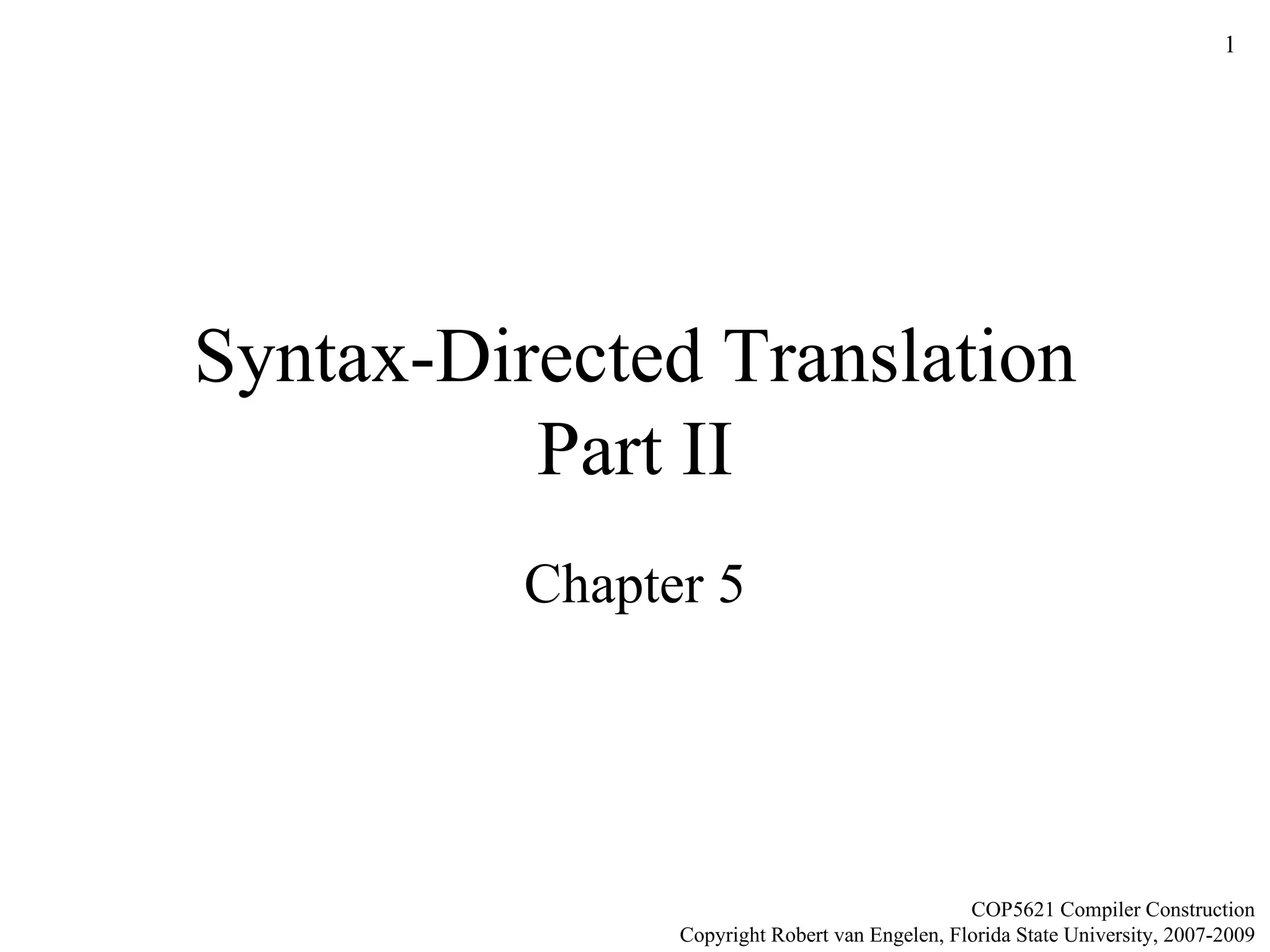
Translation Schemes using Marker Nonterminals S      if   E   M   then   S  { backpatch( M .loc, pc- M .loc) } M         { emit( iconst_0 );  M .loc := pc; emit( if_icmpeq , 0) } S      if   E  { emit( iconst_0 ); push(pc); emit( if_icmpeq , 0) }   then   S  { backpatch(top(), pc-top()); pop() } Need a stack! (for nested if-then) Synthesized attribute (automatically stacked) Insert marker nonterminal
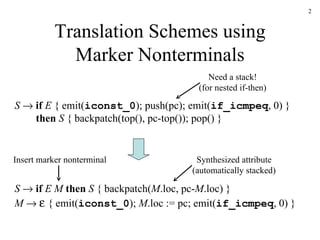
Translation Schemes using Marker Nonterminals in Yacc  S : IF E M THEN S { backpatch($3, pc-$3); }   ; M : /* empty */  { emit(iconst_0);   $$ = pc;   emit3(if_icmpeq, 0);   }   ; …
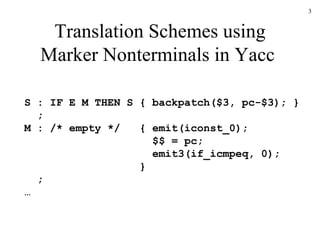
Replacing Inherited Attributes with Synthesized Lists D      T L  { for all  id      L .list :  addtype ( id .entry,  T .type) } T     int  {  T .type := ‘integer’ } T     real  {  T .type := ‘real’ } L     L 1   ,   id  {  L .list :=  L 1 .list + [ id ] } L     id  {  L .list := [ id ] } D T .type = ‘real’ L .list = [ id 1 , id 2 , id 3 ] L .list = [ id 1 , id 2 ] L .list = [ id 1 ] id 2 .entry id 1 .entry id 3 .entry real , ,
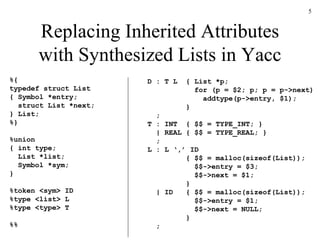
Replacing Inherited Attributes with Synthesized Lists in Yacc %{ typedef struct List { Symbol *entry;   struct List *next; } List; %} %union { int type; List *list; Symbol *sym; } %token <sym> ID %type <list> L %type <type> T %% D : T L  { List *p;   for (p = $2; p; p = p->next) addtype(p->entry, $1); } ; T : INT  { $$ = TYPE_INT; } | REAL { $$ = TYPE_REAL; } ; L : L ‘,’ ID    { $$ = malloc(sizeof(List)); $$->entry = $3;   $$->next = $1; } | ID  { $$ = malloc(sizeof(List)); $$->entry = $1;   $$->next = NULL;   } ;
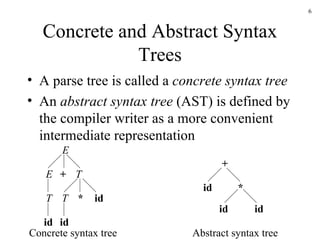
Concrete and Abstract Syntax Trees A parse tree is called a  concrete syntax tree An  abstract syntax tree  (AST) is defined by the compiler writer as a more convenient intermediate representation E + E T id id id * Concrete syntax tree + * id id id Abstract syntax tree T T
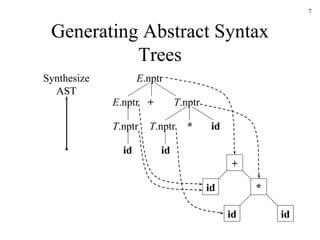
Generating Abstract Syntax Trees E .nptr + E .nptr T .nptr id id id * T .nptr T .nptr + id * id id Synthesize AST
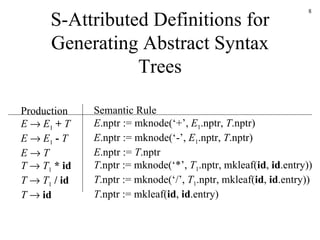
S-Attributed Definitions for Generating Abstract Syntax Trees Production E      E 1   +   T E      E 1   -   T E      T T      T 1   * id T      T 1   /   id T      id Semantic Rule E .nptr := mknode(‘+’,  E 1 .nptr,  T .nptr) E .nptr := mknode(‘-’,  E 1 .nptr,  T .nptr) E .nptr :=  T .nptr T .nptr := mknode(‘*’,  T 1 .nptr, mkleaf( id ,  id .entry)) T .nptr := mknode(‘/’,  T 1 .nptr, mkleaf( id ,  id .entry)) T .nptr := mkleaf( id ,  id .entry)
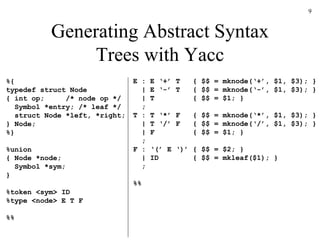
Generating Abstract Syntax Trees with Yacc %{ typedef struct Node { int op;  /* node op */   Symbol *entry; /* leaf */   struct Node *left, *right; } Node; %} %union { Node *node; Symbol *sym; } %token <sym> ID %type <node> E T F %% E : E ‘+’ T  { $$ = mknode(‘+’, $1, $3); }   | E ‘-’ T  { $$ = mknode(‘-’, $1, $3); }   | T  { $$ = $1; }   ; T : T ‘*’ F  { $$ = mknode(‘*’, $1, $3); }   | T ‘/’ F  { $$ = mknode(‘/’, $1, $3); }    | F  { $$ = $1; }   ; F : ‘(’ E ‘)’ { $$ = $2; }   | ID  { $$ = mkleaf($1); }   ; %%
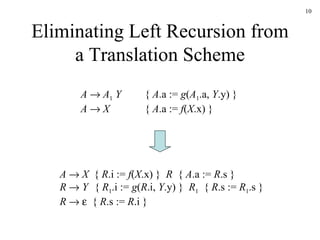
Eliminating Left Recursion from a Translation Scheme A      A 1   Y {  A .a :=  g ( A 1 .a,  Y .y) } A      X {  A .a :=  f ( X .x) } A      X   {  R .i :=  f ( X .x) }  R  {  A .a :=  R .s } R      Y   {  R 1 .i :=  g ( R .i,  Y .y) }  R 1   {  R .s :=  R 1 .s }  R         {  R .s :=  R .i }
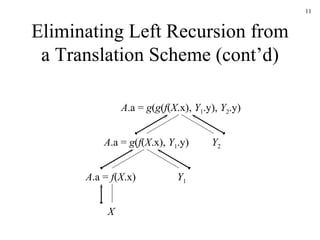
Eliminating Left Recursion from a Translation Scheme (cont’d) A .a =  g ( g ( f ( X .x),  Y 1 .y),  Y 2 .y) Y 2 Y 1 X A .a =  g ( f ( X .x),  Y 1 .y) A .a =  f ( X .x)
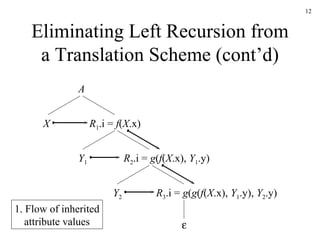
Eliminating Left Recursion from a Translation Scheme (cont’d) R 3 .i =  g ( g ( f ( X .x),  Y 1 .y),  Y 2 .y) Y 2 Y 1 X R 2 .i =  g ( f ( X .x),  Y 1 .y) R 1 .i =  f ( X .x) A  1. Flow of inherited attribute values
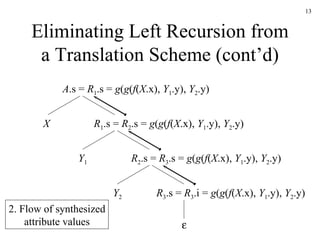
Eliminating Left Recursion from a Translation Scheme (cont’d) R 3 .s =  R 3 .i =  g ( g ( f ( X .x),  Y 1 .y),  Y 2 .y) Y 2 Y 1 X R 2 .s =  R 3 .s =  g ( g ( f ( X .x),  Y 1 .y),  Y 2 .y) R 1 .s =  R 2 .s =  g ( g ( f ( X .x),  Y 1 .y),  Y 2 .y) A .s =  R 1 .s =  g ( g ( f ( X .x),  Y 1 .y),  Y 2 .y)  2. Flow of synthesized attribute values
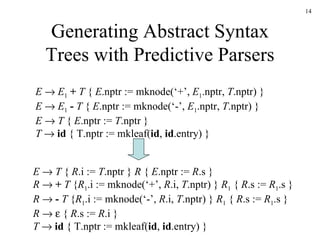
Generating Abstract Syntax Trees with Predictive Parsers E      T  {  R .i :=  T .nptr }  R  {  E .nptr :=  R .s } R      +   T  { R 1 .i := mknode(‘+’,  R .i,  T .nptr) }  R 1  {  R .s :=  R 1 .s } R      -   T  { R 1 .i := mknode(‘-’,  R .i,  T .nptr) }  R 1  {  R .s :=  R 1 .s } R        {  R .s :=  R .i } T      id  { T.nptr := mkleaf( id ,  id .entry) } E      E 1   +   T  {  E .nptr := mknode(‘+’,  E 1 .nptr,  T .nptr) } E      E 1   -   T  {  E .nptr := mknode(‘-’,  E 1 .nptr,  T .nptr) } E      T  {  E .nptr :=  T .nptr } T      id  { T.nptr := mkleaf( id ,  id .entry) }
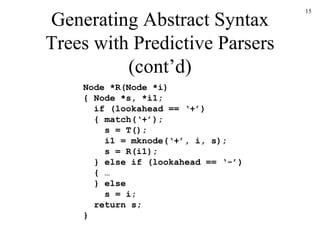
Generating Abstract Syntax Trees with Predictive Parsers (cont’d) Node *R(Node *i) { Node *s, *i1; if (lookahead == ‘+’)   { match(‘+’);   s = T();   i1 = mknode(‘+’, i, s); s = R(i1);   } else if (lookahead == ‘-’)   { …   } else   s = i;   return s; }

Ch5b

  • 1.
    Syntax-Directed Translation PartII Chapter 5 COP5621 Compiler Construction Copyright Robert van Engelen, Florida State University, 2007-2009
  • 2.
    Translation Schemes usingMarker Nonterminals S  if E M then S { backpatch( M .loc, pc- M .loc) } M   { emit( iconst_0 ); M .loc := pc; emit( if_icmpeq , 0) } S  if E { emit( iconst_0 ); push(pc); emit( if_icmpeq , 0) } then S { backpatch(top(), pc-top()); pop() } Need a stack! (for nested if-then) Synthesized attribute (automatically stacked) Insert marker nonterminal
  • 3.
    Translation Schemes usingMarker Nonterminals in Yacc S : IF E M THEN S { backpatch($3, pc-$3); } ; M : /* empty */ { emit(iconst_0); $$ = pc; emit3(if_icmpeq, 0); } ; …
  • 4.
    Replacing Inherited Attributeswith Synthesized Lists D  T L { for all id  L .list : addtype ( id .entry, T .type) } T  int { T .type := ‘integer’ } T  real { T .type := ‘real’ } L  L 1 , id { L .list := L 1 .list + [ id ] } L  id { L .list := [ id ] } D T .type = ‘real’ L .list = [ id 1 , id 2 , id 3 ] L .list = [ id 1 , id 2 ] L .list = [ id 1 ] id 2 .entry id 1 .entry id 3 .entry real , ,
  • 5.
    Replacing Inherited Attributeswith Synthesized Lists in Yacc %{ typedef struct List { Symbol *entry; struct List *next; } List; %} %union { int type; List *list; Symbol *sym; } %token <sym> ID %type <list> L %type <type> T %% D : T L { List *p; for (p = $2; p; p = p->next) addtype(p->entry, $1); } ; T : INT { $$ = TYPE_INT; } | REAL { $$ = TYPE_REAL; } ; L : L ‘,’ ID { $$ = malloc(sizeof(List)); $$->entry = $3; $$->next = $1; } | ID { $$ = malloc(sizeof(List)); $$->entry = $1; $$->next = NULL; } ;
  • 6.
    Concrete and AbstractSyntax Trees A parse tree is called a concrete syntax tree An abstract syntax tree (AST) is defined by the compiler writer as a more convenient intermediate representation E + E T id id id * Concrete syntax tree + * id id id Abstract syntax tree T T
  • 7.
    Generating Abstract SyntaxTrees E .nptr + E .nptr T .nptr id id id * T .nptr T .nptr + id * id id Synthesize AST
  • 8.
    S-Attributed Definitions forGenerating Abstract Syntax Trees Production E  E 1 + T E  E 1 - T E  T T  T 1 * id T  T 1 / id T  id Semantic Rule E .nptr := mknode(‘+’, E 1 .nptr, T .nptr) E .nptr := mknode(‘-’, E 1 .nptr, T .nptr) E .nptr := T .nptr T .nptr := mknode(‘*’, T 1 .nptr, mkleaf( id , id .entry)) T .nptr := mknode(‘/’, T 1 .nptr, mkleaf( id , id .entry)) T .nptr := mkleaf( id , id .entry)
  • 9.
    Generating Abstract SyntaxTrees with Yacc %{ typedef struct Node { int op; /* node op */ Symbol *entry; /* leaf */ struct Node *left, *right; } Node; %} %union { Node *node; Symbol *sym; } %token <sym> ID %type <node> E T F %% E : E ‘+’ T { $$ = mknode(‘+’, $1, $3); } | E ‘-’ T { $$ = mknode(‘-’, $1, $3); } | T { $$ = $1; } ; T : T ‘*’ F { $$ = mknode(‘*’, $1, $3); } | T ‘/’ F { $$ = mknode(‘/’, $1, $3); } | F { $$ = $1; } ; F : ‘(’ E ‘)’ { $$ = $2; } | ID { $$ = mkleaf($1); } ; %%
  • 10.
    Eliminating Left Recursionfrom a Translation Scheme A  A 1 Y { A .a := g ( A 1 .a, Y .y) } A  X { A .a := f ( X .x) } A  X { R .i := f ( X .x) } R { A .a := R .s } R  Y { R 1 .i := g ( R .i, Y .y) } R 1 { R .s := R 1 .s } R   { R .s := R .i }
  • 11.
    Eliminating Left Recursionfrom a Translation Scheme (cont’d) A .a = g ( g ( f ( X .x), Y 1 .y), Y 2 .y) Y 2 Y 1 X A .a = g ( f ( X .x), Y 1 .y) A .a = f ( X .x)
  • 12.
    Eliminating Left Recursionfrom a Translation Scheme (cont’d) R 3 .i = g ( g ( f ( X .x), Y 1 .y), Y 2 .y) Y 2 Y 1 X R 2 .i = g ( f ( X .x), Y 1 .y) R 1 .i = f ( X .x) A  1. Flow of inherited attribute values
  • 13.
    Eliminating Left Recursionfrom a Translation Scheme (cont’d) R 3 .s = R 3 .i = g ( g ( f ( X .x), Y 1 .y), Y 2 .y) Y 2 Y 1 X R 2 .s = R 3 .s = g ( g ( f ( X .x), Y 1 .y), Y 2 .y) R 1 .s = R 2 .s = g ( g ( f ( X .x), Y 1 .y), Y 2 .y) A .s = R 1 .s = g ( g ( f ( X .x), Y 1 .y), Y 2 .y)  2. Flow of synthesized attribute values
  • 14.
    Generating Abstract SyntaxTrees with Predictive Parsers E  T { R .i := T .nptr } R { E .nptr := R .s } R  + T { R 1 .i := mknode(‘+’, R .i, T .nptr) } R 1 { R .s := R 1 .s } R  - T { R 1 .i := mknode(‘-’, R .i, T .nptr) } R 1 { R .s := R 1 .s } R   { R .s := R .i } T  id { T.nptr := mkleaf( id , id .entry) } E  E 1 + T { E .nptr := mknode(‘+’, E 1 .nptr, T .nptr) } E  E 1 - T { E .nptr := mknode(‘-’, E 1 .nptr, T .nptr) } E  T { E .nptr := T .nptr } T  id { T.nptr := mkleaf( id , id .entry) }
  • 15.
    Generating Abstract SyntaxTrees with Predictive Parsers (cont’d) Node *R(Node *i) { Node *s, *i1; if (lookahead == ‘+’) { match(‘+’); s = T(); i1 = mknode(‘+’, i, s); s = R(i1); } else if (lookahead == ‘-’) { … } else s = i; return s; }