Implementing Subprograms
In Text: Chapter 10
N. Meng, F. Poursardar
Outline
2
• General semantics of calls and returns
• Implementing“simple” subroutines
• Call Stack
• Implementing subroutines with stack-dynamic local
variables
• Nested programs
General Semantics of Calls and Returns
3
• The subroutine call and return operations are
together called subroutine linkage
• The implementation of subroutines must be based
on the semantics of the subroutine linkage
Semantics of a subroutine call
4
• Save the execution status of the current program
unit
• Pass the parameters
• Pass the return address to the callee
• Transfer control to the callee
Semantics of a subroutine return
5
• If there are pass-by-value-result or out-mode
parameters,the current values of those parameters
are moved to the corresponding actual parameters
• Move the return value to a place accessible to the
caller
• The execution status of the caller is restored
• Control is transferred back to the caller
Storage of Information
6
• The call and return actions require storage for the
following:
– Status information about the caller
– Parameters
– Return address
– Return value for functions
– Local variables
Implementing“simple” subroutines
7
• Simple subroutines are those that cannot be
nested and all local variables are static
• A simple subroutine consists of two parts:code and
data
– Code: constant (instruction space)
– Data:can change when the subroutine is executed (data
space)
– Both parts have fixed sizes
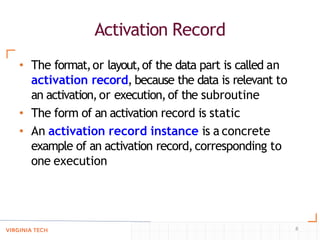
Activation Record
8
• The format,or layout,of the data part is called an
activation record, because the data is relevant to
an activation,or execution,of the subroutine
• The form of an activation record is static
• An activation record instance is a concrete
example of an activation record,corresponding to
one execution
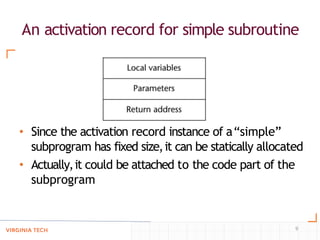
An activation record for simple subroutine
• Since the activation record instance of a“simple”
subprogram has fixed size,it can be statically allocated
• Actually,it could be attached to the code part of the
subprogram
9
The code and activation records of a
program with simple subroutines
10
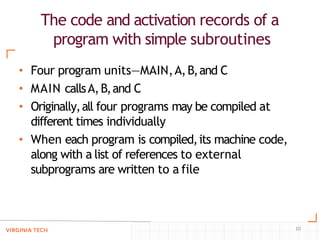
• Four program units—MAIN,A,B,and C
• MAIN callsA,B,and C
• Originally,all four programs may be compiled at
different times individually
• When each program is compiled,its machine code,
along with a list of references to external
subprograms are written to a file
How is the code linked?
11
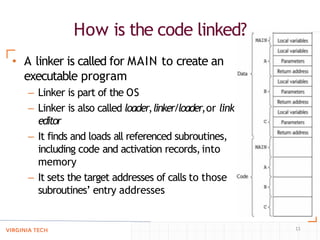
• A linker is called for MAIN to create an
executable program
– Linker is part of the OS
– Linker is also called loader,linker/loader,or link
editor
– It finds and loads all referenced subroutines,
including code and activation records,into
memory
– It sets the target addresses of calls to those
subroutines’ entry addresses
Assumptions so far…
12
• All local variables are statically allocated
• No function recursion
• No value returned from any function
Call Stack
13
• Call stack is a stack data structure that stores
information about the active subroutines of a
program
• Also known as execution stack,control stack,
runtime-stack, or machine stack
• Large array which typically grows downwards in
memory towards lower addresses,shrinks upwards
Call Stack
14
• Push(r1):
stack_pointer--;
M[stack_pointer] = r1;
• r1 = Pop();
r1 = M[stack_pointer];
stack_pointer++;
Call Stack
15
• When a function is invoked,its activation record is
created dynamically and pushed onto the stack
• When a function returns,its activation record is popped
from the stack
• The activation record on stack is also called stack
frame
• Stack pointer(sp): points to the frame top
• Frame pointer(fp): points to the frame base
Implementing subroutines with stack-
dynamic local variables
16
• One important advantage of stack-dynamic local
variables is support for recursion
• The implementation requires more complex
activation records
– The compiler must generate code to cause the implicit
allocation and deallocation of local variables
More complex
activation records
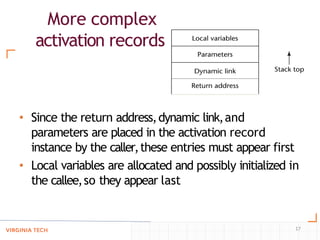
• Since the return address,dynamic link,and
parameters are placed in the activation record
instance by the caller,these entries must appear first
• Local variables are allocated and possibly initialized in
the callee,so they appear last
17
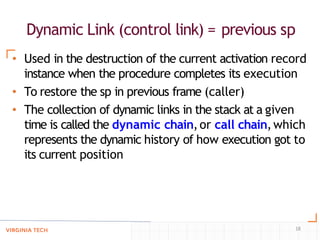
Dynamic Link (control link) = previous sp
18
• Used in the destruction of the current activation record
instance when the procedure completes its execution
• To restore the sp in previous frame (caller)
• The collection of dynamic links in the stack at a given
time is called the dynamic chain,or call chain,which
represents the dynamic history of how execution got to
its current position
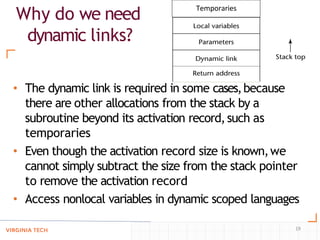
Why do we need
dynamic links?
• The dynamic link is required in some cases,because
there are other allocations from the stack by a
subroutine beyond its activation record,such as
temporaries
• Even though the activation record size is known,we
cannot simply subtract the size from the stack pointer
to remove the activation record
• Access nonlocal variables in dynamic scoped languages
Temporaries
19
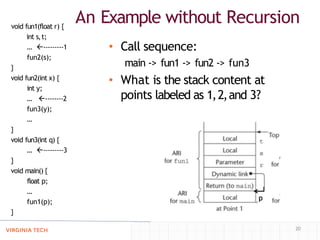
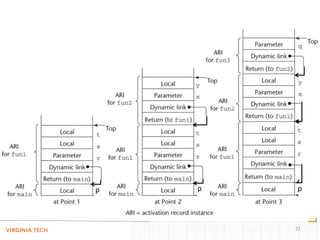
An Example without Recursion
void fun1(float r) {
int s,t;
… ---------1
fun2(s);
}
void fun2(int x) {
int y;
… --------2
fun3(y);
…
}
void fun3(int q) {
… ---------3
}
void main() {
float p;
…
fun1(p);
}
• Call sequence:
main -> fun1 -> fun2 -> fun3
• What is the stack content at
points labeled as 1,2,and 3?
20
p p p
21
LocalVariableAllocation
22
• Local scalar variables are bound to storage within an
activation record instance
• Local variables that are structures are sometimes
allocated elsewhere,and only leave their descriptors
and a pointer to the storage as part of the activation
record
An Example
23
void sub(float total,int part) {
int list[5];
float sum;
…
}
Local
Local
Local
Local
Local
Local
Parameter
Parameter
Dynamic link
Return address
part
total
list[0]
list[1]
list[2]
list[3]
list[4]
sum
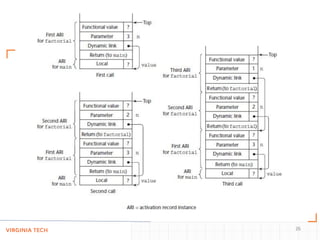
Recursion
24
• Function recursion means that a function can
eventually call itself
• Recursion adds the possibility of multiple
simultaneous activations of a subroutine at a given
time,with at least one call from outside the
subroutine,and one or more recursive calls
• Each activation requires its own activation record
instance
An Example
25
int factorial(int n) {
if (n <= 1)
return 1;
else return (n * factorial(n - 1));
}
void main() {
int value;
value = factorial (3);
}
How does the
stack change?
26
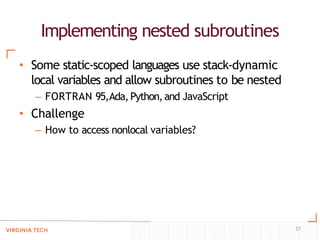
Implementing nested subroutines
27
• Some static-scoped languages use stack-dynamic
local variables and allow subroutines to be nested
– FORTRAN 95,Ada,Python,and JavaScript
• Challenge
– How to access nonlocal variables?
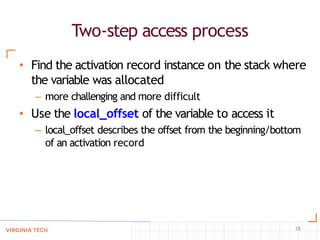
Two-step access process
28
• Find the activation record instance on the stack where
the variable was allocated
– more challenging and more difficult
• Use the local_offset of the variable to access it
– local_offset describes the offset from the beginning/bottom
of an activation record
Key Observations
29
• In a given subroutine,only variables that are declared
in static ancestor scopes are visible and can be
accessed
• Activation record instances of all static ancestors are
always on the stack when variables in them are
referenced by a nested subroutine:A subroutine is
callable only when all its static ancestors are active
FindingActivation Record Instance
30
• Static chaining
– A new pointer,static link (static scope pointer or
access link),is used to point to the bottom of an
activation record instance of the static parent
– The pointer is used for access to nonlocal variables
– Typically,the static link appears below parameters in an
activation record
FindingActivation Record Instance (cont’d)
31
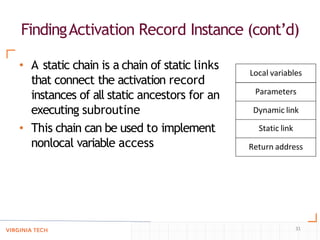
• A static chain is a chain of static links
that connect the activation record
instances of all static ancestors for an
executing subroutine
• This chain can be used to implement
nonlocal variable access
Local variables
Parameters
Dynamic link
Static link
Return address
FindingActivation Record Instance (cont’d)
32
• With static links,finding the correct activation record
instance is simple
– Search the static chain until a static ancestor is found to
contain the variable
• However,the implementation can be even simpler
– Compiler identifies both nonlocal references,and the
length of static chain to follow to reach the correct record
FindingActivation Record Instance (cont’d)
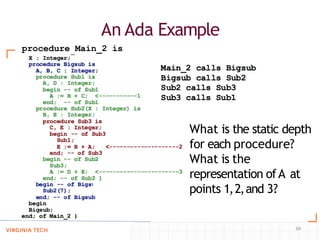
33
• static_depth is an integer associated with a static
scope that indicates how deeply it is nested in the
outermost scope
• The difference between the static_depth of a nonlocal
reference and the static_depth of the variable
definition is called nesting_depth, or chain_depth,
of the reference
• Each reference is represented with an ordered
integer pair (chain_offset,local_offset)
An Ada Example
procedure Main_2 is
What is the static depth
for each procedure?
What is the
representation ofA at
points 1,2,and 3?
34
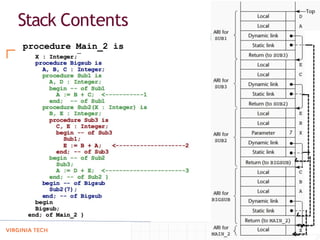
Stack Contents
procedure Main_2 is

-ImplementSubprogram-theory of programming

  • 1.
    Implementing Subprograms In Text:Chapter 10 N. Meng, F. Poursardar
  • 2.
    Outline 2 • General semanticsof calls and returns • Implementing“simple” subroutines • Call Stack • Implementing subroutines with stack-dynamic local variables • Nested programs
  • 3.
    General Semantics ofCalls and Returns 3 • The subroutine call and return operations are together called subroutine linkage • The implementation of subroutines must be based on the semantics of the subroutine linkage
  • 4.
    Semantics of asubroutine call 4 • Save the execution status of the current program unit • Pass the parameters • Pass the return address to the callee • Transfer control to the callee
  • 5.
    Semantics of asubroutine return 5 • If there are pass-by-value-result or out-mode parameters,the current values of those parameters are moved to the corresponding actual parameters • Move the return value to a place accessible to the caller • The execution status of the caller is restored • Control is transferred back to the caller
  • 6.
    Storage of Information 6 •The call and return actions require storage for the following: – Status information about the caller – Parameters – Return address – Return value for functions – Local variables
  • 7.
    Implementing“simple” subroutines 7 • Simplesubroutines are those that cannot be nested and all local variables are static • A simple subroutine consists of two parts:code and data – Code: constant (instruction space) – Data:can change when the subroutine is executed (data space) – Both parts have fixed sizes
  • 8.
    Activation Record 8 • Theformat,or layout,of the data part is called an activation record, because the data is relevant to an activation,or execution,of the subroutine • The form of an activation record is static • An activation record instance is a concrete example of an activation record,corresponding to one execution
  • 9.
    An activation recordfor simple subroutine • Since the activation record instance of a“simple” subprogram has fixed size,it can be statically allocated • Actually,it could be attached to the code part of the subprogram 9
  • 10.
    The code andactivation records of a program with simple subroutines 10 • Four program units—MAIN,A,B,and C • MAIN callsA,B,and C • Originally,all four programs may be compiled at different times individually • When each program is compiled,its machine code, along with a list of references to external subprograms are written to a file
  • 11.
    How is thecode linked? 11 • A linker is called for MAIN to create an executable program – Linker is part of the OS – Linker is also called loader,linker/loader,or link editor – It finds and loads all referenced subroutines, including code and activation records,into memory – It sets the target addresses of calls to those subroutines’ entry addresses
  • 12.
    Assumptions so far… 12 •All local variables are statically allocated • No function recursion • No value returned from any function
  • 13.
    Call Stack 13 • Callstack is a stack data structure that stores information about the active subroutines of a program • Also known as execution stack,control stack, runtime-stack, or machine stack • Large array which typically grows downwards in memory towards lower addresses,shrinks upwards
  • 14.
    Call Stack 14 • Push(r1): stack_pointer--; M[stack_pointer]= r1; • r1 = Pop(); r1 = M[stack_pointer]; stack_pointer++;
  • 15.
    Call Stack 15 • Whena function is invoked,its activation record is created dynamically and pushed onto the stack • When a function returns,its activation record is popped from the stack • The activation record on stack is also called stack frame • Stack pointer(sp): points to the frame top • Frame pointer(fp): points to the frame base
  • 16.
    Implementing subroutines withstack- dynamic local variables 16 • One important advantage of stack-dynamic local variables is support for recursion • The implementation requires more complex activation records – The compiler must generate code to cause the implicit allocation and deallocation of local variables
  • 17.
    More complex activation records •Since the return address,dynamic link,and parameters are placed in the activation record instance by the caller,these entries must appear first • Local variables are allocated and possibly initialized in the callee,so they appear last 17
  • 18.
    Dynamic Link (controllink) = previous sp 18 • Used in the destruction of the current activation record instance when the procedure completes its execution • To restore the sp in previous frame (caller) • The collection of dynamic links in the stack at a given time is called the dynamic chain,or call chain,which represents the dynamic history of how execution got to its current position
  • 19.
    Why do weneed dynamic links? • The dynamic link is required in some cases,because there are other allocations from the stack by a subroutine beyond its activation record,such as temporaries • Even though the activation record size is known,we cannot simply subtract the size from the stack pointer to remove the activation record • Access nonlocal variables in dynamic scoped languages Temporaries 19
  • 20.
    An Example withoutRecursion void fun1(float r) { int s,t; … ---------1 fun2(s); } void fun2(int x) { int y; … --------2 fun3(y); … } void fun3(int q) { … ---------3 } void main() { float p; … fun1(p); } • Call sequence: main -> fun1 -> fun2 -> fun3 • What is the stack content at points labeled as 1,2,and 3? 20
  • 21.
  • 22.
    LocalVariableAllocation 22 • Local scalarvariables are bound to storage within an activation record instance • Local variables that are structures are sometimes allocated elsewhere,and only leave their descriptors and a pointer to the storage as part of the activation record
  • 23.
    An Example 23 void sub(floattotal,int part) { int list[5]; float sum; … } Local Local Local Local Local Local Parameter Parameter Dynamic link Return address part total list[0] list[1] list[2] list[3] list[4] sum
  • 24.
    Recursion 24 • Function recursionmeans that a function can eventually call itself • Recursion adds the possibility of multiple simultaneous activations of a subroutine at a given time,with at least one call from outside the subroutine,and one or more recursive calls • Each activation requires its own activation record instance
  • 25.
    An Example 25 int factorial(intn) { if (n <= 1) return 1; else return (n * factorial(n - 1)); } void main() { int value; value = factorial (3); } How does the stack change?
  • 26.
  • 27.
    Implementing nested subroutines 27 •Some static-scoped languages use stack-dynamic local variables and allow subroutines to be nested – FORTRAN 95,Ada,Python,and JavaScript • Challenge – How to access nonlocal variables?
  • 28.
    Two-step access process 28 •Find the activation record instance on the stack where the variable was allocated – more challenging and more difficult • Use the local_offset of the variable to access it – local_offset describes the offset from the beginning/bottom of an activation record
  • 29.
    Key Observations 29 • Ina given subroutine,only variables that are declared in static ancestor scopes are visible and can be accessed • Activation record instances of all static ancestors are always on the stack when variables in them are referenced by a nested subroutine:A subroutine is callable only when all its static ancestors are active
  • 30.
    FindingActivation Record Instance 30 •Static chaining – A new pointer,static link (static scope pointer or access link),is used to point to the bottom of an activation record instance of the static parent – The pointer is used for access to nonlocal variables – Typically,the static link appears below parameters in an activation record
  • 31.
    FindingActivation Record Instance(cont’d) 31 • A static chain is a chain of static links that connect the activation record instances of all static ancestors for an executing subroutine • This chain can be used to implement nonlocal variable access Local variables Parameters Dynamic link Static link Return address
  • 32.
    FindingActivation Record Instance(cont’d) 32 • With static links,finding the correct activation record instance is simple – Search the static chain until a static ancestor is found to contain the variable • However,the implementation can be even simpler – Compiler identifies both nonlocal references,and the length of static chain to follow to reach the correct record
  • 33.
    FindingActivation Record Instance(cont’d) 33 • static_depth is an integer associated with a static scope that indicates how deeply it is nested in the outermost scope • The difference between the static_depth of a nonlocal reference and the static_depth of the variable definition is called nesting_depth, or chain_depth, of the reference • Each reference is represented with an ordered integer pair (chain_offset,local_offset)
  • 34.
    An Ada Example procedureMain_2 is What is the static depth for each procedure? What is the representation ofA at points 1,2,and 3? 34
  • 35.