BASIC
BLOCKS AND
FLOW
GRAPHS
JGALINO
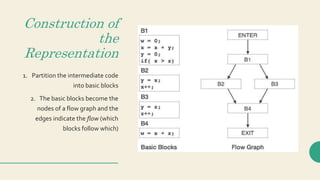
Construction of
the
Representation
1. Partition the intermediate code
into basic blocks
2. The basic blocks become the
nodes of a flow graph and the
edges indicate the flow (which
blocks follow which)
Basic Blocks
*a piece of straight line code
i.e. there are no jumps in or out
of the middle of a block
1. the flow of control can only
enter the basic block through
the first instruction
2. control will leave the block
without halting or branching,
except possibly, at the last
instruction in the block
Constructing
Basic Blocks
1) Determine a set of leaders,
the first instruction of blocks
2) A basic block consists of a
leader and all the following
instructions until the next
leader
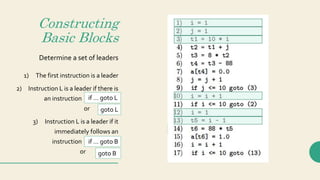
Constructing
Basic Blocks
Determine a set of leaders
1) The first instruction is a leader
2) Instruction L is a leader if there is
an instruction a
or a
3) Instruction L is a leader if it
immediately follows an
instruction a
or a
if … goto L
goto L
if … goto B
goto B
goto B
Flow Graph
Once an intermediate-code
program is partitioned into basic
blocks, we represent the flow of
control between them by a flow
graph.
Constructing
the Flow
Graph
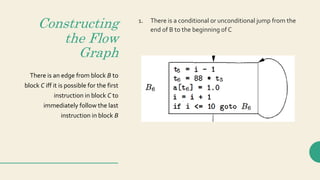
There is an edge from block B to
block C iff it is possible for the first
instruction in block C to
immediately follow the last
instruction in block B
1. There is a conditional or unconditional jump from the
end of B to the beginning of C
Constructing
the Flow
Graph
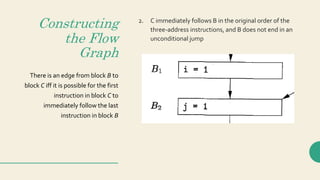
There is an edge from block B to
block C iff it is possible for the first
instruction in block C to
immediately follow the last
instruction in block B
2. C immediately follows B in the original order of the
three-address instructions, and B does not end in an
unconditional jump
Constructing
the Flow
Graph
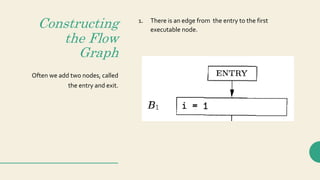
Often we add two nodes, called
the entry and exit.
1. There is an edge from the entry to the first
executable node.
Constructing
the Flow
Graph
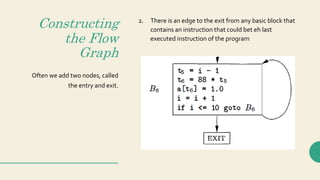
Often we add two nodes, called
the entry and exit.
2. There is an edge to the exit from any basic block that
contains an instruction that could bet eh last
executed instruction of the program
goto B
goto B
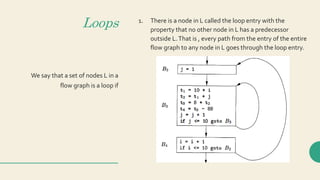
Loops
We say that a set of nodes L in a
flow graph is a loop if
1. There is a node in L called the loop entry with the
property that no other node in L has a predecessor
outside L.That is , every path from the entry of the entire
flow graph to any node in L goes through the loop entry.
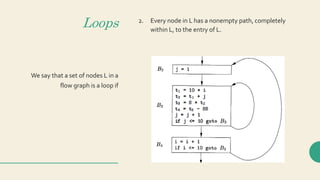
Loops
We say that a set of nodes L in a
flow graph is a loop if
2. Every node in L has a nonempty path, completely
within L, to the entry of L.
Fin

Basic Blocks and Flow Graphs

  • 1.
  • 2.
    Construction of the Representation 1. Partitionthe intermediate code into basic blocks 2. The basic blocks become the nodes of a flow graph and the edges indicate the flow (which blocks follow which)
  • 3.
    Basic Blocks *a pieceof straight line code i.e. there are no jumps in or out of the middle of a block 1. the flow of control can only enter the basic block through the first instruction 2. control will leave the block without halting or branching, except possibly, at the last instruction in the block
  • 4.
    Constructing Basic Blocks 1) Determinea set of leaders, the first instruction of blocks 2) A basic block consists of a leader and all the following instructions until the next leader
  • 5.
    Constructing Basic Blocks Determine aset of leaders 1) The first instruction is a leader 2) Instruction L is a leader if there is an instruction a or a 3) Instruction L is a leader if it immediately follows an instruction a or a if … goto L goto L if … goto B goto B goto B
  • 6.
    Flow Graph Once anintermediate-code program is partitioned into basic blocks, we represent the flow of control between them by a flow graph.
  • 7.
    Constructing the Flow Graph There isan edge from block B to block C iff it is possible for the first instruction in block C to immediately follow the last instruction in block B 1. There is a conditional or unconditional jump from the end of B to the beginning of C
  • 8.
    Constructing the Flow Graph There isan edge from block B to block C iff it is possible for the first instruction in block C to immediately follow the last instruction in block B 2. C immediately follows B in the original order of the three-address instructions, and B does not end in an unconditional jump
  • 9.
    Constructing the Flow Graph Often weadd two nodes, called the entry and exit. 1. There is an edge from the entry to the first executable node.
  • 10.
    Constructing the Flow Graph Often weadd two nodes, called the entry and exit. 2. There is an edge to the exit from any basic block that contains an instruction that could bet eh last executed instruction of the program
  • 11.
  • 12.
  • 13.
    Loops We say thata set of nodes L in a flow graph is a loop if 1. There is a node in L called the loop entry with the property that no other node in L has a predecessor outside L.That is , every path from the entry of the entire flow graph to any node in L goes through the loop entry.
  • 14.
    Loops We say thata set of nodes L in a flow graph is a loop if 2. Every node in L has a nonempty path, completely within L, to the entry of L.
  • 15.

Editor's Notes

  • #2 This section introduces a graph presentation of intermediate code (although not constructed by a code-generation algo) which is is helpful for discussing code generation Better register allocation, if we know how values are defined and used
  • #7 The nodes of the flow graph are the basic blocks
  • #9 We say that B is a predecessor of C , and C is a successor of B .
  • #11 If the final instruction of the program is not an unconditional jump, then the block containing the final instruction of the program is one predecessor of the exit, but so is any basic block that has a jump to code that is not part of the program.
  • #13 Note from that in the flow graph, it is normal to replace the jumps to instruction numbers or labels by jumps to basic blocks
  • #14 If the final instruction of the program is not an unconditional jump, then the block containing the final instruction of the program is one predecessor of the exit, but so is any basic block that has a jump to code that is not part of the program.
  • #15 If the final instruction of the program is not an unconditional jump, then the block containing the final instruction of the program is one predecessor of the exit, but so is any basic block that has a jump to code that is not part of the program.