University of Zakho
College of Engineering
Mechanical department
ancient (Egypts)
Preparing : Rawa Abdullah Taha
Supervisor : Mrs. Marwa
List of content
i. Geography
ii. Pharaoh
iii. The kingdoms times
iv. Achievement(information)
v. Vocabulary
vi. Daily life of workers
vii. Life after death
viii. Painting and sculpture
Geography
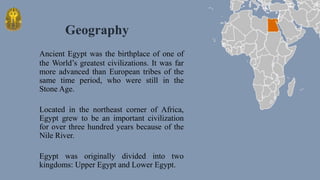
Ancient Egypt was the birthplace of one of
the World’s greatest civilizations. It was far
more advanced than European tribes of the
same time period, who were still in the
Stone Age.
Located in the northeast corner of Africa,
Egypt grew to be an important civilization
for over three hundred years because of the
Nile River.
Egypt was originally divided into two
kingdoms: Upper Egypt and Lower Egypt.
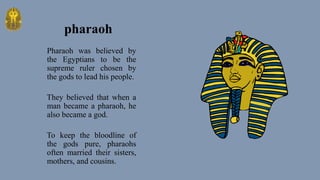
Pharaoh was believed by
the Egyptians to be the
supreme ruler chosen by
the gods to lead his people.
They believed that when a
man became a pharaoh, he
also became a god.
To keep the bloodline of
the gods pure, pharaohs
often married their sisters,
mothers, and cousins.
pharaoh
The Old Kingdom
When the pharaohs built the pyramids
The Middle Kingdom
When training and military explorers were sent out to
expand Egypt’s boundaries
The New Kingdom
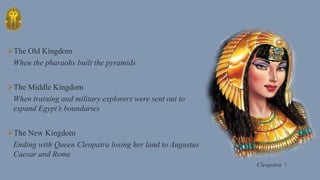
Ending with Queen Cleopatra losing her land to Augustus
Caesar and Rome
Cleopatra !
Achievements
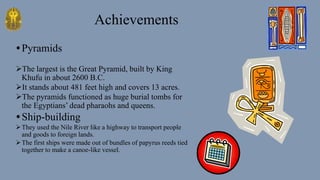
•Pyramids
The largest is the Great Pyramid, built by King
Khufu in about 2600 B.C.
It stands about 481 feet high and covers 13 acres.
The pyramids functioned as huge burial tombs for
the Egyptians’ dead pharaohs and queens.
•Ship-building
They used the Nile River like a highway to transport people
and goods to foreign lands.
The first ships were made out of bundles of papyrus reeds tied
together to make a canoe-like vessel.
Achievements
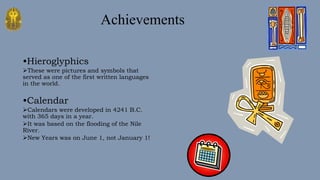
•Hieroglyphics
These were pictures and symbols that
served as one of the first written languages
in the world.
•Calendar
Calendars were developed in 4241 B.C.
with 365 days in a year.
It was based on the flooding of the Nile
River.
New Years was on June 1, not January 1!
1) cartouche – a tablet with a border, used as a nameplate
2) hieroglyphics – a sophisticated system of pictures and symbols used
in ancient Egypt to communicate information
3) Nile River – river that runs through Egypt
4) Ankh – a symbol for life after death
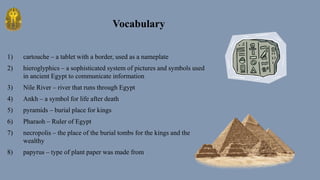
5) pyramids – burial place for kings
6) Pharaoh – Ruler of Egypt
7) necropolis – the place of the burial tombs for the kings and the
wealthy
8) papyrus – type of plant paper was made from
Vocabulary
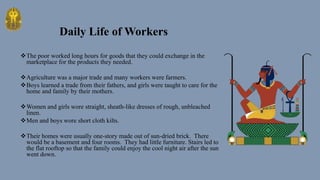
The poor worked long hours for goods that they could exchange in the
marketplace for the products they needed.
Agriculture was a major trade and many workers were farmers.
Boys learned a trade from their fathers, and girls were taught to care for the
home and family by their mothers.
Women and girls wore straight, sheath-like dresses of rough, unbleached
linen.
Men and boys wore short cloth kilts.
Their homes were usually one-story made out of sun-dried brick. There
would be a basement and four rooms. They had little furniture. Stairs led to
the flat rooftop so that the family could enjoy the cool night air after the sun
went down.
Daily Life of Workers
• The ancient Egyptians believed in an afterlife of beauty, peace, and contentment.
• Since most of their lives were filled with hard work, they looked forward to death as a release
from this lifetime.
• They believed their souls would need to use their bodies again, so the Egyptians invented a
process to embalm their bodies called mummification.
• Wealthy could afford better mummification than the poor
Life after Death
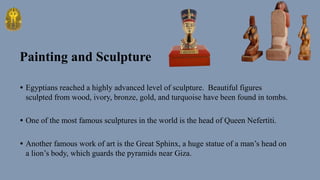
• Egyptians reached a highly advanced level of sculpture. Beautiful figures
sculpted from wood, ivory, bronze, gold, and turquoise have been found in tombs.
• One of the most famous sculptures in the world is the head of Queen Nefertiti.
• Another famous work of art is the Great Sphinx, a huge statue of a man’s head on
a lion’s body, which guards the pyramids near Giza.
Painting and Sculpture
http://www.worldofteaching.com
Reference

Ancient egypts

  • 1.
    University of Zakho Collegeof Engineering Mechanical department ancient (Egypts) Preparing : Rawa Abdullah Taha Supervisor : Mrs. Marwa
  • 2.
    List of content i.Geography ii. Pharaoh iii. The kingdoms times iv. Achievement(information) v. Vocabulary vi. Daily life of workers vii. Life after death viii. Painting and sculpture
  • 3.
    Geography Ancient Egypt wasthe birthplace of one of the World’s greatest civilizations. It was far more advanced than European tribes of the same time period, who were still in the Stone Age. Located in the northeast corner of Africa, Egypt grew to be an important civilization for over three hundred years because of the Nile River. Egypt was originally divided into two kingdoms: Upper Egypt and Lower Egypt.
  • 4.
    Pharaoh was believedby the Egyptians to be the supreme ruler chosen by the gods to lead his people. They believed that when a man became a pharaoh, he also became a god. To keep the bloodline of the gods pure, pharaohs often married their sisters, mothers, and cousins. pharaoh
  • 5.
    The Old Kingdom Whenthe pharaohs built the pyramids The Middle Kingdom When training and military explorers were sent out to expand Egypt’s boundaries The New Kingdom Ending with Queen Cleopatra losing her land to Augustus Caesar and Rome Cleopatra !
  • 6.
    Achievements •Pyramids The largest isthe Great Pyramid, built by King Khufu in about 2600 B.C. It stands about 481 feet high and covers 13 acres. The pyramids functioned as huge burial tombs for the Egyptians’ dead pharaohs and queens. •Ship-building They used the Nile River like a highway to transport people and goods to foreign lands. The first ships were made out of bundles of papyrus reeds tied together to make a canoe-like vessel.
  • 7.
    Achievements •Hieroglyphics These were picturesand symbols that served as one of the first written languages in the world. •Calendar Calendars were developed in 4241 B.C. with 365 days in a year. It was based on the flooding of the Nile River. New Years was on June 1, not January 1!
  • 8.
    1) cartouche –a tablet with a border, used as a nameplate 2) hieroglyphics – a sophisticated system of pictures and symbols used in ancient Egypt to communicate information 3) Nile River – river that runs through Egypt 4) Ankh – a symbol for life after death 5) pyramids – burial place for kings 6) Pharaoh – Ruler of Egypt 7) necropolis – the place of the burial tombs for the kings and the wealthy 8) papyrus – type of plant paper was made from Vocabulary
  • 9.
    The poor workedlong hours for goods that they could exchange in the marketplace for the products they needed. Agriculture was a major trade and many workers were farmers. Boys learned a trade from their fathers, and girls were taught to care for the home and family by their mothers. Women and girls wore straight, sheath-like dresses of rough, unbleached linen. Men and boys wore short cloth kilts. Their homes were usually one-story made out of sun-dried brick. There would be a basement and four rooms. They had little furniture. Stairs led to the flat rooftop so that the family could enjoy the cool night air after the sun went down. Daily Life of Workers
  • 10.
    • The ancientEgyptians believed in an afterlife of beauty, peace, and contentment. • Since most of their lives were filled with hard work, they looked forward to death as a release from this lifetime. • They believed their souls would need to use their bodies again, so the Egyptians invented a process to embalm their bodies called mummification. • Wealthy could afford better mummification than the poor Life after Death
  • 11.
    • Egyptians reacheda highly advanced level of sculpture. Beautiful figures sculpted from wood, ivory, bronze, gold, and turquoise have been found in tombs. • One of the most famous sculptures in the world is the head of Queen Nefertiti. • Another famous work of art is the Great Sphinx, a huge statue of a man’s head on a lion’s body, which guards the pyramids near Giza. Painting and Sculpture
  • 12.