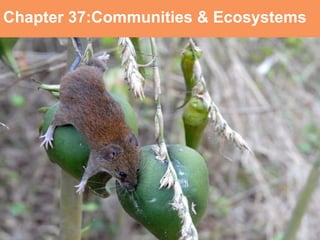
Chapter 37:Communities & Ecosystems Communities and Ecosystems
Ecology….. Ecosystem   STRUCTURE  and  FUNCTION  depend  on the interactions of the community with its abiotic environment Community   STRUCTURE  and  FUNCTION   depend  on the interactions among organisms…(biotic)
Biotic Interactions…parasitic fungi A dead carpenter ant attached to leaf in the understory of a Thai forest. Before killing the ant, the fungus growing from ant's head changed the ant's behavior, causing it to bite into the leaf vein. (Credit: David Hughes) Attack of the zombie ant! Though it may seem like the perfect title for a cheesy horror movie, scientists have discovered more about a parasitic fungus that essentially takes over the brain and body of tropical carpenter ants -- ultimately causing its host to die at a spot where the fungus has the best chance of reproducing.
 
INVASION!! Does this “invader” disrupt community structure?
 
STRUCTURAL FEATURES OF COMMUNITIES What is a community?  What are some of the key characteristics of a community? Species  diversity Species  richness Relative  abundance Dominant  species Response to  disturbances Trophic  structure:  feeding relationships among species
Figure 1.1.  Species richness and abundance of termites collected from transects in seven land-use types in Jambi Province, Central Sumatra http://www.asb.cgiar.org/data/dataset/8.htm Link to data: Species richness  is the number of different species in a given area S = species richness n = total number of species present in sample population k = number of "unique" species (of which only one organism was found in sample population : Species abundance  is the study of how common a particular species is in a given community. 
Temperate Biome, Wetland Ecosystem
Competition: Why does it happen?  Interspecific competition??? …examples… Intraspecific competition??? …examples…
Competitive exclusion principle Niche Results of Interspecific Competition? Or….maybe… Resource partitioning may evolve
What is happening here? ….why? LE 37-2a
LE 37-2b
Predation leads to diverse adaptations in both predator and prey Predation  Adaptations….how do these evolve? Examples??? Camouflage  Chemical defense
 
Biston betularia
Metalmark Moths…Watch Out! Batesian mimicry Palatable species mimics an unpalatable model  http://images.google.com/imgres?imgurl=http://neurophilosophy.files.wordpress.com/2006/12/31.JPG&imgrefurl=http://neurophilosophy.wordpress.com/2006/12/22/the-moth-in-spiders-clothing/&usg=__KTsi4Eu0ERzQHpVhuHSLUm7Ozh0=&h=242&w=646&sz=29&hl=en&start=6&tbnid=fSCkjMPr45n43M:&tbnh=51&tbnw=137&prev=/images%3Fq%3Dmoth%2Bmimicry%2Bspider%26gbv%3D2%26hl%3Den
Mullerian mimicry Two unpalatable species mimic each other
 
 
Predation….diversity…. community? Keystone species Exerts strong control on community structure because of its ecological niche Keystone predator  May maintain community diversity by reducing numbers of the strongest competitors Removal can cause major changes in community dynamics
 
Vores….. Herbivores and the plants they eat have various adaptations Herbivores are animals that eat plants or algae Plants have evolved defenses against herbivores Some herbivore-plant interactions illustrate coevolution Reciprocal evolutionary adaptations Change in one species acts as a new selective force on another species
 
Coevolution…
Symbiotic relationships  Parasitism
Commensalism
Mutualism  The obligate pollinating seed-consuming mutualism between senita cacti and senita moths is a mutualism that entails both benefits and costs to both the plant and pollinator. Senita cacti benefit from pollination, but incur costs due to larval fruit consumption. Senita moths benefit from fruit food resources, but incur costs to larval survival from fruit abortions.
Hawaian Bobtail Squid Euprymna scolopes, Vibrio fischeri & Counterillumination FIG. 1.    Path of  V. fischeri  to the entrance of the host light organ. (A) Under conditions of anesthesia, the light organ can be seen as a dark mass (black arrow) through the ventral surface of the body wall. During each ventilatory cycle, the body cavity is expanded, water is drawn into the cavity (lateral green arrows) and then the body wall contracts, expelling water out (central green arrow) through the funnel (yellow). Because the light organ is circumscribed by the funnel, the water that is exiting passes over the light organ surface. Bar, 200 µm. (B) A scanning electron micrograph of one half of the ventral surface of a hatching light organ reveals the transparent, complex ciliated fields (cf) on the lateral surfaces of the organ. Water flows across these surfaces as shown by the broken green line and arrow. Bar, 50 µm. (C) A confocal micrograph of the ciliated surface of a living animal demonstrates that the appendages of the field are dynamic, most often forming a ring-like structure lateral to the main body of the light organ. Staining of the light organ with a fluorochrome that delineates the cells reveals the three pores at the base of the appendage, which are labeled 1, 2, and 3 to the left of each pore, designating the locations of the pore leading to the largest, mid-sized, and smallest crypts, respectively. Bar, 50 µm . 
Disturbia…. Disturbance is a prominent feature of most communities Events such as fire, storms, floods Damage communities Remove organisms from communities Alter the availability of resources Can have positive effects
Ecological Sucession Primary succession: gradual colonization of barren rocks
 
 
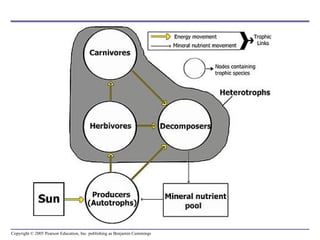
Trophic Structure Trophic structure: a pattern of feeding relationships consisting of several different levels Food chain: sequence of food transfer up the trophic levels Moves chemical nutrients and energy
… more trophic structure terms… Producers Autotrophs that support all other trophic levels Plants on land In water, mainly photosynthetic protists and cyanobacteria Primary consumers Herbivores that eat plants, algae, or phytoplankton
Secondary, tertiary, and quaternary consumers  Eat consumers from the level below them Detritivores (decomposers) Animal scavengers, fungi, and prokaryotes Derive energy from detritus produced at all trophic levels Decomposition is essential for recycling nutrients in ecosystems The fiddler crab, an important detritovore in the salt marsh community.
 
The cyclic flow of nutrients within an ecosystem. The arrows show the paths of nutrient flow between the living and non- living players.
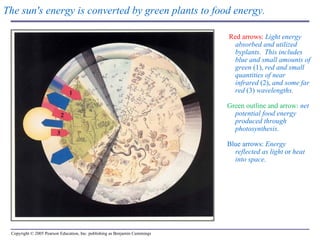
The sun's energy is converted by green plants to food energy.    Red arrows:   Light energy absorbed and utilized byplants.    This includes blue and small amounts of green  (1),  red and small quantities of near infrared  (2),  and some far red  (3)  wavelengths.   Green outline and arrow:   net potential food energy produced through photosynthesis.  Blue arrows:  Energy reflected as light  or  heat into space.
The path of energy flow through a prairie ecosystem.   Red arrow  : sunlight energy coming in;  Green arrows : food energy being passed from plants to animals Blue arrows : heat energy being dispersed to space.
LE 37-9 Trophic level Quaternary consumers Tertiary consumers Hawk Snake Mouse Grasshopper Plant A terrestrial food chain An aquatic food chain Producers Primary consumers Secondary consumers Phytoplankton Zooplankton Herring Tuna Killer whale
Food Webs A food web is a more realistic view of trophic structure Consumers usually eat more than one type of food  Each food type is consumed by more than one type of consumer
LE 37-10 Quaternary, tertiary, and secondary consumers Tertiary and secondary consumers Secondary and primary consumers Primary consumers Producers (plants)
ECOSYSTEM STRUCTURE AND DYNAMICS Ecosystem ecology emphasizes energy flow and chemical cycling An ecosystem consists of all the organisms in a community and the abiotic factors with which they interact Ecosystem dynamics involve two processes Energy flow through the components of the ecosystem Chemical cycling within the ecosystem
LE 37-11 Energy flow Light energy Chemical cycling Chemical energy Chemical elements Heat energy
Primary production sets the energy budget for ecosystems Primary production : amount of solar energy converted by producers to chemical energy in biomass Biomass : amount of organic material in an ecosystem Net primary production : amount of biomass produced minus amount used by producers in cellular respiration Varies greatly among ecosystems http://www.youtube.com/watch?v=Y3RdwvEToJw
LE 37-12 Open ocean Estuary Algal beds and coral reefs Desert and semidesert scrub Tundra Temperate grassland Cultivated land Boreal forest (taiga) Savanna Temperate deciduous forest Tropical rain forest 0 500 1,000 1,500 2,000 2,500 Average net primary productivity (g/m 2 /yr)
LE 37-13 Tertiary consumers Secondary consumers Primary consumers Producers 10 kcal 100 kcal 1,000 kcal 10,000 kcal 1,000,000 kcal of sunlight
10% Rule… Laws of T-Dynamics Energy supply limits the length of food chains Only about 10% of the energy stored at each trophic level is available to the next level Pyramid of production, (Energy), shows loss of energy from producers to higher trophic levels Amount of energy available to top-level consumers is relatively small Most food chains have only three to five levels
CONNECTION A production pyramid, (AKA  Pyramid of Energy ), explains why meat is a luxury for humans Human meat or fish eaters are  tertiary  or  quaternary  consumers Humans eating grain have ten times more energy available than when they process the same amount of grain through meat Using land to raise animals consumes more resources than using the land to cultivate crops
LE 37-14 Trophic level Secondary consumers Primary consumers Human vegetarians Producers Corn Corn Cattle Human meat-eaters
Ecological Pyramids http://ngm.nationalgeographic.com/2008/07/kingman-reef/warne-text http://en.wikipedia.org/wiki/Kingman_Reef
BGC’s Chemicals are recycled between organic matter and abiotic reservoirs Biogeochemical cycles  Cycle nutrients through both biotic and abiotic components Can be local or global
Consumers Producers Nutrients available to producers Detritivores Abiotic reservoir General BGC….
Hydrologic Cycle…by another name?? Water moves through the biosphere in a global cycle Solar energy drives the global water cycle  Precipitation Evaporation Transpiration Water cycles between the land, oceans, and atmosphere Forest destruction and irrigation affect the water cycle
LE 37-16 Solar energy Net movement of water vapor by wind Evaporation from ocean Precipitation over ocean Evaporation and transpiration from land Transport over land Precipitation over land Percolation through soil Runoff and groundwater
Carbon Cycle The carbon cycle depends on photosynthesis and respiration Carbon cycles through the atmosphere, fossil fuels, and dissolved carbon in oceans Taken from the atmosphere by photosynthesis Used to make organic molecules Decomposed by detritivores Returned to the atmosphere by cellular respiration Burning of wood and fossil fuels is raising the level of CO 2  in the atmosphere
LE 37-17 Cellular respiration Photosynthesis CO 2  in atmosphere Burning of fossil fuels and wood Primary consumers Higher-level consumers Detritus Carbon compounds in water Decomposition
Nitrogen Cycle The nitrogen cycle relies heavily on bacteria Atmospheric N 2  is not available to plants Soil bacteria convert gaseous N 2  to usable ammonium (NH 4 + ) and nitrate (NO 3 - ) Some NH 4 +  and NO 3 -  are made by chemical reactions in the atmosphere Human activity is altering nitrogen cycle balance in many areas Sewage treatment and fertilization
The complex nitrogen cycle is a marvelous example of how microbes are important to life itself (parts of cycle illustrated by red or green arrows); this cycle also includes abiotic processes (blue arrows).
Some representatives of the many groups of microorganisms, primarily bacteria, that are involved in the five steps of the nitrogen cycle.
LE 37-18 Nitrogen in atmosphere (N 2 ) Nitrogen fixation Nitrogen-fixing bacteria in root nodules of legumes Detritivores Decomposition Assimilation by plants Denitrifying bacteria Nitrifying bacteria Nitrates (NO 3 – ) Nitrogen-fixing soil bacteria Ammonium (NH 4  )
Phosphorous Cycle The phosphorus cycle depends on the weathering of rock Phosphorus and other soil minerals are recycled locally Weathering of rock adds PO 4 3-  to soil Slow process makes amount of phosphorus available to plants low Human activity has created phosphate pollution of water
LE 37-19 Rain Plant uptake of PO 4 3– Plants Weathering of rocks Geologic uplift of rocks Runoff Consumption Sedimentation Soil Leaching Decomposition
Phosphorus moves through ecosystems from rock and guano deposits to the sea and back to land again.  Along the way, phosphorus is cycled between the living and nonliving Players.
ECOSYSTEM ALTERATION CONNECTION Ecosystem alteration can upset chemical cycling The Hubbard Brook Experimental Forest is a long-term study of nutrient cycling Natural conditions  Water loss balanced between runoff and transpiration/evaporation Flow of nutrients in and out of watersheds nearly balanced
Logged and sprayed watershed Runoff increased 30 -40% Net loss of nutrients was huge Nitrate concentration in creek was 60 times greater Other long-term findings Acid precipitation has resulted in calcium loss Forest plants are not adding new growth because of calcium deficiency
 
 
LE 37-20c Control Deforested Completion of tree cutting 80.0 60.0 40.0 20.0 4.0 3.0 2.0 1.0 Nitrate concentration in runoff (mg/L) 1965 1966 1967 1968
TALKING ABOUT SCIENCE David Schindler talks about the effects of nutrients on freshwater ecosystems Dr. David Schindler was involved in environmental research that resulted in the banning of phosphates in detergents  Nutrient runoff from agricultural lands and large livestock operations may cause excessive algal growth This cultural eutrophication reduces species diversity and harms water quality
Freshwater Ecosystems Under Siege? A combination of factors threaten freshwater ecosystems  Acid precipitation Climate warming Changes in land use Cultural Eutrophication
Figure 37-21b 0

Ch37

  • 1.
    Chapter 37:Communities &Ecosystems Communities and Ecosystems
  • 2.
    Ecology….. Ecosystem STRUCTURE and FUNCTION depend on the interactions of the community with its abiotic environment Community STRUCTURE and FUNCTION depend on the interactions among organisms…(biotic)
  • 3.
    Biotic Interactions…parasitic fungiA dead carpenter ant attached to leaf in the understory of a Thai forest. Before killing the ant, the fungus growing from ant's head changed the ant's behavior, causing it to bite into the leaf vein. (Credit: David Hughes) Attack of the zombie ant! Though it may seem like the perfect title for a cheesy horror movie, scientists have discovered more about a parasitic fungus that essentially takes over the brain and body of tropical carpenter ants -- ultimately causing its host to die at a spot where the fungus has the best chance of reproducing.
  • 4.
  • 5.
    INVASION!! Does this“invader” disrupt community structure?
  • 6.
  • 7.
    STRUCTURAL FEATURES OFCOMMUNITIES What is a community? What are some of the key characteristics of a community? Species diversity Species richness Relative abundance Dominant species Response to disturbances Trophic structure: feeding relationships among species
  • 8.
    Figure 1.1.  Species richnessand abundance of termites collected from transects in seven land-use types in Jambi Province, Central Sumatra http://www.asb.cgiar.org/data/dataset/8.htm Link to data: Species richness  is the number of different species in a given area S = species richness n = total number of species present in sample population k = number of "unique" species (of which only one organism was found in sample population : Species abundance  is the study of how common a particular species is in a given community. 
  • 9.
  • 10.
    Competition: Why doesit happen? Interspecific competition??? …examples… Intraspecific competition??? …examples…
  • 11.
    Competitive exclusion principleNiche Results of Interspecific Competition? Or….maybe… Resource partitioning may evolve
  • 12.
    What is happeninghere? ….why? LE 37-2a
  • 13.
  • 14.
    Predation leads todiverse adaptations in both predator and prey Predation Adaptations….how do these evolve? Examples??? Camouflage Chemical defense
  • 15.
  • 16.
  • 17.
    Metalmark Moths…Watch Out!Batesian mimicry Palatable species mimics an unpalatable model http://images.google.com/imgres?imgurl=http://neurophilosophy.files.wordpress.com/2006/12/31.JPG&imgrefurl=http://neurophilosophy.wordpress.com/2006/12/22/the-moth-in-spiders-clothing/&usg=__KTsi4Eu0ERzQHpVhuHSLUm7Ozh0=&h=242&w=646&sz=29&hl=en&start=6&tbnid=fSCkjMPr45n43M:&tbnh=51&tbnw=137&prev=/images%3Fq%3Dmoth%2Bmimicry%2Bspider%26gbv%3D2%26hl%3Den
  • 18.
    Mullerian mimicry Twounpalatable species mimic each other
  • 19.
  • 20.
  • 21.
    Predation….diversity…. community? Keystonespecies Exerts strong control on community structure because of its ecological niche Keystone predator May maintain community diversity by reducing numbers of the strongest competitors Removal can cause major changes in community dynamics
  • 22.
  • 23.
    Vores….. Herbivores andthe plants they eat have various adaptations Herbivores are animals that eat plants or algae Plants have evolved defenses against herbivores Some herbivore-plant interactions illustrate coevolution Reciprocal evolutionary adaptations Change in one species acts as a new selective force on another species
  • 24.
  • 25.
  • 26.
  • 27.
  • 28.
    Mutualism Theobligate pollinating seed-consuming mutualism between senita cacti and senita moths is a mutualism that entails both benefits and costs to both the plant and pollinator. Senita cacti benefit from pollination, but incur costs due to larval fruit consumption. Senita moths benefit from fruit food resources, but incur costs to larval survival from fruit abortions.
  • 29.
    Hawaian Bobtail SquidEuprymna scolopes, Vibrio fischeri & Counterillumination FIG. 1.    Path of  V. fischeri  to the entrance of the host light organ. (A) Under conditions of anesthesia, the light organ can be seen as a dark mass (black arrow) through the ventral surface of the body wall. During each ventilatory cycle, the body cavity is expanded, water is drawn into the cavity (lateral green arrows) and then the body wall contracts, expelling water out (central green arrow) through the funnel (yellow). Because the light organ is circumscribed by the funnel, the water that is exiting passes over the light organ surface. Bar, 200 µm. (B) A scanning electron micrograph of one half of the ventral surface of a hatching light organ reveals the transparent, complex ciliated fields (cf) on the lateral surfaces of the organ. Water flows across these surfaces as shown by the broken green line and arrow. Bar, 50 µm. (C) A confocal micrograph of the ciliated surface of a living animal demonstrates that the appendages of the field are dynamic, most often forming a ring-like structure lateral to the main body of the light organ. Staining of the light organ with a fluorochrome that delineates the cells reveals the three pores at the base of the appendage, which are labeled 1, 2, and 3 to the left of each pore, designating the locations of the pore leading to the largest, mid-sized, and smallest crypts, respectively. Bar, 50 µm . 
  • 30.
    Disturbia…. Disturbance isa prominent feature of most communities Events such as fire, storms, floods Damage communities Remove organisms from communities Alter the availability of resources Can have positive effects
  • 31.
    Ecological Sucession Primarysuccession: gradual colonization of barren rocks
  • 32.
  • 33.
  • 34.
    Trophic Structure Trophicstructure: a pattern of feeding relationships consisting of several different levels Food chain: sequence of food transfer up the trophic levels Moves chemical nutrients and energy
  • 35.
    … more trophicstructure terms… Producers Autotrophs that support all other trophic levels Plants on land In water, mainly photosynthetic protists and cyanobacteria Primary consumers Herbivores that eat plants, algae, or phytoplankton
  • 36.
    Secondary, tertiary, andquaternary consumers Eat consumers from the level below them Detritivores (decomposers) Animal scavengers, fungi, and prokaryotes Derive energy from detritus produced at all trophic levels Decomposition is essential for recycling nutrients in ecosystems The fiddler crab, an important detritovore in the salt marsh community.
  • 37.
  • 38.
    The cyclic flowof nutrients within an ecosystem. The arrows show the paths of nutrient flow between the living and non- living players.
  • 39.
    The sun's energyis converted by green plants to food energy.    Red arrows:   Light energy absorbed and utilized byplants.    This includes blue and small amounts of green  (1),  red and small quantities of near infrared  (2),  and some far red  (3)  wavelengths.   Green outline and arrow:   net potential food energy produced through photosynthesis.  Blue arrows:  Energy reflected as light  or  heat into space.
  • 40.
    The path ofenergy flow through a prairie ecosystem.  Red arrow : sunlight energy coming in; Green arrows : food energy being passed from plants to animals Blue arrows : heat energy being dispersed to space.
  • 41.
    LE 37-9 Trophiclevel Quaternary consumers Tertiary consumers Hawk Snake Mouse Grasshopper Plant A terrestrial food chain An aquatic food chain Producers Primary consumers Secondary consumers Phytoplankton Zooplankton Herring Tuna Killer whale
  • 42.
    Food Webs Afood web is a more realistic view of trophic structure Consumers usually eat more than one type of food Each food type is consumed by more than one type of consumer
  • 43.
    LE 37-10 Quaternary,tertiary, and secondary consumers Tertiary and secondary consumers Secondary and primary consumers Primary consumers Producers (plants)
  • 44.
    ECOSYSTEM STRUCTURE ANDDYNAMICS Ecosystem ecology emphasizes energy flow and chemical cycling An ecosystem consists of all the organisms in a community and the abiotic factors with which they interact Ecosystem dynamics involve two processes Energy flow through the components of the ecosystem Chemical cycling within the ecosystem
  • 45.
    LE 37-11 Energyflow Light energy Chemical cycling Chemical energy Chemical elements Heat energy
  • 46.
    Primary production setsthe energy budget for ecosystems Primary production : amount of solar energy converted by producers to chemical energy in biomass Biomass : amount of organic material in an ecosystem Net primary production : amount of biomass produced minus amount used by producers in cellular respiration Varies greatly among ecosystems http://www.youtube.com/watch?v=Y3RdwvEToJw
  • 47.
    LE 37-12 Openocean Estuary Algal beds and coral reefs Desert and semidesert scrub Tundra Temperate grassland Cultivated land Boreal forest (taiga) Savanna Temperate deciduous forest Tropical rain forest 0 500 1,000 1,500 2,000 2,500 Average net primary productivity (g/m 2 /yr)
  • 48.
    LE 37-13 Tertiaryconsumers Secondary consumers Primary consumers Producers 10 kcal 100 kcal 1,000 kcal 10,000 kcal 1,000,000 kcal of sunlight
  • 49.
    10% Rule… Lawsof T-Dynamics Energy supply limits the length of food chains Only about 10% of the energy stored at each trophic level is available to the next level Pyramid of production, (Energy), shows loss of energy from producers to higher trophic levels Amount of energy available to top-level consumers is relatively small Most food chains have only three to five levels
  • 50.
    CONNECTION A productionpyramid, (AKA Pyramid of Energy ), explains why meat is a luxury for humans Human meat or fish eaters are tertiary or quaternary consumers Humans eating grain have ten times more energy available than when they process the same amount of grain through meat Using land to raise animals consumes more resources than using the land to cultivate crops
  • 51.
    LE 37-14 Trophiclevel Secondary consumers Primary consumers Human vegetarians Producers Corn Corn Cattle Human meat-eaters
  • 52.
  • 53.
    BGC’s Chemicals arerecycled between organic matter and abiotic reservoirs Biogeochemical cycles Cycle nutrients through both biotic and abiotic components Can be local or global
  • 54.
    Consumers Producers Nutrientsavailable to producers Detritivores Abiotic reservoir General BGC….
  • 55.
    Hydrologic Cycle…by anothername?? Water moves through the biosphere in a global cycle Solar energy drives the global water cycle Precipitation Evaporation Transpiration Water cycles between the land, oceans, and atmosphere Forest destruction and irrigation affect the water cycle
  • 56.
    LE 37-16 Solarenergy Net movement of water vapor by wind Evaporation from ocean Precipitation over ocean Evaporation and transpiration from land Transport over land Precipitation over land Percolation through soil Runoff and groundwater
  • 57.
    Carbon Cycle Thecarbon cycle depends on photosynthesis and respiration Carbon cycles through the atmosphere, fossil fuels, and dissolved carbon in oceans Taken from the atmosphere by photosynthesis Used to make organic molecules Decomposed by detritivores Returned to the atmosphere by cellular respiration Burning of wood and fossil fuels is raising the level of CO 2 in the atmosphere
  • 58.
    LE 37-17 Cellularrespiration Photosynthesis CO 2 in atmosphere Burning of fossil fuels and wood Primary consumers Higher-level consumers Detritus Carbon compounds in water Decomposition
  • 59.
    Nitrogen Cycle Thenitrogen cycle relies heavily on bacteria Atmospheric N 2 is not available to plants Soil bacteria convert gaseous N 2 to usable ammonium (NH 4 + ) and nitrate (NO 3 - ) Some NH 4 + and NO 3 - are made by chemical reactions in the atmosphere Human activity is altering nitrogen cycle balance in many areas Sewage treatment and fertilization
  • 60.
    The complex nitrogencycle is a marvelous example of how microbes are important to life itself (parts of cycle illustrated by red or green arrows); this cycle also includes abiotic processes (blue arrows).
  • 61.
    Some representatives ofthe many groups of microorganisms, primarily bacteria, that are involved in the five steps of the nitrogen cycle.
  • 62.
    LE 37-18 Nitrogenin atmosphere (N 2 ) Nitrogen fixation Nitrogen-fixing bacteria in root nodules of legumes Detritivores Decomposition Assimilation by plants Denitrifying bacteria Nitrifying bacteria Nitrates (NO 3 – ) Nitrogen-fixing soil bacteria Ammonium (NH 4  )
  • 63.
    Phosphorous Cycle Thephosphorus cycle depends on the weathering of rock Phosphorus and other soil minerals are recycled locally Weathering of rock adds PO 4 3- to soil Slow process makes amount of phosphorus available to plants low Human activity has created phosphate pollution of water
  • 64.
    LE 37-19 RainPlant uptake of PO 4 3– Plants Weathering of rocks Geologic uplift of rocks Runoff Consumption Sedimentation Soil Leaching Decomposition
  • 65.
    Phosphorus moves throughecosystems from rock and guano deposits to the sea and back to land again.  Along the way, phosphorus is cycled between the living and nonliving Players.
  • 66.
    ECOSYSTEM ALTERATION CONNECTIONEcosystem alteration can upset chemical cycling The Hubbard Brook Experimental Forest is a long-term study of nutrient cycling Natural conditions Water loss balanced between runoff and transpiration/evaporation Flow of nutrients in and out of watersheds nearly balanced
  • 67.
    Logged and sprayedwatershed Runoff increased 30 -40% Net loss of nutrients was huge Nitrate concentration in creek was 60 times greater Other long-term findings Acid precipitation has resulted in calcium loss Forest plants are not adding new growth because of calcium deficiency
  • 68.
  • 69.
  • 70.
    LE 37-20c ControlDeforested Completion of tree cutting 80.0 60.0 40.0 20.0 4.0 3.0 2.0 1.0 Nitrate concentration in runoff (mg/L) 1965 1966 1967 1968
  • 71.
    TALKING ABOUT SCIENCEDavid Schindler talks about the effects of nutrients on freshwater ecosystems Dr. David Schindler was involved in environmental research that resulted in the banning of phosphates in detergents Nutrient runoff from agricultural lands and large livestock operations may cause excessive algal growth This cultural eutrophication reduces species diversity and harms water quality
  • 72.
    Freshwater Ecosystems UnderSiege? A combination of factors threaten freshwater ecosystems Acid precipitation Climate warming Changes in land use Cultural Eutrophication
  • 73.