Chapter 5 The Working Cell 0 Lecture by Richard L. Myers
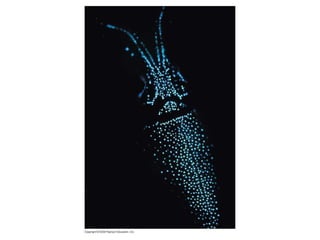
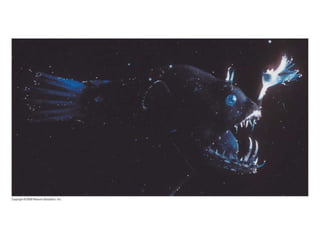
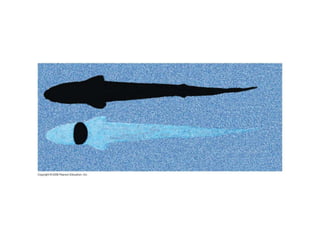
Introduction:  Turning on the Lights to Be Invisible Some organisms use energy-converting reactions to produce light Examples are organisms that live in the ocean and use light to hide themselves from predators Energy conversion involves not only energy but also membranes and enzymes So, production of light involves all of the topics covered in this chapter Copyright © 2009 Pearson Education, Inc.


MEMBRANE STRUCTURE AND FUNCTION Copyright © 2009 Pearson Education, Inc.
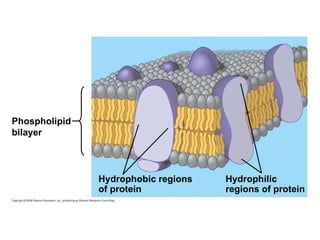
5.1 Membranes are a fluid mosaic of phospholipids and proteins Membranes are composed of phospholipids and proteins Membranes are commonly described as a  fluid mosaic This means that the surface appears  mosaic  because of the proteins embedded in the phospholipids and  fluid  because the proteins can drift about in the phospholipids Copyright © 2009 Pearson Education, Inc.
Phospholipid bilayer Hydrophobic regions of protein Hydrophilic regions of protein
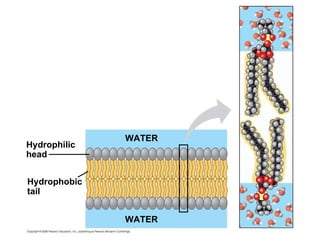
5.1 Membranes are a fluid mosaic of phospholipids and proteins Many phospholipids are made from unsaturated fatty acids that have kinks in their tails This prevents them from packing tightly together, which keeps them liquid This is aided by cholesterol wedged into the bilayer to help keep it liquid at lower temperatures Copyright © 2009 Pearson Education, Inc.
Hydrophilic head WATER Hydrophobic tail WATER
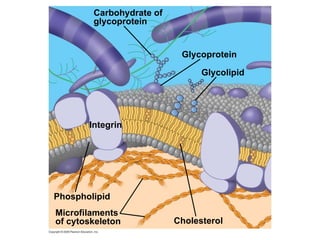
5.1 Membranes are a fluid mosaic of phospholipids and proteins Membranes contain integrins, which give the membrane a stronger framework Integrins attach to the extracellular matrix on the outside of the cell as well as span the membrane to attach to the cytoskeleton  Copyright © 2009 Pearson Education, Inc.
Cholesterol Glycoprotein Glycolipid Carbohydrate of glycoprotein Phospholipid Microfilaments of cytoskeleton Integrin
5.1 Membranes are a fluid mosaic of phospholipids and proteins Some glycoproteins in the membrane serve as identification tags that are specifically recognized by membrane proteins of other cells For example, cell-cell recognition enables cells of the immune system to recognize and reject foreign cells, such as infectious bacteria Carbohydrates that are part of the extracellular matrix are significantly involved in cell-cell recognition Copyright © 2009 Pearson Education, Inc.
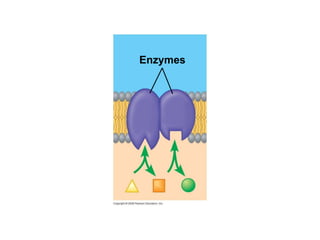
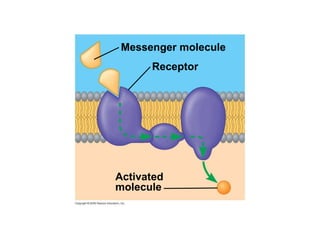
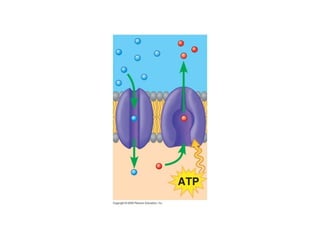
5.1 Membranes are a fluid mosaic of phospholipids and proteins Many membrane proteins function as  enzymes , others in  signal transduction , while others are important in  transport Because membranes allow some substances to cross or be transported more easily than others, they exhibit  selectively permeability Nonpolar molecules (carbon dioxide and oxygen) cross easily Polar molecules (glucose and other sugars) do not cross easily Copyright © 2009 Pearson Education, Inc. Animation:  Overview of Cell Signaling Animation:  Signal Transduction Pathways
Enzymes
Messenger molecule Activated molecule Receptor
 
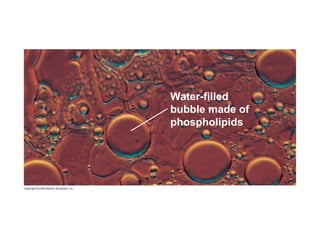
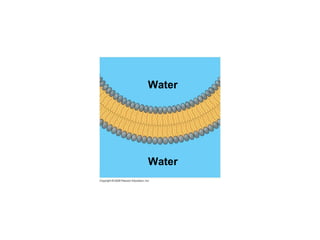
5.2  EVOLUTION CONNECTION:  Membranes form spontaneously, a critical step in the origin of life Phospholipids, the key component of biological membranes, spontaneously assemble into simple membranes Formation of a membrane that encloses collections of molecules necessary for life was a critical step in evolution Copyright © 2009 Pearson Education, Inc.
Water-filled bubble made of phospholipids
Water Water
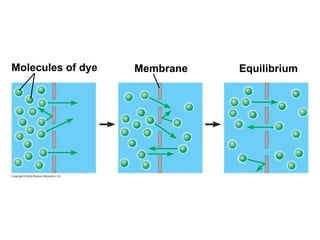
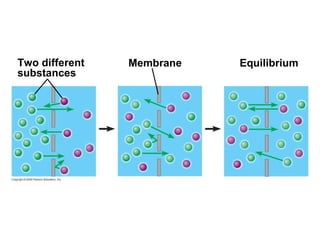
5.3 Passive transport is diffusion across a membrane with no energy investment Diffusion  is a process in which particles spread out evenly in an available space Particles move from an area of more concentrated particles to an area where they are less concentrated This means that particles diffuse down their  concentration gradient Eventually, the particles reach equilibrium where the concentration of particles is the same throughout Copyright © 2009 Pearson Education, Inc.
5.3 Passive transport is diffusion across a membrane with no energy investment Diffusion across a cell membrane does not require energy, so it is called  passive transport The concentration gradient itself represents potential energy for diffusion Copyright © 2009 Pearson Education, Inc. Animation:  Membrane Selectivity Animation:  Diffusion
Molecules of dye Membrane Equilibrium
Two different substances Membrane Equilibrium
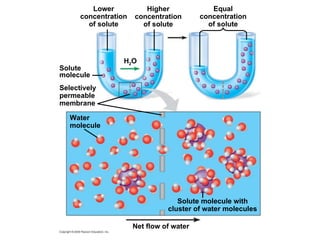
5.4 Osmosis is the diffusion of water across a membrane It is crucial for cells that water moves across their  membrane Water moves across membranes in response to solute concentration inside and outside of the cell by a process called  osmosis Osmosis will move water across a membrane down its concentration gradient until the concentration of solute is equal on both sides of the membrane Copyright © 2009 Pearson Education, Inc. Animation:  Osmosis
Selectively permeable membrane Solute molecule Lower concentration of solute H 2 O Solute molecule with cluster of water molecules Net flow of water Water molecule Equal concentration of solute Higher concentration of solute
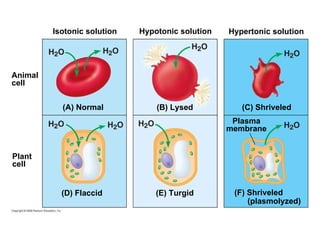
5.5 Water balance between cells and their surroundings is crucial to organisms Tonicity  is a term that describes the ability of a solution to cause a cell to gain or lose water Tonicity is dependent on the concentration of a nonpenetrating solute on both sides of the membrane Isotonic  indicates that the concentration of a solute is the same on both sides Hypertonic  indicates that the concentration of solute is higher outside the cell Hypotonic  indicates a higher concentration of solute inside the cell Copyright © 2009 Pearson Education, Inc.
5.5 Water balance between cells and their surroundings is crucial to organisms Many organisms are able to maintain water balance within their cells by a process called  osmoregulation This process prevents excessive uptake or excessive loss of water Plant, prokaryotic, and fungal cells have different issues with osmoregulation because of their cell walls Copyright © 2009 Pearson Education, Inc. Video:  Paramecium  Vacuole Video:  Chlamydomonas Video:  Turgid  Elodea Video:  Plasmolysis
Isotonic solution (B) Lysed (C) Shriveled (D) Flaccid (E) Turgid (F) Shriveled Hypertonic solution Hypotonic solution Plant cell Animal cell (A) Normal Plasma membrane (plasmolyzed)
5.6 Transport proteins may facilitate diffusion across membranes Many substances that are necessary for viability of the cell do not freely diffuse across the membrane They require the help of specific transport proteins called  aquaporins These proteins assist in  facilitated diffusion , a type of passive transport that does not require energy Copyright © 2009 Pearson Education, Inc.
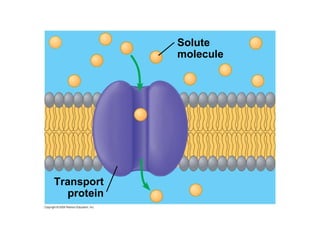
5.6 Transport proteins may facilitate diffusion across membranes Some proteins function by becoming a hydrophilic tunnel for passage Other proteins bind their passenger, change shape, and release their passenger on the other side In both of these situations, the protein is specific for the substrate, which can be sugars, amino acids, ions, and even water Copyright © 2009 Pearson Education, Inc.
Solute molecule Transport protein
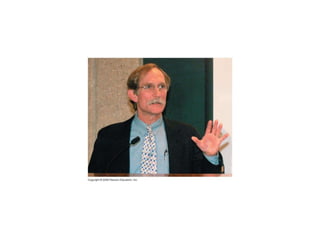
5.7  TALKING ABOUT SCIENCE:  Peter Agre talks about aquaporins, water-channel proteins found in some cells The cell membrane contains hourglass-shaped proteins that are responsible for entry and exit of water through the membrane Dr. Peter Agre, a physician at the Johns Hopkins University School of Medicine, discovered these transport proteins and called them aquaporins Copyright © 2009 Pearson Education, Inc.
 
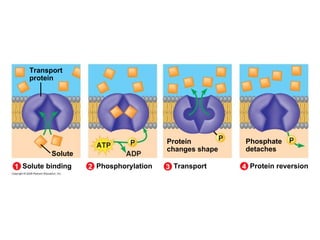
5.8 Cells expend energy in the active transport of a solute against its concentration gradient Cells have a mechanism for moving a solute against its concentration gradient It requires the expenditure of energy in the form of ATP The mechanism alters the shape of the membrane protein through phosphorylation using ATP Copyright © 2009 Pearson Education, Inc. Animation:  Active Transport
Transport protein Solute Solute binding 1
Transport protein Solute Solute binding 1 Phosphorylation 2
Transport protein Solute Solute binding 1 Phosphorylation 2 Transport 3 Protein changes shape
Transport protein Solute Solute binding 1 Phosphorylation 2 Transport 3 Protein changes shape Protein reversion 4 Phosphate detaches
5.9 Exocytosis and endocytosis transport large molecules across membranes A cell uses two mechanisms for moving large molecules across membranes Exocytosis  is used to export bulky molecules, such as proteins or polysaccharides Endocytosis  is used to import substances useful to the livelihood of the cell In both cases, material to be transported is packaged within a vesicle that fuses with the membrane Copyright © 2009 Pearson Education, Inc.
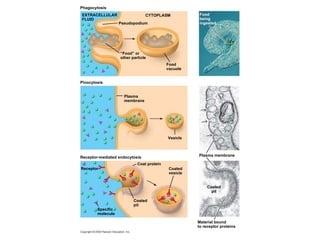
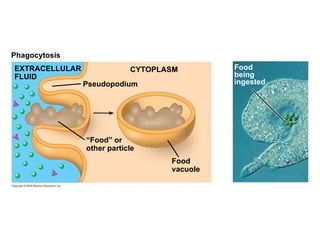
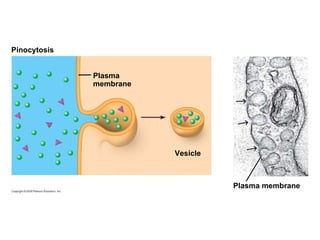
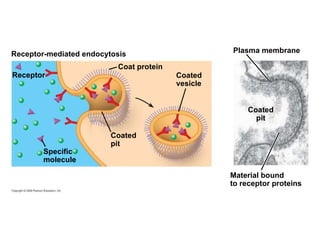
5.9 Exocytosis and endocytosis transport large molecules across membranes There are three kinds of endocytosis Phagocytosis  is engulfment of a particle by wrapping cell membrane around it, forming a vacuole Pinocytosis  is the same thing except that fluids are taken into small vesicles Receptor-mediated endocytosis  is where receptors in a receptor-coated pit interact with a specific protein, initiating formation of a vesicle Copyright © 2009 Pearson Education, Inc. Animation:  Exocytosis and Endocytosis Introduction Animation:  Phagocytosis Animation:  Exocytosis Animation:  Receptor-Mediated Endocytosis Animation:  Pinocytosis
Phagocytosis EXTRACELLULAR FLUID Pseudopodium CYTOPLASM Food vacuole “ Food” or other particle Pinocytosis Plasma membrane Vesicle Coated vesicle Coated pit Specific molecule Receptor-mediated endocytosis Coat protein Receptor Coated pit Material bound to receptor proteins Plasma membrane Food being ingested
Phagocytosis EXTRACELLULAR FLUID Pseudopodium CYTOPLASM Food vacuole “ Food” or other particle Food being ingested
Pinocytosis Plasma membrane Vesicle Plasma membrane
Coated vesicle Coated pit Specific molecule Receptor-mediated endocytosis Coat protein Receptor Coated pit Material bound to receptor proteins Plasma membrane
ENERGY AND THE CELL Copyright © 2009 Pearson Education, Inc.
5.10 Cells transform energy as they perform work Cells are small units, a chemical factory, housing thousands of chemical reactions The result of reactions is maintenance of the cell, manufacture of cellular parts, and replication  Copyright © 2009 Pearson Education, Inc.
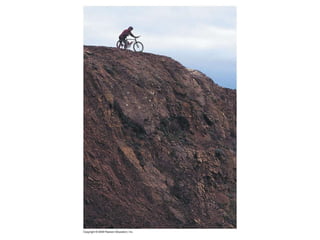
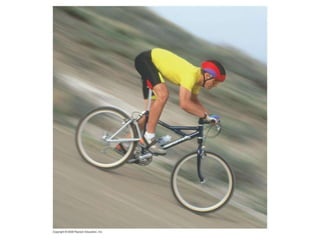
5.10 Cells transform energy as they perform work Energy  is the capacity to do work and cause change Work is accomplished when an object is moved against an opposing force, such as friction There are two kinds of energy Kinetic energy  is the energy of motion Potential energy  is energy that an object possesses as a result of its location Copyright © 2009 Pearson Education, Inc.
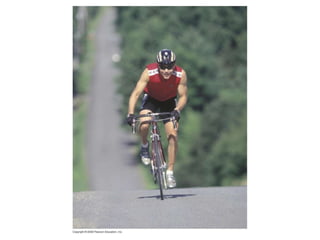
5.10 Cells transform energy as they perform work Kinetic energy performs work by transferring motion to other matter For example, water moving through a turbine generates electricity Heat, or thermal energy, is kinetic energy associated with the random movement of atoms Copyright © 2009 Pearson Education, Inc.
5.10 Cells transform energy as they perform work An example of potential energy is water behind a dam Chemical energy  is potential energy because of its energy available for release in a chemical reaction Copyright © 2009 Pearson Education, Inc. Animation:  Energy Concepts


5.11 Two laws govern energy transformations Energy transformations within matter are studied by individuals in the field of  thermodynamics Biologists study thermodynamics because an organism exchanges both energy and matter with its surroundings Copyright © 2009 Pearson Education, Inc.
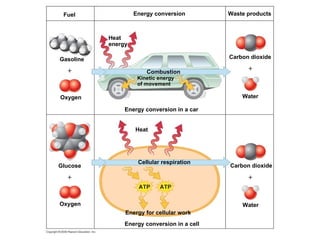
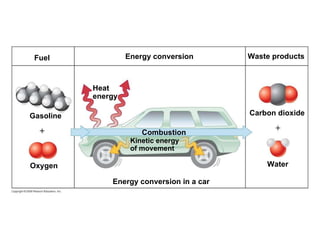
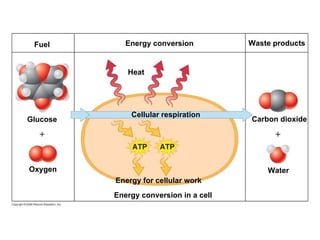
5.11 Two laws govern energy transformations It is important to understand two laws that govern energy transformations in organisms The  first law of   thermodynamics —energy in the universe is constant The  second law of   thermodynamics —energy conversions increase the disorder of the universe Entropy  is the measure of disorder, or randomness Copyright © 2009 Pearson Education, Inc.
Fuel Gasoline Energy conversion in a cell Energy for cellular work Cellular respiration Waste products Energy conversion Combustion Energy conversion in a car Oxygen Heat Glucose Oxygen Water Carbon dioxide Water Carbon dioxide Kinetic energy of movement Heat energy
Fuel Gasoline Waste products Energy conversion Combustion Energy conversion in a car Oxygen Water Carbon dioxide Kinetic energy of movement Heat energy
Energy conversion in a cell Energy for cellular work Cellular respiration Heat Glucose Oxygen Water Carbon dioxide Fuel Energy conversion Waste products
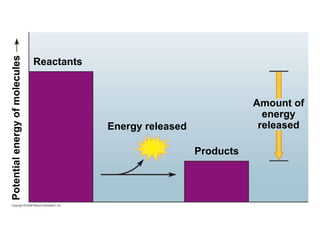
5.12 Chemical reactions either release or store energy An  exergonic reaction  is a chemical reaction that releases energy This reaction releases the energy in covalent bonds of the reactants Burning wood releases the energy in glucose, producing heat, light, carbon dioxide, and water Cellular respiration  also releases energy and heat and produces products but is able to use the released energy to perform work Copyright © 2009 Pearson Education, Inc.
Reactants Amount of energy released Potential energy of molecules Energy released Products
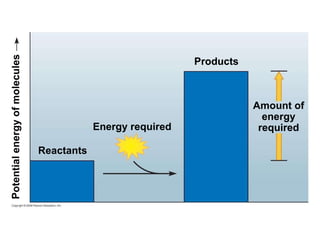
5.12 Chemical reactions either release or store energy An  endergonic reaction  requires an input of energy and yields products rich in potential energy The reactants contain little energy in the beginning, but energy is absorbed from the surroundings and stored in covalent bonds of the products Photosynthesis makes energy-rich sugar molecules using energy in sunlight Copyright © 2009 Pearson Education, Inc.
Reactants Potential energy of molecules Energy required Products Amount of energy required
5.12 Chemical reactions either release or store energy A living organism produces thousands of endergonic and exergonic chemical reactions All of these combined is called  metabolism A  metabolic pathway  is a series of chemical reactions that either break down a complex molecule or build up a complex molecule Copyright © 2009 Pearson Education, Inc.
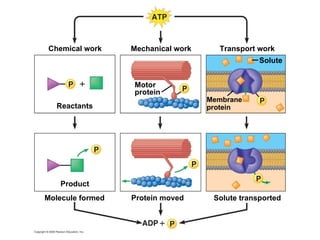
5.12 Chemical reactions either release or store energy A cell does three main types of cellular work Chemical work—driving endergonic reactions Transport work—pumping substances across membranes Mechanical work—beating of cilia To accomplish work, a cell must manage its energy resources, and it does so by  energy   coupling —the use of exergonic processes to drive an endergonic one Copyright © 2009 Pearson Education, Inc.
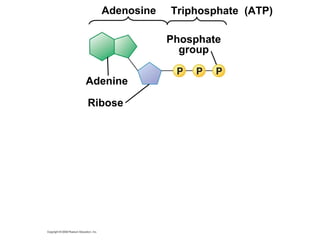
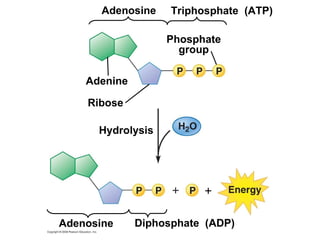
ATP,  a denosine  t ri p hosphate, is the energy currency of cells. ATP is the immediate source of energy that powers most forms of cellular work. It is composed of adenine (a nitrogenous base), ribose (a five-carbon sugar), and three phosphate groups. 5.13 ATP shuttles chemical energy and drives cellular work Copyright © 2009 Pearson Education, Inc.
5.13 ATP shuttles chemical energy and drives cellular work Hydrolysis of ATP releases energy by transferring its third phosphate from ATP to some other molecule The transfer is called phosphorylation In the process, ATP energizes molecules Copyright © 2009 Pearson Education, Inc.
Ribose Adenine Triphosphate  (ATP) Adenosine Phosphate group
Ribose Adenine Triphosphate  (ATP) Adenosine Phosphate group Hydrolysis Diphosphate  (ADP) Adenosine 
Chemical work Solute transported Molecule formed Product Reactants Motor protein Membrane protein Solute Transport work Mechanical work Protein moved
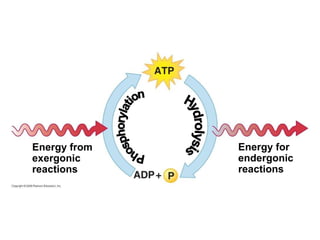
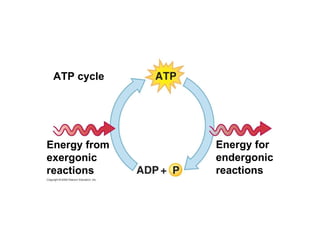
5.13 ATP shuttles chemical energy and drives cellular work ATP is a renewable source of energy for the cell When energy is released in an exergonic reaction, such as breakdown of glucose, the energy is used in an endergonic reaction to generate ATP Copyright © 2009 Pearson Education, Inc.
Energy from exergonic reactions Energy for endergonic reactions Phosphorylation Hydrolysis
HOW ENZYMES FUNCTION Copyright © 2009 Pearson Education, Inc.
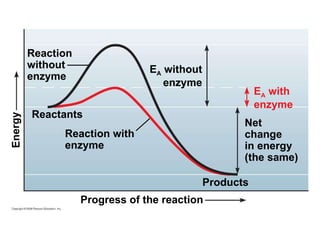
5.14 Enzymes speed up the cell’s chemical reactions by lowering energy barriers Although there is a lot of potential energy in biological molecules, such as carbohydrates and others, it is not released spontaneously Energy must be available to break bonds and form new ones This energy is called  energy of activation  ( E A ) Copyright © 2009 Pearson Education, Inc.
5.14 Enzymes speed up the cell’s chemical reactions by lowering energy barriers The cell uses catalysis to drive (speed up) biological reactions Catalysis is accomplished by  enzymes , which are proteins that function as biological catalysts Enzymes speed up the rate of the reaction by lowering the E A  , and they are not used up in the process Each enzyme has a particular target molecule called the substrate Copyright © 2009 Pearson Education, Inc. Animation:  How Enzymes Work
Reaction without enzyme E A  with  enzyme Energy Reactants Reaction with enzyme E A  without enzyme Net change in energy (the same) Products Progress of the reaction
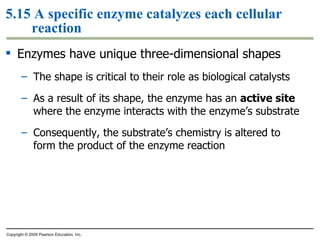
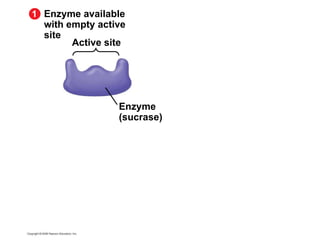
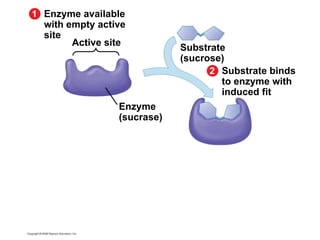
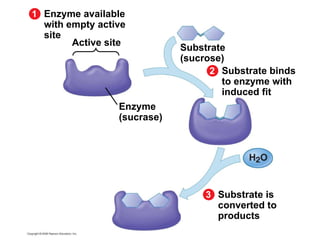
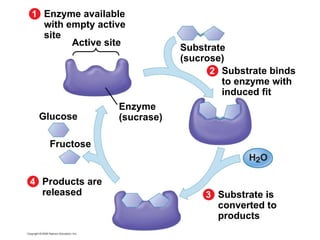
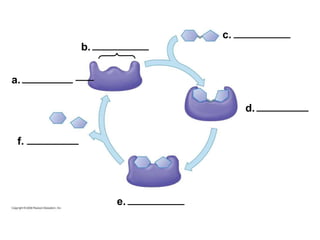
5.15 A specific enzyme catalyzes each cellular reaction Enzymes have unique three-dimensional shapes The shape is critical to their role as biological catalysts As a result of its shape, the enzyme has an  active site  where the enzyme interacts with the enzyme’s substrate Consequently, the substrate’s chemistry is altered to form the product of the enzyme reaction Copyright © 2009 Pearson Education, Inc.
Enzyme available with empty active site Active site 1 Enzyme (sucrase)
Enzyme available with empty active site Active site 1 Enzyme (sucrase) Substrate binds to enzyme with induced fit 2 Substrate (sucrose)
Enzyme available with empty active site Active site 1 Enzyme (sucrase) Substrate binds to enzyme with induced fit 2 Substrate (sucrose) Substrate is converted to products 3
Enzyme available with empty active site Active site 1 Enzyme (sucrase) Substrate binds to enzyme with induced fit 2 Substrate (sucrose) Substrate is converted to products 3 Products are released 4 Fructose Glucose
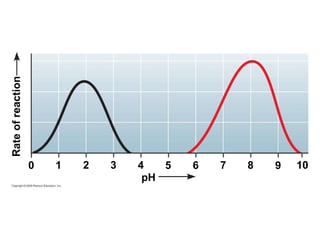
5.15 A specific enzyme catalyzes each cellular reaction For optimum activity, enzymes require certain environmental conditions Temperature is very important, and optimally, human enzymes function best at 37ºC, or body temperature High temperature will denature human enzymes Enzymes also require a pH around neutrality for best results Copyright © 2009 Pearson Education, Inc.
5.15 A specific enzyme catalyzes each cellular reaction Some enzymes require nonprotein helpers Cofactors  are inorganic, such as zinc, iron, or copper Coenzymes  are organic molecules and are often vitamins Copyright © 2009 Pearson Education, Inc.
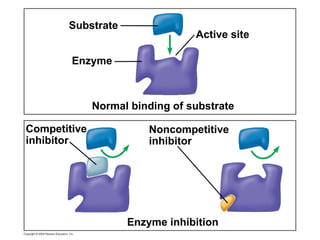
5.16 Enzyme inhibitors block enzyme action and can regulate enzyme activity in a cell Inhibitors are chemicals that inhibit an enzyme’s activity One group inhibits because they compete for the enzyme’s active site and thus block substrates from entering the active site These are called  competitive inhibitors Copyright © 2009 Pearson Education, Inc.
Substrate Enzyme Active site Normal binding of substrate Competitive inhibitor Enzyme inhibition Noncompetitive inhibitor
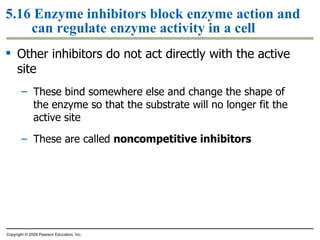
5.16 Enzyme inhibitors block enzyme action and can regulate enzyme activity in a cell Other inhibitors do not act directly with the active site These bind somewhere else and change the shape of the enzyme so that the substrate will no longer fit the active site These are called  noncompetitive inhibitors Copyright © 2009 Pearson Education, Inc.
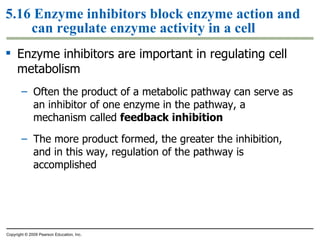
5.16 Enzyme inhibitors block enzyme action and can regulate enzyme activity in a cell Enzyme inhibitors are important in regulating cell metabolism Often the product of a metabolic pathway can serve as an inhibitor of one enzyme in the pathway, a mechanism called  feedback inhibition The more product formed, the greater the inhibition, and in this way, regulation of the pathway is accomplished Copyright © 2009 Pearson Education, Inc.
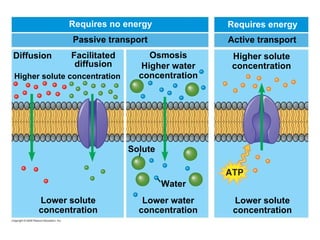
Diffusion Requires no energy Passive transport Higher solute concentration  Facilitated diffusion Osmosis Higher water concentration Higher solute concentration Requires energy Active transport Solute Water Lower solute concentration Lower water concentration Lower solute concentration
ATP cycle Energy from exergonic reactions Energy for endergonic reactions
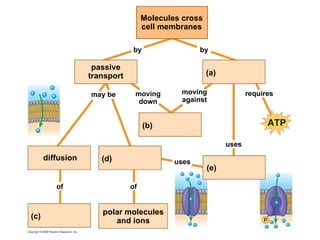
Molecules cross cell membranes passive transport by by may be moving down moving against requires uses diffusion of polar molecules and ions uses of (a) (c) (d) (b) (e)
a. b. c. d. e. f.
 
Rate of reaction pH 10 9 8 7 6 5 4 3 2 1 0
Describe the cell membrane within the context of the fluid mosaic model Explain how spontaneous formation of a membrane could have been important in the origin of life Describe the passage of materials across a membrane with no energy expenditure Explain how osmosis plays a role in maintenance of a cell You should now be able to Copyright © 2009 Pearson Education, Inc.
Explain how an imbalance in water between the cell and its environment affects the cell Describe membrane proteins that facilitate transport of materials across the cell membrane without expenditure of energy Discuss how energy-requiring transport proteins move substances across the cell membrane Distinguish between exocytosis and endocytosis and list similarities between the two You should now be able to Copyright © 2009 Pearson Education, Inc.
Explain how energy is transformed during life processes Define the two laws of thermodynamics and explain how they relate to biological systems  Explain how a chemical reaction can either release energy or store energy Describe ATP and explain why it is considered to be the energy currency of a cell You should now be able to Copyright © 2009 Pearson Education, Inc.
You should now be able to Define enzyme and explain how enzymes cause a chemical reaction to speed up Discuss the specificity of enzymes Distinguish between competitive inhibitors and noncompetitive inhibitors Copyright © 2009 Pearson Education, Inc.

Ch5

  • 1.
    Chapter 5 TheWorking Cell 0 Lecture by Richard L. Myers
  • 2.
    Introduction: Turningon the Lights to Be Invisible Some organisms use energy-converting reactions to produce light Examples are organisms that live in the ocean and use light to hide themselves from predators Energy conversion involves not only energy but also membranes and enzymes So, production of light involves all of the topics covered in this chapter Copyright © 2009 Pearson Education, Inc.
  • 3.
  • 4.
  • 5.
  • 6.
    MEMBRANE STRUCTURE ANDFUNCTION Copyright © 2009 Pearson Education, Inc.
  • 7.
    5.1 Membranes area fluid mosaic of phospholipids and proteins Membranes are composed of phospholipids and proteins Membranes are commonly described as a fluid mosaic This means that the surface appears mosaic because of the proteins embedded in the phospholipids and fluid because the proteins can drift about in the phospholipids Copyright © 2009 Pearson Education, Inc.
  • 8.
    Phospholipid bilayer Hydrophobicregions of protein Hydrophilic regions of protein
  • 9.
    5.1 Membranes area fluid mosaic of phospholipids and proteins Many phospholipids are made from unsaturated fatty acids that have kinks in their tails This prevents them from packing tightly together, which keeps them liquid This is aided by cholesterol wedged into the bilayer to help keep it liquid at lower temperatures Copyright © 2009 Pearson Education, Inc.
  • 10.
    Hydrophilic head WATERHydrophobic tail WATER
  • 11.
    5.1 Membranes area fluid mosaic of phospholipids and proteins Membranes contain integrins, which give the membrane a stronger framework Integrins attach to the extracellular matrix on the outside of the cell as well as span the membrane to attach to the cytoskeleton Copyright © 2009 Pearson Education, Inc.
  • 12.
    Cholesterol Glycoprotein GlycolipidCarbohydrate of glycoprotein Phospholipid Microfilaments of cytoskeleton Integrin
  • 13.
    5.1 Membranes area fluid mosaic of phospholipids and proteins Some glycoproteins in the membrane serve as identification tags that are specifically recognized by membrane proteins of other cells For example, cell-cell recognition enables cells of the immune system to recognize and reject foreign cells, such as infectious bacteria Carbohydrates that are part of the extracellular matrix are significantly involved in cell-cell recognition Copyright © 2009 Pearson Education, Inc.
  • 14.
    5.1 Membranes area fluid mosaic of phospholipids and proteins Many membrane proteins function as enzymes , others in signal transduction , while others are important in transport Because membranes allow some substances to cross or be transported more easily than others, they exhibit selectively permeability Nonpolar molecules (carbon dioxide and oxygen) cross easily Polar molecules (glucose and other sugars) do not cross easily Copyright © 2009 Pearson Education, Inc. Animation: Overview of Cell Signaling Animation: Signal Transduction Pathways
  • 15.
  • 16.
  • 17.
  • 18.
    5.2 EVOLUTIONCONNECTION: Membranes form spontaneously, a critical step in the origin of life Phospholipids, the key component of biological membranes, spontaneously assemble into simple membranes Formation of a membrane that encloses collections of molecules necessary for life was a critical step in evolution Copyright © 2009 Pearson Education, Inc.
  • 19.
    Water-filled bubble madeof phospholipids
  • 20.
  • 21.
    5.3 Passive transportis diffusion across a membrane with no energy investment Diffusion is a process in which particles spread out evenly in an available space Particles move from an area of more concentrated particles to an area where they are less concentrated This means that particles diffuse down their concentration gradient Eventually, the particles reach equilibrium where the concentration of particles is the same throughout Copyright © 2009 Pearson Education, Inc.
  • 22.
    5.3 Passive transportis diffusion across a membrane with no energy investment Diffusion across a cell membrane does not require energy, so it is called passive transport The concentration gradient itself represents potential energy for diffusion Copyright © 2009 Pearson Education, Inc. Animation: Membrane Selectivity Animation: Diffusion
  • 23.
    Molecules of dyeMembrane Equilibrium
  • 24.
    Two different substancesMembrane Equilibrium
  • 25.
    5.4 Osmosis isthe diffusion of water across a membrane It is crucial for cells that water moves across their membrane Water moves across membranes in response to solute concentration inside and outside of the cell by a process called osmosis Osmosis will move water across a membrane down its concentration gradient until the concentration of solute is equal on both sides of the membrane Copyright © 2009 Pearson Education, Inc. Animation: Osmosis
  • 26.
    Selectively permeable membraneSolute molecule Lower concentration of solute H 2 O Solute molecule with cluster of water molecules Net flow of water Water molecule Equal concentration of solute Higher concentration of solute
  • 27.
    5.5 Water balancebetween cells and their surroundings is crucial to organisms Tonicity is a term that describes the ability of a solution to cause a cell to gain or lose water Tonicity is dependent on the concentration of a nonpenetrating solute on both sides of the membrane Isotonic indicates that the concentration of a solute is the same on both sides Hypertonic indicates that the concentration of solute is higher outside the cell Hypotonic indicates a higher concentration of solute inside the cell Copyright © 2009 Pearson Education, Inc.
  • 28.
    5.5 Water balancebetween cells and their surroundings is crucial to organisms Many organisms are able to maintain water balance within their cells by a process called osmoregulation This process prevents excessive uptake or excessive loss of water Plant, prokaryotic, and fungal cells have different issues with osmoregulation because of their cell walls Copyright © 2009 Pearson Education, Inc. Video: Paramecium Vacuole Video: Chlamydomonas Video: Turgid Elodea Video: Plasmolysis
  • 29.
    Isotonic solution (B)Lysed (C) Shriveled (D) Flaccid (E) Turgid (F) Shriveled Hypertonic solution Hypotonic solution Plant cell Animal cell (A) Normal Plasma membrane (plasmolyzed)
  • 30.
    5.6 Transport proteinsmay facilitate diffusion across membranes Many substances that are necessary for viability of the cell do not freely diffuse across the membrane They require the help of specific transport proteins called aquaporins These proteins assist in facilitated diffusion , a type of passive transport that does not require energy Copyright © 2009 Pearson Education, Inc.
  • 31.
    5.6 Transport proteinsmay facilitate diffusion across membranes Some proteins function by becoming a hydrophilic tunnel for passage Other proteins bind their passenger, change shape, and release their passenger on the other side In both of these situations, the protein is specific for the substrate, which can be sugars, amino acids, ions, and even water Copyright © 2009 Pearson Education, Inc.
  • 32.
  • 33.
    5.7 TALKINGABOUT SCIENCE: Peter Agre talks about aquaporins, water-channel proteins found in some cells The cell membrane contains hourglass-shaped proteins that are responsible for entry and exit of water through the membrane Dr. Peter Agre, a physician at the Johns Hopkins University School of Medicine, discovered these transport proteins and called them aquaporins Copyright © 2009 Pearson Education, Inc.
  • 34.
  • 35.
    5.8 Cells expendenergy in the active transport of a solute against its concentration gradient Cells have a mechanism for moving a solute against its concentration gradient It requires the expenditure of energy in the form of ATP The mechanism alters the shape of the membrane protein through phosphorylation using ATP Copyright © 2009 Pearson Education, Inc. Animation: Active Transport
  • 36.
    Transport protein SoluteSolute binding 1
  • 37.
    Transport protein SoluteSolute binding 1 Phosphorylation 2
  • 38.
    Transport protein SoluteSolute binding 1 Phosphorylation 2 Transport 3 Protein changes shape
  • 39.
    Transport protein SoluteSolute binding 1 Phosphorylation 2 Transport 3 Protein changes shape Protein reversion 4 Phosphate detaches
  • 40.
    5.9 Exocytosis andendocytosis transport large molecules across membranes A cell uses two mechanisms for moving large molecules across membranes Exocytosis is used to export bulky molecules, such as proteins or polysaccharides Endocytosis is used to import substances useful to the livelihood of the cell In both cases, material to be transported is packaged within a vesicle that fuses with the membrane Copyright © 2009 Pearson Education, Inc.
  • 41.
    5.9 Exocytosis andendocytosis transport large molecules across membranes There are three kinds of endocytosis Phagocytosis is engulfment of a particle by wrapping cell membrane around it, forming a vacuole Pinocytosis is the same thing except that fluids are taken into small vesicles Receptor-mediated endocytosis is where receptors in a receptor-coated pit interact with a specific protein, initiating formation of a vesicle Copyright © 2009 Pearson Education, Inc. Animation: Exocytosis and Endocytosis Introduction Animation: Phagocytosis Animation: Exocytosis Animation: Receptor-Mediated Endocytosis Animation: Pinocytosis
  • 42.
    Phagocytosis EXTRACELLULAR FLUIDPseudopodium CYTOPLASM Food vacuole “ Food” or other particle Pinocytosis Plasma membrane Vesicle Coated vesicle Coated pit Specific molecule Receptor-mediated endocytosis Coat protein Receptor Coated pit Material bound to receptor proteins Plasma membrane Food being ingested
  • 43.
    Phagocytosis EXTRACELLULAR FLUIDPseudopodium CYTOPLASM Food vacuole “ Food” or other particle Food being ingested
  • 44.
    Pinocytosis Plasma membraneVesicle Plasma membrane
  • 45.
    Coated vesicle Coatedpit Specific molecule Receptor-mediated endocytosis Coat protein Receptor Coated pit Material bound to receptor proteins Plasma membrane
  • 46.
    ENERGY AND THECELL Copyright © 2009 Pearson Education, Inc.
  • 47.
    5.10 Cells transformenergy as they perform work Cells are small units, a chemical factory, housing thousands of chemical reactions The result of reactions is maintenance of the cell, manufacture of cellular parts, and replication Copyright © 2009 Pearson Education, Inc.
  • 48.
    5.10 Cells transformenergy as they perform work Energy is the capacity to do work and cause change Work is accomplished when an object is moved against an opposing force, such as friction There are two kinds of energy Kinetic energy is the energy of motion Potential energy is energy that an object possesses as a result of its location Copyright © 2009 Pearson Education, Inc.
  • 49.
    5.10 Cells transformenergy as they perform work Kinetic energy performs work by transferring motion to other matter For example, water moving through a turbine generates electricity Heat, or thermal energy, is kinetic energy associated with the random movement of atoms Copyright © 2009 Pearson Education, Inc.
  • 50.
    5.10 Cells transformenergy as they perform work An example of potential energy is water behind a dam Chemical energy is potential energy because of its energy available for release in a chemical reaction Copyright © 2009 Pearson Education, Inc. Animation: Energy Concepts
  • 51.
  • 52.
  • 53.
  • 54.
    5.11 Two lawsgovern energy transformations Energy transformations within matter are studied by individuals in the field of thermodynamics Biologists study thermodynamics because an organism exchanges both energy and matter with its surroundings Copyright © 2009 Pearson Education, Inc.
  • 55.
    5.11 Two lawsgovern energy transformations It is important to understand two laws that govern energy transformations in organisms The first law of thermodynamics —energy in the universe is constant The second law of thermodynamics —energy conversions increase the disorder of the universe Entropy is the measure of disorder, or randomness Copyright © 2009 Pearson Education, Inc.
  • 56.
    Fuel Gasoline Energyconversion in a cell Energy for cellular work Cellular respiration Waste products Energy conversion Combustion Energy conversion in a car Oxygen Heat Glucose Oxygen Water Carbon dioxide Water Carbon dioxide Kinetic energy of movement Heat energy
  • 57.
    Fuel Gasoline Wasteproducts Energy conversion Combustion Energy conversion in a car Oxygen Water Carbon dioxide Kinetic energy of movement Heat energy
  • 58.
    Energy conversion ina cell Energy for cellular work Cellular respiration Heat Glucose Oxygen Water Carbon dioxide Fuel Energy conversion Waste products
  • 59.
    5.12 Chemical reactionseither release or store energy An exergonic reaction is a chemical reaction that releases energy This reaction releases the energy in covalent bonds of the reactants Burning wood releases the energy in glucose, producing heat, light, carbon dioxide, and water Cellular respiration also releases energy and heat and produces products but is able to use the released energy to perform work Copyright © 2009 Pearson Education, Inc.
  • 60.
    Reactants Amount ofenergy released Potential energy of molecules Energy released Products
  • 61.
    5.12 Chemical reactionseither release or store energy An endergonic reaction requires an input of energy and yields products rich in potential energy The reactants contain little energy in the beginning, but energy is absorbed from the surroundings and stored in covalent bonds of the products Photosynthesis makes energy-rich sugar molecules using energy in sunlight Copyright © 2009 Pearson Education, Inc.
  • 62.
    Reactants Potential energyof molecules Energy required Products Amount of energy required
  • 63.
    5.12 Chemical reactionseither release or store energy A living organism produces thousands of endergonic and exergonic chemical reactions All of these combined is called metabolism A metabolic pathway is a series of chemical reactions that either break down a complex molecule or build up a complex molecule Copyright © 2009 Pearson Education, Inc.
  • 64.
    5.12 Chemical reactionseither release or store energy A cell does three main types of cellular work Chemical work—driving endergonic reactions Transport work—pumping substances across membranes Mechanical work—beating of cilia To accomplish work, a cell must manage its energy resources, and it does so by energy coupling —the use of exergonic processes to drive an endergonic one Copyright © 2009 Pearson Education, Inc.
  • 65.
    ATP, adenosine t ri p hosphate, is the energy currency of cells. ATP is the immediate source of energy that powers most forms of cellular work. It is composed of adenine (a nitrogenous base), ribose (a five-carbon sugar), and three phosphate groups. 5.13 ATP shuttles chemical energy and drives cellular work Copyright © 2009 Pearson Education, Inc.
  • 66.
    5.13 ATP shuttleschemical energy and drives cellular work Hydrolysis of ATP releases energy by transferring its third phosphate from ATP to some other molecule The transfer is called phosphorylation In the process, ATP energizes molecules Copyright © 2009 Pearson Education, Inc.
  • 67.
    Ribose Adenine Triphosphate (ATP) Adenosine Phosphate group
  • 68.
    Ribose Adenine Triphosphate (ATP) Adenosine Phosphate group Hydrolysis Diphosphate (ADP) Adenosine 
  • 69.
    Chemical work Solutetransported Molecule formed Product Reactants Motor protein Membrane protein Solute Transport work Mechanical work Protein moved
  • 70.
    5.13 ATP shuttleschemical energy and drives cellular work ATP is a renewable source of energy for the cell When energy is released in an exergonic reaction, such as breakdown of glucose, the energy is used in an endergonic reaction to generate ATP Copyright © 2009 Pearson Education, Inc.
  • 71.
    Energy from exergonicreactions Energy for endergonic reactions Phosphorylation Hydrolysis
  • 72.
    HOW ENZYMES FUNCTIONCopyright © 2009 Pearson Education, Inc.
  • 73.
    5.14 Enzymes speedup the cell’s chemical reactions by lowering energy barriers Although there is a lot of potential energy in biological molecules, such as carbohydrates and others, it is not released spontaneously Energy must be available to break bonds and form new ones This energy is called energy of activation ( E A ) Copyright © 2009 Pearson Education, Inc.
  • 74.
    5.14 Enzymes speedup the cell’s chemical reactions by lowering energy barriers The cell uses catalysis to drive (speed up) biological reactions Catalysis is accomplished by enzymes , which are proteins that function as biological catalysts Enzymes speed up the rate of the reaction by lowering the E A , and they are not used up in the process Each enzyme has a particular target molecule called the substrate Copyright © 2009 Pearson Education, Inc. Animation: How Enzymes Work
  • 75.
    Reaction without enzymeE A with enzyme Energy Reactants Reaction with enzyme E A without enzyme Net change in energy (the same) Products Progress of the reaction
  • 76.
    5.15 A specificenzyme catalyzes each cellular reaction Enzymes have unique three-dimensional shapes The shape is critical to their role as biological catalysts As a result of its shape, the enzyme has an active site where the enzyme interacts with the enzyme’s substrate Consequently, the substrate’s chemistry is altered to form the product of the enzyme reaction Copyright © 2009 Pearson Education, Inc.
  • 77.
    Enzyme available withempty active site Active site 1 Enzyme (sucrase)
  • 78.
    Enzyme available withempty active site Active site 1 Enzyme (sucrase) Substrate binds to enzyme with induced fit 2 Substrate (sucrose)
  • 79.
    Enzyme available withempty active site Active site 1 Enzyme (sucrase) Substrate binds to enzyme with induced fit 2 Substrate (sucrose) Substrate is converted to products 3
  • 80.
    Enzyme available withempty active site Active site 1 Enzyme (sucrase) Substrate binds to enzyme with induced fit 2 Substrate (sucrose) Substrate is converted to products 3 Products are released 4 Fructose Glucose
  • 81.
    5.15 A specificenzyme catalyzes each cellular reaction For optimum activity, enzymes require certain environmental conditions Temperature is very important, and optimally, human enzymes function best at 37ºC, or body temperature High temperature will denature human enzymes Enzymes also require a pH around neutrality for best results Copyright © 2009 Pearson Education, Inc.
  • 82.
    5.15 A specificenzyme catalyzes each cellular reaction Some enzymes require nonprotein helpers Cofactors are inorganic, such as zinc, iron, or copper Coenzymes are organic molecules and are often vitamins Copyright © 2009 Pearson Education, Inc.
  • 83.
    5.16 Enzyme inhibitorsblock enzyme action and can regulate enzyme activity in a cell Inhibitors are chemicals that inhibit an enzyme’s activity One group inhibits because they compete for the enzyme’s active site and thus block substrates from entering the active site These are called competitive inhibitors Copyright © 2009 Pearson Education, Inc.
  • 84.
    Substrate Enzyme Activesite Normal binding of substrate Competitive inhibitor Enzyme inhibition Noncompetitive inhibitor
  • 85.
    5.16 Enzyme inhibitorsblock enzyme action and can regulate enzyme activity in a cell Other inhibitors do not act directly with the active site These bind somewhere else and change the shape of the enzyme so that the substrate will no longer fit the active site These are called noncompetitive inhibitors Copyright © 2009 Pearson Education, Inc.
  • 86.
    5.16 Enzyme inhibitorsblock enzyme action and can regulate enzyme activity in a cell Enzyme inhibitors are important in regulating cell metabolism Often the product of a metabolic pathway can serve as an inhibitor of one enzyme in the pathway, a mechanism called feedback inhibition The more product formed, the greater the inhibition, and in this way, regulation of the pathway is accomplished Copyright © 2009 Pearson Education, Inc.
  • 87.
    Diffusion Requires noenergy Passive transport Higher solute concentration Facilitated diffusion Osmosis Higher water concentration Higher solute concentration Requires energy Active transport Solute Water Lower solute concentration Lower water concentration Lower solute concentration
  • 88.
    ATP cycle Energyfrom exergonic reactions Energy for endergonic reactions
  • 89.
    Molecules cross cellmembranes passive transport by by may be moving down moving against requires uses diffusion of polar molecules and ions uses of (a) (c) (d) (b) (e)
  • 90.
    a. b. c.d. e. f.
  • 91.
  • 92.
    Rate of reactionpH 10 9 8 7 6 5 4 3 2 1 0
  • 93.
    Describe the cellmembrane within the context of the fluid mosaic model Explain how spontaneous formation of a membrane could have been important in the origin of life Describe the passage of materials across a membrane with no energy expenditure Explain how osmosis plays a role in maintenance of a cell You should now be able to Copyright © 2009 Pearson Education, Inc.
  • 94.
    Explain how animbalance in water between the cell and its environment affects the cell Describe membrane proteins that facilitate transport of materials across the cell membrane without expenditure of energy Discuss how energy-requiring transport proteins move substances across the cell membrane Distinguish between exocytosis and endocytosis and list similarities between the two You should now be able to Copyright © 2009 Pearson Education, Inc.
  • 95.
    Explain how energyis transformed during life processes Define the two laws of thermodynamics and explain how they relate to biological systems Explain how a chemical reaction can either release energy or store energy Describe ATP and explain why it is considered to be the energy currency of a cell You should now be able to Copyright © 2009 Pearson Education, Inc.
  • 96.
    You should nowbe able to Define enzyme and explain how enzymes cause a chemical reaction to speed up Discuss the specificity of enzymes Distinguish between competitive inhibitors and noncompetitive inhibitors Copyright © 2009 Pearson Education, Inc.

Editor's Notes

  • #3 This chapter describes how working cells, such as those found in a prey organism, use cellular metabolism directed by enzymes associated with membranes to convert energy.
  • #8 The structure of the membrane is described as a fluid mosaic model . Scientists propose models as hypotheses, which are ways of explaining existing information. Sometimes models are replaced with an updated version. Models inspire experiments, and few models survive these tests without modifications. The fluid mosaic model is being continually refined. You may want to mention to your students that because of the hydrophobic properties of the tail of phospholipids, lipid bilayers are naturally self-healing. Teaching Tips 1. You might wish to share a very simple analogy that seems to work well for some students. A cell membrane is a little like a peanut butter and jelly sandwich with jellybeans poked into it. The bread represents the hydrophilic portions of the bilayer (and bread does indeed quickly absorb water). The peanut butter and jelly represent the hydrophobic regions (and peanut butter, containing plenty of oil, is generally hydrophobic). The jellybeans stuck into the sandwich represent proteins variously embedded partially into or completely through the membrane. Transport proteins would be like the jellybeans that poke completely through the sandwich. Analogies are rarely perfect. Challenge your students to critique this analogy by finding exceptions. (For example, this analogy does not include a model of the carbohydrates on the cell surface.)
  • #9 Campbell, Neil, and Jane Reece, Biology , 8th ed., Figure 7.3 The fluid mosaic model for membranes.
  • #10 The bilayer is about as fluid as salad or cooking oil. Teaching Tips 1. You might wish to share a very simple analogy that seems to work well for some students. A cell membrane is a little like a peanut butter and jelly sandwich with jellybeans poked into it. The bread represents the hydrophilic portions of the bilayer (and bread does indeed quickly absorb water). The peanut butter and jelly represent the hydrophobic regions (and peanut butter, containing plenty of oil, is generally hydrophobic). The jellybeans stuck into the sandwich represent proteins variously embedded partially into or completely through the membrane. Transport proteins would be like the jellybeans that poke completely through the sandwich. Analogies are rarely perfect. Challenge your students to critique this analogy by finding exceptions. (For example, this analogy does not include a model of the carbohydrates on the cell surface.)
  • #11 Campbell, Neil, and Jane Reece, Biology , 8th ed., Figure 7.2 Phospholipid bilayer (cross section).
  • #12 Teaching Tips 1. You might wish to share a very simple analogy that seems to work well for some students. A cell membrane is a little like a peanut butter and jelly sandwich with jellybeans poked into it. The bread represents the hydrophilic portions of the bilayer (and bread does indeed quickly absorb water). The peanut butter and jelly represent the hydrophobic regions (and peanut butter, containing plenty of oil, is generally hydrophobic). The jellybeans stuck into the sandwich represent proteins variously embedded partially into or completely through the membrane. Transport proteins would be like the jellybeans that poke completely through the sandwich. Analogies are rarely perfect. Challenge your students to critique this analogy by finding exceptions. (For example, this analogy does not include a model of the carbohydrates on the cell surface.)
  • #13 Figure 5.1A The plasma membrane and extracellular matrix of an animal cell.
  • #14 Carbohydrates vary among individual cells and function as markers. For example, the four human blood types designated A, B, AB, and O reflect variation in the carbohydrates on the surface of red blood cells. Teaching Tips 1. You might wish to share a very simple analogy that seems to work well for some students. A cell membrane is a little like a peanut butter and jelly sandwich with jellybeans poked into it. The bread represents the hydrophilic portions of the bilayer (and bread does indeed quickly absorb water). The peanut butter and jelly represent the hydrophobic regions (and peanut butter, containing plenty of oil, is generally hydrophobic). The jellybeans stuck into the sandwich represent proteins variously embedded partially into or completely through the membrane. Transport proteins would be like the jellybeans that poke completely through the sandwich. Analogies are rarely perfect. Challenge your students to critique this analogy by finding exceptions. (For example, this analogy does not include a model of the carbohydrates on the cell surface.)
  • #15 Membrane proteins called transport proteins play a “gatekeeper” role in selective permeability. Teaching Tips 1. You might wish to share a very simple analogy that seems to work well for some students. A cell membrane is a little like a peanut butter and jelly sandwich with jellybeans poked into it. The bread represents the hydrophilic portions of the bilayer (and bread does indeed quickly absorb water). The peanut butter and jelly represent the hydrophobic regions (and peanut butter, containing plenty of oil, is generally hydrophobic). The jellybeans stuck into the sandwich represent proteins variously embedded partially into or completely through the membrane. Transport proteins would be like the jellybeans that poke completely through the sandwich. Analogies are rarely perfect. Challenge your students to critique this analogy by finding exceptions. (For example, this analogy does not include a model of the carbohydrates on the cell surface.)
  • #16 Figure 5.1B Enzyme activity.
  • #17 Figure 5.1C Signal transduction.
  • #18 Figure 5.1D Transport.
  • #19 All cell membranes are similar in structure and function. This is a excellent point to illustrate the evolutionary unity of life. Teaching Tips 1. The hydrophobic and hydrophilic ends of a phospholipid molecule create a lipid bilayer. The hydrophobic edges of the layer will also seal to other such edges, eventually wrapping a sheet into a sphere that can enclose water (a simple cell—see Module 4.5). Furthermore, because of these hydrophobic properties, lipid bilayers are naturally self-healing. All of these properties emerge from the structure of phospholipids.
  • #20 Figure 5.2 Artificial membrane-bound sacs.
  • #21 Figure 5.2 Diagram of a section of a membrane sac.
  • #22 Much of the traffic across a membrane occurs by diffusion down its concentration gradient. This is exemplified by the diffusion of oxygen across the plasma membrane of a cell actively utilizing oxygen. As long as the cell is using the oxygen, the concentration from outside to inside will be maintained. For the BLAST Animation Diffusion, go to Animation and Video Files. Student Misconceptions and Concerns 1. For students with limited science backgrounds, concepts such as diffusion and osmosis can take considerable time to fully understand and apply. Instructors often struggle to remember a time in their lives when they did not know about such fundamental scientific principles. Consider spending extra time to illustrate and demonstrate these key processes to the class. Consider short interactive class exercises in which students create analogies or think of examples of these principles in their lives. Teaching Tips 1. Students often benefit from reminders of diffusion in their lives. Smells can usually be traced back to their sources—the smell of dinner on the stove, the scent of perfume or cologne from a bottle, the smoke drifting away from a campfire. These scents are strongest nearest the source and weaker as we move away. 2. Consider demonstrating simple diffusion. A large jar of water and a few drops of ark-colored dye work well over the course of a lecture period. Alternatively, release a strong scent of cologne or peppermint or peel part of an orange in the classroom and have students raise their hands as they first detect the smell. Students nearest the source will raise their hands before students farther away. The fan from an active overhead projector or overhead vent may bias the experiment a bit, so be aware of any directed movements of air in your classroom that might disrupt this demonstration.
  • #23 Because membranes are selectively permeable, they have different effects on the rates of diffusion of various molecules. For the BLAST Animation Passive Diffusion Across a Membrane, go to Animation and Video Files. Student Misconceptions and Concerns 1. For students with limited science backgrounds, concepts such as diffusion and osmosis can take considerable time to fully understand and apply. Instructors often struggle to remember a time in their lives when they did not know about such fundamental scientific principles. Consider spending extra time to illustrate and demonstrate these key processes to the class. Consider short interactive class exercises in which students create analogies or think of examples of these principles in their lives. Teaching Tips 1. Students often benefit from reminders of diffusion in their lives. Smells can usually be traced back to their sources—the smell of dinner on the stove, the scent of perfume or cologne from a bottle, the smoke drifting away from a campfire. These scents are strongest nearest the source and weaker as we move away. 2. Consider demonstrating simple diffusion. A large jar of water and a few drops of dark-colored dye work well over the course of a lecture period. Alternatively, release a strong scent of cologne or peppermint or peel part of an orange in the classroom and have students raise their hands as they first detect the smell. Students nearest the source will raise their hands before students farther away. The fan from an active overhead projector or overhead vent may bias the experiment a bit, so be aware of any directed movements of air in your classroom that might disrupt this demonstration.
  • #24 Figure 5.3A Passive transport of one type of molecule.
  • #25 Figure 5.3B Passive transport of two types of molecules.
  • #26 Student Misconceptions and Concerns 1. For students with limited science backgrounds, concepts such as diffusion and osmosis can take considerable time to fully understand and apply. Instructors often struggle to remember a time in their lives when they did not know about such fundamental scientific principles. Consider spending extra time to illustrate and demonstrate these key processes to the class. Consider short interactive class exercises in which students create analogies or think of examples of these principles in their lives. Teaching Tips 1. Your students may have noticed that the skin of their fingers wrinkles after taking a long shower or bath, or after washing dishes. The skin wrinkles because it is swollen with water but still tacked down at some points. Through osmosis, water moves into the epidermal skin cells. Our skin is hypertonic to these solutions, producing the swelling that appears as large wrinkles. Oils inhibit the movement of water into our skin. Thus, soapy water results in wrinkling faster than plain water because the soap removes the natural layer of oil from our skin.
  • #27 Figure 5.4 Osmosis, the diffusion of water across a membrane. Note that osmosis is a force that is actually able to cause a differential in water levels in the two arms of the U-tube shown in Figure 5.4.
  • #28 Seawater is isotonic to many marine invertebrates. The cells of most terrestrial animals are bathed in an extracellular fluid that is isotonic to their cells. If cells are put into a hypotonic or hypertonic solution, the results can be dangerous for the cell. Your students may have noticed that the skin of their fingers wrinkles after taking a long shower or bath or washing dishes. The skin wrinkles because it is swollen with water but still tacked down at some points. By osmosis, water moves into the epidermal skin cells. Our skin is hypertonic to these solutions, producing the swelling that appears as large wrinkles. Student Misconceptions and Concerns 1. Students easily confuse the term hypertonic and hypotonic. One challenge is to get them to understand that these are relative terms, like heavier, darker, or fewer. No single object is heavier, no single cup of coffee is darker, and no single bag of M & M’s has fewer candies. Such terms only apply when comparing two or more items. A solution with a higher concentration than another solution is hypertonic to that solution. However, the same solution might also be hypotonic to a third solution. Teaching Tips 1. The word root hypo- means “below.” Thus, a hypodermic needle injects substances below the dermis. Students might best remember that hypotonic solutions have concentrations of solutes below that of the other solution(s). 2. After introducing the idea of hypertonic and hypotonic solutions, you may wish to challenge your students with the following: A marine salmon moves from the ocean up a freshwater stream to reproduce. The salmon is moving from a _____ environment to a _____ environment. (Answers: hypertonic, hypotonic) 3. The effects of hypertonic and hypotonic solutions can be demonstrated if students soak carrot sticks, long slices of potato, or celery in hypertonic and hypotonic solutions. These also make nice class demonstrations.
  • #29 Organisms with cell walls are protected from lysis when exposed to a hypotonic environment. Student Misconceptions and Concerns 1. Students easily confuse the term hypertonic and hypotonic. One challenge is to get them to understand that these are relative terms, like heavier, darker, or fewer. No single object is heavier, no single cup of coffee is darker, and no single bag of M & M’s has fewer candies. Such terms only apply when comparing two or more items. A solution with a higher concentration than another solution is hypertonic to that solution. However, the same solution might also be hypotonic to a third solution. Teaching Tips 1. The word root hypo- means “below.” Thus, a hypodermic needle injects substances below the dermis. Students might best remember that hypotonic solutions have concentrations of solutes below that of the other solution(s). 2. After introducing the idea of hypertonic and hypotonic solutions, you may wish to challenge your students with the following: A marine salmon moves from the ocean up a freshwater stream to reproduce. The salmon is moving from a _____ environment to a _____ environment. (Answers: hypertonic, hypotonic) 3. The effects of hypertonic and hypotonic solutions can be demonstrated if students soak carrot sticks, long slices of potato, or celery in hypertonic and hypotonic solutions. These also make nice class demonstrations.
  • #30 Figure 5.5 How animal and plant cells behave in different solutions.
  • #31 Polar molecules and ions that are impeded by the lipid bilayer diffuse with the help of transport proteins. Teaching Tips 1. The text notes that “the greater the number of transport proteins for a particular solute present in a membrane, the faster the solute’s rate of diffusion across the membrane.” This is similar to a situation that might be more familiar to your students. The more ticket-takers present at the entrance to a stadium, the faster the rate of movement of people into the stadium.
  • #32 Aquaporins, the water-channel proteins, facilitate the massive amount of diffusion that occurs in plant cells and red blood cells. Teaching Tips 1. The text notes that “the greater the number of transport proteins for a particular solute present in a membrane, the faster the solute’s rate of diffusion across the membrane.” This is similar to a situation that might be more familiar to your students. The more ticket-takers present at the entrance to a stadium, the faster the rate of movement of people into the stadium.
  • #33 Figure 5.6 Transport protein providing a channel for the diffusion of a specific solute across a membrane.
  • #34 Kidney problems can result from defective kidney cells that have defective aquaporin molecules. Teaching Tips 1. The functional significance of aquaporins in cell membranes is somewhat like open windows in a home. Even without windows, air moves slowly into and out of a home. Open windows and aquaporins facilitate the process of these movements, speeding them up.
  • #35 Figure 5.7 Peter Agre.
  • #36 The importance of these transport proteins is their ability to move solutes from a low concentration to a high concentration. ATP energy is required. The sodium-potassium pump that helps maintain gradients shuttles sodium and potassium across the membrane against their concentration gradients. The generation of nerve signals also depends on concentration differences. For the BLAST Animation Active Transport, go to Animation and Video Files. Teaching Tips 1. Active transport uses energy to move a solute against its concentration gradient. Challenge your students to think of the many possible analogies to this situation, for example, bailing out a leaky boat by moving water back to a place (outside the boat) where water is more concentrated. An alternative analogy might be the herding of animals, which requires work to keep the organisms concentrated and counteract their natural tendency to spread out. 2. Students familiar with city subway toll stations might think of some gate mechanisms that work similarly to the proteins regulating active transport. A person steps up to a barrier and inserts payment (analogous to ATP input), and the gate changes shape, permitting passage to the other side. Even a simple turnstile system that requires payment is generally similar.
  • #37 Figure 5.8 Active transport of a solute across a membrane.
  • #38 Figure 5.8 Active transport of a solute across a membrane.
  • #39 Figure 5.8 Active transport of a solute across a membrane.
  • #40 Figure 5.8 Active transport of a solute across a membrane.
  • #41 When the vesicles fuse with the cell membrane, the vesicle becomes part of the membrane. An example of exocytosis is the excretion of insulin by cells within the pancreas. Teaching Tips 1. Students carefully considering exocytosis might notice that membrane from secretory vesicles is added to the plasma membrane. Consider challenging your students to identify mechanisms that balance out this enlargement of the cell surface. (Endocytosis “subtracts” area from the cell surface. It is a major factor balancing out the additional membrane supplied by exocytosis.)
  • #42 These mechanisms occur continually in most eukaryotic cells with the amount of plasma membrane remaining constant in a nongrowing cell. Apparently, the addition of membrane by one process offsets the loss of membrane by the other. For the BLAST Animation Endocytosis and Exocytosis, go to Animation and Video Files. Teaching Tips Students carefully considering exocytosis might notice that membrane from secretory vesicles is added to the plasma membrane. Consider challenging your students to identify mechanisms that balance out this enlargement of the cell surface. (Endocytosis “subtracts” area from the cell surface. It is a major factor balancing out the additional membrane supplied by exocytosis.)
  • #43 Figure 5.9 Three kinds of endocytosis.
  • #44 Figure 5.9 Three kinds of endocytosis.
  • #45 Figure 5.9 Three kinds of endocytosis.
  • #46 Figure 5.9 Three kinds of endocytosis.
  • #48 Student Misconceptions and Concerns 1. Students with limited exposure to physics may have never understood the concepts of energy and the conservation of energy or distinguished between potential and kinetic energy. Understanding such broad and new abstract concepts requires time and concrete examples. Teaching Tips 1. In our daily lives, we rely upon many energy transformations. On our classroom walls, a clock converts electrical energy to mechanical energy to sweep the hands around the clock’s face. Our physical (mechanical) activities walking to and from the classroom rely upon the chemical energy from our diet. This chemical energy in our diet also helps us maintain a steady body temperature (heat). Consider challenging your students to come up with additional examples of such common energy conversions.
  • #49 Energy is fundamental to all metabolic processes. Bioenergetics is the study of how energy flows through living organisms. Student Misconceptions and Concerns 1. Students with limited exposure to physics may have never understood the concepts of energy and the conservation of energy or distinguished between potential and kinetic energy. Understanding such broad and new abstract concepts requires time and concrete examples. Teaching Tips 1. In our daily lives, we rely upon many energy transformations. On our classroom walls, a clock converts electrical energy to mechanical energy to sweep the hands around the clock’s face. Our physical (mechanical) activities walking to and from the classroom rely upon the chemical energy from our diet. This chemical energy in our diet also helps us maintain a steady body temperature (heat). Consider challenging your students to come up with additional examples of such common energy conversions.
  • #50 Student Misconceptions and Concerns 1. Students with limited exposure to physics may have never understood the concepts of energy and the conservation of energy or distinguished between potential and kinetic energy. Understanding such broad and new abstract concepts requires time and concrete examples. Teaching Tips 1. In our daily lives, we rely upon many energy transformations. On our classroom walls, a clock converts electrical energy to mechanical energy to sweep the hands around the clock’s face. Our physical (mechanical) activities walking to and from the classroom rely upon the chemical energy from our diet. This chemical energy in our diet also helps us maintain a steady body temperature (heat). Consider challenging your students to come up with additional examples of such common energy conversions.
  • #51 Student Misconceptions and Concerns 1. Students with limited exposure to physics may have never understood the concepts of energy and the conservation of energy or distinguished between potential and kinetic energy. Understanding such broad and new abstract concepts requires time and concrete examples. Teaching Tips 1. In our daily lives, we rely upon many energy transformations. On our classroom walls, a clock converts electrical energy to mechanical energy to sweep the hands around the clock’s face. Our physical (mechanical) activities walking to and from the classroom rely upon the chemical energy from our diet. This chemical energy in our diet also helps us maintain a steady body temperature (heat). Consider challenging your students to come up with additional examples of such common energy conversions.
  • #52 Figure 5.10A Kinetic energy, the energy of motion.
  • #53 Figure 5.10B Potential energy, stored energy as a result of location or structure.
  • #54 Figure 5.10C Potential energy being converted to kinetic energy.
  • #55 Some scientists study matter within a particular system. Some systems are isolated systems because they are unable to exchange energy or matter with their surroundings. An open system allows energy and matter to be transferred between the system and the surroundings. Organisms are open systems. Student Misconceptions and Concerns 1. Students with limited exposure to physics may have never understood the concepts of energy and the conservation of energy or distinguished between potential and kinetic energy. Understanding such broad and new abstract concepts requires time and concrete examples. 2. All too often we hear or read that some thing or reaction creates energy. We might hear or read that a power plant “produces” energy or that mitochondria “make” energy. Even in our classroom conversations, we may occasionally slip into this error. When discussing the first law of thermodynamics, consider emphasizing the inaccuracy of such statements. 3. Although typically familiar with the concept of dietary calories, students often struggle to think of calories as a source of potential energy. For many students, it is not clear that potential energy is stored in food as calories. Teaching Tips 1. Some students can relate well to the concept of entropy as applied to the room where they live. Despite cleaning up and organizing the room on a regular (or irregular) basis, the room becomes increasingly disorganized, a victim of entropy, until another energy input (or effort) is exerted to make the room more orderly again. Students might even get to know entropy as the “dorm room effect.” 2. The heat produced by the engine of a car is typically used to heat the car during cold weather. However, is this same heat available in warmer weather? Students are often unaware that their car “heater” works very well in the summer too. Just as exercise can warm us when it is cold, the same extra heat is released when we exercise in warm conditions. A car engine in the summer struggles to dissipate heat in the same way that a human struggles to cool off after exercising when weather is warm. 3. Here is a question that might make cellular respiration a little more meaningful to your students. Ask your students why they feel warm when it is 30°C (86°F) outside if their core body temperature is 37°C (98.6°F). Shouldn’t they feel cold? The answer is, our bodies are always producing heat. At these higher temperatures, we are producing more heat than we need, to maintain a core body temperature around 37°C. Thus, we sweat and behave in ways that help release our extra heat generated in cellular respiration.
  • #56 In the process of carrying out chemical reactions that provide work for the cell, living cells unavoidably convert organized forms of energy to heat. Therefore, living systems increase the entropy of their surroundings. Some students can relate well to the concept of entropy as it relates to the room where they live. Despite cleaning up and organizing the room on a regular (or irregular) basis, the room increasingly becomes disorganized, a victim of entropy, until another energy input (or effort) is exerted to make the room more orderly again. Students might even get to know “entropy” as the “dorm room effect.” Student Misconceptions and Concerns 1. Students with limited exposure to physics may have never understood the concepts of energy and the conservation of energy or distinguished between potential and kinetic energy. Understanding such broad and new abstract concepts requires time and concrete examples. 2. All too often we hear or read that some thing or reaction creates energy. We might hear or read that a power plant “produces” energy or that mitochondria “make” energy. Even in our classroom conversations, we may occasionally slip into this error. When discussing the first law of thermodynamics, consider emphasizing the inaccuracy of such statements. 3. Although typically familiar with the concept of dietary calories, students often struggle to think of calories as a source of potential energy. For many students, it is not clear that potential energy is stored in food as calories. Teaching Tips 1. Some students can relate well to the concept of entropy as applied to the room where they live. Despite cleaning up and organizing the room on a regular (or irregular) basis, the room becomes increasingly disorganized, a victim of entropy, until another energy input (or effort) is exerted to make the room more orderly again. Students might even get to know entropy as the “dorm room effect.” 2. The heat produced by the engine of a car is typically used to heat the car during cold weather. However, is this same heat available in warmer weather? Students are often unaware that their car “heater” works very well in the summer too. Just as exercise can warm us when it is cold, the same extra heat is released when we exercise in warm conditions. A car engine in the summer struggles to dissipate heat in the same way that a human struggles to cool off after exercising when weather is warm. 3. Here is a question that might make cellular respiration a little more meaningful to your students. Ask your students why they feel warm when it is 30°C (86°F) outside if their core body temperature is 37°C (98.6°F). Shouldn’t they feel cold? The answer is, our bodies are always producing heat. At these higher temperatures, we are producing more heat than we need, to maintain a core body temperature around 37°C. Thus, we sweat and behave in ways that help release our extra heat generated in cellular respiration.
  • #57 Figure 5.11 Energy transformations (with an increase in entropy) in a car and a cell.
  • #58 Figure 5.11 Energy transformations (with an increase in entropy) in a car.
  • #59 Figure 5.11 Energy transformations (with an increase in entropy) in a cell.
  • #60 A car engine in the summer struggles to dissipate heat in the same way that a human struggles to cool off after exercising when weather is warm. Student Misconceptions and Concerns 1. Students with limited exposure to physics may have never understood the concepts of energy and the conservation of energy or distinguished between potential and kinetic energy. Understanding such broad and new abstract concepts requires time and concrete examples. 2. Energy coupling at the cellular level may be new to many students, but it is a familiar concept when related to the use of money in our society. Students might be discouraged if the only benefit of work was the ability to make purchases from the employer. (We all might soon tire of a fast-food job that only paid its employees in food!) Money permits the coupling of a generation of value (a paycheck, analogous to an energy-releasing reaction) to an energy-consuming reaction (money, which allows us to make purchases in distant locations). This idea of earning and spending is a common concept we all know well. Teaching Tips 1. The same mass of fat stores nearly twice as many calories (about 9 kcal per gram) as an equivalent mass of protein or carbohydrates (about 4.5–5 kcal per gram). Thus, when comparing equal masses of fat, protein, and lipid, the fat has nearly twice the potential energy. Fat is therefore an efficient way to store energy in animals and many plants. To store an equivalent amount of energy in the form of carbohydrates or proteins would require about twice the mass, adding a significant burden to the organism’s structure. (For example, if you were 20 lbs overweight, you would be nearly 40 lbs overweight if the same energy were stored as carbohydrates or proteins instead of fat). 2. The amount of energy each adult human needs to generate the ATP required in a day is tremendous. Here is a calculation that has impressed many students. Depending upon the size and activity of a person, a human might burn 2,000 dietary calories (kilocalories) a day. This is enough energy to raise the temperature of 20 liters of liquid water from 0° to 100°C. This is something to think about the next time you heat water on the stove! If you can bring in ten 2-liter bottles, you can help students visualize how much liquid water can be raised from 0° to 100°C. (Note: 100 calories raises about 1 liter of water 100°C, but it takes much more energy to melt ice or to convert boiling water into steam.)
  • #61 Figure 5.12A Exergonic reaction, energy released.
  • #62 Student Misconceptions and Concerns 1. Students with limited exposure to physics may have never understood the concepts of energy and the conservation of energy or distinguished between potential and kinetic energy. Understanding such broad and new abstract concepts requires time and concrete examples. 2. Energy coupling at the cellular level may be new to many students, but it is a familiar concept when related to the use of money in our society. Students might be discouraged if the only benefit of work was the ability to make purchases from the employer. (We all might soon tire of a fast-food job that only paid its employees in food!) Money permits the coupling of a generation of value (a paycheck, analogous to an energy-releasing reaction) to an energy-consuming reaction (money, which allows us to make purchases in distant locations). This idea of earning and spending is a common concept we all know well. Teaching Tips 1. The same mass of fat stores nearly twice as many calories (about 9 kcal per gram) as an equivalent mass of protein or carbohydrates (about 4.5–5 kcal per gram). Thus, when comparing equal masses of fat, protein, and lipid, the fat has nearly twice the potential energy. Fat is therefore an efficient way to store energy in animals and many plants. To store an equivalent amount of energy in the form of carbohydrates or proteins would require about twice the mass, adding a significant burden to the organism’s structure. (For example, if you were 20 lbs overweight, you would be nearly 40 lbs overweight if the same energy were stored as carbohydrates or proteins instead of fat). 2. The amount of energy each adult human needs to generate the ATP required in a day is tremendous. Here is a calculation that has impressed many students. Depending upon the size and activity of a person, a human might burn 2,000 dietary calories (kilocalories) a day. This is enough energy to raise the temperature of 20 liters of liquid water from 0° to 100°C. This is something to think about the next time you heat water on the stove! If you can bring in ten 2-liter bottles, you can help students visualize how much liquid water can be raised from 0° to 100°C. (Note: 100 calories raises about 1 liter of water 100°C, but it takes much more energy to melt ice or to convert boiling water into steam.)
  • #63 Figure 5.12B Endergonic reaction, energy required.
  • #64 Metabolism requires energy, which is taken from sugar or other molecules containing energy. Student Misconceptions and Concerns 1. Students with limited exposure to physics may have never understood the concepts of energy and the conservation of energy or distinguished between potential and kinetic energy. Understanding such broad and new abstract concepts requires time and concrete examples. 2. Energy coupling at the cellular level may be new to many students, but it is a familiar concept when related to the use of money in our society. Students might be discouraged if the only benefit of work was the ability to make purchases from the employer. (We all might soon tire of a fast-food job that only paid its employees in food!) Money permits the coupling of a generation of value (a paycheck, analogous to an energy-releasing reaction) to an energy-consuming reaction (money, which allows us to make purchases in distant locations). This idea of earning and spending is a common concept we all know well. Teaching Tips 1. The same mass of fat stores nearly twice as many calories (about 9 kcal per gram) as an equivalent mass of protein or carbohydrates (about 4.5–5 kcal per gram). Thus, when comparing equal masses of fat, protein, and lipid, the fat has nearly twice the potential energy. Fat is therefore an efficient way to store energy in animals and many plants. To store an equivalent amount of energy in the form of carbohydrates or proteins would require about twice the mass, adding a significant burden to the organism’s structure. (For example, if you were 20 lbs overweight, you would be nearly 40 lbs overweight if the same energy were stored as carbohydrates or proteins instead of fat). 2. The amount of energy each adult human needs to generate the ATP required in a day is tremendous. Here is a calculation that has impressed many students. Depending upon the size and activity of a person, a human might burn 2,000 dietary calories (kilocalories) a day. This is enough energy to raise the temperature of 20 liters of liquid water from 0° to 100°C. This is something to think about the next time you heat water on the stove! If you can bring in ten 2-liter bottles, you can help students visualize how much liquid water can be raised from 0° to 100°C. (Note: 100 calories raises about 1 liter of water 100°C, but it takes much more energy to melt ice or to convert boiling water into steam.)
  • #65 ATP is responsible for mediating most energy coupling in cells. Student Misconceptions and Concerns 1. Students with limited exposure to physics may have never understood the concepts of energy and the conservation of energy or distinguished between potential and kinetic energy. Understanding such broad and new abstract concepts requires time and concrete examples. 2. Energy coupling at the cellular level may be new to many students, but it is a familiar concept when related to the use of money in our society. Students might be discouraged if the only benefit of work was the ability to make purchases from the employer. (We all might soon tire of a fast-food job that only paid its employees in food!) Money permits the coupling of a generation of value (a paycheck, analogous to an energy-releasing reaction) to an energy-consuming reaction (money, which allows us to make purchases in distant locations). This idea of earning and spending is a common concept we all know well. Teaching Tips 1. The same mass of fat stores nearly twice as many calories (about 9 kcal per gram) as an equivalent mass of protein or carbohydrates (about 4.5–5 kcal per gram). Thus, when comparing equal masses of fat, protein, and lipid, the fat has nearly twice the potential energy. Fat is therefore an efficient way to store energy in animals and many plants. To store an equivalent amount of energy in the form of carbohydrates or proteins would require about twice the mass, adding a significant burden to the organism’s structure. (For example, if you were 20 lbs overweight, you would be nearly 40 lbs overweight if the same energy were stored as carbohydrates or proteins instead of fat). 2. The amount of energy each adult human needs to generate the ATP required in a day is tremendous. Here is a calculation that has impressed many students. Depending upon the size and activity of a person, a human might burn 2,000 dietary calories (kilocalories) a day. This is enough energy to raise the temperature of 20 liters of liquid water from 0° to 100°C. This is something to think about the next time you heat water on the stove! If you can bring in ten 2-liter bottles, you can help students visualize how much liquid water can be raised from 0° to 100°C. (Note: 100 calories raises about 1 liter of water 100°C, but it takes much more energy to melt ice or to convert boiling water into steam.)
  • #66 The phosphate group serves as a functional group, and the hydrolysis of this group releases energy. ATP is also one of the nucleoside triphosphates used to make RNA. Student Misconceptions and Concerns 1. Students with limited exposure to physics may have never understood the concepts of energy and the conservation of energy or distinguished between potential and kinetic energy. Understanding such broad and new abstract concepts requires time and concrete examples. 2. Energy coupling at the cellular level may be new to many students, but it is a familiar concept when related to the use of money in our society. Students might be discouraged if the only benefit of work was the ability to make purchases from the employer. (We all might soon tire of a fast-food job that only paid its employees in food!) Money permits the coupling of a generation of value (a paycheck, analogous to an energy-releasing reaction) to an energy-consuming reaction (money, which allows us to make purchases in distant locations). This idea of earning and spending is a common concept we all know well. Teaching Tips 1. The amount of energy each adult human needs to generate the ATP required in a day is tremendous. Here is a calculation that has impressed many students. Depending upon the size and activity of a person, a human might burn 2,000 dietary calories (kilocalories) a day. This is enough energy to raise the temperature of 20 liters of liquid water from 0° to 100°C. This is something to think about the next time you heat water on the stove! If you can bring in ten 2-liter bottles, you can help students visualize how much liquid water can be raised from 0° to 100°C. (Note: 100 calories raises about 1 liter of water 100°C, but it takes much more energy to melt ice or to convert boiling water into steam.) 2. When introducing ATP and ADP, consider having them think of the terms as A-3-P and A-2-P, noting that the word roots tri- = 3 and di- = 2. It might help students to keep track of the number of phosphates more easily. 3. Recycling is essential in cell biology. Damaged organelles are broken down intracellularly and chemical components, the monomers of the cytoskeleton, and ADP are routinely recycled. There are several advantages common to human recycling of garbage and cellular recycling. Both save energy by avoiding the need to remanufacture the basic units, and both avoid an accumulation of waste products that could interfere with other “environmental” chemistry (the environment of the cell or the environment of the human population).
  • #67 For the BLAST Animation ATP/ADP Cycle, go to Animation and Video Files. Student Misconceptions and Concerns 1. Students with limited exposure to physics may have never understood the concepts of energy and the conservation of energy or distinguished between potential and kinetic energy. Understanding such broad and new abstract concepts requires time and concrete examples. 2. Energy coupling at the cellular level may be new to many students, but it is a familiar concept when related to the use of money in our society. Students might be discouraged if the only benefit of work was the ability to make purchases from the employer. (We all might soon tire of a fast-food job that only paid its employees in food!) Money permits the coupling of a generation of value (a paycheck, analogous to an energy-releasing reaction) to an energy-consuming reaction (money, which allows us to make purchases in distant locations). This idea of earning and spending is a common concept we all know well. Teaching Tips 1. The amount of energy each adult human needs to generate the ATP required in a day is tremendous. Here is a calculation that has impressed many students. Depending upon the size and activity of a person, a human might burn 2,000 dietary calories (kilocalories) a day. This is enough energy to raise the temperature of 20 liters of liquid water from 0° to 100°C. This is something to think about the next time you heat water on the stove! If you can bring in ten 2-liter bottles, you can help students visualize how much liquid water can be raised from 0° to 100°C. (Note: 100 calories raises about 1 liter of water 100°C, but it takes much more energy to melt ice or to convert boiling water into steam.) 2. When introducing ATP and ADP, consider having them think of the terms as A-3-P and A-2-P, noting that the word roots tri- = 3 and di- = 2. It might help students to keep track of the number of phosphates more easily. 3. Recycling is essential in cell biology. Damaged organelles are broken down intracellularly and chemical components, the monomers of the cytoskeleton, and ADP are routinely recycled. There are several advantages common to human recycling of garbage and cellular recycling. Both save energy by avoiding the need to remanufacture the basic units, and both avoid an accumulation of waste products that could interfere with other “environmental” chemistry (the environment of the cell or the environment of the human population).
  • #68 Figure 5.13A The structure and hydrolysis of ATP. The reaction of ATP and water yields ADP, a phosphate group, and energy.
  • #69 Figure 5.13A The structure and hydrolysis of ATP. The reaction of ATP and water yields ADP, a phosphate group, and energy.
  • #70 Figure 5.13B How ATP powers cellular work.
  • #71 For the BLAST Animation Structure of ATP, go to Animation and Video Files. Student Misconceptions and Concerns 1. Students with limited exposure to physics may have never understood the concepts of energy and the conservation of energy or distinguished between potential and kinetic energy. Understanding such broad and new abstract concepts requires time and concrete examples. 2. Energy coupling at the cellular level may be new to many students, but it is a familiar concept when related to the use of money in our society. Students might be discouraged if the only benefit of work was the ability to make purchases from the employer. (We all might soon tire of a fast-food job that only paid its employees in food!) Money permits the coupling of a generation of value (a paycheck, analogous to an energy-releasing reaction) to an energy-consuming reaction (money, which allows us to make purchases in distant locations). This idea of earning and spending is a common concept we all know well. Teaching Tips 1. The amount of energy each adult human needs to generate the ATP required in a day is tremendous. Here is a calculation that has impressed many students. Depending upon the size and activity of a person, a human might burn 2,000 dietary calories (kilocalories) a day. This is enough energy to raise the temperature of 20 liters of liquid water from 0° to 100°C. This is something to think about the next time you heat water on the stove! If you can bring in ten 2-liter bottles, you can help students visualize how much liquid water can be raised from 0° to 100°C. (Note: 100 calories raises about 1 liter of water 100°C, but it takes much more energy to melt ice or to convert boiling water into steam.) 2. When introducing ATP and ADP, consider having them think of the terms as A-3-P and A-2-P, noting that the word roots tri- = 3 and di- = 2. It might help students to keep track of the number of phosphates more easily. 3. Recycling is essential in cell biology. Damaged organelles are broken down intracellularly and chemical components, the monomers of the cytoskeleton, and ADP are routinely recycled. There are several advantages common to human recycling of garbage and cellular recycling. Both save energy by avoiding the need to remanufacture the basic units, and both avoid an accumulation of waste products that could interfere with other “environmental” chemistry (the environment of the cell or the environment of the human population).
  • #72 Figure 5.13C The ATP cycle.
  • #74 Heat could be used to initiate a reaction. However, heat would kill the cell and would not be specific for a particular reaction. For the BLAST Animation Enzymes: Activation Energy, go to Animation and Video Files. Student Misconceptions and Concerns 1. For students not previously familiar with activation energy, analogies can make all the difference. Activation energy can be thought of as a small input that is needed to trigger a large output. This is like (a) an irritated person who needs only a bit more frustration to explode in anger, (b) small waves that lift debris over a dam, or (c) lighting a match around lighter fluid. In each situation, the output is much greater than the input. Teaching Tips 1. The information in DNA is used to direct the production of RNA, which in turn directs the production of proteins. However, in Chapter 3, four different types of biological molecules were noted as significant components of life. Students who think this through might wonder, and you could point out that DNA does not directly control the production of carbohydrates and lipids. So how does DNA exert its influence over the synthesis of these two chemical groups? The answer is largely by way of enzymes, proteins with the ability to promote the production of carbohydrates and lipids.
  • #75 Most enzymes are proteins, but RNA enzymes, also called ribozymes, also catalyze reactions. Student Misconceptions and Concerns 1. For students not previously familiar with activation energy, analogies can make all the difference. Activation energy can be thought of as a small input that is needed to trigger a large output. This is like (a) an irritated person who needs only a bit more frustration to explode in anger, (b) small waves that lift debris over a dam, or (c) lighting a match around lighter fluid. In each situation, the output is much greater than the input. Teaching Tips 1. The information in DNA is used to direct the production of RNA, which in turn directs the production of proteins. However, in Chapter 3, four different types of biological molecules were noted as significant components of life. Students who think this through might wonder, and you could point out that DNA does not directly control the production of carbohydrates and lipids. So how does DNA exert its influence over the synthesis of these two chemical groups? The answer is largely by way of enzymes, proteins with the ability to promote the production of carbohydrates and lipids.
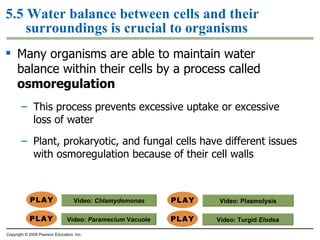
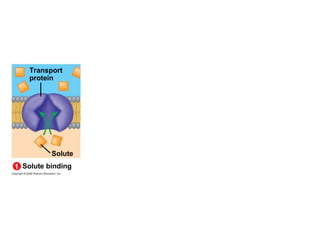
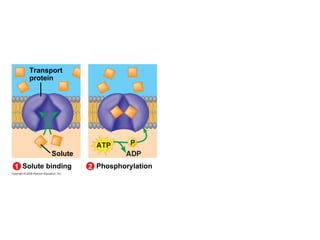
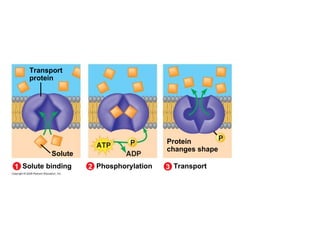
  • #76 Figure 5.14 The effect of an enzyme is to lower E A .
  • #77 Student Misconceptions and Concerns 1. The specific interactions of enzymes and substrates can be illustrated with simple physical models. Many students new to these concepts will benefit from several forms of explanation, including diagrams such as those in the textbook, physical models, and the opportunity to manipulate or create their own examples. Just like pitching a tent, new concepts are best constructed with many lines of support. Teaching Tips 1. The information in DNA is used to direct the production of RNA, which in turn directs the production of proteins. However, in Chapter 3, four different types of biological molecules were noted as significant components of life. Students who think this through might wonder, and you could point out that DNA does not directly control the production of carbohydrates and lipids. So how does DNA exert its influence over the synthesis of these two chemical groups? The answer is largely by way of enzymes, proteins with the ability to promote the production of carbohydrates and lipids. 2. The text notes that the relationship between an enzyme and its substrate is like a handshake, with each hand generally conforming to the shape of the other. This induced fit is also like the change in shape of a glove when a hand is inserted. The glove’s general shape matches the hand, but the final “fit” requires some additional adjustments.
  • #78 Figure 5.15 The catalytic cycle of an enzyme.
  • #79 Figure 5.15 The catalytic cycle of an enzyme.
  • #80 Figure 5.15 The catalytic cycle of an enzyme.
  • #81 Figure 5.15 The catalytic cycle of an enzyme.
  • #82 Certain chemicals also alter enzyme function and have been used to kill bacteria. For the BLAST Animation Enzymes: Types and Specificity, go to Animation and Video Files. Student Misconceptions and Concerns 1. The specific interactions of enzymes and substrates can be illustrated with simple physical models. Many students new to these concepts will benefit from several forms of explanation, including diagrams such as those in the textbook, physical models, and the opportunity to manipulate or create their own examples. Just like pitching a tent, new concepts are best constructed with many lines of support. Teaching Tips 1. The information in DNA is used to direct the production of RNA, which in turn directs the production of proteins. However, in Chapter 3, four different types of biological molecules were noted as significant components of life. Students who think this through might wonder, and you could point out that DNA does not directly control the production of carbohydrates and lipids. So how does DNA exert its influence over the synthesis of these two chemical groups? The answer is largely by way of enzymes, proteins with the ability to promote the production of carbohydrates and lipids. 2. The text notes that the relationship between an enzyme and its substrate is like a handshake, with each hand generally conforming to the shape of the other. This induced fit is also like the change in shape of a glove when a hand is inserted. The glove’s general shape matches the hand, but the final “fit” requires some additional adjustments.
  • #83 We need vitamins in our food or as supplements because of their role in metabolism driven by enzymes. Student Misconceptions and Concerns 1. The specific interactions of enzymes and substrates can be illustrated with simple physical models. Many students new to these concepts will benefit from several forms of explanation, including diagrams such as those in the textbook, physical models, and the opportunity to manipulate or create their own examples. Just like pitching a tent, new concepts are best constructed with many lines of support. Teaching Tips 1. The information in DNA is used to direct the production of RNA, which in turn directs the production of proteins. However, in Chapter 3, four different types of biological molecules were noted as significant components of life. Students who think this through might wonder, and you could point out that DNA does not directly control the production of carbohydrates and lipids. So how does DNA exert its influence over the synthesis of these two chemical groups? The answer is largely by way of enzymes, proteins with the ability to promote the production of carbohydrates and lipids. 2. The text notes that the relationship between an enzyme and its substrate is like a handshake, with each hand generally conforming to the shape of the other. This induced fit is also like the change in shape of a glove when a hand is inserted. The glove’s general shape matches the hand, but the final “fit” requires some additional adjustments.
  • #84 Penicillin, an antibiotic, is an example of a noncompetitive inhibitor because it blocks the active site of an enzyme that some bacteria use to make their cell wall. For the BLAST Animation Enzyme Regulation: Chemical Modification, go to Animation and Video Files. For the BLAST Animation Enzyme Regulation: Competitive Inhibition, go to Animation and Video Files. Student Misconceptions and Concerns 1. The specific interactions of enzymes and substrates can be illustrated with simple physical models. Many students new to these concepts will benefit from several forms of explanation, including diagrams such as those in the textbook, physical models, and the opportunity to manipulate or create their own examples. Just like pitching a tent, new concepts are best constructed with many lines of support. Teaching Tips 1. The information in DNA is used to direct the production of RNA, which in turn directs the production of proteins. However, in Chapter 3, four different types of biological molecules were noted as significant components of life. Students who think this through might wonder, and you could point out that DNA does not directly control the production of carbohydrates and lipids. So how does DNA exert its influence over the synthesis of these two chemical groups? The answer is largely by way of enzymes, proteins with the ability to promote the production of carbohydrates and lipids. 2. Enzyme inhibitors that block the active site are like (a) a person sitting in your assigned theater seat or (b) a car parked in your parking space. Analogies for inhibitors that change the shape of the active site are more difficult to imagine. Consider challenging your students to think of such analogies. (Perhaps someone adjusting the driver seat of the car differently from your preferences and then leaving it that way when you try to use the car.) 3. Feedback inhibition relies upon the negative feedback of the accumulation of a product. Ask students in class to suggest other products of reactions that inhibit the process that made them when the product reaches high enough levels. (Gas station pumps routinely shut off when a high level of gasoline is detected. Furnaces typically turn off when enough heat has been produced.) 4. Challenge your class to identify advantages of specific enzyme inhibitors for pest control. These advantages include (a) the ability to target chemical reactions of only certain types of pest organisms and (b) the ability to target chemical reactions that are found in insects but not in humans.
  • #85 Figure 5.16 How inhibitors interfere with substrate binding.
  • #86 Student Misconceptions and Concerns 1. The specific interactions of enzymes and substrates can be illustrated with simple physical models. Many students new to these concepts will benefit from several forms of explanation, including diagrams such as those in the textbook, physical models, and the opportunity to manipulate or create their own examples. Just like pitching a tent, new concepts are best constructed with many lines of support. Teaching Tips 1. The information in DNA is used to direct the production of RNA, which in turn directs the production of proteins. However, in Chapter 3, four different types of biological molecules were noted as significant components of life. Students who think this through might wonder, and you could point out that DNA does not directly control the production of carbohydrates and lipids. So how does DNA exert its influence over the synthesis of these two chemical groups? The answer is largely by way of enzymes, proteins with the ability to promote the production of carbohydrates and lipids. 2. Enzyme inhibitors that block the active site are like (a) a person sitting in your assigned theater seat or (b) a car parked in your parking space. Analogies for inhibitors that change the shape of the active site are more difficult to imagine. Consider challenging your students to think of such analogies. (Perhaps someone adjusting the driver seat of the car differently from your preferences and then leaving it that way when you try to use the car.) 3. Feedback inhibition relies upon the negative feedback of the accumulation of a product. Ask students in class to suggest other products of reactions that inhibit the process that made them when the product reaches high enough levels. (Gas station pumps routinely shut off when a high level of gasoline is detected. Furnaces typically turn off when enough heat has been produced.) 4. Challenge your class to identify advantages of specific enzyme inhibitors for pest control. These advantages include (a) the ability to target chemical reactions of only certain types of pest organisms and (b) the ability to target chemical reactions that are found in insects but not in humans.
  • #87 Student Misconceptions and Concerns 1. The specific interactions of enzymes and substrates can be illustrated with simple physical models. Many students new to these concepts will benefit from several forms of explanation, including diagrams such as those in the textbook, physical models, and the opportunity to manipulate or create their own examples. Just like pitching a tent, new concepts are best constructed with many lines of support. Teaching Tips 1. The information in DNA is used to direct the production of RNA, which in turn directs the production of proteins. However, in Chapter 3, four different types of biological molecules were noted as significant components of life. Students who think this through might wonder, and you could point out that DNA does not directly control the production of carbohydrates and lipids. So how does DNA exert its influence over the synthesis of these two chemical groups? The answer is largely by way of enzymes, proteins with the ability to promote the production of carbohydrates and lipids. 2. Enzyme inhibitors that block the active site are like (a) a person sitting in your assigned theater seat or (b) a car parked in your parking space. Analogies for inhibitors that change the shape of the active site are more difficult to imagine. Consider challenging your students to think of such analogies. (Perhaps someone adjusting the driver seat of the car differently from your preferences and then leaving it that way when you try to use the car.) 3. Feedback inhibition relies upon the negative feedback of the accumulation of a product. Ask students in class to suggest other products of reactions that inhibit the process that made them when the product reaches high enough levels. (Gas station pumps routinely shut off when a high level of gasoline is detected. Furnaces typically turn off when enough heat has been produced.) 4. Challenge your class to identify advantages of specific enzyme inhibitors for pest control. These advantages include (a) the ability to target chemical reactions of only certain types of pest organisms and (b) the ability to target chemical reactions that are found in insects but not in humans.