Syniverse Proprietary
1
VoLTE Charging and Clearing Explained
Mary Clark – Chief Marketing Officer, Syniverse
Keith Dyer – Founder and Editor, The Mobile Network
Leo Casey – Senior Solutions Engineer, Syniverse
Syniverse Proprietary
2
#VoLTE
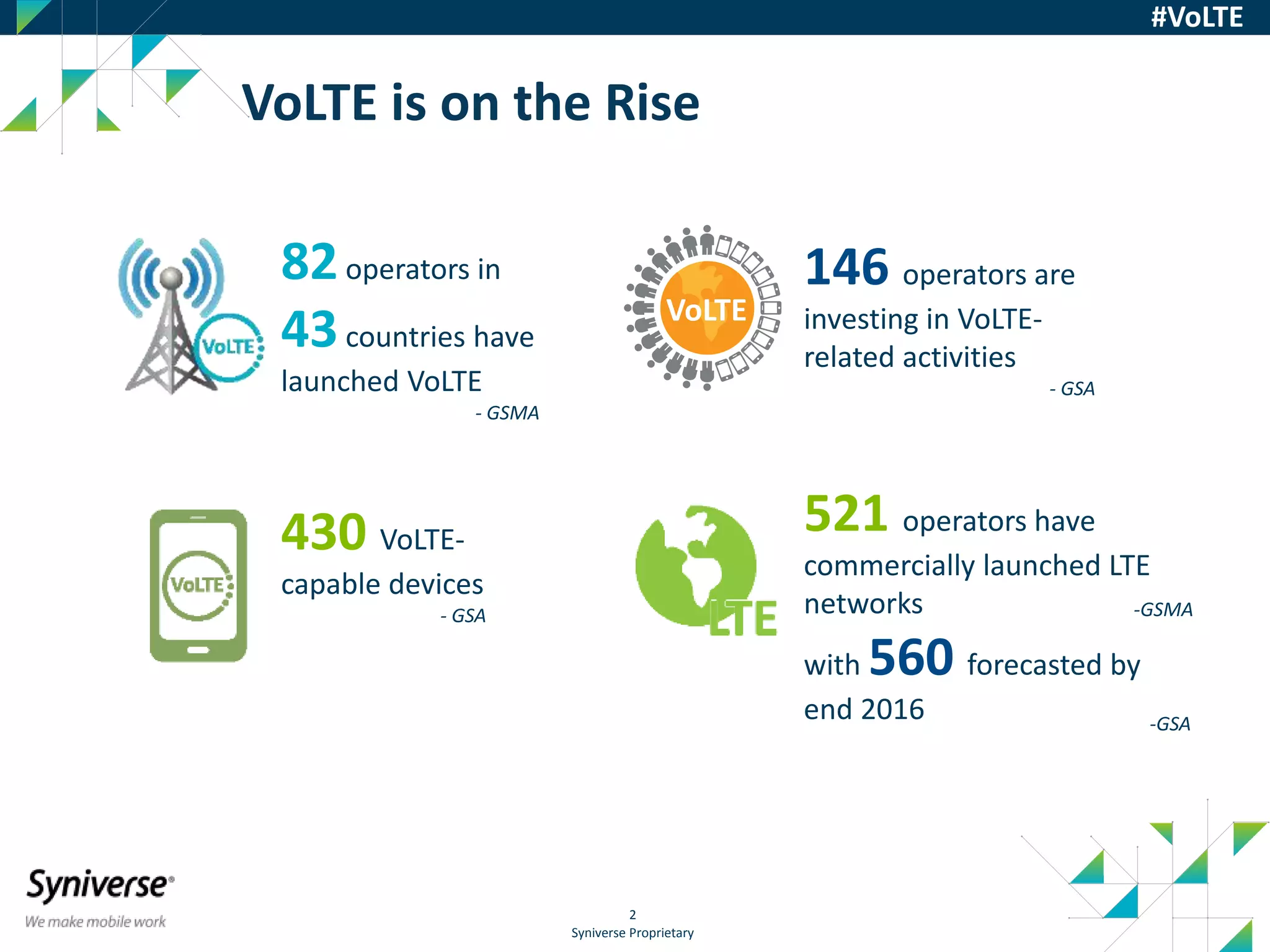
VoLTE is on the Rise
430 VoLTE-
capable devices
- GSA
521 operators have
commercially launched LTE
networks
with 560 forecasted by
end 2016
82operators in
43countries have
launched VoLTE
- GSMA
-GSA
146 operators are
investing in VoLTE-
related activities
- GSA
-GSMA
Syniverse Proprietary
3
#VoLTE
Already
Launched
Next 6
Months
6-12 Months
12 Months or
Beyond
Undecided
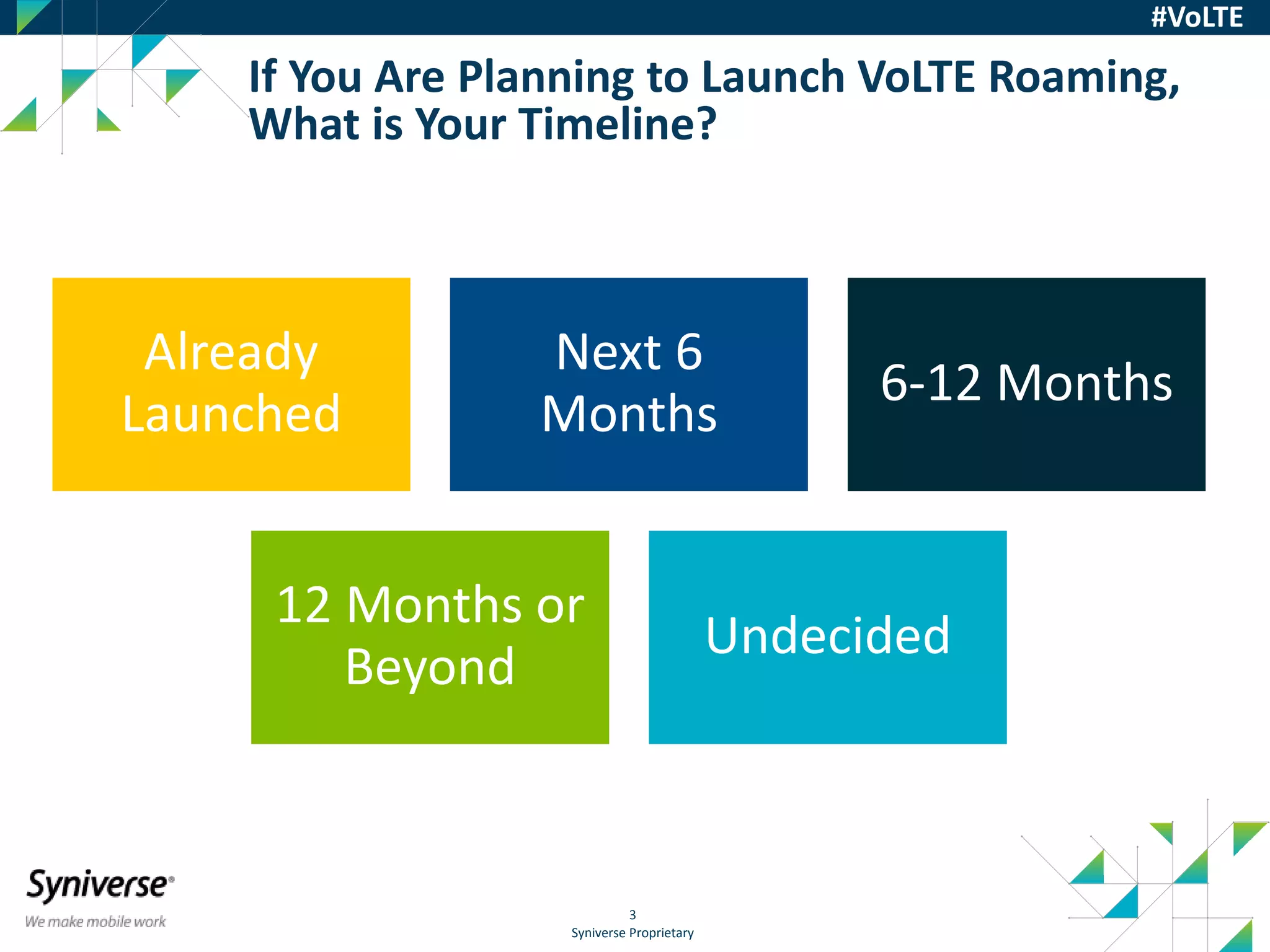
If You Are Planning to Launch VoLTE Roaming,
What is Your Timeline?
Syniverse Proprietary
4
#VoLTE
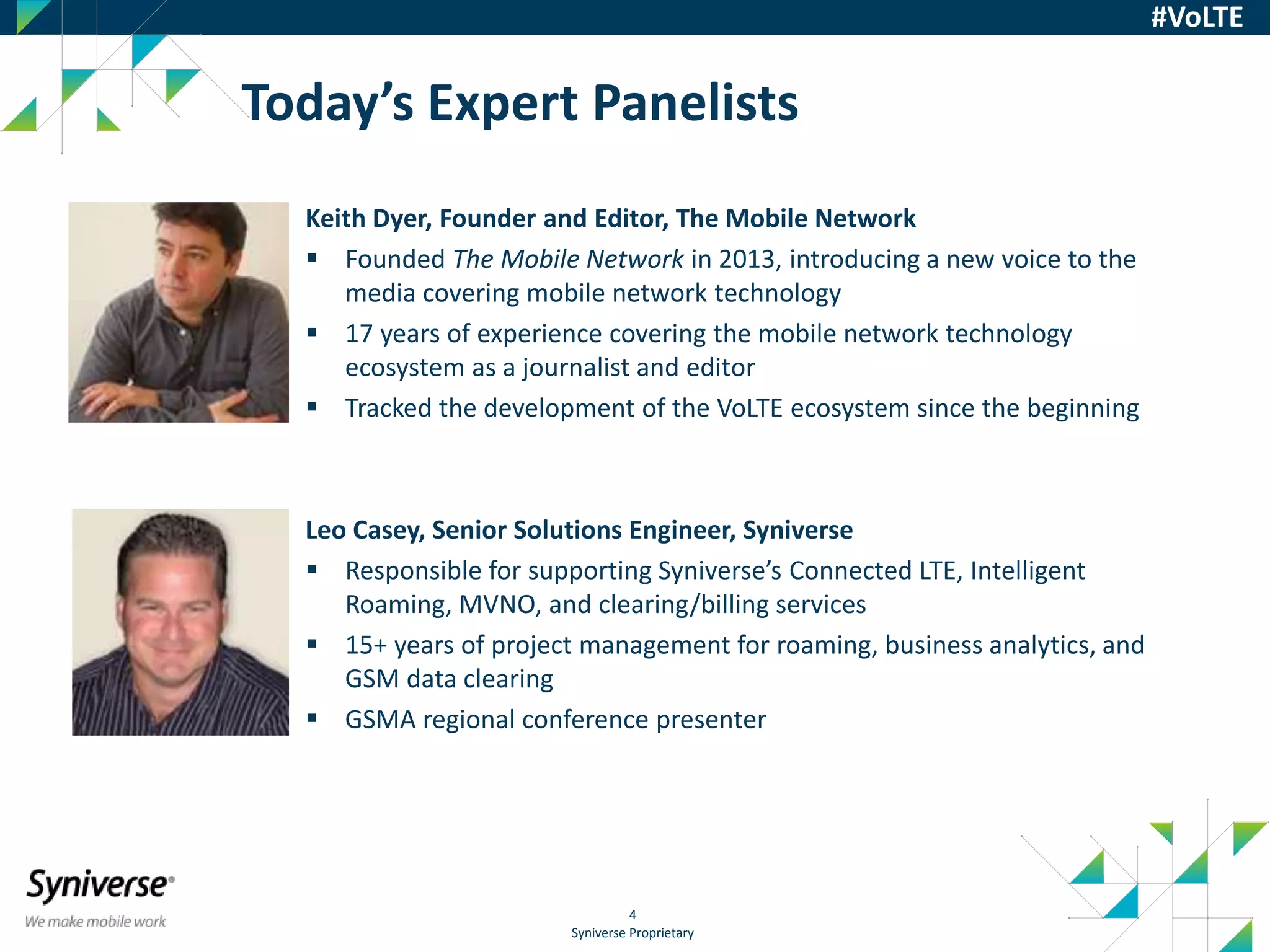
Keith Dyer, Founder and Editor, The Mobile Network
 Founded The Mobile Network in 2013, introducing a new voice to the
media covering mobile network technology
 17 years of experience covering the mobile network technology
ecosystem as a journalist and editor
 Tracked the development of the VoLTE ecosystem since the beginning
Leo Casey, Senior Solutions Engineer, Syniverse
 Responsible for supporting Syniverse’s Connected LTE, Intelligent
Roaming, MVNO, and clearing/billing services
 15+ years of project management for roaming, business analytics, and
GSM data clearing
 GSMA regional conference presenter
Today’s Expert Panelists
VOLTE Roaming: charging
Keith Dyer, Editor, The Mobile Network
www.the-mobile-network.com
keith@the-mobile-network.com
Twitter: @keithdyer
#VoLTE
#VoLTE
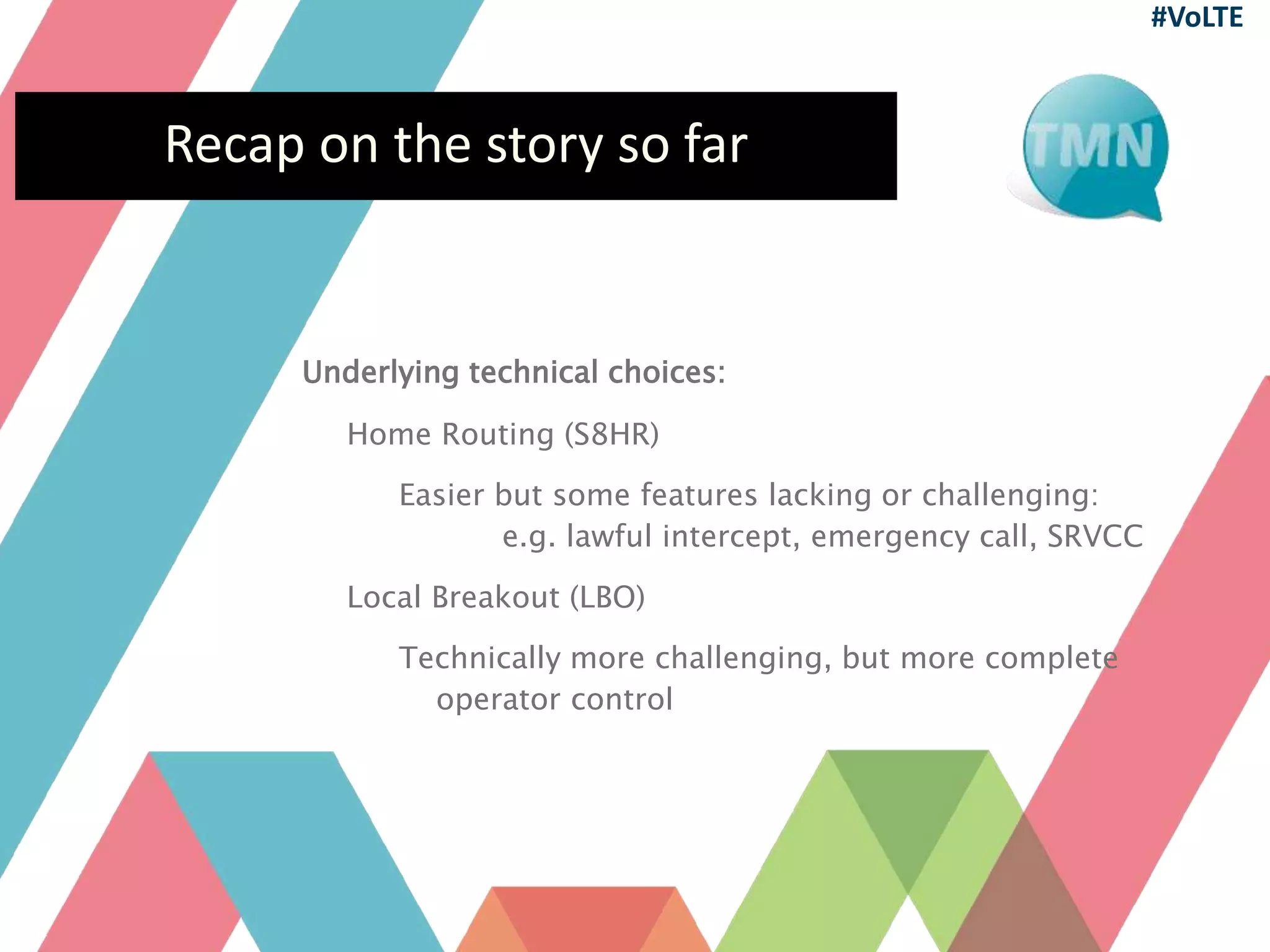
Recap on the story so far
Underlying technical choices:
Home Routing (S8HR)
Easier but some features lacking or challenging:
e.g. lawful intercept, emergency call, SRVCC
Local Breakout (LBO)
Technically more challenging, but more complete
operator control
#VoLTE
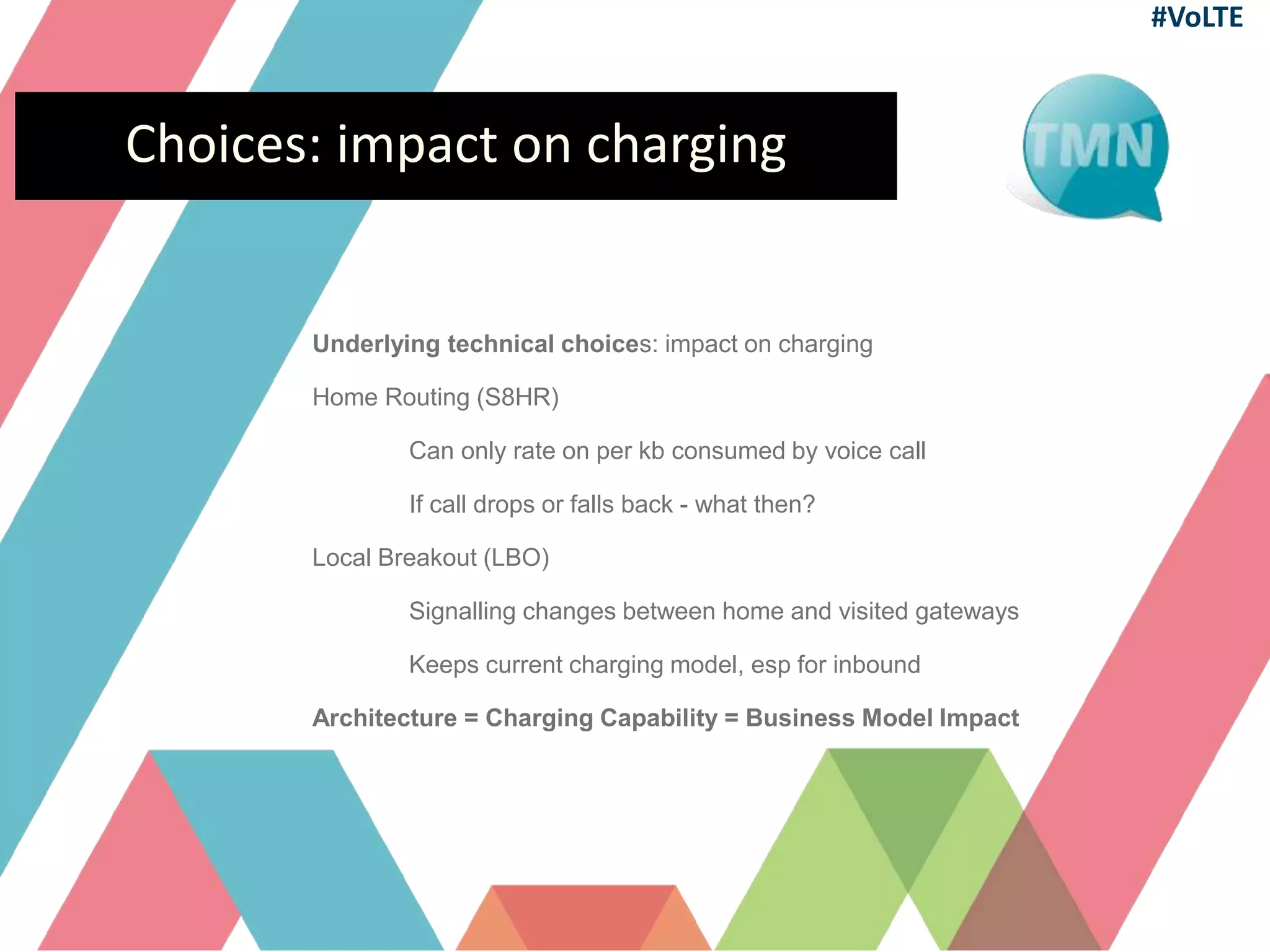
Choices: impact on charging
Underlying technical choices: impact on charging
Home Routing (S8HR)
Can only rate on per kb consumed by voice call
If call drops or falls back - what then?
Local Breakout (LBO)
Signalling changes between home and visited gateways
Keeps current charging model, esp for inbound
Architecture = Charging Capability = Business Model Impact
#VoLTE
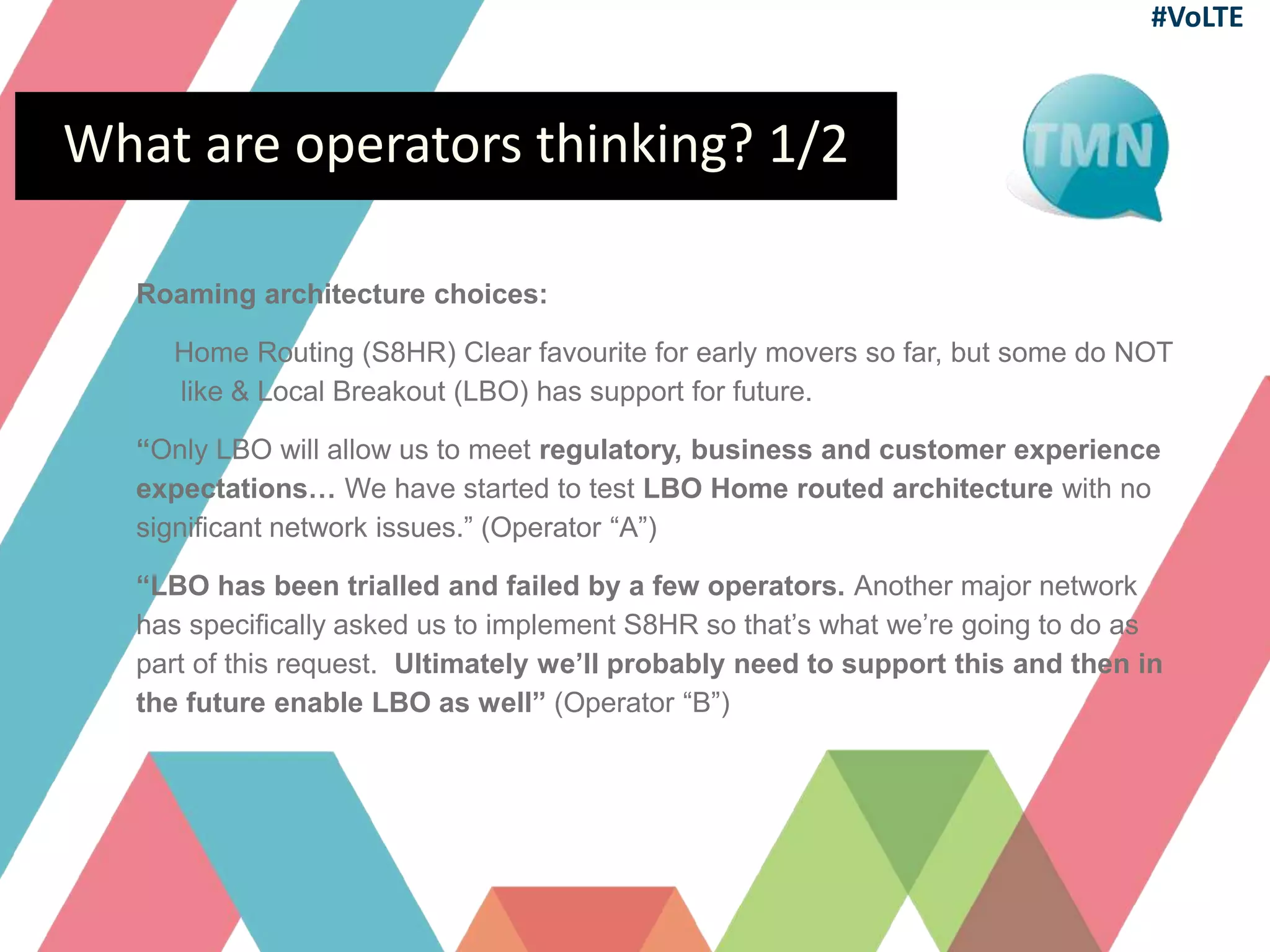
What are operators thinking? 1/2
Roaming architecture choices:
Home Routing (S8HR) Clear favourite for early movers so far, but some do NOT
like & Local Breakout (LBO) has support for future.
“Only LBO will allow us to meet regulatory, business and customer experience
expectations… We have started to test LBO Home routed architecture with no
significant network issues.” (Operator “A”)
“LBO has been trialled and failed by a few operators. Another major network
has specifically asked us to implement S8HR so that’s what we’re going to do as
part of this request. Ultimately we’ll probably need to support this and then in
the future enable LBO as well” (Operator “B”)
#VoLTE
What are operators thinking? 2/2
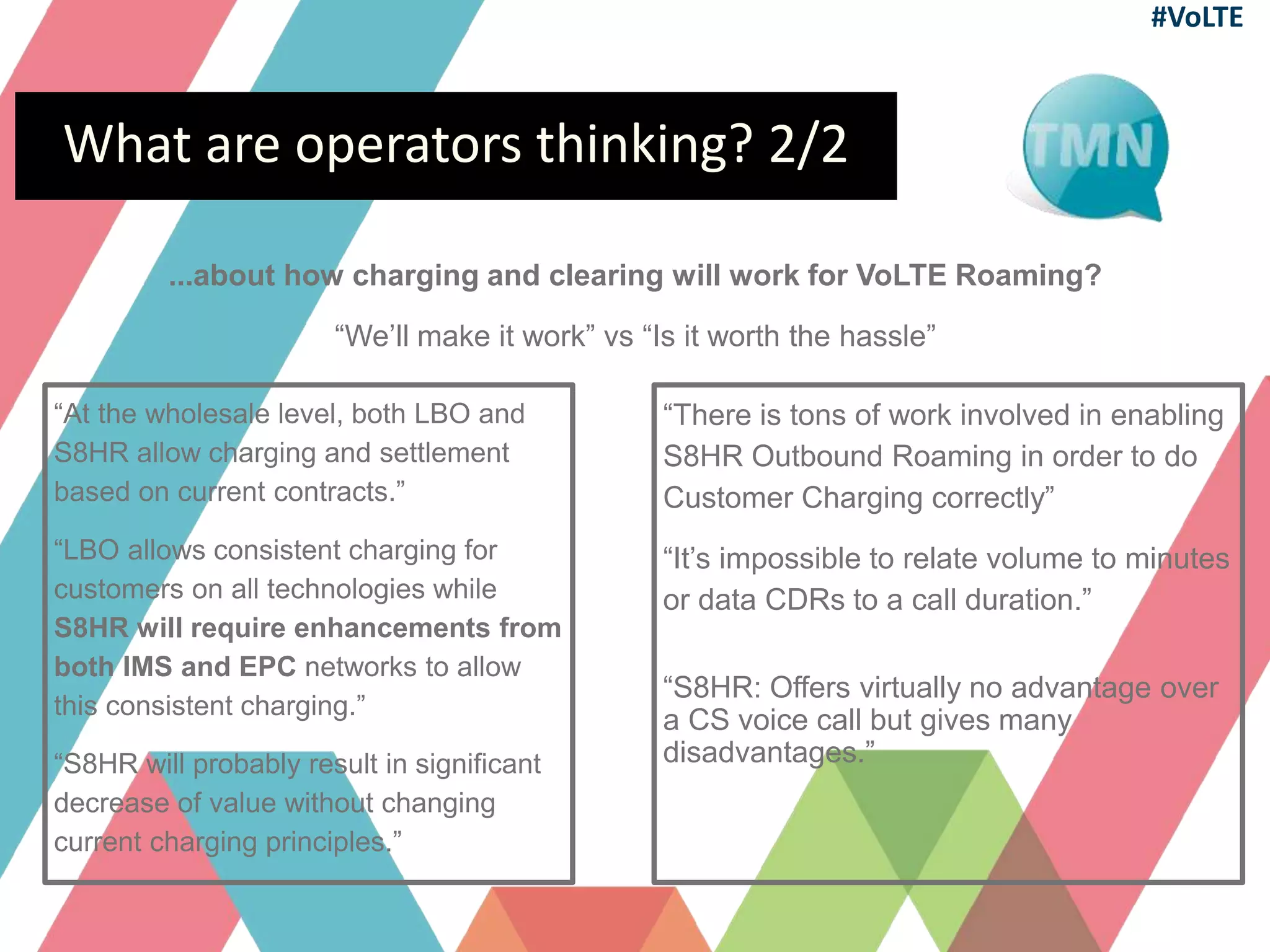
...about how charging and clearing will work for VoLTE Roaming?
“We’ll make it work” vs “Is it worth the hassle”
“At the wholesale level, both LBO and
S8HR allow charging and settlement
based on current contracts.”
“LBO allows consistent charging for
customers on all technologies while
S8HR will require enhancements from
both IMS and EPC networks to allow
this consistent charging.”
“S8HR will probably result in significant
decrease of value without changing
current charging principles.”
“There is tons of work involved in enabling
S8HR Outbound Roaming in order to do
Customer Charging correctly”
“It’s impossible to relate volume to minutes
or data CDRs to a call duration.”
“S8HR: Offers virtually no advantage over
a CS voice call but gives many
disadvantages.”
#VoLTE
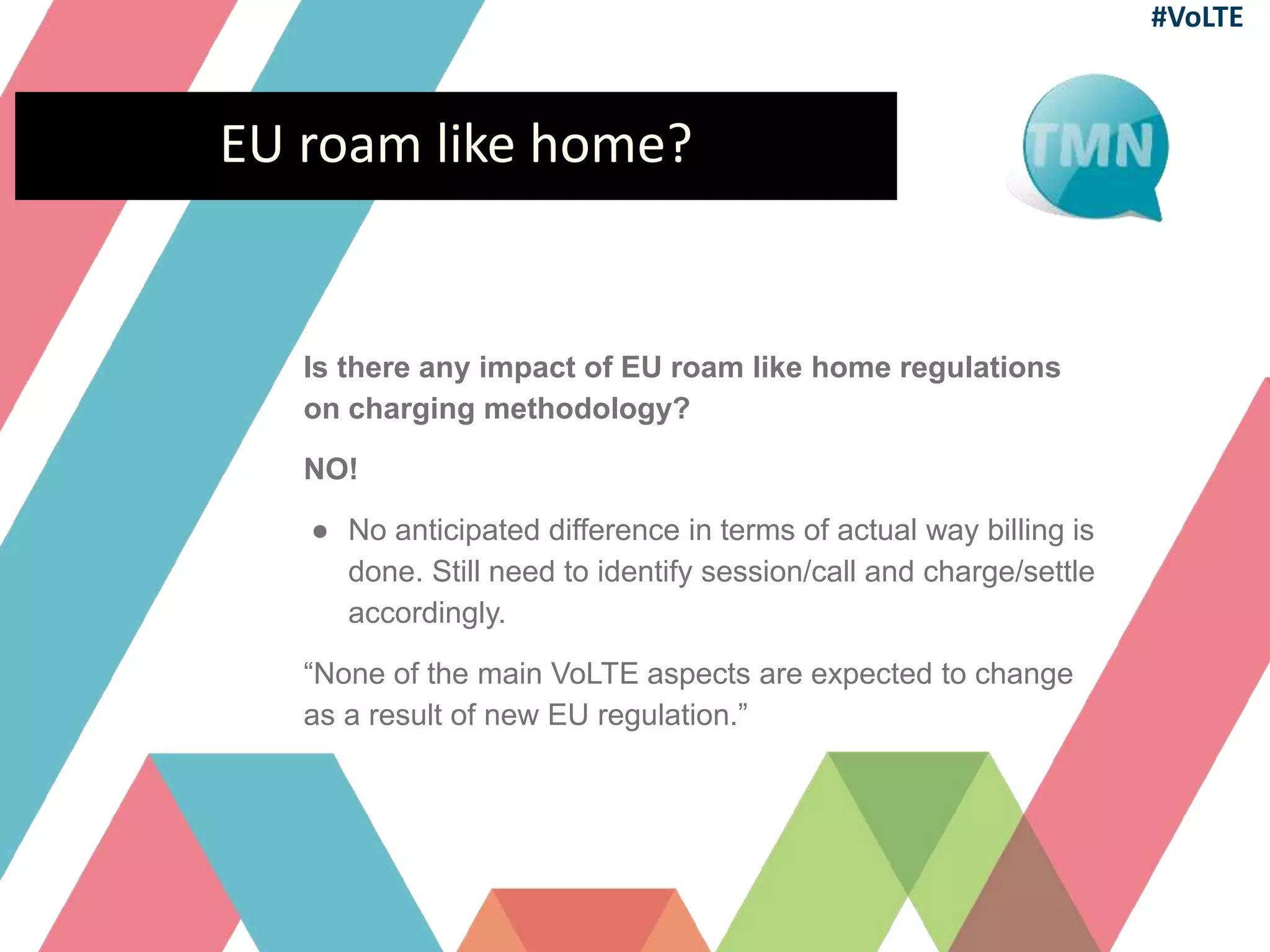
EU roam like home?
Is there any impact of EU roam like home regulations
on charging methodology?
NO!
● No anticipated difference in terms of actual way billing is
done. Still need to identify session/call and charge/settle
accordingly.
“None of the main VoLTE aspects are expected to change
as a result of new EU regulation.”
#VoLTE
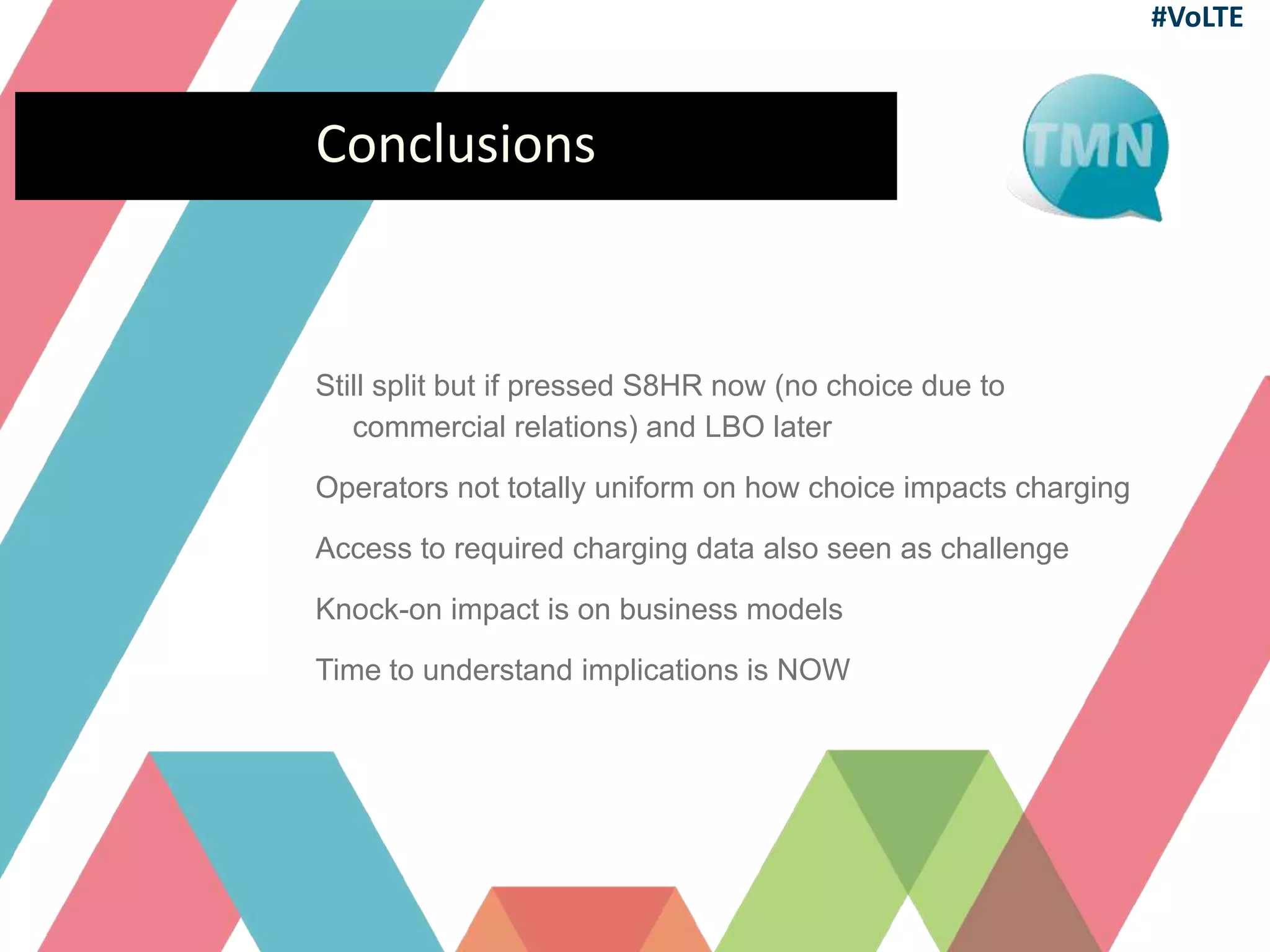
Conclusions
Still split but if pressed S8HR now (no choice due to
commercial relations) and LBO later
Operators not totally uniform on how choice impacts charging
Access to required charging data also seen as challenge
Knock-on impact is on business models
Time to understand implications is NOW
#VoLTE
Syniverse Proprietary
13
#VoLTE
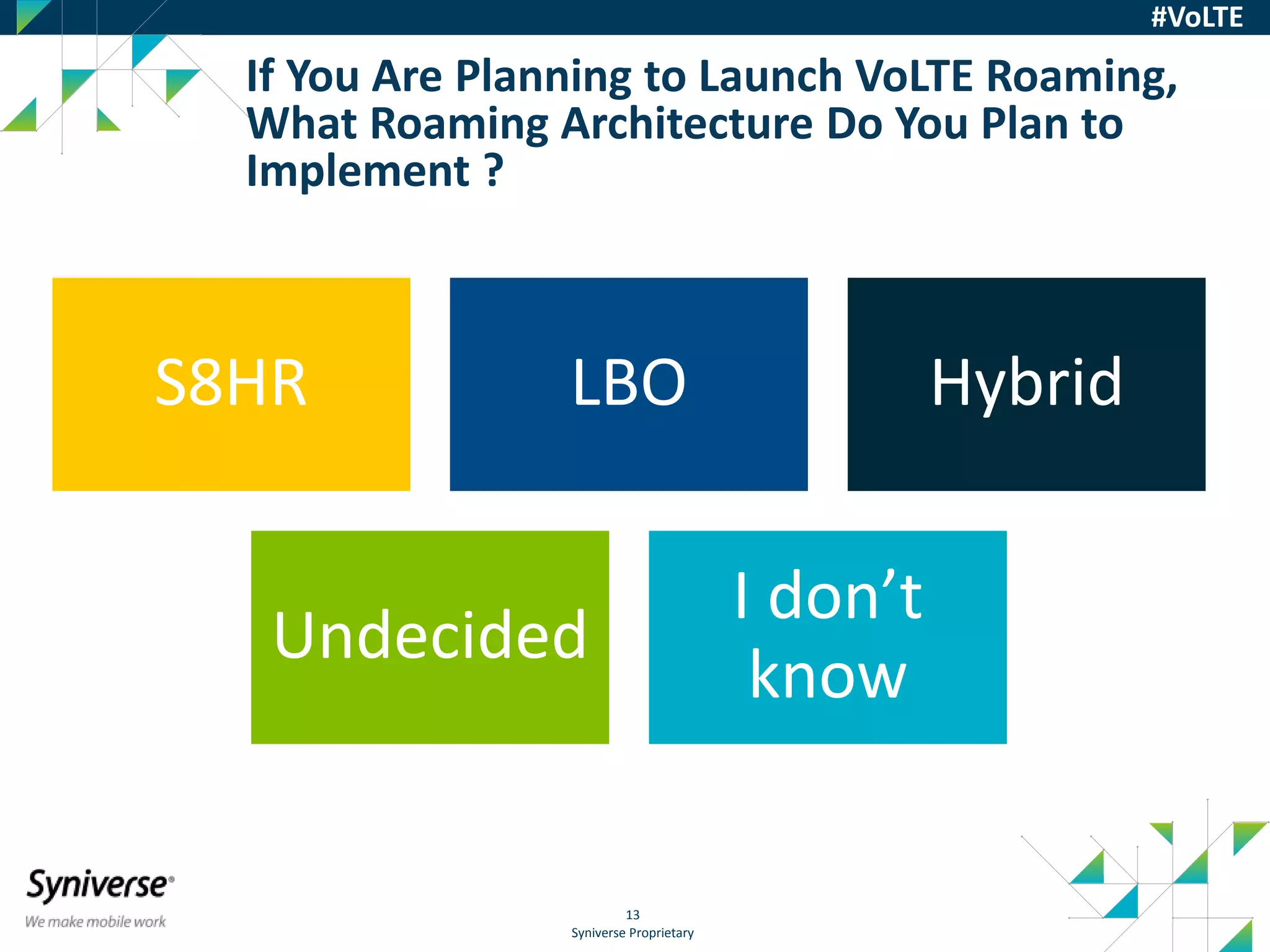
S8HR LBO Hybrid
Undecided
I don’t
know
If You Are Planning to Launch VoLTE Roaming,
What Roaming Architecture Do You Plan to
Implement ?
Syniverse Proprietary
14
#VoLTE
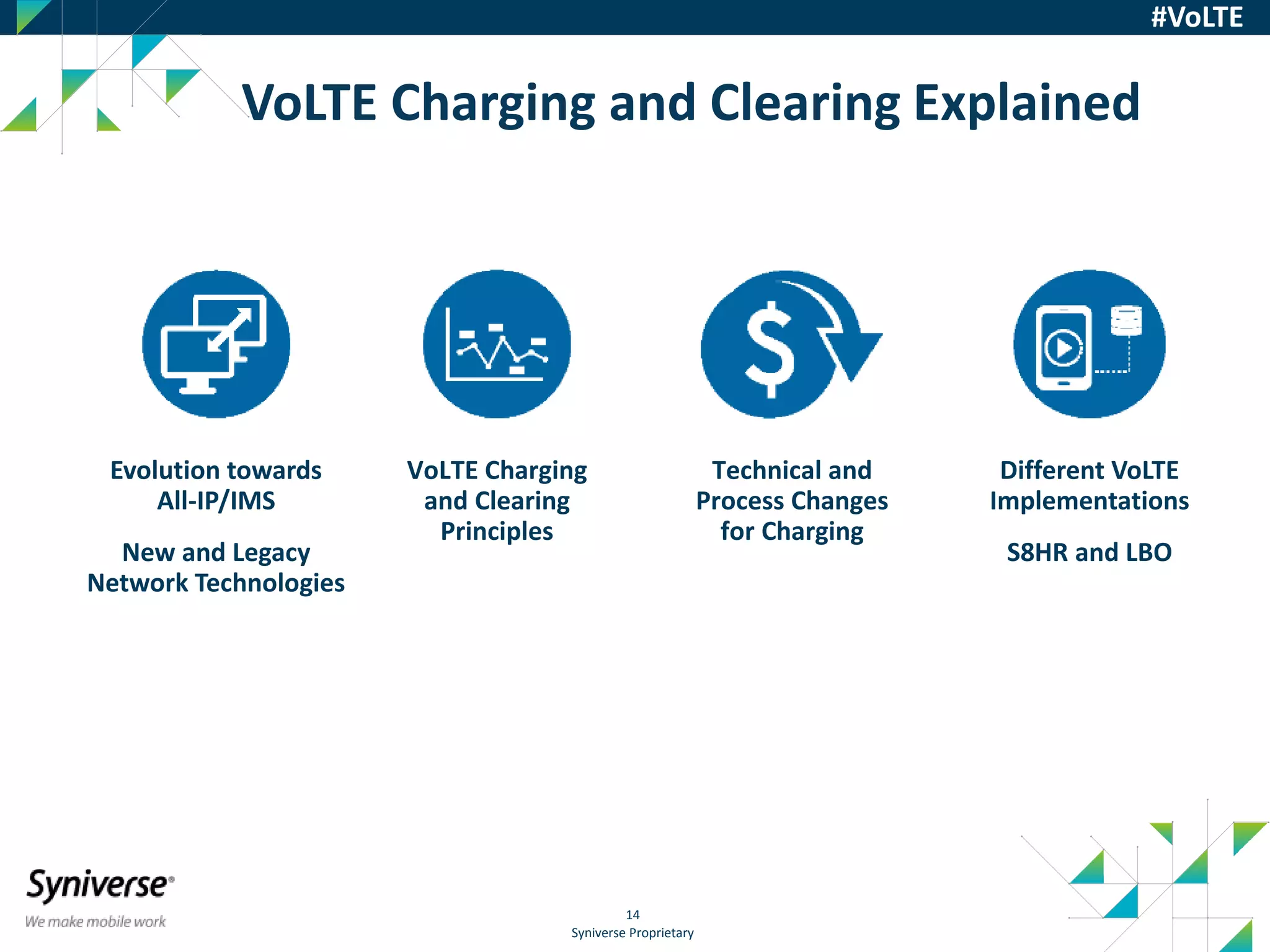
VoLTE Charging and Clearing Explained
Evolution towards
All-IP/IMS
New and Legacy
Network Technologies
Technical and
Process Changes
for Charging
VoLTE Charging
and Clearing
Principles
Different VoLTE
Implementations
S8HR and LBO
Syniverse Proprietary
15
#VoLTE
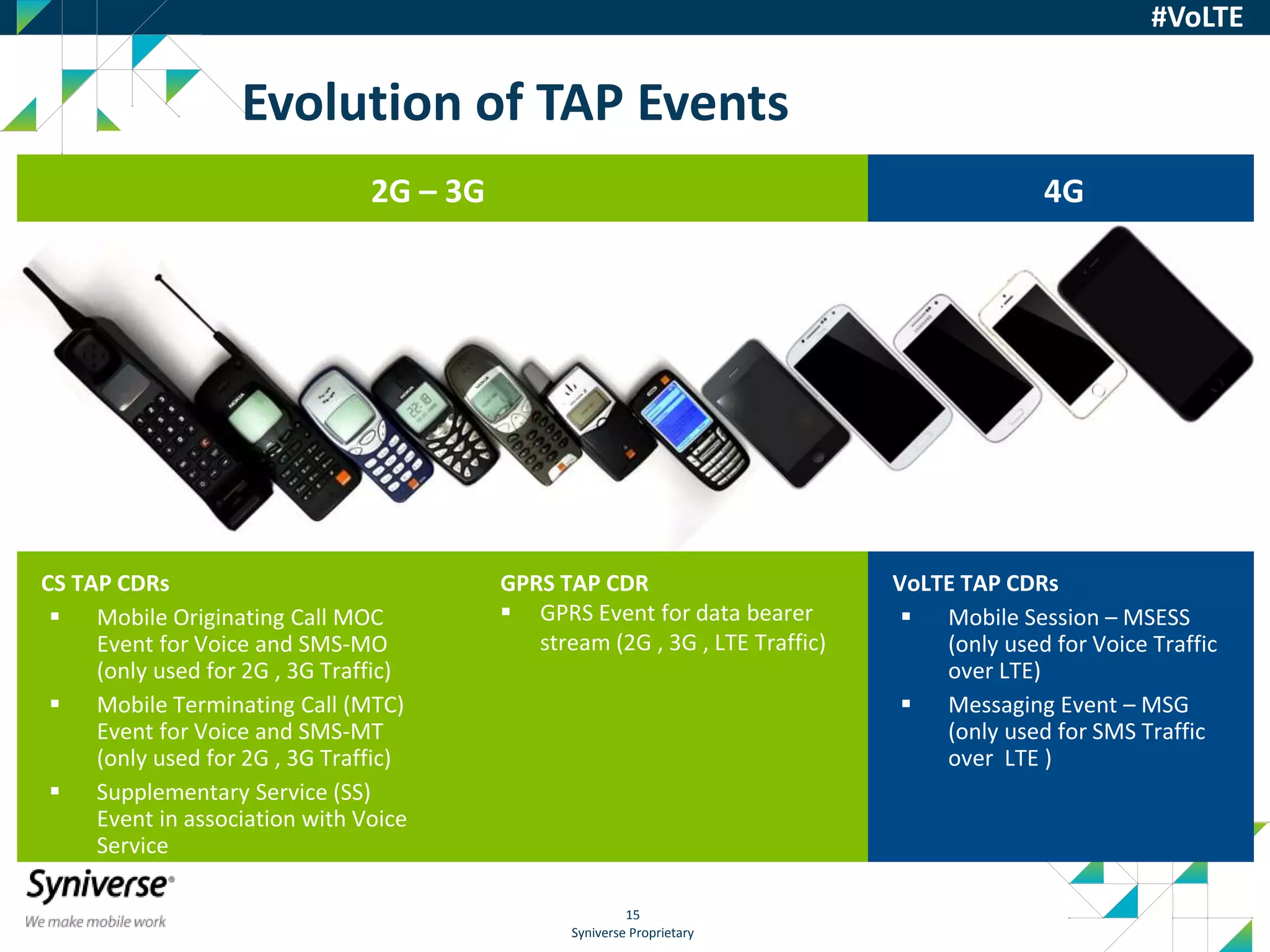
Evolution of TAP Events
CS TAP CDRs
 Mobile Originating Call MOC
Event for Voice and SMS-MO
(only used for 2G , 3G Traffic)
 Mobile Terminating Call (MTC)
Event for Voice and SMS-MT
(only used for 2G , 3G Traffic)
 Supplementary Service (SS)
Event in association with Voice
Service
GPRS TAP CDR
 GPRS Event for data bearer
stream (2G , 3G , LTE Traffic)
VoLTE TAP CDRs
 Mobile Session – MSESS
(only used for Voice Traffic
over LTE)
 Messaging Event – MSG
(only used for SMS Traffic
over LTE )
2G – 3G 4G
Syniverse Proprietary
16
#VoLTE
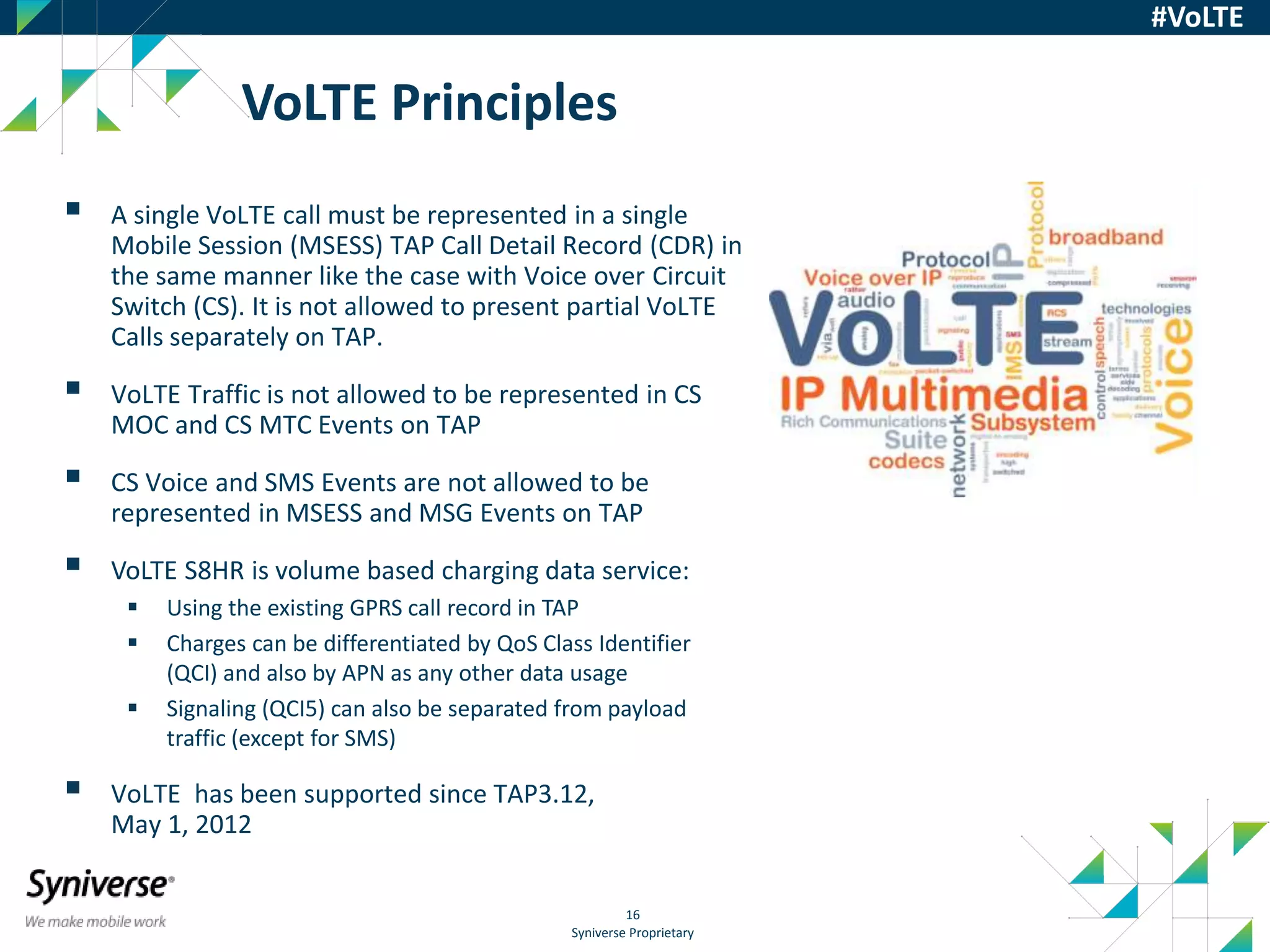
 A single VoLTE call must be represented in a single
Mobile Session (MSESS) TAP Call Detail Record (CDR) in
the same manner like the case with Voice over Circuit
Switch (CS). It is not allowed to present partial VoLTE
Calls separately on TAP.
 VoLTE Traffic is not allowed to be represented in CS
MOC and CS MTC Events on TAP
 CS Voice and SMS Events are not allowed to be
represented in MSESS and MSG Events on TAP
 VoLTE S8HR is volume based charging data service:
 Using the existing GPRS call record in TAP
 Charges can be differentiated by QoS Class Identifier
(QCI) and also by APN as any other data usage
 Signaling (QCI5) can also be separated from payload
traffic (except for SMS)
 VoLTE has been supported since TAP3.12,
May 1, 2012
VoLTE Principles
Syniverse Proprietary
17
VoLTE Support in TAP
Syniverse Proprietary
18
#VoLTE
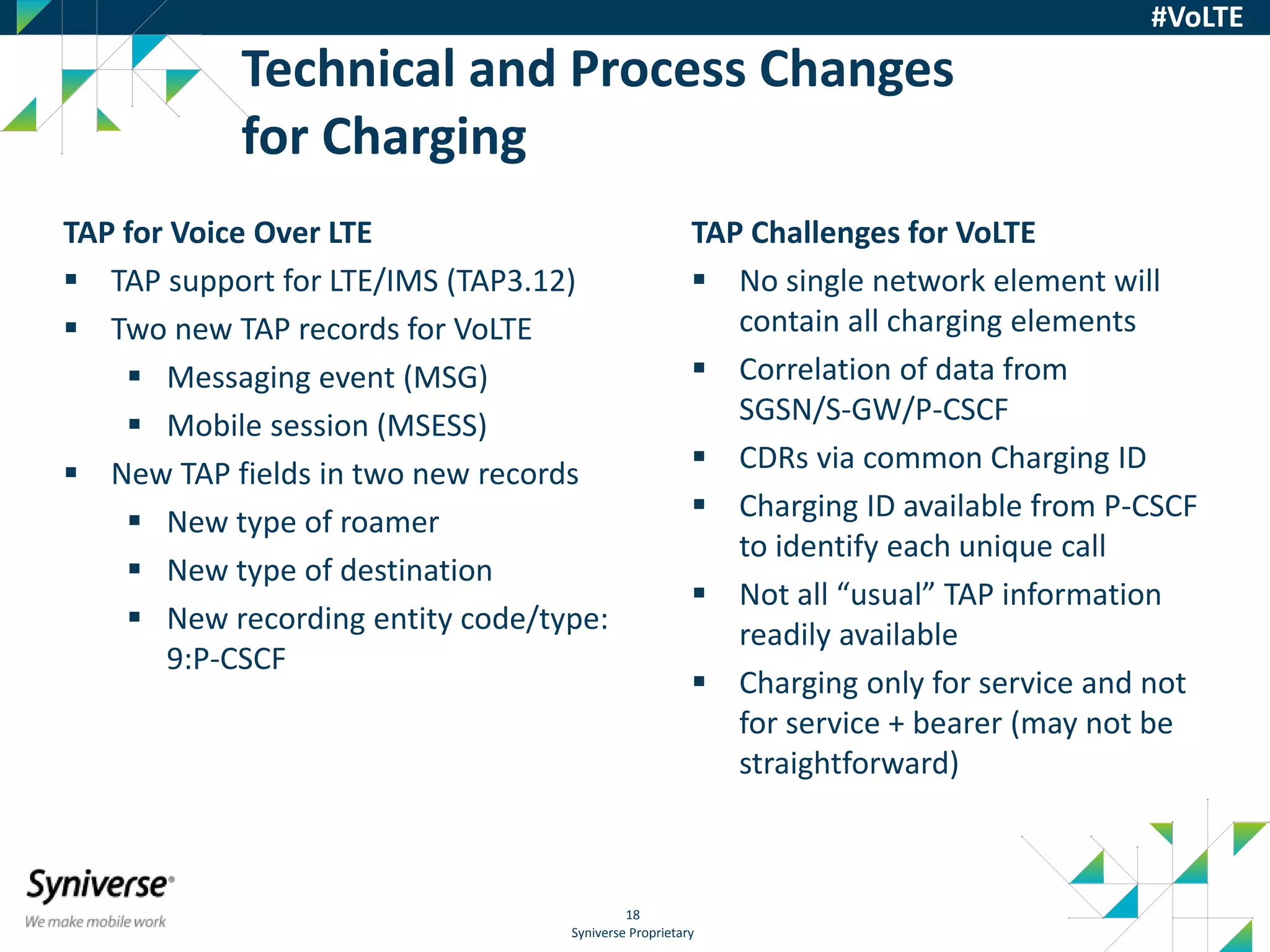
TAP for Voice Over LTE
 TAP support for LTE/IMS (TAP3.12)
 Two new TAP records for VoLTE
 Messaging event (MSG)
 Mobile session (MSESS)
 New TAP fields in two new records
 New type of roamer
 New type of destination
 New recording entity code/type:
9:P-CSCF
Technical and Process Changes
for Charging
TAP Challenges for VoLTE
 No single network element will
contain all charging elements
 Correlation of data from
SGSN/S-GW/P-CSCF
 CDRs via common Charging ID
 Charging ID available from P-CSCF
to identify each unique call
 Not all “usual” TAP information
readily available
 Charging only for service and not
for service + bearer (may not be
straightforward)
Syniverse Proprietary
19
#VoLTE
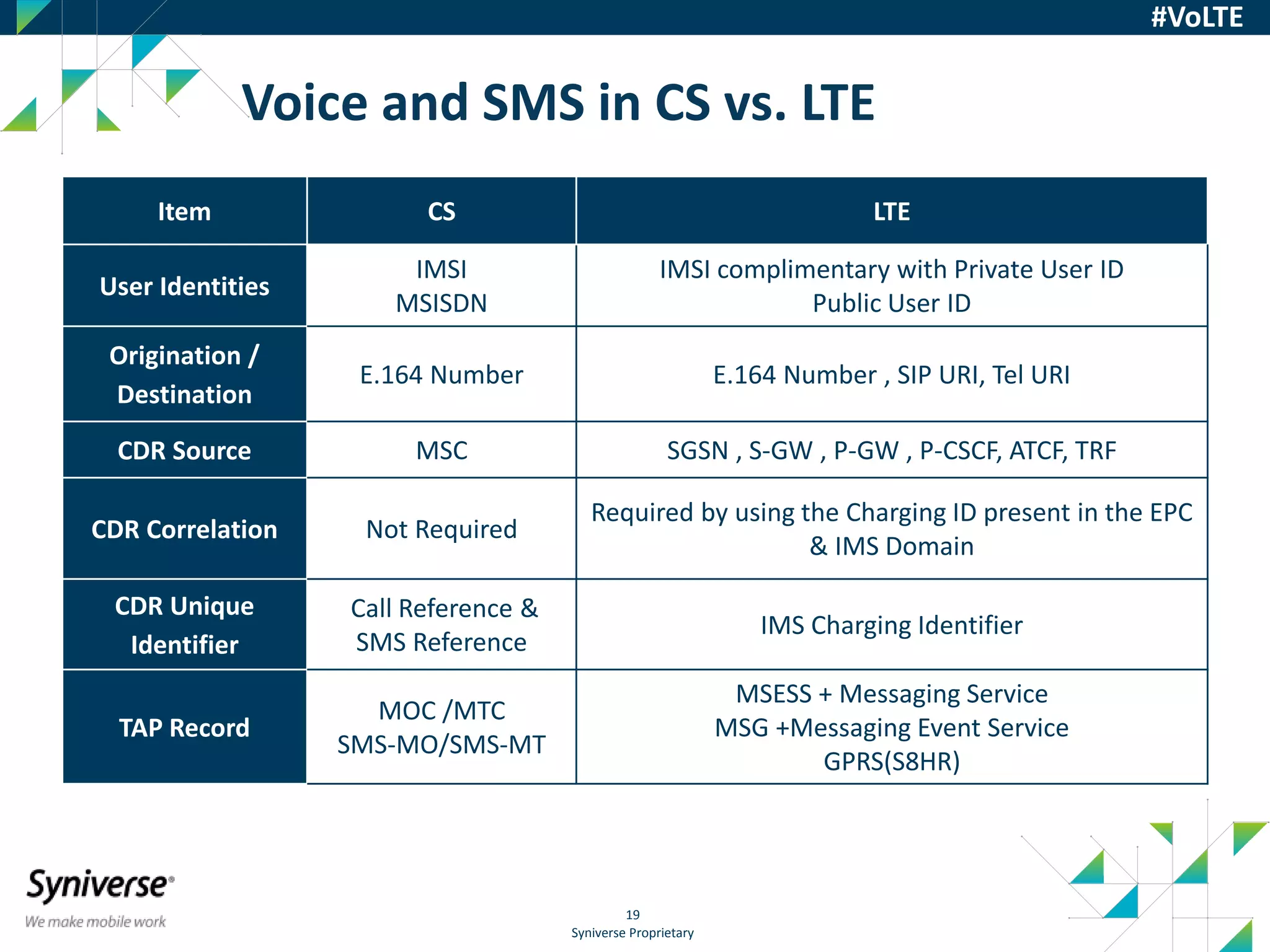
Voice and SMS in CS vs. LTE
Item CS LTE
User Identities
IMSI
MSISDN
IMSI complimentary with Private User ID
Public User ID
Origination /
Destination
E.164 Number E.164 Number , SIP URI, Tel URI
CDR Source MSC SGSN , S-GW , P-GW , P-CSCF, ATCF, TRF
CDR Correlation Not Required
Required by using the Charging ID present in the EPC
& IMS Domain
CDR Unique
Identifier
Call Reference &
SMS Reference
IMS Charging Identifier
TAP Record
MOC /MTC
SMS-MO/SMS-MT
MSESS + Messaging Service
MSG +Messaging Event Service
GPRS(S8HR)
Syniverse Proprietary
20
VoLTE (S8HR) Home Routed
Syniverse Proprietary
21
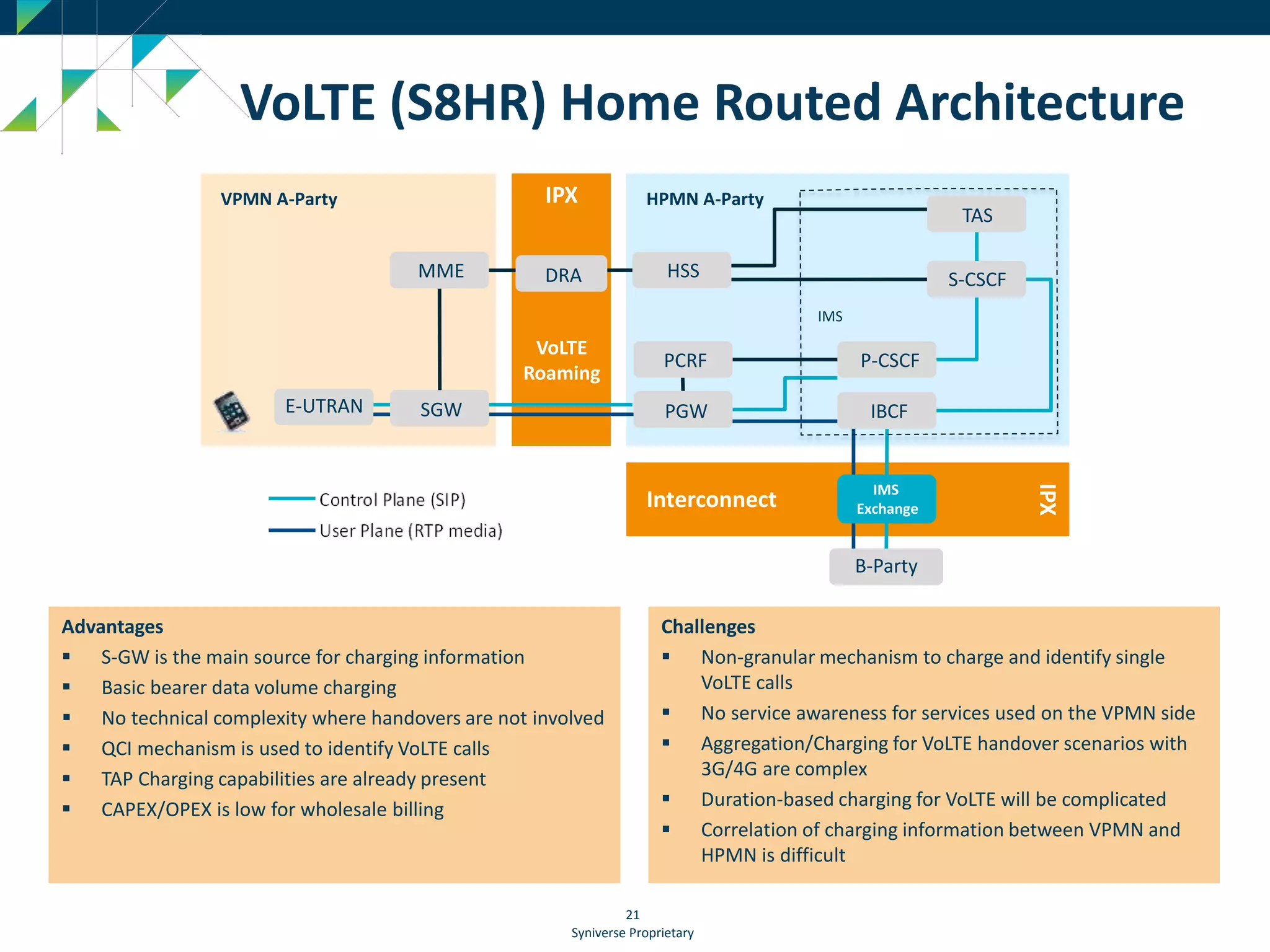
VoLTE (S8HR) Home Routed Architecture
Advantages
 S-GW is the main source for charging information
 Basic bearer data volume charging
 No technical complexity where handovers are not involved
 QCI mechanism is used to identify VoLTE calls
 TAP Charging capabilities are already present
 CAPEX/OPEX is low for wholesale billing
Challenges
 Non-granular mechanism to charge and identify single
VoLTE calls
 No service awareness for services used on the VPMN side
 Aggregation/Charging for VoLTE handover scenarios with
3G/4G are complex
 Duration-based charging for VoLTE will be complicated
 Correlation of charging information between VPMN and
HPMN is difficult
IPX
IPX
E-UTRAN
MME
VPMN A-Party HPMN A-Party
B-Party
HSS
P-CSCF
S-CSCF
TAS
SGW
DRA
IBCF
VoLTE
Roaming
Interconnect
IMS
IMS
Exchange
PCRF
PGW
Syniverse Proprietary
22
#VoLTE
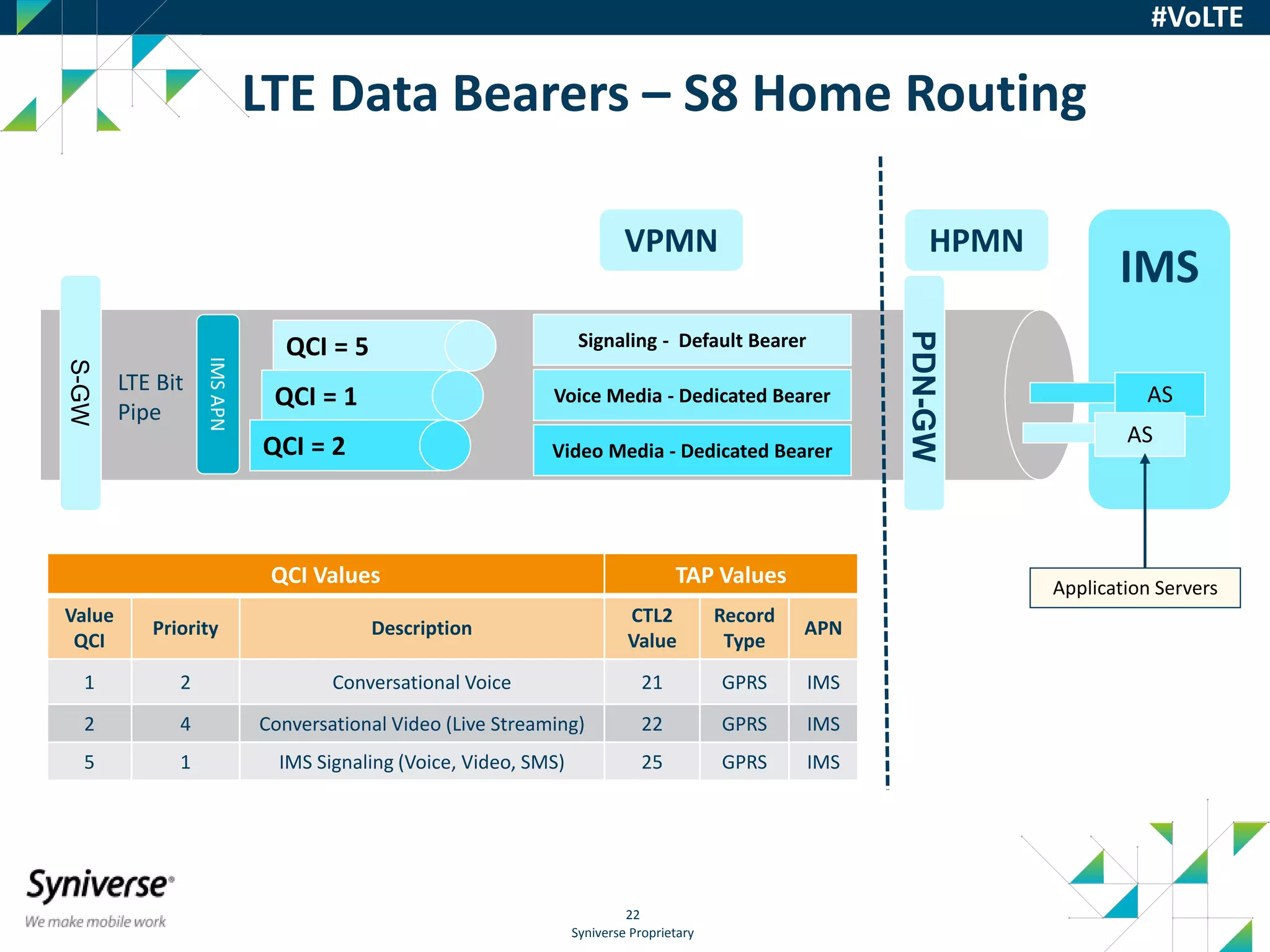
LTE Data Bearers – S8 Home Routing
QCI = 5
QCI = 1
QCI = 2 Video Media - Dedicated Bearer
Application Servers
IMSAPN
LTE Bit
Pipe
Voice Media - Dedicated Bearer AS
AS
IMS
HPMN
Signaling - Default Bearer
QCI Values TAP Values
Value
QCI
Priority Description
CTL2
Value
Record
Type
APN
1 2 Conversational Voice 21 GPRS IMS
2 4 Conversational Video (Live Streaming) 22 GPRS IMS
5 1 IMS Signaling (Voice, Video, SMS) 25 GPRS IMS
PDN-GW
S-GW
VPMN
Syniverse Proprietary
23
#VoLTE
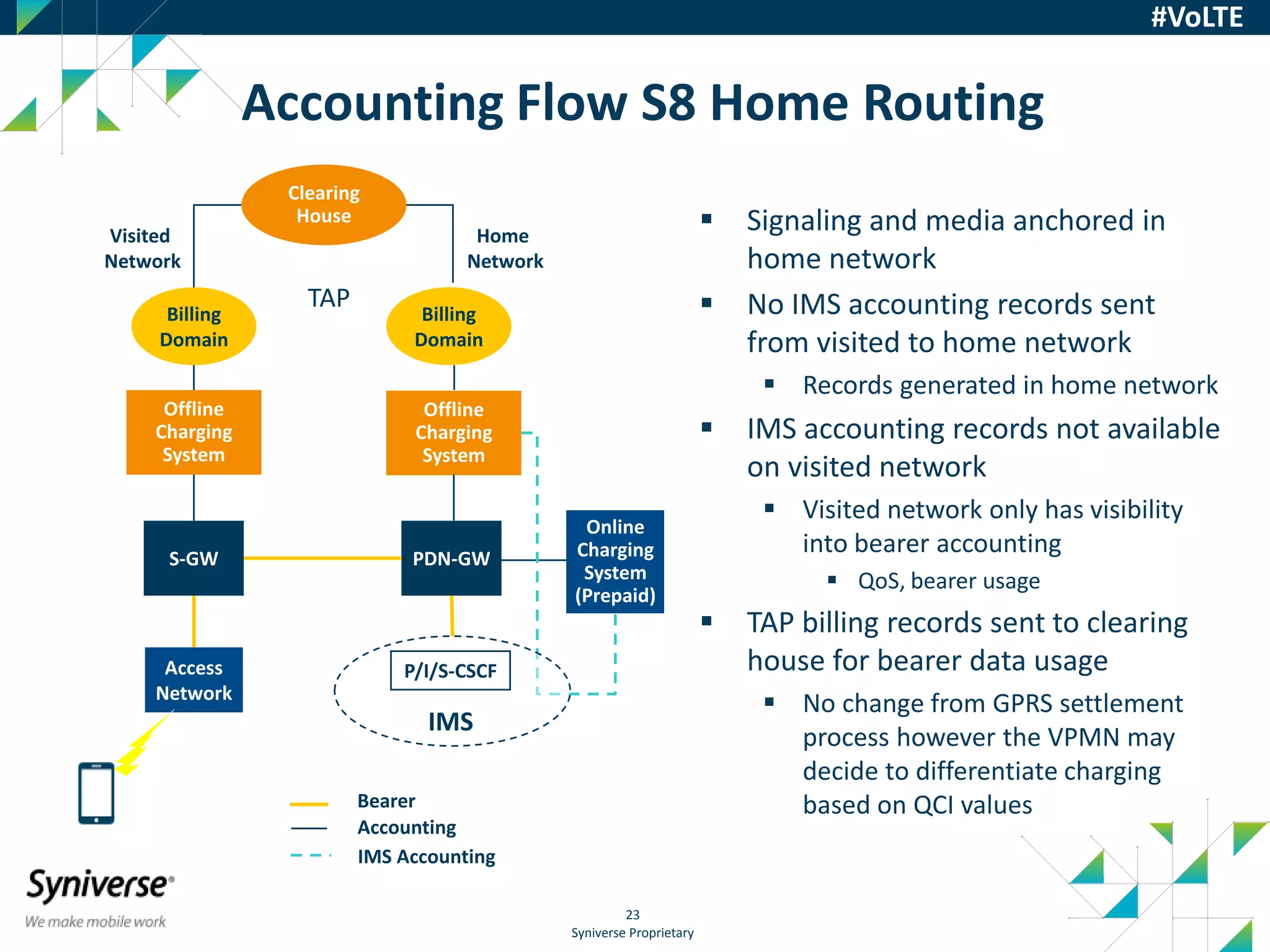
 Signaling and media anchored in
home network
 No IMS accounting records sent
from visited to home network
 Records generated in home network
 IMS accounting records not available
on visited network
 Visited network only has visibility
into bearer accounting
 QoS, bearer usage
 TAP billing records sent to clearing
house for bearer data usage
 No change from GPRS settlement
process however the VPMN may
decide to differentiate charging
based on QCI values
Accounting Flow S8 Home Routing
Billing
Domain
Billing
Domain
Access
Network
Visited
Network
Home
Network
Clearing
House
Bearer
Accounting
Offline
Charging
System
S-GW PDN-GW
Offline
Charging
System
Online
Charging
System
(Prepaid)
IMS Accounting
TAP
P/I/S-CSCF
IMS
Syniverse Proprietary
24
VoLTE (LBO)
Syniverse Proprietary
25
VoLTE (LBO) Local Breakout Architecture
IPX
IPX
xCSCF
MME
VPMN A-Party HPMN A-Party
B-Party
HSS
P-CSCF
S-CSCF
TAS
IBCF
DRA
IBCF
VoLTE
Roaming
VoLTE
Interconnect
EPC
IMS
IMS
IMS
Exchange
IMS
Exchange
PCRF
IBCF
Advantages
 More visibility into the control and media plane aspects of a
call or video session as it’s taking place with IMS
 Full support for lawful intercept and emergency call handling
 SRVCC support continuity of a voice call when moving between
LTE and CS networks
 VPMN has visibility of the call information using their IMS
records, TAP records can be created to reflect MOUs. This
makes it possible to use TAP for retail billing
Challenges
 More complexity implementing and supporting VoLTE roaming
 Interoperability issues that must be resolved between IMS cores
 Requires multiple feeds from many network elements for both
visited and home operators
 Operators may choose to implement home routing for data, but
local breakout for voice, adding complexity
 The TAP 3.12 MSESS & MSG records need to be supported by
both roaming partners
Syniverse Proprietary
26
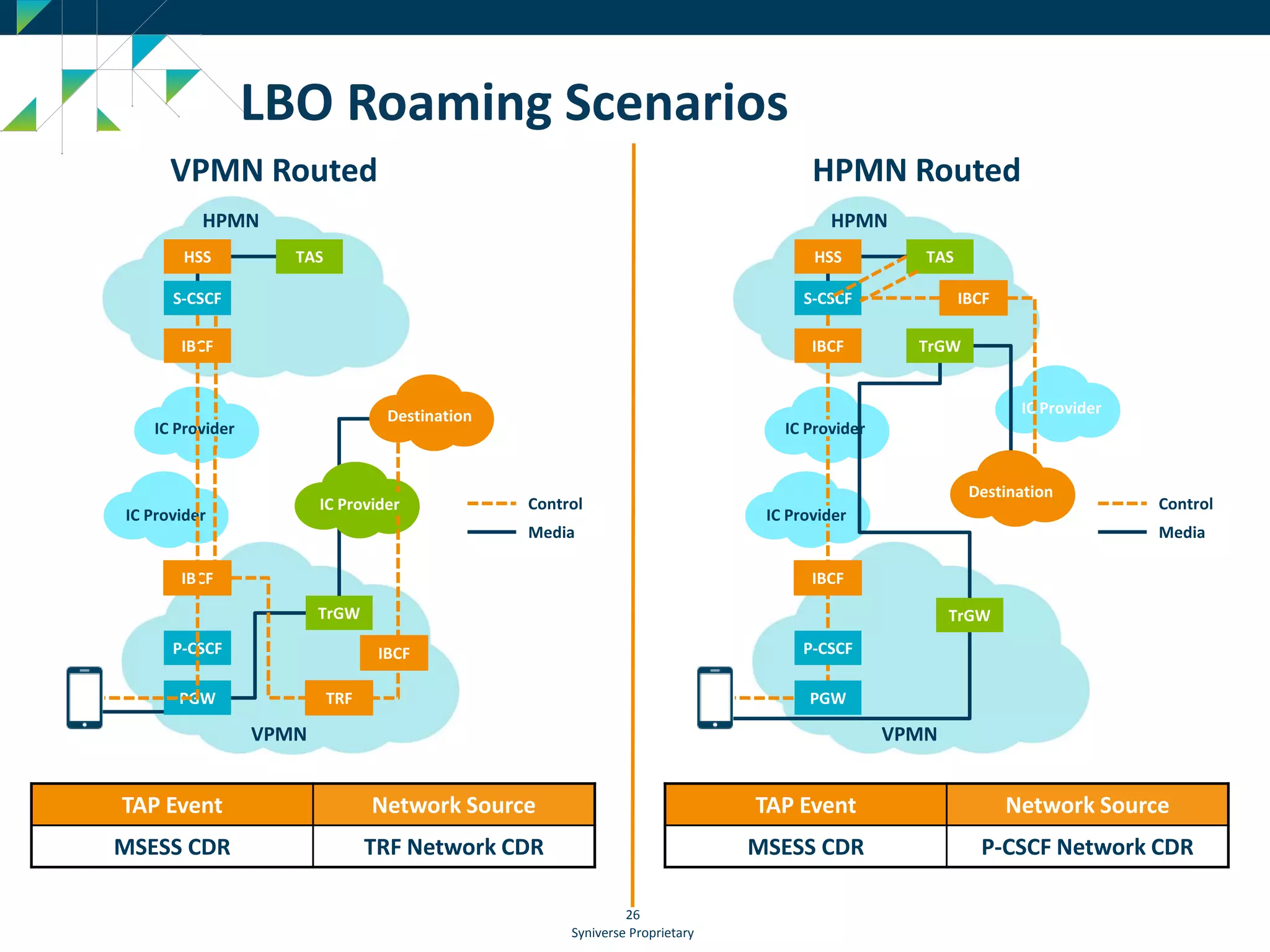
LBO Roaming Scenarios
VPMN Routed HPMN Routed
TAP Event Network Source
MSESS CDR TRF Network CDR
TAS
S-CSCF
Destination
TrGW
VPMN
HSS
IBCF
IBCF
TRF
IC Provider
IC Provider
IBCF
P-CSCF
PGW
IC Provider Control
Media
TAS
S-CSCF
Destination
TrGW
VPMN
HSS
IC Provider
IC Provider
IBCF
P-CSCF
PGW
IC Provider
Control
Media
HPMN HPMN
TrGW
IBCF
IBCF
TAP Event Network Source
MSESS CDR P-CSCF Network CDR
Syniverse Proprietary
27
#VoLTE
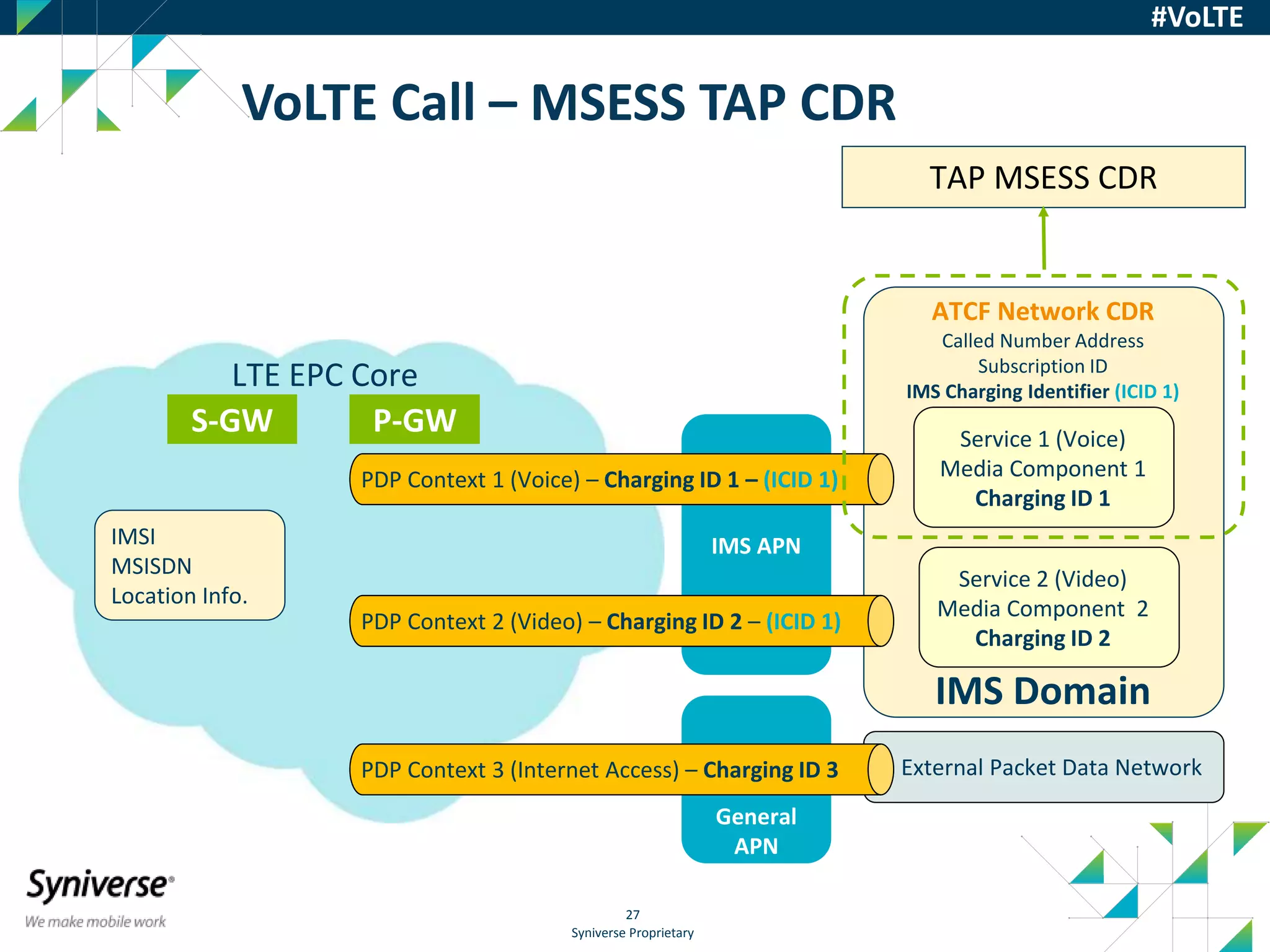
VoLTE Call – MSESS TAP CDR
General
APN
IMS Domain
ATCF Network CDR
Called Number Address
Subscription ID
IMS Charging Identifier (ICID 1)
Service 1 (Voice)
Media Component 1
Charging ID 1
Service 2 (Video)
Media Component 2
Charging ID 2
IMS APN
PDP Context 3 (Internet Access) – Charging ID 3
PDP Context 2 (Video) – Charging ID 2 – (ICID 1)
PDP Context 1 (Voice) – Charging ID 1 – (ICID 1)
S-GW P-GW
LTE EPC Core
External Packet Data Network
TAP MSESS CDR
IMSI
MSISDN
Location Info.
Syniverse Proprietary
28
#VoLTE
 Bearer accounting records optionally sent from visited to home network
 IMS accounting records generated by visited P-CSCF and home S-CSCF
 Diameter interfaces to offline and online charging systems
 TAP billing records may be sent to clearing house to support legacy settlement and retail billing processes
 IPX provider has access to IMS accounting records
LTE Accounting Flow Local Breakout
IMS Services
Visited Network Home Network
TAP
IMS IMS
Bearer
Bearer Accounting
IMS Accounting
IPX
Proxy
IPX
Provider
Offline/Online
Charging System
Billing
Domain
Access
Network
Clearing
House
PDN-GW
Billing
Domain
Offline
Charging
System
S-GW
P-CSCF I/S-CSCF
Syniverse Proprietary
29
#VoLTE
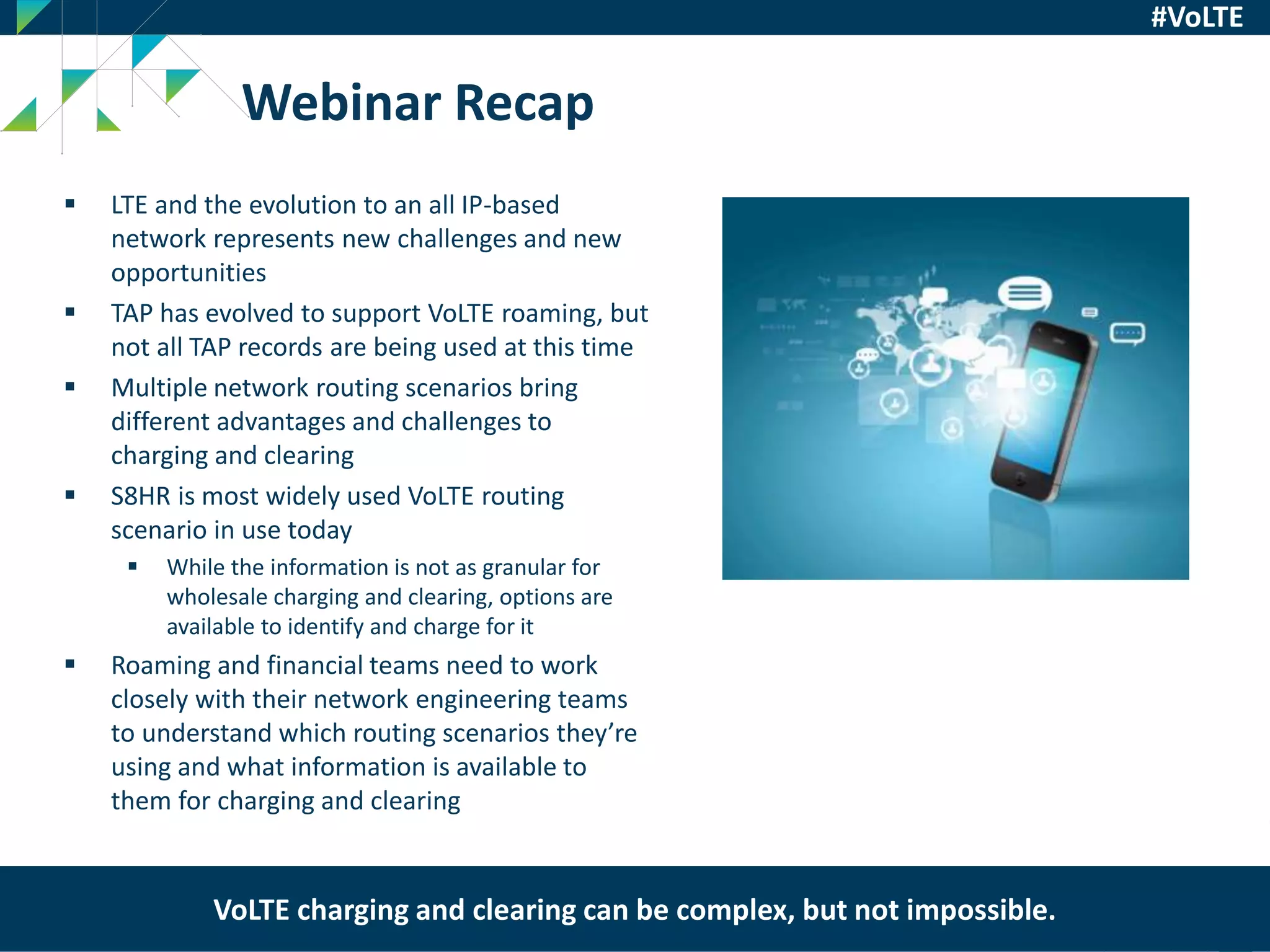
 LTE and the evolution to an all IP-based
network represents new challenges and new
opportunities
 TAP has evolved to support VoLTE roaming, but
not all TAP records are being used at this time
 Multiple network routing scenarios bring
different advantages and challenges to
charging and clearing
 S8HR is most widely used VoLTE routing
scenario in use today
 While the information is not as granular for
wholesale charging and clearing, options are
available to identify and charge for it
 Roaming and financial teams need to work
closely with their network engineering teams
to understand which routing scenarios they’re
using and what information is available to
them for charging and clearing
Webinar Recap
VoLTE charging and clearing can be complex, but not impossible.
Syniverse Proprietary
30
Q&A
Syniverse Proprietary
31
Thank You!
For more information, visit www.syniverse.com
or follow us on Twitter @Syniverse

VoLTE Charging and Clearing Explained

  • 1.
    Syniverse Proprietary 1 VoLTE Chargingand Clearing Explained Mary Clark – Chief Marketing Officer, Syniverse Keith Dyer – Founder and Editor, The Mobile Network Leo Casey – Senior Solutions Engineer, Syniverse
  • 2.
    Syniverse Proprietary 2 #VoLTE VoLTE ison the Rise 430 VoLTE- capable devices - GSA 521 operators have commercially launched LTE networks with 560 forecasted by end 2016 82operators in 43countries have launched VoLTE - GSMA -GSA 146 operators are investing in VoLTE- related activities - GSA -GSMA
  • 3.
    Syniverse Proprietary 3 #VoLTE Already Launched Next 6 Months 6-12Months 12 Months or Beyond Undecided If You Are Planning to Launch VoLTE Roaming, What is Your Timeline?
  • 4.
    Syniverse Proprietary 4 #VoLTE Keith Dyer,Founder and Editor, The Mobile Network  Founded The Mobile Network in 2013, introducing a new voice to the media covering mobile network technology  17 years of experience covering the mobile network technology ecosystem as a journalist and editor  Tracked the development of the VoLTE ecosystem since the beginning Leo Casey, Senior Solutions Engineer, Syniverse  Responsible for supporting Syniverse’s Connected LTE, Intelligent Roaming, MVNO, and clearing/billing services  15+ years of project management for roaming, business analytics, and GSM data clearing  GSMA regional conference presenter Today’s Expert Panelists
  • 5.
    VOLTE Roaming: charging KeithDyer, Editor, The Mobile Network www.the-mobile-network.com keith@the-mobile-network.com Twitter: @keithdyer #VoLTE
  • 6.
  • 7.
    Recap on thestory so far Underlying technical choices: Home Routing (S8HR) Easier but some features lacking or challenging: e.g. lawful intercept, emergency call, SRVCC Local Breakout (LBO) Technically more challenging, but more complete operator control #VoLTE
  • 8.
    Choices: impact oncharging Underlying technical choices: impact on charging Home Routing (S8HR) Can only rate on per kb consumed by voice call If call drops or falls back - what then? Local Breakout (LBO) Signalling changes between home and visited gateways Keeps current charging model, esp for inbound Architecture = Charging Capability = Business Model Impact #VoLTE
  • 9.
    What are operatorsthinking? 1/2 Roaming architecture choices: Home Routing (S8HR) Clear favourite for early movers so far, but some do NOT like & Local Breakout (LBO) has support for future. “Only LBO will allow us to meet regulatory, business and customer experience expectations… We have started to test LBO Home routed architecture with no significant network issues.” (Operator “A”) “LBO has been trialled and failed by a few operators. Another major network has specifically asked us to implement S8HR so that’s what we’re going to do as part of this request. Ultimately we’ll probably need to support this and then in the future enable LBO as well” (Operator “B”) #VoLTE
  • 10.
    What are operatorsthinking? 2/2 ...about how charging and clearing will work for VoLTE Roaming? “We’ll make it work” vs “Is it worth the hassle” “At the wholesale level, both LBO and S8HR allow charging and settlement based on current contracts.” “LBO allows consistent charging for customers on all technologies while S8HR will require enhancements from both IMS and EPC networks to allow this consistent charging.” “S8HR will probably result in significant decrease of value without changing current charging principles.” “There is tons of work involved in enabling S8HR Outbound Roaming in order to do Customer Charging correctly” “It’s impossible to relate volume to minutes or data CDRs to a call duration.” “S8HR: Offers virtually no advantage over a CS voice call but gives many disadvantages.” #VoLTE
  • 11.
    EU roam likehome? Is there any impact of EU roam like home regulations on charging methodology? NO! ● No anticipated difference in terms of actual way billing is done. Still need to identify session/call and charge/settle accordingly. “None of the main VoLTE aspects are expected to change as a result of new EU regulation.” #VoLTE
  • 12.
    Conclusions Still split butif pressed S8HR now (no choice due to commercial relations) and LBO later Operators not totally uniform on how choice impacts charging Access to required charging data also seen as challenge Knock-on impact is on business models Time to understand implications is NOW #VoLTE
  • 13.
    Syniverse Proprietary 13 #VoLTE S8HR LBOHybrid Undecided I don’t know If You Are Planning to Launch VoLTE Roaming, What Roaming Architecture Do You Plan to Implement ?
  • 14.
    Syniverse Proprietary 14 #VoLTE VoLTE Chargingand Clearing Explained Evolution towards All-IP/IMS New and Legacy Network Technologies Technical and Process Changes for Charging VoLTE Charging and Clearing Principles Different VoLTE Implementations S8HR and LBO
  • 15.
    Syniverse Proprietary 15 #VoLTE Evolution ofTAP Events CS TAP CDRs  Mobile Originating Call MOC Event for Voice and SMS-MO (only used for 2G , 3G Traffic)  Mobile Terminating Call (MTC) Event for Voice and SMS-MT (only used for 2G , 3G Traffic)  Supplementary Service (SS) Event in association with Voice Service GPRS TAP CDR  GPRS Event for data bearer stream (2G , 3G , LTE Traffic) VoLTE TAP CDRs  Mobile Session – MSESS (only used for Voice Traffic over LTE)  Messaging Event – MSG (only used for SMS Traffic over LTE ) 2G – 3G 4G
  • 16.
    Syniverse Proprietary 16 #VoLTE  Asingle VoLTE call must be represented in a single Mobile Session (MSESS) TAP Call Detail Record (CDR) in the same manner like the case with Voice over Circuit Switch (CS). It is not allowed to present partial VoLTE Calls separately on TAP.  VoLTE Traffic is not allowed to be represented in CS MOC and CS MTC Events on TAP  CS Voice and SMS Events are not allowed to be represented in MSESS and MSG Events on TAP  VoLTE S8HR is volume based charging data service:  Using the existing GPRS call record in TAP  Charges can be differentiated by QoS Class Identifier (QCI) and also by APN as any other data usage  Signaling (QCI5) can also be separated from payload traffic (except for SMS)  VoLTE has been supported since TAP3.12, May 1, 2012 VoLTE Principles
  • 17.
  • 18.
    Syniverse Proprietary 18 #VoLTE TAP forVoice Over LTE  TAP support for LTE/IMS (TAP3.12)  Two new TAP records for VoLTE  Messaging event (MSG)  Mobile session (MSESS)  New TAP fields in two new records  New type of roamer  New type of destination  New recording entity code/type: 9:P-CSCF Technical and Process Changes for Charging TAP Challenges for VoLTE  No single network element will contain all charging elements  Correlation of data from SGSN/S-GW/P-CSCF  CDRs via common Charging ID  Charging ID available from P-CSCF to identify each unique call  Not all “usual” TAP information readily available  Charging only for service and not for service + bearer (may not be straightforward)
  • 19.
    Syniverse Proprietary 19 #VoLTE Voice andSMS in CS vs. LTE Item CS LTE User Identities IMSI MSISDN IMSI complimentary with Private User ID Public User ID Origination / Destination E.164 Number E.164 Number , SIP URI, Tel URI CDR Source MSC SGSN , S-GW , P-GW , P-CSCF, ATCF, TRF CDR Correlation Not Required Required by using the Charging ID present in the EPC & IMS Domain CDR Unique Identifier Call Reference & SMS Reference IMS Charging Identifier TAP Record MOC /MTC SMS-MO/SMS-MT MSESS + Messaging Service MSG +Messaging Event Service GPRS(S8HR)
  • 20.
  • 21.
    Syniverse Proprietary 21 VoLTE (S8HR)Home Routed Architecture Advantages  S-GW is the main source for charging information  Basic bearer data volume charging  No technical complexity where handovers are not involved  QCI mechanism is used to identify VoLTE calls  TAP Charging capabilities are already present  CAPEX/OPEX is low for wholesale billing Challenges  Non-granular mechanism to charge and identify single VoLTE calls  No service awareness for services used on the VPMN side  Aggregation/Charging for VoLTE handover scenarios with 3G/4G are complex  Duration-based charging for VoLTE will be complicated  Correlation of charging information between VPMN and HPMN is difficult IPX IPX E-UTRAN MME VPMN A-Party HPMN A-Party B-Party HSS P-CSCF S-CSCF TAS SGW DRA IBCF VoLTE Roaming Interconnect IMS IMS Exchange PCRF PGW
  • 22.
    Syniverse Proprietary 22 #VoLTE LTE DataBearers – S8 Home Routing QCI = 5 QCI = 1 QCI = 2 Video Media - Dedicated Bearer Application Servers IMSAPN LTE Bit Pipe Voice Media - Dedicated Bearer AS AS IMS HPMN Signaling - Default Bearer QCI Values TAP Values Value QCI Priority Description CTL2 Value Record Type APN 1 2 Conversational Voice 21 GPRS IMS 2 4 Conversational Video (Live Streaming) 22 GPRS IMS 5 1 IMS Signaling (Voice, Video, SMS) 25 GPRS IMS PDN-GW S-GW VPMN
  • 23.
    Syniverse Proprietary 23 #VoLTE  Signalingand media anchored in home network  No IMS accounting records sent from visited to home network  Records generated in home network  IMS accounting records not available on visited network  Visited network only has visibility into bearer accounting  QoS, bearer usage  TAP billing records sent to clearing house for bearer data usage  No change from GPRS settlement process however the VPMN may decide to differentiate charging based on QCI values Accounting Flow S8 Home Routing Billing Domain Billing Domain Access Network Visited Network Home Network Clearing House Bearer Accounting Offline Charging System S-GW PDN-GW Offline Charging System Online Charging System (Prepaid) IMS Accounting TAP P/I/S-CSCF IMS
  • 24.
  • 25.
    Syniverse Proprietary 25 VoLTE (LBO)Local Breakout Architecture IPX IPX xCSCF MME VPMN A-Party HPMN A-Party B-Party HSS P-CSCF S-CSCF TAS IBCF DRA IBCF VoLTE Roaming VoLTE Interconnect EPC IMS IMS IMS Exchange IMS Exchange PCRF IBCF Advantages  More visibility into the control and media plane aspects of a call or video session as it’s taking place with IMS  Full support for lawful intercept and emergency call handling  SRVCC support continuity of a voice call when moving between LTE and CS networks  VPMN has visibility of the call information using their IMS records, TAP records can be created to reflect MOUs. This makes it possible to use TAP for retail billing Challenges  More complexity implementing and supporting VoLTE roaming  Interoperability issues that must be resolved between IMS cores  Requires multiple feeds from many network elements for both visited and home operators  Operators may choose to implement home routing for data, but local breakout for voice, adding complexity  The TAP 3.12 MSESS & MSG records need to be supported by both roaming partners
  • 26.
    Syniverse Proprietary 26 LBO RoamingScenarios VPMN Routed HPMN Routed TAP Event Network Source MSESS CDR TRF Network CDR TAS S-CSCF Destination TrGW VPMN HSS IBCF IBCF TRF IC Provider IC Provider IBCF P-CSCF PGW IC Provider Control Media TAS S-CSCF Destination TrGW VPMN HSS IC Provider IC Provider IBCF P-CSCF PGW IC Provider Control Media HPMN HPMN TrGW IBCF IBCF TAP Event Network Source MSESS CDR P-CSCF Network CDR
  • 27.
    Syniverse Proprietary 27 #VoLTE VoLTE Call– MSESS TAP CDR General APN IMS Domain ATCF Network CDR Called Number Address Subscription ID IMS Charging Identifier (ICID 1) Service 1 (Voice) Media Component 1 Charging ID 1 Service 2 (Video) Media Component 2 Charging ID 2 IMS APN PDP Context 3 (Internet Access) – Charging ID 3 PDP Context 2 (Video) – Charging ID 2 – (ICID 1) PDP Context 1 (Voice) – Charging ID 1 – (ICID 1) S-GW P-GW LTE EPC Core External Packet Data Network TAP MSESS CDR IMSI MSISDN Location Info.
  • 28.
    Syniverse Proprietary 28 #VoLTE  Beareraccounting records optionally sent from visited to home network  IMS accounting records generated by visited P-CSCF and home S-CSCF  Diameter interfaces to offline and online charging systems  TAP billing records may be sent to clearing house to support legacy settlement and retail billing processes  IPX provider has access to IMS accounting records LTE Accounting Flow Local Breakout IMS Services Visited Network Home Network TAP IMS IMS Bearer Bearer Accounting IMS Accounting IPX Proxy IPX Provider Offline/Online Charging System Billing Domain Access Network Clearing House PDN-GW Billing Domain Offline Charging System S-GW P-CSCF I/S-CSCF
  • 29.
    Syniverse Proprietary 29 #VoLTE  LTEand the evolution to an all IP-based network represents new challenges and new opportunities  TAP has evolved to support VoLTE roaming, but not all TAP records are being used at this time  Multiple network routing scenarios bring different advantages and challenges to charging and clearing  S8HR is most widely used VoLTE routing scenario in use today  While the information is not as granular for wholesale charging and clearing, options are available to identify and charge for it  Roaming and financial teams need to work closely with their network engineering teams to understand which routing scenarios they’re using and what information is available to them for charging and clearing Webinar Recap VoLTE charging and clearing can be complex, but not impossible.
  • 30.
  • 31.
    Syniverse Proprietary 31 Thank You! Formore information, visit www.syniverse.com or follow us on Twitter @Syniverse