
Air Interface
Air Interface
• Radio Transmission Techniques
– FDMA
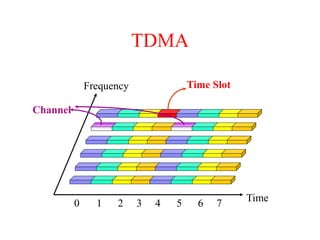
– TDMA
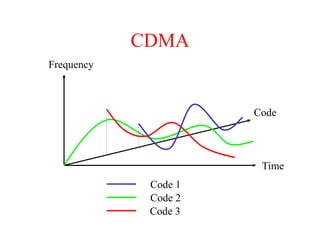
– CDMA
• Channels
– Physical channels
– Logical channels
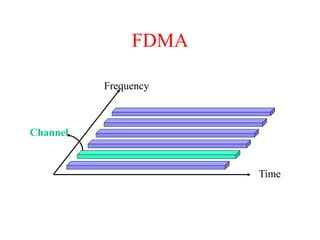
FDMA
Time
Frequency
Channel
TDMA
Time
Frequency
0 1 2 3 4 5 6 7
Channel
Time Slot
CDMA
Frequency
Time
Code
Code 1
Code 2
Code 3
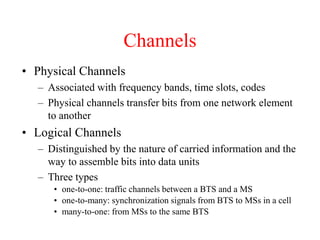
Channels
• Physical Channels
– Associated with frequency bands, time slots, codes
– Physical channels transfer bits from one network element
to another
• Logical Channels
– Distinguished by the nature of carried information and the
way to assemble bits into data units
– Three types
• one-to-one: traffic channels between a BTS and a MS
• one-to-many: synchronization signals from BTS to MSs in a cell
• many-to-one: from MSs to the same BTS
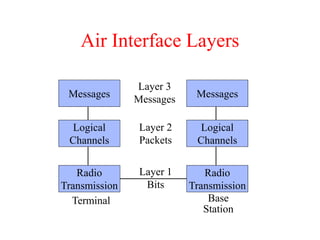
Air Interface Layers
Radio
Transmission
Logical
Channels
Messages
Radio
Transmission
Logical
Channels
Messages
Terminal Base
Station
Layer 1
Bits
Layer 2
Packets
Layer 3
Messages
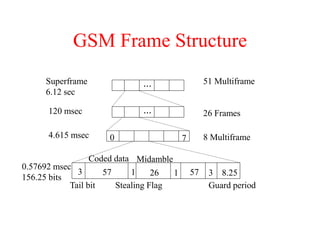
GSM Frame Structure
3 57 26 57 8.25
1 1 3
0 7
...
...
Superframe
6.12 sec
120 msec
4.615 msec
0.57692 msec
156.25 bits
51 Multiframe
26 Frames
8 Multiframe
Coded data Midamble
Tail bit Stealing Flag Guard period
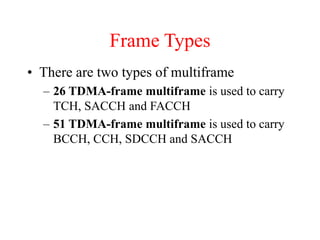
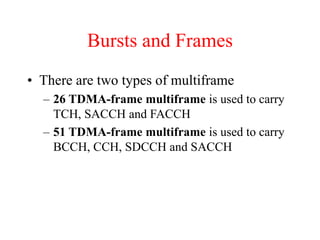
• There are two types of multiframe
– 26 TDMA-frame multiframe is used to carry
TCH, SACCH and FACCH
– 51 TDMA-frame multiframe is used to carry
BCCH, CCH, SDCCH and SACCH
Frame Types
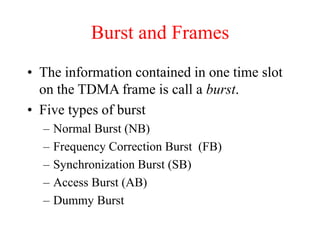
Burst and Frames
• The information contained in one time slot
on the TDMA frame is call a burst.
• Five types of burst
– Normal Burst (NB)
– Frequency Correction Burst (FB)
– Synchronization Burst (SB)
– Access Burst (AB)
– Dummy Burst
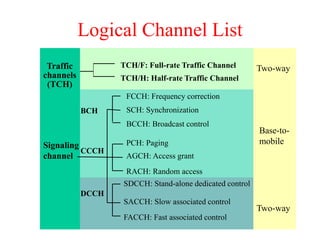
Traffic
channels
(TCH)
Signaling
channel
TCH/F: Full-rate Traffic Channel
TCH/H: Half-rate Traffic Channel
FCCH: Frequency correction
SCH: Synchronization
BCCH: Broadcast control
PCH: Paging
AGCH: Access grant
RACH: Random access
SDCCH: Stand-alone dedicated control
SACCH: Slow associated control
FACCH: Fast associated control
Two-way
Base-to-
mobile
Two-way
Logical Channel List
BCH
CCCH
DCCH
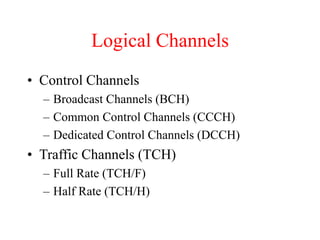
Logical Channels
• Control Channels
– Broadcast Channels (BCH)
– Common Control Channels (CCCH)
– Dedicated Control Channels (DCCH)
• Traffic Channels (TCH)
– Full Rate (TCH/F)
– Half Rate (TCH/H)
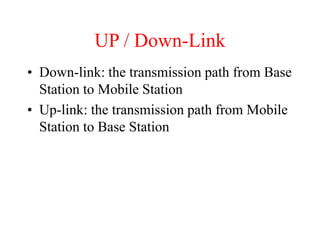
UP / Down-Link
• Down-link: the transmission path from Base
Station to Mobile Station
• Up-link: the transmission path from Mobile
Station to Base Station
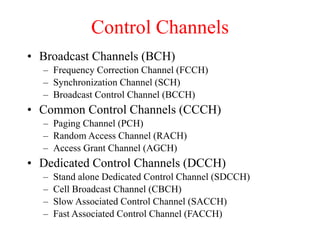
Control Channels
• Broadcast Channels (BCH)
– Frequency Correction Channel (FCCH)
– Synchronization Channel (SCH)
– Broadcast Control Channel (BCCH)
• Common Control Channels (CCCH)
– Paging Channel (PCH)
– Random Access Channel (RACH)
– Access Grant Channel (AGCH)
• Dedicated Control Channels (DCCH)
– Stand alone Dedicated Control Channel (SDCCH)
– Cell Broadcast Channel (CBCH)
– Slow Associated Control Channel (SACCH)
– Fast Associated Control Channel (FACCH)
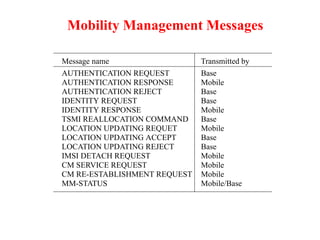
Message name Transmitted by
AUTHENTICATION REQUEST
AUTHENTICATION RESPONSE
AUTHENTICATION REJECT
IDENTITY REQUEST
IDENTITY RESPONSE
TSMI REALLOCATION COMMAND
LOCATION UPDATING REQUET
LOCATION UPDATING ACCEPT
LOCATION UPDATING REJECT
IMSI DETACH REQUEST
CM SERVICE REQUEST
CM RE-ESTABLISHMENT REQUEST
MM-STATUS
Base
Mobile
Base
Base
Mobile
Base
Mobile
Base
Base
Mobile
Mobile
Mobile
Mobile/Base
Mobility Management Messages
Message name
Starting a call
Transmitted by
SETUP
EMERGENCY SETUP
CALL PROCEEDING
PROGRESS
CALL CONFIRMED
ALERTING
CONNECT
Mobile/base
mobile
base
base
mobile
mobile/base
mobile/base
During a call
START DTMF
STOP DTMF
MODIFY
USER INFORMATION
Mobile
mobile
mobile/base
mobile/base
Ending a call
DISCONNECT
RELEASE
RELEASE COMPLET
Mobile/base
mobile/base
mobile/base
Abnormal conditions
STATUS
STATUS ENQUIRY
CONGESTION CONROL
Mobile/base
mobile/base
mobile/base
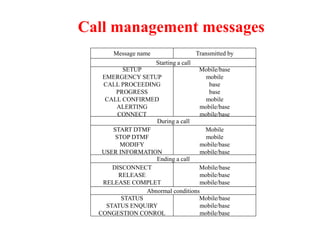
Call management messages
Message name Logical channel Transmitted by
SYNC CHANNEL INFORMATION
SYSTEM INFORMATION (TYPE 1,2,3,4,5)
SYSTEM INFORMATION (TYPE 6)
CHANNEL REQUEST
PAGING REQUEST (TYPE 1,2.3)
IMMEDIATE ASSIGNMENT
IMMEDIATE ASSIGNMENT EXTENDED
IMMEDIATE ASSIGNMENT REJECT
ASSIGNMENT COMMAND
ADDITIONAL ASSIGNMENT
PAGING RESPONSE
MERSUREMENT REPORT
HANDOVER COMMAND
HANDOVER ACCESS
PHYSICAL INFORMATION
HANDOVER COMPLETE
CIPHERING MODE
CHANNEL RELEASE
PARTIAL RELEASE
FREQUENCY REDEFINITION
CLASSMARK CHANGE
CHANNEL MODE MODIFY
RR STATUS
SCH
BCCH
SACCH
RACH
PCH
AGCH
AGCH
AGCH
FACCH
FACCH
SDCCH
SACCH
FACCH
TCH
FACCH
FACCH
FACCH
FACCH
FACCH
SACCH
FACCH
SACCH
FACCH
FACCH
FACCH
SACCH
Base
Base
Base
Mobile
Base
Base
Base
Base
Base
Base
Mobile
Mobile
Base
Mobile
Base
Mobile
Base
Base
Base
Base
Mobile
Base
Mobile/base
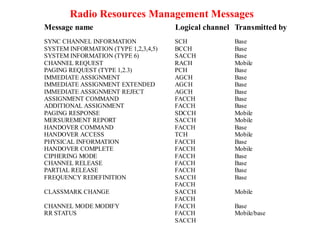
Radio Resources Management Messages
Prior
MSC
Prior
VLR HLR
Serving
VLR
Serving
MSC
Serving
Base
Registration info
Store info
REGISTRATION NOTIFICATION INVOKE
Store info
Store info
Change info
remove info
REGISTRATION NOTIFICATION INVOKE
REGISTRATION NOTIFICATION RESULT
REGISTRATION CANCELLATION INVOKE
remove info
REGISTRATION CANCELLATION RESULT
REGISTRATION CANCELLATION INVOKE
REGISTRATION CANCELLATION RESULT
QUALIFICATION REQUEST INVOKE
QUALIFICATION REQUEST RESULT
PROFILE REQUEST INVOKE
PROFILE REQUEST RESULT
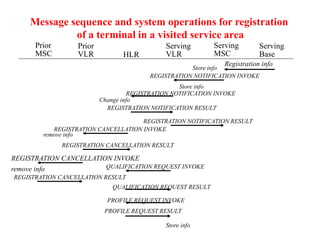
Message sequence and system operations for registration
of a terminal in a visited service area
Mobile
station
Base
station
Category Logical
Channel
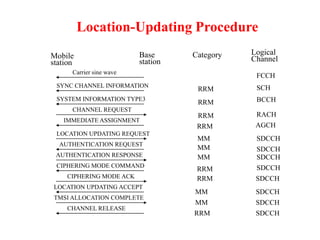
SYNC CHANNEL INFORMATION
Carrier sine wave
SYSTEM INFORMATION TYPE3
CHANNEL REQUEST
IMMEDIATE ASSIGNMENT
LOCATION UPDATING REQUEST
AUTHENTICATION REQUEST
CIPHERING MODE COMMAND
CIPHERING MODE ACK
LOCATION UPDATING ACCEPT
TMSI ALLOCATION COMPLETE
AUTHENTICATION RESPONSE
CHANNEL RELEASE
RRM
RRM
RRM
RRM
MM
MM
MM
MM
MM
RRM
RRM
RRM
FCCH
SCH
BCCH
RACH
AGCH
SDCCH
SDCCH
SDCCH
SDCCH
SDCCH
SDCCH
SDCCH
SDCCH
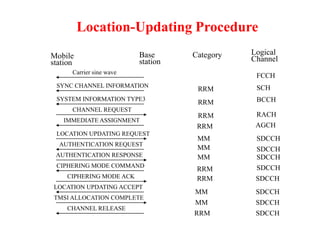
Location-Updating Procedure
Mobile
station
Base
station
Category Logical
Channel
RRM
RRM
RRM
RRM
RRM
RRM
MM
MM
RRM
RRM
CMCM
CM
CM
RRM
RRM
CM
CM
CM
CM
RRM
FCCH
SCH
BCCH
PCH
RACH
AGCH
SDCCH
SDCCH
SDCCH
SDCCH
SDCCH
SDCCH
SDCCH
SDCCH
SDCCH
SDCCH
SDCCH
FACCH
TCH
TCH
FACCH
FACCH
FACCH
FACCH
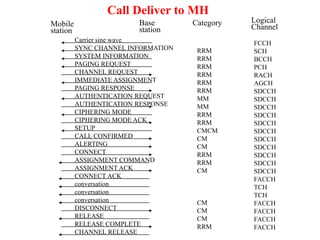
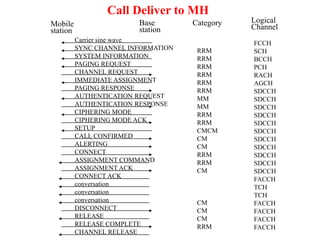
Carrier sine wave
SYNC CHANNEL INFORMATION
SYSTEM INFORMATION
PAGING REQUEST
CHANNEL REQUEST
IMMEDIATE ASSIGNMENT
PAGING RESPONSE
AUTHENTICATION REQUEST
AUTHENTICATION RESPONSE
CIPHERING MODE
CIPHERING MODE ACK
SETUP
CALL CONFIRMED
ALERTING
CONNECT
ASSIGNMENT COMMAND
ASSIGNMENT ACK
CONNECT ACK
conversation
conversation
conversation
DISCONNECT
RELEASE
RELEASE COMPLETE
CHANNEL RELEASE
Call Deliver to MH
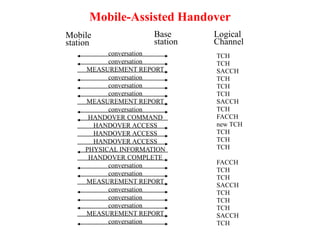
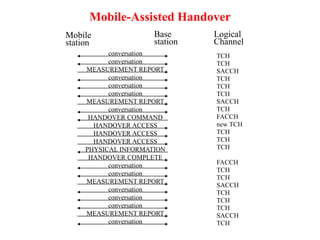
Mobile-Assisted Handover
Mobile
station
Base
station
Logical
Channel
TCH
TCH
SACCH
TCH
TCH
TCH
SACCH
TCH
FACCH
new TCH
TCH
TCH
TCH
FACCH
TCH
TCH
SACCH
TCH
TCH
TCH
SACCH
TCH
conversation
conversation
MEASUREMENT REPORT
conversation
conversation
conversation
MEASUREMENT REPORT
conversation
HANDOVER COMMAND
HANDOVER ACCESS
HANDOVER ACCESS
HANDOVER ACCESS
PHYSICAL INFORMATION
HANDOVER COMPLETE
conversation
conversation
MEASUREMENT REPORT
conversation
conversation
conversation
MEASUREMENT REPORT
conversation
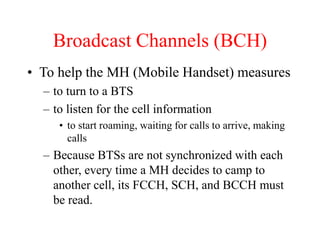
Broadcast Channels (BCH)
• To help the MH (Mobile Handset) measures
– to turn to a BTS
– to listen for the cell information
• to start roaming, waiting for calls to arrive, making
calls
– Because BTSs are not synchronized with each
other, every time a MH decides to camp to
another cell, its FCCH, SCH, and BCCH must
be read.
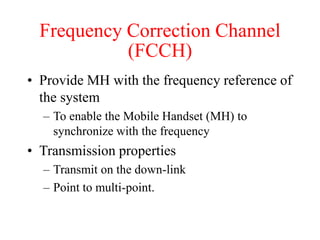
Frequency Correction Channel
(FCCH)
• Provide MH with the frequency reference of
the system
– To enable the Mobile Handset (MH) to
synchronize with the frequency
• Transmission properties
– Transmit on the down-link
– Point to multi-point.
Synchronization Channel (SCH)
• MH synchronize with the structure within the
locative cell
– MH can receive information from the proper time slots
on the TDMA structure
• To ensure a GSM BTS is chose
– The Base Station Identity Code (BSIC) can only be
decoded by a GSM BTS
• Transmission properties
– Transmit on down-link
– Point to multi-point.
Broadcast Control Channel
(BCCH)
• BTS broadcast cell information to MH
– LAI ( Location Area Identity), to start roaming,
waiting for calls to arrive, making calls
– maximum output power allowed in the cell
– information about BCCH carriers for the
neighboring cells
• MH will perform measurement to BTS
• Transmission properties
– Transmit on down-link
– Point to multi-point
Common Control Channels
(CCCH)
• CCCH support the establishment of a
dedicated communication path (dedicated
channel) between the MH and the BTS
• Three types of CCCH
– Paging Channel (PCH)
– Random Access Channel (RACH)
– Access Grant Channel (AGCH)
Paging Channel (PCH)
• Used by BTS to page particular MH in the cell
– MH actively listen to PCH to check contact info
within certain time
– Contact could be incoming call or short message
• Contact info on PCH include
– IMSI (MH’s identity number), or
– TMSI (temporary number)
• Transmission properties
– Transmit on down-link
– point to point
Random Access Channel (RACH)
• Used by MH to request a dedicated channel
for call setup
– Shared by any MH attempts to access the
network
– Channel request message contains the reason
for the access attempt
• Transmission properties
– Transmit on up-link
– Point to pint.
Access Grant Channel (AGCH)
• The network assigns a signaling channel via
AGCH
– A Stand alone Dedicated Control Channel
(SDCCH) is assigned
• Transmission properties
– Transmit on down-link
– Point to point
Dedicated Control Channels
(DCCH)
• DCCH are used for transferring nonuser
information between the network and the MH
– Messages on DCCH Including
• channel maintenance
• mobility management
• radio resource management
• Four kinds of DCCH
– Stand alone Dedicated Control Channel (SDCCH)
– Cell Broadcast Channel (CBCH)
– Slow Associated Control Channel (SACCH)
– Fast Associated Control Channel (FACCH)
Stand alone Dedicated Control
Channel (SDCCH)
• Transfer signaling information between the
BTS and the MH
• Typically used for location updating prior to
use of a traffic channel
• Transmission properties
– Bidirectional channel, transmit on both up and
down-link
– Point to point.
Cell Broadcast Channel (CBCH)
• To carry Short Message Service Cell
Broadcast (SMSCB)
• Use the same physical channel as SDCCH
• Transmission properties
– Transmit on down-link
– Point to multi-point
Slow Associated Control Channel
(SACCH)
• Carries control and measurement parameters along
with routine data necessary to maintain a radio
link between the MH and the BTS
– On the uplink, MS sends averaged measurements
(signal strength and quality) of current and neighboring
BCCH
– On downlink, MS receives information about
transmitting power to use and an instruction with time
advance/retard
• Transmission properties
– Bidirection channel, transmit on both up and down link
– Point to point
Fast Associated Control Channel
(FACCH)
• An FACCH is used over a TCH where it
steals time slots from a TCH
– a 20 ms segment of speech is stolen to carry
handover signaling information
• Appears on demand
Traffic Channels (TCH)
• TCH transport user information (speech/data)
• TCH are bidirectional dedicated channels
between the network and the MH
Mobile
station
Base
station
Category Logical
Channel
SYNC CHANNEL INFORMATION
Carrier sine wave
SYSTEM INFORMATION TYPE3
CHANNEL REQUEST
IMMEDIATE ASSIGNMENT
LOCATION UPDATING REQUEST
AUTHENTICATION REQUEST
CIPHERING MODE COMMAND
CIPHERING MODE ACK
LOCATION UPDATING ACCEPT
TMSI ALLOCATION COMPLETE
AUTHENTICATION RESPONSE
CHANNEL RELEASE
RRM
RRM
RRM
RRM
MM
MM
MM
MM
MM
RRM
RRM
RRM
FCCH
SCH
BCCH
RACH
AGCH
SDCCH
SDCCH
SDCCH
SDCCH
SDCCH
SDCCH
SDCCH
SDCCH
Location-Updating Procedure
Mobile
station
Base
station
Category Logical
Channel
RRM
RRM
RRM
RRM
RRM
RRM
MM
MM
RRM
RRM
CMCM
CM
CM
RRM
RRM
CM
CM
CM
CM
RRM
FCCH
SCH
BCCH
PCH
RACH
AGCH
SDCCH
SDCCH
SDCCH
SDCCH
SDCCH
SDCCH
SDCCH
SDCCH
SDCCH
SDCCH
SDCCH
FACCH
TCH
TCH
FACCH
FACCH
FACCH
FACCH
Carrier sine wave
SYNC CHANNEL INFORMATION
SYSTEM INFORMATION
PAGING REQUEST
CHANNEL REQUEST
IMMEDIATE ASSIGNMENT
PAGING RESPONSE
AUTHENTICATION REQUEST
AUTHENTICATION RESPONSE
CIPHERING MODE
CIPHERING MODE ACK
SETUP
CALL CONFIRMED
ALERTING
CONNECT
ASSIGNMENT COMMAND
ASSIGNMENT ACK
CONNECT ACK
conversation
conversation
conversation
DISCONNECT
RELEASE
RELEASE COMPLETE
CHANNEL RELEASE
Call Deliver to MH
Mobile-Assisted Handover
Mobile
station
Base
station
Logical
Channel
TCH
TCH
SACCH
TCH
TCH
TCH
SACCH
TCH
FACCH
new TCH
TCH
TCH
TCH
FACCH
TCH
TCH
SACCH
TCH
TCH
TCH
SACCH
TCH
conversation
conversation
MEASUREMENT REPORT
conversation
conversation
conversation
MEASUREMENT REPORT
conversation
HANDOVER COMMAND
HANDOVER ACCESS
HANDOVER ACCESS
HANDOVER ACCESS
PHYSICAL INFORMATION
HANDOVER COMPLETE
conversation
conversation
MEASUREMENT REPORT
conversation
conversation
conversation
MEASUREMENT REPORT
conversation
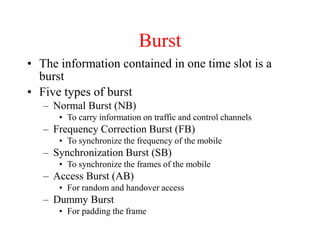
Burst
• The information contained in one time slot is a
burst
• Five types of burst
– Normal Burst (NB)
• To carry information on traffic and control channels
– Frequency Correction Burst (FB)
• To synchronize the frequency of the mobile
– Synchronization Burst (SB)
• To synchronize the frames of the mobile
– Access Burst (AB)
• For random and handover access
– Dummy Burst
• For padding the frame
Bursts and Frames
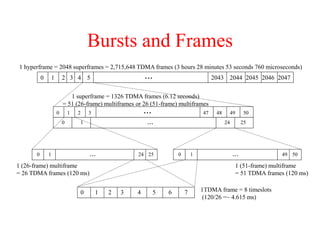
• There are two types of multiframe
– 26 TDMA-frame multiframe is used to carry
TCH, SACCH and FACCH
– 51 TDMA-frame multiframe is used to carry
BCCH, CCH, SDCCH and SACCH
Bursts and Frames
... 2047
2046
2045
2044
2043
1
0 2 3 4 5
...
0 1 2 3 50
49
48
47
0 1 25
24
...
0 1 25
24
... 0 1 50
49
...
0 1 2 3 4 5 6 7
1 hyperframe = 2048 superframes = 2,715,648 TDMA frames (3 hours 28 minutes 53 seconds 760 microseconds)
1 superframe = 1326 TDMA frames (6.12 seconds)
= 51 (26-frame) multiframes or 26 (51-frame) multiframes
1TDMA frame = 8 timeslots
(120/26 =~ 4.615 ms)
1 (26-frame) multiframe
= 26 TDMA frames (120 ms)
1 (51-frame) multiframe
= 51 TDMA frames (120 ms)
Bursts and Frames
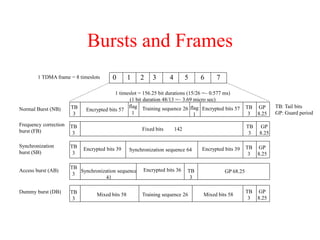
0 1 2 3 4 5 6 7
GP
8.25
TB
3
Encrypted bits 57
flag
1
Training sequence 26 flag
1
Encrypted bits 57
TB
3
TB
3
Fixed bits 142 GP
8.25
TB
3
GP
8.25
TB
3
TB
3
Encrypted bits 39 Synchronization sequence 64 Encrypted bits 39
TB
3
Synchronization sequence
41
Encrypted bits 36 TB
3
GP 68.25
GP
8.25
TB
3
TB
3
Mixed bits 58 Training sequence 26 Mixed bits 58
Normal Burst (NB)
Frequency correction
burst (FB)
Synchronization
burst (SB)
Access burst (AB)
Dummy burst (DB)
TB: Tail bits
GP: Guard period
1 TDMA frame = 8 timeslots
1 timeslot = 156.25 bit durations (15/26 =~ 0.577 ms)
(1 bit duration 48/13 =~ 3.69 micro sec)
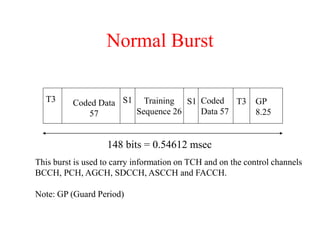
Normal Burst
T3 Coded Data
57
Training
Sequence 26
Coded
Data 57
GP
8.25
S1 S1 T3
148 bits = 0.54612 msec
This burst is used to carry information on TCH and on the control channels
BCCH, PCH, AGCH, SDCCH, ASCCH and FACCH.
Note: GP (Guard Period)
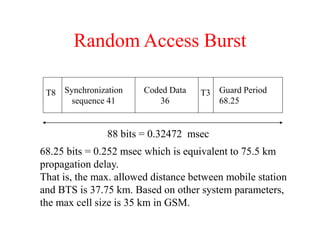
Random Access Burst
T8 Synchronization
sequence 41
Coded Data
36
Guard Period
68.25
T3
88 bits = 0.32472 msec
68.25 bits = 0.252 msec which is equivalent to 75.5 km
propagation delay.
That is, the max. allowed distance between mobile station
and BTS is 37.75 km. Based on other system parameters,
the max cell size is 35 km in GSM.
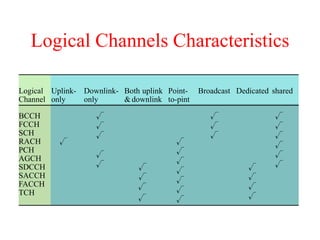
Logical Channels Characteristics
Logical
Channel
Uplink-
only
Downlink-
only
Both uplink
&downlink
Point-
to-pint
Broadcast Dedicated shared
BCCH
FCCH
SCH
RACH
PCH
AGCH
SDCCH
SACCH
FACCH
TCH
√
√
√
√
√
√ √
√
√
√
√
√
√
√
√
√
√
√
√
√
√
√
√
√
√
√
√
√
√
√
GSM Architecture
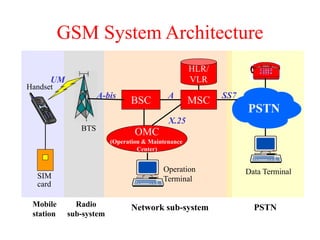
GSM System Architecture
PSTN
Data Terminal
HLR/
VLR
MSC
BSC
OMC
(Operation & Maintenance
Center)
Operation
Terminal
BTS
Handset
A
X.25
A-bis SS7
Network sub-system PSTN
Radio
sub-system
Mobile
station
UM
SIM
card
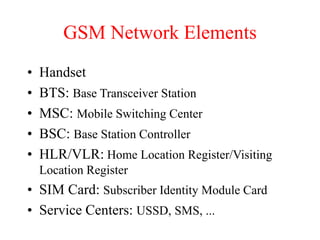
GSM Network Elements
• Handset
• BTS: Base Transceiver Station
• MSC: Mobile Switching Center
• BSC: Base Station Controller
• HLR/VLR: Home Location Register/Visiting
Location Register
• SIM Card: Subscriber Identity Module Card
• Service Centers: USSD, SMS, ...
Mobile Handset (MH)
• Used by the subscriber to access the GSM
network via the air interface
• Contains the hardware and software specific
to the radio interface
• Need a Subscriber Identity Module (SIM)
which contains the subscriber-specific data
to access GSM network, except emergency
call
Base Transceiver Station (BTS)
/ Base Station
• Responsible for communication to and from MHs
via air interface
– MH communicates with the mobile system using a
radio channel to a BTS
• BTS comprises radio transmission and reception
devices
– Including the antennae and signaling processing
specific to the radio interface
• BTS separates the speech and control signaling
associated with a MH and sends them to the BSC
on separate channels
Mobile services Switching
Center (MSC)
• Responsible for all switching functions
related to call processing
– Coordinate the setting up of calls to and from
GSM users
• MSC is the interface between GSM network
& PSTN (Public Switched Telephone
Network)
Base Station Controller (BSC)
• Monitor and Control several base stations
– Frequency administration, control of BTSs,
exchange functions
• Responsible for all the radio interface
management
– Channel allocation and release, handover
management
• BSC is the interface between MSC and BTS
– BSC is connected on one side to several BTSs
and on the other side to the MSC
Home Location Register (HLR)
• A database in charge of the management of
mobile subscribers
• Contains information of network subscribers
– Information on teleservices and bearer services
subscription, service restrictions, and
supplementary services
– The data stored in HLR is of a semipermanent
nature and does not usually change from call to
call
Visitor Location Register (VLR)
• Contains the relevant data of all MHs
currently located in a serving MSC
– The permanent data is the same as data in the
HLR
– The temporary data includes
• Temporary Subscriber Identity (TMSI)
• Location Area Identity (LAI) of an MH
– VLR allocates mobile subscriber roaming
numbers (MSRNs) for the incoming call setup
Subscriber Identity Module (SIM)
• Subscriber Identity Module
– Contains
• phone number (MSISDN)
• international mobile subscriber identity (IMSI)
• status of SIM
• service code
• authentication key
• PIN (personal identification code)
• PUK (personal unlock code)
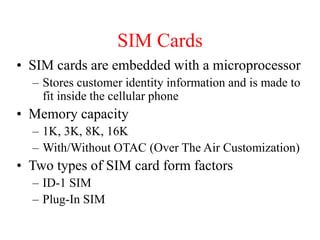
SIM Cards
• SIM cards are embedded with a microprocessor
– Stores customer identity information and is made to
fit inside the cellular phone
• Memory capacity
– 1K, 3K, 8K, 16K
– With/Without OTAC (Over The Air Customization)
• Two types of SIM card form factors
– ID-1 SIM
– Plug-In SIM
Application Service Centers
• Responsible for GSM network add-on services
– Operation and Maintenance Center (OMC)
• Monitoring and control the network
• Usually connect with MSC, BSC, HLR, and other service
centers
– Short Message Service Center (SMSC)
• provide short message services
• usually connect to MSC
– Unstructured Supplementary Service Data Center
(USSDC)
• provide USSD service in the form of *ID*ID*info#
• usually connect to HLR
Geographical Network Structure
• Location Units
– Cell
– Location Area (LA)
– MSC/VLR Service Area
– PLMN (Public Land Mobile Network) Service
Area
– GSM Service Area
• Cell Planning
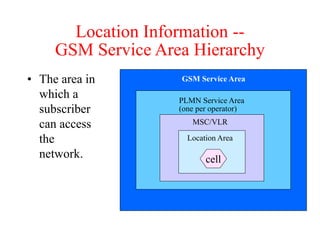
Location Information --
GSM Service Area Hierarchy
• The area in
which a
subscriber
can access
the
network. cell
Location Area
MSC/VLR
PLMN Service Area
(one per operator)
GSM Service Area
Cell Characteristics
• The Basic Union In The System
– defined as the area where radio coverage is
given by one base station.
• Addressed by Cell Global Identity (CGI)
• A cell has one or several frequencies,
depending on traffic load.
– Frequencies are reused, but not used in
neighboring cells due to interference.
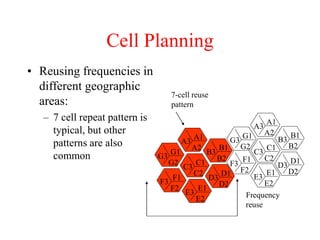
Cell Planning
• Reusing frequencies in
different geographic
areas:
– 7 cell repeat pattern is
typical, but other
patterns are also
common
A3
A1
A2
G3
G1
G2
C3
C1
C2
B3
B1
B2
F3
F1
F2
D3
D1
D2
E3
E1
E2
G3
G1
G2
F3
F1
F2
C3
C1
C2
A3
A1
A2
B3
B1
B2
E3
E1
E2
D3
D1
D2
7-cell reuse
pattern
Frequency
reuse
Cell Patterns
1
3
2
3
2
7
1
6
4
5
K=3
K=7
Frequency Utilization v.s. K
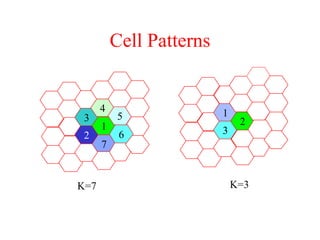
• Frequency can’t be reused in the same pattern
• Larger K
– More channels in a pattern
– Higher subscriber number
– Worse frequency reusability
• Smaller K
– Less channels in a pattern, high channel distortion
– Smaller subscriber number
– Better frequency reusability
Numbering & Routing
Numbering
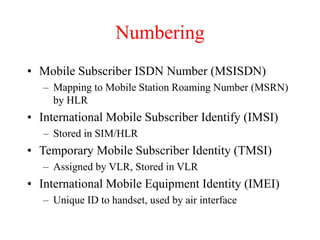
• Mobile Subscriber ISDN Number (MSISDN)
– Mapping to Mobile Station Roaming Number (MSRN)
by HLR
• International Mobile Subscriber Identify (IMSI)
– Stored in SIM/HLR
• Temporary Mobile Subscriber Identity (TMSI)
– Assigned by VLR, Stored in VLR
• International Mobile Equipment Identity (IMEI)
– Unique ID to handset, used by air interface
ID-Numbers
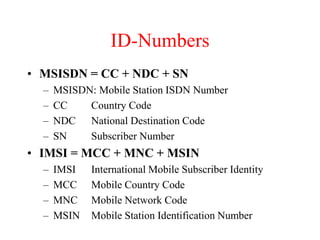
• MSISDN = CC + NDC + SN
– MSISDN: Mobile Station ISDN Number
– CC Country Code
– NDC National Destination Code
– SN Subscriber Number
• IMSI = MCC + MNC + MSIN
– IMSI International Mobile Subscriber Identity
– MCC Mobile Country Code
– MNC Mobile Network Code
– MSIN Mobile Station Identification Number
ID-Numbers (cont.)
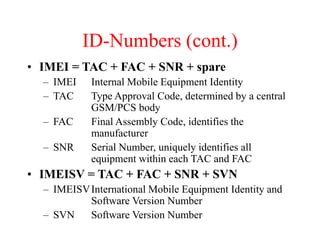
• IMEI = TAC + FAC + SNR + spare
– IMEI Internal Mobile Equipment Identity
– TAC Type Approval Code, determined by a central
GSM/PCS body
– FAC Final Assembly Code, identifies the
manufacturer
– SNR Serial Number, uniquely identifies all
equipment within each TAC and FAC
• IMEISV = TAC + FAC + SNR + SVN
– IMEISVInternational Mobile Equipment Identity and
Software Version Number
– SVN Software Version Number
ID-Numbers (cont.)
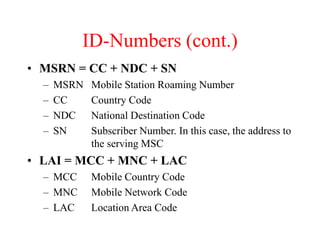
• MSRN = CC + NDC + SN
– MSRN Mobile Station Roaming Number
– CC Country Code
– NDC National Destination Code
– SN Subscriber Number. In this case, the address to
the serving MSC
• LAI = MCC + MNC + LAC
– MCC Mobile Country Code
– MNC Mobile Network Code
– LAC Location Area Code
ID-Numbers (cont.)
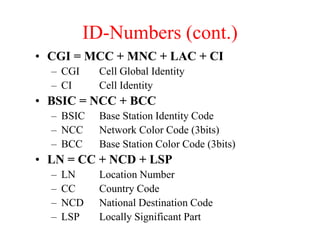
• CGI = MCC + MNC + LAC + CI
– CGI Cell Global Identity
– CI Cell Identity
• BSIC = NCC + BCC
– BSIC Base Station Identity Code
– NCC Network Color Code (3bits)
– BCC Base Station Color Code (3bits)
• LN = CC + NCD + LSP
– LN Location Number
– CC Country Code
– NCD National Destination Code
– LSP Locally Significant Part
ID -Numbers (cont.)
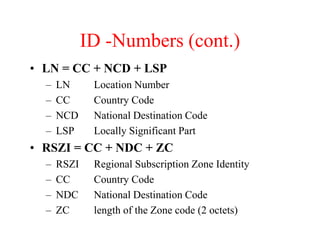
• LN = CC + NCD + LSP
– LN Location Number
– CC Country Code
– NCD National Destination Code
– LSP Locally Significant Part
• RSZI = CC + NDC + ZC
– RSZI Regional Subscription Zone Identity
– CC Country Code
– NDC National Destination Code
– ZC length of the Zone code (2 octets)
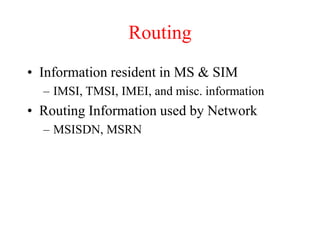
Routing
• Information resident in MS & SIM
– IMSI, TMSI, IMEI, and misc. information
• Routing Information used by Network
– MSISDN, MSRN
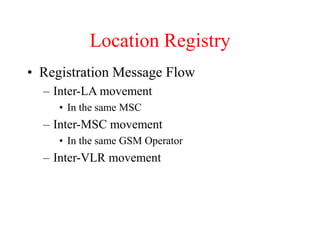
Location Registry
Location Registry
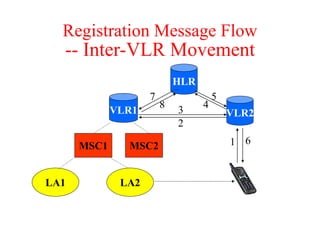
• Registration Message Flow
– Inter-LA movement
• In the same MSC
– Inter-MSC movement
• In the same GSM Operator
– Inter-VLR movement
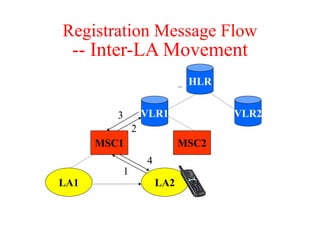
Registration Message Flow
-- Inter-LA Movement
1
2
3
4
HLR
MSC2
LA2
LA1
MSC1
VLR2
VLR1
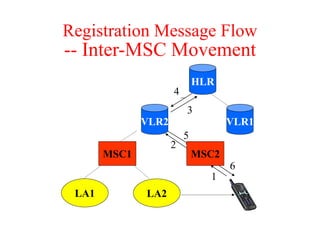
Registration Message Flow
-- Inter-MSC Movement
1
2
3
4
5
6
LA2
MSC2
HLR
LA1
MSC1
VLR1
VLR2
HLR
VLR1 VLR2
LA1 LA2
Registration Message Flow
-- Inter-VLR Movement
1 6
7
8
3
2
4
5
MSC2
MSC1
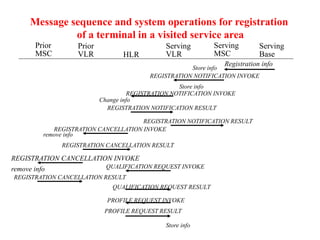
Prior
MSC
Prior
VLR HLR
Serving
VLR
Serving
MSC
Serving
Base
Registration info
Store info
REGISTRATION NOTIFICATION INVOKE
Store info
Store info
Change info
remove info
REGISTRATION NOTIFICATION INVOKE
REGISTRATION NOTIFICATION RESULT
REGISTRATION CANCELLATION INVOKE
remove info
REGISTRATION CANCELLATION RESULT
REGISTRATION CANCELLATION INVOKE
REGISTRATION CANCELLATION RESULT
QUALIFICATION REQUEST INVOKE
QUALIFICATION REQUEST RESULT
PROFILE REQUEST INVOKE
PROFILE REQUEST RESULT
Message sequence and system operations for registration
of a terminal in a visited service area
Call Setup
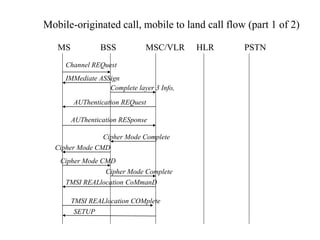
MS BSS MSC/VLR HLR PSTN
Channel REQuest
IMMediate ASSign
Complete layer 3 Info,
AUThentication REQuest
TMSI REALlocation CoMmanD
SETUP
Mobile-originated call, mobile to land call flow (part 1 of 2)
AUThentication RESponse
Cipher Mode Complete
Cipher Mode CMD
Cipher Mode CMD
Cipher Mode Complete
TMSI REALlocation COMplete
MS BSS MSC/VLR HLR PSTN
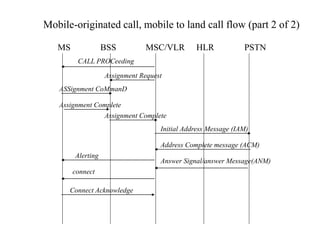
CALL PROCeeding
Mobile-originated call, mobile to land call flow (part 2 of 2)
Assignment Request
ASSignment CoMmanD
Assignment Complete
Assignment Complete
Initial Address Message (IAM)
Address Complete message (ACM)
Alerting
Answer Signal/answer Message(ANM)
connect
Connect Acknowledge
Prior
MSC
Prior
VLR HLR
Serving
VLR
Serving
MSC
Serving
Base
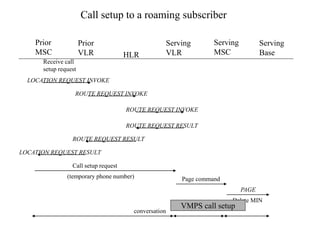
Call setup to a roaming subscriber
Receive call
setup request
LOCATION REQUEST INVOKE
ROUTE REQUEST INVOKE
ROUTE REQUEST RESULT
LOCATION REQUEST RESULT
Call setup request
(temporary phone number) Page command
PAGE
Delete MIN
conversation
VMPS call setup
GMSC
MSC/VLR
BSC
HLR
BTS BTS BTS
MSISDN
MSISDN
MSRN
IMSI
MSISDN-->IMSI-->
MSC/VLR Service Area
IMSI<-->MSRN
6.
1.
3.
5.
4.
7.
8.
8. 9.
2.
PSTN
5.
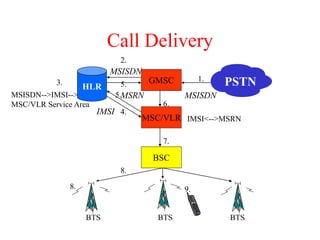
Call Delivery
MS BSS MSC/VLR HLR PSTN
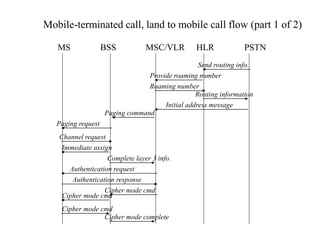
Mobile-terminated call, land to mobile call flow (part 1 of 2)
Send routing info.
Provide roaming number
Roaming number
Routing information
Initial address message
Paging command
Paging request
Channel request
Immediate assign
Complete layer 3 info.
Authentication request
Authentication response
Cipher mode cmd
Cipher mode cmd
Cipher mode cmd
Cipher mode complete
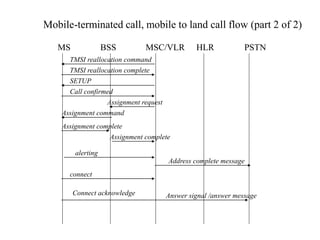
Mobile-terminated call, mobile to land call flow (part 2 of 2)
MS BSS MSC/VLR HLR PSTN
TMSI reallocation command
TMSI reallocation complete
SETUP
Call confirmed
Assignment request
Assignment command
Assignment complete
Assignment complete
alerting
connect
Connect acknowledge
Address complete message
Answer signal /answer message
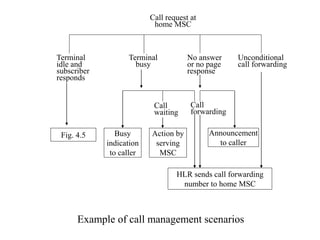
Example of call management scenarios
Fig. 4.5 Busy
indication
to caller
Action by
serving
MSC
Announcement
to caller
HLR sends call forwarding
number to home MSC
Terminal
idle and
subscriber
responds
Terminal
busy
No answer
or no page
response
Unconditional
call forwarding
Call request at
home MSC
Call
waiting
Call
forwarding
Handover
MS BSS MSC VLR HLR VLR
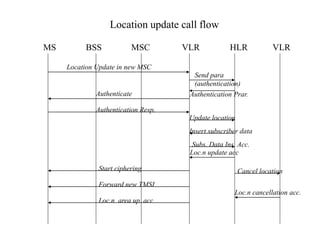
Location Update in new MSC
Authenticate
Authentication Resp,
Start ciphering
Forward new TMSI
Loc.n area up. acc
Send para
(authentication)
Authentication Prar.
Update location
Insert subscriber data
Subs. Data Ins. Acc.
Loc.n update acc
Cancel location
Loc.n cancellation acc.
Location update call flow
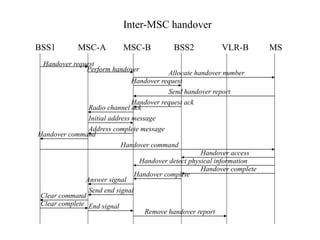
Inter-MSC handover
BSS1 MSC-A MSC-B BSS2 VLR-B
Handover request
MS
Perform handover
Allocate handover number
Handover request
Send handover report
Handover request ack
Radio channel ack
Initial address message
Address complete message
Handover command
Handover command
Handover access
Handover detect physical information
Handover complete
Handover complete
Answer signal
Send end signal
Clear command
Clear complete End signal
Remove handover report
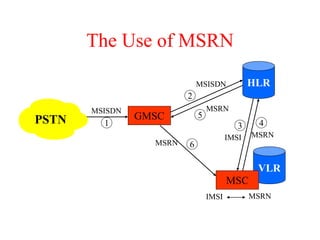
HLR
VLR
GMSC
MSC
MSISDN
MSISDN
MSRN
MSRN
IMSI
IMSI
MSRN
MSRN
1
2
3 4
5
6
The Use of MSRN
PSTN

Gsm system architecture

  • 1.
  • 2.
    Air Interface • RadioTransmission Techniques – FDMA – TDMA – CDMA • Channels – Physical channels – Logical channels
  • 3.
  • 4.
    TDMA Time Frequency 0 1 23 4 5 6 7 Channel Time Slot
  • 5.
  • 6.
    Channels • Physical Channels –Associated with frequency bands, time slots, codes – Physical channels transfer bits from one network element to another • Logical Channels – Distinguished by the nature of carried information and the way to assemble bits into data units – Three types • one-to-one: traffic channels between a BTS and a MS • one-to-many: synchronization signals from BTS to MSs in a cell • many-to-one: from MSs to the same BTS
  • 7.
  • 8.
    GSM Frame Structure 357 26 57 8.25 1 1 3 0 7 ... ... Superframe 6.12 sec 120 msec 4.615 msec 0.57692 msec 156.25 bits 51 Multiframe 26 Frames 8 Multiframe Coded data Midamble Tail bit Stealing Flag Guard period
  • 9.
    • There aretwo types of multiframe – 26 TDMA-frame multiframe is used to carry TCH, SACCH and FACCH – 51 TDMA-frame multiframe is used to carry BCCH, CCH, SDCCH and SACCH Frame Types
  • 10.
    Burst and Frames •The information contained in one time slot on the TDMA frame is call a burst. • Five types of burst – Normal Burst (NB) – Frequency Correction Burst (FB) – Synchronization Burst (SB) – Access Burst (AB) – Dummy Burst
  • 11.
    Traffic channels (TCH) Signaling channel TCH/F: Full-rate TrafficChannel TCH/H: Half-rate Traffic Channel FCCH: Frequency correction SCH: Synchronization BCCH: Broadcast control PCH: Paging AGCH: Access grant RACH: Random access SDCCH: Stand-alone dedicated control SACCH: Slow associated control FACCH: Fast associated control Two-way Base-to- mobile Two-way Logical Channel List BCH CCCH DCCH
  • 12.
    Logical Channels • ControlChannels – Broadcast Channels (BCH) – Common Control Channels (CCCH) – Dedicated Control Channels (DCCH) • Traffic Channels (TCH) – Full Rate (TCH/F) – Half Rate (TCH/H)
  • 13.
    UP / Down-Link •Down-link: the transmission path from Base Station to Mobile Station • Up-link: the transmission path from Mobile Station to Base Station
  • 14.
    Control Channels • BroadcastChannels (BCH) – Frequency Correction Channel (FCCH) – Synchronization Channel (SCH) – Broadcast Control Channel (BCCH) • Common Control Channels (CCCH) – Paging Channel (PCH) – Random Access Channel (RACH) – Access Grant Channel (AGCH) • Dedicated Control Channels (DCCH) – Stand alone Dedicated Control Channel (SDCCH) – Cell Broadcast Channel (CBCH) – Slow Associated Control Channel (SACCH) – Fast Associated Control Channel (FACCH)
  • 15.
    Message name Transmittedby AUTHENTICATION REQUEST AUTHENTICATION RESPONSE AUTHENTICATION REJECT IDENTITY REQUEST IDENTITY RESPONSE TSMI REALLOCATION COMMAND LOCATION UPDATING REQUET LOCATION UPDATING ACCEPT LOCATION UPDATING REJECT IMSI DETACH REQUEST CM SERVICE REQUEST CM RE-ESTABLISHMENT REQUEST MM-STATUS Base Mobile Base Base Mobile Base Mobile Base Base Mobile Mobile Mobile Mobile/Base Mobility Management Messages
  • 16.
    Message name Starting acall Transmitted by SETUP EMERGENCY SETUP CALL PROCEEDING PROGRESS CALL CONFIRMED ALERTING CONNECT Mobile/base mobile base base mobile mobile/base mobile/base During a call START DTMF STOP DTMF MODIFY USER INFORMATION Mobile mobile mobile/base mobile/base Ending a call DISCONNECT RELEASE RELEASE COMPLET Mobile/base mobile/base mobile/base Abnormal conditions STATUS STATUS ENQUIRY CONGESTION CONROL Mobile/base mobile/base mobile/base Call management messages
  • 17.
    Message name Logicalchannel Transmitted by SYNC CHANNEL INFORMATION SYSTEM INFORMATION (TYPE 1,2,3,4,5) SYSTEM INFORMATION (TYPE 6) CHANNEL REQUEST PAGING REQUEST (TYPE 1,2.3) IMMEDIATE ASSIGNMENT IMMEDIATE ASSIGNMENT EXTENDED IMMEDIATE ASSIGNMENT REJECT ASSIGNMENT COMMAND ADDITIONAL ASSIGNMENT PAGING RESPONSE MERSUREMENT REPORT HANDOVER COMMAND HANDOVER ACCESS PHYSICAL INFORMATION HANDOVER COMPLETE CIPHERING MODE CHANNEL RELEASE PARTIAL RELEASE FREQUENCY REDEFINITION CLASSMARK CHANGE CHANNEL MODE MODIFY RR STATUS SCH BCCH SACCH RACH PCH AGCH AGCH AGCH FACCH FACCH SDCCH SACCH FACCH TCH FACCH FACCH FACCH FACCH FACCH SACCH FACCH SACCH FACCH FACCH FACCH SACCH Base Base Base Mobile Base Base Base Base Base Base Mobile Mobile Base Mobile Base Mobile Base Base Base Base Mobile Base Mobile/base Radio Resources Management Messages
  • 18.
    Prior MSC Prior VLR HLR Serving VLR Serving MSC Serving Base Registration info Storeinfo REGISTRATION NOTIFICATION INVOKE Store info Store info Change info remove info REGISTRATION NOTIFICATION INVOKE REGISTRATION NOTIFICATION RESULT REGISTRATION NOTIFICATION RESULT REGISTRATION CANCELLATION INVOKE remove info REGISTRATION CANCELLATION RESULT REGISTRATION CANCELLATION INVOKE REGISTRATION CANCELLATION RESULT QUALIFICATION REQUEST INVOKE QUALIFICATION REQUEST RESULT PROFILE REQUEST INVOKE PROFILE REQUEST RESULT Message sequence and system operations for registration of a terminal in a visited service area
  • 19.
    Mobile station Base station Category Logical Channel SYNC CHANNELINFORMATION Carrier sine wave SYSTEM INFORMATION TYPE3 CHANNEL REQUEST IMMEDIATE ASSIGNMENT LOCATION UPDATING REQUEST AUTHENTICATION REQUEST CIPHERING MODE COMMAND CIPHERING MODE ACK LOCATION UPDATING ACCEPT TMSI ALLOCATION COMPLETE AUTHENTICATION RESPONSE CHANNEL RELEASE RRM RRM RRM RRM MM MM MM MM MM RRM RRM RRM FCCH SCH BCCH RACH AGCH SDCCH SDCCH SDCCH SDCCH SDCCH SDCCH SDCCH SDCCH Location-Updating Procedure
  • 20.
    Mobile station Base station Category Logical Channel RRM RRM RRM RRM RRM RRM MM MM RRM RRM CMCM CM CM RRM RRM CM CM CM CM RRM FCCH SCH BCCH PCH RACH AGCH SDCCH SDCCH SDCCH SDCCH SDCCH SDCCH SDCCH SDCCH SDCCH SDCCH SDCCH FACCH TCH TCH FACCH FACCH FACCH FACCH Carrier sinewave SYNC CHANNEL INFORMATION SYSTEM INFORMATION PAGING REQUEST CHANNEL REQUEST IMMEDIATE ASSIGNMENT PAGING RESPONSE AUTHENTICATION REQUEST AUTHENTICATION RESPONSE CIPHERING MODE CIPHERING MODE ACK SETUP CALL CONFIRMED ALERTING CONNECT ASSIGNMENT COMMAND ASSIGNMENT ACK CONNECT ACK conversation conversation conversation DISCONNECT RELEASE RELEASE COMPLETE CHANNEL RELEASE Call Deliver to MH
  • 21.
    Mobile-Assisted Handover Mobile station Base station Logical Channel TCH TCH SACCH TCH TCH TCH SACCH TCH FACCH new TCH TCH TCH TCH FACCH TCH TCH SACCH TCH TCH TCH SACCH TCH conversation conversation MEASUREMENTREPORT conversation conversation conversation MEASUREMENT REPORT conversation HANDOVER COMMAND HANDOVER ACCESS HANDOVER ACCESS HANDOVER ACCESS PHYSICAL INFORMATION HANDOVER COMPLETE conversation conversation MEASUREMENT REPORT conversation conversation conversation MEASUREMENT REPORT conversation
  • 22.
    Broadcast Channels (BCH) •To help the MH (Mobile Handset) measures – to turn to a BTS – to listen for the cell information • to start roaming, waiting for calls to arrive, making calls – Because BTSs are not synchronized with each other, every time a MH decides to camp to another cell, its FCCH, SCH, and BCCH must be read.
  • 23.
    Frequency Correction Channel (FCCH) •Provide MH with the frequency reference of the system – To enable the Mobile Handset (MH) to synchronize with the frequency • Transmission properties – Transmit on the down-link – Point to multi-point.
  • 24.
    Synchronization Channel (SCH) •MH synchronize with the structure within the locative cell – MH can receive information from the proper time slots on the TDMA structure • To ensure a GSM BTS is chose – The Base Station Identity Code (BSIC) can only be decoded by a GSM BTS • Transmission properties – Transmit on down-link – Point to multi-point.
  • 25.
    Broadcast Control Channel (BCCH) •BTS broadcast cell information to MH – LAI ( Location Area Identity), to start roaming, waiting for calls to arrive, making calls – maximum output power allowed in the cell – information about BCCH carriers for the neighboring cells • MH will perform measurement to BTS • Transmission properties – Transmit on down-link – Point to multi-point
  • 26.
    Common Control Channels (CCCH) •CCCH support the establishment of a dedicated communication path (dedicated channel) between the MH and the BTS • Three types of CCCH – Paging Channel (PCH) – Random Access Channel (RACH) – Access Grant Channel (AGCH)
  • 27.
    Paging Channel (PCH) •Used by BTS to page particular MH in the cell – MH actively listen to PCH to check contact info within certain time – Contact could be incoming call or short message • Contact info on PCH include – IMSI (MH’s identity number), or – TMSI (temporary number) • Transmission properties – Transmit on down-link – point to point
  • 28.
    Random Access Channel(RACH) • Used by MH to request a dedicated channel for call setup – Shared by any MH attempts to access the network – Channel request message contains the reason for the access attempt • Transmission properties – Transmit on up-link – Point to pint.
  • 29.
    Access Grant Channel(AGCH) • The network assigns a signaling channel via AGCH – A Stand alone Dedicated Control Channel (SDCCH) is assigned • Transmission properties – Transmit on down-link – Point to point
  • 30.
    Dedicated Control Channels (DCCH) •DCCH are used for transferring nonuser information between the network and the MH – Messages on DCCH Including • channel maintenance • mobility management • radio resource management • Four kinds of DCCH – Stand alone Dedicated Control Channel (SDCCH) – Cell Broadcast Channel (CBCH) – Slow Associated Control Channel (SACCH) – Fast Associated Control Channel (FACCH)
  • 31.
    Stand alone DedicatedControl Channel (SDCCH) • Transfer signaling information between the BTS and the MH • Typically used for location updating prior to use of a traffic channel • Transmission properties – Bidirectional channel, transmit on both up and down-link – Point to point.
  • 32.
    Cell Broadcast Channel(CBCH) • To carry Short Message Service Cell Broadcast (SMSCB) • Use the same physical channel as SDCCH • Transmission properties – Transmit on down-link – Point to multi-point
  • 33.
    Slow Associated ControlChannel (SACCH) • Carries control and measurement parameters along with routine data necessary to maintain a radio link between the MH and the BTS – On the uplink, MS sends averaged measurements (signal strength and quality) of current and neighboring BCCH – On downlink, MS receives information about transmitting power to use and an instruction with time advance/retard • Transmission properties – Bidirection channel, transmit on both up and down link – Point to point
  • 34.
    Fast Associated ControlChannel (FACCH) • An FACCH is used over a TCH where it steals time slots from a TCH – a 20 ms segment of speech is stolen to carry handover signaling information • Appears on demand
  • 35.
    Traffic Channels (TCH) •TCH transport user information (speech/data) • TCH are bidirectional dedicated channels between the network and the MH
  • 36.
    Mobile station Base station Category Logical Channel SYNC CHANNELINFORMATION Carrier sine wave SYSTEM INFORMATION TYPE3 CHANNEL REQUEST IMMEDIATE ASSIGNMENT LOCATION UPDATING REQUEST AUTHENTICATION REQUEST CIPHERING MODE COMMAND CIPHERING MODE ACK LOCATION UPDATING ACCEPT TMSI ALLOCATION COMPLETE AUTHENTICATION RESPONSE CHANNEL RELEASE RRM RRM RRM RRM MM MM MM MM MM RRM RRM RRM FCCH SCH BCCH RACH AGCH SDCCH SDCCH SDCCH SDCCH SDCCH SDCCH SDCCH SDCCH Location-Updating Procedure
  • 37.
    Mobile station Base station Category Logical Channel RRM RRM RRM RRM RRM RRM MM MM RRM RRM CMCM CM CM RRM RRM CM CM CM CM RRM FCCH SCH BCCH PCH RACH AGCH SDCCH SDCCH SDCCH SDCCH SDCCH SDCCH SDCCH SDCCH SDCCH SDCCH SDCCH FACCH TCH TCH FACCH FACCH FACCH FACCH Carrier sinewave SYNC CHANNEL INFORMATION SYSTEM INFORMATION PAGING REQUEST CHANNEL REQUEST IMMEDIATE ASSIGNMENT PAGING RESPONSE AUTHENTICATION REQUEST AUTHENTICATION RESPONSE CIPHERING MODE CIPHERING MODE ACK SETUP CALL CONFIRMED ALERTING CONNECT ASSIGNMENT COMMAND ASSIGNMENT ACK CONNECT ACK conversation conversation conversation DISCONNECT RELEASE RELEASE COMPLETE CHANNEL RELEASE Call Deliver to MH
  • 38.
    Mobile-Assisted Handover Mobile station Base station Logical Channel TCH TCH SACCH TCH TCH TCH SACCH TCH FACCH new TCH TCH TCH TCH FACCH TCH TCH SACCH TCH TCH TCH SACCH TCH conversation conversation MEASUREMENTREPORT conversation conversation conversation MEASUREMENT REPORT conversation HANDOVER COMMAND HANDOVER ACCESS HANDOVER ACCESS HANDOVER ACCESS PHYSICAL INFORMATION HANDOVER COMPLETE conversation conversation MEASUREMENT REPORT conversation conversation conversation MEASUREMENT REPORT conversation
  • 39.
    Burst • The informationcontained in one time slot is a burst • Five types of burst – Normal Burst (NB) • To carry information on traffic and control channels – Frequency Correction Burst (FB) • To synchronize the frequency of the mobile – Synchronization Burst (SB) • To synchronize the frames of the mobile – Access Burst (AB) • For random and handover access – Dummy Burst • For padding the frame
  • 40.
    Bursts and Frames •There are two types of multiframe – 26 TDMA-frame multiframe is used to carry TCH, SACCH and FACCH – 51 TDMA-frame multiframe is used to carry BCCH, CCH, SDCCH and SACCH
  • 41.
    Bursts and Frames ...2047 2046 2045 2044 2043 1 0 2 3 4 5 ... 0 1 2 3 50 49 48 47 0 1 25 24 ... 0 1 25 24 ... 0 1 50 49 ... 0 1 2 3 4 5 6 7 1 hyperframe = 2048 superframes = 2,715,648 TDMA frames (3 hours 28 minutes 53 seconds 760 microseconds) 1 superframe = 1326 TDMA frames (6.12 seconds) = 51 (26-frame) multiframes or 26 (51-frame) multiframes 1TDMA frame = 8 timeslots (120/26 =~ 4.615 ms) 1 (26-frame) multiframe = 26 TDMA frames (120 ms) 1 (51-frame) multiframe = 51 TDMA frames (120 ms)
  • 42.
    Bursts and Frames 01 2 3 4 5 6 7 GP 8.25 TB 3 Encrypted bits 57 flag 1 Training sequence 26 flag 1 Encrypted bits 57 TB 3 TB 3 Fixed bits 142 GP 8.25 TB 3 GP 8.25 TB 3 TB 3 Encrypted bits 39 Synchronization sequence 64 Encrypted bits 39 TB 3 Synchronization sequence 41 Encrypted bits 36 TB 3 GP 68.25 GP 8.25 TB 3 TB 3 Mixed bits 58 Training sequence 26 Mixed bits 58 Normal Burst (NB) Frequency correction burst (FB) Synchronization burst (SB) Access burst (AB) Dummy burst (DB) TB: Tail bits GP: Guard period 1 TDMA frame = 8 timeslots 1 timeslot = 156.25 bit durations (15/26 =~ 0.577 ms) (1 bit duration 48/13 =~ 3.69 micro sec)
  • 43.
    Normal Burst T3 CodedData 57 Training Sequence 26 Coded Data 57 GP 8.25 S1 S1 T3 148 bits = 0.54612 msec This burst is used to carry information on TCH and on the control channels BCCH, PCH, AGCH, SDCCH, ASCCH and FACCH. Note: GP (Guard Period)
  • 44.
    Random Access Burst T8Synchronization sequence 41 Coded Data 36 Guard Period 68.25 T3 88 bits = 0.32472 msec 68.25 bits = 0.252 msec which is equivalent to 75.5 km propagation delay. That is, the max. allowed distance between mobile station and BTS is 37.75 km. Based on other system parameters, the max cell size is 35 km in GSM.
  • 45.
    Logical Channels Characteristics Logical Channel Uplink- only Downlink- only Bothuplink &downlink Point- to-pint Broadcast Dedicated shared BCCH FCCH SCH RACH PCH AGCH SDCCH SACCH FACCH TCH √ √ √ √ √ √ √ √ √ √ √ √ √ √ √ √ √ √ √ √ √ √ √ √ √ √ √ √ √ √
  • 46.
  • 47.
    GSM System Architecture PSTN DataTerminal HLR/ VLR MSC BSC OMC (Operation & Maintenance Center) Operation Terminal BTS Handset A X.25 A-bis SS7 Network sub-system PSTN Radio sub-system Mobile station UM SIM card
  • 48.
    GSM Network Elements •Handset • BTS: Base Transceiver Station • MSC: Mobile Switching Center • BSC: Base Station Controller • HLR/VLR: Home Location Register/Visiting Location Register • SIM Card: Subscriber Identity Module Card • Service Centers: USSD, SMS, ...
  • 49.
    Mobile Handset (MH) •Used by the subscriber to access the GSM network via the air interface • Contains the hardware and software specific to the radio interface • Need a Subscriber Identity Module (SIM) which contains the subscriber-specific data to access GSM network, except emergency call
  • 50.
    Base Transceiver Station(BTS) / Base Station • Responsible for communication to and from MHs via air interface – MH communicates with the mobile system using a radio channel to a BTS • BTS comprises radio transmission and reception devices – Including the antennae and signaling processing specific to the radio interface • BTS separates the speech and control signaling associated with a MH and sends them to the BSC on separate channels
  • 51.
    Mobile services Switching Center(MSC) • Responsible for all switching functions related to call processing – Coordinate the setting up of calls to and from GSM users • MSC is the interface between GSM network & PSTN (Public Switched Telephone Network)
  • 52.
    Base Station Controller(BSC) • Monitor and Control several base stations – Frequency administration, control of BTSs, exchange functions • Responsible for all the radio interface management – Channel allocation and release, handover management • BSC is the interface between MSC and BTS – BSC is connected on one side to several BTSs and on the other side to the MSC
  • 53.
    Home Location Register(HLR) • A database in charge of the management of mobile subscribers • Contains information of network subscribers – Information on teleservices and bearer services subscription, service restrictions, and supplementary services – The data stored in HLR is of a semipermanent nature and does not usually change from call to call
  • 54.
    Visitor Location Register(VLR) • Contains the relevant data of all MHs currently located in a serving MSC – The permanent data is the same as data in the HLR – The temporary data includes • Temporary Subscriber Identity (TMSI) • Location Area Identity (LAI) of an MH – VLR allocates mobile subscriber roaming numbers (MSRNs) for the incoming call setup
  • 55.
    Subscriber Identity Module(SIM) • Subscriber Identity Module – Contains • phone number (MSISDN) • international mobile subscriber identity (IMSI) • status of SIM • service code • authentication key • PIN (personal identification code) • PUK (personal unlock code)
  • 56.
    SIM Cards • SIMcards are embedded with a microprocessor – Stores customer identity information and is made to fit inside the cellular phone • Memory capacity – 1K, 3K, 8K, 16K – With/Without OTAC (Over The Air Customization) • Two types of SIM card form factors – ID-1 SIM – Plug-In SIM
  • 57.
    Application Service Centers •Responsible for GSM network add-on services – Operation and Maintenance Center (OMC) • Monitoring and control the network • Usually connect with MSC, BSC, HLR, and other service centers – Short Message Service Center (SMSC) • provide short message services • usually connect to MSC – Unstructured Supplementary Service Data Center (USSDC) • provide USSD service in the form of *ID*ID*info# • usually connect to HLR
  • 58.
    Geographical Network Structure •Location Units – Cell – Location Area (LA) – MSC/VLR Service Area – PLMN (Public Land Mobile Network) Service Area – GSM Service Area • Cell Planning
  • 59.
    Location Information -- GSMService Area Hierarchy • The area in which a subscriber can access the network. cell Location Area MSC/VLR PLMN Service Area (one per operator) GSM Service Area
  • 60.
    Cell Characteristics • TheBasic Union In The System – defined as the area where radio coverage is given by one base station. • Addressed by Cell Global Identity (CGI) • A cell has one or several frequencies, depending on traffic load. – Frequencies are reused, but not used in neighboring cells due to interference.
  • 61.
    Cell Planning • Reusingfrequencies in different geographic areas: – 7 cell repeat pattern is typical, but other patterns are also common A3 A1 A2 G3 G1 G2 C3 C1 C2 B3 B1 B2 F3 F1 F2 D3 D1 D2 E3 E1 E2 G3 G1 G2 F3 F1 F2 C3 C1 C2 A3 A1 A2 B3 B1 B2 E3 E1 E2 D3 D1 D2 7-cell reuse pattern Frequency reuse
  • 62.
  • 63.
    Frequency Utilization v.s.K • Frequency can’t be reused in the same pattern • Larger K – More channels in a pattern – Higher subscriber number – Worse frequency reusability • Smaller K – Less channels in a pattern, high channel distortion – Smaller subscriber number – Better frequency reusability
  • 64.
  • 65.
    Numbering • Mobile SubscriberISDN Number (MSISDN) – Mapping to Mobile Station Roaming Number (MSRN) by HLR • International Mobile Subscriber Identify (IMSI) – Stored in SIM/HLR • Temporary Mobile Subscriber Identity (TMSI) – Assigned by VLR, Stored in VLR • International Mobile Equipment Identity (IMEI) – Unique ID to handset, used by air interface
  • 66.
    ID-Numbers • MSISDN =CC + NDC + SN – MSISDN: Mobile Station ISDN Number – CC Country Code – NDC National Destination Code – SN Subscriber Number • IMSI = MCC + MNC + MSIN – IMSI International Mobile Subscriber Identity – MCC Mobile Country Code – MNC Mobile Network Code – MSIN Mobile Station Identification Number
  • 67.
    ID-Numbers (cont.) • IMEI= TAC + FAC + SNR + spare – IMEI Internal Mobile Equipment Identity – TAC Type Approval Code, determined by a central GSM/PCS body – FAC Final Assembly Code, identifies the manufacturer – SNR Serial Number, uniquely identifies all equipment within each TAC and FAC • IMEISV = TAC + FAC + SNR + SVN – IMEISVInternational Mobile Equipment Identity and Software Version Number – SVN Software Version Number
  • 68.
    ID-Numbers (cont.) • MSRN= CC + NDC + SN – MSRN Mobile Station Roaming Number – CC Country Code – NDC National Destination Code – SN Subscriber Number. In this case, the address to the serving MSC • LAI = MCC + MNC + LAC – MCC Mobile Country Code – MNC Mobile Network Code – LAC Location Area Code
  • 69.
    ID-Numbers (cont.) • CGI= MCC + MNC + LAC + CI – CGI Cell Global Identity – CI Cell Identity • BSIC = NCC + BCC – BSIC Base Station Identity Code – NCC Network Color Code (3bits) – BCC Base Station Color Code (3bits) • LN = CC + NCD + LSP – LN Location Number – CC Country Code – NCD National Destination Code – LSP Locally Significant Part
  • 70.
    ID -Numbers (cont.) •LN = CC + NCD + LSP – LN Location Number – CC Country Code – NCD National Destination Code – LSP Locally Significant Part • RSZI = CC + NDC + ZC – RSZI Regional Subscription Zone Identity – CC Country Code – NDC National Destination Code – ZC length of the Zone code (2 octets)
  • 71.
    Routing • Information residentin MS & SIM – IMSI, TMSI, IMEI, and misc. information • Routing Information used by Network – MSISDN, MSRN
  • 72.
  • 73.
    Location Registry • RegistrationMessage Flow – Inter-LA movement • In the same MSC – Inter-MSC movement • In the same GSM Operator – Inter-VLR movement
  • 74.
    Registration Message Flow --Inter-LA Movement 1 2 3 4 HLR MSC2 LA2 LA1 MSC1 VLR2 VLR1
  • 75.
    Registration Message Flow --Inter-MSC Movement 1 2 3 4 5 6 LA2 MSC2 HLR LA1 MSC1 VLR1 VLR2
  • 76.
    HLR VLR1 VLR2 LA1 LA2 RegistrationMessage Flow -- Inter-VLR Movement 1 6 7 8 3 2 4 5 MSC2 MSC1
  • 77.
    Prior MSC Prior VLR HLR Serving VLR Serving MSC Serving Base Registration info Storeinfo REGISTRATION NOTIFICATION INVOKE Store info Store info Change info remove info REGISTRATION NOTIFICATION INVOKE REGISTRATION NOTIFICATION RESULT REGISTRATION NOTIFICATION RESULT REGISTRATION CANCELLATION INVOKE remove info REGISTRATION CANCELLATION RESULT REGISTRATION CANCELLATION INVOKE REGISTRATION CANCELLATION RESULT QUALIFICATION REQUEST INVOKE QUALIFICATION REQUEST RESULT PROFILE REQUEST INVOKE PROFILE REQUEST RESULT Message sequence and system operations for registration of a terminal in a visited service area
  • 78.
  • 79.
    MS BSS MSC/VLRHLR PSTN Channel REQuest IMMediate ASSign Complete layer 3 Info, AUThentication REQuest TMSI REALlocation CoMmanD SETUP Mobile-originated call, mobile to land call flow (part 1 of 2) AUThentication RESponse Cipher Mode Complete Cipher Mode CMD Cipher Mode CMD Cipher Mode Complete TMSI REALlocation COMplete
  • 80.
    MS BSS MSC/VLRHLR PSTN CALL PROCeeding Mobile-originated call, mobile to land call flow (part 2 of 2) Assignment Request ASSignment CoMmanD Assignment Complete Assignment Complete Initial Address Message (IAM) Address Complete message (ACM) Alerting Answer Signal/answer Message(ANM) connect Connect Acknowledge
  • 81.
    Prior MSC Prior VLR HLR Serving VLR Serving MSC Serving Base Call setupto a roaming subscriber Receive call setup request LOCATION REQUEST INVOKE ROUTE REQUEST INVOKE ROUTE REQUEST INVOKE ROUTE REQUEST RESULT ROUTE REQUEST RESULT LOCATION REQUEST RESULT Call setup request (temporary phone number) Page command PAGE Delete MIN conversation VMPS call setup
  • 82.
    GMSC MSC/VLR BSC HLR BTS BTS BTS MSISDN MSISDN MSRN IMSI MSISDN-->IMSI--> MSC/VLRService Area IMSI<-->MSRN 6. 1. 3. 5. 4. 7. 8. 8. 9. 2. PSTN 5. Call Delivery
  • 83.
    MS BSS MSC/VLRHLR PSTN Mobile-terminated call, land to mobile call flow (part 1 of 2) Send routing info. Provide roaming number Roaming number Routing information Initial address message Paging command Paging request Channel request Immediate assign Complete layer 3 info. Authentication request Authentication response Cipher mode cmd Cipher mode cmd Cipher mode cmd Cipher mode complete
  • 84.
    Mobile-terminated call, mobileto land call flow (part 2 of 2) MS BSS MSC/VLR HLR PSTN TMSI reallocation command TMSI reallocation complete SETUP Call confirmed Assignment request Assignment command Assignment complete Assignment complete alerting connect Connect acknowledge Address complete message Answer signal /answer message
  • 85.
    Example of callmanagement scenarios Fig. 4.5 Busy indication to caller Action by serving MSC Announcement to caller HLR sends call forwarding number to home MSC Terminal idle and subscriber responds Terminal busy No answer or no page response Unconditional call forwarding Call request at home MSC Call waiting Call forwarding
  • 86.
  • 87.
    MS BSS MSCVLR HLR VLR Location Update in new MSC Authenticate Authentication Resp, Start ciphering Forward new TMSI Loc.n area up. acc Send para (authentication) Authentication Prar. Update location Insert subscriber data Subs. Data Ins. Acc. Loc.n update acc Cancel location Loc.n cancellation acc. Location update call flow
  • 88.
    Inter-MSC handover BSS1 MSC-AMSC-B BSS2 VLR-B Handover request MS Perform handover Allocate handover number Handover request Send handover report Handover request ack Radio channel ack Initial address message Address complete message Handover command Handover command Handover access Handover detect physical information Handover complete Handover complete Answer signal Send end signal Clear command Clear complete End signal Remove handover report
  • 89.