LOCATION AREA UPDATE
LOCATION UPDATING
A mobile subscriber who is roaming moves freely within the
network and the network knows where the MS is located. This
makes it possible for the mobile subscriber to receive a call
wherever he or she is. To keep the network up to date with
the subscriber’s location, the MS performs a location
updating. The request for location updating can indicate one
of three procedures. They are:
• location updating type normal
• IMSI attach
• periodic registration
• The MS also informs the network when it switches to
detached mode.
LOCATION UPDATING, TYPE NORMAL
A location area is by definition the area, handled by one or
more BTSs where the MS can move around without updating
the system. A location area is controlled by one or more BSCs,
but only by one MSC. When the MS is idle, it listens to the
system information on BCCH. This is how the MS gets the
location area Identity of the serving cell.
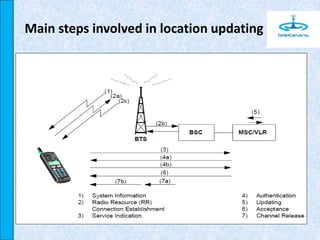
Main steps involved in location updating
1. The MS listens to the system information, compares the
Location Area Identity (LAI) to the one stored in the MS on
the SIM card and detects whether it has entered a new
location area or is still in the same location area. If the
broadcast LAI differs from the one stored on the SIM card,
the MS must perform a location update, type normal.
2a. The MS sends a channel request message including the
reason for the access. Reasons other than location updating
can be for example, answering a page or emergency call.
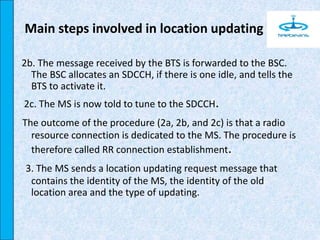
2b. The message received by the BTS is forwarded to the BSC.
The BSC allocates an SDCCH, if there is one idle, and tells the
BTS to activate it.
2c. The MS is now told to tune to the SDCCH.
The outcome of the procedure (2a, 2b, and 2c) is that a radio
resource connection is dedicated to the MS. The procedure is
therefore called RR connection establishment.
3. The MS sends a location updating request message that
contains the identity of the MS, the identity of the old
location area and the type of updating.
Main steps involved in location updating
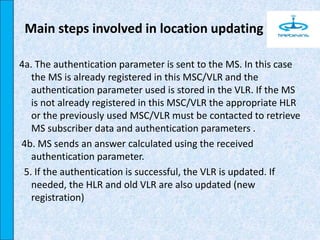
4a. The authentication parameter is sent to the MS. In this case
the MS is already registered in this MSC/VLR and the
authentication parameter used is stored in the VLR. If the MS
is not already registered in this MSC/VLR the appropriate HLR
or the previously used MSC/VLR must be contacted to retrieve
MS subscriber data and authentication parameters .
4b. MS sends an answer calculated using the received
authentication parameter.
5. If the authentication is successful, the VLR is updated. If
needed, the HLR and old VLR are also updated (new
registration)
Main steps involved in location updating
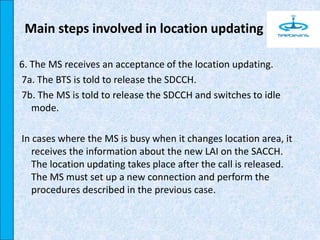
6. The MS receives an acceptance of the location updating.
7a. The BTS is told to release the SDCCH.
7b. The MS is told to release the SDCCH and switches to idle
mode.
In cases where the MS is busy when it changes location area, it
receives the information about the new LAI on the SACCH.
The location updating takes place after the call is released.
The MS must set up a new connection and perform the
procedures described in the previous case.
Main steps involved in location updating
LOCATION UPDATING, TYPE IMSI ATTACH
IMSI attach is a complement to the IMSI detach procedure and
is used by the MS to notify the system that it was powered on,
provided that it is in the same location area as it was when it
entered the detached state. The system information informs
the MS, if IMSI attach and detach is required or not.
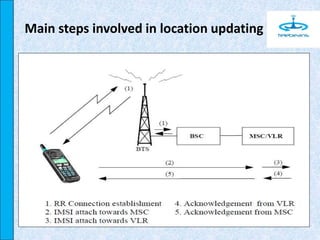
1. The MS requests an SDCCH.
2. The system receives the IMSI attach message from the MS.
3. The MSC sends the IMSI attach message to the VLR. The VLR
removes the IMSI detached flag and resumes normal call
handling for the MS.
4. The VLR returns the IMSI attach acknowledge message to
the MSC.
5. The MS also receives an acknowledge message.
The procedure is to be used only when the IMSI detach flag is
set in the VLR, as is the case in Ericsson’s GSM system. If the
flag is set in the HLR, switching to active mode requires a
normal location updating of the MS.
Main steps involved in location updating
If the MS changes location area while detached, it must perform
a normal location updating when switched on again. The
signaling for location updating, type IMSI attach is identical to
normal location updating, except for some bits in the message
Location Updating Request that indicate the type of updating.
Authentication is optional in this case.
Main steps involved in location updating
LOCATION UPDATING, TYPE PERIODIC
REGISTRATION
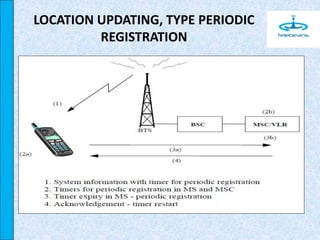
Periodic registration is a type of location updating procedure
that is used to avoid unnecessary paging of the mobile in
cases where the MSC never receives the IMSI detach message
and also to prevent damage in case of database failure.
1. The MS is informed via the system information if periodic
registration is used in the cell. If periodic registration is used,
the MS is told how often it must register. The time is set by
the operator and can have values from 0 to 255 decide hours
(a unit of six minutes). If the parameter is equal to zero,
periodic registration is not used in this cell. If the parameter is
set to ten, for example, the MS must register every hour.
2. A timer in both the MS and in the MSC controls the
procedure.
3a. When the timer in the MS expires, the MS performs a
location updating, type periodic registration. The timers in MS
and MSC restart
3b. In the MSC there is a time scanning function for the MSs. If
the MS does not register within the determined interval plus a
guard time, then the scanning function in MSC detects this
and the MS is flagged as detached.
4. The MSC sends an acknowledgment to the MS.
LOCATION UPDATING, TYPE PERIODIC
REGISTRATION
LOCATION UPDATING, TYPE PERIODIC
REGISTRATION
GSM Location area update

GSM Location area update

  • 1.
  • 2.
    LOCATION UPDATING A mobilesubscriber who is roaming moves freely within the network and the network knows where the MS is located. This makes it possible for the mobile subscriber to receive a call wherever he or she is. To keep the network up to date with the subscriber’s location, the MS performs a location updating. The request for location updating can indicate one of three procedures. They are: • location updating type normal • IMSI attach • periodic registration • The MS also informs the network when it switches to detached mode.
  • 3.
    LOCATION UPDATING, TYPENORMAL A location area is by definition the area, handled by one or more BTSs where the MS can move around without updating the system. A location area is controlled by one or more BSCs, but only by one MSC. When the MS is idle, it listens to the system information on BCCH. This is how the MS gets the location area Identity of the serving cell.
  • 4.
    Main steps involvedin location updating 1. The MS listens to the system information, compares the Location Area Identity (LAI) to the one stored in the MS on the SIM card and detects whether it has entered a new location area or is still in the same location area. If the broadcast LAI differs from the one stored on the SIM card, the MS must perform a location update, type normal. 2a. The MS sends a channel request message including the reason for the access. Reasons other than location updating can be for example, answering a page or emergency call.
  • 5.
    2b. The messagereceived by the BTS is forwarded to the BSC. The BSC allocates an SDCCH, if there is one idle, and tells the BTS to activate it. 2c. The MS is now told to tune to the SDCCH. The outcome of the procedure (2a, 2b, and 2c) is that a radio resource connection is dedicated to the MS. The procedure is therefore called RR connection establishment. 3. The MS sends a location updating request message that contains the identity of the MS, the identity of the old location area and the type of updating. Main steps involved in location updating
  • 6.
    Main steps involvedin location updating
  • 7.
    4a. The authenticationparameter is sent to the MS. In this case the MS is already registered in this MSC/VLR and the authentication parameter used is stored in the VLR. If the MS is not already registered in this MSC/VLR the appropriate HLR or the previously used MSC/VLR must be contacted to retrieve MS subscriber data and authentication parameters . 4b. MS sends an answer calculated using the received authentication parameter. 5. If the authentication is successful, the VLR is updated. If needed, the HLR and old VLR are also updated (new registration) Main steps involved in location updating
  • 8.
    6. The MSreceives an acceptance of the location updating. 7a. The BTS is told to release the SDCCH. 7b. The MS is told to release the SDCCH and switches to idle mode. In cases where the MS is busy when it changes location area, it receives the information about the new LAI on the SACCH. The location updating takes place after the call is released. The MS must set up a new connection and perform the procedures described in the previous case. Main steps involved in location updating
  • 9.
    LOCATION UPDATING, TYPEIMSI ATTACH IMSI attach is a complement to the IMSI detach procedure and is used by the MS to notify the system that it was powered on, provided that it is in the same location area as it was when it entered the detached state. The system information informs the MS, if IMSI attach and detach is required or not.
  • 10.
    1. The MSrequests an SDCCH. 2. The system receives the IMSI attach message from the MS. 3. The MSC sends the IMSI attach message to the VLR. The VLR removes the IMSI detached flag and resumes normal call handling for the MS. 4. The VLR returns the IMSI attach acknowledge message to the MSC. 5. The MS also receives an acknowledge message. The procedure is to be used only when the IMSI detach flag is set in the VLR, as is the case in Ericsson’s GSM system. If the flag is set in the HLR, switching to active mode requires a normal location updating of the MS. Main steps involved in location updating
  • 11.
    Main steps involvedin location updating
  • 12.
    If the MSchanges location area while detached, it must perform a normal location updating when switched on again. The signaling for location updating, type IMSI attach is identical to normal location updating, except for some bits in the message Location Updating Request that indicate the type of updating. Authentication is optional in this case. Main steps involved in location updating
  • 13.
    LOCATION UPDATING, TYPEPERIODIC REGISTRATION Periodic registration is a type of location updating procedure that is used to avoid unnecessary paging of the mobile in cases where the MSC never receives the IMSI detach message and also to prevent damage in case of database failure. 1. The MS is informed via the system information if periodic registration is used in the cell. If periodic registration is used, the MS is told how often it must register. The time is set by the operator and can have values from 0 to 255 decide hours (a unit of six minutes). If the parameter is equal to zero, periodic registration is not used in this cell. If the parameter is set to ten, for example, the MS must register every hour.
  • 14.
    2. A timerin both the MS and in the MSC controls the procedure. 3a. When the timer in the MS expires, the MS performs a location updating, type periodic registration. The timers in MS and MSC restart 3b. In the MSC there is a time scanning function for the MSs. If the MS does not register within the determined interval plus a guard time, then the scanning function in MSC detects this and the MS is flagged as detached. 4. The MSC sends an acknowledgment to the MS. LOCATION UPDATING, TYPE PERIODIC REGISTRATION
  • 15.
    LOCATION UPDATING, TYPEPERIODIC REGISTRATION